




Abstract
Peri-urban areas are often subject to intensive construction, through both formal and informal processes. As land transitions from rural to urban status, different land tenure and administration systems may come into conflict, leading to disputes, contestation and, in some cases, violence. However, little is known about the precise causes of peri-urban land conflict. In Mexico, peri-urban growth has historically proceeded peacefully, owing to the control exerted by a corporatist system of government, and the political use of land tenure regularisation. However, the effects of land reforms on transactions at the peri-urban fringe, in the context of wider processes of liberalisation, may be increasing vulnerability to conflict over land. This paper explores these issues through a case study of an irregular settlement on the peri-urban fringe of the provincial Mexican city of Xalapa, where contestations over informally developed land have escalated into violent encounters between groups of settlers and the state. The findings show that vulnerability to conflict in peri-urban areas can be attributed to the interaction of macro-level processes with local-level factors, including diverse claims, overlapping legal and governance frameworks and, critically, local power relations.
Introduction: The significance of peri-urban land conflict
Observers suggest that conflict over land is often particularly acute in the context of rapid urban growth, and particularly in peri-urban areas. As the costs of shelter and services increase, and demand for serviced residential sites exceeds the supply of suitable land, so competition for land becomes more intense (DFID, 2002: 3). While diverse conceptualisations of peri-urban areas emphasise variables such as population size and density, infrastructure provision, administrative boundaries and economic activities (Allen, 2003), here these areas are understood as zones of rapid change at the urban periphery, often characterised by land transitioning from rural to urban uses, where different land systems may come into conflict (GLTN, 2008). They may contain high-income gated communities and commercial property in close proximity to low-income neighbourhoods, or agricultural production alongside the construction of large-scale residential estates. In particular, peri-urban zones are often subject to unauthorised land use, including informal 1 settlements (Gashu, 2014), as informal land markets on the urban fringe offer cheap, unserviced land for those unable to access formal land and housing markets.
The regulation of land tenure and rights in such areas, which may be subject to rural land management regimes despite the expansion into them of urban land uses (Allen, 2003), is often inappropriate or confused. The uncertainty over which land tenure regimes are operating, the variety of different actors and their competing claims to land, and lack of administrative clarity and capacity all contribute to the likelihood of land conflict developing. Land tenure can be understood as ‘the mode by which land is held or owned, or the set of relationships among people concerning land or its product’ (Payne, 2001: 416). Drawing on theories of property, tenure is often conceived of as a ‘bundle of rights’ (e.g. USAID (US Agency for International Development), 2005), and while this interpretation has been criticised for its narrowness in terms of the social relationships that frame property claims (Ribot and Peluso, 2003), it is helpful for identifying the different interests in a given property (Von Benda-Beckmann et al., 2006: 7), or in this case plot of land. A piece of land may have multiple users with specific rights, ranging from limited to full use and transfer rights; and different rights may refer to different legal norms. Land rights are therefore diverse, in that they may belong to many people, and varied, in that they may be constituted in different ways. While property rights must be recognised as context-specific, political and subject to negotiation (Von Benda-Beckmann et al., 2006: 7), the co-existence of diverse rights to the same piece of land is not uncommon, and is not necessarily problematic.
However, land conflicts which are not easily resolvable by existing law may be problematic for urban authorities and communities. For authorities at the local or national level, the potential for land conflict to escalate into violence (Bruce, 2011) and the links between tenure insecurity and urban insecurity more broadly (UN-Habitat, 2007) make it a critical issue. For the households and communities involved, land disputes may have devastating social impacts, including loss of land, housing and neighbourhood; and damage to community solidarity, in addition to the long-term negative effects of insecure land tenure (UN-Habitat, 2007). Yet although there is a vast literature on land conflict, there is surprisingly little analysis of the factors contributing to conflict over urban and peri-urban land.
In general terms, the analysis of land conflict has been approached in various ways: for example, it may focus on the actors involved (Barry et al., 2007); different land regimes (USAID, 2005); the context in which conflict occurs (Brown et al., 2005); or the specific causal factors in a particular case (Wehrmann, 2008). Relating to the last aspect, a report by the European Union identifies changes in population, the economy and the environment as factors generating land competition, which may develop into conflict where ‘scarcity of resources is increasing and access is reduced, where tenure rules are unable to adjust sufficiently rapidly to changing circumstances, and where different and contradictory rules co-exist’ (EU, 2004: 6, emphasis added). Echoing this, Baranyi and Weitzner (2006: 3) suggest that the main sources of land tenure conflicts are ‘competing claims to access rights, tenure insecurity and unequal distribution of land’, but they also highlight ‘alterations in the social, political and economic balance’, such as population increases, the development of intensive farming, in-migration and changes to land legislation.
In terms of peri-urban areas, which are subject to rapid change of land use and different land systems, the local-scale factors of competing claims and different frameworks of rules are particularly salient. At the same time, both of the above accounts highlight the political economy of land, in terms of the influence of larger scale changes in relevant legal and governance frameworks accompanying social, political and economic change (see also Bruce, 2011). This concurs with the assertion that while land conflict is ‘a site-specific [phenomenon] deeply rooted in local histories and social relations, [it is also] connected to larger processes of material transformation, political power, and historical conjuncture’ (Simmons, 2004: 187).
This paper explores land conflict in the context of peri-urban growth through an in-depth case study of an informal settlement in a provincial city in Mexico, a country undergoing profound economic, political and social shifts, in the context of which land reform has been undertaken. Mexico is a highly urbanised country, with 72% of its population of 112 million living in urban areas (CONAPO, 2012). Despite now being considered an upper middle-income country, high levels of poverty and inequality persist. In 2008, the proportion of the urban population living in extreme poverty was 11%, while 40% of Mexico’s urban population was considered moderately poor (CONEVAL, 2010: 13). Urban inhabitants who cannot access land or housing via the formal market often do so in settlements with informal origins known as colonias populares, which have been estimated to contain as much as 50% of all housing in Mexico (CIDOC, 2012, in Solana, 2013: 1).
These settlements usually originate on rural land at the urban periphery. They are characterised by informal tenure and building construction outside urban regulatory frameworks, but generally have good prospects for consolidation and integration into the urban fabric (Ward, 1999) because of the rights held by land subdividers, political dynamics and, since the 1970s, a policy of land tenure regularisation. 2 In general, informal urban expansion in Mexico has been remarkable for its relatively peaceful nature. However, recently observers have suggested that land conflict in peri-urban areas may be increasing because of changes to the legal framework governing rural land, in the context of the country’s economic liberalisation (Salazar, 2012, 2014; Ugalde, 2012). The effects of these changes on informal urban expansion have so far been relatively underexplored, and this paper also seeks to contribute to a growing body of research exploring their implications, alongside its contribution to the debates on land conflict mentioned above.
Drawing on these accounts, this paper takes a broad political economy approach to exploring the factors influencing vulnerability to land conflict in a specific peri-urban area of Mexico, in a context of wider social, economic and political change. In the case of Santa Lucia, an informal settlement at the edge of the Xalapa Metropolitan Zone, the prevalence of contested land in and around the neighbourhood has led to intractable disputes, which have periodically escalated into conflicts and violent encounters between the members and leaders of groups occupying the land and the forces of law and order, as well as between occupier groups and those who claim original ownership of the land. This has led to a situation where, as one local news source put it, ‘[a]narchy and impunity reign’ (Zavaleta, 2011b). However, the conflict cannot be understood without framing it within wider processes of agrarian reform and the decline of the corporatist system in Mexico.
The aim of the paper is therefore to explore how and why peri-urban land conflict develops through an examination of the specific case outlined above, based on a situated analysis that examines the contextual factors that shape the situation, in conjunction with the local-level factors involved in generating conflict. In support of this, the next section gives a detailed account of how and why the informal acquisition of and construction on peri-urban land has generally occurred peacefully in Mexico throughout the 20th century, in terms of the influence of Mexico’s corporatist system of governance and the systematic implementation of land tenure regularisation, drawing on a rich body of literature from scholars of Mexican urban development. This is followed by a discussion of the impact of agrarian reform on local land market dynamics, an area of increasing interest to urban researchers. The analysis of the empirical case draws on the factors identified as specifically pertinent to peri-urban conflict from the discussion above, namely diverse claims and overlapping frameworks, to explore how they interact with wider processes of change; and a third factor, local power relations, is introduced, relating to changes engendered by liberalisation and also, potentially, increasing insecurity.
Urbanisation, conflict and control in Mexico
From around the mid-20th century in Mexico, colonias populares have been formed on private land, through illegal (unlicenced) subdivision or invasion; or on ejidal land, in which case illegal subdivision (deriving from the land’s inalienable nature) has been more common than invasion. The legal characteristics of each form of property have a decisive influence on how a given neighbourhood develops, along with contextual political and legal factors such as different degrees and forms of tolerance from state institutions, and the variable application of different legal norms (Azuela, 1989). Observers generally agree that ejidal land has been the most important source of land for development in Mexican cities (Austin, 1994). An ejido is a collectively owned farming community, a form of landholding established by the post-revolutionary Constitution of 1917, which redistributed land from large estates to peasant workers. By the 1990s, social property 3 occupied more than 50% of the total land area of Mexico (Assies and Duhau, 2009).
The basic structure of an ejido is its land, members and governing bodies, as defined in the Agrarian Law. Relating to land, the elements of the ejido are parcels over which individual members have use rights; common use land to which all members have communal rights; and an area for human settlement, where members of the ejido live. There are three categories of membership within an ejido: ejidatarios, who have rights to land; avecindados, who live in the human settlement area of the ejido but do not have rights to land; and posesionarios, who have recognised rights of possession to ejidal plots, but do not enjoy the full rights of participation in the affairs of the ejido that ejidatarios exercise. 4 Each ejido has three governing bodies: a General Assembly, in which all ejidatarios participate; an Ejidal Commission, a body of representatives elected for three years; and a Supervisory Council, which oversees the activities of the Commission and reports to the Assembly.
By the time of agrarian reforms in 1992, much ejidal land had already been sold informally for urban expansion and low-income housing, normally through subdivision and at low prices because of its lack of infrastructure. Prior to the reforms, ejidal lands were officially inalienable: under the ejidal system of land tenure, ejidatarios in effect enjoyed use rights without the right to dispose of or exchange the land. However, by the 1990s, it was estimated that in Mexico, perhaps half of urban land development had occurred illegally on ejido land (Austin, 1994). In the most common form of land sales, settlers have, since at least the 1950s, bought land from ejidatarios (directly or via intermediaries) in transactions which are ‘non-existent’ in law (Azuela and Duhau, 1998: 159).
Despite some claims that there was ‘conflict and controversy’ over use and development rights during the 1960s and 1970s (Davis and Rosan, 2004), what is remarkable about this process is how peacefully it occurred in the majority of cases. Indeed, it has been noted that ‘[c]ompared with many countries in Latin America, in Mexico the ejido has offered an important “safety valve”, such that urban development has proceeded in a relatively peaceful fashion’ (Austin, 1994: 330). In Mexico, then, informal urbanisation on rural ejidal land at the urban periphery has been understood to have generally taken place ‘without causing significant conflicts’ (Assies and Duhau, 2009: 379).
However, rather than suggesting that disputes were absent from these processes, this highlights how the corporatist political system which prevailed for much of the 20th century has been tolerant of or even complicit in these processes. Jones and Varley (1999: 15) highlight the ‘extraordinary complexity of the problems that … accrued over decades of illegal development around Mexico’s cities’, as illegal activities such as invasion, subdivision, sale of invaded land and sale of the same plots more than once were undertaken by landowners and squatters but also intermediaries. The state’s attempts to adjudicate between different interests, via regularisation where possible, rested on identifying the actors involved, and securing their cooperation. However, the state’s role was far from neutral. Durand’s (1983) detailed ethnographic study of a neighbourhood developed informally on ejidal land to the south of Mexico City relates how struggles among the actors involved –ejidatarios and their representative bodies, settlers and associated social movements, and local and federal institutions – saw protest and violent repression giving way to negotiation and co-optation of representative organisations. Ultimately, the response of the party apparatus determined that of local institutions under the corporatist system, which tended to manipulate such situations in order to maintain social control (Durand, 1983).
A corporatist system of governance
The PRI, 5 which was in power in Mexico from 1929 until the country’s first democratic elections in 2000, maintained its dominance through a corporatist system of governance, within which social and political control was exercised in both rural and urban areas through a strategy that combined networks of patronage with fear of repression. This rested on securing the support and compliance of three pillars: rural workers, industrial labour and the ‘popular sector’ (Assies and Duhau, 2009). The ‘reciprocal obligation’ of clientelism offered benefits for both the party and the urban poor, enabling the party to maintain political support and control with minimum violence, while offering the poor access to government benefits and decision-makers (Montaño, 1976). Prior to the systematic implementation of land tenure regularisation programmes from the 1970s onwards, the largely peaceful nature of informal settlement was understood as linked to the corporatist political system, within which the informal subdivision of ejidos was tolerated as a response to the high levels of housing demand deriving from rural–urban migration, and more broadly, to rural and urban poverty (Montaño, 1976). Corporatism provided an effective system of control through co-optation and other ‘soft’ mechanisms, backed up with the threat of violent repression (Gilbert and Ward, 1985).
Despite this general tendency towards peaceful informal development, some cities, such as Mexico City and Monterrey, experienced politically organised land invasion during the 1970s (Varley, 1998), leading some analysts to suggest that low-income groups were, at that time, strong and systematically organised. Social movements such as the Movimiento Urbano Popular (Mexico City) and Tierra y Libertad (Monterrey) encouraged residents to demand housing, land and services through invasions and community self-organisation (Moctezuma, 2001). Tierra y Libertad represented a high point of settlement-based collective organisation. During Echeverría’s presidency (1970–1976), the movement established an autonomous community based around several informal neighbourhoods on the periphery of Monterrey, which it had helped to found through organised land invasion, and where it provided services including policing, education and healthcare (Vellinga, 1989). However, by the late 1970s, the national government’s offer of regularised land tenure and basic service provision, combined with increased repression at the State level, led to its splintering and decline.
While settlement-based collective mobilisation has been celebrated by some for its radical aims and achievements, it appears to have been exceptional rather than widespread (Azuela and Tomas, 1996). Although social movements remained prominent in Mexico City in the 1980s, the 1990s saw social movements shift away from political initiatives towards projects of self-reliance and participatory planning (Moctezuma, 2001). The case of Tierra y Libertad demonstrates the corporatist regime’s capacity to manage dissent and conflict through repression and co-optation, particularly in the context of precariety (Vellinga, 1989). In addition, the systematic use of regularisation since the 1970s suggested its increasing importance as a mechanism of control used by the state in response to actual and potential social conflict.
This includes conflict deriving from more prosaic (i.e. not politically motivated) forms of invasion. Although a lack of data impedes drawing firm conclusions, in general, organised invasion as a form of acquiring land for informal settlement is understood as having been less significant in Mexico than the process of informal subdivision on ejidal land outlined above (Azuela, 1989). However, research in the 1980s suggested that where invasion did occur on ejidal land, it was often accompanied by some form of dispute, often involving groups with ‘essentially the same class affiliation’ – namely ejidatarios and settlers – backed up by different government institutions (Connolly, 1982: 161; see also Durand, 1983). Azuela (1989) suggests that conflict may arise because of the inherent tension between the protection of private property under a capitalist regime, and the revolutionary origins of the Mexican state, which included the sanctioning of land occupation, meaning that ‘[t]olerance of direct occupation of land is not alien to the Mexican political system, in which eviction is not as simple as in other countries’ (Azuela, 1989: 98; author’s translation). Thus a historical perspective on invasion in urban Mexico suggests that informal ejidal land sale, regularisation and invasion are deeply entangled, as invasion may be promoted by the legal limbo which results from informal land sale.
Regularisation as a means of control
The initial aim of the national policy of systematically regularising informal settlements, adopted in the 1970s, may have been ‘to counter the political influence of opposition movements with a territorial basis in illegal settlements’ (Varley, 1993: 261), such as Tierra y Libertad; however, as discussed above, the majority of settlements were neither invasions nor politically conflictive, suggesting a more generalised political usage of the policy (Varley, 1993). Its adoption coincided with a period of burgeoning social and political unrest, based on dissatisfaction at the uneven distribution of the fruits of the ‘Mexican miracle’ of preceding decades. The response of the Echeverría administration was populist (Varley, 1998), leading observers to recognise that ‘land tenure legalization … played an important part in maintaining political stability in the urban areas’, based on the social and political integration of the urban poor, within a regime where they otherwise lacked adequate representation (Varley, 1993: 249).
The establishment of the Commission for the Regularisation of Land Tenure (CORETT) in 1974, the main function of which was to legalise informal settlement on subdivisions of ejidal land in urban areas, institutionalised land tenure regularisation as a ‘core urban policy’ (Assies and Duhau, 2009: 379). From 1974 to 2000, CORETT regularised 136,000 ha of informally settled land and issued around 2.2 million titles to low-income urban settlers who had illegally bought subdivided land (Assies and Duhau, 2009). 6 In many settlements, regularisation has been used to redirect political activity and demand-making towards pursuing secure tenure and settlement upgrading through official channels, fostering a paternalistic relationship between urban settlers and the state – embodied by the central role of the Mexican President who authorises all expropriations (Azuela and Duhau, 1998; Varley, 1993, 1998).
Regularisation in Mexico became particularly widespread during the presidency of Salinas de Gortari (1988–1994), with the effect of reproducing and accelerating the process of low-cost illegal subdivision of ejidal land (Azuela and Duhau, 1998; Azuela and Tomas, 1996). Salinas’ pursuit of policies in support of economic and political liberalisation entailed a shift away from a purely clientelist motivation towards more general deregulation of land markets (Jones et al., 1993). However, at the same time, regularisation became a central element of the ‘neopopulist’ National Solidarity Programme (PRONASOL), a Presidential initiative to fund public works. The political nature of this programme was suggested by the fact that settlements with stronger links to the ruling PRI were likely to be able to access funds more easily (Assies and Duhau, 2009; Azuela and Duhau, 1998; Jones et al., 1993). In Mexico, then, ‘ejidal land developments and regularisation have formed an important part of the leitmotif of political mediation and statecraft’ (Austin, 1994: 329).
Agrarian reform and its implications for informal peri-urban settlement
As part of Salinas’ ongoing programme of liberalisation, the 1992 Agrarian Law and the amendment of Article 27 of the Constitution 7 produced radical changes in the ejidal system. The reforms aimed to modernise the agrarian sector and make land markets more efficient by opening up opportunities for real estate investment. Breaking the political taboo of protecting ejidal land ownership, the reforms gave ejidatarios the right to legally sell, rent, sharecrop or mortgage – although not to subdivide – their land parcels, subject to the approval of the ejido’s general assembly; they also enabled private capital (including foreigners) to purchase former ejido holdings (Austin, 1994).
As part of these reforms, a programme of land certification was established, with the objective of assigning formal titles to all participating ejidatarios and other rights holders. Based on a census of ejidal land, in 1993 PROCEDE (the Ejidal Rights Certification Programme) was implemented. The programme aimed to address the high levels of informality and poverty associated with this form of land tenure; to bring clarity and certainty to rural property ownership; to free ejidatarios from their dependent relationship with the state; and to facilitate the entry of ejidal land into formal land markets, thus stimulating the extension of credit as well as external investment (Duhau, 2009; Salazar, 2012). By 2005 this free voluntary programme had issued formal titles to 96% of all ejidos (Assies and Duhau, 2009: 372), benefiting over 4.5 million ejidatarios, posesionarios and avecindados through certification of their land (Salazar, 2012).
Suggestions that ejidos were being privatised (Nuijten, 2003) or deregulated (Austin, 1994) refer to the second stage of the process, which has been less well-subscribed. This involves converting ejidal land (or social property) into private property via the issue of individual freehold titles (dominio pleno) to ejidatarios, thus disincorporating the land from the ejido and conferring full rights of use and transfer on the title holder. Dominio pleno can only be applied to land parcels over which individuals have use rights. By 2006, dominio pleno had been sought for only 1.4% of eligible ejidal land, indicating that in general, certification has occurred without disincorporation (Assies and Duhau, 2009: 371).
However, predictions that the reform would end informal land sales have not been borne out; several years later, Jones and Ward (1998: 82) suggested that ‘it has been largely “business as usual”’ as regards illegal urban development. Two main explanations have been advanced for the limited take-up of freehold title. First, it is suggested that the process of obtaining title encounters obstacles, including the costs or time involved; a lack of information regarding ejidatarios’ rights; or the involvement of coyotes 8 who ‘convince ejidatarios that it is their land, and theirs to sell’, even before they have received legal title (Jones and Ward, 1998: 86). In particular, Duhau (2009: 404–405) observes a lack of clarity among ejidatarios and their representatives regarding the difference between, on the one hand, the need for freehold title to be obtained in order to sell the land formally; and on the other, for an application for land use change to be made to the local authority, in order to be able to develop the land legally. The unclear provisions of the Agrarian Law in this respect may mean that ejidatarios are at risk of contravening it or of being manipulated in land transactions. Second, the low take-up of individual freehold title may also be because land is seen as ‘much more than a commodity’ for the ejido, which offers its members benefits in terms of status, organisational power and subsistence farming in times of crisis (Assies and Duhau, 2009: 381–382), as well as identity, patrimony and a place of residence (Quintana et al., 1998, in Duhau, 2009: 403).
In addition to the provisions outlined above, the 1992 Agrarian Law established new channels of land tenure regularisation, with potentially far-reaching effects relating to informal settlement. Specifically, CORETT’s dominance in the field of regularisation of human settlements since 1974 was challenged by the granting of new powers to ejidatarios, through the institution of the Ejidal Assembly, to ‘[take] decisions relating to who is recognised as legitimate possessors of urban sites’ (Salazar, 2012: 283). As Salazar (2012) explains, in terms of land already settled, the law makes provision for the ejidal assembly to regularise the illegal alienation of ejido land through recognising possession, as well as allowing for its legal alienation through the creation of reserve land for human settlement. In support of this process, ejidatarios have increasingly contracted private developers or consultants to assist them with subdivision. In terms of selling ejidal land, these provisions allow ejidatarios to seek to realise the market value of their land from private development companies who prefer to acquire the land informally and regularise via the ejido, at a better price and without having to wait for dominio pleno to be expedited.
The entry of new private actors and the diminished powers and role of CORETT have changed local land market dynamics (Salazar, 2012). As predicted by Jones and Varley (1999), regularisation of informal settlement carried out by ejidos in conjunction with private consultants, rather than by CORETT, may be disadvantageous for settlers on several grounds. These include the loss of legal certainty granted by the state; the loss of access to CORETT’s subsidised programme and the resulting higher costs; the higher prices at which land is available for sale; and the length of time regularisation takes (Salazar, 2012). As a result, the terms on which subdivided plots are available for sale are more unfavourable to potential settlers and have weakened their security of tenure, as they are more dependent than before on the disposition of the ejidatario to recognise their possession of the land (Salazar, 2012).
However, as Duhau (2009: 399) points out, in a context of peri-urban growth, the pressure to sell, whether legally or illegally, may also disadvantage ejidatarios, forcing them to accept suboptimal offers for their land, as well as weakening their ability to act collectively. Thus where regularisation is driven by an ejido rather than CORETT, the potential for intractable social conflict may be significantly increased, not only because of the less favourable terms for settlers, but also because of the ejidatarios’ potential vulnerability to exploitation. 9 Some of these effects are only now being observed, as the interpretation of the legal reforms and the outcomes of ejidal land transactions become more evident. At the same time, changing contextual factors may make resolution less likely. In the next section, a specific case of conflict over informal settlement on ejidal land at the edge of Xalapa is analysed to identify the factors involved.
Peri-urban land conflict in Xalapa
The case presented here, analysed as part of a wider research project on urban land conflict in Mexico, was selected for its representativeness with regard to land transactions (the informal sale of ejidal land), the diversity of actors and claims involved, and the intractable nature of the dispute. Given the limited availability of data for analysing urban land conflict in Mexico, a qualitative, case study approach was applied. A single case study allows in-depth exploration of a specific conflict at the micro scale, necessary to understand the conjunction of ‘spatiohistorical circumstances’ and exogenous factors (Simmons, 2004: 197).
As the medium-sized capital of the State of Veracruz, Xalapa has experienced significant growth along with high levels of urban informal settlement. From 1980 to 2000, its population increased from 205,594 to 390,590 (Benítez et al., 2011), swelled by many ‘rural refugees of economic reform’ who were fleeing the effects of economic restructuring and commodity price fluctuations (Meyers, 2003: 77). While the municipality of Xalapa has a current population of 457,928, the population of the Xalapa Metropolitan Zone (XMZ), which is comprised of seven municipalities, is 666,535 (SEDESOL, 2010). 10 With an economy based on commerce and service functions, downturns resulting from the economic reforms in the 1980s and 1990s contributed to the informalisation of the city’s economy and declining standards of living. Figures from 2008 showed that 76% of Xalapa’s population earns five minimum salaries or less (Benítez et al., 2011). Land for housing may be delivered by the state, private actors or the ejidal market, but in practice the latter remains the main source. It is estimated that 54% of Xalapa’s surface area is occupied by informal settlements (Benítez et al., 2011), and most new residential construction is still informal, accompanied latterly by expanses of middle-income housing, often in peri-urban areas.
While subdivision of ejidal land thus appears to be the primary form of providing land for low-income settlement, the regional history of invasion in Xalapa and Veracruz suggests specific sensitivities around informal settlement that are worth mentioning briefly. Drawing inspiration from the anarchist-led tenants’ movement in Veracruz port in the 1920s (Castells, 1983), as well as the national Movimiento Urbano Popular, settlers’ movements in Xalapa in the 1980s used land invasion as a means of securing land for housing but also in support of political aims. The most prominent was the Veracruz Tenants’ and Housing Petitioners’ Union (UCISV-Ver), 11 formed in the 1980s by two sociology professors from the Universidad Veracruzana, which carried out organised land invasions leading to the establishment of colonias populares such as Revolución and Moctezuma on the city periphery. Although land invasions are less common now, a persistent anxiety over their consequences can be detected in the local news media, making it difficult to distinguish between authentic cases of invasion, and situations labelled as such for sensationalist or political reasons.
The informal neighbourhood discussed here, Santa Lucia, is situated in a zone of peri-urban growth which contains both informal and formal development on formerly ejidal land. As well as Santa Lucia, it includes more consolidated colonias populares with informal origins, and middle-income formal housing. This growth zone was identified from a review of local news media and interviews with local officials, civil society organisations and academics. A total of 16 semi-structured interviews was carried out with key informants who were resident in this peri-urban zone during the period October 2011 to March 2012, including residents of Santa Lucia, the ejido to which the land belonged, and an adjacent colonia popular. Access to the neighbourhoods in the zone was obtained, respectively, via an intermediary in Santa Lucia, the ejidal commission in the rural settlement, and the residents’ committee in the adjacent colonia. The discussion that follows is based on the 16 interviews mentioned above and an additional nine semi-structured interviews with officials from local, State and Federal authorities, as well as information gathered from local media and academic sources.
It should be noted that the insecure and threatening situation in Santa Lucia, along with the longstanding and complex nature of the conflict, gave rise to some methodological difficulties that are common in researching land-related conflict (e.g. Tomei, 2014). Owing to the security situation in Santa Lucia, access to the neighbourhood was severely limited; and of the 16 interviews carried out, only two were with residents of Santa Lucia per se (as opposed to people from the surrounding area), along with informal conversations with a handful of other residents. Owing to the difficulty of interviewing residents, local news media sources were also consulted, especially for correspondence from residents and original buyers, and these accounts were triangulated against other sources including expert and official interviews. However, the confused and contradictory nature of accounts from parties with diverse interests in the conflict complicated the task of reconstructing a coherent narrative, suggesting the need for a flexible approach to the notion of a single ‘truth’ emerging from the analysis of land conflict.
Santa Lucia
The informal settlement of Santa Lucia is located in the southeast of the Xalapa Metropolitan Zone, just inside the boundary of the municipality of Emiliano Zapata (see Figure 1), in an area adjacent to two large formal middle-income housing estates. The settlement originated in 1995, when ejidatarios from the ejido Estanzuela ‘sold’ 72 ha of parcelled land adjacent to Xalapa’s urban fringe to individual purchasers via local ‘developers’ Banda Rivas and Company. The ejido did not undergo the PROCEDE certification programme until 2000, meaning it did not have the option to legally sell until then; however, the land sale in 1995 also suggests that ejidatarios were not prepared to wait for this process in order to sell. The basis for the transaction was an agreement between the ejidatarios and the private company for the latter to act as a consultant and intermediary in the process of informal land sale to third parties, followed by subsequent regularisation by the ejidal authorities, an arrangement only possible following the 1992 reforms. The initial action involved part of the 72 ha being subdivided into over 2000 unserviced plots of around 160 m2. Of these plots 400 were then sold to individuals at a fixed cost of $8,500MXN, 12 forming the neighbourhood referred to here as Santa Lucia. 13
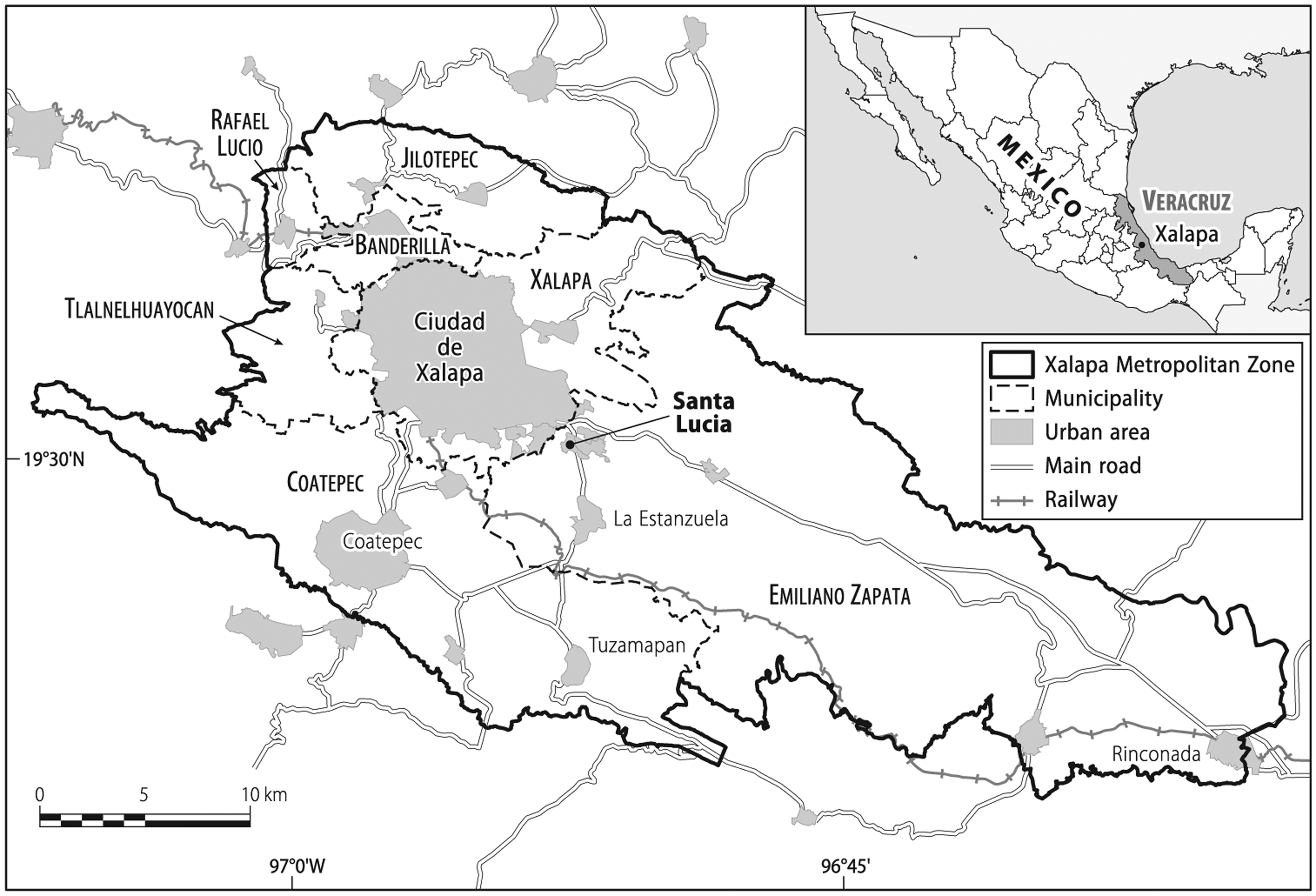
Map showing urban boundaries and case study location (adapted from Benítez et al., 2011).
These sales appear to have been made largely via a movement known as the Veracruz Housing Coalition, led by Banda Rivas director Hugo Banda, mainly to individual lower middle-income buyers such as public-sector workers seeking affordable land for housing. Owing to the ejidal nature of the land, the sales were informal, although buyers received a transfer agreement in the form of a cesión de derechos, a document signed by the ejidal assembly in which the ejidatario concerned ceded his or her use rights pending regularisation, which nevertheless is not considered to have judicial weight. In December 1995, the sale of these plots came to the attention of SEDUVER, the Urban Development Department of the State of Veracruz. In October 1996, SEDUVER took the unusual step of lodging a complaint with the State Public Ministry (Secretaría del Gobierno) against the responsible parties – in this case, the ejidatarios who were still in legal possession of the land – for unauthorised subdivision and fraudulent sale of untitled ejidal land (Daniel Martí Capitanachi, personal communication, 11 July 2014). This led to the questioning and detention of several ejidatarios.
According to representatives of the ejido, the uncertainty generated by the legal case, and the subsequent delay in regularisation and service provision, made many buyers reluctant to invest in developing their plots (interview with ejidatarios). They also suggested that the delay was because the proceeds of the sales had not been passed on to them by the developer, leading them to obstruct the regularisation process. From 1996 to 2009, the majority of these plots remained uninhabited, although some buyers erected fencing to demonstrate possession. Apparently as a consequence of this lack of development, from around 2007 land invasions were observed on the site, coming to public attention in August 2009, when the local media began reporting on the ‘invasion’ of the land by Santa Lucia Civil Association (SLCA). The leaders of this organisation, political aspirants who claimed that they were appropriating the empty plots in response to the housing need of vulnerable urban populations, in fact illegally sold these plots to their members.
In July 2000, the certification of the ejido via PROCEDE was agreed, but the plot of land on which Santa Lucia is located was excluded because of the legal dispute. At the same meeting in 2000 in which the ejido agreed to participate in PROCEDE, ejido members voted to recognise existing occupants of land belonging to Estanzuela, a move that was only possible because of the 1992 reforms. This suggests that the ejido had started the process of regularising informal land sales through recognising some individuals who had bought land in the original transactions in 1995 as posesionarios, although it was not possible to verify further details of this. 14
Currently, around half of the plots there are inhabited, mainly by members of the SLCA, who are generally vulnerable. Although weekly monetary collections are made by the association, services are poor, with no drainage, paving or rubbish collection, and only informally supplied water and electricity. The site has become known for high levels of social conflict between the different groups making claims to the land, which reflects and reproduces the uncertain living conditions. By 2010, over 100 criminal complaints had been made to the Veracruz Public Ministry about Santa Lucia, including several reports of violence to the Public Safety Department (Zavaleta, 2010). In 2010 and 2011, leaders of the SLCA were imprisoned for selling plots illegally (Zavaleta, 2011b); subsequently, in the last four years there have been several evictions by the State Government, such as the eviction of 14 plots in April 2011, and 15 in January 2012 (Zavaleta, 2011b, 2012). These evictions seem to have followed recognition of claims by the original buyers following their legal assignation as posesionarios by the ejido.
However, on other occasions, evictions have been postponed because of armed resistance from the residents (Aguilar, 2012; Hernández, 2012). Original buyers have complained of intimidation and threats with machetes, stones and sticks when they have attempted to reclaim their land; resident SLCA members were reported to have attacked the association’s leaders after a dispute (Aguilar, 2012; Zavaleta, 2011a); and aggression from the organisation towards its members is common. The situation has continued to deteriorate: in August 2014, reports emerged that Gabriel Nava Lopez, identified as one of the ‘leaders’ of Santa Lucia, had been ‘executed’ at his home in the neighbourhood by a group of armed men (Cancino, 2014).
The remainder of this paper explores the recent conflict in Santa Lucia, drawing on the factors identified above to explore the role of diverse claims to the land, and overlapping legal and governance frameworks, in the context of the wider changes outlined in earlier sections. Based on the research findings, an additional factor of local power relations is identified and discussed.
Analysis of land conflict in Santa Lucia: Diverse claims, overlapping frameworks and power relations
Diverse claims to land rights
The complexity and intractability of the land conflict in Santa Lucia reflects the diverse interests of the actors involved in the land transactions there. While diverse and varied rights to a given piece of land are common, conflict may arise where different claims are in competition (e.g. Baranyi and Weitzner, 2006). The current conflicts in Santa Lucia centre on the competition between the rights and claims of three of the groups mentioned above – the members of the ejido; the original buyers of subdivided plots; and the current residents, members of the SLCA – which vary in terms of their strength, a situation which has been further exacerbated by the reforms.
The ejidatarios’ rights consist in their jurisdiction over the transfer or disposal of the land, in the sense that since 1992, they have been entitled to undertake regularisation themselves once agreement is reached by the ejidal assembly. The original buyers, most of whom have documentation of their purchase in the form of a cesión de derechos or transfer agreement, are not in occupation of the land, weakening their claim to ownership rights. However, the process of recognition by the ejido in 2000, mentioned above, appears to have benefited some of these individuals through formalising their status as posesionarios. They have been able to use this status in support of their claim that they bought in good faith, enabling some to obtain court orders which have allowed them to evict the current occupants and reclaim their plots. The claims of the original buyers, who acquired the land informally, are privileged over those of current occupiers of the site, despite the fact that, as a representative of the Agrarian Ombudsman pointed out, ‘Their papers have no legal weight’ (interview with Official 1). This suggests the political nature of the conflict, discussed further below.
This process also reveals the highly insecure situation of the current residents, who have de facto use rights but no documentation – one respondent estimated that only 5% of current residents have any form of document of sale (interview with residents of Santa Lucia). Paradoxically, because undocumented occupiers are dependent on the SLCA to pursue their claims for regularisation, the organisation is able to maintain its control of the settlement, a central factor in the ongoing conflict. At the same time, evidence of the association’s aggressive tactics towards residents also emerged, as it was reported that residents who do not ‘cooperate’ financially with the SLCA are threatened with their provisional services being cut off or violent eviction. Residents thus suffer double insecurity of tenure, based on their fear of eviction by either the association or the state, accompanied by a fear of violence perpetrated either by the association or, in the case of official evictions, by the forces of law and order. In the words of the above resident, the ‘law of the jungle’ prevails (interview with residents of Santa Lucia). The lack of legal resolution to the situation, despite the involvement of a variety of institutional actors – including the current ejidal commission of Estanzuela, the municipalities of Xalapa and Emiliano Zapata, CORETT, the State Government Department, the State Property Department and the Agrarian Ombudsman, advising the ejidal commission – suggests that the arbitration of these claims is elusive, reflecting the overlapping frameworks that may characterise peri-urban land markets.
Overlapping legal and governance frameworks
The nature of peri-urban areas means that they may be more subject to overlapping legal and governance frameworks than other parts of the city. At the same time, the ‘uneasy’ nature of this setting, ‘characterized by … the loss of “rural” aspects … [and a] lack of “urban” attributes’ (Allen, 2003: 136), may result in a ‘legal limbo’ for residents as their neighbourhoods are considered neither rural nor urban (Lombard, 2014). In Santa Lucia, despite informal processes of urbanisation, the land is still officially rural, in the sense that the ejido still has legal possession of it. Moreover, the plot is still designated as having rural land use under the municipal planning framework. Ejidal land that has been informally settled is ‘legally invisible’ as urban land to the Xalapa Department of Urban Development; legal visibility can only occur following regularisation, and with a formally recognised change of land use category (Martí, 2008), after which urban infrastructure is more likely to be installed.
This situation reflects and may exacerbate tension and potential overlap between the competencies of different municipalities within the same metropolitan zone. Santa Lucia is situated in the municipality of Emiliano Zapata, within the boundary of the Xalapa Metropolitan Zone. The Municipality of Xalapa is not responsible for servicing settlements outside its own boundary – even those within the Metropolitan Zone (interview with Official 5) – meaning that Emiliano Zapata has formal responsibility for this. However, in Emiliano Zapata, 63% of the population earn less than two minimum salaries, compared with 45% in Xalapa, underpinning its limited financial capacity. Thus Santa Lucia’s residents have recently appealed to the Xalapa Municipal Government to improve their drinking water supply (Cancino, 2014). In the absence of a metropolitan authority, and with poor relations between the two municipalities generated by a dispute over municipal boundaries in 2005 which resulted in the restitution of land to Xalapa (Gamboa 2007), there has been no coordination between them over Santa Lucia. This is exacerbated by party politics, with Emiliano Zapata currently led by the left-wing PRD, and Xalapa by the PRI, in alignment with the PRI-dominated State government (Mauricio Hernández Bonilla, personal communication, 11 November 2014).
Some respondents suggested that there is also a mismatch between social and private property regimes, which may be more salient in peri-urban areas. A respondent from the State Property Department suggested that these regimes are based on ‘two different logics’, giving rise to conflict between rural and urban land management systems (interview with Official 6). In the eyes of an informant from the Xalapa Department of Urban Development: The ejido is effectively … social property, a legacy of the Mexican Revolution. It’s not very clear where the authority of the ejido ends and the authority of the municipality begins … each is protected by their norms. (Interview with Official 5)
Not only is the process by which land transitions between these two spheres at issue, the reforms have also conferred conflicting competencies on ejidos and urban authorities with respect to urbanising land (Martí, 2008). In particular, the agrarian reforms of 1992 complicated the process of regularisation, by granting authorities beyond CORETT the power to regularise informal subdivision, as outlined above.
Local power relations
Along with the two factors outlined above, which concur with the literature on land conflict, an additional, highly salient factor identified from the research is local power relations, underpinning the diversity of claims and overlapping jurisdictions. This is particularly relevant in peri-urban areas where diverse interests may be accompanied by a lack of judicial clarity, as suggested above. The conflicting claims to the land resulting from the land invasion, and the overlapping legal competencies relating to regularisation, have led to a power vacuum of which the association has taken advantage to consolidate its de facto control of the neighbourhood and its land market. Although the Association presents its role within the neighbourhood as one of pursuing negotiations with the local government for tenure and service provision, its dominance of the land market there includes the threat of interrogation and ‘removal’ of individuals acquiring land independently (interview with residents of Santa Lucia), suggesting its interest in maintaining the current status quo.
Recent judicial proceedings represent a challenge to this status quo, but with potentially negative effects for the residents. Moreover, the positions taken by some of the key actors, including the two municipalities involved, suggest that ‘land is a political instrument’ (interview with Official 4). This implies a degree of official tolerance of the SLCA’s control of the land market in Santa Lucia, as a strategy to avoid more disruptive conflict over demands for land and housing, which can take the form of demonstrations, occupation of municipal installations and so on, potentially affecting the city as a whole. In the post-corporatist setting of Mexico, the traditional strategies for resolution of social conflict, such as control, co-optation and repression, are no longer employed so openly; however, the legacy of the corporatist era means that clientelism, patronage and populism are still prevalent in urban governance (Guarneros-Meza, 2009).
Meanwhile, the configuration of local power relations has shifted, partly because of the changes to regularisation engendered by the reforms discussed above, but also relating to the wider context of increasing liberalisation, accompanied by heightened insecurity. With regard to the former consideration, an intriguing figure in this case is that of the developer contracted to assist the ejido in informal subdivision. While ascertaining the precise motivations of the company is difficult given the historical dimension of the case, it was alleged in certain sections of the popular press, and by some respondents, that this organisation was also responsible for the subsequent invasion of the land and the illegal resale of the plots, under the guise of the ‘Santa Lucia Civil Association’ (interview with residents of Santa Lucia). Some also suggested that this company had links to higher order authorities and actors, with allegations that the original buyers were linked to the PAN, 15 while the SLCA was apparently affiliated to the PRI via the previous governor of the State of Veracruz, with implications that he had sanctioned the invasion (Zapata, n.d.). Other reports that the invasion represents a ‘confluence of political and economic interests’ ( La Jornada Veracruz, 2011) concur with these interpretations.
At the same time, this case is suggestive of ‘the link between tenure insecurity and urban insecurity more broadly’ (UN-Habitat, 2007). While the effects of narcoviolencia vary by region, Veracruz’s position as a coastal state with strategic access to Mexico City and fertile terrain means it is ‘vulnerable to drug trafficking and other illegal activities associated with it’ (Guarneros-Meza, 2015: 149). Heightened perceptions of insecurity in the state (Becerra and Meza, 2014) have been exacerbated by a series of high-profile and grisly acts of violence; the presence of militarised police on the streets of the region’s cites; and the unexplained murders of several investigative journalists. The latter have been linked to allegations of high-level corruption and criminal infiltration of local and regional political structures (e.g. Rodríguez, 2009), although these remain unsubstantiated. While substantiating causal linkages between drugs violence and land conflict is a difficult and sensitive task, it appears that the prevailing climate of insecurity may generate a situation in which the authorities are loathe to intervene owing to lack of capacity and fear of further violence (Guarneros-Meza, 2015). In the case of Santa Lucia, the reporting of the 2014 murder of a local leader as an ‘execution’ suggests that the dominant organisation there may now be imbricated in complex and dangerous wider networks, further increasing the potential for insecurity.
The land conflict in Santa Lucia therefore both reflects the enduring nature of certain arrangements of power relations in Mexico and highlights shifts that have reconfigured others. The state’s dominance prevails, in the sense that the rules are still set centrally, as in the corporatist era, and this is bolstered by support from the ejidatarios, who retain their privileged status compared with low-income settlers, who in turn find themselves vulnerable to multiple insecurities. At the same time, the potential for a legal limbo to develop in peri-urban areas, in which overlapping and inconsistent legal and governance frameworks can lead to a lack of clarity, may compound the complexities resulting from attempts to open up the agrarian land market, involve new actors and increase the options for regularisation. In the case of Santa Lucia, this has generated a stalemate that ultimately fosters further conflict, compounded by an overt tendency towards aggression on the part of the association in de facto control of the settlement where insecurity is prevalent, suggesting the state no longer has a monopoly of violence in this area.
Conclusion
This paper explores the factors contributing to land conflict in peri-urban areas, by focusing on a single case of informal settlement within the wider urban and political context in Mexico. A historical perspective on informal urban growth showed that the corporatist system of government in Mexico worked to pre-empt conflict over land and settlement, as well as responding to actual social conflict by employing a strategy of control, co-optation and repression. With liberalisation, the systematic use of regularisation came to the fore as the policy to address low-income housing need. At the same time, agrarian reforms were implemented, with potentially significant implications for peri-urban informal settlement and regularisation that are only now being fully appreciated.
In the case of Santa Lucia, on the outskirts of Xalapa, the acquisition of and construction on land at the peri-urban fringe was complicated by several factors which contributed to the generation of violent conflict. The land sale which was the basis for the settlement, which ejidatarios planned to regularise under the provisions of the 1992 Agrarian Law, was informal. This gave rise to legal proceedings and disputes over payment which led to delays in occupation and the area’s subsequent invasion. The escalation of the conflict in both social and legal terms has led to the current intractable situation, in which several factors are salient. Among the diverse claims on the land, those of current residents are weakest, contributing to their insecurity; while the overlapping jurisdiction of urban, ejidal, municipal and State authorities in the peri-urban context has contributed to the lack of a legal resolution to this dispute.
All land markets give rise to conflicts of interest; but not all develop into violent conflict. Conflicts of interest in land development processes, including informal ones, are likely to reflect the wider political economy. A historical perspective on ejidal subdivision and invasion in Mexico reveals that aspects of this situation are not unusual; but the acute and intractable nature of this conflict makes it particularly salient. The case has shown how local factors interact with and are influenced by wider factors. The analysis concurs with the literature that diverse claims and overlapping frameworks are key factors in land conflict, and shows that this is especially the case in peri-urban areas where the diversity of claims may be greater, and claimants may refer to different frameworks which overlap and sometimes come into conflict.
However, the case also shows that local power relations are critical, and central to understanding wider processes of change. Such processes may incorporate land reforms engendering the liberalisation and deregulation of peri-urban land markets, which ascribe new powers to certain actors, at the expense of others. However, the prevailing culture of power relations – in the case of Mexico, shaped by the corporatist culture – may prove obdurate, resulting in factors that previously ameliorated conflict now intensifying it. This may be exacerbated by urban insecurity, suggesting a need for further investigation of the link between increasing insecurity and land conflict, bearing in mind that the current lack of research in this area may reflect the methodological difficulties highlighted above.
Finally, it should be emphasised that in examining cases of peri-urban land conflict, the causes and consequences of such conflicts are not restricted to informal settlements. However, their effects are most acute in informal settings. Moreover, while key actors may include the state, urban political leaders, and local associations, it is the communities in which poor people live that are most likely to be adversely affected by (sometimes violent) conflict over land, through its effects on neighbourhood consolidation, as seen here; and this, along with the need to better understand the precise causes in distinct contexts, merits further investigation.
Footnotes
Acknowledgements
The author would like to thank the reviewers for their valuable comments, which helped to strengthen the paper considerably; and to thank Carole Rakodi, Diana Mitlin, Alfredo Stein, Daniel Martí Capitanachi, Mauricio Hernández Bonilla, Griselda Benítez and Clara Salazar for their helpful comments on earlier drafts of this paper. Socorro Chiu provided invaluable research assistance and critical insights in Xalapa. Finally, the author would like to thank the research participants, particularly residents and officials, who gave their time for this study.
Funding
This research was supported a Hallsworth Research Fellowship from the University of Manchester.