




Abstract
Informal street vending is the most widespread activity in the global informal economy and a central part of citizens’ everyday lives, both sellers and patrons, in the urban centres of the Global South. Recently, however, authorities have started to ban street vending and even buying from vendors, as they impose policies that seek to control access to and use of urban spaces in pursuit of urban modernisation. Despite this, street vending continues. We seek understanding of this policy failure, from the perspective of the patrons of street vendors, a largely-neglected focus. Adopting a neoinstitutionalist framework, we utilise the concept of institutional incongruence to frame our empirical research. We apply multinomial analysis to an in-depth survey of 529 individuals in Lagos, Nigeria, complemented by 10 interviews. We find patrons are motivated by multiple economic, social and spatial factors. Our results, as well as codifying and confirming existing understandings of patrons’ motivations, introduce a distinct factor – necessity – into the literature. These results allow us to offer important policy insights. Gaps between citizens’ behaviour impacted by the formal institutions of neoliberal urban policies, and the longstanding informal institutions shaping custom, and community, provide new insights into Lagosians’ everyday lives as patrons of street vendors. Moreover, these urban policies are shown to drive people towards street vending, as sellers and patrons – the opposite of their intended outcome. For policies to be developed that can reduce institutional incongruence and improve, rather than worsen, Lagosians’ lives, our results offer an important starting point.
Keywords
Introduction
Over half of the world's workforce is employed in the informal economy. 1 Within this, informal street vending is the single largest activity, providing jobs, income and poverty alleviation opportunities for many, especially in the Global South (Maneepong and Walsh, 2013; Onodugo et al., 2016; Roever and Skinner, 2016). Given its scale, street vendors are highly visible in urban spaces. As a result, however, they are seen by urban planners and other public authorities as constituting a nuisance (Onodugo et al., 2016).
More specifically, their presence is seen as inimical to the modern city, an idea rooted in official perspectives on the management and control of urban spaces (inter alia, Harvey, 2007a; Huang et al., 2017). The authorities have, in many cities, targeted street vendors, even criminalising them and, in some cases, those who buy from them. One example is Lagos, Nigeria – the focus of this research. Despite this, street vendors continue to operate and customers continue to patronise them. Motivated by this evident policy failure over the uses of urban space, our aim here is to bring new insights, both theoretical and empirical, that might explain such policy failure.
Our primary empirical concern is to analyse the motivations of those who buy from street vendors. This complements the dominant focus in street vending research, on the motivations of vendors. The lack of research on the demand-side represents a significant lacuna: given the scale of street vending, the patrons of vendors necessarily constitute significant proportions of urban populations in the Global South.
We also offer theoretical insights, via a novel integration of neoliberalism, the everyday, and institutional incongruence. These concepts are present in the existing literature but (to the best of our knowledge) have not been unified before. Neoliberalism is a concept that is easily misunderstood. Often taken to mean the absence of government in economic activities, the economic governance of urban spaces in the Global South involves extensive but indirect steering of economic activities, formal and informal. The everyday, with its intellectual roots in the writings of, for example, de Certeau (1984), addresses not only people's literal everyday activities, but how these activities have deep and profound symbolic, as well as practical, meaning in the uses of urban space.
That said, there is an inherent contradiction between the aims and ambitions of neoliberal urban policy and their consequences, as manifest through the everyday activities of urban citizens. We locate this conflict within a neoinstitutionalist framework, distinguishing between formal and informal institutions to explore how their incongruence, or misalignment, can help us to understand the conflicts between the neoliberal and the everyday and the consequences of this for people's lived experiences.
Our analysis is based on a novel and rich dataset gathered in 2019 from 529 participants in Lagos, Nigeria, who purchase from street vendors, complemented by interviews with six government officials and four members of the public. Multinomial analysis (with Tobit analysis utilised as a robustness check), incorporates multiple socioeconomic and demographic factors. Our findings confirm the motives identified in the limited existing research, that we label ‘accessibility-availability-convenience’ (AAC), ‘price’, and ‘social-redistributive’. Significantly, we identify a fourth motive that is new to the literature – necessity – that captures specific demands for specific goods that arise out of immediate circumstances (see section ‘Results, analysis and discussion’ for a detailed discussion).
Further, we locate these findings in the specifics of Lagos. Policies seeking to control urban space are shaped by certain beliefs about the design of the ‘modern city’. However, customers of street vendors are driven by motives that reflect first, the consequences for everyday urban living of the failure of formal institutions, the laws and policies put in place to control citizens’ behaviour and develop the modern city; and, second, the presence of powerful informal institutions, the norms, beliefs and practices that shape the everyday (which we discuss further in section ‘Neoinstitutionalism, institutional incongruence and the everyday’). Crucially, these informal practices influence citizens’ chosen behaviour, despite the obligation embedded in the formal institutions of law and the criminalisation of street vending to stop vending and buying from vendors.
We thus draw together multiple scales of analysis (Cirolia and Scheba, 2019) – the local and specific of the everyday, with a broader structural-institutional framing – to highlight challenges in the governance of urban space and its uses, not just in Lagos, but across the Global South. To this end, next, we review relevant literature, then describe our study location, Lagos. Methods and results are presented in sections ‘Methodology and methods’ and ‘Results, analysis and discussion’, followed by conclusions and policy reflections.
Literature review
Economic informality, street vending and buying from street vendors
The notion of economic informality emerged from research that sought to understand observed conditions of work in the cities of the Global South (ILO, 1972; Hart, 1973). One problem with this, however, is that it sets up a false dichotomy. It gives rise to binary divides – order versus disorder, legal versus illegal, modern versus primitive (inter alia, Adebayo and Akinyemi, 2019) or, more simply, good versus bad, that fail to reflect the complex interacting processes that characterise economic reality in the Global South (e.g. Sekhani et al., 2019). In Lagos for example, ‘as much as 90 percent of the money produced in the city comes through informal channels’ (Neuwirth, 2013: 66). This suggests that life for most Lagosians, indeed for citizens across the Global South, is not so much the ‘informal’ as ‘the everyday’ (inter alia, Pratt, 2019) – something we analyse in section ‘Neoliberalism and the everyday: Criminalising informality without halting the informal’. We continue to use the term ‘informal economy’ for convenience.
That said, policies that control access to and uses of urban spaces, shaped by this dichotomous thinking, affect street vendors and their patrons profoundly. This is justified, in Lagos as elsewhere, by efforts to turn Lagos into a ‘modern city’, a term that conveys a particular perspective on infrastructure, essential services, economic profile etc. (and one we critique in section ‘Neoliberalism and the everyday: Criminalising informality without halting the informal’). Despite its prevalence and visibility, street vending still lacks a single accepted definition (e.g. Cross, 2000; Basinski, 2009, 2010; Onodugo et al., 2016). In the present study, we adopt the definition of Igudia (2020: 57), which captures the range of activities undertaken, the spatial context of these activities, and the policy and legal challenges faced: ‘individuals or small-business entrepreneurs, generally own-account or self-employed’, who engage in manufacturing and/or street-trading of ‘legal or socially acceptable goods and services’, particularly in mobile forms, fixed or semi-fixed stalls, public/private spaces, whether regulated or otherwise; ‘thus [flouting] either business regulation, planning codes or other legal requirements’.
In order to comprehend why citizens continue to buy from street vendors, criminalisation notwithstanding, we seek a deeper understanding than currently exists in the literature of their motives for doing so. The only other paper we know of that explores the demand-side of street vending is Igudia (2020). In addition, we know of three papers that analyse demand-side motivations for participating in the informal economy more broadly (Culiberg and Bajde, 2014; Williams and Horodnic, 2017; Williams and Martinez-Perez, 2014). Although their focus is European countries, their theoretical framing is still useful as a reference-point.
Igudia (2020) explores patronage of street vending in Lagos, adopting in his analytical framework key motivations derived from this European-focused literature: price; social and/or redistributive purposes (including kinship); and failure in the formal economy (Williams and Martinez-Perez, 2014: 803), also described as formal institutional imperfections (Williams and Horodnic, 2017: 301). Igudia (2020) finds evidence supporting these motivations in Lagos. He also identifies the fourth motive, ‘multifeature’ (Igudia, 2020: 65): individuals buy from street vendors in order to build up networks, as they aim to become vendors themselves. We do not include this as it is not strictly a demand-side factor.
The present research differs substantially from that of Igudia (2020), utilising a much larger and more detailed questionnaire, distributed to more people in more areas of Lagos. Further, we provide a strong theoretical foundation for our empirical research, as we bring together and thus provide new insights into, notions of neoliberalism and the everyday, in the Global South, framed by institutional incongruence.
Neoliberalism and the everyday: Criminalising informality without halting the informal
The notion of neoliberalism underpins an important strand of research on urban development in the Global South, as authorities seek to promote urban economic development through the imposition of property rights and control of access to urban spaces (inter alia, Harvey, 2007a; Xue and Huang, 2015; Gillespie, 2016; Onodugo et al., 2016; Huang et al., 2017). Harvey (2007a: 22) defines neoliberalism as ‘a theory of political economic practices proposing that human well-being can best be advanced by the maximization of entrepreneurial freedoms within an institutional framework characterized by private property rights, individual liberty, unencumbered markets, and free trade’.
This definition captures the essence of neoliberalism – the removal of direct state involvement in economic activity, complemented by the creation of an institutional framework that promotes private activity. This shift from ‘rowing’ to ‘steering’ (e.g. Parsons, 2004), captures the changing focus of economic policymaking, from implementing the public to enabling the private. The interests at the heart of economic decision-making thus shift with this.
In the Global South, this has manifested itself as ‘the state working as an agent for financial, tourism, and real-estate capital’ (Gillespie, 2016: 73), including foreign capital (inter alia, Xue and Huang, 2015; Gillespie, 2016; Omoegun et al., 2019; Olajide and Lawanson, 2021). Gillespie (2016: 74, emphasis added) likens this to ‘the colonial policy of segregating global and indigenous business activities … [and] the activist approach of the postcolonial developmental state regarding land assembly for urban development’.
The impact of these policies has been, in Lagos and elsewhere, the opposite of that claimed by the proponents of neoliberalism. The aim is to cleanse urban spaces of messy and undesirable actors and activities – such as street vendors (inter alia, Adebayo and Akinyemi, 2019; Omoegun et al., 2019) – to allow for improved infrastructure, roads and pavements (fixed-location units are typically excluded from bans). This cleansing, undertaken to attract entrepreneurial capital, has however led to ever-greater socio-economic differences within society, without the trickle-down neoliberalism predicts (as foreseen by Arndt, 1983; see also Lapeyre, 2013). The poverty caused thus pushes more people into activities such as street vending. This is the essence of what Olajide and Lawanson (2021) call the ‘urban paradox’.
Olajide and Lawanson (2021: 3-4), citing Harvey (2007b), argue that neoliberal policies as practised by municipal policymakers give rise to ‘creative destruction’, where ‘urban transformation destroys the social and economic structures of everyday people while creating urban modernity’ (Olajide and Lawanson, 2021: 3-4). The paradox arises because neoliberal policies (in their study, the Lagos State Ten-Point Agenda, and the Lagos State Development Plan 2012–2025), led to projects that, instead of promoting economic development, economic growth and reduced poverty have ‘resulted in a city where the poor, in addition to suffering social exclusion, are also victims of the city's development’ (Olajide and Lawanson, 2021: 15). Neoliberal policies and the absence of trickle-down thus create the conditions by which poverty and inequality grow, placing greater demands on individuals engaging in ‘informal’ activities such as street vending to survive. This leads to the further implementation of failing policies, as policymakers persist in seeing such activities as justifying their policies rather than being a consequence of them (inter alia, Xue and Huang, 2015; Gillespie, 2016; Onodugo et al., 2016; Huang et al., 2017; Olajide and Lawanson, 2021).
This brings us to the everyday. With the informal economy being so significant in Lagosians’ lives, it is no stretch to observe that ‘informality constitutes the everyday of the city’ (Pratt, 2019: 612). We can thus understand ‘the everyday’ literally, describing citizens’ multiple behaviours as they go about their daily lives (inter alia, Kudva, 2009; Kihato, 2011; Agbiboa, 2019; Lata et al., 2019). It is then the purpose of the research below to clarify and codify the distinct drivers that lie behind these everyday behaviours, insofar as they relate to the informal economy in general, and to decisions to buy from street vendors in particular.
In this, the literature on the everyday highlights the notion of struggle, ‘between street vendors and authorities over access to public space’ (Lata et al., 2019: 143); or in ‘informality's everyday politics of stealth, survival and encroachment’ (Kudva, 2009: 1615). Enacting neoliberal policies to prioritise capital accumulation has involved the expulsion of hawkers etc. to the margins of cities (Gillespie, 2016; Omoegun et al., 2019). Such socio-spatial exclusion is a feature of large-scale ‘elite projects’ (Adama, 2018). It denies notions such as the urban commons (Gillespie, 2016), collective rights and space as a common property resource (Brown, 2015), and spatial citizenship (Khan, 2018), setting up conflict between planners’ and bureaucrats’ ‘conceived space’ and citizens’ day-to-day ‘lived space’ (Lata et al., 2019).
These ideas around struggle stem from the writings of one of the original explorers of the everyday, Michel de Certeau (notably de Certeau, 1984). He writes about the ‘strategies’ of official actors and ‘tactics’ of informal actors (de Certeau, 1984: 35–37; see also, inter alia, Kamalipour and Peimani, 2019; Gibert-Flutre, 2021; Truelove and Cornea, 2021; Villani and Talamini, 2021). Strategies are exercises of power predicated on ‘a place that can be delimited as its own’ enabling the management of relations with ‘targets or threats’ (de Certeau, 1984: 36). In response, tactics are the actions of those who are seen as the targets or threats, taking place in ‘the space of the other’ (de Certeau, 1984: 37).
These conflicts become not only understandable but inevitable, in the context of creative destruction. Sheldrake (2016: 36–40, passim) contrasts the ideas of de Certeau with the work of Le Corbusier, in a parallel to the idea of creative destruction (supra). de Certeau saw the work of Le Corbusier as containing ‘new instruments of isolation’. This is not just a physical isolation, but economic and social, with poverty and inequality growing as a direct consequence of neoliberal policies. To understand fully how the conflicts, the strategies and tactics, play out we need a framework within which to locate the differing and conflicting actions and reactions of the authorities and citizens – specifically, why citizens continue to patronise street vendors, despite the ban. For this, we turn to neoinstitutionalism and the concept of institutional incongruence.
Neoinstitutionalism, institutional incongruence and the everyday
Neoinstitutionalism embraces the ‘formal rules, informal norms, and their enforcement characteristics’ that frame human activity (North, 2005: 48). That said, whilst formal institutions (laws, regulations, policies etc.) are ‘mainly controlled by norms and sanctions that are formalized’, and informal institutions (values, norms and belief systems, including gender and kinship) have enforcement structures that are ‘strictly informal in nature’, they both have an ‘obligatory character’ (Streeck and Thelen, 2005: 10–11, passim; emphases in original). Thus ‘actors are expected to conform to [them], regardless of what they would want to do on their own’ (ibid; emphasis in original), an expectation that applies equally to formal and informal institutions.
Neoinstitutionalism, by drawing a distinction between the two, enables us to explore what happens when a gap opens between them; that is, when there is institutional incongruence (see inter alia, Webb et al., 2009, 2013; Williams et al., 2015). In this context, ‘individuals can be motivated to act outside of laws and regulations given their discontent with formal institutions […] or loss of trust in public institutions and an increased perception of corruption’ (Webb et al., 2013: 607; see also Lata et al., 2019), to the extent that ‘individuals within the society can come to perceive their informality as being validated’ (Webb et al., 2013: 607) and thus render formal institutions ineffective (Williams and Vorley, 2015).
In understanding institutional incongruence, the time-dimension is also important (see also ‘casual time’ in de Certeau, 1984). ‘Formal rules can be changed overnight […]; informal constraints change much more slowly and play a critical role in the evolution of polities’ (North, 2005: 51; see also, e.g. Williams et al., 2015). Thus, whilst policymakers may ‘overnight’ introduce new laws which criminalise street vending (e.g. Adama, 2018), if street vending is part of people's culture, tradition, way of life or gesture of kinship (Igudia, 2020), or if the ban is perceived as causing pain, inconvenience and disruption (Cross, 2000; Xue and Huang, 2015), including worsening poverty and inequality, vendors and their patrons will ignore the ban.
This matters, because, whilst neoliberal approaches to urban development empower capital over citizens, the latter still possess agency (inter alia, de Certeau, 1984; Gillespie, 2016; Cirolia and Scheba, 2019; Lata et al., 2019; Banks et al., 2020), for example, through ‘quiet encroachment’, the ‘noncollective but prolonged direct actions of dispersed individuals and families to acquire the basic necessities of their lives […] in a quiet and unassuming illegal fashion’, (Bayat, 2013: 45), a concept that Kamalipour and Peimani (2019: 2), connect directly with de Certeau's strategies and tactics.
From the foregoing, we derive our research questions and research hypotheses. The first research question is: what are the factors driving patrons’ decisions to buy from street vendors, despite the criminalisation of street vending activities? This question is supported by research hypotheses H1a–H1d, exploring the attitudes of the patrons of vendors towards the ban on street vending:
Our second research question is: how does institutional incongruence surrounding street vending influence patrons’ decisions to buy from street vendors? This question is supported by research hypotheses H2a–H2d:
The empirical context – Lagos, Nigeria
Nigeria has faced several years of challenging economic conditions. Over 94 million Nigerians (nearly half of the population) live in extreme poverty, the most in any country. 2 Nigeria has an annual population growth of 2.6% (UN, 2019), but urban population growth of 4.3%. Economic growth is slow or negative, GDP declining by 1.8% in 2020 (NBS, 2021). Unemployment and inflation are both high, with total unemployment of 33%, but youth unemployment of 42.5% (NBS, 2021), inflation officially at 33%, but food inflation of 66% (NBS, 2021), with these likely to be underestimates. With a weak formal economy, the informal economy employs over two-thirds of Nigerians, contributing approximately half of the country's GDP (Basinski, 2009; Igudia et al., 2016; ILO, 2018).
Lagos State is one of 36 states in Nigeria, with Lagos city at its heart. As Africa's largest urban centre and one of the fastest-growing cities in the world, Lagos dominates Nigeria's economy, 3 contributing 42% of VAT revenues 4 and about 20% of GDP. 5 Around 75% of its eleven million micro-enterprises operate in the informal economy as street vendors (Onodugo et al., 2016). 6 Their visible presence emphasises how entwined they are into everyday Lagos life, their cash-based transactions helping to maintain the pace and rhythm of everyday life.
Despite, or perhaps because of, this visibility of the law prohibiting street vending, the ‘Lagos State Street Trading and Illegal Market Prohibition Law 2003’ was fully and forcefully implemented in 2016. It forbids both street vending and buying from hawkers. Offenders are liable to a fine of 90,000 nairas or a jail term of 6 months. Reasons given for its introduction included enhancing mega-state status (creating a visually attractive city), clearing environmental nuisances, and addressing security threats to citizens (Lawanson and Omoegun, 2018; Xue and Huang, 2015).
Our interviewees (in public service) confirmed this, and offered additional concerns. Mr Dapo 7 (an Officer at the Ministry of Commerce, Industry and Cooperation) referred to the security of road users, obstruction of traffic and the safety of citizens, with some using hawking as a front to rob people. Mrs Tola (spokesperson, Ministry of Justice) highlighted ‘people selling themselves’, ‘children being used, e.g. child abuse’ and ‘sexual abuse’.
Despite the ban, and despite these concerns, we found during fieldwork that street vendors continued to operate, on most roads, at traffic junctions, in slow-moving traffic (Lagosians spend up to 30 h a week in Lagos's notorious traffic), 8 and at bus stops. We even found street vendors selling packaged food to passers-by within the State Secretariat, Alausa. This contains the offices of all government departments and ministries, including the Ministry of Justice, which oversees the enforcement of laws in Lagos State. Given the evident policy failure, officials in the Ministry of Justice assured us of their willingness to support a more effective policy formulation endeavour, hence the need for this research.
Methodology and methods
Research design considerations
The research design of the present study brings together analyses of the informal economy from different disciplinary roots, unifying familiar elements into a unique whole. Location-specificity is important in much informal-economy research, since ‘to really ‘see’ informality, we must resist generalisation: there are only particular timed and placed informalities’ (Pratt, 2019: 614). That said, this should be combined with ‘the analytical power of scalar and structural analysis’ (Cirolia and Scheba, 2019: 607).
In seeking to explore what motivates those who buy from street vendors as they actualise their ‘tactics’, we develop a research design, based on quantitative analysis, that remains epistemologically closely aligned with the existing qualitative research. Thus, it provides the methodological reconciliation between the everyday and the structural, as called for by Cirolia and Scheba (2019: 595; see also McFarlane, 2019).
Following Pratt (2019), many researchers utilise ethnographic research methods of interviews and observations in research on the everyday (inter alia, Kihato, 2011; Agbiboa, 2018, 2019; Lata et al., 2019). In order to collect data appropriate to analysis of the everyday, but which are also suitable for quantitative analysis, we use as our primary data-collection instrument a questionnaire, 9 including both closed- and open-ended questions. The former provide data that are suitable directly for quantitative analysis, whilst the latter provide attitudinal responses that are then, via aggregation and (re)coding, converted into data that can be analysed quantitatively.
Given that survey research lacks the personal interaction of interviews, we asked some questions in multiple ways, with different wording and styles, as we sought to minimise the potential biases that can arise from questionnaire responses (Geer, 1991; Reja et al., 2003; Huang et al., 2017). We also asked participants the reasons they had for patronising street vendors, what they bought from vendors, the impact of the ban on their everyday life, and what they thought was the best policy approach to street vending. By asking more questions than previous studies, we obtain a much richer dataset. Participants were also asked to choose, from a pre-determined set of responses, whether they were willing to buy from vendors despite the ban, and what they thought was the biggest challenge faced by vendors.
We supplemented the questionnaire instrument with interviews: with six government officials and four members of the public (about whom details are provided in the Online Appendix). The members of the public were chosen at random, through opportunity sampling, in different locations, with the government officials chosen through purposive sampling. These provided complementary, contextual information and enabled further robustness checks through triangulation with the survey data.
We thus bridge several literatures to present an ‘economics of the everyday’. This analysis, ultimately, enables us to both extend and shift the focus, from the extant literature on the supply side of the informal economy in general, and street vending in particular, to explore the motives driving those who buy from street vendors, despite a ban on such activities.
Data collection and analysis
Data collection took place in early 2019, across fourteen of 20 local government areas in Lagos State. At least sixty questionnaires were administered in each area, rising to over 150 in the most populous, Alimosho. 10 Potential participants were selected by a combination of spatial random sampling (selecting every alternate location and participant: Igudia et al., 2016); and street-by-street sampling (e.g. Reddy et al., 2003). We went to public places, notably workplaces, shopping centres, schools, places of worship and transport hubs, to sample every alternate willing adult (Igudia, 2020). House-to-house sampling, popular for studies in the Global North, was not suitable for our purposes. Most Lagosians’ daily routine involves leaving home early in the morning for work, returning late in the evening, having worked late, or after waiting for the worst of the traffic to ease. It would also have reduced the success-rate of meeting individuals who go out to buy from street vendors.
We administered over one thousand questionnaires and received 541, of which 529 are usable, assisted by four undergraduate students from the University of Lagos. They were trained by the lead author to observe sampling rules and avoid leading respondents to certain responses. They then worked under the supervision of the lead author, their familiarity with the city enabling them to guide the lead author. Being fluent in native Yoruba and English, they could administer questionnaires to locals who could not speak English. Working as a team reassured respondents that we were not out to swindle them. 11
The quantitative analysis was undertaken using multinomial analysis. This is most appropriate for our data-type – a nominal dependent variable on multiple categorical and ordinal independent variables. As a robustness check, we undertook Tobit analysis. The qualitative data were converted to quantitative data via a systematic aggregation and coding process (see section ‘Overview of responses’ and Tables 1 and 2).
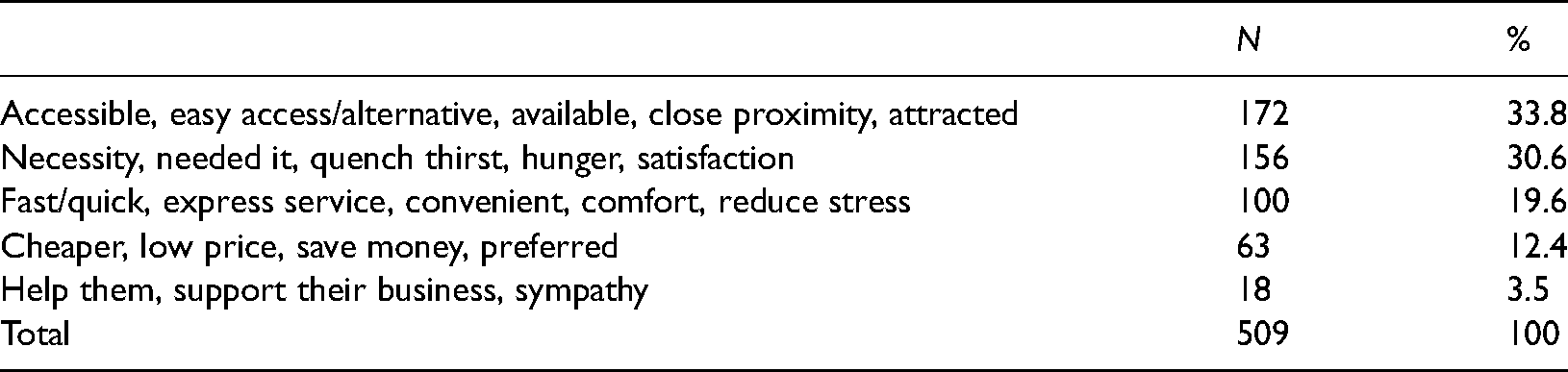
Respondents’ primary reason for patronising street vendors in Nigeria.
Participants’ perceptions of institutions and street vending.
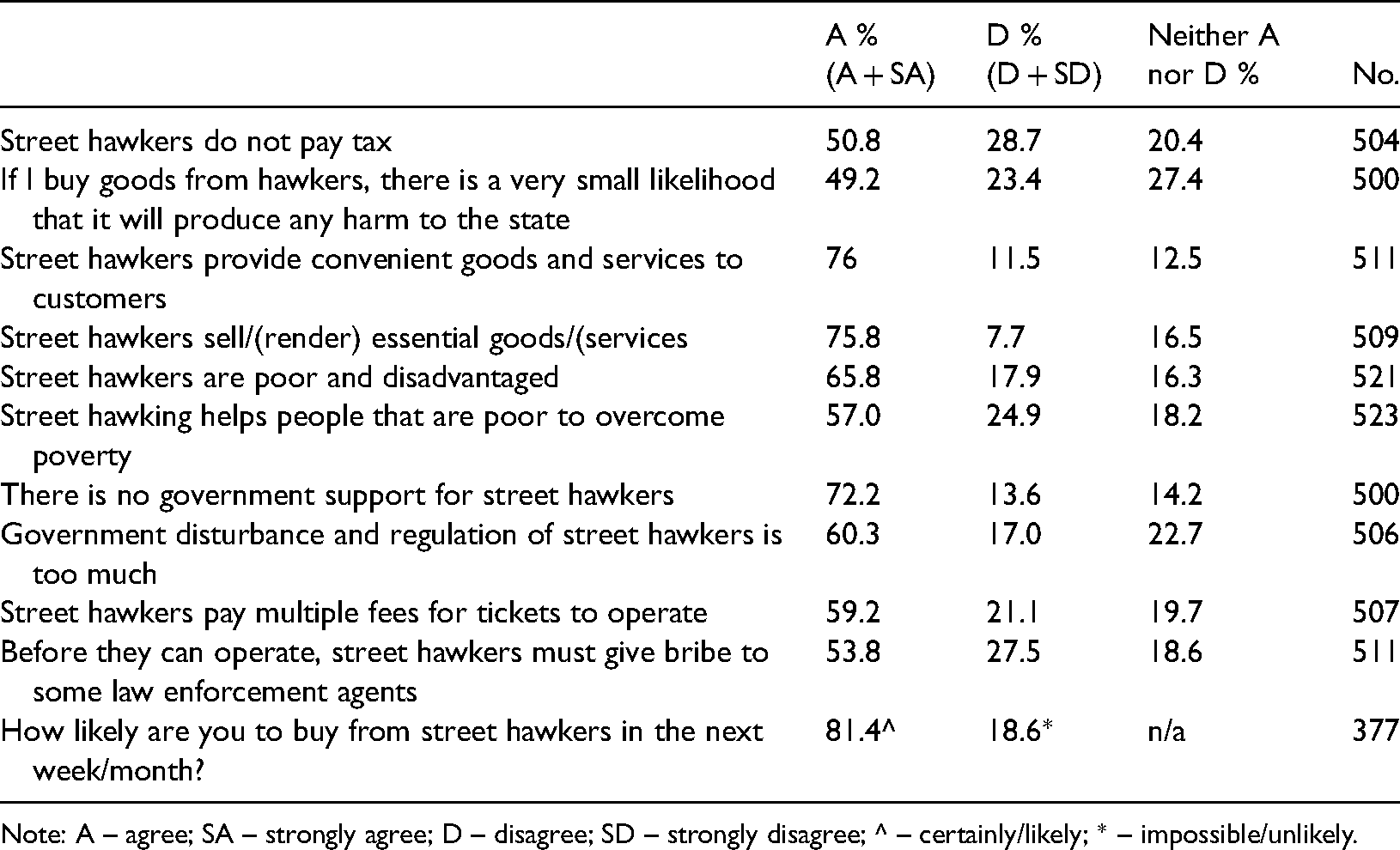
Note: A – agree; SA – strongly agree; D – disagree; SD – strongly disagree; ^ – certainly/likely; * – impossible/unlikely.
Triangulation and robustness checks were provided via two different econometric techniques being applied to the numerical data, similar questions being asked in different ways, and cross-referencing these results with our interview data. We are thus able to explore in-depth and unravel citizens’ everyday activities and the factors that determine the demand-side of street vending.
Results, analysis and discussion
Overview of responses
First, we test for the internal consistency and reliability of our variables and survey instrument and report an acceptable Cronbach alpha coefficient of 0.76 (Field, 2005). Online Appendix Table A1 presents descriptive statistics for respondents. We have a broad gender balance, most respondents are relatively young, single, with many well-educated. Just over half run, or have run, their own business, either full-time, or part-time alongside paid employment.
Tables 1 and 2 are key to the subsequent analysis. When asked ‘why did you buy from street vendors, despite the ban?’, 25 different words or terms were used. The thematic analysis enabled us to group the terms as shown in Table 1. Many of the responses obtained support the price, social/redistributive and market failure/institutional imperfection factors from the existing literature (for our quantitative analysis below, we group accessibility, availability and convenience into a single variable, ‘AAC’). In addition, we identify from participants’ responses a primary motive that is new to the literature: ‘necessity’. 12 This term captures specific demands arising from specific circumstances. Examples given by interviewees included the need for water, or a cloth to mop a brow, whilst stuck in Lagos's traffic; or getting food where circumstances meant AAC reasons did not apply (i.e. with necessity, people lack choice over where and from whom to buy). In addition, there are some goods and services that are only, or mainly, available from street vendors, which raise further questions about the impact of the ban on citizens (see section ‘Discussion’).
Necessity is thus context-specific (Pratt, 2019), relates to Lagosians’ everyday life and arises in the context of institutional incongruence. The context-specific nature of necessity, with an absence of alternatives, distinguishes it from AAC – although we acknowledge that whilst participants, individually, used this term unambiguously, in aggregate there might be a blurred boundary between necessity and AAC. Necessity is distinct from the ‘price’ motivation, where citizens, for the reason of having very little money, go to street vendors in search of the lowest possible price. Necessity is also distinct from social/redistributive motives. These reflect citizens’ behaviour as members of a wider community, where buying from street vendors is a political act of solidarity and support, as we discuss further below.
The data in Table 1 thus confirm the presence of the three motivations in the existing literature for buying from street vendors, but each can be understood in the context of Lagos, its ban, its traffic, its economic travails and its local culture. Moreover, our much larger and richer dataset allows us to identify necessity as a new, distinct, motive. AAC and necessity also both capture spatial aspects of buying from street vendors. The simplest definition of ‘market’ is somewhere buyers and sellers come together to exchange goods and services. 13 AAC and necessity result from the needs of buyers arising where they are as they go about their everyday lives, being met by street vendors who, knowing this, will be present in those places to satisfy those demands. This simple but essential point provides a spatial dimension to our results.
Table 2 shows responses to questions that gauge individual perceptions of street vending and related institutions, formal and informal. Overall, participants’ views of street vending are positive, matched by negative perceptions of how formal institutions impact on street vendors.
Regarding the question of taxes, whilst street vendors do not pay taxes such as PAYE on income, individuals operating in the informal economy do pay VAT on the goods they sell/consume (although their ability to claim VAT refunds can be problematic: Valodia and Francis, 2020). In the present research, our focus is on participants’ perceptions about the payment of taxes, fees, bribes etc., in relation to their patronage of street vendors. Table 2 shows a clear picture of about 50% believing that vendors do not pay tax, about 30% disagreeing with this and 20% having a neutral view. Moreover, many vendors pay fees for trading permits, and have to pay bribes to law enforcement officers to be allowed to trade (inter alia, Igudia et al., 2016). The percentages of participants believing vendors have to make these payments is slightly higher than with ‘taxes’, especially for fees.
Multinomial analysis
Our multinomial analysis uses as the dependent variables the motives for buying from street vendors derived from Table 1. The independent variables are institutional factors, alongside demographic and socioeconomic variables.
In Table 3, Model A captures the relationship between the demand-side of street vending and institutions, alongside two sociodemographic variables (education and age). Model B then unravels the influence of three sociodemographic factors (gender, marital status and internal migration). The results of the two models, computed at the 95% confidence level, are consistent and complementary. We report only results for variables that are statistically significant at the 1%, 5% or 10% significance levels. The chi-square and likelihood ratios are statistically significant at the 5% level. The pseudo R2 for both models ranges between 0.22 and 0.33, with a range of 0.25–0.5 denoting best-fit models. Our models thus fit the data well.
Multinomial results.
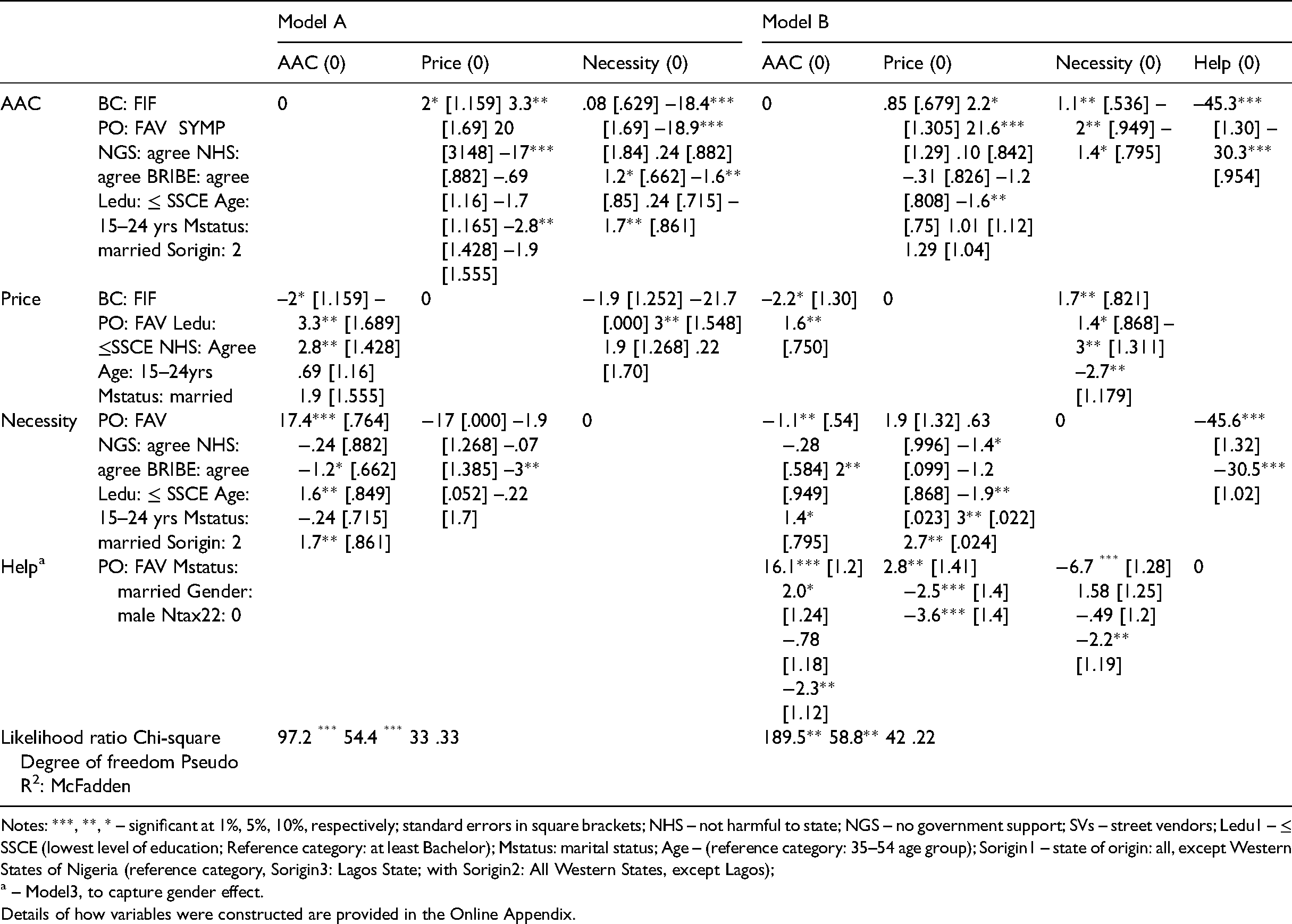
Notes:
a – Model3, to capture gender effect.
Details of how variables were constructed are provided in the Online Appendix.
These models capture our four motives for buying from street vendors, but the results are not symmetrical: participants consider all motives important, but to different degrees. Also, in each instance, the reference category (in the second row), is set against multiple other categories (in the first column). Thus, whilst individuals who buy primarily for AAC reasons may have a particular view on the different factors included in the models, there is no reason why those views should be held similarly by those who buy primarily for price or necessity reasons. We provide a non-technical summary of findings in Online Appendix Table A2.
From the result of those who buy for AAC and necessity, with Help as the reference category, we can also infer that this group is less likely to be from other western states than Lagos State. This is significant, given our interest in informal institutions such as kinship. Lagosians already have established kinship networks, such as family. This result suggests that incomers seek kinship and networks, but in other ways. Finally, our Tobit analysis confirms the findings above. We do not present these results, for reasons of space. They can be obtained from the authors on request.
Discussion
In this section, we frame our discussion around our research questions and hypotheses. First, we can respond to RQ1 through our acceptance of all four hypotheses H1a–H1d. That is to say, our analysis finds all four motives for buying from street vendors, including necessity, to be statistically significant. This also confirms the significance of the spatial and the everyday, via ‘AAC’ and ‘necessity’. These results, in capturing people seeking purchasing opportunities as, when and where they arise, thus provide a new, demand-side, interpretation of the concept of ‘opportunity recognition’ which, previously, has only been identified in the supply-side literature (e.g. Webb et al., 2009, 2013; Williams et al., 2015). Searching for the lowest price is also part of some people's everyday lives, but is distinct from AAC and necessity, in that it suggests individuals go in search of vendors, rather than vendors going to where they will find customers. One interviewee highlighted the economic conditions in Nigeria and the need to be prudent as a major driver. 14
Many individual responses specified either necessity, or the factors we have grouped as AAC, as motives for buying from street vendors. These two categories offer an important way of framing the differences citizens face in terms of purchasing decisions. So, for example, if two people have not made lunch at home because they left early to beat the traffic, one might have the time and opportunity to choose a street vendor over a shop on their way to work or during their lunch break (an example of AAC), whilst the other might rely on there being a street vendor nearby to buy something from and have no choice in who or what (necessity). One of our interviewees, Mrs Bayo (spokesperson, Ministry of Wealth and Creation) highlighted the necessary motivation when she observed that ‘People patronise street vendors because they work all day and have no place to have lunch when they are hungry’. She gave another example of necessity when she reflected on the challenges created by traffic – as noted earlier, demand for water, food, tissues and handkerchiefs etc. Mr Oluwole observed, ‘how do you expect people to survive without buying pure water to quench your thirst, or handkerchief to wipe your face when held-up in traffic in this hot weather’.
Our research also found another reason for necessity purchases: some goods and services are only, or largely, available from street vendors. A number of popular food and drink items are either entirely or mostly grown by individuals, or prepared at home, for direct sale on the streets rather than through formal retail outlets. Examples include African salad Abacha, boiled groundnut epa sise, boiled corn with sliced coconut owowo, boiled cow milk wara, fried coconuts, roasted plantain boli, roasted yam, walnuts, roasted cashew nuts. Services provided include the likes of shoe shines. In addition, it is estimated that 60% of goods sold by multinationals in Nigeria are exchanged through informal channels (e.g. gala snacks, mobile telecommunication data and calling-minutes top-ups), given street vendors’ customer reach and ‘superhero’ service. 15 We also found evidence of what can be called a circular informal economy. Many participants in the informal economy conduct their business ‘on the go’, but especially those who provide mobility services, such as okada riders, commercial drivers and conductors. They will themselves buy food and drink, for example, from street vendors where they can as they conduct their own business.
Another finding is that patrons grouped by primary motivation for buying from street vendors share certain characteristics. Those who buy primarily for AAC reasons have higher education levels and are older on average than 24, whilst those who cite necessity are more likely to be young and married. We also note that whilst our analysis confirms support for ‘informal institutions’ (H1c) these issues, including kinship and gender considerations, are discussed in detail next, as they are important in answering RQ2 and responding to H2a–H2d.
Turning to our second research question and associated hypotheses, a common theme is that the patrons of street vendors were well aware that their actions had been criminalised. Our results allow us to make a positive response to RQ2 and to accept all four hypotheses H2a–H2d. In so doing, we offer a key theoretical contribution: institutional incongruence is critical in understanding patrons’ decisions to continue buying from street vendors, despite criminalisation.
Our results in Table 3 confirm that patrons of street vendors have negative views of formal institutions (FIF), seeing this as street vendors’ biggest challenge, supporting H2a; that street vendors need to pay bribes to be allowed by government officials or police and security agents to operate (BRIBE), supporting H2b; and they also believe that there is ‘no government support for vendors’ (NGS), supporting H2c. Interestingly, a further pattern emerging from these results is that each group offering supporting evidence for H2a–H2c had different primary motivations for patronising street vendors: AAC, Necessity and Price, respectively.
A further reflection on hypotheses H2a–H2c concerns the payments of fees and bribes by street vendors and who they pay. Agberos (non-state actors who are known to the state) exercise significant control over some sectors of the Lagos informal economy, collecting daily levies from commercial drivers and street vendors (Agbiboa, 2018). These levies are not remitted to the state government, but are retained by the agberos, yet they represent nearly one-third of the state's annual internally generated revenues (Anudu, 2021). One simple explanation for the state allowing this is the lack of political will to stop them (e.g. Anudu, 2021). That said, behind this lies ‘politician-agberos mutual loyalty’ (Agbiboa, 2018). Agberos are used by politicians to win elections, and allowing the former to retain levies is a way of compensating them. Indeed, one interviewee argued that politicians use the informal economy to support their political associates. Thus even where street vendors make payments to non-state actors, the state is present in facilitating this.
We turn now to H2d and institutional incongruence as a factor influencing individuals’ patronage of street vendors. We assess this through various channels. First, there is simply the patronage of street vendors, combined with the declared intention to continue doing so, regardless of criminalisation. When patrons were asked what policies they would like to see for street vendors, 86.3% wanted favourable (FAV) or sympathetic (SYMP) policies. Fewer than 6% of participants favoured policies banning street vending (including enforcing the existing ban), their longer responses aligning with the official reasons for the ban (see section ‘The Empirical Context – Lagos, Nigeria’). These results also offer an important insight into institutional incongruence. Respondents who patronise street vendors strongly oppose the existing policy. They are supportive of street vendors, reflecting informal institutions, but they also want to see policies that are supportive of street vending – that is, they want institutional incongruence to be closed via pro-vending policy reform.
Moreover, those who expressed preferences for favourable/sympathetic policies, favour Necessity over AAC, and AAC over Price. This is consistent with the spatial idea that those who buy from vendors for these reasons benefit personally from street vendors being in particular places. This contrasts with those who go in search of street vendors selling items more cheaply than shops, for whom the location of the vendors is less important.
The negative attitudes towards formal institutions are seen in the frustrations and cynicism of interviewees. Mr Dapo acknowledged there was ‘selective implementation’, resulting from ‘no political will’ for change. The most people prosecuted in a single year was 4442 (4317 male, 125 female) in 2016. By 2020, numbers were down, to 2490 (2465 male and 25 female). 16 Mrs Abiola noted, ‘it is not possible to stop hawking in Lagos because government has not provided alternative’ – for sellers or buyers. Mr Adeola (a prosecutor) quipped ‘street vendors seem to be caught up in the manoeuvrings of politicians. Politicians know it is impossible to get rid of street vending in Lagos in the current economic climate, but some attempt to do so for political reasons, self-enrichment and to increase their budgetary allocation or [they criminalise it] to settle their political acquaintances’. This links to another type of formal institutional failure: corruption and clientelism (as seen also with the agberos, above). Many respondents in our survey also understood that street vendors paid bribes to law enforcement officers, to ensure they could continue trading (inter alia, Kihato, 2011: 358). This, however, undermines formal institutions, as bribes encourage non-enforcement (Omoegun et al., 2019).
There is, therefore, strong evidence of opposition to the formal institutions of the ban on street vending and buying from vendors. The full significance of institutional incongruence manifests itself through three channels – positive views of informal institutions; views supporting pro-vendor policy change; and the conflicts that manifest as a direct result of the institutional incongruence.
Model B in Table 3 shows a strong desire amongst patrons to help street vendors. Whilst Table 1 shows only eighteen individuals identifying Help as their main purchasing motive, when asked to rank five literature-defined motives for buying from street vendors, Help was identified 253 times, 86% of which were in the top three. 17 Within the full sample, 22.1% of female respondents ranked Help first, compared with 19.2% of males. But of those who included Help in their ranking, 52% of females ranked it first, compared with 35.9% of males.
Our results thus indicate that women are more likely than men to buy from street vendors motivated by a desire to help them. There are several possible explanations for this. Although we focus on the demand-side, data indicate that female vendors outnumber males (Dada, 2013: 127). Also, in Yoruba culture (the dominant ethnic group in Lagos), buying and selling (including street vending) is considered an enterprise for women, for which they are more highly skilled. This complements what are seen as male roles, including farming hunting, and blacksmithing, the output from which can then be sold by women.
Further, in Yoruba culture, fomoleboo is common practice (Dada, 2013: 128): ‘capable extended family members’ are entrusted with the care of one's children. Moreover, they not only take care of the child, but Dada observes they and/or the child engage in vending to generate extra income. Yoruba women are therefore likely to have a deep understanding of the conditions and challenges of street vendors when they go out to buy goods and services. Our results also go beyond bloodlines, with patrons originating from other Western states of Nigeria more likely to buy from vendors for help reasons. This supports the idea that buying from street vendors can also act as a form of kinship, as these incomers to Lagos seek ties and communities of their own.
It has been argued that, relative to informal institutions, strong and trusted formal institutions solicit and enlist support and obedience from citizens (Schneider, 2006). We find substantial evidence that the converse applies equally. Policymakers and the formal institutions they oversee and represent, and individuals who buy from street vendors, driven by informal institutions, have very different views about the presence of street vending. The latter are heavily influenced by their distrust and dislike of formal institutions, and by their respect for informal institutions. This incongruence between formal and informal institutions, moreover, takes us back to the conflict between the neoliberal and the everyday. The actions of the patrons of street vendors, motivated by informal institutions contra formal institutions, are the tactics employed in their everyday lives to circumvent the challenges posed by policymakers’ strategies, the formal institutions shaped by neoliberal ideology. We thus accept H2d.
Conclusions
Street vending, the most widespread economic activity in the informal economies of the Global South, is under pressure from policymakers. Lagos State, Nigeria, has criminalised both street vending and buying from street vendors, despite which street vending continues unabated. Against the backdrop, and with almost all research on street vending focusing on the vendors, we have presented a uniquely detailed analysis of the factors motivating those who continue to buy from street vendors. We have framed this within the context of institutional incongruence, which has also enabled us to analyse the conflicts and contradictions between a policy agenda motivated by neoliberal rationalisation, and the lived experiences of Lagosians, as embodied in the concept of the everyday.
Our empirical contributions are, first, that we find evidence from Lagos consistent with the vanishingly-small demand-side literature – that the patrons of street vendors are motivated by concerns over accessibility/availability/convenience (AAC), price, and feelings of kinship and the desire to help and support the vendors. Second, we have identified a fourth factor – necessity – that is new to the literature. We have shown that this is distinct conceptually from the other three factors. Our findings also offer a new, demand-side, interpretation of the concept of ‘opportunity recognition’, linked to the spatial aspects of AAC and necessity.
Third, we have located these factors, empirically and conceptually, in Lagos and Nigeria. Empirically, Lagos's chaotic traffic situation influences people's everyday activities, which impacts people's ability to buy what goods and services they need, where and when they want. Traffic jams can also create unplanned demands, arising as a result of being stuck in traffic for hours. Nigeria's weak economy also creates a powerful need for many to seek out the lowest prices they can find – which often means going to street vendors. The size of the informal economy itself also plays a role, with many goods and services, including popular food items, solely or mostly available to Lagosians from street vendors; whilst other informal economy workers buy from street vendors when and where they can, as they go about their own business.
Conceptually, too, there is a distinct Lagosian and Nigerian flavour to our findings. The shortcomings of formal institutions, notably the ineffectiveness of the ban on street vending and people's distrust and disapproval of those formal institutions, are shown to influence people's behaviour in Lagos. There are also strong attachments to informal institutions, including those rooted in the specifics of local (especially Yoruba) culture, towards women and kinship. There is also strong evidence that the gap in trust between formal and informal institutions, itself, influences behaviour, with widespread recognition of the economic and social harm being caused to the most vulnerable by the policy approaches taken against street vending.
Thus, institutional incongruence provides a conceptual frame for the conflicts that exist between neoliberal policy and everyday lived experiences. Drawing on the language of de Certeau (1984), given the ‘strategies’ of the urban authorities, we have categorised what motivates the patrons of street vendors as they actualise their ‘tactics’. Policy is being driven by beliefs about what modern urban spaces should look like and be used for, underpinned by economic concepts like trickle-down to help the poorest Lagosians’ everyday experiences of the consequences of those policies, however, confirm that trickle-down does not work, but instead exacerbates the economic conditions that drive so many to work in the informal economy … most numerously as street vendors. Indeed, one reason for weak enforcement of the ban is the economic and social damage that such actions have on citizens. The frame of institutional incongruence thus enables us to offer an ‘economics of the everyday’, which captures the contradictions present in the collision of neoliberalism and the everyday.
The results from the present study offer new empirical and conceptual insights into factors driving the patronage of street vendors, the ban notwithstanding. For any attempt at policy change to be successful in Lagos, the gap between formal and informal institutions, which also embraces the conflicts between neoliberalism and the everyday, must be closed. Evidence suggests that things do not have to be conflictual. Research conducted in cities across the Global South shows that cooperation between policymakers, authorities, urban planners, can yield positive outcomes (Roever and Skinner, 2016; Onodugo et al., 2016). We offer our results as an important, but only initial, step on the path to making Lagos a modern and inclusive city for all its citizens.
Supplemental Material
sj-docx-1-epn-10.1177_0308518X221083989 - Supplemental material for Institutional incongruence, the everyday, and the persistence of street vending in Lagos: a demand-side perspective
Supplemental material, sj-docx-1-epn-10.1177_0308518X221083989 for Institutional incongruence, the everyday, and the persistence of street vending in Lagos: a demand-side perspective by Eghosa Igudia, Robert Ackrill and Michael Machokoto in Environment and Planning A: Economy and Space
Footnotes
Declaration of conflicting interests
The authors declared no potential conflicts of interest with respect to the research, authorship, and/or publication of this article.
Funding
The authors received no financial support for the research, authorship, and/or publication of this article.

Supplemental material
Supplemental material for this article is available online.
Notes
References
Supplementary Material
Please find the following supplemental material available below.
For Open Access articles published under a Creative Commons License, all supplemental material carries the same license as the article it is associated with.
For non-Open Access articles published, all supplemental material carries a non-exclusive license, and permission requests for re-use of supplemental material or any part of supplemental material shall be sent directly to the copyright owner as specified in the copyright notice associated with the article.
