




Abstract
In Chinese cities, informal street vendors often appear in a transient space intertwined with a large number of pedestrians and heterogeneity, in contrast with the dichotomous construction of static built environment and dynamic street activity examined in most studies on walkability. This paper explores the rhythm of everyday street spaces and the temporary experiences of pedestrians and street vendors in Yuncheng, China. The author argues that street vendors are particularly well suited for capturing city rhythms and can discern the tempo of social life and pedestrians in urban street spaces. Following Lefebvre’s rhythmanalysis approach and drawing on 86 semi-structured interviews combined with on-site observation in three street spaces, this paper investigates how rhythms are linked to spatial form, time and the everyday street activity of walking and vending. It expands an analytical framework in both daily rhythms and long-standing rhythms, including arrhythmia, eurhythmia and polyrhythmia. The conclusions provide an alternative way of understanding why pedestrians emerge, through considering how street vendors temporarily meet the everyday needs of different pedestrians in specific, real and detailed ways. Such fine-grained narratives, in turn, demonstrate the need to advance theoretical and empirical understandings of multiple rhythms in relation to walkable space and walking forms.
Introduction
Globally, understanding walking forms and walkable spaces is becoming an increasingly significant topic in interdisciplinary studies (e.g. D’Haese et al., 2015; Fan et al., 2017; Giles-Corti et al., 2016; Sallis et al., 2016; Sun et al., 2020). Most current studies of this kind focus on the associations between walking behaviours and environmental factors (e.g. high residential density, land-use diversity and accessibility, street connectivity and pedestrian-oriented design). However, in Chinese cities, dynamic street vendors frequently appropriate spaces where many pedestrians walk, leading to ever-changing environmental functions in transient and ephemeral ways (Flock and Breitung, 2016; Sun et al., 2016). Most previous studies are embedded in a political notion of static spatial attributes and fixed typologies, meaning that the city is addressed on the basis of this same logic but ignored when dealing with heterogeneities in real life (Awan, 2017; Kwan, 2013). Stability is an invariable preoccupation of political discussion, and the threats to politics are anarchy, chaos, instability and disorder (May, 2005: 120). Given this, I argue that most studies on walkability rely on traditional modalities of urban planning and design, which both conceptualise walkable space as rational, ordered, unified and measurable, and examine static spatial attributes correlated to walking, in seeking a solution or exemplary guidance. These approaches generally focus on the characteristics of the built environment that can improve walkability and make people healthier in the city, while failing to deal with the heterogeneous urban needs and time-related behaviours of a variety of pedestrians.
Many studies in the field of geography recognise that the experience of urban space, as much as its physical form, needs to be addressed in contemporary urban practice in relation to time (e.g. de Certeau, 1984; Giddens, 1984; Harrison, 2000; Lefebvre, 2004; Soja, 2014; Sun et al., 2019). But most studies ignore a number of facets of time, such as rhythm and the subjective experiences of time, that shape human spatio-temporal experiences (Kwan, 2013). For example, Bergson (2010) proposes the notion of ‘lived time’, which is subjective time, as opposed to objective ‘clock time’. In our everyday life, lived time speeds up when we immerse ourselves in interesting things and produce temporal experience; meanwhile, we often ignore clock time until we see it. As such, Lefebvre (2004: 77) notes that ‘everybody thinks they know what this word means. In fact, everybody senses it in a manner that falls a long way short of knowledge’. This paper highlights how the various facets of time enter into the lived, but this does not mean that they enter into the known, and thus I further analyse them in relation to a specific space, culture, society and population in a nuanced way.
Marcu (2017) notes that research related to rhythm can add various explanations to the body of work on temporalities and time. Rhythm cannot be separated from an understanding of time, and in particular of repetition and the emergence of difference within it (Elden, 2004). Absolute repetition exists only in a fiction and repetitions in everyday life often derive various differences that create changing possibilities (Potts, 2015). In return, differences produced by repetitions comprise the thread of time. Difference and repetition are not contradictory; rather, they are interconnected in a complex time-structure (i.e. the past, the present and the future) (Deleuze, 2004, 2014). I argue that we can understand why diverse practices of vending and walking may reoccur through a chronological succession of differences and repetitions concerning both physical and social actors. These local everyday practices appear in the present but connect to the experience and knowledge of the past, as well as to imagination and prediction about the future.
Lefebvre’s last work, ‘the rhythmanalysis project’, provides a tool of analysis with which to study rhythms, by examining and re-examining a range of research in relation to space, time and everyday life (Lefebvre, 2004). Rhythmanalysis distils ideas from Lefebvre’s famous books Critique of Everyday Life and The Production of Space (Lefebvre, 1991, 2014). For example, rhythms occupy space but also demonstrate how space is occupied (Lefebvre, 1991). Many urban studies in geography and architecture that have been influenced by Lefebvrian notions prefer to focus on concepts such as right to the city and concrete abstraction, often overlooking rhythmanalysis and temporality (Marcu, 2017; Simpson, 2008; Sletto and Palmer, 2017). Recently, rhythmanalysis has begun to play a crucial role in the field of geography, while it still suffering from a lack of attention in architecture and urban design (Potts, 2015). Expanding Lefebvre’s theorisation on rhythmanalysis, Potts (2015) indicates that space and time need to be considered as simultaneously related to everyday life, and replaces the abstract notions of temporality and spatiality with practical examples: temporalised space and localised time. Lefebvre is not an abstract theorist on the urban space but is grounded in empirical evidence to understand the small details of everyday life (Elden, 2004). Therefore, I develop the approach of rhythmanalysis with the aim of dealing with practical consequences, concrete situations and specific cases in the context of heterogeneous practices of vending and walking in Chinese street spaces.
In theory, Lefebvre (2004) distinguishes two interpenetrating rhythms: linear rhythms, which are monotonous and tiring and explain the significant roles involved in the daily grind and routine; and cyclical rhythms, which are considered to influence social life over a long period. The cyclical rhythms originate in the linear rhythms and in nature, in such phenomena as ‘days, nights, seasons, the waves and tides of the sea’ (Lefebvre, 2004: 8). For example, through observing a city square with its crowds, ‘maritime rhythms’ can be explored. In addition, an apparently immobile object moves in multiple ways over time, combining various movements, for example the slow changing of a stone or a tree trunk, the so-called ‘interminable rhythm’ (Lefebvre, 2004: 20). By comparing maritime and interminable rhythms, I further identify short rhythms and long-standing rhythms, and these need to be captured in different ways.
Furthermore, the theory of rhythms starts from the experiences of knowledge of the body: the observer knows that he or she takes this time as first reference while at the same time observing multiple rhythms, and the observer’s body serves him or her as a metronome (Lefebvre, 2004). Lefebvre (2004: 16) proposes a conceptual framework: Polyrhythmia? It suffices to consult one’s body; thus the everyday reveals itself to be a polyrhythmia from the first listening. Eurhythmia? Rhythms unite with one another in the state of health, in normal (which is to say normed!) everydayness; when they are discordant, there is suffering, a pathological state (of which arrhythmia is generally, at the same time, symptom, cause and effect).
Marcu (2017) develops this framework for the social issue of rhythmic change in the context of the job insecurity experienced by young Eastern Europeans in Spain. His study highlights the analysis of rhythms to understand a set of practices carried out by different actors, including careers, feelings, language and work. He explains the different rhythms in this way: arrhythmia, ‘reflected by precarity, disturbances and de-synchronisation’, polyrhythmia, ‘situated between instability and flexibility’ and eurhythmia, ‘composed of diverse and equilibrate rhythms’ (Marcu, 2017: 406). This interpretation offers wider applications for the rhythms of society and people’s own rhythms beyond the body, by using rhythmanalysis as a qualitative method in understanding how different people move and adapt to environments via the life-course in mobility.
Based on the above studies, and with the aim of identifying and analysing heterogeneous rhythms in the context of dynamic street vendors and pedestrians in the ever-changing street space of Chinese cities, I further develop the framework by placing at the core of the analysis the meaning of rhythmic vending–walking relations. First, for the arrhythmia, ‘the exception of disturbances’ leads to illness (Lefebvre, 2004: 19). I emphasise that the exception (e.g. illness) is unpredictable and is reflected in the interruption of normal life but that consequent changing actions are reasonable and underpin the rationale, namely, these actions need to be explored through uncertain situations. Second, the eurhythmia emerges in ‘the state of good health’ and includes numerous ‘associated rhythms’ (Lefebvre, 2004: 68). I further expand this notion in relation to the ‘cyclical rhythms’ (Lefebvre, 2004: 30). Eurhythmia in this paper appears as the union of rhythms in normal everydayness, closely related to high-frequency re-visiting, which means establishing a sort of stability and cyclical repetition of everyday practices at a certain rhythm (e.g. selling breakfast for schoolchildren). Third, the polyrhythmia comprises ‘diverse rhythms’ (Lefebvre, 2004: 67), but this does not clearly differentiate between eurhythmia and polyrhythmia, for example associated rhythms and diverse rhythms sometimes overlap. In fact, the two notions reveal different insights. The different practices of space, time and everyday life intersect, being connected with local culture, society, politics and so on, and produce a multiplicity of spheres (Marcu, 2017). Therefore, the polyrhythmia here means that different practices happen simultaneously but their co-existence has different implications and meanings.
Mels (2004) also argues that rhythms should extend to social space. For instance, urban streets or other social spaces always contain the integrated rhythms of various individuals’ movements and time–space patterns in a common social order (Simpson, 2008). That is, the built environment and its physical elements need to be considered alongside communal forms of social life (Whyte, 2012). Furthermore, drawing on empirical interview material and a social dimension, Marcu (2017) explores the meaning of time and the mobility experiences by involving the participants in rhythmanalysis. A rhythmanalyst can listen to a town or a street in the same way as someone listens to an opera or a symphony (Elden, 2004). In this paper, I further expand this idea, considering the people present as the rhythmanalyst, so that researchers can learn from them through on-site observation and interviews.
More specifically, I argue that street vending is particularly well calibrated for capturing city rhythms and that vendors can discern the tempo of urban life and pedestrians. Compared with dynamic pedestrians, street vendors in my study usually stayed in one place for a long time and observed the potential opportunities in that place (e.g. pedestrians’ features, time-related demands, socio-spatial relations, physical elements and developing states). Many of the vendors emerged regularly at a fixed spot during predictable periods, serving pedestrians’ various needs and/or calibrating spatial properties at different times (Sun et al., 2016). Consequently, I analyse different rhythms of street vendors to ascertain multiple spatial practices of everyday walking. This offers an alternative way of understanding how street vendors operate at different times, why pedestrians emerge and how street vendors temporarily meet the everyday needs of different pedestrians at specific sites. The complex rhythms (re-/co-)produce an ever-changing but walkable space, temporarily maximising vitality in an existing place.
Additionally, I present three common characteristics of vending-walking space in contemporary Chinese cities. First, the street vending area is primarily a transient space (Flock and Breitung, 2016) with pedestrian flow, and this is likely to become a cyclical daily repetition. Second, over time it is a space co-produced by or for ordinary lives via a set of relations including demand, habitus, land use, street network and other actors. Finally, the behaviours and practices of both vendors and pedestrians interact with the built environment and spatial elements. In the context of vending-walking space, rhythmanalysis inspired me to analyse the dynamic practices of cyclical repetition and co-existence, revealing the heterogeneous modes of (re-/co-)production of walkable space as well as walking and other forms of occupying these street spaces. Returning to the study aim of understanding why people walk and how urban life occurs, the research questions are:
Why do street vending and walking emerge?
How do street vendors and pedestrians (co-/re-)produce a transient walkable space? and why?
Methodology
Details of the city and site selection are published elsewhere (Sun et al., 2019, 2020). Briefly, although studies on pedestrians and street vendors have recently been conducted in China, most have focused on large cities and have neglected the country’s small cities, which is where the majority of the population lives (Sun et al., 2020). Yuncheng is a typical low-tier Chinese city, with high population density (5,275,300/14,233 km2) and rapid economic growth (GDP increasing by 7.8% annually) (Yuncheng Bureau of Statistics, 2016). Through my 20 years of experience living in Yuncheng, I am familiar with local cultures and everyday lives.
Regarding site selection, I first interviewed urban managers to roughly identify a series of popular locations for street vending. Following this, based on on-site observation and the selection criteria (i.e. residential neighbourhoods, high numbers of pedestrians and street vendors but less integrated streets), I selected three representative public urban streets (Table 1). Site 1 is situated in the eastern part of the city centre and is an entrance connected to an alley (i.e. a narrow and less integrated road), with less vehicle movement but a higher pedestrian flow and many vendors. Site 2 is also situated in the eastern part of the city centre and it involves various everyday activities and a less integrated area (i.e. a cul-de-sac for vehicles). Some street vendors occupy space at the end of the street, thereby altering its function to that of a small market corner during specific periods. Site 3 is situated in the east urban fringe (i.e. a less integrated area). This new development originated in around 2010 and includes a large nature park (2397 ha in total) and high-rise residential buildings. In recent years, some residents have begun to move into the residential neighbourhood but it still lacks amenities.
Characteristics of the interview participants at the three selected sites (N = 86).
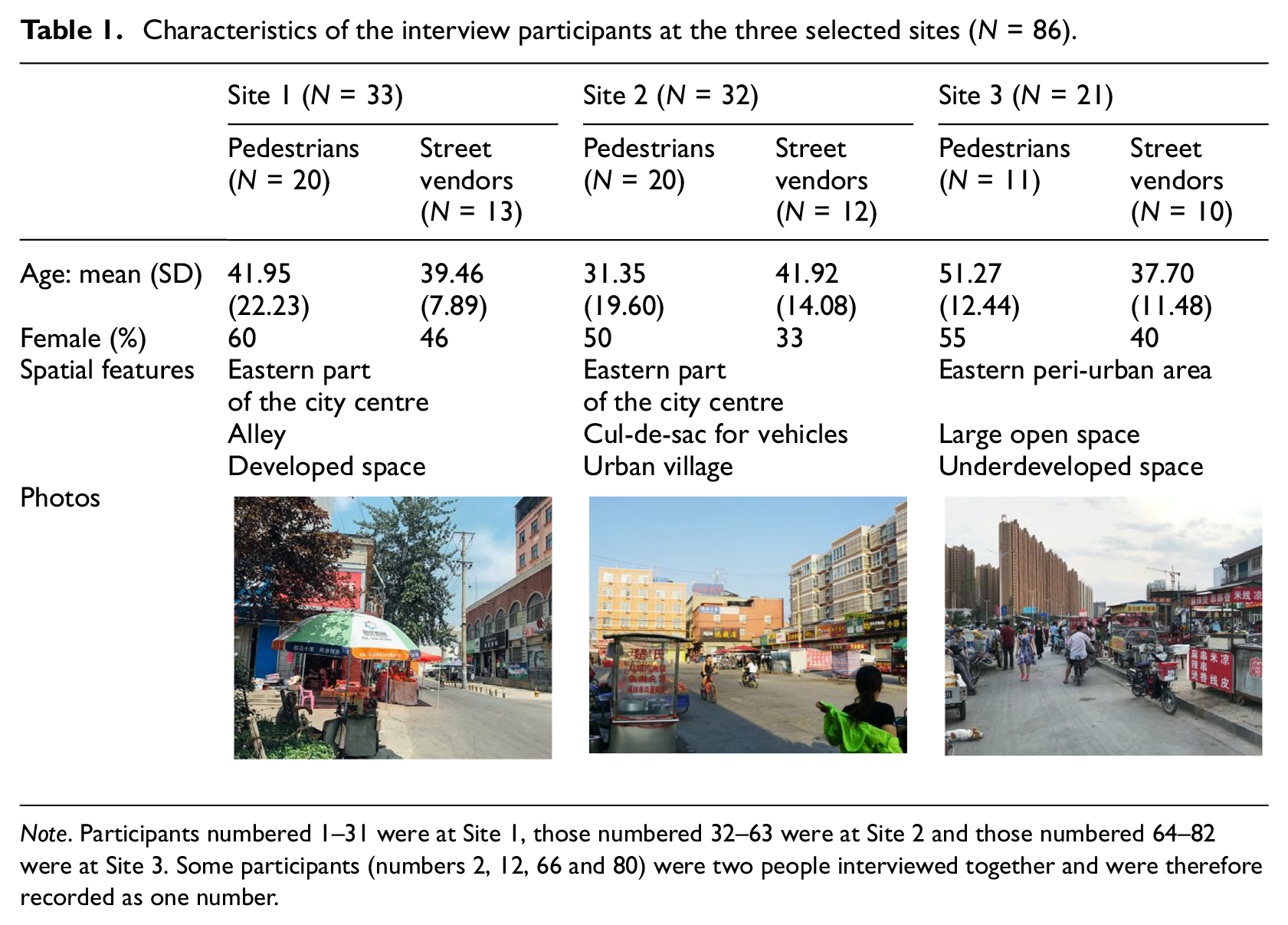
Note. Participants numbered 1–31 were at Site 1, those numbered 32–63 were at Site 2 and those numbered 64–82 were at Site 3. Some participants (numbers 2, 12, 66 and 80) were two people interviewed together and were therefore recorded as one number.
Semi-structured interviews were conducted at the selected sites. The three main questions were: Why do you come here (primary and secondary reasons, etc.)? How often do you come here (If often, when do you come and leave here)? How long does it take you to walk here from home? In order to increase efficiency, the maximum interview duration was kept to 20 minutes. The abbreviation coding for the respondents was: F for female, M for male, C for children (0–17 years), A for late adolescents (18–25 years), Y for young people (26–35 years), M for middle-aged people (36–59 years) and O for older people (60+ years). This age distribution was similar to that used in other studies (Lin and Gaubatz, 2017; Sun et al., 2020). Eighty-six randomly sampled participants interviewed in July 2017 were involved in the analysis, of whom 43 were female. The numbers of pedestrians and street vendors/shop owners were 48 and 38, respectively, as some couples were interviewed (Table 1).
Using NVivo 11 and based on Braun and Clarke’s (2006) six phases, I analysed the interview material. In phase 1, the interview transcripts were combined and revisited in order to obtain a general sense of the time and space and to examine similarity and singularity. From phase 2 to phase 5, the transcripts were repeatedly coded in order to capture concealed meanings and two research themes were extracted. Daily rhythm concerns when people appear or leave, associated with what they do at specific times, and is coded from, for example, ‘coming here around 05.00 in the morning’ and ‘selling in another area in the afternoon’. Long-standing rhythm is about how long people have lived/move in the neighbourhoods and why, and is coded, for example, ‘from a few years ago’ and ‘since 2008’. In the last phase, the two themes were further analysed in different situations in relation to the framework of arrhythmia, polyrhythmia and eurhythmia. The findings were combined or refined to produce persuasive and insightful narratives, leading to an understanding of a series of forms of walking and vending as well as modes of production of walkable space in local contexts, and these were classified into the categories below.
Daily rhythm: ‘Breakfast’, ‘whole day existence’, ‘speciality’
Eurhythmic prelude: Breakfast
‘Eurhythmia […] presupposes the association of different rhythms’ in normal everydayness (Lefebvre, 2004: 67). I further expand the eurhythmia in relation to stability and cyclical repetition. Compared with other vending types, selling breakfast (MM51, MA65, FM75 and MM79) indicated a series of similar cyclical repetitions with a stable rhythm. For instance, MM79 noted: I wake up at 03.00 to prepare breakfast and start to come here at 05.00 … There are a lot of people between 07.00 and 08.00 … Usually, I sell out of all my food around 10.00 and start to pack up my stall after 10.30.
As Lefebvre (2004: 23) stresses, ‘[…] the act of rhythmanalysis integrates these things – this wall, this table, these trees – in a dramatic becoming, in an ensemble full of meaning, transforming them no longer into diverse things, but into presences’. In my study, the sequential actions and cyclical rhythms of street vendors’ preparation at home are closely integrated into the knowledge of the potential pedestrians in the street. For example, selling out of all prepared food at around 10.00 indicated that vendors were able to estimate how many customers would be there from 05.00 to 10.00, and how much food they would therefore need to prepare between 03.00 and 05.00. This suggests an iterative process where the quantity is refined to sell out by a certain time. After the preparation, the subsequent rhythm of selling would be: first, setting up the stall and capturing the earliest urban pedestrians at 05.00–07.00 (i.e. time-walking spatiality of special occupations, such as construction workers); second, fully capturing the highest pedestrian flow at peak hours (i.e. 07.00–08.00); and third, selling the remaining prepared food to a much reduced flow of pedestrians after 09.00. A few vendors selling breakfast noted that they might stay here one more hour at the weekends, as people come late. In general, those vendors’ starting time was more fixed, and their ending time more flexible (e.g. MA65 noted leaving around 11.00). This reveals that selling breakfast contains a eurhythmia – as a prelude embodied in the collective rhythm of local everyday lives. This rhythm is a simple and intriguing prelude to the complex chorus that follows.
Drawing on there being similar cyclical repetitions of breakfast selling at all three sites, I assume that the emerging time of this eurhythmia appears to be co-produced by an imperative and global system that is less impacted by local environments. Further, I observe that a mixed-use neighbourhood environment offers more options to local residents, leading to breakfast vendors and pedestrians being dispersed across various street corners at Sites 1 and 2. In underdeveloped and less walkable areas, such as Site 3, they are more concentrated in a particular place (Sun et al., 2019). Additionally, ‘[the rhythmanalyst’s] act, his deed [geste], relates to reason’ (Lefebvre, 2004: 25). This paper found that the vendors selling breakfast were the rhythmanalyst, playing multiple roles underpinned by different time-related reasons – producer during daily preparation, seller every morning, urban observer (e.g. understanding spatio-temporal usages and predicting pedestrians’ needs) and spatial agent (e.g. temporarily mediating between pedestrians’ morning collective need and the affordance of the fixed built environment).
Polyrhythmic multiplicity: Whole day existence
Apart from selling breakfast, some vendors (MM19, MM52, FM53 and MY64) who sold cooked food indicated a longer selling time, sometimes from 06.00 until 23.00. In the morning, they clearly co-exist with the rhythms of selling breakfast and the emerging pedestrians at peak hours, co-producing a polyrhythmia. Lefebvre (2004: 30) notes that ‘[t]he night does not interrupt the diurnal rhythms but modifies them, and above all slows them down’. This paper highlights how the rhythm of selling cooked food changes in relation to the slow and diverse pedestrians during recreational time when they are not working. For example, MY64 said: I come here [Site 3] at 07.00–10.00 every day to sell snacks. I stay longer if my business is better at night. It is uncertain. I will move my stall to the gate of the elementary school, when it is not the summer holiday.
MY64 indicated that the selling tactics of these vendors differ from those of vendors selling breakfast, who emerge only for the high-intensity periods of pedestrian movement in the morning. According to the principle of polyrhythmic multiplicity, the fast rhythm presents as busy, hurried and intensive, and is described as accelerated, repetitive and homogenised (Marcu, 2017). I found that the practices and forms of, and reasons for, walking and vending in the morning conformed to this principle. For instance, these vendors generally appeared later than those selling breakfast, closely aligning with the morning peak hours and serving those pedestrians who are usually in a hurry and have a unified need to eat quickly. This co-exists with the fast rhythm of common lives rather than with special occupations, to ensure that sufficient daily profit is made during a short but intense period. With these vendors’ presence, the prelude gradually becomes complex and accelerated, and reaches a climax, turning into the polyrhythm.
The slow rhythm is portrayed as recreational, unhurried and fluid, and is described as flexible, moderative and heterogenised (Marcu, 2017). MY64 noted that, after having a rest during off-peak hours, these vendors generally come out again from late afternoon until into the evening, to serve heterogeneous crowds. Although the evening peak hour can be predictable, the number of people with customer intensity and impulse, and the length of time people spend and their motivations appear unpredictable and manifold in terms of the time–space features of recreational periods. Unlike those selling breakfast, these vendors did not mention the need to sell all their items every day or by a fixed leaving time. Unlike in the morning, the evening tactic enhances their daily profits as much as possible, rather than ensuring them. This suggests that they use their time to exchange the profits and to deal with the uncertainty and heterogeneity. I found that the evening polyrhythmia had a multiple and loose rhythm, slowing towards the end, as a ritardando. I differentiate between the fast and slow rhythms in the specific context and underline the idea of indissolubility of time and space (Lefebvre, 2004).
This paper also differentiates between pedestrians and vendors. Walking as a form of tactical practice constantly feels and perceives the outside environment. The feeling and perception are constantly weaving, attaching and disconnecting, as well as constantly creating and mutating (de Certeau, 1984; Harrison, 2000). Compared with pedestrians, street vendors selling cooked food magnify this idea, being more sensitive and knowing the multiple rhythms of a specific street because of their long-standing existence there. Over time, the weaving, attaching and disconnecting temporarily become stable and regular, creating different and co-existing rhythms that transform into a hybrid polyrhythmia, in line with complex and interactional rhythms (Simpson, 2008). I found that this polyrhythmia interconnected tactics and practices of street vending, needs and times of pedestrian movement, and characteristics of nearby amenities and the built environment. In short, the long-standing vendors selling cooked food as a senior rhythmanalyst reveal the existence of a polyrhythmic multiplicity, co-existing with and attuned to the ever-changing rhythms of local daily lives. Namely, unlike other vendors, they analysed the environmental characteristics and grasped differences between the fast morning and slow evening rhythms of dynamic pedestrians, and then developed heterogeneous tactics accordingly to maximise efficiency at different times of the day.
Eurhythmic and arrhythmic relations: Speciality
Some vendors selling cooked food (e.g. MA44, F/MY66 and FM67) emerged only in the evening and stayed until midnight. Unlike the complex and multiple rhythms of whole day selling, this reveals a eurhythmic relation, offering a clear and direct way of thinking about the co-practice and co-existence of everyday street life, particularly the space and time relations of different actors. As F/MY66 noted: We usually come out at 16.00 until 23.00 to sell fried [vegetable and meat] balls. It’s for cravings [not for hunger]. Our main customers are the waiters/waitresses from nearby hotels.
This reveals a similar rationale to that of the vendors selling breakfast. However, unlike the fast morning rhythms, these varying forms of vending not only reflect complexity and diversity but also adhere to non-functional meanings (e.g. cravings) as an unnecessary but crucial feature of slow rhythms in the recreational periods. In addition, that the people emerged late onto the public streets implies a special rhythm. For example, hotel or nightclub workers served common leisure activities and did not have time to eat during recreational periods, therefore generally emerging late at midnight as special urban pedestrians. Some vendors emerged until 01.00 to serve specific occupations, such as those working in hotels, karaoke bars and night clubs. This means that the special rhythm of street vending at midnight seems to detach from the polyrhythmia of local common lives, while specific occupations adhere to it (Figure 1). This special rhythm of street vending is more responsive and flexible and is closely related to the last urban pedestrians in order to maximally increase income. According to the notion of normed and ‘associated rhythms’ in the state of health (Lefebvre, 2004: 68), I interpret this eurhythmic relation as a harmonious and stable interaction between the special rhythms of vendors and pedestrians, particularly their regular emergence onto public streets at midnight.
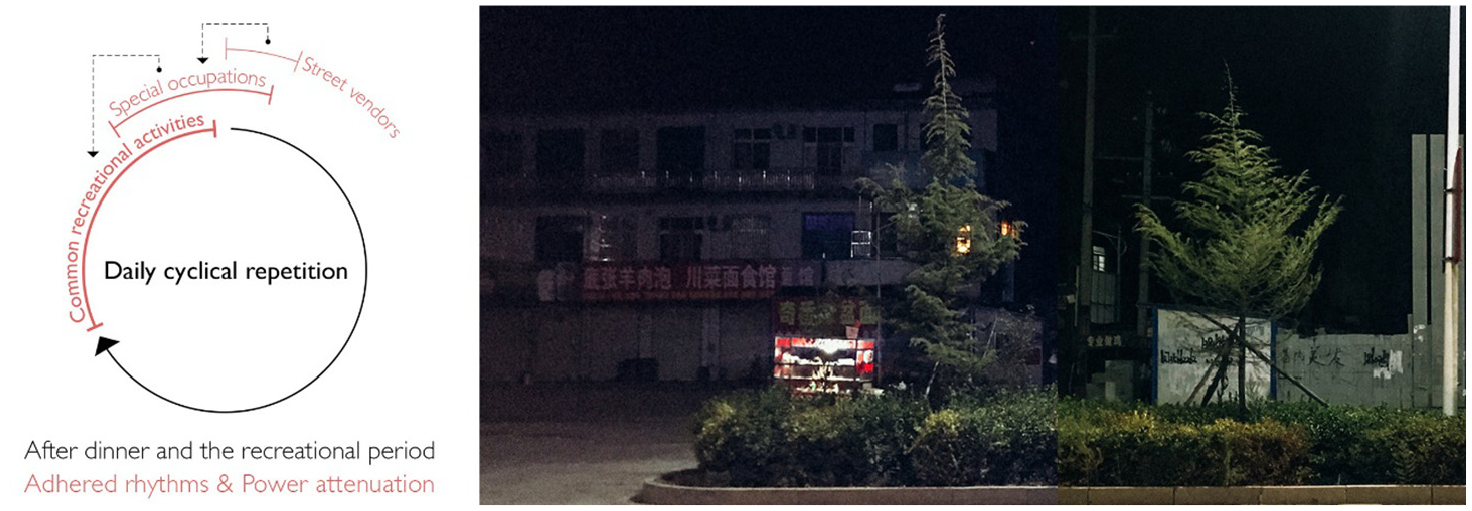
Diagram showing the space and time relations between different groups of people leaving urban streets after dinner (i.e. the recreational period); photo illustrating a few vendors at Site 3 selling cooked food for the last urban pedestrians at 01.00.
The walking form of special pedestrians should be differently understood. The built environment with its various amenities might be more related to ordinary walking forms and increasing common walkability (Giles-Corti et al., 2016; Sun et al., 2020) but less connected to minority pedestrians. For instance, all facilities and shops are likely to be closed after these pedestrians finish work. This reveals that the common rhythms of masses of pedestrians have strong collective powers, closely interacting with the physical environment and other rhythms, as per the hybrid polyrhythmia defined as ‘interrelated rhythms functioning independently of one another, but influencing each other’ (Simpson, 2008: 816). I found that although the special rhythm of special pedestrians might create less impact, it adhered to common everyday lives and generated a niche walking that tended to emerge in areas with low rental costs, producing a eurhythmia, which merits further detailed study.
‘In arrhythmia, rhythms break apart, alter and bypass synchronisation’ (Lefebvre, 2004: 67). Some long-standing vendors reported an arrhythmia, changing their regular rhythm as a result of unexpected accidents. FM21 mentioned: I open my shop at 05.00 every day. I have to work hard to pay the basic expenses because my husband is ill … Our home and shop are together, so there is no time to waste on the street … we are unwilling to spend money.
This reveals that working for a long time is the only way to address the negative of uncertainty. These vendors sacrificed their everyday lives to maximally facilitate multiple rhythms and grasp every potential customer, with a monotonous selling action during the whole day. I found that this maximisation produced a series of predictable tactics, such as home and shop together, less walking around and longest time in a fixed spot. Given this, the vendors might walk (or carry out physical/enjoyable activities for themselves) as little as possible, although they facilitate the activities of others and increase environmental walkability. Their income might reach the average level and even exceed it (Lin and Gaubatz, 2017; Whyte, 2012) but saving money leads to there being no rhythms of capital (Potts, 2015), no services and less investment for them, unlike with the special occupations. Hence, this paper highlights how these vendors are more associated with the heterogeneous rhythms of pedestrians because of the arrhythmia of their everyday lives.
Long-standing rhythm: ‘Standby’, ‘education’, ‘development’
Another interesting emerging theme was related not to daily rhythms but to the people who had first moved to the sites. For instance, respondents (MY15, FM25, MA39, FY48 and FM55) reported that they had moved into Sites 1 and 2 around 10–20 years previously, they had relatively regular rhythms integrated with multiple actors and they had close social relations with other people.
The exception of arrhythmia: Standby demand and decades
Lefebvre (2004: 20) comments on ‘the exception of disturbances (arrhythmia) that sooner or later become illness’. I further develop the arrhythmia of normal everydayness and present novel additions to advance two notions of ‘familiar’ and ‘recovery’. For example, MY15 mentioned: I live nearby and moved here in 2008. I set up a car-repair stall, but when my customers call me, I provide an at-home service to repair motorcycle taxis and cars. I have regular customers and it’s hard to find new ones.
Along with other similar vendors and shop owners (e.g. the locksmith, mechanic, doctor and tailor), MY15 indicated that during their long-standing existence serving the arrhythmia of nearby pedestrians, they were familiar with almost all potential customers in the surrounding neighbourhoods. Their business had become relatively stable and less impacted by the built environment; for example, they noted that a lower level of shopfront transparency did not influence their business. Given this, I came to realise that when the nearby residents have arrhythmia there is less choice, and the form of walking automatically happens between the fixed locations of the special vendors/shops and a resident’s home, which produces a familiar eurhythmia at the time.
Many old Chinese neighbourhoods often include a small number of practices of special vendors/shop owners in some inconspicuous areas, practices that are unlike the everyday rhythms of selling breakfast and vegetables. According to Deleuze: Under the huge earth-shattering events are tiny silent events, which [Nietzsche] likens to the creation of new worlds … a reinterpretation of the world. (Deleuze, 2004: 130)
In my understanding, these ‘tiny imperceptible vendors’ (e.g. the locksmith and mechanic) reinterpret a special form of walking that emerges in the exceptional state, and their significance and meanings can be grasped only from the historical process. For example, the arrhythmia of being locked out is not something that happens regularly, nor can it be ignored when it emerges. It is more like an accident that presents a threat to the normal state of everyday life and it cannot be addressed by non-professionals. When this arrhythmic state emerges, the residents need to find a reliable expert to address the problem as soon as possible, so as to recover the normal state. I found that this arrhythmia had the dual feature of being unpredictable and having the potential to emerge at any time. The possibilities, exceptional states and special skills, as the intrinsic values of residential neighbourhoods and the vital need for recovery, are concealed under the normal state of the neighbourhood environment and integrated with the polyrhythmia and eurhythmia of common everyday lives.
‘[T]the rhythmanalyst does not have the right to provoke an accident’ (Lefebvre, 2004: 21). Although the occasional and unstable arrhythmic accident leads to fewer practices and practitioners, I argue that the immediate and necessary power keeps the special vendors, as the rhythmanalyst, on standby, both existing in residential neighbourhoods for a long time and familiar with most customers. The resultant arrhythmic practices seem to be unremarkable, unpredictable and uncertain in the normal state, but the few vendors/shops play an irreplaceable role when an accident happens. Over time, the relation between the special vendors and various customers becomes extremely strong in every old Chinese neighbourhood, revealing a fixed walking distance with a series of default actions during the exceptional state as a short period of arrhythmia for recovery in the long-standing rhythm, and a familiar eurhythmia at the time.
Eurhythmia for the education process: The destination and years
Some pedestrians (M/MC02, FM18, FC33, MC34, FA37 and MM52) who moved to Sites 1 and 2 a few years ago referred to children’s education. For instance, FC33 noted: I have been living here [Site 2] since I studied at the Yifu elementary school [a few years ago]. Now I am studying at Yuncheng middle/high school [around 1000 m away from here] … A lot of people live here because of the schools.
This reveals a long-standing rhythm of children’s development in relation to two schools. Yifu elementary school is a high-quality public school with a defined catchment area. Yuncheng school is one of the best middle/high public schools in the city but its admission requirement depends on the school entrance examination rather than on a mandatory geographic boundary. I found that going to Yuncheng high school is not a current aim but rather a predictable ultimate and single goal that comes years after families decide to move to this area and their children start studying at Yifu elementary school. In other words, studying at Yuncheng school was seen, towards the beginning, as something that was coming and there was, therefore, a close association between Yifu school and Yuncheng school that forced some parents and their children to live in Sites 1 and 2, producing a eurhythmia for children’s education.
Considering the two schools as a whole (Figure 2), following Simpson’s argument for linking different terms together in a dialectical relation (Simpson, 2008), long-standing residency in Sites 1 and 2 has two pedestrian features for this eurhythmia. First, this area is in an urban village, so the rental costs and living expenses are relatively low. This paper reveals how higher accessibility to the Yuncheng school was likely to increase the cost of housing and produce high-quality buildings, which might exclude students from low-income families in the nearby area (Figure 2). Low-income families had to look for an area with lower accessibility to live in, and they walked or cycled to the school for around 15–20 minutes almost every day (e.g. MC02, FC33, MA42 and FM77). This fixed and predictable walking flow engaged some street vendors along the main road at specific times, which were closely related to the cyclical rhythm and long intervals of the school. As Lefebvre (2004: 30) highlights, ‘[schoolchildren] would be more cyclical, of large and simple intervals’.
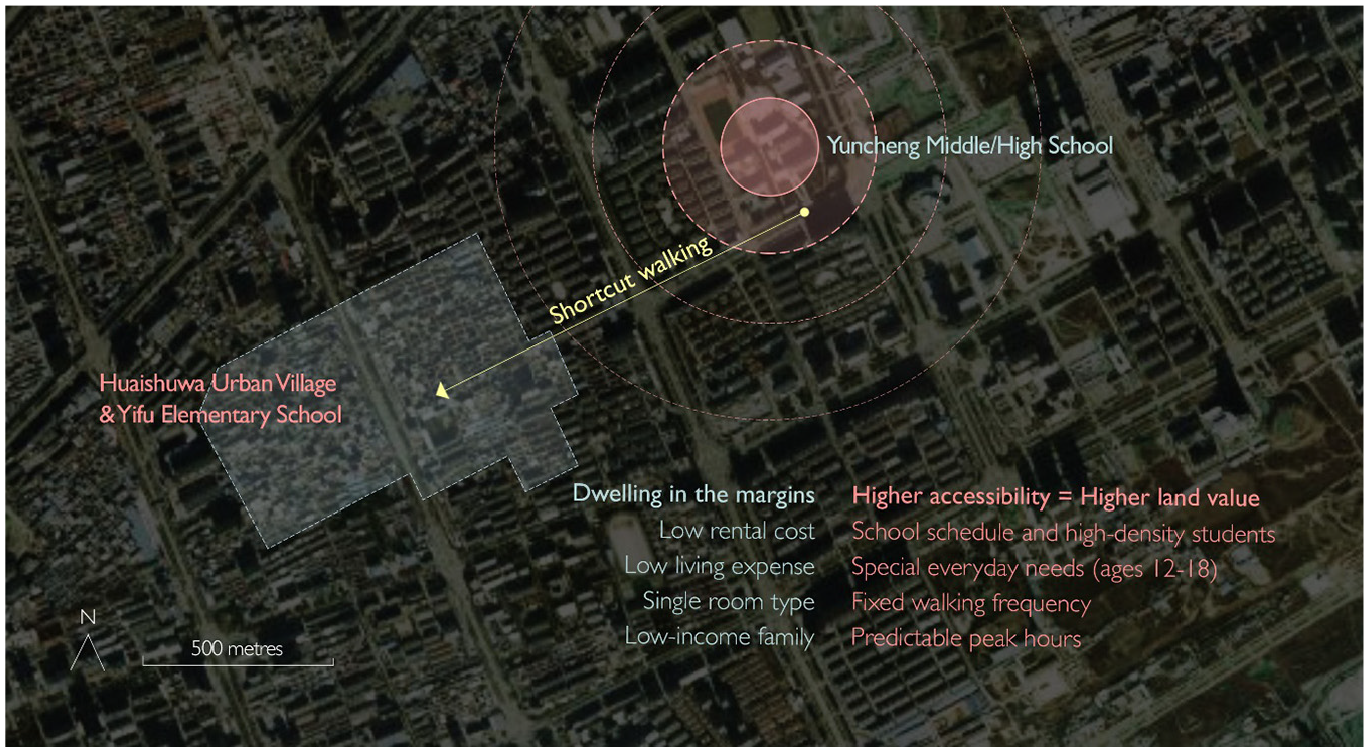
Spatial associations for the special amenity of middle/high school.
Second, as an age-related feature of pedestrians in elementary schools (6–12 years), living in closer proximity and crossing fewer streets can increase safety for children when going to school and playing around the area (D’Haese et al., 2015). As most parents have to work, taking care of children in large numbers at school becomes a commercial opportunity, causing the area around schools to include plentiful and varied educational amenities, such as after-school homework tutoring and the teaching of special skills. Other amenities for children also emerged, such as the selling of toys and stationery (Sun et al., 2020). I think that the neighbourhood environment is significantly impacted and transformed by the rhythms of children over time. Moreover, many similar growth processes relating to child development overlap and are metabolised, circulating in the area repeatedly; for example, some families eventually move out and new families move in. Eurhythmia ‘may be understood as an aspect of movement and a becoming in which cyclical rhythms are wrapped in harmonious rhythms of mental and social function’ (Lefebvre, 2004: 8, quoted in Marcu, 2017: 413). I believe that this cyclical repetition constantly transforms the built environment and produces regular vending rhythms to suit the special eurhythmia of the education process.
Rhythmic change: The development in peri-urban areas
In the peri-urban area at Site 3, the long-standing rhythm presents a rhythmic change regarding the rapid development and the high-density urban sprawl. For example, FM75 claimed: I used to live in the village. Now I’ve moved out, but my home is not far from here. The place was originally very messy. After the government flattened the ground, it became useful. I have been selling breakfast here for three years. Our customers used to be construction workers, but they are now fewer.
Some long-standing vendors selling cooked food (FM67, FM75, MM79 and MO82) indicated that, in the beginning, the ground was just farmland with no streets, as in the countryside. Owing to the low land-value and the beautiful natural environment, including a large lake, the area was developed in around 2010 – for example, many construction projects for high-density buildings and the largest park were built in this period (Sun et al., 2019). As such, large numbers of construction workers temporarily emerged, and their everyday basic demands (e.g. eating) became a great opportunity for street vendors in the earlier stages of rapid development, producing a simple and unified eurhythmia. As some vendors noted, their business fared better years ago when there was less competition and the emerging times, or everyday rhythm, of construction workers were more predictable and monotonous.
Over time, as some street vendors and shop owners emerged and became attuned to the surrounding communities and the total number of residents increased, the ontological forces (e.g. everyday demand, culture, economy and society) were accordingly transformed. This relates to the more linear and cyclical repetitions that constantly interfere with one another and produce differences (Deleuze, 2014; Lefebvre, 2004). I identify the transitional rhythms of everyday walking and vending through the development process. This process is irreversible and inevitable, and is associated with the constant transformations of the built environment, nearby amenities and temporary vendors. The eurhythmic relation between construction workers and vendors become complex polyrhythmic relations, with various demands and supplies from multiple rhythms of people. It is also worth noting that the transitional rhythms might occur in other peri-urban areas of Chinese cities. Compared with the city centre, the interference and rhythmic change in the peri-urban area are more dramatic, with increasingly varied actors.
Conclusions
Marcu (2017) outlines a practical framework of eurhythmia, polyrhythmia and arrhythmia and considers the interviewees themselves in the analysis. I further expand his idea to consider street vendors as the rhythmanalyst, and present new additions to advance the theoretical and empirical understandings of time–space rhythms in relation to multiple forms of vending and walking. Drawing on the adapted framework of eurhythmia, polyrhythmia and arrhythmia with on-site observation and 86 interviews at three specific sites in Yuncheng, this paper identifies and analyses six categories of daily and long-standing rhythms in the context of vending–walking space. The fine-grained narratives in the six categories contribute to a better understanding of why street vending and walking emerge and how they (co-/re-) produce a transient walkable space in low-tier Chinese cities, something that has often been overlooked in specific, real and detailed ways.
Previous studies on walkability have mainly focused on static spatial attributes or demographic characteristics. Although some studies have identified physiological or socio-cultural differences, the results might be misleading for niche groups of street vendors/shop owners and special occupations. There are many studies that critique homogeneity and attempt to provoke heterogeneities in our cities. For instance, the practices of everyday life might lose their stability but obtain efficiency, functionality and flexibility (de Certeau, 1984), which certainly aligns with my study of vendors’ heterogeneous rhythms. However, what is at stake here is not efficiency or supporting the heterogeneities themselves but an understanding of the consequences of being heterogeneities and niche groups. Compared with common lives, what do they sacrifice and what are their everyday rhythms? We need to ascertain how the trade-off for niche groups operates in a complex network with multiple rhythms.
Undoubtedly, the street vendors as the rhythmanalyst are flexibly and efficiently related to the ever-changing rhythms of nearby residents; meanwhile, they resist the capital operation for themselves. On the one hand, the built environment is transformed over time to fit the common everyday rhythms of nearby residents. It disconnects the rhythms of vendors (e.g. less investment for them), leading to minimal environment–behaviour interaction and invalidation of environmental walkability for them in the same neighbourhood. On the other hand, in daily cyclical repetition the vendors sacrifice their time by adhering to common rhythms. During their recreational time, not only are they too tired to undertake physical activities but also most amenities are likely to be closed. As presented above, homogeneity (e.g. the rhythms of common everyday lives) and heterogeneity (e.g. the rhythms of niche groups) co-existed and involved the multiplicities of time, space, body, society, culture, economy, education, demand and supply. The different sets of combinations and associations may reveal different rhythms of vending and walking, and the time–space meanings are able to be (re-)examined through the eurhythmia, polyrhythmia and arrhythmia, which need to be thoroughly investigated in small Chinese cities.
Supplemental Material
sj-pdf-1-usj-10.1177_0042098021997044 – Supplemental material for A rhythmanalysis approach to understanding the vending-walking forms and everyday use of urban street space in Yuncheng, China
Supplemental material, sj-pdf-1-usj-10.1177_0042098021997044 for A rhythmanalysis approach to understanding the vending-walking forms and everyday use of urban street space in Yuncheng, China by Ziwen Sun in Urban Studies
Footnotes
Acknowledgements
I wish to thank the residents of Yuncheng for agreeing to interviews and sharing grounded information. I would like to thank Dr Simon Bell and Mr Iain Scott, who supervised this PhD project over 4 years at the University of Edinburgh. I also acknowledge the 16 ‘Walking Practice’ workshop participants, Prof. Catharine Ward-Thompson, Dr Tahl Kaminer, Dr Mathew White, Dr Xi Chen and Mr Chengrun Li who contributed fruitful discussions and/or facilitated the interviews. Finally, I would like to thank Prof. Shenjing He and Dr Beisi Jia, who made valuable comments after my presentation at the University of Hong Kong.
Declaration of conflicting interests
The author declared no potential conflicts of interest with respect to the research, authorship and/or publication of this article.
Funding
The author disclosed receipt of the following financial support for the research, authorship and/or publication of this article: This study was supported by the International Collaboration from National Key Laboratory of South China University of Technology [2020ZA01]; Young Scholars’ Academic Initiation Programme from Beijing Institute of Technology; China Ministry of Housing and Urban-Rural Development [K22018130].

Supplemental material
Supplemental material for this article is available online.
References
Supplementary Material
Please find the following supplemental material available below.
For Open Access articles published under a Creative Commons License, all supplemental material carries the same license as the article it is associated with.
For non-Open Access articles published, all supplemental material carries a non-exclusive license, and permission requests for re-use of supplemental material or any part of supplemental material shall be sent directly to the copyright owner as specified in the copyright notice associated with the article.
