




Abstract
This paper shows how the capture and circulation of data about social lives are enabled through digitalisation and market logics and practices. Drawing on Australia's new Consumer Data Right, a state-led initiative that creates access rights to personal data, we distinguish between market promises and the translation of market models in actually existing markets and regulatory frameworks. ‘Life's work’ is brought to market through promises to fix the problems of essential service markets by harnessing data. We argue that the Consumer Data Right is underpinned by a more ambitious vision to create future markets that transcend individual sectors through aggregation across the economy. These visions are silent on how the data, which cannot be owned and therefore cannot be commoditised, is capitalised. We show the Consumer Data Right's discursive, administrative, regulatory and technical aspects through which the previously hard-to-penetrate spaces of the home and everyday life become enrolled in circuits of value, both present and future. This involves technical standard setting by state agencies for accreditation, consent and approval processes; discourses of trust and calculative devices to promote consumer control; and weak de-identification and deletion requirements that grant data an afterlife beyond the original agreed use. This paper calls for greater attention to the enabling role of the state in digital markets as a counterbalance to the focus on the state's regulatory and constraining role. We argue for a more staged approach to market-making analysis to show how the state lays the market foundations that can then be deepened through practices of intermediation and capitalisation by private firms.
Keywords
Introduction
The digitalisation of everyday life is a defining characteristic of the 21st century. Smart devices, sensors, online browsing histories and social media all generate an ever-accelerating volume of high-resolution, real-time, geo-located and exhaustive data points about the intimate and prosaic behaviours of vast populations in space and time. The development of complementary capabilities in big data techniques such as machine learning is expanding our ability to extract insights from this datafication (Kitchin, 2014). These new capabilities and techniques underpin claims about the limitless possibilities of ‘smart’ (Sadowski and Bendor, 2019, Wiig, 2016).
One of the promissory logics legitimising the digitalisation and datafication of everyday life is the entrepreneurial utopia of new market frontiers: of the lubrication of existing markets for ever-greater efficiency and of innovating new and barely imaginable products and services not to mention the myriad commercial possibilities of the Internet of Things (e.g. PWC 2014). Big data holders are now in the business of ‘selling human futures’ (Zuboff, 2019), raising serious concerns about both the social and democratic costs of such a transformation. Yet there remains a relative lack of attention to case studies showing how markets are being constituted by the datafication of social lives in ways that were previously ‘off-limits’ for value creation and exchange. Digital technological developments, like smart meters, have made it possible to visualise in granular detail the everyday processes of social reproduction. However, a critical challenge in going from visualising to valuing highly personal data is how to disentangle it from the sensitivities of its originating context – the everyday life of work and home and all the attendant issues of privacy and intimacy.
The data capitalism literature has explored the imperative to collect ever greater amounts of data (Fourcade and Healy, 2017); data as an endless source of value creation (Srnicek, 2016) including its transformation of data into an asset (Birch et al., 2020); and as a form of extraction based on exploitation and inequity (Fourcade and Healy, 2013; Thatcher et al., 2016; Sadowski, 2020). The rise of Big Tech and the nature of firm power through control of data has been the subject of significant analysis (Perzanowski and Schultz, 2016; West 2019; Srinivasan, 2020) with some going so far as to argue that the growth of firm power will eventually eliminate market exchange altogether leading to rule by data (Pistor, 2020). In this paper, we explore the relationship between data and capitalist processes of accumulation, but turn our attention to the role of the state. The focus on firms in the literature has come at the expense of a more fine-grained analysis of how the state enables and inhibits markets for data. This occurs not just through its privacy regulation role or its authoritative powers to collect data and surveil citizens (Zuboff, 2015) but in its capacity to make and mend markets.
We argue that greater attention to the role of the state is needed to understand how the minutiae of everyday life are transformed into consumer data and the struggles inherent in the market-making process. We focus on the plethora of consumer data generated through the use of everyday utility services – areas of service provision at the heart of social reproduction. Banking, telecommunications and energy are the key sectors targeted in our case study, Australia's new Consumer Data Right (CDR). Prior to the CDR, access to personal data relating to oneself or products and services such as banking transaction histories, or energy and telecommunications usage data, was constrained and difficult to access. The CDR changes this by creating a right to access and transfer this data to third parties and promises that ‘improved data access and use can enable new products and services that transform everyday life, drive efficiency and safety, create productivity gains and allow better decision making’ (Productivity Commission, 2017). The development of the CDR provides a window into the motivations, mechanisms and challenges of turning everyday life into new market frontiers. 1 We show how the state is seeking to enable the mobility and aggregation of data across essential service markets through standardisation and calculative mechanisms of trust and control and enhancing some privacy constraints but also passively allowing the extension of the afterlife of data with limited protections.
Our argument unfolds as follows. Section 2 reviews literature on social reproduction and market-making through deep digitalisation. Sections 3 and 4 delve into the CDR case study exploring its nature and origins and consequent geographies of data governance. We show how marketisation of private household data is shaped by struggles for control over data which relate to political-economic questions about the underlying value form and the type of market that is in the making. Section 5 discusses the implications for our understanding of the marketisation of social reproduction, and explains the key processes involved in aggregating data to create current and future value.
This paper emerged from two complementary projects: the !rst on Digital Poverty and Competitive Metering and the second examining market-regulatory models for smart meter deployment used in Australian and German jurisdictions (see Kallies et al., 2019). Both coincided with the development of Australia's CDR and the EU's General Data Protection Right. The CDR shares some of the goals of the EU Single Digital Market for legal and technical interoperability across space, and also the goals of the European GDPR and the California Consumer Privacy Act of protecting the sovereignty of users over the data that they produce through consent and transparency provision. It differs from both in that it is a whole of economy undertaking, that its ambition is cross-sectoral and intended to drive national economic growth (see Section 4), and unlike the UK government's Midata initiative, it is not voluntary but state-led and enforced. Both research projects are also located within a longitudinal program of research into the structural reforms of Australia's electricity sector (Chandrashekeran 2016, 2020). The paper draws on the interviews, stakeholder workshops, industry presentations and document analysis for both projects, spanning 2016–2019, supplemented by desktop analysis of documents constituting debates and reforms associated with the Data Right's development and implementation.
Transforming everyday services through markets: Deep digitalisation and value creation
Everyday services – from energy to banking to telecommunications – provide the enabling conditions for contemporary life. Energy powers our technologies and key infrastructure systems. Telecommunications keep us connected across space and time, accelerating transactions and interactions and reconfiguring boundaries between work and leisure/home. Banking grants us access to wages, facilitates near-instant transactions and creates systems of indebtedness that reproduce our lifestyles. These enabling services, these ‘basic necessities’ (Roberts, 2008:545), are fundamental to social reproduction, defined to encompass ‘daily life and long term reproduction, both of the means of production and the labour power to make them work’ (Katz, 2001:711) as well as the reproduction of ‘skills, knowledge and moral values’ (Roberts, 2008:545).
In many liberal democracies in the last century, essential services have shifted from state ownership and guaranteed universal service provision to privatised and mainly market modes of provision. Neoclassical logics of the self-regulating market locate agency in nuanced preferences of atomised consumers and the profit-making ambitions of small firms engaged in competition. However, numerous developments in actually existing essential service markets have punctured the narrative of utopian markets, such as persistent concentration of market power and vertical reintegration (Christophers, 2014); the growing role of state-led regulatory regimes (Cahill, 2020); and network failures and fragmentation (Graham, 2010). Nonetheless, neoclassical market scripts remain powerful performative devices (Callon and Muniesa, 2005; Callon, 2007) that feature in political struggles and are integral to processes of market formation, reproduction and remaking networked infrastructures (Berndt and Boeckler, 2011).
Digitalisation provides a new lever for market fundamentalists and Big Tech to crank the engines of marketisation and expand reach further into the sphere of social reproduction. Digitalisation involves more than material technologies, extending to sociotechnical artefacts and ‘the orderings of everyday life’ shaped by digital mediums and discursive logics extending the reach of digital technologies (Ash et al., 2018: 26). The digitalisation of everyday life enhances the ability to track, score and rate aspects of everyday life and this data is used to differentiate products and services in terms of offers, prices, marketing strategies and probabilities (of repayment, health, performance, crime, etc.) (Fourcade and Healy, 2017). This enhances the ability to extract profit via sophisticated classification mechanisms. This in turn enables ‘splintering urbanism’ whereby the most lucrative customer segments are targeted with premium service provision leaving other ‘cold’ zones un(der)served (Graham and Marvin, 2001). The sweeping digitalisation of enabling services is generating vast datasets that reveal the intimate and near real-time movements and consumption patterns of households. Much of this data is held by essential service providers who remain subject to strong privacy and customer protection regulation in many Western liberal democracies. These service providers remain a critical frontier in the quest for traceable data, what Fourcade and Healy (2017) term the ‘data imperative’.
The social reproduction literature has analysed digitally enabled social reproductive labour via the market. But it has had less to say about the processes of value creation that arise from seeing deep into the worlds of unpaid labour and care. Schwiter and Steiner (2020) argue that the commodification of digitally enabled care services is built on the back of exploitation of an underpaid feminised workforce that devalues domestic work. Digitalisation has transformed caring practices by enabling distanciated communication (Valentine, 2006), monitoring and nudging users to self-care (Rosenberg and Waldbrook, 2017; Hayes and Moore, 2017) and the platform-based allocation of care labour (Hunt and Machingura, 2016; Huws, 2019). This underscores the continuing role of un- or low-paid reproductive labour, labour-saving technological solutions and the marketisation of household labour. In this paper, we seek to show how telecommunications, energy provision and banking link bodies, spaces and materialities of the home into chains of value creation beyond the home. In so doing, we address the gap in the social reproduction literature on how these essential insights become enrolled in processes of value creation that go beyond service provision. Unpaid work and care labour deemed ‘unproductive’ or devalued in the mainstream economy is being rendered meaningful and valuable via digitalisation of information. The question of how this is occurring is central to this paper.
The smart urbanism literature engages with the processes of datafication and social life. Dense layers of data-producing devices that are increasingly networked and integrated are now a feature of what Crang and Graham (2007) call ‘sentient cities’. These invisible sensors are embedded in the smallest quotidian spaces of human activity rendering practices of social reproduction visible and enabling new patterns of identification that are layered and cross-referenced via algorithms and then tracked over time and space (Thrift, 2014; Luque-Ayala and Marvin, 2016). Yet, the relationship between the rise of the smart city and processes of value creation and market-making is more assumed than explained. To understand how value is extracted from these processes of data generation, processing and information exchange requires a study of market-making, value creation and the associated amalgam of technical, administrative, regulatory and financial techniques (Barry, 2001).
Platforms have been shown to structure market encounters in digital space through intermediation and capitalisation (Langley and Leyshon, 2017). Code is the medium for coordinating a range of spatially distanced economic actors who seek to find each other to transact (Evans et al., 2011), but it is the cultivation of connectivity between users that differentiates the platform from earlier analogs of intermediated market exchange (see Muerleille 2020). Platforms enrol users through the demonstration of network effects: actively inducing and programming circulations of data by attracting users and co-creating value (Langley and Leyshon, 2017; Beer, 2018). Participants are enrolled as ‘users’ – not ‘consumers’ – who share data, out of which emerges a business model that extracts rent from data circulation.
As an exercise in market-making, the key human and non-human agents are the platform firms and the concealed software code, applications and shared protocols that enable participation (Beer, 2013). The state is not integral to the intermediary logic and the business model; rather it is an inconvenient limitation to be overcome. The corporate tactics of global platform firms like Uber are to bypass or disregard regulatory frameworks through strategies of ‘disruptive regulation’ (Collier et al., 2018), and to engage in ‘regulatory entrepreneurialism’ whereby changing the law is a significant part of the business plan (Pollman and Barry, 2016). In these cases, states are on the back foot seeking to play regulatory ‘catchup’ with an advancing front of platform capitalism. This work, however, does not address those cases where state agencies are key agents in unlocking the potential of data connectivity via networked spaces through processes of regulatory design and market making. The platform capitalism literature has little to say about the institutional constitution of markets through the exercise of state power (Cahill, 2020), how the market arrangements are not just conditioned but enabled by institutional arrangements, or what processes stabilise them and their alignment with the values of the society the state represents (Block, 2003; Fligstein and Mara-Drita, 1996). As Schou and Hjelholt (2019:50) argue: ‘digital state spaces’ are produced through the interaction of actors at multiple scales and through ‘national policy agendas, technological infrastructures, legal measurements and local institutions’. In this paper, we are particularly interested in how states play an integral role in creating the enabling infrastructure for digital business models. We see this as related but also distinct from the state's regulatory functions of privacy and consumer protection.
There is an emerging body of work focused on the fields of economic interactions traditionally the domain of state regulation: finance, spatial information systems, market power and so on. Alvarez León (2018a and 2018b) foregrounds the role of legal regimes in shaping the geographies of commodification and marketisation of geographical information, such as cadastral data. He shows the barriers to a single cross-jurisdictional digital market for geographic information presented by legal regimes at the subnational and national scale, and government controls over information flows. At once enabled by supranational EU regulation but constrained by territorialised intellectual property protections, a single data market is constituted slowly via inchoate processes. Rather than engaging in light-handed ex post regulation, states are characterised as crucial actors in the constitution of markets in accordance with Polanyi’s (2001) argument about the embeddedness of markets. The functional role of the law in shaping digital market spaces resonates with work on the law's role in mediating the unstable balance between monopoly and market competition (Christophers, 2016); and in structuring cross-border financial flows (Potts, 2020).
The challenge of enabling digital connections across space is particularly acute when the nature of the information is highly personalised and materialises the everyday inner workings of social reproduction. We are interested in this market frontier (Berndt et al., 2020): those spaces that are traditionally seen as ‘outside’ the scope of market-making that are being drawn in. We study the logics, contestation and devices that redefine what is inside and outside the legitimate sphere of the market. Under the platform model slices of personal life are surrendered by users in pursuit of the benefit of ‘connectivity’. Extracting value from the circulation of highly personal data can also occur through generating and charging for data insights/analysis or on-selling data in an aggregated and de-identified form. This is not without contestation, producing ‘overflows’ that platform market actors must manage or contain (Callon, 2007) and there is no shortage of recent examples of this (e.g. Hu 2020). However, the practices of social reproduction are being reconstituted in digital space in ways that go beyond the platform model. There remains a relative lack of attention to state agency in the active constitution of markets based on the data of social lives that were previously ‘off-limits’ for value creation and exchange.
This brings us to the question of how value is created out of the digital footprint of social lives. Personal data cannot be owned as property (Perzanowski and Schultz, 2016; Varian, 2019; Pistor, 2020). Rather value is primarily created through the exercising of control rights and the extraction of rent as opposed to exchange (Birch, 2020). This involves making personal data knowable and measurable as an engaged user of a particular platform or ecosystem (number and frequency of views; level of activity, etc.) (Birch et al., 2021). User data is not synonymous with the user themselves, rather ‘use’ is performatively constructed through techniques that make users measurable and legible, such as end-user licence agreements or interoperability protocols (Birch et al., 2021). Users become a source of value in a variety of ways that involve capturing digital rents, for example, by tracking user engagement and then selling access to user decisions and behaviours mainly for the predictive power this enables. User metrics become the basis for big tech firms to enclose and control access to these ‘users’ and to sell access to user decisions, actions and behaviours. This rent relation is monetised through extraction-as-service or subscription-based business models, entailing repeat revenue streams rather than one-off earnings, and allows future revenue to be capitalised (Perzanowski and Schultz, 2016; Srnicek, 2016; Sadowski, 2020; Birch et al., 2020). The logics, devices and practices (or ‘techcraft’ (Birch et al., 2021)) involved in transforming personal data into the model of users as assets is now a key accumulation strategy, and is critical to understanding the construction of data-based markets (Birch, 2017; Birch and Muniesa, 2020). Assetisation differs from the commodification and market exchange of personal data. It is the capitalisation of property and value creation through the control of access, rather than the trade in private property for exchange value. Personal data has value for firms as part of their own asset base, and the processes of valuation have been shown to be opaque and highly contingent (Birch et al., 2021). Assetisation of personal data can also be a market lubricant enabling data-based infrastructures that facilitate the trade in goods and services. The provision of informational goods that enhance consumer decision-making and match suppliers to consumers via tailored marketing can be seen in a number of domains including health (see Ebeling 2016). Data brokers capitalise everyday life by taking raw data and analysing, processing, de-identifying and aggregating it (or them).
An important step in the assetisation process is data aggregation: collecting or merging data points from many different sources and institutions to hide the identity of the data subject and create ‘anonymous’ data for analysis. Aggregation is a key manoeuvre that legitimates the wider process of data circulation and value creation. Because aggregated data is considered to be unidentifiable it is subject to relatively weak regulatory protections. For example, General Data Protection Regulation (GDPR) requirements that data controllers ensure confidentiality and consent, and notification if data is breached are only triggered if the personal data is being processed, as opposed to aggregated data considered to be unidentifiable (Veale Binns and Edwards, 2018). We explore the processes through which the state enables aggregation and de-identification of aggregated data in terms of performing a techno-economic object and extracting value. We seek to understand how these processes are interrelated and mutually constitutive in the making of markets.
Privacy, the ability or right to reveal oneself selectively to the world, looms large in the datafication of social reproduction. Privacy as a concept has been well analysed as culturally- and contextually contingent (Kitchin, 2016); and in a variety of forms (e.g. territorial, bodily, information, locational, etc.) that can be breached through unacceptable practices that produce harm (Solove, 2006). Big data and its related processes pose significant challenges for privacy protections via laws and information management principles. A key strategy to secure privacy is to anonymise data – this can occur through aggregation. However, ubiquitous machine learning strategies, such as inferential analytical techniques and predictive modelling, undermine the effectiveness of de-identification protections and breach confidentiality (Veale Binns and Edwards, 2018; Edwards, 2018). Reidentification algorithms, profiling and inference capabilities are growing in sophistication and outpacing the slower evolution of regulatory protections (Edwards and Veale, 2017). By repackaging and claiming to aggregate and de-identify data it can be repurposed in new ways without the need for consent or even notice being given. However, the potential for inference of private attributes remains and there is always a trade-off between effective methods that guarantee privacy versus data utility, and the latter frequently triumphs in the implementation (Narayanan and Shmatikov, 2010; de Montjoye et al., 2013; Zigomitros et al., 2020).
In the face of data privacy concerns, trust becomes a key ingredient to legitimise the flow of data. Digital technologies enhance interconnection across vast spaces and populations. A key challenge for data markets-in-the-making is how to build trust sufficiently to make personal data mobile and valuable? Trust is secured through the creation and enabling of a foundational market infrastructure that promotes value extraction and distribution. Economic sociology sees institutions as playing a critical role in building trust in a context where trustor and trustee have no prior relationship and interact in spatially distanciated ways (Zucker, 1986; Solove, 2007; Edwards and Veale, 2017). To transcend the constraints of privacy as a protective mechanism, the state engages in processes of trust building to enable data markets. The trustor overcomes the risks of non-performance or non-fulfillment or unauthorised use via a range of trust-enhancing processes (Granovetter, 2017). In this paper, we explore how the state facilitates interoperability and creates institutional processes of trust to unlock markets in digital information through a range of processes embedded in and through code such as authentication, accreditation and consent regimes.
This paper applies a synthetic political-economic and cultural-economic approach focused on performation struggles in market-making. The cultural-economic approach shows how the model of the perfect market comes to inform the sociotechnical arrangements of the commodification process. The political-economic approach emphasises how the ‘reality’ of commodity production can and ought to be distinguished from the processes of circulation, market exchange and accumulation. These two approaches have coexisted with critical tensions: political economists are critical of fetishising the realm of market exchange at the expense of the sphere of commodity production, whilst cultural-economic scholars are sceptical of political economy's totalising tendencies (Berndt et al., 2020). We apply the two approaches in search of complementarity rather than opposition, because digital marketisation works at multiple levels and cannot be understood using a single lens. The synthetic approach enables us to understand the complex performative dimensions of market-making by drawing our attention to the technical, administrative, regulatory and discursive processes. By then applying a political-economic lens we can connect these to the processes of production, value creation and accumulation.
In foregrounding the role of the state we take a geographically informed approach that eschews the notion of the territorial state, i.e. a predetermined fixed entity whose institutional system is defined by its geographical borders (Brenner, 2001). Instead, we see the state as materialised and produced through strategic actions, which involve mobilising resources to promote a coherent agenda and managing competing interests by intervening in socio-economic processes, regulating social relations and shoring up ideological hegemony (Jessop, 1990). Whilst attentive to the state's unique set of institutions for governance and their transformation through digitalisation (Fountain 2014), we emphasise the state spatialities of and for socio-economic ordering and the discursive, ideational dimensions that underpin existing, layered and emerging forms of state spatiality (Brenner et al., 2008).
Australia's CDR
Unleashing consumer data: Creating the mobile data object
In 2017, the Australian Government announced the introduction of a new general Right for Consumers to exercise greater control in the sharing and use of their personal data. The CDR is a government and regulator-led regime which mandates that organisations must share consumers’ data in a machine-readable way with the consumer themselves or an accredited third party when requested by the consumer. It is a cross-sectoral reform designed to enable and promote data sharing, framed as enhancing national economic productivity and competition (ACCC 2019). The CDR comes during sustained economic stagnation and declining productivity: officials are concerned that despite record low-interest rates, (non-mining-related) capital investment is declining leading to lower wages growth and labour productivity (RBA 2019). Technological improvements and enhanced competition are seen as a way of offsetting this decline: …[M]icrodata results to date support a pro-productivity agenda, including structural policy changes that encourage workers to move between jobs, that encourage investment and innovation and that support the broad adoption of innovation across workers, firms and industries. One such reform is the proposed Consumer Data Right. This will enable the development of better and more convenient products and services for businesses, and therefore support more efficient and competitive business processes (Treasury, 2019a).
The CDR will have a staged roll-out through designated sectors of the economy – first banking, then energy and later telecommunications – with a view to extending to the whole-of-economy. The selection of three essential service sectors is a strategic intervention to mobilise knowledge about social life. The CDR will help to animate domestic spaces by enabling the flow of highly disaggregated data with granular spatial-temporal scale about everyday social practices: energy consumption, geolocation, social networks and financial flows. Without the CDR, this data remains tightly held by a select group of utility service providers (data holders) and locked up through legal (mainly privacy) constraints and also organisational priorities. Incumbent utilities use the data to their own advantage, for example, to optimise systems, guide investment and building decisions, model demand and hedge risk.
The idea for the CDR emerged from the state ‘think tank’, the Productivity Commission, which has been at the forefront of major economic reforms over the last 30 years, initiating far-reaching structural reform, privatisation and competition among utilities and the ‘roll back’ of governments from daily operation (Chandrashekeran 2016). The Commission has lamented the loss of momentum of its reform agenda and tapering productivity gains – remonstrating governments for their lack of leadership (Bagshaw, 2020). The CDR's emergence reflects the efforts of a group of economist technocrats exercising power through the agencies of the state who have framed the CDR in terms of the ‘unfinished business’ of competition reform, the search for new rounds of national productivity gains and lacklustre growth.
The microeconomic reform agenda is closely coupled to, indeed indistinguishable from, market rule. The Chair of the Productivity Commission at the time, Peter Harris, said: There's a strong economic case for this. One of the most persistent features of economic development around the world is the presence of reliable market rules. A crucial rule is that related to property rights, which make many assets tradable. With these rights, markets function to become self-sustaining mechanisms for effective and efficient resource allocation (Productivity Commission, 2018).
The CDR creates a property right for consumers in data about their everyday activities. It is a right of access not ownership, and involves the development of a set of technical and regulatory practices that enable the transfer of data to third parties who then have an effective licence to use the data in accordance with the terms and conditions of the transfer. The data will be standardised by sector avoiding negotiations between the individual and the third party. Figure 1 shows an example of data flows and actors in the energy sector.
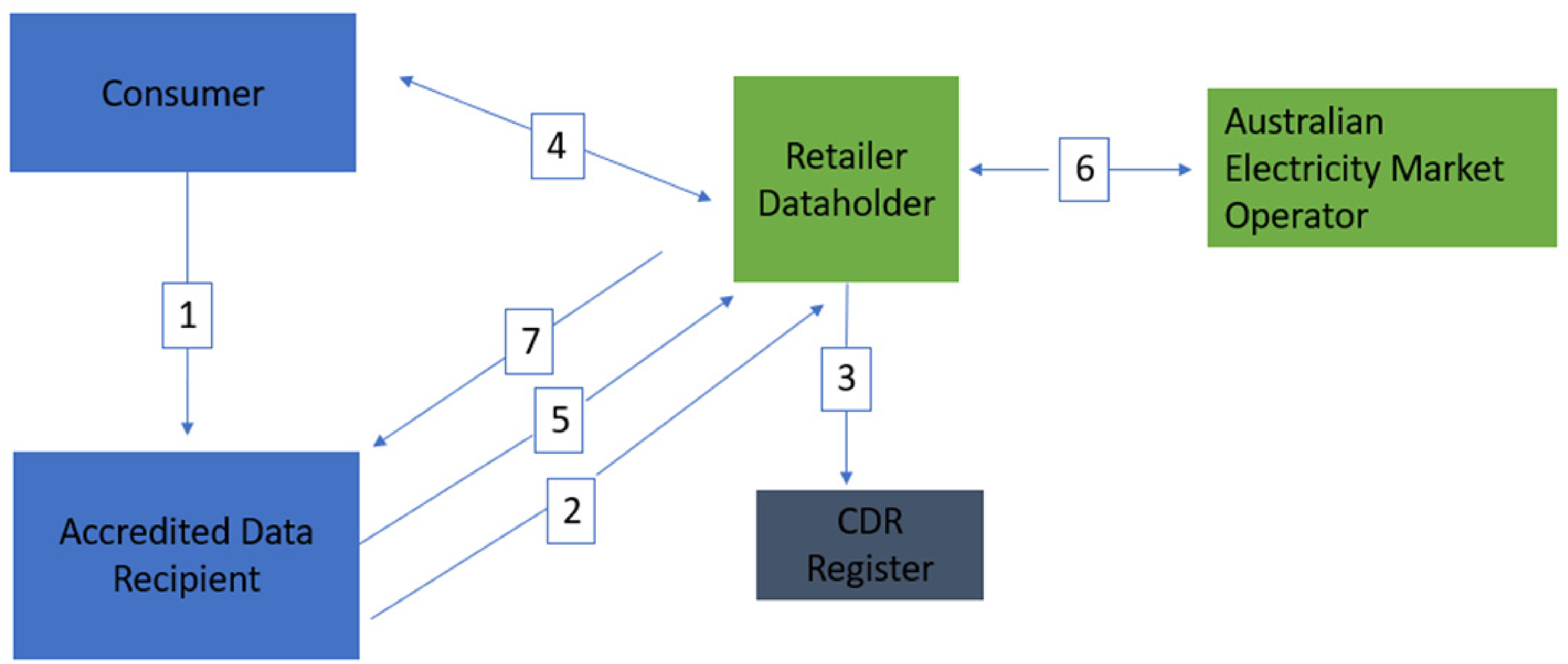
Data flows, consent and key actors. This shows the energy sector’s model for data flows and the key actors. The process varies from sector to sector. The accreditation of the dataholder is a !rst hurdle required to initiate the process and consumer consent is required initially and then again via authentication in step 4. (1) The consumer consents to an accredited data recipient (ADR) obtaining their data. (2) The ADR seeks access to the consumer's data via the electricity Retailer Dataholder. Accreditation involves meeting the ‘fit and proper person’ test; information security requirements and assurance reporting; committing to dispute resolution processes; and adequate insurance. (3) The Retailer Dataholder authenticates the ADR using the CDR Register. (4) The Retailer Dataholder authenticates the identity of the consumer via a one-time password, and the Consumer authorises the retailer Dataholder to disclose their data to the ADR (5) The ADR makes a request to the retailer, (6) who then requests the data from the Electricity Market Operator who is the dataholder (7) The consumer's data is shared between the Retailer Dataholder and the ADR.
As the above quote shows, this is based on an understanding of data as an asset: ‘a valuable object which can be shaped and used over and over again with no loss of utility, to generate benefits in the near future’ (Productivity Commission, 2018). Consumers need no longer be just a source of data, the promise is that they can now use and derive value from their data.
The disengaged consumer: Formatting calculative agencies
The CDR promises to fix markets by enhancing markets, namely by processing and circulating data to address problems of information asymmetry. The underlying problem is the so-called ‘disengaged consumer’ who, despite decades of market reforms, has failed to act as an ideal market subject by switching providers to achieve the best service at the lowest cost
In the energy sector, for example, smart meter roll outs were endorsed in 2012 as part of reforms to lower prices through information provision and more active consumer participation. A universal gold standard state-led smart meter roll out in one subnational jurisdiction was plagued by governance and legitimacy issues and lack of demonstrated consumer benefits (Lovell, 2017). A market-led approach in the rest of Australia has seen a patchwork of basic (low specification) new meters emerging slowly (Chandrashekeran 2020). The meter quantifies household activity by measuring and translating electricity flows into a machine-readable format. A single metering hardware is connected within property boundaries with the service agreement between the person on the bill and the electricity provider governing the use of that information. These boundary markers embed the householder on the bill in the social relations of tenure and tenancy but disentangle them from the socio-demographic complexity behind the meter.
Having captured the data in a usable format, the CDR provides the means by which to develop calculative agencies in accordance with the idealised economic subject motivated by lower prices and ‘value for money’. CDR proponents lean on behavioural economics arguing that by mobilising data and simplifying its provision to third parties, the data can be activated to nudge deficient/disengaged human subjects into more efficient market-oriented decision-making. It's not just a problem of information asymmetry…. it's an issue of do they even have the capability to use that data? Even if they are capable does it actually make sense for them? The return on the investment - does it work out? The amount of effort they have to invest, is it a rational decision not to engage in that process?….And then there's the fact that none of us are rational, so there are behavioural issues with consumers and this is….the potential that third party service providers can overcome some of those behavioural problems with consumers and try to get some of these markets working more efficiently…(Treasury, 2019b)
The key agent who will assist in bringing the householder's behaviour closer to the neoclassical ideal of rational calculation is the third-party service provider. Examples of third-party service providers, who are the personification of competitive market forces, include agents who aggregate multiple data sources, store and enrich the data through analysis and generate marketing insights, and then develop new products and service or on-sell the information. This may include selling advice to a household to optimise their energy use, maximise value through trading energy and finding the lowest tariff. In banking, third-party fintech firms may address potential risks of open banking through the provision of consent management services that include consent revocation and development of consent dashboards. Other sectors, such as insurance, may see value in becoming accredited data recipients to access essential service data that helps them assess consumer risk profiles.
Enabled with the consumer's data, the third-party offers search tools that help consumers locate the best deal on energy, mortgages or mobile phones; budgeting tools to enhance financial management; and analysis that informs the purchase of new energy technologies (Treasury, 2019b). Data helps the third party to find a competitive edge and secure new business, and consumers receive the benefits of this innovation and competition in the form of lower prices and better services. Data sharing is a critical aspect of formatting calculative agencies among service users. Where consumers were once disengaged and idle, now data can be harnessed by third parties to nudge and prompt consumers to act ‘rationally’. The well-recognised failures of market competition in financial services and energy provide the rationale for deepening marketisation through data sharing.
Accreditation and interoperability: Unlocking data for circulation
The CDR is a joint right to exercise control over the circulation of knowledge of everyday service usage. To enable data to move both within and across sectors, sociotechnical devices must be created that guarantee secure access to trusted parties, and standardise the information so that it flows simply across space. Unlike social media where personal data is surrendered in return for the benefits of connectivity, essential service provision is governed by retail contracts that are subject to strict privacy protections and consumer protection rules. We now discuss two critical devices or processes that govern the security and mobility of consumer data: accreditation of third parties and data standards for interoperability.
The CDR introduces a new class of ‘accredited data recipients’ to whom consumers can effectively licence use of their data (ACCC 2019). Accreditation is a process used to establish trust between data providers and recipients: mediating between ensuring a data recipient is ‘fit-and-proper’ and the imperative for ‘on-demand’ access in a uniform manner. The new CDR rules stipulate information security requirements and assurance reporting; internal and external dispute resolution processes; local address requirement; adequate insurance; and ‘meet the fit and proper person’ test There has been concern within banking and energy, particularly from smaller third parties, about the barriers to entry that such an accreditation regime presents, and how this may undermine the goal of competition and innovation.
Accreditation standards are evolving to balance tensions between privacy/protection and broader participation and the free flow of data. Consumer-focused communicative devices play a key role in establishing trust and transparency around accreditation such as the ‘dashboard’ that visualises the consumer's consents for the collection and use of data. The dashboard must be online and is the touchpoint for consumers seeking to withdraw their consent or deletion of data. Another technique is to tier accreditation based on a risk assessment of harm posed by the relevant data set. For example, in banking detailed bank account data is deemed higher risk than personal identity data of the account holder. Yet, there are ongoing attempts to expand the frontier of data circulation, for example, a proposal to allow the transfer of customer ‘insights’ to non-accredited parties with a consumer's consent. This faced strong opposition and did not go through, but shows the creeping tendency to expand the range of data recipients. Moreover, there is little recognition of the cumulative risks arising when data is combined across sectors. The broader the participation in the data network, the greater the pressure to demonstrate effective consent (see next section).
Interoperability is the ability to transfer and render useful data across diverse systems, applications and components (Gasser and Palfrey, 2012). To ensure that data flows across sectors (e.g. banking, finance and energy), common standards are being developed by the government Data Standards Body. Standards for Application Program Interfaces (APIs) allow machine-readable data to be shared across users via shared protocols; and consumer experience (CX) standards govern consent models and language. Both create a digital space where different parties come to access data irrespective of who holds it. The CDR simply intermediates the transfer of information to enable a two-sided market between a business and a consumer. It is not participatory – there is no network of users co-creating value through interactions (Langley and Leyshon, 2017). There is no data layer that allows third-party service providers to market their actual services and find customers through the platform; they can merely use the platform or share protocols to request useful data. Moreover, the API is not opened up to third parties to create applications and new revenue streams. The state governs the API standards and does not seek to capture value from data sharing. The promise of seamless interoperability via technical common standards belies the complexities and risks that arise from a failure of sociotechnical shared understandings (e.g. different languages/codes, timeframes or institutional resources) or the sheer magnitude of the task of aligning institutional processes never designed for integration. The result may be suboptimal results and unintended consequences across a range of domains. In the case of the CDR, developing integrated standards for a single sector such as energy has been the focus of efforts thus far. Simply porting banking data from one bank to see whether there are better options from other banks has proven sufficiently challenging. These difficulties bring to the fore the role of the state in establishing, coordinating and overseeing the interoperability processes within and across sectors. State agencies like the Data Standards Board play a vital role in creating the conditions for market by shaping the technical and institutional conditions that then facilitate interoperability across sectors and virtual space.
A key feature of the CX standards is designing markets for diversity. This departs from the neoclassical orthodoxy by privileging the lived experience of diverse consumers, and designing processes that accommodate that variegation. Hundreds of individuals have been involved in design testing for ease of use of CDR architecture, involving a range of consumer demographics and personal characteristics including varying levels of digital financial literacy; privacy awareness; and trust in government organisations. A critical device for standards design is the ‘use case’ – detailed descriptions of how a person will interact with a proposed system – that provides a guidebook for the technical and CX working groups. The use case focuses design on the ‘problems’ that data sharing solves for both stakeholders and consumers. Stories of ‘experiences’ are crafted for the Data Standards Board to inform how standards are written. Standard-setting draws on insights from behaviouralist economics about consumer difference and frailty and seeks to overcome these differences and deficiencies through enhanced language, formats, information provision and prompts.
Overflows and the CDR: The geographies of governance
The CDR is a project designed to create ‘calculative collective devices’ which enable calculative agencies (Callon and Muniesa, 2005). We have described the frames projected by economists and other policy elites for the marketisation of everyday services through a consumer right to data. In this section, we focus on the other side of the framing process, ‘overflowing’, where the market ideal faces resistance as certain social identities or principles exceed the available frames. These overflows represent some of the diverse geographies, jurisdictional frictions and blind spots in the governance of digital market-making. Through the CDR development, b/ordering work is achieved through discursive manoeuvring from privacy to trust, and the spectrum of consumer types reflecting and reproducing geographies of social difference. These struggles threaten or reinforce the projects of marketisation through data.
Jurisdictional frictions and blind spots
The CDR has an ambitious intensive and extensive spatial reach that involves new geographies of data governance. The CDR legislators are balancing tensions between pre-existing regulatory regimes and dispute resolution processes in the designated sectors and the interaction with the new consumer data rules that have an economy-wide focus. There is frustration among energy stakeholders that standards for banking are being applied to the energy sector that is ‘excessive’ and inappropriate (ECA 2019). For example, legal requirements for banks to know their client before making recommendations create a different risk analysis for data sharing than for energy. These are not just practical problems that can be ‘ironed out’ sector-by-sector; cumulatively they become the ‘speed humps’ or frictions that threaten the swift roll out of the CDR. The open banking initiative was delayed by 18 months, and energy was meant to commence in July 2020. Some senior bureaucrats argue for a swift ‘learning from doing agile approach’ knowing that mistakes will be made (Coates, 2019); others argue that it is better to slow down to avoid security breaches and high profile failures (Solomon, 2019).
The new geographies of CDR governance also have blind spots. There are important parts of the industry not governed by the CDR such as electricity retailers and their subcontracted metering data providers. The intimate smart meter data about the private lives of 1.6 million Australian households have been transferred to Amazon Web Services (AWS) by the metering data provider Vector in a ‘deal’ reported by the media (Ziffer, 2020). Whilst data holders cannot on-sell energy consumption data without the household's permission, this example is suggestive of what Birch (2015: 122) describes as assetisation: ‘the transformation of things into resources which generate income without a sale’. The nature and value of that income are yet to be revealed by Vector or AWS but there are plausible opportunities for value creation involving retailers (Vector's clients). So there are spaces of exception where real opportunities for large-scale data transfers operate beyond the governance of the CDR.
B/ordering data flows: From privacy to trust
The language of the CDR is about enabling participation in markets and providing the confidence to consumers to do so. The primary requirement for achieving this is the meaningful control of data by consumers, and that data is made secure but still able to move across space. This is in contrast with a privacy rights-based approach seen in the European GDPR which includes rights of erasure and portability (art. 17 and 20) and strong penalties for non-compliance (art. 83.2). The Productivity Commission distinguished the CDR from the GDPR arguing that Australia's treatment of data ‘as an asset in regulatory terms is a first step in a better foundation for managing both the threat and the benefit’ (Harris 2018). Protective principles of privacy are cast in tension with the policy goals of data collection and sharing, and enhanced competition. Existing privacy legislation proceeds from the presumption of harm from the release of data (personal information), and even where an individual has rights to their own data under the Australian Privacy Act 1988, it provides a number of grounds for refusal. The CDR creates a new set of replacement privacy safeguards governing an individual's access to their own personal information in a way that is more consistent with the objectives of data sharing, whilst at the same time applying other existing privacy principles in more restrictive and detailed ways than under the current Privacy Act 1988. Overall though, the Australian approach adopts ‘Big Data Exceptionalism’ (Nissenbaum, 2017) which legitimates large-scale data collection and promotes the capacity to deliver widespread social and economic benefits.
There is also a discursive manoeuvre to shift away from the language of privacy toward trust. Whereas ‘privacy’ is seen as a roadblock to circulation, ‘trust’ is a quality that facilitates market participation and data sharing. There is a well-recognised risk that missteps in data circulation could erode trust in the essential service markets which already suffer from a ‘trust deficit’. In 2018, trust in overall financial services was at 48% of Australian respondents, whilst trust in the energy sector fell from 50% in 2017 to 39% (Edelman Trust Barometer 2018 as cited in CPRC 2018). However, the circulation of data itself is now framed as a key source of information that can build trust in market encounters. The state helps to cultivate trust through a variety of technologies and devices such as accreditation of ‘trusted third parties’ which is described as ‘establishing an ecosystem of trusted investors in the handling and retention of consumers’ data’ (Productivity Commission 2018). This trust underpins interoperability which is materialised through the language of APIs that make information legible across sectors and different applications and parties. The state Data Standards Body oversees the development of APIs and plays a critical role in cultivating trust across a complex assemblage through standard setting.
The CDR contains requirements to de-identify data when it becomes redundant or where the consumer consents to the data being disclosed (for sale or otherwise) to other parties. Once data is de-identified it can circulate in new ways beyond the set of permitted relations. Data that cannot be de-identified must be deleted. De-identification involves removing direct identifiers and applying techniques or controls to ‘remove, obscure, aggregate, alter and/or protect data …so that it is no longer about an identifiable (or reasonably identifiable) individual’ (OAIC 2018). De-identification should be a threshold privacy safeguard to protect from misuse, interference and loss, as well as unauthorised access, modification and disclosure. In reality, de-identification ‘is a risk management exercise, not an exact science’ (OAIC 2018). What is deemed reasonable is highly contextual rather than prescriptive. Part of the risk calculus involves weighing up the public benefit of data analysis against the potential risks, some of which may only materialise in the future with the advent of more advanced technologies that allow reidentification. It is difficult to evaluate the reasonable likelihood of reidentification in a dataset due to the complexity of large datasets and the availability of other datasets; a lack of clarity around how to test the effectiveness of de-identification processes; and what is an acceptable level of risk around reidentification.
The CDR is notably silent on the requirements for de-identification of aggregated data, indeed it remains unclear whether data aggregated across sectors falls within the scope of the Act. Despite the early grand visions of cross-sector portability, the scheme is largely designed to operate within sectors. The legislation does little to clarify the treatment of different types of data: aggregated, transformed, derived and raw data. The risks are even greater if data is allowed to be disclosed without consent to unaccredited third parties. Consumers are unlikely to understand that privacy safeguards will not apply to unaccredited parties raising questions about the nature of their consent. There are few clear protections for customers when third parties, such as insurance companies, aggregate data to infer customer risk profiles and then disassemble and on-sell or repurpose that data in hard-to-trace ways. The afterlife of data remains an unresolved b/ordering in the CDR design process.
The Janus-faced consumer and geographies of social difference
There are four competing versions of the market subject (consumer) playing out in the CDR debates (Table 1). First, is the ‘problem market subject’ who remains disengaged in essential service markets that we outlined in Section 3. Second is the counterpoint to this, the ‘rational average consumer’ who, armed with the right information, is able to transact in the marketplace to their benefit and in so doing promotes competition among firms. Third is the ‘diverse consumer’ whose complexity needs to be understood to nudge and cajole and empower to engage effectively in market encounters. This is the actually existing consumer of behavioural economics as we outlined in Section 5. Fourth, is the ‘vulnerable consumer’ who is weak in relation to powerful firms, prone to acting irrationally and is therefore in need not just of empowerment, but substantive rights and consumer protections (Mak, 2016).
Consumer typologies, market logics and the role of data.
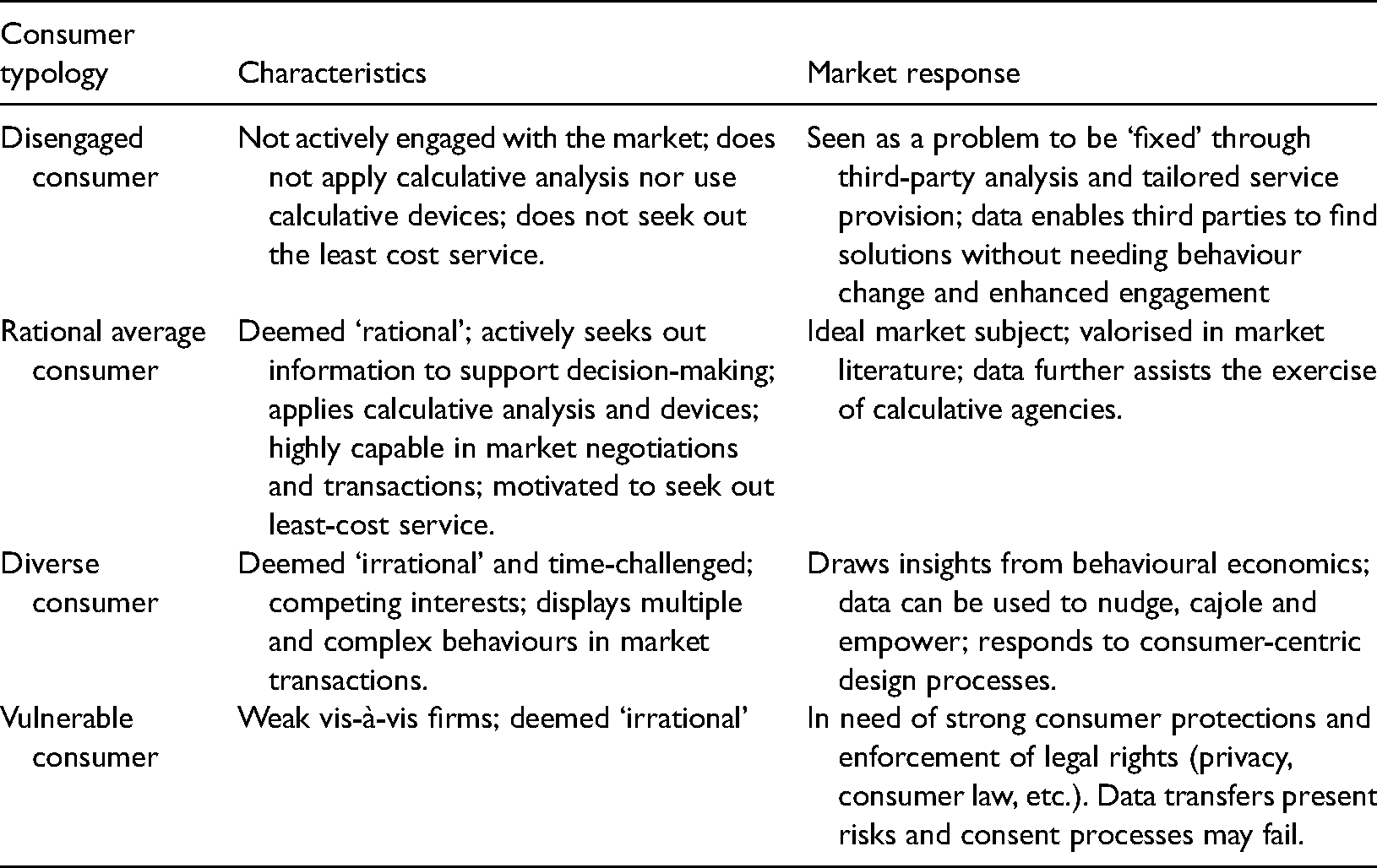
The disengaged consumer is the ‘problem’ that the data right sets out to address and fix. Proponents of the CDR argue that private markets and capital can deliver services to disengaged consumers without them having to do much more than provide meaningful informed consent to data transfers. The rational informed consumer is the ideal type that a data-rich market landscape seeks to cultivate and who stands to benefit from the free flow of data. This is the prosumer who actively seeks out the information supports available such as comparison sites, to make beneficial decisions around new technologies, mortgage rates and more. The diverse, not-always-rational and attention-challenged consumer is the imagined consumer who informs the CX standard-setting processes (what constitutes meaningful consent for diverse consumers?; how do we ensure consumer-centric simple and inclusive design of the CDR ecosystem?). And the vulnerable consumer is prefigured in privacy principles, security protocols and dispute resolution and enforcement (what are the protections against discriminating and redlining vulnerable consumers?; what are the penalties for operating as an unaccredited third party?, etc.).
The first three consumer prototypes reinforce the centrality of market logics in processes of data circulation but differ on the need for enhanced consumer engagement through more socially embedded market design and practice. The vulnerable consumer, however, presents the strongest critique of the market model based on differential power between firms and vulnerable groups, and the risks of expanding market participation. Consumer law advocate firms seek to escape the regulatory net by exploiting loopholes in the rules such as deceptive digital practices and interface design (dark patterns) (Financial Rights Legal Centre and Consumer Action Law Centre, 2019); whilst firms say they have transformed data sufficiently through aggregation or modelling making it impossible to reverse engineer or recreate the original CDR data (Quantium, 2020). The vulnerable consumer framing focuses attention on how value extraction by firms can cause more harm than benefit to already existing vulnerable consumers. Particularly in the context of everyday life services, consumer advocates emphasise what Ash et al. (2018, 31) call processes of ‘socio-spatial sorting’ via algorithms that ‘calculate and enforce differential access with respect to perceived worth’.
Discussion
In this paper, we have shown how the capture and circulation of data about social lives are enabled through market logics and practices. We have paid attention to the calculative devices deployed to abstract and disembed data from the social and reframe it in the context of market exchange. The CDR offloads the task of information processing to third-party market actors who, armed with data-based insights, enable consumers to maximise their preferences in the marketplace. The CDR claims to address allocative efficiency by arming suppliers with greater information which enables them to compete against incumbents leading to lower prices and better service.
We distinguish between the market promise of the CDR and the translation of the model in actually existing markets and regulatory frameworks (Berndt et al., 2020). We have emphasised barriers to the construction of a cross-sectoral codespace where data flows freely and incommensurabilites between sectors and overflows. We locate performation struggles both in but also beyond the micro-dynamics of markets using a political-economic analysis. We draw out four analytical insights from this case study that sheds light on how life's work is brought to market through digitalisation.
Fixing markets/making markets
The power of datafication as a political technology is that it is founded on a critique of the market but also a fix for its multiple problems (Muniesa, 2017). The success of the CDR hinges on a promise to fix the problems of discrete markets for electricity and banking (and later telecommunications) that have, to date, slowed the march of marketisation. The spatial reach of the CDR across sectors depends on the claims making sense first at a sectoral scale, so market-fixing is the key logic that enables data mobility within a single sector.
There is also a secondary promise that is more speculative in nature: that data circulation enables future markets for yet-to-be-defined products and services. The grand vision for the CDR pivots on this promissory logic to create a market of markets that transcends the individual sectors and is lubricated by the new oil that is data. Speculative market-making at once prefigures new accumulation opportunities and therefore investment, but also new and unknown risks for the consumer. Indeed, it is better for CDR proponents to focus on fixing rather than making new markets through data to secure a field that is amenable to future speculative marketisation. We observe the importance of cultivating that field at a sectoral scale, but planting the seeds for linking more and more objects and people in space so that the spatiality of the everyday becomes ‘transduced’ by code and new market opportunities emerge (Dodge and Kitchin, 2005, 162). The late proposal to change the rules to allow data to be transferred to non-accredited third parties is an example of how ‘afterthoughts’ come to format market exchange in line with this speculative future market.
Importantly, marketisation through data is a highly staged process and the sequencing of market-making is critical to legitimising the project. We go further than saying that marketisation and framing processes are incomplete and always in the making (Mitchell, 2014, Berndt and Wirth, 2019) to argue that we must pay more attention to the ordering of marketisation processes, and not presume an inexorable and linear path toward market exchange. The CDR is one stage in a process that begins with creating a data object, often by placing sensory objects in the home such as smart meters, and then developing the code and software to metricise everyday practices. The CDR is focused on making that data object mobile by connecting across space to a variety of new (market) actors. Figure 2 shows the phases of collection; integration and analysis; publication and release. The CDR is particularly important for enabling the integration or aggregation phase and concentrates efforts on consumer protections and enabling consumer agency in this phase, and then is relatively weak in protections when it comes to releasing the data beyond the agreed use by an accredited third party. This data mobility can be distinguished from the process of value creation itself, which the CDR is notably silent on and to which we turn next.
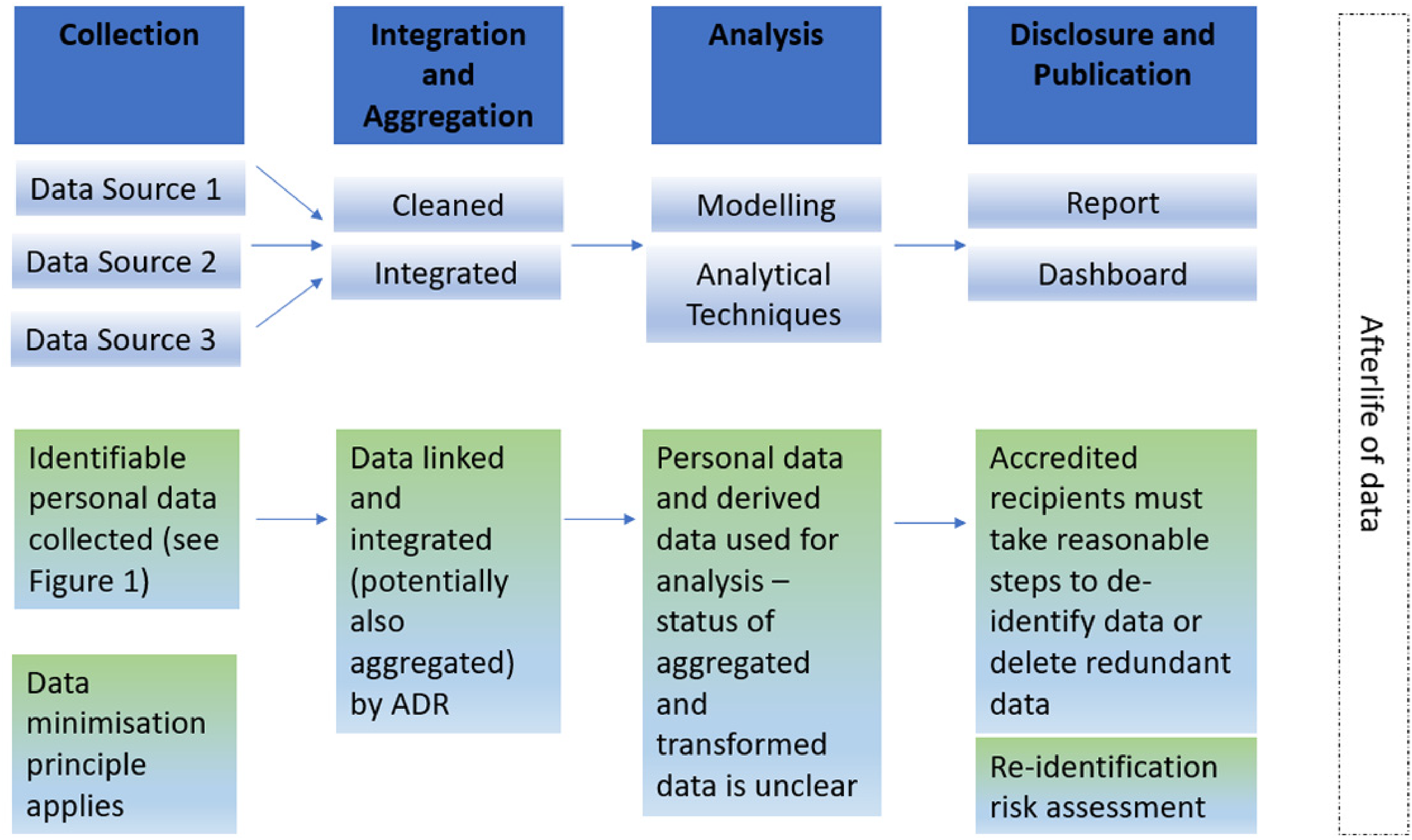
Flow of data through the lifecycle of the Consumer Data Right (CDR).
Foundations for data assetisation
Market fixing/enhancing imbues data with a new kind of informational power but is silent on how the data is capitalised – subsumed instead with the language of consumer benefits and market efficiency (Barns, 2019). We see glimpses of its underlying value in the discussions of data as a tradeable asset. The CDR is a regime that is seeking to transform data into an intangible asset – but how a firm creates value that can be observed, counted and traded is never made clear. It is a promise of market-making. We show how data that cannot be owned and therefore cannot be commoditised, undergoes a range of techcraft practices that set the scene for it to be capitalised as property by firms and investors in the future (see Birch et al., 2021). Firms can only claim personal data as an asset if the data infrastructure is established in the first place. This is the work of the state: to develop pathways to connect the micro spaces of the home and work to the spheres of capital accumulation. In the same way that infrastructures of rail, road, electricity and telecommunications link up and reconstitute public and private spaces, so too the CDR establishes the informational pipelines or roads whose use is enabled through licences (a data right and consent regimes), uniform gauges (shared software protocols) and crossings (accreditation standards). Infrastructure is both material things but also the relationship between things (Larkin, 2013) so the engineered landscapes of data sharing (shared data protocols, software, metering devices) coevolve with the technologies of government or the ‘government of matter’ (Lemke, 2014, 14).
It is the users not the data that are the source of firm value (Birch et al., 2021). We have shown the state-led processes that format data to enable future monetisation. The CDR provides the framework for discrete data points to be assembled and connected to a singular identifiable individual. That individual is a future ‘user’ of Internet services, apps, platforms, etc. By linking datasets together the CDR creates the conditions to turn activities of social reproduction into the people and subjectivities that firms can monetise in the future. The state does this by making markets based on data, and then sets the conditions for control of data. This data is not owned by an individual, rather it can generate value. The underlying form of value can be materialised not through exchange but liability structures including rent relations (Sadowski, 2020; Birch, 2020). A staged approach to understanding market-making enables better resolution of how the state facilitates digital economic circulation which can then be deepened through practices of intermediation and capitalisation by private firms (Langley and Leyshon, 2017). We see this as frontier work for scholars of marketisation interested in the institutional constitution of markets and the role of the state (Cahill, 2020).
Aggregation and identification
The key feature of the CDR is to enable the aggregation of data across hard-to-coordinate sectors of essential service provision. Numerous barriers to the aggregation of sensitive personal data are overcome through the executive authority of the state and the technical work of its coordinating agencies. Interoperability is the catchphrase that sums up a series of highly technical processes in which code connects actors and institutions both within and across sectors. We have drawn attention to the key role of standards (APIs) that make security, accreditation, consent and approval processes legible across space and therefore facilitate the construction of a data market.
The CDR's key framing is unlocking and personalising data for the consumer's benefit. However, de-identifying that data to reduce the risk of harm in the afterlife of that data, beyond the purpose that the consumer intended, is poorly addressed in the legislation. The CDR has enabled a new aggregated dataset, with lax requirements to anonymise and limited means of monitoring and enforcement. This previously hard-to-access data that makes social lives visible can now exist in an aggregated form that can be transferred to third parties and combined with other datasets, and then reidentified using machine learning and inferential analytical techniques. We argue that the state has engineered a process of data aggregation that does not (and indeed cannot) rule out reidentification (De Montjoye et al., 2013). The off-limits data previously constrained through strong privacy and customer protection provisions has been unsettled and made mobile through the authority of the state and ‘techcraft’ of its agencies.
Privacy versus control
The process of disembedding this data to enable immediate and future markets involves a shift away from the discourse of privacy to control, and we demonstrate the limits of control rights. The CDR positions privacy as paternalistic – limiting freedom of choice in the market.
By creating a new right to data to match the right to privacy the CDR shifts the emphasis toward privacy self-management, that is exercise of control by the consumer themselves. ‘Privacy self-management takes refuge in consent. Neutral about substance – whether certain forms of or disclosing personal data are good or bad … Consent legitimises nearly any form of collection, use, or disclosure of personal data’ (Solove, 2013, 1880). The response to the failures of privacy self-management are modifications to privacy self-management itself, most notably through the application of behavioural economics insights via CX standards or enhanced calculative devices such as dashboards. The framing of the ‘disengaged consumer’ suggests the problem is one of individual engagement, rather than applying a larger calculus of collective harms and benefits that require strong privacy protections. We have shown how vulnerable consumers (rightly) become a focus of critique of consent regimes. This leaves other consumer typologies as opportunities for improved consent regimes and calculative devices, despite real questions as to whether free, prior and informed consent is possible at all for any consumer in the context of fast-moving often invisible market transactions through codespace.
We have also shown how trust-building processes are key market-enhancing mechanisms. The promise of market rationality through data intensification relies on processes of accreditation and standard setting. These processes of technocratic knowledge production seek to stabilise markets by building institutional trust and making it ‘safe’ for data to flow across space. State-led processes of measurement, accreditation and standardisation manifest state power (Ferguson 1990; Scott 1998). The state assembles standards to shift data beyond its sectoral limits and create a substrate of institutional trust upon which data-intensive markets can be built. This substrate is replete with contradictions which can become market overflows. We highlight the limits of de-identification requirements and the potential for data to have an afterlife unintended by the consumer. This may lead to potential harms for a consumer down the track. State-led institutional standards based on trust (via code) rather than prescriptive privacy limits lays the foundations for new processes of value creation and market-making.
Conclusion
This paper has shown how the markets for the data of our everyday lives are emerging. We have foregrounded the state's role in enabling aggregation and assembling the foundations for current and future markets and the limits and overflows of the market design. We highlight the cloak of claims to fix broken markets via digital economic circulation but show how this obscures a more significant state-led infrastructural project: enabling data aggregation that escapes the grip of privacy regulation. The state facilitates aggregation in the construction of data markets in the following ways. First, the development of code-based standards (APIs) that makes the data of social lives identifiable and legible across sectors and space. Second, disentangling data from the sensitivities of its originating context by shifting from the language of privacy to control and trust. Third, the performance of control through calculation and self-management manifests via consent regimes and dashboards. Fourth, de-identification requirements that can be subverted to extend the life of the data and create future value.
The paper adds to both the critical studies of marketisation and the data accumulation literatures by emphasising the role of the state in facilitating aggregation in the construction of markets. Creating, moving and valuing data objects involves different spatio-temporal processes that need not be linear nor confined to a single market. We call for a more staged approach to unpacking processes of marketisation in and through data. To understand deep digitalisation of social life we need to link market-making with processes of value creation. This involves showing how the practices of everyday life become grist to the mill of Big Tech. This involves examining the discursive, administrative, regulatory and technical practices at a very early stage in the life of the data. There remains further work to be done to understand value creation from the perspective of third-party firms who build their business model on future value streams, and trace the transformation of data analysis into user metrics. Our insights also contribute to the social reproduction literature by showing how everyday practices within the home are linked into chains of value creation beyond the home. The role of trust in constituting these markets and managing sensitivities and risk is an area ripe for further analysis.
Footnotes
Declaration of conflicting interests
The author(s) declared no potential conflicts of interest with respect to the research, authorship, and/or publication of this article.
Funding and Acknowledgments
This article is based on research funded by the University of Melbourne Carlton Connect Initiative Fund No. 1554149, and benefited greatly from the research assistance of Dr Paris Hadfield then at the University of Melbourne. This research also benefited from research funding from the Australian-German Energy Transition Hub which was supported by the Commonwealth through the Department of Foreign Affairs and Trade for the project “Smart meter deployment in Australia and Germany – enabling innovation and consumer benefits.” We acknowledge the contribution of our fellow Investigators on that project: Professor Lee Godden at the University of Melbourne and Dr Anne Kallies at the Royal Melbourne Institute of Technology. We are grateful to the two anonymous reviewers for providing valuable feedback on a previous version of this article.