




Abstract
Buenos Aires, under the city administration of Horacio Rodríguez Larreta, has recently implemented an ambitious social and territorial integration project in Villa 31 and other low-income settlements within the city. The mayor and his team have circulated the project in prestigious universities and urban forums while talking about Buenos Aires as ‘a global city’. When discussing the design of this integration initiative, the mayor referred to London’s Borough Market, New York’s High Line and Medellín’s Parque Biblioteca. This paper examines the role of policy circulation on the change in discourse and practice towards low-income settlements in Buenos Aires, as well as its relation to the making of a world-class city. I argue that: (a) policy change has been the result of a complex assemblage of artifacts and individuals that mobilise successes, a process that is increasingly South-South; (b) the city government drew its inspiration from urban policies adopted by other cities, not only for the urbanisation project itself, but for approaches to internationalise the initiative; (c) Buenos Aires is using this project as an opportunity to world itself as an integrated city. By doing so, this research adds value to the policy mobility scholarship, since Latin American cities are not only worlding themselves through mega urban developments but also through the circulation of singular ‘world-class’ imaginaries.
Introduction
“We have a very ambitious development plan
ready in the most visible slum in Buenos Aires”
Buenos Aires Mayor talk, LSE, 6/11/2017
“We are taking the example of the Borough Market
to develop something similar in Villa 31”.
Meeting between Buenos Aires and London Mayors La Nación, 7/11/2017
“The Government’s idea is to transform
the current highway into a … green space,
similar to New York’s High Line”
Página 12, 29/11/2016
In parallel to this change of discourse and practice, the city government started an aggressive communication and marketing strategy to internationalise the city. This included a series of trips oriented to showcase the opportunities that the city has to offer as a talent-attraction pole, mainly due to its quality of living and its inclusive development concerns. As part of these exercises, in November 2017, the city mayor Horacio Rodríguez Larreta came to the LSE to deliver a talk about Buenos Aires as ‘a global city’. Intriguingly, a substantial part of the presentation referred to the urbanisation project analysed in this paper. This leads to the question of how the Villa 31 project is linked to the international benchmarking of a ‘world-class’ Buenos Aires. In order to answer this, as well as why policies towards low-income settlements changed, I will situate my analysis within policy mobility debates. This body of literature moves aside from the limited approaches of policy transfer and diffusion, and focuses on complex power relations that shape relational/territorial and global/local realities (Ward, 2011). In relation to this, I will also explore literature on ‘assemblages’ and ‘worlding’. The first term relates to a theoretical approach that understands policies as a result of multiple socio-material connections (Farías, 2011; McFarlane, 2011a; following Latour, 2005). The concept of ‘worlding’ is associated to how, in a world of ‘ordinary cities’ (Robinson, 2005), there could be many modes of being global (Ong and Roy, 2011).
Policy circulation is arduous to trace (Cochrane and Ward, 2012). Hence, policy mobility scholars have been discussing for the last years how to deal with this methodological challenge. Progressively moving away from the primary methodological influence of political science, they started to incorporate elements from other disciplines such as anthropology, sociology and development studies (McCann and Ward, 2012; Peck and Theodore, 2015a; Wood, 2016). Among different approaches, I found it helpful to use the systematisation proposed by Wood (2016). The author recommends disentangling urban policy ‘assemblages’ by following the people, following the materials and following the meetings. The first strategy comprises interviewing the stakeholders that were key in shaping mobile policies’ locality; the second one refers to “the role of urban materialities […] in redistributing agency between human and material actants [see Latour, 2005] in the dissemination of learning” (ibid. Wood, 2016: 399); the last strategy involves analysing events such as international conferences, forums and workshops where knowledge circulates.
Considering Wood’s (2016) contribution, as well as my research questions, I conducted nineteen in-depth interviews from April to July 2018. The participants included: eight mid-level and senior government officials who have been involved in the design of the urbanisation project; two members of community advocacy organisations; three experts from International Financial Institutions (IFIs) who acted as counterparts in the Villa 31 project; and six Argentinian urban experts. This obviously meant some elite interviewing (see Bok, 2015). While this allows to see power dynamics more vividly, there are some limitations. To deal with them, I have complemented interviews with the revision of journalistic articles from three recognised Argentinian newspapers (La Nación, Clarín and Página 12), published from January 1st, 2016 to June 25th, 2018. The chosen start date was related to the fact that the urbanisation discussions had a significant media impact that year. In order to filter the digital archives, I used three triggering words: Villa 31; Barrio 31 and urbanización. This helped me understand the role of other agents involved in shaping localities, for instance recovering the voice of Villa 31 dwellers as well as of urban policy gurus. I have also analysed policy artifacts (i.e. policy brochures, renders, blueprints). This allowed me to examine the evolution in governmental discourses and practices, and Buenos Aires “self-constructions” of a successful project (see Bok, 2015: 2726). Finally, I dove into government websites, IFIs reports, and international media.
The first section of this paper will provide the contextual framework on how the GCBA responses towards low-income settlements evolved, predominantly using the case of Villa 31. This will be followed by the exploration of debates on policy circulation, ‘assemblages’ and ‘worlding’ in order to understand how policies are designed and mobilised. Those concepts are particularly valuable to understand the underlying assumptions behind the change in policy towards low-income settlements and its relation to the making of a world-class Buenos Aires. In the next sections I will present my research findings and my interpretation, unravelling the assemblages under this social and urban integration project and its policy circulation. In my view, policy change towards social and territorial integration was possible because there was political momentum as well as the adequate institutional framework. More importantly, however, the integration project gained traction due to the possibility of combining the unavoidable urbanisation project with the aspiration of achieving a world-class city status. This neoliberal government found a way to deal with the ‘problem’ of villas while seizing the opportunities that emerge from it. Inter-city referencing provided legitimacy and gave the opportunity to ‘leverage’ (see Montero, 2018) the upgrading project internationally and position the city as world-class.
Evolution of responses towards slums and the emblematic ‘Villa 31’
Studying Villa 31 provides an opportunity to understand the historical responses towards informal settlements in Buenos Aires, due to the settlement’s privileged location, size and history, being the oldest low-income settlement in the city. This settlement was established in the 1930s by a group of immigrants (Sehtman y Cavo, 2009; Vitale and Ramos, 2011), and it has a long history of transformation and political resistance. It has to be noted that, being located in Retiro (one of the city’s wealthiest neighbourhoods), it has faced several attempts of eradication, interspersed with promises of regularisation (ibid.). According to Cravino (2010), before 1960s, this kind of settlements were not considered problematic and consequently, there was a period of ‘policy inaction’; actual attempts of upgrading began in the 1980s.
During the 1960s and 1970s, particularly in times of coup d’etat, the mainstream response towards slums was eradication, accompanied by forced relocations to the metropolitan area (Cravino et al., 2008; Vitale, 2009). Even if tremendously violent, these policies were never able to fully eradicate Villa 31, since its strong grassroots political movements resisted evictions (Sehtman y Cavo, 2009). With the return to democracy in 1983, following Hernando De Soto’s (2000) ideas of land regularisation, several initiatives were implemented. However, only some sporadic and small-scale interventions were executed due to lack of resources and administrative articulation (Vitale, 2009). In 1992, the government, jointly with the United Nations Development Programme, designed a participatory upgrading initiative (Programa de Integración y Radicación de Villas y Barrios Carenciados). Yet, the incorporation of certain grassroots’ leaders as GCBA officials, instead of facilitating negotiations, created antagonism and more fragmentation (Sehtman y Cavo, 2009). As a result, the participatory initiative was paralysed.
In 1994, as part of a series of governmental reforms, the National Constitution was amended, establishing the autonomy of the City of Buenos Aires. This administrative change was followed by the election, in 1996, of the first city’s mayor, as well as by the sanction of the local Constitution, which included the right to decent housing and adequate habitat. The integration of informal settlements became a right enshrined in the law. This constituted a steppingstone for the sanction of the Law 148, which recognised the need to prioritise the attention on informal settlements’ social and habitational concerns (Vitale, 2009). Nonetheless, it was not until 2009 that the Law 3.343 was sanctioned, as a result of the lobbying from local political organisations (Vitale and Ramos, 2011). This law enforced the obligation to provide infrastructure and services in Villa 31, the prohibition of evictions, as well as the establishment of a conciliation space (Mesa por la Urbanización y Radicación; cf. SISU, 2016a). Unfortunately, due to the political opposition between the national party and the city government, there was no space for the coordination needed to implement the project. 2
When Mauricio Macri (former mayor of Buenos Aires) won the national presidential elections in 2015, the GCBA under Horacio Rodríguez Larreta (from the same political party) seized the opportunity to re-start the urbanisation project. This was indeed unexpected since, as stated in the introduction, during the city elections campaign, Macri had an eradication discourse towards the settlement. Nonetheless, the city began to design the urbanisation project and negotiated a loan of around 420 million dollars from the World Bank and the Inter-American Development Bank (IDB) for its execution (IDB, 2017). According to the Secretariat of Social and Urban Integration (SISU), an organism exclusively stablished to operate in the Retiro-Puerto area, the project has four pillars: (1) human capital: an education pole within the settlement as well as health and community centres; (2) habitat: housing improvement and construction of 1,200 new units; (3) economic development: creation of employment and training centres, formalisation of businesses and improvement of shops; 4) urban integration: new public spaces and green areas, in addition to services and infrastructure works (SISU, 2016b). This upgrading was also designed as a pilot for other low-income settlements in the city and similar approaches were implemented in Villas 20, Rodrigo Bueno and Playón Chacarita (Vitale, 2018).
As stated in the introduction, the city mayor Horacio Larreta, expressed in different occasions and events (La Nación, 2017b, 2017c; Clarín, 2017a) his vision for the settlement: having a food fair similar to the London’s Borough Market, an elevated park akin to the New York’s highline (in the area of the former Illia highway), and even a McDonalds’ franchise. In some other occasions, the mayor also referenced Medellín’s Parque Biblioteca, a project characterised by building cultural equipment and public offices in the poorest areas of the city, when he mentioned the relocation of the Ministry of Education to Villa 31 (GCBA, 2018). These are only some of the many urban initiatives that have been referenced in relation to this project.
Understanding policies in motion
Taking into consideration the previous section, there are at least three noteworthy facts. The first is related to the change in discourse and practice towards a logic of socio-territorial integration. The second is the mayor’s references to urban practices in New York, London and Medellín, in his words about the Villa 31 project. The third is how the GCBA utilised the promotion of the project in several events as a way of positioning the city internationally. With this in mind, I will situate my study within debates on policy mobilities. Even though the conceptual framework on policy transfer was traditionally dominated by political science (McCann and Ward, 2011), these debates have gained sophistication – as they progressed from approaches of policy transfer, to policy diffusion, and then to policy mobilities/circulation. Porto and Faria (2017) explain that whereas policy transfer is a somewhat constrained process encompassing few stakeholders (and I add, rather straightforward), policy diffusion involves several stakeholders and more multifaceted interactions. The particularity of policy circulation is related to its rather “diffuse and multidirectional” (Porto and Faria, 2017: 16) character. As I will explain below, the latter seems the most fertile ground in which to position my research.
Policy circulation/mobility can be seen as “a vast and continuous movement of production of models, emission, appropriation and translation of their contents by multiple actors … which have different power resources” (Porto and Faria, 2017: 22). In human geography, it is a process of sharing and adapting cities’ successful urban practices to local contexts (Jajamovich, 2016, 2013; Montero, 2017). This is “neither a horizontal learning exercise nor a story of coercion from ‘above’”, but a process that “takes place at the intersection of local and transnational agendas” (Montero, 2017: 339). Therefore, in contrast to scholars who consider these practices as ‘one-size-fits-all’ or ‘best-practice replication’ (see Peck and Theodore, 2010: 173), I concur with other scholars who argue that policy circulation is shaped by political agendas of both local and global stakeholders (McCann and Ward, 2011; Wood, 2014b). Policy circulation is a political process which is “sensitive to territorial and relational geographies” (Ward, 2011: 734). It is not a straightforward process, but rather the result of a combination of interactions from actors holding different degrees of power at multiple levels (Peck and Theodore, 2010; Wood, 2014b). This means that there is a process of translation: “[p]olicies are not, after all, merely being transferred over space; their form and their effects are transformed by these journeys, which also serve continuously to remake relational connections across an intensely variegated and dynamic socio-institutional space” (Peck, 2011: 773).
Policy circulation is mainly generated by the intention, from a diversity of agents, to look for international urban policies that can be practical and politically advantageous for local contexts (Jajamovich, 2016). Policy mobility is of course not a new phenomenon, yet it has accelerated in recent years since urban policy solutions are increasingly considered “as an arena to achieve global development impacts” (see Montero, 2018: 1). For the same reason, it constitutes a multidirectional process – both of acquiring as well as transmitting knowledge (Jajamovich, 2016). This is important because it seems to indicate that ideas travel not only between and from central areas to the peripheries, but also from and between the Global South (Jajamovich, 2013) – which is happening more and more often (Montero, 2017). The instruments of circulation can be associated to: policy tourism (Cook and Ward, 2010; Ward, 2011; Wood, 2014a), which is stakeholders’ visits to acquire better knowledge about a project in situ; the role of “agents of policy circulation” (Robinson, 2011: 21) which are not only the state or IFIs, but can also be ‘expert-citizens’ (Sosa López and Montero, 2017: 2) or policy gurus (Peck and Theodore, 2015a; Wood, 2016); ‘technologies of urban mobilities’ (McCann and Ward, 2012), for example archives, briefs, presentations (Blok, 2014: 272); and transnational events (Porto and Faria, 2017) such as the World Urban Forum or Habitat III, among others.
Assemblage urbanism in the study of circulating policies
When studying policy mobility, assemblage theory is particularly relevant. The concept of ‘urban assemblages’, inspired by Deleuze’s intellectual tradition and Latour’s actor-network theory (Farías, 2011; McFarlane, 2011a), refers to “contested processes of city-making, articulated within variable temporalities and spatialities, and their emergent ethico-political possibilities” (Blok, 2014: 271). This contrasts to more rigid analysis in human geography, since these multiple temporalities and spatialities are difficult to map (Robinson, 2011), indicating a more topological nature (McFarlane, 2016). This characteristic means that there are not fixed and linear time and space relationships, but complex and interrelated ones (McFarlane, 2016). These assemblages, as McFarlane indicates, can signify a novel view on urban policy epistemologies but it can also refer to objects of study (2011b: 662). Accordingly, this body of literature permits to understand the city as “multiplicity” (Farías, 2011: 369): an aggregation of “expertise and resources” from different places (McCann et al., 2013: 583) but also an inherently local phenomenon (see Latour, 2005). This is in line with the above-mentioned relational and territorial character of urban policies, as it contributes to unravel urban policy components, recognise the power dynamics involved, and overcome traditional dichotomies such as global/local. These multiplicities and aggregations are then shaped by deeply imbalanced power dynamics, using a combination of power technologies: coercion, seduction, persuasion, etc. (Allen, 2004: 28). As I will show in the subsequent sections, this mindset is extremely useful to unknot how urban policies emerge and circulate.
Brenner et al. (2011) have criticised the conceptual foundation of the assemblages’ framework. These authors claim that McFarlane (2011a) and other urban scholars have stretched the explanatory capacity of the assemblages as “an idea, an analytic, a descriptive lens, or an orientation” (229). While I do not agree with these critiques since assemblages offer ‘multiple ontologies’ (McFarlane, 2011c), I do not have the space in this paper to explore the full potential of this framework. Consequently, I will deploy assemblages in their methodological aptitude, to explore how different models circulate and interact with new localities. In doing so, I will pay particular attention to the different actants (human and non-human) that “create seductive neoliberal urban futures” (Pow, 2014: 289).
Worlding urban policies from the global South
An era of persistent inter-city referencing, comparison and even rivalry, “encourages places and people to constantly reinvent themselves” (Larner and Le Heron, 2004: 215). Agreeing with Porto and Faria, this reinvention is not only about generating successful urban initiatives but to be able “to ‘market’ them to the world” (2017: 16). McCann, for instance, talks about ‘policy boosterism’ as a “subset of traditional branding and marketing activities that involves the active promotion of locally developed and/or locally successful policies” (2013: 5). However, even if this literature resonates with Harvey’s account for ‘entrepreneurial urbanism’ (1989), McCann – in the same line of my research – argues that local policy is not passive to global logics but is the product of intricate assemblages. Similarly, Peck and Theodore (2015b) talk about policy models created to be mobilised; which in urbanism could imply “that other places turn to this site as an example to follow” (Hoffman, 2011: 57). Sánchez and Moura (2005), referring to the internationalisation of Curitiba (Brazil) or Singapore (Singapore) as ‘model cities’, argue that these world-class impulses are the reaction of governments that conceive the city as a commodity, and thus urban marketing (see approaches from Duque Franco, 2011; Delgadillo, 2014) is oriented to attract investment as well as consumer-citizens. This literature is relevant to highlight the way cities design and implement policies in order for them to be internationally showcased as economic, political or cultural centres.
However, besides what has been discussed earlier, I argue that Global South cities are increasingly engaging in these processes, which demonstrates that there are different ways of ‘being global’ or having world recognition (McCann et al., 2013; Ong, 2011). This exposes less-evident “forms of power, governance, and legitimacy … embedded in the construction and mobilisation of certain policies as world policy models” (Montero, 2016: 111). Therefore, post-colonial and post-structural interpretations are relevant in that they recuperate critiques of traditional conceptions of ‘the global’, which are based on emblematic modern Euro-American cities (see Robinson, 2005; Roy, 2016; Vainer, 2014). In this framework, Ong and Roy (2011) coined the term ‘worlding’, which means “contemporary experiments to remedy [a problematic] urban situation […which] draw on global forms that are re-contextualised in the city matrix, and then dispersed to other places seeking solutions” (Ong, 2011: 4). While Ong and Roy (2011) refer to Asian iconic interventions, Villa 31 project also seems to be worlded, mainly through Latin American solidarities. In this regard, this paper is aligned to recent studies on worlding cities since it “challenges the conceptualisation of inter-referencing and urban modelling as it is currently documented in the literature” (Connolly, 2018: 617). A I will show in the following sections, the GCBA is prioritising references from comparable Latin American cities that “act as more realistic reference points” than global and mega-cities (Connolly, 2018: 617).
Baker and Ruming (2015) maintain that worlding can be ‘from above’ or ‘from below’. With regard to the latter, they quote Simone (2001), who argues that there might be new agents that carry out processes of making-up ‘the global’ (see also Roy, 2011b). Ghertner’s work (2011) echoes with this when he narrates the case of Delhi’s shantytowns’ dwellers as accomplices of the world-class city masterplan. Instead, ‘worlding’ from above’ refers to “visions produced primarily by collections of the elite interests” (Baker and Ruming, 2015: 66). I argue that these processes can never be fully one or the other, but they are normally an assemblage of elites as well as ‘ordinary people’ urban imaginaries. This last point also appears in Ortiz (2014) when she, pointing out to Medellín’s model, highlights the heavy urban marketing undertaken, labelling the initiative as Social Urbanism even if there were conflicts at the grassroot level – focusing more on how it looks rather than how it actually is (see also Duque Franco, 2016). At the same time, she reflects on how ordinary citizens were also supporters of the government’s interventions, as they were trying to move away from the stigma of Medellín being a violent city, and promoting it to become world-class. This shows less-evident power dynamics that shape worlding practices.
Assembling an urban and social integration project in Buenos Aires
“In these exchanges, ideas circulate … a light turns on,
something that allows you to think from another place”
Interview with city government official
One critical, albeit timid, milestone in policy change was the creation of the Secretariat of Habitat and Inclusion (SECHI) a year after hundreds of families occupied the Parque Indoamericano in 2010. The inefficient response and the lack of coordination at different government levels to deal with the resulting melee (see Centner, 2012a) exposed the inadequacy of the available institutional framework. With the creation of SECHI within the city government, Marina Klemensiewicz appointed Jorge Melguizo as an advisor. Melguizo was a key figure in the development of Medellín’s Social Urbanism and Klemensiewicz “thought about him when her integration plans crashed with the imaginaries of the rest of the … government officers” (La Nación, 2017d). Klemensiewicz also received several visits from the UNHABITAT former Executive Director and former Barcelona Mayor, Joan Clos. Clos was not only an ambassador of the Barcelona model but the one that contributed to the permeation of the New Urban Agenda (NUA) in Argentina. The NUA exhorts the allocation of resources for upgrading projects that allow to ‘integrate’ those spaces to the formal city (UNHABITAT, 2016), something that will be present in governmental rhetoric from this point onwards. This shows the importance of the human and non-human actants (Latour, 2005) that contribute to the change in government’s discourse. Yet, in practice, SECHI developed only few works in Villa 31 since it did not have enough resources, support or even the adequate political context. Despite evidencing an incipient paradigm change, this also showed that this administration was still divided in their agendas towards low-income settlements.
As explored in the background, it was not until the victory of Mauricio Macri in the 2015 national election that the GCBA was able to intervene national public land and start the project. This, together with changes in the international context in line with the NUA’s urban futures and the availability of resources, made the project viable. Macri’s administration appointed Klemensiewicz as the National Secretary of Urban Infrastructure and her ideas permeated the federal government. Horacio Larreta, from the same political colour, won the city election and made the social and territorial integration of ‘la 31’ one of the central axes of his political platform. With this momentum, the city administration created the SISU in 2016, mandated to Diego Fernández, with the objective of having an integral approach to ‘la 31’. This was innovative since, as articulated by one government official, “normally, you have different sectoral units like health, education, etc., and [with SISU], you cover everything for a specific geographic unit”. From this moment on, the government started an aggressive communication strategy, evident in all the analysed newspapers and materials, appropriating and re-signifying the academia-born urbanisation project. As part of this appropriation, and trying to impregnate the NUA, the government started to use the phrase ‘social and urban integration’ to market the project. The term even contrasted, in some occasions, with the strong symbolic significance of urbanización. Larreta argued that “integrate is more than urbanise, is creating conditions for everyone to have the same opportunities to develop” (La Nación, 2018b). The shift to ‘integration' was a very different vision from the fractiousness that had defined preceding years in the wake of neoliberal reforms, heightened inequality, and conflict in the city (see Centner, 2012b). However, when some “neighbours hear the government talking about ‘urban and social integration’, they just show a sly smile of disapproval” (Página 12, 2017). Even if the subaltern still has instruments to counterbalance power - either by the work of community associations or grassroots’ organisations protests -, the ‘integration’ discourse became quite ubiquitous. This new rhetoric grew into “the agenda of the entire government” because it also provided a “a strategy to position the city internationally”, as different officials noted.
In most of my interviews, government officials repeated term ‘integration’ as a mantra and the ‘integrated city’ ideal appeared as the brand of Larreta’s government, a tool for city marketing (Delgadillo, 2014; Duque Franco, 2011). Other recurrent themes in interviews and policy artifacts were ‘transforming Villa 31 into a neighbourhood’ or ‘bringing Villa 31 closer to the city’. As part of this evangelisation process to make the project visible, the government hired the prestigious Danish urban design company, Gehl, and teamed up with top-level academic universities such as Harvard. All these are indeed efforts to legitimate governmental actions towards the ‘formal’ city electorate, whose taxes maintain the project 3 – a way to make “middle-class consumer citizens” allies of the integrated city worldview (Fernandes, 2004: 2427). Discursively, this is also present in references as the New York’s High Line, Barcelona’s La Boquería and London’s Borough Market, which “are not even interventions within informal settlements” as one interviewee from a community organisation noted. Again, this is a way of legitimising this massive investment, using examples from “developed countries’ cities [interventions, which] have proven to be successful” (he added). However, these exemplary practices also involved problematic consequences, for instance rising land prices that ended up displacing its original inhabitants and businesses (see Hernández and Eneva, 2016). As it also happens with this project, there is certain independence between the project storytelling, in contrast to the local complications and criticism (see Duque Franco, 2016). One might deduce that the latter are less mobile due to the kind of agents that mobilise successes, in contrast to the ones that criticise.
To put ‘integration’ in practice, the GCBA started some pilot housing improvement interventions (Figure 1) (La Nación, 2017e). Once they got funding from the World Bank and the IDB, they were able to scale it up. By financing different policy tours and events, and bringing international experts, IFIs modified the original project, negotiating with their counterparts. For instance, the World Bank invited them to visit successful upgrading projects in Brazil, as well as the Washington’s Anacostia waterfront redevelopment, among other initiatives. However, even if considering the important role of IFIs, authors as Delgadillo (2014) or Sánchez and Moura (2005) see in them more or less an imposition of ideas, in line with their policy diffusion tradition. Conversely, after conversations with different agents, it seemed that there was a constant process of negotiation, shaped by different power dynamics, more in line with the policy circulation scholarship. What is captivating is the multidirectional nature of policy mobilities since even the IDB used this project to showcase their own interventions, aiming to move their headquarters to Villa 31 (La Nación, 2018b) with a symbolic ‘bridge building’ (Figure 2). Moreover, they hired Alejandro Aravena (La Nación, 2018a), the well-known Chilean guru of ELEMENTAL, as the architect in charge.
Thanks to funding availability, the CGBA participated in several policy tours (see Cook and Ward, 2010; Ward, 2011; Wood, 2014a). Due to what was highlighted in interviews, I will focus on visits to Medellín, São Paulo and Rio de Janeiro. From Medellín, they were mainly impressed about: (a) the ‘urban acupuncture’ approach (inspired by Barcelona’s model), in which Medellín implemented high-quality interventions in the most disadvantaged areas of the city, for example Parque Biblioteca; (b) the ‘urban development enterprises’, municipal entities in charge of urban planning at specific geographic scales; (c) the way the project improvement in the quality of life boosted the city’s pride. This was translated in Villa 31 by: (a) the construction of María Elena Walsh Education Pole and the Ministry of Education, together with the recuperation of drug-trafficking warehouses as community centres; (b) the creation of SISU to deal with the Retiro-Puerto area. The last point (c) will be explained in the following section. From Brazil, they mentioned: (a) the incorporation of health centres inside favelas; (b) a food contest between favelas to showcase traditional dishes. This was considered as inspiration for (a) the health centres developed in Villa 31; (b) the intention to transform the settlement into a gastronomic pole to seize its cultural diversity (mainly due to its Peruvian, Bolivian and Paraguayan communities). This idea was discursively combined with the Borough Market and La Boquería imaginaries, exposing that there are complicated processes of translation, without well-defined policy transmitter-receiver relations.
This ‘upgrading’ project, gradually inspired by a diversity of human and non-human actants (Latour, 2005), including actors as dissimilar as low-income settlement dwellers and IFIs, and urban practices such as Favela Bairro or La Boquería, shows an immense effort to install the logic of socio-territorial integration. However, the underlying reasons are also varied and complex. On the one hand, these assemblages show that the GCBA wants to have a more ‘human face’, which appeared several times within interviews, for example arguing: “this project humanises the image of Horacio, and his party in general, and evidences that they care about the most vulnerable, being the government that tackles this issue after eighty years”. On the other hand, these discourses were always paired with the economic opportunities associated: “the project has a tremendous symbolic, geographic, political and real estate value”. This is in line with the NUA or the SDGs; while being ‘human’, they still focus on the primary need to create markets’ enabling environments (Pingeot, 2014). For the government, this could be a win-win, while recuperating access to the river they sell themselves as more inclusive, and attract tourism, investments and new businesses. Nonetheless, this represents a menace for community advocates: “if one sees the four informal settlements that were selected to commence interventions … [they] are [all] linked to real estate business’ opportunities”. This is not to underestimate all the interesting integration initiatives that are being developed, but to be cautious as the government might be overlooking the Barrio 31 dwellers’ futures.
This project shows that there are in fact rhizomatic networks that shape policy change. As new actors are considered, policy discourses and practice mutate, even diluting its relational and territorial aspects. The role of the subaltern is as important as the role of government elites, however mediated by different power dynamics. The tactics of circulation are also varied, as different inter-city referencing was used to provide legitimacy and seduce specific local and international audiences. Interestingly, the target is not only the conservative electorate nor the international community, but the Villa 31 dwellers themselves (for instance through participation strategies), trying (without much luck) to convert them into consumers of this ‘world-class’ imaginaries. It is also noteworthy that, even if the government used Borough Market or La Boquería (Global North models) in talks and events, Global South urban initiatives were given primacy within interviews (see Jajamovich, 2013; Montero, 2017). In this regard, the case of Medellín is particularly relevant since the GCBA is getting inspiration not only for the design of the urbanisation project, but for the modes on how to ‘world’ Buenos Aires as an integrated city – which will be further explained in the following section. Besides these findings, it has to be noted that there has been criticism to the project - mainly related to the fact that there were neither clear definitions nor a comprehensive participatory process - which is obviously not being mobilised as its successes. Again, this might not be problematic in itself, as long as the GCBA takes into consideration the risks to low-income settlement dwellers associated to this kind of interventions. When I was conducting field work, there seemed to be plenty of uncertainty among the Villa 31 dwellers.
Worlding Buenos Aires through Villa 31
“The strategic location of Villa 31 makes Buenos
Aires inequality extremely evident”
Interview with City Ombudsman's officer
An interviewee from the City Housing Institute (IVC), who also participated in the design of the Villa 31 project, explained: “the ability to develop a successful project in Villa 31 is important to positively impact in the Buenos Aires city brand”. From the gathered materials and interviews one can clearly realise that the social and territorial integration project was created to be a model (see Peck and Theodore, 2015b). A model for the rest of the city and the country, and a policy that could be translated in other cities around the world, facing similar concerns or different ones that could be tackled by similar instruments. One city government official even referred to ambassadors from countries in the Global North visiting the project to get inspiration for refugee’ camps. In the same way, a SISU high-level official explicitly said: “this is a project at the forefront of urban studies … it will be a model that could be implemented somewhere else … it will evolve but they will take something from us”. In several interviews, this objective appears to be related to the need to position the city globally, as one urban expert clarified: “similar to what Medellín did, Buenos Aires is trying to position itself internationally”. Another interviewee sarcastically mentioned “Medellín was able to sell itself and this government likes what it sells”. As seen in the previous section, this is partly produced, but not only, by the participation of IFIs. These organisms contribute to the circulation of knowledge by financing policy tours, advocating for certain practices against others, and mainly, transforming the project into ‘best practice’ (see Vainer, 2014: 53). As Montero perceptively observed, by promoting certain urban policies, IFIs “materialise a particular global development agenda” (2018: 7).
While drawing many elements from Medellín’s model, the main inspiration appears to be the capacity of internationalising the city through this model (Sánchez and Moura, 2005). That is, how Medellín was worlded - in terms of Ong and Roy (2011) - through their Social Urbanism. When I asked about inspirations for the design of the project, almost all interviewed officials mentioned Medellín, but repeated immediately after: “Medellín was considered the most successful urbanisation case … [but] we are convinced that ‘la 31’ constitutes a paradigm change … we put people in the axis of development”; “there are certain aspects such as building social capital that were not considered in Medellín”; “Favela Bairro changed the paradigm from ‘the slum does not exist’ to ‘it exists and I recognise it’ … Medellín went even further … however, we have a new paradigm, we also guarantee development conditions”. These phrases show that ‘boostering’ Buenos Aires (McCann, 2013) through ‘modelling’ (Ong and Roy, 2011) the social and territorial integration project has been accompanied by an extremely corporate internal and external communication. Here, the creation of SISU is particularly determinant as it is quite autonomous Secretariat, directly dependent from the Cabinet of Ministers, which has less-bureaucratic procedures as well as much more resources available. This might also relate to this corporate and entrepreneurial mindset, which is not surprisingly in the hands of someone like Diego Fernández, former CEO of a well-known gastronomic chain.
Therefore, the above shows that the worlding goal is also the product of a strategic assemblage of approaches and actants (Latour, 2005). As one community advocate explained: “Larreta wants to integrate those spaces to the rest of the city, but he is also incredibly pragmatic … being a centre-right-aligned government, he can afford to promote himself with a policy identified as progressive…. It is a kind of a catch-all urbanism”. After analysing all the material, this statement became key to understand how a neoliberal government is incorporating a strategic combination of progressive-regressive elements to become more popular within diverse audiences. When the same interviewee was asked about this project and its promotion, he argued that it is: “a complex combination of continuities and surgical strategical ruptures, which I think is clever but also very disconcerting … it is a mix of translation and smuggling … but if you scratch the surface a little, a lot of problems arise”. These particularities demonstrate a different context than the Asian experiences shared by Ong and Roy (2011), since the political cost of eradicating Villa 31 could have challenged the governing party re-election expectations. Without an alternative, the solution was worlding the silver bullet for urban and social integration through Latin American solidarities.
In this process of worlding the model, one of the most remarkable aspects is related to this novel temporality which differs from a more traditional one (see Wood, 2015), in which projects are circulated and sold as best practices even when they are at an initial stage. One government official said: “we are constantly receiving visits from people that are curious about the project, but it is difficult to describe the success of something when it is just starting”. The socio-territorial integration project seems to have varied, multiple temporalities: one attached to the actual project’s pipeline, and a much faster one, related to its political framing and marketing. This indicates that these processes have a topological essence (McFarlane, 2016), since their time-space boundaries are not well-defined. It also demonstrates how powerful the circulation of policies is, particularly when supported by powerful structures or ideas that already contain certain legitimacy and contribute to the generation of a model, even before it starts showing results. In this vein, the circulation of models from ‘comparable cities’ in Latin America that have been considered successful (Connolly, 2018), provided traction and credibility to the Buenos Aires’ social and territorial integration project, as well as an opportunity to project itself as world-class. This is obviously framed in an international development apparatus that encourages the implementation of these types of programmes (Montero, 2018).
To finalise this section, I will use a phrase from one of the interviews to an IFI representative. She argued that the idea under Larreta’s recurrent discourse of ‘Buenos Aires as a global city” is that “a city that can be successful at integrating slums, could probably be successful at a global scale”. This is a notable way of ‘worlding’ a city, confirming that there are different ways of being global (Ong and Roy, 2011). It is also interesting to see that the world imaginaries that are being sold and circulated are related to the aspiration of an integrated city. These imaginaries are even shared by Global North governments that are coming to Villa 31 to know more about this ‘successful’ practice in order to deal with their new urban challenges. This again reveals that the circulation of policies is something not uniquely North-South, but South-South (even if mediated by actors like IFIs), as seen in the previous section, and South-North, as seen here. While I am not implying that Buenos Aires is only using one internationalisation strategy, a huge part of the process is under ‘la 31’ project. As a high-level government official said: “this helps us to position ourselves as a human global city, because being global is not only about certain [economic, technological] characteristics … it is about sustainability, resilience, integration”. There are, however, many challenges behind this particular worlding logic. Besides the vast amounts of resources invested in one particular geographic area and some dissimilar treatments in other low-income settlements within the city, multiple temporalities might obscure the project’s concrete outcomes and tensions. So far, the evolution of the project has exposed some complications and local inhabitants’ discontent, 4 evident in the last city elections (see La Nación, 2019; Página 12, 2019).
Conclusion
Based on Wood’s (2016) methodology (follow the people, follow the meetings and follow the materials), I have mainly argued that the circulation of ‘slum’ upgrading models has contributed to policy change towards low-income settlements in Buenos Aires, by offering an opportunity to position the city as world-class. Firstly, the study has shown that policy change (towards a logic of socio-territorial integration) was the result of the circulation of “seductive neoliberal urban futures” (Pow, 2014: 289), particularly from ‘comparable cities’ (Connolly, 2018) in Latin America. The social and territorial integration project of Villa 31 is the product of a series of assemblages from different mobile urban initiatives and archetypes, which have been transformed due to local occurrences and actors. This endorses a body of literature that identifies territorial and relational aspects of these interactions, and how they often get diluted during the process of translation. Moreover, it adheres with this scholarship in terms of recognising a multiplicity of actors that play a part, however with different power hierarchies.
Secondly, the research has confirmed that policy circulation processes not only impacted on the design of the urbanisation project but also on the outline of a worlding strategy. This confirms the multidirectional character of policy mobilities. Buenos Aires government is trying to develop a successful model to showcase internationally, for which it is getting inspiration from urban practices that are considered successful. They have been particularly impacted by Medellín’s way of boostering the city’s pride with its Social Urbanism interventions, and tried to provoke the same imaginaries through the Villa 31 project. In this way, inter-city referencing, mainly based on other Latin American models, is particularly meaningful. Porto and Pal (2018) argue that the role of policy circulations other than North-North is still a ‘frontier’ in these debates (despite talking about policy diffusion). In this case, not only dialogues are predominantly South-South (Jajamovich, 2013; Montero, 2017; Ong and Roy, 2011), but also indicate opportunities for circulations from South to North. For instance, developed countries’ diplomats visited Villa 31 since this integration worldview promises solutions for their new urban challenges.
Last but not least, this study revealed that the GCBA is worlding the Villa 31 project to promote Buenos Aires as a human, liveable, integrated city. Confirming what Ong and Roy (2011) state regarding the varied ways a city can project itself as world-class, this paper showed that this could happen even with a ‘slum’ upgrading project. This is indeed relevant since the majority of this scholarship shows that cities are being worlded by urban renewal enterprises, real estate developments or greening initiatives (Ong and Roy, 2011). Those are world-class visions that, in many cases, even demand the eradication of low-income settlements to be implemented (see Ghertner, 2011; Roy, 2011a). Larreta’s discourses of a city without slums (La Nación, 2017f) are not comparable to analogous discourses in other regions around the world (see Ghertner, 2015), because of the particular trajectories in Argentina, in which the eradication of low-income settlements is no longer a viable option. Therefore, governments are finding innovative ways to deal with this scenario while seizing new opportunities. The worlding of the Villa 31 project contributes to positioning Buenos Aires’ integration as a model within international academia, policy-makers, and urban experts and forums. These agents act as quality-meters (Sánchez and Moura, 2005: 23) and as instruments for further mobilisation and legitimacy. While this model is not easily translated into other cities due to the amount of resources that have been invested, it provides an “aspiration to a possibility … to be successful” (Beng Huat, 2011: 50).
My research adds value to the policy mobility scholarship since, through the circulation of this kind of world-class imaginaries, mobile policies have contributed to policy change. Moreover, I have shown how Latin American solidarities have offered more realistic models than those that have been mainly studied in the worlding literature to date. The circulation of these singular ‘world-class’ projects has helped abandon the eradication discourse, and similar social and territorial integration actions are being developed in other low-income settlements within the city. While this is indeed a symbolic success, there are important caveats. This integration initiative seems to materialise what Montero (2018) calls ‘urban solutionism’ since this type of programmes do not necessarily address the dynamics that generate socio-territorial exclusion in the first place. In addition, what still needs to be considered is if these ways of selling accomplishments internationally are overshadowing the realities of Villa 31 inhabitants. During field work, for example, it was uncertain if the government’s approaches would allow to incorporate mechanisms to protect dwellers in the future - especially towards their full integration to the market and the probable increase of land value in that coveted area of the city.
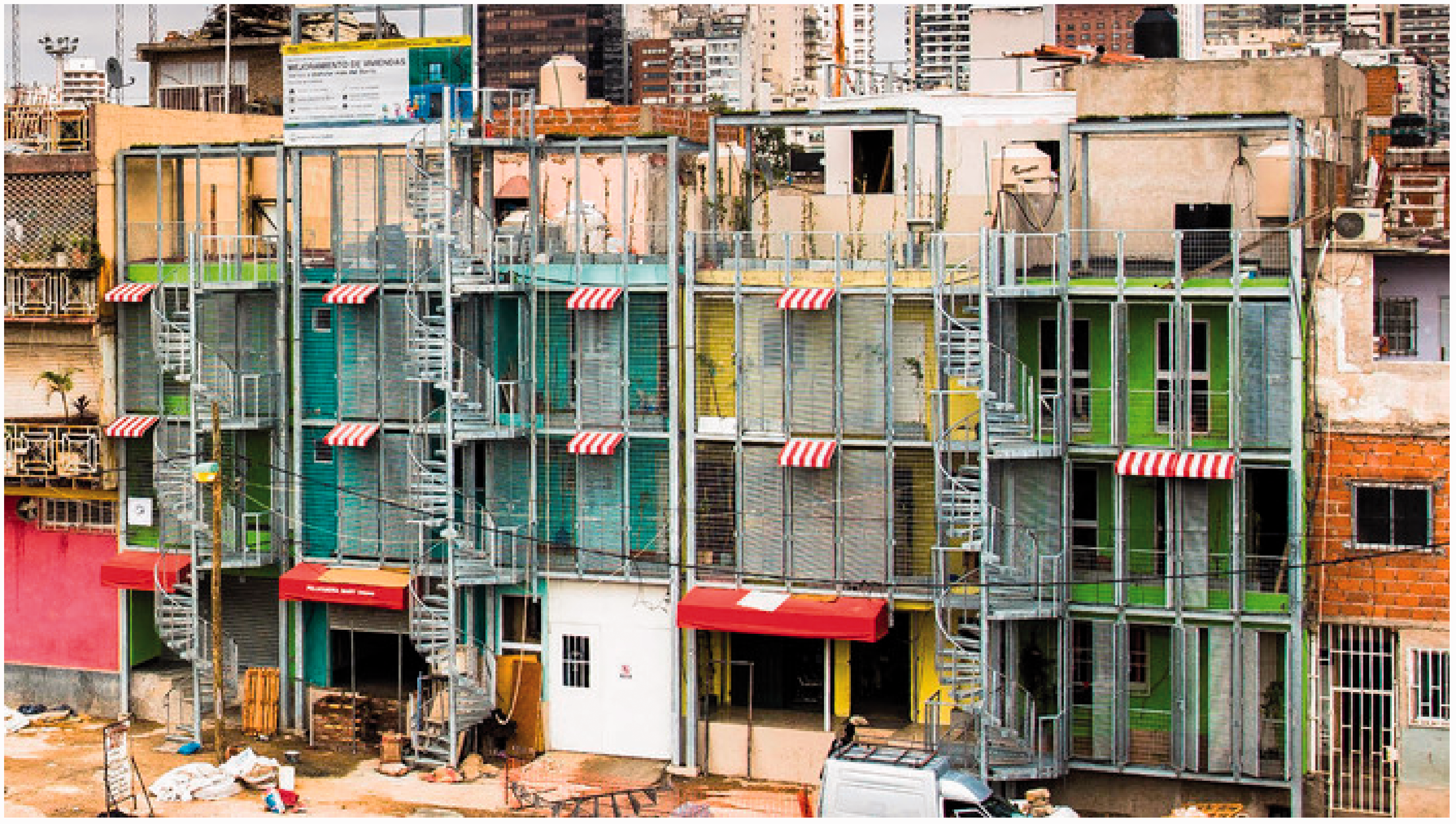
Pilot housing improvement interventions (Courtesy of SISU, GCBA).
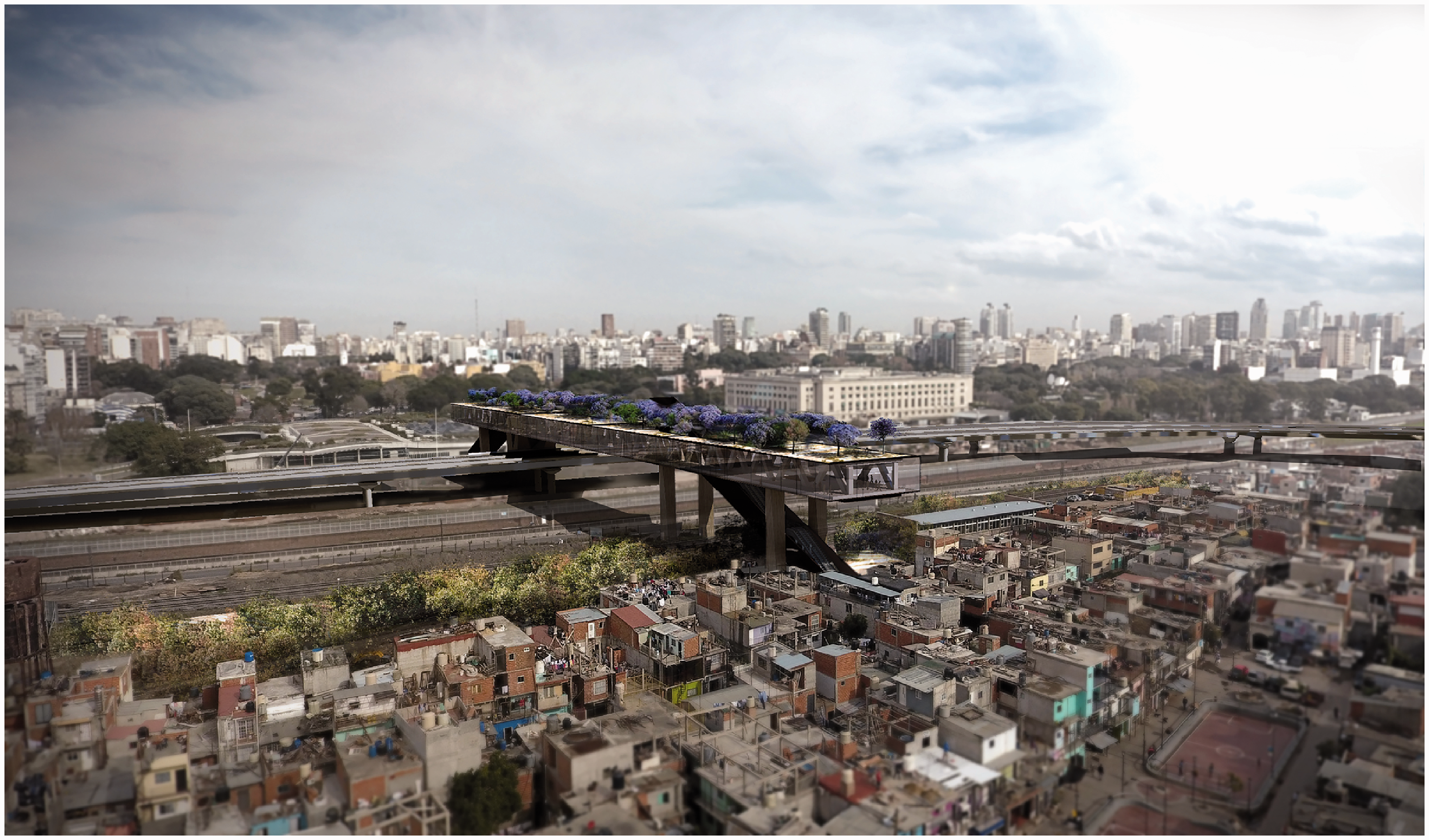
Render for the IDB bridge building (Courtesy of ELEMENTAL).
Footnotes
Acknowledgments
I would like to thank my colleagues from the Department of Geography & Environment at the London School of Economics for comments on an earlier version of this paper, particularly to Dr. Ryan Centner and Prof. Gareth Jones. I am also grateful to Dr. Guillermo Jajamovich for providing specific guidance on the topic of policy mobility in Argentina. I also thank the anonymous reviewers for their valuable comments which have significantly improved my paper. Any omissions or mistakes are my own.
Declaration of conflicting interests
The author(s) declared no potential conflicts of interest with respect to the research, authorship, and/or publication of this article.
Funding
The author(s) received no financial support for the research, authorship, and/or publication of this article.