




Abstract
This paper interrogates and expands understandings of agency in processes of knowledge circulation by focusing on actors switching their position from the demand-side to the supply side of policy knowledge. In doing so, we contribute to recent debates about the importance of accounting to other scales beyond the local–global binary that dominates the policy mobility literature and to the politics of policy translation and dissemination. Emphasis is given to the performative role of domestic actors and their practices in localising mobile policies of urban regeneration in ‘gateway cities’ while leveraging and recirculating knowledge within their national contexts. Conceptualised as policy brokers and policy entrepreneurs, such actors are attuned to the local dynamics and able to distil context-specific lessons that are sensitive to national regulatory frameworks, funding and political contingencies. We focus on two urban megaprojects of waterfront regeneration in Buenos Aires and Rio de Janeiro that introduced new practices of land monetisation while making use of inter-referencing, drawing on in-depth interviews with policy actors and archival material. We argue that an attention to ‘follow the reformatted model’ reveals how policy models mutate as they conform to contextual factors and to particular interests. The analysis of such processes allows us to transcend the local–global dichotomy and to trace multiscalar connections between multiple projects.
Keywords
Introduction
The transformation of urban landscapes through megaprojects is normally analysed as visible manifestations in cities of the effects associated with globalisation. These large-scale development projects are justified by urban elites for the need to make cities competitive and attractive to investment capital (Swyngedouw et al., 2002). A range of experiences abound in how to drive such transformations; if culture-led (through museums and cultural centres), property-led (such as residential and commercial real estate), (mega) event-led (with the construction of venues and facilities), mobility-led (new and renovated transport terminals and hubs), among others. In order to legitimise plans, proponents of megaprojects often associate their visions with the images of those experiences judged successful elsewhere where it is hoped to learn from, replicate and to achieve similar results. Although this practice of mobilisation and inter-referencing is not new (Harris and Moore, 2013), such approaches have become ubiquitous in recent decades as the circulation of policy knowledge intensified (Peck and Theodore, 2015) with the multiplication of networks, transnational organisations, city tables and the work of intermediary agents. The critical analysis of the processes through which policy models and best practices are structured, circulated and grounded has since motivated an expanding line of research under the rubric of policy mobilities (McCann and Ward, 2010; Peck and Theodore, 2010).
Nevertheless, this literature has recently been critiqued for its dominant focus on ‘local globalness’ (McCann, 2011: 120), that is, an emphasis on the local–global binary that sidelines the importance of other scales (e.g. supranational, national and intra-urban) (Borén et al., 2020; Bunnell et al., 2018; Henderson, 2020; Prince, 2017; Temenos and Baker, 2015; Varró and Bunders, 2020; Zhou, 2021). Accordingly, greater attention is given to what is clearly visible, ‘successful’ and circulating through global networks while paying less attention to how knowledge circulates more subtly through other networks and scales. In addressing these identified gaps, this paper furthers this agenda by foregrounding the neglected afterlives of megaprojects made with references to elsewhere that are recirculated within domestic networks. In other words, what happens after a model is grounded? We argue that in addition to scrutinising the supply and demand dynamics of policy mobilisation it is also important to examine how, why and by whom knowledge is leveraged and taken forward to other places, especially more proximate ones, after the ‘complex processes of translation, interpretation, and adaption’ (Healey, 2010: 5) have been carried out and lessons may resonate more strongly. More attuned to the local dynamics, domestic actors are able to distil context-specific lessons and recirculate knowledge that is sensitive to national regulatory frameworks, funding and political contingencies. This speaks to the importance of focusing on the relational work carried by key actors producing the space such as developers (Ballard and Butcher, 2020) but not exclusively, as we will show, who ‘represent an important juncture at which universalizing global forces and contingent local contextual factors meet’ (Mouton and Shatkin, 2020: 405).
We address the following questions: if transnational exchange is helpful to explain how policy making may converge around specific practices in ‘global cities’ what is the impact upon secondary cities further down the urban pecking order? In which ways is the knowledge generated through megaprojects leveraged and mobilised to guide further policy interventions? We examine these questions through two large-scale regeneration programmes of waterfront areas in Latin America; Buenos Aires’ Puerto Madero and Rio de Janeiro’s Porto Maravilha; and how and why different actors got involved and disseminated knowledge related to land monetisation in other projects within Argentina and Brazil, respectively. The analysis of such processes allows us to transcend the local–global dichotomy and to trace multiscalar connections between multiple projects. Ultimately, this paper contributes to advancing the literature on urban megaprojects and policy mobilities in two ways. First, by examining how dominant policy rationales localised through megaprojects are further embedded in less visible development projects. Second, we add empirical evidence to demonstrate how policy knowledge ‘mutates’ and travels in disaggregated and disembedded forms (Peck, 2011) by critically analysing the politics of knowledge dissemination. The focus is on the agency that facilitates recirculation processes. We examine the role of actors imbricated in urban megaprojects positioning themselves as knowledge brokers and as policy entrepreneurs to prospect further opportunities within a more limited geographical reach.
The paper is structured as follows. First, we review the discussion on urban megaprojects and their circulation as practices for spatial and economic restructuring supported by the theoretical advances made by the policy mobility literature. We underscore the importance of an actor-centred analysis on both the supply and demand sides but argue that further examination on how, why and by whom these practices become embedded and disseminated is needed. Second, we present the methodology used in the research projects underpinning this paper and the contribution of ‘comparisons developed retrospectively’ (Lancione and McFarlane, 2016). Third, the empirical section presents the analysis of the two waterfront regeneration schemes in three key moments: the grounding of dominant practices, the leveraging of policy knowledge and the recirculation of reformatted models. Detailed evidence is provided on actors who occupied key spaces and disseminated lessons that advanced their interests. The final section provides the comparative discussion and contribution of the study. We conclude in agreement with recent debates for greater consideration of multiple scales as they structure how actors position themselves and mobilise instruments, influence and knowledge.
Circulating practices in urban megaprojects and the role of domestic actors in disseminating policy knowledge
Urban megaprojects are large-scale development initiatives aimed to achieve a comprehensive transformation of spaces in cities through changes in land uses and in the built environment. These are complex programmes of urban intervention involving multiple stakeholders and employing substantial levels of capital. Their use as a strategy for spatial and economic restructuring associated with globalisation has intensified in recent decades leading to what has been termed a ‘new wave’, predominantly seen in the guise of mixed-use developments that combine commercial, leisure and residential functions (Cuenya et al., 2012; Diaz Orueta and Fainstein, 2008; Lehrer and Laidley, 2008). They offer important sites for the analysis of how places are relationally transformed, that is, how dominant circulating ideas and practices about urban competitiveness and investment attraction have an influence on particular responses shaped by context-specific trajectories (del Cerro Santamaria, 2013; Fainstein, 2008). In this light, a proliferating literature has examined different aspects of megaprojects including its financing and costs (Flyvbjerg, 2014), governance arrangements (Haila, 2008; Tarazona Vento, 2017), decision-making (Priemus, 2010; Salet et al., 2013) and social impacts (Wang and Wu, 2019). A dominant focus of these analyses is on the ability of megaprojects to be conducive to change; from relations between public and private partners (Doucet, 2013; Swyngedouw et al., 2002), to increasingly financialised and complex contractual relations (Raco, 2014; Theurillat and Crevoisier, 2013), from planning processes, instruments and democratic accountability (Carmona, 2009; Shatkin, 2008) to deleterious demographic shifts through gentrification and displacement (Watt, 2013).
One strategic quality of urban megaprojects rests on its imaging effects. Flagship projects – often making use of iconic architecture and starchitects – are employed as key symbols in large-scale programmes to confer a distinctive identity and project an instantly recognisable image to a global audience (Bunnell, 2013; Sklair, 2017). Within a context in which urban elites aspire to recreate and reimage urban spaces into ‘world-class’ areas that reflect their values and tastes, those experiences positioned as ‘successful’ become powerful templates to be learned from and potentially reproduced. The redevelopment of waterfront areas is a conspicuous example of such circulation of images and strategies (Brownill, 2013; Cook and Ward, 2012), and particularly of land monetisation mechanisms seeking to finance operations based on the future value of real estate (Amirtahmasebi et al., 2016).
Critical inquiry into how ‘policies rise to the status of ‘‘models”, or objects of emulation’ (Peck and Theodore, 2010: 170) has been the focus of the literature of policy mobilities, a perspective that transcends debates on megaprojects. In particular, there is an emphasis on agency and the role of ‘policy mobilizers’ and ‘transfer agents’ (McCann, 2011) in facilitating the circulation and exchange of knowledge between cities. These include categories such as international consultants (Prince, 2014; Vogelpohl, 2019); architects, engineers and planners (Larner and Laurie, 2010; Rapoport and Hult, 2017); real estate actors (Brill and Conte, 2020; Grubbauer, 2015); policy advocates, ‘gurus’ and ‘ambassadors’ (McCann, 2013; Porto De Oliveira, 2020); and institutions positioned as ‘clearing houses’ for particular policies (Lederman, 2020; Peck and Theodore, 2015; Webber, 2015) that constitute a large ‘spectrum of expertise’ (Larner and Laurie, 2010: 224).
While examining the role of such policy intermediaries is crucial to understand how certain policy ideas acquire ‘license to travel’ (Pow, 2014), our contribution is to consider the role of domestic actors who are embedded in different networks and perform much of the translation, promotion and negotiation tasks needed before a certain policy is mobilised (Silvestre and Jajamovich, 2021; Temenos and McCann, 2012). This requires a longer timeframe than the immediate politics surrounding policy implementation or otherwise. Recent scholarship has engaged critically with the temporal aspect of policy making by unsettling outright analyses of policy ‘failure’ and demonstrating the generative effects, incremental dynamics and ‘absent presences’ of policies that though may fail to materialise in the first instance, can steer policy debate and learning to open-ended pathways (Baker and McCann, 2020; Chang, 2017; Robin and Nkula-Wenz, 2020; Ward, 2018). By engaging with longitudinal analyses of mobilised policies on the ground regardless of their initial outcome, it is possible to follow how it mutates, is reformatted or resignified over-time with an effect over future policies. Our suggestion is to pay greater attention to the actors involved who also change their positionality over time, in this case switching from an initial position of policy mobilisers at the ‘demand side’ to policy brokers and entrepreneurs imbricated and supplying knowledge though more localised networks. Scant attention has been given to actors operating at other scales beyond the local–global binary, although analyses on the mobilities of policy models within Asia have highlighted the key role played by national actors in steering policy experimentation involving trans-national expertise and validating blueprints that influence national and regional initiatives (Chang, 2017; Zhou, 2021).
We examine two urban megaprojects that introduced new practices while making use of inter-referencing with attention to the actors who sought to leverage policy knowledge from these experiences. Similar to the recent attention given to the relational role of developers (see special issue in Environment and Planning A vol. 52 issue 2), the construction companies and development authorities that will be examined are not only relevant in mobilising models and knowledge that provide opportunities to them. They also play an important role in disseminating lessons and practices – in this case land-based financing instruments – as they are embedded in local, national and regional networks. Although finding new opportunities is what drives actors in the two cases, it is possible to identify subtleties in the way they operate, making some akin to ‘policy brokers’ while others are more clearly ‘policy entrepreneurs’. The policy analysis literature often makes undistinguished references to these categories to acknowledge the role of certain actors in influencing policy change (Christopoulos and Ingold, 2015). However, the aggressiveness in their strategies and the risks taken in promoting their knowledge to (strategically framed) policy problems are important differences. Policy entrepreneurs, according to (Mintrom 1997: 765), ‘are prepared to take risks to promote innovative approaches to problem solving, and they have the ability to organise others to help turn policy ideas into government policies’. They move in different policy circles and invest resources to shape the terms of policy debate at their advantage (Mintrom and Luetjens, 2017). In relation to policy brokers, emphasis is given to the ability of facilitating connections and access to knowledge while ‘potentially playing a key role in any lesson-drawing activity’ (Howlett et al., 2017). Brokered knowledge is ‘knowledge made more robust, more accountable, more usable; knowledge that “serves locally” at a given time; knowledge that has been de- and reassembled’ (Meyer, 2010: 122). In order to examine why and how knowledge is recirculated domestically, attention is given to the motivations, discourses, practices and resources of both groups of policy actors. We focus on three key moments of the process: on the grounding of globally circulating models of waterfront regeneration, the leveraging of policy knowledge by actors moving across domestic scales and the recirculation of reformatted practices to other less visible projects. The methodology section that follows explains how such an actor-centred approach was investigated in the research projects underpinning this paper.
Methods
Our methodological strategy is based on ‘following the policy’ (McCann and Ward, 2012) by analysing (more than local) mobile agents and megaproject proposals that mutate while circulating. More specifically, we seek to examine how and why demand-side agents become supply side agents through recirculation processes in domestic instances. The methodology attempts to grasp mobile objects and agents, requiring special attention and sensibility to changes and mutations. Thus, we seek to understand the ways in which megaproject proposals mutate – within and between grounding and recirculating – and how this is accompanied by reconfigurations of the involved agents and its changing agendas.
The two cases analysed here offer relevant insights for three reasons. First, these are highly visible and large-scale programmes of urban intervention with a strong use of inter-referencing practices (including between themselves). Second, given the scale of the projects, the changes to normal planning and delivery processes and the importance of the two cities within their respective national domains, they localise knowledge and offer potential ‘lessons’ to other cities – and actors – in the region. Third, they involve different types of elite actors across the public and private sectors who are able to leverage knowledge and seek further opportunities.
Research on the two cases was undertaken separately and brought into conversation after being completed. Therefore, the comparative analysis in this paper is one of ‘comparisons developed retrospectively’ (Lancione and McFarlane, 2016: 2406) or as it has more recently been proposed, to practice ‘a posteriori comparisons’ that allows ‘new opportunities for urban comparison and collaboration [to] emerge based on the comparability of findings rather than on the a priori characteristics of cities’ (Montero and Baiocchi, 2021).
It was possible to identify resonances in the two regeneration projects (such as their scale, practices, visibility and zones of influence mentioned above) but also important contextual differences (regarding their timing, completion and degrees of influence by different actors). Generalisation, in that vein, ‘is positioned not as an endpoint but as an informant there to enlighten understanding and intervention in specific contexts’ (Lancione and McFarlane, 2016: 2403). We compared how the ‘successes’ of the two projects were framed and how they echoed in other policies. To address the question of their impact upon secondary cities, we ‘followed the model’ as we identified study tours, references to the interest from other places – as well as resistances – and the involvement of actors in other opportunities. We examined how such connections were established and what were the motivations of actors from other cities requiring the analysis of sources beyond Buenos Aires and Rio. Related to this and addressing our second question on how knowledge is leveraged and mobilised, we paid attention to the discursive practices of actors in presenting selective readings of the achievements of the two programmes to general audiences and to particular policy makers interested to learn from the experiences. As a result, it was possible to identify nuanced differences in their approaches and thus our suggestion to employ the concepts of policy brokers and entrepreneurs.
The two projects combined similar methods of archival research, document analysis and semi-structured interviews with elite actors involved in the processes of mobilisation and recirculation of policy knowledge. Fieldwork in Buenos Aires took place between 2010 and 2016. In addition to 25 key informant interviews, it involved site visits and the analysis of policy documents and media material. Fieldwork related to Porto Maravilha in Rio de Janeiro was undertaken from 2013 to 2015 and involved 21 interviewees supplemented by the analysis of official documents and media articles. The range of participants in the two projects included officials from the development authorities, consultants, developers and senior civil servants. Attention was given to mix multiple primary sources to avoid the ‘trap’ of echoing agendas and discourses describing processes – while advertising them – in post-political and/or technocratic ways. This way, we sought to avoid fetishising and reinforcing successes and flows (Webber, 2015), as well as biases on ‘success’ discourses and practices (Lovell, 2019).
Urban megaprojects in Latin America: Grounding models and recirculating knowledge
Characteristics of the Puerto Madero and Porto Maravilha regeneration models.
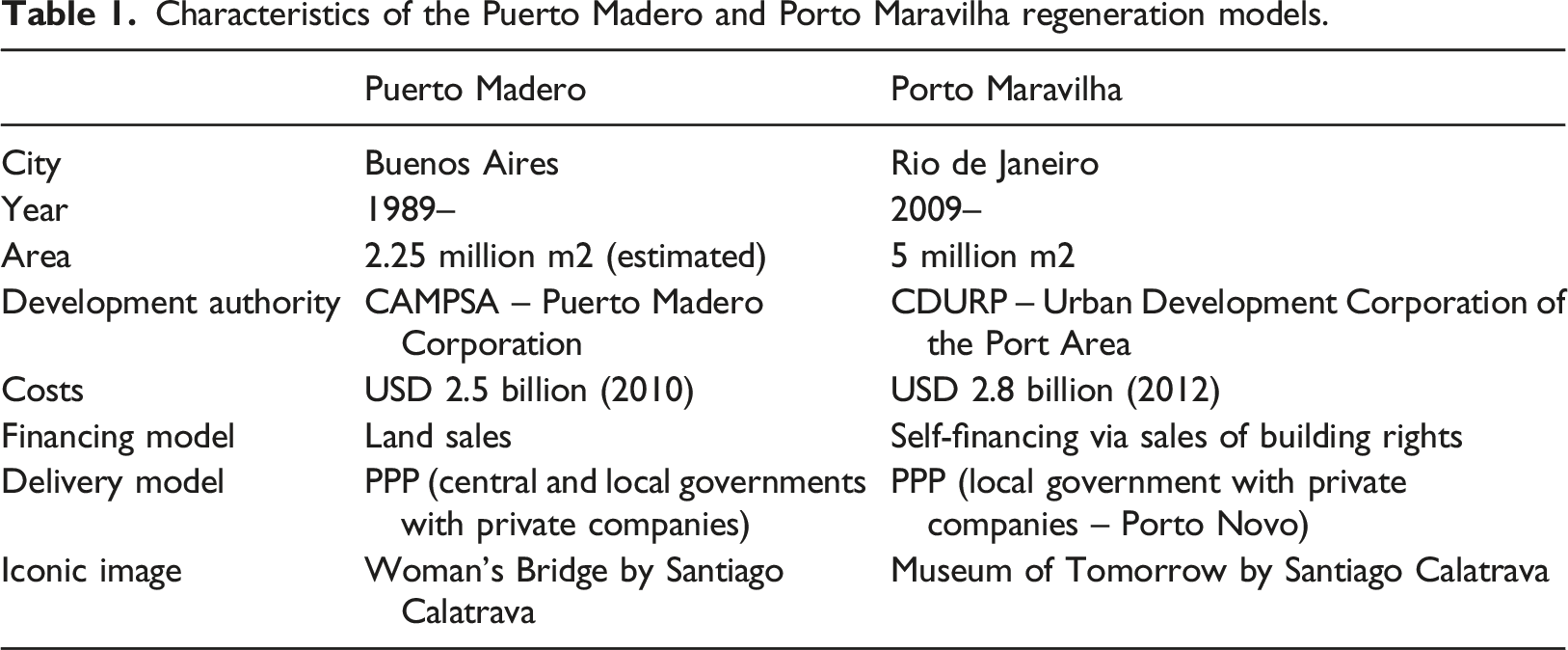
Despite the similarities, a few differences between the two cases can be mentioned. In Puerto Madero, a semi-public corporation such as the Puerto Madero Corporation (CAPMSA) – formed by both national and local government representatives – oversaw the grounding and recirculation process – although not being the only agent involved. CAPMSA involvement in the process implies different mutations in relation to changing audiences and the search for economic gains and institutional survival. On the contrary, in Rio, the Urban Development Corporation of the Port Area (CDURP) commanded the urbanisation of the area while private agents – such as construction companies operating at multiple scales – are leading its national circulation, mutating the initial ‘model’ in ways according to its interests. The temporalities of both recirculation processes are also different: Puerto Madero materialised before Puerto Maravilha being also a reference for the Brazilian programme. Also, the geographical reach of the recirculation process of both megaprojects is different. In Puerto Madero, the recirculation process began prior to, and extended beyond, that in Porto Maravilha.
Following the processes of recirculation and mutation of urban models with respect to megaprojects, allows us to investigate the role of knowledge brokers and policy entrepreneurs. This mediating role allows us to discuss biases on global flows, dichotomies such as supply-demand and to give an account of the complicated spaces, agents and spheres involved in these processes. The sections below provide a separate analysis of the two cases followed by a comparative discussion and conclusion.
Puerto Madero between grounding and recirculation processes
Grounding megaprojects models in Buenos Aires
The Puerto Madero regeneration programme was conceived in 1989 at a time of wide ranging economic and political reforms in Argentina, notably the privatisation of national industries and services. This phase of ‘roll back’ neoliberalism was also seen at the local scale where the newly appointed mayor of the City of Buenos Aires prepared a privatisation agenda. It was in this context that the Historic Puerto Madero Corporation (CAPMSA) was created as a semi-public entity, tasked with developing a financial, regulatory and physical plan that would secure the development of the port. CAPMSA incorporated local and national government agents, which facilitated the release of public-owned land and in establishing a new governance arrangement. Moreover, it presented a public-private model that allowed the self-financing of the programme via land sales and urbanisation by stages, capturing in each round the value obtained from the previous process of urbanisation. CAPMSA assets were entirely formed by the transfer of public-owned land with revenues coming from their sales to pay the private partner (Jajamovich, 2016a).
After the creation of CAPMSA the municipality of Buenos Aires commissioned a master plan for Puerto Madero to consultants from Barcelona, reactivating a bi-lateral agreement signed in 1985. Mayor Carlos Grosso made several trips to the Catalan city, which at that time was completing its own regeneration programme for the port area and becoming an emerging site exporting ‘best practices’. The proposed plan, the ‘Strategic Plan for Historic Puerto Madero’, suggested it could be the first phase of broader cooperation intended to reinforce links between the two cities and their respective enterprises and experts. Other international experiences such as London’s Canary Wharf, Paris’ Les Halles, Baltimore’s Harborplace and New York’s Battery Park and Lincoln West were also acknowledged by Grosso and his team. In fact, during the 1980s and prior to becoming mayor, Grosso worked as manager in Macri Holdings Limited (a holding company including construction and real estate companies) which participated in the development of Lincoln West (Amirtahmasebi et al., 2016).
As (Ong 2011: 17) noted, the practice of citing a ‘more successful city’ – itself an unstable category – seems to stir urban aspirations and sentiments of inter-city rivalry as well as standing as a legitimation for particular enterprises at home’. However, urban policy circulation processes can also stir local conflict. The foreign proposal generated criticism, especially from the local association of architects, who contested the legitimacy of foreign experts. As the original plan was discarded, the association became involved and organised a competition with proposals from local practitioners with the support of the city council. Despite the rejection of the foreign proposal, its core elements were adopted, namely, strategic planning and a project-led approach that reinforced the participation of private capital in the city. An important change must be signalled in relation to management and financing strategies: the combination of sale systems and land grants presented in the Catalan proposal was also left behind in favour of simply prioritising sale systems.
CAPMSA as policy broker in the recirculation of the Puerto Madero experience
In celebration of its first 20 years, CAPMSA edited a publication pointing to two issues. First, it showed how Puerto Madero was almost completed with the urbanisation of the area. Second, CAPMSA introduced itself as an ‘exporter’ of its ‘successful’ urban formula to Latin American cities. It self-proclaimed being ‘internationally renowned for one of the most successful urban projects in Latin America’ (CAPM, 2011). The corporate website focuses on its consultancy capacities – design and implementation of plans, programs and urban projects of renewal and development – and showing different intended audiences such as investors and governments. Ultimately, it argues to provide tools to boost the management ability to implement local public policies and to articulate and integrate objectives with private sectors.
CAPMSA portrays itself and its transfer activity in a postpolitical and technocratic way. In order to avoid echoing its agendas and discourses, we reconstruct both discursive and practical work implied in making a mobile model. In that vein, we ask how, when and why CAPMSA as a development authority with a specific remit (the urbanisation of Puerto Madero) became involved in the dissemination of knowledge as a policy broker. In a very interesting change to its institutional competencies, its scope was altered in 1999 to expand its role in order to provide national and international consultancy. This enabled the continuity of the institution beyond the temporal and physical limits of the urbanisation of the Puerto Madero area. In other words, knowledge brokering and dissemination was also a matter of institutional survival and not a mere technocratic process.
CAPMSA provided consultancy to Latin American cities such as Buenos Aires, Mendoza, Posadas, Corrientes, Resistencia, Santiago de Chile, Encarnación, Rio de Janeiro, Asunción, Santo Domingo and Barranquilla. The recirculation mutated according to different audiences including planning consulting, feasibility studies, technical assistance, formulation and conceptual development of urbanisation alternatives. Not surprisingly, most of these consultancies were developed in Argentinean cities. Being staffed with local and national government representatives, CAPMSA connections with other local governments were facilitated as the national government owns urban land in different cities and has political ties with different local governments. This way, the organisation emerged as a broker by exhibiting high betweenness centrality forming links with agents that would be otherwise disconnected (Howlett et al., 2017). CAPMSA did not only move knowledge but produced a new kind of knowledge: ‘brokered knowledge’ (Meyer, 2010) facilitating the creation, sharing and use of knowledge on megaprojects development.
Recirculation practices included study tours and policy tourism initiatives in Puerto Madero and the Corporation’s office as well as multiple forms of extrospective actions via its website, publications, prizes, urban planning contests, architecture exhibitions, urban planning, urban management and real estate, networks of expertise on port recovery experiences, lobbying for obtaining new projects and the aforementioned agreements with other cities.
Although CAPMSA is the main policy broker in the recirculation of Puerto Madero, the Corporation does not monopolise the recirculation process of the experience. In parallel and juxtaposed, the activity of former members of the Corporation should also be highlighted as knowledge brokers. After leaving the Corporation, former members created private urban consultancies and worked in advisory and consulting services in the remodelling of port areas and waterfronts in different Argentinean and Latin America cities – even as CAPMSA partners (Jajamovich, 2016b).
Being awarded and recognised by city networks and international organisations such as the World Bank (Amirtahmasebi et al., 2016) and UN-Habitat (Borja and Castells, 1997), allowed Puerto Madero to be packaged as a ‘model’ detached from its original context and exported, mutating along the way in accordance with changing audiences. Following (Ong 2011: 14), modelling processes ‘sets a symbolic watermark of urban aspirations on the one hand and provides achievable blueprints for urban renovations on the other’. Thus, modelling involves discursive and material activities that are inspired by particular models of urban achievements in other cities. Puerto Madero was packaged as a brand to be circulated via CAPMSA brokering activity. Far more than simply moving knowledge, CAPMSA transformed knowledge in order to recirculate it.
Recirculation, practices and discourses: CAMPSA and the Madero-Mendoza project
Between 2003 and 2009, CAPMSA was involved in a regeneration programme of 36 ha in the city of Mendoza in Argentina. Known as Mendoza-Madero, the project was explicit in its inter-referencing positioning in the framework of ‘successful’ projects. The main lesson brokered and recirculated by CAPMSA was related to its self-financing strategy.
From the demand-side perspective, it was expected that with the relationship between the municipality of Mendoza and CAPMSA a series of objectives could be achieved. This included the possibility of obtaining certain know-how on how to deliver megaprojects, access to financing and investors as well as receiving greater legitimacy in association with a successful brand and experience. At the same time, the attempt to carry out the project sought to raise the city profile. As stated by (Ong 2011: 15), urban modelling is thus not only a technology for building projects, ‘it can become a political tool for changing the built form and social spirit of another urban environment’. Nevertheless, conflicting interstate priorities, contrasting attempts by different levels of the national government, and local resistances – featured by architects, trade unions, informal settlement inhabitants and artists – presented effective obstacles to the proposal brokered by CAPMSA, being finally abandoned and showing that this recirculation and grounding process was not linear nor top-down.
By following both the reformatted model and the agents involved, we can trace how CAPMSA experience in recirculating proposals to Mendoza produced mutations in the corporation’s subsequent recirculations and brokering activity. In fact, the Mendoza-Madero agreement indicated that CAMPSA remuneration would occur after the completion of the project (Bustos Herrera, 2005; CAPM, 2003). When this did not materialise, the organisation suffered economic losses by assuming the payment corresponding to the project. In contrast, in later agreements, the corporation’s fees were stipulated in different stages, before and after the development of the project.
Although not implemented, CAPMSA continues including – and recirculating – the Mendoza-Madero project as an example of its local, national and regional successful circulation. This can be seen as part of a movement of a policy that ‘can fail in its implementation yet remains successful in its mobility’ (Chang, 2017: 1737; Lovell, 2019). Transforming failure into success – worthy of replication in new sites – implied both a new mutation and a discursive work from CAPMSA where contestations, resistances and failures are not part of the official narrative and remain immobile, as can be seen on its website. This movement can be explained as an attempt to build or reinforce CAPMSA internal and external legitimacy as policy broker in order to show its growing audiences and get broader replication sites.
Disseminating lessons from the Urban Operation Porto Maravilha
Grounding models in Rio de Janeiro
The challenges to adapt to the changes in the shipping industry since the 1960s and the construction of a new port in the metropolitan region of Rio de Janeiro led to the economic and urban decline of the historic port area near the city centre. Regeneration proposals to recover the area came in succession. In the 1980s, businesses in the international trade lobbied for plans that replicated features of revitalised ports elsewhere, from establishing a Special Economic Zone to renewal strategies modelled after Baltimore’s Inner Harbour to Japanese-style ‘teleports’ (Silvestre, 2021). According to one policy entrepreneur who led some of the proposals, the complex land ownership by public institutions was a major challenge and the coordinated effort involving multiple governments was unlikely to happen at the time (interview private investor, December 2013).
In the 2000s, the municipality was influenced by the experience of the city of Bilbao and, it entered talks with the Guggenheim Museum whose representatives were prospecting sites to expand their operations. The project proposed an iconic museum to be built at Pier Mauá designed by French architect Jean Nouvel, but the criticism from the local association of architects and a legal challenge mounted by opposition councillors led the project to be shelved (del Rei, 2004). Nevertheless, the Secretariat of Urbanism elaborated a comprehensive proposal for infrastructure improvement, the renewal of public spaces and the modernisation of mobility in the region. What was missing, according to the Secretary of Urbanism, was the definition of appropriate institutional and financial frameworks to support such interventions in line with what was seen in similar experiences in Buenos Aires and Paris (Sirkis, 2005).
In 2006, a consortium of some of the largest Brazilian construction companies responded to a call for a feasibility study for a public-private partnership in the port area. The final report advocated two core premises (Rio Mar e Vila, 2007). Firstly, to apply the planning instrument known as Urban Operation pioneered in large-scale projects in nearby São Paulo and recently regulated in the national Planning Act, the City Statute. This model of intervention gives the basis for planning controls in a ring-fenced area to be flexibilised and financially leveraged by the state (land value capture) through the sale of building rights (called CEPACs – Certificates of Additional Potential of Construction). These are securities issued by the municipality and traded as bonds in the market (ownership of bonds is not linked to ownership of land or developing activity) to be used exclusively to finance the operation (see Klink and Stroher, 2017). Secondly, it stressed the need to establish a development corporation having its assets formed by the transfer of public-owned land and the stock of CEPACs. The proposal was taken forward by new Mayor Eduardo Paes as he took office in 2009 under favourable circumstances.
Porto Maravilha as a laboratory for financing mechanisms and service delivery
When the Porto Maravilha regeneration project was announced in 2009, the political and economic context of Brazil and Rio gave assurances to its backers that a large-scale intervention in the port area could finally see the light. While the national economy presented high rates of growth, the oil and gas industry was boosted by the finding of offshore reserves along Rio de Janeiro’s coastline with an associated rise in demand for corporate real estate. At the same time, the political coalition at the federal government was reproduced at Rio’s state and municipality levels, which facilitated the release of public-owned land and the cutting of red tape. The award of the hosting rights of the 2016 Olympic Games provided further momentum with the delivery of key projects in the port aligned with the preparations for the mega-event. This way, it was argued that Rio was following ‘the example of cities around the world like Buenos Aires, New York, Baltimore and Rotterdam, among others, that boosted their economies in recovering their degraded port areas’ (CDURP, 2010: 17).
In October 2010, the consortium Porto Novo formed by the same construction companies involved in the 2006 feasibility study was appointed in the tendering process to set up the PPP. The group would liaise directly with the newly established Urban Development Company of the Port Area of Rio de Janeiro (CDURP), a semi-public organisation with shares owned by the municipality. The construction companies were interested in two of the proposals outlined in the plan that they designed. First was the construction of tunnels, expressways and public spaces and the upgrading of infrastructure. According to the consortium’s institutional relations manager, it offered new prospects for a long-term engagement: The largest Brazilian engineering companies saw that it was not possible to do the usual tendering of large projects. So, they realised the opportunities in the change of law to organise themselves, to study and propose projects, to be involved in long-term projects … It is a project with a high volume of investment, so it has obviously stirred interest (interview Porto Novo manager, January 2015).
Second, the programme also included 15-year concessions for the delivery of services renewable to a further similar period. It included public lighting, street cleaning, waste collection, road maintenance, traffic management and landscaping. Despite the experience of the companies in some of these areas, the delivery of all services in an integrated manner by one company was seen as a pioneering factor: Here, the companies [in the consortium] see it as a laboratory of this business model … They are at the forefront of acquiring this experience... The know-how is an asset of the companies, at the end of the day, it is not transferred to the public authority (interview Porto Novo manager, January 2015).
The payment for the delivery of works and services was estimated at USD 2.8 billion to be paid within 15 years. Differently from the urban operations in São Paulo where CEPAC sales were carried over a long period and negotiated according to each new development, all of Porto Maravilha’s certificates – corresponding to building rights for an additional four million square m2 – were auctioned in a single batch in 2011. The sole winning bid was presented by FGTS, a semi-public fund composed of worker’s pension savings and managed by the state-run Federal Savings Bank. The financial flow CDURP and the winning fund – involving certificates, land and payments to the private partner – was regulated through the creation of two real estate investment trusts representing each party (see Silvestre, 2021). In this way, the payment for the totality of the regeneration programme was secured upfront.
Construction companies as policy entrepreneurs in the dissemination of the Porto Maravilha model
The speed in which the programme was launched and how the initial phase of interventions was completed attracted attention. In 2014, it was awarded the second prize offered by Metropolis, a global network of cities and regional authorities, with praise for its financial model (Metropolis, 2014), while the World Bank included it as a case study on urban regeneration worldwide meant to ‘distil good practices and lessons learned’ (World Bank, 2020). The port area of Rio soon became a site for policy tourism receiving missions from other Brazilian cities such as Belo Horizonte, Salvador, Porto Alegre and Niterói. For CDURP’s Chief Financial Officer, the experience had much to offer to other places: Is it replicable? It is. Perhaps not with everything. Can I take the Porto Maravilha package to Recife, to Salvador? I don’t know, I don’t know how to answer because maybe over there you don’t need a fund, maybe you don’t have to do an auction of a single batch, maybe you don’t need a PPP for smaller interventions, it is not a development of BRL 8 billion, there are no [concessions of public] services. So, all these things need to be examined in each case (interview CFO CDURP, December 2013).
The quote suggests that Porto Maravilha can be understood as the archetypal model of urban regeneration in Brazil for its scale and combination of different elements. At its heart lies the planning instrument of urban operation, an extensive list of infrastructural developments and service delivery, financing via land value capture mechanisms and the possible guarantee from a state organisation to assume the risks of the operation. Institutionalising the public and private relationships through real estate investment trusts shielded the operation from the vagaries of the electoral cycles while securing the payment for works and services to the private partner. National construction companies played a key role in the design and implementation of this model and as seen in the previous section stood to leverage knowledge and opportunities for long-term engagement in the concerted delivery of works and services.
These companies have since engaged in the recirculation of urban operations in the country. As Stroher and Dias (2019) have demonstrated, a small number of them have been involved in feasibility studies in other Brazilian cities with proposals similarly arguing for PPPs, CEPACs and other features of the Porto Maravilha programme. Roadshows organised in 2017 sponsored by the Federal Savings Bank and the Brazilian Chamber of the Construction Industry presented Porto Maravilha as a successful model and provided details on how to access funds from FGTS (Stroher and Dias, 2019: 25). However, the economic recession in the national economy in recent years and the unveiling of corruption scandals have slowed the recirculation of the regeneration model.
Since 2014, a criminal investigation involving top government officials, state-run companies and a host of construction companies has exposed extensive corruption schemes that resulted in the imprisonment of politicians and business executives. Developers and construction companies are among the biggest donors to local, regional and national elections and exercise great influence over projects. Among the evidence found, there were notes dating back to 2007 in which the chairman of one of the companies of the Porto Novo consortium communicated that the Brazilian president and the governor of Rio were aware of the regeneration programme and were taking the necessary steps for it to happen (Carazzai and Carvalho, 2014). Representatives of another company admitted having paid bribes to the speaker of the lower house of the Brazilian Congress to lobby for the use of FGTS funds to finance the operation (Coutinho, 2015). Despite the risks of such illicit activities, the close interactions between large private interests and politicians are a longstanding feature of Brazilian politics. Although these two instances were not sufficient on its own to halt the project, it stands as evidence of the multi-scalar networks and lobbying activities between the country’s largest construction companies and top officials.
Discussion and conclusion
When does one stop looking into the circulation of policy models? Scholarship in policy mobilities has been attentive to the departure and arrival points of mobile policy knowledge punctuated by multiple anchoring spaces in between. Our contribution in this paper is to critically engage with the onward travels of policy models after being grounded, materialised and ‘mutated’ into something else, a different model to new audiences. This entails new rounds of circulation, which in the cases analysed here were channelled from ‘gateway’ global cities to other cities in vicinity within the same jurisdictional landscape. To grasp the recirculation dynamics of reformatted models, we adopted an actor-centred approach focusing on domestic multi-scalar actors performing the translation and dissemination of knowledge from hallmark programmes of urban change. We drew on concepts from public policy analysis to interrogate the work of actors influencing policy change. We suggest that an attention to policy brokers and policy entrepreneurs contributes for a better understanding on how dominant global rationales are embedded and variegated more extensively within national territories.
A comparative analysis of the two urban megaprojects allows us to make three relevant contributions. First, in line with the urban megaproject literature (e.g. Raco, 2014; Swyngedouw et al., 2002), the exceptional nature of the Puerto Madero and Porto Maravilha regeneration programmes introduced significant changes in how large-scale development projects are facilitated. However, we have provided further empirical evidence of how planning models mutate as the two programmes came to symbolise, more prominently, new approaches to the governing and financing of large-scale regeneration. As (Peck and Theodore 2010: 170) noted, policy models can ‘take on lives of their own’. In both cases, the monetisation of land as a mechanism to self-finance development projects stood as a core and telling feature. This is not casual if we consider that most Latin American municipalities have limited possibilities to invest themselves, thus being attracted to land monetisation. After experimenting in the core cities of Buenos Aires and Rio de Janeiro it has since been taken forward to secondary cities as examined.
Second, and building on the previous point, an attention to who stands to leverage from knowledge mobilisation and how this is then disseminated can reveal how well-resourced actors can influence further projects. This extends previous theoretical claims to pay more attention to agency on the demand side of policy mobilisation and to other scales beyond the local and the global (Silvestre and Jajamovich, 2021; Varró and Bunders, 2020; Zhou, 2021). Both Puerto Madero’s development corporation and the construction companies involved in Porto Maravilha managed to occupy positions as authoritative voices in urban regeneration within Argentina and Brazil, respectively, after their experiences in engaging with trans-local expertise and assembling knowledge, practices and actors. These stood as references to other cities and regions as these actors skilfully sought to connect with local, regional and national networks to promote their expertise. However, their practices and abilities to influence future policies were considerably different. We have alluded to CAMPSA as a policy broker for its positioning as a ‘go-to’ knowledge provider on large scale projects and the (marketed) ability to connect public and private actors in different scales. The enduring existence of CAMPSA is in itself an interesting feature of policy mobilities; the creation of a permanent space built upon the prestige of a particular megaproject to disseminate its lessons that signified its ‘institutional survival’. Differently, the practices of the Brazilian construction companies resembled that of policy entrepreneurs for being more aggressive, taking risks and lobbying to influence policy change – not least by resorting to illicit practices that led to corruption scandals. Within the wider nature of Brazilian politics, these large national companies were able to exercise a strong influence on development agendas and circulate policy models due to their prominent role as electoral donors in national, regional and local elections and for their involvement in illegal schemes of diversion of public funds. Both cases reflect the ‘situated embeddedness’ of domestic actors in leveraging knowledge and circulating reformatted practices sensitive to national contingencies that naturalises policy rationales experimented in ‘gateway’ cities to less visible local initiatives.
Third, the two cases also exemplify the complexity in framing policy experiences as ‘successful’ or ‘failure’ and the longer timeframes required to examine the generative effects of grounded policy knowledge (Baker and McCann, 2020; Ward, 2018). Recent authors have emphasised the importance of considering the mobilities of policy failure (Chang, 2017; Lovell, 2019) and our two cases reaffirm how this is an unstable category. Although the Mendoza-Madero project failed to materialise, the experience is promoted by CAMPSA as evidence of its expertise and the prestige conferred to Puerto Madero. Similarly, while important milestones were reached in Porto Maravilha, the programme has been significantly delayed by economic recession and corruption scandals. This did not stop the circulation of the programme as a blueprint for Brazilian megaprojects.
Following (Robinson 2011: 15), this article sought to critically examine how the circulation of knowledge is ‘punctuated by nodal points ... by the infrastructures that enable or keep ideas circulating and by places that might assume some coordinating function in relation to particular circuits…’. Building on recent critiques to the policy mobility literature, we offered new directions in conceptualising and analysing successive rounds of policy circulation and the significant role of actors embedded in domestic networks.
Footnotes
Acknowledgements
We would like to thank Tom Goodfellow and Ryan Powell for their helpful support and feedback on earlier versions of this article. We are also grateful to the feedback from participants of the seminar ‘Policy Transfer, Diffusion, and Translation in Territorial Governance and Spatial Planning in the Global South’ where this paper was first presented.
Declaration of conflicting interests
The author(s) declared no potential conflicts of interest with respect to the research, authorship, and/or publication of this article.
Funding
The author(s) disclosed receipt of the following financial support for the research, authorship, and/or publication of this article: This work was supported by CAPES Foundation (grant number BEX 0704/12-1) and CONICET (grant number PIP N 11220130100717CO).