



Abstract
Neoliberalisation processes have long permeated Western societies, including a common direction towards neoliberal migration regimes. This paper combines the perspective of variegated neoliberalisation with the recent literature on migration industries, to investigate the neoliberalisation of the Swedish labour migration regime and how it affected and interacted with the wild berry migration industry. It shows how neoliberalisation as a historical and spatially contingent process resulted in the distinct phases of intertwined policymaking and enactment of the industry. The ‘roll back’ phase included mutual interests and ‘intimate relations’ between state and industry, which both empowered and increased the number of private actors, creating structures that remained during the regular restructuring phase of ‘roll out’ neoliberalisation. While adding the perspective of variegated neoliberalisation, the paper deepens the analysis of migration industries by pointing at neoliberalisation as a spatial and temporal process, where the interplay between state and industry, an enlarged number of intermediaries and the increased responsibility of private actors are central cornerstones. The Swedish case shows how the role of intermediaries in the wild berry migration industry was reconstructed in order for the neoliberal migration regime to regulate a previously irregular migration industry. It is concluded that strong but spatially contingent links exist between neoliberal political economies, migration regimes and migration industries.
Keywords
Introduction
Neoliberalisation has profoundly affected societies and the regulations governing them since the 1970s (Harvey, 2007; Peck and Tickell, 2002). This includes the market-led and variegated restructuring of state institutions and regulations (Brenner et al., 2010a). The deregulation of the labour market is at the core of the neoliberal project (Bourdieu, 1998), which is why the neoliberalisation of labour migration regimes has been a dominant course, with states regulating their policies according to the competitiveness of free markets (Herod, 2000; Schierup et al., 2018). Notably, it has contained the global competition of workers and the flexibilisation of particularly low-waged, temporary labour schemes (Strauss and McGrath, 2017). As such, neoliberal migration regimes are a response to the deepening social inequalities on a global scale, accompanied by the precarisation of migrant workers (Delgado Wise, 2015).
The current paper analyses the neoliberalisation of migration regimes by attaching it to the spatial and temporal contingencies and the ‘regulatory experiments’ that are emphasised within variegated neoliberalisation (Brenner et al., 2010b; Peck and Tickell, 2002). Central to this perspective is the uneven unfolding of neoliberal regimes across time, and how they undergo sequences of, first, strong marketisation, so-called ‘roll back’ neoliberalisation, to then become adjusted, or ‘rolled out’. Linked with labour migration regimes, analytical attention is drawn to how neoliberal labour migration schemes intersect with the increasingly powerful migration industries, including the wide range of profit-making actors and networks that are involved in the production of migration flows (Cranston et al., 2018; Gammeltoft-Hansen and Sørensen, 2013). The paper highlights the idea that neoliberal states are producing novel sets of private actors to govern migration (Menz, 2013), as well as the growing interest in migration industry literature on the mutually constitutive state–industry relations (Axelsson et al., 2021; Surak, 2018).
The paper analyses the link between migration industries, migration regimes and the neoliberalisation of political economies, through the example of the contemporary evolvement of the Swedish labour migration scheme, developing in close relation to the wild berry migration industry, at that time constituting an unregulated Swedish ‘Wild West’. The Swedish labour migration policy was radically altered from state control towards market-driven selection in 2008 (Emilsson, 2016). This makes the Swedish case exceptional (OECD, 2011), showing a pure form of neoliberalisation of migration regimes (Frank, 2014), which, rather than privileging high-waged labour, included all workers. The paper departs from the approach of variegated neoliberalisation, while following the historical process of how state–industry relations developed, including the establishment of new private actors. It brings forward how neoliberalisation affects migration regimes, which, in turn, affect migration industries, while creating new constellations of intimate relations and mutual interdependencies and interests between state and industry in the process of channelling and regulating migration flows. In this way, the paper adds to the literature on, first, the neoliberalisation of migration regimes, and second, how the neoliberalisation of states and the mutual constitution of states and industries are creating migration industries.
Method
The paper combines documents from Swedish policymaking and state agencies, and interviews with actors from the Swedish state and the wild berry industry. The parliamentary process of neoliberalisation has been followed since the launching of the labour migration regime in 2008 through official documents and reports that are published by the Swedish government. Moreover, several interviews have been performed with state actors. The main source of information has been the Swedish Migration Agency, which has been interviewed repeatedly (2012, 2016 and 2018). Moreover, representatives at the Ministry of Justice, the Ministry of Finance, the Swedish Tax Agency in 2018, the Border Police in Västerbotten in 2018 and a member from the parliamentary Committee for Labour Migration have been interviewed. Another major actor for the development of industrial relations in Sweden regards the trade unions. One interview was performed with an ombudsman at the Swedish trade union confederation LO in 2018, who represented the trade unions in the parliamentary process. Interviews were also performed with Kommunal, the trade union working for the berry pickers (2012 and 2018). The analysis also contains letters and reports from the Swedish Migration Agency and LO.
The wild berry migration industry has been followed since 2011, involving multi-sited studies on actors in Sweden and Thailand. Both workers and a variety of formal and informal companies have been interviewed, contributing to the overall understanding of the migration process. Since this paper addresses the migration industry, the main focus has been on the interviews with the four major berry companies and wholesalers. Two of the companies were interviewed repeated times (2012, 2013 and 2018), whereas other actors were interviewed in 2013 and 2018, respectively. These interviewees have also been members, and sometimes chairs, of the Swedish Berry Business Organisation (SBIF), which played a major role in the neoliberalisation process. The interview material also includes interviews with two more other members of the organisation (interviewed in 2012, 2018 and 2019).
Variegated neoliberalisation of the Swedish migration regime
Neoliberal migration regimes and migration industries
This paper departs from the notion of variegated neoliberalisation, emphasising how capitalist states are characterised by the differentiated processes of marketisation and commodification (Brenner et al., 2010a). In their seminal paper, Peck and Tickell (2002: 383) underline the unfolding of neoliberalisation as a historical process, where neoliberal ideologies ‘are produced and reproduced through institutional forms and political action’. Moreover, although they move across space, neoliberal projects are path-dependent and vary between places. In this way, variegated neoliberalisation emphasises institutional spatial and temporal contingencies, rather than globally homogeneous, all-encompassing explanations, which, for instance, are common from a pure Marxist perspective (Brenner et al., 2010a; Cumbers et al., 2003).
A major ingredient in neoliberal political economies is the commodification of labour. Bourdieu (1998) outlines how ‘the precarious arrangements that produce insecurity’ and ‘the existence of a reserve army of employees’ constitute cornerstones of neoliberal and deregulated labour markets. Neoliberal globalisation in this way deeply affects the organisation of work, including the organisation of labour migration schemes (Herod, 2000; Munck et al., 2011). Neoliberal migration regimes are the dominating tendency in Western countries, selecting low-wage, temporary workers to ‘less desirable’ positions (Delgado-Wise, 2015; Samers and Collyer, 2017). As pointed out by Schierup et al. (2018), the neoliberalisation of migration concerns both irregular migration and temporary migration schemes that are sanctioned by states. Migration scholars, such as Preibisch (2010), Binford (2013), Axelsson et al. (2017) and Strauss and McGrath (2017), have showed how the temporary element in neoliberal migration schemes, and in particular the global competition and flexibilisation of labour, has led to migrant precarity. Accordingly, temporary migrants are subject to precarious and unfree conditions, including uncertainty regarding the continuation of work and income, the degree of control over working conditions, dependency on the employer and the extent of regulatory protection.
The literature on variegated neoliberalisation provides further tools to the analysis of migration regimes. First, through the focus on neoliberalisation as a historical processes, the uneven development of ‘regulatory experiments’ across time is highlighted, along the sequences of extreme marketisation (roll back) and re-regulations (roll out) (Brenner et al., 2010b; Peck and Tickell, 2002). Second, the spatial awareness brings contextual variations and path dependency to the fore, where the specific restructuring of institutions of governance and the institutionalisation of relations between specific states and markets are important to consider. A tangible result is the uneven spatial development and growing social inequalities in neoliberal societies on global and national scales (Jessop, 2018). Transferring this to the neoliberalisation of migration schemes, they are viewed as historically and spatially situated in their institutional context and in the relations between state and private actors.
Likewise, in the literature on migration industries, state and private actors are central elements. This strand of research directs attention to the facilitation of migration through the ‘growing commercialisation of international migration’ (Cranston et al., 2018; Gammeltoft-Hansen and Sørensen, 2013: 2). The primary focus has been on the ‘meso level’ activities of private actors, targeting the increased involvement of intermediaries and other profit-seeking actors in migration industries (Hernández-Leon, 2013; Surak, 2018) and how they stand ‘between’ states and migrants (Xiang, 2012). The role of the state has here primarily been theorised as ‘an essential backdrop’ to the activities of private actors (Gammeltoft-Hansen and Sørensen, 2013: 11) where governance is shaping migration flows in between their colonial heritage and neoliberal regimes (Lindquist, 2018). Menz (2013) develops the role of the state while emphasising how neoliberalisation is increasing the involvement of private actors in migration processes (see also Coe et al., 2007). The motive of states to involve private actors could be to escape ‘the often-unpleasant implementation’ of migration policies (Menz, 2013: 111). Moreover, the inclusion of private actors has long-lasting implications, termed ‘path-dependent lock-in effects’.
Cranston et al. (2018:552) point out that future research should embark from a structural approach on migration industries, to instead include the wider socio-economic context such as ‘stories about the evolving role of the state, the day-to-day operation of globalisation and how we can understand the economy’. One way of doing this, our paper suggests, is to look at neoliberalisation as a spatially and temporally variegated process (Brenner et al., 2010a) and how this intersects with migration industries.
Another central feature in the migration industry literature is the now growing awareness that actors in the migration industry are interrelated (Schapendonk, 2018). According to Xiang (2012), research should go from a perspective that views intermediaries as standing ‘between’ state and migrants, towards seeing private actors as integrated within state regimes. Along these lines, state–industry relations have been characterised as ‘intimate’ (Gammeltoft-Hansen and Sørensen, 2013) and inseparable (Lindquist et al., 2012). However, there is still room for research to explore further the quality of these relations. Surak (2018) distinguishes between formal and informal state–industry relations, while Axelsson and Pettersson (2021) show how private actors are actively searching to gain an influence on migration policies by intense lobbying and building relationships of proximity and reach. In this way, state and industry are co-producing the regulatory spaces of labour migration while either establishing tight relationships, or with industries establishing a powerful presence towards the state (Axelsson et al., 2021). The current paper continues along this discussion on how state and industry are mutually, but asymmetrically related. It seeks to broaden the understanding of neoliberal migration regimes while attaching it to, first, the historical unfolding of contextually and temporally contingent ‘regulatory experiments’ within variegated neoliberalisation, and, second, the mutual interdependence of state and industry that is evolving in migration industries. The paper highlights how the regulatory process of constructing neoliberal migration schemes is related to the formation of migration industries, in particular interdependent state–industry relations, and how durable structures of newly established private actors are created.
Neoliberalising the Swedish labour migration regime
The current Swedish labour migration scheme was launched in 2008, mainly going from the strong influence of the trade unions towards neoliberalised, market-driven employment decisions. At this point in time, Swedish labour migration was exceptionally low, compared to other OECD countries (OECD, 2008). During the 1980s and 1990s, only a few hundred official workers arrived to Sweden from outside the Nordic countries (Emilsson, 2016). The ‘Swedish model’ of labour relations was informing labour migration to Sweden, where it was central that the trade unions approved a declaration that no surplus of domestic workers existed in the sector, which served as a basis for the Migration Agency to approve work permits. In 2008, that condition was removed, creating a system for labour migration that was informed by the decisions of individual employers and thus the work permits provided by the Migration Agency. Emilsson (2016) argues that the Swedish policy in this way was opposite to the global trend on increased migration control. However, along with Frank (2014), this paper rather takes the stand that the Swedish migration policy, similarly as other states, embarked along the road of neoliberalisation, prioritising flexibilisation and competitive labour markets. The Swedish case, however, was taking this one step further in illuminating how the idea of how variegated neoliberalisation processes and the regulation and deregulation of migration affect migration regimes.
The initiation of the neoliberalisation process could, this paper argues, be traced back to the heavy lobbying in the early 2000s of the influential business federation Confederation of Swedish Enterprise (Svenskt Näringsliv) (Hedberg et al., 2014). The organisation drafted a report and performed an intensive lobbying campaign for an employer-based model to import migrant workers (Ekenger and Wallén, 2002). Following this, in 2004, the Swedish parliament voted for an investigation to deregulate labour migration, based on a majority that went against the sitting Social Democratic government. The subsequent Swedish election in 2006, which resulted in a shift to a centre-right coalition government, affected the outcome of the policy towards the priorities of the employer's side. While the final report of the parliamentary investigation (SOU, 2006) suggested limited changes to the current order of labour migration, the changing parliamentary situation motivated the centre-right coalition government to ‘develop and closely consider some of the suggestions’ (Ds, 2007).
Accordingly, only 10 months after the Swedish election, a new, complementary investigation was presented (Ds, 2007). Its main message was that the employer alone should decide the need for foreign labour, a suggestion that echoed the previous report of the Confederation of Swedish Enterprise. The quick investigation was strongly criticised by the trade unions, which lost their influence on the issue. According to an interview with the trade union confederation LO, the new construction of labour migration policies implied high risk for trafficking and forced labour. The Swedish Migration Agency, which was given the ultimate responsibility to perform the policy, commented: That's the paradigm shift in Swedish foreign policy regarding labour migration since 2008: There are no points or quotas or labour market demands. But there is a Swedish employer, who estimates that this person is needed (Swedish Migration Agency, interviewed in 2012).
In sum, the 2008 labour migration policy strongly neoliberalised migration in Sweden, giving the employers a large and direct responsibility. The policy was internationally unique (OECD, 2011), since it treated all industries equal, both high and low waged labour. It was designed as a two-plus-two years’ system, where the employer could offer the worker employment for two plus two years. If employment was continued, the migrant should be granted the right to permanent residence. In practice, however, migrant workers are constantly running the risk of being out-competed by newly arrived migrant workers, who are more prone to accept precarious work conditions (Axelsson et al., 2017). Seasonal workers, such as berry pickers, were included in the general work permit, but their limited employment to only a few months per year meant that they were not entitled to permanent residence in Sweden. Accordingly, the neoliberalisation of the Swedish migration regime was initiated by meeting the interests of private actors, showing the interrelatedness in the process of neoliberalisation between state and industry.
Neoliberalising a migration industry
The neoliberalisation process of the Swedish migration regime in 2008 was intrinsically related to the wild berry industry and the private actors that constituted this migration industry. In response to their common interests to promote migration, state and industry entered into a mutually enforcing process, where they both could gain from restructuring migration. Just like Krifors (2021) puts it, the migration industry has, in this case, been intertwined with the economic activities of the berry industry and the goal to maximise profitability.
To grasp the historical process that the neoliberalisation of the Swedish migration scheme and the Swedish wild berry industry involves, the paper analyses the unfolding of distinct phases (Table 1). The irregular phase, the Wild West, represents the period preceding neoliberalisation; this is followed by roll back neoliberalisation, which concerns the phase of strong marketisation of Swedish migration policies, accompanied by the regulations of the state towards the wild berry industry, and negotiations between state and industry; lastly follows the phase of roll out neoliberalisation, when state and trade unions re-regulated the industry.
Neoliberalisation of the Thai–Swedish berry industry.
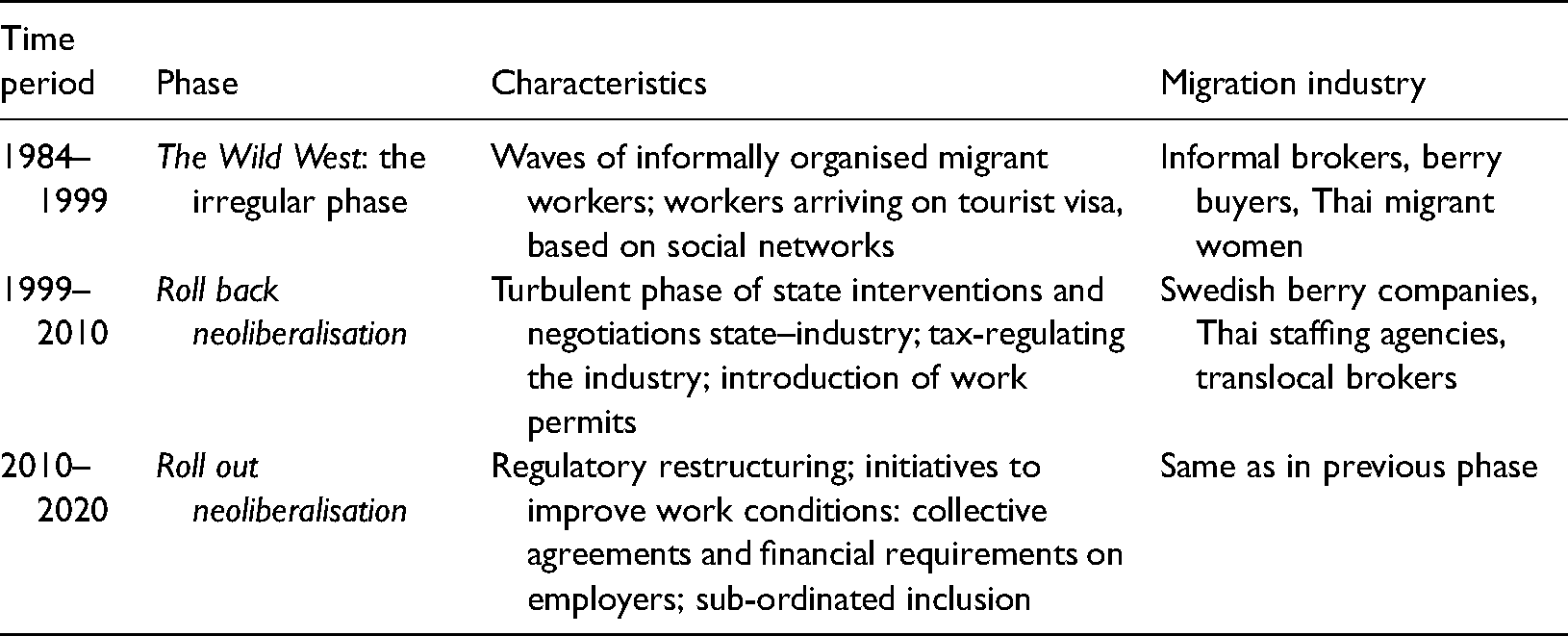
The analysis shows how the wild berry migration industry evolved in parallel with the neoliberalisation of the Swedish labour migration regime. Each phase affected the construction of the migration industry, where some of the already present private actors were empowered, and where novel, powerful actors were added to the migration industry, particularly Thai staffing agencies.
The Wild West: The irregular phase
Neoliberalisation has been illuminated as a process starting off from non-regulated contexts resembling a ‘jungle law’, to then become regulated by market rules of competitiveness (Peck and Tickell, 2002). This is distinctive also for the Swedish wild berry industry, which at the time of neoliberalisation was characterised by social unrest and lack of regulations. The industry had even coined a name for themselves: the Swedish ‘Wild West’.
In this phase, the wild berry migration industry developed as an irregular sector consisting of different waves of migrant workers who arrived on tourist visas (Jonsson and Uddstål, 2002). There is a wide understanding among researchers that the Swedish wild berry industry has constructed itself as dependent on migrant workers, integrated in the wider process of economic activities to maximise profits and keep costs down (Eriksson et al., 2019; Krifors, 2021). It has developed against the context of an internationally unique condition, the historical Right of Public Access (Allemansrätten), which enabled actors of varying nationalities to pick berries for commercial purposes, in private or institutional regimes (Hedberg, 2013; Stens and Sandström, 2013). As shown in Figure 1, migrant workers have gradually replaced a high number of Swedish workers, who used to pick berries as a side income. While in the 1950s, around 100,000 Swedes were picking berries for commercial purposes, this number had in the 2000s decreased to around Swedish 500 workers. In this period, berries were sold to local berry buyers, who were distributed as a network in rural Sweden, for example, located outside small shops or gas stations. They distributed the berries to two Swedish, globally oriented wholesalers: Polarica, in the very North, and Olle Svenssons, in the South. To some extent, this practice exists also in the contemporary industry, but it has been complemented with a number of national and international wholesalers, and the berry pickers selling berries to the local berry buyers are often replaced with migrant workers. From a Nordic perspective, there has been a critique that the wild berry industry has failed to involve forest owners and the local community (Hamunen et al., 2019). In the Swedish case, the majority of berries has been exported as raw materials, mainly to the Asian health industry, but also to Finland, instead of investing in the regional refinement of products (Hedberg, 2013). Eriksson and Tollefsen (2018) have documented how the peripheral location of the industry for decades enabled the industry to pass unregulated from the state, despite high turnover and export values.
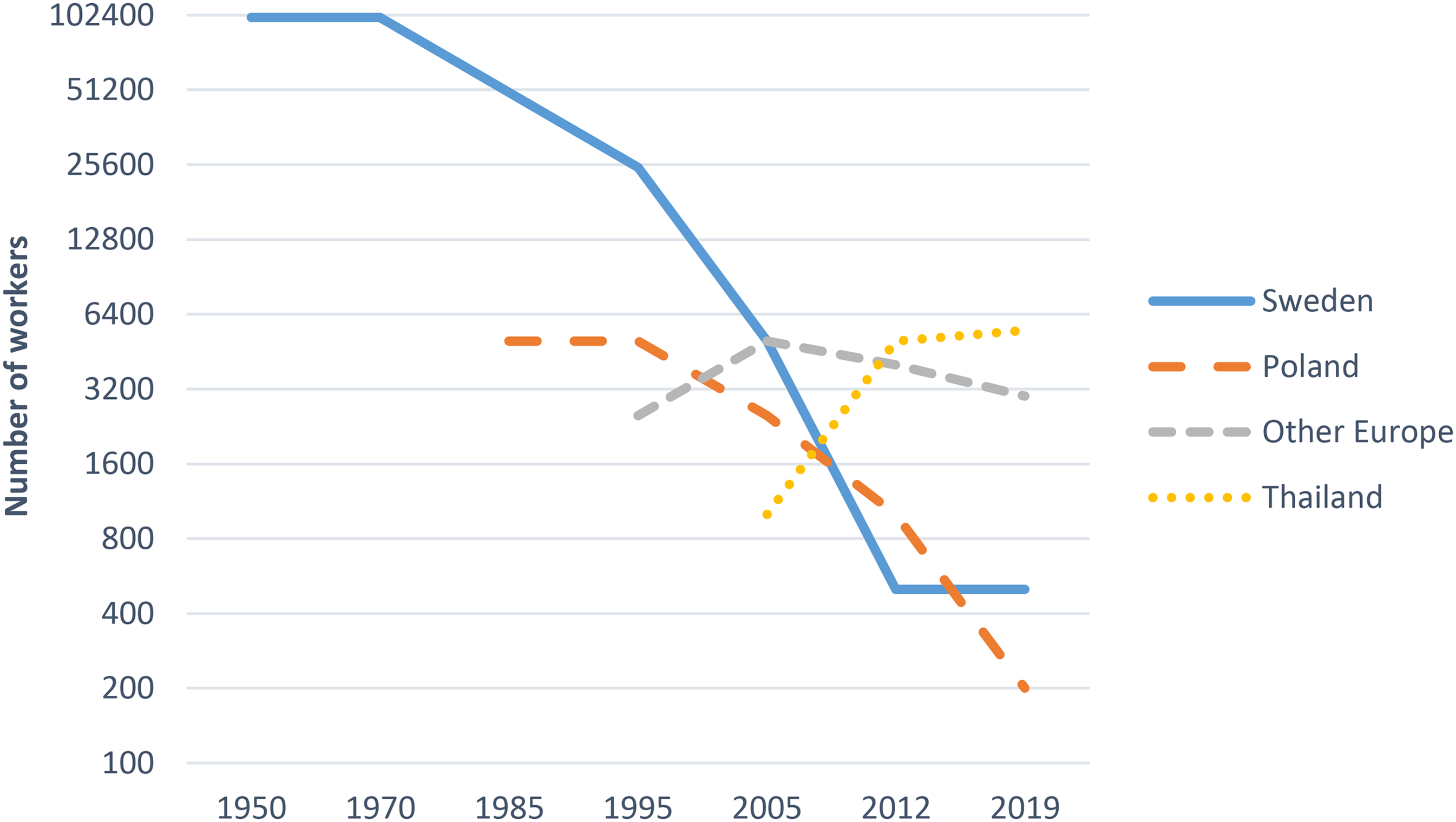
The origin of berry pickers in Sweden, 1950–2019. Logarithmic scale.
Figure 1 illustrates how the waves of migrant workers comprised, first, the import of Polish workers, when the berry buyers acted as informal brokers in the migration industry. According to the industry, around 5000 Polish workers arrived annually, ‘in more or less organised forms’. In 2004, however, they seized coming to Sweden when Poland joined the EU, and more attractive jobs were offered to the workers. Rather, a second wave of migrant workers from other European countries, mainly Ukraine and Bulgaria, arrived. Although some of these workers travel independently within the free movement of the EU as ‘tourist workers’, there are also large groups of workers who are organised from their homeland by informal brokers, and received and hosted by Swedish berry buyers, comprising a group of irregular and precarious migrant workers (Vogiazides and Hedberg (2013); Mešić and Woolfson, 2015).
None of these groups, however, is directly affected by the Swedish labour migration regime, targeting non-EU migrants. Instead, regulation has mainly concerned the third wave of irregular migrant workers, arriving from Thailand. Although the wild berry industry gives that this group of workers arrived during the 2000s (Figure 1), interviews with Thai women tell that this migration process was initiated already in the mid-1980s. This migration industry developed as an informal chain of workers, based on the strong social networks of Thai migrant women (Hedberg, 2016; Eriksson et al., 2019). The pioneer migrant was a Thai woman residing in rural Sweden, who brokered her closest relatives. Soon, this escalated into an informal Thai–Swedish mobility system in the otherwise well-regulated Swedish industrial landscape (Do Carmo and Hedberg, 2019). Arriving on tourist visas from the poor, rural districts in north-eastern Thailand, the berry pickers worked for their co-ethnics, without regulations regarding work conditions or accommodation, a process that could go on due to its location in periphery Sweden (Eriksson and Tollefsen, 2018). While some give account of friendly working conditions among friends and relatives, others tell of informal brokers cheating their co-ethnics (Hedberg, 2016).
Between 1990s and 2000s, a junction occurred in the migration industry, when the brokerage of Thai women was replaced by Swedish berry buyers (Table 1). Some of these actors had already before changed roles from buying the berries to importing European migrant workers, but now, they started importing Thai workers. Among them existed several unserious actors, who put the workers at risk for being deceived and swindled (Vogiazides and Hedberg, 2013; Wingborg, 2011). An actor in the industry describes this period as ‘very, very messy, […] very, very Wild West’.
‘Roll back’ neoliberalisation: The turbulent time of state interventions
The neoliberalisation process of the Swedish labour migration regime entailed the complete restructuring and regulation of the berry industry, which reshaped the entire structure of the migration industry. It was an extremely turbulent time, consisting of messy and overlapping sequences, where the twists and turns of state interventions were followed by reactions of the Swedish berry industry, in some ways resembling a ‘cat and mouse play’. It reasons with the idea of Brenner et al. (2010b) that neoliberalisation contains negotiation processes between state and market, and shows connections to the literature on migration industries emphasising similar issues of state–industry dialogue (Axelsson et al., 2021).
There are clear signs that the Swedish state was concerned to include the irregular wild berry industry into the labour migration policy, which was launched in 2008. According to an interview with the trade union confederation LO, low-waged workers were even the main target of the policy, since they otherwise, due to the strong say of the trade unions, were denied the issuing of work permits in favour of domestic workers. High-waged workers could migrate to Sweden already within the previous legislator framework (LO, 2013). The wild berry industry was of particular interest, due to its sheer number of migrants. During the first years of implementation of the new labour migration policy, wild berry pickers outnumbered all other groups of workers (Figure 2). The first season, in 2009, half of all work permits, or 7200 workers, were given to berry pickers coming from non-EU countries. More than 80% of them were from Thailand 1 . Thereafter, the number of Thai workers has fluctuated between 3000 and 6000 per year (Figure 2), often including the same individuals, who return seasonally (Hedberg et al., 2019).
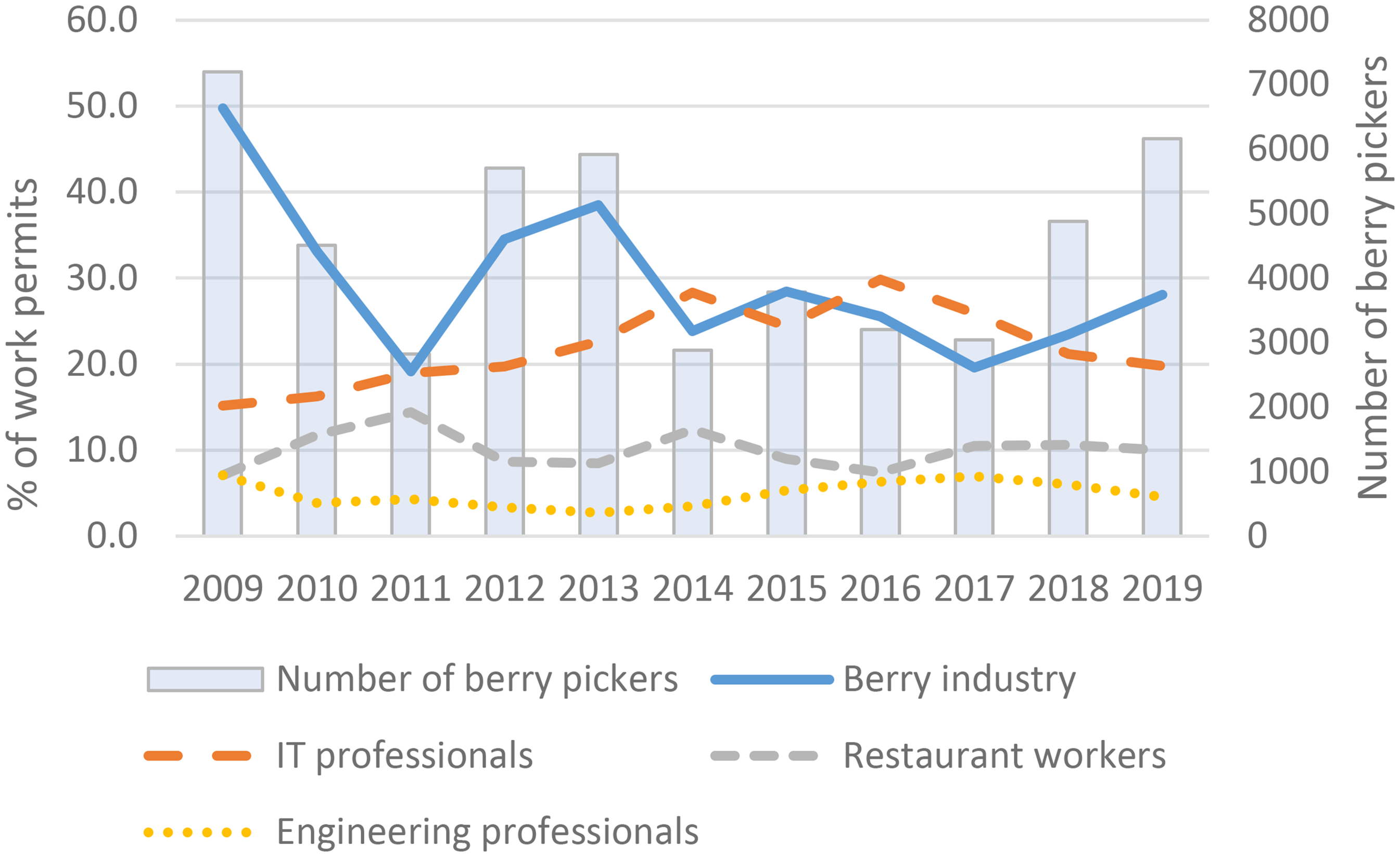
The distribution of work permits within the four major sectors related to the total number of work permits, 2009–2019, and the number of berry pickers.
Regulating the wild berry industry
To incorporate the wild berry industry into the migration policy, which at this point in time consisted of the irregular ‘Wild West’, the state needed to ‘sanitise’ and regulate the industry. This embarked into a process of close cooperation between the industry and the state and made the wild berry industry part of the process of neoliberalising Swedish migration policy.
Two major state-led attempts served to regulate the wild berry industry. Regulation was aimed at the visas for the workers coming to Sweden, but also came to include the regulation of taxes since the berry companies’ profitability to a large extent rested on the exemption from payroll taxes. First, the state introduced work permits instead of tourist visas for berry pickers, something that put an end to many of the previous activities of informal brokers. A first attempt occurred already in 1999, when the state replaced the informal entries on tourist visa with work permits that were issued specifically for seasonal labour. Work permits have been used in Swedish migration politics as a way to regulate migration since the 1920s, and in the 1990s, the state successively searched to increase the possibilities for migrants to work (Calleman and Hertzfeld Olsson, 2015). However, the introduction of work permits in the berry industry contained many problems, resting on the irregular migration industry that occurred with the shift in brokerage from Thai migrant women to Swedish berry buyers. After two seasons, the migration industry could return to the informal system based on tourist visas.
The failed trial illuminated a need for a ‘polished’ party in the berry industry, and in 2002, the berry companies’ interest organisation, SBIF, was founded. One company highlights that the Swedish Migration Agency strongly encouraged the companies to establish SBIF to remove the informal system of the Thai women: [SBIF] was founded since the Migration Agency wanted a [discussion] part, simultaneously as… […] It was these Thai women… They discovered that [the workers] were living in cowsheds, and [the Agency] had no control. The Migration Agency said: ‘Can’t you, who are buying berries as companies, can’t you fix this, because they can’t be living in cowsheds’ (berry company, interviewed in 2018).
The SBIF became a central player in the wild berry migration industry, both in the import of Thai workers and in representing the industry towards the state. The members consisted of wholesalers and previous berry buyers, who now instead hosted berry pickers. The aim with the organisation was to protect the interests of member companies and, although some interviewees mention a fund to protect the workers, the main focus was to enable the import of workers to Sweden. A former chair remarks that the organisation was extremely conflict-ridden, torn between the interests of the two main wholesalers. Although the SBIF describes a good dialogue with the trade union confederation LO, it was never a part of the ‘Swedish model’, in the form of being an employers’ organisation. Instead, one former chair describes the organisation as ‘passive’ in relation to wages and work conditions.
The Swedish Migration Agency held regular meetings with SBIF, before and after the berry season. Local and state authorities, such as the trade union confederation LO, the local police and the border police, and the Swedish Tax Agency, also took part in the meetings. According to a former chair of the SBIF, the meetings resulted in regulations in a range of areas, including fire safety, food quality and accommodation, first attempt to establish minimum salaries and initiatives to control the berry companies that imported workers. In this way, the SBIF became a spider in the net of the wild berry migration industry, regulating the actors on the Swedish side.
In parallel, the second step of regulating the industry occurred, which included a tax revision of the industry. In 2003, a sentence in the Supreme Administrative Court stated that the employers in the berry industry were obliged to payroll taxes for employees working in Sweden but residing abroad (so-called SINK tax). The Migration Agency and the SBIF had annual meetings, which is why the industry expressed surprise and alarm when the Swedish Tax agency filed a court case against them: We had a reconciliation with the Migration Agency each year. […] Nobody had anything to say. Everything went better and better. Then the Tax Agency hit us […]. Demanded a revision of the organizations’ balance acts. […] We had several companies who thought they had done something good. Because the Tax Agency had been informed from the first day (chair of SBIF, interviewed in 2013).
The tax revision was controlled in 2005. One company refers to the tax revision as a ‘big, big crisis’, which hit both themselves and the workers economically. To solve the situation, a former chair of the SBIF describes how he started intense lobbying activities towards the state: We didn’t know what to do. So we started to court politicians. […] I don’t know how many politicians I have met on the ministry level, but they are plenty… And everybody found it damn wrong. […] But no one wants to change the tax system (chair of SBIF, interviewed in 2013).
Several sources in the interview material indicate that the new, centre-right coalition government was involved in finding a solution. A letter addressed from the Migration Agency confirms that it was supported by both the Ministry of Finance and the Tax Agency (Swedish Migration Agency, 2009). A former chair of SBIF goes one step further, arguing that negotiations existed on the highest political level, through the involvement of Maud Olofsson, at that time the Minister for Enterprise and Energy and the Deputy Prime Minister of Sweden: ‘Finally we found ourselves with Maud Olofssonand we had a big meeting […] And then – then finally we had a solution (chair of SBIF, interviewed in 2013)’.
The solution that evolved was the introduction of a new and influential actor in the migration industry, the Thai staffing agencies. Their task was not only to arrange labour migration in Thailand, based on local brokers in Thai villages, but also to act as the formal employers. This arrangement enabled the migration industry to avoid Swedish taxes, to instead ‘post’ the workers to their work in Sweden (Axelsson and Hedberg, 2018). The solution was approved by the Tax Agency, which in an interview explains that it followed all rules and regulations. In the migration industry, SBIF was the main coordinator, and the Swedish berry companies acted as hosts to the wild berry pickers.
In line with Menz (2013), the case thus illustrates that the neoliberalisation of the migration regime created a new set of powerful private actors in the migration industry, in this case strongly related to the industry's interest to increase profits (Krifors, 2021). The tax revision critically and contradictory coincided with the neoliberalisation process, and while the neoliberlisation process had the goal to increase labour migration, taxing the industry rather counteracted the import of migrants. There thus existed strong but diverging interests between state and industry to reach to a solution. While the industry wanted to avoid Swedish taxes, Swedish state authorities were eager to ‘sanitise’ the industry, which included that the import of workers should take place within a regulated migration industry.
Implementing the labour migration policy
To regulate the migration industry, the next step in the neoliberalisation process was to implement work permits in the berry industry. Since it was pressing to introduce the Thai staffing agencies before the next season, the Swedish Migration Agency agreed with the SBIF to reintroduce work permits in the berry industry already for the season 2007, that is, two years before the implementation of the new labour migration policy. Simultaneously, in 2006, general but minor changes were made in the Aliens Act regarding work permits for non-EU workers, specifying more clearly that they could be issued to workers who either belonged to a group with occasional deficiency, international exchange or temporary work in agriculture or horticulture (Calleman and Hertzfeld Olsson, 2015).
During 2007–2009, the SBIF was given a major influence on the recruitment process and the structure of the migration industry. The organisation had the formal control to decide which Swedish berry companies that were allowed to import workers, where after the Swedish Migration Agency issued work permits. The companies should meet a range of criteria, among others stating that they should have a written contract with both a wholesaler and a staffing agency and should show a plan for logistical issues like accommodation in Sweden. Moreover, it regulated that the industry should take responsibility if a foreign worker runs into problems: ‘The staffing agency takes responsibility in the case of unforeseen occasions where the picker suffers economically, and covers its costs. The member company shall, in agreement with the staffing agency, assist to practically solve unforeseen events occurring in Sweden’. The SBIF also had an informal agreement with the Agency about the number of workers that would come to Sweden. In this way, the SBIF took on the tasks that were usually performed by trade unions.
However, the activities of SBIF went against the general recommendations that the Swedish state had set up for work permits in Sweden (Calleman and Hertzfeld Olsson, 2015). These guidelines stated that salaries and other employment conditions should be in level with a collective agreement or what was praxis in the industry and that the salary should not be lower than 13,000 SEK. During the season 2007–2009, the Swedish Migration Agency instead supported the criteria of the SBIF before the general recommendations of the state.
The trade union confederation LO points out in an interview that the relationship between SBIF and the Swedish Migration Agency became even more problematic after the launching of the new labour migration policy in 2008. Now, the recommendations about wages and work conditions were actively brought into the Aliens Act. Since the berry industry was acting according to their own rules, the issuing of work permits to berry pickers for the season 2009 was actually illegal. However, according to LO, this could proceed since there was no sanction against the employers.
The season in question, the summer of 2009, also turned out to be quite misfortunate in the wild berry industry. Workers arranged open protests and hundreds of workers returned to Thailand with low payment, or even indebted (Axelsson and Hedberg, 2018). The criteria set up by the SBIF, that staffing agencies should ‘take responsibility’ and cover costs when the workers suffered economically, apparently weighed lightly.
‘Roll out’ neoliberalisation: The phase of regulatory restructuring
Rather soon after the enactment of the Swedish labour market regime followed a phase of regulatory restructuring, which can be characterised as ‘roll out’ neoliberalisation (Peck and Tickell, 2002). In this phase, the influence of the SBIF was completely removed, and instead, the Swedish Migration Agency started a close cooperation with the trade union confederation LO. The main structure of the migration industry, based on Swedish berry companies and Thai staffing agencies, remained intact. However, when their influence was removed, the conflict-ridden organisation SBIF seized to exist in 2013.
After the difficult season in 2009, LO decided that the problems attached to the wild berry migration industry must be solved ‘once and for all’. The Migration Agency agreed that the problems had escalated to a situation that forced them to act: I know how it was around 2009, about when we started to practice the new policies. It was chaos, to be honest People were exploited en masse […] There are reliable sources from the Tax Agency that Vietnamese citizens were building slingshots to shoot down birds to [have something to] eat. It was on that level. That is of course nothing that our agency could watch without saying, but we had to do something (Swedish Migration Agency, interviewed in 2012).
A working group was created among LO's member unions, which aimed to bring order to the issuing of work permits and to make one of its member unions responsible for berry pickers. In a letter to the board, an administrator at LO writes that it was ‘the insufficient administration of the Migration Agency’ that finally made them act: The flaws can in short be described as that the Migration Agency, against current law, choose to ignore the requirement for salaries and other work conditions in level with Swedish collective agreements. Moreover, work permit applications were not remitted to a trade union for an opinion, despite current legislation stating that they should (LO, letter from 2010-02-02).
It was decided that the Swedish Municipal Workers’ Union (Kommunal) should take responsibility for the workers and offer them a collective agreement, despite the workers not being regular, paying members. In an interview, the union describes this as a forced rather than voluntary task: Normally we can fight a little about the members, but I think that here the other unions were kind of happy that [we took responsibility for the Thai workers] […] Partly we wanted it, in a crass way, since we think it is terrible that people are being exploited. Then, we also had no choice (Kommunal, interviewed in 2011).
A collective agreement was put in place for the season 2010, based on a combination of two already existing agreements for foreign strawberry pickers and posted workers, which granted the workers a guaranteed wage and regulated work hours. Regulatory restructuring then occurred in 2011, when the Swedish Migration Agency concluded that migrant workers in low-waged industries were still being exploited. The agency made an amendment to the labour migration policy, while stating, among others, that the Swedish companies inviting workers had to provide salary guarantees. This would save the workers from being exploited by unserious actors, in line with the 2010 collective agreement: ‘We saw pretty fast that the key to prevent the companies from exploiting people was simply that companies can show that they have the ability to pay salaries’ (Interview with the Swedish Migration Agency, 2012).
A document from the Swedish Migration Agency (2014) summarises the legal obligations which the ‘roll out’ neoliberalisation process resulted in. To be able to import berry pickers to Sweden, the berry companies should: document payment of salaries to workers in previous years; demonstrate their ability to pay salaries to workers in advance; demonstrate their ability to organise work for berry pickers, including the provision of accommodation, vehicles and food; demonstrate the costs that are put on the individual worker; and document that the workers have been informed about the nature of work, Swedish regulations and the conditions of work, as well as foreign companies should register a local branch in Sweden; companies should also provide work conditions in accordance with Swedish collective agreements and sign insurances for the workers when working in Sweden; a trade union should approve the work conditions, and the worker should be offered a salary of at least 1300 euro/month or higher 2 .
Taken together, it is the view of both representatives of the wild berry industry, government authorities and unions, that these measurements removed the problems with exploitation of workers and ‘sanitised’ the industry. The Swedish Border Police in Västerbotten Region, where a major part of the berries are picked, expresses it accordingly: It feels as if there are no major problems today, this is a pretty regulated [industry]. […] Considering that the police authority is an operative agency, acting from the set of problems that we see in society, I think it is rather telling that if there would be much problems around berry pickers and around their accommodations, […] well in that case we would act upon that. And that picture is nothing that I recognize at all (Border Police Västerbotten, interviewed in 2018).
However, empirical examples indicate that problems still exist, making the berry pickers subject to ‘subordinated inclusion’ (Tollefsen et al., 2020). Despite formal inclusion in collective agreements and Swedish labour standards, the workers are still not in a position to claim their rights once they lose them (Axelsson and Hedberg, 2018). This indicates that despite ‘roll out’ activities, neoliberal ‘experiments’ still characterise the migration regime, upheld by the actors of the migration industry and the industrial setting that was created during the ‘roll back’. The seasonal arrangements of the workers, and the transnational setting of employment relations within the migration industry, still create loopholes for the wild berry industry to circumvent national legislations (Axelsson and Hedberg, 2018). Once again, it demonstrates the tangible links between the neoliberal migration regime and the migration industry.
Conclusions
Neoliberalisation processes have long permeated Western societies, including a common direction towards neoliberal migration regimes. This paper analyses the neoliberalisation of migration regimes as a variegated historical process (Brenner et al., 2010a, 2010b; Peck and Tickell, 2002), while attaching it, first, to the process of neoliberalising migration regimes and, second, to the empowerment and re-creation of migration industries.
The paper goes into detail with the deregulation of the Swedish labour migration scheme, and how it unfolded in close symbiosis with the wild berry migration industry. An important conclusion is that the migration regime is, indeed, neoliberalising but it is also a process that is variegated depending on context. It shows empirically how neoliberalised migration governance is linked to spatially and historically contingent contexts, and characterised by an uneven development of deregulating ‘roll back’ phases and de-marketising phases of ‘roll out’ neoliberalisation. Moreover, the paper shows that the neoliberalisation of migration regimes coincides with the formation and restructuring of migration industries, and the notion that migration is increasingly commercialised and facilitated by private actors. As brought forward by Menz (2013), the neoliberalisation of migration regimes increases the number of private actors to implement the often unpleasant regulations, which have long-lasting institutional effects, or path dependency. The migration industry literature is also starting to unpack the mutual interdependence of state and industry (Axelsson et al., 2021). This paper finds theoretical linkages between the literature on variegated neoliberalisation and that on migration industries, both through their mutual emphasis on integrated state–industry relations and through their emphasis on spatio-temporal contexts and path dependency.
The neoliberalisation of the Swedish migration regime represents the most deregulated and homogeneous neoliberalisation process in Western countries (Frank, 2014; OECD, 2011) and is as such an example of a neoliberalising migration regime when it is drawn to its tip. It illuminates how the migration industry at times was drawn into the governance process, both through negotiating with the state and also when implementing the migration policy. This included the right of the industry to decide which companies that were allowed to import workers, the issuing of work permits and the establishment of an additional group of private actors, Thai staffing agencies, to circumvent Swedish taxes. A prerequisite for the neoliberalisation of Swedish migration policies was the regulation of the previously irregular wild berry migration industry, sometimes referred to as the Swedish ‘Wild West’. The process was uneven, as suggested in the theory of variegated neoliberalisation, and the strong influence of the Swedish wild berry industry on the state was limited to a period of eight years (2002–2010). As such, it contained distinct phases of first ‘rolling back’ the migration regime, when the interests between state and industry were deeply entrenched, followed by a phase of ‘roll out’ neoliberalisation, when an intense dialogue proceeded between state and trade unions to adjust the policy. However, despite the now strongly reduced influence of the industry on state policy, the effects, or path dependency, of this period are still considerable in the industry, not at least since Thai staffing agencies continue to be an inseparable and influential part of the migration industry. This shows how the links between neoliberal social structures, labour migration regimes, and migration industries, mutually enforce each other in directions that are spatially and temporally contingent, creating durable structures across time.
An important point in the neoliberalisation process of a migration regime, which has been in the shadow of this paper, remains the position of migrant workers. Notably, despite the proclaimed intentions of the state to protect workers, their precarity rather tends to be enhanced. The unpredictable nature of the regulations and de-regulations in the Swedish wild berry industry caused turbulence in the industry, which in the end affected the workers, including uncertainty regarding the continuation of work and income, and the extent of regulatory protection. Moreover, the creation of a new, transnational actor in the migration industry, the Thai staffing agencies, also created a distance towards the ‘real’ Swedish employer, which has increased the risk for precarious work conditions, including exaggerated fees to be put on the workers.
Taken together, the paper shows that migration regimes are also becoming neoliberal and that neoliberalisation processes are both spatially and temporally variegated, closely intertwined with the migration industry. In fact, the Swedish case suggests that these theoretical tools are inseparable from the analysis of the neoliberalisation of a migration regime. First, it is obvious that the neoliberalisation of the migration policy occurred at a temporally distinct period in time, the ‘roll back’ phase, which nonetheless had continual effects in the contemporary industry. Second, the paper demonstrates that during this period, the migration industry played a major role in facilitating and co-producing the migration policy. Accordingly, this paper suggests that neoliberalisation and the ‘intimate relations’ that are created between state and industry are at the core of understanding how migration industries develop and that they are particularly strong during ‘roll back’ neoliberalisation.
Footnotes
Acknowledgments
We are grateful for valuable comments on the first draft of the manuscript from the anonymous referees and for fruitful discussions on the paper with Linn Axelsson, Qian Zhang and Nils Pettersson, all from Stockholm University.
Declaration of conflicting interests
The author(s) declared no potential conflicts of interest with respect to the research, authorship and/or publication of this article.
Funding
This work was supported by the Swedish Research Council Formas (Grant No. 2013-01457) and the Swedish Research Council (Grant No. 2017-01010).
