




Abstract
The policy of density agreements, allowing extra density for condominium developers in exchange for affordable housing units, is seen as an example of the neoliberalization of urban governance in North American and European cities. The consensus of scholarship on urban neoliberalism has suggested this practice is indicative of the rise of the entrepreneurial, market-orientated local state. Through a study of urban development in Vancouver, British Columbia. I illustrate how exchanging density for affordable housing also operates on the basis of gift giving. In doing so I integrate Karl Polanyi's framework of substantivism, which highlights various forms of economic exchange including markets, redistribution, and reciprocity, into research on urban governance. Applying the principles of substantivism to the case of Vancouver, I argue that reciprocity obfuscates the negative effects of the privatization of affordable housing provision by making social welfare contingent on increasing profits for developers, concealing the role of political power in land-use decisions, and gentrifying low-income neighbourhoods. These findings hold implications for the study of urban politics, the neoliberalization of affordable housing, and urban-economic research more generally.
Introduction
In recent years, municipal governments in cities across North America have turned to private development firms to fund affordable housing in the context of the rollback of the welfare state. These arrangements often rely on a policy framework known as density agreements, a form of ‘land-value capture,’ where the local state allows for extra height and density on new condominium projects in exchange for social services from developers. Common in cities such as Vancouver, Toronto, New York, and London, density agreements are seen as part of a shift to entrepreneurial, market-driven urban governance (Fox-Rogers and Murphy, 2015; Graham, 2015; Lehrer and Pantalone, 2018; Marcuse and Madden, 2016; Rosen and Walks, 2013, 2015; Stabrowski, 2015; Stein, 2019). Building on theories of urban neoliberalism, this paper argues that an additional set of economic relationships characterize density agreements—the exchange of gifts between the private sector and the state. Within Vancouver's field of urban development, for example, prominent developers, housing nongovernmental organization actors as well as politicians, including the mayor and deputy mayor of the city, construct and enact this policy through ongoing relations of reciprocity. Developers that ‘give back’ by including social housing in their projects can be granted lucrative planning exemptions on their future endeavors, such as with the Oakridge development, a massive multi-tower luxury condo in central Vancouver and one of the largest residential developments in Canadian history.
That the privatization of the welfare state can take the form of gift giving at the local level expands on theories of urban neoliberalism and the shift to market-oriented logics of city governance (Akers, 2015; Boudreau et al., 2009; Brenner et al., 2012; Hackworth, 2007; Peck, 2010). Drawing from Polanyian substantivist economics (Peck, 2013a, 2013b; Polanyi, 1944, 1971), I develop a framework for the study of urban-economic processes that highlights a variety of forms of exchange, including markets, redistribution, and reciprocity. Combining Polanyi with thinkers in economic sociology, such as Marcel Mauss and Pierre Bourdieu, I show how economic exchanges are socially constructed by local state and non-state actors, and how this influences the development and land-use outcomes. Drawing on in-depth ethnographic and interview-based research, and developer and city data on rezonings for social benefits, I illustrate how urban neoliberalism is advanced through patterns of gift giving, including non-market mechanisms such as status, trust, symbolism, and reputation.
Exchanging density for affordable housing: A form of urban neoliberalism?
One of the most widely discussed findings in urban studies over the past several decades has been the shift toward neoliberal urban governance in cities across the Global North. With the dismantling of the Keynesian welfare state, scholars have noted that cities are increasingly subject to market logic and entrepreneurial governance across numerous domains including housing, labour markets, and capital and financial investment (Brenner and Theodore, 2002; Hackworth, 2007; MacLeod, 2011). For example, density agreements, a form of land-value capture, have become an increasingly popular way for cities to fund public goods, especially affordable housing, as welfare state funding has declined. 1 The concept of land-value capture maintains that the state influences the value of land, through actions such as investment in public infrastructure, zoning, and other forms of regulation (Germán and Bernstein, 2020; Wolf-Powers, 2012). Therefore, if a private landowner such as a developer seeks to rezone their property to allow for additional height and density of a building, a process termed spot zoning, the public should share in the ‘creation’ of that value by ‘capturing’ some of the profits resulting from that increase (Moore, 2013, 2016).
Some scholars, planners, and policy makers have suggested that this form of land-use policy socializes the economic benefit from densification and works to mediate private market forces (Campbell and Henneberry, 2005; Friendly, 2017; Germán and Bernstein, 2020; Punter, 2003; Shih and Shieh, 2020; Whitehead, 2007). In this idealized form, land-value capture is seen as a ‘win–win’ between the state and the private sector, who share in the value created by the relaxation of existing zoning rules. However, critical urban scholars have suggested that land-value capture policies, such as density agreements and density bonusing, further entrench neoliberalism. These scholars argue that density agreements are a part of ‘roll-out neoliberalism,’ which results in the privatization of services previously provided by the welfare state and the subordination of citizen needs to the market (Fox-Rogers and Murphy, 2015; Peck and Tickell, 2002; Stabrowski, 2015). In particular, researchers point to the overrepresentation of density agreement applications in low-income neighbourhoods, which fund housing as a part of new gentrifying developments (Marcuse and Madden, 2016; Stabrowski, 2015; Stein, 2018, 2019). Rosen and Walks (2013, 2015) argue that density agreements are a part of ‘condo-ism,’ a form of growth boosterism tied to condominium development in North American cities (see also Graham, 2015; Lehrer and Pantalone, 2018). Writing about Toronto, they state “Condominium development has increasingly been sought out for the public benefits that have become dependent on it, providing a direct link between the rise of condoism and the neoliberalization of city policy” (2014: 304). In sum, this body of work suggests that density agreements are part of the privatization of social welfare through the logic of market-oriented growth and urban development. 2
While this work has helped to theorize the shift to market-based forms of urban governance in advanced capitalist countries, there has been much less work that accounts for the persistence of non-market exchange within cities in the context of the re-regulation of the welfare state. Drawing on the work of Karl Polanyi, I investigate how various forms of exchange accompany the shift from redistribution to forms of governance that favour the private housing sector. I use the case of Vancouver, where density agreements have become a pervasive policy over the past 20 years, to show how these arrangements are negotiated by developers, politicians, and planners to produce affordable housing. Elaborating on the discussion of density agreements and entrepreneurial governance, I find that density transactions are socially constructed as ‘gifts’ through relations of reciprocity and gift giving between the private sector and the local state. I then illustrate how this enactment of density agreements as gifts influences land-use decisions that increase the profits for private development firms who ‘give back’ through contributions.
This paper builds on existing theories of urban neoliberalism by showing how the downloading of social welfare onto cities has created new patterns of reciprocity between politicians, planners, and the urban development community. A recognition of different forms of exchange illustrates how neoliberalism, rather than working solely through a market-based exchange, is also perpetuated through cultural processes such as status, patronage, reputation, gift giving, and symbolism. A critical understanding of gift giving allows us to see how this form of economic exchange can conceal the negative effects of the privatization of affordable housing, revealing an underexamined aspect of state power in facilitating private economic gain in the neoliberal city (Boudreau et al., 2009; Hackworth, 2007, 2016; Marcuse and Madden, 2016; Peck, 2010; Stein, 2019; Weber, 2002).
A substantivist economics of the city
In recent years, Karl Polanyi's work has been taken by up economic sociologists and geographers and in a number of areas within a heterodox political economy (Block and Somers, 2014; Burawoy, 2003; Dale, 2010, 2016a, 2016b; Krippner, 2001; Peck, 2013a). These movements have centered on bringing Polanyi's master concept of the social embeddedness of the economy, as well as his unique perspectives on market fundamentalism relating to the commodification of land, labour, and money, and the dynamics of protectionist double movements, to bear on contemporary neoliberalism.
While these conversations have helped to clarify the role of culture and institutions in the economy, as well as the power of market fundamentalism as a form of economic ideology, it is only recently that scholars have attempted to revive Polanyi's broader theoretical and methodological apparatus of substantivist economics. Peck (2013a, 2013b) highlights the potential of substantivism for economic social science through its emphasis on institutions and various ‘hybrid’ forms of economic exchange. For Polanyi, substantivism is a historicist antidote to the abstract formalism of classical liberal economics, in particular, Adam Smith's (1776) claims that humans have a natural propensity to ‘truck, barter, and exchange’—to engage in market-like behaviour. Polanyi (1944, 1971) argued that markets were just one of several ‘forms of integration’ or patterns of exchange that have provided the foundation for economies throughout human history, the others being reciprocity (gift giving), redistribution (socialism), and house-holding (self-sufficiency). In societies based on reciprocity, exchange takes the form of gift giving and status through dense and ongoing social ties (Sahlins, 1972). In other words, the economy is deeply embedded in the culture. Redistributive societies are based on centralization, where goods are transmitted to a central authority (a clan chief or formal administration) and then redistributed on the basis of need. Finally, markets involve one-off transactions based on barter and principles of supply and demand. In his critique of Smith, Polanyi illustrates that experiments with market fundamentalism, or ‘self-regulating’ markets, in the mid-1800s was the first time humans sought to create a society solely based on markets (Block and Somers, 2014; Somers and Block, 2005).
Peck’s (2013a) interest in reviving substantivism is based on its ability to account for the development of markets by placing them in a historical–institutional context and in relation to other forms of exchange. Polanyi believes that one form of integration would come to dominate over others as the central organizing mechanism of an economy, however various forms of integration could still be found in all societies. As put by Peck, “a Polanyian take on markets (like other modes of integration) would be grounded in social ontology: markets are constituted through instituted processes; markets coexist with other forms of integration, usually in awkward and contradictory ways; and to the extent that markets display disembedding tendencies, far from being the prelude to equilibrium or the attainment of ‘purity,’ these are by definition disruptive, providing a range of social and institutional responses” (2013a: 1552). Thus, for Peck, Polanyi's substantivist approach provides theoretical flexibility to account for the various empirical instantiations, both of markets and general economic processes.
This paper also places the ideas of Marcel Mauss (1925) and Bourdieu (1990) in dialog with substantivism, to show how gifts operate by creating a fuzzy, incalculable relationship between the giver and receiver that are often heightened by a delay between exchange and reciprocity (Lainer-Vos, 2013a, 2013b; Rossman, 2014; Schilke and Rossman, 2018). In turn, these exchanges are enacted through a language of trust, altruism, and status. Mauss (1925) saw gifts as a way to gain power over receivers, in particular those who may not be able to immediately reciprocate the exchange. For Bourdieu (1990, 1991, 2000), who drew extensively on Mauss, the gift was central to a theory of symbolic power, which was intertwined with and yet irreducible to economic power (Silber, 2009). By giving gifts, an ostensibly ‘voluntary’ act (Mauss, 1925), individuals promote the appearance of being altruistic and disinterested, while accruing status that may be economically advantageous in future transactions. As Bourdieu puts it, “there is much transmissible power, which derives from the art of delaying transmission and keeping others in the dark about one's ultimate ulterior motives” (1990: 107).
Polanyi's framework of substantivism, when combined with economic thinkers such as Mauss and Bourdieu, offers new opportunities to unpack hybrid forms of economic exchange within the neoliberal city. While density agreements take place within Vancouver's housing market, state actors engage in reciprocal transactions with private developers that are embedded in relations of trust and status, reflecting real estate transactions more generally (Bourdieu, 2005; Buzzelli and Harris, 2006; Fainstein, 1994; Guy and Henneberry, 2000; Weber, 2015, 2016). Thus, this paper works to integrate Polanyian economic geography and sociology into the study of urban development, land use, and the privatization of the welfare state. In doing so, it also sheds light on the problems associated with density agreements as a form of social policy, especially when enacted as gift giving.
A study of the politics of urban development
My analysis is based on a comparative study of the field of urban development in Toronto and Vancouver. This research includes 3 years of ethnographic fieldwork in both cities, 100 interviews with developers, planners, politicians, and housing advocates, and textual and quantitative analysis of secondary sources such as development applications, city documents about the size and value of rezonings, and campaign contributions from developers. I use the case of Vancouver to illustrate the role of gift giving within the context of welfare state reform. While these findings are common across both cases, the role of reciprocity in density agreements is mediated by the political structures of each city—an at-large system in Vancouver and a ward system in Toronto.
I carried out fieldwork in Vancouver between 2015 and 2018, attending city hall meetings, rezoning application hearings, developer-led events, workshops held by housing advocates, and other community forums. I also conducted semi-structured qualitative interviews (n = 54) with actors in the field of urban development, which lasted between half an hour and two hours. My field notes and interviews were transcribed and coded using the qualitative software package MaxQDA. In coding the data, I followed the method of abductive analysis developed by sociologists, Tavory and Timmermans (2014), which involves an iterative process of moving between close engagement with the data, academic literature, and follow-up visits to the field to collect additional data based on these impressions. Alongside my qualitative fieldwork, I also analyzed secondary sources obtained through the city of Vancouver's annual reports on community amenity contributions (CACs) on the size and value of rezoning (see Appendix 1). This data allows me to compare city documents with the financial outcomes of density agreements for private sector actors who seek rezonings in exchange for affordable housing. Finally, I use data on the campaign contributions of developers to political parties to compare this with city decisions about rezonings.
Community amenity contributions: From ‘quality of life’ benefits to affordable housing
In Vancouver, the exchange of density for affordable housing is conducted through the policy of CACs, a form of density agreement (Moore, 2013; Punter, 2003). Situated in the broader policy framework of land-value capture, CACs allow developers to ask for an increase in density beyond existing zoning if they contribute some of their additional profits to community amenities. As in the cases of Toronto and New York city, in Vancouver land-value capture takes the form of a negotiated agreement (Moore, 2016), where sites can be rezoned on a case-by-case basis. With CACs, as with other forms of value capture, the process is ideally founded on ‘good planning principles,’ in other words the increase in zoning must first pass through the city's planning department, which decides whether the increase is appropriate for the site.
The city's real estate department calculates an estimate of the land lift of the site (the value of the land before and after the rezoning), and then proposes an in-kind contribution for the developer to build, for example a park, daycare, or affordable housing, that amounts to 75% of the land-lift (city of vancouver (CoV), CAC Reports). 3 A recommendation is then forwarded from the real estate and planning departments to the 10 members of the city council and the mayor, who vote to either approve or reject the rezoning. This process is thought to produce the most careful and lucrative results for the city, as it estimates the land value of individual sites rather than entire neighbourhoods. However, it is also time consuming and opaque to the public. Socio-legal scholar Valverde (2012) refers to this form of zoning as “the state of exception as the rule,” arguing that the flexibility of zoning in cities such as Vancouver and Toronto in its “very regulatory architecture, encourages a constant proliferation of site-specific exemptions and legal black holes” (2012: 45). This is further reinforced by policy stating that negotiations for density agreements are protected from freedom of information (FOI) requests, based on the justification that disclosing this information could threaten the city's bargaining power and the developer's need to protect themselves from competitors. 4
CACs were introduced in Vancouver in 1989 as a way for city planners to use density increases to pay for the construction of community services during the large brownfield redevelopment of the formerly industrial False Creek area on the edge of the downtown core (Punter, 2003). The use of CACs to provide funding for parks, community centers, daycares, and the city's famous seawall around the perimeter of the downtown peninsula added to Vancouver's reputation as a well-planned city, crystallizing in the global planning movement known as Vancouverism (Beasley, 2019; Peck et al., 2014; Punter, 2003).
While CACs were initially intended to provide ‘quality of life’ amenities, in the mid-2000s they became increasingly used by Vancouver's local government to address a growing housing crisis as a result of the disinvestment from affordable housing by both the federal and provincial governments and increasing land values and rents in the city (see Figure 1). The move away from funding affordable housing started in the early 1990s when a liberal federal government withdrew from funding 1500 social housing units a year in British Columbia, downloading responsibility onto provinces (Carter, 1997; Hackworth and Moriah, 2006; Suttor, 2016). In British Columbia, which was then governed by a progressive left-leaning New Democratic Party, social housing construction continued at a little over 50% of the previous rate, about 900 units a year, throughout the 1990s (Suttor, 2016). This also came to an end in 2001, however, as the election of a right-leaning provincial government cut this funding and left the expensive Vancouver region grappling with growing homelessness and general housing insecurity.
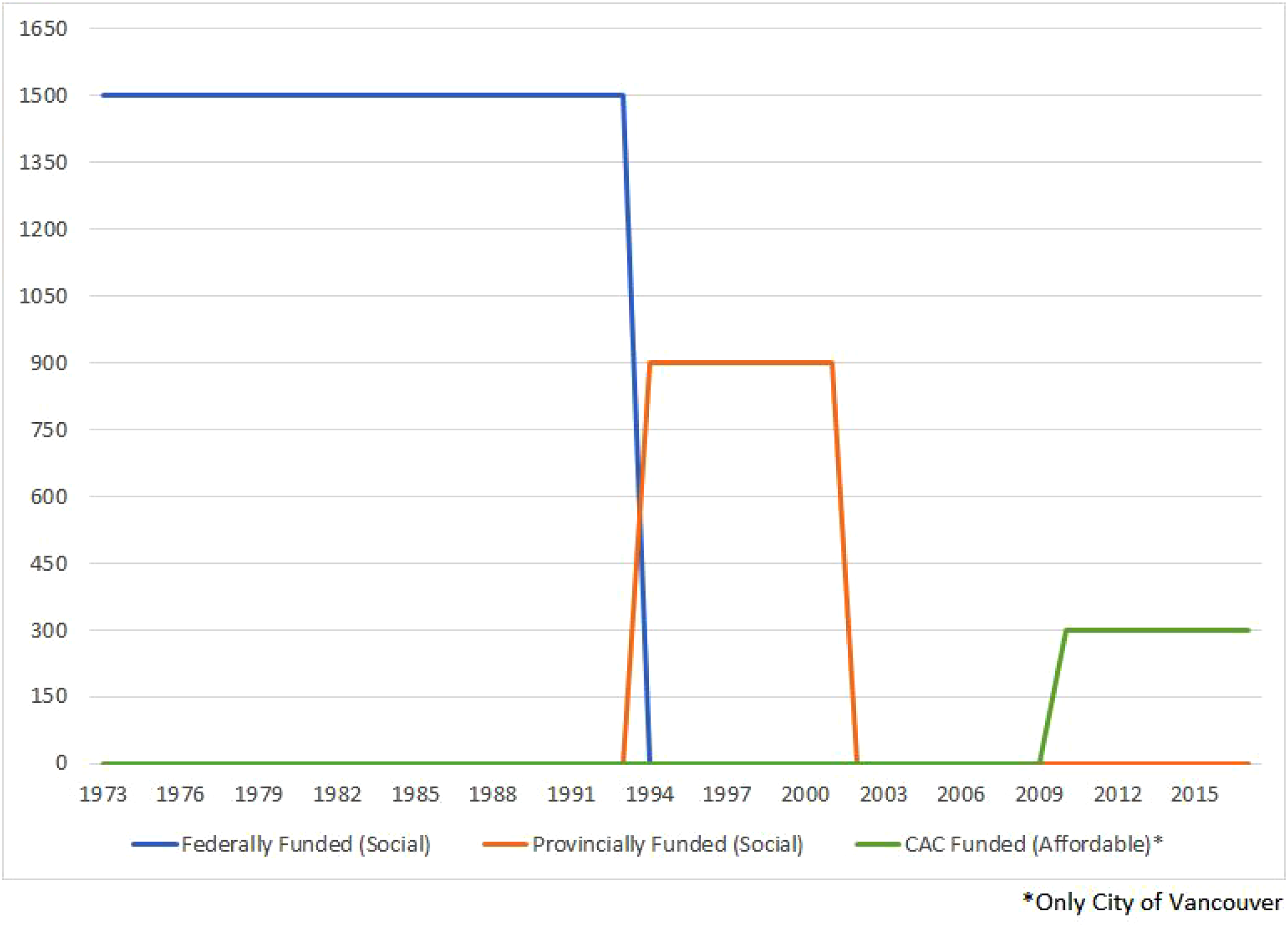
Social and affordable housing in British Columbia (1973–2017) (based on Suttor (2016) and City of Vancouver CAC report 2019).
In 2008, the citizens of Vancouver elected a recently formed center-left political party, Vision Vancouver, led by social entrepreneur Gregor Robertson, who ran on a platform of housing and environmental justice. After a large-scale ‘social mix’ redevelopment in the low-income Downtown Eastside neighbourhood (Blomley, 2003; Lees et al., 2013; Vidaver, 2003), which involved rezoning in exchange for extra social housing, Vision Vancouver began to reorient the CAC program away from quality-of-life amenities and toward affordable housing (Bula, 2009). During their 10-year majority in city hall between 2008 and 2018, Vision Vancouver continuously leveraged zoning and density to produce several thousand units of affordable housing, about 300 units per year, through $708m worth of contributions (CoV, CAC Reports 2018).
While this number is small compared to previous levels of federal funding (Carter, 1997), it served an important legitimating function for local politicians who could claim to be the only level of government to provide any low-income housing to Vancouverites. It is also important to note that of the units created, only around 1000 of the units met the affordability criteria for social housing, while others constituted ‘affordable’ rentals targeted to middle-income renters significantly above low-income tax brackets (CoV, CAC Reports 2018). 5
Gift, tax, or sale? The enactment of density agreements as a form of exchange
Previous research on urban neoliberalism has focused on the role of density agreements in the commodification and marketization of low-income housing provision (Fox-Rogers and Murphy, 2015; Stabrowski, 2015). However, through my investigations of Vancouver's field of urban development, I found that the meaning of density agreements and their status as either a market or non-market form of exchange was highly contested. Politicians, planners, and developers discursively construct CACs as a ‘voluntary contribution’ that is different from either a ‘sale’ or ‘tax.’ CACs, therefore, are an underdetermined form of exchange (Lainer-Vos, 2013a, 2013b); they could be seen as either a redistributive tax or a market-like transaction. They have come, however, to be presented as a relationship of reciprocity between the state and the private sector. Therefore, participants in rezoning decisions constantly affirm and reaffirm that these exchanges are indeed ‘gifts’ through both formal and informal mechanisms. These include statements at public events and city hall hearings, legal directives in policy documents, and private justifications by politicians and developers. I show how density agreements come to be seen as gifts over competing interpretations, such as market sales or redistributive taxation, through an ongoing relational process of meaning-making between urban actors. In doing so I uncover an overlooked dimension of urban neoliberalism, the fact that the privatization of social goods is constructed as gifts to the public.
Politicians: Density agreements as developer contributions to the public
Municipal politicians, particularly from Vision Vancouver, advocated for the use of density agreements to produce affordable housing as a pragmatic solution to the housing crisis. In responding to the constraints of welfare state defunding, they represented density agreements with developers as a form of reciprocal exchange between the state and the private sector. They often referred to CACs as gifts or ‘gift-like,’ even as these arrangements were lucrative for developers through increasing height and density on private condominium projects. As was put to me by the deputy mayor of Vancouver and councilor with Vision Vancouver, “CACs are a gift from a developer that is asking for an up-zone, asking for more density and height than is currently allowed within zoning. So, in order for them to achieve that, we have a negotiated CAC that is geared toward investments in housing.” 6
While politicians and city officials did not always explicitly use the word “gift,” they often used alternative terms such as “contribution,” “offering,” “donation,” or “voluntary.” 7 At a public talk in 2018, then-mayor of Vancouver Gregor Robertson explained to me: “We have a negotiation around what is called the ‘land lift’ and generally we end up with 80 to 85 percent of that land lift which comes to the City that's for community amenities. It's called a contribution. It's not a hard and fast requirement—it's a negotiated contribution.” 8 Similarly, the former Head of Vancouver's planning department, Larry Beasley, asserted that CACs “are not requirements. They are expectations.” 9 That the city collects 80% of the value of the land-lift from rezoning as a CAC is an aspirational number. Depending on the size of the rezoning and the prospective value of the land, which involves intense negotiations with the planning department, the dollar value of the CAC can vary (see also Weber 2020).
In addition to the language of gifts and contributions, politicians and city staff often discuss these transactions in evaluative and morally laden terms. This was especially the case with developers who were perceived as wanting to ‘work with’ the city and contributing with little hesitation. This distinction was articulated by a member of the city's real estate department, describing their community values: “In my mind there are some very responsible developers. Yes, profit is important to them, but community development is also very important to them. Where they see those benefits coming back to the arts community, or to park dedications, or to non-market housing, they are happy to do it.” 10 The use of moral language was also common during my observations of city council meetings and the urban design review panel, where urban planners vetted rezonings for affordable housing. For example, during one rezoning hearing, a lead planner thanked a developer for “all that you’re doing for the city,” before commenting that the rezoning should “sail through” city council based on the recommendations of the department. 11 Scholarship has often noted that urban neoliberalism has resulted in a ‘partnership’ model (Pacewicz, 2016), where local politics and the private sector converge in their interest in growth and competitiveness. The case of density agreements reveals a new dimension to the dynamic, where politicians and developers are few partners dealing in business together, than in exchanging gifts with one another.
That developers can walk away from providing affordable housing or extra services by not seeking extra density contributes to the impression that providing CAC funding is an altruistic gesture. Developers are by no legal means obligated to pursue rezonings—and in fact, since many do not—CACs come to be seen as voluntary transactions. The legal language around CACs (Punter, 2003) officially distinguishes them from a ‘tax’ that all developers would be required to pay. According to the CACs guideline issued by the province of British Columbia, cities must “stay on solid legal footing” by acknowledging they have “no authority to impose such conditions on a rezoning applicant; any contributions must either be at the initiative of the applicant/developer or emerge from rezoning negotiations between the applicant/developer and the local government” (Province of BC, 2018). The use of the term contribution, rather than tax, is also important to notice, as the dictionary defines a contribution as a “gift or payment to a common fund or collection,” whereas a tax is a “compulsory contribution to state revenue” (Oxford English Dictionary, 2020). While the city of Vancouver does collect taxes from developers in the form of development cost levies, CACs are only attached to projects where a change in land use is sought, making them discretionary for the developer. This helps to explain why politicians are careful to avoid any suggestion that they are ‘taxing’ development through CACs, which could result in legal pitfalls.
Although the provincial government makes it clear that CACs should not be treated as a redistributive tax on development, it does not immediately follow that they should be treated as gifts. Mauss (1925) describes gifts as interactions where one party receives and is expected to reciprocate at a later, undefined time. In this sense, CACs do not intuitively conform to the anthropological understanding of a gift because both parties are receiving something in the arrangement: developers receive extra density, and the city receives affordable housing. However, because developers are seen as ‘helping’ the city to achieve its social objectives and are not legally required to do so, the exchanges are framed as ‘gifts’ by politicians and some city planners. Politicians are also dependent on developers to build affordable housing in the absence of funding coming from the state. This unequal dynamic, alongside the legal requirement treating CACs as ‘not a tax,’ leads the transactional relationship to take on the more voluntary, ambiguous, and morally laden qualities of gifting.
Developers: Density agreements as an altruistic choice
Similar to politicians, developers framed density agreements in terms of gift giving, altruism, and ‘giving back’ to the city. From their perspective, it is even more clear that they are choosing to provide the city with affordable housing by seeking rezonings. Thus, while rezonings can also greatly benefit the developer's bottom line, they typically highlight the philanthropic dimensions of CACs. A professional working for a firm that pursues large rezonings in exchange for social benefits and low-income housing stated: “[We] have a mandate to do affordable housing … we can contribute our resources and our expertise to something that actually benefits the city over time rather than writing a cheque when you are retiring.” 12 A second professional spoke about the voluntary aspect of CACs: “We get higher than what was currently allowed for with the zoning because we give back to the city. We give 75 percent of the value to the city. We voluntarily offer the CACs from the higher height.” 13 Echoing Bourdieu's (1990, 1991, 2000) theory of symbolic capital, developers highlight the advantages of ‘being altruistic’ as it creates a fuzzy set of expectations that they are ‘owed’ something in return at a future, undetermined time. For example, the same development industry professional went on to say, “I think there is a trust aspect that has to take place with these developments. With each individual project, if you are willing to give more, then theoretically you will get more.” An architect working with the same developer also confirmed this:
All that is to say that everybody is getting certain intangibles out of it, versus if they did a straight deal at market value. I think that's the piece that developers are starting to catch on to. It's more of a relationship with the City over time. Over lot of different projects, we have developed a relationship where they have given a bit to the City and are fairly generous, and then the City is fairly open to different design ideas or different experimental things that we want to do. 14
The notion that CACs are a way to build reciprocity was mentioned numerous times in my interviews. These findings are in line with research on density agreements in Toronto and London (Elsmore, 2019; Hyde, 2018; Rosen, 2017), which notes the tendency of developers to frame density agreements in terms of ‘social conscience’ or ‘altruism.’ Thus, developers accumulate both economic and symbolic (or reputational) capital, which is less quantifiable but can influence future land use and zoning decisions, enhancing profit margins in the long term.
Planners: Density agreements as good planning versus selling zoning
City planners were the innovators and overseers of the city's CAC program throughout the 1990s and into the 2000s, and generally saw it as a prudent approach to funding local amenities. However, this interpretation was contingent on their role in directing this policy and city council following their recommendations closely. According to Vancouver's planning community, density agreements should be primarily built on ‘good planning principles’ rather than the need to increase revenue to fund social goods. However, over the course of Vision Vancouver's tenure in the 2010s, some planners became wary of CACs being “politicized” and subordinated to market forces. Rumors circulated that planners were being informally asked by politicians and their staff members to endorse all projects with an affordable housing component to help the city address the housing crisis. If they refused to do so, city council was willing to go against planners’ recommendations to create units of affordable housing.
This spurred the idea that density agreements amount to ‘selling rezoning’ among some planners, who spoke out on the matter in the local media with critiques about the practice being carried out with an overly economic agenda. Claiming the city was treating these arrangements as a direct exchange or sale was a morally charged and taboo line of discussion (Rossman, 2014). For example, one senior planner who felt the city had stopped listening to the advice of planners in their pursuit of affordable housing stated:
Vancouver has become this giant safety deposit box for world capital. In my view it has become too enticing to perhaps nudge up or even sell zoning because there is such value to be created and through predominately the CAC. I think the CAC is a dilemma because if your entire reason for regulating is selling, it's creating value through the selling of rezoning. 15
After making this statement, the participant expressed hesitation in being quoted by name, illustrating the sensitivity of speaking about CACs as ‘selling zoning.’ 16 In a more overt expression of the same sentiment, the former head of city planning during the 1980s penned a series of blog posts and open letters critiquing Vision Vancouver's approach. In one passage, he writes:
The more rezonings you have, the more profit there is to be shared … If the City becomes over-enthusiastic about their profit, they may begin to rebalance their evaluation systems to prioritize profit in their planning evaluations over other good planning matters; such things as good neighbourliness, view protection or enhancement, overshadowing, sharing daylight, privacy, protecting the public realm like streets and parks, good urban design, even transparency and rigorous rezoning evaluations. (Spaxman, 2015).
Overall, planners were supportive of the policy format of sharing the wealth from density bonusing, as long as these decisions were not reduced to budgetary logistics. Thus, seeing CACs as a tenet of ‘good planning’ is in line with their understanding as ‘contributions’ rather than impersonal, ideal–typical market transactions based on monetary considerations. This points to the fact that providing social benefits, such as affordable housing, is challenged when it is perceived to be an explicitly economic transaction as opposed to a voluntary contribution.
By examining the meanings of politicians, developers, and planners, I have shown how the exchange of density for affordable housing is understood as reciprocity through a negotiated process of meaning-making that is both morally laden and politically contested. While density agreements are an underdetermined form of exchange that could be seen as either a gift, a tax, or a sale, their understanding as gifts by politicians, developers, and planners has a consequential impact on land-use decisions. By examining how these transactions unfold over time we can see the material aspects of reciprocity in the context of urban neoliberalism.
Relationships of reciprocity in building affordable housing: CACs and the accumulation of symbolic capital
That developers pursue informal, reciprocal relationships with politicians is not a new idea. Urban growth machine theory posits that they enter into preferential relationships, where politicians rely on developers for campaign donations and provide favourable treatment in exchange once elected (Logan and Molotch, 2007; Marwell, 2009; Mollenkopf, 1994; Molotch, 1976, 1993). While evidence for this claim is mixed (Fleishmann and Stein, 1998), citizens and journalists in Vancouver commonly claim that politicians are ‘beholden’ to developers by accepting campaign contributions. Drawing on quantitative and qualitative data of campaign and CAC transactions by developers in Vancouver, I illustrate that there is little relationship between campaign contributions and the granting of extra density. I also show how the exchange of density for affordable housing lessens the perceived transactionalism between the state and the private sector (Rossman, 2014) and produces fuzzy and underdetermined expectations for reciprocity (Bourdieu, 1990) that can impact land-use outcomes.
Reciprocity in exchange for zoning: CACs versus campaign contributions
Between 2012 and 2017, the city of Vancouver collected $494m in CACs from 25 “major” rezonings on large condominium projects throughout the city (CoV CAC Reports 2018). Close to half of this money, $228m, came from a single developer, Westbank, which has gained a reputation for ‘giving back’ and working with the city to provide social services and affordable housing. This number vastly outstrips other developers in the city, with the second closest, Concord Pacific, contributing $41m in CACs. Westbank has gained over five million square feet in extra density on high-end speculative developments, including a starchitect-designed tower, Vancouver House, which sold for roughly $1500 per square foot—some of the highest prices in Canada. An additional massive rezoning of the shopping center Oakridge, granted to Westbank, is set to become one of the largest redevelopments in Canadian history. Based on a cautious estimate of the prospective value of the land (at least $1000 per square foot at sale, and the amount of increased density granted by the city), this rezoning could be worth several billion dollars for the developer. As I will illustrate, these exchanges are not one-off transactions but can be traced back to Westbank's participation in the early 2000s redevelopment of the large public–private social mix project, Woodward's, in the low-income Downtown Eastside neighbourhood.
Before discussing Westbank's ongoing relationship of reciprocity with the city, I first investigate whether the amount of density received has a relationship with campaign contributions to the ruling political party, Vision Vancouver. Using publicly available information, I constructed a data set of all campaign contributions from developers to political parties between the 2014 and 2017 municipal elections in Vancouver (see Table 1). 17 During this period, Westbank placed near the bottom of the list with a contribution of $30,000—roughly one-quarter of the donation of the top contributor, Wall Financial Corp. The top three contributors to Vision Vancouver were all on the list of developers granted major rezonings; however, Wall Financial Corp and the third top contributor, Onni, received relatively few density bonuses during this period—<200,000 square feet each. Westbank, on the other hand, was granted 5,200,000 square feet of extra density, more than seven times the amount received by the developer in second place, Concord Pacific.
Rezonings granted versus developer donations to the city (2012–2017).
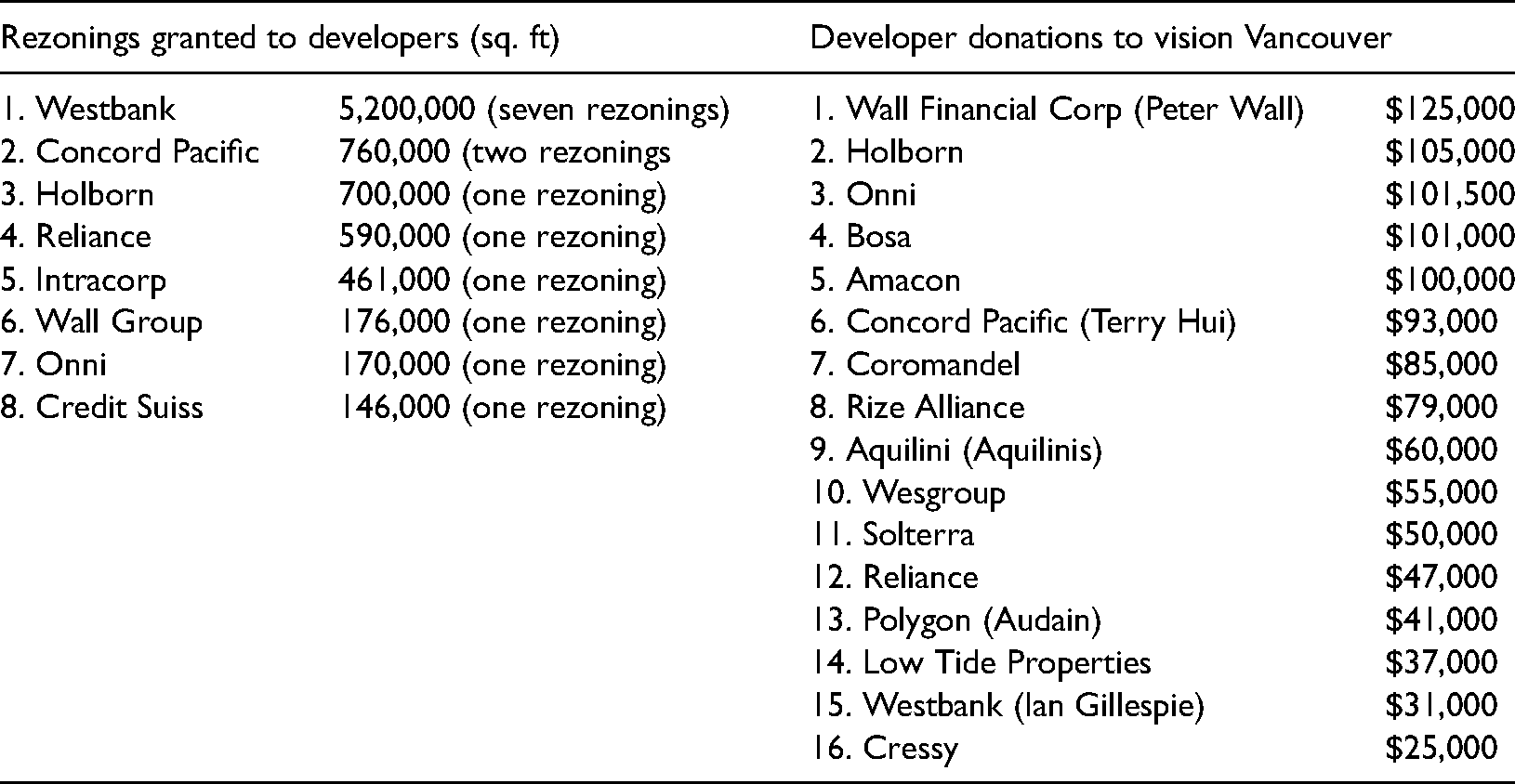
That Westbank contributes little to political campaigns can be seen as a practice aimed to reduce the perceived transactionalism between themselves and the state (Schilke and Rossman, 2018). Indeed, during my interviews, several development industry insiders and local journalists pointed out that while Westbank is seen as a ‘favourite’ of the city, unlike other developers they contribute very little to political parties. For example, the top Vancouver real estate reporter for the high-circulation newspaper The Globe and Mail, states in reference to Westbank chief executive officer (CEO) Ian Gillespie: “Some commentators may say he appears so favoured by Vision because he gives money to them. For my story I went back and looked at the record and strangely Gillespie gives very little” (Bula, 2014).
While campaign contributions almost certainly have some impact on the relationship between developers and politicians—otherwise there would be little use in making them—it is clear from this data that there is not a direct correlation between the rezonings and campaign contributions. On the other hand, Westbank's significant contributions through CACs is a clue about whether other forms of exchange may be influencing and sustaining a relationship with the city. To investigate this possibility, I delve into the case of Westbank and several of their developments over the 2000s, including Woodward's, a social mix public–private partnership with the city, and Vancouver House, a high-end starchitect-designed condominium tower.
Building symbolic capital through salient developments: Westbank and the Woodward's development
Westbank's relationship with the city began with the development of a public–private social housing redevelopment, Woodward's, in Vancouver's low-income Downtown Eastside neighbourhood in the early 2000s. The project is located at the former site of the now-defunct department store and neighbourhood retail institution Woodard's, which closed in 1993 and had occupied a square block of prime land in downtown Vancouver. After local activists blocked several attempts to build high-end condos at the site and conducted a high-profile housing squat in 2002, the city purchased the land to build a social mix high-rise project with both condominiums and low-income social housing (Blomley, 2003; Lees et al., 2013). Holding an open call design competition to select a private partner for the development in 2003, the city chose Westbank, which pitched a smaller project that was deemed to be the most ‘sensitive’ to the community. However, after a year of consultations in 2004, Westbank submitted a second proposal that advocated for doubling the density permitted on the site in exchange for more social housing units.
The negotiation over Woodward's can be seen as a precursor to the city's approach to rezoning in the coming decade. The much larger building was approved by city hall and the 536 units of market condominiums sold out in a matter of hours after being offered as presales to the public (Enright, 2010; Lees et al., 2013). The decision to increase the density at Woodward's has become a locus of contention in the Downtown Eastside, as the large increase in private high-end condominiums is believed to have led to gentrification and displacement in the area since the building opened in 2009.
The Woodward's project was a consequential turning point for both the city and Westbank as a developer. Vision Vancouver party member and mayor Gregor Robertson, elected in 2008, was mentored by the city councilor in charge of the Woodward's redevelopment and adopted a similar stance that the city should pursue affordable housing by any means. Westbank, in turn, continued to advance their relationship with the city after building Woodward's. Reflecting on this approach, an architect who works closely with Westbank and helped design the project, stated, “I think Woodward's kind of gave us new insight into how we can work with private developers to deliver social goods, so that's where that started. Since then, it's almost like we are hand-picking projects that are private developments that will do some kind of social good.” 18
In an interview at the time of the Woodward's opening, the CEO of Westbank, Ian Gillespie, refers to the symbolic ‘currency’ accrued through the project, saying:
I think we got some currency out of the project that will only grow when it is finished. It's hard to put a number on what that goodwill is worth, but I think in the long run it's worth something … we get accused of benefitting from favouritism. But it isn't favouritism. It's called trust, and if you earn that trust you should be given more latitude than if you haven't (Enright, 2010: 110).
The notion that giving gifts through the CAC program is a way to build a reciprocal relationship with the city was also noted by those working in the nonprofit housing sector. For example, a representative of the nonprofit organization that oversaw the social housing component of the Woodward's project stated, “All of the developers wanted to do Woodward's … because developers have to have a good relationship with the city. They are obsessed with it.” 19 In taking on Woodward's, Westbank committed to partnering with the city and sharing the risk on a project that had been the site of a contentious protest. About social mix projects of this nature, developers sometimes argue that the additional time and effort of rezoning and the difficulties of marketing condominium towers that contain affordable housing units are not worth the financial reward. Indeed, whether Westbank made ‘any real money’ from Woodward's has been a topic of interest and debate within Vancouver's development community. The consensus, among knowledgeable insiders and those working for the firm, is that Westbank made a normal return on investment (typically 15%) on Woodward's, but only after tackling one of the most complex, controversial, and, hence, risky developments in Vancouver's history. 20 As Gillespie states in the 2010 interview, “the truth is there isn't a deal that is this complicated. From a time-money perspective, Woodward's makes no sense at all.”
For Woodward's to ‘make sense,’ Gillespie recognized the importance of the “goodwill” he would receive from the city. This goodwill has included the streamlining of very large rezonings on other luxury developments, such as Oakridge and Vancouver House, where the financial benefits are more clear-cut. One development consultant who worked on the Woodward's project summed up Gillespie's development approach: “He got it [Vancouver House] for nothing. He got the land from them [City of Vancouver]. He lost money on Woodward's but made a shit ton of money off Vancouver House. He alternates between utopian projects, that barely recover their costs, with hyped, high profile sell jobs.” 21 In other words, while both Woodward's and Vancouver House involved large-scale rezonings, the former could be conceived as a ‘loss-leader’ that gave back to the city, while the latter was highly lucrative and a ‘safe bet.’ In the understanding of the development consultant, the two are intimately linked.
In June 2014, as part of the Vancouver House rezoning, Westbank acquired a piece of city-owned land on the development site for an undisclosed amount (CoV Council Meeting Minutes, 2014). This sale was approved unanimously by city council without public consultation or open debate. A quick sale and the absence of negotiation with other buyers, followed by the immediate decision from the city to rezone the land for additional density, corroborates with insider impressions that Westbank received a favourable arrangement. 22 In discussing the deal, a local architect explained:
The City of Vancouver has a clause in their charter, if they want to sell any land they have to go through a public process, unless someone owns a piece of property next to a City property they can negotiate. Westbank bought a storage unit next to City-owned land and then negotiated and bought all the others. He [Ian Gillespie] has a good relationship with the Mayor and all that. So they got the city land and a lot of extra density. It was unprecedented. 23
Similarly, in 2017, a local citizens’ group, the South Vancouver Parks Society, launched a BC Supreme Court Action asserting that the value of the land at the Oakridge—a 28.5 acre lot in the center of an expensive neighbourhood—was under-assessed by the city by over $350m (South Vancouver Park Society, Affidavit 2017). While the judge ultimately dismissed the case, access to the CAC calculations and the price paid for the land remain undisclosed. These examples correspond with claims in my interviews with city officials and development industry actors that Westbank's efforts to build “trust” with the city have indeed benefitted the firm (Figure 2).
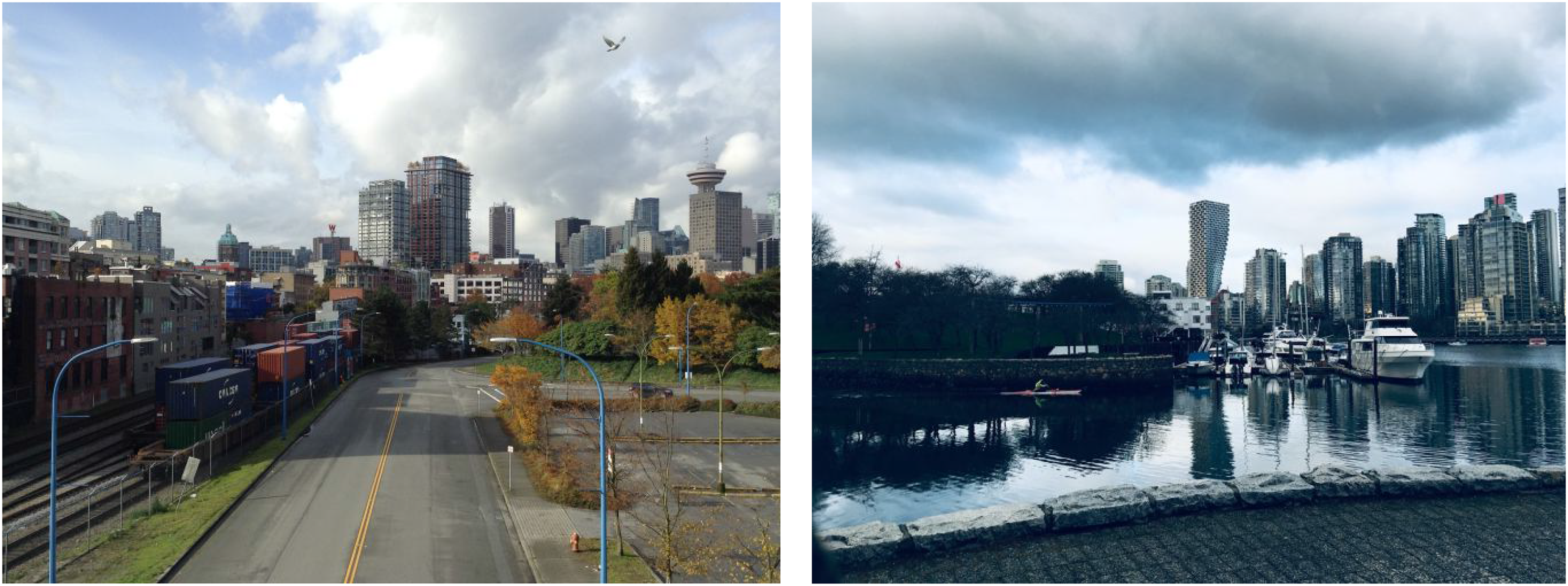
The Woodward's Towers in the Downtown Eastside and Vancouver House in False Creek (photos by author).
The case study of Westbank illustrates how CACs can be used to generate symbolic capital for developers that influences land-use decisions over time. Through this process, reciprocity extends beyond a discursive manoeuvre that masks a transactional relationship, in other words, the ‘selling’ of zoning. A developer's reputation for doing ‘good deeds’ for the city, such as taking on a major, time-consuming social mix project such as Woodward's, can generate a sentiment that stays beyond one particular CAC negotiation. While planners and politicians in Vancouver avoid claims they are engaging in ‘favouritism,’ they commonly classify some developers as being ‘easy to work with’ or ‘generous.’ Developers recognize that being classified in this manner can give them latitude with the city when they ask for considerations such as buying a piece of city-owned land, as in the case of Vancouver House. Therefore, to understand how CACs have been drawn into this pattern of reciprocity, we must see them as interlinked and temporally embedded.
Gift giving and neoliberalism: Obfuscating the negative effects of funding affordable housing through density
The literature on urban neoliberalism outlines the transition of the local state from welfare provision to a more competitive approach based on markets (Akers, 2015; Boudreau et al., 2009; Brenner et al., 2012; Hackworth, 2007, 2016; Harvey, 1989; Merrifield, 2014; Peck, 2010, 2012). The case of density agreements in Vancouver reveals the underexamined role of gift giving and reciprocity in these processes. My findings correspond with Polanyi's (1944, 1971) dictum that the economy is always constructed and maintained by both the state and social institutions involving hybrid patterns of markets, reciprocity, and redistribution. In this sense, density agreements exist alongside broader patterns of market-based neoliberalism. While proponents argue that density agreements are a form of redistribution (Beasley, 2019; Friendly, 2017; Punter, 2002; Shih and Shieh, 2020), examining the broader context shows they benefit the private sector over public interest (see also Marcuse and Madden, 2016; Stein, 2018). Like other researchers, my work shows that these arrangements can work to deepen inequality. However, I have argued that this requires us to expand our conceptual repertoire to include theories of gift giving.
Density agreement transactions are neoliberal in the sense that their emergence and increasing use is a result of the ongoing downloading of responsibility for social welfare onto cities over the past 20 years (Hackworth and Moriah, 2006; Peck and Tickell, 2002; Suttor, 2016). While politicians and planners argue that density agreements help deliver social goods to citizens, compared to policy mechanisms such as redistributive taxation, they make social welfare contingent upon increases in profitability for the private sector (Fox-Rogers and Murphy, 2015). While taxes also accumulate more returns from an increase in profits, in the case of CACs the contribution is dependent on higher density and its returns, facilitated by the state. Indeed, the legal language around CACs is careful to stipulate that density agreements are not a ‘tax’ collected by the state (Punter, 2003), but rather a voluntary transaction that is pursued by the private sector. This fosters the impression that CACs are an altruistic and disinterested gift from developers who are “giving back” to the city. Not only do these contributions increase profitability on individual projects, but they also work to build relations of give-and-take with the city, which can result in future lucrative land use and zoning exceptions for developers with ‘good reputations’ (Elsmore, 2019; Hyde 2018; Rosen, 2017). These high-end condominium projects, such as Vancouver House and Oakridge, tend to be of a speculative nature and targeted toward transnational ‘luxury-class’ housing investors (Graham, 2015, 2016).
Second, as other scholars have argued (Stabrowski, 2015; Stein, 2018, 2019), density arrangements can lead to gentrification, as the provision of affordable housing is contingent upon increases in for-profit condominium density. Increases in density, in turn, oftentimes lead to an increase in land values and rents near socially mixed projects, resulting in ancillary displacement from previously affordable neighbourhoods (Bridge et al., 2012). This has been the case for Vancouver's Downtown Eastside, where the Woodward's project contributed 125 units of social housing, while 426 units were lost from nearby single room occupation hotels up-scaling for higher-income tenants in the years following its opening (Swanson and Drury, 2012). Scholars have also illustrated a range of negative effects that social mix policy has on the subjective experiences and daily lives of low-income neighbourhood residents, such as loss of affordable businesses, increased policing and surveillance, and a general sense of exclusion from newcomers (August, 2014, 2016; Bridge et al., 2012; Blomley, 2003; Butler and Robson, 2003). The community organizers and housing advocates I spoke with echoed this sentiment. 24 As one long-time Downtown Eastside housing advocate shared: “Woodward's has been a disaster for the community except for those that got into the housing. My feeling now is that CACs suck. The price that you pay for CACs is always too high in terms of the impacts of gentrification.” 25 That density agreements are framed as ‘the only way’ to achieve affordable housing has meant progressive politicians continue to support projects that gentrify low-income neighbourhoods.
This leads to a final point regarding the fusion of progressive values with high-end condo development that is characteristic of density agreements (see also Stein, 2019). Exchanging density for affordable housing both legitimates the progressive claims of politicians and obscures and socially embeds the ongoing exchange relationship between the state and private sectors. The negotiations over CACs happening behind closed doors between the city's real estate department and developers adds another layer of obfuscation to these arrangements (Valverde, 2012). While campaign contributions are mandated to be publicly available information, as well as direct and quantifiable, density agreements lead to the accrual of symbolic capital, which is diffuse, temporally discontiguous, and difficult to trace (Bourdieu, 1990; Schilke and Rossman, 2018). It has, however, led to the increasing power and influence of developers that have gained a good relationship with the city for providing goods previously supported by the welfare state.
Conclusion: Substantivism and the economies of the city
This paper has added nuance to debates about funding affordable housing through density agreements by illustrating the relationship between market and non-market forms of exchange within neoliberal urban policy making. These findings contribute to recent discussions of Polanyian economic geography and sociology by placing them in dialog with urban studies. As suggested by Peck (2013a, 2013b), substantivism offers a way to theorize different forms of integration, including redistribution and reciprocity, within the context of market societies.
While focusing on the particular policy framework of Vancouver, this is not a trivial or exceptional example. Density agreements are but one instantiation of land-value capture policies which are increasingly used by the state to pay for social welfare and infrastructure. Across its different forms, land-value capture usually involves increases in density and profitability for private developers in exchange for benefits. In 2018, the Lincoln Institute of Land Policy launched a large-scale study of land-value capture policies in an attempt to create best practice models for cities (Germán and Bernstein, 2018). If these policies are in fact leading to negative outcomes for low-income people, such as displacement and gentrification, an understanding of their formulation as gift giving is important to theorize, critique, and challenge the policy rhetoric that legitimates them.
Finally, this research opens new terrain for the study of urban neoliberalism and economic policy making in cities. How does gift giving operate in various policy spheres and urban governance contexts? When cities transfer public land to the private sector, is this thus constructed as a sale or gift? How do private sector actors build reputational or symbolic capital that has lasting effects beyond changes in ruling governments? As this paper has suggested, viewing the city through the lens of Polanyian social science opens up new questions and facilitates new ways to think about urban policy making in the context of neoliberalism.
Footnotes
Acknowledgements
I would like to thank Lily Ivanova for extensive feedback alongside Amy Hanser, Nathan Lauster, Amin Ghaziani, and Jamie Peck. Three anonymous reviewers provided substantial and invaluable engagement, one reviewer commented on several drafts that greatly improved the paper. The paper was also presented in the form of talks at the Department of Sociology at the University of British Columbia and at the Department of Geography and Planning at the University of Toronto where it received constructive critique from audience members. This research was supported by a grant from the Social Sciences and Humanities Research Council of Canada (File Number 752-2013-2348).
Declaration of conflicting interests
The author declared no potential conflicts of interest with respect to the research, authorship, and/or publication of this article.
Funding
The author received no financial support for the research, authorship, and/or publication of this article.