




Abstract
This paper presents a critique of supply chain responses to a particular global wicked problem – antimicrobial resistance (AMR). It evaluates the understanding of AMR (and drug-resistant infections) as a food system challenge and critically explores how responsibility for addressing it is framed and implemented. We place the spotlight on the AMR strategies applied in UK retailers’ domestic poultry and pork supply chains. This provides a timely analysis of corporate engagement with AMR in light of the 2016 O’Neill report on Tackling Drug Resistant Infections Globally, which positioned supermarket chains, processors, and regulators as holding key responsibilities. Research included interviews with retailers, industry bodies, policy makers, farmers, processors, consultants and campaigners. We evaluate how strategy for tackling AMR in the food system is focused on antimicrobial stewardship, particularly targets for reducing antibiotic use in domestic food production. The global value chain notion of multipolar governance, where influence derives from multiple nodes both inside and outside the supply chain, is blended with more-than-human assemblage perspectives to capture the implementation of targets. This conceptual fusion grasps how supply chain responsibility and influence works through both a distributed group of stakeholders and the ecological complexity of the AMR challenge. The paper demonstrates in turn: how the targets for reducing antibiotic use in domestic meat production represent a particular and narrowly defined strategic focus; how those targets have been met through distributed agency in the UK supply chain; and the geographical and biological limitations of the targets in tackling AMR as a wicked problem.
Keywords
Introduction
‘This [antimicrobial resistance] is not a linear food safety risk, but a broader public health issue, the linkages of which are not very well understood’ (UK Corporate Food Retailer, R6a).
This paper presents a critique of agri-food system responses to a particular global ‘wicked problem’, focusing on the case of antimicrobial resistance (AMR). In terms of defining AMR for the purposes of our analysis, the United Nations Environment Programme (UNEP) (2017: 13) explains that ‘antimicrobial resistance occurs when a microorganism evolves to resist the effects of an antimicrobial agent and multiply in its presence’. Yet when and where AMR occurs is uncertain, implying that the agri-food system grapples with uncertain pathological geographies and temporalities from evolving microbial ecologies.
There is developing evidence that bacteria containing resistance genes, including pathogens resistant to treatment with antibiotics, can be transmitted from animals to humans through the domesticated food animal supply chain (Food Standards Agency, 2016; Graham et al., 2019). As Cheng et al. (2019: 9) write ‘The impact of animal reservoirs on human health remains debatable and unclear; nonetheless, there are some examples of direct links that have been identified’. The role of farm animal production and the food system in the rise and spread of AMR is therefore taken seriously. AMR is identified as one of the top five public health priorities for the World Health Organization (WHO). ‘Antibiotic resistance is rising to dangerously high levels in all parts of the world. New resistance mechanisms are emerging and spreading globally, threatening our ability to treat common infectious diseases’. 1 Such resistance is difficult to contain, as resistance genes are mobile and can be shared with bacteria of different species when selection pressures occur (Food Standards Agency, 2016). Our paper evaluates the social and economic response to AMR – and to drug-resistant infections – as a challenge in the food system, which performs with much uncertainty. We assess how responsibility for addressing AMR is framed and practised in UK grocery retailers’ pork and chicken supply chains and acknowledge the limits to that responsibility in the face of uncertainty.
A step change in the UK's policy endeavours to confront AMR came midway through the first Five Year UK AMR Strategy in 2014 when the economist, Lord Jim O’Neill, was commissioned by the government to produce a report to tackle AMR as a global challenge. The high-profile report was published in May 2016 entitled, Tackling Drug-Resistant Infections Globally: Final Report and Recommendations—The Review of Antimicrobial Resistance. It positioned supermarket chains, processors and regulators as a set of influential actors beyond the healthcare setting with responsibilities for attending to AMR in the food system. This positioning is in keeping with the mode of UK food system regulation enshrined in the 1990 Food Safety Act (Marsden et al., 2009). Yet, addressing the public health challenge of AMR within food systems, which presents through non-linear, uncertain pathogenic pathways and within a ‘highly capitalised’ landscape (Hinchliffe et al., 2017: 221), has its challenges, which we address in the paper.
With the implications of Brexit unfolding and the possible arrival of US-produced, chlorine-washed chicken carcasses 2 in the UK, critical engagement with the oft-cited power of corporate food retailers and processors is timely on a topic that unites public health, animal welfare, food safety and food security concerns. Food retailers, in particular, are frequently positioned as a key set of actors choreographing the food system (Lang et al., 2009), and we have witnessed that belief shaping the UK Government response to AMR (HM Government, 2016). The highly consolidated UK grocery retailing sector has for several decades been marked by significant corporate buying power and influence. And yet, how corporations, including but not limited to retailers, are meeting the challenge of AMR as a food safety and animal welfare concern, as well as a broader public health issue, has been under-researched compared with those of government, agricultural producers and veterinary practitioners. We argue that there is a need for a focus on corporate response and how it operates through the agri-food system.
The influence of the global ‘One Health’ approach, which drives the interdisciplinary and tripartite collaboration between the WHO, the United Nations Food and Agricultural Organisation and the World Organisation for Animal Health (Hinchliffe, 2015) is clear in the UK response to AMR. UK Government responsibility for implementing the UK's 2013–18 and 2019–2024 Five Year Antimicrobial Resistance Strategy, accompanied by a 20-year vision, in agriculture and the food system spreads across multiple Whitehall departments, including the Department for Environment, Food and Rural Affairs (Defra) and the Veterinary Medicines Directorate (VMD), as well as the Food Standards Agency (FSA) as a non-ministerial department. Global AMR policy informs the UK approach through its focus on (a) reduction and rationalisation of antibiotic use, (b) biosecurity and attempts to contain infectious disease and AMR, and (c) innovation in diagnosis, vaccination and treatment (Hinchliffe et al., 2017). Whilst tackling the problem of AMR in the UK food system began with broad, multi-faceted aims (Prestinaci et al., 2015), our study provides insight into how policy became sharply focused on the first (i) of these – reduction and rationalisation of antibiotic use – when applied to the agri-food system. Whilst antimicrobial agents can also include antivirals and antifungals to kill or restrict the growth of a wide range of organisms, much of the attention in AMR research and debate has focused on the protection, by reducing their usage, of antibiotics used to target and kill pathogenic bacteria (and by consequence often also the non-pathogenic) in clinical settings (Ventola, 2015).
AMR in the global agri-food system remains methodologically hard to map and measure, but the potential risks to the health of farm animals, ecosystems, farm labourers and wider publics (Graham et al., 2019) demand attention and action. Antibiotic practices on-farm are already associated with growing resistance amongst Salmonella, Campylobacter, and E. coli bacteria (European Food Safety Authority, 2015; Hinchliffe et al., 2017). Moreover, against a backdrop of decades of farming involving the use of antibiotics, it has become clear that while antibiotics are an important tool to support the health, welfare and productivity of animals, a key issue is their inappropriate and disproportionate use on farm (Buller et al., 2015). This has the ripple effect of reduced efficacy of antibiotics, including critically important antibiotics (CIAs), in human healthcare as resistant ‘superbug’ populations increase (O’Neill, 2016). Similarly, drug-resistant pathogens are a health challenge for future farm animal populations with implications for food security.
Retailers have an identifiable regulatory responsibility for food safety (Marsden et al., 2009) along transmission routes; for example, it was found that one in four chickens on the shelves of UK supermarkets, including Tesco, Sainsbury, Asda, Aldi, Waitrose, the Co-op, and Morrisons, has been shown to contain antibiotic-resistant E. coli (Khomami, 2016). This goes some way to explain why the food sector is under pressure to respond by developing and implementing standards that can address the selection for and transmission of AMR. In the paper, we discuss why prudent antibiotic use (O’Neill, 2016), literally to reduce the weaponry of antibiotics driving selection for gene resistance, has been the central strategy across the agri-food system. Our paper critically engages with the framing of AMR and the manner of its management through targets and standards, in particular the narrow focus on targets for the stewardship of antibiotics used in livestock farming. Targets and standards are set against a backdrop of on-going scientific uncertainty about when and where resistance may manifest and create health problems. In so doing, we demonstrate how governance, economy and environment through to the microbial world co-constitute both the challenge of AMR in the food system and the prevailing strategies mobilised to address it.
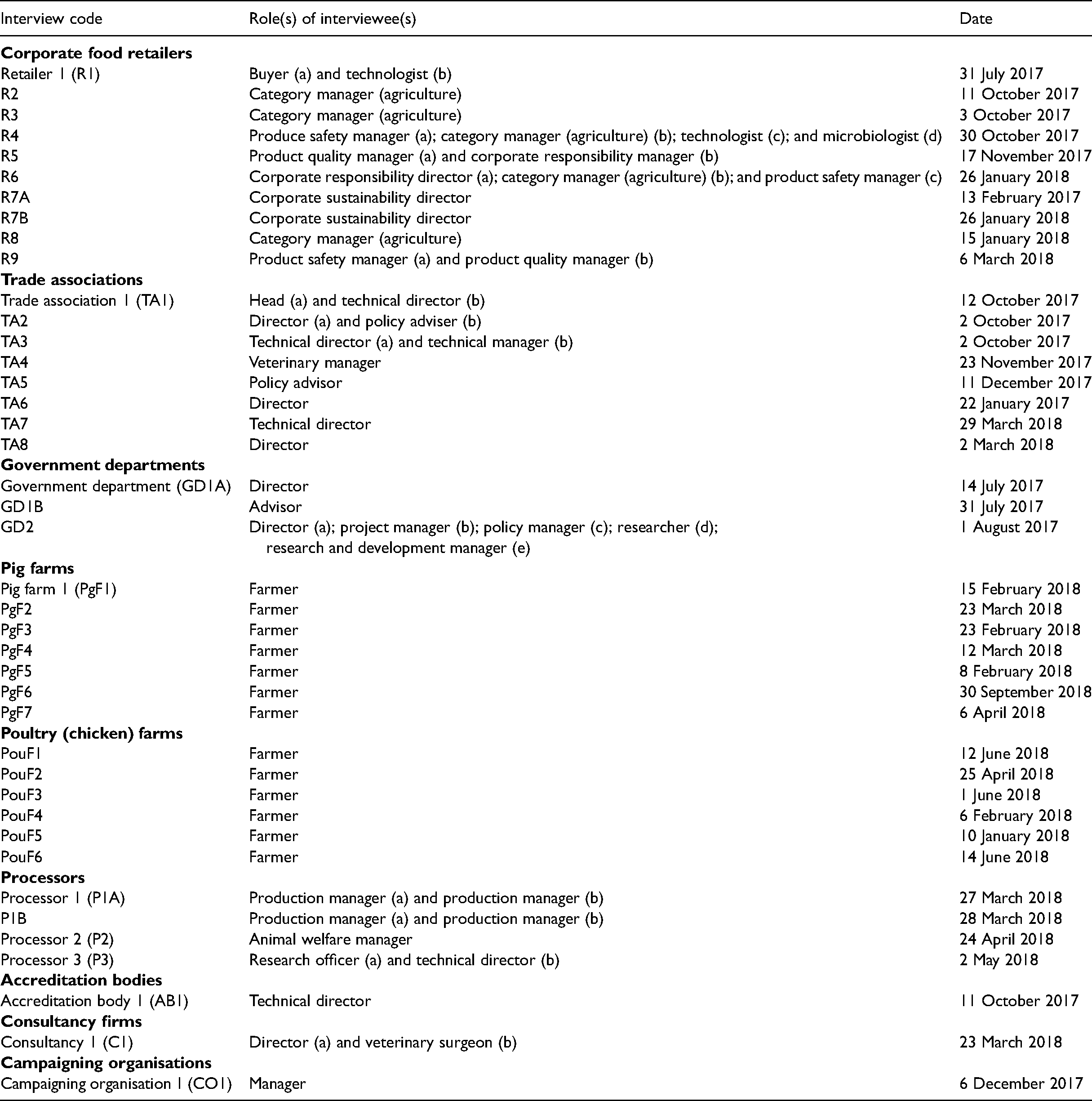
Research underpinning our paper explored the evolving framing of responsibilities for tackling AMR in UK grocery retailers’ pork and poultry supply chains in the period following the O’Neill (2016) report. Pork and poultry, specifically chicken, were selected as case studies because they are sectors where AMR strategy has been evident through contrasting corporate structures and in the context of different disease profiles and attendant levels of antibiotic usage (outlined later). The study sought to evaluate evolving antibiotic stewardship strategies and standards in the UK and to appraise their implementation. The fieldwork ran from 2017 to 2018 across two phases, which involved 41 interviews covering 38 organisations (see Table 1). The first phase involved interviews with nine of the UK's top ten supermarket chains by market share, including 17 people working as agricultural managers, technical directors, microbiologists, product safety and quality assurance managers and corporate responsibility managers; 11 people from eight trade associations including those tasked with developing, communicating and monitoring AMR-related policies; and seven staff from two policy-making bodies connected with government departments. In the second phase, research extended up the supply chain to include interviews with: 13 pig and chicken farmers in the North of England, 3 three meat-processing companies including five representatives working across production and health and welfare; a standard-setting body; two representatives of a consultancy firm; and one campaigning organisation. The research team also attended five industry and policy-orientated conferences on AMR. Table 1 sets out the interview sources referenced in the paper. 4 The interview data was analysed using NVivo, with coding initially involving nodes linked directly to our research questions on AMR strategies and finally refined to the themes of collaboration on responsible antimicrobial stewardship and reduction; complexities and understandings of the emergence, mobilities and persistence of AMR; materiality, food systems and AMR; and power, responsibility and risk in food systems.
List of interview sources.
The paper proceeds by outlining our conceptualisation of the AMR challenge in the food system and the distributed responsibility for addressing it. This conceptualisation combines political-economic insight into food system governance with perspectives of more-than-human assemblages to grasp the material constitution of corporate and governmental responses to AMR as a socio-ecological challenge. We then advance that conceptualisation to evaluate, first, the ways in which the complex uncertain, socio-ecological challenge of AMR in the food system has been reduced to a focus on prudent antibiotic usage, with target-setting, both for refining the classes of antibiotics used and reducing total antibiotic doses by weight of animal on domestic farms. We explore how actors across the UK corporate food system from government departments, trade associations and corporations, through to farmers, vets, and accreditation bodies, have situated capabilities for setting these targets. Second, combining critical perspectives on supply chain governance with those apprehending the material liveliness of more-than-human microbial assemblages, we show how the targets have been met and monitored, as those capabilities are applied through distributed agency in the supply chain and its materialities. And third, we critically reflect on the geographical and biological limits to the targets in tackling the nonlinearity and unpredictability of AMR as a wicked problem.
Conceptualising AMR risk and responsibility in the food system
Conceptual frameworks for understanding supply chain governance are brought together in this paper with more-than-human approaches in order to evaluate both the accomplishments and the limitations associated with the ways in which the industry has framed, shared and practised the responsibilities for tackling the AMR challenge. Hinchliffe et al.’s (2017) ‘disease-diagramming’ of AMR in relational terms provides a compelling understanding of the agency of combined microbial, social, economic and regulatory worlds as they interweave to render AMR a problem to be addressed. For Hinchliffe et al. (2017), ‘disease diagramming’ refers ‘to the ways in which diseases are understood and acted upon’ (page xiv) and to ‘the ways that disease is grasped and governed’ (page 7). First, we position that conceptualisation in the wider literature on governance in the food system.
Commodity chain, network and systems literatures comprehending the geographies of food production and distribution through which AMR can transmit are now vast and variegated. They span and derive from political economy associated with the legacy of Karl Kautsky's Agrarian question (Watts and Goodman, 1997), food regimes perspectives (Friedmann, 1993), global value chain (GVC) and global production network (GPN) frameworks (Gereffi et al., 2005; Coe et al., 2004), and assemblage thinking on the heterogeneous associations between human and non-human elements of production networks (Freidberg, 2017; Lewis et al., 2013; Ouma, 2015). For the purposes of this paper, we suggest the merits of combining GVC notions of multipolar governance with the concept of more-than-human assemblage in order to capture the distributed agency in the UK food system through which AMR is addressed.
The global commodity chain (GCC), GVC and GPN frameworks address the increasing influence of corporations and buying power at a time of global economic liberalisation, structural adjustment, deregulation and export-orientated industrialisation since the late 1980s. Although orientated towards different objectives, they trace the contours of corporate influence characterising Friedmann’s (1993) regime of ‘private global regulation’ through which transnational corporations rather than states in this era became the new and most powerful architects of global trade. Recent work in these traditions, however, has also sought to illuminate state influence (Horner, 2017).
The GVC framework, with its focus on governance, is concerned with the organisational forms, inter-firm linkages and modes of coordination through which power and influence operate in the supply chain (Gereffi et al., 2005). Standards governing production, ranging from product quality and technical specifications to labour and environmental codes (Nadvi, 2008), are seen to transmit through the value chain, typically with mechanisms of monitoring and traceability integral to their verification (Bailey et al., 2016). For the study of supply chain responses to AMR uncertainty, GVC perspectives on governance can capture the corporate structures, forms of inter-firm coordination and standards through which AMR uncertainty and responsibility are managed. Although our study is mainly focused on the domestic context of the UK rather than cross-border supply chains, GVC insights can nonetheless be applied, given this emphasis on governance. A valuable insight of GVC theorists is that value chains can be characterised not only by unipolar governance, ‘where “lead firms” play a dominant role in shaping the chain’, but also by multipolar governance involving a ‘plurality of drivers and driving mechanisms’ both within and external to the chain (Ponte and Sturgeon, 2014: 215). Although we are focused on a specific sphere of influence rather than whole chain governance, we take this notion forward into our analysis of how responsibility for addressing AMR uncertainty in the food system is achieved by a large cast of corporate, state and third sector actors linked, coordinated and exercising responsibility in multiple different ways.
GVC and cognate perspectives falter, however, in their marginalisation of ‘the material’ and its co-constitutive role in supply chain dynamics. Ouma (2015: 7) powerfully argues that such frameworks simply do not grasp ‘materially entangled practices’; these are pressing in the context of AMR with its associated uncertain microbial geographies and yet which still demand supply chain governance of some kind. The concept of assemblage, deriving from Deleuze and Guattari (1987) (Anderson and McFarlane, 2011), already has traction in research on global supply chains (see Buller and Roe, 2018; Freidberg, 2017; Lewis et al., 2013; Ouma, 2015).
The value of assemblage thinking for theorising the management of AMR uncertainty in the food system lies in its apprehension of the inter- and intra-actions between human and non-human elements/bodies in a network (Anderson et al., 2012; DeLanda, 2006). Such an approach appreciates non-human vital materiality as shaping and shaped by, human world-making activities. Whilst acknowledging the symbolism of power as concentrated in the hands of identifiable institutions such as the state and corporations, an assemblage perspective explores agency as being more distributed in practice (Allen, 2011). Anderson et al. (2012: 177) explain that ‘… an assemblage is both the provisional holding together of a group of entities across differences and a continuous process of movement and transformation as relations and terms change’. There is therefore a sense of capturing the dynamic making of food production networks, as well as being attuned to their management of ongoing flux, alteration and iteration. Engagement with materiality in the analysis of AMR uncertainty in food supply chains is therefore useful for addressing the agency of food, animal bodies, pharmaceuticals and of microbial life in the development and sharing of genes resistant to antimicrobial drugs. Allen (2011) and Hinchliffe et al. (2017) appreciate the ways in which this materiality is not simply a risk factor in economic systems, but rather material uncertainties are constitutive of the economy, of markets and all that they perform. In that sense, AMR uncertainty is not exogenous to food supply, it is integral to the material processes found within it and is (un)known across the supply chain in different contexts and through different practices.
In the next sections, we address, in turn, how the responsibilities for managing the uncertainties of AMR are focused on antibiotic stewardship and targets for reducing use, how these responsibilities are practised through distributed agency in UK meat supply chains, and how the focus on these targets has limitations in terms of tackling the complexities and uncertainties of the problem of AMR. We do so in a way that is sensitive to assemblage insights, but also one that retains valuable political-economic insights into corporate structures and governance.
Framing responsibility for tackling AMR uncertainty in the food system: The focus on targets for reducing antibiotic usage
The focus on antibiotic usage
In this section, we identify how antibiotic stewardship and reduction targets centred on domestic food production have become the key focus of strategic attention as manageable objectives. Several of our research respondents explicitly acknowledged the significance of the O’Neill report in driving change in UK antibiotic stewardship in the food system (R3, R7A, TA3, TA5 and GD2ab). We begin to see in that report characteristics of the policy makers’ ‘strategic diagramming’ (Hinchliffe et al., 2017) of AMR with the identification of agri-food system actors – producers, retailers and regulators – tasked with responsibilities. We also witness the UK's AMR policy as strongly shaped by the rendering of AMR as a novel pathogenic threat generated through food production–consumption–waste systems when (un)healthy animals receive significant quantities of antibiotics. The requested contribution by the food sector in tackling AMR was the reduction of ‘the extensive and unnecessary use of antibiotics in agriculture’ (O’Neill, 2016: 2). This amounts to policies for reducing both total use of antibiotics and minimising the use of those deemed key to treating disease in humans, the CIAs. The language here frames antibiotics as an over-used bio-technical resource. The desired outcome from the narrow objective of reducing and refining antibiotic use on-farm is arguably derived from identifying a straightforward relationship: reducing the antimicrobial weaponry would lessen the agitations of genetic resistance and thus reduce a source of resistant pathogens.
Targets as instruments for driving change
The target of reducing antibiotic use to an average of 50 mg/kg, which was set for the UK livestock and farmed fish sectors following the O’Neill report, was recognised in the sector as an instrument to prompt and advance a wider antibiotic stewardship agenda (GD2a). A retail manager and a trade association director, respectively, acknowledge that the 50 mg/kg target as a multi-species average was not reached with scientific certainty, but suggest that it has had capacity as a device to drive change and to encourage greater responsibility: ‘You can argue about the validity of that target, but if that's the target, then I think you’ll find that a lot of the sectors will make massive changes and will have the resource to demonstrate that’ (R7A). ‘It's very much a political issue and it's a tool that's used to drive a response in the industry to start thinking about responsible use, but very few people would credibly say that the 50 mg/kg has a very meaningful, scientific value … You know, economists wrote the [O’Neill] report essentially, so they’re thinking about what could actually drive change … So, we’re using that as an opportunity to have that renewed conversation’ (TA3a).
Interestingly, it was the citation in the O’Neill report of Denmark as a leader in reducing total antibiotic usage in its pork industry to <50 mg/kg that influenced that target being proposed as a multi-species average for UK-farmed fish and livestock. When the UK Government responded to O’Neill in September 2016, they confirmed the 50 mg/kg target and the commitment of Defra to achieving it by 2018 (HM Government, 2016). The FSA, with its focus on consumer protection and food safety, was handed a supporting role. The response also called on the food sector to agree sector (species)-specific targets by 2017. And so the disease diagram for tackling AMR became more established, as different actors by their own initiative coordinated to address the process of the UK livestock sector meeting the new targets.
Corporate reactions and responsibilities
To understand how these targets were then applied in the UK food system, it is crucial to grasp the role played by corporate retailers and processors as pivotal firms in supply chains. The top five supermarket chains operating in the UK – Tesco, Sainsbury's, Asda, Morrisons, and Aldi (with its headquarters in Germany) – between them hold just over 75% of the UK grocery market share. 5 Likewise, in the case of poultry processing, only a small number of companies, some of them multinational, control around 90% of the UK market, with 2Sisters, Brazilian-owned Moy Park, and Avara Foods dominating the sector. 6 Although the pork sector has historically been less consolidated, at the time of writing there are three corporations exercising significant control over slaughter and processing – Cranswick, Karro Food Group and Tulip (Strak, 2017). These corporations play a powerful role in mediating food production and consumption, including through the application of a wide range of food quality, safety, environmental, technical and social standards, some legally enforced such as the 1990 Food Safety Act.
The 1990 Food Safety Act requires retailers and processors to demonstrate ‘due diligence’ regarding human health risks from food sold. This goes some way to explaining why these corporations were tasked by O’Neill (2016) to take significant responsibility. Despite their dominant position in the UK food system, several corporate retailers in our study reacted with concern that they were positioned by the O’Neill report and the government as having influence over AMR in the supply chain, and seemingly more so than food service companies (R4ab, R5, R, R7A and CO1), a long-standing oversight regarding integrated corporate food service supply chains. However, the specific focus on antibiotics resonated with what retailers and farmers felt capable of managing, against the backdrop of AMR's deeper complexity.
‘I don't like AMR as a target because I can't manage it … There might be a microbe evolving with antibiotic resistance in the canal as we speak. What I can be responsible for and influence is antibiotic use, which may indirectly lead to antibiotic resistance. But I have no control of antibiotic resistance’ (R7b).
In terms of what is driving the antibiotic reduction targets and their supply chain implementation, we therefore witness the significant influence of government and the O’Neill Report. This stands in contrast to other aspects of corporate responsibility, for example ethical trade and labour standards, which are driven less by the influence of government and far more by consumer pressure and campaigning. As we explain next, consumer pressure is not a significant influence on the development of strategy for addressing AMR.
Questions of transparency in the sphere of consumption
There is currently limited consumer grasp of antibiotic use in farm animal production and effects of antibiotic withdrawal periods. As a result, early strategic developments in tackling AMR have largely happened below the radar of consumers. A minority consumer concern, or the anticipation of it, has sparked the use of the only AMR-related marketing slogan ‘Antibiotic Free’. More evident in North America, this niche derives in part from a greater emphasis in the USA than in Europe on the fears of antibiotic residues rather than on the more complex problem of AMR (Kirchhelle, 2020). Our respondents felt that such labelling gives out unhelpful messages, adding to consumer misunderstandings about antibiotic residues in meat, whilst threatening both animal welfare and pre-competitive commitments on AMR (R1a, R5b, R6a, R7A, R7B, TA1b, GD2a and P3b).
7
Therefore, despite O’Neill's recommendation that retailers ‘improve transparency for consumers regarding the use of antibiotics in the meat that we eat, to enable better informed decision-making by customers’ (O’Neill, 2016: 73), there are few signs that this has been a strategic priority. Retail interviewees confirmed that public knowledge and understanding of AMR is very limited and is represented neither as a significant consumer concern in customer research nor through customer correspondence (R1a, R3, R5b, R6a and R8): ‘I am not aware we have had any direct contact on it [from consumers]. If a letter goes to our Chief Executive, it will come to the relevant person in the business to deal with and I don't recall ever seeing a letter into [our company] about [antimicrobial] resistance’ (R1a).
Some of the implications for animal welfare and health of the reduction in the use of antibiotics may be linked to the challenges around consumer communication. The animal welfare lobby, for example, has concerns about poor welfare associated with antibiotic-free meat. Animal welfare is such a valued higher tier in the market, and antibiotic-free sits very uncomfortably beside it. This is because antibiotic-free implies to the welfare-aware consumer that animals will not receive medical attention when sick. That message about not treating sick animals is in tension with animal welfare concerns (see also a review of antibiotic-free labelling by Responsible Use of Medicines in Agriculture Alliance (RUMA, 2016)). Whether responses to AMR per se (as opposed to antibiotic-free) can ever feature as a marketing quality that could translate into more retailer-driven modes of antibiotic stewardship standards is unknown. At the time of writing, several interviewees reflected that the challenge of AMR as both a public health and a food safety issue should remain pre-competitive (R1a, R3, R8, TA3a, TA4 and TA6).
Meeting the targets in UK meat supply chains: Accomplishments through multipolar governance and distributed agency
Meeting the 50 mg/kg target ahead of schedule
This is a story of targets that can be met with minimal inconvenience. For example, the target to reduce average antibiotic use to 50 mg/kg in the UK's domestic livestock and fish sectors by 2018 was met ahead of schedule. Indeed, by 2018, reduction was down to a multi-species average of 29.5 mg/kg (Veterinary Medicines Directorate, 2020). We can therefore reflect on how the highly capitalised food system when it came to AMR as a dual food safety/public health crisis has not struggled to meet initial targets. Yet importantly, AMR environmental dissemination or transmission across species borders, where targets do not exist, is largely ignored in favour of the certainty of meeting a stable target on antibiotic usage as a source.
Ponte and Sturgeon’s (2014) notion of multipolar governance, where power in the supply chain derives from more than one operative node, is helpful in appreciating the roles of state, corporate and third sector actors not only in setting targets for reducing antibiotic usage, but also in meeting them. The current model of food safety governance in the UK is effectively a form of multipolar governance. With the AMR problem widening to incorporate not only food safety, but also public health, the government's role extends across ministerial departments beyond the FSA to include Defra and the VMD. This contemporary multipolar governance, in contrast to unipolar, lead firm control, now characterises UK food safety and, by extension, AMR. It is performed through a constellation of ‘driver’ actors and interlocking roles and as the discussion in the previous section suggests, has been strongly influential in the effective focus on domestic antibiotic stewardship. Assemblage perspectives brought into dialogue with the notion of multipolar governance grasp the distributed agency of ‘driving mechanisms’ involved in meeting the targets by attending to how mechanistic relations between ‘driving’ actors are necessarily responding to the animal bodies and other environmental materialities with which they enmesh. In the context of AMR uncertainty, the ‘plurality of drivers’ (Ponte and Sturgeon, 2014: 215) must therefore be conceived in terms of their performance through the materiality of farm animals, meat and microbial evolutionary processes, as well as how responsibilities are distributed between institutions and developed. We demonstrate this below.
In the UK case study, antibiotic reduction and its reporting and transparency of usage in supply chains were achieved through the establishment and influence of the RUMA Targets Taskforce. Demonstrating a multi-stakeholder approach to standard-setting indicative of Ponte and Sturgeon’s (2014) multipolar governance, the RUMA Targets Taskforce is illustrative of an organised collective of a variety of stakeholder bodies that sit within, influence and monitor the supply chain. Membership of the Targets Taskforce includes producers and vets from across UK livestock and farmed fish sectors, and the work is overseen by observers from government departments, accreditation bodies and trade associations. It was charged in 2016 with responsibility for creating the sector-specific antibiotic reduction targets.
The same organisations involved in the Targets Taskforce support the collection of antibiotic usage data. Industry specific membership bodies including the British Poultry Council and the Agriculture and Horticulture Development Board (AHDB) collect usage data and submit it to the VMD, who then publicise it alongside antibiotic sales data for its annual, public Veterinary Antimicrobial Resistance and Sales Surveillance (VARSS) reports. However, also covering antibiotic stewardship more broadly are voluntary Red Tractor standards, to which most farms, processors, and retailers are signed up. Farms requiring Red Tractor certification by processors and retailers have an annual audit, including verification of the submitted antibiotic usage data, but also prescribing practices, related animal husbandry issues and other aspects of the standard not directly involving antibiotics. As a consultant put it, ‘There are two different issues involved here: antibiotic use, but also the way supply chains work. We need granularity in the former and transparency in the latter’ (C1a). What this quote refers to is, on the one hand, the detailed nature of the antibiotic usage data collected and recorded to demonstrate the meeting of standards and targets, and on the other hand, a need for more traceability in the supply chain so that products and antibiotic usage can be linked to particular farms and chains of corporate supply.
Meeting the targets in the chicken and pork sectors
We now discuss what has been achieved in different ways and with different levels of success on pig and chicken farms. In doing so we focus on the multiple ‘driving mechanisms’ (Ponte and Sturgeon, 2014: 215, emphasis added) that have informed the effective meeting of targets: capital concentration (linked to corporate coordination), farming with particular animal species, managing endemic disease levels and storying ‘acceptable’ levels of negative health and welfare indicators. In so doing, we explain how the materialities and ecologies of supply chains assemble these ‘driving mechanisms’, also indicating the need to tailor mechanisms for new environmental AMR transmission pathways (see the next section).
The chicken sector has found it easier than the pork sector to be at the forefront of antibiotic stewardship in the UK, driven by initiatives of the British Poultry Council. The chicken sector achieved a species average of 12.4 mg/kg in terms of antibiotic usage by the end of 2018. Although this increased to 17.4 mg/kg by 2019, this is still well within its RUMA Targets Taskforce 2020 target of 25 mg/kg (Veterinary Medicines Directorate, 2020: 31).
8
Retail interviewees reflected on the influence of capital concentration in terms of the significant coordinating role played by the three dominant poultry-processing corporations – 2Sisters, Moy Park, and Avara Foods – in collecting and handling antibiotic usage data (R1a, R6a, R7B and R8) through consolidated as opposed to fragmented supply chains. Retailers typically had access to aggregated farm data via these processors, and they also accessed specific farm-level data in cases where they have a dedicated supply base (R1a, R2, R7AB, TA2, GD2b and AB1). As one retailer explains: ‘With poultry it's very easy. We have three big suppliers [processors]. We know all of their supplying sites, and in some cases we know all of the individual farms we will take from. You are much more able to have that transparency and where appropriate have a more direct influence. If it is more fragmented, it is more difficult … You have varying levels of traceability. But it would be our processors that hold all of the information back to the farm level. We’re buying from the processor’ (R1a).
This retailer describes heavy reliance on the suppliers/processors playing a coordinating role in supply chain transparency and antibiotic usage traceability and the difficulties faced with fragmented supply chains that, by contrast, are characterised by weaker linkages. Nevertheless, research participants still acknowledged that since the O’Neill (2016) report, retailers have been increasingly influential in driving the pressure on reduction in antibiotic usage up the supply chain (TA7, TA8 and PouF6).
Interviewees noted that the less integrated pork sector, despite recently becoming more consolidated, has not been as advanced in terms of the corporate coordination of antibiotic usage standards. There was a step-change in the pork sector's capability in this area when in 2017 it moved to an electronic medicine book for pigs (eMB-Pigs), co-developed by the AHDB and the VMD, as opposed to commercial players. Farmers and the vets with whom they work input antibiotic usage data into the eMB-Pigs on a quarterly basis (for the poultry sector, it is monthly, reflecting the shorter production cycle). The eMB-Pigs is therefore making progress in creating the aggregated data that go into the annual VARSS reports, while the capacity to reduce antibiotic usage is linked to the specific needs for antibiotics per animal. For the pig sector, producing animals carrying multiple endemic diseases, a higher mean use of antibiotics is expected in contrast to the poultry sector with greater integration and a lower mean use per animal. Thus, for the pig sector, the specific target was to reduce the sector average antibiotic usage to 100 mg/kg population correct unit by the end of 2020, a reduction of >60% since 2015. By 2018, antibiotic use had been reduced to a species average of 110 mg/kg and remained at that level by 2019 (Veterinary Medicines Directorate, 2020: 31), representing significant progress towards the RUMA target of sub-100 mg/kg in this sector by 2020.
Any moves to reduce antibiotics therefore need to be sensitive to what is feasible given the production of the species involved, illustrating how agency works through the materiality of farmed animals, as well as supply chain structure and organisation. This is also the case in terms of managing the greater risk of livestock infection, morbidity and mortality when antibiotics are withdrawn from use. Mitigation can involve: improved diagnostics (TA4); widespread vaccination (PouF2, PouF4, PouF5 and P1ab); improvements in genetics (R2, R7, R8, C1 and CO1) and in hygiene and biosecurity (PouF2, R7AB and TA6); and improved housing that can support the health of animals and so reduce the need for antibiotic intervention (R2, R3, R7AB, TA5, GD2b, PgF1, PgF7, P2, AB1, PgF1 and PgF7). Retailers offering direct, cost-of-production contracts were praised by interviewees for presenting a means to share the disease risk (TA5 and TA6). Cost-of-production contracts are contracts that are not only direct between retailers and farmers, but also include a set price for their duration. They therefore guarantee an income for the farmers, providing them with confidence to invest in infrastructure. This illustrates how meeting the targets has involved not only reducing antibiotic usage, but also a range of material achievements addressing ecological challenges and enabling commercially feasible, prudent antibiotic usage through, for example, disease prevention and improved biosecurity.
The coordination of antibiotic usage data operates in contrasting ways in the supply chains for chicken and pork, reflecting differences in the corporate structures, antibiotic prescription patterns and recording across the two sectors. Given the lack of scientific attention initially as to what the species-specific targets should be, and the widespread belief that the average was set more to shift behaviours rather than the outcome of rigorous science, there are questions regarding whose interests are being served by the standards set. Perhaps a consequence of the uncertainty that surrounds the wheres and the whens of AMR is that making an achievable target has been a successful way to engage the industry, and it is from that position that further progress can be made.
Limitations of the targets in tackling wider AMR transmission pathways
In this section, we develop the paper's contribution by reflecting on the challenges in extending corporate agri-food responsibility beyond the sphere of domestic production and the narrow, albeit successful, focus on reducing UK antibiotic usage. Indeed, the livestock sector acknowledges that a narrow focus on tackling AMR through antibiotic usage targets can be something of a tick-box exercise (TA4). Most of the farmers in our research were aware via their vets and the trade press of the deeper problem of AMR sitting behind the pressure to reduce their use of antibiotics, particularly CIAs (PouF1, PouF2, PouF3, PouF4, PouF5, PouF6, PgF1, PgF2, PgF3, PgF4 and PgF5). With this level of awareness, what more could the agri-food sector be doing? At the start of the paper, the public health as well as food safety dimensions of AMR were acknowledged. We therefore consider whether the current model of multipolar governance forged from food safety regimes has limitations in its applicability both to international supply chains and to the domestic dissemination and transmission of agri-food sourced AMR out into the environment (see Singer et al., 2020).
The challenges of addressing AMR and antibiotic usage in international supply chains
Retailers’ international supply chains for fresh and processed meats are largely untouched by current AMR-related strategy (R6a, R7A, R7B, R9a and C1) with the sole focus being on domestic farms. Interviewees explicitly recognised and attributed this international supply chain conundrum both to AMR complexity and to the lack of traceability in terms of imported product, especially processed meats (R1b, R2, R4bc, R6a, R7b, TA4, TA7, GD1B, GD2a, P2, AB1 and CO1). One retailer also remarked that ‘No one has emailed me or contacted me to say “where is your imported [antibiotic usage] data?”…’ (R7b).
Product imported from within the European Union (EU), particularly from parts of Northern Europe, is likely to be covered by similar standards for prudent antibiotic use. 9 However, ‘Brexit-related changes in the relative amounts of foods imported from non-EU countries are likely to change the qualitative and quantitative antimicrobial and AMR-related challenges’ (Advisory Committee on the Microbiological Safety of Food 2018: 12–13). In recognition of the international challenges of AMR evolving within these supply chains, a minority of retailers revealed that they have looked at more sophisticated surveillance systems to monitor antibiotic usage and AMR in their international food supply (R1a), but HM Government (2019a) recognises the expense of operationalising such systems.
The picture of how monitoring of antibiotic usage and traceability are achieved in UK meat supply chains, as outlined in the section above, goes some way to explaining the challenges for monitoring and reporting reduction in antibiotic usage through international supply chains. Coordination and traceability of antibiotic usage data through inter-firm linkages are more difficult to replicate through international sourcing networks. There is also no impetus as yet for retailers to report on antibiotic reduction achieved by overseas suppliers, as the retailer quoted above explained. The model of multipolar governance characterising achievements in the reduction of antibiotic usage is not evident beyond the national context, despite the influence of WHO and regional EU initiatives and guidelines. For an international supply base to imitate effective antibiotic reduction on a comparable systematic level, there would need to be tighter coordination between government departments, multi-stakeholder targets taskforces and traceability managed by the public and/or private sector at scale and across national borders. These challenges will play out over the coming years in the UK as the implications of Brexit unfold and with increasing volumes of meat likely to be sourced from outside of the EU.
The reluctance to address non-domestic usage of antibiotics speaks to the UK framing of AMR as a UK food safety challenge on UK soil that matters to UK public health, though the government's 20-year vision mentions the importance of global partnership at a strategic level (HM Government, 2019b). Major uncertainties remain regarding AMR-related production, processing and retailing transmission routes for foods sourced outside the UK and whether it is relevant to UK public health. In the era of COVID-19, the international zoonotic disease risk, of which AMR is a slower evolving threat, may start to be taken more seriously.
The marginalisation of wider AMR transmission pathways
As Singer et al. (2020) outline, understanding and addressing AMR in the environment is vital to tackling it. This requires a shift in business culture, the identification of new actors/nodes and materially responsive driving mechanisms to support tackling the transmission and dissemination of antimicrobial-resistant bacteria through environments where the agri-food network has less tested governance for food safety (on which we suggest AMR has piggy-backed). Arguably, this demands new extensions to agri-food multi-polar governance. For example, farm animals excrete unmetabolised antibiotics, resistant bacteria, and antibiotic resistance genes into the environment (Silva et al., 2020) in concentrations too low to kill pathogens, but high enough for resistance genes to disseminate. How might farm animal excrement be formally measured and monitored? For both resistance genes and antibiotic residues, there are other potential dissemination routes including through slurry, wastewater and drinking water, and through direct contact of people (e.g. farmers and farm labourers) with the environment (UNEP, 2017). Who should form a taskforce for tackling resistance disseminated and transmitted through farm or factory run-off? Are targets workable in this context? We suggest that the uncertainty around causal relationships that can be measured and monitored across this wider set of potential dissemination and transmission routes for AMR is only partly the reason for the lack of any concerted regulatory attention given to them. Perhaps a more significant factor is the lack of multipolar governance in agri-food for environmentally linked public health, which would be needed to address behaviour change. From our previous section, it is clear that the materialities of non-human animal species have shaped the capacity to meet antibiotic reduction targets. What similar insights are still to be found about how, for example, soil types and vegetation coverage shape the future success of meeting targets to reduce resistance levels in farmland run-off? Any AMR assemblage is dynamic, its refrains and borders simultaneously influenced by, colluding with, and resisting, the rhythms of corporate food systems, heterogeneous environments and the gene sharing between microbes – creating less discussed ‘braking mechanisms’ as a counter to those ‘driving mechanisms’. We bring these insights to support the challenges of broadening approaches within agri-food for tackling AMR transmission and dissemination in the environment.
Conclusion
In light of the influential O’Neill (2016) report, the paper has sought to demonstrate how responsibility for AMR in the UK agri-food system on the part of retailers, processors and regulators has been narrowly focused on reducing antibiotic use in domestic meat production, leaving other AMR transmission pathways largely unaccounted for. We examined the targets for reducing antibiotic usage in livestock farming in the UK over the past few years and showed how those targets have been achieved ahead of schedule through multipolar governance – a wide cast of influential state, corporate and third sector actors – interacting with the materialities of farming, medication and the microbial world to create highly effective driving mechanisms. We suggested that blending the GVC notion of multipolar governance with more-than-human perspectives gained critical purchase on the distributed agency through which targets were achieved. However, we finished by reflecting on dimensions of the AMR problem, including international food supply chains and transmission pathways beyond the point of production, marginalised by such a sharp focus on antibiotic usage and its reduction in domestic settings.
Our critique of food supply chain responses to AMR sits within a wider scholarly project of understanding the unfolding ways in which ‘wicked problems’ such as AMR and climate emergency are confronted, with particular performative effects, through contemporary modes and practices of economy, regulation and governance. Situating our paper in a broader debate on corporate engagement with global grand challenges, we concur with Barua's call to recognise ‘the co-constitution of the economic by the ecological from the outset’ (Barua, 2019: 1). We have taken this perspective, urged by O’Neill's framing of AMR as an economic risk, in exploring how firm and state agency entangles with ecological agency. GVC and cognate frameworks on their own do not explore how the motivations of corporate and state co-ordinators interplay with ecological processes and how those processes resist mastery and domination by institutional power in various ways. A relational understanding of AMR in the food system grasps that dynamism and resistance and is therefore significant for critical analysis of how ‘wicked problems’ such as AMR are being confronted, often problematically, by prevailing modes of governance.
Footnotes
Acknowledgements
We are grateful for the ESRC Award ES/P011586/1 funding the research and to three anonymous reviewers, Henry Yeung as editor, and Fraser Broadfoot at the Veterinary Medicines Directorate for their very helpful comments on earlier drafts of the paper. Thanks also go to Neil Wrigley, Bill Keevil, Michelle Lowe and Tim Leighton at the University of Southampton and Steve Wearne at the Food Standards Agency for supporting the research and providing advice. We are grateful to Charles Scott for coordinating the interviews with farms and to Carmen Hubbard at Newcastle University for advice on facilitating this.
Declaration of conflicting interests
The author(s) declared no potential conflicts of interest with respect to the research, authorship and/or publication of this article.
Funding
The author(s) disclosed receipt of the following financial support for the research, authorship and/or publication of this article: This work was supported by the Economic and Social Research Council (grant number ES/P011586/1).
