




Abstract
Despite the large evidence of the recent globalization phenomenon at national level, very little is known about the involvement of regional economies in Global Value Chains (GVCs). Instead, the regional dimension of GVCs is of primary importance since regions require an absolute advantage to be part of an international production chain. It can in fact be easily the case that within the same country both the participation and the gains from GVCs strongly differ among regions. In going to the territorial roots of GVCs, the paper aims to conceptualize a taxonomy of different modes in which regions can be involved in GVCs, based on different intensity of participation and rewarding conditions. Based on regional trade in value added matrices, the taxonomy is applied to the manufacturing sector at NUTS2 regions in Europe, combining two indicators of regional participation and ‘terms of trade’ imposed in the chain. Although national patterns are visible, and a clear divide between Eastern and Western Europe emerges, the modes of involvement are highly diversified within countries. Moreover, through a multinomial logit model, the local characteristics associated with the different roles that regions can have within GVCs are looked for. Their identification has far-reaching normative consequences that intervene in the capacity of regions to gain from participation in GVCs, and to mitigate the interregional income distribution effects that this involvement may cause.
Introduction
In recent decades, the increase in global integration, jointly with the decline of transportation and information and communication costs, stimulated the progressive rise of Global Value Chains (GVCs). The term GVCs refers to a production model in which firms’ competitive strategies of outsourcing and offshoring lead to the fragmentation of the stages of production across different countries (Barrientos et al., 2016). The intensification of GVCs is mirrored in trade statistics: in 2018, about 53% of EU27+UK gross exports was due to the exchange of intermediate rather than final products. 1
A long stream of research studied this phenomenon, measuring countries’ embeddedness in GVCs and the advantages and/or disadvantages national economies get from the embeddedness into globally fragmented production processes (Jangam and Rath, 2021). The findings of this literature are mixed and still inconclusive.
In the first phase of GVCs emergence, dating approximately until the 2008 economic crisis, the literature mostly pointed to the apparently globally widespread benefits of GVCs involvement. In developing countries, the involvement in GVCs gave access to new productive and technological capabilities, raising productivity and leading to economic and social upgrading (Ndubuisi and Owusu, 2023; Pahl and Timmer, 2020). In developed countries, the involvement in GVCs was expected to open paths for upgrading domestic technological capabilities (Verspagen, 2010) and for shifting towards more complex patterns of innovation (Capello and Lenzi, 2013).
The 2008 crisis resulted in the ‘great trade collapse’, a sudden, synchronized, severe world trade decline amplified by the existence of international supply chains (Baldwin, 2009). When the COVID-19 pandemic took place and the Russia-Ukraine conflict began, once again doubts on the sustainability and the generalized beneficial effects of GVCs were raised (Antràs, 2020). These doubts are emphasized by a paradox that emerges nowadays, when, at least at a first glance, no particular country can easily be labelled as beneficiary from GVCs involvement in terms of both economic and social upgrading (Teipen et al., 2022). On the one hand, in fact, developed countries have doubts about the advantages from offshoring, as it may lead to a decrease of productivity and jobs. The literature shows that in most advanced nations neither economic dynamics from GVCs involvement nor social upgrading, in terms of employment rates, median income and income inequality, are clearly and evenly associated with involvement in globally fragmented production processes (Bernhardt and Pollak, 2016; Carballa Smichowski et al., 2021). On the other hand, emerging nations are increasingly worried about receiving low value added jobs (Baldwin and Ito, 2021), reiterating the negative reflections on the ‘integration/domination’ relationship of the radical school of thought on multinationals (Holland, 1977; Lipietz, 1980).
This paradox can emerge also at sub-national level. In fact, the involvement in GVCs of strong regions of advanced countries may cause a deindustrialization of their economies, leading to loss of jobs and productivity. At the same time, within GVCs the less developed regions of advanced countries are more likely to host low-value added activities, generating an economic dependency on strong areas.
Another reason exists to claim that the analysis of involvement in globally fragmented production processes at regional level is of paramount importance. The involvement in GVCs is expected to provide growth opportunities for certain regions to the detriment of others. In fact, unlike countries, regions do not compete on the basis of comparative advantages. They instead require an absolute advantage to be part of an international production chain (Camagni, 2002). For this reason, within the same country, there may be regions that participate in GVCs and gain, and regions that are excluded and lag behind. In this line, previous studies showed that GVC-induced economic and social upgrading and downgrading may coexist within a given country (Barrientos et al., 2016). Other studies showed that the impact of GVCs participation on within-country inequalities are heterogeneous over time (Carpa and Martínez-Zarzoso, 2022) and across different positions along the value chain (Duarte et al., 2022).
In this perspective, it is reasonable to expect that the regional impact of the involvement in GVCs depends on the modes in which the regions participate in GVCs. Exploiting a new database of trade in value added at regional level (Thissen et al., 2018), the present work studies the ways in which European regions participate in GVCs, aiming to fill the gap of the largely under-investigated regional dimension of GVCs. More in details, the paper is interested in going to the territorial roots of GVCs, identifying and mapping the different modes in which regions participate in GVCs, and in discovering the local characteristics that are associated with a more rewarding GVCs mode of involvement.
Compared with the scant literature on the regional dimension of GVCs, the contribution of this paper to the literature is two-fold. On one hand, rather than being interested in measuring the mere intensity of regional involvement in GVCs, our analysis aims at capturing also the economic gains that accompany regional participation. Combining these two elements will allow us to define four modes of involvement in GVCs, each of them representing an archetype of the role of regions in global production processes. On the other hand, to the best of our knowledge, this is one of the first studies, together with Bolea et al. (2022) that poses the issue of the territorial characteristics associated with the role regions play in the global production processes. Their identification has far- reaching normative consequences for intervention in the capacity of regions to gain from their involvement in GVCs, so as to mitigate the interregional income distribution effects that this involvement may cause.
The rest of the paper is structured as follows. The next session reviews the relevant literature and defines the dimensions in which the alternative modes of regional involvement in GVCs are identified. Then, the paper presents the data employed in the analysis and the methodology used to compute the indicators. The discussion of the empirical results on the geography of modes of involvement to GVCs follows, with a section devoted to the identification of the association between the different modes of involvement and the structural characteristics of regions. Finally, conclusions and policy implications are discussed in the last section.
Regional involvement in GVCs: A taxonomy
From the early 1990s, a broad literature focussed on the organization, diffusion and impact of GVCs (e.g. Gereffi, 1996; Gereffi and Korzeniewicz, 1994). These works adopted several different perspectives on this topic, from GVCs participation in the functional structure of GVCs, and their environmental and socio-economic impacts, with contributions from several disciplines, from international business to sociology, to environmental studies and international economics (see Kano et al., 2020, for an extensive review).
A few years later, in the field of regional studies, a first wave of research on the effects of GVCs on local development appeared. These works focussed on industrial clusters, and on the way in which the involvement in GVCs may stimulate the upgrade to higher functions, processes and/or products in such specific manufacturing areas (Humphrey and Schmitz, 2002). These works adopted a firm-perspective, identifying the access to new knowledge as the mechanism through which the participation in GVCs may induce learning, innovation and, in the end, upgrading (Pietrobelli and Rabellotti, 2011). The factors mediating the effect of GVCs on local learning opportunities are in general not related to the territory in which firms are embedded but, rather, to elements such as the chains’ form of governance (Gereffi et al., 2005), firms’ strategies (Buciuni et al., 2022) and the structure of the international linkages (Schmitz and Knorringa, 2000). The firm perspective is generally explored through a case study methodology that allows deep analyses of GVCs involvement and the implementation of specific products in narrow sectors. If we limit our attention to developed countries, examples come from the studies on the footwear industry in Italy (Canello et al., 2022; Crestanello and Tattara, 2011), on the ceramic tile production in Spain (Oliver et al., 2008) and on the Italian gold jewellery districts (De Marchi et al., 2014). The merit of these works is to shed light on the highly spatially differentiated effects that the processes of global fragmentation of production may contribute to the reinforcement of local growth conditions.
For the way in which they are conceived, such studies are not able to assess the aggregate impact of GVCs on regional development and growth, which remains largely unknown. Studies at macroeconomic level started only recently, once data limitations had been overcome (Thissen et al., 2018). In fact, conventional indicators of gross exports and imports are not adequate measures of trade in a globally fragmented production process, given the multiple counting in the countries’ export and import flows of the same product that crosses the border between two countries several times for further processing. For this reason, trade in value added data has been developed, starting from international trade Input-Output (I-O) tables (Johnson, 2014). In these statistics, exports (imports) in value added measure the amount of domestic value added embodied in the gross exports to (imports from) each destination (Johnson and Noguera, 2012).
Trade in value added data have been made available only recently at regional level (Thissen et al., 2018), allowing for regional macroeconomic analyses that are of primary importance. In international economic theory, each country has a role in global trade, which depends on its comparative advantage, determined (and maintained) by the level (and fluctuations) of labour productivity, wages and exchange rates. Within countries, instead, regions compete on the basis of an absolute advantage principle rather than a comparative one (Camagni, 2002). This is because some of the compensatory mechanisms that guarantee a comparative position to each country in global trade, at the regional level either do not exist (as for the possibility of modifying the exchange rates) or do not work properly (as for the variation of wages, not flexible enough due to national contracts and high labour mobility) (Camagni, 2002). The upshot, therefore, is that when some regions are more efficient in absolute terms than others, they tend to produce all goods, while the others are at risk of mass unemployment, ‘desertification’ and economic decline. This implies the need to ‘safeguard’ the real competitiveness of regions, because it is on this that their long term development lies. The regional attractiveness of GVCs functions can be one way of fostering regional competitiveness, totally overlooked when adopting a country-level perspective.
The availability of regional trade data promoted a still relatively limited stream of research, aimed at outlining the geography of regional participation in GVCs and at understanding its implications on local development.
The scant studies can be classified into three groups, according to their goals. The first group, which includes most of the works published until now, quantifies the effects of real or hypothetical exogenous shocks on regional economies through GVCs. Several papers focussed for instance on the regional trade-related consequences of Brexit (Chen et al., 2018; Van Oort and Thissen, 2021). Empirically, starting from regional trade in value added data (Thissen et al., 2018), these studies developed measures of regional exposure to Brexit, defined as the potential decrease in regional value added, due to the interruption of bilateral trade of both intermediate and final products between the UK and the European Union (EU). In a similar vein, measuring dependency on GVCs through the ratio between the foreign value added of regional exports and the overall regional value added, Giammetti et al. (2022) studied the effect of hypothetical de-globalization processes, identifying regions that would benefit and those that would lose from a return to a less integrated world.
The second group of works focuses on the benefits and costs that regions get from GVCs involvement. While there is a broad literature on the trade-growth nexus at the country level (Hagemejer and Mućk, 2019), this issue remains still largely unexplored at the regional level. In their analysis on US local labour systems between 1980 and 2007, Autor et al. (2015) show that exposure to trade decreases local manufacturing employment, especially for low-educated workers, and this loss is not compensated by an increase of local employment in other sectors. In their study on EU27+UK regions, Colozza et al. (2021) found a positive association between GVCs participation, measured as the sum of foreign and domestic value added of regional exports over the gross exports of the region, and the economic complexity of regions.
Finally, the third research question answered by this literature concerns the identification of the determinants of the regional participation in GVCs. Bolea et al. (2022) focussed on EU regions, underlying how the participation and position in GVCs is associated with regional characteristics such as urbanization and human capital. Noticeably, in this analysis the participation is empirically measured as the share of domestic value added in the export of a region over the total value added embodied in EU exports. It is therefore a measure of the relative contribution of each region to the overall EU value added in exports.
The geographies of regional GVCs involvement emerging from these three groups of studies are highly diversified and widely inconsistent among them, reflecting different aims for each analysis. In the first group discussed above, involvement is interpreted in terms of regional dependency on external markets. In the second one, GVCs involvement refers to the regional embeddedness in GVCs, regardless of the origin of the value added in trade (domestic vs foreign). In the third group of studies, involvement in GVCs consists in the regional contribution to the overall EU value added in exports. These different definitions explain the choice of the empirical measurement, with the result of conflicting geographies of regional involvement in GVCs.
In the literature so far little, if no effort exists to analyse the ways in which regions participate in GVCs. The present paper is interested in filling this gap by defining conceptually and empirically the modes in which each region participates in GVCs. In our perspective, the modes of regional involvement in GVCs depends on two elements. On the one hand, it depends on the intensity of participation in GVCs, that is, embeddedness of a region in globally fragmented production processes. This element is however not enough, since this does not express the role a region plays within a GVC, captured instead by the control a region can have in a GVC.
In modern economies, economic control manifests itself through a specific division of labour (Camagni and Pompili, 1988). In fact, in a Smithian logic, economic power refers to and is ‘measured’ through the ‘value’ in terms of ‘labour commanded’, that is, labour employed in the production of each commodity. According to Smith, this is the factor that determines the exchangeable value of a good (Naldi, 2003), that is, the value the good has when it is supplied on the market and exchanged with other goods or money (Smith, 1776/1976). The ‘labour commanded’ represents the terms of trade, and economic power exists when favourable terms of trade are established. In modern times, economic power refers to situations in which goods are exchanged at high prices thanks to their quality, innovativeness and/or scarcity (Camagni et al., 2022).
Applying the concept of economic power at an aggregate regional level, one can identify and measure the capacity of a region to establish favourable ‘terms of trade’. Areas specialized in strategic (natural) resources or functions (skills), present in limited quantities, scarce compared with the demand, and therefore able to generate extra-profits and rents, are those characterized by high economic power. Such regions in fact sell their resources at favourable terms of trade to the other areas, obtaining a high share of the value created in the chain.
Starting from this concept, one can measure the economic power as the capability of regions to impose and take advantage of favourable terms of trade in GVCs. This can be operationalized through the calculation of the ratio between domestic value added embedded in exports over foreign value added generated by trade of intermediate goods:

where r stands for the region and i for the sector. The numerator is represented by the sum of the Domestic Value Added in intermediates (DVAINT), measuring the value produced internally and subsequently exported, and the Foreign Value Added (FVA) embedded in regional exports, capturing the value produced externally that is first imported, domestically processed and then re-exported. 2
Increasing values of this indicator measure the capacity of a region to add, for each euro of imported intermediate goods, a higher amount of domestic value added. This reflects the advantage of the region stemming from its specialization in highly remunerative sectors and/or functions. In other terms, it represents the terms of trade with which goods are exchanged along the GVC: the higher the indicator, the more favourable the GVC terms of trade for the region.
Concerning the regional participation indicator, this is usually defined as the extent to which the regional exports are made up by value added in intermediate goods, either produced inside or outside the region, which will be furtherly processed elsewhere, in line with previous literature (Colozza et al., 2021), that is, as:

High values of the indicator of participation identify those regions whose trade is strongly dependent on the participation in GVCs. In fact, their export are largely dependent upon the value added received from and supplied to the chain.
When the two indicators of participation and terms of trade are crossed, four modes of involvement in GVCs emerge (Figure 1). The top-right quadrant includes regions with higher-than-EU average levels of terms of trade and participation in GVCs. These areas are therefore substantially embedded in GVCs and, at the same time, they add to foreign inputs a significant amount of domestic value. Therefore, regions of this kind can be labelled as GVCs suppliers of inputs and intermediates that, in relative terms, provide a major contribution to the value created along the global chain.
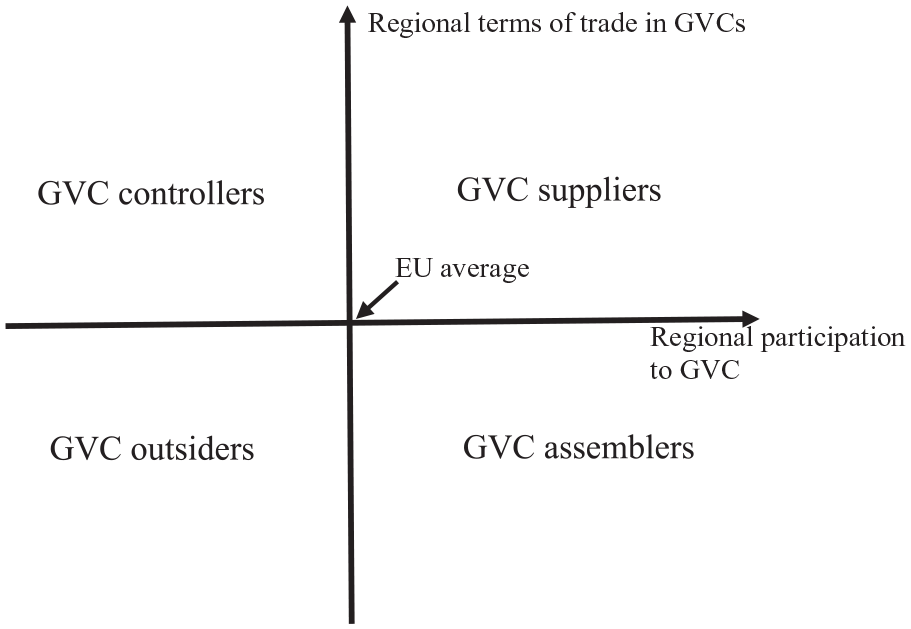
Regional modes of involvement in GVCs.
Moving to the left, the second group of regions is characterized by a higher than average level of terms of trade, accompanied by a lower than average level of participation. These areas are therefore relatively less embedded in GVCs but, in spite of this, they are able to obtain a higher than average benefit from this participation, as they add to the production process more value than the average. This is possible through the presence of high value-added functions, mainly control functions (e.g. headquarters, marketing). Since they host relatively few phases of production (low participation), characterized by favourable terms of trade, these regions can be labelled GVCs controllers.
The interpretation of the third category, with low levels of both regional participation and terms of trade in GVCs is straightforward. These areas are GVCs outsiders, in the sense that they are peripheral links of the global chains and, at the same time, they add poor value to the globally fragmented production processes. Nothing can tell us whether such regions suffer from their marginality of GVCs or, on the contrary, they gain from it, through a condition of relative protection of their economies from international competition.
More interesting is the situation in which a low level of terms of trade in GVCs is matched with an intense participation. These regions are heavily embedded in GVCs, although their contribution is marginal in terms of value added. This is the case of GVCs assemblers, that is, areas specialized in low-value functions, typically hosting, within GVCs, the most labour-intensive phases of production.
The four categories are particularly intriguing. When applied to EU regions, the geography of regional modes of GVCs involvement emerges. Before moving to the results, the next section is dedicated to the data on regional trade in value.
Data on regional trade in value added
At the regional macroeconomic level, the two GVCs indicators presented in equations (1) and (2) can be calculated starting from the interregional I-O data contained in the EUREGIO database (Thissen et al., 2018). Merging WIOD data, regional economic accounts, and estimates of interregional trade flows (Thissen et al., 2013; Los et al., 2015), the database details the I-O relationships of European regions at NUTS2 level. The matrices cover interregional flows across all EU27+UK, with the exception of Bulgaria and Romania (that exist only at country level) and Croatia (not available) for all years from 2000 to 2010. For the sake of this work, the analysis is performed using the last available year (2010) and considering the 258 available NUTS2, in the manufacturing sector. The choice of focussing on the manufacturing sector is due to its paramount importance in the overall phenomenon and in its trends (e.g. de-globalization, offshoring, reshoring, etc. . .) (Sapir, 2022).
I-O matrices are structured in the canonical shape, distinguishing intermediate flows, final demand, gross output, and value added. These elements are linked according to the following relationship:

where gross output (
In this setting, it is possible to define
Equation (3) can be rewritten as

where r, s are generic regions and N is the number of regions and t is a third region different from s. The first term of the last step of equation (4) represents the domestic value added in final goods

where r, s are generic regions, t is the region source of foreign value, and N is the number of regions.
The first summative part of equation (5) represents the foreign value added contained in the exports of final goods, while the second part measures the foreign value added contained in the exports of intermediate goods.
The geography of the modes of involvement in GVCs in European regions
The empirical results, presented in Figure 2, provide a picture of Europe which is not far from what one could expect. Controllers are mostly located in the core of Europe. Germany, together with France, Denmark, and UK are those countries hosting the majority of controlling regions. This is consistent with the expectations that controllers host high functions in the production chain, such as headquarters.
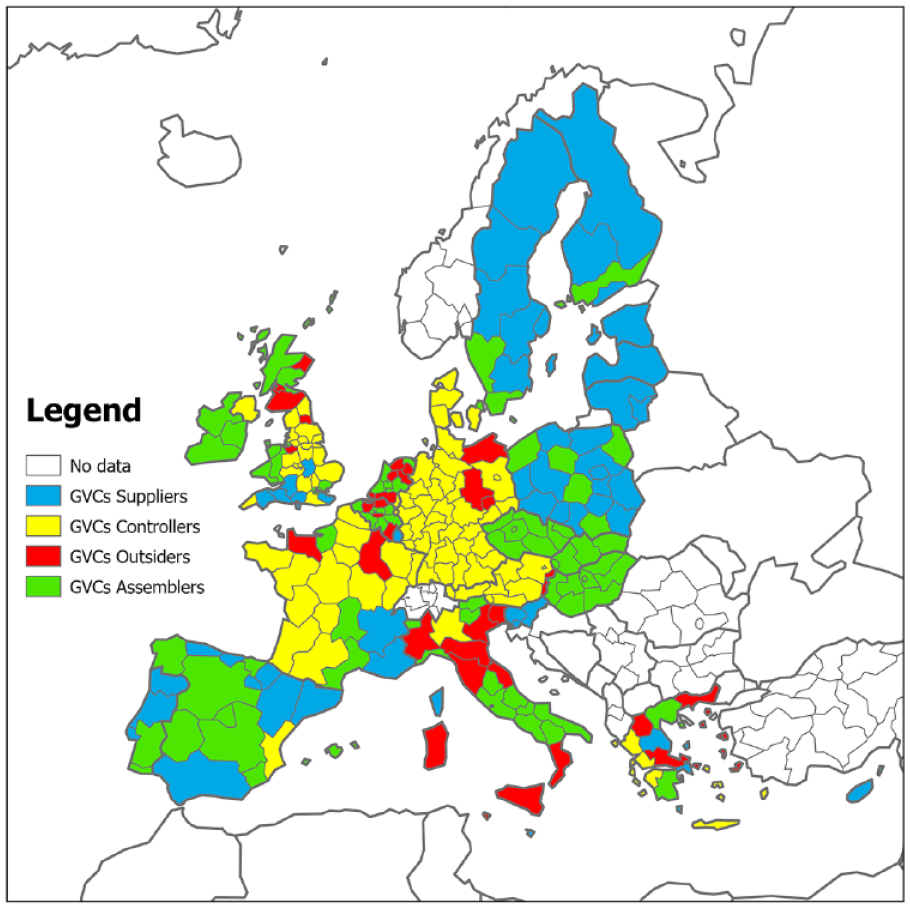
The modes of regional involvement in GVCs (manufacturing sector, 2010).
Suppliers are rather scattered across space, and they are present, as far as Western Europe is concerned, in Spain, Greece and Southern regions of France, with the exception of Finland and Sweden, presumably mirroring in this case also the regional specialization in primary, energy-related sectors.
Eastern European regions characterize themselves as either suppliers or assemblers, consistently with the literature discussing the intense flows of offshoring, from the mid-90s on, of manufacturing activities from western countries (Szymczak et al., 2022). Some regions in the New Member States (Poland and the Baltic countries) show a capacity to gain significant economic advantages (relative to the foreign value added they import) from their intense participation in GVCs, climbing little by little the GVC ladder.
Most of the regions in Eastern Europe are included in the group of assemblers, where low-value functions are located. Assemblers also exist in medium-low income regions of Italy, Greece, Spain and Ireland.
Interestingly enough, GVCs outsiders include a relatively small number of regions. These areas are often characterized by the presence of major transport infrastructures (like ports in southern Italy, northern France and the Netherlands). Their role as hubs significantly increases the volume of exports (i.e. the denominator of our indicator of participation in equation (2)), while the domestic value added is relatively small, as most of the goods only transit through these regions.
Within countries, the picture is sometimes rather homogenous, and sometimes variegated, witnessing that the regional mode of involvement does not always reflect a country-effect. In Germany, for example, the specific focus on manufacturing highlights the leading role of the whole country in GVCs. However, in other cases, for instance Italy, the picture is rather scattered. The majority of southern areas participates in manufacturing GVCs as assemblers, while in Northern and Central Italy the situation is more diversified. Lombardy, a highly advanced manufacturing region, plays the role of controller, while all regions in Northern and Central Italy with a traditional made in Italy manufacturing rely much more on internal production, in a typical industrial district tradition (Becattini, 1989).
Regional characteristics and the GVCs involvement modes
The variety of modes existing within countries generates an interest in studying the association between the modes of involvement in GVCs and some structural characteristics of the regions. If it is true that regions compete on the basis of an absolute advantage, the identification of these characteristics helps regions to ‘safeguard’ and to increase their attractiveness in terms of GVCs functions, totally overlooked when adopting a country-level perspective.
In our analysis, three factors are expected to forge the mode of regional involvement in GVCs. The first element is the overall level of economic development. Most developed areas are expected to host the highest functions of the globally fragmented production processes. In our taxonomy, they are therefore likely to be associated with the highest levels of terms of trade (i.e. controllers and suppliers).
The second element concerns the settlement structure of the region. Large cities are typically those areas hosting high-skilled functions like R&D, innovation, design, decision making, and therefore expected to sell such functions at relatively high prices (Camagni et al., 2023), and therefore registering higher terms of trade in comparison with non-urbanized areas, irrespective of the participation in GVCs. Non-urbanized areas, on the other hand, might attract GVCs if they are close to larger markets and/or production centres (Belderbos et al., 2016). In this case, however, they are expected to play the role of assemblers, registering a high participation with a limited gain.
Finally, the third regional characteristic is represented by the sectoral specialization. Regions with a strong specialization in manufacturing are expected to be those areas that, without a more intense participation in GVCs than the average, are capable of adding value in specific and highly specialized production phases. This is the case, for instance, of regions with a historical specialization in manufacturing, that maintained such an industrial vocation, endowed with decision making functions while progressively offshoring some low-value added phases of production. Based on this reasoning, we expect the specialization in manufacturing to be associated with a role of control within GVCs. From this perspective, a particular case is the one concerning the orientation of regional trade towards domestically processed energy and natural resources. Regions intensively involved in such activities are, in fact, expected to build their terms of trade on the ownership of (or proximity to) the sources of scarce basic inputs, such as coke, oil and gas. These areas are therefore likely to associate favourable terms of trade with an intense participation in GVCs, since they supply these basic resources to a broad market. Based on this reasoning, the orientation of regional trade towards energy-related goods is expected to be associated with a ‘supplier’ participation mode.
Empirically, we measured the three groups of regional characteristics for European NUTS2 areas as follows. Regional development is proxied by per capita GDP. A dummy for Eastern European regions captures the main difference with respect to attractiveness, while other macro groups of western countries (i.e. Northern, Central and Southern Europe) control for heterogeneity in the economic and cultural characteristics. 5 The degree of urbanization is measured by a set of dummy variables, first presented in Capello et al. (2015). This classification defines three groups of settings, namely rural, urban and agglomerated regions. Agglomerated regions are those with the highest level of urbanization, including a centre of more than 300k inhabitants and a population density of >300 inhabitants/square kilometre. Urban regions are characterized by intermediate levels of urbanization, that is, with a centre between 150 k and 300 k inhabitants and a population density between 150 and 300 inhabitants/ square kilometre. Rural regions are the residual areas. Finally, regional specialization in manufacturing is measured as the share of employment in this sector (i.e. NACE Rev.2 category C) over the total, while the orientation of regional trade towards domestically processed energy and natural resources is captured by the share of exports in the sector of coke and refined petroleum products (i.e. NACE Rev.2 category CD) over the total exports. 6 Specialization in agriculture, on the other hand, is expected to be associated with a peripheral role in GVCs, as this sector is less offshorable than the others.
Our analysis aims at studying the following relationship:

where r is a generic region. Given the categorical nature of the dependent variable (i.e. the four modes of involvement in GVCs), equation (6) is estimated by means of a multinomial logit model, able to provide a statistical probability that regions belong to a certain mode of GVC involvement if they have certain level of economic development, urbanization and sectoral specialization.
Table 1 summarizes the results of the analysis on the manufacturing sector. For sake of clarity and simplicity in presenting the results, Figure 3 reports the marginal effects of some selected variables. The first interesting result concerns the neutral association between per capita GDP and the four modes of involvement in GVCs of manufacturing (Figure 3, panel 3a). This suggests that most developed regions do not tend to have a higher probability to play a role of controllers in manufacturing GVCs with respect to less developed ones.
The association between territorial characteristics and the role of regions in manufacturing GVC: multinomial logit estimates.
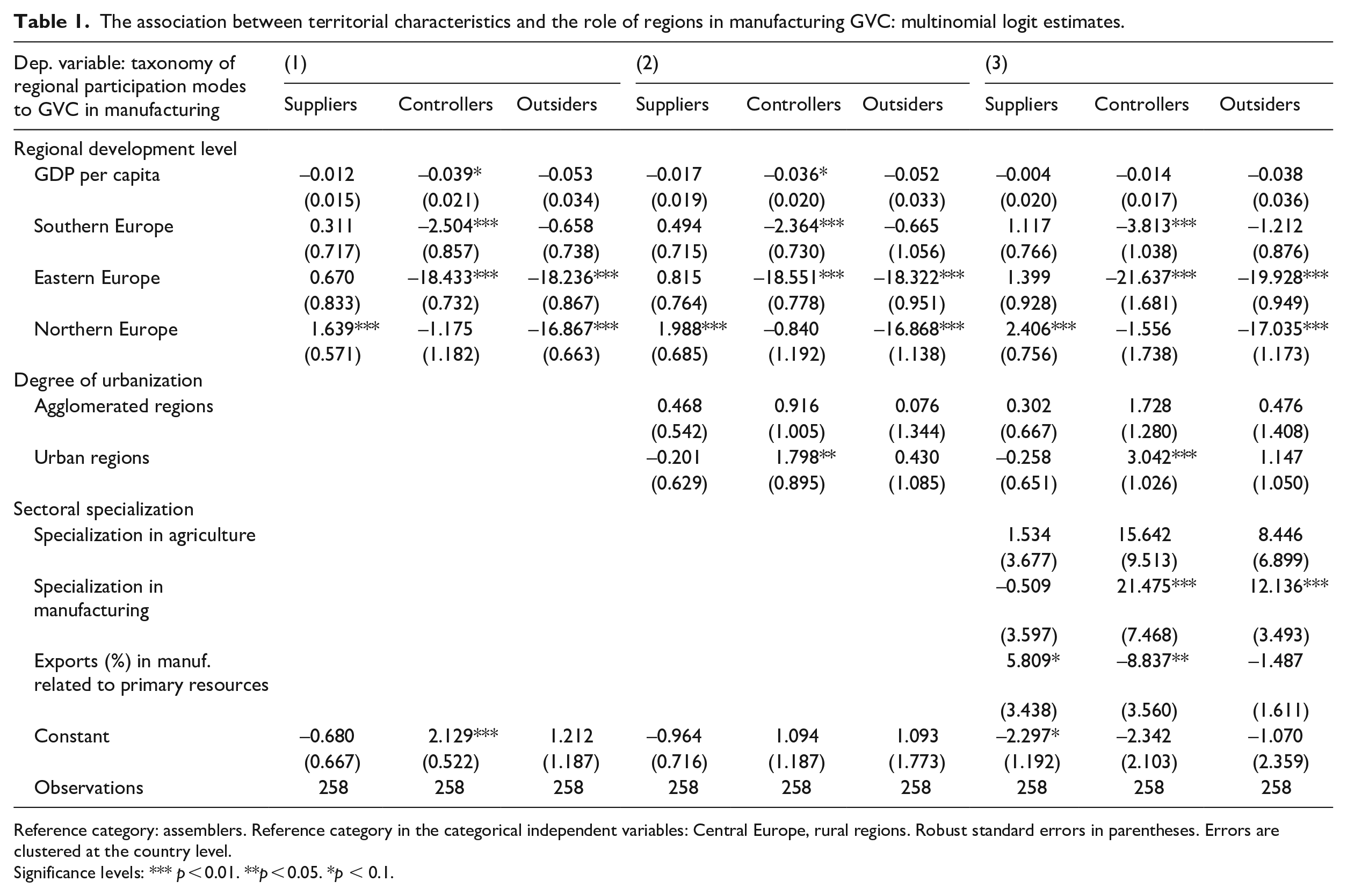
Reference category: assemblers. Reference category in the categorical independent variables: Central Europe, rural regions. Robust standard errors in parentheses. Errors are clustered at the country level.
Significance levels: *** p < 0.01. **p < 0.05. *p < 0.1.
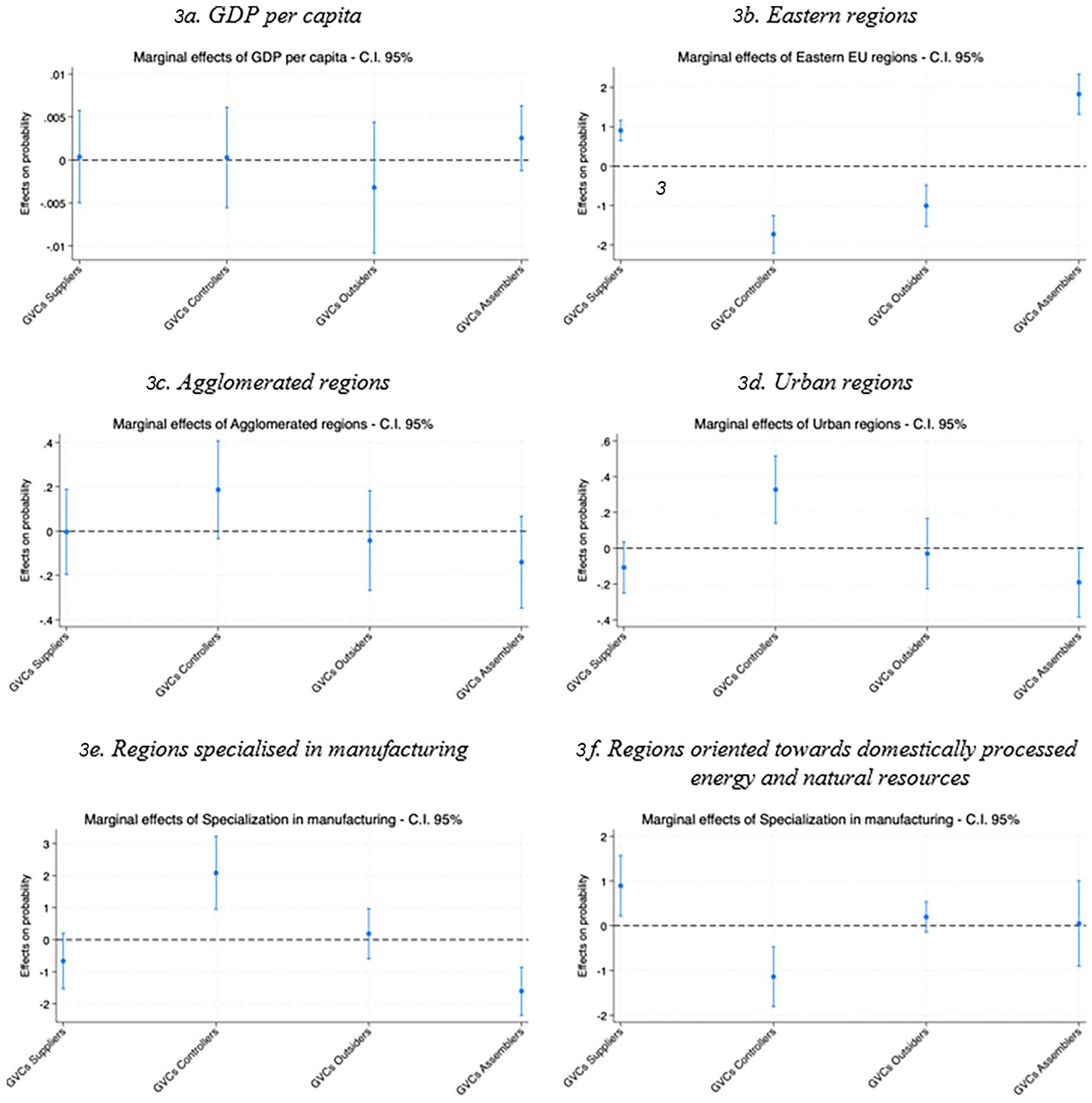
Marginal effects of selected regional characteristics on GVCs involvement modes’ probability: (a) GDP per capita, (b) eastern regions, (c) agglomerated regions, (d) urban regions (e) specialization in manufacturing and (f) specialization in energy and natural resources.
Eastern countries confirm their role as the manufacturing belt of Europe. This is where most of suppliers and assemblers are located, leaving to Western regions a higher probability to be either controllers or stand-alone producers, that is, GVCs’ outsiders (Figure 3, panel 3b).
Large, agglomerated cities are not associated with a role of control (Figure 3, panel 3c). This suggests that regions with the presence of the highest functions, scarce with respect to the demand, and therefore capable to generate extra-profits and rents, are not the only ones that can hold an economic power on GVCs. When a broader definition of urban regions is assumed, embracing those where smaller cities are present, the probability for these regions to be part of the controllers’ regions becomes significantly higher than for other regions (Figure 3, panel 3d). This result can be explained by the presence of high value functions in urban regions in those countries, like Germany, where the urban structure is polycentric, with a flatter angular coefficient of the rank-size rule (Zipf, 1949), and where several large manufacturing companies are located in second-rank cities, like Volkswagen in Wolfsburg or Mercedes-Benz in Stuttgart.
The probability of playing the role of controller is also typical of manufacturing regions, consistently with our assumption (Figure 3, panel 3e). This suggests that the historical vocation of manufacturing regions in Central Europe (Figure 2) is still associated with a pivotal role in GVCs, thanks to the presence of high-value functions such as management, R&D and design, typical of headquarters. On the other hand, the orientation of regional trade towards domestically processed energy and natural resources is matched with a higher probability of playing the role of supplier (Figure 3, panel 3f). In this case, the source of the favourable regional terms of trade does not come from the presence of high-value functions but, rather, from the ownership and/or transformation of a scarce natural resource, which is traded on large markets, leading to a high regional participation in GVCs.
Conclusions and policy implications
This paper has developed a taxonomy of regional involvement in GVCs, going beyond the mere participation and aiming at capturing the role that regions can occupy in globally fragmented production processes. Conceptually, the novelty of our work consists in the development of a measurement of the regional terms of trade in GVCs, mirroring the advantages that a region can get from its embeddedness in globally fragmented production processes. Empirically, our results show that the regional dimension of this phenomenon matters. Although national patterns are visible, and a clear divide between Eastern and Western Europe emerged, the modes of involvement are highly diversified within countries. Moreover, they are significantly associated with some regional characteristics, so that the most competitive areas are also more likely to occupy a central and strategic role in GVCs.
As one of the first studies on this topic, this paper certainly does not exhaust the open issues characterizing the research on the regional involvement in GVCs. As a first attempt at capturing the heterogeneous modes of involvement of regions in GVCs, its association with other measures of positioning within the chains deserves attention. At the same time, the findings discussed in the previous section raise several issues to be addressed by future research.
The first issue concerns the effects that the different modes of regional involvement in GVCs may generate on economic development and regional inequalities. Concerning regional growth, an important question is how alternative modes of GVCs involvement influence regional performance, in terms for instance of GDP and employment growth. The answer to this question is not trivial, also because a trade-off between the expansion of income and jobs might emerge. Improving regional terms of trade, in fact, may be the result of an increase of domestic value added in specific sectors and occupation, at the cost of a reduction of low-skilled jobs, offshored elsewhere. The net effect of mechanisms of this kind could increase within-regional inequalities. At the same time, also within-country inequalities might be exacerbated by the heterogeneous modes of regional involvement in GVCs. Lagging-behind areas in countries with relatively high wages are at risk of a further deterioration of their competitiveness. The intertwining between involvement in GVCs, growth and inequalities is still an under-investigated topic, although the rise of GVCs is generally associated with the negative distributional trends (Bair et al., 2021). These issues are extremely important, also for their implications for the social and political sphere, where the growing discontent of individuals in a condition of economic disadvantage finds an outlet in the growing support for anti-system movements (Iammarino et al., 2019; McCann, 2020).
Supplemental Material
sj-docx-1-epn-10.1177_0308518X231211788 – Supplemental material for At the territorial roots of global processes: Heterogeneous modes of regional involvement in Global Value Chains
Supplemental material, sj-docx-1-epn-10.1177_0308518X231211788 for At the territorial roots of global processes: Heterogeneous modes of regional involvement in Global Value Chains by Roberta Capello, Roberto Dellisanti and Giovanni Perucca in Environment and Planning A: Economy and Space
Footnotes
Declaration of conflicting interests
The author(s) declared no potential conflicts of interest with respect to the research, authorship, and/or publication of this article.
Funding
The author(s) disclosed receipt of the following financial support for the research, authorship, and/or publication of this article: This research was funded by the programme PNRR M4C2 Inv. 1.3 PE - Parternariati Estesi, project “GRINS – Growing Resilient, INclusive and Sustainable” (PE0000018).

Supplemental material
Supplemental material for this article is available online.
Notes
References
Supplementary Material
Please find the following supplemental material available below.
For Open Access articles published under a Creative Commons License, all supplemental material carries the same license as the article it is associated with.
For non-Open Access articles published, all supplemental material carries a non-exclusive license, and permission requests for re-use of supplemental material or any part of supplemental material shall be sent directly to the copyright owner as specified in the copyright notice associated with the article.
