




Abstract
Grassroots village organizations are crucial for understanding the interplay between the decentralization of state power and growing income inequality in periurban China. Based on a study of 380 shareholding cooperatives and 43 administrative villages in Guangdong, we examine how state policy has interacted with village institutions to determine the management and distribution of collective income among villagers. Our findings suggest that the decentralization of power over collective asset management and distribution to these grassroots organizations did not cause a retreat in the state’s capacity for strategic intervention and local regulatory controls. Rather, the state made continued attempts to regain power over village governance through institutional formalization. Such interventions enhanced the access of villagers to state welfare. However, they worsened income disparities among villagers by undermining the village redistributive mechanism based on informal rules.
Introduction
Significant economic disparities between different regions of China have placed the relationship between governance decentralization and state restructuring at the forefront of scholarly debates. Ongoing administrative and fiscal decentralization of the Chinese government has led to the expansion of a market-oriented economy and the increasing autonomy of local agencies to engage in grassroots governance (Chung, 2010; Hsing, 2010; Oi, 1992; Pearson, 1997). However, it has often been argued that decentralization has worsened regional disparities and income inequality (Chan and Buckingham, 2008; Croll, 1999; Khan et al., 1993; Kim, 2010; Lyons, 1991; Tsui, 1993; Whalley and Yue, 2009). In some wealthy provinces, such as Guangdong, income levels vary significantly across cities. In 2018, the per capita annual disposable income was RMB35,810 in Guangzhou, but RMB29,547 and RMB21,217 in Jiangmen and Meizhou, respectively (National Bureau of Statistics, 2019).
Decentralization has not only created significant economic disparities among regions and cities but also deepened the division between poor and rich villages (Bach, 2010; Rozelle, 1994). Some scholars have suggested that the villages nearest to cities are more likely to benefit economically from urban economic growth than peripheral villages (Hsing, 2010; Kan, 2016; Zhao and Webster, 2011). Economic disparities have emerged between neighboring villages, as they have developed their own mechanisms and rules for managing collective assets (Sargeson, 2011). Decentralization has empowered local elites and clan-based networks to manipulate local development via rent seeking and property confiscation. A direct consequence of this has been the rise of localism, under which local agents have operated in self-contained compartments (Kan, 2020; Liu et al., 2010; Mattingly, 2016; Zhu, 1999). The fragmentation of local governance has inevitably undermined the power of the state to pursue economies of scale in providing public welfare and infrastructure, leading to rising inequality, as evidenced by income segregation and poverty concentration (Lampton, 1987; Lieberthal, 1992; Tomba, 2018).
In this study, we argue that the emerging fragmentation of local governance as a result of decentralization does not necessarily imply the declining influence of state power in the provision of public welfare and infrastructure, despite its direct role in increasing economic disparities in urbanizing China. Instead, state power has been re-organized in villages through the strategic efforts of the socialist state to restrain the rise of localism. We characterize this power restructuring as a shift from the “decentralization of governance” to the “governance of decentralization.” This process is not manifested through a show of strength by the state, as in the authoritarian era. Instead, what we observe is an attempt by the state to harness the power of local elites through de-centralization and the formalization of collective asset management. Following an analysis of this shift, we instigate a refocused inquiry into the complex effects of fiscal decentralization and state power restructuring and their association with income disparities.
Emerging income disparities: Intra- and inter-village
We draw on an empirical study of the interrelations between decentralization and growing income inequality in Guangzhou Luogang, where urbanization has given rise to the rapid growth of many wealthy and autonomous villages. In the Pearl River Delta, many “land-losing” villagers are not landless (Wong, 2015a). The same is true of Luogang. Beginning in the late 1980s, the local authority divided land compensation packages into two parts. One part was cash compensation, but as all arable land was collectively owned, this cash compensation was not distributed directly to individual villagers. Once the value of any agricultural products grown on the requisitioned land was paid to the affected farming households, the remaining portion of the compensation money was held and managed by the shareholding cooperative (SC). The second part was in the form of land itself. After land requisitions, the government returned approximately 10% of the requisitioned land to the SC as part of the overall compensation. This “reserved commercial land (ziliujingjiyongdi)” could not be sold on the market but could be leased to outside investors for non-farming uses. The majority of collective incomes in Luogang are therefore rental income generated from leasing “reserved land” to outside investors. Lacking access to non-farming job opportunities, villagers have increasingly relied on these ever-growing collective incomes for their livelihoods during their rapid urban transition. In wealthier SCs, according to some villagers, the dividend income constituted more than 50% of the villagers’ disposable household income. In the last decade, rapid urban development has meant that many SCs have experienced rapid growth in their collective assets, which has led villagers to engage with their SC to improve the incomes and benefits received from collective welfare. Meanwhile, income disparities among villagers became significant.
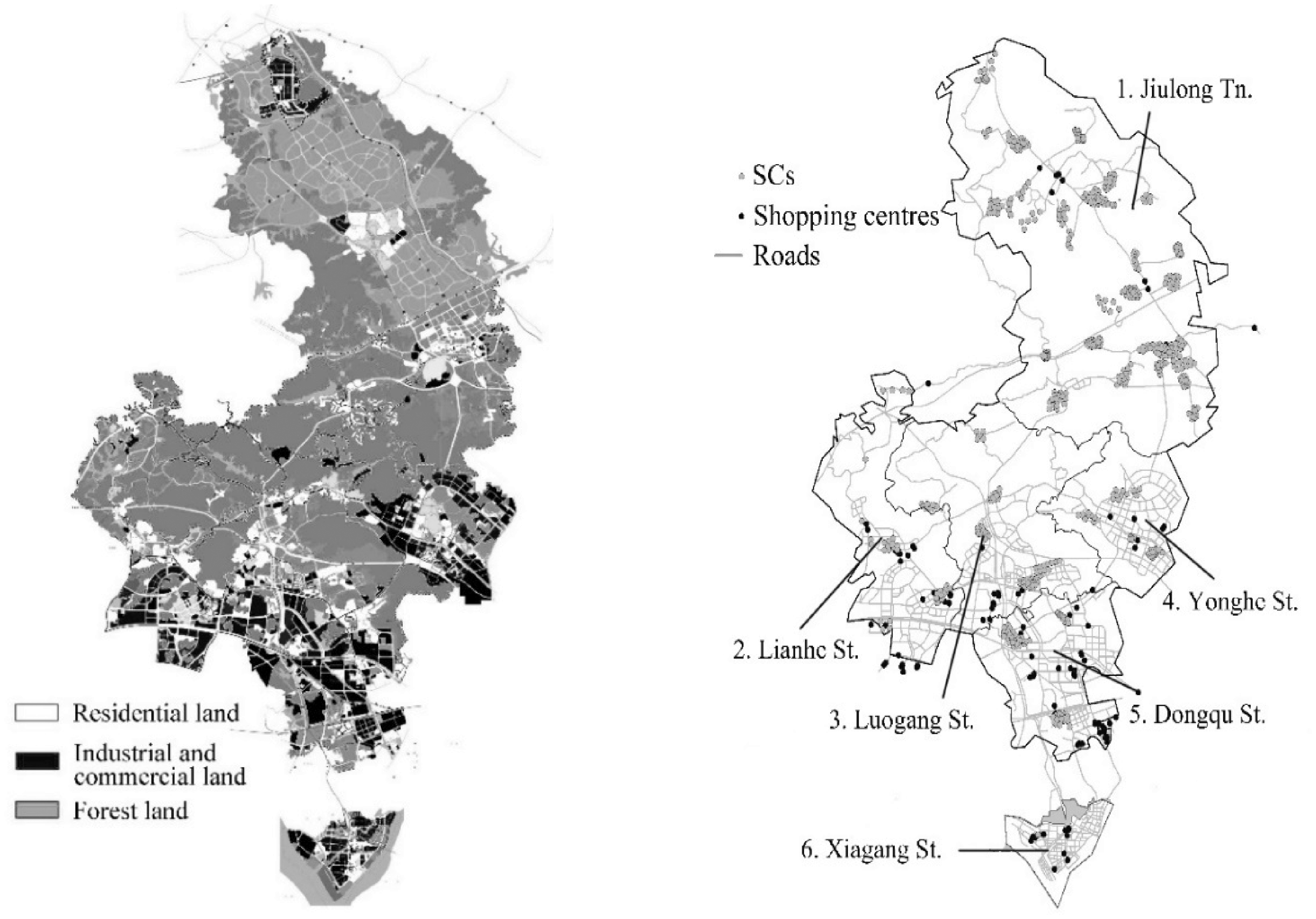
Luogang has six administrative areas (Figure 1). The per-capita income disparities within these areas in 2015 were shown in Figure 2. Villagers from Xiagang Street earned the lowest collective income, despite this area being well-developed since the 1980s. One possible reason is that its inhabitants did not own much reserved commercial land for rental income generation. Their arable land was mostly requisitioned in the 1980s, when the government offered urban hukou rather than reserved commercial land as compensation. Following changes in compensation policy in the 1990s, the villagers living in other administrative areas were offered reserved commercial land instead of hukou as compensation. Thus, they could generate more collective income through leasing their commercial land. It is worth noting that villagers living in Lianhe Street, Dongqu Street, and Jiulong Town earned higher collective income than those living in Yonghe Street and Luogang Street. One possible reason is that the land values in Lianhe Street, Dongqu Street, and Jiulong Town were higher than in Yonghe Street and Luogang Street.
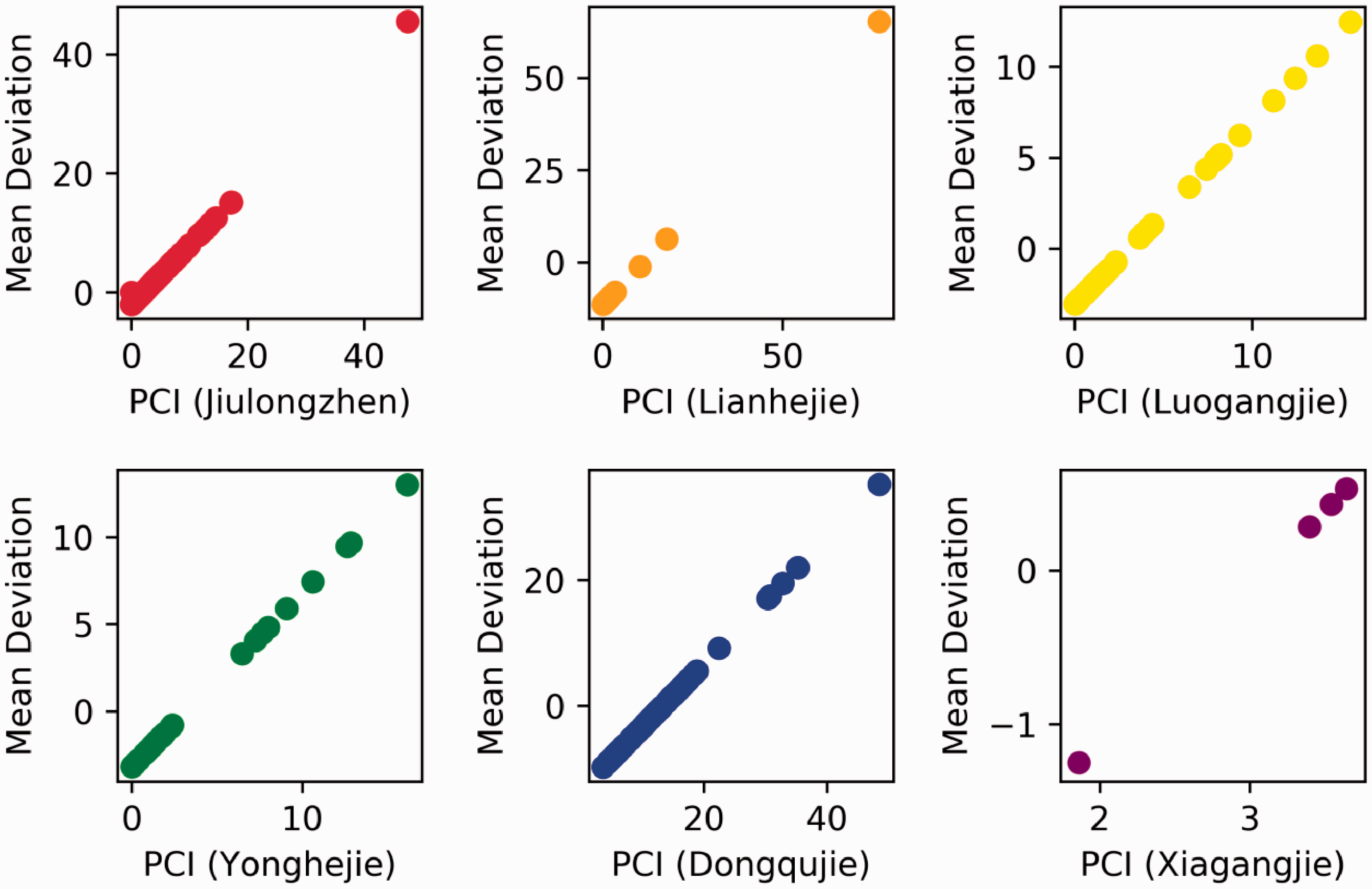
Per-capita income disparities within towns (RMB1,000).
These regional disparities in Luogang have been shaped by both inter- and intra-village variances. Our analysis shows that the average per-capita income of villages was RMB4,283.23. The mean per-capita income varied significantly from RMB389.4 in the poorest village to RMB38,438.5 in the wealthiest village. As shown in Figure 3, the richer the village, the greater the income disparity among villagers. For example, the wealthiest village had a standard deviation of RMB54,276.6 and the poorest village had a standard deviation of RMB375.4. In this context, understanding these regional disparities requires a re-focused inquiry into the origin of income disparities within the same village.
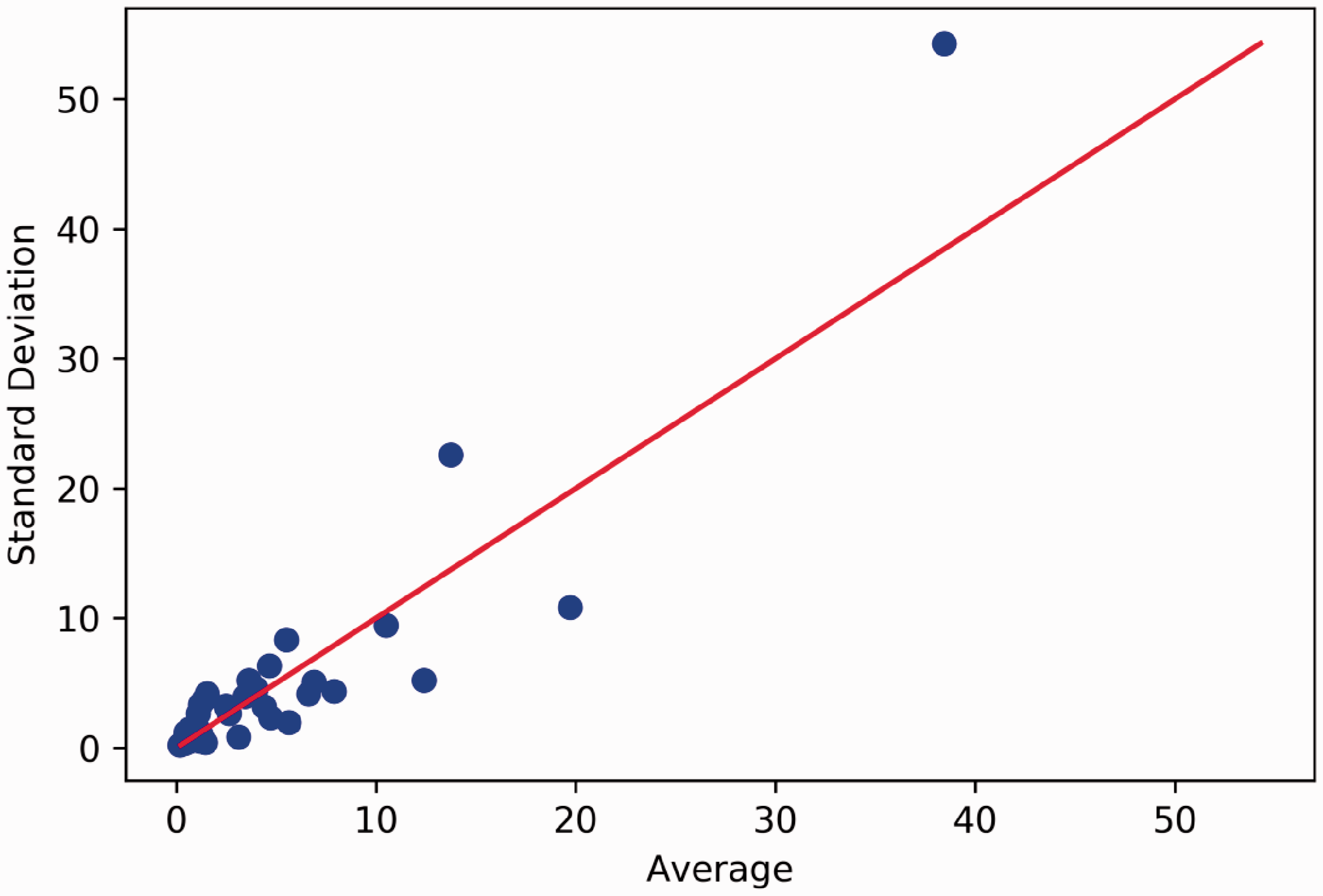
Per-capita income disparities within villages (RMB1,000).
We use a data set gathered from 380 SCs in 43 villages, and combine qualitative analysis with quantitative modeling to examine how these SCs have interacted with state policies and informal rules (e.g., village norms and customs), which have shaped their economic outcome and performance. After the 2003 shareholding reforms, villagers were allocated an equal number of shares (200) in their collective assets. Despite their equal entitlement to these collective assets, however, the income received by the villagers varied substantially. Our analysis focuses on three questions: (1) How have income disparities been fostered under the institution of SCs? (2) How are income disparities associated with the governance fragmentation caused by the decentralization of collective asset management? (3) Why did the emerging governance fragmentation not result in a decline in state power in regional governance?
Studying SCs as a method of inquiry
Like many of its counterparts in the Pearl River Delta, the SC system in Luogang now comprises two levels of organization, namely the Association of SCs and the SCs themselves (Figure 4). These two levels of village organization originated in the brigade and production teams of the Maoist era. After the collectivization movement in the early 1960s, a three-level form of village collective organization, the “commune–brigade–production team,” was firmly established in villages in Luogang. Under this system, the production team was the basic accounting unit for collective land and assets. In the reform period, communes were re-organized into township governments. Brigades and production teams were re-organized into administrative villages and villagers’ groups, respectively. In light of this restructuring, their economic organizations, known as “Associations of Rural Economic Cooperatives,” were renamed “Rural Economic Cooperatives.” In the late 1990s, they were further re-organized into Associations of SCs (at administrative village level) and SCs (at Villagers’ Group), respectively.
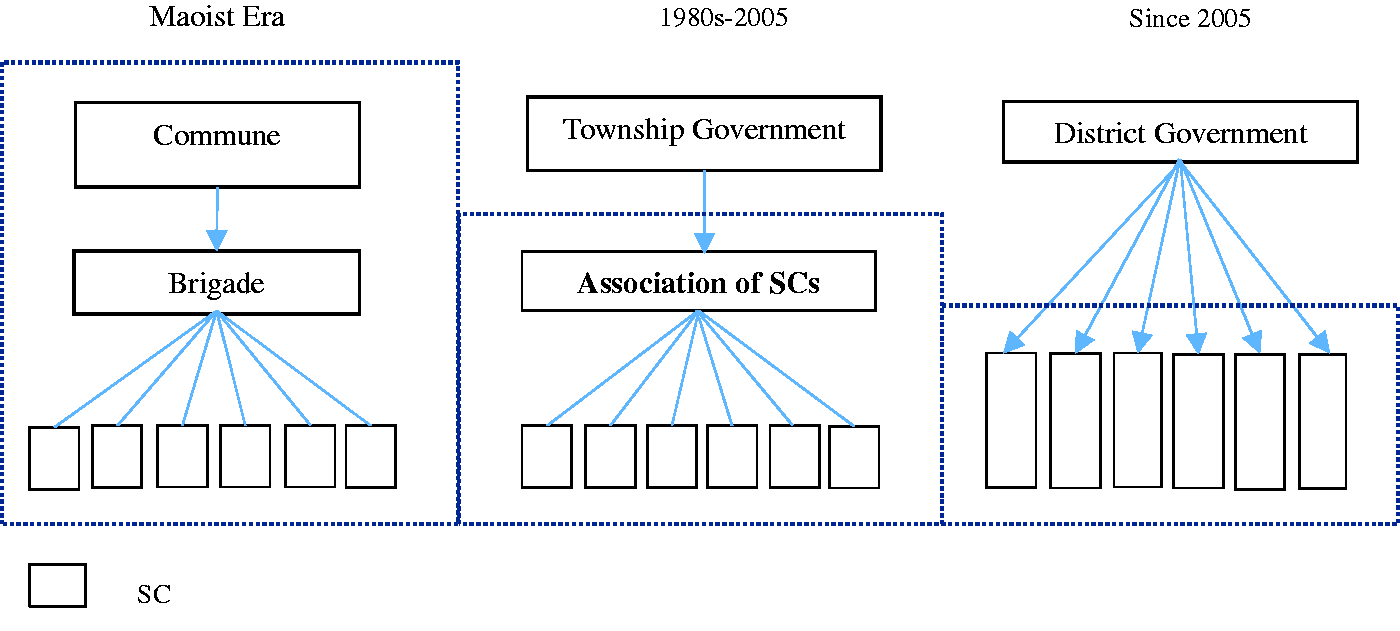
Restructuring of village organizations.
Taking the “administrative village” as the basic unit of analysis, existing studies have yielded important insights into the income disparities between villages (Hsing, 2010; Rozelle, 1994; Sargeson, 2011; Vermeer, 1982). However, relatively little attention has been paid to intra-village income disparities. In this study, we explore how income disparities have been created among villagers from different SCs within the same village. Accordingly, we take the SC as the unit of analysis. The divergence of economic performance between different SCs has inevitably led to different dividend, resulting in a widening gap between the rich and the poor among “land-losing” villagers.
In previous studies, shareholding reforms have been viewed as a bottom-up process mainly driven by the initiatives of villagers to defend their economic and social interests (e.g. Chan et al., 2009; Chen, 2016; Hsing, 2010; Hou; 2013; Yep, 2015; Zhu and Guo, 2015). The results of these studies suggest that the domination of lineage-based power was the main cause of income inequality. In this study, we emphasize the need to bring the role of the state back into the analysis of income distribution at the SC level. In the past decade, the local state has heightened its control over urbanizing villages through its day-to-day governance practices and the pursuit of a complex policy agenda comprising social welfare provision, shareholding reforms, and intervention in grassroots politics (Wong, 2015a). To this end, “to better understand local governance restructuring through the lens of shareholding reforms, one must impose a focused inquiry on how government intervention has interacted with the informal rules that are embedded in a kinship-based community to recast the institutions for the redistribution of villagers’ entitlement to shareholding benefits” (Wong, 2016: 703).
We use both qualitative and quantitative methods in the analysis of SCs. A good mix of qualitative and quantitative analysis, as some scholars have suggested (Hesse-Biber, 2010; Pekrun et al., 2002), should combine contextual explanations and rigorous tests of hypotheses to examine causal relationships. We focus on 380 SCs and 43 associations in 43 villages, with these villages located in six street wards. Between 2015 and 2018, we conducted intensive field research, which had two aims. First, we aimed to understand the real operation of SCs on the ground and, in doing so, identify the factors affecting their operation. Second, we aimed to assemble a historical database containing spatial, economic, and social conditions relevant to SCs. In addition to data collection, we also conducted in-depth interviews with local officials and village cadres, as it was difficult to locate relevant materials without their help, despite most of these materials being originally made for public inspection. Interviews with local officials and village cadres were also required to gain an understanding of how policies have been interpreted and implemented on the ground. We collected five categories of data relating to SCs, as detailed below.
Spatial features and socio-economic characteristics. We collected these data from the Luogang Town Gazetteer, the GLD Lougang District Yearbooks, and the Guangzhou Development District Reports. These Yearbooks and Reports provide substantive information about the Luogang’s development since the 1980s. Furthermore, most census and statistical data representing the demographic features and development conditions of villages over time have been made available to the public by these reports. Organizational structure. We collected these data mainly from the Articles of Association, which are usually available in the Office of the Villagers’ Committee for public inspection. Furthermore, the personal particulars of village cadres (including the directors and shareholder representatives of SCs, and the directors and members of Villagers’ Committees) are listed in the bulletins posted on the board outside the Residents’ Committee. We also collected historical data from interviews with local officials and village cadres. Financial status. These data were accessible from the Platform of Village Information Disclosure, which is an online system established by Guangzhou Municipality to allow the public to oversee the operation of SCs and village governance. These data provided historical information about the financial conditions of each SC, such as income and expenditure accounts, profit and loss accounts, and so on. Both monthly and quarterly auditor reports had to be made public, to allow villagers to inspect the actual amount of expenses and transactions involved. However, the database of this system only covers the period from May 2010 to the present, and data in some categories are still missing. Intensive field research was carried out in urbanizing villages to review and analyze the archival records kept by the Villagers’ Committees. Conditions of land use and development. These data were also accessible from the Platform of Village Information Disclosure. The data-assembly task also required research into various documentary sources such as government working papers, government policy notices, leaders’ speeches, past development layout plans, and aerial photographs. It also required clarification from the relevant departments of the GLD administration, the Villagers’ Committees, and SCs to understand how local practices at the village level have interacted with government policies to shape the outcomes of “reserved commercial land” development and village redevelopment. Government strategies and policies. The collection of data about government strategies and policies covered a critical review of key government strategies and policies that had direct repercussions on the management of collective land and assets. They included three main sets of documents. The first is related to the policies and regulations governing the management of collective assets, as exemplified by the Organic Law on Rural Neighbourhood Economic Cooperatives of 1990, Regulations Concerning Audit on Village Collective Assets 1995, Opinions on Improving Rural Shareholding Cooperatives 2003, and Notice Regarding the Management of Village Collective Assets in the GLD 2005. The second is related to the development of “reserved commercial land,” as exemplified by the Urban and Rural Planning Law 2007 and Notice of Planning Permission for Construction Land 2009.
Model specification and results
The characteristics of SCs are important in determining their income level. SCs are not identical; they vary in terms of morphological features, such as location, availability of developable land, and asset mix. Upon the completion of field research, we created a database of the geographical profiles of the SCs and their financial conditions and economic performance. We hypothesize that these variations exert different influences on their economic outcomes and performance. In this study, the economic performance of an SC is specified as a function of the leadership of village cadres, organizational structure, financial status, built-up area, and location. An econometric model is then used to identify and estimate their influences. Formal diagnostic tests are computed to test the uniqueness of our models. The estimated equation takes the following form:

The model states that the dependent variable
This section presents a review of our model estimation results, z-statistics, and diagnostic tests. Table 3 presents the empirical estimation of per-capita income using multilevel models. We first begin our discussion at the SC level (model 1). In particular, the variable chief_same is estimated to be negative but not significant, and this implies that local political power does not have an influence on income. Even if the secretary and deputy secretary come from one clan (i.e., have the same surname), it is not likely that the per-capita income of an SC will increase or decrease. Our result does not confirm the general belief that the clan-based power exerted influence on the income generation of an SC, by either working closely to raise collective income or shirking to lower collective income, or by focusing on earning more personal income rather than collective income.
Variables and definition.
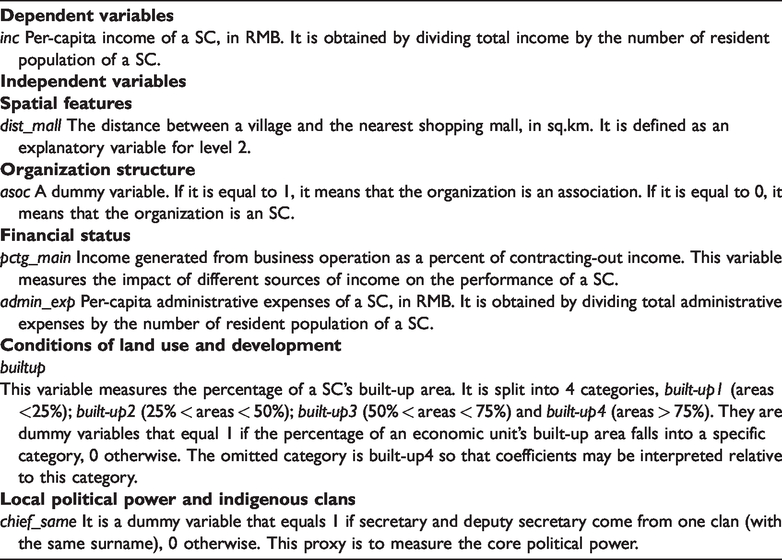
Descriptive statistics.
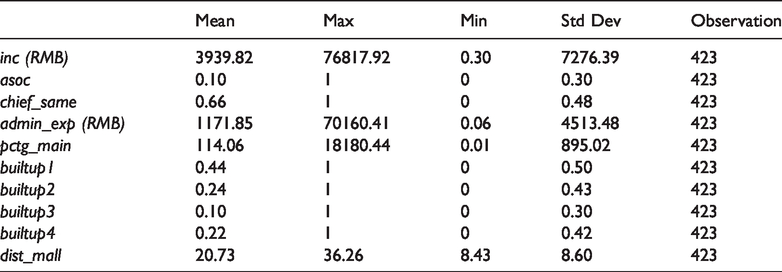
Empirical estimates.
Note: Figures in parentheses are the z-statistic. *** indicates statistically significant at 1 percent confidence level; **indicates statistically significant at 5 percent confidence level. * indicates statistically significant at 10 percent confidence level.
Before the institutional reform in 2003, all SCs were required to transfer a portion of their collective income to their association, which would give a subsidy to poor SCs to reduce income disparity, while providing social welfare to all SCs under its governance. Since the reform, SCs have not been required to transfer their income to their association (or have only been required to transfer a very small portion of it), while the function of providing social benefits, like infrastructure, has now fallen to the government. This means that the effect of associations has gradually faded. The insignificance of this variable tends to support our hypothesis.
We find that per-capita administrative expense increases the per-capita income of an SC, as suggested by a positive and significant coefficient. Our result suggests that if expense increases by RMB1, income would increase by RMB1.89, all other things being constant. Hence, we estimate the income elasticity with respect to expense to be 1.89, which is highly elastic. Our result shows that the management team of SCs is very efficient in earning income in the six towns in Luogang. This may be because these SCs can now retain all of their income, and are not required to transfer their income to their associations.
The variable pctg_main represents the ratio of income from business to income from land rent (Table 1). It is estimated to be negative and insignificant. Our result suggests that even if this ratio increases, the per-capita income will not change at the SC level. In fact, this result deserves further explanation. On average, SCs in the southern part of China, such as Guangzhou, are not good at developing their own businesses compared to their northern counterparts. They mostly earn their collective income from renting out their land rather than establishing their own manufacturing plants or factories.
We find that the built-up area of an SC has an influence on the per-capita income of an SC in Luogang (Table 1). Compared to an SC in the builtup4 category (area > 75%), an SC in the builtup1 category (0% < area < 25%), builtup2 category (25% < area < 50%), or builtup3 category (50% < area < 75%) earns less income. On average, the decrease in income is estimated to be RMB5,360.2, RMB5,550.5, or RMB7,129.2 for SCs in the builtup1, builtup2, or builtup3 category, respectively. Furthermore, the wealthier the village, the greater the income disparity among its SCs. The variable dist_mall represents whether an SC is in a convenient location (with proximity to main roads). It is a level-two explanatory variable. Our results suggest that this variable is highly significant, as suggested by the z-statistic.
Turning to associations (model 2), the variables chief_same and pctg_main are both estimated to be statistically insignificant (Table 2). This implies that these two variables do not have an effect upon the per-capita income of an association. Our estimate shows that when per-capita administrative expense increases by RMB1, per-capita income increases by RMB0.98. Hence, the income elasticity with respect to administrative expense is estimated to be 0.98, which is close to unitary. When we compare this coefficient in models 1 and 2, we find that an association is less competitive than an SC. This may be because although an association must operate its own business, it is simultaneously obligated to manage its own SCs to better utilize their resources. This means that earning income may not be an association’s top priority.
As in model 1, we find that the proportion of an association’s built-up area has an influence on its per-capita income. Compared to an association in the builtup4 category (area > 75%), an association in the builtup1 category (0% < area < 25%) or builtup2 category (25% < area < 50%) does not earn more (or less) per-capita income. However, an association in the builtup3 category (50 < areas < 75%) is associated with a lower per-capita income. The amount is estimated to be RMB-14,447.7. One plausible explanation is that an association with less built-up area may have more valuable land in a more convenient location, whereas an association with more built-up area may have less valuable land in a less convenient location.
Finally, we discuss the results associated with the full model (model 3). As the full model incorporates 380 observations and 43 observations from models 1 and 2, respectively, its results are estimated to be exactly the same as the results based on model 1, with the exception of the magnitude of the estimated coefficients. Financial status, the proportion of built-up area, and location are major determinants of income generation, whereas local political power does not have an effect on income. Hence, one interesting point is that the earning ability of an SC is not different from that of an association, as suggested by the insignificance of the z-statistic. One possible explanation for this is that although the management of associations may be less efficient, it may occupy a larger portion of more valuable land in a better location.
Overall, our empirical findings suggest that the influence of informal lineage networks on SCs is not as clear-cut as previous studies have predicted. Indeed, the local state has had a decisive effect on the economic performance of SCs through its direct interventions in social welfare programs, shareholding reforms, and infrastructure provision. In the following section, we further explain how ongoing decentralization has consolidated the fiscal autonomy of SCs, and in turn weakened rather than strengthened the role of clan-based power in the management and distribution of villagers’ collective income.
“Decentralization of governance” and the growth of informal village institutions
The decentralization of the management of collective assets from the government to administrative villages (i.e. Associations of SCs) began in the 1980s. As one of the first areas to implement the open door policy, Luogang pioneered economic reforms and urbanization through a progressive policy of attracting foreign investment and promoting export production (Wong and Tang, 2005). The township government therefore devoted its main efforts to making land available to overseas investors through land requisitions, rather than directly assisting villagers in developing rural enterprises. Following the government’s introduction of “reserved commercial land” to replace the direct provision of employment opportunities and social welfare to villagers affected by land requisitions, from the early 1990s onward, all land compensation fees were directly channeled to the village collectives. This meant that the local government gave up direct control and left ownership rights to the lower organizational levels, namely the former brigades (now the Associations of SCs) and production teams (now the SCs). The three-tier ownership system was thus transformed into a two-tier one (Figure 4).
The end result of the “reserved commercial land” policy was the retreat of the local state from the collective ownership system, leaving the authority for managing collective land and other assets to self-governing grassroots organizations (Wong, 2015b). Before the early 2000s, most collective assets and income were centrally managed by the Association of SCs to support the operation of a self-sufficient welfare system for the villagers. Under the country’s unique urban–rural dualist system, villagers were excluded from state-administered welfare. In the absence of top-down financial support, most resources required for the provision of rural infrastructure and services relied on the income generated from the land collectively owned by villagers.
During the Maoist period, the meager collective income could only support the appointment of a village doctor (or barefoot doctor) to provide basic healthcare services, such as immunizations and simple medical attention. In the reform era, the increasing collective income enabled many associations to improve their medical services and expand their services to provide community libraries, kindergartens, and primary schools. This was especially the case in the 1990s, when massive land requisitions by the local state for industrial development led many SCs to experience rapid growth in their collective income. To support the continual improvement of village facilities and services, many associations required each SC to contribute approximately 30% of its land compensation fees and rental income generated from “commercial land” for social welfare provision.
The rapid growth of these self-sufficient welfare systems throughout the 1990s created the right conditions for clan-based power to become politically dominant in villages. Like many of their counterparts in Guangzhou, the clan-based networks in Luogang originated in the Song dynasty (960–1279), when widespread conflicts in northern China forced many people to move to the south. These migrants usually reached the Lingnan Region through the Meiguan Road. Most of them first stopped over in Zhujixiang, which is located in today’s Nanxiong City, and then moved to the other parts of today’s Guangdong Province. Luogang was no doubt an ideal destination, as evidenced by the fact that the Zhong family, one of the biggest clans, immigrated there in 1163. Gradually, more families with different surnames, such as Liu, Kong, Huang, He, and Luo, arrived to build their so-called “natural villages.” Maintaining a neighborhood watch and helping to defend each other became practical strategies for these new migrants to settle and flourish in their new home. Families and clans maintained distinct identities, yet established firm social bonds through inter-marriages and residing in close proximity, creating a sense of community based on kinship and neighborhood.
In these villages, those who gained recognition from villagers were mostly local elites from large families, which had members who held academic degrees and/or bureaucratic offices in urban areas. In imperial China, it was not uncommon for people, both rich and poor, to work in cities and later return to their villages (Skinner, 1977). This was especially the case for the bureaucratic elite class. Many of them were from rural areas, and gained academic degrees and bureaucratic offices in the city with financial and spiritual support from their rural family and lineage (Wong et al., 2020b). They were considered an honor to their place of origin, and thus usually hoped to return there in the autumn of life.
This was also true in Luogang (Wong, 2014). As revealed by the genealogical book of the Liu family, Liu Liang (1030–1112), an ancestor of the Liu family, served as Defense Minister during the Songhui Reign of the Song dynasty and eventually retired in Liu Village. In the Zhong family, similar stories were not only recorded in the family genealogical book, but also posted on the walls of the Luogang Residents’ Committee office. In 1205, Zhong Yu-yan obtained the degree of Jinshi in the palace examination and was then appointed the Magistrate of Wuchang Prefecture. After retirement, he returned to his home village in 1219. During the Yuan dynasty, Zhong Zi-huan, another member of the Zhong family, held a professorship at Suzhou University and eventually retired in his clan village. These retired bureaucrats and scholarly elites played a critical role in village governance, devoting their efforts to building temples and schools. Earning support and esteem from their fellow villagers, they and their descendants became the local leaders, or what we now call “local gentry.”
Maoist collectivization suppressed but did not eliminate these clan-based networks. When the state power reduced its presence in villages, such networks were revitalized. During the 1990s, as a result of the implementation of the “reserved commercial land” policy, village organizations had a high degree of autonomy in the management and distribution of collective income, enabling the growth of clan-based power in village governance. This was evidenced by the fact that the posts of the Director (and Deputy Director) of Associations of SCs were mostly occupied by members from large families. For instance, in one village, village cadres from the Zhong family occupied the post of Director of the Association of SCs for more than 20 years. Traditionally, in village elections, a candidate’s appeal to voters was usually not only due to his personal ability but also to voters’ desire to sustain the power of their clan in the village community (Wong et al., 2020a). In such a context, candidates from large families usually won elections throughout the 1990s.
However, this should not lead us to conclude that such domination was bound to only act favorably over villagers from the Zhong family. The key reason was that the members of the Zhong family (including several close relatives of village cadres) belonged to different SCs. Thus, to protect the interests of the family members in different SCs, the Director of Association had to balance the needs of different SCs. For example, each SC was required to contribute 30% of its collective income to the Association of SCs for the provision of village facilities and social services. Due to this mechanism, wealthier SCs, which mostly generated ever-growing rental income from their commercial land, were actually subsidizing poorer SCs, effectively reducing the income disparities among SCs within the same village.
“Governance of decentralization” and the decline of informal village institutions
In the early 2000s, the local government continued to promote decentralization; it further de-centralized collective asset management from the village (i.e., Association of SCs) level to SCs. This turn toward decentralization did not sustain the growth of clan-based power, although one proclaimed objective of shareholding reform was to decentralize collective ownership and let SCs run their course. The actual implementation of this turn of decentralization involved the significant recentralization of state power in village governance through social welfare provision and the formalization of individual entitlement to the collective income.
After land requisitions took place, the villagers no longer worked as farmers. However, they continued to rely on their village collective for their livelihoods. By the early 2000s, many of them had changed their hukou status from “agricultural” to “urban.” However, they were unable to enjoy benefits on par with those of urban residents, as most of the financial costs associated with the provision of village facilities, healthcare services, and retirement pensions were shouldered by associations. Tang (2015) describes this mode of village governance as “not rural but not urban.” From the perspective of government, this hybrid form of governance was by no means desirable (Wong et al., 2018). To speed up villagers’ transition to urban institutions, the district government got directly involved in the construction of village facilities and provision welfare eservice for villagers.
By expanding its administrative and financial support in the provision of physical infrastructure and social welfare for villagers, the local government fulfilled its commitment to the principle of “cities support countryside (chengshi zhichi nongcun)” which had been advocated by the central government as part of the New Countryside Construction policy. In the face of the soaring social tensions associated with the widening economic disparities between cities and the countryside, the central government switched from its dualist approach for rural-urban development to policy seeking rural-urban integration. These policy changes led to a new stage of governance transformation, in which local governments at all levels were required to honour the basic needs of villagers for social security services in the process of urbanization (Klotzbücher et al., 2010; Schubert and Ahlers, 2012). In the case of Luogang, strong local financial capabilities enabled the local government to be a pioneer undertaking a greater role in social welfare matters (Wong, 2015a). In the early 2000s, the local government provided direct subsidies in many aspects of social welfare development.
By 2009, more than 90% of the villagers were covered by the government’s pension scheme. Meanwhile, the local government introduced a new cooperative medical system in 2005. This new system was run like an insurance program, and villagers participated in the system on a voluntary basis. By 2007, more than 90% of the villagers had enrolled in the new scheme. Steadily increasing participation provided a solid foundation for the government to carry out medical reform. The government created an upgrading program to establish a central system for the delivery of medical care services. A clinic network was then established through the construction of new community clinics. For each street ward, a medical service center was provided. To overcome the lack of qualified local medical professionals, the management and operation of these medical centers were contracted out to district and municipal hospitals. Furthermore, to eliminate the urban–rural inequality in education, the local government also took up the management of all primary schools which were previously funded and operated by associations.
These welfare reforms marked an end to the role of the association as a leader and welfare provider. SCs were no longer required to contribute their collective income for the operation of a village-wide welfare system. Associations were required to return to the SCs all land compensation fees and collective assets that they held in custody for the provision of social welfare for villagers. This also means that associations surrendered their management authority to the SCs, which represented the basic accounting unit for collective assets. To this end, this process of decentralization gradually altered the association-led, two-tier village organization; it substantially undermined the authority of the Association by allowing SCs to retain full control of their budget and income distribution.
Given this increasing fiscal autonomy, each SC tended to ensure economic equality among its small group of shareholders, ignoring the economic needs of villagers from other SCs within the same village. Unlike associations, SCs did not need to fund welfare programs for all villagers. They were now only required to fight for the best interests of a small group of shareholders by maximizing dividend incomes from their given “commercial land. The increasing emphasis on the fiscal autonomy and the self-governance of SCs encouraged competition rather than cooperation among them. Consequently, the rich got richer and the poor got poorer, and the wealthier SCs could provide more collective income as dividends for their shareholders.
Since the early 2000s, the local government has introduced two major regulatory frameworks strengthen its direct control over SCs. The first was to impose a two-tier accounting system, under which all SC accounts were required to be audited by not only the Villagers’ Committee but also Street Office, which was an administrative extension of the district government. The second was to impose more controls on “reserved commercial land” development, under which planning permissions from the local authorities must be obtained before the commencement of land development, and the leasing of collective land to outside investors must go through rigid tendering procedures (Wong et al., 2018, 2020a). These regulations limited the influence of clan-based power.
Furthermore, the shareholding reforms of 2003, which institutionalized the individual entitlement of villagers to collective income, had some downstream consequences in the dissolution of clan ties. In the 1990s when the collective assets were managed by associations for welfare purpose, share allocation was re-adjusted every three years in order to accommodate the change in village population. In practice, shares were returned to the association upon death, so that such shares could be reallocated to new-born villagers. From the early 2000s when the local government expanded the welfare programs into villages, periodical share reallocation was no longer necessary. In this context, the local government introduced in 2003 a new regulatory framework, under which villagers could designate their shares to be inherited by any recipient of their choosing upon death, whereas in the previous system, shares had to be permanently returned to the association for reallocation. The rule of inheritance was expected to gradually weaken the lineage network (Wong, 2016). Share allocation by inheritance rather than by birth would eventually diminish the number of the indigenous shareholders in the long run. This would occur in two ways. First, by inheritance, the number of indigenous shareholder in each nuclear family would be reduced from two to one under the one child policy. Second, shares would be transferred out of the village if they were inherited by non-indigenous persons.
All in all, the decentralization of collective asset management from the association to its SCs resulted in the significant fragmentation of village governance, which contributed directly to increasing intra-village income disparities. However, it is worth noting that such a governance fragmentation did not undermine the power of state. We find that the decentralization of collective asset management from the associations to their SCs was essentially a process of “governance of governance,” under which the activities of SCs remained tethered to top-down directives from the local government rather than lineage-based manipulation of village governance in favor of the interests of clan members. This trend of institutional formalization has gradually undermined a village-wide mechanism that counted on not only formal but also informal clan-based rules to reduce distributional inequalities among villagers.
Conclusions
Conventional wisdom suggests that decentralization is a key contributing factor in the increasing economic inequality in periurban China. We argue that the real issue is not so much about whether to decentralize in general, but rather what authorities and responsibilities to decentralize and to which level. When the local state strengthens its financial input into the central provision of better social welfare services and urban infrastructures, it should leave more autonomy to villages in the management and distribution of collective assets. This may provide space for the revival of clan-based power to influence daily village governance, but will help reduce income disparities between villagers from wealthy versus poor SCs.
Regarding the questions about the extent of decentralization, we found that decentralization limited to the village level strengthened a village-based community, as villagers from different SCs could engage in cooperation and mutual help. However, when the decentralization was further extended to the SC level, the increasing autonomy of SCs and resultant fragmentation of village governance gradually eliminated the informal clan-based institutions for the management and distribution of collective income. By removing the village-based mechanism for ensuring distributional justice, the state has made ongoing attempts directly intervene in the management and distribution of collective assets. We characterize this shift as a move from “decentralization of governance” to “governance of decentralization,” under which the activities of grassroots village organizations have been tethered more strongly to a state-driven process of formalization, although the legal status of these organizations has been scaled up in local governance.
Our findings reveal not only the underlying cause of income disparities but also the complex effects of decentralization on state restructuring in periurban China. Since the 1980s, the attempts by the Chinese government to support decentralized decision-making and promote local economic development have led to significant local variations in wealth accumulation. The specific local development processes and outcomes in different parts of periurban China show that fiscal decentralization did not produce a uniform pattern of local governmental participation in socio-economic development. The disparate governance outcomes, however, by no means indicate the declining power of the central state over local government. As revealed by the case of Luogang, governance of decentralization has created the horizontal fragmentation of governance structure at the village level but not the vertical fragmentation of its bureaucratic governance system. What has been weakened, in short, is the power of informal clan-based institutions rather than the state.
Footnotes
Declaration of conflicting interests
The author(s) declared no potential conflicts of interest with respect to the research, authorship, and/or publication of this article.
Funding
The author(s) disclosed receipt of the following financial support for the research, authorship, and/or publication of this article: The work described in this article was supported by two grants from the Research Grants Council of the Hong Kong Special Administrative Region, China (Project Nos. PolyU 252032/15E and PolyU 152193/18E) and an international grant (Grant No. 131778) from the Ford Foundation.