




Abstract
Over the last decade, degrowth has offered a concrete alternative to eco-modernization, projecting a society emancipated from the environmentally destructive imperative of competition and consumption. Urban development is the motor of economic growth; cities are therefore prime sites of intervention for degrowth activists. Nevertheless, the planning processes that drive urban development have yet to be questioned from a degrowth perspective. To clear a path for a degrowth urban agenda, this paper rethinks the institutions governing urban development in growth-dependent contemporary economies. It starts by problematizing the regional territorialization of economic competition, ideology of land scarcity, and institution of zoned property rights, which together make urban development an engine of growth. It then outlines three transitions toward urban degrowth, arguing for a regional imaginary of polycentric autonomism, a paradigm of finity in development, and care for habitability as principle of spatial organization.
Introduction
Degrowth has been defined as ‘a collective and deliberative process aimed at the equitable downscaling of the overall capacity to produce and consume and of the role of markets and commercial exchanges as a central organizing principle of human lives’ (Sekulova et al., 2013: 1). A systemic imaginary of transition, degrowth is a ‘source of hope and dreams’ (Latouche, 2009: 32) for a more equitable and sustainable society that has ‘exited the economy’ (Latouche, 2012). A degrowth perspective couples the critique of contemporary market economies with the prefiguration of a society emancipated from the imperative of competition.
A degrowth imaginary begins from evidence indicating the impossibility of decoupling economic growth from environmental destruction (Hickel and Kallis, 2019) and of (self)destructive capacities of capitalist economies. Degrowers criticize the ideology of competition that pervades society, forcing companies, states, and humans into an unending pursuit of increased productivity and the exploitation of material resources, land, and labour. Against the hegemony of growth in (eco)modernist thinking, degrowers call for a de-commodification of nature, labour, land, and housing and for an ethic of solidarity, cooperation, and wellbeing. Among numerous proposals (for an overview, see D’Alisa et al., 2015), they envision an economy built around notions of care and reciprocity; the divestment from (and taxation of) financial, rent, and fossil-based activities; de-commodified housing and the revaluation of domestic work; and expanded free-time through a basic universal income (Jackson, 2009; Kallis et al., 2012). Against consumerism, they urge a cultural shift toward values of buen vivir, sufficiency, and simplicity (Alexander and Ussher, 2012; Meissner, 2019). In sum, degrowth is a project of transitioning systematically toward a new society.
To contribute to this project, this paper explores an urban degrowth paradigm in planning. First, it develops a critique of the contemporary planning mechanisms that drive the growth of city-regions and, second, it sketches new lines of imagination for those mechanisms from a degrowth perspective. Contemporary urban economists celebrate cities’ unique capacity to concentrate and produce economic wealth. As post-Fordist ‘growth machines’ (Molotch, 1976), cities are defined as economic ‘triumphs’ (Glaeser, 2011). Urban development is less a product than a driver of economic growth. Cities, then, are prime sites for experimentation among degrowth activists. They are the locations of most ‘positive fragments of degrowth urbanism’ (Alexander and Gleeson, 2018: 180), that is, sites of transformative practices of cohousing, slow mobility, farmer’s markets, self-sufficient housing, non-commercial sharing, and urban gardening, which, since the 1990s, have offered viable alternatives to competitive growth. These are the seeds of an urban life premised on degrowth. Yet, while spatial planning plays a crucial role in imagining, promoting, or hindering a degrowth urban development, there is hardly any work that explicitly identifies the essential logics of a degrowth planning paradigm.
Mobilizing the prefigurative power of degrowth, this paper presents a critique and a framework for planning from a degrowth perspective. As I argue below, current degrowth research addressing urban areas primarily focuses on the real-life of de-commodified practices of eco-living, the challenges of realizing a symbiosis between the urban and the rural, and the imperative of democratic autonomy in cities. However, this body of work still misses alternatives to the planning mechanisms and approaches that bind urban development to economic growth.
To tackle this challenge, the article focuses on three dimensions of contemporary planning: the territorial organization of city-regions, the paradigm of urban development that drives urban transformations and the approach to land use organization. Part I presents a critique of these three dimensions. First, it questions the regional territorialisation of contemporary economic growth and identifies functional polycentrism as the spatial paradigm that structure competition. Second, it argues that this competition is perpetuated by the maintenance of land scarcity through a planning mode that makes cities’ public goods viciously dependent on land development. Third, the paper argues that zoning is a foundational institution that maintains competition through property rights. Part II instead explores three lines of prefiguration for those same three dimensions from a degrowth perspective. First, the paper argues for an imaginary of regions as polycentric federations of autonomous settlements. Second, it calls for a planning paradigm led by principles of finity in urban development. Third, it proposes to mobilize the notion of habitability in shaping of socio-spatial relations.
Both critique and prefiguration points at the fundamental traits of contemporary planning within market economies. My critique builds on the available study of planning frameworks in large urban agglomerations, the centers of economic growth globally. As degrowth literature itself, much of this literature is still produced in the Aglo-European contexts of industrialized cities. Yet, while the specific articulation of these planning mechanisms may change in context, the paper deliberately keeps an abstract level of argumentation, which is necessary to question the fundamental tenets of urban development in contemporary capitalism. I will nonetheless support my propositions with examples from different cities of the world.
The current challenges for an imaginary of urban degrowth
Urban areas are central to the degrowth imaginary. The urban activism of the 70 s and 80 s showed great affinities with the contemporary body of degrowth principles. The term ‘degrowth’ was not yet used by these activists but both their targets and their proposals did resonate with the essential principles of a degrowth urban imaginary (Demaria et al., 2013). They were resisting to the expansion of airports, highways, industrial food production and aggressive real-estate development. Their actions included a range of strategies, tactics and policies ranging from cycling advocacy, materials reuse, squatting, slow food, street markets, consumer cooperatives and self-managed green spaces. Cities were both the fields of struggle and the stage of prefiguration for early degrowth activism. The scholarship that later captured the degrowth imaginary of those movements widely recognized the role of cities in re-appropriating individuals’ time and in devising new forms of living based on principles of solidarity and wellbeing (Gorz, 1991: 21). The cities of degrowth, as Latouche suggested in developing a philosophy of a degrowth imaginary, reflects the village atmosphere of southern European towns and celebrate the Utopie méditerranéenne (Mediterranean utopia) of free time, family ties, identity and cohabitation in rural towns (Latouche, 2014).
Despite the centrality of cities for the degrowth imaginary, only a very small minority of studies have explicitly questioned the growth-dependency of planning and engaged with the idea of a degrowth approach to planning. Among those, Rydin (2013) pointed at the micro-economic mechanisms that bind planning to the pursuit of economic gains. She questions the dependency of public authorities on public-gains out of private land development. Looking at shrinking cities, Hackworth (2018) stressed the need to emancipate planning from the pursuit of population growth to enlarge cities’ tax base. He urges planners to pursue wealth within stability in size. Ferreira and von Schönfeld (2020) urges planners to form an alliance with the degrowth economics. In so doing, they argue, it is possible to envisage a planning approach that is oriented to well-being rather than redistribution of economic gains.
Degrowth scholars, however, have for long looked at urban areas as sites of prefiguration for a degrowth society. Today’s research on degrowth in cities form a constellation of studies that, while sharing a common concern for urbanized areas and their socio-spatial geographies (see for an overview Demaria et al., 2019), do not yet question the planning mechanisms that drive urban development. These studies can be summarized in three macro lines of debate.
Practices of de-commodified eco-living: Housing, public space, and mobility have been and still are the primarily field of degrowth activism and research in cities (Nelson and Schneider, 2018; Xue, 2013). This scholarship shows some of the essential normative tenets of a degrowth society. Degrowers envisage co-living, co-ownership, and eco-housing as palpable alternatives to the individualist approach to housing. Ownership, self-regulation, and self-building are pivotal elements in these proposals, for they question individual home ownership and link community cohabitation with a culture of sufficiency and care (Jarvis, 2017). These communities use self-defined statutes (the statue of a cooperative) that govern the management of living space and define it as a common property, so to limit the resale of housing units and bind it to the collective will of the renters. Beside being housing property schemes, such projects have become niches for developing new ways of living, built around principles of material self-sufficiency and caregiving, sharing space and living together (Chatterton, 2016). Degrowth initiatives also understand de-commodified and cooperative housing as a testing ground for alternative practices of production and consumption around the notion of sufficiency, conviviality, and democracy. (E)co-housing is seen as a space for building different social metabolisms, which link autonomy in food, waste, and energy management with community democracy (Lietaert, 2010; Pickerill, 2016). Carlsson and Manning (2010) survey numerous so-called “newtopian” practices of production and consumption, free from automated labour. Cooperation is also a necessary condition for decentred energy systems. Indeed, local approaches to creating circular metabolisms try to reconnect water, waste, and energy streams around self-sufficient communities (Wächter, 2013). Alongside a plea for cycling and public transport, degrowth activists counter the globalized mobility of goods, people, and data by revaluing practices and policies of ‘immotility’ or slow mobility, reclaiming street pavements for public and convivial uses (Ferreira et al., 2017).
Symbiotic urbanization: Degrowth critiques of urbanization share a socio-ecological imaginary that questions the rural-urban-industrial economic divide and, through ‘urban symbiotic practices,’ transcend the zoning separating residential, commercial, productive, and natural areas (Kallis et al., 2012). These practices occur in spaces that share both urban and rural characteristics, where food is locally produced, consumed and then composed, where water is circularly reused to sustain agriculture, where it is possible to establish long-lasting local food distribution systems and where communities of users self-manage natural resources. Degrowth settlements aim to establish a regenerative relation between core cities and their hinterlands. This is epitomized by the notion of “(r)urbanization”: a form of semi-autonomous, convivial, and frugal living centred around small-scale self-organized production for sufficiency (Cattaneo and Gavaldà, 2010). The de- and re-concentration of urban settlements, and a restored equilibrium between rurality and urbanity, are common properties of these transitional places, which are often located at the peripheries of large urban agglomerations (Nicolosi and Feola, 2016).
Autonomy and regionalization: The emergence of new forms of cooperative eco-living and symbiotic urban systems could drive an unprecedented restructuring of the state as we know it (Trainer, 2012). Commoning and localizing energy, land, housing, worktime, and even credit systems are the pillars of a degrowth politics of justice and inclusion. Scholars suggest that these communitarian views must coexist with systems of wealth redistribution through a politics of ‘open localism’ where the right of communities to self-governance is coupled with the possibility to diversify and include others in political decisions (Schneider and Nelson, 2018). This territorial articulation of the state would combine centralizing and decentralizing forces (Xue, 2018). It unfolds as an interplay between local practices of self-organization and national (and international) programs of divestment and redistribution to break the hegemony of globalized capital on the life of communities. However, to prevent contradictory results and competition between among localities, it is critical to address the relation between degrowth and eco-communitarian localism (Xue, 2014). Degrowth thus requires a ‘commitment to metropolitan governance’ so as to redefine the spatial and institutional conditions driving urban competition today (Alexander and Gleeson, 2018: 196). As Latouche argues, it is the ‘regionalization of the economy’ that allows for less transport, breaking dependence on multinational capital, and a ‘more democratic approach to the economy’ (Latouche, 2009: 50). Nevertheless, despite these calls for a regionalist approach to autonomy able to balance statist and communitarian politics, the regional scale does not figure yet in degrowth debates.
This overview shows that de-commodified eco-living, symbiotic urbanization and political autonomy within regional territories provide the step-stones for urban degrowth research (and action). They are not monolithic proposals but suggest that cities are breeding grounds for experimental and alternative practices of living that produce new socio-spatial ecologies of place and that this process requires radical forms of direct urban democracy. However, this body of work still misses a critique of the institutions, regulations and governing approaches that anchor city-regional development to perpetual economic growth. They do not explain how real-life degrowth practices challenge existing urban institutions nor how they generate new ways to govern land use at different scales. Furthermore, they do not explore the role that planning plays in setting the conditions for these practices to survive against the constant pressure of co-optation and marginalization by competitive land markets.
Current degrowth research does however suggest that a degrowth of cities will affect the regional territorialisation of urban areas, the way different land uses are combined and the economic drivers of urban development. This paper builds on these inputs to rethink the fundamental institutions that structure the city-regions as competitive markets, that have artificially separated land uses and that have frustrated communities’ political and material autonomy. To do so, it addresses three key planning mechanisms that shape urban areas under contemporary capitalism: the territorial organization of city-regions, the development paradigm that drives urban change and the approach adopted to organize land uses.
In what follows I will depart from these insights to structure both a critique and a proposal to rethink planning from a degrowth perspective.
Part I: Critique
To set an imaginary of an urban degrowth is necessary to dissect the mechanisms of spatial organization that strengthen and reproduce economic growth. There are three particular planning mechanisms that are functional to the maintenance of economic competition in contemporary urban development. These are the functional polycentrism that organize city regions as competitive land markets, the maintenance of land scarcity to lubricate this competition and the institution of Euclidean land zoning to regulate and protect private property.
The regional territorialisation of competition: Functional polycentrism
Today, global economic growth is territorialized into what Scott defines as a ‘post-metropolitan worldwide grid’ (Scott, 2019: 2009), an archipelago of urbanized centres that through their competition for mobile capital drive contemporary economic growth. In 2014, 300 metropolitan areas produced 47% of global GDP, despite hosting just 20% of the world’s population (Brookings Institution, 2015). These regions’ GDP is also affected less by economic crises and stably drives national economies (McKinsey Global Institute City Scope 1.0). This regional system is far from becoming sustainable, despite numerous attempts at decoupling urban development from environmental degradation (see for example Xue, 2015). The ecological footprint of contemporary city dwellers exceeds any sustainable threshold and capital agglomerations have the highest ecological footprint. 1
From a global perspective, city regions are in competition with each other, but these regions do not compete as unitary agents in the global economy. They work as ‘space of competitiveness’ (Brenner, 2004), becoming territories where the intra-regional competition between cities and neighbourhoods bolster urban development. In these territories of competition, urban centres jostle for incoming investments in housing, commercial spaces, entertainment facilities, and public facilities. Urban areas compete to attract highly skilled human capital, jobs, and green spaces. They also strive to displace or prevent less beneficial or negative functions, such as waste facilities, landfills, heavy industry, and large social-housing estates.
Since the 1990s, regionalism – the organization of economies into regions – became a dominant approach to managing and maintaining intra-regional competition. Strategic regional planning is, on the one hand, geared to balance growth against wealth polarization and environmental damage and, on the other, to boost the global capacity of the region to attract capital on the other (Grant, 2017). To do so, planners have advanced a model of spatial organization that can be defined as ‘functionally polycentric’ because it views regions as the territory where different urban centres manage their competition by means of specializing into particular functional qualities for the regional economy.
Functional polycentrism relies on an atomist and functionalist organization of socio-economic relations (Savini, 2019). Urban areas are subdivided into zones of production, living, and circulation. This subdivision of zones is then reassembled through policies that, following neo-Marshallian principles of compound localization, pursue interdependencies to create agglomeration effects. Functional polycentrism sees the region as a set of clusters, a spatialized form of production that offers enterprises numerous productivity gains (Hamidi and Zandiatashbar, 2018). Recently refashioned as smart specialization, this approach pushes cities to diversify, incubate unique entrepreneurial atmospheres, and stoke the ‘delusional hope’ of competitive advantages that only a few already competitive areas can actually achieve (Hassink and Gong, 2019). Though often diverse, urban areas within regions are neither materially nor politically autonomous. Instead, the pressure to specialize traps them in permanent dependence on the overall region’s economic performance and resource imports.
Without a strong redistributive state, this process inevitably produces polarization, dividing areas that produce and reproduce capital, labour, and material. To boost growth, cities come to depend on expansion in the wider region’s economic output and on permanent differentiation and specialization. This process entails a divisive approach to territorial specialization. ‘Business districts,’ ‘industrial parks,’ ‘new towns,’ ‘rust-belts,’ ‘corridors,’ ‘buffer zones,’ and ‘green-belts’ are just some of the many forms of territorial organization that, while managing externalities, reproduce divisive regional competition. The popularity of transit-oriented development and corridors, while presented as improving accessibility and inclusion, only enhances labour productivity, increases sales, and promotes industrial investments in selected areas (Kasraian et al., 2016). Similarly, most recent strategies of ‘sustainable growth,’ ‘green growth,’ or ‘circular growth’ hardly question the regional distribution of functions, reproducing an “ecosystem services” approach that quantifies and commodifies natural qualities (Borowy and Schmelzer, 2017).
Functional polycentrism has historically offered an effective way to maintain liveability despite unevenness economic development. However, this form of territorial organization reproduces a structural interdependency among subareas (for labour, materials, food, and transport) upon which regional competitiveness is organized. Cooperation is linked to an ever-increasing regional output or national subsidies, with regions fragmenting during economic recessions. Coordinating mechanisms remain unstable and prone to crises, having been heavily impacted by the 2008 global financial crises (Hadjimichalis and Hudson, 2014).
The maintenance of urban competition through scarcity
Why do cities compete after all? The persistence of inter-city competition is due to the fact not only that, today, urban real estate is the most important asset for households, but also that development is a carrier of investments in transports, utilities, and many other public goods. Cites can control revenue streams such as development fees, utility fees, real estate, and land taxation, although this is not their prime source of income. Cities depend on these streams to subsidize public goods, especially in times of austerity (Peck, 2012). 2 Goods funded through these streams, whether directly or indirectly, include pavements, designed public spaces, urban nature, water systems, care services, and subsidies for social and affordable housing. Still, these resources, however necessary for urban liveability, depend on an overall increase in economic output.
I here argue that there are three mechanisms that strengthen this dependency: the maximization of land values, the process of value capturing, and the regulation of land scarcity. When national subsidies decrease (or the economy slows down), entrepreneurial governments maximize public returns gained through land development. They do so by either limiting the proportion of urban investments devoted to public services – with dramatic effects on liveability and essential services – or leading large, revenue-generating investments, focused on infrastructure projects, areas with high rent gaps, or simply through urban sprawl (Flyvbjerg et al., 2003). Similarly, city governments are often inclined to homogenize and streamline urban development. They may build large residential zones to reduce public risk or simply prioritize investments in areas that are already serviced by infrastructures and do not require serious public outlays.
At the base of this process lies an approach to urban development that is rooted in neo-classical economics. Urban change, as Rydin explains, is driven by the ‘gap between the price of a site in its existent use and the potential price if developed for another use’ (2013: 36). Planning regulates these differentials in price by structuring land markets. This process is essential to developers themselves (and the development industry at large) but also to public planning authorities. By enabling larger price differentials, planners stimulate development and at the same time set the conditions to gain public returns out of this development. The growth-dependency of planning is strengthened by the fact that the highest the market return on the development, the higher the public gain obtained.
Central to these calculations is the mechanism of “value capturing,” which allows the capture and use of a portion of the yields realized through development for public purposes. Value capturing realizes the public share in development, despite private subjects holding development rights. Value capturing has become a central mechanism of contemporary urban entrepreneurialism and it takes different forms depending on the property regime at hand (Phelps and Miao, 2019). When city governments own land, they can impose public service fees and obligations on developers. When they do not, they try to set regulatory schemes that capture value indirectly, by taxing rent increases, or by seeking to increase the income level of their jurisdictions (Gielen et al., 2017). This mechanism becomes highly problematic when municipal governments have little public spending capacities (or land property) – often peripheral or shrinking towns in growing agglomerations – because it accelerates the search for increasing value (Savini, 2014). Combined with national austerity policies, value capturing has helped financialize land and housing markets and prompted city governments to adopt the same accountancy models as private corporations (Weber, 2010). Common examples of these processes include rising property taxes as part of gentrification or the promotion of development to fund ecosystem services. The more that cities rely on capturing land value increases, the more common goods – public space, care services, energy, and mobility – are reduced to an appendix of development processes.
The regulation of land scarcity explains why value capturing has become taken-for-granted in urban governance. An axiom in neoclassic economics, scarcity has been portrayed as the necessary condition of pricing goods positively and the ethical justification of private property (Bognar, 2018). Beyond pregiven conditions of land, water, and energy scarcity, the active creation of relative scarcity through planning has justified the neoliberal defence of property rights and competitive land markets (Gerber et al., 2018). In a competitive land market, abundance causes price to fall. In cities, competition for scarce land prevents stagnation and boosts real investments in land.
Scarcity’s role in maintaining the land market is revealed during economic crises because it allows to concentrate investments in areas where high returns can be achieved. After economic downturns, cities have widely reformed their planning frameworks to maintain pressure on available plots of land (Ponzini, 2016). They further strengthened the interdependence of market development and social and environmental benefits. After 2008, the ideology of ‘doing more with less,’ has legitimized austerity agendas presented as necessary given scarce land, fiscal, and other resources (Nikolaeva, 2019). Yet in cities it justified risky public investments in infrastructural markets, aimed at fuelling private initiatives. Here, the reaction to crisis is not deregulation, but rather a more precise regulation of land markets to re-establish scarcity, especially in countries with long planning traditions (Savini, 2017).
The interdependence of public investment and cycles of land value increase makes contemporary urban growth models unstable and unfair. The higher the actual rent gap in a particular area, the more likely it is that development will concentrate there, shifting investment away from the poorer urban areas, which are often most in need of public amenities. This system reproduces a competitive regional market that must be permanently managed – or restored – through public investment programs, which in turn need to be repaid by value capturing (Kirkpatrick and Smith, 2011). This also increases public risks because, to maximize land values, both governments and private parties tend to privilege large-scale projects, which, when they fail, have dramatic effects on municipal revenues. Finally, this system is unstable because it depends on expected increases in real estate values: both private profits and public gains suffer in times of economic downturn, frustrating development and further endangering the public goods that depend on it.
The organization of competitive urban markets: Euclidean zoning and property rights
Land zoning provides the conditions under which scarcity and productivity are spatialized. Zoning spatially regulates land use, subdividing land into fragments with particular use requirements. As regulatory tool, it allows local governments to establish a variety of conditions under which land can (or cannot) be developed. These relate to population and building densities, maximum volumes, and relative distances between uses, or even to specific commercial activities, opening times, etc.
Modern planning is rooted on an approach of zoning generally known as “Euclidean” to stress its essentializing, rationalist, categorical, and geometrical character. This form of zoning is today essential to planning because it enables a subdivision of land into discrete units and allows prescribing desirable combinations of land uses. Because of this capacity, Euclidean zoning had an important role in structuring land markets. It institutes zones of exchangeable land to which property rights are assigned, whether private or public. Moreover, the definition of zones is culturally embedded in institutionalized notions of “good” land use that can shift over time.
Since the mid-1970s, planners and urban activists have contested Euclidean zoning’s standardizing effects on communities’ ability to govern themselves and innovate living practices (Friedmann, 1994). Today, this form of zoning is still object of critique because it can constraint communities’ capacities for regulating and organizing autonomously. While planners recognize its importance to protect the spatial and ecological qualities of place, they question existing zoning frameworks because they tend to degrade the plurality of rationalities in land use, frustrating more cooperative, collective, and informal cohabitation processes (Davy, 2014).
The parcelling of land into discreet units, each endowed with property and use rights, stabilizes market expectations and calculations regarding land property transactions. As a future-oriented tool, zoning stabilizes property values, establishing a degree of certainty regarding future land values. It is historically rooted in both the urgency to organize hygiene or safety in the modern city and the need to devise an ‘insurance policy that the single-family homeowner’s investment would be protected in stable neighbourhood community’ (Boyer, 1986: 148). The legal certainty provided by continuity in land use provided an essential factor to calibrate property investments and stimulate housing investments, but also divided cities into ‘club-like communities’ of proprietors (Webster, 2002). Land’s commodification as a fungible good depends upon its possible future uses, not its actual realized use. Economic growth – increasing land and real estate transactions – needs a legal infrastructure of zoning to regulate the future of land, especially when the liquidity of financialized assets puts these futures at risk.
Property based and functionalist zoning not only maintains but enlarges land markets. City governments increasingly use zoning in development as a prescriptive rather than prospective tool. In premodern urban history, ante-litteram forms of zoning were used to limit unwanted practices. With the consolidation of land and property markets, zoning became a prescriptive means of instigating investments through “more desirable” forms of land use. Today, myriad zoning regulations pursue that end through a variety of incentives, including subsidies for densification and renewal; the adjustment of noise and safety zones for new industrial activities; and tax-free investment zones. Today, zoning has become so central in establishing property rights that the World Bank is advocating it worldwide as a prerequisite for development, even in countries whose land markets work pretty well already on a trans-legal basis without formal zoning (Gilbert, 2012). Applied to natural areas, zoning constitutes the dominant means of calculating environmental compensations for ecosystem services.
Zoning’s significance for growth is epitomized by its prominence in times of crisis. When real estate markets slow down, adherents to neoliberalism portray zoning as housing markets’ enemy, a depressor of housing supply, on the grounds that it organizes land scarcity. Advocates of housing justice also target zoning, for it often reproduces property rights, and racial and income discrimination, in housing markets. Significantly for this paper, activist practices of social innovation and urban commoning also criticize zoning regulations. This highlights the importance to explicitly interrogate this instrument in a degrowth approach to planning. The challenge is not to abolish zoning all together but to imagine and realize a new approach to land use regulation able to transition towards a self-sufficient urban society and protect land from commodification or dispossession. The ambition is to reimagine normative conceptions of “good land use,” beyond property value.
Part II: Prefiguration
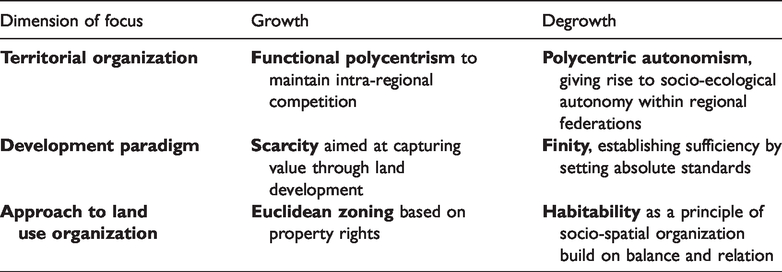
As showed at the beginning of this paper, degrowth scholarship and activism offer many examples of what urban living would look like when freed from competition and accumulation. These examples share a commitment to values of solidarity, cooperation, and synergy between the city and nature, and to self-regulated commons’ capacity to empower communities. In what follows, I set out three propositions for an urban degrowth (Table 1). Together, in imagining urban settlements in a degrowth society, they rethink the three mechanisms of urban development outlined above. Against prevailing mechanisms of contemporary urban growth, I propose three lines of prefiguration: a polycentric autonomism in organizing regional territories, the institution of a finity paradigm in urban transformations, and the principle of habitability as driver of socio-spatial organization. Habitability moves beyond the ideology of zoned (individual) property towards an imaginary of (collective) balance and equilibrium.
Polycentric autonomism
Autonomy is central to the imaginary of degrowth. It is a “normative” condition ascribed to territories, defined as the capacity for, and right to, self-determination. Degrowth scholars have widely argued that autonomy should be construed not in solely political or jurisdictional terms, but also as a cultural emancipation from the ideology of market competition (for a review, see Asara et al., 2013).
From a territorial and socio-spatial perspective, I understand autonomy as a community’s capacity to independently provide biophysical, material, and social resources for its survival and prosperity. It entails emancipation from dependence on other territories of production, consumption, and material exploitation. Hence, material sufficiency and political autonomy overlap within a territory. They coexist in the self-governing of services essential for socio-ecological reproduction (namely water, energy, and waste), productive activities, and the resources necessary for production.
Autonomy is not isolationism, but the condition and product of processes of coordination, assistance, solidarity, and redistribution across localities (Lluch, 2012). Although existing regionalisms already involve a combination of coordination and autonomy, they subordinate biophysical and ecological elements to economic goals. Enhancing the autonomy of urban centres within regions entails moving away from policies premised on functional dependencies among specialized centres, and moving toward a region of centres whose social and material autonomy relies on regional coordination.
This demands a bio-communitarian and confederate approach to regionalism, primarily concerned with urban settlements’ capacity to provide essential habitability and coordinating solidarity in pursuit of that goal (I shall return to this). A region can provide the coordinating mechanisms that allow for a ‘completely decentralized city’ (Foldvary, 2001), with associations of users-producers providing services. Members would distribute rights and resources though higher levels of coordination and confederation. This polycentric autonomism is constitutive of imaginaries of the region as a coordinated network of commoning practices (Stavrides, 2016), that is, a democratic confederation of local associations that prevent enclosure and ensure autonomy (see also Ocalan, 2015).
An early imaginary of decentralized eco-agglomerations is Friedman’s agrimetropolis (Friedmann, 1985). Made to fulfil rural localities’ basic demands, the agrimetropolis would function as a communitarian political organization, federated in an overarching redistributive state. This vision resonates with the suggestive idea of bioregionalism. Inspired by Bookchin’s work (1992), bioregionalism has recently found renewed interest among environmental economists (Cato, 2011). A bioregion is conceived as a confederation of municipal settlements whose subsistence depends on the same living ecosystem, but which have a degree of material and political autonomy (see Ewert, 2002). Against ecomodernism, it is necessary to enact what Latour calls ‘dwelling places’ (2018), the intermediate space between locality and globality around which human-nature relations of social reproduction are organized.
In imagining regional autonomism – and type of planning to pursue it –we can build on existing examples of regional federations of autonomous producers of different services. Campi Aperti is an association of regionally federated farming cooperatives that care for each other and protect local agriculture in Bologna. 3 Similarly, Chantier de l’economie Social is a network of associations that have provided mutual child and home care in Quebec since the mid-2000s. 4 In the housing sector, the Mietshäuser Syndikat in Germany is one of the most known examples of federated housing commons at national level, where ownership of alienation rights of housing cooperatives is partially networked. In the energy sector, there are many examples of community owned distributed energy systems attempting to establish overarching federations (or platforms).
As Hall et al. (2019) argued, today’s technological advancements combined with a re-municipalization of energy and utility infrastructures can set the conditions to connect decentred systems with each other both within and across municipal territories. Nationwide examples are the E’Nostra cooperative in Italy or the Vandebron platform in the Netherlands (not a cooperative), which connect wider networks of producers and consumers. 5 Upper Austria Water is a regional association of autonomous rural water cooperatives, which together organize control systems and emergency recovery. 6
These are a few examples of federations of producers and consumers of essential services, working as regional networks of coordinated autonomous units (for more examples of regional commons see Krueger et al., 2017). This understanding of the region has deep implications for planning. It understand planning as an active practice of rebalancing existing hierarchies in urban systems, putting the self-sufficient survival of localities at the forefront, and protecting their autonomy. The regional space is not anymore the driver of an economic growth that in turn trickles down to localities, but is a mode of coordination between localities that allow maintaining and preserving autonomy.
Finity
Degrowth engages with a post-scarcity paradigm in economic theory, which moves beyond the assumption that a fair distribution of resources is best achieved through social relations of competition and property. Degrowth thinkers advance the notion of sufficiency as a different principle of social organization, building on evidence that the planet is approaching its full carrying capacity. Sufficiency is seen as a precondition for autonomy, reciprocity, and care, insofar as individual households cannot be totally self-sufficient. Reducing demands is a precondition of sufficiency.
In urban contexts, the idea of sufficiency translates into settlements able to organize and maintain social ties and food and energy provisions autonomously, without property markets and the need to expand and develop. Such sufficiency requires deliberately a reduction of demands. The dominance of a scarcity paradigm in planning is functional to simultaneously regulate and enable the competition for land to be developed, lubricating land markets by maintaining exchange values steadily attractive. To interrupt this process, this paradigm must be displaced by one of finity: a paradigm of urban development that is actively oriented to decelerate the forces of land development inscribed in value capturing mechanisms. Finity interrupts competition by valuing existing urban qualities, opening up the possibility to maintain and regenerate them. In practice, adopting this paradigm means to deploy a repertoire of regulations that set boundaries to growth through maximum prescriptions. These include maximum development volumes in an area, maximum housing rents, a maximum number of transactions for single real estate properties in a given period, a maximum number of second homes, or a maximum amount of floor space that can be owned, modulated by area (see also Xue, 2015). Finity, then, entails reducing markets’ power to commodify urban resources by setting absolute limits that define the threshold of excess or “too much.”
Urban activism has generally mobilized claims of finity in urban development in combination with an imaginary of well-being in cities, targeting urban renewal and densification programs in 70 s and 80 s or the expansion of airports and highways. Yet, in the face of an ecological crisis and the erosion of well-being (and affordability) in urban areas, the plea to finity is back into the agenda, with cities undertaking strategies to control overexploitation of natural and human resources and redistribute excess. Examples include establishing common car free zones, maximum CO2 emissions per district, maximum rent levels, maximum nights for short-term rentals, and a minimum number of years before properties can be sold. Clear requirements for public provision, which existed prior to neoliberal reforms, are another existing example of regulators imposing obligations on developers. Maximum standards apply to many other dimensions of urban land. Limits have been set to tourist entrances (i.e. Dubrovnik and Maya Bay) and dwellings above a certain rental price, not to mention population caps, which may de-concentrate and re-urbanize outer urban centers. 7 Absolute standards should work as performative rules, limiting practices that endanger a particular locality’s habitability (see below). They should set mandatory limits to land use, thereby reducing biodiversity loss, emissions, waste, and infringements on green space.
Finity-based regulations can create new forms of scarcity. Under contemporary capitalism, they can increase land prices and worsen exclusion in urban areas where market pressure is high or, on the contrary, it could lead to depression in areas of steady shrinkage. To avoid this risk, it is fundamental that these finity rules are coupled with stronger redistribution and a political agenda explicitly oriented to social and ecological justice. By mobilizing finity as instruments to restore and maintain the habitability of place (please see below) these rules can bring a positive balancing effect on the quality of urban environments. Accordingly, by mobilizing these rules across federated autonomous communities (please see above), they can enable new forms of territorial solidarity. If they break with austerity discourses (increasing debt) and increase taxation on excess, they will have redistributive effects on urban areas. As Raworth (2017) has illustrated with reference to the so-called ‘doughnut,’ we can only develop an economy that prospers through redistribution and regeneration by setting boundaries. A finity-based planning framework might revalue urban amenities such as unused estates, vacant land, and natural spaces. In so doing, it justify transferring properties to social cooperatives and community land trusts that are able to retain – and not capture – land’s social and use value.
For an example of these redistributive and regenerative effects, consider how the right to housing enforced by squatters impacted on Amsterdam’s economy in the early 1980s. Political reclaiming vacant properties restored urban qualities in a shrinking city. Today, a logic of finity is justifying Berlin’s successful ‘Expropriate Deutsche Wohnen & Co’ campaign, which challenges the concentration of home ownership in the hands of large corporations. 8 These policies justify stringent taxation on vacancy and speculation, and transferring properties to owners’ associations and cooperatives. It will redirect resources toward the socio-ecological improvement of available land and natural resources in cities.
Adopting a principle of finity in regulating urban land should not be misunderstood as urban shrinkage, just as degrowth should not misunderstood as regression. Rather, it is a controlled process of revaluing every precious square meter in a crowded planet as a precious social good.
Habitability
Degrowth is founded on the evidence that the pursuit of economic growth is socially and environmentally destructive in that it entails exploiting ecosystems and human labour. Against this, degrowers propose alternative values that can shape social relations, liberated from the imaginary of competition and accumulation. These values include care, solidarity, reciprocity, and disconnecting wellbeing from GDP and other quantitative notions.
The challenge for an urban degrowth planning is to ingrain these values in institutions of land use organization that generate well-being, justice and ecological stability while being emancipated from the dominance of individual property rights. As explained above, land markets are today organized through a zoning approach that is rationalist, functionalist and individualized. This system is functional to the maintenance of competition because it geometrically separates land into exchangeable units with unitary, standardized and comparable functions. A degrowth approach to land use organization needs therefore to offer a different approach that is able, on the one hand, to appreciate the overlapping multiplicity of land uses within a parcel of land and, on the other, to move beyond individualized forms of property allocation. This is an approach that does not reject all together the need to regulate space into zones but that defines these zones beyond individual property and standardized functions. These zones can instead identify the unique relations that form the ecosystem of a particular area, and to allow for a collective management of land. Rather than a categorizing tool, zoning should provide a compass able to inform interventions to restore, balance and maintain urban places.
To reimage a century-old land property system is the utmost task of degrowth planning research. In engaging with this task, I suggest mobilizing the notion of habitability as fulcrum for an alternative approach to land use organization. The word is rooted in the Latin Habitare, meaning to live or dwell, and in the proto-Indo-European locution Ghabh, meaning ‘to give/to receive’ and ‘to hold’. The notion of habitat refers to a place’s capacity to sustain a condition of dwelling and stresses the relation between organisms and their environment. It signifies ‘the capacity of a particular physical space to support the activity of an organism, that is, to provide the set of resources and conditions required for its way of life’ (Cockell et al., 2016). Rather than toward exchange, the notion of habitat identifies an equilibrium and its long-term maintenance to guarantee the reproduction of both human and non-human life. As such, it resonates with the idea of buen-vivir, stressing the biophysical conditions of wellbeing. In a degrowth perspective, it is the relation between humans and their environments – not between one individual and the other – that are endowed with rights as the central pillar around which socio-spatial relations can be defined. Rather than a right to property and exchange, habitability advances a ‘right to metabolism,’ able to enforce basic living rights, including dwelling, care, physical, and mental wellbeing (Olsen et al., 2018).
To take habitability – the right to a habitat – as a central principle of socio-spatial organization means moving from an individualist to a systemic approach to land use rights. In contrast with Euclidean zoning, the subject of rights is not the legal ‘subject’ that owns a particular plot of land but it is the ‘relation’ between the subjects and that land. This step is crucial to move beyond a paradigm of dichotomous regulation (public or private subject and object) to a relational regulation, which is essential to institute practices of commoning (Mattei and Quarta, 2018). While this may be hard to imagine from the perspective of legal positivism that today govern judicial systems (particularly in the Global North), there are existing examples that already translated a relational regulation in practice. The Derechos de Naturaleza of the Ecuadorian constitution, for example, already endows balanced ecosystems with constitutional rights. Umeek (2011a, 2011b) gives several examples of settlement practices that maintain stable socio-spatial ecosystems and recognize this equilibrium through charters of rights. The Haida Gwaii community of Skidegate in Canada, for example, is founded on a system of rights and values particular to its habitat. These norms include the injunction to ‘only take what you need,’ put all edible leftovers back into the ocean, or consider ‘food as medicine’ (Skidegate, 2014). Although these laws are not spatial, they establish the necessary conditions for organizing socio-spatial relations.
These examples from indigenous modes of land management sketch useful lines of imagination for the planning of highly urbanized areas. 9 They suggest that the social-ecology of an area – from a street or neighbourhood to a municipality – and not the specific functions of a parcel – become central to the planning process. The target of a zoning approach becomes to identify, maintain and restore the social and ecological qualities of this area, which result from the contextually specific way in which different uses interact with each other (i.e. residential, commercial, waste disposal, water provision, natural and recreational areas. The balance of these qualities become the subject of rights allocated through land-use. This include the capacity of an area to cater for essential demands such as heathy food and healthy lifestyle; to provide with essential care services; to provide social dwellings and maintain a degree of social diversity in place; to allow for slow mobility, immobility, clean water, healthy soil and waste reuse to name a few. The balance of these qualities is not standard but specific to the context.
This approach to land-use is essential to both the application of finity rules and the achievement of polycentric and autonomous cooperation between localities. Finity rules can be used to maintain habitability qualities of place, preventing those land uses that can be armful for the social ecological qualities of place. They make it possible to enforce the precautionary principle in governing land use transformations and prevent the erosion of the place’s habitability. They also allow identifying excesses to trigger planning programs oriented to rebalance and restore. A polycentric network of autonomous localities requires the acknowledgement of the specific habitability of each locality. It also helps identifying the essential qualities that cannot be autonomously catered by specific communities and need to be organized by federations.
In sum, habitability offers a context specific approach to land-use organization for which the know-how and direct involvement of local communities becomes crucial. For planners, it is already possible to build on existing models of land ownership that have coupled collective management of land with essential habitability concerns (e.g. affordable housing), namely community land trusts and cooperative forms of community-based ownership.
Conclusions
Cities are central to the imaginary of degrowth. Urban degrowth research has largely demonstrated the capacity of real-life practices of urban dwelling to plant the seeds of a more cooperative, symbiotic and democratic urban society. Yet, this constellation of works has not yet provided with a systemic critique of the urban institutions governing contemporary urban growth nor a prefiguration of alternative institutions for socio-spatial organization. This paper sharpened the understanding of urban degrowth by dissecting the challenges and lines of imagination for an urban degrowth paradigm in planning. It did so by looking at three planning mechanisms that bind urban development to economic growth and that perpetuate this co-dependency: the territorial organization of regions, the development paradigm and the approach to land-use organization used in planning.
Part I argued that, territorially, economic growth organizes according to principles of functional polycentrism that perpetually promote internal competition among urban areas within agglomerations. Regions are divided and uneven ecosystems driven by cities’ and corporations’ search for increasing land values to capture as public returns. Scarcity became the necessary condition to perpetuate a paradigm of urban growth dependent on the imperative of capturing value through land development. The individualist paradigm of zoned property rights became the paradigm of efficient spatial organization that has maintained urban competition through modern urban history.
Part II built on this critique to sketch the prospects of degrowth planning research. In contrast with a functional understanding of region, it is crucial to reimagine regional systems as polycentric patterns of autonomous urban settlements. Necessarily, this autonomy is both political and material and confederative cooperation needs to ensure territorial solidarity. This conception of the region cannot work without regulations that deliberately decelerate – if not annul – competition in economic output among urban areas. To move beyond land scarcity, I propose to search for a planning paradigm built around the notion of finity, to build a regulatory framework that strive towards the setting of absolute standards. This shift in paradigm is crucial to maintain and restore existing qualities of place and to decelerate competition for land. The notion of habitability can provide the compass to identify and regulate those qualities and to rethink the idea of rights as a relation between urban living and the urban ecosystems. As I envisage it, a right to a habitat would demand protecting and restoring urban areas’ social, physical, cultural, and natural properties. These include the availability of cultural spaces; healthy food; air quality; spaces for social interaction; energy democracy and accessibility; access to care and social ties; and capacities for self-determination.
This paper did not address explicitly the underlying political change (and struggles) necessary to produce and foster degrowth urban imaginaries. Still today, the profile of a degrowth politics remains an open debate. Yet, degrowth scholarship explicitly recognize the power of prefiguration, on the capacity of existing degrowth practices to coalesce into political movements of change. In this paper, I suggest that confederational institutions are necessary to resist against the pressure of capital on land, and that finity needs to be the principle that govern those federated autonomous communities to sustain their independence. The idea of habitability is yet a crucial compass to inform redistributive processes across those localities, to ensure essential social and ecological qualities. These proposals may be familiar to many urban scholars, planners, activists, and professionals who have long advocated environmental and social justice. Given limited space, this paper could not hope to summarize in detail the immense body of work criticizing capitalist growth in its social and spatial modes. Rather, it has meant to prefigure an urban engaged scholarship able to rethink cities as dynamic sites of deceleration, regeneration, and redistribution.
Summary overview of the critiques and prefiguration presented in the paper.
Footnotes
Acknowledgments
The author would like to thank Luca Bertolini, Anna Nikolaeva, Miriam Meissner, Kim von Schonfeld and Antonio Ferreira for their comments on early versions of the paper. Thanks also to the anonymous reviewers and the editor for their constructive feedback.
Declaration of conflicting interests
The author(s) declared no potential conflicts of interest with respect to the research, authorship, and/or publication of this article.
Funding
The author(s) received no financial support for the research, authorship, and/or publication of this article.