




Abstract
This article revisits debates on the contribution of the social economy to urban economic development, specifically focusing on the scale of the city region. It presents a novel tripartite definition – empirical, essentialist, holistic – as a useful frame for future research into urban social economies. Findings from an in-depth case study of the scale, scope and value of the Liverpool City Region’s social economy are presented through this framing. This research suggests that the social economy has the potential to build a workable alternative to neoliberal economic development if given sufficient tailored institutional support and if seen as a holistic integrated city-regional system, with anchor institutions and community anchor organisations playing key roles.
Introduction
Over the last few decades the social economy has become the subject of growing political and academic interest, particularly in urban studies (Amin et al., 2002; Moulaert and Ailenei, 2005; Murtagh, 2018). While research on social entrepreneurship and social enterprise tends to focus on the individual-entrepreneur and organisational scale, urban scholars are drawn to institutional assemblages and how the social economy operates within, and transforms, urban economies as an alternative model for local economic development. There is limited work, however, on the broader scale of the city-region, despite the rise of the city-region concept as part of the ‘new regionalism’ in economic geography and urban studies (Beel et al., 2016; Rodríguez-Pose, 2008). Much of the urban-oriented literature has highlighted the limits of the social economy within capitalist political economy at the municipal scale. A seminal intervention came in 2002 with Amin, Cameron and Hudson’s comparative study of ‘corporatist’ urban social economies (Middlesbrough and Glasgow) and ‘distributed’ approaches (in Bristol and Tower Hamlets), drawing the cautious assessment that … [I]t is naïve and unreasonable to expect, as does UK, and increasingly EU, policy […] that the social economy can be a major source of jobs, entrepreneurship, local regeneration, and welfare provision. To do so, runs the risk of marked disappointment, a return to the vagaries of ‘good acts’ and ‘good people’ in combating social exclusion and meeting welfare needs, while legitimating cuts in state expenditure or state welfare remit … (Amin et al., 2002: x)
In this article we argue that it is not so naïve or unreasonable to envision the social economy playing a greater potential role in urban-economic governance. We explore examples of where the Liverpool City Region (LCR) social economy is providing a ‘major source of jobs, entrepreneurship, local regeneration and welfare provision’ (Amin et al., 2002: x) and suggest how, with the right political and institutional support, it could be scaled up to become a more systematic producer of economic and social value. But in heeding the warnings of Amin et al., we also explore how the social economy all too often falls short of socialist hopes (Gough and Eisenschitz, 2011) and slides into a more secondary role of mopping up after an exploitative capitalist economy or shadowing the state in delivering public services on the cheap.
The progressive potential of the social economy to transform urban economies is more recently suggested by the (re-)emergence of radical – or ‘new’– municipalism in which urban social movements, led by Barcelona’s example, are ‘occupying institutions’ to pursue municipal socialist policy agendas challenging neoliberal austerity and, importantly, championing the social economy (Thompson, 2020b). Such experiments parallel burgeoning ‘cooperative cities’ across the USA, in which municipal governments are supporting worker-owned cooperative ecosystems (Sutton, 2019); and build on more established and region-wide projects for social economy and cooperative development in Montreal, Mondragon and Bologna (Murtagh, 2018; Rowe et al., 2017). This is now an opportune moment to revisit debates around the contribution of the social economy to city-regional economic development.
However, the latter examples notwithstanding, these developments tend to focus on cities, or urban municipalities, rather than the wider metropolitan and peri-urban regions for which they constitute the core and that they help define as city-regions. This may be due to the prevailing association of city-regionalism with agglomeration economics and neoliberal growth machine logics (Beel et al., 2016; Rodríguez-Pose, 2008). Another explanation is the historical instability – especially in the UK – of city-regional economic powers and governance structures, recently reterritorialising with English devolution, mirroring global trends towards devolved metropolitan governance. Influenced by US metro area policy, this ‘metromania’ (Axinte et al., 2019: 117) is underpinned by a competitive, centripetal logic that concentrates resources on successful agglomerations of urban-economic activity as a means to fuel the further growth of core cities – conceptualised as the engines of prosperity for their wider regions and the motors of innovation for the global economy (Rodríguez-Pose, 2008). As a political project, city-regionalism thus tends to neglect issues of equity, redistributive justice and social policy – a ‘missing link’ of social reproduction and infrastructures (Beel et al., 2016: 518–519). This article explores ways in which the social economy can provide that missing link as part of a holistic vision for a ‘regenerative city-region’ in a renewed ‘progressive regionalism’ (Axinte et al., 2019).
Part of our interest in pursuing this line of enquiry is a sympathetic reading of city-regionalism as highlighting the functional ties that integrate city-regions as relatively coherent territorialities and spaces of flows – through the ‘imagined coherence’ of place identity and the ‘material coherence’ (Jones and Woods, 2013) of labour and housing markets, travel-to-work, retail and public service catchment areas – and which may enhance capacities for building a more social economy. We are also motivated by a more pragmatic concern with what is achievable politically in the UK. With the establishment of 39 Local Enterprise Partnerships (LEPs) across England and Combined Authorities in ten metropolitan areas, eight with directly elected ‘metro mayors’, including in LCR, several key statutory functions are being devolved to city-regional governance structures (Pike et al., 2015), thereby renewing the city-region as a territory for economic development and policymaking.
The UK is widely portrayed as pioneering the development of policies to create a thriving ‘enabling environment’ for social enterprise. Characterised as ‘the most supportive [national] policy environment in the world’ (Roy et al., 2015), social enterprise policies and institutional infrastructure at the city-regional scale are nonetheless under-developed, under-studied and under-theorised. A related concern is a similar neglect of institutional support mechanisms. Aside from recent notable interventions that delve deeper into the urban constitution of social economics (Murtagh, 2018), scant attention has been paid to the institutional infrastructure that catalyses, supports and maintains the development of the social economy, especially at a more tangible city-regional, as opposed to national, scale; whilst the importance of material infrastructure is acknowledged by a number of scholars who also highlight the lack of theorisation, evidence and understanding in this area (Graefe, 2002; Moulaert and Ailenei, 2005).
Part of the tendency to study the social economy at an individual/organisational – rather than institutional/regional – scale stems from its association, particularly in the Anglo-American context, with specific organisational types, seen as a standalone sector (Mendell, 2010). The late John Pearce (1993), a leading advocate of the related ‘community economy’ approach, described the radical (over merely reformist) potential of what he saw as a ‘third system’ to transform the social relations of production in progressive directions. Following Pearce, the social economy should not be dismissed simply as a ‘third sector’– although it is, as we discuss below, sometimes politically useful to delineate its sectoral boundaries in order to demonstrate its socioeconomic value – but rather seen as a holistic approach for reorganising local economic development at the city-regional scale.
This article draws on a nine-month action-research project, conducted over 2017, which involved mapping the scale of the LCR social economy through in-depth quantitative analysis of national databases for statistical information on all registered social organisations; and qualitatively exploring key issues through 38 semi-structured interviews with 46 practitioners, activists, policymakers and politicians across and beyond the city-region (Heap et al., 2017). We present our research findings by looking at the scale, scope and value of the social economy to show an emerging structure of social economy organisation that begins to draw the coordinates of a ‘third system’ at the city-regional scale. This ecosystem, we argue, is anchored by ‘anchor institutions’ that consist, primarily, of large locally embedded, quasi-public, not-for-profit, place-based civic organisations such as housing associations and universities (Goddard et al., 2014) and, at a more local level, ‘community anchor organisations’ (Henderson and Mcwilliams, 2017), which provide a similar civic function for their own much smaller constituencies, the neighbourhood-based communities in which they are rooted. In what follows, we first revisit and review the literature on the social economy in order to define its coordinates. Three broad approaches to defining the social economy – empirical, essentialist, holistic (or normative) – are discerned and mobilised in order to frame the following discussion on the LCR social economy ecosystem.
Defining the social economy
Within the extensive social economy literature, three distinctive definitions can be discerned: an ‘empirical’ definition of specific organisational forms and activities; an ‘essentialist’ self-contained category complementing the more familiar public/private sectors; and a ‘holistic’, relational approach underpinning a normative project of socialising the whole economy.
Empirically, the organisational forms most commonly constituting the social economy coalesce around three main groupings: mutual aid societies; cooperatives; non-profit associations (Evers and Laville, 2004; Moulaert and Ailenei, 2005). These three types are distinct in how they treat and distribute surpluses; how workers, customers, members and other stakeholders are related; in their societal functions and historical origins – yet all share salient features. There is some consensus, particularly among European and French-Canadian scholars (Defourny and Nyssens, 2010; Laville and Nyssens, 2001), that for an organisation to be a part of the social economy it must be geared towards producing goods or providing services, entail economic risk, provide some paid work, create community benefit, originate in citizen action, limit profit distribution according to democratically agreed and accountable principles, maintain autonomy in working practices, be governed by participatory, democratic decision-making and seek to involve all stakeholders affected by the activity.
In ‘essentialist’ definitions, the social economy is conceptualised as an independent social sector alongside the two conventional public and private domains. This ‘third sector’ approach positions the social economy at the centre of three competing domains – state, market, community/civil society – frequently represented in ‘Pestoff’s Triangle’ (see: Avelino and Wittmayer, 2016; Evers and Laville, 2004). These domains can be understood in Polanyian terms as the state governed by the principle of ‘redistribution’; the market, by the logic of ‘exchange’; and civil society, by ‘reciprocity’. To the latter can be added ‘solidarity’ as a motivating factor distinguishing social from other economic activity. Each domain has a unique combination of characteristics defined by three axes: formal versus informal, for-profit versus non-profit and public versus private. The state is formal, non-profit and public. The market is formal, for-profit and private. Civil society is informal, non-profit and private. The ‘third sector’ is formal, non-profit and private – to which the social economy is most commonly aligned. This identifies the social economy most strongly with voluntary, non-profit, formally organised associations – charities and trusts – although its hybridity is recognised by fuzzy boundaries overlapping with other domains.
On this reading, cooperatives and mutuals including their relatively recent neoliberal mutation into ‘social enterprise’ (Huckfield, 2021) – are not easily placed within the third sector. Co-ops are private, market-based firms that generate profits according to entirely different principles from those of capitalist firms. This confusion reflects a tendency, especially amongst Anglo-American scholars, to omit mutuals and co-ops from the social economy – commonly conflated with the third sector – limiting the focus to just non-profit associations (Mendell, 2010; Moulaert and Ailenei, 2005). This derives from debates over the profit-making nature of co-ops and mutuals – whether profit has any place in the social economy, despite profits being shared out amongst members equitably and democratically, in stark contrast to surplus distribution in a capitalist firm.
This reflects how the three organisational types have evolved historically as distinct, largely separate traditions, each with their own ideology, ethos, membership base and resource structure. A radical lineage can be traced to the dawn of industrial capitalism, when the guilds, associations and mutual societies of the early modern period were reinvigorated by utopian-socialist thought and new institutional forms, notably cooperatives, innovated as social alternatives (Martinelli, 2010). At the same time, non-profit charitable trusts were established through more conservative and liberal-reformist traditions associated with Christian socialism and bourgeois philanthropy. This was the era when the tripartite social economy as still defined across continental Europe – mutuals, co-ops, associations – was first articulated (Moulaert et al., 2010). While non-profit associations, largely comprised of charities, have flourished under capitalism, co-ops and mutuals have struggled, especially under recent neoliberal regulation, partly because of their more direct, competitive market relationship with for-profit firms. Many of the innovations in community care and social provision developed by cooperative and mutual movements in 19th- and early 20th-century Europe were later incorporated into national welfare states.
The third definition is more normative – the social economy regarded as a counterforce to the destructive effects of market fundamentalism and state bureaucracy, mediating the extremes of both neoliberal capitalism and state socialism (Gough and Eisenschitz, 2011; Graefe, 2002, 2006; Murtagh and McFerran, 2015). This hinges on an axis defining the social economy as it has grown in policy relevance –‘radical’ versus ‘reformist’ (Kay et al., 2016) or ‘progressive’ versus more neoliberal, ‘Third Way’ conceptions (Graefe, 2006). Elaborating on this, Graefe (2002: 250) points to three social economy strategies: a market-oriented perspective, where the social economy becomes a prop to neoliberal policies; a social democratic strategy, where the social economy is deployed as part of rebuilding the welfare state to empower public service providers and consumers; and a more radical vision of rethinking the relations between market, state and civil society for a new economy built on reciprocity and solidarity. The first strategy is an ‘entrepreneurial’ model in which the social economy is seen to operate where the private sector cannot, to address market failure (Murtagh and McFerran, 2015: 1587–1588). The second, ‘socioeconomic’ model addresses state failure, patching up the welfare state and providing services to the most difficult-to-reach neighbourhoods. Third, an ‘ideological paradigm’ transcends this bi-polar state/market focus to take in the organisation of the entire economy, addressing societal failure, constituting a radical or progressive conception.
The neoliberal and reformist conceptions prove problematic in a number of ways. First, from a Polanyian perspective, they adopt a ‘formalist’ as opposed to ‘substantivist’ view, reducing the economy to the logic of exchange, seen as an independent sphere operating free from other social relations. Polanyi (1944) criticised such economic reductionism for overlooking the inherently interdependent nature of economic relations embedded in social life and material processes outside the domain of the ‘formal’ economy. Polanyi’s ‘double movement’ describes tendencies towards market dis-embedding being counteracted by a dual front of civil society (reciprocity) and state (redistribution) mobilisation. Some social economy advocates see the redistributive logic of the state as becoming too dominant in the 20th century; others, such as Laville (2013), see the state as an ally, whereby the logics of redistribution and reciprocity are conducively combined. The neoliberal conception of the third sector is problematic for failing to see the interrelations between exchange, redistribution and reciprocity constituting the whole economy.
Second, (neo)liberal perspectives tend to align the social economy with traditional notions of charity or voluntary work over more structural transformations of paid employment. This bias for the charitable non-profit association reflects a tension between democratic-socialist and conservative-philanthropic conceptions of value and solidarity (Graeber, 2001; Laville, 2013). Whilst the former assumes equality and reciprocity between participants through free association – pushing towards new forms of economic democracy, such as worker-owned co-ops, to transform capitalist relations of production – the latter is founded on an unequal relationship of debt between charitable donor and recipient, reproducing capitalist hierarchies, dependencies and inequalities. The social economy movement is riven between these two senses of solidarity – conceptions favouring charitable giving and philanthropic magnanimity versus those aiming for their dissolution through cultivating cooperative relations. This helps explain why non-profit associations have dominated social economy theory and practice in more neoliberalised Anglo-American contexts.
In more radical conceptions, the social economy prefigures a third system of societal organisation in relation to market-capitalism (the first system) and state-socialism (the second). Pearce (2003) championed an economy where the values of the third system would gradually influence and eventually usurp those of the dominant dualism. This third perspective establishes an ethical approach to all economic activity, working relationally between the four Polanyian economic domains (the fourth being the ‘householding’ or ‘community’ domain) to present the economy as substantive rather than formal. In this sense, the social economy points to how the economy should be seen from a more ‘social’ angle – as necessarily founded in and constituted by social relations and processes, by conventionally considered non- or extra-economic activity, by social reproduction as much as production. Drawing on Latour, Murtagh (2018: 11) highlights the concept of ‘the social’ describing a type of connection between things rather than a thing in itself and argues that the social (and wider) economy should be seen as a relational assemblage of associations rather than an entity. If we are to transform capitalist urban systems, understanding and cultivating the institutional interrelations between social enterprises is just as important as studying social enterprises themselves.
This holistic conception is concerned not only with seeing the whole economy in terms of social relations but with providing the conceptual apparatus to actively shape and transform capitalist into more social economies. This opens a pathway to the related concept of social innovation. Territorial social innovation as developed by critical urban scholars (Moulaert et al., 2010, 2013) identifies the power of transformative social change in the urban development of the social economy, drawing specific attention to its various roots in mutualism, cooperativism and the commons – actually existing alternatives to capitalism or what Wright (2010) calls ‘real utopias’. Social innovation in urban economies is ‘mainly about the (re)introduction of social justice into production and allocation systems’: the process of change that transforms the economy into a more social –socialised– economy (Moulaert and Ailenei, 2005: 2037). Here, the sectoral social economy is that which organises economic functions primarily according to democratic, cooperative and reciprocal principles, aims for high levels of equality, redistribution and empowerment of marginalised citizens and, critically, works towards satisfying unmet human needs sustainably. The emphasis is on the neighbourhood scale – reflected in the provocative question behind the seminal study Can Neighbourhoods Save the City? (Moulaert et al., 2010). We seek here to move beyond this most local of scales to encompass the wider urban economy of the city-region.
In our research on LCR’s social economy, we found many examples of the first two political-economic strategies –‘entrepreneurial’ and ‘socioeconomic models’ that address market and state failure, respectively (Murtagh and McFerran, 2015) – but also found among practitioners a strong sense of the social economy’s potential to transform the whole economy. This article responds to such common beliefs in the sector by elaborating into a conceptual whole those elements emerging in LCR which, if given tailored financial, political and legal support, might articulate the coordinates of a ‘third system’ (Pearce, 1993). We draw attention to a more holistic, systemic notion of the social economy whereby the whole economy – including market, state and civil society – is structured so as to maximise individual and collective wellbeing, democratic control over economic decision-making and relations of solidarity. This contains an explicitly normative motivation to effect progressive social change through making the whole economy more social.
The contribution of the social economy to the Liverpool City Region
The Liverpool City Region’s contemporary social economy has evolved out of radical local labour and cooperative movements, influenced by seafaring anarcho-syndicalism (Southern, 2014), alongside charitable trusts and philanthropic traditions associated with Liverpool’s wealth and status as a primary port of the British Empire (Taylor, 2011). Eleanor Rathbone was amongst the most influential of Liverpool’s philanthropists, helping revitalise in the inter-war period the Liverpool Council of Voluntary Aid to meet desperate social needs – later renamed the Personal Services Society or PSS, one of the largest charities now operating in the city-region – and originally inspiring the development in Liverpool of the Citizen’s Advice Bureau and Age Concern nationally.
This rich place-based heritage sets Liverpool apart from the rest of the UK. The city-region’s contemporary social economy has been shaped by brutal economic restructuring in the 1980s and various state-led regeneration programmes, notably EU Structural Funds Objective One ‘Pathways to Integration’, which focused on developing community enterprise to tackle social exclusion in the city-region’s 38 most deprived neighbourhoods (Meegan and Mitchell, 2001). This can be seen as a harbinger of New Labour’s Third Way agenda around tackling social exclusion in disadvantaged neighbourhoods through entrepreneurial forms of social economy. Beneficiaries of Pathways to Integration became involved in organising a more durable structure for the representation and governance of social enterprise (Brennan, 2004). The Merseyside Social Enterprise Network was founded in 2000, the UK’s first membership-based social enterprise network. These pioneering developments were reflected in the choice to locate in Liverpool the national body for measuring social value, Social Value UK.
Working alongside and pre-dating Merseyside’s Social Enterprise Network by almost a century are the Councils for Voluntary Services (CVS) for each of LCR’s six local authority districts – Halton, Knowsley, Liverpool, Sefton, St Helens and Wirral. These infrastructure bodies for the charitable and voluntary sector are organised at the city-regional scale as the VS6 network and at the subnational north-west regional scale as Voluntary Sector North West, crucially connecting LCR with Greater Manchester. These two most organised traditions – social enterprises and voluntary associations – often acted as rivals rather than allies, with sectoral territorialism hindering prospects for cooperation to build a unified social economy movement. Since 2015, with austerity threatening the financial viability of CVSs and the Social Enterprise Network dissolving entirely, leaving a vacuum in city-regional infrastructure, an alternative umbrella network, the LCR Social Economy Panel, has been established to unify these disparate traditions and provide a political voice within the Combined Authority and the LEP.
In late 2016, as co-founders and participants in the Panel, we began a nine-month research project that was designed to investigate LCR’s social economy across a number of dimensions that can be summarised as scale, scope and value – broadly corresponding to the tripartite definition outlined in the previous section. First, we intended to provide an unprecedented comprehensive empirical account of the social economy as a sector made up of specific organisational types operating across the city-region – exploring sectoral scale from employment figures to asset value to revenue generation. We also explored scale in a different sense: the geographical structure of social economy organisation from the neighbourhood to the city-region. Second, we sketched out relationships with the two mainstream sectors of the economy – public and private – unpacking how the relative scope of social economy activity has changed over time. This involved an historical understanding of how the social economy has evolved as an alternative, competitor or complement to state and market. Third, we sought to explore the value and values of the social economy. This meant both a quantitative assessment of its monetary contribution to the local economy and a qualitative understanding of the social value created and the political values embodied in potentially transforming the economy into one more democratic, equitable and responsive to human needs. These three dimensions – scale, scope, value – can be seen to correspond, respectively, to the empirical, essentialist and holistic definitions outlined above.
Scale
Taken as an overall sector, the LCR social economy is substantial. Our 2015/2016 data set identified 1368 social organisations operating in 2016 – 2.2% of all registered companies. This included 623 registered charities, 276 social enterprises, 113 clubs and membership organisations, 5 universities, 122 other educational establishments, 127 social firms, and 103 cooperatives. The largest sectors were: education; housing; health and social work; and arts, entertainment and recreation. Together, these social organisations generate annual income of £3bn; employ 45,000 people; and own net assets of £4.4bn. In the context of a total city-region economy worth some £28bn, and 598,000 employees working across all businesses in the region (LEP, 2016), this represents nearly 10% of total economic activity. Recent research on the British social economy estimates that it accounts for about 5.6% of UK employment, much lower than the 6.5% average of European employment (Vickers et al., 2017). In some countries, such as Sweden, Belgium, Italy, France and the Netherlands, the social economy accounts for between 9% and 11%. This suggests that the LCR social economy is large by British standards, and similarly well-developed as its European counterparts.
However, a methodological factor that may contribute to statistical distortion is extensive inclusion of organisations in our account of the social economy. Higher education institutions, academy trusts (formerly state-run secondary schools) and housing associations are large employers with high income streams. In most European countries, schools have not been privatised or outsourced into the social sector as in the UK with New Labour’s ‘academisation’ process. Academy trusts are charities. The universities we include are charities too and have a legislative duty to provide a social good in the form of education. That public education in the UK has become highly financialised and operates in a space between market and state – true for universities (McGettigan, 2013) and schools (Hatcher, 2006) – adds to the complexity and ambiguity of defining the social economy. So too does the legal form of organisations, with, for example, hospitals (mainly) state run in the UK, but incorporated into parts of the social economy in North America (Mendell, 2010). Academy trusts and universities are non-profit, formal organisations – precisely those that sit within the third sector in Pestoff’s Triangle – with a charitable legal structure and strong civic mission distinguishing them as key players within the social economy.
Collectively, universities and academy trusts contribute 35% of total social sector income and around one-quarter of all employees in the LCR social economy. Similarly, a large proportion of the asset base of LCR’s social economy is owned by housing associations, which in the UK have replaced local authorities as primary public-housing providers. The 53 social landlords and other real estate organisations, including cooperatives (4% of total organisations), are the financially strongest members of the social economy ecosystem and own almost half of all assets. Alongside universities, housing associations therefore act as powerful anchor institutions for the incubation of social economy organisations and the development of the local economy as a whole.
An interesting factor here is the predominance of housing co-ops in inner-city Liverpool. Nearly half of the 103 Industrial and Provident Societies (the legal form up until very recently for co-ops in the UK) are housing co-ops. Some 40% of total social economy assets, around £1.8bn, are owned by cooperatives. The relatively high market value of property originally procured by co-op groups in the cooperative movement heyday of the 1970s – when local and national state policy and a supportive infrastructure enabled the development of some 50 co-ops across LCR (Thompson, 2020a) – skews the data for cooperatives, otherwise a low asset-owning category. There is potential here to collectively pool cooperatives’ asset values as renewed resources for reigniting the co-op movement.
Our study has not captured the full extent of all voluntary sector organisations, as many operate beneath the radar of official measures such as registration with those national databases we consulted (i.e. Companies House, Charities Commission). This gap has been filled by research, commissioned by Liverpool CVS, into voluntary action in the city-region (Jones and Meegan, 2015), which found 8638 voluntary organisations operating in LCR, comprising 3102 registered and 5536 ‘below-the-radar’ organisations. The LCVS study counted many of the same organisations we counted; excluded the large housing associations and universities; and included smaller voluntary sector organisations not officially registered and therefore beneath our radar. The LCVS study finds that this latter group ‘predominantly have an income below £5000 and will not be employing people, but will be operated by volunteers instead’. Using various proxies, it calculated that approximately 182,000 volunteers contribute to the city-region – around 12% of the total population. It estimates that the voluntary sector (volunteer labour alone) contributes some £917.9m GVA – around 3.7% of the city region’s total. Notwithstanding challenges presented by double-counting, this represents an additional contribution of some £900m through volunteering. This places the city-region’s social economy, in terms of economic scale, alongside the ‘growth sectors’ favoured by the LCR Local Enterprise Partnership (LEP, 2016).
Scope
In this section, we explore the scope of the LCR social economy – the functions it fulfils in relation to the state and market. The social economy in Liverpool has traditionally developed on the ‘entrepreneurial’ and ‘socioeconomic’ models (Murtagh and McFerran, 2015) of responding to market and state failure in deprived neighbourhoods. This is perhaps borne out by statistical correlation of social economy activity with the most deprived communities. Through our database study we found that social organisations tend to be located in those areas in the city-region in the most deprived nationally – those in the most deprived 10% of wards contain by far the most social organisations, as shown in Figure 1.
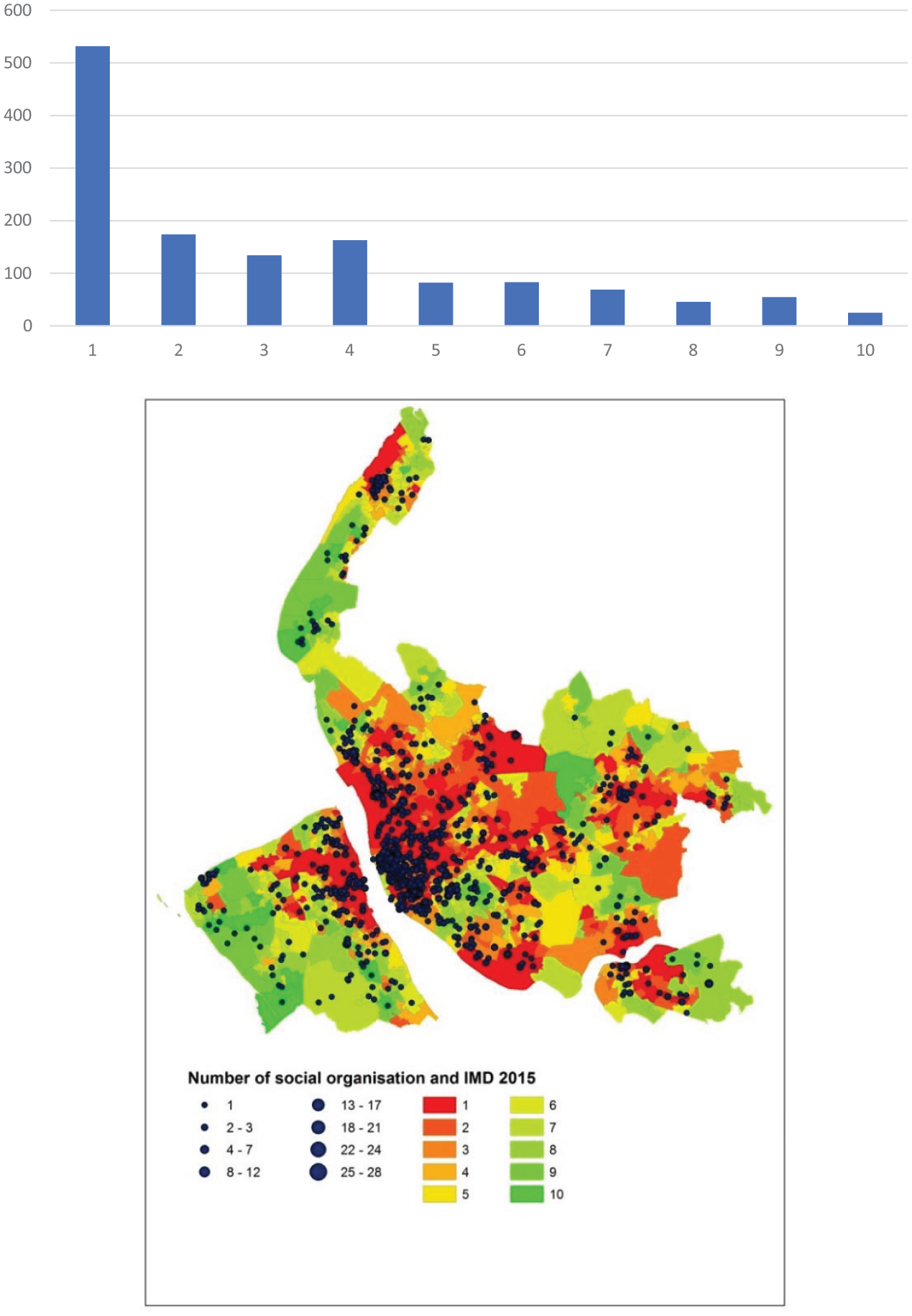
Number of social organisations located in areas of multiple deprivation in the Liverpool City Region (by decile of IMD 2015) (top) and map showing spatial distribution of social organisations in relation to deprivation score (bottom).
The social economy operates in areas of market failure or in those ‘providential sectors’ in which the market struggles to turn a profit (Foundational Economy Collective, 2018). Almost one-quarter of social economy organisations in LCR operate in health and social work (22.7%) and in education (22.4%); one-fifth in arts, entertainment and recreation (20.7%). The predominance of activity in these three sectors indicates social economy specialisation in people-based, relational and ‘foundational’ sectors – those fundamental to supporting everyday life and human flourishing (Foundational Economy Collective, 2018). These areas are dependent on human labour and relationships between people (care-giving, teaching, artistic performance) and therefore oppose the trend towards technological unemployment and replacement by machines in other, more formally ‘profitable’ industries such as advanced manufacturing (Baumol, 2012). The market refuses to engage in these areas without the profit margins accruing through technological efficiency savings (replacing expensive human labour with cheaper machines); the social economy steps in to provide these essential goods and services, responding to market failure. The social economy lubricates the whole local economy for smoother functioning, especially in relation to workforce participation rates, tackling skills gaps, and health and wellbeing issues, and therefore helps deliver strategic public policy objectives of the LCR Combined Authority and LEP. However, this seems a perversely functional rendering of the social economy – fixing a flaw in otherwise functioning markets. The social economy’s competitive advantage in health, education and the arts – so important to human flourishing – suggests it fulfils a vital, unquantifiably valuable role in society that will only grow as technological unemployment threatens jobs in other sectors, shifting employment into people-based industries.
In this way, the social economy should not merely be viewed as a deficit model that fills in the gaps of a retreating state, a tool to fix neoliberal policy failures, but as a specialist provider of fundamental goods and services and harbinger of an economy valuing human flourishing over efficiency savings. Addressing the most severe instances of multiple deprivation wrought through state or market failure – whilst an important market-intermediating function – should not be elevated to the social economy’s raison d’être. A more politically expansive and economically transformative role for the social economy is envisioned by many of its advocates. In this we see the true value of the social economy.
Value
In this section we construct a vision of what value the social economy could produce for LCR if given political and institutional support to develop. Between the two poles – reformist versus radical – the social economy is ultimately defined in terms of fundamentally divergent views on the nature of value (Kay et al., 2016). Social value is a concept that most practitioners agree underpins the social economy as a distinct domain reconfiguring economic activity towards social and environmental ends beyond the economic – privileging social over financial surplus. Yet differences emerge over how to conceive of social value. Is the value of the social economy to be found in redistributing resources, finding efficiency savings and internalising externalities within the same quantitative horizon; or in trying to articulate or prefigure a qualitatively different way of organising economic life? At one end of the spectrum, value is understood to be qualitative, relational and processual whilst at the other it is treated as an object amenable to quantitative measurement (Graeber, 2001). In this section, we attempt to provide a vision of what the social economy could be – a prefigurative force for ‘bending’ the whole economy to become more democratic, holistic and people-oriented – if viewed through the relational lens. Its opposite tends towards monetising social value because of the equivalence, convenience and universalisability of using monetary value as a measure. The risk of adopting too principled a view against quantification is that the social economy remains outside the purview of policymakers and investors and therefore lacks the resources and political support needed to grow. A difficult balance is to be negotiated between maintaining the animating principles of reciprocity and solidarity and translating such values into the language of exchange increasingly required for gaining the necessary political, financial and legal support.
In terms of quantitative value, our study places LCR’s social economy – with an annual income of £3bn; 45,000 employees; net assets worth £4.4bn – on the same footing as the largest ‘growth sectors’ identified by the LCR Local Enterprise Partnership (LEP) (2016), including advanced manufacturing, financial and professional services, and digital and creative industries. Yet the social economy has not been valued by the LEP as economically significant. Of the 39 LEPs established since 2010, the LCR LEP was unusually large – employing at one point up to 60 staff (Pike et al., 2015) – before becoming subsumed within the new Combined Authority structure. The LEP is distinctive for evolving out of an existing business development agency called the Mersey Partnership which was geared towards its private sector members’ interests. This, coupled with a local policy culture steeped in agglomeration economics and urban entrepreneurialism and geared towards a boosterist growth machine logic, has meant the LEP has been, from its inception, fixated on the growth of high-productivity, export-oriented, technology-intensive sectors over and above the foundational and social economies (Thompson et al., 2020). This was evident in the production of its so-called ‘Growth Strategy’ (LEP, 2016), for which one of us was seconded to help write yet struggled in vain to get more democratic, inclusive and social economic approaches incorporated.
This was one of the motivating factors for undertaking this research: to demonstrate to those agencies and actors who define future directions in city-regional policymaking, notably the LEP, Metro Mayor and Combined Authority, that the social economy is an economically significant component in its own right. This meant speaking their language – identifying sectoral boundaries as well as calculating in monetary terms figures for asset ownership, revenue generation, etc. Crucially, this also enables practitioners and activists to understand where power, resources and capacity reside within the social economy ecosystem in order to identify niches and opportunities for further development.
Identifying and developinga city-regional social economy ecosystem
A key task of the research, then, was to outline the structure of the social economy as seen as an ecosystem. The contemporary LCR social economy can be most simply conceptualised as comprising five main groups, structured across different scales from neighbourhood to city-region:
Social entrepreneurs, cooperatives and small voluntary organisations working within one or several neighbourhoods, often focusing on single issues; including the majority of social organisations employing fewer than ten people on average. Of the 50% of the sample which disclosed data for annual income, over one-half reported less than £250,000; over one-quarter bring in under £50,000.
Community anchor organisations, acting as ‘anchors’ for defined localities or neighbourhoods, often focused on holistic place-based regeneration and incubation of social entrepreneurship.
Large charities and social enterprises, operating at scale across local authorities to deliver goods and services in specific sectors, often outsourcing public services, especially health and social care.
Anchor institutions, providing more overarching civic functions helping define the city region, such as universities and housing associations.
Infrastructure organisations, linking all others together, providing the coordination and support required for their growth (particularly for the first three categories), such as social investment funding bodies, membership networks and umbrella bodies.
Income and wealth in the social economy are heavily skewed towards a few very large players – the large charities and anchor institutions. The 35 largest organisations (2.5% of total) account for around three-quarters of all income, assets and jobs. Most of the rest are very small. Over one-half of social organisations have a net asset value of less than £75,000, around one-third less than £10,000, and 11% disclosed negative net worth. Charities employ over one-half of the LCR social economy’s employees; approximately 20% work for schools, clubs, membership organisations and social firms; cooperatives employ around 8% of the total; only 0.1% of all workers in the data set are employed by social enterprises. The five universities, ten largest charities, ten largest housing associations and ten largest schools and academy trusts between them deliver £2.2bn of the £3bn income generated by all the social organisations in this sample. The remaining 1333 social organisations generate only around one-quarter of income and assets in the social economy and employ 35% of the workers.
These figures suggest the scope and need for harnessing the asset base and spending power of the big players – particularly anchor institutions but also larger charities – to help grow and develop smaller organisations. This is particularly relevant for those high potential social enterprises on the cusp of growth but struggling to find the right financial support in increasingly neoliberalised and financialised social investment markets (Huckfield, 2014). There is a case to be made for enhancing relations of solidarity and cooperation between – particularly large and small – organisations within the social economy and to develop a supportive infrastructure at the city-regional scale to coordinate and codify these relationships. This final section explores how this is beginning to emerge in LCR.
LCR’s history of co-op, community and social enterprise development is one riven with corruption, compromise and contradiction just as much as it contains progressive potential. However, as the following characterisation of this history by a local stakeholder suggests, there are glimpses of new transformative economic models emerging: Some of the smaller ones that are great local community centres have over time become a bit inward-looking, becoming a play thing of the matriarchs. You’ve got a group who have probably been around 30–40 years down the voluntary sector … They’re friends and family … and they’re run a bit for their convenience. They don’t take enough account of the wider community … You’ve got another group of voluntary sector organisations which emerged in the ’90s out of what I’d call the [National] Lottery culture and then the millennium [grant] culture who are brilliant at writing funding bids but don’t really give a toss about what they do … Then you’ve got the most interesting ones … Alt Valley is a good example which has a network of enterprises but a very strong local focus … What you find with those is they’ve got very very strong local political social roots, i.e. they’re networked into people, they deliver a range of things and they negotiate relationships with the Council, with other partners and they tend to cooperate with each other.
Alt Valley Community Trust, mentioned above, is an exemplar of a third, more progressive model of social-economic development, embedded in Liverpool politics since the 1970s. It is joined by a growing number of like-minded experiments in community-led regeneration that together point to a different way of organising urban-economic life. One is SAFE Regeneration, which we explore below after briefly considering the role of Alt Valley.
Alt Valley started life in an era of confrontational politics, through the occupation by parents, students and teachers of a school in Croxteth, Liverpool, threatened with closure because of budget cuts in the early 1980s (Taylor, 2011). Growing out of a radical campaign to run the school without state support was a ‘Communiversity’, now providing adult education services across multiple communities residing in the Alt River valley area, from Dovecot to Norris Green. The Trust recently took on ownership and management of three public libraries across this area, in the context of intensifying austerity. Alt Valley is a charity and company limited by guarantee that now owns and manages many public services otherwise facing closure as a result of public cuts, as well as self-developed new community assets: three community centres, nurseries, nursing homes, sports centres, a community pub, a shopping precinct, a college including a skills centre, community farm and affordable housing. It runs a subsidiary property company, a catering company and an environmental maintenance company; provides training and apprenticeship programmes for local young people, such as nursing and social care courses; and directly employs 150 people on the living wage. It acts as a local incubator, offering support to start-up social organisations and small businesses.
Alt Valley sees SAFE Regeneration as its contemporary counterpart, self-described as an ‘incubation space, cultural hub and community business’. SAFE was established in 2000 by a group of socially engaged artists from inner-city Liverpool who, on commission to develop a sculpture trail along the Leeds–Liverpool Canal to engage young people in plant life, discovered a derelict canal-side site in Bootle in the Metropolitan Borough of Sefton. By occupying this site, centred on a disused primary school, SAFE was able to offer affordable incubation space for local community-led social enterprises; developing opportunities for entrepreneurship and providing social support for the area’s largely highly disadvantaged residents. SAFE is now a grassroots infrastructure organisation for countless social enterprises and entrepreneurs – acting as a source, conduit and consortium for government contracts and large philanthropic grants, such as Big Lottery Fund money. Once funding is secured, SAFE then subcontracts these grants and contracts out to its family of in-residence enterprises and other community businesses off site. With a core staff of seven with eight others part-time, it estimates some 7000 people a year visit SAFE to access services. In 2016–2017, SAFE provided 56 people with volunteering apprenticeship opportunities. It sees its ‘success’ when the social enterprises it hosts ‘fly the nest’ and set up other enterprise hubs elsewhere in the city-region. Its evolution from a largely arts-led, activist organisation into a broader-based community anchor specialising in place-based regeneration is reflected in the name change: from SAFE Productions (Support and Arts For Everyone) to SAFE Regeneration (Support and Activities For Everyone).
Like Alt Valley, it has innovated new ways of designing and delivering public services. For instance, SAFE has incubated a ground maintenance start-up employing marginalised groups in ways which create social value thrice over: We took it to Sefton Council to say ‘here’s our model, we’ll work with people who are in recovery from one of these things. We’ll train them up and we’ll deliver your grounds maintenance contracts.’ Then we also have a conversation with the privates, with the GPs [General medical Practitioners] who are also referring people with mental health illnesses and recovery, and say ‘give us your organised maintenance contract’ and then to the libraries …
This socially innovative approach creates new social value for three different groups: ‘patients’ who gain employment, which could be seen as an active form of ‘social prescription’; GP practices and medical services, finding new upstream solutions for expensive and time-consuming treatments; and the Council and other public bodies for saving on a number of costs, by combining two different services (ground maintenance and social care) into one integrated contract. SAFE calculates that ‘for every pound invested in us it creates a social value of 1:9’. The true value of the project is less its quantitative economic impact than a vision of how to do local economic development differently, more socially.
These examples are not purist forms of radical transformation so much as internally contradictory ‘real utopias’ (Wright, 2010) made up of competing forces and compromises with a neoliberalised system within which they attempt to create incremental change. They contain and express elements of financialisation just as much as examples of a qualitatively different way of organising economic life. Whilst cognisant of the former, we foreground their latter aspects as part of an emerging trend of community anchor organisations that provide a blueprint for how to rethink the social economy as an emergent third system of economic organisation, towards a ‘progressive mutualism’ (Pearce, 2003). The exemplars of Alt Valley and SAFE begin to draw the coordinates of the social economy as a third system, or at least one essential element of that system. Their functions include being catalysts of urban regeneration, incubators of social entrepreneurship and community enterprise, and community hubs for a variety of services, some public, delivered at the local scale.
Community anchors have a history –Pearce (1993) was the first, in the early 1990s, to articulate the concept of facilitative, locally controlled ‘core community enterprise’ as the basis for a third system suffused with mutualism. This was taken up by Thake (2001), who identified ‘large, independent neighbourhood regeneration organisations’ and, in the context of tackling social exclusion in deprived neighbourhoods, emphasised their local accountability, partnership working, diverse provision of services, holistic undertaking of leadership and facilitative roles, and strong organisational structures. Our exploration of the community anchor model in LCR builds on a small body of work that highlights their more transformative potential but which has so far focused mostly on Scotland (Henderson and Mcwilliams, 2017). Many of the key characteristics of community anchors have been captured by Power to Change (Pollock et al., 2018) in their concept of ‘community business’, which they define through four ‘tests’: being ‘locally rooted’; trading for community benefit; accountable to the community; with broad community impact.
Nonetheless, the community anchor model alone lacks the institutional power to effect systemic change. The key complement is the more familiar idea of anchor institutions – larger-scale, longer-established and more extensively networked organisations with clear civic and often statutory functions that can therefore provide the overarching coordination and bridging capital required to generate growth and development of the social economy for its transformation of the whole economy. Just as community anchors are embedded in their communities and rooted in particular neighbourhoods, hosting a number of community enterprises, anchor institutions are likewise ‘anchored’ to place, often at the city-regional scale. By this term we mean that deriving from the USA to describe large, locally embedded, typically non-governmental public or social institutions that are tied to place and perform various civic functions, notably medical institutes, hospitals and universities (Goddard et al., 2014) but which in the UK context also includes housing associations, local authorities, clinical commissioning groups (CCGs), further education colleges, academy trusts, police constabularies as well as municipal energy, utility and refuse companies (CLES, 2017).
This might also be extended to include large charities and socially conscious large for-profit family firms which are locally rooted and play significant roles in the local economy. There is already a similar term for this –‘anchor tenant’– describing private firms in industrial districts that provide an anchor for the development of locally embedded supply chains (Goddard et al., 2014). LCR has been highly innovative in the growth of philanthropic organisations and has a number of home-grown large charitable organisations, such as PSS, which fall within this category. However, for our purposes here, only certain types of anchor institution can be classified as part of the social economy, including housing associations, universities, academy trusts and large city-regional charities, but excluding local authorities, hospitals and other public or private bodies. We see anchor institutions working in collaboration with those organisations more commonly associated with the social economy in a renewed city-regional social economy via, for instance, their powers of procurement and subcontracting as well as civic leadership.
Powers to redirect ‘influenceable spend’– not already tied up in national or international contracts – into local social enterprises, co-ops and SMEs has the potential to radically transform local economies to maximise social value creation and local employment generation whilst also strengthening relationships between producers, consumers and citizens within otherwise disintegrating urban areas, as in the cases of Preston, Lancashire, and Cleveland, Ohio (CLES, 2017; Rowe et al., 2017). What the so-called Preston and Cleveland models miss, however, is the potential role that community anchors might play in such a system – acting as the crucial hub and conduit at the local level through which anchor institutional spend may flow onwards through to individual enterprises. This is not the only way anchor institutions can work more systematically with community anchors to incubate social innovation and social-economic activity. There is much to learn from pioneering experiments around the world, such as Brazil’s Social Economy Incubators, which since 1996 have helped facilitate the development of community enterprise and cooperatives in the favelas of cities such as Rio de Janeiro through a participatory-action-research approach led by researchers and students in universities (Pacheco da Costa, 2017).
A director of a prominent community anchor in LCR explains the impact they could have on local lives if given the chance to deliver basic contracts of key anchor institutions: We’ve got a contract with a housing association now, about £1.8 million, doing fence and flagging, building brick walls, we renovate houses … We’ve done about 175 apprenticeships, proper CITB [Construction Industry Training Board] legislative apprenticeships. We got that contract at no extra cost and we can create apprenticeships. But the effect a social business can have, the impact it can have, is not fully understood … The housing associations with their spend – half a billion [pounds] probably, when they took over all the [council] housing in Liverpool – they could’ve broken the back of the skills development problem in Liverpool. But they didn’t … Mad things like going to Italy to buy tiles or going to Germany to buy sinks or whatever … If they’d’ve said well we’ve got 15,000 houses to renovate, to do up from scratch, 15,000 houses, 700 million pound or whatever – the difference that they could make!
This perspective, increasingly voiced across the city-region, suggests there is room to think more strategically about how anchor institution contracts can be procured more locally and socially to make positive place-based impacts on skills, health and economic development. If this had been done more systematically from the very early days of commissioning, when it was first introduced into local authorities from the NHS with the restructuring of Primary Care Trusts into Clinical Commissioning Groups (CCGs), the Liverpool City Region might well look very different today.
Another social economy practitioner suggests how the anchor institution model can be better integrated into the current structure of large specialist charitable or private organisations delivering public services for local authorities and CCGs: I think from a design point of view it’s probably a matrix … The matrix is geography down one side and the other side is what I’d call specialism, so that might be hospitals, it might be organisations like PSS, it might be things like Local Solutions, it might be specialist services. But I think that their relationship with those local communities needs to be through some of these anchor institutions and those anchor institutions need to be the coordinating institution, so effectively channelling the expertise of these bigger regional [specialist] organisations … It’s that type of relationship that we need to cultivate and so I am asking for not only devolution of London-based charitable money into some sort of civic infrastructure, local social infrastructure fund, but then also champion for further devolution down past the city-region.
Although framed within a ‘socioeconomic’ conception of the social economy as limited to outsourcing of public services, such a suggestion for creative remodelling of the city-regional social economic institutional architecture hints at how anchor institutions and community anchors, responsive to local geographies, can help channel the activities of more specialist organisations. It also highlights the need for a ‘civic infrastructure’ that is capable of coordinating a ‘social infrastructure fund’ through which grant and other funding can be channelled more systematically for the further development of the local social economy.
Conclusion
In this article we advanced a tripartite definition of the social economy as a conceptual lens through which to frame and organise future research. This comprises an empirical definition, identifying forms the social economy takes, historically and in practice; an essentialist definition, situating the social economy as one distinct sector in relation to state, market and community domains; and a holistic definition, drawing attention to normative aspects as a political project for transforming and socialising the whole economy as well as highlighting its composition as an assemblage of social relations. This three-part conceptualisation has helped frame our own research on the Liverpool City Region’s social economy. First, we delineated the scale of the LCR social economy, describing its empirical extension. Second, we outlined its scope, exploring the role played in the wider city-regional economy. Third, we explored its value – not only in terms of quantitative, financial contribution to the local economy but also in its potential political and social value in transforming the city-regional economy. A quantitative assessment has been useful in demonstrating the economic scale and power of the social economy to key stakeholders, gatekeepers, policymakers and funders. In the final section, we outlined a city-regional ecosystem structured by a range of differently scaled social organisations, focusing on the synergies beginning to emerge between neighbourhood-based community anchor organisations and multi-scalar anchor institutions. This, we argued, has the potential to constitute an actually existing ‘third system’ promoted by Pearce (2003) as the social economy’s most politically expansive promise.
The novel definitions and classifications we have advanced in this article may seem controversial. The holistic definition stretches the boundaries of the social economy at the very risk of undermining its conceptual coherence. But we see this as a necessary normative horizon – bending the whole economy to become more ‘social’, more cooperative and democratic, socially equitable and ecologically regenerative – upon which the eyes of the sectorally bounded social economy should be fixed for the integrity of the movement as an alternative to neoliberal state-capitalism. This holistic vision points beyond particularist localisms and organisational boundaries to take in the wider regional scale, to envision a ‘regenerative city-region’ (Axinte et al., 2019). This, we hope, helps define what exactly counts as a social economy organisation in an essentialist and empirical sense. In our interpretation of the latter, we recognise that it is unusual – especially in the European social economy context – to classify public educational institutions (universities and schools) as social organisations. We have done so partly because of the unusual legal status these institutions occupy in the UK, being private (or privatised), non-profit and formal organisations, thus aligned more with the third than the public or private sectors. But this decision is also shaped by our involvement as participant-action-researchers in the LCR Social Economy Panel and its mission to support local social economic development through enhancing visibility for policymakers (Heap et al., 2017).
A principal argument of this article is that the city-region represents a conducive – yet under-theorised – scale for social economic development, policy and research. The dominant, neoliberal conception of city-regionalism ‘has a very specific spatiality in play’, Beel et al. (2016: 514) suggest, ‘whereby the city-region’s projected territoriality looks to harness surrounding areas in order to serve the economic growth of the centre’. We have identified a two-tiered ‘anchor’ model structuring Liverpool’s city-regional social economy that acts to reverse this centripetal spatiality by channelling and redistributing resources to deprived urban peripheries otherwise marginalised by agglomeration economics. Anchor institutions, especially universities but increasingly also housing associations, are inserted into global circuits of value and harness forces of agglomeration to accumulate capital. However, if they see themselves as part of the local social economy with functional ties with other social organisations and responsibilities to residents across the city-region, their agglomerative-accumulative capacities can be harnessed for the circulation of capital through peripheralised areas, the transformation of city-regional economies and the realisation of socio-spatial equity and justice. We have suggested ways in which such centrifugal flows can be channelled through community anchor organisations – presenting the examples of Alt Valley Community Trust and SAFE Regeneration, located in some of LCR’s most deprived neighbourhoods – which act as conduits for the distribution of resources into marginalised communities and hubs for the cultivation of new social economic activity. By linking the community anchor model with anchor institutions as a city-regional hub-and-spoke network for social economic development, purely conceptual visions for regenerative city-regions as part of a renewed ‘progressive regionalism’ (Axinte et al., 2019) begin to take more concrete shape. In advancing city-regionalism as a conducive scale for social-economic development – and in focusing on the distinctive history of LCR in particular – we must remain cognisant of the risks of sliding into a parochial reading, or of reproducing the ‘myth of Liverpool exceptionalism’ (Thompson, 2020a). Alongside investigating the intra-regional ties that bind social economies locally, research should focus on inter-regional networks and structures that strengthen solidarities across and between territories, such as Quebec’s 22 Social Economy Poles, including three Indigenous Poles, which act as regional interlocutors to coordinate development across the province.
This analysis has raised, and omitted, a number of important issues for further investigation – notably the roles played by social finance, trade unions and infrastructural-support intermediary organisations in the development of social-economic urban ecosystems. In the most fully realised examples of social economies around the world – Montreal, Mondragon and Bologna – alliances with trade unions and the innovation of solidarity funds for patient capital investment take centre-stage (Gough and Eisenschitz, 2011; Murtagh, 2018). In these three regions – Quebec, the Basque Country and Emilia-Romagna – sophisticated, multi-scalar, networked and integrated social economies have been constructed over decades or even centuries by grassroots cooperative movements and their bespoke institutional infrastructures, subsequently attracting state policy support (Rowe et al., 2017). Questions remain over the role played specifically by city-regions – those urban authorities, anchor institutions, social-economy membership networks and infrastructure support organisations operating at the metropolitan scale – in these processes of social economy development, for which this case study of LCR has provided an initial outline. Insights might be gleaned from ‘new municipalist’ projects emerging globally (Thompson, 2020b) and, in the USA, the experience of ‘cooperative cities’ in which municipal authorities are now taking the lead in catalysing cooperative economies within their jurisdictions, often constructing social-economic ecosystems from the ground up (Sutton, 2019). Here, cooperative ecosystems are being supported by recalibrating enterprise ‘enabling environments’– legal frameworks, regulatory regimes and financing mechanisms for access to markets, start-up capital, technical assistance, skills training, public education – specifically for worker-owned co-ops and not just private businesses.
Yet, for a social economy that begins to move beyond the public/private sectors to define its own ‘third system’, we need to engage, theoretically and empirically, with attempts to construct and cultivate social-economic ecosystems from without as well as within the local state, using the tools of the social economy, through the institutional structures created by social economy actors themselves. If we are to more fully address Amin et al.’s (2002) concerns with the structural limits of the social economy to provide a meaningful alternative to neoliberal state regulation of the urban capitalist economy, future research should investigate new combinations of social financing, labour movement organisation and infrastructural support, as well as emerging assemblages of anchor institutions and organisations, as they are constructed at the city-regional scale.
Footnotes
Acknowledgements
We would like to thank members of the LCR Social Economy Panel for supporting and contributing to the research, Les Huckfield for his stalwart encouragement of the project, as well as Andy Cumbers at Urban Studies and the three reviewers whose critical feedback has been particularly constructive. Any errors or oversights are of course our own.
Declaration of conflicting interests
The author(s) declared no potential conflicts of interest with respect to the research, authorship and/or publication of this article.
Funding
The author(s) disclosed receipt of the following financial support for the research, authorship, and/or publication of this article: The Leverhulme Trust provided funding for Matthew Thompson in the writing up of this article.
