




Abstract
Research on land grabs has identified the Gulf Arab states as major actors in the acquisition of agricultural land. However the role of these investments in the economies of the Gulf remains underexplored in the scholarly literature. In response, I propose that these projects are part of commodity chains that are articulated to the agribusiness industry in the Gulf states. I argue that they are extractive zones; enclaves created through articulation to the investor states, and disarticulation from their host society. With this considered, the commodity chains that link these projects with the Gulf economies transfer surplus value in the form of labour time, but also biophysical matter such as water, energy, and soil nutrients. This focus on the appropriation of nature allows a better understanding of these schemes and their role in the Gulf’s economic growth. As will be demonstrated, the cycle of exhaustion of water impells the location of these land grabs, and this context connects them with the history of domestic projects. This article uses a framework that integrates theory on the spatial contestations of commodity chains with work on political ecology, and by doing so it contributes to a growing body of work that examines the relationship between networks of commodity production and nature.
Introduction
New patterns in the circulation of commodities and capital are reshaping the global food system (Frame, 2019; McMichael, 2019; Margulis and Porter, 2013; Muldavin, 2012; Tilzey, 2018). In order to achieve industrialisation and growth, rising economic powers have increased imports of agricultural products, creating new geographies that defy a linear North-South configuration. The Gulf Arab states are conspicuous actors in this process, and their economic growth and demographic expansion has fuelled demand for imported food commodities (Hanieh, 2018). Their arid environments make agribusiness cultivation costly, and these Gulf Cooperation Council (GCC) states import as much as 90% of their food (Arab News, 2016). In order to meet this demand, the Gulf economies have acquired tracts of agricultural land in foreign states in Africa and Asia, and particularly in Arab countries in the Nile Basin.
The dominant way in which these projects have been researched is in the scholarly literature on land grabs (Araghi and Karides, 2012; Cotula, 2012; Hall, 2013; Akram-Lodhi, 2012; McMichael, 2012, 2013; Zoomers, 2010). This approach has tended to focus on the host state, and the motives of investors are underexplored. This is particularly the case in grabs undertaken by the Gulf states and according to one study these economies are often treated as a “black box”, with little investigation into their motives (Woertz, 2013b: 87). Possibly due to the lack of attention that international political economy theory has given to regions such as the Middle East, Gulf-owned projects are often treated as exceptional (Baumann, 2019; Ennis, 2018; Snider, 2017). Often food security is a primary way of analysing these projects, and one scholar considered them as a form of “agro-security mercantilism”, suggesting they are anomalous within the world economy (McMichael, 2013: 48). As a result of these problems the study of these projects is incomplete. Their integration into the economies of the investor state, their role in the accumulation of capital, and their social and ecological ramifications remain underexplored.
In response, this article shows how land grabs are a part of commodity chains that are articulated to the Gulf states. By doing so it highlights two characteristics of these projects. First, as a result of capital investment, dispossession and political intervention, the attachment of these spaces to commodity chains results in their disarticulation from their host countries. Second, this disarticulation enables a process of social and ecological unequal exchange; the commodity chains that connect these projects with the Gulf economies transfer surplus value in the form of labour time but also other biophysical matter such as non-renewable fossil water, energy, and soil nutrients. 1 In order to examine these characteristics, the article uses a theoretical framework that examines the spatial contestations of commodity chains; the disarticulations perspective of Bair and Werner (2011). I build on this notion by examining the ecological implications of this process and I consider the commodity chain as a relation between a mode of extraction and a mode of production (Bunker, 1985). This framework examines the relation between nature and commodity chains, and their ecologically unequal exchange, a theme that has been understudied (Baglioni and Campling, 2017).
Methodologically, I rely on two sets of primary sources. Firstly it will use a variety of open source material such as media and company websites for quantitative data on the size of land holdings. Secondly, this intervention is based on insights that were provided by a series of interviews that took place between 2013–2018. These were started during fieldwork in Egypt, UAE and Qatar between 2013–2014, and were then updated in second interviews with a smaller number of participants by phone and Skype between 2016–2018. They consisted of around 45 interviews with 35 employees of agribusiness companies, government officials and staff of think tanks and development organisations. In the sections that examine the history of agricultural projects and government policy, the article relies on secondary sources in the form of scholarly literature on agriculture in the Gulf states and the Middle East. Although much of the argument here can be applied to all of the Gulf economies, I focus on Saudi Arabia and the United Arab Emirates, the largest and second largest economies of the GCC states respectively. 2
This article comprises the following sections. It will first submit the theoretical framework summarised above. It will then examine the history of domestic agricultural enclaves with particular focus on schemes in Saudi Arabia that were started in the 1970s, so-called “onshore” agriculture. Attempts at domestic onshore agriculture resulted in exhaustion of water resources and a high fiscal cost. The “offshore” farms abroad allowed the Gulf states to displace the unsustainability of intensive agricultural production. The article will then illustrate how the rising ecological and fiscal cost of these projects led to their internationalisation. It will briefly examine the biggest companies involved in this process and their position in the political economy of the UAE and Saudi Arabia. Following this, the case of Gulf-owned projects in Egypt will be examined.
Commodity chains and ecology
The commodity chain was originally conceived as a method within World System Theory and it was defined as the examination of “network(s) of labor and production processes whose end result is a finished commodity” (Hopkins and Wallerstein, 1986: 159). 3 In recent years, there has been an increase in work on commodity chains that attempts to critically examine the broader context of production (Bair, 2005; Bair and Werner, 2011; Collins, 2013; Dunaway, 2014; Hough, 2010, 2011; Niebuhr, 2016). Rather than a focus on the interaction between firms through market exchange, this body of work has attempted to examine commodity chains as part of “broader processes that contribute to the (re)production of global poverty and inequality” (Selwyn, 2015: 1). In order to achieve this, scholars have lengthened the study of chains by “starting at the beginning” (Ciccantell and Smith: 2009: 379).
One outcome of this turn has been the “dis/articulations perspective” of Bair and Werner, who argued that the study of articulation of commodity chains to fixed spaces should be combined with an examination of the process of divestment and dispossession (2011). The dis/articulation of commodity production is relevant to the case of land grabs and their integration into the circuits of capital within the Gulf states. It accounts for the dispossession and ecological rupture of these enclosures, their “spatially based disarticulations and contestations” (Ciccantell and Smith: 2009: 361). This approach allows for the study of particular spaces and the “paradoxical double movement of articulation: the conjunctural connections of commodities, people, and places, and complex processes of separation and exclusion, that together constitute circuits of commodity production” (Bair et al., 2013: 25).
While the social ramifications of the dis/articulation of commodity chains have been well established, less attention has been given to the ecological implications, with some exceptions (Baglioni and Campling, 2017; Ciccantell and Smith: 2009; Havice and Campling, 2013; Killoran-McKibbin and Zalik, 2016; Smith and Mahutga, 2009). One unresolved matter is the ontological definition of nature, a question that determines our understanding of how natural resources are appropriated and transformed into exchange value, and the manner that commodities are the product of both labour and nature. This is obfuscated by market prices and commodity fetishism; according to Burkett: “capitalism only ascribes value to nature insofar as its appropriation requires human labor, even though nature's contribution to production is not materially reducible to this labor of appropriation,” (1996: 333).
This article intervenes on this discussion by applying Stephen Bunker’s notion of a mode of extraction (Bunker, 1985, 2019; Bunker and Paul, 2005). It will posit land grabs as extractive enclaves, which are articulated to industry in the Gulf states through commodity chains. In doing so it takes two positions on the ontology of nature. Firstly, it posits nature’s value as one that is partly independent from human activity, in the sense that it is temporally and culturally specific. Extraction leads to the “exploitation of natural resources uses and destroys values in energy and material which cannot be calculated in terms of labor or capital” (Bunker, 1985: 22). In this sense, crises created by the exhaustion of resources cannot be resolved by capital-intensive technological fixes or the intensification of the labour process. In the case examined here, this value is manifest in the extraction of non-renewable fossil water, as well as the energy and matter that are embedded in the agricultural produce that is transferred back to the Gulf states. Secondly, it emphasises the manner that access to nature is mediated by class relations, and it must undergo a process of political production prior to its commodification.
This approach contrasts to some of the dominant conceptualisations of nature-society relations within the political ecology literature. 4 One important perspective is Moore’s concept of commodity frontiers (2011, 2012, 2015), which was used by Baglioni and Campling in their research agenda on commodity chains and ecology (2017). Moore proposes a monist ontology in which the appropriation of nature takes place through the “oikeios” or “web of life,” which consists of two “bundles of human and extra human nature” (2015: 18). One outcome of this is Moore’s proposition that “capitalism makes nature. Nature makes capitalism,” and in this sense he considers that value is achieved through nature (Moore, 2015: 28). Despite the contribution made by this ambitious and provocative approach, Moore’s lense has potential problems. Firstly the monist ontology creates “insurmountable barriers to sociological research” in that it does not explore the social stratification that determines access to resources (Gellert, 2019: 127). Secondly Moore’s approach is totalising. It is a single undifferentiated meta theory that leaves no “space for ecology outside of the capitalist value chain” (Hoffman, 2019: 4).
An alternative frame is Foster’s use of the metabolic rift (1999, 2000) a notion which stems from Marx’s definition of an “irreparable rift in the interdependent process of social metabolism” (1981: 949) This concept accounts for the manner that the separation of rural inhabitants from the means of production results in both their alienation from the environment and a rupture in the social metabolism. The nutrients embedded in the products that are transported from country to town leads to the degradation of soil. This notion could be applied to commodity production at the international scale. According to Marx: “England has indirectly exported the soil of Ireland, without as much as allowing its cultivators the means for making up the constituents of the soil that had been exhausted” (1890: 504). However the weakness of this approach is that it tends to treat both nature and society as static; it does not take “ecological systems and cycles as dynamic processes” (Schneider and McMichael, 2010: 482). These are the case specific “ecological and social indeterminacies” that determine both extraction and production (Baglioni and Campling, 2017: 11).
Bunker’s approach resolves these problems in several ways. Bunker uses a differentiated ontology (but not separate) to emphasize value in nature; “humans cannot create matter, so they must extract it from natural sources” (Bunker and Ciccantell, 2005: 3). In doing so it considers that nature has an ontological value that is distinct from human activity, and that the removal of matter such as minerals and soil results in exhaustion that cannot be resolved by capital, labour or technology. This enables a fuller account of the entropy of extractive activities. Bunker’s differentiated ontology also allows us to understand the role of class in mediating nature resources. It ensures an understanding of the political and social “internal” dynamics of capitalism and its “external” reproduction. According to Tilzey: “We need, rather, a differentiated unity, not a flattened ontology, that allows us to recognize biophysical dependencies whilst insisting that these are mediated, and even defined, by historically specific class relations, relations furthermore, that may have nothing specifically to do with the biophysical domain,” (2016: 9).
With this differentiated unity established, we must consider the manner through which an extractive mode is politically and socially “produced” (Smith, 2007). This is a process which involves a constellation of actors ranging across the local to international scales. According to Killoran-McKibbin and Zalik: “commodities stemming from extractive processes are indeed produced but this production is simultaneously material, social and politico-legal in its essence,” (2016: 540) This is a process that is manifest in the dispossession of land grabs, a rupture that transforms them into extractive spaces. This is partly a function of the host state, but the investor state and supranational institutions can be included within a “coalition of dispossession” that arbitrates resource allocation in the neoliberal era (Bush, 2011).
Understanding this broader social process of commodity production is integral. Some studies on the ecology of commodity chains place an emphasis on the dynamic of inter-firm relations, particularly the manner that competition drives the circuit of capital that appropriates nature (Baglioni and Campling, 2017). However in the case examined here, the companies that have acquired land have vertically integrated most of their supply and exert monopoly control. With this considered, competition between companies is not the only dynamic that determines the struggle over value, and the role of the state must also be considered (Wallerstein, 2009). This is a position that is mediated by the state’s allocation of resources and it augments the level of value that is captured through the chain. In this sense the state determines the “price of nature”, yet this is subject to contestation as a result of “class, anti-imperialist, and environmental struggles,” (Frame, 2019: 83).
An additional advantage of Bunker’s work was his methodological focus on the Amazon, a particular place and space. According to him “regardless of the degree to which exchange systems have become global, commodities can emerge only out of locally based extraction and production systems,” (2019: 14). This focus on a particular case redresses the abstractions of ontological discussions and the meta tendencies of work on commodity frontiers and ecological rifts. Additionally, he also encourages the study of the regional dynamics of commodity production and natural resource extraction. This is particularly relevant to this case, especially given the manner that the Middle East has largely been treated as peripheral, with little attention paid to the regional processes of exchange. The region’s politics and economics have been observed “through the lens of global processes and thus often (there is a tendency) to underplay historical and regional specificities,” (Fuccaro, 2009: 6).
One tendency within the work on Gulf land grabs is the exclusion of the historical processes that led to their foundation. The notion of a mode of extraction counters this by focussing on the manner that commodity chains are driven by the geographies of natural resources. Bunker considered that the central difference between extractive and productive modes is that the economy of scale in extractive economies are inverse to those in production; as more commodities are extracted, the cost increases due to the depletion of resources (Bunker, 1985). In the initial phase of an enclosure, the availability of resources makes the cost of extraction low both in terms of labour and capital (Bunker, 1985). However as resources are depleted, the cost rises, creating a demand for new sites of extraction. According to Bunker, “either alternative profoundly disrupts the economy of the exporting region. The ephemeral nature of extractive economies may lead to a series of demographic and infrastructural dislocations,” (Bunker, 1985: 23).
In the case explored here, commodity chains are articulated to hydrological features and there is less human agency over the location of extraction than there is in productive industries (Bunker, 1985: 23). The exhaustion of these aquifers can only be resolved by relocation and the integration of new uncommodified nature within production networks. This reveals the logic behind the Gulf’s offshore land grabs. These enclosures were preceded by agricultural projects within the Gulf countries, as will be detailed. These sites gradually became less productive and profitable due to the depletion of water resources, and this decline was a central impetus for the establishment of enclosures in foreign sites for food production. As a result, the development of transport and logistics is concomitant with expanding extractive frontiers.
This articulation of the Gulf’s extractive enclaves with commodity chains results in a regional dynamic of “unequal ecological exchange” (EUE) a notion used by Bunker and other scholars to account for the transfer of biophysical matter such as water, land, energy and also labour (Frey et al., 2019; Hornborg, 1998; Hornborg and Martinez-Alier, 2016; Oulu, 2016). It is a process that is created by the “asymmetric flows of resources obscured by the apparent reciprocity of market prices” (Hornborg and Martinez-Alier, 2016: 329). This leads to forms of socio-economic entropy for the extractive zone and capital accumulation for the productive zone. EUE is pertinent given the limitations and exhaustion of agricultural resources in the Gulf states and the dependency on imported biophysical matter. These imports are integral to the social metabolism of the Gulf states and are manifest in societal organisation, consumption and economic growth, which “depend on a continuous throughput of energy and materials in order to maintain their internal structure” (Walter and Martinez Alier, 2012: 5). However this form of exchange is difficult to quantify, especially in cases where there is an absence of statistics, such as is the situation here (Gellert et al., 2017). With this considered, this article will qualitatively argue that land grabs and their function within Gulf commodity production represents a process of EUE.
Domestic land grabs
The entropy and dislocation created by extraction can be observed in the history of Gulf land grabs. In the 1970s large scale domestic agricultural projects were established in the Gulf states. The rapid increase in oil revenue during this period led to a social and economic transformation in the region. Urbanisation, population growth, consumption, and declining smallholder agriculture led to increased demand for food commodities. In order to mitigate dependency on food imports, states such as Saudi Arabia and the UAE initiated a programme of domestic production, stimulated through land allocation and subsidies. These projects represent an initial phase of Gulf agro-commodity chains and their articulation to extractive spaces.
These schemes were based on the extraction of water. Their location was determined by groundwater aquifers of paleowater, fossil water that has lain undisturbed for millennia. These hydrological reserves comprises around seven principal aquifers that extend across the Arabian Peninsula (Al-Sheikh, 1997). They are vast features, and in some cases they extend as far as Syria and Iraq (Al-Sheikh, 1997). They were exploited by “mining” water through the drilling of boreholes, and the extraction of water with pumps, a costly process given that the water is as deep as 1500 metres below the surface (Al-Sheikh, 1997).
These enclaves were enclosed through the “control, technology, and power” of the ruling clique (Smith and Mahutga, 2009: 68). This was most apparent in Saudi Arabia, which pursued the most ambitious and costly programme of extraction. The high levels of government support created a nexus of state and capital that transferred wealth to some of the most powerful members of the Saudi ruling class. This was most apparent in the subsidy allocation that was intended to encourage production; during the 1980s the Saudi state's wheat support price was up to five times the international rate (Elhadj, 2005). As a result of this subsidy, one estimate suggests that the total cost of Saudi domestic agriculture was around US$85 billion (Elhadj, 2005). Much of this was absorbed by members of the ruling family and their allies. One of the biggest producers of grain in the 1980s was a company owned by a senior member of the Al-Saud and a number of prominent business families (Woertz, 2013a).
Land allocation was also determined by class. Publically, these projects were intended to provide land to smaller farmers but the majority of space was given to the ruling elite. In 1989 more than 56% of cultivated areas were accounted for by “special projects” owned by members of the ruling family and their clients (Jones, 2010). This was also manifest in the differential in land ownership. While 67,000 farmers were granted plots of less than 6 hectares, 17 companies were allocated plots of more than 15,000 hectares, most of these owned by those with royal connections (Jones, 2010). These investors had little experience in agriculture yet their wealth allowed them to import Western technology and expertise. Pivot irrigation booms, tractors, pumps, seeds, chemicals and fertilizer were all acquired and advise was provided by consultants from US agencies such as the Ford Foundation, the Stanford Research Institute, Arthur D. Little Consultancy and Harvard University (Lackner, 1978). The farms were often managed by Western companies who became foreign partners in joint ventures (Woertz, 2013a: 82).
These policies were successful in reducing the reliance on imports and there was a rapid increase in production through the 1980s. Saudi cereal production increased from 267,000 tonnes in 1980 to 5 million tonnes in 1993; at its peak the kingdom was the sixth biggest wheat exporter in the world (Elhadj, 2004: 2). The second biggest crop was alfalfa, a type of clover used for cattle feed, the production of which increased from 388,000 tonnes to 2.4 million tonnes in the same period. Yet these projects were enormously water intensive. One estimate suggests that around 300 billion cubic metres of water was used in total by these projects, the approximate equivalent to six years of Nile river flow (Elhadj, 2004: 18). Another calculation suggests that around two thirds of Saudi Arabia’s non-renewable aquifers were drained by state-subsidised agriculture (Elhadj, 2004: 18). These figures are difficult to corroborate but the draining of aquifers was evidenced by the fact that boreholes had to be drilled to a greater depth in order to access water, a problem that resulted in a higher cost. An additional problem is that the salinity of the water increased as the water was depleted, making it less suitable for agriculture (Al-Sheikh, 1997).
In the UAE, a similar programme was pursued that encouraged agricultural production through subsidies and resource allocation. As a result there was a substantial increase in the area of cultivated land from the 1970s onwards and between 1994 and 2003 this area tripled (Woertz, 2013b: 95). However this policy was also fiscally expensive and resulted in the exhaustion of groundwater aquifers. In the UAE, crops on these projects were not grains but rather cattle fodder, dates and vegetables (Woertz, 2013b).
The rising cost of extraction created an impetus for the disarticulation of these commodity chains to these domestic spaces. As the next sections will illustrate, this resulted in the articulation to external sites. This was a more complex endeavour that was concomitant with the expansion of infrastructure, logistical capacity and technology, as well as the rising political and economic power of states such as the UAE and Saudi Arabia.
Foreign land grabs
Starting in the early 2000s, the UAE and Saudi Arabia shifted away from supporting large scale domestic agriculture towards encouraging the acquisition of land in foreign states (Shamseddine and Lewis, 2011). The driver of this change was the rising cost of domestic production, which was explicit in the exhaustion of aquifers and fiscal cost. In 2008 the Saudi government began to cut subsidies to domestic wheat farmers and state support for large scale water intensive agriculture was removed completely by 2016. In the UAE, the cultivation of water intensive crops such as alfalfa and other animal feed grass had been banned since 2006, also in order to conserve water reserves (Arabian Business, 2017).
This rising cost was manifest deep within the social metabolism, and the exhaustion of fossil water reserves was a resource depletion that had consequences elsewhere in the political economy. Partly as a result of their intense use of groundwater aquifers, the UAE and Saudi Arabia increased their production of desalinated water by four times; between 1980 and 2005 the amount of desalinated water consumed in Saudi Arabia increased from 200 million cubic metres (MCM) to 1050 MCM (Abderrahman, 2006). This made agriculture, which at its height consumed as much as 90% of national water supplies, a highly energy intensive activity (Shamseddine and Lewis, 2011). Desalination accounts for as much 9% of the country’s electricity consumption (Rambo et al., 2017). Moreover, the drop in water levels in aquifers and the rising cost of pumping also increased the cost of agriculture, especially as the more shallow aquifers were drained first (Al-Sheikh, 1997). This value becomes fully apparent when one considers that oil and gas power stations account for a high level of the electricity mix in Saudi Arabia and the UAE (in the former, oil burning power stations generate 40% of the country’s electricity). As a result, a substantial quantity of these economies’ oil supplies are consumed by internal power generation instead of being exported and sold at the international market rate. In recent years this cost inefficiency has risen up the policy agenda in Saudi Arabia and the UAE, adding to the pressure to scale down onshore agriculture (Shamseddine and Lewis: 2011).
This impetus is also motivated by industrial development within the Gulf states. GCC governments have encouraged the investment of surplus capital into their domestic economies, in part due to the need to reduce reliance on hydrocarbon revenues and diversify their economies. This also carries a political significance as the Gulf states are under pressure to create private sector employment in the hope that it can provide employment for their youthful populations. The growing level of unemployed youth represents a political threat and the cost of employment in the public sector is an increasing fiscal burden.
One sector in which there has been substantial growth are food industries, and in Saudi Arabia this industry now accounts for 12% of GDP (Kassem, 2017). Dairy has grown rapidly and consumption of milk and dairy products in the Gulf is estimated to have increased by 50% between 2007 and 2012 (Packaging Strategies, 2014). Large dairy farms have been established and Saudi Arabia’s Al Marai company has one of the largest herds of milk cows in the world. This development has been held up by government officials as a sign of the reduction in reliance on imports, but this disregards the dependency of these industries on imported feedstocks. Partly as a result of these huge dairy operations, the market for livestock forage in Saudi Arabia is estimated to be 4 million tonnes a year (Laessing, 2013) and in the UAE 500,000 tonnes a year (Gale, 2010). Such is the extent of this demand that the Saudi government requests that 1 kg of livestock forage is imported for every litre of milk that is exported from dairy companies (Arab News, 2013). Feedstock is now one of the most important products within Gulf agro commodity chains and it is a common crop on agricultural enclaves. Alfalfa is the most sought after crop as it provides dairy cows with high levels of protein that produces milk of good quality.
These relations reveal the significance of these commodity chains to the metabolism of Gulf capitalism. These commodities have a biophysical value that has deep significance within the political economy of GCC states, one that compelled the decision to seek external land acquisitions over domestic production. In a reproduction of the domestic model, offshore investments in agricultural projects continued to be state-led. The government support that ensured that onshore sites were spaces of accumulation was transferred to the establishment of offshore enclaves. The Saudi government offered subsidies that covered the cost of these projects by as much as 60% (Woertz, 2013b). This direct backing ensured that the ruling elite would continue to accrue rent.
These projects received other forms of state support. Acquisitions were encouraged by a pledge that investments would be part of bilateral agreements with host states that would safeguard projects and grant them a privileged status (Woertz, 2013a). This was intended to allay fears that the projects would be vulnerable to nationalisation, taxation and regulation as a result of political pressure. The need to politically underwrite these projects meant that the favoured location for these projects was in states that had a history of close relations with Gulf states. These include Sudan, Pakistan, Egypt and Ethiopia, countries that have an added advantage of being geographically proximous to the Gulf. Access to resources in these countries was predicated on the heightened level of commodification that took place following the structural adjustment programmes that were implemented in these countries from the late 1980s onwards.
This offshoring was accompanied by logistical development that could overcome spatial expansion. The increase in offshore land acquisitions in the 2000s was concomitant with a major growth in the Gulf’s logistics and transport sector (Ziadah, 2018). Capacity in food commodities infrastructure in Gulf ports was developed and storage plants for grain, rice and other commodities have all received investment. This is particularly evident in the UAE, and Al Dahra, a large agribusiness conglomerate based in Abu Dhabi, is the biggest customer of Port Khalifa, and it claims to be the biggest importer of containers into the country (Al Dahra, 2019). Gulf agribusiness companies have also directly entered the logistics market and have vertically integrated their own transport requirements or bought shares in logistics firms. 5
The policy shift towards offshore agriculture projects was accompanied by a publicity campaign that promoted a number of large projects across states in Asia and Africa (Woertz, 2013a). Statements on these plans were reported as fact and sometimes referenced in scholarly research, despite the absence of evidence that they were initiated or that the initial plans were fulfilled (Oya, 2013). It is possible that in order to attract financing and state support, investors sought to promulgate these schemes with exaggerated details of their size and potential. However, projects in locations as distant as Indonesia and Cambodia were often unsuccessful due to local resistance and weak property rights (Hanieh, 2018). As a result there has been skepticism over whether these land acquisitions were actually a genuine phonemana or rather white elephants that were merely motivated by rent seeking (Woertz, 2013a).
However, a close examination of the land holdings of the biggest agribusiness companies in Saudi Arabia and the UAE reveals that productive land investments clearly materialised, albeit on a smaller scale than initially envisaged. As will be evidenced in the next section, these projects are operational and they are producing commodities on a large scale. The following tables detail some of the largest Saudi and UAE agribusiness conglomerates and their offshore land projects. The tables reveal the close relations of these companies with the state, either in the form of ownership by members of the royal family or through direct ownership by state institutions such as pension funds. Also evident is the manner that their land holdings are largely concentrated in Egypt and Sudan. These appear to be the most favoured locations for these projects, partly on the basis of proximity but also due to the close relations between the ruling classes of these states, which has engendered established bilateral frameworks for investment and cooperation.
1. Saudi Arabia 6
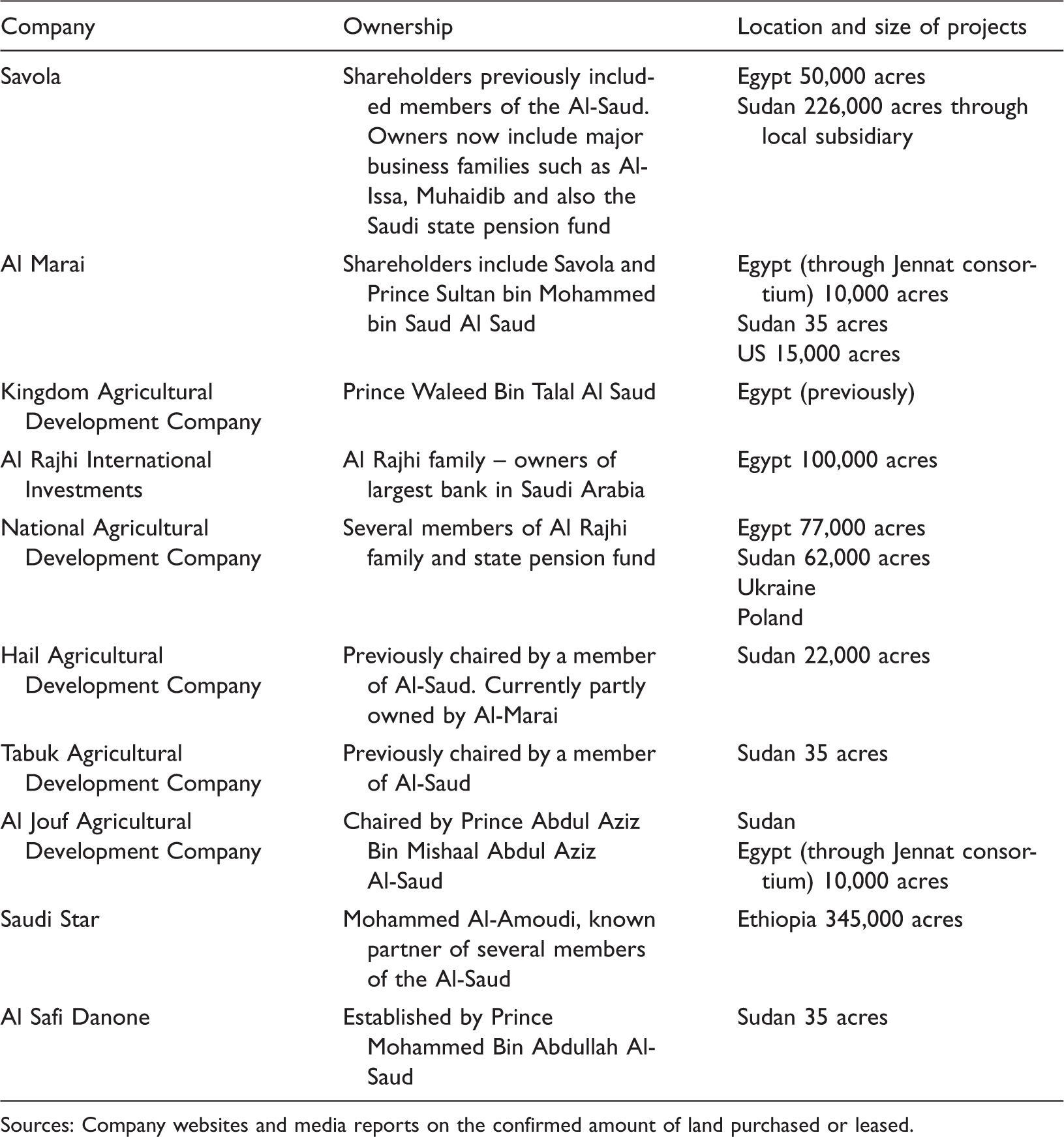
Sources: Company websites and media reports on the confirmed amount of land purchased or leased.
2. UAE
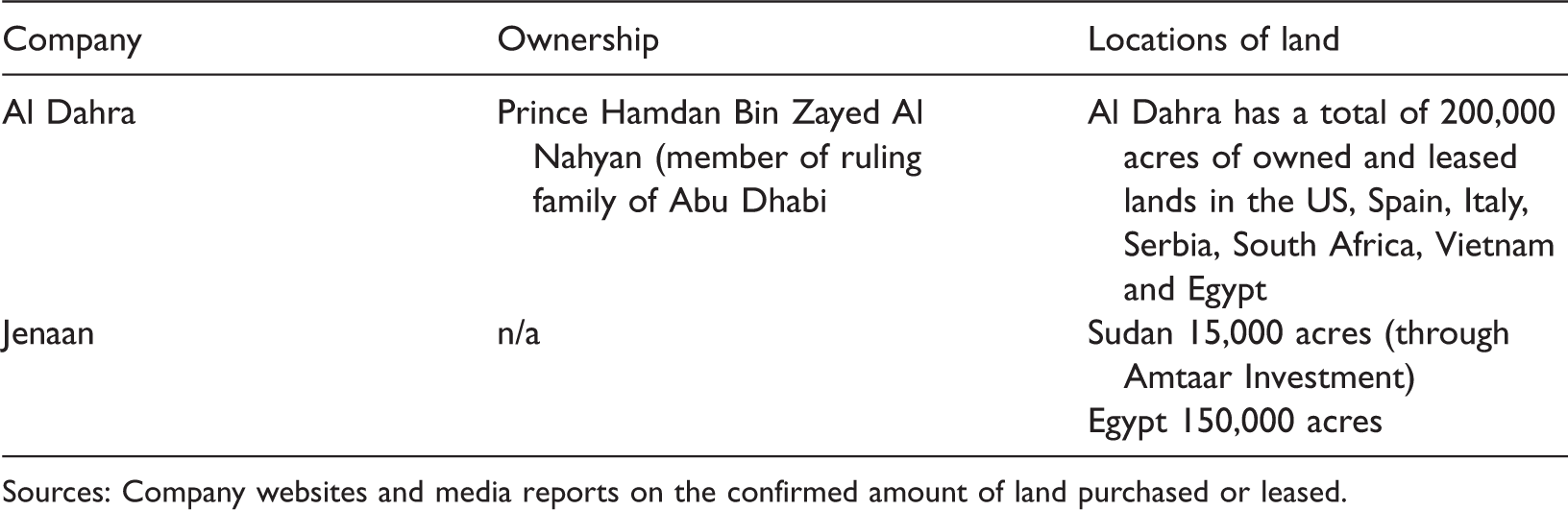
Sources: Company websites and media reports on the confirmed amount of land purchased or leased.
Enclosures in Egypt
This section examines two cases of agricultural enclaves in Egypt, Toshka and Sharq El Oweinat, two projects in which Gulf investors own large areas of land that have been reclaimed from the desert. These are the spaces of Gulf-agro-commodity chains; the “specific geographic and ecological place” to which these chains have been articulated (Hough, 2011). As will be demonstrated, these enclosures constitute a mode of extraction on the basis of their capital-intensive farming, mining of water and relatively small labour force. Also evident is the manner that these schemes are politically produced by an alignment of Egyptian, Gulf, and international class interests, whose intervention ensured the dispossession and rupture of appropriation.
One tendency in some work on Gulf investment in Arab agriculture is the liberal expectation that they can be mutually beneficial for both the investor and the host state, in part due to assumptions of inter-Arab solidarity and cooperation. On this basis some reports suggest that an increased level of regional investment could represent a solution to policy problems such as food security (Harrigan, 2014). According to one study “regional ecological integration around exchange of water, energy, food, and labour, though politically difficult to achieve, offers the best hope to improve the adaptive capacity of individual Arab nations,” (El-Zein et al., 2014). However in the case examined here, there is little evidence of this mutual benefit. What is more apparent is that their extractive nature results in a biophysical transfer that is part of a process of ecologically unequal exchange (EUE). Due to a lack of transparency and absence of statistics this cannot be evidenced quantitatively, but the emphasis on the articulation of these projects to Gulf commodity chains buttresses the definition of EUE qualitatively.
The location of Toshka and Sharq El Oweinat was determined by the extraction of water, which explains their location in remote areas far from ports and other infrastructure. Initiated in 1996, the Toshka project is a huge scheme that diverts water from Lake Nasser for the irrigation of agriculture on around 600,000 acres of land. The project involved hydrology on an enormous scale; the main pump was reportedly the largest in the world at the time of the project’s launch and the irrigation canals reached 260 kilometres in length (Sims, 2018: 49). In the initial plans, Toshka was allocated substantial water resources, the equivalent of up to 10% of Egypt’s total allocation of Nile river water (Milliman and Farnsworth, 2013: 147). On Sharq El Oweinat, an isolated site in the Western Desert, 260,000 acres of farms depend on irrigation from paleowater, which is extracted with boreholes from the Nubian Sandstone Aquifer System, a large hydrological feature. 7
Gulf investors are the only major foreign investors on these projects. Companies from the UAE and Saudi Arabia acquired large swathes of land on both of these schemes. On Toshka, Al Dahra from the UAE owns 120,000 acres, and Al-Rajhi Investments and National Agricultural Development Company own 104,000 acres and 78,000 acres respectively (Dahan: 2013). On Sharq El-Oweinat the UAE’s Jenaan and Al Dahra own 50,000 acres and 23,500 acres respectively, Saudi Arabia’s Jannat owns 10,000 acres (Detrie, 2010; Maher Milad Iskander & Co, 2016). The most common crop on these projects is alfalfa and to a lesser extent wheat and table crops are also cultivated.
Ecological rupture is embodied in the capital intensive character of these schemes. This can be observed in the process of reclamation, the conversion of desert land into agrarian spaces, an undertaking that exhibits high levels of technology and automation. Soil undergoes a transformation with the application of fertilizer, and chemicals such as sulphuric acid are administered in order to reduce high alkaline levels of the earth (Aljunaibi, 2018). Fields are irrigated by large automated booms that move in a circular motion and can cover 120 acres in a single rotation (Aljunaibi, 2018). Tractors and other machinery carry GPS devices that allows them to be steered automatically and prevent any overlap in their movement, thus minimising the waste of fertiliser. In order to reduce the cost of fuel used for irrigation pumps, some companies have established their own solar energy plants (Egypt Today, 2017). After harvesting, crops are processed and loaded onto trucks and transported for shipping, usually to Port Said on the Mediterranean Sea, which is more than 1000 kilometres from Toshka and Sharq El Oweinat, from where they are shipped to the Gulf (Aljunaibi, 2018). This is a regular passage and Jenaan sends a weekly shipment of alfalfa and other forage crops from Egypt and Sudan. (Jenaan, 2017).
The social disarticulation of these projects is manifest in the absence of a large labour force, a relation allowed by investment in technology and automation. One estimate suggests that companies such as Al Dahra and Jenaan employ around 200 people each on their sites in Egypt (Arafat and El Nour, 2020). This number is much lower than the labour required to cultivate similar areas of land held by smallholders (Arafat and El Nour, 2020). Workers consist of Egyptian workers and foreign migrants who live on projects for months at a time, an alienated state that weakens their bargaining power. This disarticulation is made more acute by the absence of any employee development and training, and there appears to be little emphasis on the transfer of expertise to Egyptian employees. Few locals hold managerial positions, and in one promotional video on Al Dahra’s operations in Toshka, all of the management staff interviewed were European (Aljunaibi, 2018). This rupture is also deepened by the exclusion of other companies or subcontractors from these operations. Many of the companies that have acquired land on these projects have fully vertically integrated their operations and engineering, logistical and technical tasks are undertaken internally.
The nature in these spaces was politically produced prior to its commodification, and this depended on an alignment of class interests across different scales. Large land grabs in Egypt increased following the structural adjustment policies that were applied in 1992 (Dixon, 2014; Arafat and El Nour, 2020; Mitchell, 2002). The policies of the IMF and other institutions pushed for the expansion of market access for foreign capital. These reforms resulted in a reduction in state support for smallholder agriculture and the allocation of land and water resources to capitalist agribusiness (Bush, 2011). The Gulf states were central participants in this market liberalisation; their close relationships with Egyptian capitalists and state officials in the civilian bureaucracy and military ensured that they were major beneficiaries in the privatisation of state assets (Henderson, 2019).
The Gulf states actively supported Toshka and other similar projects, a strategy that was intended to maintain close relations with the regime of Hosni Mubarak, which viewed it as a project that would grant legitimacy. These projects were intended to allow the regime to counterbalance the social upheaval created by the austerity and privatisations of neoliberal reform. 8 The UAE financed the main canal that channeled water into the project from Lake Nassar. 9 On Sharq El-Oweinat, direct Gulf support was less, possibly as this project did not serve the same political purpose as Toshka.
This Egyptian and Gulf class alignment is manifest in the disarticulation of these enclaves within Egypt; they are special zones enclosed by the state. Sharq El-Oweinat is directly overseen by the Egyptian military, and its farm is almost half the total size of the entire project, an area of 110,000 acres (Bahar, 2014). The army’s involvement has securitised this enclave, and a permit is required to visit the area, supposedly due to its proximity to the Sudanese border. Some managers of Gulf agribusiness companies are explicit about the advantages of this: “I think the military are better organised,” said one manager familiar with Sharq El Oweinat, “you don’t have any interference. This is a benefit,” he said. 10
This class power is also evident in the historical and contemporary dispossession of these projects. Toshka was the site of more than 40 Nubian villages that were evicted in the 1960s, prior to the construction of the High Dam (El-Din, 2016). Despite renewed protests since the 2011 revolution, villagers are still prevented from returning to their land as the military has designated it as a security zone (El-Din, 2016). This exclusion is motivated by the state’s policy of ensuring market access. According to a lawyer who is representing the claimants: “These lands overlook the Nile, like most Nubian land, and represent a large fortune for investors. That’s why the state does not intend to give us the right to return and resorts to trumped-up security threats,” (El-Din, 2016).
A more oblique form of social rupture created by these enclaves is manifest in the regional inequality in food security. The intensive cultivation and export of commodities such as livestock feed has taken place amid rising food insecurity and food price inflation in Egypt. 11 This carries a fiscal cost for the Egyptian government, which spends around US $500 million a year on subsidised food commodities. This is a complex problem and it cannot be solely attributed to Gulf acquisition of land. However, these enclaves are a manifestation of the differential in resource allocation and the removal of state support for smallholder farming that has a role in food insecurity in Egypt. In this context these commodity chains and their enclaves allow a transfer of energy that results in ecologically unequal exchange, a process that may lead to the deceleration of the “extractive region’s economy while the resource consuming communities gain value and their economies accelerate,” (Bunker, 1985: 22).
Conclusion
This article has reframed land grabs as constituent parts of commodity chains that articulate Gulf agro industry with sources of inputs. This emphasis is a redress to the exceptionalisation of these projects. Rather than an aberration, these enclosures and their integration to commodity chains are impelled by the same demand for food commodities and raw inputs for agro-industry that exist in core capitalist regions. These land acquisitions provide the Gulf states with access to resources, of which the biophysical value has facilitated economic growth. In host countries such as Egypt, the extraction of these commodities was predicated on a process of social dispossession and ecological disarticulation.
This is a process that can qualitatively be defined as ecologically unequal exchange. It has allowed the semi-peripheral development of an agro-processing sector, the production of cheap food, and capital accumulation within the Gulf states. This growth is also an implicit feature of Gulf social organisation, and is a factor behind the survival of these monarchies. The transfer of biophysical matter within an international commodity chain displaces ecological exhaustion and creates the appearance of limitless growth without cost; it ensures that questions over environmental sustainability and consumption can be politically reduced to technological intervention (Günel, 2016). For the host states it results in ecological entropy and rupture, a trend that is manifested in rising levels of food insecurity.
This exchange is concomitant with the formation of the Middle East and North Africa as a region within the global economy. In addition to its subordinate integration into the global economy through colonial legacies, this region features its own internal relations constituted by unequal exchange and differentials in development and resource distribution. In Egypt, the commodification of agrarian life cannot be fully understood as a process solely determined by Western capital, but is also one that has been determined by regional capital and investment. This is a relation that has received less attention within the scholarly literature, in part due to erroneous assumptions that such interactions represent forms of aid and cooperation. This regionalisation is an example of the growing multipolarity of the global economy, engendering increasingly non-linear flows of commodities across space with attendant shifts in social and ecological relations. These are the new formations that configure the totality of the world economy.
Footnotes
Acknowledgments
I would like to thank Dr Hannes Baumann and Dr Crystal Ennis for their comments on earlier drafts of this article. I would also like to thank the two anonymous reviewers for their highly constructive and helpful comments.
Declaration of conflicting interests
The author(s) declared no potential conflicts of interest with respect to the research, authorship, and/or publication of this article.
Funding
The author(s) received no financial support for the research, authorship, and/or publication of this article.