




Abstract
A large number of studies have analysed the role of individual and geographical determinants of voting behaviour in the context of the recent EU referendum in the UK, but several questions remain. A key unresolved issue is the extent of the interaction between individual voter characteristics and the geographical context in which they live, with some of the variance in voter preferences previously attributed to individual characteristics potentially being mediated by the geographical context. Space, and the people who live in it, are in continuous interaction, which requires a careful conceptual and empirical treatment of the issues of composition and sorting. We therefore ask to what extent individuals with very similar individual characteristics voted differently in different places. We use data from the British Election Study, along with a non-parametric matching approach, to analyse whether comparable individuals voted differently in areas with particular economic and cultural characteristics. We find that composition effects account for less than half of the observed constituency-level variation in the vote, while the remaining contextual effects are driven almost entirely by cultural factors.
Introduction
A large number of studies have analysed the role of individual and regional determinants in explaining the result of the recent EU referendum in the UK, but several unresolved questions remain. An important consideration is the extent to which the spatial variations in the vote reflected composition or contextual effects. Why did individuals with very similar characteristics vote differently in Leave- and Remain-voting areas? How do area-level characteristics interact with individual characteristics in explaining the vote? The striking geographical variation in observed voting patterns could be due to the local context, with local economic conditions, cultural norms, social networks and variations in political engagement all potentially affecting the outcomes of the vote. Individuals are also not randomly distributed across space. A competing hypothesis is therefore that the observed spatial variation in voting patterns originates from the composition of neighbourhoods, possibly augmented by the self-selection of individuals into particular areas.
In ‘The revenge of the places that don’t matter’, Rodríguez-Pose (2018) argues that the rise of populism in certain regions is due to persistent poverty, economic decay and a lack of economic opportunities. Individuals who choose or are obliged to live in lagging and declining regions manifest their discontent through voting for anti-establishment candidates. A similar argument is made by Dorling and Tomlinson (2019), who highlight the additional burden of austerity policies since the financial crisis in 2009, which has disproportionately affected the poorest areas. This point is also noted in many recent academic and media reports, highlighting the ever-increasing and stark urban–rural disparities in voting behaviour, as well as the divide across neighbourhoods within cities and towns (Lichter and Ziliak, 2017; Rossi, 2018).
An analysis of the regional disparities observed in the EU referendum vote faces two important methodological problems. First, if individuals with certain views and political preferences are selected, through either birth or subsequent migration, into areas with certain characteristics (such as peripheral areas or those in long-term economic decline), it is difficult to identify the extent to which their political behaviour can be attributable to their individual characteristics vis-à-vis their regional context. Simply controlling for both individual and regional characteristics would not allow us to isolate the impact of the regional context, since the two sets of characteristics are not orthogonal to each other. Second, the clustering of individuals with similar characteristics is likely to lead to further feedback mechanisms that amplify their original political views, as individuals are influenced by their peers and through their social networks. As noted by Goodwin and Heath (2016a) and Gordon (2018), there is a danger of deriving individual inferences from regional outcomes, particularly in the case where multiple factors interact to produce the result, as was the case in the EU referendum. For instance, Gordon (2018) shows that there is an interaction between individual occupation and regional migration levels in explaining the support for populist parties across Europe, while other authors have found similar individual–regional interaction effects in the EU referendum vote (Goodwin and Heath, 2016b; Lee et al., 2018).
Conceptually, the question of whether the EU referendum vote was driven by composition or contextual factors is key to understanding the value of place-based policies versus people-centred policies (Austin et al., 2018; Barca et al., 2012; Bartik, 2019). Are the grievances that drive the recent upsurge of populist votes driven by local or regional economic or cultural grievances, or do they instead reflect a growing segregation of voters into separate geographical locations? The former view would suggest that carefully targeted place-based policies might help to address some of the grievances driving the populist vote, while the latter view would suggest the need for investment in skills and resolving individual constraints to mobility. Our contribution with this paper is to quantify explicitly the relative importance of these composition and contextual effects by comparing very similar individuals living in different locations, and analysing whether the context in which they live affects their voting behaviour. We propose a novel methodological approach that allows us to disentangle these two effects, and to analyse the importance of a range of political, economic and cultural contextual variables in influencing individual voting behaviour.
Previous literature and conceptual framework
Individual versus regional determinants
In an early and comprehensive study, Becker et al. (2017) analyse the relative importance of regional characteristics in predicting the EU referendum vote at both the district level and the more disaggregated ward level. They find that the key regional determinants are demographic variables, education, a historical reliance on the manufacturing sector, low average income, high unemployment, fiscal cuts and (very marginally) the level of EU migration from the post-2004 accession countries. An interesting question that arises from Becker et al. (2017) and other regional studies of the vote is whether the effects observed at the regional level are simply aggregated individual-level effects. For instance, Goodwin and Heath (2016b) find that the most significant individual drivers of the Leave vote are, in order of declining importance, low education, poverty, unemployment, financial insecurity and working in a low-skill and low-income job. Similarly, Alabrese et al. (2019) show that the Leave vote is associated with older age, white ethnicity, low educational attainment, infrequent use of smartphones and the Internet, receiving benefits, adverse health and low life satisfaction.
An important question from both a conceptual and policy point of view is whether there are additional regional contextual effects that increase or decrease individual propensities to vote Leave. We are interested in knowing, for instance, if a voter with particular individual characteristics would have voted differently if he/she lived in an area with a different economic or cultural context. There is some evidence that the effect of individual-level factors was qualified by the regional context. Goodwin and Heath (2016b) find that the difference in the Leave vote of high- and low-skilled individuals is larger in low-skilled areas than in high-skilled areas, while Gordon (2018) finds that individuals in vocational occupations are more likely to support populist parties in areas with high migrant populations, while individuals in graduate-level occupations react in the opposite way.
The issue of neighbourhood effects in voting behaviour has been analysed by political geographers and political scientists using a variety of definitions of ‘neighbourhood’. A number of different mechanisms could explain these neighbourhood effects: (a) social interaction, whereby individuals exchange views and are influenced by others within their local social networks; (b) neighbourhood selection, where individuals move to neighbourhoods composed of others with similar characteristics and views; (c) emulation, where individuals conform to local social norms and choose to behave like others in their neighbourhood, even in the absence of direct social interaction; (d) environmental observation, where individuals identify local issues and vote for parties that will act in the interests of their local neighbourhood; and (e) political mobilisation, where political parties campaign more intensively in certain areas, and electoral outcomes therefore differ by location (Johnston et al., 2004; Weaver, 2014).
With the exception of the selection mechanism (which varies the composition of the neighbourhood), the channels outlined above act to increase or decrease individual voting propensities, as predicted by individual characteristics and values. Conceptually, our aim was to estimate how the same individuals would have voted had they lived in areas with different socio-economic and cultural characteristics, where these characteristics result in spillover effects via the mechanisms outlined above. Our work therefore builds on a literature in political geography which analyses the relative importance of individual- and area-level effects (Baybeck and McClurg, 2005; Gimpel et al., 2004; Johnston et al., 2001, 2004, 2005; and a comprehensive review by Weaver, 2014). We discuss the possible sources for these contextual effects in more detail in the following sections.
The spatial scale at which the analysis is conducted affects the extent to which different context effects are observed, with some, such as social interaction effects, clearly operating at smaller levels of spatial disaggregation, with others, such as emulation or political mobilisation, occurring at both small and larger geographical scales (Gimpel et al., 2004). In addition, effects captured at larger regional scales are often aggregations of effects occurring at smaller geographical scales, such as neighbourhoods, districts or constituencies, and must therefore be interpreted with great care (Johnston et al., 2007). In using larger spatial units such as parliamentary constituencies, as we do in this paper, we aim to capture political mobilisation and emulation effects while remaining conscious of the possibility of missing some of the social interaction effects occurring at a more disaggregated level.
Turnout and political mobilisation
A significant amount of the literature has identified the importance of political party organisation, campaign intensity and the extent to which an individual voter fits the overall majority profile of a voting area in determining political preferences and voting outcomes. In the context of referendums, the literature has found that voting intentions are driven by party affiliation, popularity of the party leader, support for the governing party and the level of education of the voters, with more educated and older voters generally supporting the government position (De Vreese and Semetko, 2004). Turnout is a key variable, with voters being incentivised or disincentivised to vote according to the views of their neighbours, with minority-view voters being less likely to turn out to vote (Cho et al., 2006; Dyck et al., 2009; Gimpel et al., 2004). As shown by Baybeck and McClurgh (2005), even voters who rarely interact with their neighbours or read local newspapers are still able to perceive the political context of their local area accurately – an example of contextual effects working through a process of emulation.
Given the unique nature of British democracy, which is based on a first-past-the-post system that results in a significant number of safe seats, the national nature of the EU referendum campaign may have led to a higher turnout in areas that are normally unimportant in deciding election results (Goodwin and Heath, 2016b; Johnston et al., 2016). The relative strength and history of pro- and anti-EU parties in each local area (Fetzer, 2019), the degree to which those parties – and hence the Remain and Leave campaigns – had a foothold on these areas, and the resulting amplification processes driven by social interaction, emulation and political mobilisation, are therefore likely to constitute important contextual factors that affected individual voting outcomes in different areas.
Economic grievances
We next turn to other sources of contextual effects, working primarily through the environmental observation mechanism, that is, individuals observe their economic context and vote for the party or choice that is likely to help improve or alleviate their concerns. These economic factors, resulting in economic grievances (Norris and Inglehart, 2019: 377), may also contribute to local contextual effects via the social interaction or emulation mechanisms, with voters observing the grievances in their community and voting accordingly, regardless of their own personal situation.
An important source of economic hardship is the uneven impact of trade liberalisation on specific locations. As noted by Rodrik (2017), these may worsen as the process of liberalisation advances, with the removal of the final trade barriers, for instance, as through the harmonisation of rules and standards, having the greatest distributional impacts. In principle, the overall gains from trade could be used to compensate workers who are disadvantaged by it. However, in practice, providing adequate compensation is often politically difficult. In the context of the UK, the negative impacts of trade liberalisation coincided with a period of cuts in government spending which may have exacerbated the economic grievances associated with globalisation and EU economic integration. These trade-related economic grievances are strongly clustered geographically, given the historic concentration of manufacturing industries in the Midlands, the North of England and parts of Wales, notably the former mining community known as the Valleys.
Two other aspects of globalisation may also have contributed to the development of economic grievances: (a) an increase in international capital mobility, resulting in a heightened risk of financial crises, and (b) an increase in immigration, which has depressed wages among some categories of low-skilled workers during the recent economic downturn. It is important to note that unlike other free trade agreements such as the North American Free Trade Agreement, EU membership led to the development of complex cross-border supply chains, which protected manufacturing jobs that might otherwise have been lost. In addition, EU membership includes a component of redistribution (the cohesion policy), which mitigated some of the effects of UK government spending cuts. As discussed previously, however, individuals may have attributed the negative effects of globalisation and other changes such as automation to EU membership, and these perceptions may have been further amplified by the media, the growing influence of the populist UK Independence Party (UKIP) and the narratives developed during the EU referendum campaign. In the context of migration, it is worth noting that while areas with low migration levels were more likely to vote Leave, the recent increase in migration from the EU accession countries was particularly high in some areas with previously low levels of migration, possibly contributing to the economic grievances discussed above, even among voters who are not directly economically affected by the influx of migrants (Goodwin and Milazzo, 2017; Kaufmann, 2017).
Several empirical studies have analysed the importance of these potential sources of economic grievance. Colantone and Stanig (2018) find that greater exposure to trade shocks (in the form of imports from China) resulted in a higher share of the Leave vote, after controlling for other area-level factors. Moreover, once the trade shock is accounted for, there is no further statistically significant role for immigration in predicting the vote. Along similar lines, Crescenzi et al. (2018) find that economic and cultural openness reinforce each other in reducing the degree of Euroscepticism in a given location, but that internationalisation in the context of a lack of cultural openness leads to a higher Leave vote.
An important factor identified by the literature is the extent to which areas have been affected by the government spending cuts which followed the 2008 crisis (the ‘austerity’ programme). As argued by Dorling (2016) and Dorling and Tomlinson (2019), the impact of austerity, and existing health and income inequalities, are likely to have been significant contributors to the decision to vote Leave, particularly among lower-income households. Similarly, Fetzer (2018) investigates the extent to which austerity can explain regional variations in political preferences, such as support for UKIP, anti-establishment views and popular support for Leave. His analysis also shows that exposure to austerity policies is a key activating factor that increases individual propensities to vote Leave, given existing economic grievances (Fetzer, 2018). There is also evidence that the Leave result was driven by a significantly higher turnout in deprived and segregated areas (Bartle et al., 2017).
Cultural grievances
A third set of variables that may potentially explain the existence of contextual effects are those linked to cultural grievances or, more specifically, those that are associated with a ‘cultural backlash’ against a perceived expansion of social-liberal values in society (Norris and Inglehart, 2019). These cultural grievances manifest themselves as the previously predominant cultural majority becomes a cultural minority, with traditional values surrounding faith, family and national identity undergoing rapid changes as a result of cultural and social diversity. Their rise is associated with intergenerational population replacement of the baby-boomer generation by younger generations, the expansion of access to higher education, with young people leaving peripheral areas to attend university, and an influx of migrants, not necessarily to the area itself but rather to neighbouring large towns and cities. The cultural backlash theory seeks to explain the rise of populism in high-income countries as a result of voter support for populist authoritarian parties by voters who seek security in the context of rapid sociocultural change.
A number of studies have found evidence supporting this theory in the context of the EU referendum. For instance, Arnorsson and Zoega (2018) show that higher net migration regions are more likely to be suspicious of immigrants, more reluctant to have them as neighbours and more likely vote Leave. Similarly, a number of studies have shown that although the Leave vote was lower in more diverse locations, it was higher in areas experiencing rapid immigration growth (Goodwin and Milazzo, 2017; Kaufmann, 2017). Other studies show that perceptions of high immigration, regardless of actual immigration levels, are associated with greater support for Leave, and that voters do not generally distinguish between EU and non-EU migrants when forming their views on immigration (Blinder and Markaki, 2018; Goodwin and Milazzo, 2017). Moreover, there is a clear spatial pattern to anti-immigration views, which tend to be strongest in neighbourhoods which are themselves relatively homogenous but which are located on the outskirts of large, diverse cities (Blinder and Markaki, 2018; Carter, 2018; Kaufmann, 2017; Kaufmann and Harris, 2015).
These anti-immigration views, linked to rapid demographic change in an area and exacerbated by a lack of previous experiences of immigration, in turn translate into higher support for far-right and populist parties and into greater support for Brexit. In keeping with the cultural backlash theory, the effect is strongest for older individuals, particularly of the baby-boomer generation, suggesting that all else being equal, societies are likely to become less immigration averse over time (Schotte and Winkler, 2018). It is also mediated by cognitive and non-cognitive skills, including psychological traits. For instance, Johnston et al. (2015) show that personality mediates the effect that immigration growth has on voter support for populist parties, with individuals who score low on ‘openness’ being particularly susceptible due to a preference for order, with several other studies finding similar effects (Garretsen et al. 2018; Lee et al., 2018). Similarly, Gordon (2018) finds that individuals in graduate occupations were less likely to support populist parties in areas with large immigrant populations, as were individuals who are members of organisations with a national focus, such as trade unions or religious institutions. 1
A final component of the cultural grievance hypothesis is the role played by education, particularly by the recent increase in the proportion of the population with a university education. While education is an economic variable strongly associated with higher incomes, economic growth and prosperity, in the context of voting behaviour and intergenerational change, it is also particularly salient as a proxy for socially liberal and post-materialist values. A significant proportion of young people now attend university, frequently away from home, in areas of relative diversity and in an environment that promotes gender equality and openness to religious, ethnic and cultural diversity. Older voters in peripheral regions experience the outmigration of the young among a wider context of cultural change that causes them to feel like ‘strangers in their own land’, fuelling resentment that translates into votes for authoritarian populist parties (Norris and Inglehart, 2019: 89–91). Cultural grievances on issues such as gender equality, LGBT rights and immigration are therefore potential sources of contextual effects in the context of the EU referendum, working through social interaction, emulation, environmental observation (in the case of views on immigration) and political mobilisation (through support for anti-immigration parties such as the English Defence League or UKIP). Individual values on the left–right axis, while potentially less relevant to the populist vote than the cultural change process discussed above, may also explain party affiliation, emulation and political mobilisation in former mining and manufacturing communities.
Data and methods
Data sources
We use individual-level data from the British Election Study (BES), a nationally representative survey of political views and electoral behaviour, which also covers economic, political, demographic and cultural variables. The BES has been run before and after every general election since 1964, and at other salient times in between. The survey is conducted by YouGov based on their Internet panel, and is representative of the UK by nation/region and major demographic group, as well as being adjusted to account for response bias. Our analysis is based on Wave 9, the immediate post-referendum wave of the survey, in order to obtain the most accurate measure (in terms of recollection) of how individuals voted in the EU referendum. The total number of individual observations available is 30,036, although the final sample size for the analysis is 17,382 individuals due to item non-response for some of the variables and after excluding individuals <18 years of age. 2
An important consideration is the appropriate spatial scale at which to capture contextual effects, as discussed earlier in the section ‘Individual versus Regional Determinants’. For the analysis at hand, the appropriate scale needs to be large enough to encompass the delivery of local public services and political mobilisation, but disaggregated enough to allow for the study of social interaction and emulation effects. Given the data limitations, there are two options: parliamentary constituencies and local authority districts. A significant amount of local public service delivery occurs within local authority districts, but political organisation and the bulk of political campaigning are organised within parliamentary constituencies, and this is also the smaller spatial unit. There are 650 constituencies in the UK, and for reasons of data comparability, we exclude Northern Ireland so that our analysis covers the remaining 632 constituencies. The average size of the electorate per constituency varies between 50,000 and 75,000 individuals.
There is an additional complication in that the EU referendum votes were tallied at the local authority district level rather than at the usual constituency level, although in some areas, there are also ward-level results. Our measure of the overall Leave vote at the constituency level (used as one of the treatment variables) is therefore an estimate based on a combination of district and ward-level EU referendum results, as well as census data, as compiled by Hanretty (2017). The remaining constituency-level variables used in the analysis are based on data from the Electoral Commission, the Annual Survey of Hours and Earnings, the Work and Pensions Longitudinal Study, the census and Vivyan and Hanretty (2015). Details are provided in Table B1 in the Appendix.
Empirical design
The literature on political preferences and voting behaviour has traditionally used multilevel modelling in order to address the hierarchical nature of the voting process, with individuals nested within neighbourhoods, districts and regions, and sometimes in additional intermediate units such as households (Duch and Stevenson, 2005; Johnston et al., 2007; Singh, 2011). Multilevel models capture both between-individual and between-place variation, improving inferences and interpretation of the coefficients of the model. However, one of the limitations is the potential bias arising from the self-selection of individuals into neighbourhoods (Walks, 2006). Our primary empirical contribution is to implement a procedure that allows us to incorporate individual- and area-level data into our model, but also to control explicitly for the self-selection of individuals into locations. A small number of studies have used coarsened exact matching (CEM) to analyse political behaviour (Alvarez et al., 2018; Donovan et al., 2016; Hobbs et al., 2014) but not to model area-based effects. Our aim is to show that a CEM approach can help to provide robust and intuitive estimates of contextual effects in voting outcomes.
Our empirical strategy allows us to control for pretreatment confounding influences in the selection of individuals into different types of constituencies, where being located in a certain type of constituency is the ‘treatment’. Intuitively, we create a balanced sample of individuals with very similar demographic and socio-economic characteristics living in different types of location and analyse whether they vote similarly or differently. As long as the set of matching variables adequately covers all the relevant confounding factors, it is conceptually equivalent to assigning individuals at random to locations and then testing for differences in their voting behaviour.
In practical terms, we coarsen continuous variables into categories. For instance, for the variable ‘age’, we have seven categories: <25 years, 26–35 years, 36–45 years, 46–55 years, 56–65 years, 66–75 years and ≥76 years. Categorical variables are also reclassified into broader categories where appropriate. We then assign individuals to strata, so that within each stratum, all individuals have the same values for all of the coarsened matching variables, and create weights to be used in further analysis. Individuals in strata without at least one treated and one control individual are assigned a zero weight and pruned from the data set in subsequent analysis (Blackwell et al., 2009; Iacus et al., 2008). 3
As with all matching methods, the aim is to maximise balance (i.e. to ensure that treated and control samples are comparable in terms of personal characteristics), while also ensuring that the overall sample size remains as large as possible in order to retain accuracy. Unlike other matching methods, CEM sets the degree of imbalance in advance through the theory-driven choice of coarsened categories rather than through a process of trial-and-error following the matching procedure. It has the benefit of requiring fewer modelling assumptions, unlike other methods such as propensity score matching, which require a probit or logit modelling step. It is also computationally fast, intuitive and robust to measurement error (King et al., 2011; King and Nielsen, 2019). A disadvantage of CEM is that it typically produces a matched sample with fewer observations than other matching methods, which may be problematic if the original data set is small. It also requires careful interpretation of the estimated sample average treatment effect on the treated (SATT), since the estimated treatment effect is only generalisable to the group categories included in the analysis (i.e. those which are not pruned as part of the matching process). We discuss this limitation in more detail later in the section ‘Robustness Checks’ and address it using several robustness checks.
Our analysis consists of two sets of estimates: a first set based on binary treatments, defined by high or low values of relevant political, economic and cultural variables, and a second set involving multi-category treatments, defined as a combination of high or low values for combinations of two different treatment variables. We calculate the SATT by estimating a weighted logistic regression (using CEM weights) of the individual Leave vote on a treatment dummy variable. Our choice of treatment variables follows directly from the discussion earlier in this paper and covers three types of area-level contextual effects. First, we consider those related to political mobilisation and the social emulation of political views, which we capture using the proportion of the local area that voted Leave in the referendum, UKIP vote share in the 2015 general election and local turnout in the 2015 general election. Second, we consider environmental observation and social interaction effects related to economic grievances resulting from trade liberalisation and the financial crisis. We capture these using the local wage growth, working-age inactivity rate, proportion of welfare claimants in 2010 and income inequality rate (80:20 ratio in hourly wages). Third, we consider contextual effects resulting from cultural grievances via social interaction and emulation but also potentially environmental observation. These include the local level of immigration (both overall and from the EU accession countries), immigration growth rate, proportion of the population with a university degree, and local views on redistribution, immigration and the pace of social change (proxied by views on same-sex marriage). In each case, we classify constituencies into those above average or below average values for the treatment variable, and this constitutes our treatment dummy. Technical details of the empirical specifications are provided in Appendix A.
In a second step, we extend the analysis to consider multi-category treatments. While many different combinations are possible, we are particularly interested in two sets of interactions. The first category is the interaction between economic grievances, proxied by wage growth, and cultural grievances, proxied by views on immigration, redistribution and the pace of social change (views on same-sex marriage). The second category is the interaction between political mobilisation, captured by turnout in the 2015 general election, and the cultural grievances discussed above.
Matching variables
Our aim is to match similar individuals living in different locations in order to improve the balance of our sample. Since there is a trade-off between ensuring a good match and minimising the loss of observations, we match on personal characteristics that have been identified in previous work as being strongly associated with political views and voting behaviour, although we also consider variations in the matching variable as part of our robustness checks. 4 Our matching variables are:
Age: the individual’s age in years. This is our only continuous variable, and we include the un-coarsened variable in the logistic model to control for any remaining imbalance.
Education: a series of dummy variables indicating the individual’s highest qualification out of (a) primary or lower, (b) GCSE D–G grades, (c) GCSE A*–C grades, (d) A-level or equivalent post-16 college qualification, (e) undergraduate degree or equivalent and (f) postgraduate degree or equivalent.
Ethnicity: a dummy variable to indicate whether the individual is white British versus all other ethnicities.
Employment circumstances: three dummy variables to capture the most relevant employment circumstances, including employed (full-time or part-time), student and retired.
Household income: a dummy variable to capture whether the individual’s household has a gross annual income of ≥£35,000.
Personality: we include a set of variables to capture individual personality, based on the Big Five psychometrics framework, which have been found by the literature to be highly relevant in explaining both the EU referendum vote and internal migration decisions. Due to the dimensionality problem and resulting loss of observations, we include the two traits that are most highly correlated with the likelihood of voting Leave: openness and conscientiousness. For robustness, we also estimate a model that includes all of the Big Five personality traits. Individual-level scores for each trait are provided on a 1–10 Likert scale, and we recode these into low, medium and high categories.
Political efficacy: a dummy variable that is equal to 1 if the individual strongly agrees with the statement ‘politicians don’t care what people like me think’, and 0 otherwise.
Daily newspapers: a categorical variable indicating which daily newspaper the individual reads regularly, out of the Daily Express, Daily Mail, Daily Mirror, The Sun, The Telegraph, The Guardian, The Independent, The Times, local papers, other (including smaller circulation national newspapers) and none. This variable allows us to control for the effects of the material in the news media on individual voting intentions and also to match individuals to others with similar cultural views which are not otherwise controlled for by the other matching variables. There is extensive evidence to show that the editorial line of British newspapers was starkly political during the referendum campaign, and that they may have influenced the propensity to vote Leave (Levy et al., 2016).
Results
Composition and contextual effects
Table 1 shows our main set of results, reporting the SATT for different treatment variables, where the treatment is living in a constituency with particular characteristics. The first column shows the unweighted estimates based on the full sample, the second column shows the estimates based on the smaller matched sample (with unmatched observations, typically minority or unusual values, pruned by the matching process) and the final column shows the estimates, after controlling for composition effects. The fall in the size of the estimates between the second to the third columns indicates the extent to which composition effects explain the EU referendum vote. The estimates in the final column show the contextual effects only. The results in the first column are provided for reference, and the fall in the estimates between the first and second columns shows the effects of restricting the sample to the common support. All estimates reported in Table 1 are in the form of marginal effects.
Binary treatments: SATT estimates by treatment variable (showing marginal effects).
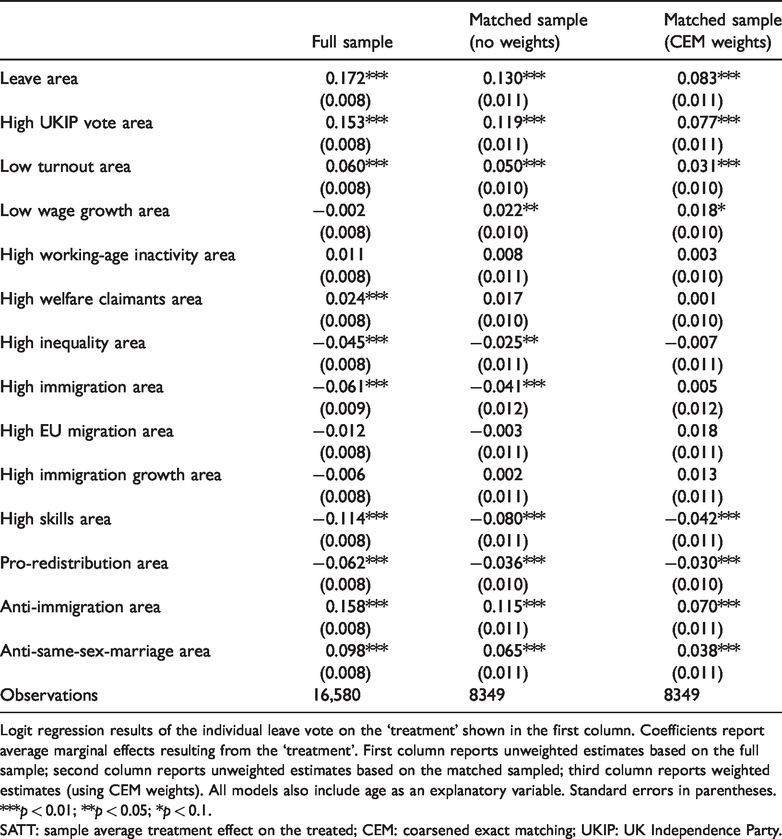
Logit regression results of the individual leave vote on the ‘treatment’ shown in the first column. Coefficients report average marginal effects resulting from the ‘treatment’. First column reports unweighted estimates based on the full sample; second column reports unweighted estimates based on the matched sampled; third column reports weighted estimates (using CEM weights). All models also include age as an explanatory variable. Standard errors in parentheses.
***p < 0.01; **p < 0.05; *p < 0.1.
SATT: sample average treatment effect on the treated; CEM: coarsened exact matching; UKIP: UK Independence Party.
We first analyse the contextual relevance of political mobilisation variables, including the overall Leave vote, the UKIP vote share and turnout. Our results show that for these variables, composition accounts for less than half of the area-level effects, with the remainder being driven by direct contextual effects. For instance, living in a Leave-voting area increases the individual likelihood of voting Leave by 8.3 percentage points, as does living in a strong UKIP area (7.7) and living in a low-turnout area (3.1). For all of these variables, the composition effect is relatively small, suggesting that contextual effects linked to political mobilisation (organisation, campaign spending, volunteers, etc.) and social interaction and emulation (political views, likelihood of voting) are important drivers of the vote at the local level.
Our second set of treatment variables relates to economic grievances, including low wage growth, inactivity rates, welfare claimants (a proxy for the impact of austerity) and inequality within the local area. Our results show that these variables explain very little of the vote at the area level, with most having no statistically significant effect on the likelihood to vote Leave, after controlling for composition. The only economic variable with a statistically significant contextual effect on the Leave vote is low wage growth, which increases the likelihood of voting Leave by 1.8 percentage points but which is only marginally significant (at the 10% level). Individuals living in areas with high levels of inequality, typically the larger cities, are less likely to vote Leave (regardless of their own situation), but this effect disappears after controlling for composition. The inequality effect observed is therefore entirely driven by composition, that is, by the characteristics of individuals living in these areas, who are typically younger, with higher levels of education and with socially liberal values.
Finally, we consider area-level treatments linked to cultural grievances. Starting with immigration, we find no statistically significant effects on the Leave vote for individuals living in high immigration areas, after controlling for composition. This is true for areas with high levels of overall immigration, high levels of EU migration and high immigration growth rates. Individuals in areas with high overall immigration are more likely to vote Remain, before controlling for composition, but this effect disappears in the final column. It is can therefore be explained by same composition effects discussed above in the context of high inequality areas, that is, that these individuals are typically living in diverse neighbourhoods in large cities, which are largely composed of young, educated, socially liberal voters. Interestingly, constituency-level views on immigration, as opposed to actual immigration levels, have a large amplifying effect on the Leave vote, both before and after controlling for composition, in the order of 11.5 (before) and 7.0 (after) percentage points. These anti-immigration views may have been developed historically as part of a process of increased peripherality and marginalisation of certain locations and/or enhanced during the EU referendum campaign and as part of previous general electoral campaigns.
Our other treatments covering cultural grievances are all similarly highly statistically significant. We find that living in a skilled area (with a higher than average proportion of residents with a university degree) reduces the propensity to vote Leave by 4.2 percentage points, after controlling for composition. The effect of living in a skilled area is almost entirely contextual, suggesting that individuals with low personal levels of education are still significantly less likely to vote Leave if they live in large skilled urban areas, pointing to the social interaction and emulation channels. We note that area-level education can be linked to both economic and cultural grievances, for instance, as it indicates whether an area is peripheral with little access to higher education provision. Other purely cultural treatments have large and significant SATT estimates, including a 3.8 percentage points higher likelihood of voting Leave if living in an anti-same-sex-marriage area (indicative of negative reactions to social change), and a 3.0 percentage points lower likelihood of voting Leave for individuals in areas with aggregate pro-redistribution views. The latter finding is very interesting, suggesting that there is a disconnect between economic hardship and pro-redistribution political mobilisation.
It is important to note that all of these results are only generalisable to a subsample of the population and may not necessarily apply to the population as a whole. This is because, as discussed earlier in the section ‘Empirical Design’, the CEM process involves the pruning of observations for which there is no match across the treated and control areas. The effects of restricting the sample in this way can be seen in the differences between the estimates in the first and second columns of Table 2, which show the difference in the unweighted SATT before and after pruning the sample. Intuitively, the SATT estimates go down as the sample is reduced because individuals with more unusual or minority characteristics are left out after the matching process. The results discussed above are therefore applicable to individuals with characteristics and views that are close to the median of the population, but may be less applicable for individuals with characteristics and views that are closer to the tails of the distribution. 5
SATT estimates for multi-category treatments, involving interactions between two area-level variables.
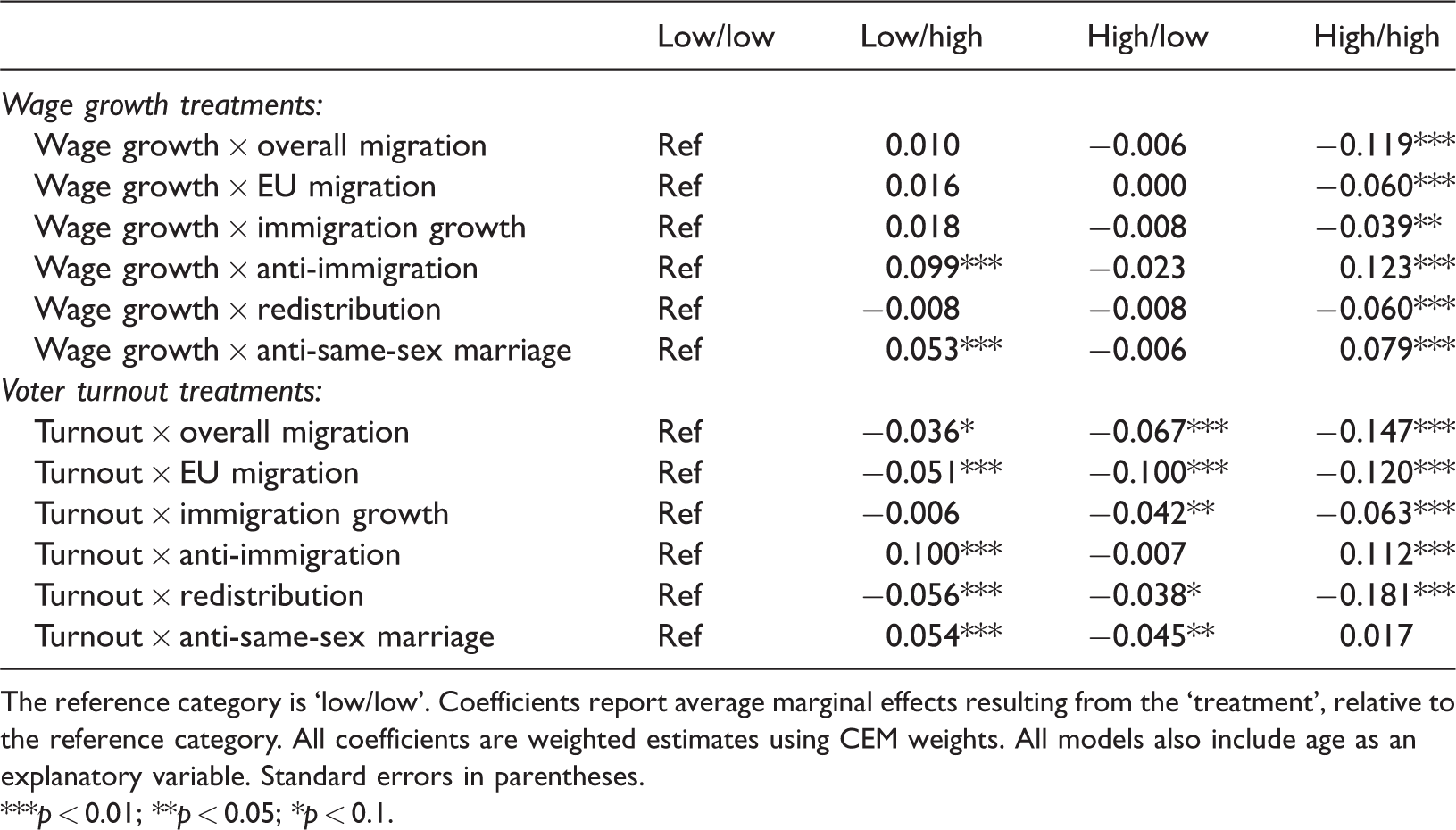
The reference category is ‘low/low’. Coefficients report average marginal effects resulting from the ‘treatment’, relative to the reference category. All coefficients are weighted estimates using CEM weights. All models also include age as an explanatory variable. Standard errors in parentheses.
***p < 0.01; **p < 0.05; *p < 0.1.
Multiple contextual effects
We have so far considered SATT estimates for high and low values of a given treatment variable, but contextual effects may work along more than one dimension. We now consider two-way interactions between two variables of particular interest in the literature, wage growth and turnout, interacted with a range of cultural and values-based variables. These results are shown in Table 2, where all the estimates are based on models that have been adjusted for composition effects using CEM weights. The estimates shown therefore capture contextual effects only.
We start with wage growth, a measure of the economic well-being of the electorate in a local area, and interact it with measures of immigration. Contrary to popular perception, we find no contextual effects for areas with a combination of low wage growth and high immigration levels or growth rates. We do, however, find a negative effect for areas that are economically successful but which also have high levels of immigration, with residents in those areas significantly more likely to vote Remain (11.9, 6.0 or 3.9 percentage points, depending on the measure). Interestingly, our results for anti-immigration views, as opposed to actual immigration levels, are quite different. Residents in areas with strong anti-immigration views were more likely to vote Leave, after controlling for composition. This values effect is stronger in the economically successful areas (12.3 percentage points) than in the slow-growth areas (9.9 percentage points).
We consider two further interactions with values-based measures. We find that the interaction of wage growth with views on the pace of social change, in this case proxied by views on same-sex marriage, is very similar to the interaction between wage growth and anti-immigration views. More specifically, we find that living in an area with strong anti-same-sex-marriage views increases the likelihood of voting Leave, and that this effect is strongest in the economically successful areas (7.9 percentage points vs. 5.3 percentage points). We also find that living in an area with strong pro-redistribution views lowers the likelihood of voting Leave, but only in areas that are economically successful (6.0 percentage points), while having no statistically significant effect on the vote in economically unsuccessful areas.
Finally, we consider whether these cultural views interact with turnout in a way that affects the overall Leave vote. In general, we find a strong contextual effect for a combination of low turnout and low immigration levels (the omitted category), with residents in these areas being significantly more likely to vote Leave than residents in areas with either higher turnout or higher immigration levels. This suggests that an increase in turnout in previously low-turnout areas which are economically unsuccessful (associated with lower migration levels) was a key driver of the EU referendum vote. We also find that individuals living in politically engaged areas with high turnout levels are more likely to vote Remain, particularly if these areas are also diverse, with high levels of immigration or high immigration growth rates.
As with the results for the binary treatments, we find significant contextual effects that increase the propensity to vote Leave in areas with strong anti-immigration views (10.0 or 11.2 percentage points, depending on turnout levels) and decrease the propensity to vote Leave in areas with pro-redistribution views (5.6 or 18.1 percentage points), with the effects being strongest in the more politically engaged high-turnout areas. A final interesting result worth noting is that residents in areas with strong anti-same-sex-marriage views were more likely to vote Leave, but only if they are also low-turnout areas. Residents in high-turnout areas were less likely to be driven by cultural grievances associated with the pace of cultural change. It is possible that this is linked to Conservative Party support for same-sex marriage legislation in what are predominantly wealthy Conservative areas.
Robustness checks
A limitation of the CEM approach is the potential loss of observations resulting from the exact matching process. There is a trade-off between increasing the number of matching variables in order to improve the balance of the sample and a loss of observations which reduces the external validity of the results. While the SATT estimates capture the contextual effects affecting the groups included in the sample, it may be less applicable for groups with relatively rare or spatially clustered characteristics (i.e. the very young or old, those with very low or very high levels of education, those with very weak or strong views on the values questions, etc.). The matching process reduces imbalance in the matching variables to zero across the treated and control groups (by definition), with the exception of the variable ‘age’, for which a small amount of imbalance remains due to the coarsening process (Table B4). 6 We control for the remaining imbalance in this variable by including it in the regressions as an additional explanatory variable. The overall measure of imbalance, in the form of the L1 distance, falls following CEM in all of the specifications (Table B5).
Our first set of robustness checks addresses the choice of matching variables. When using our preferred set of variables, discussed earlier in the section ‘Matching Variables’, the CEM process results in the pruning of around 50% of the observations, depending on the choice of treatment (see Table B6 for details). In order to test whether this has an impact on the estimates, we rerun the models, starting with only the demographic variables and gradually adding additional variables until reaching our preferred set. The results, shown on Table B7, indicate that our findings are robust, with all the statistically significant contextual effects discussed above also showing as statistically significant in the sparser models, which retain between 85% and 99.9% of the original observations. The only additional results found when using the sparser models are a reduction in the propensity to vote Leave for individuals in areas with high inequality, and a similar reduction in areas with high immigration levels (first and second columns of Table B7). However, this effect disappears once personality traits and cultural characteristics are also accounted for (third and fourth columns of Table B7).
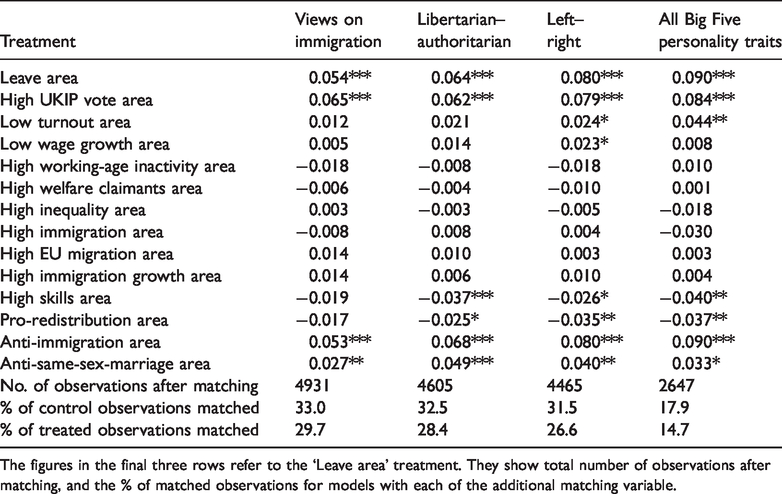
Our second set of checks involves the inclusion of additional matching variables that capture additional cultural and values-based characteristics. The reason for not including them in our preferred model is that with the exception of the Big Five personality traits, these characteristics are likely to have been influenced by the EU referendum campaign, since they are measured at the same point in time as the EU referendum vote. They are nevertheless helpful in allowing us to assess the robustness of our results. As shown in Table B8, our results are robust to the inclusion of these variables, although some of the SATT estimates are no longer statistically significant once individual-level anti-immigration views are accounted for. Our main conclusion that cultural factors are an important contextual determinant of the EU referendum vote, while economic factors are not, holds throughout.
Conclusions
Following the result of the EU referendum in the UK, a small but growing literature has investigated the individual and regional determinants of the vote. The factors identified at the individual level include age, education, occupation, personality traits and political views, while the factors identified at the regional level include demographics, exposure to trade shocks, economic deprivation, immigration, austerity policies and cultural values at the regional level. An important unanswered question is the extent to which the observed regional variations in the vote are due to variations in the composition of the electorate across locations, or whether they are due to contextual effects that work to increase or decrease individual propensities to vote Leave. Moreover, these contextual effects could work through a variety of channels, and involve political variables such as turnout or the strength of local political parties, or variables relating to economic or cultural grievances felt by the local population, and spread through social interaction and other channels.
We aim to fill this gap in the literature by using a non-parametric matching approach to compare the voting preferences of very similar individuals living in different types of constituencies. We use individual-level data from the post-referendum wave of the BES (Wave 9) and analyse the vote across Leave- and Remain-voting constituencies, as well as across constituencies with high and low values of UKIP support, electoral turnout, wage growth, working-age inactivity, welfare claimants, inequality, immigration levels and growth rates, skills, inequality and views on redistribution, immigration and same-sex marriage. Our approach allows us to capture the relative size of the composition and contextual effects, and the increase in the likelihood of voting Leave resulting from living in constituencies with different political, economic and cultural characteristics.
Our results indicate that less than half of the observed difference in the vote across Leave and Remain constituencies is due to composition effects, with the remainder being due to contextual effects. We find that the most important contextual effects are those linked to political organisation and mobilisation, including the strength of the UKIP vote (7.7 percentage points more likely to vote Leave) and the local turnout level (3.1 percentage points more likely to vote Leave in low-turnout areas). Of the economic contextual variables, only low wage growth is weakly statistically significant (1.8 percentage points). In contrast, most of the values-based cultural grievance contextual variables have strong effects on the vote, including anti-immigration views (7.0 percentage points), anti-same-sex-marriage views (3.8 percentage points) and pro-redistribution views (3.0 percentage points less likely to vote Leave). While living in an anti-immigration area increases the likelihood to vote Leave, there is no statistically significant effect associated with living an area with high immigration levels or growth rates, indicating that the contextual effect is linked to negative perceptions of immigration rather than an increased exposure to it in the local area. Moreover, we also find that the anti-immigration contextual effect is particularly marked in economically successful areas rather than in the poorer and slower growing areas, and that this is the case for most of the values-based contextual effects.
Our analysis thus suggests that the most important contextual determinants of the Leave vote are cultural rather than economic in nature, possibly reflecting the presence of strong social interaction, solidarity and emulation effects in voting behaviour. As a final point, we note that the observed contextual effects could also have resulted from spatially targeted advertising during the referendum campaign, with resources likely to have been directed to areas with a high number of Leave voters and the potential for voting preferences to spread – for instance, areas that are in economic decline and politically isolated, with low skill levels, high levels of deprivation and ageing populations. Such targeting might explain the significant increase in turnout observed in areas typically associated with low levels of political engagement. As we find in this paper, it is the combination of political disengagement and cultural grievances that had the most significant contextual effect on the vote. While more data would be needed to test this hypothesis, particularly data on campaign finance and political mobilisation at the local level, the role of turnout may be a very significant one in explaining the EU referendum result.
Footnotes
Declaration of conflicting interests
The author(s) declared no potential conflicts of interest with respect to the research, authorship and/or publication of this article.
Funding
The author(s) received no financial support for the research, authorship and/or publication of this article.
Notes
Appendix A. Empirical models
In a first step, we analyse the effect of a set of binary treatments on the individual Leave vote. Our empirical specification is as follows:
In a second step, we analyse the effect of combinations of two treatments. The model to be estimated now becomes:
Appendix B. Additional tables
SATT results for models based on different sets of matching variables, including different sets of attitudinal variables.
| Treatment | Views on immigration | Libertarian–authoritarian | Left–right | All Big Five personality traits |
|---|---|---|---|---|
| Leave area | 0.054*** | 0.064*** | 0.080*** | 0.090*** |
| High UKIP vote area | 0.065*** | 0.062*** | 0.079*** | 0.084*** |
| Low turnout area | 0.012 | 0.021 | 0.024* | 0.044** |
| Low wage growth area | 0.005 | 0.014 | 0.023* | 0.008 |
| High working-age inactivity area | −0.018 | −0.008 | −0.018 | 0.010 |
| High welfare claimants area | −0.006 | −0.004 | −0.010 | 0.001 |
| High inequality area | 0.003 | −0.003 | −0.005 | −0.018 |
| High immigration area | −0.008 | 0.008 | 0.004 | −0.030 |
| High EU migration area | 0.014 | 0.010 | 0.003 | 0.003 |
| High immigration growth area | 0.014 | 0.006 | 0.010 | 0.004 |
| High skills area | −0.019 | −0.037*** | −0.026* | −0.040** |
| Pro-redistribution area | −0.017 | −0.025* | −0.035** | −0.037** |
| Anti-immigration area | 0.053*** | 0.068*** | 0.080*** | 0.090*** |
| Anti-same-sex-marriage area | 0.027** | 0.049*** | 0.040** | 0.033* |
| No. of observations after matching | 4931 | 4605 | 4465 | 2647 |
| % of control observations matched | 33.0 | 32.5 | 31.5 | 17.9 |
| % of treated observations matched | 29.7 | 28.4 | 26.6 | 14.7 |
The figures in the final three rows refer to the ‘Leave area’ treatment. They show total number of observations after matching, and the % of matched observations for models with each of the additional matching variable.