




Abstract
The creative and cultural industries form an important part of many urban economies, and the fashion industries are one of the exemplar creative industries. Because fashion is based on intangibles such as branding and reputation, it tends to have a two-way relationship with cities: urban areas market themselves through their fashion industry, while the fashion industry draws heavily on the representation of place. In this paper we investigate this interlinked relationship between the fashion industry and place in four of the major cities of global fashion – London, New York, Milan and Paris – using data from the social media platform Twitter. To do this, we draw upon a variety of computer-aided text analysis techniques – including cluster, correspondence and specificity analyses – to examine almost 100,000 tweets collected during the Spring–Summer fashion weeks of February and March 2018. We find considerable diversity in how these cities are represented. Milan and Paris are seen in terms of national fashion houses, artisanal production and traditional institutions such as galleries and exhibitions. New York is focused on media and entertainment, independent designers and a ‘buzzy’ social life. London is portrayed in the most diverse ways, with events, shopping, education, social movements, political issues and the royal family all prominent. In each case, the historical legacy and built environment form important parts of the city’s image. However, there is considerable diversity in representation. We argue that social media allow a more democratic view of the way cities are represented than other methodologies.
Introduction
The creative and cultural industries (CCIs) have become increasingly important in most developed economies (Kemeny et al., 2019; Leslie and Rantisi, 2009; Scott, 2001). Global cities such as London, Paris and New York provide the ideal conditions for these industries, with dense concentrations of creative workers allowing rapid access to the tacit knowledge necessary for symbolic activity (Pratt, 2006; Storper and Venables, 2004). As cities have become increasingly important as sites of creative activity, the creative industries have, in turn, become an important part of their external reputation. Policy makers have encouraged this trend by incorporating notions of creativity and culture into economic development strategies which take advantage of these symbiotic relationships, with cities such as Manchester, Shanghai and Toronto using their creative reputations to attract human capital, firms, inward investment and tourists (Evans, 2003, 2015; Hall, 2000; Vanolo, 2008).
One particular creative industry – fashion – has played an important role in this. A strong fashion industry helps cities be seen as ‘creative’ (Leslie and Brail, 2011) and fashion has been placed at the heart of city branding efforts (Hu and Chen, 2014; Leslie and Rantisi, 2009). For example, Antwerp and Barcelona have become important locations of the global fashion industry through targeted city-branding activities including cultural events, museum initiatives and shopping activities (Chilese and Russo, 2008; Martínez, 2007). The relationship between fashion and perceptions of cities is two-way: fashion is used to create a particular image of an urban area, but the fashion industry also incorporates imagery from and represents the cities in which it is located (Lin, 2017; Scott, 1997, 2010; Turok, 2009). This symbiosis between city, fashion and economy has been the subject of an increasing amount of research (Bellini and Pasquinelli, 2016; Jansson and Power, 2010; Rantisi, 2004; Skivko, 2016; Tokatli, 2012; Weller, 2013). As Crewe (2013) argues, new technologies are changing the way fashion is consumed and presented. In response, studies have begun to use new sources of data and methodologies which are able to capture the intangible elements behind the promotion and development of contemporary fashion cities. For example, Williams and Currid-Halkett (2014) used geo-located data from the social media network Foursquare to map the movement of fashion designers in New York.
In this paper we use data from the social media platform Twitter to consider the interrelationship between fashion and representation of four of the most important cities in global fashion: London, New York, Paris and Milan. The paper aims to understand the way in which cities are represented in social media, with a focus on fashion, one of the archetypal symbolic industries. To do this, we analyse almost 100,000 tweets collected during the Spring–Summer fashion weeks of February and March 2018, a process we outline below. Social media platforms such as Twitter are now ‘important platforms through which place brands can be communicated, negotiated, projected and assessed with few spatial or temporal constraints’ (Andéhn et al., 2014: 2). Each tweet is a short message of up to 280 characters which conveys a message to other users. Because of this, we argue that an investigation of tweets provides an opportunity to investigate how cities are represented – our focus is on the relationship between an economically and culturally important industry, fashion, and this representation.
Our paper makes two main contributions to the literature. Firstly, we move the literature on fashion and cities forward by introducing social media data as an analytic tool. While this creates some methodological issues, it allows us to see how fashion contributes to images of cities. Secondly, this methodology allows us to directly compare the major cities of the fashion world – New York, London, Paris and Milan. These have been selected because of their importance to global fashion and their distinct economic, cultural and production systems. By considering content analysis of a large sample of tweets, we also hope to contribute to the breaking down of the ‘methodological polarisation between macro and micro analysis’ (Tinati et al., 2014: 668).
While the four cities share strong fashion industries, they differ in other significant ways. Casadei and Gilbert (2018) argue that Milan and Paris have the strongest traditions of artisanal production, characterized by an education sector focused on technical, craft and production skills. They are home to powerful global fashion luxury houses (e.g. Versace, Chanel, LVMH), which are important incubators of international creative talent (Godart, 2014; Jansson and Power, 2010). These cities are also important locations for international trade fairs, whereas their major fashion weeks tend to showcase established fashion houses rather than new emerging talent.
In contrast, craftsmanship is less important in representations of New York and London, which focus more on incubating new talent (Tokatli, 2011). New York’s Garment District operates as a magnet for fashion designers in the city. A dense network of other creative industries and activities like media, events, theatres, art galleries and the film industry contribute to the attraction of international creative talent and fashion-related tourism (Rantisi, 2004; Williams and Currid-Halkett, 2011a). London is described as the most innovative, dynamic and experimental place for fashion with leading educational institutions and shopping experiences. Retail and distribution dominate the local fashion industry, while the education system, which emphasizes a conceptual approach to fashion, attracts talented students globally and helps drive the economy.
The paper is structured as follows. The interrelationship between fashion and cities and their image-making process is described in the first section. The subsequent section considers why Twitter has been used. This is followed by a presentation of the methodology and a discussion on the main findings in the last section of the paper. Conclusions critically discuss the results, highlighting the main contributions of the paper to the literature, as well as suggestions for possible future research.
Cities, fashion and geographical association
The growing importance of new technology, economic change and rising education levels have meant intangibles, such as reputation, are seen as increasingly important for urban economic success (Scott, 2014; Turok, 2009). Location in a major city can be beneficial for some forms of production, with cities offering ‘a unifying symbolic identity in the guise of a striking global brand’ (Scott, 2014: 566). The literature on the cultural economy (Scott, 1997, 2010) suggests a symbiotic relationship between place and cultural products’ industries. This creates a virtuous circle where the generation of positive images connecting products to places allows these industries to enjoy a sort of monopoly that enhances their competitive advantage and provides cities with a unique sense of authenticity and reputation (Lin, 2017; Molotch, 1996; Turok, 2009). As Pike (2009: 619) argues, brands are now ‘entangled in inescapable spatial associations’. These associations are particularly important for creative and cultural industries, which are reliant on symbolic representation to sell their goods.
Fashion design is one example of an important cultural industry (Weller, 2008; Williams and Currid-Halkett, 2011a). Fashion has long benefited from positive images that industries and knowledge communities have gradually attached to cities in terms of local values, cultures, traditions, sensibilities and skills. For example, the fashion houses Chanel, Gucci and Armani have transformed the symbolic resources associated with Paris, Florence and Milan into powerful ‘monopoly rents’ (Tokatli, 2011, 2012). The fashion chain Burberry has drawn on geographical associations of ‘Britishness’ to distinguish their products and develop their distinctive brand (Pike, 2013). But new technology is changing the way in which fashion is consumed – intermediaries, such as major fashion magazines, are losing ground to user-generated content produced by amateurs and published on social media (Crewe, 2013).
The relationship between cities and fashion is dynamic, synergistic and complex. As fashion designers incorporate geographical associations in their work (Pike, 2013), the associations of cities with the fashion industry alter perceptions of place (Crewe, 2016). A fashion centre’s image can be seen as made up of symbols that are embedded in material elements (e.g. garments, production processes, educational institutions, flagship stores), immaterial factors (e.g. trends, local cultures, artisan skills) and discourses about the city that are built by image-making activities (e.g. events, trade shows, exhibitions, advertising). These representations, which can be defined as mental pictures in terms of ideas, beliefs and perceptions that people hold about cities, strongly affect people’s attitudes toward these cities, making places attractive not only to consumers and tourists but also to human capital, firms and investments (Kotler and Gertner, 2002).
These processes are dynamic as old images are reprocessed and new ones are added, contributing to the creation of individual place-based mental associations that are self-reinforcing over time and collectively become images of a specific fashion city (Scott, 2010). The more cities are symbolically associated with fashion, the more fashion retailers aspire to open flagship stores, fashion houses to establish headquarters, fashion designers to exhibit their collections and students to be trained at local fashion schools located in these cities. Therefore, place-based mental associations contribute to perpetuating the identity of fashion centres and to stimulating the accumulation of symbolic and cultural capital (Larner et al., 2007; Power and Hauge, 2008).
The image-building process of a fashion centre can be favoured by interconnected local cultural actors who are interested in fashion for their own strategic reasons and exploit the symbolic capital of cities as a tool for competitiveness (Bellini and Pasquinelli, 2016; Jansson and Power, 2010). In particular, the designer fashion industry has long tended to symbolize cities through its own branding strategies. Fashion houses have often included ‘cities’ within their brands (e.g. DKNY – Donna Karan New York) or advertising campaigns (e.g. Burberry’s campaign ‘From London with love’), triggering a virtuous cycle where both the fashion design industry and the city take advantage from a symbiotic relationship. On the one hand, fashion brands benefit from the positive image of cities and enhance their reputation by offering products endowed with place identity (Crewe and Beaverstock, 1998; Tokatli, 2011). On the other hand, the designer fashion industry contributes to generating the authenticity and reputation of urban environments, functioning as a complex system of messages, symbols and narratives connecting fashion cultures to cities (Jansson and Power, 2010).
The image of cities can be attached to specialized local production such as Parisian haute couture, Florentine leather and Milanese ready-to-wear, whose industries have grown thanks to significant place-based competitive advantages (Scott, 2008). Similarly, ‘made in’ geographical associations, which are usually connected to high-quality or artisanal production, favour the creation and communication of place-based images. In addition to the designer fashion industry and its productive system, a variety of ‘brand channels’ serve for the communication of interlinked images about fashion cultures and provides the city with significant and unforgettable symbols. In this regard, promotional events including not only trade fairs and fashion weeks but also awards and temporary exhibitions act as powerful branding devices (Lin, 2017). Similarly, spectacular flagship stores, shopping malls, retail districts and showrooms with a strong visual impact on the territory provide cities with additional symbolic meanings (Jansson and Power, 2010). Moreover, some educational institutions have also played a role in image-building processes. For example, Antwerp’s reputation is strongly attached to the Flanders Fashion Institute, which was established as part of a city-branding process aimed at promoting fashion and creativity in the city (Martínez, 2007).
The images or representation of cities resulting from this process are then communicated and disseminated through gatekeepers, particularly traditional and more modern media (e.g. journalists, social networks, bloggers), through a variety of channels including social media networks like Twitter (Crewe, 2013; Currid and Williams, 2010; Rocamora, 2009). Due their widespread diffusion among both gatekeepers and the general public, social media have become an important tool for exploring cities’ representation and drawing conclusions on the prior image-making process and the subsequent formation of place-based associations. In other words, the way cities are represented on social media offers some consideration on the interrelationship between cities and fashion that contributes to the image and reputation of both urban centres and the wider fashion industry. This is why in the remainder of this paper we set out to investigate how the representation of fashion and cities on social media are intertwined.
Understanding cities through social media: Why Twitter?
Technological change has led to an enormous increase in the volume of data that can be collected, stored and processed. Because of this, the use of ‘big data’ – defined as massive, dynamic and low-cost databases of digital data – has become increasingly common in the social sciences. Data produced on social media platforms such as Facebook, Twitter and Instagram are considered as typical examples of big data (Arribas-Bel, 2014; Kitchin, 2014). The growth of social media, whose purposes are multiple and include functions like information dissemination, personal activity posting and picture sharing, has provided new ways to monitor opinions, narratives and perceptions.
The micro-blogging platform Twitter was launched in 2006, and now ranks as one of the most popular social networks with around 335 million monthly users (126 million daily users) and 500 million messages posted per day. Registered users can publish an unlimited number of ‘tweets’, which are normally public and can be viewed by anyone with web access. Tweets are normally public and can be viewed by anyone with web access. Each user shares public tweets, which may include new original content or information selected from other users’ tweets or different sources, to open debates, participate in discussions or follow others’ communications. The short length of tweets lowers users’ requirement of time and contributors are encouraged to post multiple updates every day. Moreover, ‘retweeting’ (sharing another user’s tweet) allows popular tweets to reach large audiences. Twitter has been used to extract information about public perceptions of a variety of topics (Arribas-Bel, 2014).
Twitter is seen as suitable for exploring perception of places, as a complement to traditional methods such as surveys or interviews. The complete and meaningful sentences that form tweets allow us to see a large number of representations of cities, including from both the media (e.g. journalists, critics) and the general public. Several studies have used Twitter to investigate urban branding issues. For example, Sevin (2013) analysed Twitter data on prominent American destination marketing projects; Andéhn et al. (2014) collected data about Stockholm to analyse how social media affect place brands.
The contents of tweets allow us to see how these users represent and, we argue, perceive cities. We focus on text from Twitter rather than images from Twitter or Instagram because fashion-related images are usually on fashion models or products, making it difficult to extrapolate meanings and concepts from posts and compare narratives. Similarly, hashtags were excluded from the analysis because they often have little intrinsic meaning (e.g. #instafashion, #blogger, #fashionaddict) and are used in all fashion-related tweets regardless of city. The tweets we analyse need to be considered in their context, however. These are not objective representations, but subject to the manner in which people are attempting to represent themselves to an outside audience (Marwick and Boyd, 2010). In short, while we study representation of cities, which are likely to represent perceptions, we need to be aware that tweeters are also representing themselves.
There are, of course, limitations to the use of Twitter. The most important is that, as is common to most methodologies, there is a bias in the responses (Longley et al., 2015). Twitter users in the regions we study tend to be younger and wealthier and do not represent the general population (Blank and Lutz, 2017). However, according to Blank (2017), the lack of representativeness of Twitter data is considered less important when research focuses on commercial products like music, books and fashion. In particular, fashion is usually consumed by younger and wealthier elites, particularly when associated with major events. Because Twitter users share many of the characteristics of people interested in fashion, this reduces the issue of representativeness. A second limitation concerns the public nature of Twitter that could result in a distorted picture of people’s opinions. We assume there are few incentives for users to create tweets that do not reflect their true personal opinions. In addition to this, the main advantage of Twitter is that we can draw conclusions from a wide range of individuals without imposing structure on their thoughts as you would with a survey. While Twitter has its limitations, its use allows us to reach a wider range of fashion’s consumers than other methods.
Methodological approach
Data collection
Tweets were collected using Netlytic (Gruzd, 2016), a data mining tool for the production of large and chronological batches of social media data. It draws upon Twitter’s Representational State Transfer (REST) Application Programming Interface (API), which retrieves up to 1000 tweets every 15 minutes and within the past seven days prior to each day of collection. Data were collected via the following search terms: London (AND) fashion, New York (AND) fashion, Milan (AND) fashion, and Paris (AND) fashion. The total number of tweets collected during the period of tracking was 364,594: 102,097 for London, 94,269 for New York, 86,454 for Paris and 81,774 for Milan.
We collected tweets from 8 February to 6 March 2018. This was a deliberate choice, as this period of data collection includes the biannual Women’s Spring–Summer Fashion Week that was held in early 2018 in New York (8–16 February), London (16–20 February), Milan (21–27 February) and Paris (27 February – 6 March). The fashion week event attracts significant interest on social media. Data from Google trends over the last five years show how the web search interest for fashion’s relation with New York, London, Milan and Paris peaks every September, October, February and March, when these cities host the biannual world-renowned Spring–Summer and Autumn–Winter fashion weeks. Likewise, in our Twitter database, there was a significant increase in the number of messages posted during each fashion week. More than two-thirds of tweets collected in the period under analysis were posted in the specific time interval of each fashion week (the exception was London where only half of these were posted during the event). Focusing on fashion weeks allows the collection of a large number of tweets in a relatively small time period. 1
We collected tweets in English as it is the most used language on Twitter, covering approximately half of all messages (Arnaboldi et al., 2016). However, to avoid potential bias in the comparative analysis between Anglophone and non-Anglophone cities, tweets in Italian and French were also gathered, translated and combined with the English ones for the cities of Milan and Paris. Tweets in Italian were retrieved through the search term ‘Milano (AND) moda’ and accounted for nearly 5% of total tweets on Milan fashion, whereas tweets in French were collected via the query ‘Paris (AND) mode’ and represented around 6% of total tweets on Paris fashion. The low number of messages in Italian and French is because non-Anglophone users tend to post tweets in English to reach wider audiences.
Data were pre-processed to reduce noise from the sample. Messages created by one user and shared by another (‘retweets’) were removed because of the specific research focus on the discursive element (Bruns and Stieglitz, 2013). 2 More specifically, tweets including the acronym RT (i.e. retweet) were excluded. Since not all users use this acronym to indicate retweets, tweets with identical content posted by different users were also removed (with the earliest tweet kept). Retweets accounted for 66% of the original sample, which can indicate the high rate of information propagation in the Twitter discussion on fashion. The remaining tweets (approximately 124,000 tweets) were checked for duplicates, spam and misleading messages. Multiple tweets with identical content from a single author and messages exclusively formed of punctuation marks, symbols and emoticons were deleted. Although most of the cleaning procedure drew upon Excel worksheet functions, a final step involved the manual check and removal of spam and misleading tweets that were not related to the topic of analysis despite including our search terms. The entire cleaning process took one week to be completed. The final dataset consisted of 99,862 original tweets: 31,674 for London, 32,167 for New York, 16,429 for Milan, and 19,592 for Paris. Overall, a large and varied sample of contributors published an average of two tweets, with the top-10 authors, which mostly consisted of magazines, journalists, bloggers and retailers, contributing 7% to the total volume. Very few were geo-located (around 1%) so it was not possible to discuss their geographical distribution.
Textual data analysis
The analysis was performed using a variety of computer-aided text analysis (CATA) techniques. 3 Although textual data is qualitative, the large sample means this kind of data can also be analysed through statistical methods (Cortina and Tria, 2014). Our methodology involves first conducting a quantitative analysis of the data, before following this with qualitative interpretive analysis of findings, through an approach based on the distinction between the elementary contexts (ECs) and lexical units (LUs) 4 and the production of matrices representing reciprocal relationships between these, where frequency numbers indicate the instance of occurrences and co-occurrences. For the purpose of our analysis, term frequencies and statistical relationships between lexical units or between lexical units and tweets are regarded as the best tools for extrapolating meaning from a large number of tweets and shed light on the way users represent and, we argue, perceive different cities on social media.
The software employed automatically performs most of the steps to prepare the text for quantitative analysis. However, a large customized list of multi-words, including terms subject to lexicalization 5 was created after a preliminary screening. The unit ‘chunks’ was considered the best suited for text segmentation, due to the short nature of tweets (i.e. 280 characters) and the possible lack of punctuation at the end of the message. 6 In other words, tweets are considered in the analysis as chunks, which refer to elementary contexts formed by one or two sentences and that do not necessarily end with punctuation marks. 7
The final corpus of textual data, which consists of 99,862 original tweets, was formed by a total of N = 993,761 word-tokens (i.e. total number of words regardless of how often they are repeated) and of V(N) = 75,146 word-types (i.e. total number of distinct words). While word-tokens refer to the corpus dimension, word-types indicate the vocabulary dimension. Moreover, hapax legomena (V = 36,821 words) shows the number of word-types that occur only once in the whole corpus of tweets. A statistical approach makes sense only with large corpora with lexical variety and richness. Two measures are useful to verify whether corpora of text are sufficiently large to statistically process data: the Type/Token Ratio obtained dividing the vocabulary dimension by the corpus dimensions (TTR = V(N)/N) and the hapax percentage (V/V(N)) calculated dividing the hapax legomena by the vocabulary dimension V(N). In particular, when the TTR is less than 20% and the hapax percentage is less than 50%, it is possible to state the consistence of a statistical approach (Bolasco, 1999). The value of these indicators in our final corpus of tweets (TTR = 7.6% and Hapax = 48.9%) confirmed the viability of a statistical approach.
The variable ‘city’ was selected to divide the corpus into four sub-corpora. Through the computation of the TF-IDF (Term Frequency – Inverse Document Frequency), 8 the software automatically selected 3000 keywords. Due to the high significance of keywords for subsequent analyses, these were accurately checked and customized to ensure a good quality of the sample. Lexical units with irrelevant content were excluded and others were renamed or coded with the same lemma according to both a synonyms and content analysis. 9 The lemma fashion week, together with its mostly co-occurring keywords (e.g. catwalk, fashion models, fashion show, collection, platform, menswear, womenswear) was excluded from the analysis to delete commonalities associated with this event in the final sample. Moreover, for other keywords commonly used in the Twitter discussion on fashion regardless of the focus on different cities (e.g. trends, apparel, street style, news, beauty, glamour, accessories), names of cities and countries as well as adjectives were deleted from the sample.
A thematic analysis of elementary contexts (TAEC) was performed to explore the main themes emerging from the narrative about global fashion centres on Twitter and to analyse the different significance of these themes for each city. This is a technique for identifying and analysing the most meaningful thematic domains included in textual data that are important to the description of a phenomenon. Themes are characterized by tweets with the same pattern of keywords. In this study, thematic clusters are identified using a deductive ‘top-down’ coding system or ‘supervised classification’. Whereas K-means is traditionally viewed as an ‘unsupervised’ clustering algorithm used to automatically partition a set of objects into k clusters,
10
supervised classification depends upon a predefined set of clusters, which are defined according to the notion of similarity. An example of this type of classification might be classifying a group of animals into fish, birds and mammals. In other words, given a set of labelled objects (i.e. a set of objects assigned to pre-defined
For the analysis we use one tool to identify similarities between cities (multivariate multidimensional scaling analysis, or MDS), before using correspondence analysis (CA) to represent these graphically. The MDS output is a spatial configuration of variables, where the distance among them corresponds to their proximity (i.e. similarity or dissimilarity). The cosine coefficient (Salton and McGill, 1983) was used to compute proximity values (i.e. co-occurrences of keywords within elementary contexts) included in the similarity matrices. We applied Sammon’s method or stress function (Sammon, 1969) to measure the correspondence between the MDS map and similarity matrices: the lower the level of stress, the higher the goodness of fit.
CA is a multidimensional technique that plots data in a space of reduced dimension defined by factors that explain their variability. Each factor, which can be interpreted as a spatial dimension represented by an axis line whose centre is the value ‘0’, develops towards negative and positive ends so that clusters and variables on opposite poles are the most distinct. In other words, a two-dimensional graph shows the relationships of proximity and distance between thematic clusters and variables, where a smaller/larger distance between them indicates a higher/lower degree of association.
Specificity analysis was then performed to find what was distinct about each city. This analysis performed a chi-square test to detect the typical and exclusive keywords for each sample of tweets on London, New York, Milan and Paris. In other words, each sample of tweets was compared with the whole database of tweets in order to identify both the keywords that are overused and those that occur exclusively in that city. This analysis enabled us to compare similarities and differences between cities’ representations by means of their most characteristic keywords.
Findings
Thematic clusters of the relationship between fashion and cities
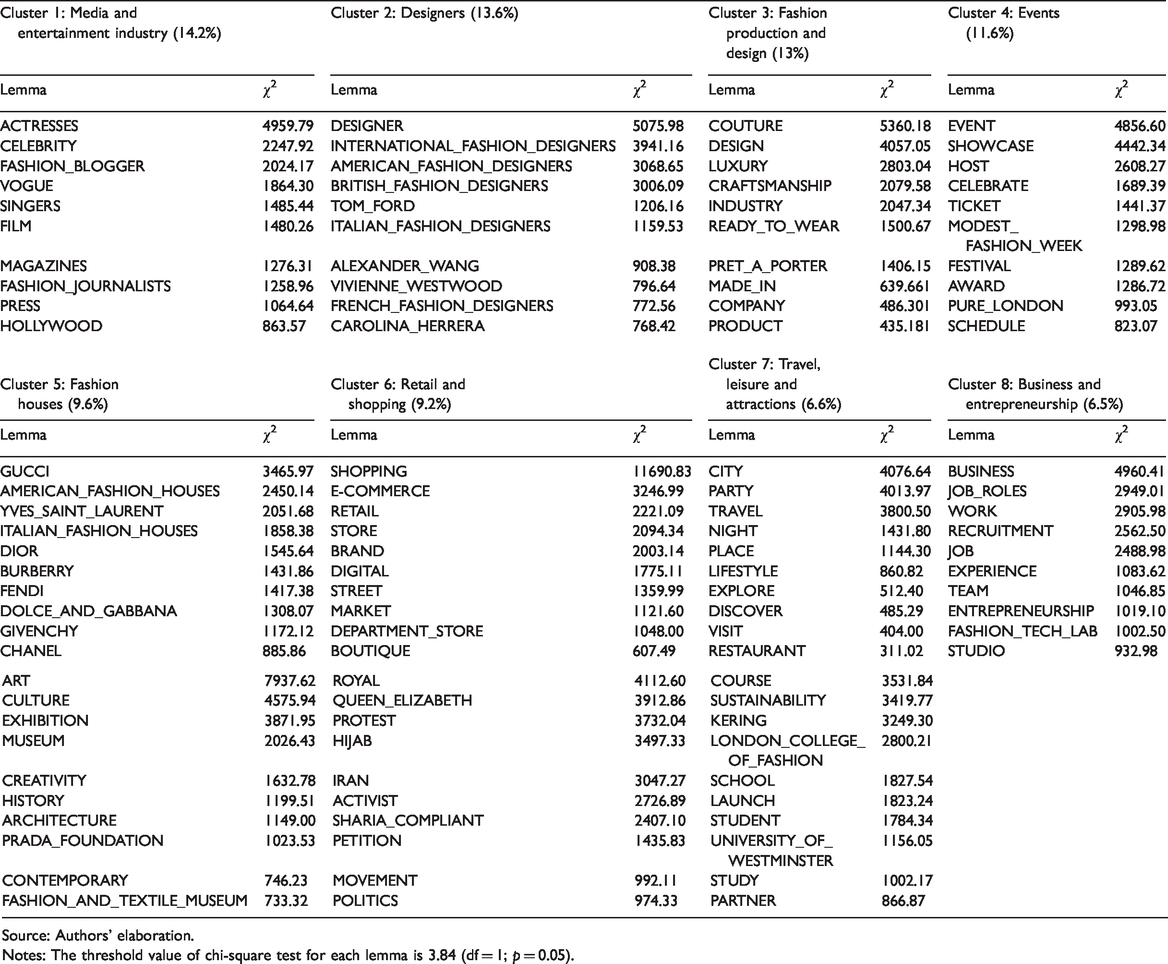
The analysis identified 11 thematic clusters, or groups of tweets on related subjects. In Table 1, the first 10 keywords with the highest chi-square in each cluster are listed in a descending order. The number of elementary contexts classified in TAEC was 31,265, which corresponds to 31.3% of total tweets. Each cluster has a different weight (or significance) that is based on the relationship between elementary contexts (or tweets) of the cluster and the overall elementary contexts in the entire corpus of tweets. These clusters, which are the main topics addressed when connecting the fashion industry to global cities on social media, contribute to the image-building process of these fashion urban centres.
Most characteristic lemmas and relative weight of the 11 thematic clusters.
Source: Authors’ elaboration.
Notes: The threshold value of chi-square test for each lemma is 3.84 (df = 1; p = 0.05).
Six thematic clusters were most important: ‘media and entertainment industry’ (14.2%), ‘designers’ (13.6%), ‘fashion production and design’ (13%), ‘events’ (11.6%), ‘fashion houses’ (9.6%), and ‘shopping and retail’ (9.2%). Most of the tweets included in the first cluster are about fashion’s relation with other creative industries (e.g. film, music, news, photography). Since the late 19th century, the emergence of a modern media system has played a key role in the image-building process of London, New York, Milan and Paris. Moreover, over time, the fashion industry has developed strong inter-dependencies with other CCIs, such as music, photography, media, arts, film, television and advertisement, which have helped these cities to sustain their position in the ‘symbolic economy’ for fashion (Rantisi, 2004; Rocamora, 2009; Tokatli, 2012). The second group of tweets exclusively refers to fashion designers, whereas the third cluster mainly deals with typology, processes and characteristics of production in the industry. An example tweet in this cluster is ‘Happy and proud of the sartorial excellence craftsmanship of Commonwealth Fashion Exchange London’. As explained earlier in the text, forms of specialized production have contributed to generating powerful symbolic associations between cultural goods and places (Scott, 1997). Keywords linked to the organization of events, fashion brands, shopping experience, in addition to online and offline retail are clustered in the fourth, fifth and sixth clusters, respectively. In this regard, we have already highlighted the role played by a variety of brand channels such as events, flagship stores, showrooms, shopping malls and retail districts in communicating interlinked place-based images that reinforce the primacy of these cities. Moreover, fashion houses are strongly connected to cities through a reciprocal relationship where firms use the image of urban centres for branding purpose and cities benefit from these associations by improving their position in the global geography of fashion (Jansson and Power, 2010).
Some of the remaining tweets are associated with ‘travel, leisure and attractions’ (6.6%), ‘business and entrepreneurship’ (6.5%), and ‘art, creativity and culture’ (6.4%). These clusters respectively group tweets on (a) travelling, tourist attractions, leisure time and nightlife, (b) established and new businesses, entrepreneurship, innovation and job searches, and (c) arts, creative and cultural activities, museums, exhibitions, theatres and architecture. Of particular importance is the contemporary relationship between fashion and art. In fact, in recent years, fashion has become growingly placed outside its traditional commercial context and within the context of museums, art galleries and architecture exhibitions. Cultural and arts-related institutions have become significant places where attaching fashion cultures to particular places (Tokatli, 2014). Tweets about forms of governments, social and political movements or actions and politics, as well as education systems, fashion-related institutions, training and launch of new talent are grouped under the themes ‘government, movements and politics’ (5.5%) and ‘education, institutions and talent development’ (3.7%), which have the lowest weight on the overall sample of textual data. Over time, educational institutions have functioned not only as means of attracting creative individuals but also of building the reputation and image of fashion centres. For example, in the late 19th and first half of the 20th century, the establishment of Pratt Institute, Parsons School of Design, and Fashion Institute of Technology, which are prestigious schools specialized in fashion and design, have helped build the global reputation of New York in the fashion industry (Rantisi, 2002).
The MDS analysis (see Appendix 1) showed similar co-occurrence patterns of keywords between the more tangible fashion design industry, represented by the thematic clusters ‘business and entrepreneurship’, ‘designers’, ‘fashion production and design’, and ‘fashion houses’, and the symbolic aspects of the industry, including all the other themes.
The first output emerging from TAEC provides an overall picture of the main themes addressed in the Twitter discussion on global fashion cities. The next step of the analysis involves the exploration of the relationship between these thematic domains and each city under investigation.
A comparative analysis of London, New York, Milan and Paris
Figure 1 synthetizes the thematic features of each city in a comparative thematic map. The geometric space is composed of two factors, which together accounted for 94% of the total variation. The first factor helps explain 74% of the thematic variance, whereas the second factor explains 20% of the data variability.
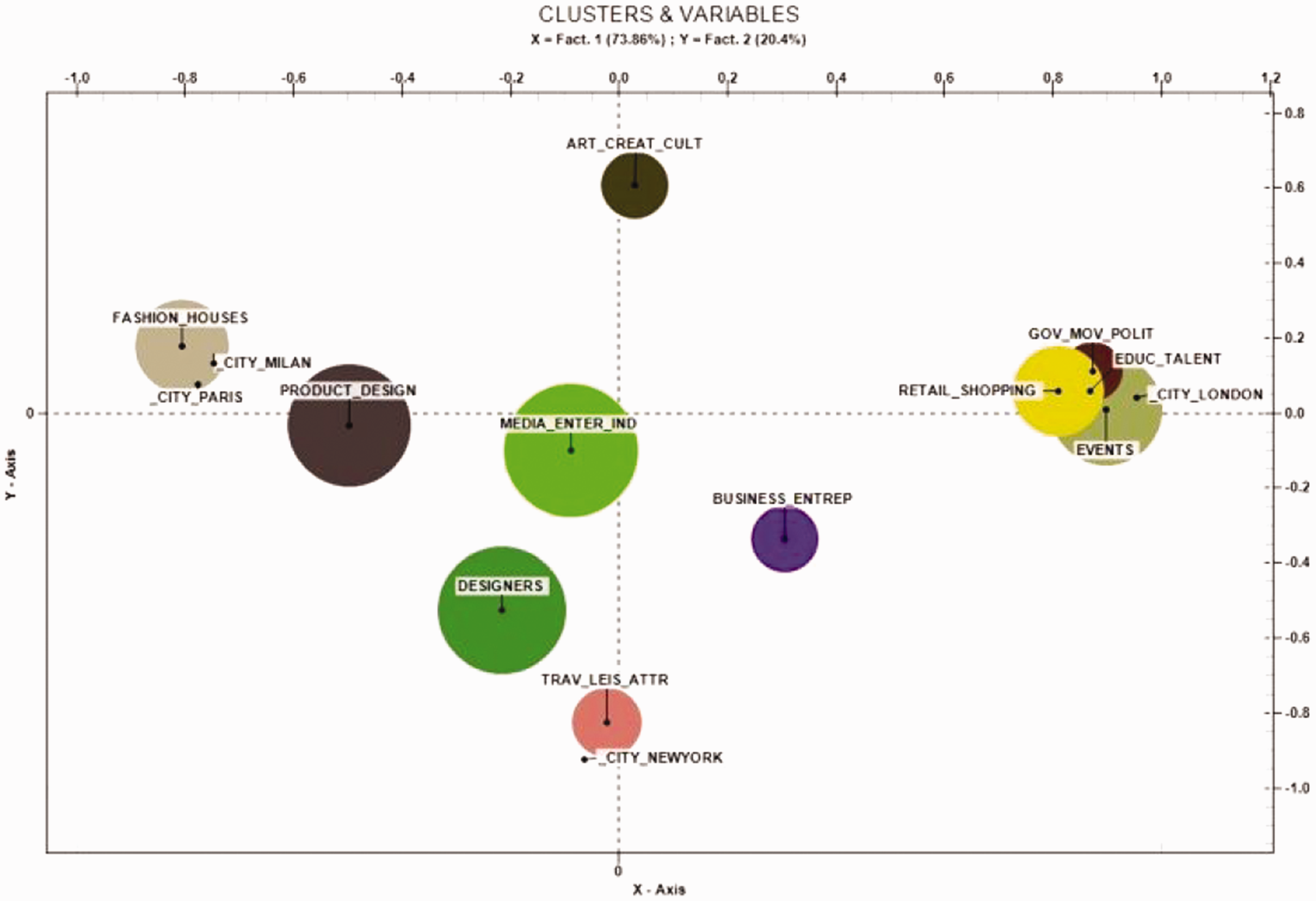
Correspondence analysis: Relationship between thematic clusters and variables.
The first factor, which explains most of the thematic variability, separates the variables Milan, Paris and New York (negative pole) from the covariate London (positive pole). Tweets on Milan and Paris are most similar; tweets on New York and London are relatively distinct. Tweets about Milan and Paris are more likely to be associated with traditional fashion houses, products and production processes. These cities hold strongly established traditions for being major centres for the world’s most renowned fashion houses, as well as for specific typologies of production like ready-to-wear for Milan and haute couture for Paris. In fact, while Milan includes some of the most renowned and powerful fashion houses in the world (e.g. Giorgio Armani, Versace, Dolce & Gabbana), Paris has become a key centre of powerful luxury and fashion goods conglomerates, particularly LVMH (which includes the fashion brands Dior, Louis Vuitton, Kenzo, Givenchy and Marc Jacobs) and Kering (which includes Balenciaga, Saint Laurent Paris, Gucci and controlling interest in Alexander McQueen and Stella McCartney) (Godart, 2014; Jansson and Power, 2010; Rocamora, 2009). Moreover, they both have a long-established tradition in artisanal production particularly renowned for its high-quality, innovation and creativity, and are described in the literature as cities characterized by a reputation ‘congealed in their products’ because of strong local cultural traditions and symbologies that enrich them with local authenticity (Scott, 2008: 94). Some of the tweets grouped in these clusters are: ‘The fashion houses of Paris and various industries in the country supporting haute couture would not be what they are today without haute couture’, ‘Even though the capital of Italy is Rome, Milan is the centre of fashion and design’, and ‘To open to the public and show the value of fashion manufacturing, creativity and craftsmanship in Milan. This is what the new exhibition held at Palazzo Reale is aimed to’.
New York seems to be portrayed differently: discussion mostly converges on themes linked to the media and entertainment industry and designers. The city hosts the headquarters of some of the largest fashion advertising companies in the world (e.g. Women’s Wear Daily, Vogue, Harper’s Bazaar) that have strongly encouraged the image-building of New York as a renowned fashion capital (Rantisi, 2002). New York is also known for the wave of American ‘entrepreneurial’ designers such as Ralph Lauren, Tommy Hilfiger, Calvin Klein, and Donna Karan, which in the 1980s and 1990s achieved international reputation in the global fashion market and effectively invented the category of ‘designer-wear’(Rantisi, 2002, 2004). Since then, around 40% of US fashion designers have been based in the New York area with a very high location quotient of 8.16 for the greater metropolitan area (Casadei and Gilbert, 2018). Tweets referenced ‘Hollywood elite’ and linked into economic development efforts, for example: ‘The council of fashion designers of America is in partnership with the New York City Economic Development’ (Tokatli, 2011; Williams and Currid-Halkett, 2011a).
Moreover, the variable New York is closely associated with the thematic cluster ‘travel, leisure and attractions’, emphasizing the significance of its tourism industry, leisure activities and nightlife. In fact, New York is home to a large variety of cultural institutions and activities such as art galleries, opera, theatres, retail districts, museums and nightclubs that contribute to attracting an international pool of creative talent and stimulating fashion-related tourism (Rantisi, 2004). Tweets included: ‘New York City is a people magnet attracting 60 million visitors every year and the iconic experiences are not bucket list items but a pilgrimage starting from its fashion nightlife’ and ‘New York is one of the world’s most visited cities, a global hub of finance, politics, communications, film, music and fashion, it is arguably one of the most influential cities in the world’.
The image of London on Twitter is as an innovative centre for training, launching and showcasing established and emerging talent by means of renowned schools, fashion-oriented institutions and a large variety of events. London has developed a reputation for a creative and conceptual approach to fashion, which is often regarded more as a form of artistic expression than of physical production. Its education system is a powerful engine of the local fashion economy, and is committed to attracting highly talented international students, and producing creative and innovative talent. The London Fashion Week is internationally regarded as one of the most important events for discovering the most original and creative fashion talent in the world (Casadei and Gilbert, 2018). Examples of tweets are: ‘London has always been the fashion city where anything can happen, always innovative, always full of surprises, always packed with talent both established and new’, ‘Students of the University of Westminster from BA in fashion design made a spectacular debut on the London Fashion Week schedule’, and ‘Emerging talent has long been regarded as the backbone of London Fashion Week out of all the fashion weeks’.
London is also regarded as an important city for shopping. It has a strong retailing history and is regarded as one of the major destinations for fashion-related tourism. The fashion retail sector includes some of the most prestigious fashion districts in the world with high-end boutiques, internationally known department stores, a huge variety of high street shopping opportunities and new significant hubs for cutting-edge independent emerging designers. This sector contributes to generating both economic and symbolic value in the local ecosystem (Casadei, 2018). For example, some of the tweets are: ‘London, so many stores so many wonderful things and only one day to shop Selfridges and Harrods’, ‘From London to Milan you will be inspired not only by what you see on the runway but by the looks which you find on the street’, ‘London’s most vibrant urban markets Sample Spring is back showcasing emerging creatives from the worlds of fashion design with their new collections’, and ‘Clerkenwell Vintage Fashion Fair is on Sunday. Shop brands you won’t find in the high street shopping’.
London’s representation on Twitter is also associated with the royal family, social movements like the Islamic fashion industry, animalist protests or political issues like Brexit. For example, some of the tweets are: ‘London Modest Fashion Week celebrates Sharia compliant clothing’, 13 ‘How Brexit could destroy London Fashion Week. Study by The Law Society reveals copyright nightmare that could stop new designs being unveiled’, ‘Queen Elizabeth II has made her first visit to London Fashion Week to present an award recognizing British design excellence’, ‘Sustainable fashion has got support from the Royal family of UK’, and ‘From provocative to political t-shirts of all kinds on exhibit in London fashion’.
It is interesting to point out that the thematic cluster ‘art, creativity and culture’ is positioned almost equidistant from the covariates Milan, Paris and London, indicating the importance of this theme in the representation of all these cities. In Milan, a growing number of fashion houses has recently showcased collections within museums or arts-related venues or has invested in art galleries and exhibitions. For example, in 2001, Prada turned its Fondazione Prada into a cultural organization including a vast array of creative fields such as architecture, design and cinema with a large symbolic and economic impact in the cityscape (Tokatli, 2014). Since the 19th century Paris has been known for being a leading cultural, creative and fashion centre, capable of attracting artistic talent from France and other countries. Moreover, the Parisian haute couture has intensively relied on art, defining itself as a highly creative activity rather than a mere sartorial practice (Scott, 1997). Lastly, London is acknowledged for high levels of creativity in fashion. Moreover, the strong connection between fashion and art contributes to generating a highly vibrant creative field, where fashion designers are part of local artistic communities and fashion design courses are taught within colleges of arts (Casadei, 2018). Some of tweets are: ‘Wonderful time at London Victoria & Albert Museum for the Balenciaga exhibition’, ‘Paris is the French capital and a global centre for art fashion and culture’, ‘Chanel gives Paris its first fashion museum’, and ‘Italy has a rich cultural heritage that encompasses among other things architecture food and fashion. Starting tomorrow at Palazzo Reale in Milan an unmissable new exhibition: Italy Through the Lens of Fashion from 1971 to 2011’.
Likewise, the cluster ‘business and entrepreneurship’ is positioned almost equidistant from the variables London and New York. An explanation for this is the reputation of these cities for being important centres for establishing new businesses and finding employment in the fashion industry (Tokatli, 2011). Most of the tweets are about job offers to work in fashion-related fields in these cities. Others deal with awards and competitions in support of fashion designers and entrepreneurs. For example, a few tweets are: ‘British creative talent and designers are today employed throughout the world and at all of the top fashion houses’, ‘With its billion-dollar fashion brands and emerging designers New York offers exciting career opportunities to job seekers’, and ‘Congrats to former Start Up Challenge winner fashwell.com for being selected for New York Fashion Tech Lab’. Lastly, the cluster ‘media and entertainment industry’ is very close to the centre of the graph, showing its high significance in the narrative of all the four cities.
The output of MDS analysis of variables (see Appendix 2) further highlights the peculiarity of London’s representation, which strongly differs from the way Milan and Paris, and to a lesser extent New York, are perceived on Twitter.
Figure 2 shows the relative weight of thematic clusters in each city, enabling us to better compare London, Milan, New York and Paris in terms of significance of themes. This graph further emphasizes differences in the way global fashion cities are represented on Twitter.
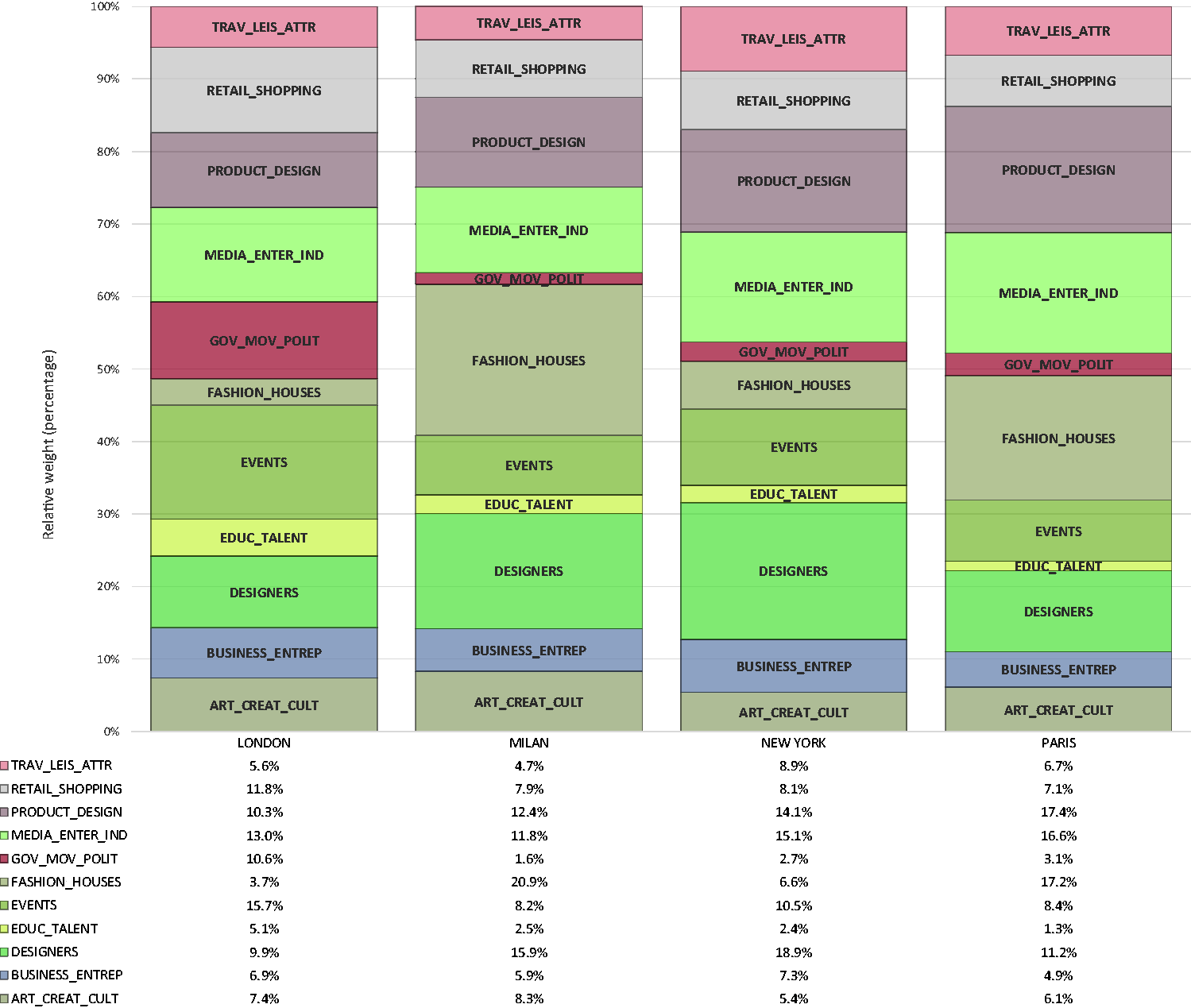
Relative weight of thematic clusters by city.
London has the most heterogeneous composition of thematic clusters. Compared with the other cities, most of its tweets focus on ‘events’, ‘shopping and retail’, ‘education, institutions and talent development’, and ‘government, movements and politics’, whereas a lowest number of tweets deal with ‘fashion houses’, ‘designers’ and ‘fashion production and design’. Previous research has shown that retail and distribution, events organization and the education system dominate the London-based fashion industry, whereas the fashion design sector is relatively narrow and not adequately supported by a tiny, fragmented and non-specialized manufacturing base (Casadei, 2018). Conversely, tweets on Milan mostly relate to ‘fashion houses’, ‘designers’ and ‘fashion production and design’, with less focus on ‘government, movements and politics’ and ‘travel, leisure and attractions’. Like Milan, most tweets on Paris are related to ‘fashion houses’, ‘fashion production and design’ and ‘media and entertainment industry’. Among the other cities, the Twitter narrative on Paris is less focused on ‘business and entrepreneurship’, ‘education, institutions and talent development’ and ‘retail and shopping’. This representation is in line with results from previous studies on these cities. In fact, in both Milan and Paris, due to an education system strongly focused on technical, craft and production skills, there is a tendency to hire design professionals trained in other cities in the world, particularly London and New York (Casadei and Gilbert, 2018). Tweets on New York are primarily associated with ‘designers’, ‘media and entertainment industry’ and ‘fashion production and design’. Compared with the other cities, New York’s representation has the highest percentage of tweets on ‘designers’ and ‘travel, leisure and attractions’, and the lowest percentage on ‘art, creativity and culture’.
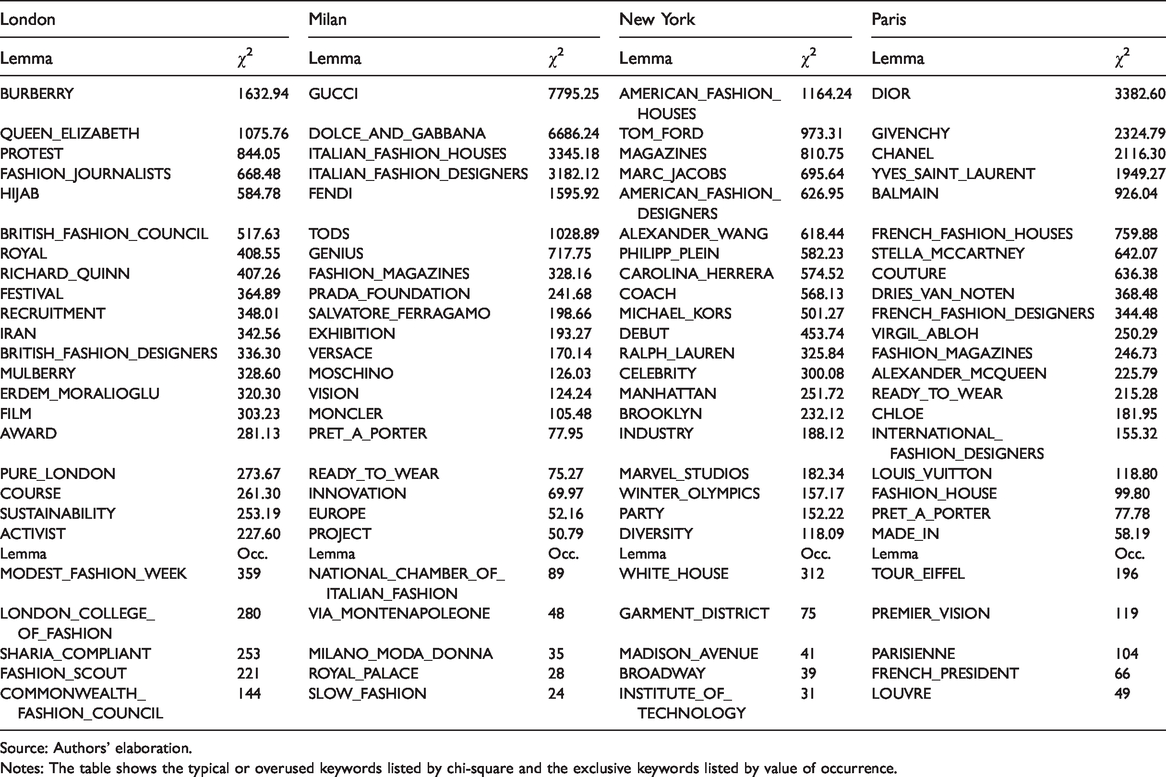
Results from specificity analysis (Table 2) display the most used (i.e. keywords that are mostly repeated in one corpus subset) and unique keywords (i.e. keywords that appear exclusively in one corpus subset) for each sample of tweets on London, Milan, New York and Paris. This analysis helped shed light on the specificities of each city’s representation on Twitter. The most typical and exclusive lemmas for tweets on London are varied and refer to different topics. Burberry and Mulberry are the only two fashion houses that appear in the list, which also includes fashion-related institutions (i.e. British Fashion Council and Commonwealth Fashion Council), and a few lemmas associated with the education system (i.e. London College of Fashion and course) and local designers (i.e. British fashion designers, Richard Quinn and Erdem Moralioglu). Many keywords are linked to events (e.g. festival, award, Pure London, Modest Fashion Week), whereas other lemmas refer to the royal house (i.e. Queen Elizabeth and royal), more general issues linked to social movements and politics (e.g. protest, Iran, activist, Sharia Compliant), media (i.e. fashion journalist and film) and employment opportunities (i.e. recruitment).
Specificity analysis: Typical and exclusive keywords by city.
Source: Authors’ elaboration.
Notes: The table shows the typical or overused keywords listed by chi-square and the exclusive keywords listed by value of occurrence.
Tweets about Milan are associated with Italian fashion houses (e.g. Gucci, Dolce & Gabbana, Fendi). Some other lemmas refer to typologies and processes of production (e.g. prêt-à-porter, ready-to-wear, slow fashion), as well as art, creativity and culture (i.e. Prada Foundation, exhibition and Royal Palace). Only a few lemmas are related to events, media and shopping (i.e. Milano Moda Donna, fashion magazines, Via Montenapoleone). In a similar vein, the majority of tweets on Paris are linked to French fashion houses (e.g. Dior, Chanel, Yves Saint Laurent, Louis Vuitton), with several lemmas dealing with fashion production and design (i.e. couture, ready-to-wear, prêt-à-porter and made-in) and a few keywords associated with media, tourist attractions and events (i.e. fashion magazines, Tour Eiffel and Louvre).
The typical and exclusive keywords of Twitter data on New York are mostly about American fashion designers (e.g. Tom Ford, Marc Jacobs, Michael Kors), media and entertainment industry (i.e. magazines, celebrity and Marvel Studios), and travel, leisure and attractions (e.g. Manhattan, Brooklyn, party, White House, Madison Avenue, Broadway). Only a few lemmas refer to fashion production (i.e. Garment District), education, institutions and talent development (i.e. debut, Institute of Technology), and events (i.e. Winter Olympics).
Discussion and conclusions
This paper has used micro-data from tweets to provide a fine-grained study of the interrelated representations of cities and the fashion industry. Our focus is on fashion: an exemplar creative industry of symbolic production and an important part of many place-branding strategies. We used an innovative methodological approach to explore the interrelationship between representations of the fashion industry and representation of cities, a topic which we argue is important both to place branding efforts and the fashion industry, an important sector in many major cities. To the best of our knowledge, this is the first study that uses Twitter data and text mining to explore the representation and perceptions of fashion centres. We focused on the four leading cities of fashion because of their heterogeneity in terms of manufacturing, economic, cultural and symbolic factors that have contributed to their enduring reputation in the worldwide fashion scenario.
Our primary finding is differentiation between the four cities. The literature on city branding and urban economic development argues that companies draw on local associations to differentiate production (Pike, 2013; Turok, 2009). We find support for this idea with considerable diversity in the way cities are portrayed. Moreover, the way these global fashion cities are differently represented on Twitter has considerable similarities to results from previous analyses of these cities (Casadei and Gilbert, 2018; Godart, 2014; Jansson and Power, 2010; Rantisi, 2004; Tokatli, 2011; Williams and Currid-Halkett, 2011a).
Milan and Paris are portrayed in the most similar way, with a focus on traditional national fashion houses (e.g. Gucci, Versace, Dior) and artisanal production. There are connections with arts and culture that specifically refer to museums, galleries, exhibitions and cultural attractions, as well as with creativity. Tweets about New York deal not only with American fashion designers (e.g. Tom Ford, Marc Jacobs), the media and entertainment industry, and production and design, but also with tourist attractions, leisure activities and nightlife. In line with this result, previous academic literature has already described New York as a hub for the success of independent designers, which are supported by the proximity to the so-called Garment District and an intense social life that contribute to their success (Rantisi, 2004). Moreover, some of its associations refer to elements linked to business, entrepreneurship, innovation and recruitment industry, which are also part of the Twitter discourse on London. In fact, these cities are known for being important centres for finding employment and establishing new businesses in the fashion industry (Tokatli, 2011). In contrast, London is most distinct, portrayed on Twitter as hosting innovative fashion- and non-fashion-related events, home to extravagant shopping including some of the most important retailers in the world, and a renowned system for training and launching new designers. In addition to important associations with art, creativity and culture, other tweets refer to more general themes such as the royal family, political issues, new trends, protests and social movements, some of which emphasize the openness of the city to diversity, newness, different cultures and views.
But our second finding provides an important extension to this point: the four cities are portrayed differently, but each individual city was also portrayed in different ways by different users. This finding was clearest in London where some of the associations we identified can seem, at first sight, contradictory. For example, while the royal family is considered in representations of London, other themes focus on the modern, inclusive and open nature of the city. Some focused on the sustainability of fashion, others on compliance with Islamic cultural norms. As Crewe (2013) outlines, social media have allowed multiple representations of fashion to exist. Using Twitter, a freely available social media platform, shows this clearly. As new technologies have allowed more voices, they have allowed us to highlight this differentiation.
Third, we show that symbols local to each particular city were woven into the broader narrative about fashion. Rather than a placeless ‘fashion week’ focused on global trends in production, our results show that the events in each city were interrelated with the institutional and physical environment of each city. In particular, the social media network Twitter is the platform through which these messages are communicated and can be considered as the ideal platform mirroring the most significant messages linking fashion to cities. Gatekeepers in the sector and, to a lesser extent, the more general public (that is influenced by gatekeepers) tend to select and transform messages coming from the magnitude of information disseminated by media. However, results of this study highlight that social media – in this case Twitter – tend to reflect the material elements and the messages created around these elements, not altering or manipulating the representation of cities. They also integrate the physical environment of the city, such as the Eiffel Tower. While fashion is portrayed as being fast-changing and ephemeral, many of these images are, we suspect, long-lasting to the point that they could even be described as clichés.
Although we need to be cautious about generalizing from one social media platform, we can make a few observations on the increasingly widespread use of symbolism as a means of developing and revamping fashion cities, specialized in image-making activities, fashion design or manufacturing. Our results show that urban cultures, creative elements, histories and traditions that are rooted in cities still play an active and fundamental role in the representation and perception of fashion cities. Therefore, it is important for policy makers not to think about fixed place-branding strategies, but about customized policies for each different historical and cultural urban context; for example Milan might refer to the traditions of craftsmanship we identify as important here. In this regard, future studies should address the way symbolism and image-making processes act as a means of promoting ‘positive’ cities’ images and contributing to economic growth to better inform policy makers on the adoption of fashion-related policies for the revamping of cities. Other suggestions for further research concern the replication of our analysis using new data sources and methodologies, including less established cities, and executing the analysis over different periods of time to reduce the chance of time-specific ‘disturbing elements’. While our research has used Twitter, other analysis may also seek to see how users link Twitter with other social media such as Instagram to see if this yields different results.
Footnotes
Declaration of conflicting interests
The author(s) declared no potential conflicts of interest with respect to the research, authorship, and/or publication of this article.
Funding
The author(s) disclosed receipt of the following financial support for the research, authorship and/or publication of this article: The research was funded by an LSE STICERD small grant and the AHRC Centre of Excellence for Policy and Evidence in the Creative Industries [Grant reference AH/S001298/1].
