




Abstract
Conventional approaches to local economic development are failing to address deepening polarisation both within and between city regions across advanced capitalist economies. At the same time, austerity urbanism, particularly in the UK, presents challenges for urban authorities facing reduced budgets to meet increased demands on public services. Municipalities are beginning to experiment with creative responses to these crises, such as taking more interventionist and entrepreneurial roles in developing local economies, generating alternative sources of revenue or financialising existing assets. Rooted in a Polanyian perspective and building on the concepts of the entrepreneurial state and grounded city, we identify an embryonic alternative approach – what we call ‘entrepreneurial municipalism’ – as a policy pathway towards resolving enduring socioeconomic problems where neoliberal urban-entrepreneurial strategies have failed. We situate entrepreneurial municipalism as one strand in an assemblage of new municipalist interventions, between radical urban social movements and more neoliberal strategies such as financialised municipal entrepreneurialism. Drawing on original research on the Liverpool City Region, we explore how local authorities are working with social enterprises to harness place-based assets in ways which de-commodify land, labour and capital and re-embed markets back into society. Finally, we draw upon Polanyi as our guide to disentangle differences in approach amongst divergent forms of municipalist statecraft and to critically evaluate entrepreneurial municipalism as a possible trajectory towards the grounded city.
Keywords
Introduction
Imagine a world in which the city region’s devolved government – not the private sector per se – is the economy’s indispensable entrepreneur, innovating and able and willing to take risks and to persevere through uncertainty. Adapted from Mazzucato’s (2013) The Entrepreneurial State (our changes in italics)
Our interest in exploring new forms of city-regional industrial strategy is set within the context of conventional approaches that have failed to ameliorate economic polarisation in advanced capitalist economies, particularly Britain with its historic policy vacuum in regional rebalancing (McCann, 2016); and the failures of ‘late-entrepreneurialism’ (Peck, 2017) and ‘austerity urbanism’ (Williams et al., 2014) in addressing socioeconomic problems afflicting post-industrial cities. Industrial strategy as currently conceived at national and city-regional levels is insufficient to arrest growing economic imbalances and inequalities between and within regions and will not lead to inclusive or sustainable economic development, particularly for ‘lagging’ city regions – as argued in recent work on the ‘foundational economy’ (Bentham et al., 2013; Foundational Economy Collective, 2018). Instrumental in this failure is the prevailing focus on productivity over employment; innovative high-tech industries over foundational sectors; and inward investment over endogenous assets. In this article, we explore the possibilities of refocusing industrial strategy-making to the city-regional and municipal scales and a recalibration towards entrepreneurial-municipal strategies.
Decades-dominant approaches to local economic development – notably, the ‘creative class’ boosterism of ‘new urbanism’ (Florida, 2002) and the fixation on agglomeration in ‘new economic geography’ (see, for instance, Overman, 2013) – have also proven insufficient to resolve enduring socioeconomic problems for all but a few in the major metropolitan city centres. As the purchase of new economic geography has loosened, ‘inclusive growth’ has begun to gain traction – in some sense, a Polanyian counter-movement against market hegemony in the domain of policy ideas. Inclusive growth moves away from pre-occupations with trickle-down and agglomeration to highlight important connections between economic and social domains that could support a more holistic, redistributive and democratic approach to address poverty and inequality (Lee, 2018; Lupton and Hughes, 2016). Inclusive growth is gaining purchase on urban policy thinking in the UK, having been first popularised amongst policymakers in the Global South in the 2000s and, later, by the Organization for Economic Cooperation and Development (OECD) and World Bank. A lack of clarity over competing definitions makes measurement problematic and strategies to operationalise it difficult to pin down, and there are concerns over the power of local government to stimulate economic growth or decide who benefits, particularly in the context of austerity (Lee, 2019). However, inclusive growth is held to be a shared agenda whereby local governments can link existing policy tools, collaborate with neighbouring authorities and other tiers of government, anchor institutions, employers and voluntary and community organisations to stimulate and direct economic growth towards social change (Lupton and Hughes, 2016).
Most recently, we have witnessed the resurgence in municipalism – the relative power of municipalities over political and economic governance. At one end of the spectrum, the ‘new municipalism’ of the Fearless Cities network, an emerging global social movement of citizen platforms aiming to democratically transform local government and urban economies, signals a radical break with post-democracy and neoliberal austerity (Blanco et al., 2019; Russell, 2019). At the other end are more pragmatic responses to austerity urbanism that involve local governments creatively utilising or financialising their assets in land to build new housing or buy commercial property to create alternative revenue streams for funding essential services (Christophers, 2019) in what has been labelled ‘financialised municipal entrepreneurialism’ (Penny and Beswick, 2018) or ‘financialised city statecraft’ (Pike et al., 2019).
Building on recent reinterpretations of the concept of statecraft (see also Ayres et al., 2018; Lauermann, 2018), we understand these various municipalist mutations as part of an assemblage of competing adaptive and experimental strategies of governing in, against and beyond ‘late-entrepreneurial’ urban political economy (Peck, 2017). Here, entrepreneurial municipalism is just one tool amongst a panoply of approaches that local states adopt to survive (Pike et al., 2019) – both a product and part of municipal bricolage. We draw on Polanyi – following the recent turn towards Polanyian economic geographies (see Peck, 2013, part of a special issue on Polanyi in this journal) – to construct a conceptual lens through which to view and evaluate these different variants of municipalism. Polanyi’s concepts of (de)commodification and (dis)embeddedness are mobilised to help explain the fine differences between entrepreneurial municipalism and the financialised municipal entrepreneurialism we see emerging across the UK in particular.
To illuminate these insights through concrete cases, this article focuses on several examples of entrepreneurial municipalism we have identified in the Liverpool City Region (LCR). Our choice of case study partly reflects the interesting dynamics of local economic development innovation emerging in this city; partly the expediency of our status as researchers based in LCR and embedded in many of these or related projects. We draw on empirical material derived from two independently commissioned research projects in LCR, each conducted by at least two of us throughout 2017 (Heap et al., 2017; Southern et al., 2017). They involved a mapping exercise of the local economy, documentary analysis of key local economic development policy texts, 50 semi-structured interviews with local politicians and public policymakers at both local authority and city-regional level, business leaders, trade union representatives, charity leaders, social entrepreneurs and community activists, as well as roundtable debates and focus group discussions with broader stakeholders. This work forms part of an ongoing action-research project involving the creation of a platform for promoting the social and solidarity economy for more inclusive growth in the city region, through which a number of prominent organisations and key actors meet regularly to design strategy and influence policy.
Our understanding of entrepreneurial municipalism is not of a fully formed ‘model’ of economic development but rather, following Purcell’s (2013: 23) interpretation of Lefebvre’s method of transduction, [A]n extrapolation or amplification in thought of practices and ideas that are already taking place in the city, practices and ideas that are inchoate, that have not yet come to full maturity, but are nevertheless being expressed, if only hesitantly, fleetingly, or inarticulately.
Using Lefebvre’s method of transduction as our approach to explore emergent examples of entrepreneurial municipalism in the LCR, we thus draw out lessons for how the local state can play a more proactive role in developing what Engelen et al. (2017) describe as ‘accelerators’ and ‘stabilisers’ as part of a more ‘grounded’ approach to urban economic development. In what follows, we first locate the theoretical foundations of the concept of entrepreneurial municipalism, in Polanyian and foundational economic perspectives, before situating it within related terms. Next, we introduce our empirical research in Liverpool, including some background to the political-economic and policy contexts. Finally, we explore the tentative signs of an emergent entrepreneurial municipalism in the city region through instances and exemplars of experimentation in policy and practice before, in the conclusion, drawing out conceptual implications for local economic development.
Theoretical foundations for entrepreneurial municipalism
Our conceptualisation of entrepreneurial municipalism is founded upon a Polanyian understanding of the economy as socially embedded institutional structures or ‘modes of integration’ (Polanyi, 1944) – enabling a shift in focus from productivity and competition towards a more active role for the state and civil society. Polanyi conceived the economy as composed of interacting processes of reciprocity, redistribution and market exchange – each involving different actors and requiring different types of institutional support, constructed over time to develop an overarching institutional framework (Polanyi, 1944). Reciprocal exchanges take place within a community or social sphere and require symmetrical relations in terms of power and influence, that carry no expectation of material gain, but are associated with empathetic social relations motivated by reasons other than self-interest (Block, 2008). Redistribution is associated with state structures, requiring a central mechanism for movements into and out of – as in systems of taxation and re-allocation – with an obligative non-market relationship between the state authority and participants (Polanyi, 1944). Polanyi’s conception of market exchange comprises a two-way flow of goods, services or money between buyers and sellers that takes place within a system of price-making markets, with transactions underpinned by logics of personal gain and competition.
Polanyi’s substantivist view conceived the role of economy as provisioning for peoples’ needs or livelihoods rather than efficiency, utility or profit maximisation. Through the neoliberalisation of society, state structures have come increasingly to support market exchange, with urban competitiveness and productivity eschewing consideration of community. Here, government provides formal support for private for-profit enterprise with resources and activity directed towards the market. This follows Polanyi’s insight that capitalism tends to dis-embed the market economy from the social relations and material environments that co-constitute it and thereby elevates exchange as the primary sphere of economic interaction. Dis-embedding can be seen in the ‘fictitious commodification’ 1 of labour, which exerts market control over people creating levels of precarity that put pressure on society, sometimes leading to resistance against market dominance (Peredo and Mclean, 2019; Polanyi, 1944). Similarly, Polanyi viewed land as sustaining life and access to it a pre-requisite for well-being and social stability, rather than a privatised commodity from which to extract wealth (Christophers, 2018; Polanyi, 1944). Bringing property into common ownership to support social goals, as in Community Land Trusts, has the effect of de-commodifying and re-embedding land in society, so contesting marketisation (Christophers, 2018; Peredo and Mclean, 2019).
By re-embedding the economic factors of production – land, labour and money (or capital) – back into society, municipal entrepreneurialism might be seen as part of a Polanyian ‘countermovement’ for a more equitable, sustainable and democratic economy in which the three logics – reciprocity, redistribution and exchange – are in balance (Polanyi, 1944). Each of these spheres are ever-present and inter-related but their strength and dominance will vary over time and between places depending upon broader social, cultural, political and economic contexts. This has two implications for our research. First, this strand of Polanyi has guided understanding on geographical variegation that provides a spatial fix to understanding economy (Peck, 2013), underlining the importance of case study research that appreciates local context and history to understand broader economic shifts. Second, it signifies incremental movement in the relative influence in each sphere, opening possibilities for shifts towards increased government and community activity within a market-driven economy as those advanced in what we describe as entrepreneurial municipalism below. Polanyi’s work – as part of growing interest in the so-called ‘moral economists’ – has been influential in renewing political interest in alternatives to neoliberal and agglomeration economics, particularly on the foundational economy.
Re-founding the economy; re-grounding the city
One of the more critical strands within the emerging policy paradigm of inclusive growth – and chiming with Polanyi’s substantivist approach – the ‘foundational economy’ rejects traditional focus on productivity in favour of ‘that part of the economy that creates and distributes goods and services consumed by all (regardless of income and status) because they support everyday life’ (Bentham et al., 2013: 7). Specifically, the foundational comprises ‘providential services’ like education, health and social care and the ‘material infrastructure’ of utilities, transport networks, digital connectivity, retail banking and food production, which together underpin the rights of citizenship and the common good (Foundational Economy Collective, 2018). This appears to draw on Braudel’s tri-partite architecture of society in which the economy is conceptualised as three layers: the world economy of large companies and institutions engaged in global export markets; the local market economy of anchor institutions, small and medium-sized enterprises (SMEs) and the self-employed addressing local needs; and a subsistence economy of informal activities (see Haughton, 1999: 9). Whereas conventional sector-based industrial strategy foregrounds the first, most visible layer, the foundational economy draws attention to the latter layers – those mundane and overlooked yet fundamental economic activities that constitute the foundation of everyday life.
Reflecting Polanyi’s tri-partite economic institutions, the foundational economy presents public services and civic infrastructure – delivered ‘outside’ the economy by the state and third sector – as much a part of the economy as the ‘world economy’ of glamourous export industries. Foundational sectors are seen not as some unproductive drag on the ‘real’ economy, paid for out of tax receipts from ‘productive’ sectors, such as high-tech and knowledge-intensive industries, but as the real foundation of our economy generating social value and providing the majority of jobs. Our skewed perception of the economy is partly a matter of where we have drawn the line between market and state – between the surplus-creating, tax-funding private sector and the surplus-consuming, tax-spending public sector. Health services, for instance, can be reframed as creating outputs rather than costs, through a different accounting lens. Taken together, by 2017, foundational sectors employed nearly 37% of the Italian workforce, over 41% of the German workforce and over 43% of the British workforce – far more than technology- and export-oriented industries, and increasing in number as automation makes more jobs redundant (Foundational Economy Collective, 2018).
The scholars associated with the Foundational Economy Collective have posited the ‘grounded city’ as an alternative to the free-floating and disconnected ‘competitive city’ – ‘the city as a space of collective civic provision, which meets social needs’ and whose economy is ‘grounded’ in its locale and local population (Engelen et al., 2017: 408). By ‘grounded’ they mean three things: a city’s development is inter-dependent with, and rooted in, its metropolitan regional hinterland of resource and labour inputs; that one of the major ‘accelerators’ of urban-economic growth is rising land values; and grounded in the sense that cities are built on their foundational economy, acting as a ‘stabiliser’. The alternative approach to economic development proffered by the grounded city concept ‘starts by accepting that external governors cannot be controlled at the city level and that policy should therefore focus on the internally controllable stabilisers and accelerators’ (Engelen et al., 2017: 419). ‘External governors’ comprise exogenous factors of economic growth that include both political advantages such as administrative status in the national hierarchy of state functions, and economic advantages such as location on international trade routes and endogenous export industries with historical competitive advantage. Whilst influenceable to some degree, the overt focus of industrial strategy that supports external governors over stabilisers and accelerators has led to a race to the bottom where local assets and endogenous capabilities are neglected to the disadvantage of residents and long-term growth.
Instead, city-regional industrial strategy should refocus on more controllable and locally embedded ‘accelerators’ of growth balanced by ‘stabilisers’ of provision of essential services. Engelen et al. (2017) cite urban land as an important accelerator, in capturing ‘unearned social increment’ accruing through public and private investment in land and services that provides productive industries with infrastructure, which, in turn, generates higher land values. We would add another important factor as an accelerator – grassroots innovation and entrepreneurship at a local level. Rather than rely on large corporations from elsewhere to drive economic growth (and extract wealth created rather than re-investing locally), this involves incubating SMEs, social enterprises and entrepreneurs in ways which not only generate economic value through new business activity but also connect local labour markets with large-scale ‘innovation assets’ and ‘growth sectors’.
Whilst accelerators provide opportunities for (inclusive) growth, stabilisers help ‘ground’ a city, acting as a ‘buffer’ to the vagaries of changing market dynamics (Engelen et al., 2017). Stabilisers centre on the provision of essential services and welfare goods for the satisfaction of human needs – what we conventionally conceive as public services – as well as material infrastructure of everyday life in the foundational economy. It is obvious how the local state can act to enhance and develop the important role of stabilisers in local economic development, not least through its central role in delivering public services, generating social and economic value through innovative procurement and commissioning policies that support a sustainable local economy. However, stabilisers are most effective when deployed in combination with accelerators.
Both stabilisers and accelerators have contributed to economic revival in Cleveland, Ohio, where severe deindustrialisation saw population decline over 50% from its peak in 1950. Here the logic is simple: rather than relying on big multinational corporations and external governors, Cleveland policymakers focused on existing place-based assets and the power of anchor institutions to cultivate those assets through their supply chains (see Alperovitz, 2016; Coppola, 2014; Rowe et al., 2017). The Cleveland model effectively combines the stabilising power of procurement and commissioning with the accelerating power of small enterprise incubation and development. There has been a big focus on developing a network of worker-owned co-operatives, the Evergreen Cooperative Initiative, each specialising in aspects of the foundational economy – laundry, solar energy, food production – to fulfil the procurement needs of the big anchor institutions, notably universities, medical research institutes and hospitals. The model is highly democratic and sustainable in that workers control the decision-making of each Evergreen co-op, which pays 10% of pre-tax profits back into a development fund to seed the growth of new co-ops.
Whilst this initiative has not solved all of Cleveland’s problems, it has made some progress towards economic revitalisation (Coppola, 2019; Rowe et al., 2017) – by employing hundreds of local people otherwise stuck in structural unemployment; creating spin-off economic activity through local multiplier effects; strengthening connections between anchor institution and local people for place-based civic engagement; moving away from highly competitive, increasingly futile inward investment strategies towards a focus on existing assets, self-sufficiency and mundane, everyday economic activities like laundry; re-localising production and consumption processes, such as food, and strengthening self-sufficiency by cutting reliance on economically and environmentally costly global imports; transitioning to a more ecologically sustainable economy; creating the conditions for economic democracy and empowerment in marginalised communities; improving workplace conditions; and providing a new vision for future prosperity. The success of the ‘Cleveland Model’ has inspired several other US cities, and in the UK most famously the ‘Preston Model’ (O’Neill, 2016).
Grounding the concept of entrepreneurialism
The grounded city approach could benefit a great deal by being brought into conversation with recent work on the ‘entrepreneurial state’. Mazzucato has argued for a leading state role in actively shaping local spaces to enable innovation. Rather than trying to fix markets, to put ‘patches on existing trajectories provided by markets’ (Mazzucato, 2015: 5), the state should instead support initiatives such as advanced manufacturing, by developing local institutional infrastructure, more than seeking to fix market failure. This would involve the local state taking a more proactive – or entrepreneurial – role in shaping land and labour markets in ways which harness local assets and maximise the benefits of stabilisers and accelerators for local economic growth. This is what we mean by the concept of ‘entrepreneurial municipalism’. Drawing on the co-operativism of the 1840s, the ‘gas and water’ municipal enterprise of the 1890s and the more radical municipal socialism of the 1980s, this concept reinvents entrepreneurialism as a progressive municipal idea for the 21st century. It stands diametrically opposed to those more passive, competitive approaches of the earlier phase of ‘urban entrepreneurialism’ that tend to let the global market dictate trajectories and respond reactively to opportunities through, for instance, asset-stripping public land and services (Lauermann, 2018). In this way, we draw on counterhegemonic concepts of entrepreneurship that challenge capitalocentric notions of the ‘heroic entrepreneur’ and posit instead a more collective, cooperative and disruptive creative force that owes as much to political agitation and social transformation as economic opportunism (Southern, 2014; Thompson, 2019).
We see this notion of the cooperative insurgent activist-entrepreneur at work in the rise of new municipalism (Russell, 2019). In cities across the world such as Barcelona, Berlin, Bologna, Jackson and Preston, activist-entrepreneurs are beginning to experiment with more endogenous approaches to local economic development that remain alert to both social justice and future economic trajectories. This includes initiatives across a diverse range of policy areas, notably harnessing digital platforms and platform cooperatives for neighbourhood democracy and participatory budgeting as in Barcelona (Blanco et al., 2019; Lynch, 2019); establishing ‘public-common partnerships’ (Russell and Milburn, 2018), such as Ghent’s Commons Transition Plan (Bauwens and Onzia, 2017) and Bologna’s Office for Civic Imagination (Foster and Iaione, 2016); and, as is beginning to emerge in Jackson (Akuno and AkuNangwaya, 2017) and Preston (O’Neill, 2016), though from very different political wellsprings, developing infrastructure for worker-owned co-operatives and digital fabrication makerspaces, re-municipalising public services, protecting common land and assets through community land trusts, utilising progressive procurement and commissioning policies that provide greatest benefit for local suppliers and social value creation. Here, we see potential for the local state at the city-regional scale to take greater control of urban-economic futures. The challenge remains in bringing such ideas to bear on the fiscal and socioeconomic difficulties facing lagging city regions.
When austerity is thrown into the mix, such difficulties lead to mutations of municipalism with neoliberal logics. Surveying trends in urban entrepreneurialism, Lauermann (2018) identifies a recent shift from more passive, competitive forms – in which city elites responded to exogenous shocks in the global economy, reacting to waves of ‘roll-back’, ‘roll-out’ and ‘roll-with-it’ neoliberalism (Keil, 2009) in order to fill the void left by the retreating national state by customising and adapting off-the-shelf strategies to their own context in a fast-moving world of policy tourism and mobilities – to more active, interventionist and cooperative forms. This shift sees cities beginning to challenge and diverge from neoliberal growth logics towards new agendas such as ‘degrowth machine politics’ in the case of shrinking cities (Schindler, 2016) or smart city and urban laboratory initiatives (Karvonen and van Heur, 2014). To this array of tools of contemporary statecraft (Pike et al., 2019) we might add moves towards the promotion of the social and solidarity economy (for which Barcelona has recently declared itself, in classic boosterist mode, the world’s capital), the foundational economy and the grounded city. The latter certainly embodies the trend towards a new kind of urban entrepreneurialism based on ‘experimentation’ rather than ‘speculation’ in which success is measured not by a return on investment but evaluated according to alternative metrics, such as social value or democratic assent (Lauermann, 2018). The progressive procurement policies of Cleveland and Preston both attest to this.
To evaluate this ambivalent relationship to neoliberalism and entrepreneurialism, we return to Harvey’s (1989) original formulation, which highlighted a logic of pursuing public–private partnerships, municipal speculation in real estate projects, and a concern with promoting place over territory or what Harvey (1989: 8) described as the ‘speculative construction of place rather than amelioration of conditions within a particular territory’. The grounded city approach departs from this to re-socialise development as a three-pronged Polanyian countermovement: pursuing public–common partnerships (see Russell and Milburn, 2018) rather than public–private partnerships; spending public funds on foundational services and investing at risk in the social and foundational economy rather than in profitable land speculation; and focusing more on tackling socio-spatial inequalities and economic injustices within a particular municipal jurisdiction as opposed to place marketing, even if efforts sometimes slip into the latter.
Whilst classic urban-entrepreneurial strategies attempt to respond to ‘external governors’ by encouraging foreign investment through speculative development and place marketing, the grounded city approach refocuses on influenceable local factors that are potentially more sustainably and equitably transformative of territorial conditions. Indeed, land is cited as a critical factor (Engelen et al., 2017). But in what ways does this focus on investment in land as an accelerator of development – via the harnessing of unearned social increment – depart from speculative property investment or ‘late-entrepreneurial’ strategies that financialise public land and property assets to fund municipal services? To establish whether we are seeing decommodification of land we need to take a closer look at what distinguishes what we call ‘entrepreneurial municipalism’ from what others have identified as ‘financialised municipal entrepreneurialism’ (Penny and Beswick, 2018) and ‘financialising city statecraft’ (Pike et al., 2019).
Recent municipalist approaches have embraced late-entrepreneurial statecraft to fulfil commitments to the public interest in ways which run surprisingly with the grain of the grounded city. Many London Borough Councils are creatively experimenting with special purpose vehicles – arms-length council-owned companies set up precisely to circumvent legal restrictions on council borrowing and house-building (Penny and Beswick, 2018). This enables local authorities to act as speculative property developers, building homes for sale alongside affordable housing, generating new sources of revenue to cross-subsidise struggling public services as well as fund social housing. This is part of a broader ‘late-entrepreneurial’ trend in the UK that sees councils redeploying municipal enterprise to invest in the ownership of non-operational commercial property, such as shopping centres and office complexes as well as arms-length housing companies to generate new revenues for financing statutory obligations in the context of austerity-driven budget cuts (Christophers, 2019). These phenomena have been characterised as an unprecedented, intensified twist to neoliberal financialisation whilst constituting a return to municipal control – in that the local state itself becomes the executor of financialisation (via the arms-length housing company turning public land into a liquid financial asset) as opposed to mere facilitator as in the case of more conventional privatisation of public assets through public–private partnerships. Some critics see this as a pernicious development (Penny and Beswick, 2018). Others perceive it as a compromised means to a progressive end: ensuring the delivery of essential services as they are threatened by austerity (Christophers, 2019).
By comparison with the Janus-faced logic operating behind municipal entrepreneurialism, we can clearly see the contours of entrepreneurial municipalism, and its departure from neoliberalism. Whereas the former extends neoliberal logic, in its speculative financialisation of public assets, albeit through greater municipal control in order to deliver on social objectives, the latter seeks to close this gap, this contradiction, between means and ends by embedding the social objectives of democracy and distributive justice from the very outset within the initiatives and mechanisms of local economic development. Whereas municipal entrepreneurialism can be likened to the operation of Third Way social democracy (such as the British New Labour Governments) where capitalist wealth creation and extraction was positively encouraged so as to tax and redistribute some of the proceeds after the fact of production, as concessions in the form of welfare receipts, entrepreneurial municipalism is more aligned with democratic socialism, with social justice integrated within the structure of the economy. What, then, does this look like and how is this achieved in practice? The next section explains how entrepreneurial municipalism, building on the grounded city concept, may embody a different logic of local economic development to other, financialised late-entrepreneurial strategies, by way of several examples of specific accelerators and stabilisers developed in the LCR.
Entrepreneurial municipalism in action in the Liverpool City Region
Liverpool is an interesting case study to elaborate in practice the conceptual ideas we have introduced above – not least for its rich history of radical politics, such as the dogged development of municipal socialism in the 1980s as countermovement to Thatcher’s neoliberal regime, and its cultivation of a seafaring-infused anarcho-syndicalism that can be seen to have produced a distinctively activist entrepreneurial outlook (Southern, 2014; Thompson, 2019). It has been argued that huge public investment by the Militant-led Labour city council administration during the mid-1980s was pivotal in turning around the city’s fortunes, paving the way for economic recovery in the following decade (North, 2017). Since this flirtation with radical municipal socialism the city has adopted increasingly neoliberal urban-entrepreneurial approaches that bear all the hallmarks of Harvey’s (1989) prognosis. Whilst the city centre has been revitalised through retail-led, property-led and culture-led regeneration and the local economy now hosts a number of high-profile multi-national companies in advanced manufacturing, such as Unilever and Jaguar Land Rover, this growth has by-passed those marginalised residents and peripheral neighbourhoods that remain amongst the poorest in the UK and, indeed, the European Union (EU).
The need for clearer thinking around shaping the city-region economy is illustrated by the limits of the LCR Local Enterprise Partnership’s 2 (LEP) ‘Growth Strategy’ (LEP, 2016), which embodies ‘late-entrepreneurial’ (Peck, 2017) and ‘competitive city’ (Engelen et al., 2017) approaches. This is evident in plans for Liverpool Waters Enterprise Zone, dubbed ‘Shanghai-on-the-Mersey’ for the huge number of skyscrapers envisioned for this northern stretch of derelict docks – funded by Chinese investment – with the usual ‘signature’ luxury apartments, hotels, leisure facilities and an international cruise terminal, hiding behind it and leaving untouched the economic poverty of inner-city north Liverpool. Liverpool City Council has recently set up its own special-purpose vehicle housing company called Foundations in an effort to financialise its assets and provide alternative revenue sources as well as affordable housing. The council, like others in the city region, has also engaged in risky property speculation of the sort Christophers (2019) identifies, for instance in the purchase of the Cunard Building, one of the iconic ‘three graces’ on the waterfront, now home to council offices as well as rented out to private companies for profit.
In this section, we explore policy developments in the LCR to illustrate how entrepreneurial municipalism might provide a more equitable and self-sustaining form of local economic development, yet so often rubs up against the more dominant strategies of late-entrepreneurial speculation and austerity urbanism. Before exploring examples of such policy experiments, we first contextualise city-regional policymaking and demonstrate through Liverpool’s experience how conventional trickle-down approaches geared towards inward investment, export industries and productivity growth in high-tech sectors – over and above employment – will continue to fail peripheralised city regions.
The UK economy is increasingly dislocating and decoupling into a diverging and polarising range of fast- and slow-speed regional economies, with London at one pole and the peripheral, northern city regions such as Liverpool at the other. McCann (2016) demonstrates that the UK is merely average relative to Europe in GDP per capita, wages, research and development, innovation, energy and environment, quality of life, institutional engagement and social inclusion – and that the range of disparities on all these factors between regions within the UK mirrors the range of disparities across all Eurozone countries, unlike any other EU member. In fact, the UK interregional inequality problem is now the worst of all OECD countries relative to national growth and development.
Within this context, the LCR occupies a position at the extreme end of the spectrum to London. Liverpool has suffered a comparable fall from grace as that of Cleveland, Ohio – from a peak population of over 800,000 in the 1930s (Cleveland’s peak stood at 900,000) to a nadir of around 400,000 in the late 1990s, having witnessed the near-collapse of its maritime and mercantile industrial base through the 20th century. During this period, Liverpool City Council embarked upon a modernist programme of comprehensive urban redevelopment to address housing problems and social deprivation remaining from untrammelled growth in the 19th century. A number of new towns and outer estates were constructed on the metropolitan periphery that helped boost the populations of surrounding boroughs, whilst diminishing Liverpool’s, to create the city region we see today. Politically, this is now composed of six borough councils – Halton, St Helens, Knowsley, Sefton and the Wirral, alongside Liverpool – which together comprise the LCR Combined Authority (CA), following recent devolutionary reforms of city-regional governance (see Figure 1).
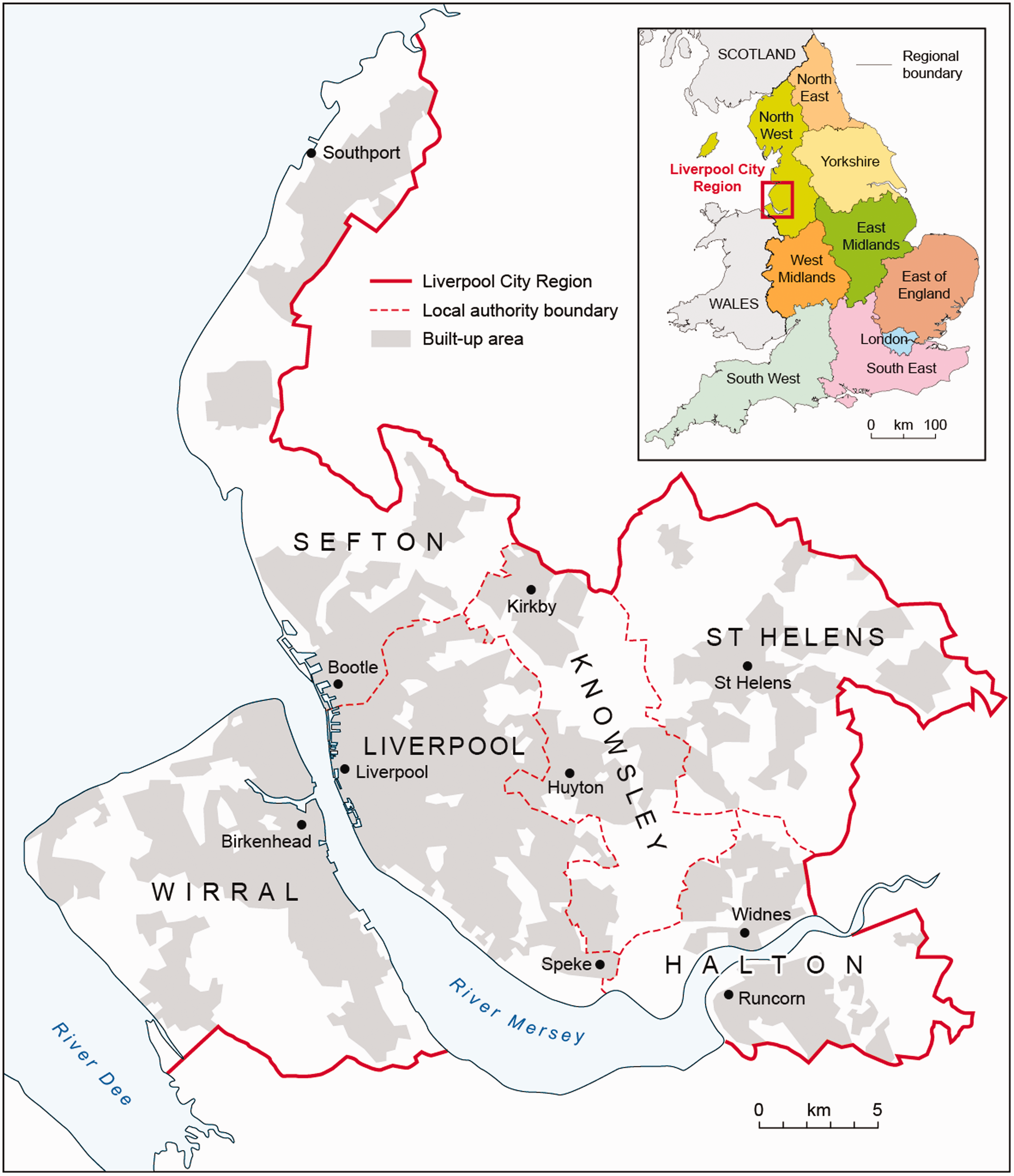
Map of the Liverpool City Region and its constituent local authorities.
LCR suffers with some of the worst rates of deprivation in the UK, as well as severe intra-urban inequalities. In the 2019 Index of Multiple Deprivation, LCR remains the most deprived of all 39 LEPs in England, ranked worst for unemployment and health deprivation and disability, scoring particularly badly for income deprivation; whilst Liverpool and Knowsley were ranked fourth and third most deprived local authorities (MHCLG, 2019). Despite recent recovery after decades of decline in the late 20th century, Liverpool still scores poorly on almost all indicators and is falling further behind London and the south-east. Gross value added (GVA) per head for the City Region remains well below the UK average £20,125 against £27,555, achieving the second lowest real GVA growth rate compared to other LEP areas that saw an increase of just 2.4% since 2009 (ONS, 2019b). A strikingly low employment rate means that just 728,300 residents of working-age population (72.8%) were employed in 2019, with one of the highest out of work claimant rates of any UK LEP at 4.1% of population. Liverpool features amongst the worst performing city regions for education and skills: 10.7% working age residents lack any formal qualifications compared to 7.8% for Great Britain; only 32.9% have attained high-level qualifications against 39.3% average (ONS, 2019a).
City-regional devolution of some centralised powers to local areas provides financial support to UK regions for economic development. LCR will receive a modest allocation of £30m each year over 30 years for economic development investment, through the strategic decision-making capacity of the LCR CA and elected Metro Mayor (see LCR CA, 2015). The devolution arrangement also provides specific responsibility for transport; education and skills, housing and planning, including establishing Mayoral Development Corporations and a Land Commission that support public asset disposals; and fiscal responsibilities, focusing on administering a Single Investment Fund (SIF) that pulls together existing funding streams to be prioritised on economic impact.
Despite opportunities opened up by devolution, LCR is on the brink of fiscal crisis that will only reinforce deep-rooted inequality (Southern et al., 2017). As a result of Brexit, LCR will lose European Structural Funds, a redistributive policy mechanism supporting economic development across all EU regions, of £100m per annum (p.a.). Since 1989, LCR has received over £2.5bn of EU Structural Funding, designated Objective One status attracting a wider total public contribution of some €3.4bn. Withdrawal of EU funding will create major disruption for many institutions, businesses and communities. Withdrawal from the common market will seriously impact upon the cost of trading with the EU, Britain’s biggest trading partner, whilst gaining only £30m p.a. from the devolution deal (£900m over 30 years into the SIF). The LCR will face an additional loss of some £70m of business rate income p.a. It is in this context, combined with ongoing budget cuts under ongoing austerity, that the six LCR local authorities now face what many councillors refer to as the ‘fiscal cliff’, explored in more depth below.
Despite such stark challenges, the relatively recent revival of city-regional industrial strategy in LCR has fixated on a conventional ‘competitive city’ pathway of creating competitive advantage via productivity increases through agglomeration effects, investing in a very narrow vision of innovation in certain high-growth industries. Conventional ‘capitalocentric’ conceptions of urban competitiveness and productivity (Blake and Hanson, 2005) are evident in the LEP’s consistent strategic focus (LCR LEP, 2014; LEP, 2016) on key ‘innovation assets’ and high-tech manufacturing as the primary means to drive urban competitiveness. The ‘Single Growth Strategy’ commissioned by the LCR CA and published by the LEP (2016), designed to bring together multiple competing economic strategies operating at various scales – and provide the guiding principles for how devolved spending and policymaking would unfold following the devolution deal. Anticipating the ‘Building our Industrial Strategy’ Green Paper, this Growth Strategy (incidentally entitled ‘Building our Future’) took a similarly sectoral approach to economic development, citing seven ‘growth sectors’ as primarily important for investment and support: advanced manufacturing; digital and creative; financial and professional services; health and life sciences; low carbon energy; maritime and logistics; and the visitor economy. These sectors are strikingly similar to those targeted by comparable LEPs across the country and, indeed, map closely onto the Independent Economic Review of the Northern Powerhouse analysis of the North’s specialisms, which identified four ‘primary capabilities’ (Advanced Manufacturing; Digital; Health Innovation; Energy) and three ‘enabling capabilities’ (Financial and Professional Services; Logistics; Education). It is unclear in what exactly LCR’s competitive advantage is meant to consist when all its northern counterparts specialise in almost precisely the same sectors.
Accelerating development
At the same time, LCR is home to a flourishing social economy (Heap et al., 2017) and, operating at the margins of official strategy, several municipally backed ‘accelerators’ working within the social economy are beginning to forge a different kind of economic development. Digital and creative industries are promoted by the LCR LEP as the most promising of the seven growth sectors – witnessing double-digit growth year on year, it is the fastest growing tech cluster in UK, leading in computer gaming and Internet of Things (LEP, 2016). A significant part of this growth can be attributed to a particular social enterprise, Baltic Creative CIC, whose explicit mission is to develop digital tech and creative start-ups through providing incubation space and business support. Baltic Creative was established in 2009 by the North West Regional Development Agency (NWDA) and Liverpool Vision – a regeneration and city marketing QUANGO – with the support of Liverpool City Council. With NWDA and EU funding, Baltic Creative had the means to acquire and manage 18 large warehouses in the Baltic Triangle area of inner-city Liverpool, where space is now leased out at favourable rates to local start-ups and small businesses. They provide a co-working hub and organise events for networking and training, with plans for a new social investment arm to provide tailored finance for the sector. All revenues from rents are recycled back into its social purpose of developing the industry, and the company is now expanding premises into the former Cains Brewery site.
Formally constituted as a Community Interest Company (CIC) – the legal form most readily adopted by social enterprises – Baltic Creative is a non-profit enterprise with an ‘asset lock’ on the buildings it owns, ensuring all profits from rents are reinvested back into the development of the sector. The ‘asset lock’ of the CIC legal structure enables this reinvestment and underpins its huge success in enterprise development. This effectively de-commodifies the neighbourhood – Baltic Creative is now the largest landowner and anchor institution for the Baltic Triangle – enabling benefits to accrue to society in a Polanyian re-embedding movement (Peredo and Mclean, 2019). This also stimulates the market in digital and creative industries. Following its establishment in 2009, new business growth rates in the sector more than doubled between 2010 and 2013 (LEP, 2016). Baltic Creative has also been successful in creating new jobs – estimates suggest the social enterprise created 1500 new well-paid jobs by 2017. It is instrumental in bridging the gap between, on the one hand, the larger ‘anchor firms’ and innovation assets that the LEP champions and, on the other, the smaller start-ups, individual entrepreneurs as well as those of the future. They are working with Liverpool’s two large universities, further education colleges and Academy Trusts to create opportunities for the next generation of budding tech innovators, supporting routes for students to set up new businesses. This is extremely important if Liverpool is to tackle its enduring skills gap and deprivation.
There is huge potential to expand this model from what is currently a fairly small-scale special vehicle rooted in one particular neighbourhood in the urban core to a city-region-wide municipal strategy, as this Baltic Creative representative imagines: The revenues that we generate – they obviously finance the running of the company but essentially we were lucky in that we were set up with a 100% grant finance. So basically we got £4-5million asset, no debt … Our remit written into our terms of reference about the growth of the creative and business sector in the Liverpool City Region, not just the Baltic Triangle. So my guess is we’d roll it out in the first year in the Baltic and then we might look beyond that … to any activity which we see as supporting the underbelly of the sector… We’ve invested probably £400,000 in the last five years back into the sector. Now let’s imagine with our growth plan over the next five years to triple the footprint, we go from being able to invest say £100,000 a year to investing circa £500,000 a year – so it’s a lifetime model (Interview with authors, May 2017)
One example of a successful business incubated by Baltic Creative is Make Liverpool CIC – a social enterprise makerspace specialising in providing co-working space, equipment and facilities for people of various trades and skillsets. Rather than rely on attracting external companies or workers, Baltic Creative nurtures local talent and incubates start-ups such as Make Liverpool to produce grassroots enterprise. Makerspaces contribute to local economic development in a number of ways: encouraging local cultures of entrepreneurship, particularly among young people; supporting small business growth through services provision (e.g. workspace), workforce training and retention; upskilling of marginalised groups through education initiatives; and innovation through free-sharing of ideas and outputs in shared co-working spaces (Van Holm, 2017). Despite evidence that makerspaces tend to be dominated by privileged population groups (Van Holm, 2017) – the professional creative class rather than the unemployed or marginalised – they may provide a bridge between many groups, particularly young people, and the digital manufacturing economy of the future. Like Baltic Creative, Make Liverpool is itself an incubator of entrepreneurs – a collective space for start-up businesses producing goods for sale. Make Liverpool have expanded into a multi-site enterprise with new, larger bespoke premises in the north docks area. This expansion was supported by a £30,000 low-interest loan from the Beautiful Ideas Company – also part of the social economy.
Constituted as a CIC, Beautiful Ideas Co. was born out of a collaborative project led by local councillors, activists and practitioners called Beautiful North – aiming to revitalise the more deprived, northern areas of Liverpool. It began with Liverpool City Council leasing public land – the site of a former school, close to the City’s two football stadia – to volunteers, who transformed it into a makeshift car park for football fans. The initiative provided some local employment and generated approximately £375,000 from parking receipts, match funded by a government grant. The £750,000 pot seeded Beautiful Idea Co.’s Launchpad – a social investment fund for projects or businesses aimed at transforming north Liverpool’s economy. An ideas competition was launched in 2016 and 30 out of 200 applicants were successful.
Beautiful Ideas Co. offer a groundbreaking form of ‘patient capital’ with very low-interest loans only repayable if the enterprise is successful; over a ten-year period with a three-year repayment holiday; repayments starting only once enterprises are profitable; repayable in social value instead of financial return if preferred. Additionally, a revenue participation agreement means that Beautiful Ideas Co. receive 1% of an enterprise’s total revenues, capped at £10,000 return. These conditions are intended to inspire an entrepreneurial rather than grant culture and provide long-term fund replenishment to complement car park revenues. It has been highly successful, creating or supporting the development of 100 new jobs – £7500 investment per new job – with further employment generation expected in years to come.
This model has proven vulnerable to local politics. The Launchpad fund is dependent on the car park as a source of revenues, but this has been divested to Liverpool Football Club, in a commodification of this public resource. As this Beautiful Ideas Co. representative explains: They [Liverpool City Council] still owned it and then at the end of last season they sold it to Liverpool FC which was a bit of a shock … so the idea was that we will take it on a meanwhile use, we would use it and then it was ready for development, so there was talk of there being an Academy there but that didn’t materialise … the idea was that it would be developed into houses or businesses or shops or this, that and the other. So they sold it to Liverpool FC who have now turned it into – of all things – a car park! (Interview with authors, May 2017)
The pressures on councils in the UK to find alternative funds to plug budget gaps will only get heavier as reforms progress towards local business rates retention as the primary source of council financing. A Liverpool City Councillor explains how Liverpool’s early adoption as a pilot of business rates retention may jeopardise its financial security: In Liverpool City Council’s boundary there’s 14,500 businesses; the incentive given by the Local Authority Finance Review was to give the city council authority to collect and retain its own rates – this is where the pilot idea came from – and discovered Liverpool City Council unlike York or Westminster would be in considerable deficit, by about £70-80m … Currently we create £193m in business rates … of which at the moment we get to keep 49% – the rest goes back to Government and then they top it up with the revenue support grant to about £269m or £270m in total. That £270m will disappear, will be back at £193m, which we get to keep it all but what happened to the other £70m or nearly £80m that we won’t get anymore?
Stabilising development
There is some evidence of more entrepreneurial municipalist approaches being taken towards procurement in the city region, led by Knowsley Borough Council. Despite decades of public investment through EU Objective One funding and central government regeneration programmes, such as the New Deal for Communities, Knowsley remains one of the most deprived local authorities in the country: second most deprived of all 326 local authority areas in England, with 45% of its neighbourhoods classified in the 10% most deprived nationally in 2015. Councillors and council officers alike recognised that these programmes had improved the environment and infrastructure, such as housing and roads, but had done little to combat deep-seated structural issues. Following research into the borough’s trajectory in 2008, the council invited the Centre for Local Economic Strategies (CLES) to help develop a new approach to procurement, paralleling their much more celebrated partnership with Preston City Council, dubbed the ‘Preston model’ (O’Neill, 2016). CLES recommended that, in the absence of big government regeneration programmes, Knowsley should see their procurement budget as a financially sustainable and locally controlled regeneration programme. Knowsley Council spends around £136m a year on procurement with third partners – £25m is tied up in public sector bodies, such as waste disposal, but £100m a year is spent contractually on the private and social sectors. If more of that pot – what CLES call ‘influenceable spend’ – could be diverted into projects or providers who produce social value and buy locally, then procurement becomes a sustainable tool for social and economic regeneration. In Polanyian terms, the redistributive institutions would favour reciprocal interactions in the social economy by supporting market exchanges between the local Council and social enterprises, or enhance social value by supporting local businesses (Polanyi, 1957).
Knowsley produced a Social Value Framework stipulating contract procedure rules that exceed the 2012 Social Value Act to embed social value accounting for all services procured. They go ‘beyond the law … keeping it local and social if it’s viable.’ (Interview with authors, 2017). If there is no market for a certain service within the local social sector or if the quality provided is poor then contracts will go elsewhere. Otherwise, local, social providers are favoured. As part of a ‘Keeping the (£) local’ agenda, the council worked closely with representative groups such as Knowsley Council for Voluntary Services (KCVS) to ensure their procurement made sense to local social organisations. This involved campaigning, consultation and communications to co-produce new procurement policies. Training in social value accounting for commissioners was provided via a Commissioning and Procurement Forum. Social value was measured across contracts retrospectively to provide a baseline, and is now integrated within the procurement process. The results are promising: just 15% of contracts procured in 2014 had demonstrable social value outcomes, rising to 38% in 2015, 53% in 2016 and 60% by 2017. Shifting all council grant spending into procurement inadvertently threatened smaller social organisations who were unable, or ill-equipped, to compete for contracts. To address this, the Council worked with KCVS to redirect 1% of their (influenceable) procurement spend into a £1m grant fund for smaller community-based organisations who could not get through the tendering process. Grants allow for experimentation with new forms of social action or support continuation of socially valuable voluntary work. This acts as a co-produced commissioning process funding the co-design of innovative public services.
Neighbouring authorities have followed suit with Knowsley’s approach to commissioning, and discussions are now afoot to incorporate some of these innovative policies in devolved city-regional governance, such as the £30m per annum, £900m SIF administered by the LCR CA. For instance, social value could be embedded in the SIF criteria for funding capital and infrastructure projects. At the local scale, Knowsley Council developed a Construction Futures programme in partnership with social enterprises providing consultancy on procurement and regeneration services, to design-in social value accounting to the planning process. Developers have to comply with the same social value stipulations for public sector contract providers, with approved specialist social enterprises, providing services to the private sector measuring social value and embedding social value accounting into planning applications for a fee. While this does not lead to decommodification of land, it goes some way to mitigate the effects of the associated social dislocation by taking the principle of planning gain that bit further: stipulating into planning permissions or funding criteria the need to deliver on a number of specific problems and improvements across the area from establishing a community centre and providing new apprenticeship schemes for young people to delivering contracts with SMEs that produce social value and employ local labour. By systematising their approach to harnessing public spending to create social value, and bending local regulative systems to favour communities over the interests of capital, Knowsley are challenging urban entrepreneurialism and ‘trickle out’ economics.
Discussion: advancing the grounded city concept
The examples explored above each in some way mobilise Polanyian counter-movements against the commodification of the fictitious commodities land, labour and capital. For instance, Baltic Creative reinvests rental surpluses from its tenants back into the further development and protection of affordable business space, including incubation space for start-ups, keeping land rents perpetually low through the asset lock of its CIC constitution. Beautiful Ideas Co. reinvents credit as patient capital for its funded organisations – mostly social enterprises requiring very low-interest loans in order to grow – and provides skills training for local social entrepreneurs. Both of these projects have been supported and financed by an ‘entrepreneurial (local) state’ (Mazzucato, 2013) working closely with civil society groups, social innovators and enterprises, all willing to take risks for social gain. The state is not financialising assets to trade on markets in order to generate revenues as cash transfers for under-funded services, but rather investing directly in self-sustaining projects, which harness the value of (de-commodified) land, (cooperative) labour and (patient) capital to ground economic development in people and place.
We have presented entrepreneurial municipalism as a conceptual fleshing out, and particular instantiation, of the grounded city concept articulated by some of the Foundational Economy Collective (Engelen et al., 2017). Developed to combat the dominance of the neoliberal competitive city and agglomeration economics, the grounded city draws consciously on the historical traditions of municipal socialism and municipal enterprise. It is grounded in the sense of realising the essentially territorialised nature of municipal authorities in relation to de-territorialised capital – seeing like a city, from the perspective of places stuck with picking up the pieces left in the wake of capital flow and flight under inter-urban competition.
However, contradictions pertain to the concepts of accelerator and stabiliser. First, the process by which accelerators work is explicated as ‘a Keynesian circular flow, with multiplier effects in successive rounds when revenue circulates several times inside the city walls as it meets demand at the level at which it becomes valorised’ (Engelen et al., 2017: 414). This emphasises the ability of cities to control the flow of capital such that it circulates through intra-urban rather than inter-urban value chains. The Preston model – and, by extension, Knowsley – demonstrates the beneficial socioeconomics of rolling this out through progressive procurement policy, but has yet to show how this can avoid a competitive race to the bottom, where the only option remains defensive protectionism, as some critics have argued (Bolton and Pitts, 2018). For Polanyian grounded cities to represent an effective alternative to neoliberal competitive cities, more thought needs to be given to how cooperative relations can be cultivated to protect against the dangers of competitive protectionism. This might focus on developing trans-national networks of cooperative supply chains linking social value producers (and consumers) in grounded cities globally.
Second, in stabilising strategies, which attempt to ground cities in their foundational economies, anchor institutions are an oft-cited central component, such as in the progressive procurement policies of Preston and Knowsley, yet are – much like the state in general – deeply ambivalent institutional spaces best understood as an ensemble of social relations and competing forces than unified entities. This is one of the blind spots of Polanyian socioeconomics – the lack of theorisation of the state. Of all anchor institutions, universities especially embody their double-edged impact particularly on smaller peripheral urban economies boosted by property bubbles stimulated by rising student numbers but thereby made vulnerable to the whims of higher education and migration policies formulated within the central state (Goddard et al., 2014). This problematises the notion of any clear-cut stabiliser in relation to the external governors of global markets and state policies – all stabilisers are cut through by contradictory forces and scalar relations. After all, statecraft is an explanatory concept originally devised to explain centre–periphery relations dominated by the central state’s manipulation of regional and local government (Ayres et al., 2018). In seeing a municipal statecraft in the emerging assemblage of competing and interwoven municipalist strategies – from financialised municipal entrepreneurialism to grounded entrepreneurial municipalism – we must remain cognisant of the state’s scalar contradictions and ambivalence.
Third, the way in which accelerators are seen to work, as an intra-urban multiplier in secondary rounds of circulation, leaves unanswered where this value is created primarily, from where it is extracted. Another of Polanyi’s blind spots – from a Marxian perspective – is overlooking capital accumulation as the primary force driving the double movement of (de)commodification. If the accelerator process of growth creation amounts simply to the pump-priming of rising property values – albeit through self-sustaining municipal investment rather than speculative mobile capital – this, nonetheless, remains an ultimately self-defeating tactic based on the financialisation of the fictitious commodity land, vulnerable to overaccumulation crises and boom–bust dynamics. Moreover, such investment strategies might only intensify processes of uneven urban development within cities by creating hot spots, leaving others cold. For instance, Baltic Creative has arguably over-heated the Baltic Triangle, concentrating private property investment and drawing interest away from other areas in need of regeneration. On the flipside, accelerators often rely on hotspots or important assets in order to leverage value. For instance, the quick profits made through car parking to seed the Beautiful Ideas Co. fund were enabled by the high price that football fans were willing to pay to park near stadiums in Anfield and Everton. Such opportunities clearly do not exist everywhere they are needed – and demonstrate grounded cities’ economic inter-dependency with and insertion into global circuits of value and landscapes of uneven urban development.
Thus, there must be more to accelerators than land alone, as the grounded city thesis implies, which we argue to be investments in cooperative labour and entrepreneurship. Both Baltic Creative and the Beautiful Ideas Co. provide examples of how accelerators can develop the local skills base and incubate new businesses (notably, social enterprises and co-ops, thereby expanding economic democracy and social benefits for local populations) as well as stimulate the growth of emerging sectors, such as digital and creative, for trading in global markets. This is the source – the primary round – of wealth creation missing from the grounded city thesis. What, then, separates accelerators of grounded cities from conventional sector-boosting industrial strategy? Baltic Creative and Beautiful Ideas Co. hint at an answer: the way in which surpluses generated from market activities are used and distributed. Both these projects embed their market activities into communities, reinvest in their social supports and ensure benefits are channelled to people and place. From a Polanyian perspective, grounded city accelerators do two things: promote the development of exchange logics, through market trading, and (re)embed redistribution and reciprocity into their business structure and ethos – demonstrating the simultaneity, multiply enmeshed and interacting workings of different modes of urban-economic integration. On this reading, market-promoting accelerators exist in an antagonistic, dialectical relationship with stabilisers – pulling in different directions and in some sense representing a Polanyian double movement. In the budding fields of urban socioeconomics and Polanyian economic geographies, this remains a fruitful tension ripe for deeper investigation.
Conclusion: Polanyi as our guide
Responding to the shortcomings of sector-based industrial strategy and agglomeration-fixated urban economics, we have explored what a more inclusive, holistic and integrated place-based economic strategy would look like based on a Polanyian understanding of socioeconomics. This broadly follows the so-called inclusive growth agenda in challenging market dominance under urban entrepreneurialism in which cities look outwards to attract mobile capital and the creative class in a competitive zero-sum race to the bottom. Developing the idea of the entrepreneurial state (Mazzucato, 2013) for the municipal scale, what we call entrepreneurial municipalism involves urban authorities using their political, legal and financial powers to harness endogenous assets such as land and labour to build a more socially just and self-sustaining pathway to local economic development – one which reflects the interacting processes of reciprocity, redistribution and market exchange of a socially embedded local economy. Where Mazzucato (2013) has effectively argued that the state drives the creation of value in the economic innovation of knowledge and information – the fourth factor of production or fictitious commodity (Jessop, 2007) – and, therefore, rightly deserves to capture this value for reinvestment and public benefit, we have argued that the local state is well-positioned to more proactively develop and better capture for redistribution the value created by the three classical factors of production, land, labour and capital.
Using a method of transduction as conceived by Lefebvre (2003), we identified emergent practices and projects in the LCR and extrapolated from them, as tentative articulations, a ‘virtual object’ of entrepreneurial municipalism – best understood not as a coherent model of economic development but rather a possible future direction currently inchoate and entangled in an assemblage of municipal strategies exhibiting divergent tendencies. We have drawn on recent re-engagements with the notion of statecraft (Ayres et al., 2018; Lauermann, 2018; Pike et al., 2019) to propose entrepreneurial municipalism as one of many possible strategies available to local actors. It is situated within an emerging variegated landscape of (new) municipalisms arrayed from the more radical global movement around Fearless Cities to more neoliberal financialised variants. These represent the rediscovery of a more interventionist, risk-taking and entrepreneurial municipal state; but with different inflections on the kind of speculative risk-taking undertaken. Marking out entrepreneurial municipalism from other forms of municipal statecraft – those largely reactive coping strategies responding to austerity – is its proactive, generative approach to state-supported local economic development.
Important distinctions should be drawn with its inverse, financialised municipal entrepreneurialism (Penny and Beswick, 2018). This is where Polanyi comes in – as our guide to tease out the differences between ambiguously interwoven, interrelated strands. Financialising housing and other fixed public infrastructures as liquid assets to generate alternative sources of revenue for austerity-choked councils is a highly creative coping mechanism to contend with difficult aspects of what Peck (2017) has labelled late-entrepreneurial urban political economy. Whilst some suggest, against the grain of critical urban studies, that this is a laudable effort to make the best out of a bad situation (Christophers, 2019), a Polanyian reading highlights how this represents a problematic and contradictory commodification of public goods in order to fund other public goods. Municipal entrepreneurialism stokes the fire of financialisation with one hand while, simultaneously with the other, dampening the flames and limiting the burn of capitalist dis-embedding of the market from society so as to, at the very least, prevent all that is solid melting into air. Entrepreneurial municipalism, by contrast – although lacking the radical democratic practices infusing new municipalist movements associated with the Fearless Cities network – nonetheless closes the gap in this bipolar tactic to create an integrated, holistic response to dis-embedding tendencies.
Footnotes
Acknowledgements
The authors would like to thank the TUC, and in particular Lynn Collins, for funding and supporting the original research for this article. Our ideas have benefited from discussions with participants at the ‘Industrial Policy revisited’ workshop at the University of Bath in April 2018, the Global Social Economy Forum in Bilbao in October 2018 and the Inclusive Growth in Cities conference at the University of Manchester in November 2019, as well as from generous critical engagement from three anonymous reviewers. All errors and oversights are of course the authors’ own.
Declaration of conflicting interests
The author(s) declared no potential conflicts of interest with respect to the research, authorship, and/or publication of this article.
Funding
The author(s) received no financial support for the research, authorship, and/or publication of this article.