




Abstract
Airbnb has recently become a growing topic of both concern and interest for urban researchers, policymakers, and activists. Previous research has emphasized Airbnb’s economic impact and its role as a driver of residential gentrification, but Airbnb also fosters place entrepreneurs, geared to extract value from a global symbolic economy by marketing the urban frontier to a transnational middle class. This emphasizes the cultural impact of Airbnb on cities, and its power of symbolizing and communicating who belongs in specific places, responding to questions of class, gender, and ethnicity—and thereby potentially driving cultural displacement. Coming from this perspective, this paper uses computational critical discourse analysis to study how white and black hosts market black-majority neighborhoods in New York City on Airbnb, and how guests describe their consumption experience. The analysis shows how white entrepreneurs attempt to attract guests through a form of colonial discourse: exoticizing difference, emphasizing foreignness, and treating communities as consumable experiences for an outside group. White visitors, in turn, consume these cultural symbols to decorate their own identities of touristic consumption, describing themselves in colonial tropes of brave white adventurers exploring uncharted territories: glorious conquests no longer over gold and ivory, but over sandwiches at a local bodega. This situates Airbnb’s marketing at the urban frontier in a longer history of colonialism and racialized expropriation.
Keywords
Introduction
The city has increasingly become a marketplace within which place is consumed like any other postindustrial product, as brands, identities, or images of life, used to gain advantages in a symbolic economy (Zukin, 1989, 2009). This type of marketing and consumption of neighborhoods affect rents, but also changes the production of urban space (Lefebvre, 1991), symbolizing and communicating who belongs in specific places in ways responding to questions of class, gender, and ethnicity. This makes the city an arena in which culture has gone from a by-product to a generator of wealth, as symbolic value is quick to translate to rent increases (Amin and Thrift, 2007; Hyra, 2015; Zukin, 1996).
Recently, digital platforms such as Airbnb have come to play an increasingly important role in this symbolic marketplace. These platforms epitomize urban neoliberalism by making every citizen an entrepreneur in an ostensibly liberal, open, and level playing field that claims to widen participation in the market to underprivileged groups, while drawing widespread criticism for their impacts on the rental markets (e.g. Barron et al., 2018; Horn and Merante, 2017), in particular in relation to disenfranchised communities (Cox, 2017; Edelman and Luca, 2014). Existing research on the effects of these platforms has, in particular, focused on racial biases (Edelman et al., 2017; Kakar et al., 2016, 2018; Leong and Belzer, 2016), the ways that they drive gentrification (Cox, 2017; Gant, 2016; Wachsmuth and Weisler, 2018), and rent increase (Barron et al., 2018; Horn and Merante, 2017).
This paper focuses instead on the cultural and discursive impact of Airbnb. We argue that Airbnb provides a symbolic marketplace that helps expand cultural commodification and appropriation to previously stigmatized urban arenas. Airbnb is turning citizens into “place entrepreneurs” (Logan et al., 1987; Molotch, 1976), set to extract value from the tastes of a global middle class by marketing place and community to outside groups. Airbnb becomes a powerful engine for the cultural representation of neighborhoods, and this representation is, in turn, central to determining the development of neighborhoods. Following the notion of gentrification as a new colonialism (e.g. Smith, 2005), this paper looks at the marketing of black-majority neighborhoods through the lens of colonial discourse, thus relating to a large literature documenting the ways that the stereotypes of colonial people are constructed to fit the interests of colonial rulers (Chrisman and Williams, 2015; Loomba, 2007; Said, 1978).
Coming from this perspective, the paper asks: how are black-majority neighborhoods marketed by hosts on Airbnb, and how do guests frame their consumption decisions? To answer this question, the paper carries out a large-scale computational discourse analysis (Törnberg and Törnberg, 2016) on data on Airbnb listings in New York City. This discourse analysis approach views discourses as not only mirroring, but also contributing to perpetuating and producing social processes (Zukin et al., 1998). Discourse analysis thus permits the study of how cultural tastes in gentrifying areas are constructed to enable extraction of profit from urban land.
The results of this analysis are used for a broader discussion on the role of race within the cultural commodification of the new phase of urban neoliberalism, emphasizing the conjoined racial processes of property making and property taking (McKittrick, 2011; Ranganathan, 2016; Roy, 2017).
The paper begins, however, with situating platforms such as Airbnb in the current era of urban neoliberalism, discussing its impact on, and role in, the urban economy: the casting of citizens into entrepreneurs in a market that enables the expansion of urban cultural commodification (Peck, 2014; Ranganathan, 2016).
Cultural commodification in platform capitalism
Airbnb is an online marketplace for short-term rentals. The company does not own this rental real estate, but instead collects fees by acting as a broker between those with dwellings to rent and those looking to book lodgings. Airbnb is thus part of a growing trend of online platforms that function as information hubs for connecting users, often referred to using one of a plethora of marketing premodifiers—“smart,” “social,” or “sharing”—which in reality signals their transformation of the social through an added technical intermediation (Törnberg and Törnberg, 2018). As is argued in the introduction of this special issue, this development, which Srnicek (2017) calls “platform capitalism,” implies an expansion of entrepreneurialism beyond states and regulation, and into the life of citizens (Foucault et al., 2008). Airbnb describes this aspect of its operation as providing economic opportunities and a “democratization” of capitalism, by “fostering entrepreneurship” of citizens, thus casting itself as a platform for “sharing” and small-scale rental.
While Airbnb does to a certain extent indeed lower the thresholds for participation in the rental market through reduced transaction costs, its implications are better understood as a blurring of the discursive lines between small- and large-scale real estate operations, by—at least superficially—enabling both to operate under the same rules and conditions. This blurring has two implications.
First, it has enabled Airbnb to provide larger-scale real estate operations with a vehicle to bypass regulation under the guise of small-scale sharing. By casting itself as a platform for informal rental rather than as a company in competition with hotel lodging, Airbnb accommodations are in many locations flouting both taxation and local zoning regulation. This is motivating Airbnb to cast what is essentially a push against regulations as part of a new “sharing” economy driven by ostensibly inevitable technological innovation (Pollman and Barry 2016).
Second, to the extent that the platform indeed does constitute a broadening of participation by lowering thresholds of participation, Airbnb is not a neutral platform. The blurring of the lines between small-scale renter and real estate capital also implies a broadening of the actors involved in marketing the city as a consumption experience, gearing homeowners to participate in processes of gentrification and cultural commodification. Previously local and informal renters become “hosts” on Airbnb: “place entrepreneurs” (Logan et al., 1987; Molotch, 1976) pushed to employ discursive strategies for establishing or rebranding a place’s identity to market their neighborhood in a way that makes it attractive for the consumption of outside groups (Boyle, 1997; Cox and Mair, 1989; Kearns and Philo, 1993; Kenny, 1995; Rofe, 2004; Short, 1999). These outside groups are increasingly made up of a transnational middle class, as Airbnb brings a changed relationship between urban space and global demand by providing enabling window shopping for an urban place in physically distant cities (Sigler and Wachsmuth, 2015). This contributes to a transnational gentrification, in which local residents are forced to pay housing prices being set by global rather than local demand, as local capital extracts profit from extralocal demand.
The combination between this narrative of small-scale rental and the push of short-term lodging into residentially zoned urban areas has allowed cultural commodification to seep into parts of the city that were previously largely protected from this form of consumption. This aspect of Airbnb is linking up with a contemporary surge in tourists on the hunt for “real urban experiences”: off-the-beaten-track, everyday, and mundane urban life, which is seen as representing something “real” and “authentic” (Maitland 2010). Airbnb aims to respond to this demand by allowing visitors to feel part of neighborhoods, rather than being banished to the community-sterile areas assigned by zoning permits. While small-scale renters may not constitute the primary part of Airbnb’s marketplace, they thus serve a disproportionately discursive role, providing a sense of authenticity to the place consumption, and granting credibility to Airbnb’s claims to bypass hotel lodging regulation.
This global demand is to a large extent driven by “urban imaginaries” (Huyssen, 2008), as postmodern tourists treat cities as symbolic marketplaces to be consumed like any other postindustrial commodity. This requires a construction of consumer tastes to enable extraction of profit from urban land: real estate developers are known to manipulate cultural symbols of the industrial past of a factory building they wish to convert into an office park or art gallery, as cultural symbols and representations affect the ability to attract capital and new residents (Kearns and Philo, 1993; Watson, 1991; Zukin, 1996). These representations of place have a material impact on urban growth and decline—indeed, as Amin and Thrift (2007) argue, economic life is so shot through with cultural inputs and practices at all levels that “culture” and “economy” cannot be seen as separate. While marketability could potentially be beneficial for the residents in an area, the benefit rather tends to go primarily to landlords, property owners, and platform capitalists, rather than to improving the wellbeing of local residents. The latter are, however, those to suffer the negative consequences, such as rent increases and cultural commodification of their communities (Eisinger, 2000; Hoffman, 2003; Smith, 2005; Zukin, 1996).
In other words, Airbnb provides a marketplace for a global “symbolic economy”—a continual production of symbols and spaces that constitutes a language of social identity, while at the same time framing and giving meaning to the city. The ways that the city is commodified in this symbolic economy also affects the experience of the city itself, signaling who belongs and feels at home in certain areas; culture is a powerful means of control, responding to questions of class, gender, and ethnicity (Zukin, 1996). Consumption in this symbolic economy can thus drive cultural displacement (Abramson et al., 2006; Hyra, 2015; Zukin, 2009), as the representation of a neighborhood is taken away from the people living there. This can lead to reduced attachment to place, as the neighborhood changing so profoundly that its residents no longer recognize or identify with their home (Maly, 2011).
The treatment of place as any cultural commodity also opens the possibility of an expansion of cultural appropriation into physical space. While aspects of black culture have been used for years to market music, it has, as Hyra (2017) argues, only more recently come to be applied for the marketing of place. While labeling a neighborhood as “black” used to stimulate white flight, it now increasingly seems to function as a rallying flag for gentrification. This illustrates the way cultural tastes and preferences, including in relation to racial outgroups, are a function of the economic interests of elites, suggesting the situation of the current dynamics of urban neoliberalism in a longer history of colonialism and racialized expropriation (Desmond, 2016; Gilmore, 2002; McKittrick, 2011; Ranganathan, 2016; Roy, 2017; Smith, 2005; Uitermark et al., 2007).
While the recent cultural turn in urban studies has brought increased focus on the connection between cultural meaning of place and its economic transformation, there has been limited focus on precisely how ethnic communities are commodified and how this results in extraction of value (Huyssen, 2008; Iwabuchi, 2008; LiPuma and Koelble, 2005). Similarly, cultural displacement has received limited attention compared with residential displacement (Fraser, 2004; Hyra, 2015).
In summary, Airbnb blurs the distinction between large- and small-scale real estate capital, thus providing real estate capital with a vehicle to bypass local zoning regulation and taxation by using the guise of informal home sharing, while simultaneously bringing small-scale actors into a marketplace geared to extract value from a global symbolic economy by marketing the urban frontier to a transnational middle class, thereby contributing to driving cultural commodification and displacement of racialized communities. To substantiate this argument, we now turn to a case study of Airbnb’s activities in New York City, focusing on the ways that black-majority neighborhoods are marketed by white and black hosts on Airbnb, and who profits from this. This allows us to study how cultural appropriation plays a part in the dynamics of gentrification and urban change in the neoliberal city.
Method
This study uses data from InsideAirbnb (Cox, 2015), from October 2, 2017, complemented using custom-made scrapers, as well as with census data from the 2016 American Community Survey demographic and housing estimates data on high-resolution census areas, referred to as Neighborhood Tabulation Areas (NTA) level. Listings were linked to NTAs using their location coordinates to allow for comparison between demographic and Airbnb data. The data were then analyzed using primarily Python and PostgreSQL. Similar to Cox (2017), we use the Face++ machine-learning application programming interface (API) to classify images of hosts and reviewers by skin color (the categories being black, white, and Asian).
The limitations inherent in this automated approach should be acknowledged. First, using census information implies having to relate to data aggregated on predefined areas, which constitute fixed conceptions of urban place that rarely overlap completely with historic or community understandings of neighborhood boundaries. Such formalizations always imply a risk of reification, implying that they should be approached with caution. The city is contested and discursively constructed, in particular its neighborhood boundaries, and any conception of the city will embody certain interests. In this paper, the neighborhood names come from New York City census data definitions and from Airbnb’s own descriptions, and should therefore be seen not as external and objective, but as part of the discourses being studied.
Second, similar limitations and need for caution apply to the notion of race. As an operationalization of this elusive phenomenon, automatic identification of skin color has obvious and important limitations. In the view of this paper, race is a contested and socially constructed concept which functions to maintain the interests of the population that constructed it, and is thus far from merely a binary question of skin color. Skin color does, however, provide us with a departure point, allowing us to have a qualitative look—at least tentatively—into the qualitative large-scale processes at play in this social construction.
The content analysis was carried out using a form of “computational hermeneutics” that combines discourse analysis and computational methods, as developed in Törnberg and Törnberg (2016). To allow the analysis of the large corpus, we use latent Dirichlet allocation (LDA)—a form of topic modeling (Blei and Lafferty, 2009)—as well as statistical measures to compare the word frequencies in corpuses, in a process that iterates between close-reading and computational methods, zooming in and out on the discursive landscape. The computational methods were used to provide an overview and to navigate the material, enabling a qualitative analysis that identified a number of framings. In the following analysis, these will be discussed together with a number of illustrating quotes that exemplify the specific framing.
Discourse analysis is a heterogeneous research program (Wodak and Meyer, 2009) aimed at studying “the way social power abuse, dominance, and inequality are enacted, reproduced, and resisted by text and talk in the social and political context” (Van Dijk, 2001: 353), seeing discourses as not simply mirroring social processes but contributing to their perpetuation and production (Fairclough, 1992). Cultural and discursive aspects cannot be completely separated from the economic or political dimensions; as JanMohamed puts it, there is a “profound symbiotic relationship between the discursive and the material practices of imperialism” (1985: 64).
This approach is thus a powerful way to explore how culture, discourse, and taste develop in ways that serve the interests of those in power, as exemplified by a large literature on colonial discourse analysis, documenting the ways that the stereotypes of colonial people fit into the interests of colonial rulers (Chrisman and Williams, 2015; Loomba, 2007; Said, 1978). Since discourses are constitutive of real-world processes, discourse analysis allows us to see how power works through language, literature, culture, and the institutions that regulate our daily lives. In the context of this study, discourse analysis can thus provide a looking glass into the way that cultural commodification is used to market urban space, and can provide hints about the larger racial and colonial hierarchy within which Airbnb operates.
Airbnb in New York City
We begin by providing a brief overview of Airbnb’s activities in New York City.
New York City is Airbnb’s third largest market, with more than US$650m in host revenue per year. Airbnb in New York has been subject to some controversy, both for functioning as a way to bypass regulation of commercial short-term rental, but also for enabling racial bias. Studies such as that by Edelman et al. (2017) have shown that hosts are prone to reject African American guests, and Edelman and Luca (2014) that black hosts earn 12 percent less than non-black hosts for the same kinds of housing. Airbnb (2016) has attempted to respond to this criticism, for instance in their 2016 report “Airbnb and Economic Opportunity in New York City’s Predominantly Black Neighborhoods,” which used primarily anecdotal evidence to argue that Airbnb helps middle-class African American families to make ends meet. The report boasted that Airbnb usage had risen more than 50 percent faster in black neighborhoods than in the city as a whole.
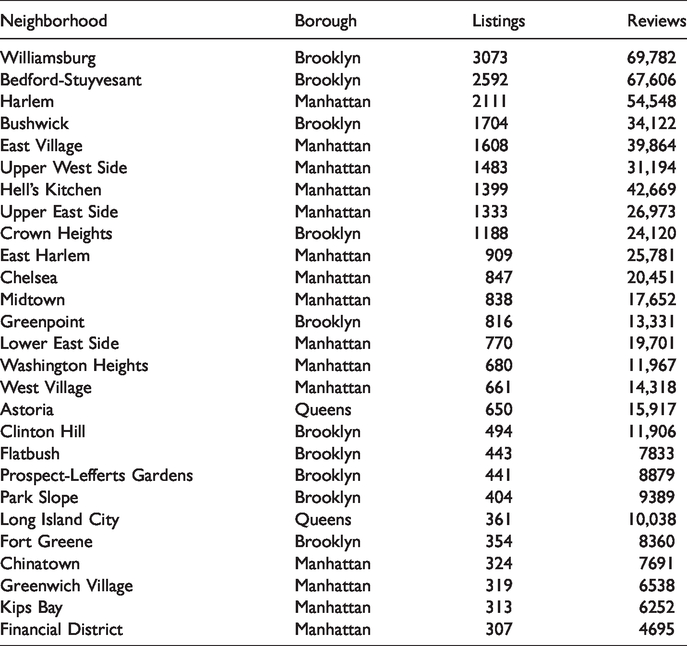
Looking at the data (Table 1), we see that compared to hotels, which are predominately located in downtown Manhattan, Airbnb indeed does have a large number of listings outside of the most central parts of the city, in particular in Brooklyn. “Super-gentrified” (Lees, 2003) Williamsburg dominates, followed by Bedford-Stuyvesant and Bushwick, both of which are in the process of rapid gentrification. While Airbnb is clearly focused on more peripheral and residential areas than traditional hotels, it does not necessarily follow that the benefits accrued from this is indeed going to the black and disenfranchised residents of these neighborhoods. If Airbnb constitutes a blurring of the demarcation between small- and large-scale rental—serving to bring the former into the marketing of place to a transnational middle class and to allow the latter to avoid regulation imposed on traditional hotel lodging—this raises the questions which of these movements are dominant, and to what extent is Airbnb dominated by large-scale actors? We can get a sense of this empirically by looking at the revenue extraction in the platform marketplace.
Percentage of listings offering different accommodation types, and their number of reviews and fraction of generated revenue.

Airbnb in New York currently has 44,317 listings, owned by 37,108 hosts. These have been reviewed a total of 801,784 times by 703,685 reviewers. Entire-home listings make up half of all active New York City listings, but earn a disproportionate 72 percent of platform revenue, as they tend to be priced higher (see Table 2); 29 percent of revenue is earned by hosts with multiple listings.
Number of Airbnb listings (that have received reviews) and reviews per neighborhood, for neighborhoods with more than 300 listings.
By assuming that the number of monthly reviews multiplied by the listing price for all listings of a host is proportional to the income, we can look at the revenue distribution of the marketplace. Figure 1 shows this distribution as a Lorenz curve, i.e., comparing the cumulative share of revenue with the cumulative share of hosts. This shows that 10 percent of hosts take in about 53.8 percent of the revenue, giving us a Gini coefficient of 0.723. While this is a highly unequal revenue distribution, it is not out of the ordinary for Airbnb marketplaces, falling close to the middle of the 41 cities that this paper looked at for comparison.1 This suggests that Airbnb is primarily a vehicle for large-scale rental, but that smaller-scale hosts still play an economic role in the marketplace that is not insignificant.
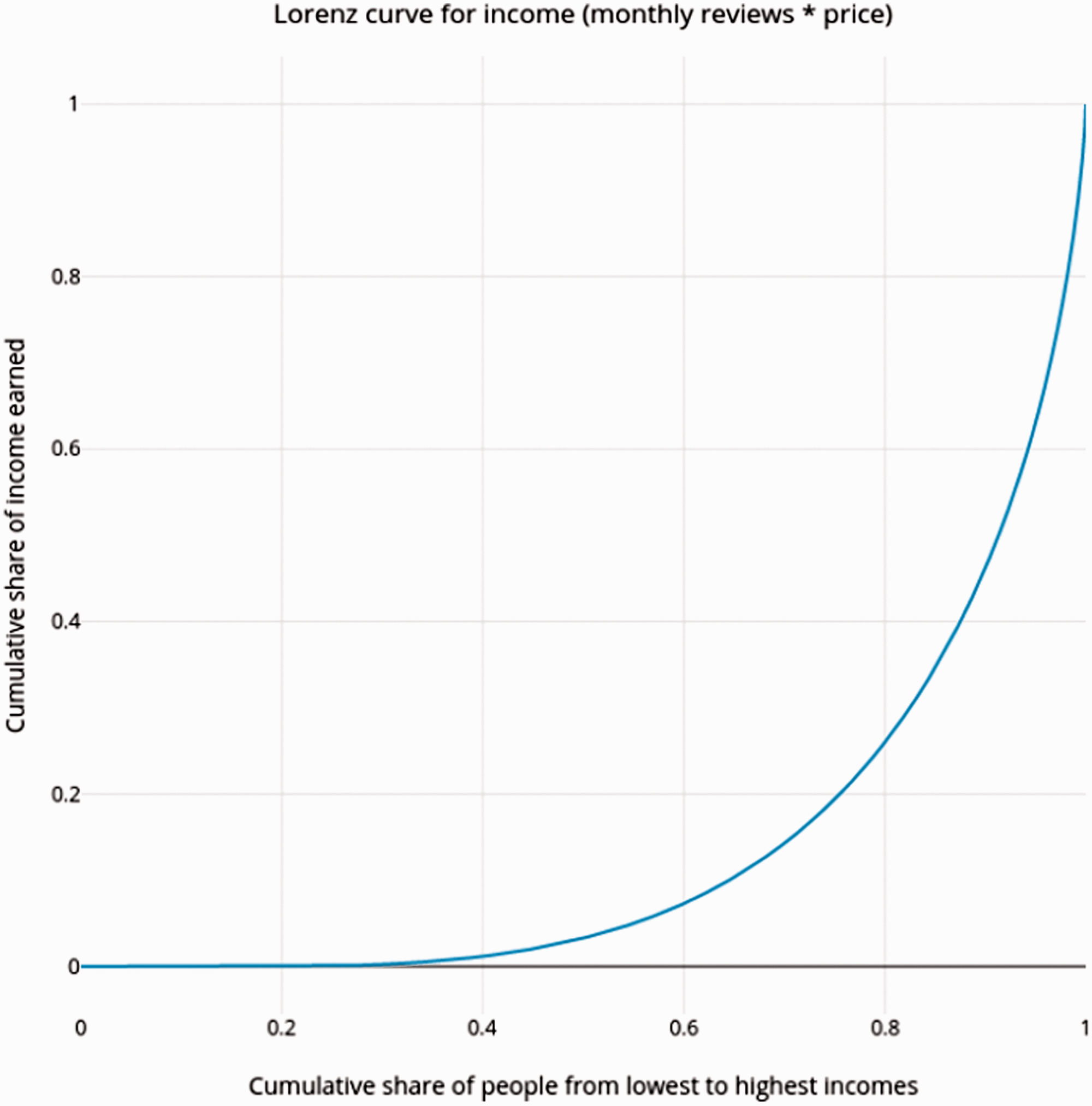
The Lorenz curve of host revenue for the Airbnb marketplace, showing what fraction of the population takes what fraction of the income. For instance, we can see that the 90 percent of the population represents only 46.2 percent of the total revenue, implying a highly unequal economy.
Looking at the skin color of hosts and guests, we can see that while reviewers overall are 8.7 percent black, reviewers of black hosts are 14.7 percent black, implying a rather strong racial homophily between guests and hosts—possibly the result of, for example, preferences among guests, discrimination in the hosts’ selection of guests, or confounding factors such as lack of resources. As Table 3 shows, both reviewers and hosts are significantly whiter than the overall population of the city. This goes in particular for black-majority neighborhoods, where 68.8 percent of hosts are white, whereas the population is only 25 percent white. This overview implies, in line with Cox (2017), that the new rent gap (Wachsmuth and Weisler, 2018) is primarily exploited by white users, in practice implying that the benefits accrued from the marketing of the cultural resources of these black communities are not primarily going to the local residents.
Ethnic distribution of hosts, reviewers, and overall demographics of New York City, when including only black and white. For demographics data, “white” is operationalized as all ethnicities except Asian and African American, to match the Face++ categorization. Black-majority neighborhood (BMN) is defined as neighborhoods where more than 50 percent of the total population identifies as African American. As can be seen, whites are strongly overrepresented as both hosts and reviewers. Particularly notable is the exceptional overrepresentation of white hosts in BMNs.

Selling black places
Having provided an overview of Airbnb’s activities in New York City, we turn to the question of this paper: how are black-majority neighborhoods marketed on Airbnb, and how do guests describe their consumption experience? We first turn to how hosts describe the neighborhoods of the listing that they are marketing. These texts are attempts to market the neighborhood by framing it in ways that one thinks will attract one’s “imagined audience” (Litt, 2012), describing it as a consumable experience. The analysis focuses on comparing how black and white hosts describe the black-majority neighborhoods that they are marketing.
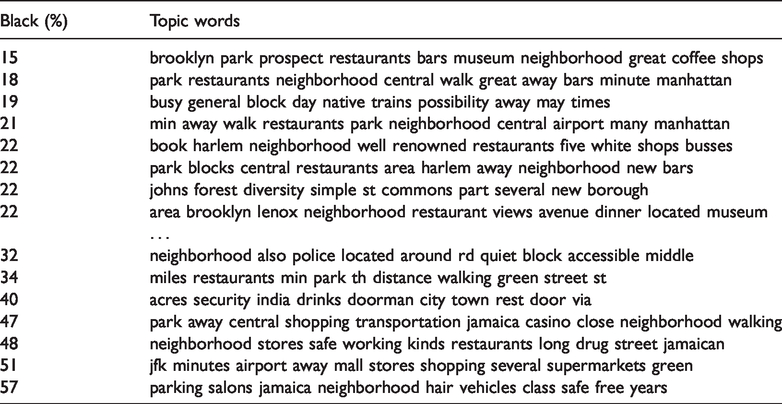
To provide an overview of the differences in discourse between white and black hosts, we begin by running an algorithm which identifies what words are most statistically overrepresented in a comparison of documents. The result is shown in Figure 2. White hosts tend to use words such as “hipster,” “artist,” or “writer”—emphasizing cultural experiences, using terms associated with narratives of classic artist-led gentrification (Ley, 2003; Zukin, 1989, 1996). Black hosts instead tend to emphasize “security,” “surveillance,” and “police”: pointing toward a narrative of contradicting an implied understanding of the neighborhood as dangerous. This overview can be further supported by using LDA: a technique that finds words that tend to occur together in multiple documents, thus identifying “topics” on which the documents focus (Blei and Lafferty, 2009). Here, we run the topic model as a function of the race of the host, by looking at the fraction of white vs. black hosts for each topic. This analysis (see Table 4) reinforces the view of the word frequency comparison. The white-dominated topics emphasize cultural consumption, restaurants, and walkability, whereas black-dominated topics tend to focus on security, police, and more practical consumption, such as supermarkets or access to transportation.
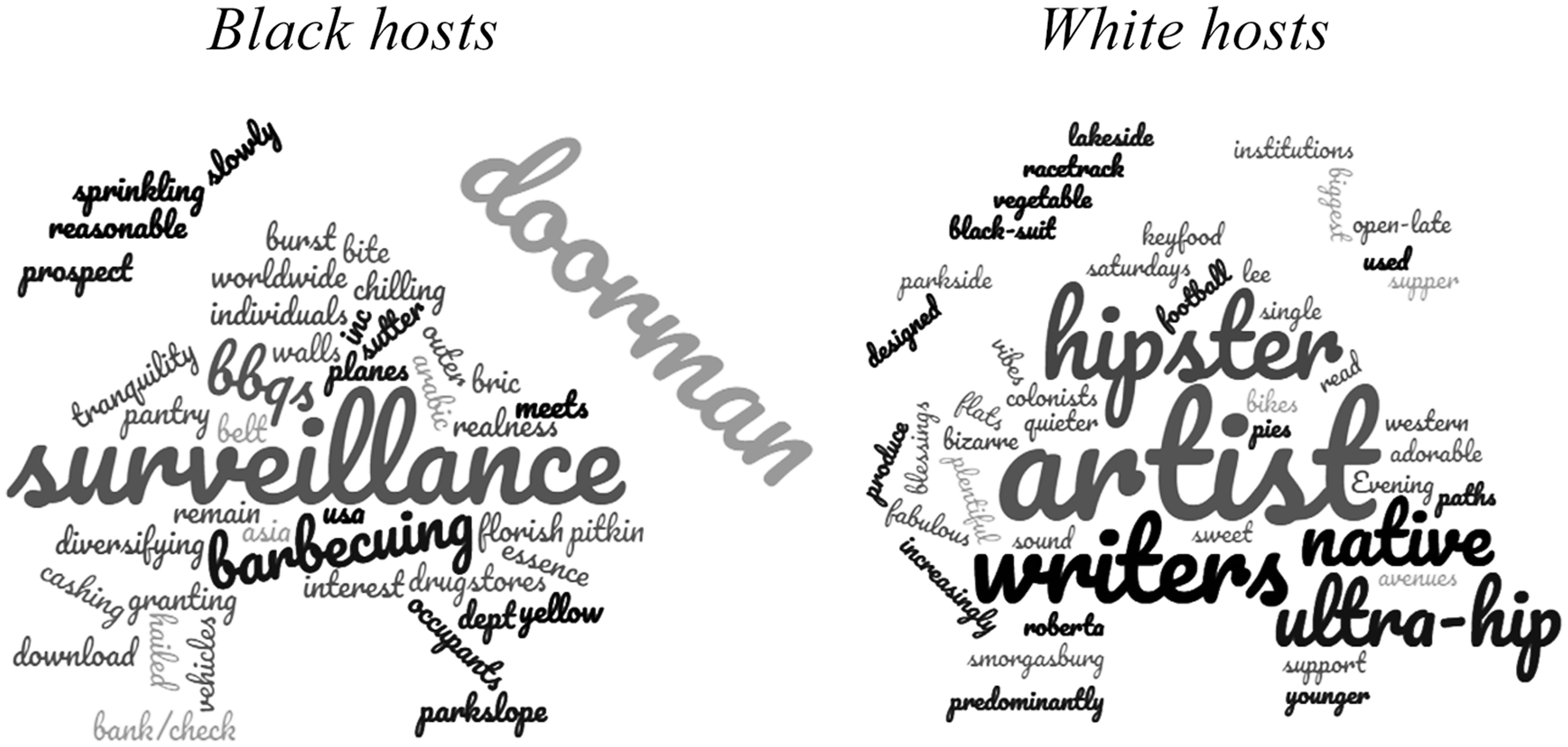
A word cloud representation of the most overrepresented words when comparing white and black hosts’ descriptions of their neighborhoods.
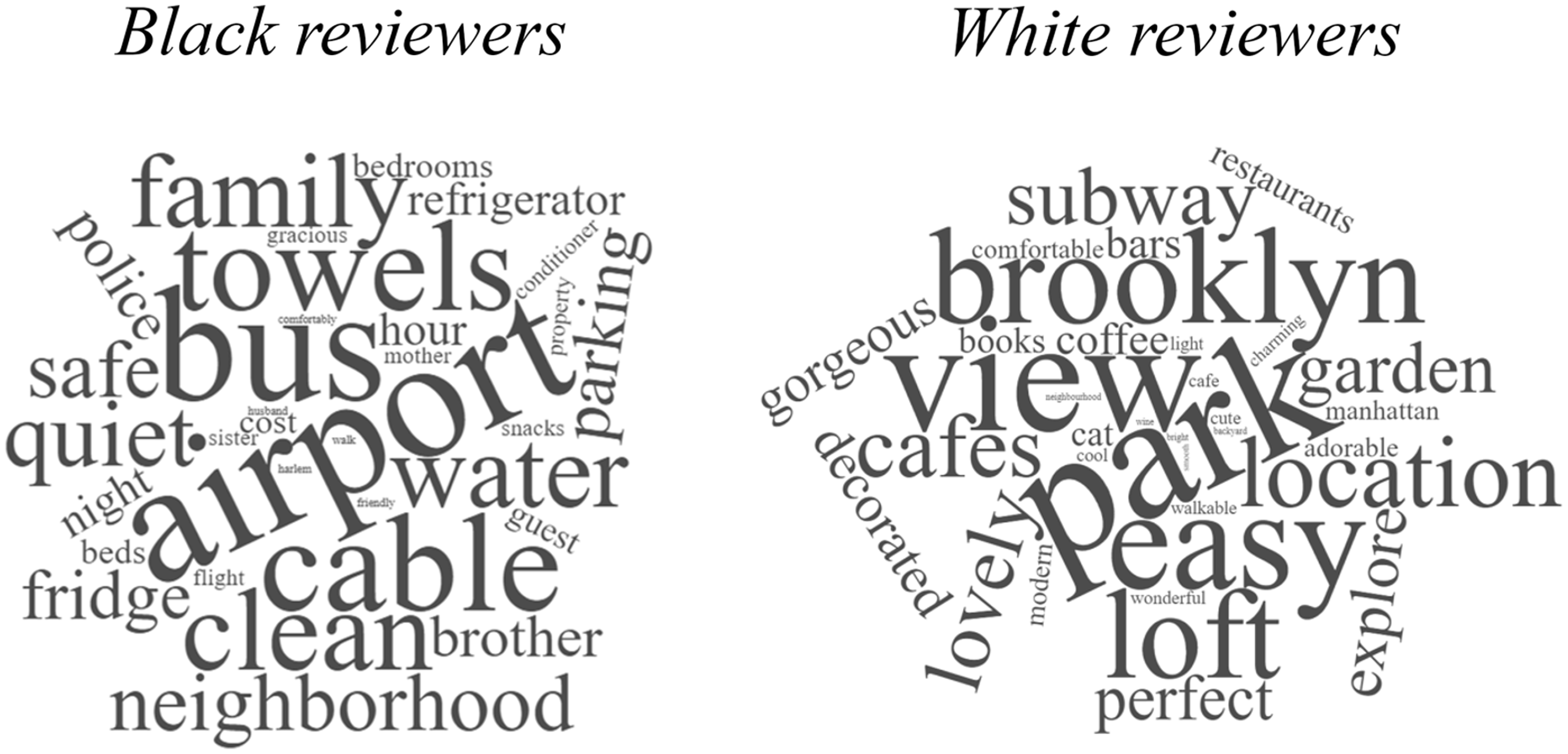
A word cloud representation of the most overrepresented words, comparing white and black reviewer comments of black-majority neighborhoods.
Output of an LDA of the neighborhood descriptions of black-majority neighborhoods. The rows are sorted by the Black (%) column, which shows the percentage of hosts whose neighborhood descriptions are associated with this topic who are categorized as black.
Using this initial computational analysis as a map to navigate a discursive landscape (as outlined in Törnberg and Törnberg, 2016), we move into close reading to allow in-depth study of the ways discourses are employed in the marketing. Here, we use the topic model as a way of identifying what topics and discourses are most characteristic of black vs. white hosts in these neighborhoods. While this is the result of the systematic reading of a large number of documents, the description will be kept relatively brief.
Adventures at the urban frontier
This close reading reveals a common framing in which neighborhoods are described as places to be explored, filled with “authentic” and “exotic” cultural experiences to be “discovered” by the daring visitor (JanMohamed, 1985; Zukin, 2009). To visit a local bodega, or to enjoy the neighborliness of the next-door African American, is described as to have a unique, cultural experience. Such narratives of exotic exploration naturally involve a certain level of danger, as exemplified in the description of a white host in Crown Heights, Brooklyn: this neighborhood is a diamond in the rough, especially in the Summer months you will get that Brooklyn authenticity of people chilling, hanging out, barbecuing and enjoying the weather until the small hours of the morning. If you can’t “walk like you belong,” then this isn’t the location for you.
This thus functions to package local culture into consumable experiences for an outsider group, as the neighborhood is framed as a playground for touristic urban fantasies. As one white host markets his neighborhood: Bushwick has been recently named as the new Soho. A neighborhood full of graffiti art, alternative art galleries, artist studios, bars, coffee places and restaurants. Close to Williamsburg, a vibrant hipster neighborhood with restaurants, bars, flee markets, concert venues.
Transnational gentrification
Aware that they are addressing an international audience, hosts often attempt to market their neighborhood accordingly. For instance, they may describe their neighborhoods using references to other famous, and often gentrifying, areas. This contributes to positioning the neighborhood in the world, and decontextualizing cultural capital (Hannerz, 1990; McEwan and Sobre-Denton, 2011), thus serving to emphasize the globalizing tendencies of gentrification (Sigler and Wachsmuth, 2015). This fits into the notion of today’s cosmopolitan middle class having stronger ties to neighborhoods in global cities than to the city that surrounds them, thus blurring the distinction between touristic and residential consumption of urban space (Gant, 2016; Sassen, 2016). These global neighborhoods come with global urban imaginaries, as illustrated by a host in Bedford-Stuyvesant: “Brooklyn is where it’s at. Kevin discovered this while traveling in France, when he heard ‘Très Brooklyn!’ used to invoke something hip and exciting.”
Authentic gentrification
A central part of this urban imaginary, referred to by primarily white hosts, is the very notion of gentrification itself. Gentrification is something inherent in and characteristic of New York in general, and Brooklyn in particular, being understood as a place undergoing rapid change: this is part of its brand and urban imaginary, and so to experience “authentic” Brooklyn, one needs to experience—and indeed take part in—its gentrification process.
This discourse contains within it an implicit understanding that gentrifying neighborhoods are perishable goods; early gentrification is preferable to late gentrification, as it means the neighborhood is “more authentic.” This means that the frontier will keep moving, as if driven by manifest destiny. This is visible, for instance, in suggestions that “Williamsburg has become Manhattan,” but “Bushwick is the new Williamsburg”; signifying that the urban frontier has changed, and so the fashionable visitor in search of authentic gentrification will need to follow. As a white host in Bedford-Stuyvesant, Brooklyn, notes: “Not totally gentrified yet, Bed-stuy is the new place to be in Brooklyn. Enjoy before the hipster invasion which already began!”
Hosting while black
While white hosts emphasize local neighborhoods as cultural experiences, black hosts often seem acutely aware that they are not only speaking to a predominately white audience, but that this audience furthermore see them as “black.” This seems to bring a perceived need to counter and dispel presumed stereotypes and racial anxieties. This in part expresses itself in black hosts tending to focus on safety, often emphasizing security guards and proximity to police stations. As a host in Bedford-Stuyvesant puts it: “The feeling of safety as you walk outside and realize that a police station is directly across the street gives me an extra sense of security.”
The insider’s perspective
The neighborhood is often said to be “family oriented” and “very safe”—or at least “relatively safe.” These attempts to negate racial stereotypes at times comes to the surface in more explicit ways. For instance, some hosts reference previous negative experience with guests, motivating them to provide warnings that the listing and neighborhood is “diverse.” While these may refer to negative experiences, they are almost always expressed with the constant veneer of positivity, as illustrated by a host in Flatbush: “this is a Black neighborhood. We are Black people. We wouldn’t mention this if it wasn’t an issue with some renters in the past. Bigots need not apply:) .”
Black hosts furthermore tend to see their neighborhood from the “inside” rather than through an outside perspective. First, this results in a focus on the more mundane selling points of their neighborhood, such as access to public transit and parking, or proximity to stores and discount shopping, as illustrated by both the topic model and the word overrepresentation data in Figure 2. A typical description by a host in Bedford-Stuyvesant reads: “Family oriented neighborhood. Close access to a Grocery Store, Family Dollar, and on street parking.”
This insider’s perspective also makes it more difficult to tell a story using poverty, drugs, and crime as attractive, edgy, and authentic elements, as is implicit in white hosts’ discourse about “adventures in the urban frontier” (Hyra, 2017). The stereotyped imaginary of a “ghetto” full of carjackings, muggings, and shootings, developed from TV shows and movies, makes it significantly easier to cast these as exciting to other outsiders, than if one has lived in the multifaceted reality of the neighborhood one is marketing.
Buying black places
While hosts’ neighborhood descriptions are attempts at marketing the neighborhood to an imagined audience of tourists (Litt, 2012), the reviews are guests’ opportunities to describe their experiences. These texts are primarily intended to communicate to future potential guests of the host, but the reviewer also communicates with the specific host, as well as to the larger community of Airbnb users. Reviewers thus aim to sell themselves by managing impressions, in part by using their touristic consumption to fulfill the cultural preferences of their imagined audience (Goffman, 1970). The reviews therefore provide a lens not only on how guests view their consumption experience, but also what they believe is seen as positive in the larger community. We will here focus on the experience of white guests in black-majority neighborhoods. The focus on white guests is motivated by race not being a universally uniform construct, making the social implications of the skin color of a tourist difficult to interpret, in particular when it comes to the relationship to US black-majority neighborhoods—to which these reviewers are generally still “outsiders.” To provide an overview of the differences in discourse between white and black guests, we again look at the most statistically overrepresented words in a comparison of documents. The result is shown in Figure 3.
The brave gentrifier
White guests tend to frame their experiences in ways that emphasize their own adventurous spirit, often hinting that the experience requires a bit of sophistication. This frame focuses on the relationship between the reviewer and the place, presenting the reviewer as a pioneer exploring an uncharted foreign land. A common way to describe the experience of the neighborhood in this frame is along the lines of: “at first take,” “at first look,” and “for the untrained eye,” the neighborhoods look “sketchy,” “ghetto,” and “scary,” but for the more “adventurous,” “metropolitan,” and “well-traveled” it is in fact “authentic,” “trendy,” and “cool.” These positive descriptions tend to use words like “gritty,” “real,” and “authentic” when describing the neighborhoods. As a reviewer of a listing in Prospect-Lefferts Gardens, Brooklyn, puts it: The neighborhood feels very authentically Brooklyn. I never felt unsafe, but it definitely had the “trendy” grunge and multicutural-ness [sic] that one would expect when thinking about stereotypical Brooklyn. It will be a shock if you’re coming from a quiet suburb (like me), but I adjusted quickly.
Neil Smith (2005) referred to this as the “urban pioneer” mentality: part of lifestyle trends that encourage young suburbanites to migrate to the inner city in search of urban “grit” and “authenticity” (Lloyd, 2010; Zukin, 2011). In this case, however, it is consumed as a touristic experience by a transnational middle class, on the hunt for “exotic destinations.” Just like the hosts, guests explicitly reference the neighborhoods’ ongoing gentrification processes as part of a desirable experience, as illustrated by a guest in Bedford-Stuyvesant: “This part of Bed-Stuy is about one-fifth gentrified (with the house containing this rental definitely one of the pioneers).”
In these narratives of adventure, white guests at white hosts in black-majority neighborhoods tend to emphasize that their house provided a “safe space” to explore the area, or, in commonly used terminology illustrated by a reviewer in Bedford-Stuyvesant: “Was great to have such an oasis in this urban jungle!”
Packaging blackness
The “adventurous experience” of white guests in black-majority neighborhoods at times becomes too adventurous. Some guests, in particular white guests staying at black hosts, describe feeling intimidated by the neighborhood or even by the hosts, using words like “dark,” “scary,” or “ghetto.” As a reviewer Bedford-Stuyvesant puts it: the neighborhood is pretty “SCARY”, I did not feel safe walking at night. Lots of neighbors on the street but the only one that spoke to us was some guy pushing a cart full of “glow lights, sticks etc” […] Noah tried hard to sell us on “BEDSTUY” saying its the “VENICE” of LA, sorry but I think its more like the COMPTON of LA.
This illustrates the balancing act involved in marketing blackness, as the back-side of its “authentic grittiness” is a perception of “danger,” at times resulting in comments such as on a listing in Crown Heights: “We did not feel safe at all in this area and if I return to NYC I will not stay in Crown heights or even in Brooklyn.”
This balancing act seems to make it easier for white hosts than for black hosts to market black neighborhoods, as the latter are disadvantaged both when it comes to having the cultural resources necessary to frame and package their neighborhood as a cultural experience to white outsiders, and to themselves function as culturally “safe oases” to their guests.
Colonial discourse and urban neoliberalism
We will now broaden the analysis of the results of this discourse analysis, tying to a broader discussion of the cultural effects of platform capitalism as a new stage of urban neoliberalism.
The discourse analysis shows how the white place entrepreneurs of Airbnb use racial stereotypes to attract white guests, by exoticizing difference, emphasizing foreignness, and treating communities as consumable experiences for an outside group. White visitors in turn consume these cultural symbols to decorate their own identities of touristic consumption, describing themselves in colonial tropes of brave white adventurers exploring uncharted territories: glorious conquests no longer over gold and ivory, but over a sandwich at a local bodega. This reveals a territorial ideology (Short, 1999) within which blackness means authentic urbanity, and urbanity means poverty, danger, and excitement.
Scholars are not far-fetched in describing gentrification as the new colonialism, as these discourses fit into a long history of tailoring racial stereotypes to fit the specific needs of colonial policies (Chrisman and Williams, 2015; JanMohamed, 1985; Loomba, 2007; Said, 1978). In the historical context—in which colonialism was driven by western countries’ capital facing scarcity of labor, combined with a superabundance of capital thus requiring a move to subordinate non-industrialized countries to acquire the labor needed to sustain its own growth (Lenin, 1999)—these stereotypes often took forms creating a critical dependence of wage labor among colonial people (Loomba, 2007). Today, as the postindustrial production machinery has turned to cultural production, the scarcity it faces is not primarily labor, but rather cultural authenticity and uniqueness. As commodification tends to destroy the local and unique, capital needs to find ways to maintain its supply of the uniqueness that is the basis for its appropriation of monopoly rents (Harvey, 2012; Zukin, 1996). This brings a search for new identities and cultural symbols to commodify; an expansion into the “urban frontiers” that parallels the colonial scramble for Africa but now not in search for labor and material to feed industrial production, but for symbols to quench an insatiable thirst for authenticity and difference for the production of consumption in a postindustrial economy. This points to a phase perhaps best described as an accumulation by cultural dispossession (Harvey, 2003), in which extracting cultural authenticity becomes essential for continued growth.
This regime of accumulation expresses itself as a form of cultural neocolonialism, extracting that unique sense of authenticity found in the suffering of those forced to live outside the fluidity of the commodified symbolic economy (Zukin, 2009). This points to a new central distinction: between those with the privilege of a postmodern fluidity of identity, able to take on or shed identities in order to communicate through a symbolic language, and those who are left with fixed identities, branded on their skin, on their bodies, or in where they live. This implies an era in which privilege means having one’s identity take the form of performances through consumed cultural symbols, in which belonging to the norm implies having one’s identity be a tabula rasa on which one is free to paint without risking being reduced to the crayons that one uses. Authenticity becomes a scarcity as symbols increasingly become disconnected from the real (Baudrillard, 1994), to be found and extracted from those who lack the privilege to freely move between meanings and symbols. Those who are seen as part of their place, rather than just temporary visitors; those who are seen as their ethnicity, rather than just wearing its symbols; those who are not granted the benefit of an assumed ironic distance.
This separates between two co-existing racial stereotypes, serving different purposes: the traditional colonial stereotype serving a supply of wage labor of African Americans as “dangerous,” “physical,” “strong,” and “hard-working,” invoking what Derek Hyra (2017) calls a “blatant racism,” and the new stereotypes of African Americans as part of an “exciting” and “authentic” consumption experience, invoking what Hyra calls a “subtle racism.” While the blatant racist stereotype has been highly profitable, by legalizing displacement and housing discrimination for example, it can at times be detrimental to the interests of real estate capital, by reducing the demand for black-majority neighborhoods. Therefore, capital needs to find a way to cast aspects of black stereotypes as part of attractive consumer symbols—even real social ills, such as poverty and crime in disenfranchised neighborhoods, must be cast as desirable aspects of a gritty, urban experience to a gentrifying elite. Just like historic colonialism, this not only exploits but dehumanizes and objectifies the colonized subject, in a reification now not as labor power but as consumption experience (Césaire, 2001). In this construction of race, subtle and blatant racism thus co-exist, the former allowing black-majority neighborhoods to be marketed as hip and attractive, while the latter legitimizes the displacement of previous residents.
While black hosts are certainly part of the real estate capital participating in marketing the urban frontier, they do not have the same discursive access to draw benefit from this new “subtle racism”: they are not as readily seen as the pioneers in these dreams of colonial adventures, but rather cast as its objects—what is being consumed. Their marketing of neighborhoods is thus left attempting to battle the old “blatant racism” of the black body as “dangerous” and “scary,” by emphasizing safety, policing, and security.
As illustrated by a recent example of a Brooklyn bar drilling their walls with fake bullet-holes and marketing their US$10 craft beers in brown paper bags (Helmore, 2017), the effect on local communities from this marketing is a cultural commodification which shares many features with the much-debated Disneyfication (e.g. Zukin, 1996)—but while Disneyfication tended to remove any reference to the negative, this process rather creates a virtual Disneyland of past horrors, in which poverty and suffering—whether imagined or real—are commodified and sold for touristic consumption. As their neighborhoods are marketed, residents are forced to watch stereotyped versions of personal traumas become the vacant diversions for selfie-stick-wielding tourists. Visitors whose temporary stays permit a fleeting and fluid relationship to the cultural symbols of the neighborhoods, allowing symbols of disenfranchisement and poverty to serve as an ironic contrast emphasizing precisely privilege and affluence. The end result of this is cultural displacement, as residents lose their sense of their neighborhood as their home.
Perhaps the starkest expression of the way these racial cultural dynamics reinforce and drive gentrification is the way that gentrification itself is used as part of the marketing of gentrifying neighborhoods, both as part of the urban imaginary of an “authentic” New York, but also in providing a sense of consumption urgency. In this territorial ideology, the dynamics of gentrification itself becomes yet another set of symbols in the symbolic economy used in the marketing of place. The dynamics of urban change are thus themselves made part of the dynamics, in a way that pushes forward and intensifies the very process that it describes: “gentrification” drives gentrification. This reflexivity recalls the discussions on the role of “emergence” in gentrification, showing precisely why “there is nothing natural about gentrification” (Slater, 2014; Uitermark, 2015).
Conclusion
This paper begins from the view, in line with the overall argument of this special issue, of Airbnb being part of a new stage of urban neoliberalism, giving real estate capital a vehicle to bypass taxation and local zoning regulation, and gearing homeowners to market their piece of the urban frontier on a transnational market, thus expanding entrepreneurialization from governance structures to “entrepreneurial citizens” (Tomassetti, 2016). This creates not only a new rent gap (Wachsmuth and Weisler, 2018) but also expands on the extraction of cultural authenticity from urban place. As the platform turns homeowners into entrepreneurs, they also become its cultural agents in the city: place entrepreneurs charged with extracting value from the tastes of a global middle class by marketing place and community to outside groups, thus contributing to driving cultural displacement (Molotch, 1976).
Coming from this perspective, the paper used a critical discourse analysis approach to look at cultural aspects of racial gentrification, thinking of the marketing of minority neighborhoods as a form of colonial discourse, shaped by economic interests. The specific question driving this exploration was: how are black-majority neighborhoods marketed on Airbnb in New York City, and how do guests describe their consumption experience?
This discourse analysis provided the foundation for expanded discussion of the current stage of neoliberalism and racial appropriation, showing the ways that new economic pressures are resulting in a transformation of racial stereotypes. This analysis found that despite claims of a liberal “free-for-all” market, now encoded digitally in technical code (Feenberg, 1991), the platform effectively perpetuates racial inequalities, continuing a long history within which race is foundational to the economic and geopolitical order, and white appropriation a fundamental pillar of wealth creation (Gilmore, 2002; McKittrick, 2011; Ranganathan, 2016; Roy, 2017; Smith, 2005; Uitermark et al., 2007). Airbnb thus forms a lens through which the racially illiberal underbelly of liberalism is made visible for study. This lens suggests that consumer tastes in gentrifying neighborhoods are far from being “naturally occurring” (Ball, 2014; Slater, 2014), but are constructed to enable extraction of profit from urban land: emphasizing the conjoined racial processes of property making and property taking. The paper, however, also suggests methods to explore and critique this type of cultural processes, using computational interpretative methods that bridge the gap between what Brown-Saracino (2016, 2017) refers to as “micro” and “macro” approaches to gentrification.
In summary, this suggests that the spatialized form of cultural appropriation—to which Airbnb provides a market—accumulates value by cultural dispossession and displacement, and thus constitutes a form of cultural postcolonialism at the urban frontier. This situates the new stage of urban neoliberalism in a long history of settler colonialism, imperialism, slavery, and racialized expropriation.
Footnotes
Declaration of conflicting interests
The author(s) declared no potential conflicts of interest with respect to the research, authorship, and/or publication of this article.
Funding
The author(s) disclosed receipt of the following financial support for the research, authorship and/or publication of this article: PT wants to acknowledge the support of European Union's Horizon 2020 research and innovation programme under grant agreement No. 732942.

Note
1. The sample was based on the cities available from InsideAirbnb.com. Gini average: 0.691, median: 0.704, variance: 0.005652. The full list: Montreal: 0.822. Hong Kong: 0.805. Austin: 0.805. London: 0.79. Sydney: 0.774. Toronto: 0.759. Brussels: 0.758. Berlin: 0.749. Los Angeles: 0.749. Boston: 0.748. Paris: 0.746. Melbourne: 0.742. Vienna: 0.741. Athens: 0.738. Washington, DC: 0.735. Barcelona: 0.73. Madrid: 0.729. Rome: 0.728. New York City: 0.723. San Diego: 0.715. Quebec City: 0.704. Geneva: 0.699. San Francisco: 0.682. Mallorca: 0.678. Copenhagen: 0.674. Oakland: 0.666. Vancouver: 0.665. New Orleans: 0.645. Antwerp: 0.637. Northern-Rivers, Australia: 0.635. Denver: 0.634. Nashville: 0.628. Edinburgh: 0.625. Venice, Italy: 0.624. Chicago: 0.624. Amsterdam: 0.624. Seattle: 0.613. Victoria, Canada: 0.56. Portland: 0.553. Santa Cruz: 0.54. Asheville: 0.522.