




Abstract
In this paper we explore creative reuse as a critical and imaginative mode of urban practice. By engaging with the case of De Ceuvel, an experimental community located in Amsterdam Noord, we submit three main affordances of creative reuse. Reuse value is accordingly discussed in relation to (a) abandonment, (b) the co-constitutive character of experimentation, and (c) the circulation of heterogeneous ideas and materials. In moving beyond circumstances of disposal and dissolution, the three affordances are evocative of a salvage value regime, which transcends conventional narratives of the city and a siloed treatment of urban sustainability. Based on the findings, we suggest that creative reuse interventions enact infrastructures of curatorship, capable of unsettling particular ways of dwelling, learning and narrating the city.
I am enthusiastic over humanity’s extraordinary and sometimes very timely ingenuities. If you are in a shipwreck and all the boats are gone, a piano top buoyant enough to keep you afloat that comes along makes a fortuitous life preserver. But this is not to say that the best way to design a life preserver is in the form of a piano top. I think that we are clinging to a great many piano tops in accepting yesterday’s fortuitous contrivings as constituting the only means for solving a given problem. (Fuller, 1969: 9)
Introduction
Crossing the River IJ by ferry from Amsterdam Centraal, it takes roughly 10 minutes to reach Buiksloterham, a patchwork of docklands stretching for several kilometres along the northern riverfront. Once a main powerhouse of the Dutch shipbuilding industries, the area has turned, over the past decade, from a desolate industrial landscape into a cultural hotspot and breeding place for self-organizing communities. The latter were often endorsed by the municipality of Amsterdam in the attempt to foster the further regeneration of the IJ’s riverfront, especially during the global financial crisis. Among the more recent communities we find De Ceuvel, established on the premises of the former De Ceuvel-Volharding shipyard. A narrow street bordered by old workshops provides access to the area, and upon arrival you are struck by an odd arrangement, more likely to be found on the nearby canal rather than on land. The area looks almost surreal: stranded houseboats connected by a winding boardwalk (Figure 1) and a café-restaurant built on harbour wooden posts, all surrounded by lush greenery. The set-up includes a terrace with rough wooden tables, benches made of old rowing boats, a jetty and a floating garden located at the end of a rusty slipway. Despite its unconventional look, De Ceuvel’s on-land harbour accommodates a vibrant creative community and cleantech playground 1 that merge in the ambition of becoming one of ‘the most unique and sustainable urban developments in Europe’ (De Ceuvel, 2014).
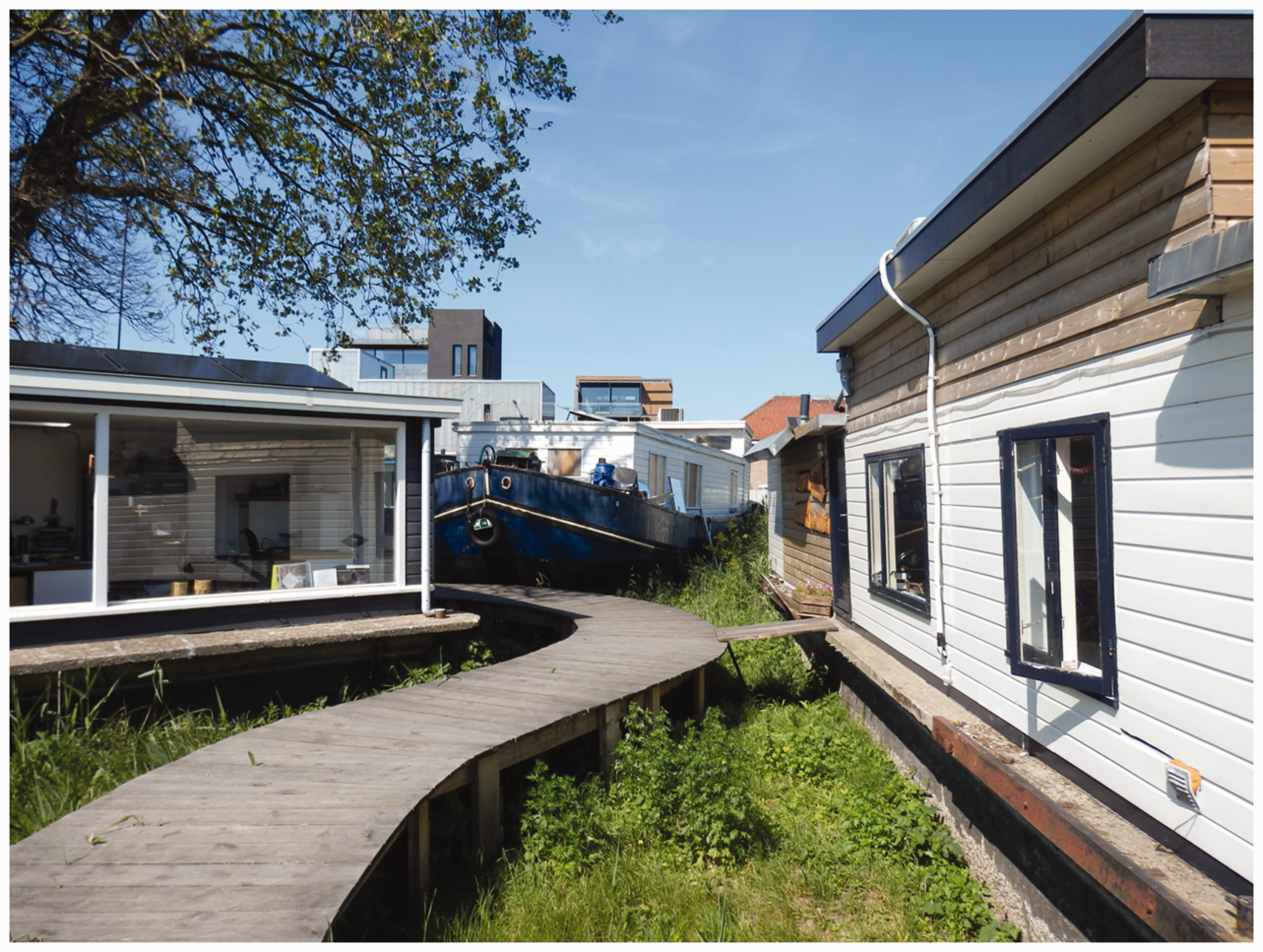
Upcycled houseboats at De Ceuvel.
From the outset, De Ceuvel has brought together an impressive pool of volunteers, as well as a motley crew of creative professionals. Theatre artists, filmmakers, social entrepreneurs, architects and designers claimed their spots on the houseboats, while customizing them in an innovative and largely improvised manner. Notably, the ways they were transformed mirrors the very sociality of De Ceuvel as a place of inspiration, from the circulation of heterogeneous ideas and materials, to its experimental character, to the emergence of an alternative salvage value regime. Animated from its inception by a logic of ‘flexible, cheap and off the grid’ (Pop-Up City, 2015) the on-land harbour distinguished itself as a landmark of creative reuse that both subsumed and exceeded the seemingly residual materialities informing its making. After the official opening in June 2014, De Ceuvel rapidly turned into a key exponent of sustainable urban living in Amsterdam and currently scores as one of the most successful initiatives of its kind in the Netherlands. In exploring De Ceuvel’s ethos of creative reuse, we conducted an ethnographic study focused on the actor coalitions, the material and affective displacements that allowed this experimental initiative to take off.
We started fieldwork prior to the official opening and performed regular site visits for roughly two years. Materials were generated based on semi-structured interviews with volunteers (4), researchers (4), community members (12), architects (3) and policy makers (3) that contributed to the realization of the on-land harbour. The respondents were asked to provide a narrative of their own motivation, experience and vision of De Ceuvel. The resulting accounts were complemented by informal talks with visitors and residents of the neighbourhood, as well as by observing daily routines within the community and attending various events organized on-site. The latter included, though were not limited to, the official opening, two subsequent editions of the annual De Ceuvel festival and workshops on a diverse range of topics, from storytelling and theatre, to the future of public spaces, to enhancing sustainability transitions in the city. Additionally, we conducted an extensive survey of local reports 2 and the media coverage 3 of De Ceuvel to triangulate the respondents’ feedback and participant observations. Based on the findings, we submit three main affordances of creative reuse. These are accordingly discussed as responses to abandonment, the co-constitutive character of experimentation and the circulation of heterogeneous ideas and materials. In moving beyond circumstances of disposal and dissolution, we argue, creative reuse interventions provide the means to expose and alter the productive latencies of incumbent sociotechnical arrangements, with the resulting heterogeneity often fostering ‘new situated solutions and practices through experimentation and hybridisation’ (Faulconbridge, 2013: 340). Hereafter, we dwell on such an occurrence that enabled things otherwise redundant, disposed and forgotten to make surprising returns and, as such, to inspire more sustainable and inclusive modes of assembling and narrating the city.
Urban alternatives
Not architecture alone but all technology is, at certain stages, evidence of a collective dream. (Benjamin, 2002: 152)
The Oxford Dictionary provides two main definitions of the word alternative. The first pertains to ‘one or more things available as another possibility or choice’, and the second to ‘activities that depart from or challenge traditional norms’. Both imports feature a role in our conceptual enterprise. The first, as a matter of choice and causality, concerns the mongrel character of alternatives and their multiple political incarnations. The second import is suggestive of the dislocation work prompted by the emergence of alternatives in relation to dominant imaginaries. With hindsight to the past decade or so, both imports are redolent with a spate of scholarly dispositions towards marginal and informal articulations of urban everyday practices. If some flag alternatives as the struggle for recognition and often survival (Ghertner, 2008; Pickerill and Chatterton, 2006; Soja, 2009), others call attention to makeshift coalitions and governance experiments that transcend the logic of incumbent regimes (Brown et al., 2012; Evans et al., 2016; Richardson et al., 2014). This line of reasoning was seminal to a more generous reading of urban politics in both the Global North and South, where acts of resistance and the learning processes enabled by them are in fact increasingly highlighted as catalytic to new sociotechnical synergies (McFarlane, 2011a; Roy, 2009). The latter often foster transient ‘subsumption architectures’, evoked by Sanford Kwinter (2007: 187) as the referent of wild, bottom-up systems that ‘range and explore and mine their environment, that capitalize on accidental successes, store them, and build upon them’.
By and large, what many of these instances arguably share is the onus on envisioning ‘more hopeful urban futures’ (Purcell, 2008: 34). Or, as AbdouMaliq Simone (2008: 30) contends, within the swirl of everyday life the city acts as ‘a constant reminder of what could be but [still] isn’t’. Once approached in this manner, the status of alternatives aligns to Appadurai’s (2013: 295) plea for an ‘ethics of possibility’, indicative of ‘those ways of thinking, feeling and acting that increase the horizon of hope, that expand the field of the imagination, that produce greater equity […] and that widen the field of informed, creative, and critical citizenship’. Hence, in light of the case explored in this paper, we align the above treatment of alternatives with ongoing attempts to reimagine the sociality of experimentation and urban infrastructures (Amin, 2014; Brenner, 2016; McFarlane, 2015; Tonkiss, 2013). We elaborate on these questions in the following sections. First, we address the interplay between austerity-led urban politics and interim alternatives to abandonment. Second, we dwell on the politics of urban experimentation, with the latter broadly defined as ‘purposive interventions in which there is a more or less explicit attempt to innovate, learn or gain experience’ (Bulkeley and Castán Broto, 2013: 366). Third, we discuss how such purposive interventions enable the circulation of heterogeneous ideas and materials to cohere into an alternative value regime. In the final section, we elaborate further on the topological sway of creative reuse interventions in enacting infrastructures of curatorship, capable of unsettling particular ways of dwelling, learning and narrating the city.
Enacting interim alternatives to abandonment
At the outset, we evoked De Ceuvel’s post-industrial and somewhat precarious appearance. While certainly displaying an idiosyncratic layout, De Ceuvel shares a broader experimental condition with Amsterdam’s progressive ethos, from Aldo van Eyck’s work on urban playgrounds and the establishment of the ‘Situationist International’ (Oudenampsen, 2010), to its tumultuous history of social centres and urban squatting (Owens, 2009; Soja, 2002). According to Oudenampsen (2010: 25), van Eyck’s post-war recovery of derelict sites through playgrounds inaugurated in Amsterdam a ‘shift from the top down organization of space by modernist functionalist architects, towards a bottom up architecture that literally aimed to give space to the imagination’. A more recent example of that was the Kinetic North initiative 4 to redevelop the NDSM wharf, located at the heart of Buiksloterham.
Formerly home to one of the largest shipbuilding facilities in the world, the site went through a series of dramatic transformations over the past 30 years. After NDSM’s collapse in 1984, it took almost two decades for the abandoned shipyard to formally receive a new function and become part of Amsterdam’s cultural scene. The founders of Kinetic North were a group of artists, skateboarders and social entrepreneurs with tight connections to the squatting movement. After getting evicted from other locations in Amsterdam, they joined forces to turn the NDSM wharf into a vibrant creative hub. The Kinetic North group thus drafted back in 2000 a plan for NDSM’s transition ‘towards an experimental, multi-disciplinary cultural environment’ (Kinetic North, 2003). The plan received support via Breeding Places Amsterdam (BPA), a programme initiated by the municipality in 1999 to provide artists and social entrepreneurs with affordable office space and housing.
In the context of intensifying austerity discourses, as well as of national campaigns against squatting of commercial properties, the municipality used the BPA programme to concede social entrepreneurs more leverage for setting up new initiatives. Support was mainly offered via a dedicated subsidy scheme and by tendering out vacant sites throughout the city. As Pruijt (2004: 700) points out, the BPA’s motivation was ‘based on an explicit recognition of the value of artists and cultural entrepreneurs for the vitality of the city’, yet without excluding the possibility of further evictions. The attempts to incentivize temporary occupation, whereby starting and low-income creative professionals would be granted formal access to vacant commercial properties, reveal a first affordance of creative reuse interventions as alternative to abandonment.
Since the global financial crisis of 2008, when the investment plans for Buiksloterham were scrapped by real-estate developers, NDSM has grown into a main hotspot for grassroots initiatives and start-ups, thus playing a pivotal role in the further regeneration of the area. First-hand this might appear as yet another occurrence of government-led gentrification or, in light of the ‘post-crisis city’ argument, a manifestation of what Neil Gray (2018: 15) terms ‘soft austerity urbanism’, that is, ‘seemingly progressive, instrumental small-scale urban catalyst initiatives that in reality complement rather than counter punitive hard austerity urbanism’. Such manifestations are in fact often flagged as the upshot of austerity-led urban politics (Fuller, 2017; Peck, 2012), predicated upon a logic of ‘insecurity, flexibility and temporariness’ (Ferreri et al., 2017: 249). And their temporary character may indeed become a catalyst for ‘intensifying and normalising precarity’ in the city, as shown by Ferreri et al. (2017: 249) in the discussion of property guardianship.
Conversely, through that very logic of flexibility and temporariness, interim alternatives to abandonment could also inspire emergent forms of experimentation, ownership and creative action. While bound to unusual sites in the city and notably to the precarious condition of their occupants, the case of NDSM and the more recent example of De Ceuvel are evocative of such an experimental ethos. This vantage point aligns with Fran Tonkiss’ (2013: 313) interrogation of the critical spatial practices that operate ‘in the cracks between formal planning, speculative investment and local possibilities’, to highlight the opportunities ‘they open up and the forms of sociality they might entail’. Both NDSM and De Ceuvel are indeed emblematic ‘breeding places’ of the Buiksloterham, recognized, on the one hand, for the creative appropriation of derelict industrial sites and, on the other, as spin-offs of the municipality’s BPA programme. Notwithstanding their temporary character, both cases are evocative of urban experiments that emerge at the interface between formal and informal practices, which represents a key tenet of their transformative function.
Experimenting ‘at the edge of mainstream’
Concerning the interplay between formality and informality in cities, McFarlane and Vasudevan (2014: 257) point to ‘the below-the-radar practices of everyday life and culture that not only grease the wheels of these apparently formal realms, but which may indeed be more important than the formal domain’. Often informed by precarious means (MacLeod and Jones, 2011), the ingenuity of ‘informally-sourced’ alternatives is always contingent on their ‘formal’ referents, through shifting ‘entanglements between objects and bodies, discourses and power, performances and blueprints for actions’ (Lancione, 2016: 13). Resulting ‘practices of gathering, composition, alignment, and reuse’ (McFarlane, 2011b: 649) thus enable the conditions for modes of (re)ordering that expose the productive latencies routinely inhibited by incumbent forms of urbanization. This is not to downplay precarity or the effects of austerity-led agendas, but rather to stay attentive to how creativity is relationally deployed to sustain urban infrastructures of experimentation. The latter proved essential to NDSM’s role as a regenerative hub in Buiksloterham. Despite the post-crisis hardship, NDSM has endured as the main launch pad for grassroots initiatives and new businesses like Metabolic, a cleantech start-up co-opted in the realization of De Ceuvel.
As part of the BPA programme, the former De Ceuvel-Volharding shipyard was tendered out in 2012 for a 10-year lease. The on-land harbour design was submitted by Space & Matter, Delva Landscape Architects and the University of Ghent. This consisted of an organic composition of old houseboats (Figure 2), retrofitted to create office space for starting and low-income creative professionals, set within a phytoregenerative park that would clear heavy pollutants from the soil. Added to the ingenious approach to office space provision and soil remediation, Metabolic’s involvement stimulated a broadly inspiring narrative of experimentation and play. The start-up became responsible for designing an experimental system for on-site energy, water and food production. Labelled the Cleantech Playground, the system combined both rudimentary and mainstream technical solutions to progressively implement a circular-regenerative system at De Ceuvel. The submission immediately appealed to the municipality, notably for its sustainability dimension. In order to meet the requirements for BPA lease agreements, the project also had to accommodate a commercial and public function, hence the café-restaurant and nearby square became later additions to the on-land harbour design.
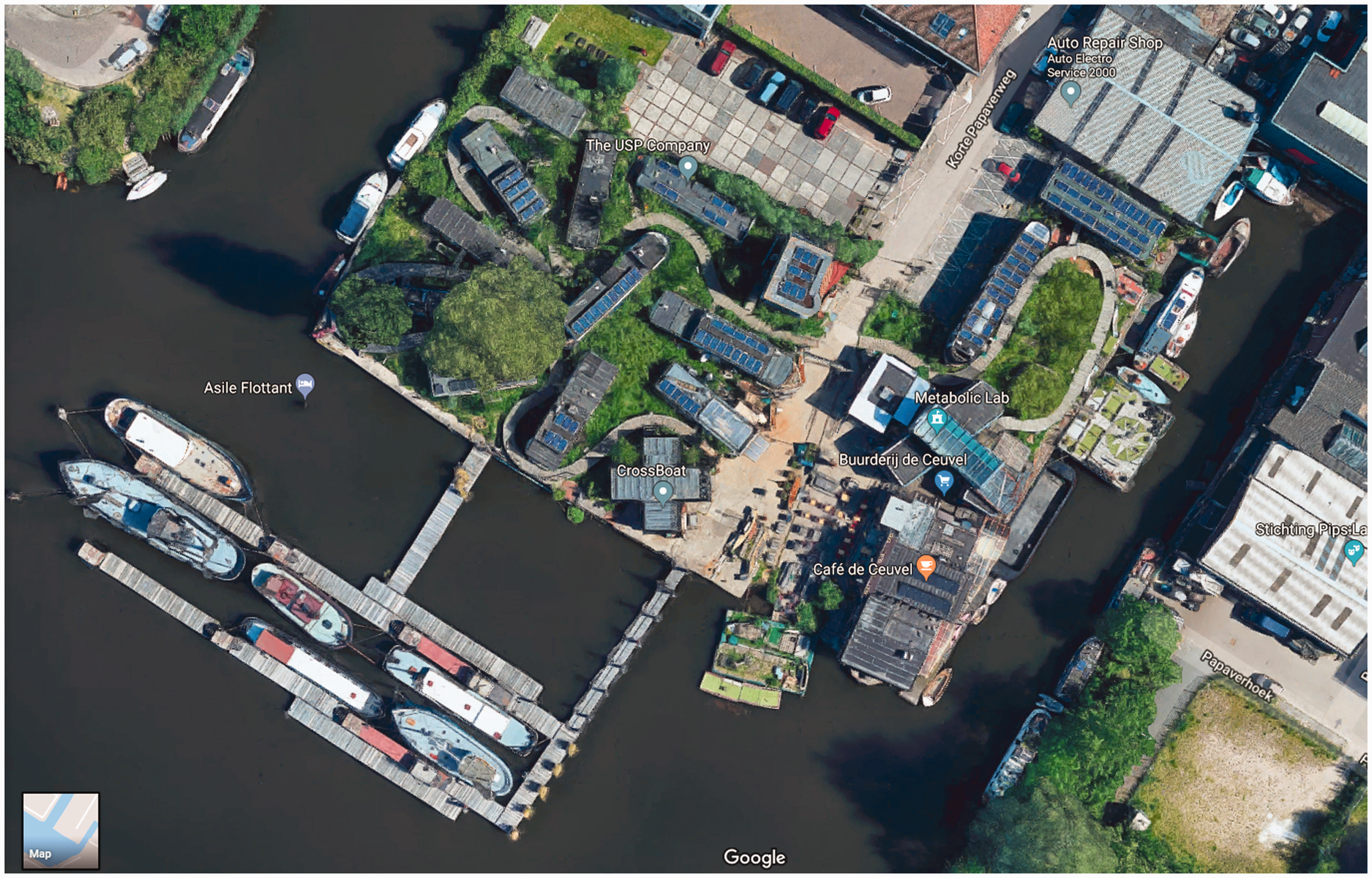
Aerial view of De Ceuvel.
Shortly after the lease was approved, the first houseboats could already be spotted by the NDSM wharf, where they were partly retrofitted with the basic equipment required for their new function. At the end of October 2013, the houseboats were towed to De Ceuvel-Volharding site and craned into their designated position on the ground. With this phase completed, one could find on-site a jury-rigged infrastructure that seemed worlds apart from the initial vision endorsed by the municipality. As mentioned by an early volunteer, in fixing things, preparing the ground and pioneering the project implementation, ideas took shape by trial and error while building De Ceuvel (interview). Somewhat surprisingly, the improvised character and strong collaborative dimension became in fact a main drive for the project implementation rather than a drawback. This was reflected in a successful early spate of volunteering and promotional events, including a rather atypical campaign to attract tenants. The campaign was organized via Marktplaats, the most popular Dutch auction website, where prospective tenants could submit their motivation letter and preference for one of the houseboats. As indicated by most tenants, they could freely customize their office space and contribute to the sustainability agenda of De Ceuvel. When the houseboat revamping was nearly completed, one of the respondents cheerfully recalls that ‘somewhere in April, there was this point, when they hung the rope swing in the tree and then I had the feeling that it was enough for people to finish this. For me the rope swing was a symbol, we do not only have to work, there is also time to play’ (interview landscape architect, emphasis added; Figure 3). The reference to play is evocative of De Ceuvel’s shifting spatialities of experimentation and creative action.
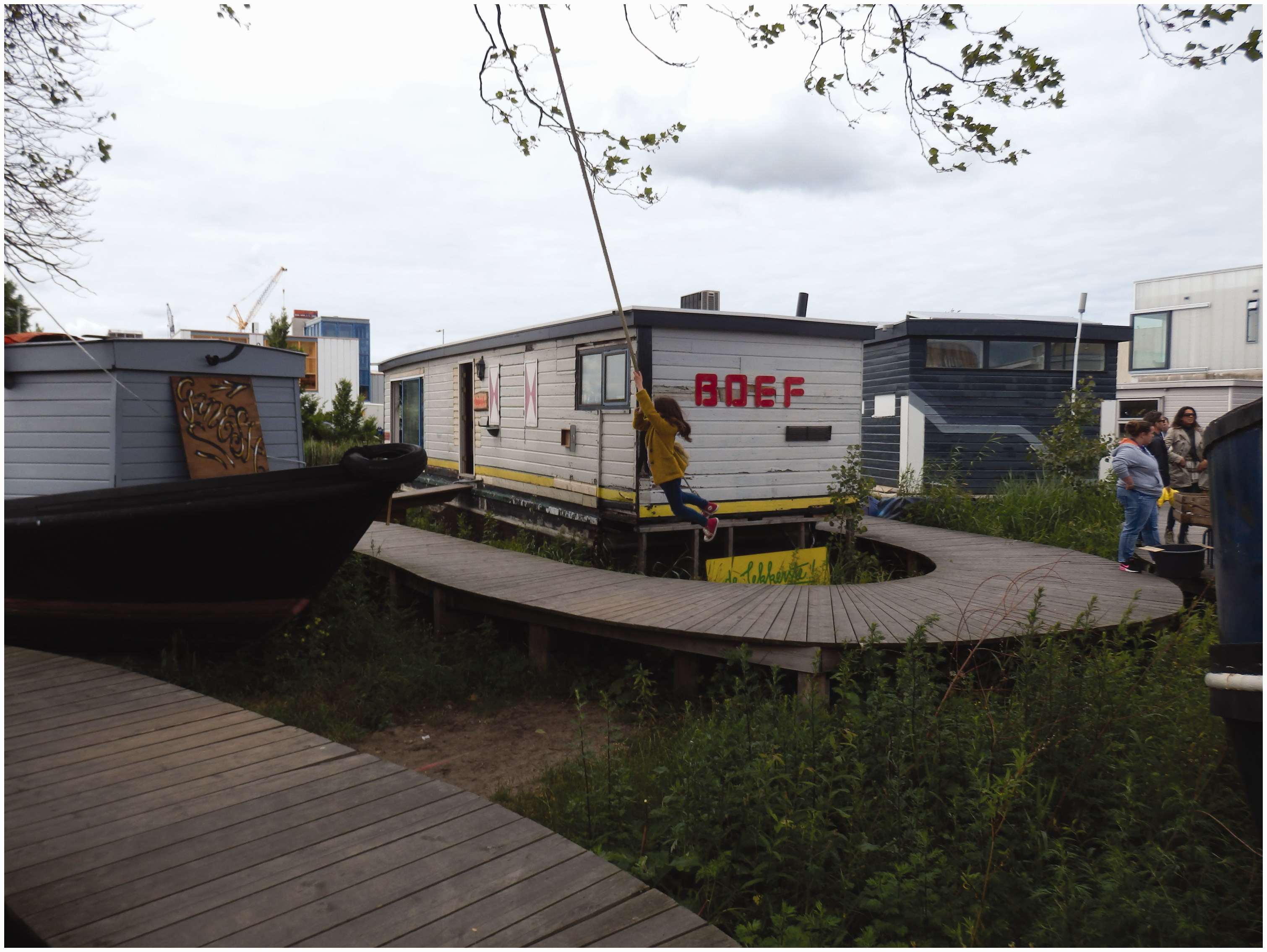
The rope swing.
Bulkeley and Castán Broto (2013: 373) contend that ‘recognising experimentation as a site of politics’ calls for closer attention to ‘the emergence of new sites and intermediaries’, which blur the boundaries between ‘neatly established categories of producer and consumer, public and private, regulatory and economic and through which governing is accomplished’. This was particularly the case with developing the circular-regenerative system at De Ceuvel. One of the quarterly reports dating from the implementation phase specified that on ‘site, new or little-known aspects of water and energy management are investigated, focused on a household and neighborhood scale systems thinking, with low resources consumption and high nutrient recovery, combined with a strong and dynamic community involvement’ (Metabolic, 2014: 5). While the cleantech playground was praised by the municipality, the licensing and approvals for utility provision proved a thorny task. As pointed out by Eva Gladek, founder of Metabolic, the ‘site has no gas and no sewage connection; that itself is illegal’ (Schuetze, 2014). There were issues also with recycling rainwater into drinking water, which ‘was blocked by the city because that would have meant licensing the community as a drinking water provider – which was too complex and costly’ (Schuetze, 2014).
The licensing limitations required inventive ways of bypassing regulations to allow for makeshift and low-tech solutions. Hence, the experimental boundaries of the cleantech playground were the result of intensive negotiations that moved forward in fits and starts. In order to cater for the community’s ambitions of self-sufficiency, De Ceuvel could qualify for exemptions by having the status of a protected testbed. This allowed for all sorts of trials and tweaks, such as implementing a decentralized resource recovery system, individual heat pumps and compost toilets.
Through its set-up as a cleantech playground, as well as a breeding place for creatives, De Ceuvel’s infrastructure is suggestive of the unremitting struggle to claim the city. Thinking of experimentation as a site of politics, De Ceuvel’s making alludes to such a dynamic generative of alternative conditions of possibility. While reflecting on the process, one of the social entrepreneurs in residence indicates that ‘what made it all possible is really the government, relaxing, letting go … and then you can see what these grassroots initiatives pretty much can do … it is not a top-down world anymore, it is a bottom-up world’ (interview, emphasis added).
The emergence of sustainable alternatives in collusion with incumbent practices is particularly important in the case of De Ceuvel. This speaks to Pieterse’s (2008: 85) account of ‘transgression at the edge of mainstream consensus in order to subvert and remould new and more empowering agreements on sustainable forms of city building’ (see also Smith, 2007). De Ceuvel’s infrastructure of experimentation may well be regarded as a sociotechnical niche, yet not necessarily as one confined to a marginal political space (Bulkeley and Castán Broto, 2013: 365). Accordingly, a second affordance of creative reuse pertains to the co-constitutive character of alternatives, which invites a more careful reflection on their political status, beyond idealizing the latter as marginal or otherwise (Luque-Ayala and Marvin, 2015; Sundaram, 2010). Many community members were well established within the broader professional networks of Amsterdam and actively involved in other grassroots initiatives throughout the city. In a similar way, Metabolic’s rapid expansion from a start-up into a leading cleantech company became possible by skilfully connecting an ambitious sustainability agenda to a whole range of locally influential partners. De Ceuvel’s inspiring story also featured extensive local and international media coverage over the past years. This enabled it to quickly earn recognition as a flagship sustainability initiative, to such an extent that the whole area of Buiksloterham was declared by the municipality a ‘living lab for Circular, Smart, and Biobased development’ (Amsterdam Smart City, 2016). By morphing various imaginaries and actor constellations into a novel collaborative arrangement, De Ceuvel turned into the fixed point of an expanding network, where the capacity for broader societal transformation is presumably being built. Amsterdam may indeed represent one of those cities that thrive on urban experiments (Raven et al., 2017), ‘where governance structures and cultures allow for genuinely participatory collaboration’ (McFarlane and Vasudevan, 2014: 260). However, what notably distinguished De Ceuvel was the imaginative cross-breeding of the creative community and the cleantech playground functions in establishing a space of translation for the circulation of heterogeneous ideas and materials. This effectively enacted a salvage value regime at De Ceuvel, which transcends a siloed treatment of sustainability, as well as the taken-for-granted status of urban materiality and related narratives of belonging.
Warping the circulation of heterogeneous ideas and materials
De Ceuvel’s experimental condition is readily apparent from the ingenious integration of the on-land harbour, the phytoregenerative park and the cleantech playground. Each of these main components in fact transcends circumstances of disposal or dissolution in exploiting what Latham and McCormack (2004: 719) call ‘the productive potentialities often hidden within the materialities of the urban’. The attempts to reuse or even upcycle the discarded houseboats, industrial wasteland and all sorts of renewables are primarily evocative of De Ceuvel’s makeshift character. Yet, they also render explicit an emergent salvage value regime, of repair and maintenance (Graham and Thrift, 2007), and of sociotechnical arrangements that challenge the conventional status of urban materialities. As Vasudevan (2015b: 355) contends, to ‘speak of a makeshift urbanism is therefore to acknowledge the constantly changing role of materials and resources in the making of such spaces’. In a similar fashion, one of the architects from Space & Matter points out: [We] got the right to use the heavily polluted 4,600-square-meter plot for a period of ten years. But we didn’t receive any money and there were no buildings, so our plan had to be flexible, cheap, and off the grid as we didn’t want to touch the soil […] I knew that houseboat owners are stuck with their old houseboats when they buy a new one and since there’s no place to store them, many end up at junkyards. We came up with the idea to use them as basic structures to build upon and we could get them very cheaply. (Pop-Up City, 2015)
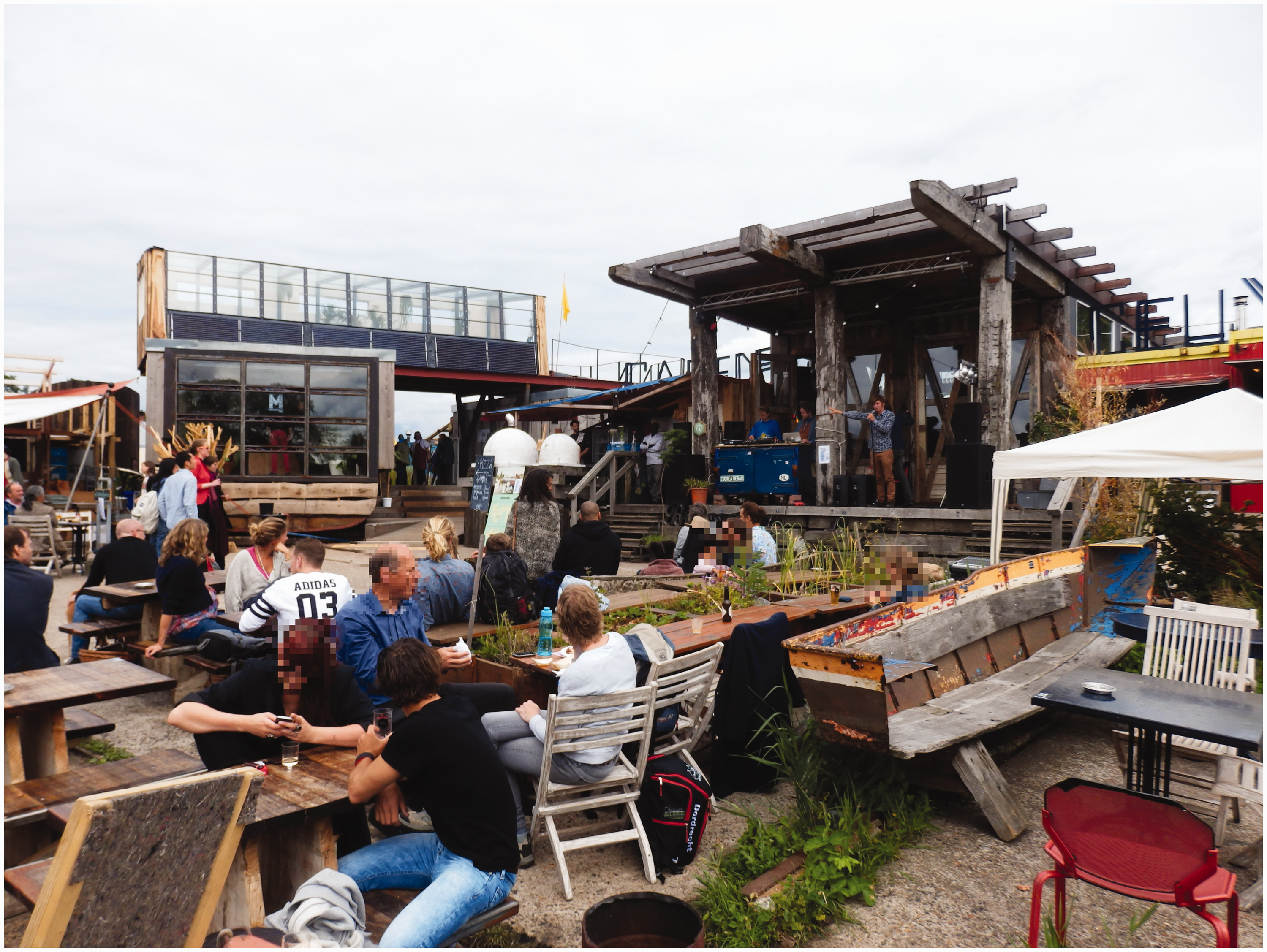
Café De Ceuvel (right) and Metabolic boat (left).
The whole café has been built by the architect completely upcycled. For example these poles are old bollards that were used in the water, in the harbour of Amsterdam; they were there for eighty years in the water and now they are a construction. This, where we are right now, used to be a beach pavilion used for the emergency service in The Hague, and now we shipped it here and used it to build the café. But also the floor, for instance, is made of these old planks where bricks would be baked on … this is from an old gym, everything is upcycled or given a new goal [ … ] We are really looking for those ingredients that are most innovative or most sustainable, for instance, we are using a lot of mushrooms which are from urban farming here in Amsterdam, and actually reusing waste streams from the city to grow within the city [ … ] We are also starting a garden on the island made of recycled plastic [Figure 5], floating here, and we already had a volunteer day a few weeks ago to start planting seeds. (Interview with co-founder, emphasis added)
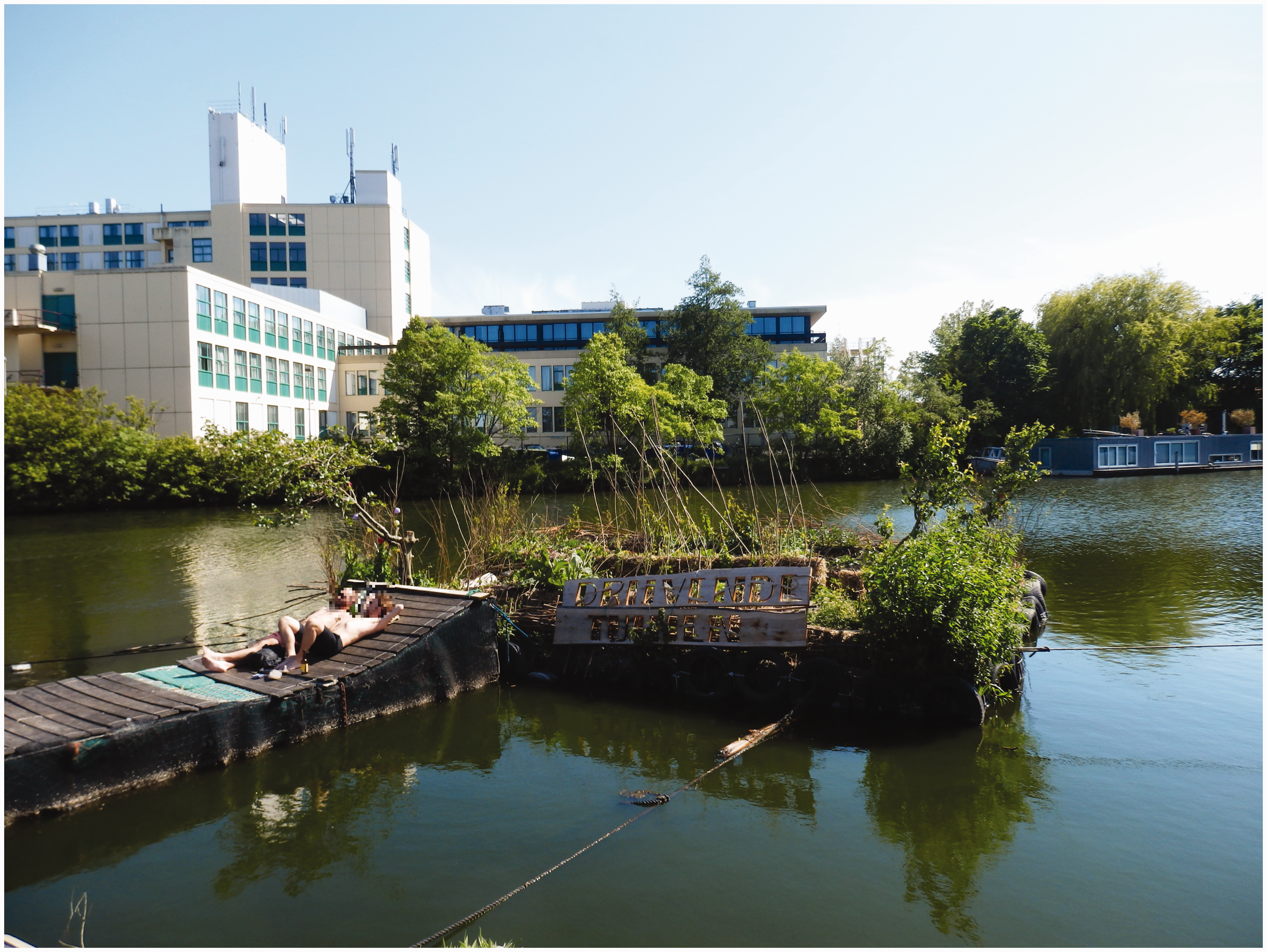
The floating garden at De Ceuvel.
The case of Café De Ceuvel exposes the disruptive character of creative reuse as an alternative imaginary to ongoing processes of disposal and dissolution. Analogously, the houseboats’ metamorphosis resembles a tinkering process animated by the manifold enrolments of seemingly residual materialities. As Moore (2012: 792) convincingly suggests, ‘Waste can escape and exceed, not just our categories for it, but also the physical limits and boundaries imposed on it, and is given capacity to act on society in interesting and surprising ways.’ The question of (re)use value is particularly important here, as the status of things is habitually bound to their symbioses, whereby objects and waste become ‘two sides of the same coin’ (Harman, 2016: 5). Creative reuse thus alludes to modes of (re)ordering that exploit the residual substrate of extant urban materialities. This seems a rather twisted symbiosis, one of peculiar association, which often enables discarded things to make surprising returns. The latter elicit the reworking of various affects through the circulation of heterogeneous materials and ideas, from the odd materiality of the on-land harbour to the co-constitutive character of the political capital required to unsettle expected returns. For instance, while reflecting on De Ceuvel’s distinctiveness, a designer in residence explains that: There is a project very much alike at NDSM, where they transformed a big industrial hall for artists to establish their own studios and that you could basically do in all industrial halls around the world. But the houseboats are something typical for Amsterdam that you would not do in most of the other cities in the Netherlands, definitely not in Paris. The industrial halls could serve as an example on how to organise a project like this. It paves the way for this, on how you can build a sort of community or broedplaats [breeding place]. Whereas here, it goes well beyond creating workspaces for creative people. The ambition is way bigger, and the way it is shaped is also way more surreal. (Interview) I think the idea of De Ceuvel can be really well transported, but it shouldn’t be too rigid. Here they looked what is in the area that can be used to make easy constructions, recycled ones, placed on wasteland. In a more rural area it’s not houseboats, but maybe glasshouses that they recycle, or old barns [ … ]. I hope that in ten years we have built up a lot of experience with the techniques used here, so maybe you don’t need a cleantech playground, but you can use the techniques that were tried out here [ … ] It’s the thought behind it that could be transported. And what I like, is that it fits the flexible way of working. (Interview, landscape architect)
Identified with Amsterdam’s legacy of living by the water, at De Ceuvel reuse value stands out as an expression of the potent afterlives of things and affects (Ash, 2014: 7; Thrift, 2008: 9). In other words, as Hill (2015: 413) suggests, the ‘always already affective nature of matter and the material opens up opportunities to think through the role of past in the present from an entirely novel perspective, to embrace the immaterial as part of the material, and to reanimate the past’. Revealing the ‘political potential of multiplicity’ (Davies, 2010: 670) is the point, whereby the circulation of heterogeneous ideas and materials could transcend into new narratives of belonging and creative action. Dwelling on the on-land harbour’s inspiring character, one respondent insists on its equally unconventional and familiar atmosphere: I mean the idea is totally genius, to put the houseboats on toxic earth, with plants that will clean it up. And it fits the historic context of Amsterdam because we have boats, navigation … . Not only the concept, it is altogether. When you walk in the area it looks fantastic, it immediately inspires people because it is so unconventional. But it is not far away from our unconscious imagery, it is not out of place you know … . The old boats that are lying here fit the image of Amsterdam. (Interview, theatre director)
Towards urban infrastructures of curatorship
In furthering the treatment of creative reuse, we dwell here on its broader implications for urban experimentation and sustainable living. As emphasized throughout the paper, creative reuse pertains to those action repertoires inspired by the productive latencies of incumbent sociotechnical arrangements. We explored three main affordances that transcend a siloed treatment of sustainability, with reuse value hence emerging in relation to abandonment, the co-constitutive character of experimentation, and the circulation of heterogeneous ideas and materials. These affordances effectively enact a salvage value regime at De Ceuvel, turning it into a place of inspiration, where dwelling, learning and narrating the city can become otherwise. In tune with Doreen Massey’s (1995: 184–185) account, ‘the past of a place is as open to a multiplicity of readings as is the present’ (see also Benjamin, 2002: 883). The attempts to recalibrate past and present conditions of assembling the city, from the reuse of polluted land and discarded materials, to the unconventional set-up of the cleantech playground, to the alternative narratives of Amsterdam – all are suggestive of De Ceuvel’s transformative function as a dynamic repository.
Articulated by a logic of aspiration and difference, De Ceuvel could be regarded as an archival space that enables seemingly redundant things and affects to become impactful (Cresswell, 2012: 175). This requires a shift in focus from the archive conceived as repository, as clutter, to the archive understood as ‘a dynamic process that combines heterogeneous timescales, scrambles origins and mashes up elements from different horizons’ (Sheringham and Wentworth, 2016: 519). Yet, whether we consider the constant tweaking of the cleantech playground or the shifting subjectivities of De Ceuvel in the broader context of Amsterdam, reuse value is incessantly bound to the workings of incumbent political practices. And such an interplay may well be conducive to instances of what Anna Tsing (2015: 63) calls ‘salvage accumulation’, that is ‘taking advantage of value produced without capitalist control’. When thinking of De Ceuvel as archival space, it is arguably the living and makeshift character of the archive that could arouse mobile political practices. Accordingly, De Ceuvel’s condition of operating ‘at the edge of mainstream consensus’ is what facilitates the rerouting of ‘different social, material and epistemic resources’ (McFarlane and Vasudevan, 2014: 260) towards more sustainable and inclusive modes of assembling the city. This is perhaps the only productive way forward to achieve impact beyond a siloed treatment of sustainability and the hardship of austerity-led urban politics.
What a living archive conception then contributes to ongoing interrogations of urban sociality concerns the ways reuse value is relationally and politically deployed to accommodate other forms of accumulation, distribution and creative action. Aligned to the corpus on the post-human condition of urban sociality (Amin, 2014; Hinchliffe and Whatmore, 2006), such a revised treatment of archives adds to the efforts of unveiling the manifold enrolments that actively shape the fabric of cities. These would include infrastructures that overflow expert-led designs, or even solely human-centred aspirations, into a ‘topological terrain of contingently assembled durations, velocities, intensities’ (Jacobs and Merriman, 2011: 218). A processual reading of archival space would hence prove lucrative in attending, for instance, to how the circulation of heterogeneous ideas and materials unsettles particular ways of dwelling, learning and narrating the city. To expand on Graham and Thrift’s (2007) account of cities made through repair and maintenance, we could as well regard cities as made through infrastructures of curatorship, with their own constitutive topologies. In this context, creative reuse may be understood as a dynamic operator that sustains such infrastructures of curatorship through the sensible piecing together of materials, forms of knowledge and alternative urban narratives. The latter’s rehearsal becomes particularly important for what Neil Brenner (2016: 287) identifies as the core project of alter-urbanization, that is ‘to envision new practices and institutions through which the production of space itself may be pursued’.
While enacted within a complex meshwork of formal and informal practices, infrastructures of curatorship thus provide one among many political vantage points of unsettling the axiomatic dimensions of urbanization. In so doing, they allude to Deleuze’s (1994: 162) topological treatment of the ‘problematic’ as an expression of multiplicities, which ‘tends to give rise to discontinuity on the basis of continuity’. Consequently, the focus on the ‘problematic’ of incumbent sociotechnical arrangements and their political referents is what productively subsumes the three main affordances of creative reuse discussed in this paper. Attending to the ways these become a vivid source for an alternative value regime and related narratives of belonging is merely a first step in flagging creative reuse as a critical and imaginative mode of urban practice. In tune with the Deleuzian problematic, the point is to unveil the multiplicity of otherwise supressed spaces of translation for learning, unlearning and relearning urbanism (McFarlane, 2011a), whether in Amsterdam or elsewhere (see also, Corwin, 2018). Such spaces are primarily political by dint of retrieving their meaning from everyday practices ‘that seek to make better, though imperfect, urban spaces; which work both under and against current economic and political constraints; which take chances when they can be made to present themselves’ (Tonkiss, 2013: 323). These multiple enrolments and their underlying chase for a better-yet-to-come are the stuff of which living archives are made in reanimating the sediments of seemingly established orders.
Footnotes
Acknowledgements
We would like to thank the three anonymous referees and the editors for their comments and constructive criticism. The usual disclaimers apply.
Declaration of conflicting interests
The author(s) declared no potential conflicts of interest with respect to the research, authorship and/or publication of this article.
Funding
The author(s) received no financial support for the research, authorship and/or publication of this article.