




Abstract
This paper extends the view of homeworking as a type of flexible working by employees in organisations aimed at improving work–life balance and job satisfaction, to a type of work that encapsulates significant changes of work towards increased self-employment and casual work, high proportions of which are performed in people’s homes. Such changes to work represent a reconfiguration of the spatial separation and relationship between place of work and place of residence. Through homeworking, this paper studies how changing geographies of work and workplaces impact on workers’ life satisfaction overall and across various aspects of their lives. Using a large representative longitudinal dataset for the United Kingdom, findings reveal that workers’ satisfaction with their job, income and leisure time is significantly shaped by homeworking and that the employment status (employee versus self-employed) and gender are important elements for understanding how homeworking is related to subjective well-being. Homeworking is positively related with leisure time satisfaction of men and women. Job satisfaction advances of homeworking are only observed for employees, but not the self-employed. Men’s income satisfaction is decreased when they work as self-employed without employees in their homes. Future policies and research concerning workers’ subjective well-being need to pay attention to the continued trend towards individualised work in people’s own homes.
Introduction
The increasing prevalence of homeworking is profoundly reconfiguring the spatial separation between place of work and place of residence that industrial production and the capitalist form of accumulation have brought about (Harvey, 1978). Since the 1990s and the rapid advances in information and communication technologies (ICTs), homeworking has increased significantly in many mature economies. Homeworking increased from 5.9% in 1997 to 19.7% in 2012 in the Swedish workforce (Vilhelmson and Thulin, 2016). In the United Kingdom (UK), 4.2 million workers (13.2% of those in work) were homeworkers in 2014, up from 2.9 million (11%) in 1998 (ONS, 2014). In the USA, 24.1% of all workers were doing some or all of their work from home in 2015 (Felstead and Henseke, 2017). Most existing research on homeworking focuses on employees (see Siha and Monroe, 2006); however, the majority of homeworkers are self-employed. In the UK, almost two-thirds of homeworkers were self-employed in 2014 (ONS, 2014). This emerging geography of workplaces is connected with the dislocation of work into cyberspace (Halford, 2005) and wider global changes in work and industrial restructuring that have led to an increasingly individualised workforce of people who work for themselves as self-employed freelancers (Ekinsmyth, 2002), but also to social and demographic changes and the increasing need for reconciling work and family, given the rise in the number of dual-earner households and working mothers (Allen and Martin, 2017).
Strikingly, the home as a site of paid work has received little attention in geographical research. In accordance with the notion of spatial separation of paid work and home in industrial production, the workplace has been regarded in geography predominantly as location of firms and industries or place of tensions between capital/management and labour (MacKinnon and Cumbers, 2011). Cultural and critical geography have developed a geographical perspective on home as a place; however, the emphasis has been on unpaid domestic work in one’s own home rather than paid work (Blunt and Dowling, 2006).
ICT-enabled homeworking of employees (‘teleworking’ or ‘telecommuting’) has received much attention in organisational studies as a means to flexible working within organisations (Bailey and Kurland, 2002; Siha and Monroe, 2006). Comparably little attention has been paid to homeworking of the self-employed even though they represent the largest proportion of homeworkers. While homeworking of employees has been critiqued for being a niche of some workers in a few industries, notably technology and sales, who are afforded the flexibility of where and when to work by their employers (Heynes, 2016), home-based work of the self-employed seems to be connected with the casualisation of work (Christopherson, 2008), as well as the ‘romanticizing’ of some forms of entrepreneurial and creative work (Cockayne, 2016). It is known that homeworking is positive for some aspects of well-being of employees (Wheatley, 2017). To contrast, little is known about the implications for well-being of the self-employed working from home, for example due to the isolation that the combination of self-employment and homeworking may cause (Hislop et al., 2015). It could be, however, that homeworking genuinely affects people’s well-being, for example, in a positive way through not having to commute or, negatively, through being disconnected from co-workers and experiencing feelings of loneliness.
The overarching aim of this article is to investigate individual consequences of changing geographies of workplaces through homeworking as a contribution to subjective well-being studies and research in the work-life and home-life intersection. There are different forms of subjective well-being. How people think about their lives represents the cognitive dimension of well-being (evaluative well-being). Hedonic or emotional well-being are everyday experiences (e.g. feelings of happiness, sadness); eudemonic well-being is feelings of meaning and purpose (see Dolan et al., 2017; Holländer, 2001). The interest of this study is in evaluative well-being – people’s assessment of their life as a whole. Specifically, it will be explored whether homeworking is linked with people’s life evaluation across various life domains. One key focus is on how the employment status influences the relationship between homeworking and life evaluation. A second focus is on gender and the question of whether there are differences between women and men in how they evaluate their lives when they mainly work from home. It has been noted that homeworking is differentiated by gender (Perrons, 2003; Tietze and Musson, 2003); however, empirical evidence on gender and well-being in home-based work remains patchy, with some arguing that home-based work can help women balancing work and family and thus increase their work–life satisfaction (Collins et al., 2013; Walker et al., 2008), while others are more critical about who, among women, can successfully reconcile competing aspects of their lives (Luckman, 2015).
Confounding of factors linked to homeworking, life satisfaction and self-employment make comparisons between individuals difficult to interpret (cf. Binder and Coad, 2013). People are also unlikely to interpret subjective well-being scales used in empirical research in the same way (Clark, 1997). The data used in this study are drawn from the UK Understanding Society (2009/10–2015/16), a large, nationally representative dataset with a panel dimension of seven years. Due to the longitudinal nature of the data, the change in subjective well-being of the same individual can be investigated, thus holding constant the large effects on self-reported well-being of individual traits such as personality that are largely constant over time (Dolan et al., 2008: 96).
The Understanding Society study collects information on satisfaction with life overall, job, household income, leisure time and health. Research has usually found positive associations between domain-specific life satisfaction measures and between those and life satisfaction overall (Cohen, 2000; Rojas, 2006). The four domain-specific life satisfactions investigated in this study (job, income/financial situation, leisure and health) influenced the most people’s overall life satisfaction in earlier studies (e.g. van Praag et al., 2003). These measures together can therefore provide a comprehensive picture of the subjective well-being of homeworkers. The findings show that the employment status (employee vs self-employed) and gender are essential in understanding the subjective well-being of homeworkers, with consequences for policy that seeks to promote ‘flexible working’ and self-employment.
Existing literature
Characteristics of homeworkers and their motivations
Both employees and the self-employed use their homes as a workplace. Among employees, the highly skilled and those in clerical occupations are most likely to work from home, although the highly skilled often work only some of their time from home while clerical workers (mid-skilled) more often than high-skilled workers work more than half of their working hours from home (Felstead and Henseke, 2017). Homeworking men in paid employment occupy mostly professional and high-skilled jobs, while homeworking women are more often than men clerical workers or mid-skilled workers (Bailey and Kurland, 2002; Moore, 2006; Moos and Skaburskis, 2006). Thus, the large majority of employees who primarily work from home in Britain were found to be women (Felstead et al., 2002).
Regarding homeworking among the self-employed, their occupational profile seems to be diverse, with the biggest proportion in skilled trade occupations (ONS, 2014; Walker et al., 2008). Similar to the gender pattern of mainly working from home among employees, self-employed women have a much higher likelihood of working from home than self-employed men. According to Edwards and Rothbard (2000), the probability that a self-employed woman was a home-based worker in 1990 in the USA was almost three times as high as for a man.
Work–life balance (usually understood as work and nonwork role balance or absence of role conflict; Shaffer et al., 2011) and flexibility are common threads in homeworking (teleworking) studies (Siha and Monroe, 2006; Sullivan and Lewis, 2001). Many empirical studies highlight that workers seek the flexibility to better reconcile work with personal life and family. Individuals with children seem to be overrepresented among employees who work from home (Moos and Skaburskis, 2006; Vilhelmson and Thulin, 2016). However, others have criticised the emphasis of homeworking studies on workers with families because individuals without children do not seem to be less interested in homeworking than individuals with dependent children (Darcy et al., 2012). It seems rather that ‘flexibility’ serves different purposes for different people; for example, the better management of the family for some versus a better fit with leisure time and personal fulfilment for others (Collins et al., 2013; Jurik, 1998).
Homeworking has also been described as an ‘escape’ from the office working environment (Collins et al., 2016: 171) and as a means to a ‘more pleasant work environment’ (Tremblay, 2002: 167). However, it seems as if homeworking by men is more driven by the desire to escape the social control and distraction of the office, while women are more likely than men to seek a better reconciliation of work with family/housework and personal benefits through homeworking (Jurik, 1998). Women also perceive stress reduction more often than men as an advantage of teleworking, regardless of the presence of children (Mokhtarian et al., 1998). This chimes with the hypothesis that women have a greater sensitivity to commutes than men as they have shorter commutes, in households with and without children (Hanson and Johnston, 1985). Evidently, women’s health and well-being outcomes of long-distance commutes are worse than men’s (Sandow et al., 2014).
Autonomy over time use and flexibility for personal/family life (independence) is also a key factor in why some people choose to become self-employed (Shane et al., 1991). Hence, self-employed work rather than homeworking may provide the benefits that some employees seek through homeworking. This is confirmed by the relatively large relevance of factors such as low overhead costs, convenience and the nature of the business as reasons for running a business from home (Mason et al., 2011; Walker et al., 2008), suggesting that this type of homeworking is often not because people want to work in the home. Home-based self-employment can also be for some due to the necessity to be employed (Walker et al., 2008) or because of a lack of suitable business space (Mason et al., 2011).
The opposite can also be true, however – some choose self-employment in order to work from home and to achieve a better work–life balance or satisfaction with life. This is suggested by Loscocco and Smith-Hunter (2004), who compared self-employed women by whether they work from home or somewhere else with respect to their motivations for being self-employed. The home-based self-employed women mentioned more often than their counterpart that they wanted to balance work and family. Like homeworking studies of employees, home-based business studies suggest that women more often than men operate a business from home because of the more flexible lifestyle (Walker and Webster, 2004).
Homeworking and subjective well-being
Both positive and negative outcomes of homeworking on the subjective well-being of workers are discussed in the literature. Studies vary substantially in their assessment of the individual outcomes of working from home (Gajendran and Harrison, 2007). This is partly a reflection of differing study designs, including different measures of subjective well-being and how homeworking is operationalised, specifically whether workers spend some or the majority of their working time at home. The intensity of working from home is likely to impact on job and life satisfaction (Redman et al., 2009), for example through the quality of co-worker relations (Gajendran and Harrison, 2007) and how conflict between work and family is experienced (Golden et al., 2006).
Homeworking/teleworking studies of employees have investigated job satisfaction and less so the satisfaction in other life domains or with life overall. Among employees, homeworking was found to be related to greater job satisfaction (Binder, 2016; Felstead and Henseke, 2017; Fonner and Roloff, 2015; Redman et al., 2009; Wheatley, 2017). However, while Wheatley’s (2017) longitudinal study confirmed a positive association between homeworking and job satisfaction of men and women who are employees, Binder (2016), who used the same longitudinal dataset, found a large homeworking effect, but this effect was significant only among men, not women. Wheatley (2017) further found a positive relation between homeworking and leisure time satisfaction, again for both men and women. Neither of these two longitudinal studies could find an effect of homeworking on overall life satisfaction. In contrast, Redman et al. (2009) found with cross-sectional data a greater life satisfaction of homeworking employees compared to office-based employees.
The finding that homeworking employees may not experience an increased overall life satisfaction could reflect that the often-sought work–life balance is not achieved. The management of flexible working hours and the little physical segmentation of work and private life are often described in the literature as a ‘mixed blessing’ (Carrigan and Duberley, 2013: 94). Even though Felstead and Henseke (2017) found a higher level of job satisfaction among homeworking employees compared to office-based employees in Britain, the same homeworkers also perceived their jobs as hard, they worked beyond their formal working hours and had difficulties with switching off and unwinding at the end of the working day.
Comparable studies on job satisfaction and self-employment have not paid attention to homeworking. It is well established that the self-employed have a higher level of job satisfaction than employees because of greater autonomy and skills utilisation (Hundley, 2001). Studies on homeworking of the self-employed or business owners, similar to studies of homeworking/teleworking of employees, highlight the contradictions between enhanced work–life and home–life reconciliation, on the one hand, and pressured working conditions and conflict of managing work–life boundaries, on the other hand (Hilbrecht and Lero, 2014; Perrons, 2003; Süß and Sayah, 2013). The self-employed in general were found to have on aggregate a higher level of work–life conflict than employees, affecting both men and women (Parasuraman and Simmers, 2001).
Dissatisfaction with time is an issue for the self-employed; however, studies are ambiguous as to whether this affects satisfaction with leisure time. Perrons (2003) interviewed self-employed workers and business owners in the new media sector and concluded that men and women were not dissatisfied with their leisure time. Rather, men wanted to have more time with family while women wanted to have more time for both family and work. Women in her study tended to work less in order to make time available for family/children, a behaviour that also features in other studies and seems to apply specifically to home-based self-employed women but not self-employed women who do not work from home (Craig et al., 2012). Huws et al.’s (1996) study of home-based self-employed translators, to contrast, reports that leisure activities can often not be enjoyed by freelancers because of the unpredictability of the work and fears about when the next contract will come.
Besides work–life conflict, studies of both employees and the self-employed identify isolation and loneliness as a problem of homeworking. This feeling is due to the physical and social distance to colleagues and supervisors in the case of employees (Baruch, 2001; Fonner and Roloff, 2015; Wilks and Billsberry, 2007). The home-based self-employed often feel isolated because of the lack of co-workers and the social and physical distance to those they are likely to work for and with (Hislop et al., 2015; Spinuzzi, 2012). However, there is little to no empirical evidence about how social isolation is related to the evaluative well-being of homeworkers.
Another downside of homeworking mentioned in some studies of teleworking is a perceived penalty to career development and income (Drew and Murtagh, 2005; Maruyama and Tietze, 2012; Redman et al., 2009). In fact, some employees who work most of their time from home are paid low wages although there are also high earners among this group of workers (Felstead et al., 2002). For the self-employed, there is good evidence of the low earnings of homeworking women compared to self-employed women for whom most of the activity is performed outside of their homes, while no penalty of homeworking on earnings among self-employed men could be found (Simon and McDonald Way, 2015; see also Thompson et al., 2009).
Summary and hypotheses
It is relatively well established that homeworking increases job satisfaction among employees, mainly due to greater work-related control and work–life flexibility, although social isolation is mentioned as a problem (Baruch, 2001). Because of fewer spatial and temporal constraints, the homeworking self-employed may also enjoy greater flexibility and therefore have greater job satisfaction than the self-employed who work elsewhere. The literature is less clear about whether the job satisfaction advantage of homeworking is differentiated by gender, although some studies suggest that among employees, for both men and women, job satisfaction is increased when they work from home. It is therefore assumed that homeworking is generally positively related to job satisfaction – that is, for employees and self-employed and men and women (Hypothesis 1).
While homeworking seems to be good for job satisfaction, the picture appears to be much less favourable in relation to income satisfaction. The literature points at an income penalty of home-based self-employment among women and negative perceptions of career progression among employees. It seems therefore unlikely that the (assumed) greater job satisfaction is reflected in greater income satisfaction, although existing research often found a positive association between job and income satisfaction (Rojas, 2006; van Praag et al., 2003). In the following empirical analysis, the satisfaction with household income rather than own income is measured. People with a relatively low income (which might not be terribly satisfying) may still be satisfied with the financial situation of their household due to the income of a partner or other income streams. Particularly in relation to the self-employed, the literature has stressed the large variety in earnings and the ‘cross-subsidy’ of the business through the household (Carter, 2011: 46). On this basis, no significant relation between homeworking and household income satisfaction is predicted (Hypothesis 2).
Leisure time could be another life domain that is positively related with homeworking for men and women – but it is assumed that this applies only to men and women who are employees (Hypothesis 3). Leisure time advantages are likely through the time saved from commuting and the variability in working hours. The self-employed, however, may not be able to accrue leisure satisfaction advantages through homeworking because of the mental spillover of work into family and private life (e.g. worries about new contracts and maintaining customers). This may be particularly the case in times of economic hardship, which is captured in the study period (the global economic crisis of 2007–2009 and the following years of austerity).
In relation to health satisfaction, others have found a gender effect among workers, with men being significantly more satisfied with their health than women (van Praag et al., 2003). Accordingly, women are more likely than men to find commuting stressful and regard homeworking as a relief from commuting stress (Mokhtarian et al., 1998). Thus, it seems reasonable to assume that homeworking is related with greater health satisfaction of working women, employees and the self-employed, but not men (Hypothesis 4).
Overall life satisfaction is associated with satisfactions in job, income/financial situation, health and leisure time (van Praag et al., 2003). One reason why longitudinal studies did not find a positive effect of homeworking on overall life satisfaction of employees, both men and women, may be that even though homeworking relieves some spatial and temporal constraints of everyday life, there seems to remain dissatisfaction with family time (men and women) and work time (women) (Perrons, 2003) simply because one can rarely both work and spend ‘quality time’ with the family. On this basis, no significant relation between homeworking and overall life satisfaction is expected, regardless of employment status and gender (Hypothesis 5).
Methodology and data
Data and measures
Homeworking is a significant phenomenon in the UK labour market. The homeworking rate (those working at least half of the working time in the home as a proportion of all people in employment) was 13.9% in 2014, with most common occupations being sales accountants among employees and farming and construction trade occupations among the self-employed; a sizeable number of women are childminders (ONS, 2014). The rise of homeworking in the UK coincides with a changing labour market that has seen a marked increase in self-employment since 2008 (Henley, 2017). The UK is therefore an interesting case not only because of its high and increasing homeworker rate, but also because it underlines that for understanding homeworking and well-being both paid employment and self-employment need to be considered.
This study draws on data from the UK Household Longitudinal Study (‘Understanding Society’), a panel study that started in 2009/10 with a nationally representative sample of 30,000 households for the UK. Seven waves were available for this paper. Each year the same households, including all household members aged 16 years and older, are interviewed; individuals are followed to their new household when they leave a sample household. People’s employment status, location of work and life satisfaction are captured in a consistent manner, alongside the capture of rich information about the individuals and their households.
Satisfaction with life overall, job, household income, leisure time and health are measured annually using these survey questions: ‘How satisfied are you with your life overall (“income of household”, “amount of leisure time” and “health”)?’ and ‘All things considered, which number best describes how satisfied or dissatisfied you are with your present job overall?’. Response options range uniformly from 1 = very dissatisfied to 7 = very satisfied. These satisfaction scales are established measures of evaluative well-being (Binder and Coad, 2013; 2016; Dolan et al., 2008; van Praag et al., 2003).
The employment status (employee or self-employed) is self-reported in the annual interviews. For the self-employed, information is available about the number of employees so that the self-employed can be further distinguished by whether they have employees or not. Warr (2017) found that the self-employed with and without employees differ significantly in their job satisfaction, and the literature review also suggested some special features of working as self-employed isolated from co-workers. Hence, three categories are derived for the employment status: employee, self-employed with employees and self-employed without employees.
Both employees and the self-employed are asked each year where they mainly work in their primary employment, including in their own home. Homeworking is therefore measured in this study as working most of the time at home (in the main employment).
Sample
A sample was created across the available seven waves of Understanding Society of people of working age (18–64 years) who are either in paid employment or self-employment. To be able to measure change in life satisfaction depending on where people work (at home versus not at home), those from whom information is only available in one wave were further excluded. This gives a sample of 33,719 individuals with 140,128 year-observations (15,614 men with 64,933 year-observations and 18,104 women with 75,195 year-observations). For each individual 2–7 repeated measures of life satisfaction and the employment situation are available (see Supplementary Table for a sample description).
In this sample, 3738 people (1932 men and 1806 women) were mainly working from home in at least one wave. This equals 9074 year-observations (4433 men and 4641 women) or 6.5% of all year-observations. By far the largest share of homeworkers, both among men and women, are self-employed without employees (solo self-employed). As a percentage of all homeworking observations, 60% are solo self-employed, 33% employees and 7% self-employed with employees (all proportions are unweighted).
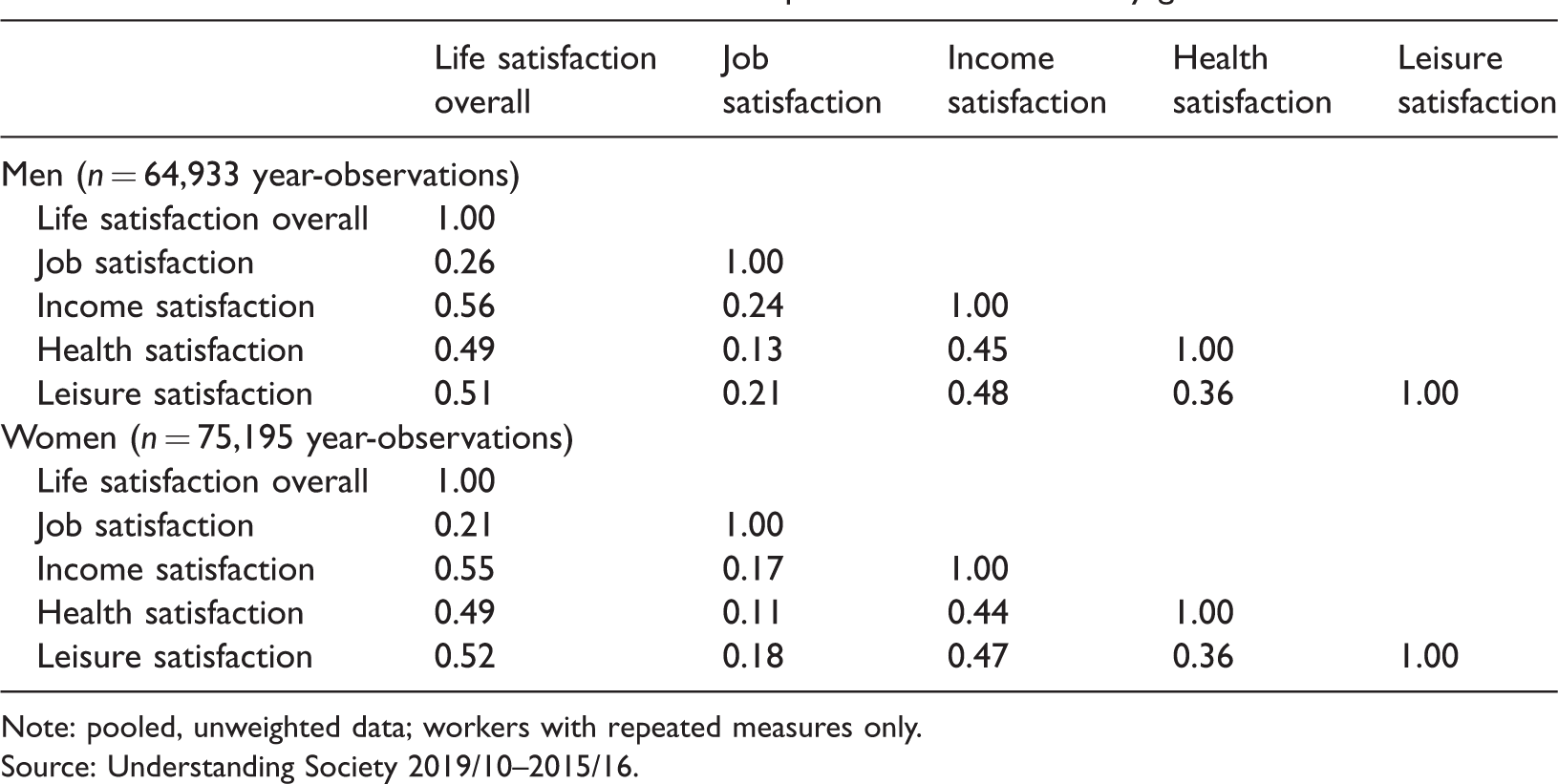
Table 1 displays the correlation matrix of all five measures of subjective well-being. Here and in the models the satisfaction scales are treated as cardinal measures. In the literature both ordinal and cardinal interpretations of subjective well-being are applied. The cardinal interpretation of subjective well-being follows Kristoffersen (2017), Ng (2008), Holländer (2001) and van Praag (1991), who argue that utility can be observed and compared and that people can attach values to subjective evaluations of situations.
Correlation matrix of overall and domain-specific life satisfaction by gender.
Note: pooled, unweighted data; workers with repeated measures only.
Source: Understanding Society 2019/10–2015/16.
The satisfaction score is highest in this sample in the job domain (average score of 5.3), followed by overall life satisfaction (average score of 5.2). The domain that workers are on average the least satisfied with is leisure time (average score of 4.4) (see Supplementary Table). Overall life satisfaction is correlated highest in this sample with income (Table 1). The correlation between overall life satisfaction and job satisfaction is the lowest of all life domains and lower still among women than men. The correlation of overall life satisfaction with the other life domains (health, income and leisure) does not vary much by gender. Also striking is the lower correlation between job satisfaction and other life domains among women compared to men, while the correlation coefficients between the other life domains (health, income and leisure) are fairly similar by gender.
Model specification
In order to investigate how homeworking is linked with people’s life satisfaction, a change in people’s homeworking status and an associated change in their life satisfaction is estimated in panel models with individual fixed effects. The reason for using only within-individual variation (fixed effects) and not between-individual variation (random effects) is that unobserved stable personal characteristics (e.g. personality, aspiration, attitudes) are likely to be correlated with life satisfaction, self-employment and homeworking. Others have shown that estimating life satisfaction in random effects versus fixed effects models produces different results, suggesting that controlling for individual unobserved time-constant effects impacts substantially on the findings of what influences subjective well-being (Andersson, 2008; Ferrer-i-Carbonell and Frijters, 2004). People with certain work attitudes or personality traits may also be more likely to consider homeworking – for example, those who can better cope with working in isolation from co-workers may be more likely to choose to mainly work from home. Although individual fixed effects are controlled for, omitted variable bias due to time-variant characteristics cannot be accounted for. It is conceivable that rapid changes in outlook or attitude could be a common cause of simultaneous changes to subjective well-being, self-employment and homeworking.
The linear fixed effects regression models are specified as follows:

Time-constant variables cannot be estimated in fixed effects models. However, interactions between time-constant and time-varying variables can be included in this model framework (even though no main effect can be estimated) (Allison, 2009: 37). In order to test whether the relation between homeworking and life satisfaction is gendered, first models are estimated separately for men and women and then interaction effects between gender and homeworking are estimated in a next step.
A set of control variables is incorporated in the models according to the current knowledge of what influences life satisfaction (Dolan et al., 2008). Variables include individual and household characteristics: age, being married (including civil partnership), having a child 0–6 years old, education (highest qualification), income (included as own-labour income or equivalised household income), housing tenure (homeowner or renter), employment status of partner, health (measured as limiting long-term illness), caring for disabled/sick or elderly people in the household and outside the household. Two variables are included indicating job characteristics: number of hours normally worked in a week and industry. An urban–rural indicator is included to capture broad characteristics of where people live. 1 In addition, year dummies are included as proxy for temporal variation in subjective well-being over the study period (e.g. economic conditions).
The models estimate an individual’s ‘average’ life satisfaction in homeworking compared to when they were not mainly working from home. It may be that homeworking initially has a positive effect on life satisfaction which then decreases as workers adjust to their working situation (e.g. Hanglberger and Merz, 2015). While understanding duration effects would be a valuable exercise in its own right, the employed modelling technique captures the variety of homeworking found in the dataset (a representative sample of the UK population in 2009/10) and is suitable for answering the questions posed in this paper.
Empirical findings
Job satisfaction
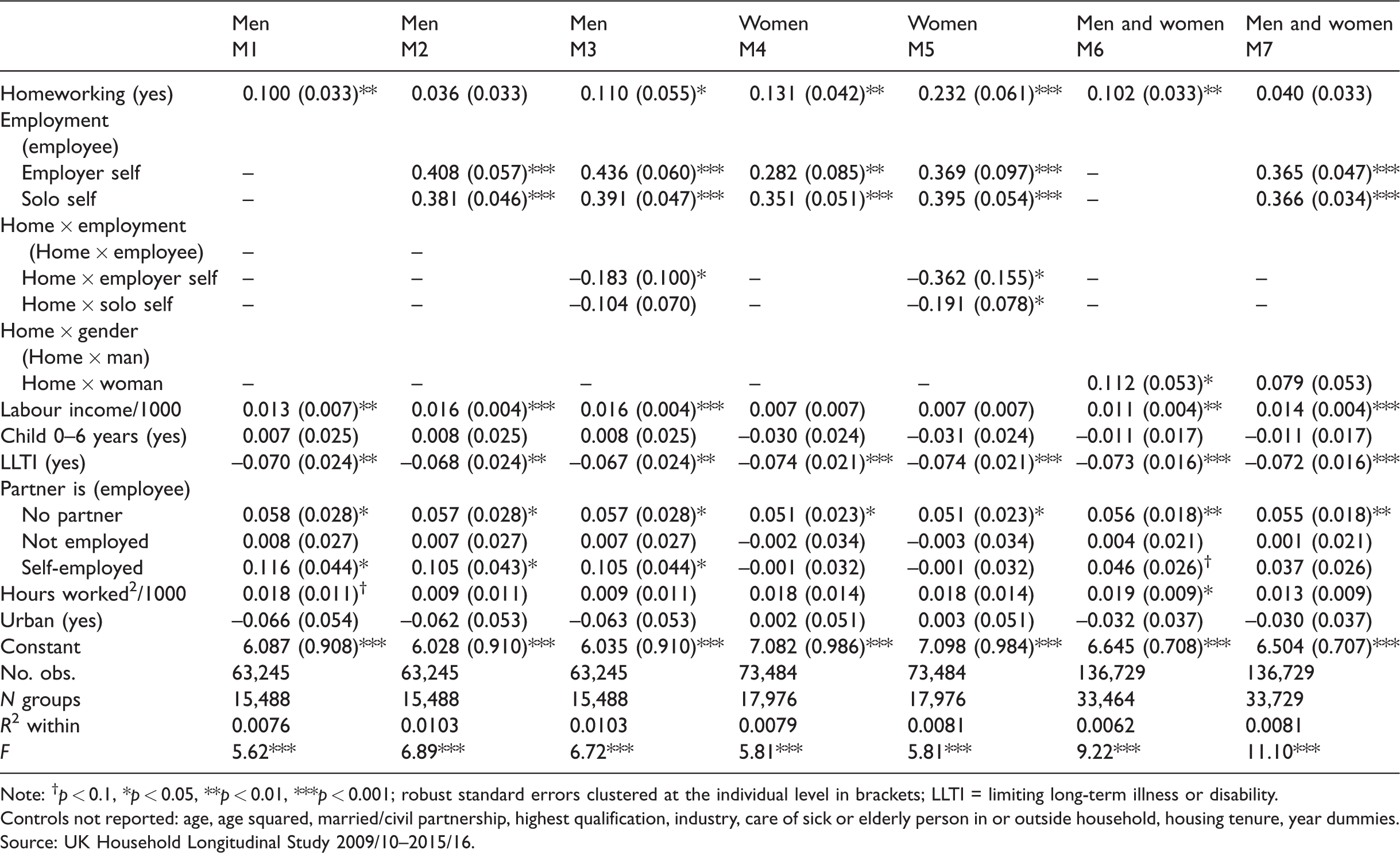
A positive relation between job satisfaction and homeworking found in the existing literature for employees was assumed to exist for both men and women and also when they are self-employed. The modelling results in Table 2 disprove Hypothesis 1.
Estimates of job satisfaction.
Note: †p < 0.1, *p < 0.05, **p < 0.01, ***p < 0.001; robust standard errors clustered at the individual level in brackets; LLTI = limiting long-term illness or disability.
Controls not reported: age, age squared, married/civil partnership, highest qualification, industry, care of sick or elderly person in or outside household, housing tenure, year dummies.
Source: UK Household Longitudinal Study 2009/10–2015/16.
The first finding to highlight is that gender makes a difference in understanding homeworking and job satisfaction. Starting with men, in Model 1, the homeworking coefficient is not controlled for the employment status, while Model 2 adds whether men are employees or self-employed with or without employees. Homeworking appears to be positively related to men’s job satisfaction – but only if their employment status is not controlled for (M1). The regression coefficient of the homeworking dummy drops and is not significant anymore if the employment status is controlled for (M2). Self-employment both as an employer and solo self-employed is strongly associated with job satisfaction, as could be expected from the literature (Coad and Binder, 2014; Hundley, 2001). The finding that the self-employment status moderates the relation between homeworking and job satisfaction means, then, that self-employment captures advantages of homeworking that men value in their job. This is most likely autonomy and control (Hundley, 2001).
Findings for women are strikingly different (M4). For them, unlike for men, both homeworking and self-employment (with and without employees) are significantly positively related with job satisfaction. Women do not have a greater job satisfaction than men when they mainly work from home once the self-employment (i.e. work autonomy) effect is controlled for (M6, cf. M7). However, the estimates in the separate models (M4 and M2) indicate that for women, in contrast to men, homeworking has an ‘additional’ benefit to the advantages gained from being self-employed as opposed to being an employee.
The second key finding is revealed through testing interactions between homeworking and employment status (M3 and M5). Importantly, the homeworking coefficient in these models is now the main effect of homeworking conditional on being an employee. The results show that for both men and women the homeworking advantage on job satisfaction exists for employees but not for the self-employed. The homeworking employer self-employed have significantly lower job satisfaction than homeworking employees (M3 and M5), and among women this also applies to the home-based solo self-employed (M5). This is likely to reflect that homeworking creates greater work–family conflict in self-employment than paid employment (Parasuraman and Simmers, 2001). Among the self-employed, however, those who mainly work from home have not a lower job satisfaction compared to those who mainly work outside their homes (cf. M2 and M4, further robustness checks not displayed).
To summarise these findings, employees accrue benefits from homeworking for their job satisfaction but not the self-employed (with and without employees). The benefits employees accrue from homeworking are different for men and women. For men it seems to be the work-related autonomy and control, much of which is captured in self-employed work (Hundley, 2001), while the benefits women (as employees) accrue through mainly working in the home go beyond these.
Income satisfaction
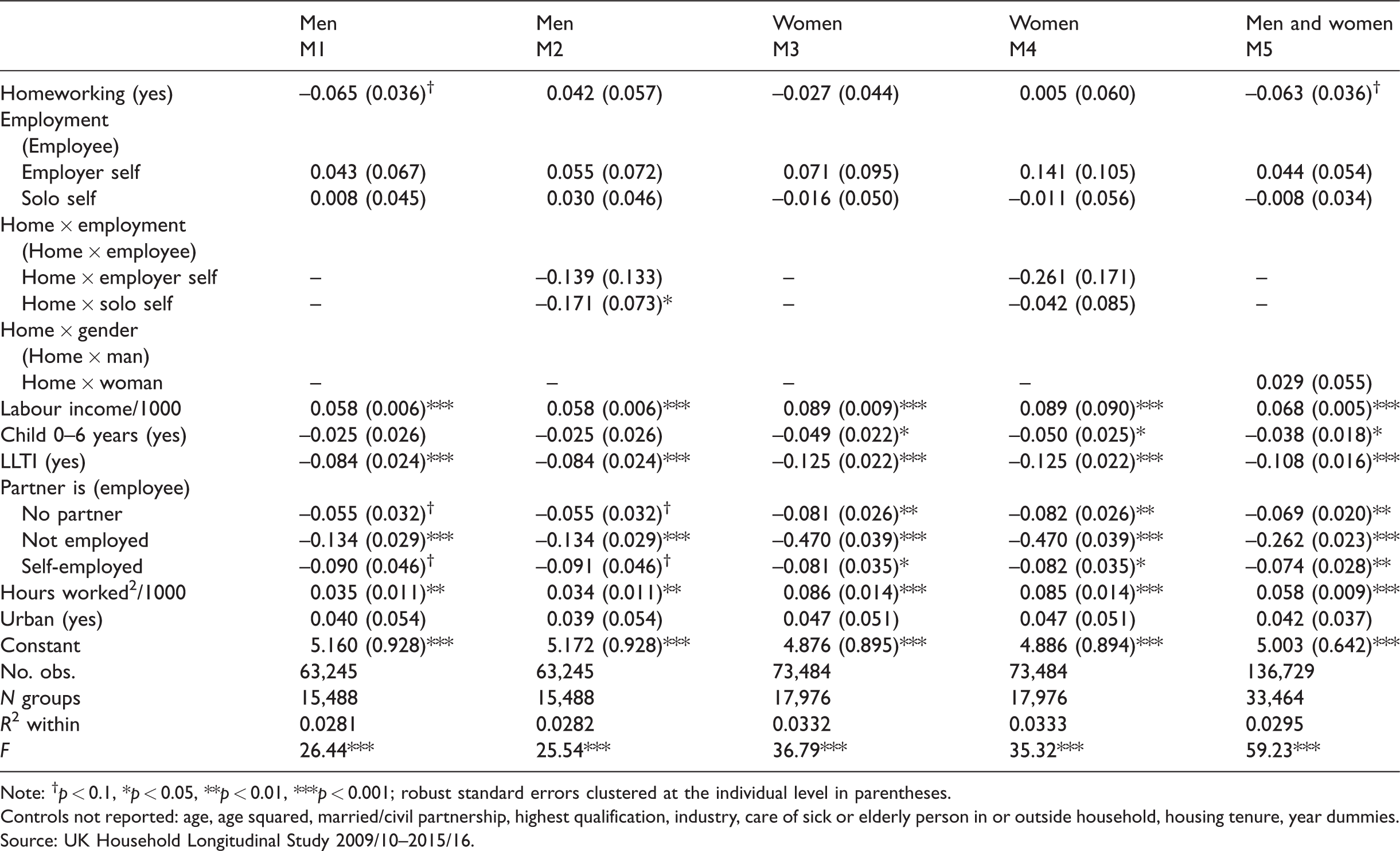
Estimates of income satisfaction presented in Table 3 measure the satisfaction with the household income. The own-labour income rather than the household income is included in these models to capture the influence of one’s own gainful employment on the household income satisfaction. No significant relation between homeworking and household income satisfaction was assumed (Hypothesis 2), despite mention of negative perceptions of career development (employees) and low income (self-employed women) in the literature. Findings disprove the hypothesis and reveal a rather unexpected relationship between homeworking, self-employment and gender.
Estimates of income satisfaction.
Note: †p < 0.1, *p < 0.05, **p < 0.01, ***p < 0.001; robust standard errors clustered at the individual level in parentheses.
Controls not reported: age, age squared, married/civil partnership, highest qualification, industry, care of sick or elderly person in or outside household, housing tenure, year dummies.
Source: UK Household Longitudinal Study 2009/10–2015/16.
The results show a weak negative relationship between homeworking and household income satisfaction among men (M1 and M5). Women are not more or less satisfied with their household income if they mainly work from home or not (M3 and M4). There is no significant gender difference in the relationship between homeworking and income satisfaction (M5), however, since the homeworking coefficient is also negative for women (M3).
Interactions between homeworking and employment status reveal differentiated relations between homeworking and income satisfaction for men (M2). Among homeworking men, the self-employed without employees are significantly less satisfied with their household income than homeworking employees (M2). It was further tested (not shown) whether home-based self-employed men without employees evaluate their financial situation differently to their female counterparts; however, the interaction term is not statistically significant.
Taken together, homeworking is significantly negatively related with household income satisfaction among self-employed men who do not have employees, while for home-based self-employed women with no employees the association is not significant. This is a novel finding since the existing literature has drawn attention to earnings of home-based self-employed women (Simon and McDonald Way, 2015) and homeworking employees’ perceptions of career development (Redman et al., 2009). Solo self-employed men may evaluate their household income (controlled for their own-labour income) negatively because of the earnings limitation through the home location. A plausible explanation seems to be the disconnection from potential clients and customers (Spinuzzi, 2012). Models were also run with the equivalised household income and without the employment situation of the partner, which confirm the robustness of the findings.
Satisfaction with leisure time
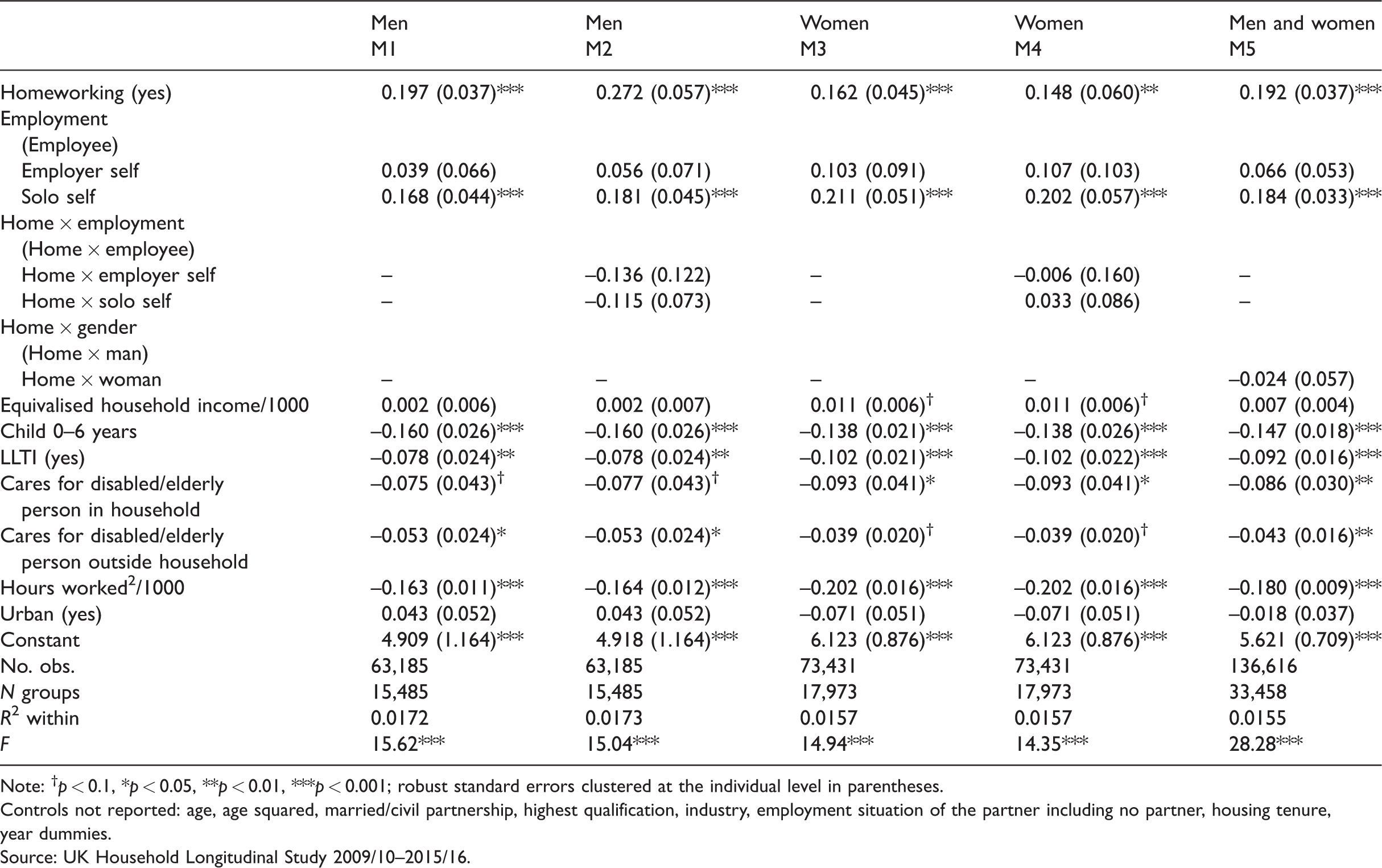
It was expected that leisure time satisfaction is positively associated with homeworking among men and women who are employees (Wheatley, 2017), but not the self-employed because of mental spillover of work into nonwork (Hypothesis 3). Findings in Table 4 partly disprove this hypothesis. Findings suggest that homeworking is significantly positively related with men’s and women’s leisure time satisfaction among employees and those who are self-employed (with and without employees) (M1 and M3). There are no significant differences in the leisure time satisfaction between homeworking employees and homeworking self-employed workers with and without employees (M2 and M4) nor between men and women (M5).
Estimates of leisure satisfaction.
Note: †p < 0.1, *p < 0.05, **p < 0.01, ***p < 0.001; robust standard errors clustered at the individual level in parentheses.
Controls not reported: age, age squared, married/civil partnership, highest qualification, industry, employment situation of the partner including no partner, housing tenure, year dummies.
Source: UK Household Longitudinal Study 2009/10–2015/16.
Being self-employed and not having employees is positively linked with leisure time satisfaction as compared to being an employee, regardless of whether the work is mainly performed in the home or not (M1 and M3). This is likely to be the case due to the temporal flexibility that being self-employed and not having supervisory responsibilities brings (Warr, 2017), perhaps going to the gym or having a walk when it fits into the personal schedule.
Weekly hours worked, having a young child (baby) and caring responsibilities for disabled or elderly, close or extended, family members all reduce workers’ leisure time satisfaction. It does not seem from the models that working people can effectively ‘buy’ leisure time satisfaction as the household income is not significantly linked with leisure time satisfaction among men and only weakly among women. Instead, as the findings suggest, working from home and fewer/no commutes are highly beneficial for workers’ leisure time satisfaction, alongside the flexibility that self-employment with no employees affords.
Health satisfaction
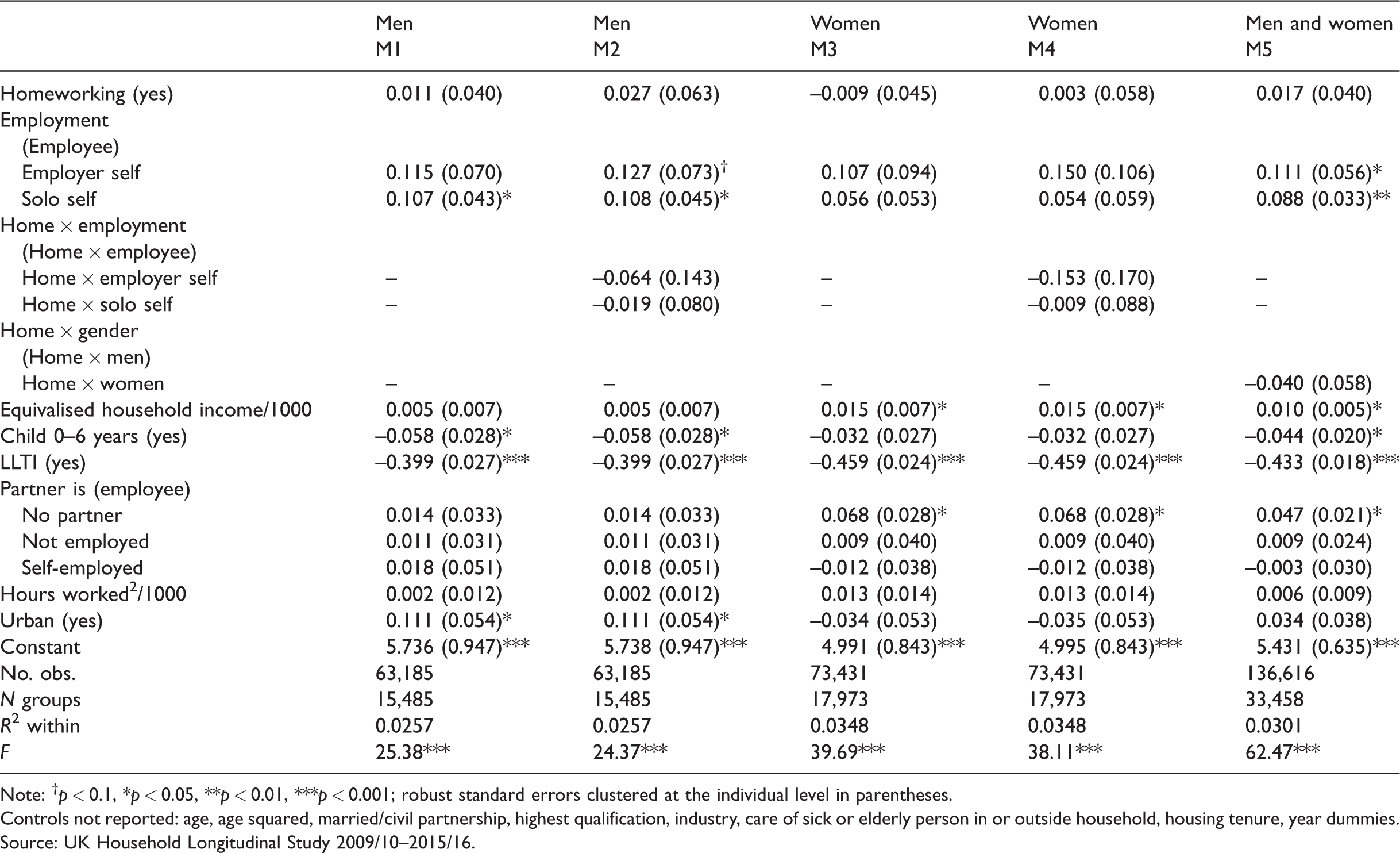
Because of gendered commuting patterns and experiences (Mokhtarian et al., 1998), it was hypothesised that homeworking is positively associated with women’s health satisfaction, either as employee or self-employed worker, while for men no significant relationship between homeworking and their health satisfaction was assumed (Hypothesis 4). Estimates in Table 5 confirm the hypothesised relationship for men but not women. Despite negative health outcomes of long commutes that existing studies found in women (Sandow et al., 2014), mainly working from home and having fewer or no commutes is not related with women’s health satisfaction. The homeworking coefficient is not significant in either of these models, and there are no significant differences in the health satisfaction of homeworkers by whether they are employees or self-employed (with or without employees) (M2 and M4) and by gender (M5).
Estimates of health satisfaction.
Note: †p < 0.1, *p < 0.05, **p < 0.01, ***p < 0.001; robust standard errors clustered at the individual level in parentheses.
Controls not reported: age, age squared, married/civil partnership, highest qualification, industry, care of sick or elderly person in or outside household, housing tenure, year dummies.
Source: UK Household Longitudinal Study 2009/10–2015/16.
Rather surprisingly, solo self-employment is positively connected with the health satisfaction of men (M1 and M2). The literature rather seems to suggest that self-employment is negatively related with self-reported health – for example, due to the stress involved in the work (Blanchflower, 2004; Warr, 2017). The models account for unobserved time-constant factors influencing self-employment and health, such as that healthier people select into solo self-employment (Rietveld et al., 2015). The positive association between solo self-employment and men’s health satisfaction may be related to the economic crisis. Short-term unemployment was found to have a significantly negative effect on men’s health satisfaction but not women’s (Gordo, 2006). The economic crisis is well reflected in people’s health satisfaction in this sample, with a significantly decreased level in the years 2010/11 and onwards compared to the start of the study period in 2009/10 (not shown). It does not matter for the health satisfaction of solo self-employed men, however, whether they mainly work from home or not.
Overall life satisfaction
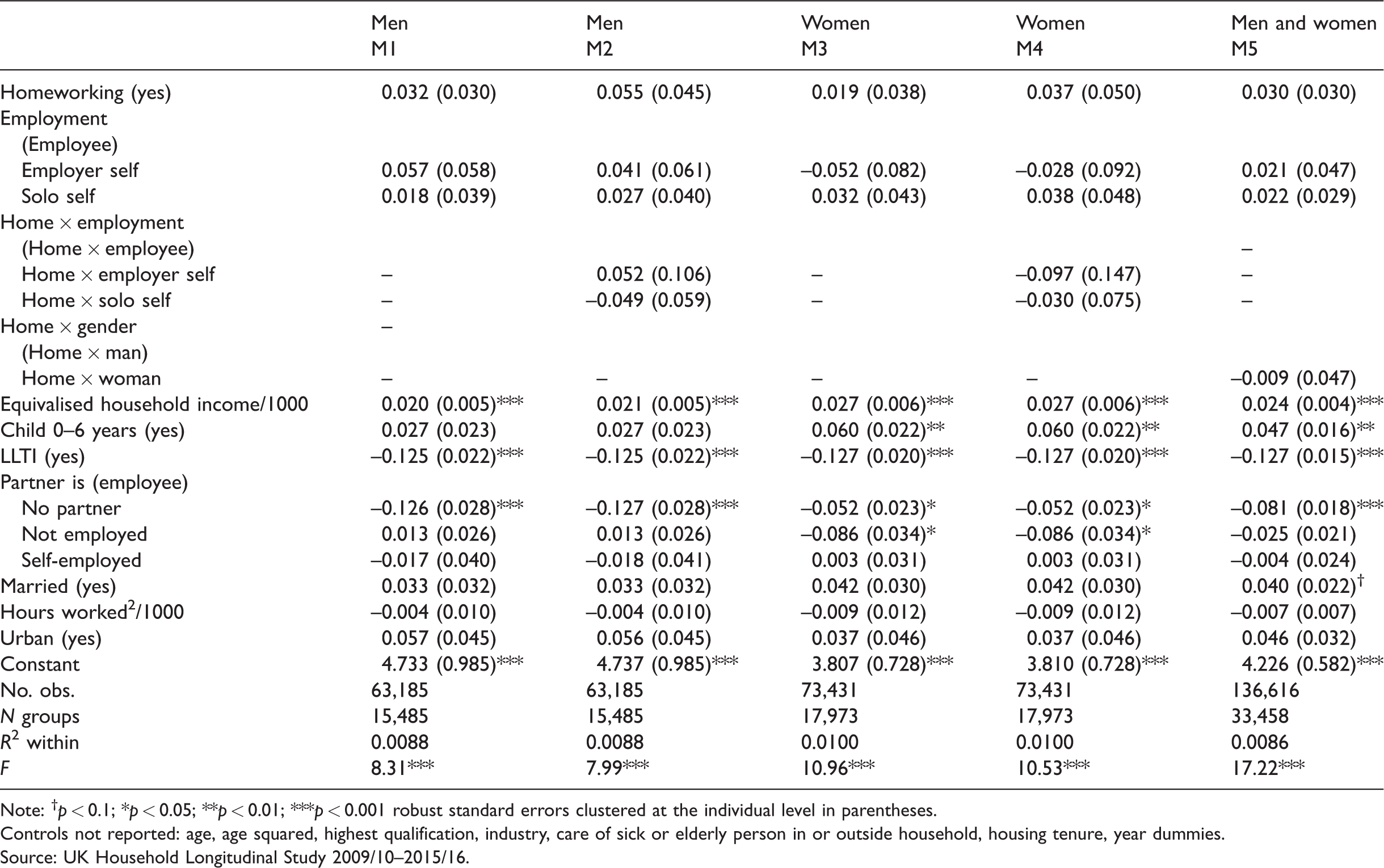
It was hypothesised that homeworking does not have an effect on overall life satisfaction following existing findings for employees (Binder, 2016; Wheatley, 2017). Modelling results in Table 6 confirm Hypothesis 5. The coefficient of the homeworking dummy is not significantly increased for men nor women (M1 and M3), and the relation between homeworking and overall life satisfaction is not significantly different between men and women (M5). There are also no significant differences in how different types of homeworkers (employee or self-employed with or without employees) evaluate their life overall (M2 and M4). The robustness of the findings is confirmed in models with own-labour income and no income measures.
Estimates of overall life satisfaction.
Note: †p < 0.1; *p < 0.05; **p < 0.01; ***p < 0.001 robust standard errors clustered at the individual level in parentheses.
Controls not reported: age, age squared, highest qualification, industry, care of sick or elderly person in or outside household, housing tenure, year dummies.
Source: UK Household Longitudinal Study 2009/10–2015/16.
The correlation matrix of the subjective well-being measures (Table 1) revealed a small correlation between overall life satisfaction and job satisfaction relative to other life domains. Health, income and leisure time satisfaction in this sample are all similarly correlated with overall life satisfaction and substantially higher than job satisfaction (Table 1), which seems to be one explanation why homeworking is not significantly linked with overall life satisfaction among employees or the self-employed. Other observed job characteristics (e.g. employment status and hours worked; Table 6) also contribute little to overall life satisfaction. Instead, overall life satisfaction is strongly associated in this sample of workers, in a period of recession and austerity, with (objective) income, a limiting long-term illness or disability and family/partnership.
Summary and conclusion
This study has investigated the life satisfaction of homeworkers to contribute to understanding of the impact of changing geographies of work and workplaces on individuals beyond the notion of homeworking as a means of flexible working of employees to incorporate the self-employed and hence highly individualised, and potentially isolating, work. Changes in people’s employment situation and associated changes in their life satisfaction across various life domains were tested using a large, nationally representative dataset for the UK (Understanding Society) – that is, in a national context and for a period of time (2009–2016) in which the prevalence of homeworking has increased in parallel with an increased flexibility in labour markets (Henley, 2017).
This study has demonstrated that not considering whether people work from home or not may lead to wrong conclusions about the subjective well-being of some workers and also that not considering whether people are self-employed or an employee may lead to wrong conclusions about the benefits of working from home for some aspects of well-being. Relations between homeworking and evaluative well-being could be identified with respect to the satisfaction with job, income and leisure time, but not overall life satisfaction and health satisfaction. Specifically, homeworking is broadly positively related with some aspects of subjective well-being of employees, and self-employment is broadly positively related with satisfaction in some life domains; however, combining homeworking and self-employment has revealed a negative relationship between mainly working in the home and subjective well-being which requires more attention in the future.
Contract work and solo self-employment (without employees) have received increasing attention in academia and policy (e.g. Christopherson, 2008; Kalleberg, 2000; Taylor et al., 2017) and the present findings contribute to this debate. No negative association between solo self-employment (without employees) and life satisfaction across life domains could be found when homeworking was not considered. When mainly working from home, however, solo self-employment is associated among men in this study (but not women) with decreased income satisfaction. The study period may have captured a higher level of home-based self-employed work that is due to the necessity to work than before the economic crisis of 2007–2009 or since the recovery of employment levels. Importantly, however, findings suggest that there is a need to integrate discussions about social and professional isolation with precarious working conditions of self-employed freelancers (cf. Bergvall-Kåreborn and Howcroft, 2013; Hislop et al., 2015) in order to understand the ways through which work that is highly individualised and disconnected from work relations is linked with subjective well-being. Social isolation, as findings suggest for men, does not seem to be limited to the feeling of loneliness but is linked with how the financial situation of the household is perceived.
On the positive side, homeworking is strongly linked with leisure time satisfaction not only among employees, as earlier research found (Wheatley, 2017), but also among workers more generally, including the self-employed, suggesting that time savings through not having to commute allow workers to spend time on leisure activities. This does not necessarily mean that workers have more time for family, but that homeworkers are able to maintain social activities. This adds to geographical research that showed relations between commuting and satisfaction with social contacts (Delmelle et al., 2013).
Homeworking is also positively related with job satisfaction of men and women who are employees. Through working at a distance from the employer, which employees, in most cases, can only achieve through working in the home, they think more positively about their job (with possible effects on worker retention and productivity). In contrast, the job satisfaction advantage that self-employed work brings is not increased through homeworking. Homeworking is a ‘non-pecuniary’ benefit for men and women who are employees (Trzcinski and Holst, 2012), although for men the homeworking advantage for job satisfaction is more or less captured by work autonomy and control (proxied by self-employed work), supporting the view in the literature that they appreciate the ‘escape’ from social control and the office environment (Collins et al., 2016). In contrast, women seem to appreciate ‘flexibility’ more broadly (beyond what is captured in features of self-employed work), suggesting that it is for them more the flexibility beyond work-related autonomy and control that is linked with their job satisfaction. Self-employed women seem to be able to flexibly combine work and private/family life even when they are not working mainly in the home (Craig et al., 2012).
To conclude, the changing geographies of work and workplaces, enabled through technology, on the one hand, can help improve men’s and women’s social lives and may well make (for some) a contribution to a better work–life balance. This is not only important for work–family research or organisational studies, but needs more attention in geographical research that seeks to better understand well-being and place. On the other hand, working in isolation from co-workers in one’s own home can also reduce aspects of well-being compared to mainly working outside the home.
Policies that regard homeworking in a limited way as ‘flexible working’ of employees neglect the new realities of labour markets and are not able to address the wider challenges that changes in labour markets, technology and society have brought about. Debates and policies about ‘flexible working’ and ‘gig work’ have been little integrated (cf. Pyper, 2018; Taylor et al., 2017) and thus opportunities seem to be missed to advance positive aspects and mitigate negative aspects of flexibilization of work. Recommendations for policy and practice arising from these findings are as follows.
Employers should be encouraged to support mainly working in the home among employees Government policies to encourage flexibilisation (e.g. through casualisation and self-employment) and support entrepreneurship should be alive to the possibilities of reduced well-being that could arise.
Supplemental Material
Supplemental material for The subjective well-being of homeworkers across life domains
Supplemental Material for The subjective well-being of homeworkers across life domains by Darja Reuschke in EPA: Economy and Space
Footnotes
Funding
author(s) disclosed receipt of the following financial support for the research, authorship, and/or publication of this article: This study was funded by the European Research Council (ERC) through the WORKANDHOME Starting Grant (ERC-StG-2014 639403).
Acknowledgement
I am deeply indebted to three reviewers and the editor, Prof. Jessie Poon, for their comments and suggestions. I also like to thank Prof. Donald Houston and Prof. Martin Binder for their comments and help.
Declaration of conflicting interests
The author(s) declared no potential conflicts of interest with respect to the research, authorship and/or publication of this article.
Note
References
Supplementary Material
Please find the following supplemental material available below.
For Open Access articles published under a Creative Commons License, all supplemental material carries the same license as the article it is associated with.
For non-Open Access articles published, all supplemental material carries a non-exclusive license, and permission requests for re-use of supplemental material or any part of supplemental material shall be sent directly to the copyright owner as specified in the copyright notice associated with the article.
