




Abstract
Existing urban research has focused on gender differences in commuting patterns to and from homes, but has paid little attention to the gendered diversity in the spatiotemporal patterns of work. The increase in remote working and information and communications technology (ICT) work has been emphasised, but at the cost of exploring the full range of workplaces and multi-locational working observed in urban areas. This article develops a new classificatory system to analyse the spatiotemporal patterns of work in European cities using the 2015 6th European Working Conditions Survey. We identify 12 distinct spatiotemporal work patterns of full-time workers and investigate gender differences across these patterns against the backdrop of occupation, industrial sector, employment status, household composition and ICT use. Findings show that women are far more likely to be restricted to only working at the employer/business premises while men have more varied and complex spatiotemporal patterns of work. Multi-locational working rather than working at one workplace is a largely male phenomenon. Working exclusively at home is still a rarity, but combinations with employer premises and other workplaces are more common. We conclude that workplace research has been blinkered by narrow concerns of advances in mobile technologies and has been blind to the pervasive effects of spatiotemporal divisions in the working lives of men and women. The methodological and theoretical implications of this new perspective on workplaces for urban development and research are discussed.
Introduction
The rise of the knowledge economy and rapid technological innovations have been connected with profound spatial and temporal changes of work (Brown and O’Hara, 2003; Felstead and Henseke, 2017; Halford, 2005; Kwan, 2002). Empirical studies suggest that information and communication technologies (ICTs) have weakened the ‘spatial fixity of the workplace’ in offices and factories (Felstead, 2012: 32) and increased working in more than one place (Liegl, 2014), and work is increasingly done ‘on the move’ (Hislop and Axtell, 2007).
The most detailed existing workplace classification by Ojala and Pyöriä (2017) suggests that rather than working in one single place, multi-locational working (combining workplaces) has become more important and that working solely at the employer’s premises, as was typical in the industrial era, has decreased over time, even though it is still the predominant pattern in Europe (i.e. EU28 plus Norway and Switzerland). The research of Ojala and Pyöriä is pathbreaking in this respect and has been influential in the ideas behind the analysis presented in this article. Their classification, however, tells us little about urban–rural differences in this emerging workplace geography or about gender differences. The spatiotemporal patterns of work have traditionally differed between urban and rural areas, for example work in agriculture is often performed in outside places. Current changes of work seem to be largely driven by infrastructures and lifestyles concentrated in or associated with urban areas, for example working in different places including co-working places (Liegl, 2014; Merkel, 2018) and combining office work with working some of the time from home (Mokhtarian et al., 2004). In terms of gender, it is well established that women have different temporal patterns of working (Bardasi and Gornick, 2008) and shorter commutes than men (Crane, 2007; Hanson, 2010; MacDonald, 1999; Madden, 1981). However, hitherto remarkably little has been known about gender in relation to where work is being performed and to multi-locational working. This is potentially important for understanding the social segmentation of work, as different workplace locations could be associated with different labour market opportunities (e.g. networks) and thus contribute to women’s disadvantage in the economy (Rosenthal and Strange, 2012).
The overall objective of this study is therefore to provide new insights into contemporary work patterns and the extent to which these are gendered in urban areas that have experienced significant changes in work locations, with new workplaces emerging both for high-skilled workers (e.g. co-working spaces) and low-skilled workers (e.g. driving and catering services enabled by the platform economy, such as Uber Taxi and Uber Eats). Our first research aim is to derive a new classification of workplaces that advances existing classifications through taking the number of different types of workplaces (office, home, vehicle etc.) and the temporal patterns of work into account. Our second research aim is then to model the factors that are associated with the most common workplace types and specifically to test gender differences. We use data from the 2015 6th European Working Conditions Survey (EWCS; European Foundation for the Improvement of Living and Working Conditions, 2018) in order to address the research aims, as this dataset provides detailed information on the spatial and temporal patterns of work from a representative sample of workers in the EU28. We derive the workplace classification for full-time workers resident in urban areas so that this study for the first time provides insights into the gendered spatiotemporal patterns of work in European urban areas.
Labour markets in developed countries are segmented, with different workers receiving very different experiences and outcomes. In combination with the spatial segregation of housing markets, this has led to sharp differences in how certain social groups can access suitable jobs, particularly since the suburbanisation of manufacturing jobs, which a large literature on the spatial mismatch hypothesis has investigated originally in relation to African-Americans (Kain, 1992) and later to low-skilled workers (Houston, 2005). For women specifically, labour market segmentation and residential location together have been linked with their lower wages compared with those of men (Carlson and Persky, 1999; Hanson and Pratt, 1995; Madden and Chiu, 1990). The gender pay gap is perhaps the most urgently debated form of gender-based discrimination in the European Union (EU). The 40 years since equal pay legislation was introduced in the EU have seen a dramatic reduction in the gender pay gap to about 25% of its previous level (O’Reilly et al., 2015). The most blatant forms of gender discrimination have now been largely removed from European societies, and the residual gender pay gap and other forms of gender inequalities (such as the ‘glass ceiling’) tend now to be caused by more elusive forces that structure the working lives of men and women differently. Gender inequality remains, quite rightly, an important policy priority in the EU. Some of those more complex and subtle forces have already been researched extensively, but this is not the case for the spatial and temporal differences in women’s and men’s working lives. We hope that this article will make an important contribution to developing policy that will continue the path to greater gender equality.
Despite gender equality having been a high priority within the EU for several decades now, the difference in working lives is still identified as a major policy concern in the EU. The fact that women make up half of the populations of EU countries and are close to 50% of the labour force in most countries makes it a mainstream concern. Furthermore, the number of ways in which women’s labour market participation differs from that of men gives us a good reason to believe that a spatial analysis of workplaces will be a fertile project to better understand gendered working lives.
In the second section of this article, we discuss literatures from urban studies, transport and mobility studies, sociology and creative studies on daily mobility, commuting and gender segmentation. Since existing studies on workplace changes have often departed from technological changes and the impact of ICTs on work, we focus first on ICT and the spatiotemporal changes of work before discussing existing evidence on multi-locational work and how gender features in the spatiotemporal patterns of work. The third section describes our data and methodology to arrive at a new spatiotemporal workplace classification. The fourth section addresses our first research aim and presents a new workplace classification of urban residents. It then addresses our second research aim and tests the role of gender in the revealed spatiotemporal workplace patterns. We conclude with a discussion of the findings and implications for future research.
Existing literature and research gaps
ICT and spatiotemporal changes to work
Most mature economies have undergone dramatic structural changes in production and jobs involving deindustrialisation (the decline in manufacturing) and tertiarisation (the increase of service sector activities). Technological change has had an immense impact on employment and industrial restructuring, as a large body of literature in economic geography has discussed; for example, under the ‘New Economy’ label (Daniels et al., 2007). Technology is profoundly changing not only global production networks and macro employment structures (Berger and Frey, 2016) but also, on the micro scale, how, where and when work is being done by the individual worker.
The concept of fragmentation of activities has been applied to spatial patterns of ICT work (Alexander et al., 2011; Couclelis, 2000; Lenz and Nobis, 2007). In this context, fragmentation describes the division of work into several pieces (fragments) and the subsequent continuation of former work tasks (Lenz and Nobis, 2007: 191). This fragmentation of activities due to ICTs enables greater locational and temporal flexibility (e.g. working on the move), although it is also described as a cause of interruptions of work tasks (e.g. calls, emails) (Eurofound and the International Labour Office, 2017). It is suggested that the higher the use of ICTs, the more fragmented the work is in terms of location and time, and that professionals and also higher-educated workers tend to have a higher spatial fragmentation of their work than those in low-skilled occupations (Alexander et al., 2010). The level of spatial fragmentation of work, however, was still low in this Dutch study; on average, workers had 1.42 work locations (Alexander et al., 2010: 693). Lenz and Nobis (2007) found support for the spatial fragmentation of work only for a small group of workers in their study of German workers and the extent to which they use internet, mobile phones and mobile computers for work activities. The vast majority of workers were ‘traditional’ workers with regular commutes and low levels of work-related travel, working while travelling and working from home. Spatial fragmentation of work applied to a minority of workers who worked from home and worked while travelling.
The new way of working, away from the office, that is most prominently linked in the literature with advances in communication technologies is ICT-enabled working from home, also called teleworking or telecommuting (Eurofound and the International Labour Office, 2017; Wilks and Billsberry, 2007). Notably, teleworking studies focus on the commuting and spatial patterns of the workplace in firms and in the home (Kim et al., 2012; Mokhtarian et al., 2004; Ory and Mokhtarian, 2006; Zhu, 2013), and therefore investigate working some but not all of the time from home. In particular, a large part of the teleworking literature has focused on paid employment and employees’ commute and residential locations (Mokhtarian et al., 2004; Ory and Mokhtarian, 2006). Other studies, by contrast, include all types of temporal patterns of working from home (as a proportion of regular working time) in their definitions (Moos and Skaburskis, 2007).
Existing studies on working from home have covered a wide range of countries in Europe, North America and Asia, underlining a more general trend of working partly from home (as opposed to working mainly or all of the time from home). Examples are Felstead (2012) for the UK, Kim et al. (2012) for Seoul in South Korea, Zhu (2013) for the USA and Helminen and Ristimäki (2007) for Finland. In the case of the UK, the percentage of those working some of the time from home almost doubled between 1991 and 2010 (from 4.8% up to 8.4% of those in paid employment), while the percentage of those working mainly at home was fairly stagnant over this period (c. 2.9% of those in paid employment) (Felstead, 2012: 34). Here, alongside ICTs, managerial, professional and technical occupations were identified as driving this trend of working some of the time from home (Felstead, 2012: 35).
The spatial patterns of working some or all of the time from home are still debated in the literature, in particular whether working from home is concentrated in large urban areas. There is evidence that those who work some of their time from home predominantly live in large urban areas including suburbs of large cities (Ory and Mokhtarian, 2006; Vilhelmson and Thulin, 2016). This seems largely to be connected with the locations of organisations and firms that allow their staff to work flexibly from home (Vilhelmson and Thulin, 2016). To contrast, working mainly or all of the time in one’s own home (as opposed to only some of the working time) seems to be more spatially dispersed and less concentrated in large urban areas (Moos and Skarburskis, 2010).
Multi-locational work
Working some of the time at home is part of a broader concept of multi-locational work suggested in recent studies on changing spatial patterns of work. Although multi-locational working, defined as performing regular work in more than one location, still appears to be a minority way of working (Ojala and Pyöriä, 2017), working at a location other than the fixed workplace during the scheduled working time has substantially increased over time. For example, the percentage of people working away from the fixed workplace in at least one other location rose to 19.7% in Sweden in 2012, up from 5.9% in 1997 (Vilhelmson and Thulin, 2016). In the UK, those working in a variety of different locations increased from 17% in 2001 to 20.4% in 2012 (Felstead and Henseke, 2017).
Despite the strong focus on ICT work and mobile devices in studies related to the spatiotemporal changes of work, Ojala and Pyöriä (2017) found that multi-location occupations in their 2015 European study were most prevalent in traditional industries (agriculture, construction and transport), while knowledge-intensive occupations were still predominantly located at employers’ premises. The study does not present details on the precise combinations of workplaces that were observed; however, the vast majority of multi-locational work involved employers’ premises. Workers’ homes were estimated to feature in multi-locational work on average less than clients’ premises, vehicles or outside sites. Public spaces played a comparably small role in their multi-locational country estimates. In comparison, (semi-)public spaces are likely to play a more important role for freelancers/self-employed workers, who are not employed by an organisation but work on their own account; however, these do not feature in Ojala and Pyöriä’s study. Most recent research on new types of working of freelancers and self-employed workers highlights working in co-working spaces, cafes or other (semi-)public spaces (Di Marino and Lapintie, 2017; Liegl, 2014; Spinuzzi, 2012) close to the home. Furthermore, co-working is concentrated in cities and may therefore not be sufficiently reflected in national figures of working in public spaces (Jamal, 2018; Merkel, 2018).
Gender and spatiotemporal patterns of work
Existing studies on multi-locational work and fragmentation have not investigated potential differences between men and women. Some evidence of gendered spatial and temporal patterns of work features in studies on working some or all of the time from home. Women seem to be underrepresented amongst homeworkers in the UK in numerical terms (Felstead and Henseke, 2017) and relative to their age, employment situation and income (Vilhelmson and Thulin, 2016). Further, according to slightly older data presented in Felstead et al. (2002), the temporal pattern of working from home seems to be strikingly different between men and women, but no newer study seems to have investigated the gendered temporal differences in working from home (teleworking). While those who work only some of the time but not mainly or all of their regular working time from home are overwhelmingly men, those who work mainly or exclusively in their home are predominantly women. This gender differentiation in terms of the extent of working from home seems to be further interrelated with occupational status differences: those who have the flexibility to work some of their time from home (mostly men) have a higher occupational status than workers (mostly women) who spend most or all of their working time at home.
Perhaps most importantly, there is still a very marked tendency for the majority of occupations to be clearly men’s jobs (e.g. construction and driving) or women’s jobs (e.g. cleaning and nursing). Relatively few occupations even come close to being equally open to men and women, and those occupations tend to be the ones requiring higher levels of education (Burchell et al., 2014). Given that the most obvious and powerful determinant for where one works (e.g. in an office, factory, vehicle, or outdoors, etc.) is the nature of the occupation, this is an important place to start in understanding the role and importance of spatial and temporal segmentation.
Occupational gender segregation may sometimes be a cause of spatial patterns of work, because, for instance, the driving of delivery vans is an overwhelmingly male job, and primary school teaching is an overwhelmingly female job. In other cases, the gendering of places probably creates the gendering of occupations: building sites are male bastions, so building jobs are done by men, and some door-to-door jobs such as market research are almost exclusively done by women because many householders would be worried about inviting an unknown man into their house.
The strong association between women and domestic work (i.e. cooking, cleaning and caring) also plays an important role in structuring their working lives. There is an abundance of evidence on the way that women’s working hours are shortened by the expectation that they will spend more of their time outside of paid work doing domestic chores. Importantly, this also seems to affect their spatial differences in working. One key factor of the shorter commutes of women identified in the literature is household responsibility and the gendered division of domestic work (Clark et al., 2003; Fan, 2017; Smith et al., 2013; Turner and Niemeier, 1997). This means that many women work in workplaces that are more geographically dispersed and thus are more likely to be situated close to their homes, and which in turn are more likely to be smaller workplaces. There is also evidence that women’s greater responsibility for childcare means that they are less flexible in their working schedules as they are more closely tied to the fixed hours of schools and formal childcare (and therefore often work part time). This disincentivises women from some multi-locational/mobile jobs (for instance, driving jobs), which are, by their very nature, also likely to be associated with less predictable or controllable finishing times. It is also suggested that women have a stronger incentive to work at home so that they can combine domestic work, particularly child care, with paid work (Hilbrecht and Lero, 2014).
Women’s greater fear of sexual violence is yet another factor which might limit the attractiveness of lone working in certain working environments, for instance as a night security guard (Phipps et al., 2018). Some other cultural effects can be quite subtle, with men and women avoiding some environments because those situations would challenge gendered and sexualised norms of appropriate environments for women (working with refuse) or men (working with young children).
Thus, the complex interplay of norms for appropriate or safe behaviour in employment and out of employment has the possibility to create gender segmented environments, which in turn can facilitate financial and other opportunities within the workplace for men or women, or exclude them from these. The empirical section of this article will examine the extent to which this accords with the lived reality of urban workers in the EU.
Data and methods
Data
This study draws on the 2015 6th European Working Conditions Survey, which interviewed c. 44,000 workers in the EU28 and affiliated countries. The sampling procedure, response rate, fieldwork quality checks, questionnaire construction, translation and weighting were of high quality (see Eurofound, 2017). Our sample created from the 2015 EWCS covered all the EU28 member states. The EWCS uses the International Labour Organisation (ILO) definition of employment according to which workers are included if they work at least one hour a week.
The 2015 EWCS is a unique data source to study spatiotemporal patterns of work, as all respondents were asked about their places of work with the following question: ‘Please take a look at these locations. In a moment, I will ask you how often you have worked in each location.’ The reference period was the last 12 months, or since they started the job if less than 12 months ago. The showcard had details of the six work locations: (1) your employer’s or your own business’ premises (office, factory, shop, school, etc.), (2) clients’ premises, (3) a car or another vehicle, (4) an outside site (construction site, agricultural field, streets of a city, etc.), (5) your own home, and (6) public spaces (coffee shops, airports, etc.). For each of these locations, it also captured how often the respondents worked there using a five-point frequency scale of ‘daily’, ‘several times a week’, ‘several times a month’, ‘less often’ and ‘never’. The response rate for these questions was very high at 98.5% compared with other questions asked in the survey. Comparable information on response rates can be found in the 6th European Working Conditions Survey Technical Report (Eurofound, 2015).
Although this level of detail is sufficient for the purposes of our study, the frequency scale is not suitable for investigating the spatiotemporal patterns of part-time workers, especially when work is performed less than five days per week. We therefore include only full-time workers in our analysis in order to derive a new classification of spatiotemporal work patterns. This is particularly unfortunate because women more often than men work part time. Implications for the derived gendered spatiotemporal patterning are discussed later.
The overall objective of this study is to develop a new classification of workplace types in urban areas as a contribution to the interdisciplinary field of urban studies. For this purpose, we selected respondents who lived in urban areas and excluded those in rural areas. 1 We decided to limit the study sample to urban areas rather than including both urban and rural residents and using a dummy variable for urban versus rural areas in the analysis because of the significant rural vs. urban differences in the spatiotemporal work patterns in the dataset. Specifically, people in rural areas were more likely to work ‘daily’ but less likely to work ‘less often or never’ in a vehicle; compared with those in urban areas, people in rural areas were more likely to work ‘daily’ or ‘several times a week’ but less likely to work ‘less often or never’ outside; people in rural areas are more likely to work from home on a ‘daily’ basis and to work ‘in public spaces’‘less often or never’ than those in urban areas.
The EWCS provides location information about the residences of the respondents but not their workplaces. Therefore, the workers in our study all lived in urban areas. It is likely that a small proportion of people will live in urban areas and work in rural locations, particularly in the case of multi-locational work patterns.
Sample
Information on workplace patterns was available from 10,599 full-time workers who lived in urban areas. The six work locations and five frequencies resulted in a possible combination of 56 = 15,625 patterns. Thus, the first significant challenge was to develop a manageable classificatory scheme, with the total number of groups being measured in a much smaller number of meaningful categories. This process was iterative. The first stage was to separate the work frequency response scale into four groups instead of five: ‘daily’, ‘several times a week’, ‘several times a month’ and ‘less often or never’. This procedure reduced the number of possible categories to 46 = 4096, of which 2646 were empty cells.
A noticeably large group contained 452 respondents who (perhaps surprisingly) reported working in none of the six work locations. They might genuinely have had a different workplace (perhaps cruise ships, market stalls, ticket inspecting on trains, etc.). More likely is that they misinterpreted the question and did not realise that their workplaces fitted into one of the categories. The next step was to combine some of the categories to make meaningful workplace categories that each accounted for c. 1% of the sample (or at least 60 cases). Respondents with unusual patterns (less than 1% of the sample) comprise together n = 1140 cases. For example, these include those who worked in public spaces daily (n = 71), at home monthly but nowhere else (n = 66) and at home and at clients’ premises monthly (n = 3). Some of these patterns may be due to misinterpretation of the questions. To have meaningful results, we combined these unusual patterns of workplaces into one ‘residual’ category and did not conduct any further analyses for this group. 2 The ‘residual’ group (with unusual patterns) and ‘nowhere’ cases were removed from the analyses below.
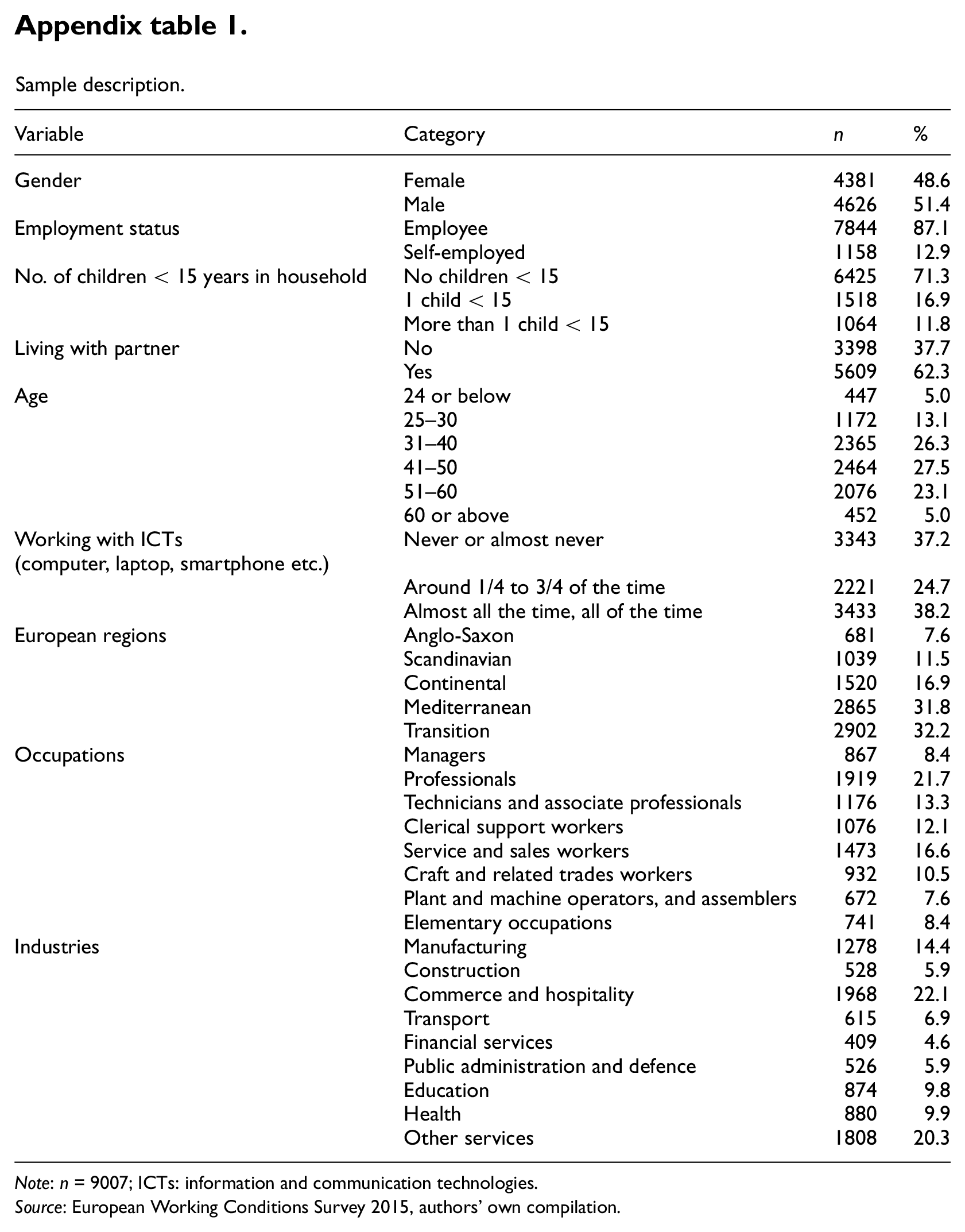
In total, this resulted in a final sample of 9007 full-time workers who lived in urban areas in the EU28 in 2015. Figure 1 summarises the distribution of work locations and frequencies in our sample. The sample is described by gender across all variables used in the empirical analysis in Appendix table 1.
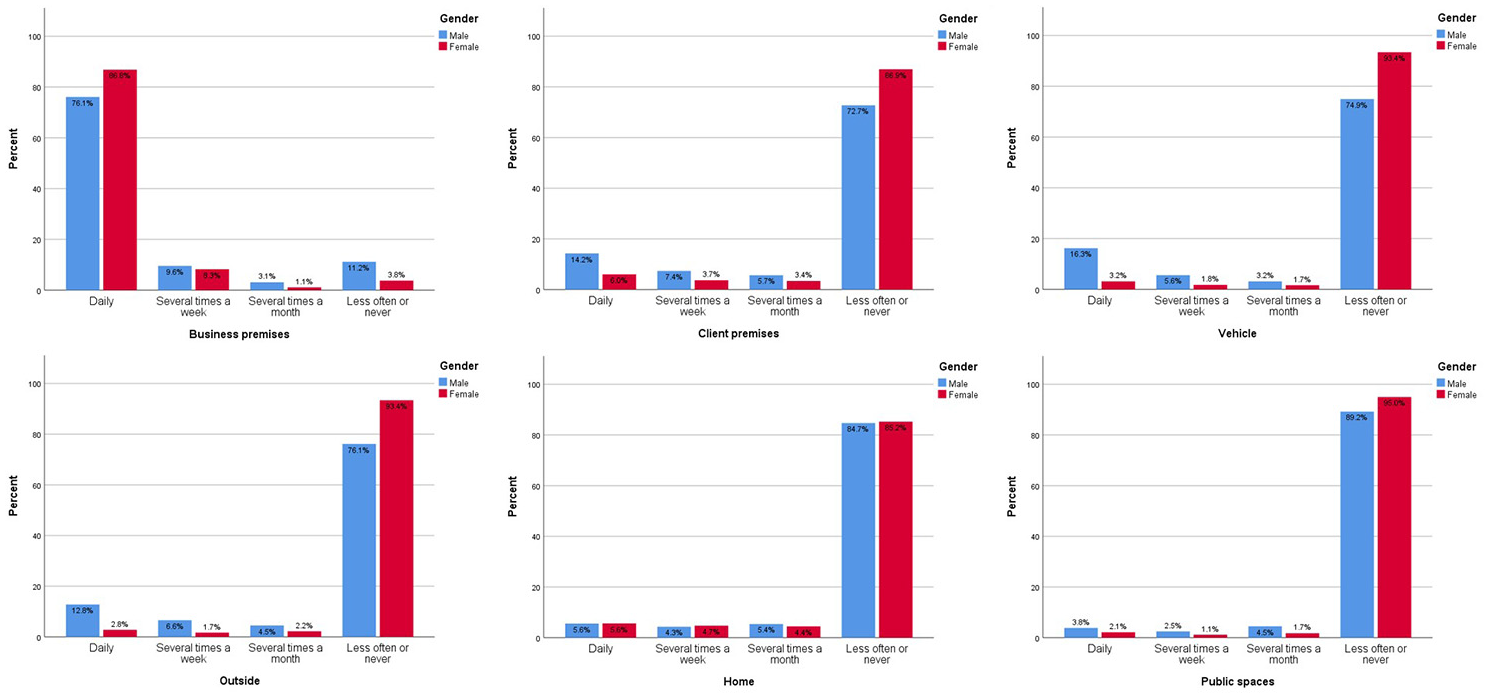
Workplace locations and frequencies by gender, percentage shares.
Models
In order to test gender differences in spatiotemporal workplace patterns, we used multiple regression models. For each identified workplace pattern, we ran a logistic regression where the outcome variable is coded ‘1’ for the particular workplace type and ‘0’ for all other workplace types combined, which allows the identification of specific characteristics of each workplace type. For workplace types with small numbers, we applied penalised logit regressions.
Our key predictive variable is gender. Regarding the confounding variables that are likely to influence the work patterns of men and women, we included job characteristics, individual and household characteristics and broad European regions. As job characteristics we used occupation and industrial sectors as key factors that are segmenting men’s and women’s work. We used the frequency of ICT use involved in work activities following Ojala and Pyöriä’s (2017) study on multi-locational work. We also included employment status (employee vs. self-employed) to better reflect the increased flexible work patterns than previous studies on multi-locational work; for instance, in the ‘new economy’ (Perrons, 2003). As individual and household characteristics, we included the age of the respondents, whether they live with a partner and the number of dependent children younger than 15 in the household, as these demographic factors capture well the effects of household structure on mobility (Fan, 2017). European regions are used to capture social welfare differences that have produced different employment outcomes for women (Esping-Andersen, 1990). The EU28 countries were divided into five regions based on a conventional classification that takes account of geography and types of capitalism and welfare systems: Scandinavian, Mediterranean, Anglo-Saxon, Continental and Transition. There were not enough cases to support individual country-level analyses, and the clustering at the regional level captured much of the country-level differences in the data.
We also tested for interactions between gender and the other predictors in the models. There were a small number of significant interactions, but none of them were as strong as the main effects, and none of them changed our interpretations of the models, so they have not been reported in this article.
Results
New workplace classification of urban residents
Our spatiotemporal classification of workplaces of urban residents contains 12 distinct patterns. The workplace patterns are ordered in Table 1 according to the overall (men and women together) numbers in our sample, although the ‘ranking’ differs between men and women. The column labelled ‘% within workplace type’ shows the relative importance of each identified working pattern separately for men and women, adding up to 100% each. The column labelled ‘% within gender’ shows the relative gender difference within the workplace types and gives us a first indication about gender inequality in spatiotemporal work patterns.
Classification of workplaces by gender, row and column percentages and examples of working patterns.
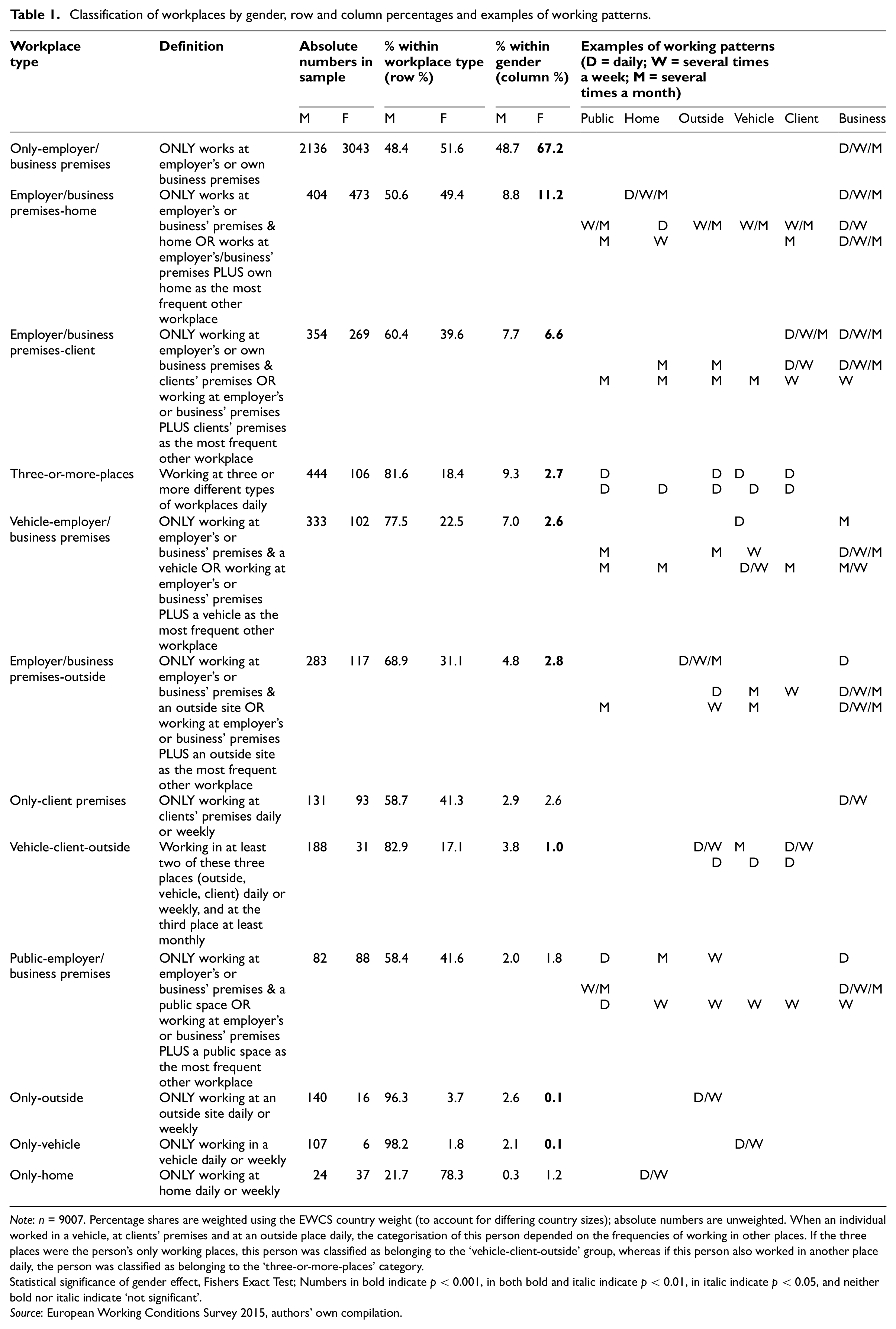
Note: n = 9007. Percentage shares are weighted using the EWCS country weight (to account for differing country sizes); absolute numbers are unweighted. When an individual worked in a vehicle, at clients’ premises and at an outside place daily, the categorisation of this person depended on the frequencies of working in other places. If the three places were the person’s only working places, this person was classified as belonging to the ‘vehicle-client-outside’ group, whereas if this person also worked in another place daily, the person was classified as belonging to the ‘three-or-more-places’ category.
Statistical significance of gender effect, Fishers Exact Test; Numbers in bold indicate p < 0.001, in both bold and italic indicate p < 0.01, in italic indicate p < 0.05, and neither bold nor italic indicate ‘not significant’.
Source: European Working Conditions Survey 2015, authors’ own compilation.
The largest proportion of full-time workers in our sample, both amongst men and women, works only at the employer’s premises or their own business’ premises and never anywhere else. The second most relevant type in relative terms for women is the combination of the employer’s or business’ premises and their own home, confirming the relevance of studying working from home (see, for instance, Felstead and Henseke, 2017). However, for men, working daily in three or more places (e.g. working in a public place, in a vehicle and at home) is more common than combining working at the employer’s or business’ premises and their own homes. Combining employer’s or business’ premises with clients’ premises is the third most relevant working pattern for women. These women predominantly work in the service sector as professionals (including technicians and associated professionals) and in craft-related trades. The remaining patterns all apply to a small minority of women.
To a large extent, women’s workplaces are confined to the employer’s/business’ premises, their own home and clients’ premises. Their working patterns appear to be more spatially fixed, as women more often than men work in only one type of location and not anywhere else. Large gaps between men and women also exist with respect to working at three and more types of work locations on a daily basis and combining working at the employer’s or business’ premises and a vehicle; that is, workplace types and practices that are likely to involve a high level of daily mobility. This is perhaps not surprising given the existing evidence of the greater sensitivity of women to long commutes (Sandow and Westin, 2010). Some vehicle-based or outside-located forms of work remain exclusively the preserve of men; for instance, workers whose only place of work is a vehicle (not surprisingly, they are also very likely to be in low-skilled occupations and working for employers in the transport industry) and workers who combine working in vehicles, at clients’ premises and in outside places on a daily basis.
Workplace combinations as opposed to working exclusively in one type of workplace (including clients’ premises, where the location may vary) are largely male. While 45% of men in our sample combine different types of work locations, this is only the case for 27% of women.
Gender differences in spatiotemporal work patterns
This section investigates further the gender differences in the identified workplace types. Regression results in Table 2 are presented in Odds Ratios (OR) together with the corresponding 95% confidential intervals. Given the large number of coefficients being computed here, the more stringent significance level of 0.001 is reported. All models are significant at p < 0.001.
Logistic regression models for workplace types, odds ratios and 95% confidence intervals in brackets.
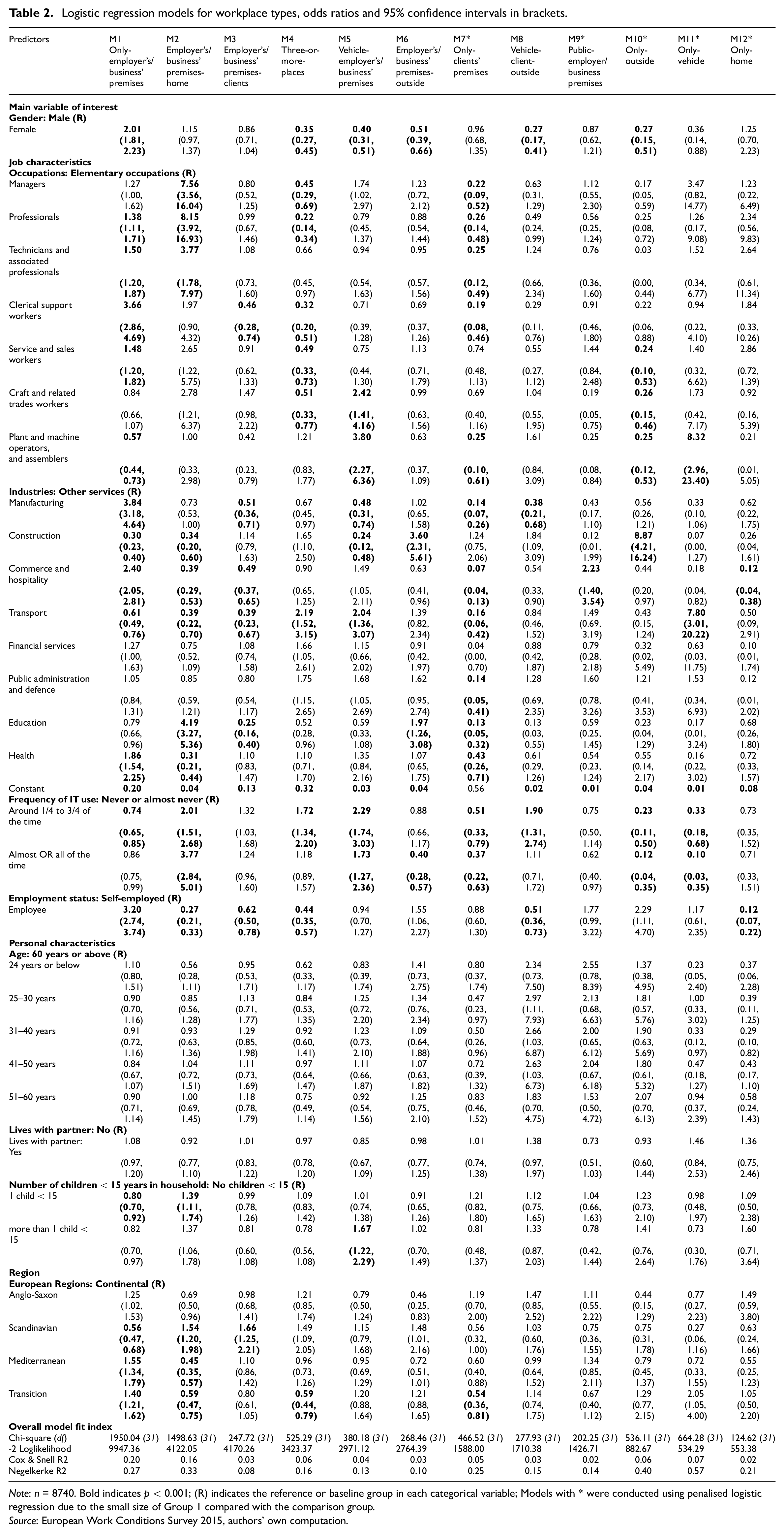
Note: n = 8740. Bold indicates p < 0.001; (R) indicates the reference or baseline group in each categorical variable; Models with * were conducted using penalised logistic regression due to the small size of Group 1 compared with the comparison group.
Source: European Work Conditions Survey 2015, authors’ own computation.
Six out of the 12 identified work patterns show statistically significant gender differences, controlled after gender segmentation by industry and occupation, household characteristics and European regions. 3 The odds of only working at the employer’s or business’ premises are about twice as high for women in comparison with men. In the other five types with significant gender effects, women are much less likely to work than men. These are work patterns that include working outside (‘only-outside’ and ‘employer’s/business’ premises and outside’), combining working at the employer’s/business’ premises and in a vehicle and work patterns with combinations of three or more workplaces (e.g. vehicle-client-outside).
There are other predictors for these six working patterns. For example, working only at the employer’s or business’ premises is related with clerical occupations, not being self-employed or being in manufacturing occupations. Working at three or more locations is also associated with the transport industry, and with not being a clerical worker. However, and most remarkably, even when occupation and industry segmentation and the greater likelihood of men being self-employed are controlled for, gender is still defining work patterns and the kinds of locations and spaces women and men frequently access for their work.
We do not find evidence, in these models, of working from home being associated with gendered patterns of work; neither with respect to working only from home and nowhere else and combinations of working at the employer’s/business’ premises and at home. This is surprising, as some previous studies suggested that working mainly from home is more common amongst women and working some of the time from home is more common amongst men (Felstead et al., 2002). However, we find that having one child younger than 15 years old in the household increases the odds of combining working from home with working at the employer’s/business’ premises – and this effect is held constant by gender.
Overall, compared with gender, the other demographic characteristics included in our models (dependent child, age, partner in household) surprisingly explain few of the work patterns. Thus, these seem to be related with commuting behaviour (Fan, 2017) but less so with multi-locational work. Frequency of ICT use, however, has strong effects on work patterns, which could be expected from previous studies on the spatial fragmentation of work activities due to ICT (Alexander et al., 2010; Lenz and Nobis, 2007). This notwithstanding, we can only find two working patterns that are associated with high ICT use: working at the employer’s/business’ premises and at home, and working at the employer’s/business’ premises and in a vehicle.
Some of the findings reported in Table 2 are fairly predictable; for instance, the effects of industrial sector with transport being associated with vehicles, manufacture being associated with employer’s/business’ premises and construction being associated with working outside. However, many of the strong effects uncovered by this work classification are original and of interest. In particular, there are strong regional effects, with the Scandinavian countries having markedly different patterns from the rest of the EU. Urban residents in Scandinavia are much less likely to be restricted to working only at the employer’s or business’ premises, but much more likely to work at a combination of the employer’s/business’ premises and either clients’ premises or their own homes.
Work patterns of part-time workers
The spatiotemporal classification could not be applied to part-time workers, as discussed above. We were only able to do some very limited analyses comparing part-time workers with full-time workers that are the focus of this article. For these purposes, the frequency response scale (how often respondents work in the respective workplaces) was simply dichotomised, comparing ‘never or almost never’ with all other categories to minimise the effects of the data flaws. In our sample of urban workers in the EU, 12.6% of men and 30.8% of women described themselves as part-time workers. For women (but not men), there were some clear differences between full- and part-time workers, using a simplified set of dependent variables. Part-time women were more likely to ‘never or almost never’ work at the employer’s premises (16.7%) compared with full-time working women (10.1%). Looking at the total number of workplaces that women worked at monthly or more frequently, part-time women were more likely to work at only one location type (71.4%) compared with full-time women (63.8%). This does suggest that findings on the reduced level of multi-locational working of women compared with men might be even more pronounced if part-time work were included in our classification.
Discussion and conclusions
The bivariate and the multivariate analyses showed that the spatiotemporal pattern of paid work for urban residents is predicted by their individual characteristics. In particular, the results show convincingly that men and women in the EU28 have very different spatial and temporal patterns of work. Women are considerably more likely than men to be restricted to only working at the employer’s or business’ premises. At the bivariate level, this difference is large: 69% for women compared with 46% for men. Men, in contrast to women, have more varied and complex spatiotemporal patterns of work.
There are several work patterns that are more common for men than women. The most extreme case is working exclusively in vehicles; women are almost completely absent from this type of working. Men are also much more likely to work outside than women, and more likely to be working in multiple types of workplaces. Another clear example of this is the category of the most extreme multi-locational workers who work in three or more types of location on a very regular basis. These are indeed patterns of peripatetic work that indicate that people are moving from one workplace to another with relatively short periods of time spend at each workplace. While other research has pointed to the increasing relevance of combining workplaces rather than working at one workplace all the time (Ojala and Pyöriä, 2017), our classification shows that this ‘modernisation’ of work is gendered and dominated by men’s work.
As this is the first article (as far as the authors are aware) that analyses the gendering of spatiotemporal patterns of work in this way, it is a long way beyond the remit of this article to fully understand the implication of this for gender inequality, but we can speculate that such high levels of segregation have some negative impacts and make gender equality harder to achieve.
Firstly, are we saying that some of the identified work patterns are associated with good jobs, and others with bad jobs? Is this contributing to the gender pay gap, or other forms of gender-based inequalities in the urban labour market? A full analysis of job quality is beyond the remit of this article, but preliminary exploratory analyses that we have conducted have shown that there are not straightforward relationships between location and job quality; some types of jobs are associated with better working hours, others with better social or physical environments, employment prospects, pay and work intensity. However, there is no clear evidence that men’s spatiotemporal patterns per se are a causal factor of gender inequality; men’s more ‘fragmented’ working lives seem to bring both advantages and disadvantages.
The impact of spatiotemporal gender segregation might be better seen as acting in the same way as occupational gender segregation. There is little evidence overall that men’s occupations are better than women’s occupations, but it is the fact that they are separated, creating separate networks and career structures, that makes it easier to sustain gender differences in the labour market, and maintain the gender stereotypes for many jobs. As the gendering of work is still highly significant in many of the 12 identified spatiotemporal patterns even after controlling for occupation and industrial sector, this demonstrates that overall gender segregation that includes this new spatiotemporal lens is even greater than previously acknowledged.
This article goes beyond conventional analyses of places of work by considering combinations of workplaces as being fundamental to understanding working lives. Other analyses tend to categorise workers by their main place of work, they are labelled as such – for instance, ‘homeworkers’. The analyses here showed that, for many workers, each day or week is characterised by two or more locations of work. But only working outside or only working in a vehicle or only working at home are all less common than working in those locations as well as working in other locations, such as working in these locations as well as the employer or business premises – and working in three or more locations is even more common. The multi-locational (and for some peripatetic) nature of so many people’s working lives should encourage us to re-imagine many aspects of working lives. For example, commuting patterns in cities are usually modelled on journeys to and from work, but we know little about the work-related journeys people make within their working day.
One of the strengths of the analyses in this article is that it is based on a representative sample of workers in urban areas in the EU and takes into account a much broader range of workplaces than many recent academic and popular articles (e.g. that investigated working some time or mainly in the home or working in co-working spaces). New peripatetic and flexible workers are frequently portrayed in many popular and academic literatures as being liberated by their laptops and mobile phones to work in cafes, public spaces, in co-working spaces or at home (Spinuzzi, 2012). The reality painted by our data shows a very different picture. There are many individuals who are low-IT users and who are already peripatetic in their working lives, travelling between outdoor sites, clients, their own homes, and working in vehicles. In fact, some of the results in this article show that the workers who made the most frequent use of IT are the ones less likely to be working in some of the most ‘fragmented’ spatiotemporal patterns. Furthermore, the working sites that have been discussed so much recently – working at home and working in public spaces such as cafes or co-working spaces – are still relatively rare. For example, only a minority of urban residents work from both home and the employer’s or business’ premises, with 11% of women and 9% of men reporting this combination. Equally striking, these workers are less likely to be employed by an employer but are more likely to be self-employed.
While some patterns of work might be exaggerated, we found that, when using this new method of classifying spatiotemporal patterns of work, the number of workers whose working lives are not restricted to their employer’s or own business’ premises is far higher than the recent estimates in the literature, which tend to cluster around 20% (e.g. Felstead and Henseke, 2017; Vilhelmson and Thulin, 2016). Our findings suggest that, amongst urban residents, 30% of women and 54% of men could be described as ‘atypical’ in as much as they do not just work at an employer’s or their own business’ premises. In fact, this is almost certainly an underestimate as most of the ‘residual’ cases that we were unable to classify probably also had atypical working spatiotemporal patterns in their working lives.
Future research
Professionals and managers and creative workers have received much attention in the urban literature with respect to a shift towards a knowledge-based economy, the co-working literature serving as example here, while lower-status workers or non-ICT workers have received far less attention. This has coincided with an emphasis of urban research on certain types of workplaces (offices and public or semi-public spaces) at the expense of outside workplaces and the vehicle as workplace, for example. Equally, these ‘other’ under-researched workplaces and multi-locational work patterns are associated with self-employed work in our data, which again has received relatively little attention in urban research. Our research then suggests that we need to open our perspective to a variety of workers in a variety of places to fully understand working patterns in urban areas.
Many current debates about place of work are also premised on the assumption that places of work have been evolving rapidly with the introduction of new ICTs (Brown and O’Hara, 2003; Felstead, 2012; Liegl, 2014). This may be true, but unfortunately there are no good longitudinal or repeated cross-sectional datasets that permit a time-series of the type of analyses presented here. One might suspect that many of the multi-locational and peripatetic working patterns reported here, which include working at clients’ premises, outside and in vehicles, are far from a new phenomenon in cities, but this is likely to remain a speculative assertion for some time. In addition to longer-running trends driven by mobile technologies, there are probably other ways in which 2015 may be dissimilar to earlier or later periods in time. For instance, many of the working patterns in the dataset are characteristic of the service economy, and would therefore be highly contingent on the demise of manufacturing in many EU countries in the 20th century. Furthermore, some of the patterns observed in the data were probably the continued effects of the major economic, Euro and austerity crises that started in about 2008. Without time-series data we can only speculate.
Not only do we not have a time series yet, but there is not even any consensus as to how the spatiotemporal patterns of work should be measured. There are clearly some inadequacies with the questions in the EWCS that have been used to generate the findings in this article: the most obvious was that over 400 individuals said that they never worked in any of the six places on the list. Whether it was because they cannot place their workplace on such a list because there were places of work that had not been included (obviously the category ‘public’ also includes semi-public places) or whether it was because they misinterpreted the categories that had been presented to them is not at all clear, and unfortunately there were no post-survey follow-ups from the 2015 EWCS to shed light on this problem. The questions also did not work well for part-time workers (who may not work anywhere on a ‘daily’ basis if they only work a few days per week). More insights into the workplace patterns of part-time workers are clearly missing. For understanding the gendered patterns of work, working patterns of part-time workers are of particular importance, because not only are women much more likely to work part time than men in every EU member state, but also the patterns of part-time work are different (Smith et al., 2013) – women’s part-time work is concentrated around their child-bearing and childrearing years, whereas the low level of part-time work done by men tends to cluster around entry to the labour market (as students) and a phased entry to retirement. The spatiotemporal questions in the 2020 EWCS have been modified to ameliorate some of these problems, but there may be several more iterations before the research community can standardise on an agreed way to measure and categorise the spatiotemporal patterns of work.
In conclusion, spatiotemporal patterns of work clearly lag behind other complex and fuzzy categories that social scientists use to make sense of our working lives such as occupations and industrial sectors. Although gender has been foregrounded in this study, it is clear that there are a lot of other strong relationships, which demonstrate the strength and flexibility of our approach. For instance, we identified working at home only and working both at home and at the employer’s or own business’ premises as two distinct work patterns in our data. Many other studies cannot compare these two working patterns (and often they are conflated), but here we have demonstrated that they are very different as, for instance, frequent ICT users (using computers almost or all of the time) are significantly more likely to work in the combination of home and employers’ or business’ premises, but are, if anything, less likely to work only at home and nowhere else.
Despite some limitations of the data, we hope that the analyses presented here have demonstrated convincingly that spatiotemporal patterns of work should be the new frontier if we are to understand the reality of working lives.
Footnotes
Appendix
Sample description.
| Variable | Category | n | % |
|---|---|---|---|
| Gender | Female | 4381 | 48.6 |
| Male | 4626 | 51.4 | |
| Employment status | Employee | 7844 | 87.1 |
| Self-employed | 1158 | 12.9 | |
| No. of children < 15 years in household | No children < 15 | 6425 | 71.3 |
| 1 child < 15 | 1518 | 16.9 | |
| More than 1 child < 15 | 1064 | 11.8 | |
| Living with partner | No | 3398 | 37.7 |
| Yes | 5609 | 62.3 | |
| Age | 24 or below | 447 | 5.0 |
| 25–30 | 1172 | 13.1 | |
| 31–40 | 2365 | 26.3 | |
| 41–50 | 2464 | 27.5 | |
| 51–60 | 2076 | 23.1 | |
| 60 or above | 452 | 5.0 | |
| Working with ICTs (computer, laptop, smartphone etc.) | Never or almost never | 3343 | 37.2 |
| Around 1/4 to 3/4 of the time | 2221 | 24.7 | |
| Almost all the time, all of the time | 3433 | 38.2 | |
| European regions | Anglo-Saxon | 681 | 7.6 |
| Scandinavian | 1039 | 11.5 | |
| Continental | 1520 | 16.9 | |
| Mediterranean | 2865 | 31.8 | |
| Transition | 2902 | 32.2 | |
| Occupations | Managers | 867 | 8.4 |
| Professionals | 1919 | 21.7 | |
| Technicians and associate professionals | 1176 | 13.3 | |
| Clerical support workers | 1076 | 12.1 | |
| Service and sales workers | 1473 | 16.6 | |
| Craft and related trades workers | 932 | 10.5 | |
| Plant and machine operators, and assemblers | 672 | 7.6 | |
| Elementary occupations | 741 | 8.4 | |
| Industries | Manufacturing | 1278 | 14.4 |
| Construction | 528 | 5.9 | |
| Commerce and hospitality | 1968 | 22.1 | |
| Transport | 615 | 6.9 | |
| Financial services | 409 | 4.6 | |
| Public administration and defence | 526 | 5.9 | |
| Education | 874 | 9.8 | |
| Health | 880 | 9.9 | |
| Other services | 1808 | 20.3 |
Note: n = 9007; ICTs: information and communication technologies.
Source: European Working Conditions Survey 2015, authors’ own compilation.
Acknowledgements
The authors would like to pay special thanks to the Urban Studies Foundation seminar series ‘Reconceptualising Urban Landscapes of Work’, which stimulated some of the ideas for this article. We are grateful for the advice from Mathijn Wilkens and Agnes Parent-Thirion of Eurofound concerning the European Working Conditions Survey dataset, and to Gill Butterworth for her proof-reading skills. We would also like to thank the careful work of the editors and anonymous referees for their encouragement and suggestions.
Declaration of conflicting interests
The author(s) declared no potential conflicts of interest with respect to the research, authorship, and/or publication of this article.
Funding
The author(s) disclosed receipt of the following financial support for the research, authorship, and/or publication of this article: Darja Reuschke’s time spent on this article was funded by the European Research Council Starting Grant WORKANDHOME (ERC- 2014-STG 639403).
