




Abstract
It is well-known that socioeconomic outcomes and (dis)advantage over the life course can be transmitted from parent to child. It is increasingly suggested that these intergenerational effects also have a spatial dimension, although empirical research into this topic remains scarce. Previous research from Sweden and the United States shows that children who grow up in disadvantaged neighbourhoods experience long-term exposure to such neighbourhoods in their adult lives. This study contributes to the literature by examining to what extent educational attainment can break the link between parental neighbourhood disadvantage and the neighbourhood experiences of children as adults up to 12 years after leaving the parental home. We use longitudinal register data from the Netherlands to study a complete cohort of parental home leavers, covering 119,167 individuals who were followed from 1999 to 2012. Using sequence analyses as a visualisation method, and multilevel logit models, we demonstrate that children who lived in deprived neighbourhoods with their parents are more likely to live in similar neighbourhoods later in life than children who grew up in more affluent neighbourhoods. We find that intergenerational neighbourhood patterns of disadvantage can be discontinued when individuals attain higher education over time. Discontinuation is however less prevalent among individuals from ethnic minority groups.
Keywords
Introduction
The residential environment has increasingly been argued to affect individual-level outcomes in life, through supposed neighbourhood effects. Deprived neighbourhoods in particular are assumed to have a negative impact on the life chances of their residents, with spatial poverty concentrations functioning as an amplifier of the consequences of individual disadvantages (for a compilation, see Crowder and South, 2003; Dietz, 2002; Durlauf, 2004; Ellen and Turner, 1997; Friedrichs and Blasius, 2003; Galster, 2002, 2012; Sampson et al., 2002; van Ham and Manley, 2012; van Ham et al., 2014; Wilson, 2012 [1987]). It has repeatedly been suggested that individuals’ long-term neighbourhood experiences are crucial in determining the possible causal connection between neighbourhood characteristics and individual outcomes (Galster, 2012; Hedman et al., 2013; Musterd et al., 2012; Quillian, 2003; Sharkey and Elwert, 2011). Individual outcomes are likely not only affected by the current residential location, but also by all previous experiences in the individual residential history. Hence, researchers have argued that individuals and their neighbourhoods must be seen as fundamentally dynamic, rather than static entities over the life course. Therefore, the full impact of neighbourhoods on individual outcomes cannot be captured when leaving out of consideration the temporal context to spatial patterns of deprivation (Sampson et al., 2002; van Ham et al., 2014). Nevertheless, most studies to date have not conducted longitudinal analyses of individual neighbourhood histories, often due to a lack of geo-coded data over longer periods of time. This limitation entails that the bulk of studies into neighbourhood effects has had to use point-in-time measures of neighbourhood characteristics, and that researchers have thus largely overlooked the temporal dimension of neighbourhood effects (Sharkey and Elwert, 2011; van Ham et al., 2014).
The argument for a dynamic interpretation of individuals and their neighbourhood history over the life course is reinforced by the body of research on intergenerational continuity of disadvantage. Sociological literature has stressed the continuity of poverty patterns across generations, suggesting great difficulty in upward social mobility throughout life for those born in the lowest social classes (Blanden et al., 2005; Bloome, 2014). The neighbourhood, however, as a potential spatial dimension to such intergenerational transmission patterns, has largely been left out of consideration. To our knowledge, there are only a few studies that have examined parent-to-child transfer of disadvantageous neighbourhood characteristics, conducted on Swedish and United States’ national data (Hedman et al., 2013; Sharkey and Elwert, 2011; van Ham et al., 2014; Vartanian et al., 2007). These authors have found that even in adulthood, up to almost two decades after leaving the parental home, parental neighbourhood characteristics are a strong predictor for the independent neighbourhood history of their children and for the length of their exposure to deprived neighbourhoods over the life course. Furthermore, for ethnic minority groups, these patterns were stronger than for majority groups (Hedman et al., 2013; Sharkey and Elwert, 2011; van Ham et al., 2014; Vartanian et al., 2007).
In this study, we use data from the Netherlands to examine the extent to which growing up in a deprived neighbourhood influences the neighbourhood histories of adults. We take an explicit life course approach to neighbourhood effects by assessing the temporal context to intergenerational transmission of residence in poverty neighbourhoods. Our main contribution to the literature is that we investigate whether educational attainment can break the link between parental neighbourhood disadvantage and the neighbourhood experiences of children as adults. We expect that higher education will moderate the effect of the deprived parental neighbourhood on individual neighbourhood outcomes for a number of reasons. First, higher educational attainment can provide the opportunity to attain higher income jobs, which can subsequently enable people to move into more expensive housing, which is commonly located in more affluent neighbourhoods. Second, the opportunity to get employed elsewhere, in itself, makes moving behaviour more likely. Third, individual neighbourhood preferences may change in accordance to educational and subsequent income levels. As individuals from non-Western ethnic minority groups were previously shown to be most likely to live in continuous poverty before and after leaving the parental home (van Ham et al., 2014), we further assess whether the moderation of an intergenerational neighbourhood effect by educational attainment is weaker for ethnic minority groups than for others.
We make use of individual-level, geo-coded longitudinal register data provided by Statistics Netherlands. These data allow us to track a complete cohort (not a sample) of parental home leavers from 1999 to 2012. We follow 119,167 Dutch inhabitants, and are able to construct and assess their individual neighbourhood histories, as well as their key demographic and socio-economic characteristics. We use sequence analyses to display the most common neighbourhood history patterns over the measurement period, and fit multilevel logit models to determine the effect of the parental neighbourhood on personal residential outcomes, as well as the moderating effect of education.
Theoretical background
Over the past decades, alleged neighbourhood effects have been reported on individual outcomes from childhood and adolescence up into adulthood, ranging from socioeconomic attainment to individual wellbeing and health. For children and adolescents, literature suggests an effect of the residential environment on school dropout rates and childhood achievement, child maltreatment, delinquency, and teenage pregnancy (Brooks-Gunn et al., 1997a, 1997b; Crowder and South, 2003; Galster et al., 2007; Overman, 2002). For adults, spatially concentrated disadvantage was shown to affect income levels and social mobility patterns, social exclusion, transition rates from welfare to work, and deviant behaviour and delinquency (Buck, 2001; Friedrichs and Blasius, 2003; Galster et al., 2007, 2010; Simpson et al., 2006; van der Klaauw and van Ours, 2003). Nevertheless, an essential and persistent problem to the body of neighbourhood effects literature, is the fact that most research to date, including examples listed above, has used either cross-sectional data or short periods of longitudinal data in their analyses (Clark and Ledwith, 2005; Geist and McManus, 2008; Quillian, 2003; Sharkey and Elwert, 2011; van Ham et al., 2014). For this reason, conclusions on neighbourhood effects are commonly drawn from single point-in-time measures of individuals’ current neighbourhood characteristics and their instantaneous effect on current individual-level outcomes (van Ham et al., 2014). However, it makes strong intuitive sense to assume that a lengthy exposure to deprived neighbourhoods will have a stronger negative effect on individual outcomes than exposure for short periods of time. For socioeconomic outcomes, such as income and educational attainment, similar mechanisms have indeed been identified, where experiences over time were shown to have a strong cumulative effect on current individual outcomes, and patterns could be discerned between generations (Blanden et al., 2005; Bloome, 2014). For this reason, studies using single point-in-time measures of neighbourhood characteristics are increasingly criticised. It is argued that in order to assess whether individuals’ chances are truly impaired by where they live, it is vital to take into consideration their full neighbourhood histories, rather than focus on their current residential location alone (Galster, 2012; Hedman et al., 2013; Musterd et al., 2012; Quillian, 2003; Sharkey and Elwert, 2011; van Ham et al., 2014). Several researchers have argued for a step forward in neighbourhood effects research by tackling this problem.
Introducing a life course approach to neighbourhood effects
We argue that a life course approach to neighbourhood effects and thorough longitudinal research must be the starting point in bringing the neighbourhood effects literature forward (Small and Feldman, 2012; van Ham et al., 2014). In relation to the residential environment, life course research has predominantly been applied in residential mobility studies into housing careers over time (Clark and Huang, 2003; Feijten and Mulder, 2005). For example, individuals receiving welfare support, or living in public housing, were shown to experience less upward mobility across neighbourhoods over time, as did homeowners (South and Crowder, 1997; Vartanian et al., 2007). Meanwhile, an increase in socioeconomic resources and status was shown to increase the chances of upward neighbourhood mobility (Clark et al., 2003). Ethnic minorities were repeatedly shown to live in neighbourhoods with higher concentrations of poverty, and worse social provisions and services, than other residents over the life course (Crowder and South, 2005; Simpson and Finney, 2009; van Ham et al., 2014; Vartanian et al., 2007). Additionally, children were shown to prefer similar types of accommodation to their parents over time with regard to rental versus privately owned housing, thus affecting their choice of neighbourhood (Feijten et al., 2008; Helderman and Mulder, 2007; Kurz, 2004).
A vital notion to the life course approach is that any point in an individual’s biography must be seen in the light of foregoing experiences in their lives. It is thus put forward that seemingly separate life events, in relation to experiences in the household, housing, education and the labour market, are in fact inescapably interrelated and can accumulate in their effect on personal outcomes over time (Dykstra and van Wissen, 1999; Feijten, 2005; Feijten et al., 2008). When using single point-in-time measures of neighbourhood characteristics, researchers cannot grasp individuals’ full personal biographies, visualise their unique sequence of life events over time, or truly assess the relative or cumulative importance thereof (Feijten, 2005; Geist and McManus, 2008; van Ham et al., 2014). Applied to our study of intergenerational transmission of residence in poverty neighbourhoods, a life course approach enables us to examine the manner in which neighbourhood experiences are embedded in larger individual neighbourhood histories, the order and timing of these occurrences, as well as their duration (Aisenbrey and Fasang, 2010; Feijten, 2005; Giele and Elder, 1998).
The impact of the parental neighbourhood
The parental neighbourhood can play an important role in determining the neighbourhood experiences of children after leaving the parental home, for a number of reasons. First of all, parental income has repeatedly been shown to be strong predictor for individual attributes related to income, including income levels and sources, homeownership, and further socioeconomic attainments over the life course (Becker and Tomes, 1979; D’Addio, 2007; Solon, 2002). Therefore, as all such attributes were shown to influence individual mobility across neighbourhoods over time, and selection into deprived neighbourhoods, parental transmission of neighbourhood characteristics may in part result from these income mechanisms. Second of all, children are socialised into similar norms and values to those of their parents, and the cultural traits of the groups and individuals their parents associate with in everyday life (Galster, 2012). Therefore, in individuals’ formative period, norms and attitudes towards customs and social processes are largely inherited from their parents and are dependent on the contacts and environment to which they are exposed. While norms continuously develop over the life course, acting in accordance to parental convictions early on in life can have long-lasting consequences to individual outcomes over time. This transmission of norms could accordingly play an important role in the transmission of neighbourhood characteristics between generations, independent to the transmission through income mechanisms. Norms can determine attitudes towards employment, income, and other socioeconomic factors involved in shaping individual neighbourhood histories and housing options (Bisin and Verdier, 1998; for an extensive discussion see Galster, 2012). Previous studies conducted in Sweden and the United States do suggest an independent effect of the parental neighbourhood on the neighbourhood outcomes of their children, and attribute their results to such transmission and inheritance mechanisms (Sharkey and Elwert, 2011; van Ham et al., 2014; Vartanian et al., 2007). Additionally, however, after leaving the parental home, individuals may prefer similar types of neighbourhoods to those of their parents because the composition and facilities are familiar to them, or they want to be close to their family.
Despite the various possible influences of the parental neighbourhood, we strongly expect that as an individual progresses through life and their neighbourhood history, their personal rather than inherited attributes and socioeconomic resources will become increasingly important to their personal outcomes. One important attainable resource over time, which can strongly determine individual outcomes in life, is education. As education can positively affect income levels; moving behaviour; subsequent housing opportunities; and thus upward social mobility, educational attainment has the potential to break the link between parental neighbourhood disadvantage and the neighbourhood experiences of children after leaving the parental home. Additionally, a higher education may lead to different neighbourhood preferences in everyday services and facilities, for instance in higher-end educational, leisure, or retail opportunities nearby. Therefore, both the opportunities and demand of socio-spatial mobility are likely to increase with higher educational attainment. As such, educational attainment can be seen as a means to escape the determining impact of the parental neighbourhood on individual neighbourhood outcomes over the life course.
Hypotheses
Based on the discussion of literature above, as well as recent findings in Sweden and the United States (Hedman et al., 2013; Sharkey and Elwert, 2011; van Ham et al., 2014), we expect that individuals from a deprived parental neighbourhood will have a higher probability of spending time and ending up in deprived neighbourhoods after leaving the parental home, compared to individuals from a more affluent parental background. In this study, our main hypothesis reads that intergenerational transmission of residence in poverty neighbourhoods can in time be significantly weakened, or even discontinued, by individuals’ educational attainment over the life course. Finally, as ethnic minorities have been suggested to be less likely to translate resources into mobility across neighbourhoods, we examine whether educational attainment is a stronger moderator of an intergenerational neighbourhood effect for ethnic majorities than for ethnic minorities.
Data
For this study, data were derived from the System of Social statistical Datasets (SSD hereafter), which is an integrated, longitudinal database of numerous surveys and administrative registers provided by Statistics Netherlands. The SSD registers contain core demographic, socio-economic and geographic observations on the entire Dutch population tracked from 1995 to 2014. The SSD provides information on family background (Bakker et al., 2014), which allows us to distinguish personal and geographic parental characteristics for individuals in our selected subpopulation. All available registers are linked at the individual level, which makes these data exceptionally suitable for a visualisation of individual neighbourhood histories. Additionally, using the SSD, we faced hardly any attrition within our subpopulation over time, as it is not a sample. Since 1999, in comparison to previous years, the number and quality of the socio-economic and demographic data in the SSD substantially increased. For the most recent years, not all registers have been released in full for public use. For this reason, the measurement period for this study will range from 1999 to 2012. Individuals can thus be followed for a period of 14 years.
Descriptive statistics of anchor population in 1999 (in the parental home), 2000 (having left the parental home), 2006, and 2012.
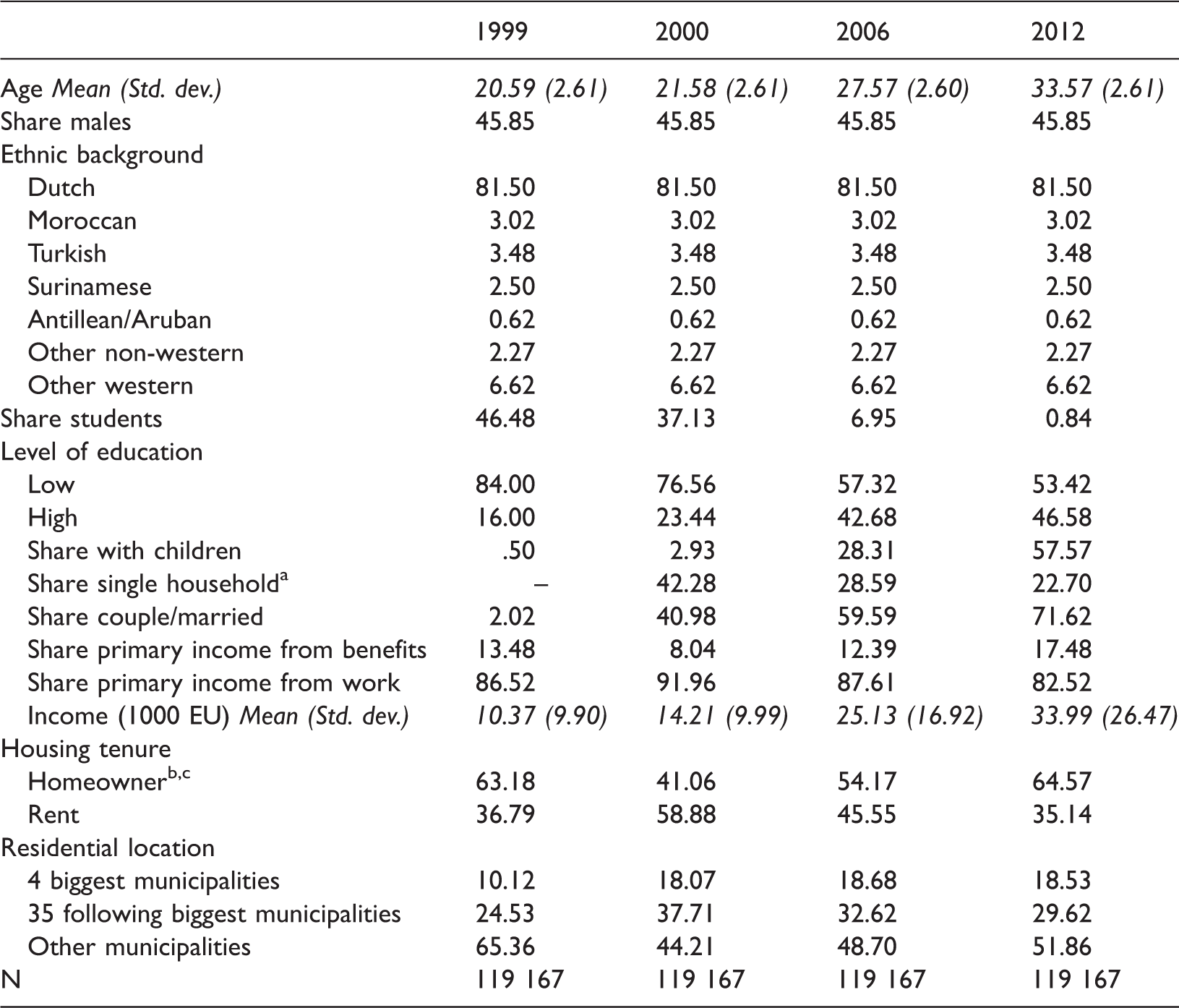
Note: Unless otherwise indicated, values are reported in percentages. As some variables contain missing or unknown values, not all values will sum up to 100%
All anchors were registered as ‘child within the parental home’ in 1999, the ‘single household’ category was therefore not applicable in this year.
The homeowner category refers to the record of the building in the national housing registers, not the individual residing in it. Therefore, the homeowner category may include individuals who rent from a landlord/lady who did not officially declare their property to be let out to tenants.
The housing tenure in 1999 refers to the parental home.
The SSD provides unique geo-coded information, including an array of spatial levels differing in size. In this study, we selected 500 × 500 meter grids to define our neighbourhood boundaries. The Netherlands consist of 34,094 inhabited 500 × 500 meter grid cells containing 496 inhabitants on average. These grids are smaller than most standard Dutch administrative units, such as postal code areas, and are thus more likely to depict inhabitants’ perceived neighbourhood boundaries and direct neighbourhood environment. Using these grids further enables us to compare equally-sized, smaller spatial units throughout the Netherlands, the boundaries lines of which are constant over time. For this reason, while grids are not defined based on logical structural, and infrastructural characteristics, but on assigned coordinates of square geographic areas, they nonetheless form a suitable spatial scale on which to construct, measure, and compare neighbourhood histories.
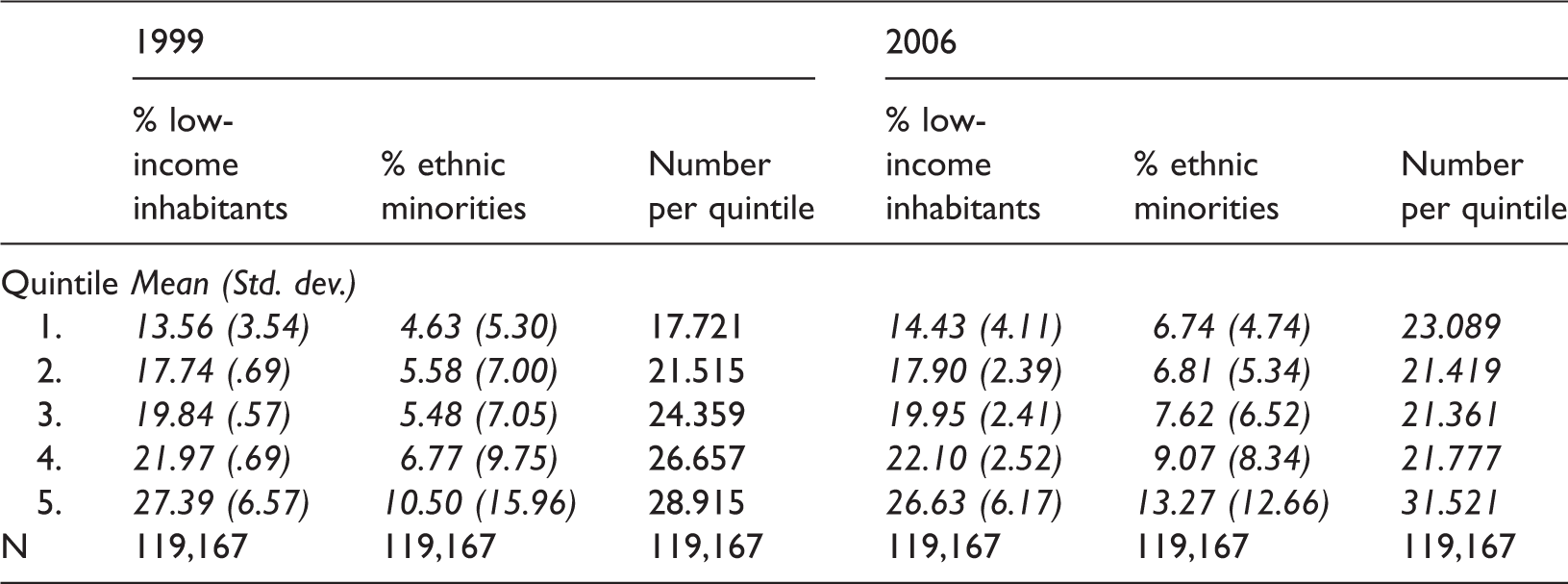
As we examine intergenerational continuity of neighbourhood status over time, our primary neighbourhood characteristic is the concentration of poverty within the grid cell. Personal income was defined as the sum of income from a variety of sources, consisting of wages, benefits, and student scholarships. On data containing the economic characteristics and income distribution of the entire Dutch population, we constructed income quintiles, the last of which contained all inhabitants who fell into the lowest 20 percent of incomes. Subsequently, we constructed neighbourhood quintiles, in which poverty concentration was defined based on the share of low-income neighbours. Neighbourhoods in the first income quintile have the lowest concentration of poverty, while those in the fifth quintile have the highest concentration of poverty. We thus refer to neighbourhoods in the latter category as deprived neighbourhoods. Figure 1(a) and (b) shows a number of basic descriptive statistics at the quintile-level, at the time of living in the parental home (1999), and halfway through the measurement period (2006).
(a) Sequence plot on patterns of individual neighbourhood histories 1999–2012 (on a sample of 5000 individual histories) of those leaving the parental home in 1999–2000, from a parental neighbourhood with the lowest poverty concentration (quintile 1). (b) Sequence plot on patterns of individual neighbourhood histories 1999–2012 (on a sample of 5000 individual histories) of those leaving the parental home in 1999–2000, from a parental neighbourhood with the highest poverty concentration (quintile 5).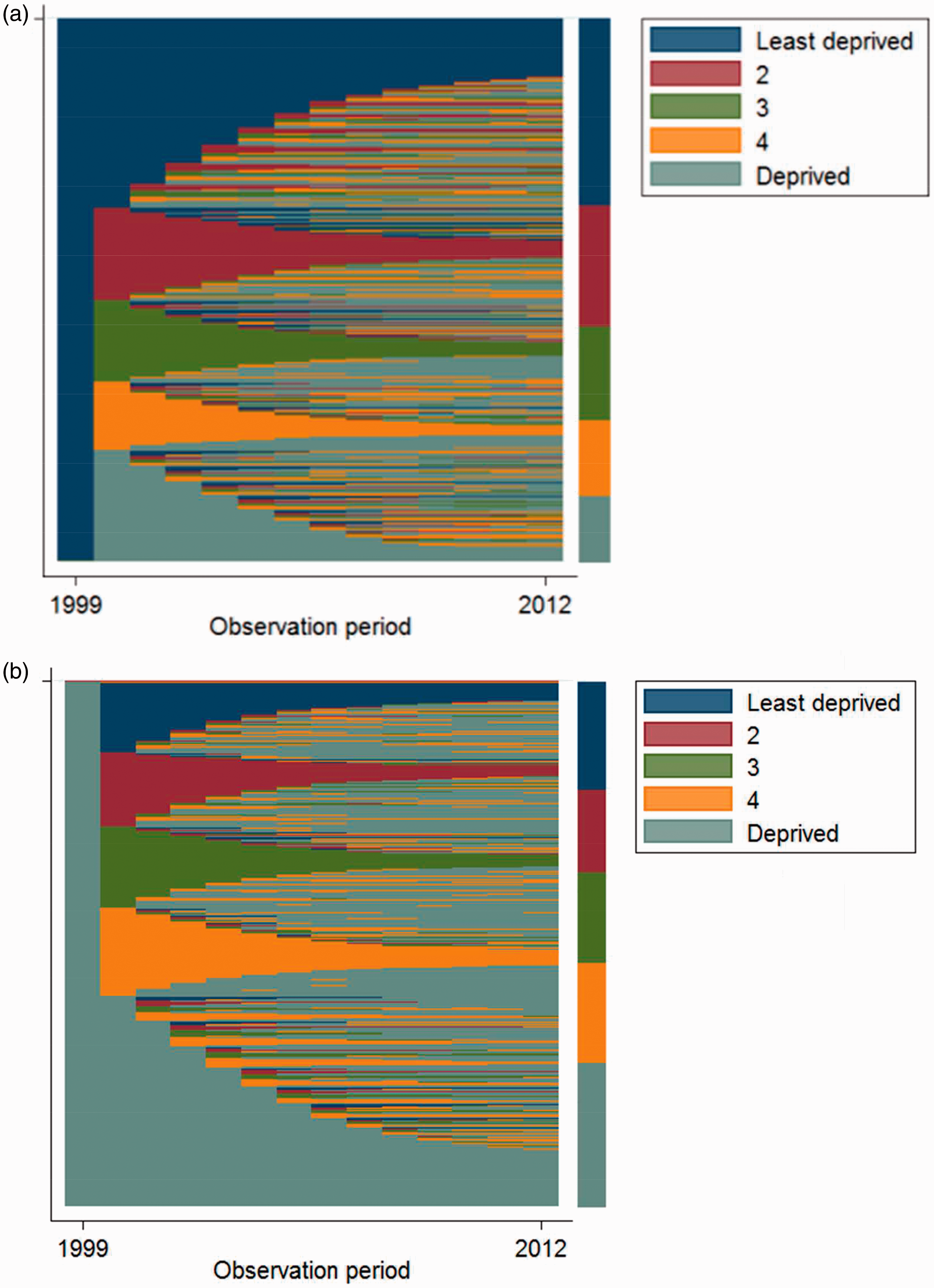
Analytic strategy
In this study, we used sequence analyses to visualise individual neighbourhood residence in the constructed income-quintiles over time. Table 2 provides an overview of core descriptive statistics at the quintile level. In recent years, sequence visualisation has become increasingly popular in social research, and a small number of neighbourhood studies have used this method before to investigate individual neighbourhood histories and track residential change over a measurement period (Coulter and van Ham, 2013; van Ham et al., 2014). We used the SQ-Ados bundle of Stata programs in Stata 12 to create individual sequences for the anchor population. Each individual person-year observation on the neighbourhood quintile forms an element in the sequence of a respondent (Brzinsky-Fay et al., 2006). In theory, each horizontal line in the sequence plots shows the entire 14-year neighbourhood history of an individual within our subpopulation, from 1999 to 2012 (see Figure 1(a) and (b)). In practice however, due to pixilation restrictions, the figures show larger population trends in neighbourhood histories rather than identifiable personal tracks. As stated, the neighbourhood quintile in 1999 is used to represent the parental neighbourhood characteristics. All five neighbourhood quintiles were given a separate colour-coding to discern their difference in poverty concentration. A change of colour in an individual timeline from one year to the next indicates a residential move to a grid area with a higher or lower concentration of low-income neighbours compared to the previous year. If there is no change of colour between years in the sequence, either the individual has not experienced a residential move, or the individual has moved but their neighbourhood quality has not changed. We constructed the data in such a way that individuals will not experience a change of neighbourhood status (and quintile colour) unless they actually move.
In addition to the visualisation techniques, in order to examine how neighbourhood histories are likely to develop after leaving the parental home, we estimated neighbourhood outcomes over the measurement period using multilevel logit models. We were thus able to look at a number of time points within the individual neighbourhood trajectories, between 2000 and 2012, and assess intergenerational aspects and its moderation by higher education accordingly. The dependent variable in these models is the probability of residing in a deprived neighbourhood after leaving the parental home. Using a dichotomous dependent variable, we fitted xtlogit models for two points in the measurement period, 2006 and 2012, which provided us with logistic estimates. In order to examine intergenerational neighbourhood continuity over time, the most important independent variable in our analyses is the parental neighbourhood quintile, measured in 1999. In model 2, we add an interaction between deprived parental neighbourhoods (in quintile 5) and individuals’ personal educational attainment, in order to check for a moderating effect of education on the influence of childhood experiences with poverty concentration. Subsequently, in model 3, we add a three-way interaction between the deprived parental neighbourhood (quintile 5); individuals’ personal educational attainment; and whether the individual belongs to an ethnic minority group. By doing so, we are able to check whether an effect of personal educational attainment on the expected intergenerational transmission of deprived neighbourhood characteristics is stronger for non-ethnic minorities in our subpopulation, as opposed to those from an ethnic minority. In other words, this model will enable us to examine whether non-ethnic minorities are more likely to discontinue poverty patterns across generations through positive accumulation of individual socioeconomic resources over the life course compared to individuals from an ethnic minority.
A selection of individual and household characteristics, described (among others) in Table 1 above, are included as further independent variables throughout the models. Socioeconomic observations include individuals’ highest level of education over time; their annual income; and their type of housing tenure (when available; see Table 1). Concerning the anchors’ educational level, the SSD contains information on degrees obtained in higher education from 1986 onwards (Bakker et al., 2014). Low and middle levels of education however were not officially recorded until 2003. Therefore, for our subpopulation, we have reliable integrated data on anchors’ attainment of higher education (i.e. higher vocational or professional (HBO), college, or university), but we cannot distinguish low and middle level degrees. We thus include a dummy for higher education (yes/no) in our models, both as a main effect and in the interactions with the parental neighbourhood characteristics and ethnicity. We further include the individual’s gender; whether they are single; and whether they belong to one of the main ethnic minority groups in the Netherlands (i.e. Moroccan, Turkish, Surinamese, and Dutch Antillean/Aruban). Finally, we add individuals’ age, and the income of the parental household in 1999 as controls in the models.
Due to our focus on active moving behaviour, we did not take into consideration contextual changes in the residential neighbourhood, unless a residential move was observed. Therefore, neighbourhood processes such as gentrification or changing housing affordability over time are not expanded upon in this particular study. In our data, the number of cases of substantial neighbourhood change (in terms of the concentration of lowest incomes) without a physical move of the individual in question was very small. Only 5% of the contextual neighbourhood changes involved a change in neighbourhood status larger than 1 quintile category (for instance from 1 to 3, or from 4 to 2) over the 12-year measurement period. All models in this study (sequence and multilevel logit) were additionally run on neighbourhood status (quintiles) that did take contextual change into account, but the models did not show significant differences from our current results on active moving behaviour (analyses not shown, available upon request).
Results
Sequence analyses
Figure 1(a) and (b) shows the 14-year neighbourhood histories of two random samples of 5000 individuals in our subpopulation, from 1999 to 2012, organised by the parental neighbourhood quintiles with the lowest (blue segments) and highest (grey segments) concentrations of poverty accordingly (quintile 1 and 5). At the beginning of our measurement period, there is a slight overrepresentation in our subpopulation of individuals residing with their parents in a deprived neighbourhood (24.3%) compared to other neighbourhood types. For individuals from a relatively affluent parental background, displayed in Figure 1(a), we see that a large part continue to live in neighbourhoods with the lowest concentration of poverty when leaving the parental home in 2000, but that the majority move into neighbourhoods with higher concentrations of poverty, some deprived. These residential changes can be expected for a young subpopulation, which likely consists of students and starters on the labour market. In the following years, the majority of this young subgroup begin to reside in more affluent neighbourhoods once again. The column to the right of the figure shows the individuals’ residential locations sorted by quintile type in 2012. At the final measurement point, individuals are relatively equally distributed over neighbourhood quintiles 2 to 5, with a distinct overrepresentation of individuals residing in quintile 1, with the lowest concentration of poverty. Nevertheless, the majority of individuals are shown not to have reached the same neighbourhood type as their parents 12 years after starting their individual residential histories. The sequence plot thus suggests that individuals from an affluent background experience upward social residential mobility after leaving the parental home, but that it takes a lot of time to reach the same neighbourhood type as their parents, if they do at all.
Residence in neighbourhood quintiles (2000–2012) by parental neighbourhood quintile (1999).
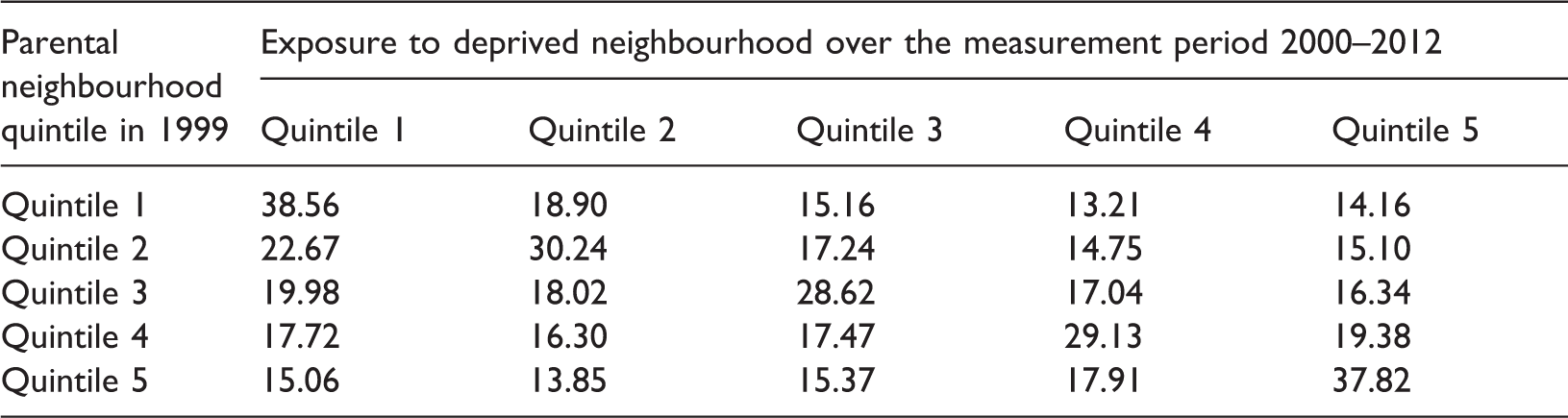
Note: Unless otherwise indicated, values are reported in percentages.
The results in Table 3 show that individuals who come from a more affluent parental background, and thus lived in a neighbourhood with a low concentration of poverty in 1999, are most likely to spend time in similarly categorised neighbourhoods (quintile 1) during their own residential history up to 12 years after leaving the parental home (38.6% of years over the measurement period). Comparatively, individuals from a deprived parental neighbourhood (quintile 5) are least likely to reside to reside in low poverty concentration neighbourhoods (only 15.1% of years over the measurement period). The other way around, the same pattern can be identified. The results show that individuals from a deprived parental neighbourhood are most likely to reside in deprived neighbourhoods themselves after leaving the parental home during the entire measurement period (37.8% of 12 years), compared to individuals from a more affluent background (14.2% of 12 years).
The results from the sequence analyses and accompanying table show a clear relationship between the parental neighbourhood and exposure to each of the five constructed categories of poverty concentration, as well as the persistence of residence within one of these categories in individuals’ residential histories after leaving the parental home. Particularly for individuals from a deprived parental neighbourhood, exposure to poverty and lengthy residence in deprived neighbourhoods are highly prevalent throughout life. Overall, these findings strongly resemble the patterns previously identified in Sweden (Hedman et al., 2013).
Multivariate analyses
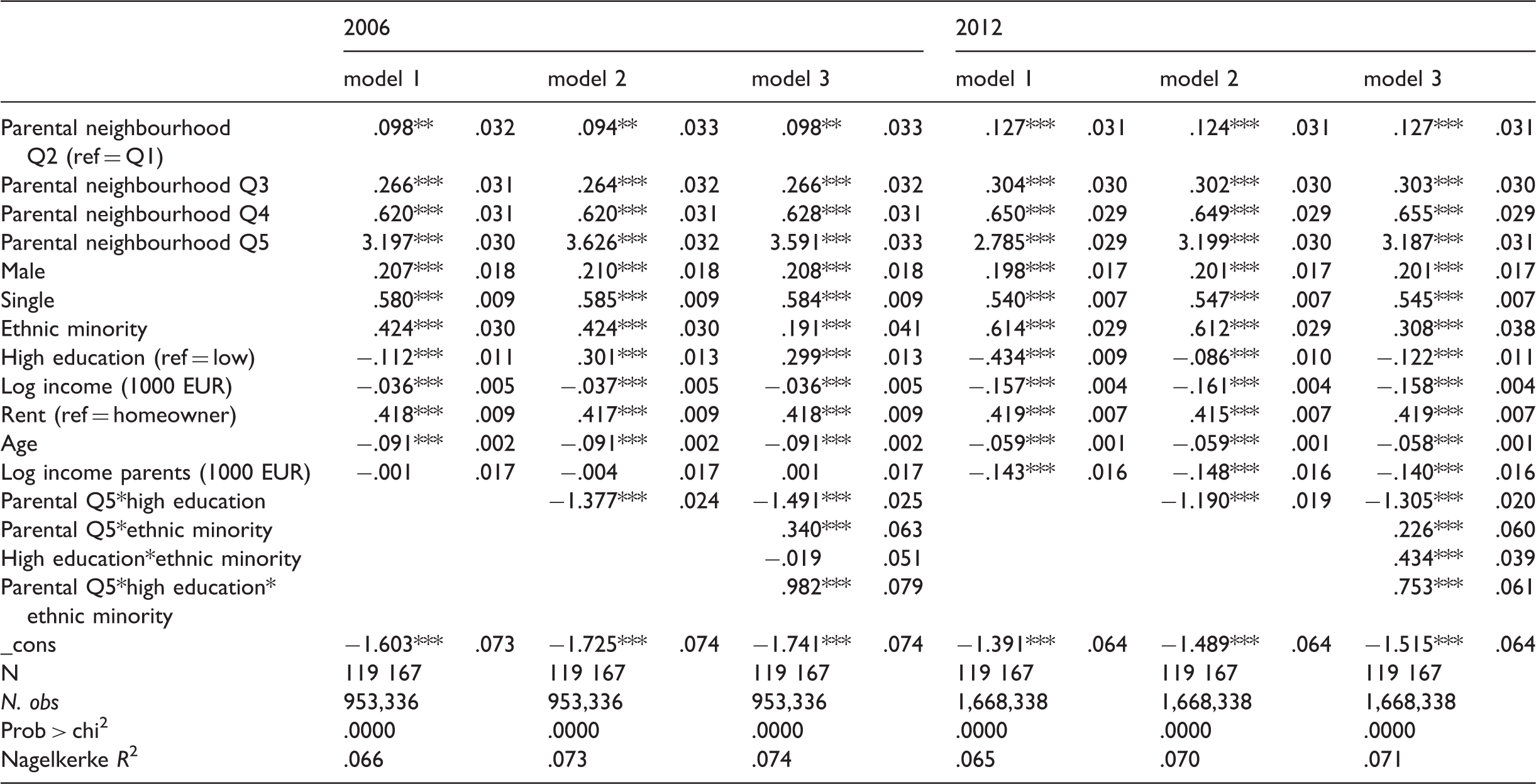
Multilevel logit models on living in a deprived neighbourhood (quintile 5), 6 and 12 years after leaving the parental home.
p < 0.05.
p < 0.01.
p < 0.001.
In support of our main hypothesis, the results further show that the likelihood of residence in poverty concentration is indeed lower for individuals who have attained higher education, and substantially higher for individuals belonging to an ethnic minority group. Both effects increase over time, which indicates that personal attributes and attainments indeed play an increasingly important role in determining personal neighbourhood outcomes over the life course. We find negative significant interaction effects between the deprived parental neighbourhood (quintile 5) and the attainment of higher education throughout the models. These results thus indicate that the negative effect of a parental neighbourhood with a high concentration of poverty on personal residential outcomes is weaker for individuals with a high education. As shown in Table 4, the moderating effect of personal educational attainment becomes stronger over time. These results thus lends support to our expectation that positive accumulation of individual socioeconomic resources over the life course, in this case higher education, can greatly weaken and potentially discontinue intergenerational transmission of deprived neighbourhood characteristics over time. Furthermore, this effect is shown to differ depending on the individuals’ ethnic background. Graph 1 displays the plot for the three-way interaction included from model 3 onwards, between the deprived parental neighbourhood; individuals’ personal educational attainment; and whether the individual belongs to an ethnic minority. Additionally, the accompanying Table 5 shows the three most frequent sequence patterns of our subpopulation, split up by education and ethnicity.
Three-way interaction effect plot after multilevel logit regression for 2012. Interaction between the deprived parental neighbourhood, educational attainment, and whether an individual belongs to an ethnic minority group. Descriptive statistics on the three most frequent quintile sequence patterns for natives and ethnic minority subgroups over the observation period 1999–2012, with low and high educational attainment. Note: one element in the sequence represents one year in the measurement period. Numbers represent the quintile type; from 1 with the lowest concentration of poverty, to 5 with the highest concentration of poverty.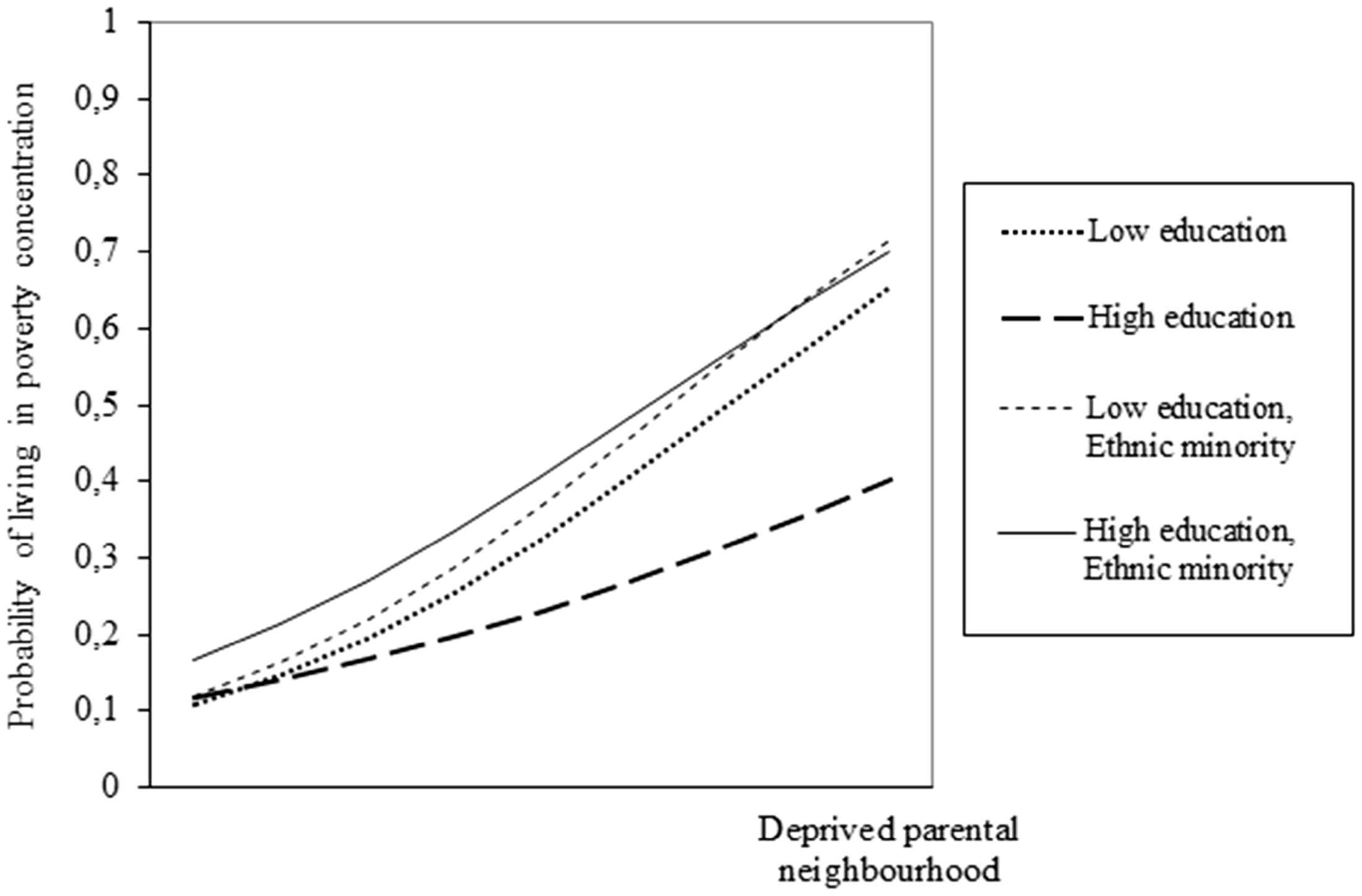
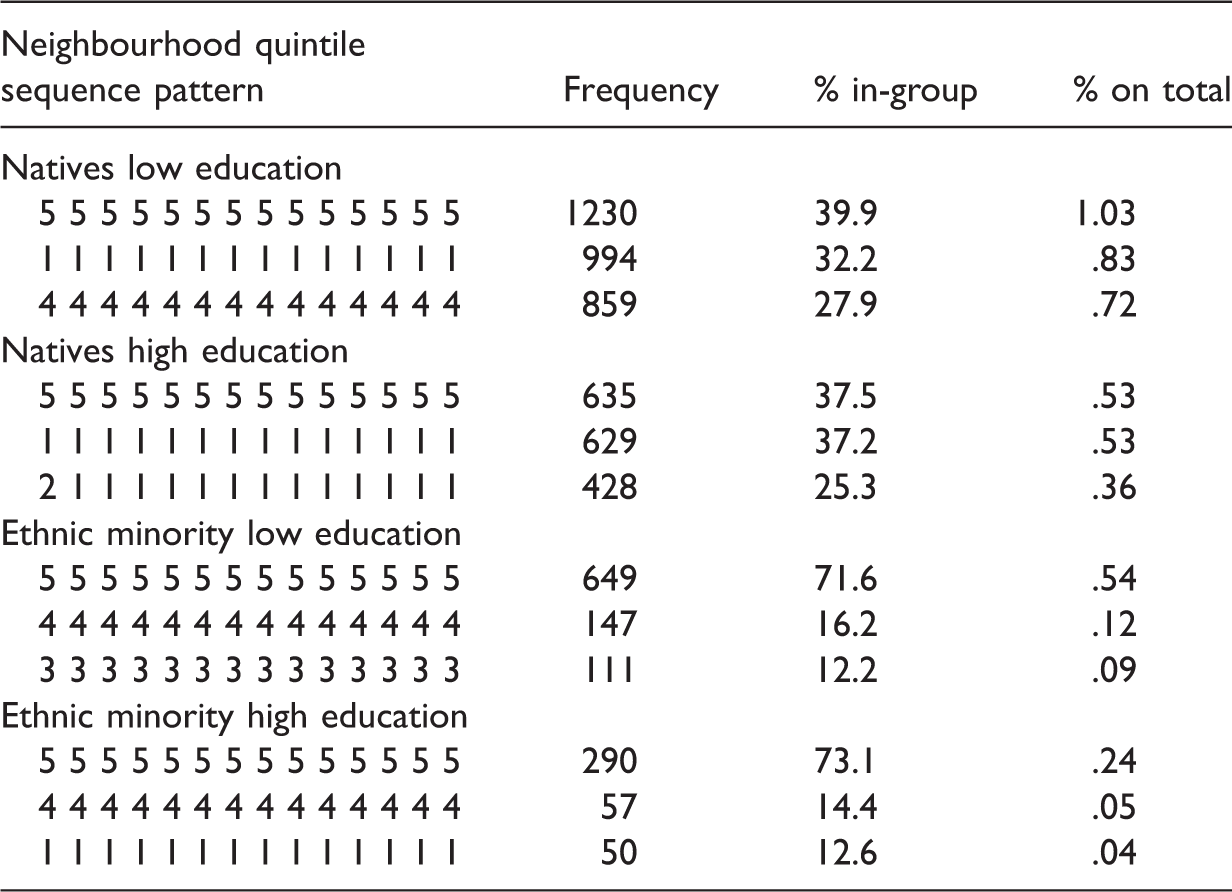
The graph clearly shows that the positive effect of a deprived parental neighbourhood on personal residence in an impoverished area over the measurement period, is most strongly moderated by educational attainment for individuals who do not belong to an ethnic minority group. This result is displayed in the slope of the long dashed line, which is significantly less steep than those of the other category combinations. In fact, the difference in probability of residing in a poverty neighbourhood for ethnic minorities is only very minor for the lower and higher education groups, as seen in the solid and short dashed lines. This leads us to broadly conclude that continued or lengthy residence in a deprived neighbourhood after leaving a deprived parental residential environment is common for ethnic minorities despite their accumulation of positive socioeconomic resources over time, while for others, educational attainment can ensure a move away from poverty concentration by strongly reducing the effect of the parental neighbourhood. The sequence patterns shown in the accompanying Table 5, split up by education and ethnicity, further indicate that unremitting residence in a deprived neighbourhood is by far the most common residential pattern for all individuals in our subpopulation. It further highlights that for ethnic minority groups, regardless of educational level, the in-group percentage of those remaining in deprived neighbourhoods over time is much higher than for their native Dutch counterparts even compared to those with a lower education, reiterating our previous findings and graph.
The results in Table 4 further show significant effects for most controls added throughout the models. Males are shown to have a higher chance of living in a deprived neighbourhood on average compared to females. This finding may in part be explained by household behaviour, as females commonly start cohabitation and marriage earlier on in life (Statistics Netherlands, 2013), and a partner subsequently results in a higher combined spendable income on housing. The fact that singles are shown to have a higher chance of living in poverty concentration supports this latter explanation. Both for individuals’ own annual income and the income of their parents, the results in 2012 indicate that the higher the income the lower the risk of residing in a deprived neighbourhood after leaving the parental home. As discussed, a substantial body of literature suggests that the income of the parent is a strong predictor of the income of their children later on in life, and this process could certainly be at play in determining the type of neighbourhood one can afford to live in. Nevertheless, the effect of the deprived parental neighbourhood on individual neighbourhood outcomes holds throughout the analyses, even after adding the control for parental income. We further find that individuals’ chance of living in a deprived neighbourhood declines with age, presumably as their income grows, and that individuals in rental accommodation are more likely to experience concentrated poverty than homeowners.
Discussion and conclusions
In this study, we applied a life course approach to the examination of intergenerational residence patterns and neighbourhood characteristics, reinforcing previous arguments for a dynamic, long-term perspective on neighbourhood effects. In doing so, we add to the limited, but growing literature which shows that individual outcomes are not only influenced by the current residential location, but also by previous neighbourhood experiences (Sharkey and Elwert, 2011; Sharkey and Faber, 2014; van Ham et al., 2014). Taking into consideration individuals’ long-term residential locations, we were able to examine whether individuals’ chances were impaired by where they lived over time. Does growing up in a deprived parental neighbourhood increase individual chances of residing in poverty concentration later in life? At the core of our research into these intergenerational transmission patterns, we hypothesised that individuals’ educational attainment, as a personal rather than inherited resource, would become increasingly important to their personal neighbourhood outcomes over time. Higher educational attainment, could weaken, or even discontinue intergenerational residence in poverty neighbourhoods over the life course, by providing moving opportunities and access to higher income jobs, as well as housing options in more affluent neighbourhoods. Furthermore, the personal wish for a more affluent neighbourhood and its facilities may increase as education, and subsequently often income, increases over time. We anticipated that education may be a weaker mediator of an intergenerational neighbourhood effect for ethnic minorities groups compared to other Dutch inhabitants.
Both the descriptive and multivariate analyses results confirm that a deprived parental neighbourhood strongly increases an individual’s chances to end up in deprived residential locations, far into adulthood. Furthermore, we find that intergenerational residence in poverty neighbourhoods is more prevalent among non-Western ethnic minority groups. The effect of the parental neighbourhood is persistently strong throughout the models, and holds even after adding relevant controls and moderators, thus overarching effects due to variation in individual and household characteristics, as well as parental income levels. Therefore, while ample literature suggests that parental income is a strong predictor of the income and outcomes of their children over the life course, and their subsequent neighbourhood selection, the parental neighbourhood itself also appears to play an important role in transmitting neighbourhood characteristics. Additionally, in support of our main hypothesis, the results show that individuals’ attainment of higher education indeed reduces the effect of the deprived parental neighbourhood on disadvantageous residential outcomes. Furthermore, when comparing the models over time, we find that the relative importance of higher education as a personal resource becomes stronger, as does its moderation of a parental effect. Interestingly, this main result primarily holds for individuals who do not belong to an ethnic minority. For individuals from a deprived parental neighbourhood and an ethnic minority, the level of education has hardly any effect on their chances of residing in poverty concentration oneself; which are higher than those of other Dutch inhabitants overall, even than those with a lower education. In line with previous research (Sharkey and Elwert, 2011; van Ham et al., 2014; Vartanian et al., 2007), these findings suggest that ethnic minorities are less likely to experience improvements of their residential environment and upward social mobility, even after attaining higher education.
Due to the nature of our data, the fact that it does not include subjective observations, we are not able to further examine the precise causal mechanisms behind intergenerational transmission of deprived neighbourhood characteristics. Explanations can range from complex inter-family and societal processes such as social contagion; a limited network range due to a homogeneous composition of the deprived neighbourhood; or a collective acceptance of dysfunctional norms and values, which affect individual chances to participate in society and experience upward social mobility (for an extensive discussion see Galster, 2012). However, people may also choose to live in a certain neighbourhood because they are accustomed to it, since it is similar to the one experienced during childhood. Additionally, individuals may purposely live close to their parents or in a neighbourhood that offers similar facilities and services as the parental neighbourhood (van Ham et al., 2014). For ethnic minority groups in particular, specific services for everyday life, such as supermarkets with international produce or local societies for inhabitants with a similar ethnic background, are often clustered within a small number of neighbourhoods in the larger cities in the Netherlands. The same holds for religious facilities, such as mosques, temples or synagogues. The controls in our models may not serve as sufficient proxies to cover this range of possible considerations behind a selection into a deprived residential neighbourhood after leaving the parental home. This study may thus encourage future research, using subjective observations on what may underlie causal mechanisms at play in the process of intergenerational neighbourhood continuity.
Basic descriptive statistics on the neighbourhood quintile-level in 1999 (in the parental home), and in 2006, halfway through the measurement period.
Footnotes
Declaration of conflicting interests
The author(s) declared no potential conflicts of interest with respect to the research, authorship, and/or publication of this article.
Funding
The author(s) disclosed receipt of the following financial support for the research, authorship, and/or publication of this article: The research leading to these results has received funding from the European Research Council under the European Union's Seventh Framework Programme (FP/2007–2013)/ERC Grant Agreement n. 615159 (ERC Consolidator Grant DEPRIVEDHOODS, Socio-spatial inequality, deprived neighbourhoods, and neighbourhood effects) and from the Marie Curie programme under the European Union's Seventh Framework Programme (FP/2007–2013)/Career Integration Grant n. PCIG10-GA-2011-303728 (CIG Grant NBHCHOICE, Neighbourhood choice, neighbourhood sorting, and neighbourhood effects).