




Abstract
How do the wealthiest inhabitants in one of the world’s wealthiest cities engage with public settings? Certainly, public concern about social and spatial divisions resulting from gross inequalities has not been matched by empirical research into the flows and social repertoires of the very wealthy. This article presents research examining the place and impact of the super-rich on London and considers how this group relates to its others, how they traverse urban spaces and their feelings about the value and relative dangers of the city. The impression derived from this investigation is of a group able to use residential locational choices and choreographed mobilities as strategies to avoid negative aspects of daily life in the city (visible poverty, potential danger, spaces of social and ethnic difference). Yet despite these strategies of selective engagement, it is also possible to identify a celebration of London as a safe and cosmopolitan urban field in which cultural institutions and commercial districts allow what is nevertheless a socially delimited range of interactions. The city allows the very wealthy to experience London as a democratic and welcoming space underwritten by high levels of domestic security, spatial divisions/buffers and public–private security apparatuses that facilitate their relative invisibility and safety. The wealthy take on a cloaked co-presence that prevents the need for disagreeable encounters with poverty, facilitated by the built structures and networks of the city.
Introduction
There was something odd about One Hyde Park: too few people went in or out of the
building. Maybe the people who owned the residences there were so rich that they chose
never to visit them? (Dorling,
2013: 59)
Even in severely unequal and segregated cities, public space may enable encounters of mutuality, trust and open social relations that cut across class and racial divisions (Anderson, 2011). Such ‘cosmopolitan canopies’ may generate feelings of relative safety and mutual regard, even transcending ethnic lines despite culturally-embedded suspicions. One possibility is that public space then may create the conditions under which inequality and grievance are either concealed or softened by the apparently democratic nature of urban public life. Similarly, social difference may be more deeply embedded than public life might suggest, as residential segregation or the non-overlapping pathways of particular groups prevent contact (Graham and Marvin, 2001). Liberal arguments about how the city may enable encounter and mutual empathy should also be infused with understandings of how wealth and income inequalities may become naturalised or accommodated through the city’s design, as it is structured for the affluent.
Anderson appears to follow key writers such as Sennett (1992), who maintains that an open street life may facilitate empathy and rich cosmopolitan moments. Against such possibilities stands the tendency to produce more homogenous, commodified and controlling spaces in cities (Minton, 2009). In addition, deepening inequalities suggest that the parameters of exchange and encounter may be shifting. The political signal offered from work on cosmopolitanism is that we should encourage tolerant and open spaces where diverse social encounters can occur, yet the reality remains that contact, respect and citizenship are being recast in many urban contexts where segregation, ethnic and other forms of differentiation and wealth/income inequalities potentially erode any gains that pro-social urban designs and spaces encourage. While the possibilities of exchange and empathy in public space thus remain appealing (Blokland and Savage, 2008), they also raise worrisome implications that involve swallowing-back resentments and conflicts indicated by gross urban inequalities and the subjugation of certain urban social groups.
These broad debates form the background to this article, which seeks to unpick the lived desires and experiences of the urban rich and their negotiation of public spaces, social difference and urban poverty. It asks to what extent the city may act as a system that, while offering the image of a cosmopolitan space of encounter and exchange, paradoxically masks inequalities and social difference. This possibility suggests that the comfortable metropolitan habitus of the wealthy may develop largely un-punctured or impeded by the problems manufactured by inequality. If London is now the pre-eminent domain for living by the super wealthy globally (Atkinson et al., forthcoming), it is also a city wracked by housing shortages, public housing demolitions, draconian welfare cuts and straining infrastructures (Lupton et al., 2013).
In cities characterised by an abundance of wealth, such social critical mass creates networks, architectures and an ambience that allows inconspicuousness in public spaces and highly developed capacities to slip in and out of public spaces. Thus, the street-level appearance of wealth belies the elaborate strategies of the rich as they circumvent entanglement or more urban spaces that are perceived to be more risky or that are simply not for them. As detailed here using data drawn from the close support staff and intermediaries of the wealthy, street-level co-presence shows that difference remains largely unregistered or is incorporated in narratives of inclusion by reference to the multiple service staff they encounter, viewed as representing social life more broadly. As Matejskova and Leitner (2011) have argued, co-presence between different (ethnic) groups does not itself assure contact or mutual trust. This observation resembles the finding here that in the narratives of the wealthy and those that support their needs in the city, the canopy of central London offers a rather circumscribed level of social contact within which wealth is unremarkable given the kind of cosmopolitan milieu that exists there. These features are frequently identified by real estate agents dealing with the purchasing requirements of the very wealthy who see this as a major attraction for cities like London as they search for relative safety through anonymity and a kind of riskless excitement in such zones (Hannigan, 1998). The second key aspect of mobility by the wealth connects to Birtchnell and Caletrio’s (2013) suggestion that the wealthy desire a kind of oysterization of the world around them that offers security, free-flowing access and closure, whenever these qualities are required. A closed circuit of personal drivers, private taxis, the use of powerful and discrete cars and occasional use of personal guards are the mainstays of these arrangements but are supplemented by secure nodal points in these networks – shops with manned doorways, fortress homes, gated communities and well-staffed private leisure and consumption spaces that symbolically or physically block access to those who do not belong.
Whether the wealthy are in the street or perambulating the city, they retain the capacity to make sudden or co-ordinated evasions or to move out of sight by withdrawing or crossing pavements to cars, rather than walking them, allowing them to engage the others populating their life-support systems (Pincon and Pincon-Charlot, 1998) while remaining unengaged with the deeper diversity of city life around them (Smithsimon, 2010). In this sense the city has the feel of what might be termed a plutocratic cloud, whose physical qualities and social networks enable near physical co-presence while reinforcing social distance. The article begins by considering the place of the rich in urban studies, asking what role such analyses should play within broader questions about urban social problems and the broader life of the city. The second part of the paper details the study of London upon which this article is based, and the third details key findings relating to questions of mobility and public space as these are unpicked by access to those servicing the needs and tastes of the super-rich.
Mobility, cosmopolitanism and contact in the plutocratic city
Early studies of urban mobility and community suggested that disconnection and extra-local contact had become unremarkable for many groups and in many places. These themes continue to resonate in more recent contributions stressing the complexity and limitations of urban space as sites of encounter, contact and integration. For Vertovec (2007), the highly diverse ethnic composition of British cities renders a straightforward diagnosis of segregation and separation difficult. Certainly, the move from notions of fixed ghettoization and immobile poverty have made way for a kind of mobility turn in the research literature, so that greater recognition has been given to the kinds of exchange, interaction and contact within and across social space in cities. Relatively static notions of residential segregation have now been extended by thinking through the kinds of time–space mobility that affect in-group contact across urban spaces (Atkinson, 2008b). These points build on the work of analysts like Massey (1996), who suggested that forms of social and institutional containerisation in the form of hyper-segregated US cities represented a major threat to social integration and cohesion. The possibilities offered by premium transport systems in particular have shaped new potential for maintaining a sense of security and in-group contact between securitised nodes or exclusive residential landscapes. These themes re-emerge strongly in the analysis presented shortly.
Mobilities may enhance the capacity of wealthier groups to withdraw socially into forms of spatial and social closure that mirror key destinations such as institutional settings, work and leisure sites. Atkinson and Flint (2004) elaborate on the strategies of higher-income residents living in gated communities. They find that such closed residential areas are augmented by access to the wider city and social contact via the orchestrated use of personal cars, traversing spaces of social difference or potential encounter, enabling riskless engagements with the wider fabric and services of the city. The introduction of mobility and inequality as more complex forces that shape social contact and encounter has extended debates about the ways the forms of urban space structure the experiences of citizenship and exclusion. Despite these important themes, the tendency to view contact as equivalent to empathy or social interaction merits resistance. As work by Valentine and Sadgrove (2012) highlights, encounter does not simply translate into feelings of respect or empathy.
If the city remains for many a space of democratic and open encounter, a kind of crucible for citizenship and social empathy, many studies now recognise that experience as complex and subject to variations based on class, gender and ethnicity, among other factors (Matejskova and Leitner, 2011; Valentine, 2008). One question that emerges from this work concerns how significantly rising wealth has shifted the fabric and structures of interactions in cities. Until relatively recently, the social sciences (e.g. Birtchnell and Caletrio, 2013; Dorling, 2014; Hay, 2013) offered limited profiles of the wealthiest social groups occupying cities, focusing on the poor, the criminal and the marginalized, and generally excluding or ignoring the wealthy and the powerful, despite earlier critiques (Nader, 1972). Certainly, there have been attempts to extend analyses of gentrification as the process has developed to include much higher income groups, labelled either as super-gentrification or financification (Butler and Lees, 2006; Lees, 2003). Yet extended analyses of the wealthy still require empirical research that grapples with those groups increasingly publicly identified as exclusive, off-limits and increasingly problematic.
Research has advanced public understanding of the condensation of St John 2002 wealthy, and in a relatively short space of time, we have seen quite considerable effort devoted to profiling and understanding how wealth has increased and what kind of impact it has on urban living. At the macro scale, analysts like Piketty (2014) have demonstrated the growth of material wealth and a return to inequalities that peaked in the earlier part of the 20th century. Dorling’s (2014) work also highlights the gross inequities and unfairness of a system problematized by earlier key contributions like that of Wilkinson and Pickett (2010). With the full force of cuts to state-run and municipal services being borne disproportionately by low income groups (MacInnes et al., 2014), an understanding of changes in the character of urban culture, contact and mobility in the context of these massive inequalities and social pressures remains critical.
London is one of the pre-eminent locations where we can observe the growing condensation of international wealth (Wealth X/UBS, 2013), property investment and massive disparities in wealth and opportunity. In recent years, the growing competition for and the relative cost of urban housing resources and the appropriation of large homes left empty for long periods of time by overseas owners has raised questions about the value of such investment and its impact on the cost of living more broadly. As the city has become a major depository for the gains of super-wealthy oligarchs, plutocrats and business elites requiring safe havens for resources in a turbulent global system, questions have also emerged about the kinds of primitive modes of accumulation, theft and surplus value extraction that underlie London’s boom (Platt, 2015). The neighbourhoods touched by these forms of social and capital investment have been termed the ‘alpha territory’ by commercial, socio-demographic profiling agencies, and into these spaces money has poured because they are relatively cheap in international terms (due to exchange rates and a low property tax regime), safe (relative to other cities and economies globally) and it is desirable to do so (the lure of a globally unique cultural infrastructure that retains a key position as a site of status, privilege and display).
Where gentrification has been represented as a search for insulating neighbourhoods that
offered a sense of social affiliation (Abrahamson, 2006; Low,
2003), the colonisation of the city by capital is marked by the need for a more
emphatic process of social disaffiliation in which wealthy new residents appear markedly
withdrawn from the social life of the city, similar to the earliest waves of suburbanisation
as a mechanism for avoiding the masses of the urban poor (Fogelson, 2005). These changes yield a sense of the
city’s social spaces as a cellular and partitioned system of barriers and mobility networks
offering immunological properties. Klauser (2010) describes such a city in terms of a series of more or less
protected spaces that resemble a kind of foam-space and argues that protected residential
spaces in such systems, of the kind witnessed in so many parts of cities like London: rely upon a daily influx of energy and information, in the widest sense, from the
outside world. Although their visible boundaries give rise to an appearance of physical
and atmospheric separation between the inside and the outside, what in fact exists is an
ambiguous continuity (Klauser,
2010: 333).
This form of wealth condensation (the process by which newly created wealth is further attracted to the rich and rich cities) has generated related activities to create forms of social insulation from diverse sources of social danger (Atkinson, 2006). Such processes involve the affluent in attempts at shielding themselves from scenes of social difference and envisaged risks. Commentators on gated communities, for example, have argued that residents of these places are both metaphorically and in reality incarcerated by their fears (Low, 2003). Similarly, there is growing evidence that the ‘capsularisation’ of social life (De Cauter, 2005) involving secure zones, transport systems and protected leisure destinations, among others, are used not only to produce privacy and safety, but also prestige (Birtchnell and Caletrio, 2013) for those able to access what may be social or price-based mechanisms of exclusion. Yet, relatively limited evidence has emerged of the particular pathways, beliefs and negotiations of urban space in cities like London by the wealthiest of its residents. Thus, this paper responds to the suggestion that capsular modes of transport and the defensive architectures of nodal points in splintered urban systems (Graham and Marvin, 2001) allow a sanitised and domesticated impression of the social life of the city in which any form of prospective social danger and spaces of poverty are concealed or skirted.
Flowing and networked spaces of privilege and insulation can be used to help conceptualise
the appropriation of space in London by the very wealthy. The precise qualities of
sociability within and between social elites and other segments of the city in the past
decade have barely been recorded by social researchers. Certainly we appear to understand
how the gaze of earlier waves of gentrification placed social difference at some distance,
as Butler and Robson observed a decade ago. Gentrifier entrants were: ‘the cosmopolitans living in a metropolitan environment. “Locals”, to whom they largely
counterpose themselves, live elsewhere: either hidden away in social housing, or indeed
anywhere else in the United Kingdom’ (2003: 8)
Research approach
The number of individuals who might be considered ‘super-rich’ can be operationalized in a number of ways (Hay and Muller, 2012). One approach is to use the 15-year series of World Wealth Reports by Capgemini and Merrill Lynch. These analyses distinguish between high net worth individuals (HNWIs) and ultra-HNWIs (UHNWIs). HNWIs are defined as people who hold disposable financial assets in excess of $1 million – so this excludes residences, collectables, consumer durables and consumables. In 2010, there were an estimated 10.8 million HNWIs globally, with wealth totalling $42.7 trillion (Hay and Muller, 2012: 2). UHNWIs – a subset of this group – are defined as those who have financial assets of $30 million or more. In 2009, there were only an estimated 78,000 such people across the globe (but holding over one-third of total HNWI wealth). Data from UBS/Wealth-X indicates London has 6360 UHNWIs (10,910 for UK as a whole), and approximately 70 billionaires.
The work presented here focuses on the areas of London touched by the investments and
choices of these super-rich groups – a kind of ‘community study’ of the very wealthy. To
this end, interviews and other demographic, census and survey data were collected for key
neighbourhoods in London. The question of how these areas and London, more broadly, has
changed is approached here through contact with the wealthy, their intermediaries, advisers
and support networks in and around the areas identified in the MOSAIC system of
neighbourhood classification defined as the ‘Alpha Territory,’ containing: ‘many of the most wealthy and influential people in Britain…people who have risen to
positions of power in the private and public sectors, whether as owners of their own
businesses, as bankers in the city, as senior managers in industry or as top lawyers,
surgeons or civil servants as well as a small but influential cadre of celebrities in
sport, the arts and entertainment’.
1
London
boroughs with concentration of alpha territory socio-demographic concentration
highlighted at census output area level (Source: David
Rhodes/Experian).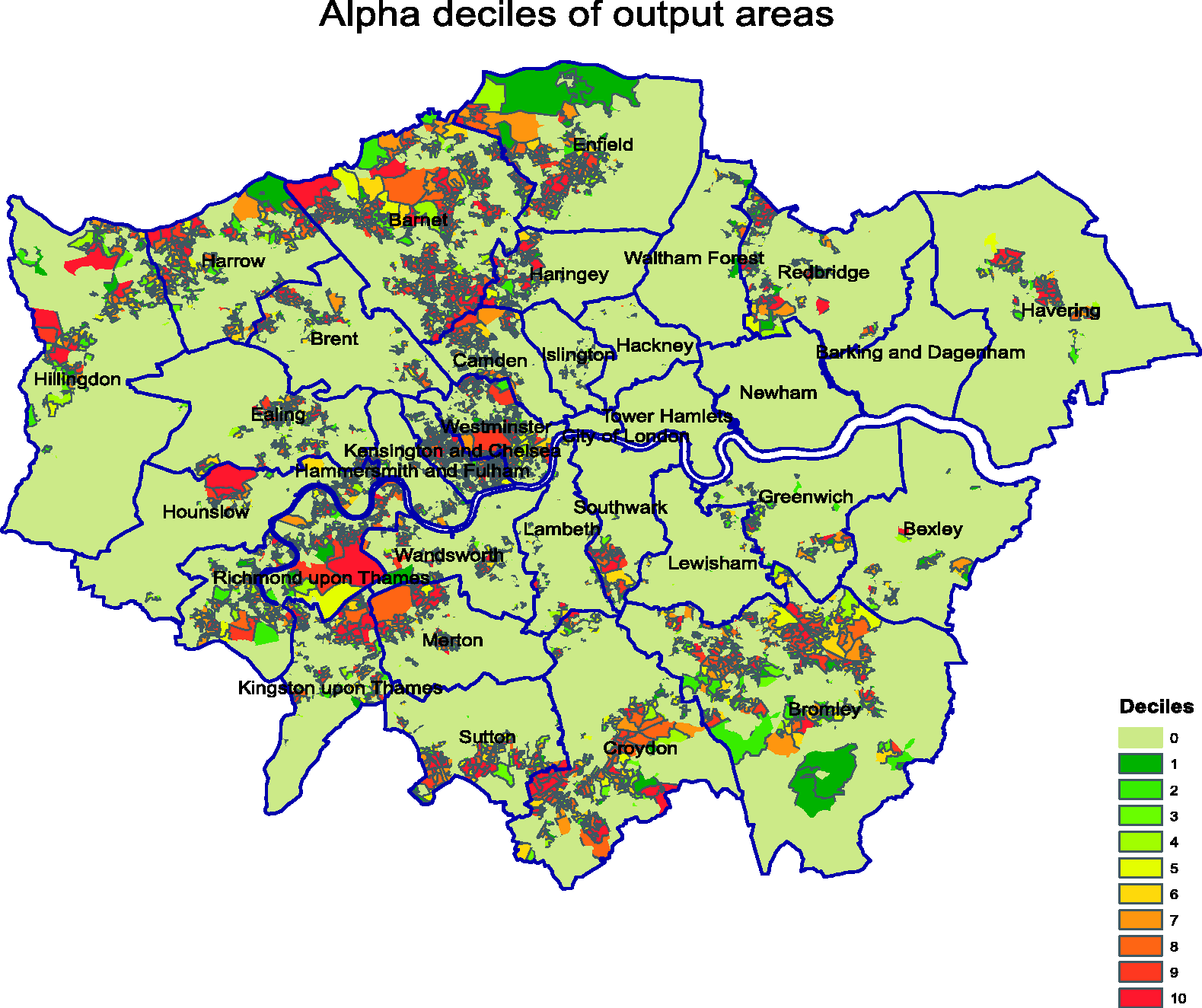
The analytic focus on territories rather than on individuals allows a further examination of many of the issues detailed in the preceding section. These include first the suggestion that we are witnessing an increase in pro-active spatial dis/engagement by the rich (Hay and Muller, 2012); an increasing spatial retreat by the affluent (Atkinson, 2006); emerging forms of self-segregation and social insulation from what are perceived to be ‘risky’ urban environments (Graham and Marvin, 2001; Smithsimon, 2010), as well as increasing levels of physical defensiveness in the homes and neighbourhoods of the very wealthy (Atkinson and Blandy, forthcoming). These ‘spatial retreat’ or partial exit (Andreotti et al., 2014) hypotheses communicate widespread social anxieties focused on the ways the rich may seek-out methods of insulating themselves from the apparent risks or unpleasantness of urban life.
In total, more than 100 interviews and ethnographic, in-depth immersion in the case study areas were conducted, alongside the extraction of a range of geodemographic, financial, socio-tenurial and real estate data profiling these areas. The range of interviews is wide, covering the wealthy and the surrounding cast of actors functioning as various social intermediaries in the enactment of these affluent localities – estate agents; other local residents, local political actors; employment agencies, servants and waiting staff; taxi drivers, nursery staff, teachers, estate managers, carpenters, plumbers, solicitors, pub landlords, cleaners, painters, beauty salon staff, security services and so on. The resulting data and immersion in these neighbourhoods is drawn on here to examine the ways the wealthy describe their engagement with public spaces, networks between them and other crucial spaces; this is further elaborated by the privileged viewpoints of personal staff and key service workers able to comment on how homes, mobilities and spaces are connected for this group. These interviews and observations are structured in such a way as to gather qualitative data on the place-based identities of the resident population, the daily flow of public life (including the social dynamics of semi-public spaces, like hotel lobbies, pubs, restaurants and so on), the role of local service providers in generating the assemblage of network amenities, the social networks and institutional life of the neighbourhood, and a clearer understanding of the relative levels of and rationales for public presence and spatialised withdrawal into these neighbourhoods, gated communities and fortified homes.
Hiding in plain sight
This section profiles the orientations of the very wealthy to public life in the capital.
It highlights dispositions to space and movement in which elements of social defensiveness,
physical distancing and closed circulation were adopted by the wealthy and their
intermediaries. These orientations can be characterised along two key dimensions –
safety/security and engagement/public presence. In terms of the former dimension, it was
clear that in many respects, the very wealthy appear comfortable with operating across
public spaces but are also focused in their circulations upon particular safe zones, despite
valuing an open engagement with the city more broadly. In this mode, spaces and settings are
sought-out to enable conspicuous and more subtle displays of wealth because of the common
positioning of signs of wealth in such spaces or because they occur in private. Second, in
terms of public presence, a complementary circuit of private withdrawal and shielded
mobility appears to run alongside more public engagements with space. In this excerpt, a
wealthy developer relates the kind of safety and mobility issues that he identifies in
moving from home to the wider city: Q. Do you use any particular kinds of security measures? A. Well, we’ve mentioned alarms, panic buttons, and I actually do have a body-guard! I
have! Only when I go to certain areas, and she drives me in the rougher areas. First of
all, I do feel safe as a man. As a woman, I am not sure. My wife goes on the train quite
a lot if she is going into meetings sometimes. She might meet me and I might be in the
city and meet her in the West End…Other areas – I don’t know. It’s like the East End of
London; it has become an affluent part of London now, and so has Harlem. It’s amazing!
It’s just the future of things. I haven’t been to Brixton for many years, and I happen
to go there, and I used to be absolutely petrified – now you go to Brixton, and it has
also now become quite a very nice area Brixton. (Geoff, property
investor)
These identifications appear to offer what writers like Savage et al. (2005) describe as feelings of elective
belonging that are not the public’s impression of a globally free-floating class. In this
sense, it is important to distinguish between the genuinely footloose, private renting,
corporate chieftains and others (the global power brokers of the mosaic socio-demographic
classification) who move between multiple residences and those who have chosen London and
live there more extensively, often with children at expensive and prestigious private
schools. These two broad segments of the very wealthy appear to have somewhat differing
values and orientations to life in the capital. The picture for less mobile and more
grounded wealthy residents in London is one of a desire to engage with the city more
generally, though the extent this is revealed in patterns of local interaction or civic
participation is much less clear. For the very wealthy resident class of
buyers (those buying to live for more substantial periods of the year in London), the needs
of family, safety and cultural infrastructure are frequently identified as unsurprising
priorities. For this group, life in the city is based on a massive support infrastructure of
welcoming spaces, warm smiles, invisible service and all necessary advice and protection
needed from diverse agencies and service providers. Much of this emerging picture relates
strongly to the analysis of dynastic wealth offered by Pincon and Pincon-Charlot: Chic neighbourhoods, luxury stores and luxury hotels offer a life-support system that
does not leave much room for surprises but which allows one, in the same way as the
Clubs in the big cities, to find a shelter from the vicissitudes of ordinary life (1998: 86). Yes, because his office is there and he prefers the lifestyle of Mayfair, and he
prefers the indigenous population of Mayfair to the other potential contending areas. He
walks where he can, I know for sure, because he walks to his office, but this is a chap
who walks around in a white t-shirt, black leather jacket and jeans, and he looks like
he is 14 years old, but he's not, and he doesn't have a driver to my knowledge, he
drives but he has… parking was another requirement for him, so within the Mayfair home
he needed certainly parking facility for three cars – where he could just drive straight
in and the cars would be on various lift hydraulic systems.
(Jeremy) I would say it is very self-contained. People branch out and go to London because some
of the men commute into London, and people go into London to the theatre or for a night
out. People travel a lot on holiday. They will have lots of holidays, and so when they
get back here, your doctors – we've got the doctors literally in this little village,
we've got a few restaurants down there, and then your gym and your golf and tennis and
everything is there at [gated community]. You go five minutes along the XX, there is a
Waitrose there, in a place called XX, which is very nice, so people tend to shop there,
pick up bits down here, and that's about it really. (Beverly, resident suburban gated
community) A. My husband would like to stay in Mayfair but he would also move to Pimlico. D'you
know what's lovely in Mayfair for people like us? It's safe, it's quiet, most of the
streets are policed, and we've got a private security company. We don't pay for it, but
we've got – I don't know who it is at the end of the street – Russian or whatever but –
street if you like. What they don't do is move the people off our doorstep, but there'll
be no trouble. Q. Why do they not … A. Because they're there to look after the building that they're protecting. So when I
went to the police, one of their suggestions was that we pay. One of the suggestions
came up that we employed a private security company. In other words, the police were not
accepting responsibility to keep our streets as we would expect, and I just said no way
I'm not going to employ a private security company. It's a wider problem but the fact is
they're living on our doorstep. Why have they chosen one of the most expensive areas in
the whole of the country to come and plonk themselves – because that's where they beg.
That's where the pickings are best. They beg and they pickpocket and everything just in
that area. (Samantha, clothes designer) A lot of people who are very, very rich don’t want to be seen walking across a pavement
from their car to the front entrance of their house because it is a security risk, so
the ability to be able to drive in in the back of a blacked-out car and get out inside
the car park and jump out and get in the lift to their own apartment and people not
being able to monitor so easily their comings and goings is a very attractive thing
these days. (Martin, Property agent, Chelsea) He had kidnap threats and blackmail threats every week on a regular basis. So in that
family's case yes, they had minders. Yes, they were careful where they went. There are,
if you go on New Bond Street, they have private rooms and they have back entrances where
people can come in and not be seen, or in some cases they will close the shop and you
either come in after hours or something and let them, so they don't have to be bothered.
Again, that's going to be of great interest to someone who has a security issue. It
really boils down to who has a security issue and who doesn't – who they are, what their
nationality is, and what their past experience has been, those three things. I see the
properties all the time, and I see some properties there and newer ones are advertising
underground. You can just drive in and you don't have to be exposed. It's a security
consciousness, whether they have to be or not (Roby, Family Office). The good thing about suburban houses is that they have a wall, a fence and a gate, so
you are protected from the front, whereas obviously most London houses face straight
onto the streets, so if somebody wants that additional buffer of security they will go
out to the suburbs, but also to get a decent sized house in the suburbs is much less
(James, Property buyer, Chelsea).
London as a plutocratic cloud
London has become an intensely cosmopolitan city in recent decades. The reasons for this
growing wealth concentration appear most fundamentally in the city as a site of fiscal and
personal safety for those with significant assets to bank and lifestyles to secure. These
changes in the wealth, social character and inequality of the capital take us to the heart
of engagements with the city as a space of encounter and diversity, as the gap between the
wealthiest and poorest has dramatically increased. The place-based impacts of massive
concentrations of global investments and the residential life of the very wealthy do not
appear to lead to a greater integration of social encounters across such divides, and this
emerges in many of the comments of interviewees: A.…the basic advantage of living in Chelsea, that you can walk everywhere and the
mobility around London is incredible…so Chelsea is you hop on the bus or the taxi or the
tube or whatever. Q. So you use public transport when you were… A. Not really, I don't really use public transport, I drive. I think I drove
everywhere. Or taxis occasionally. I think as you know I said using more tube, but I
think when I lived in Chelsea, I never did. Maybe occasionally, but not very often. But
my husband does it all the time he goes to work on the tube.
(Karl) I think there are inequalities but nowhere near as extreme as in other global cities
I've travelled and visited. I think inequality's just one of the sad facts of the way
the world is. Although London has it, I think there is a good welfare system, a good
support system, and generally, if people are willing to work, there are jobs around.
Right, so it's rare that you really see poverty, people really struggling. (Peter,
Senior investment banker, Highgate)
For the super-rich, the merely extremely wealthy, bankers and other super-affluent sections of the population, London offers a delimited spectrum of social life that appears to be diverse to those experiencing it first-hand. This illusion of difference masks the strong tendencies for members of such residents to select particular pathways and forms of mobility that iron-out the possibility of contact with the fuller range of social diversity in the city. This is certainly understandable, but it also helps us to comprehend the mythology of the city as a space of potentially limitless and open encounters, when in reality, it is far more circumscribed and less cosmopolitan than might at first appear. The cloud spaces of central London offer a partial rendition of the broader city; extensive though it is, it is nevertheless a circumscribed engagement with the diversity of the city. Closed pathways within and between these spaces, the no-go areas at the edge of cognitive maps of the wealthy and connections to other, similarly rarefied spaces and contacts globally create the sense of engaging with diversity, when in reality, this is only part of the story.
Conclusion
This article considers the ways the very wealthy engage with London as a city and its public and private spaces. Responding to the literature on encounter, citizenship and private mobilities, it has examined the ways wealth and the perceived safety of key central districts enable the rich to appear unremarkable and thus concealed by the kind of normality they are able to achieve in these areas. In this article, the super-rich, other residents in the alpha areas and a wide range of intermediaries of the super-rich (real estate agents, property buyers, private service providers, architects, decorators and so on) offer a privileged insight into the needs and desires of the super-rich. They reveal two interwoven tendencies: first, the sense of engagement with an open series of linked public realms that offer relative security, and second, the connection of secure nodal points in this urban system by which shielded mobilities and protective capacities allow seamless movement and the relative hidden presence of the very wealthy. In this context, the idea of a ‘flowing enclave’ remains useful in considering how the very wealthy reside and move through urban space; they need places that allow these twin modes of engagement with urban space as sites of a delimited range of acceptable contact with apparently diverse social groups in a narrow scope of London’s neighbourhoods deemed safe enough to allow street presence and a more entrenched, subtle and seamless structure of mobilities and protected nodes, giving access into sites of anonymity and security.
London is distinctive within a global hierarchy of cities and important locales where wealth is predominantly concentrated. While sharing many features of cities like New York and Hong Kong, its pre-eminent status as a financial service centre and the links of this centre to many offshore tax havens helps to drive residential investment from less secure regions globally. Its social and cultural circuit and ambience are often deemed to be key attractors of the super-rich already here and those from abroad. As previously discussed, there are strong, economically rational arguments for the position of London as a finance hub, the beneficiary of having cheap property relative to other locales and a long-established cultural and sporting calendar. Yet, in addition to London’s strong financial centre and relatively cheap property, there are clearly other powerful social drivers that include the feel of apparent openness and safety as important reasons for residents. The rich love London for its cosmopolitanism, leisure and consumption offerings and sense of relative safety, compared to many of the wealthiest countries of origin. While the stress on London’s infrastructure offers significant costs and problems to many other citizens, private mobility systems and refuge neighbourhoods offer the means for circumventing these problems.
Anderson’s (2011) argument, that in many cities we can identify spaces that offer open, democratic and socially-levelling spaces for encounter, rings true for London. Yet, in a context of relative segregation, inequality and wider processes of social sorting and housing displacement, the feelings of safety and free circulation felt by the rich are illusory simulations of the wider range of experiences of the city today experienced by the rest of the city's population. This suggests that the experience of public spaces and institutions in the city by the very wealthy is largely unperturbed and immune from unsightly deprivation or the increasing anger within the social politics of the city. In this sense, the capacity of the wealthy to engage with the city in relatively hidden ways also hides difference and social distress – their spaces, networks and mobilities see the city performing as a kind of plutocratic cloud that renders wealth opaque and the socially marginal an un-troubling and distant possibility. The cloud generated by these concealed networks of mobility and the ability to feel safe in much of central London may be cast either as the great achievement of the ultimate melting pot for identities and backgrounds or as a kind of null cosmopolitanism that denudes difference and neutralises the possible anxieties of a class that is increasingly critiqued for its excesses amidst an austerity-wracked metropolis.
Footnotes
Declaration of conflicting interest
The author(s) declared no potential conflicts of interest with respect to the research, authorship, and/or publication of this article.
Funding
The author(s) disclosed receipt of the following financial support for the research, authorship, and/or publication of this article: the ESRC for the project A Year in the Life of the Alpha Territory, project number ES/K002503/1.