



Abstract
In Ghana, new oil and gas discoveries at a time of global decarbonization and energy transition have put into question the viability of the country’s hydrocarbon reserves and their promises of prosperity and development. As the country anticipates stranded assets, a discourse of carbon justice has emerged around new oil and gas extraction that emphasizes differentiated responsibilities for carbon emissions and colonial legacies of energy underdevelopment. In this paper, I explore the assemblage of what I call the “moral frontiers” of the energy transition through the case of natural gas expansion. I focus on the Atuabo gas processing plant in Ghana’s Western region, built in 2016 during an acute energy crisis to provide indigenous gas from the oilfields to the grid. Amidst growing opposition to and declining investment in oil, natural gas at Atuabo is presented as a “bridging fuel” that reconciles, physically and ethically, the contradictions of global decarbonization imperatives with local demands for industrialization, energy access, security and sovereignty. Through the materiality of gas infrastructure at Atuabo – including the land acquisition process, the take-or-pay contracts of its IPPs, the operations of the plant and its applications, and the contested environmental impact of the plant – I argue that gas’ liminality as a transition or bridge fuel reshapes the moral and political possibilities of fossil fuels in a global but unequal energy transition.
Keywords
Introduction
In 2010, the first production of oil in Ghana promised to transform the country’s fortunes. New oil and gas discoveries in the mid-2000s positioned the Gulf of Guinea as a strategic oil frontier with immense potential that US policymakers went as far as to call the ‘New Gulf’ (McCaskie, 2008: 315). Amidst political tensions in the Middle East and rising US–China rivalry, African oil and gas gained prime geopolitical significance for Euro-American interests and concerns about energy security (Hicks, 2015). But today, the oil industry in Ghana faces the prospect of an early decline. Despite a proven abundance of oil, several oil companies have left, sold off their assets or paused development on existing discoveries (Patey, 2015). In Takoradi, Ghana’s new oil city and logistical base for the industry’s offshore operations, the pace is slow: many workers have faced redundancy or reduced contract hours, hotels and apartments for oil workers are empty or abandoned, and construction works in anticipation of an oil boom have halted (Issah, 2021).
While there were many reasons for the premature decline of the new oil industry, 1 one argument proved particularly persuasive. In a presentation to Parliament in August 2021, the Energy Minister stated that the global energy transition 2 had become a threat to Ghana’s emerging oil industry. Surveying recent strategy documents from oil majors and financial firms, the minister warned that foreign investment and energy demand were moving away from fossil fuels, leaving behind new producers like Ghana that are in urgent need of oil revenues for development. The solution, he proposed, was to take back control of the nation’s oilfields and boost the national oil company’s capacity, as he requested a $1.5 billion loan to buy back one of Ghana’s own oil blocks from a Norwegian company that had abandoned plans to develop the asset. Situating Ghana on the losing end of a global energy transition, the Energy Minister denounced what he called the ‘hypocrisy of the West’. While ‘advanced countries’ had profited handsomely from oil and gas extraction, they were now seeking to ‘persuade’ emerging oil and gas producers like Ghana to ‘leave their newly found hydrocarbons stranded’. The timing of the energy transition, he pointed out, was surprisingly convenient: ‘having depleted their oil and gas resources’, ‘developed countries’ were now ‘investing in renewables using profits from oil and gas’ and would force countries like Ghana to ‘borrow from them to develop renewable energy’ (GNPC, 2021). Meanwhile, his PowerPoint slide emphasized in bold red font: ‘developing countries contribute only 3% to global carbon emissions’.
The denunciation of the West’s climate hypocrisy and the energy transition as a threat to the nation’s energy sovereignty echoed many of the conversations I have had with energy professionals in Ghana. In these conversations, Ghana is positioned as a country on the margins of the global energy transition that stands to lose from the decline in fossil fuel use as it struggles with unreliable and unaffordable electricity. The oil and gas discoveries in 2007 had promised economic development, but today, the country faces the biggest economic and energy crisis in decades. As a transition away from fossil fuels appears inevitable, energy professionals in Ghana point to the inequities of the global energy transition and its timing.
Oil and gas in a low-carbon country like Ghana raise new questions about carbon justice, extractivism, development and the future of oil in a decarbonizing but unequal world. In this article, I argue that recent oil and gas discoveries on the continent constitute not just a resource frontier – the culmination of geological knowledge and techniques for exploration and drilling in previously inaccessible deepwater reservoirs – but a moral frontier: a contested zone where the political and postcolonial dimensions of energy come to the fore.
The resource frontier has been theorized as a spatial dynamic of expansion and enclosure that appropriates nature as a ‘free gift’ (Rasmussen and Lund, 2018). But as Anna Tsing has argued, frontiers are also ‘imaginative spaces’: they are ‘projects in making geographical and temporal experiences’, shaped by speculation, desires, and particular ways of seeing and valuing nature (Tsing, 2003: 5100). In this article, I conceive of the frontier in this dual sense, as a process of appropriating land and expanding (carbon) capital (de Jong et al., 2017) through a moral imaginary of energy that transforms ‘natural resources’ like oil and gas into morally viable sources of revenue and future-making (Ferry and Limbert, 2008).
All frontiers are in some sense moral in that they imply values and beliefs about resources, progress and change. But in contrast to other resources, oil and gas – in the form of carbon emissions – have given us a common currency to articulate and address global inequalities. This makes oil not just a valuable resource to extract, but also a global moral scale to assess and compare energy behaviours and responsibility. Concepts such as ‘energy justice’, ‘climate justice’ and ‘carbon justice’ all seek to make sense of this moral scale as they emphasize issues of equity and fairness in energy policy (Jenkins et al., 2016).
The concept of the moral frontier I employ contributes to the literature on energy justice, but it differs from it in several respects. In contrast to justice, which implies a normative end-point (Smith and High, 2017: 1–2), the notion of frontier conveys that those moral uses and ideas about oil are new, contested and still emerging – what Tsing calls ‘a zone of not-yet’ (2003: 5100). Frontiers are sites of competition, appropriation and contestation, over what counts and who makes the future. Rather than taking ‘justice’ as a given or an end goal, I take it as an ethnographic object and situate it in a wider moral imaginary of energy, resources and geopolitics.
Crucially, I use the concept of the frontier to explore how these moral arguments about inequality and justice come to expand and justify fossil fuel extraction. I draw attention to the rather immoral ways that questions of justice, energy poverty and security are raised to advance fossil fuel projects that benefit the few. This is what I mean by the moral frontier of new oil: a political project that seeks the expansion or retreat of petro-capital on moral grounds, rather than on purely technical, legal or economic bases.
I trace the assemblage of this moral frontier in Ghana through the case study of a gas processing plant in the Western Region. The Atuabo gas plant was built to deliver gas from the oilfields to the national grid to remediate power outages and an unreliable energy supply. On this moral frontier, I argue, natural gas is presented as a bridging fuel that reconciles, physically and ethically, the contradictions of global decarbonization imperatives with local demands for industrialization, energy access, security and sovereignty.
This article is based on fieldwork conducted since 2016 on the energy sector in Accra and more recently (2019–20, 2021, 2023) on the oil industry in Takoradi, Ghana’s new oil city in the Western Region. I draw on interviews and interactions with energy professionals at industry conferences and on ethnographic material on the logistics of oil extraction in Takoradi and the Western Region. The article begins in the conference halls of industry discussions about the uncertainty of Ghanaian oil and gas at a time of energy transition. It then moves to Atuabo, a small coastal village in Ghana’s Western Region, to explore how natural gas is presented as the ‘fuel of the future’ and a moral fix to the dilemma of industrialization and decarbonization.
Moral frontiers of the energy transition
New oil on the continent encapsulates the contradictions and tensions of the global energy transition. Amidst national pledges to net zero and a growing consensus on the need to move past fossil fuels, new oil in the Gulf of Guinea presents not only an environmental but also a moral dilemma (Pilling, 2022b). The IEA (International Energy Agency) has declared the ‘beginning of the end of the fossil fuel era’ (Sheppard, 2023) as it projects a permanent decline in fossil fuel demand after 2030 and stipulates ‘no investment in new fossil fuel supply projects’ in its roadmap to net zero (IEA, 2021). A recent study (Welsby et al., 2021) estimates that 60% of oil and gas and 90% of coal reserves are ‘unextractable’ under a 50% probability of limiting global warming to 1.5°C by 2050, making a high proportion of planned oil and gas projects – such as those for oil and gas expansion in Ghana – unviable. This is a remarkable development that should make us pause: for the first time, we have a recognition that what makes oil extractable is no longer its presence or quantity, nor the techniques and technologies required for its extraction, nor even the necessary financing or expertise, but the planetary capacity to support its combustion. In other words, oil extraction has become an existential and ethical question. Yet this turn to the moral matter of oil has gone rather unscrutinized in the field of energy studies.
In his book on the oil industry in Trinidad, David Hughes (2017) identified the absence of a moral discourse around oil and climate change. Oil is most violent, he argued, in its ‘banality’: when it is treated as ordinary, as neither moral nor immoral, but amoral (Hughes, 2017: 2). But today, this amorality no longer seems accurate: oil – its production, consumption and phase-out – has become one of the most important ethical dilemmas of our time. Oil may be unextractable under a ‘safe operating space for humanity’ (Rockström et al., 2009), but the (in)actions needed to leave it in the ground are ultimately moral and political. They demand an ethnographic attention to people’s moral compass and practices that go beyond normative and universal ideas of justice (High and Smith, 2019). This focus on morality and energy is not meant to divert from questions of political power. On the contrary, I argue that the moral value attached to oil in Ghana – and other low-carbon nations – marks an important turn in energy geopolitics that insists on the recalibration of North–South indebtedness and dependence.
What does this new moral compass look like? In Ghana and other countries new to oil and gas on the continent, the energy transition prompts fears that the oil rush may be over before it has even started: a moral resource curse of sorts. From Senegal to Uganda, new African oil and gas producers have denounced the hypocrisy of the West and its virtual moratoria on new oil and gas projects in countries that struggle with energy underdevelopment. New oil and gas discoveries, they argue, will provide much-needed revenues for industrialization, economic growth and rising energy demand (Pilling, 2022b). In contrast to earlier producers like Angola or Nigeria, newcomers to oil and gas like Ghana position new oil within an explicitly moral register that appeals to questions of responsibility, debt, underdevelopment and colonial histories, demanding a redistribution of ecological and carbon space (Newell, 2021: 6).
This was a key subject of controversy at COP27 in Egypt – dubbed the ‘African COP’ – as African leaders emphasized the continent’s priority in eradicating energy poverty and asked for greater action on the pledged $100 billion a year in climate finance that is yet to be delivered by developed nations.
Macky Sall, then-president of Senegal and the African Union, put it in those terms: Africa must be able to exploit its large gas reserves for another 20 or 30 years to further its development and provide access to electricity to the 600 million people who are still deprived. It would be unfair to stop us. (Caramel, 2022)
‘Africa can’t sacrifice its future prosperity for Western climate goals’, declared President of Uganda Yoweri Museveni (Museveni, 2021). Malawi’s president, Lazarus Chakwera, asked: ‘when will rich countries take responsibility?’ as he denounced the failure of developed countries to deliver on climate finance – a fund that is ‘not charity but a cleaning fee that must be paid’ (Chakwera, 2021).
Environmental activists and academics on the continent have denounced these justifications for new oil and gas by a small political elite as weaponizing carbon justice for personal gain (Carbon Action Tracker, 2022; Harvey and Taylor, 2022; Okereke and Sokona, 2022) and perpetuating a carbon lock-in (Unruh, 2000). Fossil fuels represent massive vested interests whose sheer profits undermine the scale-up of renewables (Christophers, 2022; Sayne, 2020).
As I explore later, claims that fossil fuels are ‘indispensable’ for development are not borne out in people’s lived experiences of energy access. Nevertheless, this moral logic appeals to principles of energy autonomy and sovereignty that find widespread resonance in a context of chronic energy crisis and long-standing carbon inequality. In a postcolonial context, where the economy has long been dominated by exports and natural resource extraction, energy transitions smack of what Jamie Cross (2021) has called ‘solar humanitarianism’ that reproduces relations of dependence and indebtedness and prolongs a ‘long history of global interventions based on unquestioned good’ (Appel, 2019: 182). This is not to say, of course, that alternative forms of energy justice for oil producers in the global South aren’t possible. In 2021, for example, the DRC (Democratic Republic of Congo) tried to balance environmental protection with resource wealth by auctioning off oil exploration blocks for conservation and carbon and biodiversity credits, following the (failed) example set by Ecuador in 2007 to seek compensation for untapped oil. In both cases, the absence of investment and funds from the international community only served to demonstrate the ‘hypocrisy of the West’ when it comes to reparative justice.
Ghana’s energy transition: Time as justice
For my interlocutors, the energy transition isn’t just a shift to renewable energy but a new process of making frontiers that, as anthropologists have shown (Fairhead et al., 2012; Franquesa, 2018), bears many hallmarks of petro-capitalist expansion: appropriating land, intensifying mining, and privatizing common resources like wind and sunlight. The energy transition also sought to preserve the geopolitical status quo by preventing capital from landing in places like Ghana, resulting in idle oilfields and the loss of potential oil revenues. Kodjo, a civil servant in charge of communication at a national industry body, shared with me several news articles he had written on the topic. In one of these articles, he explored the ‘conspiracy theories’ around energy transitions that he believed had become popular in Ghana. It was well known, he said, that Europe’s oil fields were in decline and only held about 1% of global oil reserves. Conspiracy theories, he said, started to question whether: we are really moving towards renewable energy because it is good for the planet, or because the reserves in Europe are going down; some people believe that a new industry – the green industry – is being created for Europe to still dominate.
His thoughts echoed those of other interlocutors who described climate change rhetoric as a ‘hoax’ or a ‘scam’ pushed by Western or Chinese powers.
To be clear, none of my interlocutors questioned the reality of climate change – and indeed many commented on the rising heat, droughts and floods that have affected the region in recent years. Rather, they questioned the political agenda of climate change that they believed disguised questions of energy security, power and competition. This was precisely the argument put forward by GNPC when they sought to buy back Ghana’s oilfields.
The key to a just transition, my interlocutors argued, is in its pace. The transition in Ghana would take longer than elsewhere to enable time for the economy to ‘catch up’ with living standards in the West. Some of them questioned the usefulness of the word ‘transition’, when Ghana was still on a trajectory of growth and industrialization. Time as a form of justice is a central tenet of Ghana’s energy transition policy. In 2022, the country published its National Energy Transition (NET) Framework, which includes a longer timeline to 2070 and a revision of its 10% renewable electricity target from 2020 to 2030. It is important to note that Ghana was one of the first countries in West Africa to set renewable energy targets, pass legislation (such as the Renewable Energy Act [2011] [Act 832]) and endorse the NDCs (nationally determined contributions) of the Paris Agreement. Yet, in recent years, goodwill has soured and renewable energy targets have been delayed in the absence of contributions from the Loss and Damage Funds. In its revised timeline for a paced transition, the NET Framework is ‘a microcosm of the wider tensions about energy justice and equity between the global north and south’ (Sefa-Nyarko, 2024: 1). The framework sets out to decarbonize the energy sector and reach net zero emissions by 2070, while ‘ensuring socio-economic growth and using Ghana’s natural resources’ (Ministry of Energy, 2022). Specifically, 2070 will enable the country to capitalize on its large oil and gas resources while adhering to a global roadmap for decarbonization. In the dual mission to decarbonize and industrialize, gas is given a key role as a ‘bridge fuel’ – and, I argue, as a moral fix – that reconciles contradictory environmental and economic pursuits.
Gas as a moral fix
While investment in oil is dwindling, the African continent is experiencing a ‘seismic shift’ (Juta, 2022) in gas extraction, with a $245 billion planned expansion of gas infrastructure under way following large-scale discoveries in countries that are new to hydrocarbon extraction, such as Mozambique, Mauritania and Senegal (GEM, 2022; Juta and Zimmerman, 2023). Natural gas has become key to many African countries’ visions of energy security and development, promoted in gas-to-power projects for electrification (Juta and Zimmerman, 2023). At a 2019 industry forum on gas in Accra, the chair noted that the continent now held ‘the largest gas reserves in the world’, home to 10% of the global estimated reserves, with more discoveries expected in the coming years. ‘This is the age of the gas solution’, he declared, and ‘Ghana has truly entered the gas age’. Ghana stood at the centre of this new gas revolution, he argued, as it was ideally situated as the mid-point between the gas reserves in the Gulf of Guinea to the east, and newly found gas reserves in Mauritania and Senegal to the west.
The ‘gas age’ is often conceptualized as a period in-between, a moment of transition from fossil fuels to renewables, captured in the metaphor of the ‘bridge fuel’ or ‘transition fuel’. Emily Grubert and Sara Hastings-Simon (2022: 2) call this ‘the mid-transition’: a ‘transition period where zero-carbon and emitting fossil fuel systems co-exist at scales where each imposes operationally relevant constraints on the other’. This moment ‘in-between’, I would argue, also reveals the unevenness of the global energy transition. As my interlocutors joke that the transition to renewables has been under way in Europe ‘for almost a century now’, they claim a time of ‘in-between’, when multiple energy promises can be realized – full electrification, affordable and reliable electricity supply, and enough revenues from oil to ensure the country’s long-term prosperity.
For energy executives and officials, gas embodied this ‘in-between’: as a domestic, cheaper and cleaner source of fuel, gas constituted what the chair referred to earlier called ‘a powerful weapon in the fight against economic inequalities in Africa’, that would open a new era of energy sovereignty in the country while ‘protecting the environment’ with lower carbon emissions. 3 Gas offered a compromise between national dreams of development, industrialization and electrification, and commitments to decarbonization.
The metaphor of the bridge is not innocent: when applied to energy transitions, it acts as a ‘boundary object’ that facilitates both consensus-building and contestation, and lends itself to a range of interpretations and visions (Delborne et al., 2020): a transition to renewables, a delaying mechanism, an extension of the fossil fuel era, a greener compromise compared to coal or oil, or all of these things at once. These shifting and contradictory meanings of gas have turned it into a contested aspect of energy transitions in Africa. COP26 in Glasgow adopted a resolution to exclude investments in oil and gas (including in developing nations), but in 2022, the European Union (EU) Parliament designated gas as ‘green’, and as a ‘bridge technology’, in its guidebook for green investments, following concerns about energy security after the Russian invasion of Ukraine and signalling a sudden return of European interest in African gas. Mo Ibrahim – the founder of the eponymous governance institute – denounced the double standard of gas use in Europe (Moore and Moss, 2024): While gas is approved by the EU, coal is enjoying a revival in the US, China and some European countries. But if Africans say ‘Please we need a little gas, not to heat our swimming pools or to run our air-conditioning, but to have light,’ they are told ‘Please don’t pollute.’ But it is our turn to develop and end poverty. (Ibrahim, in Pilling, 2022b)
Ugandan environmental activist Vanessa Nakate (2022) warned that natural gas was a ‘dangerous distraction for Africa’, ‘robbing us of vital time to switch to clean energy’. Scientists and analysts argued that Africa didn’t need to transition to gas for energy access if it was given adequate resources to fully scale up renewable energy technologies (Harvey and Taylor, 2022; Okereke and Sokona, 2022). Others (GEM, 2022) warned that investments in African gas were dominated by LNG (liquefied natural gas) export terminals geared to foreign markets, partly driven by the war on Ukraine and Europe’s energy security concerns, and would pose a real risk of stranded assets in the long term.
The political power of gas lies in its liminality: its material composition, environmental credentials and classificatory ambiguity make it the ideal ‘moral fix’ to the dilemma of industrializing while decarbonizing. In what follows, I describe how the liminality of gas shapes its moral and political possibilities through the case study of a gas processing plant in Ghana’s Western Region that has been presented as the key to solving the country’s power crisis. I focus on three aspects of the plant’s moral and energopolitical attributes: autonomy, industrialization and indigeneity.
Ghana in the gas age
Enter the ‘gas age’: an hour’s drive west from Takoradi, Ghana’s new oil city, in the Ellembelle district of the Western Region, fishing and farming coastal villages have been transformed into Ghana’s new oil and gas hub. Just behind the beach, along a newly tarred road, the Atuabo gas processing plant (operated by the national company, Ghana Gas) receives gas from the oilfields and feeds it to the national grid. At the commissioning ceremony for the Atuabo gas complex, one of the board members of Ghana Gas showed me pictures on his phone of pipelines in various stages of construction: huge cylinders surging from the sea, workers knee-deep in the mud, assembling pieces of steel. The pipelines, he explained, will cut across land and sea to connect the oil and gas fields offshore to the new gas processing facility onshore, and supply gas to the thermal power plants in the Aboadze enclave near Takoradi.
At the commissioning ceremony, attended by chiefs from across the Western Region, district officials, and residents, the President himself introduced the project as a ‘gamechanger’ for Ghana’s ‘industrializing economy’, providing gas for industry and the independent power plants that have in recent years provided emergency power to Ghana’s ailing grid. For the first time ever, the President insisted, ‘indigenous natural gas from the country’s oilfields has been used as fuel’. ‘So much of the hopes of our country are bound up with what’s taking place here’, he said. In particular, the Atuabo gas processing plant promised to deliver on three pillars of Ghana’s energy vision: autonomy, industrialization and indigeneity. I explore each of these in turn.
Autonomy: Gas as the new hydro
Since 2008, a time that ironically coincides with the oil and gas discoveries, the country has been struggling with frequent load shedding, locally known as Dumsor (Twi for off/on). Dumsor has profoundly impacted the economy and is estimated to have cost 2% of GDP in 2014 alone (Eshun and Amoako-Tuffour, 2016). The power outages were caused by multiple factors: environmental, geopolitical and operational.
Reduced rainfall, rising temperatures and droughts due to climate change routinely impact water levels at the Akosombo dam, which until recently provided nearly half of Ghana’s power generation capacity. Before Atuabo, thermal power plants – which make up roughly the other half of Ghana’s power generation mix – relied on imported gas from Nigerian oil fields through the West Africa Gas Pipeline company operated by Chevron. Since its inception, the pipeline has been subject to vandalism by Nigerian insurgency groups that have long contested the presence of Big Oil in the Niger Delta (Watts, 2008), forcing the pipeline to routinely shut down. Finally, a gridlock of debts between the utilities, mostly attributed to government non-payment of bills, has brought the energy system to a crisis point and precipitated a series of energy reforms that mandate private sector participation in energy generation and the privatization of the national electricity distribution company (Destrée, 2022).
During the energy crisis in 2014–16, the government turned to emergency power solutions by contracting independent power producers (IPPs) – large-scale private electricity generators that plug grid-based shortages by generating and selling electricity to utilities. The Karpower ship (Figure 1) currently stationed in Takoradi is one of these: a massive generator ship that sailed from Turkey to Ghana, initially docked in Tema, and was then transported to Takoradi to receive natural gas from Atuabo and provide electricity to the Western Region. During Dumsor, IPPs were contracted and built like ‘flat-packed IKEA furniture’, as a policy adviser put it to me. These emergency contracts have been much criticized by civil society and energy think tanks. Although IPPs are presented as ‘emergency solutions’, they often entail a 25-year lease and disadvantageous take-or-pay contracts that lock countries into debt for power they may not need or use (Eberhard et al., 2016). The addition of a dozen new IPPs in a short timespan quickly led to overcapacity, and their take-or-pay agreements (hastily negotiated without scrutiny under an energy emergency) have resulted in massive losses, estimated at $500 million a year for energy that is no longer needed. Ghana now has a generation overcapacity that is almost twice that of its peak demand (5300 MW installed capacity for an estimated 3300 MW peak demand). For domestic consumers, this led to a 60% increase in electricity tariffs, making electricity not only unreliable but unaffordable to many. To mitigate overcapacity, the government attempted to export the excess power to neighbouring countries, but the total electricity demand from Togo, Ivory Coast and Burkina Faso combined did not even amount to half of Ghana’s excess capacity. The Karpowership in Sekondi’s naval base. Source: Photo by the author.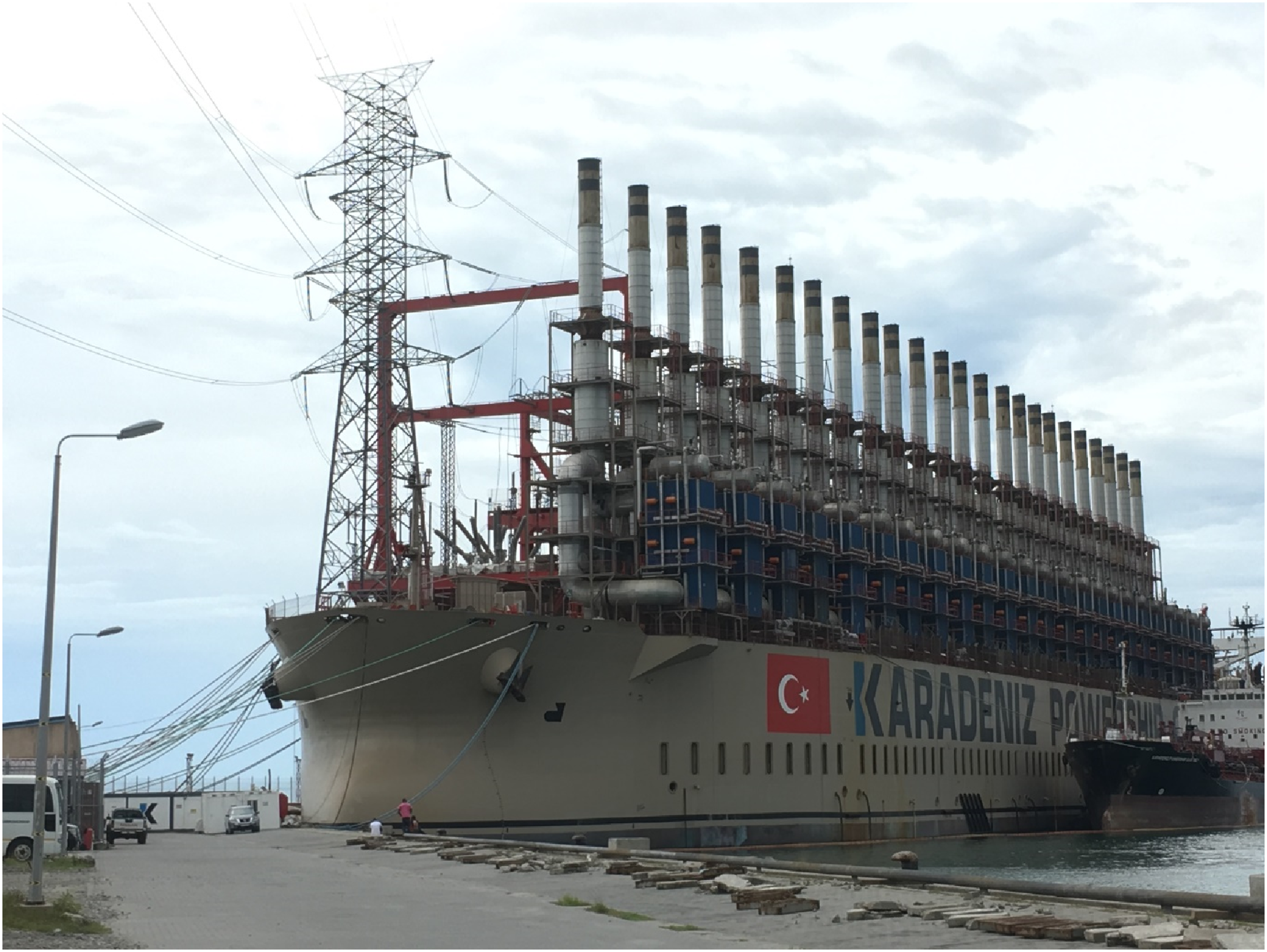
Amidst these challenges, the Atuabo gas plant was envisioned to play an important role in Ghana’s energy sector by providing indigenous gas to fuel the country’s IPPs – such as the Karpower ship – that run on imported heavy fuel oil, saving the country $300 million a year in fuel costs and reducing reliance on gas supply from Nigeria. In the context of unreliable electricity and unpredictable weather patterns, the Atuabo gas processing plant thus promised an era of energy stability and sufficiency that also made economic and environmental sense.
But replacing imported oil with indigenous gas didn’t solve a key issue – overcapacity. Ghana now has too much gas for what it can offtake, and routinely flares gas on its Jubilee field. But overcapacity also had an important impact on the future of renewable energy. In 2019, the government issued a moratorium on PPAs (power purchase agreements), banning any addition to its grid until 2027 (though this was lifted in April 2023). As a result, renewable energy projects that were in the process of coming on-grid have come to a halt and become another kind of stranded asset (Destrée, 2021). Back in 2011 – when Ghana had just started oil production – the government had embarked on an ambitious renewable energy path by passing the Renewable Energy Act (2011) (Act 832). But during Dumsor, some of these commitments were revised. At a 2019 stakeholder event on renewable energy, the director of renewable and alternative energy at the Ministry of Energy announced, to an outraged audience, that the plan’s targets for a 10% composite of the energy mix from renewable sources planned by 2020 had in fact been met long ago, since the Akosombo dam accounted for 40% of Ghana’s total capacity. Why were net zero targets not accounting for the past use of renewables and avoided carbon emissions, he asked? Was hydropower not a source of renewable energy? He pointed to the combined carbon emissions of sub-Saharan African countries: less than 4% of the total global. Why, he asked, should they be responsible for decarbonization when they had abundant oil and gas resources?
The director continued: they had exhausted their potential for hydropower, and the solution now lay with gas to keep their lights on and industries going. Gas, I heard several times, could be the ‘new hydro’, propelling the country into an industrial revolution. At the time of independence in 1957, the Akosombo dam was built by Ghana’s first prime minister, Kwame Nkrumah, to fulfil a similar purpose: leading the country to economic independence through mass electrification (Miescher, 2014). Electricity during colonial times had been selectively deployed to power the mines, the colonial administration and housing. The dam was the keystone project of independence, promising a new kind of citizenship through energy access.
Gas today makes similar promises for energy independence and abundance that could be harnessed to grow the country’s energy demand. Yet, just like the Akosombo dam sixty years ago, the construction of the Atuabo plant depended on the involvement of foreign partners and industries. Atuabo was financed by a $3 billion resource-backed loan from the China Development Bank and built by a subsidiary of Sinopec, China’s national petroleum company. The project exemplifies the rise of China’s geopolitical power in the country via ‘oil-for-infrastructure’ projects and South–South partnerships (Mohan and Tan-Mullins, 2019) (Figure 2). The plant’s largest off-takers are two Chinese-owned ceramics factories in the free-zone enclave in Sekondi, where they have their own thermal power plant. The New Gas Complex documentary shown at the commissioning ceremony. Here, a computer-generated image of the new complex bears the dual flags of Ghana and the Republic of China. Source: Photo by the author.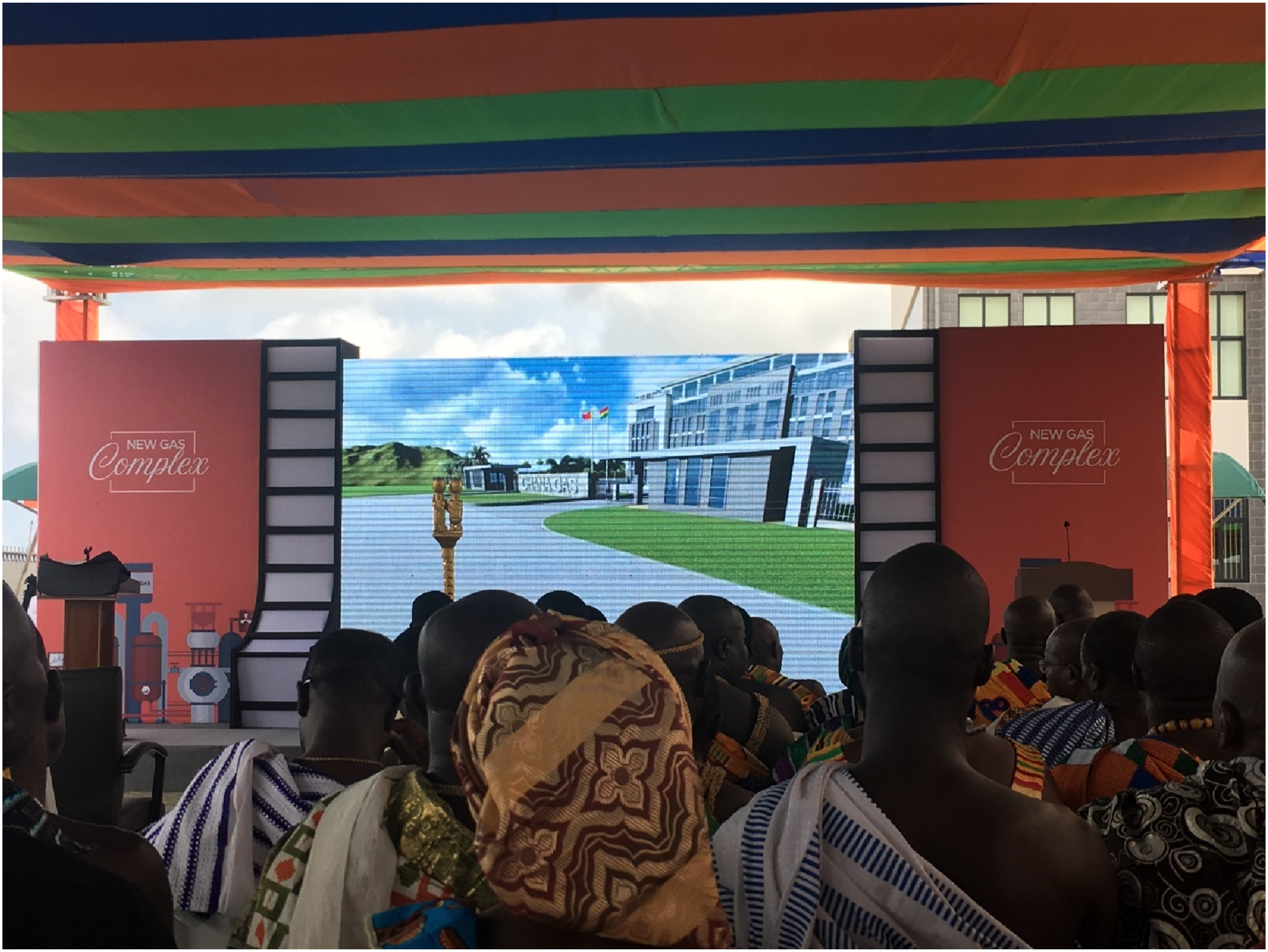
While Atuabo promised to provide much-needed electricity for the region, its future hinged on an expansion of the pipelines to industrial and resource enclaves that would offtake the gas with preferential terms: the pipelines are being extended further inland to the gold mines in Prestea and Tarkwa, the bauxite mines near Kumasi, and to a petroleum hub planned for construction next to Atuabo. The promise of gas for industrialization was thus predicated on a narrow conception of industry that mostly entailed free-zone exports and the extraction of natural resources. Yet this power of gas to industrialize remained a potent political justification for its expansion.
Industrialization: Gas as the new palm oil
At the commissioning ceremony of the Atuabo plant, the CEO of Ghana Gas introduced gas as the ‘fuel of the future’: It is impossible, impossible! – to industrialize without sustainable, reliable and affordable energy supply. Gas is becoming the fossil fuel of choice for the future compared to its hydrocarbon siblings.
Gas was the fuel of the future because, in contrast to its ‘hydrocarbon siblings’, gas offered high energy density for a third of the environmental cost: Yes, gas has got siblings, hydrocarbon siblings: it has a dense brother we call coal and a slimy sister we call oil. Coal is fast becoming extinct because of environmental reasons. Oil as well, for both environmental and cost reasons, is being replaced by gas and by renewable energy, which are fast becoming the energies of the future.
Addressing the President, he said: ‘Mr President, when you come to deliver the State of the Nation address, and you come to the energy part, I hope that you will no longer be saying “oil and gas”, you will be saying “gas and oil!”’
Gas would take precedence over oil because, he explained to the crowd, in contrast to oil, which was mostly exported, gas was a ‘catalyser’: gas would propel industrialization through indigenous (rather than imported) energy, as he listed all the applications for which gas could be put to use: heating and cooking, electricity, transport, mineral processing, ceramics, glass, paper, cement, petrochemicals, and agrochemicals. At an industry summit, the representative of a petrochemical company that hoped to open refineries and petrochemical plants near Atuabo described gas as the new ‘palm oil’ for West Africa. Like palm oil, which is found in ‘everything from instant noodles to hair creams’, he explained, gas is ‘more than what flows into pipelines’. The future, he enthused, ‘could be built entirely out of gas!’ And this time, he warned, Africa should make sure it doesn’t ‘miss out’ as it once did with palm oil. 4
The plant would ensure prosperity through industrialization by ‘adding value’ to primary products and helping to move from an export-oriented extractive economy to an industrialized economy powered by abundant domestic energy production and use. ‘Raw material-producing economies do not create prosperity for the masses’, the President himself stated in his commissioning speech. The Atuabo gas plant, he promised, would boost local industry.
The claim that some kind of fossil fuel is essential for industrialization – framed as a solution to energy poverty – is often made in discourses about developing economies and energy transitions. And, while the recent literature on degrowth makes clear that different metrics of prosperity and wellbeing must replace GDP and other economic indicators premised on economic growth (Kallis et al., 2020), the movement is still divided on what kind of growth is needed to raise living standards in the global South (Chiengkul, 2018).
This ‘myth of inevitability’ (Hughes, 2017; Nader, 2004) of the continuing use of fossil fuels tends to conflate development and industrialization with energy access. Yet energy access is context-specific and influenced by a range of factors (Brew-Hammond, 2010; Sokona et al., 2012). In Ghana, for instance, it isn’t primarily a challenge with capacity, electrification or supply, but a question of affordability and distribution – which, as shown earlier, has been undermined by a political preference for short-term fossil fuel fixes over long-term renewable solutions.
The focus on energy access also tends to be unidimensional: a mostly top-down process of connecting people to power. But, as the host communities often make clear, energy projects entail different kinds of access, not just the delivery of power. At the commissioning ceremony, the traditional leaders of Ellembelle politely thanked the President, but pointed out that what mattered most to their communities was neither oil nor gas but roads: roads that the government had long promised to build and that were still in a partial state of construction or disrepair, impairing the community’s need for greater mobility. They also argued that having given Ghana Gas access to their land and, by extension, their oilfields, should entitle them to free gas. My guide to the site pointed to the LPG (liquefied petroleum gas) bottles used for cooking and expressed his outrage that people still had to buy gas when it was being processed next to their homes. There were so many ways that a company could show goodwill and fairness: they could give free gas once in a while, make it available for free, or even subsidize it, he suggested. What was the point of exploiting ‘indigenous gas’ if it wasn’t going to the people?
Indigeneity: Gas as the new beer
The ‘indigenous’ quality of the gas at Atuabo was something that the politicians and experts involved in the project kept emphasizing. By indigenous, they referred to three things: the provenance of the gas from Ghana’s oilfields, the domestic use of gas for power generation, and the indigenization of the workforce at Ghana Gas. Importantly, they didn’t include the host communities in Atuabo as beneficiaries of the gas – though they were categorized as beneficiaries of the company’s corporate social responsibility (CSR) projects.
Gas was presented as an ‘indigenous fuel’ that challenged the extractive dynamics of oil by privileging regional and local integration. In contrast to oil and other commodities like cocoa, gold and diamonds, gas was ‘a local economy issue’: it had to be used locally (or flared) as it couldn’t so easily be shipped off. The chair of the Gas Consortium, an industry body set up to promote gas extraction in Ghana, explained to me what he saw as key differences in the political potential of gas and oil. Oil could ‘be aloof about the local economy’, because it didn’t contribute to it: it operates offshore, far removed from view and concerns of ‘most Ghanaians’. These ‘distancing’ mechanisms and the ‘enclaved’ character of the oil industry, so well described by Hannah Appel (2012) and James Ferguson (2005) – and somewhat uncannily acknowledged here by a former executive of Ghana’s main oilfield operator – had the effect of depoliticizing oil: oil was not something people could touch and feel. Gas, in contrast, constituted what he called a ‘political currency’: people cooked with it, it powered their lights, it was power at its most visible and ordinary. In that way, gas worked a lot like ‘beer’, ‘beans’ or ‘bread’: as a staple commodity that could create ‘pinch points’ and targets for political contestation. In this illuminating if reductive vision of politics, gas would have ‘a greater voice in the local economy’. Yet in Atuabo, it wasn’t quite clear what power could be exerted by the people who had been displaced by the plant and affected by its operations.
The appeal of ‘indigenous gas’ to the development of the nation through domestic power generation was key in the acquisition of the land for the project. The site in Atuabo was secured by the government under Article 20(1) of Ghana’s Constitution, which allows for the compulsory acquisition of land ‘in the interest of defence, public safety, public order, public morality, public health, town and country planning’ and for projects that aim to ‘promote the public benefit’ (Larbi et al., 2004). But the Constitution also states that fair compensation must be paid to those affected, and they should be resettled (Larbi et al., 2004). Today, many farmers who lost their land to the Atuabo project are still awaiting compensation, and those who did receive it feel that they were not appropriately compensated for the loss of something that gave them not just their livelihood but also their sense of identity (Ablo and Asamoah, 2018: 195).
When I visited the site again in 2023, seven years after it first started operating, it stood out from its lush surroundings: the coconut trees that once flourished around the site had been reduced to barren poles (Figure 3). Coconut is the main cash crop in these coastal areas, and the three districts where the gas infrastructure is situated – Ellembelle, Jomoro and Nzema – together account for 80% of all coconut production in Ghana. Farmers have complained that they weren’t adequately compensated for the lifespan yield of their trees, which provide an important source of income and inheritance. Over the years, farmers also started noticing decreasing coconut yields and attributed this to the installation of Ghana Gas. Residents complained that ‘nothing grows anymore’ and that rivers and water bodies have been polluted by the operations of the plant. They also complained of negative health effects from the smoke and chemicals of the plant. ‘Telephone pole’ coconut trees, attributed to the environmental impact of Ghana Gas’ operations. Source: Photo by the author.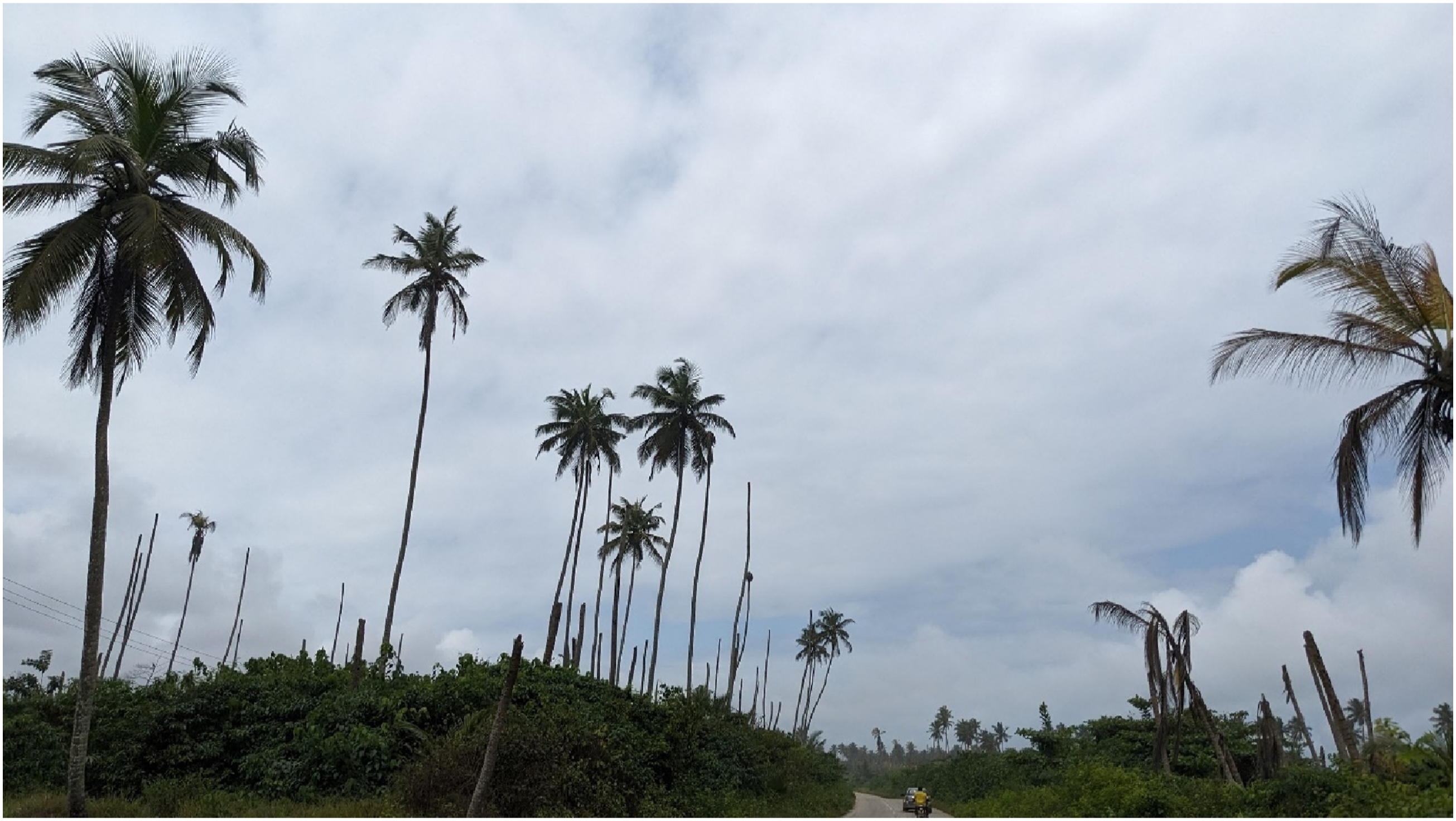
Host communities had hoped to benefit from the project’s job opportunities. Despite claims to create thousands of jobs, few Ghanaians had been employed in the construction of the plant, with 60% of inputs sourced from China – contravening Ghana’s Local Content laws (Ablo and Asamoah, 2018). Ghana Gas claims to have fully indigenized its operations, saving the company $3 million monthly. Yet there was a general perception that the plant only rewarded political partisans, did not reflect promises for local employment, and did not pay its workers adequately. A health and safety officer who had worked on the construction of the plant had hoped to work for Ghana Gas after it was built, but when he applied for the position he was told to find a ‘person of influence’ in the political party in power at the time. He gave up on the job when he realized that the oil and gas industry had ‘become very political’, the government ‘taking all the money and giving it to people who aren’t qualified’. These experiences had not only been personally costly: they were a warning for what might happen to the future of oil and gas in the country. Disillusionment with the ‘indigenization’ of the industry was leading to growing resentment, he warned, and ‘when there’s resentment, you know … we all know what has happened in the Niger Delta’. The Niger Delta often came up as a reference point for imagining Ghana’s possible oil and gas futures. The Atuabo gas plant was built in part to circumvent conflict in the Niger Delta, as the pipeline that brings gas from Nigeria is routinely subject to shutdown from sabotage and insurgency against oil companies. A Chevron representative at an oil and gas conference recounted proudly to me how the company was remediating this by using the domestic leverage of gas to quell dissent. Rather than resorting to force, he said, ‘they link [communities] directly to the gas: linking their power source directly to the pipeline. It prevents them from sabotaging and attacking the pipeline, because that’s their power source!’ Here, the domestic siting of the gas presents a powerful technology of rule, creating dependence on oil companies’ infrastructures that pacifies communities and prevents friction. Far from simply benefiting local communities, the indigeneity of gas is here coopted as a tool of corporate power – or, as the speaker mentioned above put it, as gas’s own ‘political currency’.
Conclusion
At a time of global energy transition, Africa is torn between ‘resurgent’ forms of extractivism – such as calls for oil and gas expansion – and a push for renewables to ‘leapfrog’ the continent into alternative energy futures (Degani et al., 2020). In Ghana, these tensions are most evident in the energy sector’s turn to natural gas as the ‘fuel of the future’ in a dual bid to decarbonize its energy system and capitalize on its hydrocarbon reserves. As the country’s new oil industry faces an early decline amidst dwindling investment and divestment away from fossil fuels, energy experts and professionals frame the future of oil and gas as a matter of energy justice. This moral framing of African oil and gas places carbon justice at the heart of the global energy transition as it asks for compensation, redress and the right to energy self-determination. Yet, in privileging fossil fuels over other forms of reparative energy justice, it also seeks to legitimize an expansion of the petro-capitalist frontier whose benefits to ordinary citizens are far from clear. The moral contestation of oil and gas among low-carbon producers constitutes a new logic of energy accumulation that I have described as a moral frontier of the global energy transition. On this moral frontier, arguments for carbon justice and responsibility both contest neo-colonial dimensions of the energy transition and mobilize investment to ‘salvage’ a resource that is increasingly seen as a convertible form of justice. This has tangible effects on energy systems: as I have shown, it can expand and channel petro-capital into morally justified ventures such as natural gas for power generation, or it can prevent the coming into being of alternative energy futures such as renewable energy projects. The neat appeal to global inequities between the North and the South also screens out the complicated ways that transitions unfold on the ground, as in the case of the Atuabo gas plant. In Atuabo, natural gas is presented as a ‘bridge fuel’ – and a moral fix – that reconciles contradictions of the energy transition at multiple levels: between global imperatives to decarbonize and local priorities to industrialize; between the anticipated decline of oil and the delayed rise of renewables; and between politicians’ yearnings for oil and gas revenues and citizens’ needs for affordable and reliable electricity. This liminality of gas, and its capacity to reconcile contradictions (even as it sometimes sets them up) gives it a political power that is key to understanding the changing moral appeal of fossil fuels in the energy transition, in Ghana and elsewhere.
Footnotes
Acknowledgements
I wish to thank all my interlocutors in Ghana who shared their time and perspectives. Many thanks to Zeynep Oguz and Mark Goodale for bringing this special issue to fruition, and to all the participants at the Contesting Transitions workshop in Lausanne (June 2023) where this paper was first presented. Many thanks to my colleagues at Durham for generous feedback on earlier drafts: Hannah Brown, Yulia Egorova, Ben Hildred, Jack Jenkins, Declan Murray, Istvan Praet, Andrew Russell, Tom Widger.
Declaration of conflicting interests
The author(s) declared no potential conflicts of interest with respect to the research, authorship, and/or publication of this article.
Funding
The author(s) disclosed receipt of the following financial support for the research, authorship, and/or publication of this article: This research has received funding from Durham University’s Post-Covid Recovery Award and from the European Research Council (ERC) under the European Union’s Horizon 2020 research and innovation programme under grant agreement No 715146.
