



Abstract
This article examines the practices associated with technical solutions to energy transitions. In particular, it considers the role of ‘problem solving’ as a partial view on the world with extraordinary influence. As the core epistemological practice of engineers, problem solving starts with selective framings of problems in which social or political conditions are taken as given. Engineering, as a form of applied science, therefore offers ethical choices that may be eclipsed by technical framings. This article highlights the reflexive practices of engineers engaged in modelling practices for energy transitions, who are addressing socio-technical problems in formally constrained ways that both enable and limit the thinkability of different future horizons.
Keywords
Introduction: The context of energy decarbonization
One of the main contributions to greenhouse gas emissions comes from the use of fossil fuels for energy. Whether that is burning coal, oil and gas for heating and cooking, or their use in power stations to generate electricity, the transition from fossil-fuelled to renewable energy is a central focus for climate action. If this meant a straight substitution of renewable fuels for fossil fuels, it might be relatively simple, but in practice it poses a number of complex challenges in relation to energy-related infrastructures of all kinds, including the physical, legal, social and economic infrastructures and their associated political forms. Wrapping all of these issues up in the notion of an energy transition creates complexity for energy researchers and demands interdisciplinarity and cooperation, which, in turn, entail challenges around how the problems to be solve are defined and boundaries produced.
The reduction of ‘energy’ to a scientific fact has been well documented by historians of the 20th and 21st centuries (Daggett, 2019; Hughes, 1983; Nye, 1998). The production of ‘energy’ as an ethnographic fact emerged over a similar period (Boyer, 2014; Nader and Beckerman, 1978; Strauss et al., 2013). This ethnographic attention has largely focused on social conflicts over energy infrastructures and services, exposing the power relations that support energy infrastructures (Howe, 2019): for example, the uses of infrastructure for political ends (e.g. Folch, 2013) or in pursuit of state nationalism (e.g. Shever, 2012). A smaller section of ethnographic work on energy has asked how energy infrastructures and the future-imaginaries that conjure them into being are produced, and how they are shaped and reshaped according to particular sets of social practices (Abram et al., 2022). Despite the many STS studies that reveal the construction of scientific facts, I would argue that the construction of engineering facts also deserves attention, given how central it is to the shape of infrastructures that we encounter around the world (see Jensen and Morita, 2017; Larkin, 2013).
Since all academic disciplines proceed by identifying a field of activity, they also choose, by definition, to ignore others, and, similarly, the adoption of one set of methods that reveals one set of issues also occludes others. In social anthropology, despite its claims to holism, this partiality is well recognized since the many debates about the heuristic construction of ‘the field’ and the arbitrariness of the objects of anthropological interest (see Amit, 2000; Gupta and Ferguson, 1997). Still, discussions about partiality and those about not-knowing seem to be curiously discrete, with partiality treated as both a methodological and an intellectual challenge (e.g. Strathern, 2004), whereas ignorance is often approached through a moralized epistemology (Bovensiepen and Pelkmans, 2020; McGoey, 2012). McGoey urges us to consider ignorance as itself a form or element of knowledge, one essential to the reproduction or disruption of social and political orders, whether adopted by powerful organizations to pursue their interests (e.g. in the production of doubt over scientific evidence of the dangers of their products such as tobacco or fossil fuels – see Oreskes and Conway, 2010; Proctor, 2006), or as a form of self-protection against everyday contradictions. McGoey argues that close attention to the forms and practices of ignorance can be generative.
In contrast to studies that emphasize the wilful production of ignorance for political gain (Proctor and Schiebinger, 2008), Bovensiepen’s (2020) study of the banality of corporate and bureaucratic selective non/knowing highlights the unremarkable aspects of everyday unknowing. Treating ignorance as a praxis, Bovensiepen (2020: 491) brings attention to the banality of employees ‘just doing their job’ by detaching themselves from uncomfortable concerns about the consequences of their actions. Still, with this nod to Arendt’s work on the banality of evil, Bovensiepen retains some sense that even this is a wilful political position, a means of enabling corporations and governments to reproduce repression or pursue environmental destruction. How, then can we approach pragmatic ignorance that need not be attributed to the will of governments or corporations or which is well-meant, whatever its consequences?
Building on Mary Douglas’s (1995) work on ignorance and structural forgetting, Rayner argues that ‘the social construction of ignorance is not only inevitable, but actually necessary for organizations, even entire societies to function at all’ (2012: 122). The sentiment (a truism, perhaps) is echoed by Bovensiepen and Pelkmans’ remark that, ‘we all need to blind ourselves to some of our own flaws, contradictions and hypocrisies’ (2020: 396). For them, the recognition in debates on partial knowledge that reality cannot be fully or definitively known opens the way for an exploration of ‘wilful blindness’ that is not judgemental, normative or moralistic, even if ‘the wilful blindness of some will produce genuine blindness in those further down the line’ (2020: 398). That is, if all representations of the world are partial, the contours of those partialities can be informative. We might distinguish between what is not known, and what is known yet not addressed, or between denial, dismissal, diversion and displacement (as Rayner, 2012, does), and still be able to explore the significances of such differences while considering their potential effects (intentional or otherwise), since the problem affects all of our ethnographic endeavours. If all conclusions are provisional, what matters is surely how we account for their provisionality.
This article builds on Lahsen’s (2005) interrogation of the confidence of climate modellers, to explore ways of thinking about energy among energy researchers in engineering and the physical sciences, and their approaches to managing the limitations of their methods and their knowledge. It asks how engineers and other energy system modellers put aside doubts or uncertainties about models in the interests of environmental protection or climate mitigation. It aims to account for the suppression of doubt as a ‘normalised routine’ (Lahsen, 2005: 493) without moralizing their intentions.
The article draws on long-term immersion over nearly a decade in various collaborative university-based research projects focusing on energy transitions, including a number of recorded interviews with individuals and research groups, participation in innumerable project meetings with large consortia and small research groups, and co-management of projects with different researchers in these fields. It also draws on formal meetings with energy companies and network operators in various contexts. Through many of these meetings, a growing concern over the past decade has been referred to as ‘energy system integration’, or ESI.
ESI is a response to the changing configuration of energy flows from fossil-fuelled to renewable generation that is often framed as a move from centralized energy provision to distributed energy provision. In this narrative, the 20th century was a period where energy networks were constructed around centralized energy transmission, cascaded through regional and local networks and grids. These were conceptualized as ‘demand led’, such that the work of an energy system was to provide whatever energy the consumer required, requiring comprehensive control of the generating capacity. In contrast, a move to renewable energy increasingly reliant on weather-dependent sources (wind, sun, water) meant that the system was becoming ‘generation-led’, entailing a new approach to configuring energy systems (see Figure 1 for a typical illustration).
1
Illustration of centralized/distributed energy system. Source: Purchased stock image.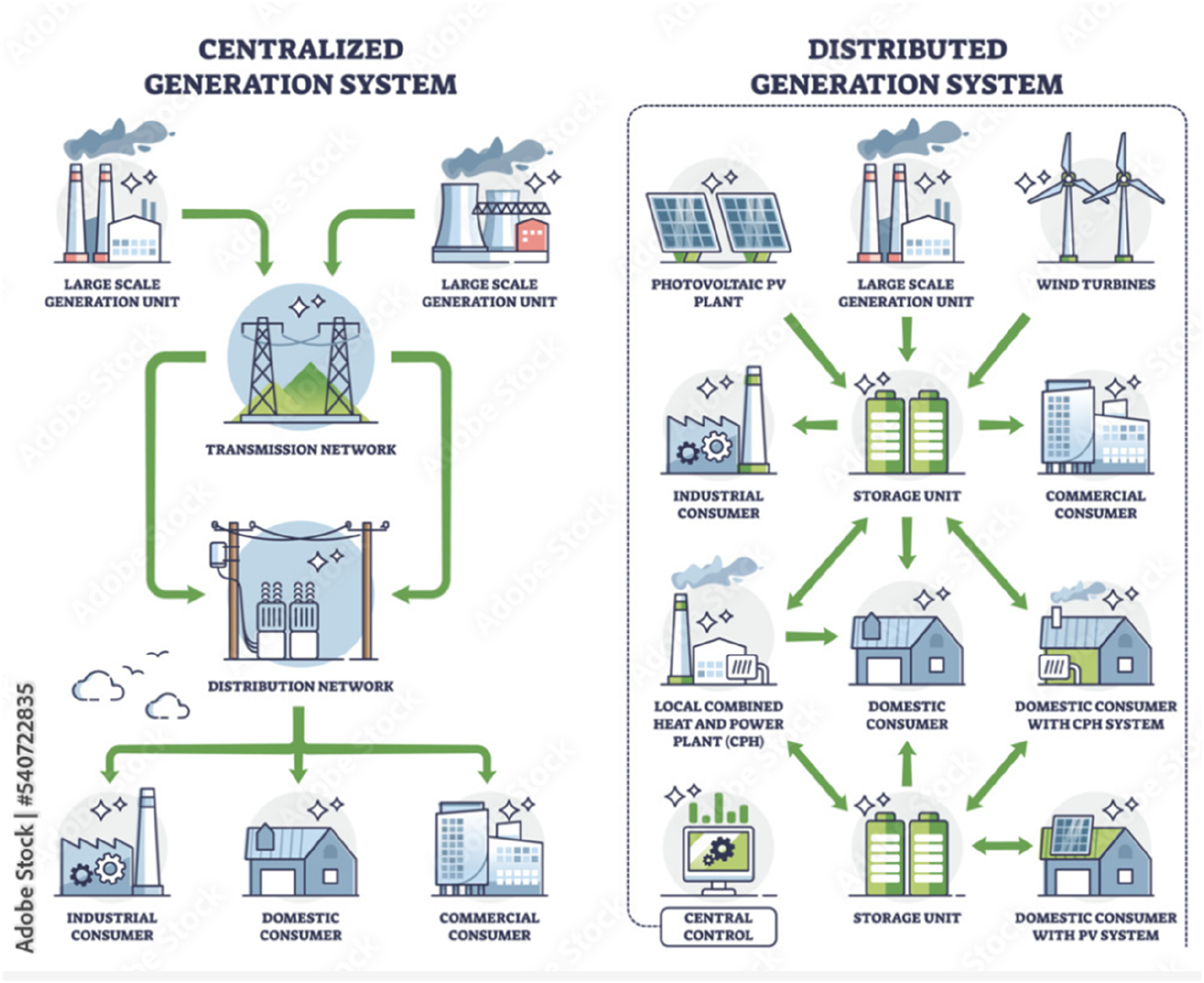
In lay terms, this argument states that in the fossil era, heat, light, power or cooling came either directly from burning fuel supplied through systems of pipelines or deliveries, or via a power station that could use variable levels of stored fuels to generate however much electricity was demanded across a grid (within defined capacity limits). In the post-fossil renewable era, we can only use as much energy as we can recover from renewable resources, which depends on the weather. To put it more succinctly (and technically): ‘The future energy system in Europe needs to be decarbonized and thus be based almost exclusively on renewable energy sources. Therefore it is challenged by the intermittent nature of renewables and requires several flexibility options’ (Möst et al., 2021: 3).
Starting from the premise that global primary energy consumption increased from around 20,000TWh in 1920 to over 170,000TWh in 2021, and over 136,000TWh of that coming from coal, oil and natural gas, the goal of shifting from fossil fuels to renewables represents a very large shift in infrastructures if the socio-economic status quo (continued growth in consumption) is assumed. One way to manage fluctuating demand and generation is to create a system with so much capacity that any level of demand can be accommodated, but this assumes unlimited investment. Another option is to better coordinate the infrastructures that already exist, or design for integrated systems that can compensate one source for another.
This framing immediately naturalizes a primary focus on energy generation, with demand treated as a separate problem, and it is notable that energy demand management is primarily treated as a socio-technical issue, in contrast to the more technical issue of energy generation. This narrative is so often repeated that it is rarely challenged, or rather, the challenge (e.g. that demand can also be managed) tends to fall away unheard. It does hold true in many ways, but it also hides a process of conceptualization that is nothing like as clear cut as it appears in this format. I will start this article by interrogating the notion of ‘energy system’, and the segregation of ‘energy vectors’ that are now the subject of recombination in the interests of radically conservative visions of a future both different, yet the same.
Energy systems
What is, in fact, an energy system? In the world of engineers and industrialists (indeed, of energy researchers generally), the term ‘energy system’ carries a world of meaning. As it in many ways constitutes the ‘field’ of both this article and the projects described in it, this section takes a closer look at how it has been considered. Among the energy researchers I work with, the term conjures an imaginary of complex intertwining infrastructures with technical management and clear purposes. However, there does not appear to be a definitive statement or definition of energy systems in the technical literature for this significant heuristic. An engineering colleagued offered his own, which he uses in teaching: A network of interconnected agents designed to convert, transmit and supply energy services to multiple end-users.
2
Another commented that, of course, it’s all about defining the boundaries, but agreed that there was not a fixed canonical definition. ‘Energy system’ is a flexible (or fuzzy) concept that encompasses all the factors or agents (or actants) that enable energy to be purposefully expended. Except for those that are never considered, such as the kind of energies that bio-social anthropologists have primarily written about, like food consumption that enables people to live (e.g. White, 1943), for example. A lack of clear definition, in other words, makes it possible to overlook what is excluded from the concept.
Techno-economic approaches to systems tend to draw attention to the energy transition as what Miller et al. (2015) describe as ‘a largely techno-economic problem’, by emphasizing these aspects over and above (or even to the exclusion of) social considerations. Miller et al. instead propose a more socio-technical approach, to shift attention towards: a perspective that recognizes that the conceptualization and design of energy systems is, fundamentally, an exercise in the simultaneous conceptualization and design of diverse social arrangements. (2015: 29–30)
Their approach echoes social science recognition that systems and infrastructures create society as much as vice versa.
In the social science energy research literature, there are numerus definitions of ESI, though fewer of ‘energy systems’. Skea and colleagues adopt a general definition for national energy systems, as: the set of technologies, physical infrastructure, institutions, policies and practices located in and associated with a country which enable energy services to be delivered to its consumers. (2010: 67)
This definition, with its built-in methodological nationalism, clearly associates the system with the provision of energy services to consumers, ‘rather than energy per se’ (2010: 68).
Their equivocation arises from the difficulties of defining systems in general, and energy networks/systems in particular. Trist and Bamforth’s Tavistock psychological analysis of ‘coal-getting’ (1951) first conceptualized the ‘socio-technical’ attributes of networks. Hughes (1983), in turn focuses on the historical development of electrical power networks in the USA and some European countries. Hughes adopts a standard distinction between closed and open systems, yet finding the boundaries of the former somewhat porous, he distinguishes between the system and ‘parts of the world that are not subject to the system’s control, but that influence the system’, which he calls ‘the environment’ (Hughes, 1983). Yet elements of this environment are seen as susceptible to control when systems creep and grow, or can be considered open, rather than closed or self-contained. Hughes then described the need for engineers designing networks and systems, ‘to deal with the messy economic, political, and social vitality of the production systems that embody the complex objectives of modern men and women’ (1983:1).
Electricity grids could be considered an energy system in their own right, as could gas networks: complex infrastructures designed to deliver energy services to diverse users, from domestic customers to industrial processors. Although, since gas is used to generate electricity, and electricity is used to pump gas, they are not discrete systems. Hence, the proposal to ‘integrate’ energy systems, such as gas and electricity, is doing the work of first purifying, before re-hybridizing the world (see Latour, 1993; Strathern, 1996).
It is striking, therefore, how far the notion of ‘energy system’ works as a heuristic that constructs an object for study, for commercialization and for regulation. It helps define an object for conjecture and discussion and for action. While systems thinking has long framed certain research in energy technologies, it has gained traction in the 21st century with the increasing urgency of adapting energy infrastructures to the pressures of climate change as outlined above. And, as noted, energy systems development does largely assume that boundary conditions, notably energy demand trends, will continue as in the present. The kinds of visualizations and diagrams that circulate from organizations like the International Energy Agency, through ‘global outlooks’ from multinational organizations such as BP, or transnational governmental institutions, set expectations about the location of change. These, in turn, are often adopted by the energy modellers in this study as background conditions, repeated frequently in introductory talks, and used to justify the urgency of transforming infrastructures through technological innovation (the object of engineering expertise, as noted by Downey, 2005).
Stewart (2016) shows how technical visualizations colonize the mind by inviting us to ‘see’ the world through a particular techno-industrial lens. In Stewart’s case, the sub-surface projections of geologists used in the oil and gas industries reveal what is below the surface of the earth (or sea) in a way that lends credence to the notion of intervention. What is below ground suddenly becomes accessible, and invites accession, exploitation or extraction. In a similar way, the repeated presentation of graphs of energy consumption (such as those in Figures 2 and 3) frame discussions of energy futures in expansionist terms, suggesting that the problem of energy expansion has a solution in the replacement of fossil fuel use with renewable energy. In other words, that growth is the fixed problem and technological advance in engineering will provide the solutions. Global primary energy consumption 1920–2020. Source: Ritchie (2021). Energy consumption by source. Source: Ritchie (2021).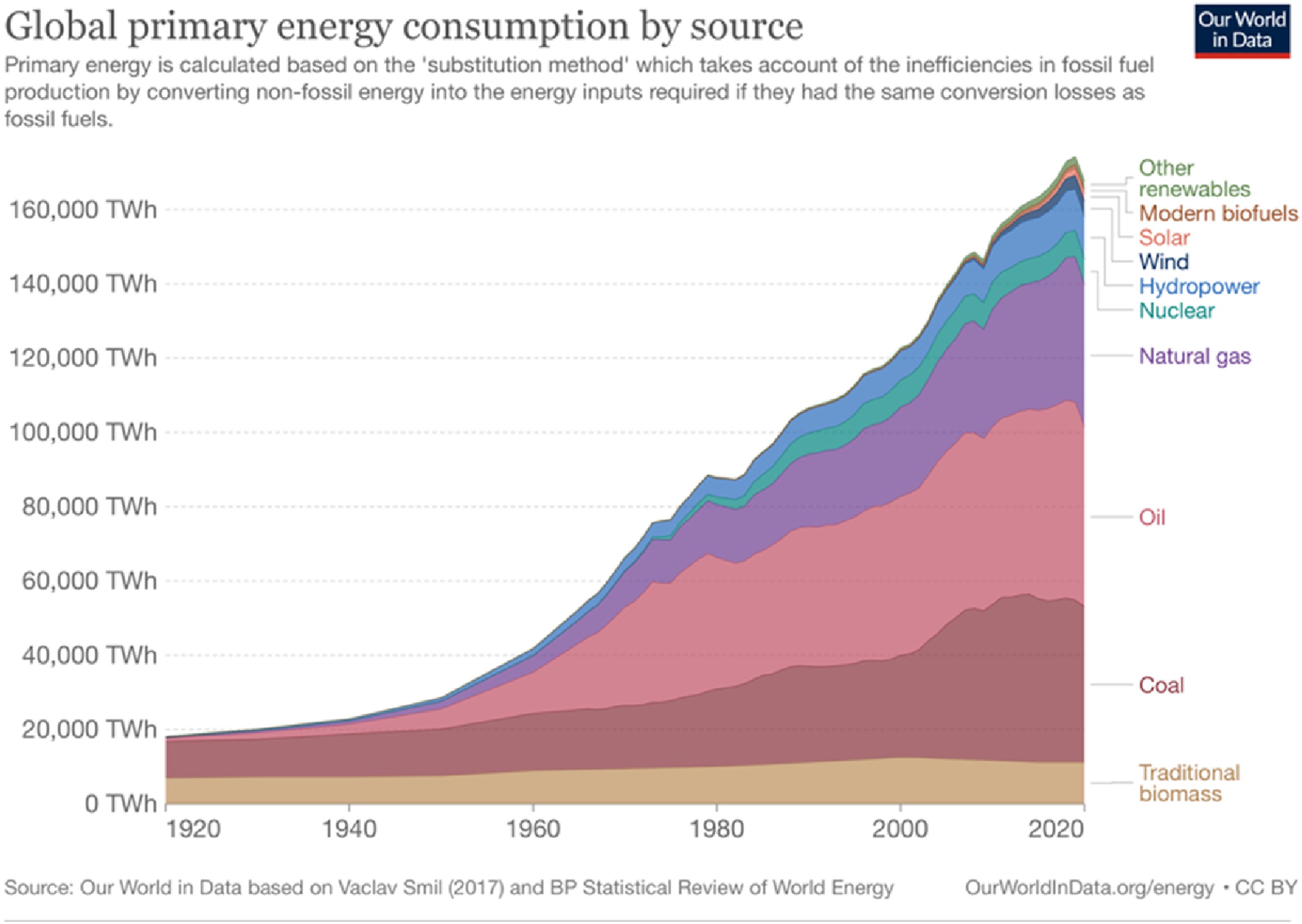
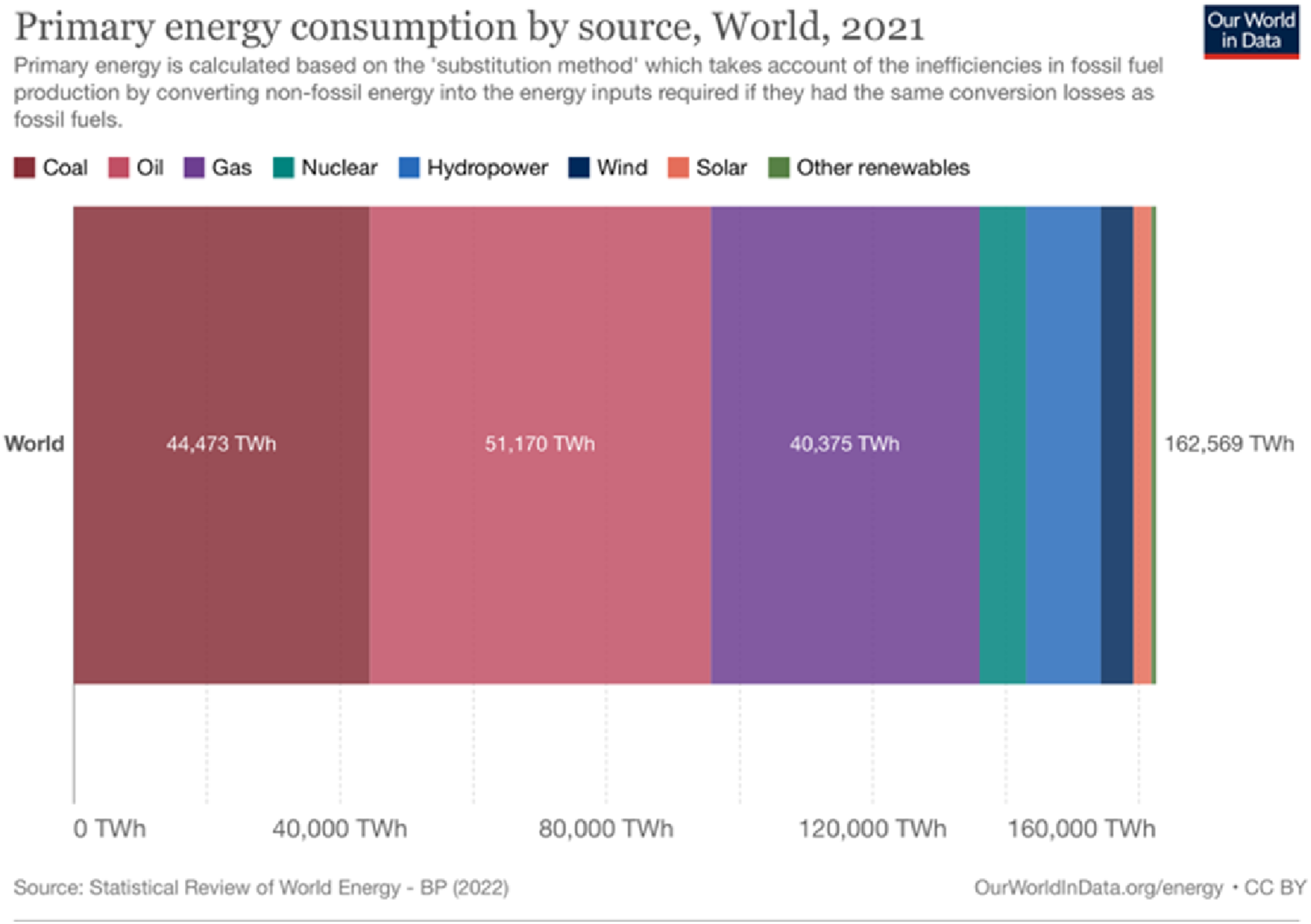
This assumption is shared far beyond energy system modelling practitioners, shaping political and techno-economic debates at different levels. At countless industry and think-tank events I have attended (including a recent energy-security summit), someone (such as the CEO of an energy company or a think tank) will say, to general assent, that ‘every projection’ tells us that energy demand is going to continue to grow, thereby confirming the speculative futures visualized in global outlooks. Graphics (such as those in Figure 2) work as technologies of government that frame what it is possible to discuss, and what is outside debate (Rose, 1999), even for scientists and research engineers. It is then understood as common sense that ‘everyone’, and particularly populations of countries which currently have low demand, will want to lead a middle-class lifestyle with electrical and electronic appliances defining their quality of life. Questioning this assumption is often met with moralized derision: that one is proposing withholding from others those benefits one enjoys oneself. 3
From this global perspective, seeing that energy (electricity, heat and transport) accounts for over 70% of greenhouse gas emissions makes the international focus on an energy transition understandable. Since the start of the 21st century, renewable energy sources have certainly increased, but have largely added to a growing global energy consumption, representing around 11–12% of global energy consumption in 2020 (see Figures 2 and 3) rather than replacing fossil fuel use. This percentage is anything but evenly distributed. Some national energy systems are much more reliant on renewable energy than others. Some electricity grids are almost totally reliant on renewable energy (such as Norway’s hydroelectric networks), while others remain predominantly fossil-fuelled (as in India), and others more reliant on nuclear power (such as France). Nuances such as this are lost in the global figures that become entirely detached from particular places or practices.
This vision is both historical and ahistorical. It is historical in the sense that its roots lie in the legacy of industrial developments with deep historical (colonial) origins and it reproduces many of the conceptual and cosmological assumptions that drove such development. Yet it is also quite ahistorical, in the lack of interrogation of these historical roots and routes, and the unquestioning reproduction of these same assumptions, as though they were eternal and universal. The broader horizon of possibilities for how humans can live and have lived, from pre-history or pre-industrial history, is quite absent, as are alternatives to contemporary extractive capitalist cosmologies. The example is perhaps one extreme in a spectrum of industrial philosophies, but it remains mainstream, and provides the background noise or ‘landscape’ (in Geels’ [2002] – contested but widely used – terms) for research and action on energy transitions. More relevant for this article is that it demonstrates an engineering approach to the world through the construction of problems to be solved.
In response, many energy researchers are heavily focused on managing a technical transition from fossil-fuelled energy systems to a world of renewable energy infrastructures. Over several decades, a relatively stable consensus has emerged that this will require a diversified system, driven primarily by the relative intermittencies of renewable energy resources such as wind, solar, and hydropower, and that it requires a solution to the long-standing engineering challenge of ‘storing’ electrical energy, as noted above. 4 At this scale it is relatively easy to see how the definition of the problem of the energy transition has been defined in a way that deflects attention from concerns about consumption or ‘demand’. I have yet to hear any echoes among my engineering colleagues of the lively debates among social scientists about degrowth and its affiliates.
Problem solving as world-making
These critiques and accounts of the socio-technical highlight the selectivity that defines ESI models with their focus on energy generation. Each part of the system modelled is complex in its own right, consisting of diverse infrastructural materials, governed by a range of regulatory principles. The discussion so far shows how the problem to be solved is already generally defined through the use of global problem-framing, abstracted from on-the-ground conditions, and extracted from local context and associated geographical and social variations and inequalities. This provides the background for the ensuing definition of engineering problems that should be addressed in order to ‘accelerate’ energy transitions and mitigate climate change.
Despite reports of crises in the positioning of engineering expertise in the US (Downey, 2005), engineering is still widely understood as a creative profession based on problem solving. As Shaw (2001: 1) outlines, ‘Engineers deal with reality and usually have a set of specific problems that must be solved to achieve a goal.’ Within this general approach is an understanding that problem methods and solutions should be ‘good enough’ (e.g. Furman, 1981), and should be achieved within the resources available. Shaw (2001: 1) defines the hierarchy of priorities especially concisely: ‘The objective is to solve a given problem with the simplest, safest, most efficient design possible, at the lowest cost.’ Engineering is undoubtedly an applied science, in which approximation plays an important role. This is expressed in terms used to describe the point at which variance between a calculated figure and a measured figure becomes small enough as to be safely ignored: when there is a ‘negligible difference’ between the world and the model of it. In other words, if it works, it is good enough. There are also rules used to define when a model is good enough, and much engineering expertise goes into improving the match between models and the observable world. But this conciliation with the inexact is core to engineering approaches, even if it is shared with some scientific practices. And it is this ability to be reconciled with inexactitude that both enables problem solving as a practice and allows the uncertainties and exclusions from engineering models to be downplayed or set aside.
The particular context for this article is a world of ESI research that is primarily led by coalitions of engineers, economists and mathematicians, but that often extends to political scientists and social scientists, and to other natural scientists, especially Earth scientists or physicists, depending on the specific project. Let us specifically focus on a handful of projects that aim to approach decarbonization of energy systems through various kinds of integrative action. By integrated energy systems, I refer to schemes that attempt to bring together differently fuelled energy services and infrastructures. For example, schemes that attempt to manage together all the energy infrastructures in one geographical location, whether that is a port area, a commercial district, or a number of dwellings. In all cases, the approach to the general problem (how to decarbonize the energy requirements of a specific set of activities) is first to model the system in order to manage it effectively. A model is expected to offer a canvas on which to experiment with different possibilities. It might either offer to demonstrate what the results of particular actions might be, or it might be intended to compare different scenarios, or to calculate the expected costs or outputs of a planned construction.
Midttun and Baumgartner (1986: 220) described models as ‘systematic codifications of cognitive and social structures, developed by actors to promote their interests and/or world views’, highlighting the social and institutional influences on assumptions about the world. They characterize social-engineering forecasting models as an ‘almost mechanical regulatory system’, in which, ‘[T]he decision-making element of a system is provided with information from a model representation of the system (or part of it). An adequate database is presumed to exist. And the regulator itself is somehow unaffected by the system’ (1986: 220). In neglecting political reality, they create a radically simplified perspective.
Although I am not discussing energy forecasting models – whose politicization is now well recognized, some of Midttun and Baumgartner’s analysis translates to energy system models. They wanted to highlight the political function of forecasts, contributing to a broader debate in the 1980s and 1990s on the role of statistics and calculation in the support of political agendas. To do this, they needed to distance their work from the internal critiques of forecasts focused on contesting data, equations or other methodological questions. Their aim was to challenge, ‘[T]he underlying assumption … that the aim of modelling is to predict an objective, societal development with the greatest possible accuracy’ (1986: 219). Since then, a significant body of literature has considered practices of scientific models, looking at the extent to which they are representative, how model developers seek to achieve representativeness in their models, or whether models serve purposes other than representing the world as it is (e.g. Cartwright, 1999; Gelfert, 2011; Lahsen, 2005; Ratti, 2020).
It is pertinent to turn back to the modelling methodologies themselves, not to evaluate them according to a teleological or self-serving judgement about how closely they represent reality – questions of validation or verification (see Lahsen, 2005; Parker, 2020) – but to take seriously the methods and materialities of the modelling world and query their status. One might also say, ‘to query their kinship’, since models exist in relation to one another as well as to their authors and the objects of their calculation.
Given the intent of a model to codify socio-material processes, we can understand that engineers use models in order to test a hypothesis of some description. Models may be physical or digital or a combination of both. But within each category – physical, digital – there is a very wide diversity of possibilities. One thing that all of the modellers I have worked with (whether engineers, economists, scientists) agree on is that models are partial representations, and that they are, in many ways, flawed. Instead, models choose to model part of the world, in order to achieve something else; that is, the model is not an end in itself but is understood to be a tool or a proxy.
Models are heuristics for organizing data and framing queries. But each model has its own history, and contains the ongoing legacy of the original designer or coder’s intentions and assumptions. In other words, beyond the truism that a model is only as good as the data that it builds on, the model is also only as good as the compromises made from the start and through its development to meet evolving demands. Physical models, for example models of the response of cables to heat variation (leading to changing capacity for current or voltage and expansion of the cables themselves) may be limited by relatively transparent variabilities in the conditions under which actual measures are taken of cables in the real world. Techno-economic models, on the other hand, are subject to much broader and multiple uncertainties, since they attempt to model complex socio-material processes.
One such model is currently under development as part of a research project on developing local multi-vector energy hubs that would use hydrogen to store energy from renewable sources and to provide transport fuels. In assessing the accessibility of hydrogen, broader geopolitical questions frame problems that require solutions. For example, if hydrogen is to be hydrolysed from water using electricity from wind turbines when it is not needed on the grid (itself the solution to a problem of a generation-led grid as already outlined), where should the electrolysing equipment be situated? Let us take a step back. Of all of the questions one might have about introducing hydrogen into the national energy mix, this group is addressing the cost of siting hydrolysing equipment onshore or offshore. We could take one further step back. How has onshore/offshore become the primary binary around wind-turbine development?
In general terms, the modellers, presented with political boundaries, treated them as limitations to work with rather than boundaries to be changed. If wind turbines cannot be built on land, for whatever reason, where else could they be built? And, as it turns out that the wind conditions for turbines are better at sea, then the problem becomes how to install large steel constructions at sea in a way that can be maintained, and the electricity generated imported back onto land. As a result, an extremely sophisticated industry for offshore wind generation of electricity has grown around the North Sea in particular, driven by the need to decarbonize electricity grids, access relatively reliable generation resources, and to build on existing knowledge and skills about managing offshore platforms from the oil and gas industry that was, otherwise, facing redundancy. Politically and socially situated objections to wind turbines based on landscape arguments became a problem that could be solved through engineering ingenuity and commercial expediency. And then, having successfully constructed offshore wind-turbine arrays, the opportunity to scale them up became a new set of problems – how large can a turbine go before economies of scale reach the limits of material conditions?
Back to the techno-economic model of where best to locate electrolysers: this is a problem with numerous layers. Questions include: What conditions are required for an electrolyser to function? What inputs does an electrolyser require to produce hydrogen? What happens to the hydrogen that is produced by an electrolyser (how can it be stored, transported, used)? What is the efficiency of transporting hydrogen versus transporting electricity? What infrastructures are already in place for transporting hydrogen and electricity? And so on.
In the following description I am eliding comments from a series of meetings to highlight the kind of discussions that guide the research while preserving the (relative) anonymity of the participants.
5
The engineering economists in the project group were attempting to model the lowest cost option for siting electrolysers. The postdoc, let’s call him Abdi, presents the calculations he has done in his economic model, and the conclusions he has drawn about the investment and operational costs of siting electrolysers in offshore wind farms or onshore. The rest of us start to ask questions about what the model represents. The model is shown in the form of a series of graphs, derived from equations organized into a spreadsheet. How has he costed the different elements, and how has he calculated that they will change over time? At one point he presents a graph that implies that energy costs will remain stable over a decade of future years (Figure 4). Gas price forecasting for hydrogen investment. Source: Personal communication. Note: NBP – National Balancing Point; FES – National Grid Future Energy Scenarios.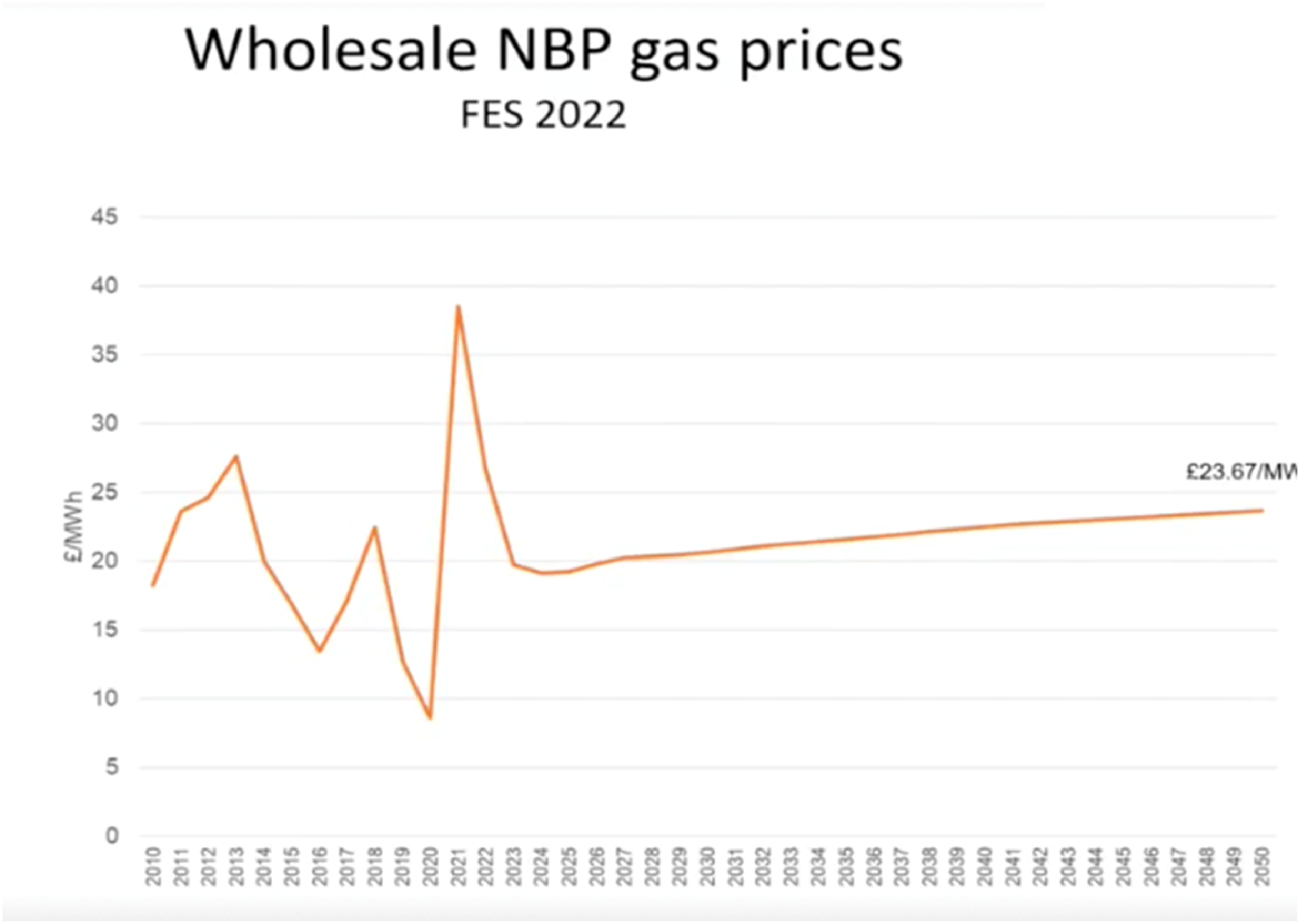
Are these based on averages from previous years, and if so, how do they account for radical imbalances, such as during the energy crisis? How can costs be compared to those of other fuels if fuel prices are radically unstable and unpredictable? Well, yes, says the supervisor, Benny: We look, kind of, for the enduring solution if, when, when it becomes like steady state. So we are not doing kind of analysing, in the context of the transition or, when the market is volatile. I think we are looking to what’s more like an enduring solution if the market is stable at a certain point, I mean, there is a balance because this moment of volatility is due to the substantial imbalance in the supply and demand. Due to this, you know, with the Russian gas and so on.
The model was assuming market responses, such that if the price of natural gas were to rise, there would be an increase in the demand for hydrogen storage. This then also leads to a rise in electricity demand. Another economist pitches in: ‘in a sense there will always be ups and downs, just occasionally quite extreme’, so it makes sense to work with an annual average to make investment decisions, since forecast average prices are usually within a few percentage points of actual prices, even if daily prices can vary wildly. Another of the engineers speculates that this graph looks like a reasonable extrapolation from the wobbly line, while remarking that it doesn’t factor in gas shortages – nor rules about not using gas that might emerge, which might crash the price. In a moment, the engineer says: The only thing we know is that that line [charting predicted gas prices] is probably wrong.
And the economist replies: ‘Of course.’ But he goes on: But the nice thing about using something like the FES [National Grid Future Energy Scenarios] is that everybody who has a strong opinion will know how they believe the FES is wrong, and can make a mental adjustment, whereas if Benny had the world’s most effective crystal ball and gave a perfectly accurate forecast, (a) he wouldn’t be here because he’d be trading and retiring, but (b), people wouldn’t know how to disagree with him. Whereas … take a well-known scenario and people in the rest of the world know what you’ve got wrong.
The group discussed the data and the methodology, querying assumptions and calculative strategies, but accepted the general findings. Disagreements about the quality of data or the predictive capacity of the model, highlighted in this quote above, were externalized to the potential users of the model (cf. Lahsen, 2005). The model was considered sufficiently useful that its limitations were acceptable, at least for its present purpose. 6 In summary: the model intends to ‘minimize the cost [of decarbonization] to UK PLC’ (as one of the techno-economists put it), based on economic modelling of annual average costs of different forms of energy, notably gas and electricity, both of which are volatile, and subject to global and national policy.
There are obviously a lot of assumptions in the model, but in particular there are some important assumptions about how actors in this market behave. They are not only modelled as rational economic actors, but as actors who respond only to daily market prices. They are to have no interest in recouping the cost of their initial investment, or in gaming markets to suit their assets. And yet, just as property developers buy land and hoard it until the house prices suit their profit ambitions (so-called ‘land-banking’), we know that large wholesalers and retailers can create shortages and flood markets for their own advantage. Are we to assume, therefore, that no gas company would ever flood the hydrogen market with methane-derived hydrogen to drive green hydrogen out of production? Shall we assume that no company would enter a contract to supply gas at a price that undermines the investment market for hydrogen storage?
There’s an awkward pause in the discussion when I lob in this question. Then the project leader explains, that ultimately this kind of model is trying to provide guidance to policymakers, to say: Look, these are the options to reach net zero by 2050 and this is how much it’ll cost to achieve that, and you know, to guide policy. But that will not be followed linearly. There’s lots of variation.
The lead co-investigator also tries to head off the problem, assuring us that in his recent discussions with a large multinational oil company, they have been ‘very, very keen on electrolysers as well, and transport electrification, and so forth’, as a ‘potential direction that they are heading in as well’. Indeed, oil majors are also investing heavily in both blue (methane-derived) and green (water-derived using renewable electricity) hydrogen because they can see their future business becoming dominated by hydrogen. The discussion moves on to an engineering model that calculates the efficiency of solid oxide fuel cells in integrated energy schemes.
So what?
It is not particularly original to argue that whoever shapes the agenda of an argument shapes the argument itself, but here I want to highlight some contradictory processes within the epistemology and practices of energy system modelling that might give us pause for thought. Clearly, to the extent that energy system models of various kinds are used to support the development of energy policy in government, in government agencies and offices, and in industrial offices, the character of those models has some influence in the way that the future is imagined and, then, acted upon. Put another way, if modelling is used to influence investment decisions, these can have far-reaching consequences over time.
None of the system modellers I have worked with deny that models have limitations, that they include false assumptions, or, as I highlight above, they are flawed or partial. But rarely are the consequences of these compromises addressed explicitly other than through generalized calculations of ‘uncertainty’. Energy system models have a life of their own in the world – they circulate and some of them endure. Models like the TIMES model of energy demand that combines engineering and economic modelling is now a standard model in many countries, promoted by the International Energy Agency
7
as a tool for ‘the exploration of possible energy futures based on contrasted scenarios’ (Loulou et al., 2005). According to one of its authors, a UK version, developed at UCL: has been adopted by the UK government as their principal in-house tool for generating long-term energy scenarios. It directly contributed to their decision to adopt a net-zero target and underpinned the Net Zero Strategy, the Clean Growth Strategy, and their decisions to agree the fifth and sixth carbon budgets proposed by the Climate Change Committee.
8
This model, with all its inherent flaws and biases, its choices of thresholds and assumptions about cost, is now a fixture of energy planning for both investment and operations around the world. Of course, no modeller would suggest that it is a perfect model, but few know their way around it well enough to bring any of those in-built ideological assumptions to the surface. Among those who would, such as academic modellers, some have suggested that the cost of purchasing licences to do such detailed analysis within commercial software would be beyond their research budgets. Yet each time it is used, the initial assumptions designed into the model are reinforced and reproduced, and shape the energy policy of a government or a company. The reason it works is because the narrowing of the scope of the energy problem through the framing of the model aligns with the narrowing of the scope of the energy problem politically. I cannot make any claims here for how this alignment took place, although I can suggest that it has been a mutually reinforcing project.
Let me offer one more glimpse of the world of energy systems modelling that might reveal something of the journey of system models through time and space. A large European Horizon project aims to demonstrate ‘a digitised energy system integration across sectors enhancing flexibility and resilience towards an efficient, sustainable, cost-optimised, affordable, secure, and stable energy supply’. 9 It models three sites of industrial regeneration in different European countries to propose a means to manage their different energy demands efficiently across energy types and uses. They are modelling the energy system at each site, including all of the current and future possible energy carriers, whether that is gas, electricity, hydrogen, solar, etc., and producing a digital version of the material world. In order to do this, they bring together existing models of different parts of the energy system, or different analyses of energy flows. Each model arrives with its requirements for data of particular types and in particular formats. The first few months of the project are dominated by the need to itemize these data requirements, source data and define ‘user-requirements’ or use-cases. Each of the models brings with it its own history of evaluations and assumptions, its own choices about how to define carbon, or where to draw the limits of the system to be modelled – what is internal to the system and what is considered external. And so each time these models are reincorporated into new models, the scope of the problem to be addressed starts to conform to political, economic and technological standards. If the habitat essential for a dormouse is not included in the environmental conditions of the model as it arrives at the new project, it would take an enormous upheaval to introduce it into a more complex model-of-models.
More significantly, perhaps (or at least, more pertinently), the modellers doing the life-cycle analysis of the proposed scheme choose to exclude the carbon costs of running a ‘data lake’, or large-data model, within the project itself, even though their analysis otherwise calculates costs of every last piece of copper cable in each fan in each heating/cooling system. This offers significant carbon discounts to the eventual projects, yet falls outside the scope of the analysis as defined by project leaders. The researchers engaged in this project certainly recognize this problem. 10 But they do not act on it – none of them appear concerned to the point of action to address the boundary issues of the modelling process, at least not beyond the incorporation of new technological developments or datasets on climate or machine efficiencies. Instead, there was a degree of shoulder shrugging and rationalizing that this problem was not within the scope of the funded research and therefore could not be addressed. The problem was recognized as one of many limitations to a research project, but which might be addressed in another project, possibly.
It is this willingness to live with the compromises included in the problem-definition that I refer to in my title as a form of selective blindness, a willingness not to see the problem that would make the rest of the exercise untenable or reveal its partiality (see Silvast et al., 2020). In some ways, all of our representations of the world have this quality – it is our ability to narrow our scope of understanding that allows us to deal with abundance and complexity. My argument is that the methodologies of engineering do this in well-established ways that have profound consequences for all of our futures. Once they feed through into political arenas, they help to set the terms of debate, receding into the background of discussions about whether wind turbines should be onshore or offshore, rather than how we address either the massive inequalities in energy access, or the norms and expectations around energy practices, either locally or globally. Energy researchers and system modellers do not do this out of any political intent to limit debate, and in informal discussion often also deride energy inequalities and lack of attention on energy use. On the contrary, many of those involved in the projects mentioned above are deeply committed to the goal of combating climate change and to a transition that is as just as possible. But their methodologies continue to reproduce framings that pose the justice issues as problems to be resolved politically, and not as a product of the current world of energy practices or structures of industry. So we are still, effectively, living with a world as seen, partially, by engineers.
Footnotes
Acknowledgements
The research referred to in this article was supported by the UK Engineering and Physical Sciences Research Council. I would like to thank the editors and blind-reviewers for their very helpful and constructive comments and suggestions.
Declaration of conflicting interests
The author(s) declared no potential conflicts of interest with respect to the research, authorship, and/or publication of this article.
Funding
The author(s) disclosed receipt of the following financial support for the research, authorship, and/or publication of this article: This work was supported by the Engineering and Physical Sciences Research Council, EP/T022949/1.
