



Abstract
This article examines how oil and gas industry participants in Colorado reflect on the potential energy mix of the future. At a time when innovation is a dominant trope that casts entrepreneurs as agents who create dreams and craft worlds, providing the materials, technologies, and processes needed to decarbonize energy systems, my interlocutors also position themselves as experienced innovators. For them, petromodernity is a techno-scientific achievement that crystallizes the successful conjoining of wildcatter risk-taking, geoscientific knowledge, and engineering endeavour. While renewable energy sources now have widespread appeal among politicians, publics, and investors, these industry participants dismiss emerging energy transitions and renewable energy imaginaries. They mock and ridicule renewable energy sources, scorning them for being ‘factually impossible’ due to their lower energy densities relative to oil and gas. Turning to and mobilizing epistemologies of facts, they regard oil and gas as destined to enjoy great longevity. While they see their own industry as a harbinger of innovation, they deem renewable energy industries void of such potential. Exploring these mocking dismissals, this article shows how the oil and gas industry’s history and epistemes inform energy imaginaries and flourish in the championing of what I call ‘nostalgic innovation’. As such, I suggest that innovation is not only a key component in entrepreneurial capitalism, but also a powerful moral commentary on who is seen to deserve to play a key role in future configurations of life.
Keywords
In his ‘State of the transition’ annual address, investor Bill Gates (2023: 3) proclaimed that ‘we’re in the beginning stages of a Clean Industrial Revolution’ – a societal transformation that he believed would halt climate disaster and unlock a prosperous future for everyone. 1 While recognizing the challenges involved in decarbonizing manufacturing, agriculture, transportation, electricity generation, and heating, he admired the great pace at which companies were bringing new technologies, products, and services to market, and their promise for the future. With emphatic optimism for a new energy epoch, he envisioned a zero-carbon world in which we will ‘use clean electricity to run all the vehicles we can and get cheap alternative fuels for everything else’ (Gates, 2020). Solar, wind, and hydropower would be optimized, while better, cheaper, and lighter batteries would be developed. For heavy, long-haul transportation, Bill Gates suggested switching trucks, cargo ships, and passenger jets from today’s crude oil products to advanced biofuels and electrofuels. This vision of mobility was predicated on what he saw as ‘lots and lots of innovation’, offering a portrait of a future that we can imagine as not here just yet, but also as not far beyond our reach. It was a future where the energy mix did not involve hydrocarbons but instead various sources of renewable energy, created and brought into being through innovation.
These epochal proclamations played on a large TV screen in the lobby of a leading oilfield services company in the corporate heart of Denver, where I was waiting to meet with its CEO. When he was ready for our meeting, I was greeted with a firm but friendly handshake. He soon started telling me about his personal journey, the company, and the future. Before long, his words echoed those of Bill Gates. It was not because he was talking about renewables. Instead, he shared with Bill Gates an almost triumphant belief in the potential and promise of innovation. The CEO described his journey from graduate student to oil executive as ‘very much a blind-squirrel-finds-a-nut story where we came up with a couple of ideas that helped launch the shale revolution’ – referring to a pivotal transformation in the US oil and gas industry in the mid-2000s, which I will discuss in further detail below. For him, the shale revolution happened in the United States not just because of the country’s particular geology, its vast economy of scale, its particular property rights regime, where the subsurface can be privately owned and rights holders receive royalty payments for the oil and gas produced. With a knowing smile, he said that it also happened in the United States because ‘Americans are innovators … very open-minded about trying ideas and committed to making it work.’ Having been nominated for, and a few months later celebrated as the winner of, the Denver Business Journal’s Trailblazer Award, he proudly concluded that ‘one of my big roles has been as an innovator’.
In this article, I will examine how oil and gas industry participants in Colorado draw on the trope of innovation in their reflections on the potential energy mix of the future. As producers of oil and gas, they position themselves as responsible for what can be achieved through more than a century of concerted scientific experimentation and innovation. For them, the energy mix, on which we have come to rely, crystallizes the successful conjoining of the early oil prospectors’ risk-taking and decades of geoscientific and engineering knowledge. This entrepreneurial ethos is promulgated through its close association with and connection to ‘the field’ – that is, the very sites of oil production where oil is a visible, tangible, and material presence. In Colorado, most of my interlocutors work for small to medium-sized oil and gas companies. These are not the Chevrons, the Exxon-Mobils, the BPs, or the Equinors, but rather the prospector-spirited smaller endeavours where ‘the field’ is not far from view.
As I will show, many of my interlocutors dismiss and resist renewable energy imaginaries, like the one presented by Bill Gates. Emphasizing energy sources’ relative energy densities, they mock and ridicule these envisioned energy transitions, scorning them for being impossible and therefore ultimately irresponsible to pursue. For them, the only energy transition that they regard as realistic is a future energy mix centred on nuclear – an energy source that is highly energy dense. While it is beyond the scope of this article to explore such nuclear imaginaries, these interlocutors’ critique of renewables rests on the same fundamental mobilization of energy density as a determining ‘fact’ regarding feasibility. While oil and gas industry participants see their own industry as a responsible and proven agent of innovation, they deem renewable energy industries devoid of even the potential for innovation. Exploring these mocking dismissals, I will show how the trope of innovation is mobilized to make moral claims about energy futures. At a time when companies must orchestrate and anticipate market changes by generating a constant stream of new products, technologies, and services, business innovation is not only a key component in contemporary capitalism. I suggest it is also a powerful moral commentary on who is seen to deserve to play a key role in future configurations of life. Attending to how interlocutors conceptualize energy transitions and value energy sources at a time of contested energy futures, I thus demonstrate how claims to innovation not only tap into a buzzword vocabulary but also involve a register that is at once ‘intensely ethical and political’ (High and Smith, 2019: 12, italics in original). I reveal how claims to innovation form part of judgements on who is considered authorized to act and speak ‘truths’ that others might be unfamiliar with, if not unable to follow (Arendt, 1958: 3). As a synecdoche for diverse visions for the future and involving stakes that are personal and planetary, energy transitions and the associated demands for innovation thus offer fertile ground for nuanced anthropological attention to ‘why we disagree about energy futures’ (cf. Hulme, 2009, 2015).
This article draws on ongoing ethnographic research that I have carried out in Colorado since 2013 in the oilfields and beyond. In Weld County, home to more than 22,000 active oil and gas wells, fieldwork has taken me into the offices of landmen, who negotiate and acquire mineral rights leases to the land where operations are planned and carried out. It has taken me out on the drilling rigs and the smaller work-over rigs, where operations often involve a huge number of trucks, equipment, and people. It has taken me into the crews’ ‘shops’ where trucks and equipment are based, and health and safety training is carried out, as well as to the producing operators’ field offices in the County seat of Greeley, where wells are monitored digitally and engineers are on constant standby. It has taken me to the offices of environmental subcontractors, surveying well pads and reporting spills and leaks, and into the homes of former workers who have reached retirement, experienced layoffs, or been involved in terrible accidents. It has taken me into the executive headquarters in Denver and up to the top floors of corporate governance with their presidents, CEOs, and boards of directors, as well as into the private equity firms and private investor firms located nearby. My hosts have let me into their workspaces and the events that take place there. Sometimes they have given me an office, other times they have let me shadow them as they go about their workday. I have been on site when starting drilling, and we have gone together to the local ‘hole in the wall’ eateries for cheap tacos and iced tea. At other times, I have found myself at corporate events, such as intense investor calls, in-house client presentations, and disaster management meetings when things go wrong. Beyond these workspaces, fieldwork has also taken me to family barbecues, dinners, dog walks in the evening, church services on Sundays, and whatever else forms part of my interlocutors’ everyday lives. This participant observation, along with interviews, forms the basis for this article, offering lateral perspectives on the industry and the importance that industry participants across its many echelons placed on ‘the field’ as a site of exploration and production, in work environments that were deeply financialized and corporate (see also High, 2019). ‘The field’, in its various modalities, was ever-present and exemplified for my interlocutors a primary, but far from exclusive, site of innovation.
The promise in innovation
In contemporary capitalism, innovation is often presented as the silver bullet for any and all problems. As the historians of science Lee Vinsel and Andrew Russell have noted, innovation is like ‘a sales-pitch about the future that doesn’t yet exist’ (2020: 11). It offers the promise that with just the right amount of know-how, resourcefulness, and entrepreneurial attitude, challenges can become opportunities. It is a trope that turns the political into the entrepreneurial by rearticulating deep colonial and other inequalities into experiments that promise worth and value. This rearticulation can be seen as ‘depoliticizing everything it touches, everywhere whisking political realities out of sight, all the while performing, almost unnoticed, its own pre-eminently political operation’ (Ferguson, 1994: xv). Serving as a beacon for entrepreneurialism, the trope of innovation calls for solutions to be developed, new wealth to be generated, and communities, from small to large, to be transformed. ‘Innovation-speak’, as Vinsel and Russell refer to it, presents futures charged with optimism and potentiality as long as the public sector, private companies, non-governmental organizations, and individuals collectively and actively cultivate what Arjun Appadurai (2004) has called ‘the capacity to aspire’ – an aspiration that is not grounded in and limited to individual motivation but shaped as a cultural capacity. In the United States, as Eitan Wilf (2019) has shown in his work, business consultants nurture and capitalize on creative imagination as bridging, on the one hand, a radical individual property that is fleeting and unpredictable, and, on the other, a highly routinized, systematic, and fundamental business strategy for creating new materials, new technologies, and new processes within the context of shortening business cycles. As he has noted, ‘it would be difficult to find a more ubiquitous trope than innovation in today’s business world’ (Wilf, 2019: 2). Indeed, innovation has become an aspiration in itself, bringing together people’s diverse visions and funnelling them towards the production of enterprise.
In her work on ‘entrepreneurial citizenship’, Lilly Irani has observed that an important part of the discursive promise in innovation is ‘not only that one makes one’s own future, but that one can generate progressive futures for others’ (Irani, 2019: 7, italics in the original). As such, it casts entrepreneurs as agents who create dreams and craft worlds. And supposedly any of us could do this. By tapping into our ‘creative persona’ (Rosaldo et al., 1993: 6), we are presented with the promise that we can all become entrepreneurs, from the least to the most privileged. It is a trope that has become part of ‘philanthrocapitalism’ (Canfield, 2022; McGoey, 2021) with Bill Gates at the helm, where strategies for market stimulation and demand creation are integrated into charitable giving. It also sits comfortably within the oil and gas industry, harking back to the early pioneering days of the industry while simultaneously offering industry participants a way to demonstrate their continuing agility and expertise in entrepreneurial capitalism. And it is a trope that has captured the imagination not only of business executives but also the wider public.
To see energy futures as emerging from and requiring innovation is thus hardly surprising. New materials, technologies, and processes will be required to bring about the change that is envisioned, be it for a ‘Green Industrial Revolution’, where the challenge is to decarbonize societal infrastructures or for a fossil-fuel future where the challenge is to deliver products with lower social, environmental, and financial cost. These energy futures, ranging from ‘green’ to ‘black’, are predicated on fundamental assumptions of and expectations for innovation. Additionally, it is also a moment in time when this ‘innovation-speak’ is predominant. Interestingly, according to an article in the Atlantic, ‘although actual innovation might be in decline, mentions of innovation are resurgent … we just can’t stop talking about it’ (Green, 2013; see also Graeber, 2015: 114). The Harvard Business Review has made a plea that we simply ‘stop calling it “innovation”’ (Zhexembayeva, 2020). While innovation-speak flourishes and captures our imaginations, among my interlocutors in the oil and gas industry, it is precisely renewables’ potential for innovation that many not only bring into question, but outright reject.
Towards a green Colorado
My fieldwork has coincided with much political upheaval, both across the state and at a federal level. In January 2019 Governor Jared Polis took office and many in the oil and gas industry joked that Colorado was now going to be run by Boulder, a nearby town that one of my interlocutors described as ‘pretentiously liberal’. Another saw Boulder as a local version of what he called ‘hippie free-thinking and anti-oil California’. Political reforms have introduced greater regulation of oil and gas exploration and production, as well as increased non-industry representation in state-level oil and gas monitoring bodies. Local public hearings on the implementation of new Senate bills have brought those for and those against hydrocarbons into shared politicized spaces, making one of my interlocutors comment how ‘under Polis, oil and gas have become extremely politicized. Much more than before! He developed this Senate Bill [181] for the Boulder Counties of the world. 2 It was not developed for Weld County.’
With a mission to make Colorado use 100% renewable energy for its electricity supply by 2040, Governor Polis announced in 2019 that 19 new solar projects were set to begin in Colorado. While this formed part of a larger plan towards an energy transition away from hydrocarbons, my interlocutors responded dismissively. As one of them said: I’m puzzled that the governor would be taking victory laps on this announcement. The projects will supply just 0.2% of annual power demand in Boulder County. In total, the 19 projects will supply just 0.04% of state power demand. I am proud of what I do and the energy oil and gas supply. For scale, the total energy production projected for the 19 solar projects over 20 years is equivalent to the energy produced by one horizontal well drilled by our company in rural Weld County in just three years.
One of the others replied: Holy smokes! That’s a bubble buster! I wonder how much land is wasted by these so-called ‘projects’. Plus the life of these things is only about 20–25 years, assuming no hail damage, and then it’s off to the dump … as toxic waste. Not very green!
A third joined the banter and commented: If you just want to employ people, the solar industry is great because it is the least efficient and least productive way to make power. It wouldn’t exist without subsidies. Lower productivity equates to lower, not higher, standards of living. He’s just selling BS and rhetoric because this will make the left feel good. Obviously, it’s about politics and not real business, like ours. We actually have to make the numbers work for us.
A few days later I was catching up with one of them again, just one-on-one. He brought up the solar projects and said: You know Polis put on his social media that he was really proud, having just greenlighted 19 solar projects. That was apparently his so-called ‘Green Colorado Economy’! He has this big, long soapbox message about how solar panels, these 19 projects, are a wave of the future. Then, when you look at the amount of energy that they would produce, it is nothing! One well here in Colorado, online for three years, produces more energy! Just one well produces more energy in three years than all those 19 projects over a 20-year span. That’s real! There’s a huge delta in the energy density that comes out of solar. It has no future!
The topic of ‘energy delta’ was recurring in conversations that turned to renewables. For my interlocutors, ‘delta’ referred to the mathematical notion for change or difference. When they compared different energy sources, it was thus expressed in terms of the ‘delta’ between, say, gas and solar. Sometimes the delta was expressed in terms of joules, along the lines of the concept of Net Energy Gain (NEG) in energy economics. Other times it was expressed as a ratio, along the lines of the concept of Energy Returned on Investment (ERoI).
3
While there is much scholarly debate around these concepts, especially regarding what should be included in and excluded from these calculations (see for example Fagnart and Germain, 2016; Oosterom and Hall, 2022), among my interlocutors it was less a topic for debate and exploration, and more an affirmation of hydrocarbons’ superiority. Given the much higher energy densities of oil and gas compared to renewables, these particular calculations anchored a perspective that repeatedly favoured oil and gas. While energy sources can be compared and evaluated in multiple and diverse ways, the calculations on which my interlocutors drew centred on calculations of energy density. This resulted in rates and ratios that presented oil and gas as thus far out-performing renewables (see Figure 1).
4
Energy density chart. Note: W/m2 – watts per square metre. Source: Saunders (2020).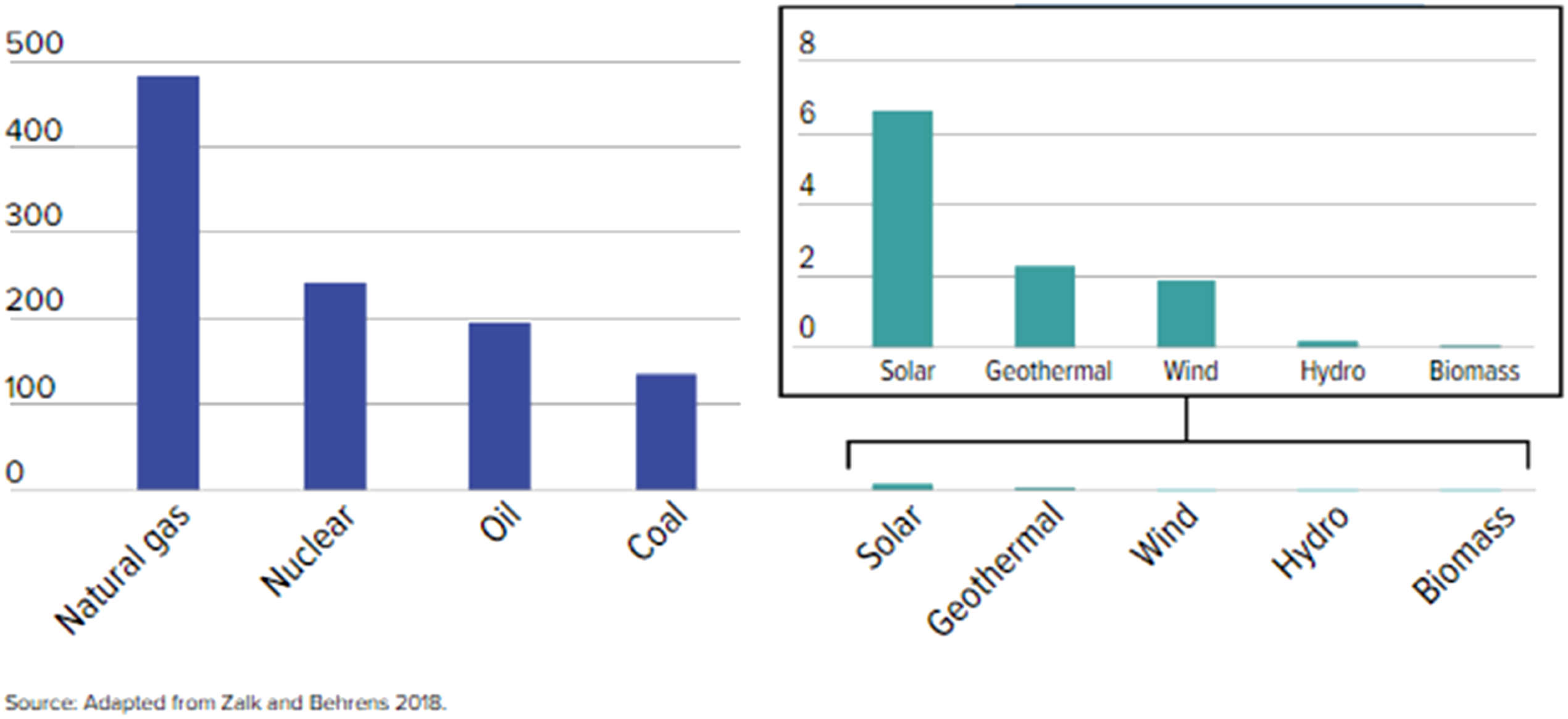
The sentiment that renewables, not just solar, had no future was commonly voiced across the echelons of the industry, present on the rigs and in the corporate corridors, in the bars and at the birthday parties. Renewable’s lower energy densities were presented as a conversation stopper – as the fact that spoke for itself. As one said, ‘facts don’t discriminate, they don’t cater to opinion or projections’. Drawing on epistemological registers that position empirical observations as unnegotiable truth claims, this fact of energy density was taken to inform and delimit all aspects of renewable energy. Materials, technologies, and processes were presented as irrelevant due to the fundamental limit in renewables’ energy densities. It was as if renewables lacked the potential for optimization – as something that could not be improved on or better harnessed. For my interlocutors, renewables were deemed devoid of potential for innovation and change, thus lacking a credible sales pitch for a future that doesn’t yet exist.
By turning big and broad questions about the future energy mix into specific questions about energy density, my interlocutors were engaged in affirmative acts of boundary-making. Through their banter, they collectively asserted, affirmed, and reaffirmed facts, claiming the scientific high ground in efforts to deal with divisive political realities, changing investor interests, and energy futures that would put their own jobs at risk. Similar to Bruno Latour’s ‘fact-builders’ (1987: 132), they strove to position facts as ‘an obligatory passage point’ for everyone else who wished to pursue the same interests. In claiming this authority, they positioned themselves as gatekeepers of innovation and delimited the potential energy futures that they believed could be built. As long as the energy density of oil and gas was superior to renewables, renewables were not accepted as a serious challenge to hydrocarbons. Such gatekeeping, where certain facts are positioned as more important than others, pivots delicately on the extent to which people can make credible claims to knowledge and expertise. It involves a temporal orientation that embraces the past in its claims on the future. As such, it mobilizes established expertise to authoritatively claim what futures might be built. For participants in the oil and gas industry, their expertise builds on and reaches back to two key moments of innovation: the early pioneering days of the wildcatters and the recent shale revolution.
Innovation in the oil patch
‘Wildcatters’ refers to oil prospectors, especially the 19th-century prospectors in the United States who drilled remote exploratory wells and, as they found oil, eventually founded the industry. While giant multinational corporations dominate the public image of the industry today, the independent wildcatters are recognized for bringing it into existence. This oil frontier opened the prospect of immediate and unprecedented economic gain that, for homesteaders at the time, would have taken many generations to achieve. Yet, as historian Ruth Sheldon Knowles has noted, oil was not only ‘the greatest single source of wealth in America for individual fortunes’, but exploring for oil was also ‘the greatest source of business failure’ (Knowles, 1959: 302). It was a high-stakes venture, often compared to gambling, as the vast majority of wells turned out to be dry.
In these early days, drilling methods drew on what was required to build water wells (see Dancy, 2018). Most of these wells were shallow, and there was little demand for technological advances that would require drilling to deeper depths. However, as homesteaders moved to lands away from the Atlantic Ocean, they soon lacked the basic commodity of salt, essential for preserving food. While salt springs existed in many areas, those who lived without access to nearby salt springs had to buy it. A thriving salt business thus arose to serve their needs, starting in West Virginia. A father and son, David and Joseph Ruffner, operated one of the first salt foundries in the country (Ratliff, 2010). They relied on surface salt springs to supply their furnaces but quickly found the demand for salt exceeded their ability to supply it. At the beginning of the 19th century, they devised methods and tools for drilling a salt well into the bedrock, pioneering the first well that was drilled as opposed to dug. Using a long iron drill, they would complete the well in a rich brine zone from which they evaporated the water and produced marketable salt.
Many of these brine wells in West Virginia also contained crude oil. According to historical records, people would dump the oil into the nearby creeks and rivers as there was no established use for the thick black substance. It was not until several decades later, in Pennsylvania in 1859, that crude oil became the specific focus of drilling efforts in the United States. Edwin Drake became recognized as the first person to purposefully drill for and successfully strike oil in America. Drake drilled his well using a six-horsepower steam engine and pioneered cast-iron well-casing to prevent groundwater flooding and well caving. When completed, the well produced roughly 20 barrels of crude oil per day. But although the drilling venture was successful, it was extremely costly, and Drake was more or less broke. Poverty and poor health dominated his life, and he eventually left the oil patch. Wildcatters moved to the region, imbued with a desire to find oil and willing to take great chances to make it happen. As has been noted, ‘[these men] could keep on going, not only when the current was with [them] but when it was most decidedly running the other way’ (Tait, 1946: 13). Drilling dry holes, taking on escalating debt, and confronting the disbelief of others, these wildcatters are today admired in the industry for continuing to pursue their dreams, against all odds. For my interlocutors, Drake, who drilled that first gusher in 1859, exemplifies how wildcatters dared to invent new means to find oil, demonstrating not only their technical abilities but also the fast pace with which they innovated the industry.
Celebrated by the industry for their courage and bravery, persistence and hard work, wildcatters continue to be significant for many industry actors today as their ‘moral exemplars’ (Humphrey, 1997). As I have described elsewhere (High, 2022), at an industry event held every year in Denver since 1981, the Wildcatter of the Year award is presented to a prominent leader in the industry, applauded for having a so-called ‘entrepreneurial spirit’ in undertaking innovative exploratory work in the American West today. While conflicts and disputes over natural resource exploration have been central to this history and continue to form part of its evolution today, this contestation is not detectable at this industry event. Nor do attendees generally reference the highly gendered and strikingly white history of the wildcatters. Instead, the legacies of the wildcatters are emphatically commemorated and celebrated, with award winners being asked to continue the moral example of their innovative industry forefathers. One of these winners was the CEO with whom I opened this article, celebrated as a data-driven energy innovator, who created a visualization technology that became central to the shale revolution.
The shale revolution refers to ‘the biggest energy innovation so far of the 21st century’ (VPRO, 2017), according to energy historian and consultant Daniel Yergin. Independent oilman George Mitchell started an oil and gas company that drilled more than a thousand wildcat wells in Texas. The company experimented with different drilling technologies and closely investigated core samples that they extracted from the wellbore. They were interested in exploring the potential for oil and gas recovery from a very hard, dense type of rock known as shale, which, at the time, was presumed to not be able to hold hydrocarbons. In a documentary (VPRO, 2017), one of the engineers at Mitchell has commented, ‘people thought we were absolutely nuts. We were crazy. One of my good friends at Mitchell said, “I don’t know what y’all doing but all this is just smoke and mirrors.”’ They developed a way to fracture the hard rock, using primarily water under high pressure (now known as ‘hydraulic fracturing’, or more commonly ‘fracking’). As another engineer has recounted: I came to work at Mitchell at a time when Nick was looking to decrease the cost of the stimulations of the frack jobs. So, when I showed up, I said, ‘Hey, there’s four times more gas here than you guys know.’ And then Nick’s figured out a way to be able to stimulate and drill the wells for half the cost. So, we have four times the gas, we have half the cost. All of a sudden, a miracle occurs. And then George Mitchell got the biggest smile on his face, leaned into the table, looked at us all and said ‘This is huge! This is the biggest secret the company has ever had. No one can talk about this.’ He knew what it meant when we told him how much gas was in the Barnett. He wanted to let loose the land teams.
5
They went out and leased land all over the place. Areas that never had produced oil and gas in Texas were all of a sudden seeing drilling rigs, starting to see landmen, starting to see Mitchell come and drill wells…. The Barnett became eventually the largest onshore gas field in the United States.
The shale revolution is celebrated by the industry as an engineering and geoscientific feat that showcases today’s wildcatter spirit. Industry participants eagerly lay claim to having contributed to the innovations, playing their part in continuing the legacy attributed to Drake and the many other early wildcatters. Approaching the oilfield with an entrepreneurial spirit is thus anchored in the past, establishing the proven expertise and insight that can bolster industry participants’ claims when they assert with conviction what kind of energy future might be possible.
At a time when we are said to be in the beginning stages of a ‘Clean Energy Revolution’, the history of oil patch innovations would seem to have much in common with innovations in renewable energy. However, my interlocutors dismiss such commonalities. For them, given renewables’ lower energy densities, the potential for innovation is deemed absent and renewable energy scenarios as ‘factually impossible’. Contemplating a renewables-only energy imaginary is, for them, naïve and evidence of ignorance. They feel that there is no real question about the possibility of a decarbonized energy future and as such, any advocacy for renewables can only be based on what they call ‘emotion’. Relegated to the margins of entrepreneurial capitalism, renewable energy futures are deemed not about economics, not about powering the electric vehicles that Bill Gates envisioned, but rather about making us ‘feel good’. And, as such, many of my interlocutors see it as an effective way to win over voters. Frustrated with the governor’s and his supporters’ shortsightedness, my interlocutors thus viewed the ‘Green Colorado Economy’ as not just an unrealistic plan, but also a morally irresponsible plan.
Concluding thoughts
In the oil fields and far beyond, morality articulates with contemporary entrepreneurial capitalism through the trope of innovation. Rather than existing as a complementary synergetic domain (Muehlebach, 2019) or as a non-market counteractive response to capitalism’s market rule (Bloom, 2017), innovation sits at the very core of entrepreneurial capitalism, generative of economic value and indexing moral worth. At a time when we just can’t stop talking about innovation, I suggest that part of the trope’s powerful appeal is rooted in how it embraces not just those who are successful at bringing new products, services, and materials to market, but also those who struggle, if not ultimately fail. Failure is integrated into innovation as a moral trope, offering sense-making of inequalities and encouragement to persevere in spite of adversity. It is not challenged by ‘the iron logic of profit and efficiency’ (Bloom, 2017: 1), the increased marketization and financialization that we are living with and through. Indeed, given the proliferation of innovation-speak, it might be, as noted by Fredric Jameson, that ‘it is easier to imagine the end of the world than to imagine the end of capitalism’ (2003:76). Whether successful or failing, innovators in their pursuit of enterprise can thus be seen to exemplify the conjoining of worth and value in contemporary capitalism.
One day, I sat with an interlocutor over a cup of coffee and chatted about the industry when he said: I’m so proud of this industry. Ever since they first struck oil, we have been able to innovate. We have gone against the grain and tried new things. We have failed, most definitely, but we have also learnt from our mistakes. We have developed new technologies. I mean, who would have thought that we can now drill down two miles and then make laterals that extend for miles? Who would have thought that? We are and have always been an industry that innovates.
Anchored in the early years of wildcatter risk-taking, bolstered by decades of geoscientific knowledge and engineering endeavours, the oil and gas industry is presented by its own participants as a quintessential and superior innovator. An innovator that continues to find new ways of bringing the same product to market. It is an innovator that produces the status quo, preserving that which already exists. This is not another dotcom bubble or risky financial innovation like the collateralized debt obligations in the financial crisis of 2007 and 2008. Instead, my interlocutors champion what I will call ‘nostalgic innovation’: while facing the prospect of becoming a sunset industry, they are presenting themselves as proven and established entrepreneurs who don’t bring new products to market, but instead excel at continuing to generate value from the familiar, from the conventional.
In their mocking dismissals of renewables, mobilizing facts to make broad conclusions that renewables have no place other than making the left feel good, my interlocutors bring a particular future into being for themselves. A future, that if changed very little from today, is in their own interest. A future that is not threatened by questions, challenges, and counter-arguments about competing energy regimes. A future in which oil and gas is certain to remain crucial. By focusing on legacies of innovation, they are mobilizing the trope of innovation to make the moral claim that they can deliver worth and value. Positioning themselves as deserving to play a key role in future configurations of life, they are creatively constructing what is, for them, their ‘feel good’ future.
Footnotes
Acknowledgements
Over the years of researching the oil and gas industry in Colorado, I have become indebted to many people. My deepest gratitude goes to all those in Colorado who have opened doors, shared with me so generously, and invited me into their lives. I also want to thank friends and colleagues who have commented on earlier drafts, presented at the Association of Social Anthropologists Conference held at University of St Andrews, the Geographies of Sustainability, Society, Inequalities and Possibilities research group (GOSSIP) seminar at University of St Andrews, Petrocultures Conference in Stavanger, Energy Ethics Lecture Series at ITAS at the Karlsruhe Institute of Technology, Department Research Seminars at University College London, Aberdeen University, and University of Konstanz, the Anthrokolloquium at Tübingen University, as well as the Energy Ethics Writing-Up Seminar with the Energy Ethics research team and Centre for Energy Ethics at University of St Andrews. Importantly, I thank the Special Issue editors for providing the most ideal environment for constructive and exploratory discussions at the Contested Transitions workshop in Lausanne and for expertly bringing it all together in this Special Issue. All of you have inspired, supported, pushed, and challenged me in important ways throughout. Finally, I thank Critique of Anthropology and its perceptive reviewers whose helpful and generous suggestions made this article remarkably better. Any shortcomings, however, remain entirely my own.
Declaration of conflicting interests
The author(s) declared no potential conflicts of interest with respect to the research, authorship, and/or publication of this article.
Funding
The author(s) disclosed receipt of the following financial support for the research, authorship, and/or publication of this article: I gratefully acknowledge the funding I have received for the research, authorship, and publication of this article from the European Research Council (grant agreement No. 715146); the Leverhulme Trust (grant number ECF-2013-177); and the British Academy (grant number EN150010).
Ethical statement

Data availability statement
Given the sensitivity of the data gathered for this research, including sensitive personal data, the data is not publicly accessible.