



Abstract
Based on ethnographic research in a multi-ethnic village in Laos, this article examines how global tourism reconfigured racial and ethnic relations between foreign tourists and locals, as well as among villagers of different ethnicities. While tourists of various nationalities were homogeneously racialized by the locals as farang (white foreigners) who are fundamentally different, they were generally in a dominant socioeconomic position. However, such global hierarchies could be upended when they became long-term stayers employed by local tourist businesses and were incorporated into the power structure. Likewise, ethnic hierarchies among local villagers that used to privilege majority youth on the job market were temporarily reconstituted as minority youth became more desirable employees in the tourism industry because of their superior English-language abilities acquired from an NGO-supported, informal class in the village. Nonetheless, recent changes in global tourism indicate that structural ethnic hierarchies persist and continue to subject ethnic minorities to employment uncertainty.
Keywords
Since tourism is such a wide-ranging topic that has generated a vast amount of scholarship across various disciplines, its impact on local ethnicity is not a new perspective in tourism research. Scholars have recognized that tourism is one of the influential determinants that shape racial and ethnic relations among the actors involved and generate “a conscious crossing of ethnic boundaries” (van den Berghe, 1980: 377; see also Tappe, 2011: 180; Wood, 1997). Robert E. Wood (1998) indicates that existing ethnic relations can be reproduced or transformed by the influx and diverse impacts of foreign tourists, which reaffirms the nature of ethnicity as a constantly relational process. He perceives tourism as a powerful force that can cause “intergroup rivalry and status competition” and thus transform “historic patterns” of ethnicity (Wood, 1997: 16). In addition, John Urry’s (1990) notion of the tourist gaze indirectly provides a context for understanding such changes in ethnicity since what the tourists see and experience about locals (through their “gaze”) can be the product of their own imagination and prior expectations. The interactions between global tourists and local “tourees” can therefore occur in particular contexts that are ethnically “staged” for tourists and are far from being “natural” or “authentic” (see MacCannell, 1973).
In this sense, the focus on ethnicity in the context of tourism has been largely about how tourism brings changes to locally bounded ethnicity, such as through the commodification of indigenous ethnic cultures and pressures on local people to display and perform “authenticity” to outsiders (see Adams, 2016; Oakes, 1998; Zhihong, 2007). Because the impact of foreign tourists on local peoples has been one of the central themes of tourism research, the existing literature tends to focus on outsider/insider relationships between global tourists and local ethnic groups (see Gmelch, 2012; Jamerson, 2016). In contrast, the ways in which global tourism reconfigures inter-ethnic relations among local peoples themselves in multi-ethnic societies are largely missing, with a few exceptions (e.g. Adams, 1992; Haokip, 2014; Michaud, 1993; van den Berghe, 1980). Although not all tourist sites are ethnically diverse and complex, research on ethnicity and tourism needs to be more attentive to ethnic dynamics among local peoples of different ethnicities, depending on the specific context at hand.
Based on my ethnographic research in the multi-ethnic village of Dao Tha, 1 located in the town of Vang Vieng in central Laos, this article examines the complex interactions between foreign tourists and local residents, but also focuses on the impact of global tourism on the relationships among villagers of different ethnicities. While the foreign tourists in this study consist of predominantly white people from Western countries (e.g. Australia, the UK, and the US), the “locals” involved in the tourism industry are from three different ethnic communities: ethnic Lao (“Lao Loum,” known as “lowland residents”), Hmong (officially called “Lao Soung,” which means “highlanders”), and Khmu (“Lao Theung” or “upper middle-landers”) (see also Ovesen, 2004).
In this sense, I demonstrate how local people of different ethnicities have experienced significant changes not only in their socioeconomic status but also internal ethnic relations vis-à-vis foreign tourists for whom they work. Global tourism in a small multi-ethnic village like Dao Tha provides important insights for tourism research about race and ethnicity. Specifically in the context of tourism in Southeast Asia, it first allows us to understand the complex relationships between global tourists and locals caused by racialized cultural differences (between “whites” and “Asians”) (e.g. Cohen 1982). Indeed, racial difference has been homogenized in this manner in many multi-ethnic Southeast Asian states to distinguish the “self” from the “other” due to the influence of European colonialism and nationalist movements in the postcolonial era (Ang, 2022: 760). As race theorists have pointed out (e.g. Miles and Brown, 2003; Omi and Winant, 2015: 128), when cultural differences and boundaries are understood to be based on race, they are often essentialized as immutable and insurmountable.
However, the case of global tourism in Dao Tha is not only about the clearly demarcated category of race but also ethnic differences among the locals themselves (between the mainstream ethnic Lao Loum and ethnic minorities like Hmong and Khmu). Lao Loum, Hmong, and Khmu participants in my research did not racialize their local differences but saw them as ethnic ones that are based on “culture” and thus inherently more malleable and flexible. Therefore, in local discourses about foreign tourists, ethnic divisions among Dao Tha villagers were blurred and appeared less significant, if not ignored, when contrasted with the apparently much greater racial differences between themselves and white, Western Others. Ultimately, race and ethnic dynamics between foreigners and local villagers were based on mutually homogenizing processes, where locals racialized global tourists of different nationalities as members of the same white race, whereas the foreigners did not recognize the ethnic differences among the locals, perceiving them uniformly as “Asians,” or “Laotians.”
In this process, global tourism reconfigured power dynamics and socioeconomic inequalities with racial outsiders and among multi-ethnic insiders in Dao Tha village, indicating that such hierarchies are contingent and contextual. Although Western tourists are generally seen to be in a dominant socioeconomic position in relation to local villagers, such hierarchies can be upended when foreigners who stayed long-term were employed by Lao Loum business owners. Likewise, hierarchical ethnic relations among villagers, where the Lao Loum are the mainstream and dominant ethnic group, can also be challenged in the context of global tourism as Hmong and Khmu minority youth were favored in the tourism industry because of their English-language abilities.
Fieldwork and researcher positionality in the context of global tourism
The impact of global tourism on the village of Dao Tha and the city of Vang Vieng has changed dramatically over the years. Although the current situation is likely to be quite different, this article aims to capture and highlight the peak of tourism in the area. It is based on ethnographic accounts collected from participant observation during three visits to Dao Tha between 2003 and 2011 that lasted for a total of nearly two years, and semi-structured interviews conducted during 2010–11 with 25 youth from all three local ethnic groups who took an English class that I taught in the village as a foreign volunteer and worked in the tourism industry. Participant observation with locals and tourists was also conducted at restaurants, hotels and guest houses, cafés, bars, and tour companies, as well as various stores. Since I left the field, I have obtained updates about the changing tourist situation in the Vang Vieng area from some of my research participants through email and from online resources (e.g. news reports).
As a female researcher from South Korea, I was ambiguously positioned between the local villagers and the foreign tourists. Despite being a foreigner, I shared the same racial identity as the villagers (as an “Asian”), spoke the Lao language, and participated in their daily lives. Ironically, I was positioned more as an outsider in relation to the tourists (although we shared the same “foreigner” status) because I am not a racially white person from a Western country. I was almost always assumed to be a local woman by the tourists and treated as such on multiple occasions. Indeed, I did not feel comfortable to actively engage with the tourists, who were dancing and drinking excessively at the rowdy bars, especially after I was accosted and harassed by some of them. In addition to my daily observation at these tourist sites, I constantly interacted with the tourists on multiple occasions in public areas and whenever I was asked to mediate between them and the locals in Dao Tha (as an English and Lao speaker).
Situating global tourism in a multi-ethnic village
Like other neighboring countries in Southeast Asia, tourism is undoubtably critical for the national economy of Laos (Harrison and Schipani, 2009). At the local level, the influx of foreign tourists has become one of the most significant sources of income for Dao Tha residents in the highly globalized Vang Vieng district. Global tourism has already been entrenched in the area for more than two decades. In the mid-1990s and 2000s, Vang Vieng attracted “eco-tourists,” who were drawn to its dynamic and beautiful natural environment, especially the mountain caves along the Song River, and engaged in activities such as kayaking and cave expeditions.
However, by 2010, it had become overrun with young foreign tourists, who wanted to enjoy a wild and rowdy time by dancing, drinking “bucket Lao” (a mixed alcoholic drink served in plastic buckets with hallucinatory herbs), and eating mainly cheap Western food (including popular items such as “happy” pizzas and shakes made with hallucinogenic wild mushrooms and intoxicant herbs). The tourists also actively engaged in drug abuse as well as covert prostitution, and there were even multiple accidental deaths caused by diving into the shallow river after excessive drinking. Indeed, travel guidebooks commonly described Vang Vieng cynically as a “tourist’s paradise” and “backpacker’s ghetto,” where young, budget-consciousness backpackers could converge and go wild (e.g. White, 2010).
Dao Tha village is located along the Song River, about two and a half miles north of the town center of Vang Vieng and is surrounded by picturesque mountains and caves. At the time of my fieldwork, the trip to the village was a relatively long ride by tuk tuk (a motorized rickshaw and the main form of local public transportation) because of very rough road conditions. Despite not being the closest or most accessible village from downtown Vang Vieng, it had become the most important site for the development of global tourism in the area by the time I conducted fieldwork. While accommodations, transportation, and restaurants for tourists were concentrated in the town of Vang Vieng, Dao Tha was the gateway for major daytime tourist activities, such as launching rubber tubes into the river, swimming, and (more often than not) dancing, doing drugs, and getting drunk at riverfront bars (Figure 1). Tourists who stayed in town gathered at a river bar in Dao Tha.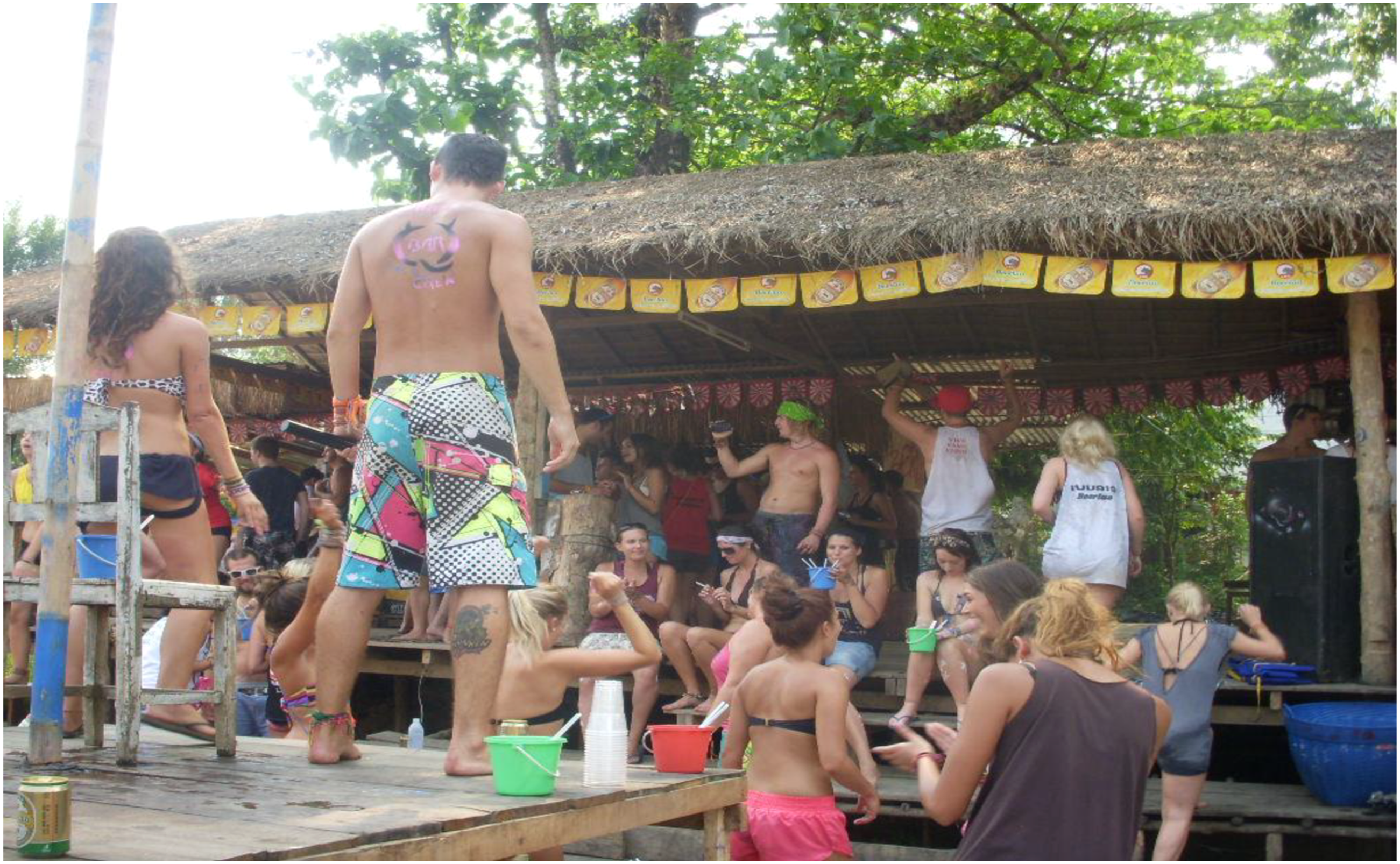
The starting point for access to the river bars was a small dirt road that ran right in front of the farm guesthouse (where I lived) inside Dao Tha village. Every morning, tuk tuks would bustle down the narrow bumpy road in the village, constantly dropping off groups of tourists at the river. The banks of the Song River in the village had become completely lined with countless bars built with bamboo and hefty wood panels with graffiti on the walls. These bars competitively played deafening rock music throughout the day from as early as eight o’clock in the morning for twelve hours until the evening. While the constant noise was one of the most unexpected and challenging aspects of my fieldwork, I became familiar with new pop songs, such as Adele’s “Set Fire to the Rain” and Jay-Z’s “Empire State of New York,” both of which ironically became my favorites. When the British rock band Oasis’s “Don’t Look Back in Anger” was played to signal the closing of the bars for the day, I often imagined that the song was constantly urging me to not look back at the bars “in anger” because of the chaos that global tourism had brought to life in Dao Tha (Figure 2). The daily scene at one of the tourist bars along the river in Dao Tha during the peak (dry) season in December.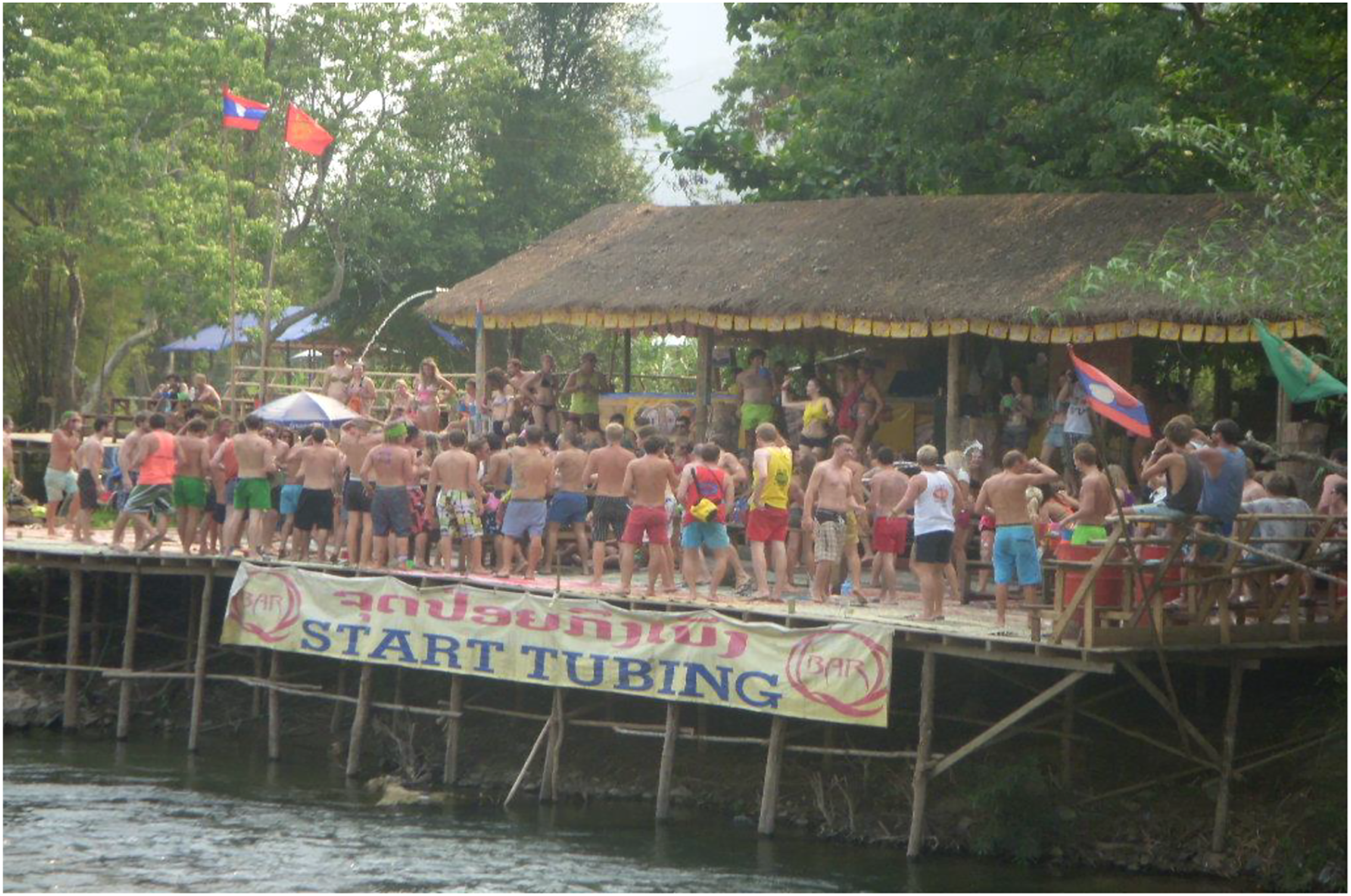
Undoubtedly, the Dao Tha villagers were exposed to, and experienced, this burgeoning global tourism in various ways. Most of them were initially rice farmers who owned or rented small plots of land located in different fields. However, as they have been increasingly inserted into a “globalized” village and encountered foreign tourists from Western countries on an everyday basis, not only did they witness the construction of new local tourist businesses, many of them also actively participated in and worked for this expanding industry.
Racial stereotyping and global hierarchies: The relationship between the foreign and the local
The scholarship on tourism has long been interested in the diverse interactions between mainly Western white tourists and the local people they meet, and the consequences of this ethnic encounter (Evrard and Leepreecha, 2009). For example, scholars have examined how tourist perceptions of locals deeply resemble those of colonial history based on sexual and racial hierarchies. For example, Dean MacCannell (2011) claims that global tourists’ perceptions of local people are similar to the way the “Orient” is created and gazed upon by the West, and therefore touristic visits and encounters are a process of discovering the exotic “Other.” This raises the possibility that tourists are unintentionally implicated in the perpetuation of the colonial desire to subjugate racialized Others as simultaneously malleable and threatening (see Said, 1978).
In contrast, fewer studies have ethnographically examined how locals perceive foreign tourists. In a study of tourism in Barbados, George Gmelch (2012) discusses the clear racial division between guests and hosts. Although some of these relationships may develop into amorous ones, they are mainly commercialized and are usually not sustainable because of the nature of the brief and superficial encounter. Tourists are often admired by locals because of their wealth and, as Gmelch notes, they become “a reference group for the host society” and “living manifestations of the wealth Barbadians so frequently see in movies and on TV” (Gmelch, 2012: 35). While the encounter between tourists and locals can sometimes lead to positive experiences and memories, it is also possible for the relationship to become contentious, and even exploitative, when locals are subject to racial and sexual “othering” by the tourists (see Dahles, 2009). For instance, this is the case when the locals are the target of tourists’ erotic desires, as shown among Afro-Brazilian women in the case of Salvador, Bahia, in Brazil (Williams, 2015).
Indeed, the relationship between global tourists and local tourees can invoke racial hierarchies and thus become negatively charged, leading to mutually unfavorable perceptions. This is especially the case with residents and tourism employees in Dao Tha, who racially stereotyped foreign tourists based on their negative experiences. In sum, the mutual encounter between tourists and locals is embedded in global hierarchies and inequalities based on race, socioeconomic status, and culture, all of which structure perceptions they have of each other as well as their social relations. Nonetheless, such intertwined hierarchies and unequal statuses are not always fixed but can be reversed, at least temporarily, depending on the positions of the two groups. In this context, it is important to illustrate ethnographically the perceptions and experiences that both foreign tourists and the locals have of each other.
Racialized stereotyping of global tourists
In Dao Tha, there were countless incidents and disputes between tourists and local residents that became part of everyday life. At the end of the day, the road in front of my host family’s guesthouse in the village frequently turned into a site for public fights between drunk tourists who accused tuk tuk drivers of “ripping them off” and the drivers who claimed that their customers were trying to take off without paying the fare. As they yelled and screamed in the growing darkness, each side ended up threatening to call the local police from the Vang Vieng district office, although no officers would show up to deal with these kinds of disputes which were a regular occurrence. While the tourists complained and alleged that the local people are “corrupt and dishonest,” the latter were clearly frustrated about the misconduct and illicit behavior of the foreign tourists.
The Dao Tha youth I interviewed who were employees in the tourism industry gave critical accounts of foreign tourists. Because the tourists were predominantly white Westerners, their behavioral and cultural attributes were also stereotyped and as those of a separate race of people, making them appear more essentialized and engrained as apparently irreconcilable differences. Dao Tha villagers constantly racialized the tourists as farang, which literally means the French people (from the era of French colonialism) but has been a more popular and generic term homogeneously applied to all white people (or Westerners) in both Laos and Thailand (see also Cohen, 1982; Thompson et al., 2016). While there are other terms that refer to “foreigners,” such as kon tang pa-thet or, less commonly, “kon kao” (which literally means white persons), farang was specifically used by the locals when discussing tourists.
Xue, a young Hmong in her early twenties who works at a restaurant, noted that she repeatedly observed white foreign tourists misbehaving and spoke about their racialized differences as follows: I think they are different [from us]. In general, the farang do not seem to know about shame [naa aai]. They just drink beer and alcohol every day, as much as they want. Also, they always take buses, bikes, motorbikes, or cars even for very short distances [instead of walking]. I also think they don’t like people in Laos.
Indeed, there was a common tendency among young tourism employees in my study to homogeneously racialize all white tourists as farang regardless of their country of origin. None of them differentiated the tourists by nationality (Australians, British, Americans, etc.) and they apparently did not recognize such differences while stereotyping them pan-racially as white Westerners. In addition, they contrasted the behavior of these white foreigners with that of the local people. Although the differences among the Lao Loum, Hmong, and Khmu villagers were an inevitable and pervasive part of their daily lives, they were seen as more flexible, ethnic (son pao) differences and therefore not as engrained and insurmountable as the racial differences of the white outsiders. In fact, such internal differences between local ethnic groups were generally blurred and disregarded as they were homogenously grouped together when compared to the foreign tourists. In this sense, the “us versus them” distinction became a racialized one between “Asians” (kon asi) versus “whites” (farang).
This was quite apparent in the comments of Mai, a young female employee at an Australian-run restaurant: Yes, farang are different. For example, Asians are shyer, although they may also know how to have fun. When they see a girl with no proper clothes like bikinis, farang men do not think the same as Asian men. Asian men would say, ‘Oh she is a bad girl!’ But the European guys would say, ‘Oh, good girl! She is sexy, good!’ I think it is impossible for Lao people to say things like that [laughs].
I asked Mai whether she could be friends of those “farang” tourists. “Maybe,” she answered rather indifferently, but followed-up with this harsh remark: “I don’t like their dirtiness (peun). In terms of dressing up in sexy clothes, I am okay with it, because I also like it [laughs]. But I don’t like their dirty ways. They eat dirty and play dirty (gin peuon, lin peuon).”
On a daily basis, Dao Tha villagers readily encountered foreign tourists getting drunk on “bucket Lao,” doing drugs, having sex with other tourists or engaging in prostitution, and not paying for accommodations and other services rendered. Kham, a relatively new employee in the local tourism industry, confirmed this prevalent viewpoint by stating that “they [tourists] get drunk so much. They don’t even pay for what they eat in the restaurant, so the owners sometimes have to call the police.” Such negative images of tourists may not be entirely exaggerated and biased stereotypes since local owners of internet cafés, guesthouses and hotels, bars, restaurants, and stores did experience and frequently complained about repeated problems with tourists who run away without paying for services they received and for food and accommodation.
There were even reports of shoplifting by foreign tourists from local stores, which outraged some of the business owners I met. “I am sure none of these behaviors would ever be acceptable in their own country,” one of them told me, raising his voice out of anger. “They think they can do anything they want in this country, because this is Laos and we are poor!” From the perspective of the locals, many tourists seemed to feel empowered to freely misbehave and even intentionally commit misdemeanors because they positioned themselves as racially, economically, and nationally superior to those living in a low-income, developing country.
In fact, some of the foreign tourists in Vang Vieng acted with apparent impunity in Laos without fear of being caught or punished. On one occasion, I shared a tuk tuk ride with a group of tourists, who apparently assumed I was one of the local women who could not understand English. A young white man, wearing only swimming pants, bragged about how he was able to get away with not paying for his hotel room and said, “They [the Lao people] need to learn how to run their business and provide customer services. They just lack any kind of professionalism as part of their service.” It is possible that unequal race relations and hierarchies are enabled by economic status differences between foreign tourists and local people, since the former seemed to feel entitled to “educate” the latter as a justification for refusing to pay for unsatisfactory services rendered.
When locals can be on “top”: Reconfiguring hierarchies?
However, even if such inequities between tourists and locals are based on global national, racial, and socioeconomic hierarchies, they are not always fixed and static but can be reconfigured in various local contexts. In fact, socioeconomic inequalities that generally position global tourists above local peoples can be challenged, or even reversed temporarily. As global tourism rapidly expanded in Dao Tha and surrounding areas, an increasing number of foreign tourists became long-term stayers who wished to continue enjoying the leisurely and entertaining lifestyle afforded to them in Vang Vieng. Even if their initial intention was to visit only briefly, many of them ended up extending their short-term tourist visas to stay longer and engage more extensively with tourist activities. The Lao Loum bar owners in Dao Tha came to realize that these tourists could actually help their businesses if recruited as “volunteer” workers since they are linguistically, culturally, and racially similar to tourist customers and would therefore promote the sales of alcoholic beverages. In exchange, the bar owners offered them free accommodation and food, and even paid for their visa extensions, allowing them to prolong their stay in Laos. They were called “volunteers (asasamak)” by the owners because they were technically not paid for their work, a term that was also used to refer to (unpaid) foreign “volunteers” who taught English in the village.
The relationship between the Lao Loum bar owners and these foreign “volunteers” became rather complicated over time since it came to resemble that of employers and employees. The bar owners gave the tourist volunteers orders and made specific demands, especially in terms of daily alcoholic beverage sales. Instead of resisting or attempting to improve their working conditions, some of these volunteers developed drug and alcohol addictions and were not in a condition to work effectively during the day. In such cases, the bar owners threatened to take their passports away and report their illicit behavior to the police in order to force them to comply with employer expectations if they wished to avoid risking their ability to continue their hedonistic lives in Laos.
In this context, it was no longer the locals who must always rely on and cater to their white tourist customers in a subordinate way, and even accept their misbehavior and lack of payment. Instead, the tourist “volunteers” became subject to the power of the local bar owners, and in fact became dependent on them for their safety and ability to continue living in Laos with their limited budgets. Power relations between Western tourists and locals are not always predetermined by global racial and socioeconomic hierarchies but constantly change over time as they are negotiated in various local contexts and situations. Although white tourists from rich nations are often assumed to be in an inherently superior position and able to act with impunity in a “poor” Southeast Asian country, those who stay in Laos become incorporated into and subject to the local power structure, eventually upending initial hierarchies between foreigners and locals. Dao Tha is therefore an active and dynamic tourist site that demonstrates how power is relational, unstable, and even reversible (see also Foucault, 1982; Hall, 2010; Simons, 2013).
The impact of global tourism on local ethnic relations
Not only has global tourism produced hierarchical relations between foreigners and locals based on racial and socioeconomic differences, it has also influenced and changed local ethnic relations in Dao Tha village in unexpected and unintended ways, an issue that has been relatively under-studied in tourism research. Over the years, tourism had become the most important source of employment in the Vang Vieng area and provided relatively high-paying jobs for the locals, although they were not respected or considered prestigious compared to government, educational, or public sector jobs, which provided lower incomes but conferred higher social status. For instance, while public school teachers were paid only about US$50/month, tourism jobs generally paid US$100–120 per month.
By providing such lucrative employment, global tourism in Vang Vieng reshaped local ethnic hierarchies in Dao Tha that used to economically benefit the majority Lao Loum compared to ethnic minorities in terms of employment. Because foreign tourists did not know or care about the ethnicity of local workers as long as they could speak English, ethnic minority village youth did not experience much employment discrimination in the tourism industry but were actually advantaged because of their superior language ability acquired from an NGO-supported English class in the village. On the surface, this seems to have made workplaces more egalitarian and diverse in ways that encouraged greater inter-ethnic interaction.
In a study of the Kyrgyz tourism, Nicola Palmer notes that the “perception of tension between groups is actually reduced by the effective development of tourism, so long as it is economically successful” (2007: 659). In the Latin American context, Florence Babb (2010: 3) similarly discusses how tourism is a site for nation-states/governments to realize their dreams and imagination to implement “development strateg[ies]” for the national economy and nationhood. In the process, local ethnic differences are often de-prioritized or eliminated in order to achieve such national agendas, which aim to promote a unifying image of a rich, harmonious culture that is not threatened by ethnic diversities in the country (see Picard, 1997; Werry, 2011).
However, economic rationality is not sufficient to explain the dynamics of ethnicity (see Trémon, 2012) or the reduction of ethnic differences and tensions, which are caused by the cultural politics embedded in ethnic minority–majority relations in Southeast Asian contexts (e.g. Jonsson, 2010; Ovesen, 2004; Pholsena, 2020). Nonetheless, economic considerations can certainly influence how different ethnic groups experience changes in their pre-existing relations and interactions in the case of tourism. During the peak of tourism in Dao Tha (and Vang Vieng), the economic opportunities provided by the expanding global tourism industry had transformed (at least temporarily) prior ethnic relations that had been constituted by historical, cultural, and political factors.
“All ‘equal’ under English”? The tourism economy and ethnic relations
Although many tourist businesses were owned by foreigners in the town of Vang Vieng, majority Lao Loum residents had also entered the local tourist industry and became its main beneficiaries. Some of them sold their agricultural land to build guesthouses, restaurants, or internet cafés for foreigners in town while others in Dao Tha became prosperous bar owners on the banks of Song River, which was a drastic contrast to their formerly poor lives as subsistence farmers. There were no tourist business owners in the village whose ethnicity was other than Lao Loum. Although Lao Loum bar owners initially did not have substantially better economic means compared to minority Hmong or Khmu, they had politically advantageous connections to local authorities who were members of the same ethnic group. They were often seen in public providing local officers with free food and alcoholic beverages and contacted them outside work hours for favors. This allowed them to deal with local regulations and negotiate the politics related to tourism businesses more easily.
While locally owned tourist businesses were dominated by Lao Loum individuals, they did not discriminate against minority applicants when hiring workers. As mentioned, because Vang Vieng primarily attracted tourists who wanted to have fun by getting drunk, doing drugs, and engaging in other illicit activities, very few showed interest in learning about the culture and history of the region or its local peoples. Those whom I briefly met who expected a peaceful, quiet rural village quickly left, commonly describing the local tourist situation as “crazy, unbearable, and embarrassing.”
Just as the local villagers did not consider the national diversity and differences of the white tourists, the tourists themselves were largely ignorant and indifferent about the multi-ethnic composition of the Dao Tha villagers, simply racializing them homogeneously as “Laotians” or “Asians.” The Hmong and Khmu youth working in either the town of Vang Vieng or the river bars in Dao Tha confirmed that tourists never asked about their ethnic background, except for occasional individuals who had briefly read about the history of Hmong in tourist guidebooks or online. In sum, it did not matter for the tourists whether the workers serving them were Lao Loum, Hmong, or Khmu.
Since locally salient ethnic differences and hierarchies are neglected by the tourists, the most important criteria for employment in the tourist industry became the ability to communicate in English with foreign customers and not ethnicity, which receded into the background. This was even more true in foreign-owned tourist businesses. In this sense, global tourism unwittingly created more equitable employment opportunities for previously disadvantaged minority youth (as long as they could speak good English) in contrast to the hiring inequity that existed both overtly and covertly in other types of businesses and employment. This was especially the case when educational credentials were required, since fewer ethnic minority individuals have graduated from high school and only a small number had opportunities to pursue higher education.
In the case of Dao Tha, the only way for youth to learn English outside school was through the informal class that had continued for many years with foreign volunteers (which included myself). The English class in Dao Tha had developed quite a reputation outside the village for its free and “real” lessons taught by foreigners. Lao Loum employers in the Vang Vieng tourist businesses were well aware of this and gave village minority youth credit for their English-language ability when they applied for jobs. As a result, Dao Tha youth of all ethnicities (and not just Lao Loum) were quickly hired as cooks, housekeepers, receptionists, servers at restaurants and cafés, tour guides, or riverside bar staff. My Lao Loum host father, who was the owner of a tourist guesthouse, intentionally hired many teenagers of different ethnic backgrounds from the village in addition to Lao Loum workers, emphasizing their informal English abilities as an example of “equal” education that provides opportunities for underprivileged minorities.
Reconfiguring ethnic relations through global tourism
Global tourism did not simply level the playing field between majority and minority workers when competing for jobs. Hmong and Khmu youth in Dao Tha were actually preferred as employees over majority Lao Loum because they generally spoke substantially better English, allowing them to further challenge local ethnic hierarchies that had socially and economically advantaged Lao Loum in the past. The reason why Hmong and Khmu youth had better language skills is because many more diligently attended the English class in the village compared to their Lao Loum peers. In fact, less than one third of the English class I taught consisted of Lao Loum youth, making them a “minority” of the students, unlike in local public schools. When my English class officially opened in the village, my Lao Loum host father (who sponsored it) and I received a lot of criticism and complaints from the parents of Lao Loum youth because of the location of the class (it was much closer to the Hmong community) and also because the class was open to all ethnicities, not just to Lao Loum students.
Overall, the ethnic minority students were much more motivated to take the class and study English, perhaps because it was a more fun and engaging than the local school, with an informal learning environment. When I conducted participant observation and taught briefly at public schools as part of my previous volunteer work, I frequently observed that the teachers (who were also predominantly Lao Loum) singled out ethnic minority students in class in the name of promoting their “equal” participation, which I found uncomfortable at times. Initially, the Lao Loum students in my English class had no minority friends because they lived in different segregated communities in Dao Tha and did not want to study alongside their Hmong and Khmu peers. In fact, many Lao Loum parents continued to pressure me (unsuccessfully) to teach English only to their children in a separate class and were even willing to pay me to do so, which could have exacerbated existing ethnic segregation in the village.
The employment advantage enjoyed by Hmong and Khmu youth in Dao Tha in the local tourism industry, because of their better English skills, also led to some resentment among Lao Loum youth who did not attend the English-language class and were not hired for tourism jobs. Because of their lucrative nature, local tourism jobs were attractive for Lao Loum youth, even those from other cities with two-year college, university, or vocational degrees. Although they were much more academically qualified than minority Hmong or Khmu youth from Dao Tha, their educational backgrounds were less valued by tourism businesses than language skills acquired from an informal English class offered in a small village.
These Lao Loum youth mainly studied English grammar and took tests but did not speak the language proficiently, even if some of them had foreign instructors. This contrasted with youth in Dao Tha, who had acquired practical conversational skills extensively with foreign volunteer teachers. As a result, Lao Loum job candidates felt that the “equality” that existed among ethnic groups when competing for tourist jobs was rather “unfair.” According to one ethnic minority tourism worker I spoke with: Lao [Loum] kids, especially those outside our village who competed with us and did not get the job are very upset about it. They spent years and money studying English with farang teachers [in college], but we came to speak better English in the village. They were clearly upset about it.
In this sense, neither the majority ethnic status of Lao Loum nor their higher educational status was much of an asset in the Vang Vieng tourism industry. Instead, minority youth with superior English skills were prioritized in the local job market, which in turn disrupted the dominant position of educated Lao Loum and challenged pre-existing ethnic relations.
Similarly, global tourism also reconfigured ethnic relations at the workplace. Most of the time, ethnic minority employees from Dao Tha said that they felt they were treated “equally” by foreign tourists who had no ethnic preferences or local knowledge that would cause them to favor Lao Loum over Hmong or Khmu workers. In contrast, domestic (Lao Loum) customers and employers often compared them with Chinese immigrant businesspeople and complained that minority employees and vendors do not speak the Lao language properly. Ironically, such pre-existing internal ethnic differences seemed to have been neutralized because of the foreign influence brought by global tourism.
The multi-ethnic nature of the local tourism industry brought together individuals of different ethnic groups who had previously lived segregated lives in separate ethnic communities in Dao Tha village. As mentioned earlier, prior to their interaction at tourist workplaces, Dao Tha youth had limited opportunities to associate with those of other ethnicities outside school. In fact, when we visited their different ethnic communities in Dao Tha once the students in my English class became more familiar with each other, many of them told me that it was the first time they had done so. Young employees of different ethnicities that I interviewed also commented on their positive interactions with each other at tourism workplaces and the friendships they had made across ethnic boundaries. One of them stated that working at a restaurant for foreign tourists was “fun,” because she “made four or five friends there and [we] cared about each other. All of them are Lao Loum.” The tourist workers from different ethnic groups also increasingly got together to eat and drink after work until late at night or socialized at each other’s homes.
Nonetheless, it remains uncertain whether such multi-ethnic work environments are conducive to meaningful, long-term inter-ethnic relationships and understanding or can simply reinforce pre-existing ethnic misconceptions and stereotypes. In fact, the tourism industry also exacerbated ethnic tensions. Minority employees often talked about how they were scolded or penalized by their bosses and business owners because their Lao Loum co-workers (who have privileged access to their co-ethnic employers) sometimes lied and intentionally gossiped about them. Lao Loum youth from urban areas with college educations who worked with less educated and previously poor Hmong or Khmu village youth also looked down upon their minority co-workers. In this sense, the multi-ethnic future of Dao Tha may consist of both “convivial” and “conflictual” (Pholsena, 2020) relations among its members in response to shifts in global tourism.
It should also be noted that there is a significant drawback to the availability of high-paying tourist jobs for minority Hmong and Khmu youth. When I returned to Dao Tha for fieldwork, I found that many of them had dropped out of school in order to work full-time in the tourism industry. Among the 40 students in my previous English class only about a quarter of them had finished high school or were going to college (most of whom were Lao Loum). Although some of them did say that they “regretted” their decision at times and wished to go back to school eventually, they also emphasized the enormous economic benefits of working in the tourism industry. I bitterly observed how these youth never went back to school, as they repeatedly quit one tourism job and then moved on to another. Others were enjoying their new lifestyles enabled by the sudden wealth they had attained. When they withdrew from school, the parents did not object because their children were providing an indispensable source of income and did not have other viable future job opportunities in their opinion.
Conclusion: The uncertain future of tourism and ongoing precarity
A full account of the impact of tourism on local people must examine not only their external relations with foreigners, but also how their internal ethnic relations can be reconfigured in the context of global tourism. Such an analysis in the case of global tourism in Dao Tha also illustrates how seemingly entrenched racial and ethnic hierarchies are always in perpetual flux. Although relations between global tourists and locals are based on long-standing international and racial inequalities, the former are not in a permanently dominant position but can become incorporated into local power structures in subordinate ways over time. Likewise, local ethnic hierarchies based on historically entrenched inequities that often privilege the ethnic majority can be challenged in unexpected ways by touristic labor markets that seemingly disregard such ethnic considerations and advantage minority youth with linguistic skills.
These outcomes also highlight the relative nature of cultural differences and diversity in race and ethnic relations. Despite the considerable national diversity among global tourists in Vang Vieng, they were homogeneously stereotyped and racialized by Dao Tha villagers as “farang” (white foreigners), making their cultural differences appear more essentialized in contrast to the locals, whose ethnic diversity was also downplayed and homogenized as “Asians” or “Lao people.” In turn, the foreign tourists commonly viewed the locals as unquestionably poor people in a “Third World” country, thus overlooking their considerable internal differences. This seemingly promoted egalitarian and inclusive hiring practices in tourist businesses that provide critical socioeconomic opportunities for minority youth. The end result was a more diverse workforce that promotes inter-ethnic interactions in ways that can reduce or exacerbate local ethnic tensions.
Although Hmong and Khmu youth can be the beneficiaries of such ethnic reconfigurations under global tourism, their socioeconomic gains may still be precarious and fleeting as local/global circumstances continue to shift. In the complex web of relations created by global tourism, the Lao state was seemingly absent throughout the development of tourism in the area. For long time, the government made no attempt to regulate or control tourism in Vang Vieng, regardless of the prevalence of illicit tourist activities. Despite multiple visits by government officials from major cities, who stopped by Dao Tha to observe the notorious riverside bars, it soon became apparent to me that they had no intention to intervene.
However, the situation dramatically changed after my fieldwork. Before the ASEAN (Association of Southeast Asian Nations) Summit in Vientiane in 2016, the Lao state suddenly shut down all the bars along the river in less than a week. Indeed, the state’s vision for the economic globalization of Laos is not simply about promoting tourism for revenue, but also carefully cultivating to foreigners a “clean” image of a law-abiding country that does not tolerate illicit activity for the sake of national economic development. This is especially important during international political events such as ASEAN, which usually start and end with photo ops showing Southeast Asian political leaders holding hands, and also involve tours of major tourist destinations, including Vang Vieng. From the state’s perspective, the “embarrassing” consequences of global tourism must be cleaned up so as not to ruin the efforts of political elites to project a progressive image of the country. In sum, the state continues to retain its authority to exercise power whenever necessary to promote its nationalist agendas.
Such state intervention undoubtedly has had serious repercussions for local Dao Tha villagers. In the short term, the sudden closure of the tourist bars caused the immediate loss of income for Lao Loum business owners and unemployment for their minority workers, although job opportunities may remain in other tourist businesses in town. However, since global tourists have now been deprived of one of their favorite activities at the riverfront bars, this may also portend a long-term decline in global tourism in Vang Vieng.
In addition, during the 2020–21 coronavirus pandemic, which certainly decimated tourism in the area, many of the Hmong and Khmu youth became unemployed. Because most of these minority employees dropped out of high school in order to pursue lucrative tourist jobs, they do not have the educational credentials to successfully find alternative employment. Although there are other jobs in the local economy where English skills are valued (such as language teachers or low-level public and government employees), they require higher levels of education, which again leaves Hmong and Khmu youth at a disadvantage compared to the Lao Loum, who could more readily pursue college degrees. In sum, although minority youth were able to temporarily capitalize on the employment opportunities offered by global tourism, their ability to overcome structural ethnic inequalities that place them in a precarious position is still questionable.
Footnotes
Declaration of conflicting interests
The author declared no potential conflicts of interest with respect to the research, authorship, and/or publication of this article.
Funding
The author received no financial support for the research, authorship, and/or publication of this article.
