



Abstract
Building on theory within anthropology and associated fields, I develop feralness as a lens for understanding the complexity of technological afterlives. Conceptual development proceeds through a case study of the relationship between Do-it-Yourself Biology (DIYbio), nonprofessional scientists experimenting with the established technology of recombinant DNA in new contexts such as garages and kitchens, and the Federal Bureau of Investigation (FBI). Absent the institutional controls of academia or industry, DIYbio has been perceived by the FBI as a potential threat to national security and is policed by the FBI’s Weapons of Mass Destruction Directorate. Though the FBI has tried to contain the spread and reach of DIYbio, it has, ironically, came to be one of the main instruments of DIYbio’s global spread. In closing, I argue that feral technologies, those technologies with unexpected and potentially dangerous afterlives, are emblematic of the 21st century.
I made [the AK-47 assault rifle] to protect the motherland. And then they spread the weapon [around the world] – not because I wanted them to. Not at my choice. Then it was like a genie out of a bottle, and it began to walk all on its own and in directions I did not want. – Mikhail Kalashnikov (quoted in Walsh, 2003)
During a 2010 talk at Xerox PARC (Palo Alto Research Center), Genevieve Bell offered a provocation. Spurred by extremes of drought and flood and a sparsity of population, Australian agriculturists of the 19th and early 20th centuries imported a litany of animals to improve their productivity: donkeys, deer, goats, horses, pigs, water buffalo, cane toads, camels, dogs, cats, and rabbits. Inevitably, Bell notes, these animals slipped the fences and fields of their domesticated lives and escaped to the unpoliced expanse of the Outback, returning feral, as plagues and pestilence, always at the expense of indigenous ecosystems and often at the expense of the very agricultural interests they were imported to further. In short order, Australian agriculturists found themselves in the paradoxical position of becoming the most powerful lobby acting to contain feral animals while remaining the most potent force spreading those same animals. The irony was not lost on Australian cartoonists of the time, as can be seen in Figure 1. ‘Stevenson’s wire fence’. Source: The Queensland Figaro, 2 August 1884, p. 129.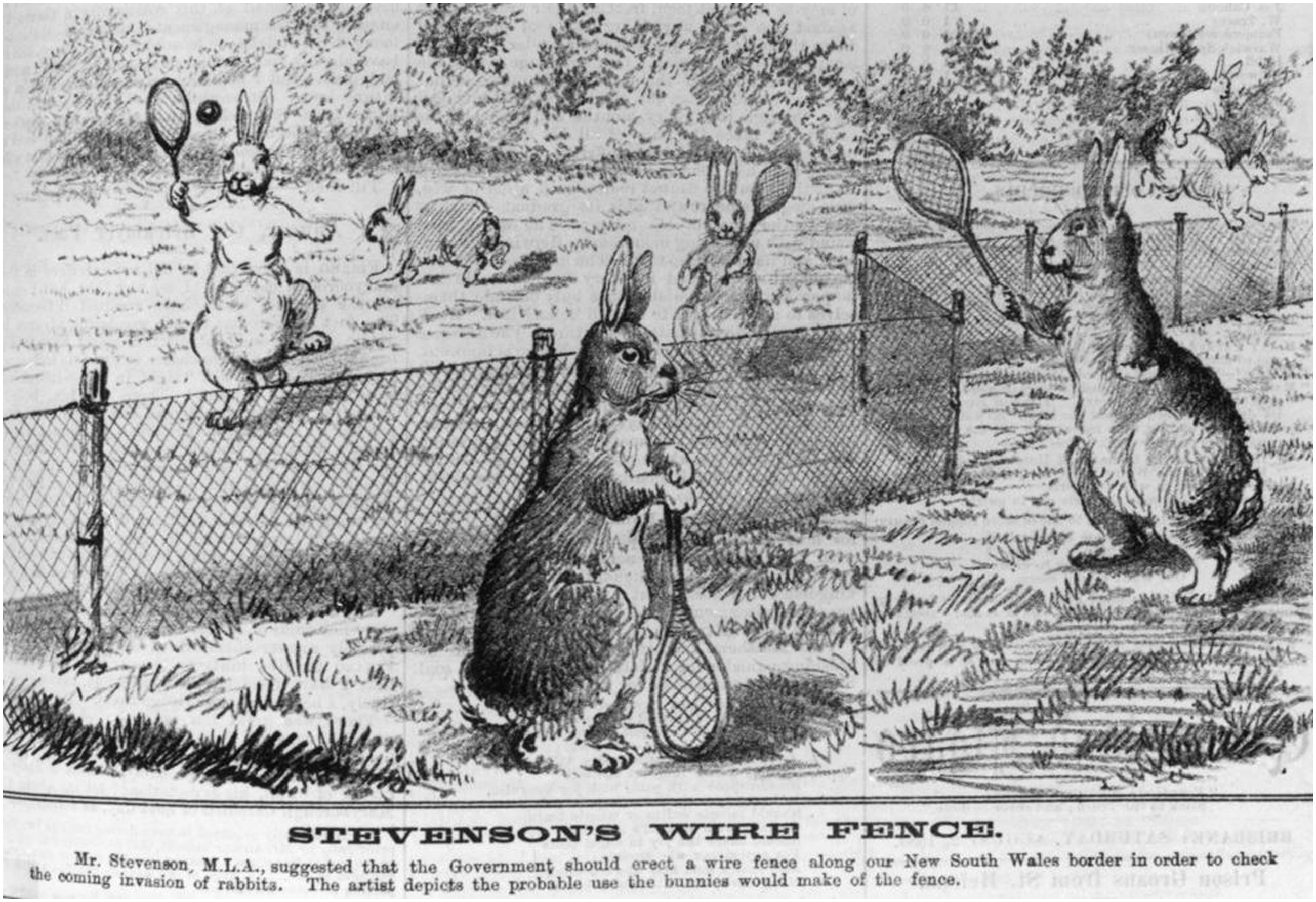
Out of this long history, Bell finds an analogy for the afterlives of technology. Pointing to the unexpected twists and turns taken by the internet as it spread, Bell wryly observes that seemingly domesticated and settled technologies often slip the received wisdom about users, contexts, and regulatory regimes to emerge in new locations as feral versions of their former selves. Bell focuses her analogy on the unexpected uses and transformations that technologies take on as they spread, for example, technologies that begin to “walk on their own” as Kalashnikov lamented, leaving the bounded space of regulation, proprietary protocols, and walled gardens behind.
In Bell’s hands, feral marks a deviation from a norm. It indexes surprise and change at the unanticipated consequences of planned action (Giddens, 1979, 1984; Merton, 1936; Varenne 2019), calling attention to the often-provincial assumptions of designers and technologists. Further, Bell’s analogy contains a point as obvious as it is overlooked: institutional control of technology is always partial and often ineffective. Institutions are as likely to find themselves in the comedic position of Australian agriculturists as in the panoptic position of Bentham’s jailers.
That day, Bell’s audience was composed of technology executives and engineers, and many, if not most, knew quite well what happens to their technology when repurposed in the garage or shed. Under the labels of open and lead-user innovation (Von Hippel, 1986), technology companies regularly look far and wide in garages and sheds for that magical deviation from the norm known as disruptive innovation (Christensen et al., 2015).
In what follows, I narrate a history of the FBI and Do-it-yourself biology (DIYbio) and examine how the FBI tried to contain the spread and reach of DIYbio and yet ironically came to be one of the main instruments of DIYbio’s spread. 1 DIYbio can roughly be defined as amateurs, often with little or no laboratory experience, experimenting with DNA in bathrooms, kitchens, garages, and increasingly in public laboratories. Empirically, I draw on two years of dissertation fieldwork as a volunteer and member of the Silicon Valley DIY laboratory BioCurious, an archive of documents generated by BioCurious, and interviews (n = 32) with members and volunteers at BioCurious. Though my fieldwork encompassed two years of on-site work at BioCurious (Scroggins, 2017a; Scroggins and Varenne, 2019), the ethnography presented here focuses narrowly on the 2012 FBI/DIYbio conference held at BioCurious and a small follow-up conference held two years later. In closing, I briefly address how the FBI came to be supplanted by the MIT Media Lab, which, like the FBI, has the reach and budget to assemble an international conference of DIYbiologists, but unlike the FBI, also seeks to convert DIYbio’s constant stream of feral deviations into a steady stream of biotech innovations.
Before turning to that task, however, a brief review of the analytical uses of the term “feral” in the social sciences will prove helpful.
Unpacking feralness
The canonical meaning of the term “feral” comes from biology and derives from the Latin ferus, or wild. In English, it acquired its common use in the 19th century as a once-domesticated animal that has returned to the wild. A subtle implication is that an expected path – from natural to cultured – is reversed. The term “feral,” above all, is a marker of the deviant from the perspective of the normative.
Over the last twenty years, the term “feral” has been used intermittently across a range of social science disciplines: in cultural studies to describe citizens with a deviant relationship to middle-class norms in Australia (St John, 1999) and New Zealand (Beddoe, 2014); in urban planning to account for future scenarios in which the risks inherent in planned action make futures less desirable (Ramírez and Ravetz, 2011); in science studies to describe a genre of online videos detailing the wanton destruction of iPhones by their owners (Michael, 2018); in postcolonial studies (Clark, 2003; Rollo, 2018) to describe the effects of settler colonialism and challenge domesticated livestock as a symbol of settler civility (Anderson, 2004); in the environmental humanities to address the phenomena of unsupervised domestic animals in urban environments (Fortuny, 2019); and in communications to describe unexpected and destructive uses of hypertext (Rettberg, 2010). 2 Dourish and Bell (2011: 169) develop feral as part of a tripartite division in the life of technology to better understand the unexpected trajectory and unanticipated afterlives of ubiquitous computing. Comparing the biographies of technologies with the canonical definition of “feral” as a formerly domesticated animal that has escaped the bounds of domesticity, they mark distinctions between wild technologies, only recently developed in laboratories and without a well-developed commercial home; and domesticated technologies, safe and useful technologies found in in household and industrial contexts; and feral technologies, those taken out of domesticated industrial and household context and remade in garages or workshops into feral versions of their domesticated selves.
What binds these uses of “feral” together is their deployment of the term in opposition to a normative order that is assumed to be rational and orderly. In the works above, “feral” appears as a negation, a negative appraisal of a course of action. There is an assumed course of action and a deviation from that course marked as feral. As I intimated in the previous section and develop in sections to follow, this dynamic can have multiple outcomes, ranging from reactionary policing to an opportunity for disruptive innovation.
Recombinant DNA slips the fence: From Asilomar to DIYbio
The history of DIYbio begins with the domestication of recombinant DNA (rDNA), the subject of the 1976 Asilomar Conference, where a cohort of academic biologists decreed that the fate of rDNA would remain in the hands of, and follow the domesticating strictures of, academic biology. However, like Bell’s rabbits and Kalashnikov’s gun, the technology of rDNA escaped this attempt at containment, emerging unexpectedly in kitchens and garages in the early 2000s.
While a robust history of rDNA is beyond the scope of this article, it should be noted that the primary mechanisms of rDNA’s spread were: (a) governmental policies aimed at transferring technology from university laboratories into the marketplace and (b) conversion of cutting-edge techniques for working with rDNA into commercially available kits (and protocols for the newly invented PCR machine), enabling work previously reserved for only the most advanced labs to be performed by those with a minimum of equipment and expertise (Weiner and Slatko, 2008). So democratized and common had the tools and techniques for working with rDNA become that in a series of articles in the IEEE Spectrum and Wired published in the early 2000s, Rob Carlson (2001, 2005) took stock of the possibilities and proclaimed the age of “garage biology” was upon us.
Concomitant with Carlson’s proclamations were the anthrax attacks following 9/11. The same tools, techniques, and creative impulses that Carlson assumed would usher in a new era of biotech innovation were perceived by the FBI as a clear and present threat to national security. Though a decade later the FBI would conclude that only a highly trained military scientist with access to weapons-grade anthrax could have been responsible for the attacks, in the immediate aftermath of the attacks, it was widely believed in law enforcement circles that an amateur with a lab in a kitchen or bathroom could have made the anthrax used in the attacks. In a 2001 news conference, officials from the FBI claimed that anyone with moderate scientific knowledge and $2,500 worth of “basic laboratory equipment” could create the anthrax used in the attacks in the privacy of a kitchen or garage. 3 Such an unexpected and unwelcome new normal (Varenne, 2019) demanded a new containment strategy.
The new strategy did not develop overnight. In 2004, a team of armed FBI agents burst into the home of bio-artist Steve Kurtz in upstate New York, following a hurried 911 call requesting medical assistance for his ailing wife (Hirsch, 2005). Haunted in part by memories of the 9/11 attacks and in the main by the failure to identify a suspect in the following anthrax attacks, a call made by Kurtz to 911 about his ailing wife ended with drawn guns, hazmat suits, and years of legal wrangling. The image of Kurtz shackled hung like a specter over the early years of DIYbio. After the Kurtz debacle, the FBI began preemptively reaching out to DIYbio groups, gently asking about experimental programs and safety policies. In its formative years, DIYbio would find itself caught between two poles, seen by the FBI as a potential source of danger and by business interests as a potential source of new riches. Both set themselves in relation to DIYbiologists’ deviation from the assumed course and context of biological science, the former seeking to curb those deviations and the latter to capitalize on them.
By 2009, DIYbiologists interested in opening public laboratories, such as Mac Cowell and Jason Bobe in Boston, had established durable relationships with the FBI. From the FBI’s point of view, the formation of DIYbio laboratories was a welcome and productive development, as it brought most (though not all) DIYbiologists out of their kitchens and garages and into the view and jurisdiction of local municipalities. As public labs began to open, the FBI deepened their initial relationships with DIYbio by inviting DIYbiologists to participate in a series of joint conferences. The initial meetings were held in concert with existing synthetic biology conferences, but eventually the FBI decided to hold conferences specifically with and for DIYbiologists. The first FBI/DIYbio conference was organized in 2011 at Genspace, a DIYbio lab in New York. During these early meetings, a new idea of policing emerged. The FBI would establish friendly relationships with DIYbio laboratory organizers and invite them into an open dialogue, rather than break down their doors following an incident. Aiding in this effort was a new cohort of FBI agents hired in the wake of 9/11 with backgrounds in science and technology. Many of these young FBI agents shared both laboratory training and a sunny outlook on the possibilities of genetic engineering with their counterparts organizing DIYbio laboratories.
Before proceeding further, a brief history of BioCurious is in order. A half decade prior to opening as a public laboratory in 2011, the idea animating BioCurious was hatched in an Arizona warehouse in the mid-2000s when a German graduate student, John Schloendorn, funded by Aubrey De Grey’s life-extension foundation (SENS – Strategies for Engineered Negligible Senescence) and pursuing a PhD in Bruce Rittmann’s laboratory at Arizona State University, decided to use some of his SENS funding to open a small laboratory in a nearby warehouse. While looking at warehouse spaces, he met real estate agent Eri Gentry and discovered a mutual affinity for biotech startups. It was not long before Eri and John set off to Silicon Valley to explore the possibilities of biotech in the new age of garage and kitchen experimentation.
In Silicon Valley, through means that remain a closely guarded secret, they acquired a line of cancer cells and began experimenting with the cancer-killing potential of white blood cells in the kitchen of their Mountain View condominium. 4 To support their experimental efforts, John continued a practice he had begun in Arizona – buying and selling used laboratory equipment via Craigslist and eBay. Meanwhile, Eri organized a Meetup group that met regularly in their garage. Among the early visitors to their garage Meetup was Peter Thiel, who was impressed enough with John’s moxie and skill to invest US $1.5 million in his cancer-fighting startup, Immunepath. Eri meanwhile continued the Meetup group, which, in short order, acquired the name BioCurious. Immunepath had a brief life, while BioCurious is still open for business. 5
When it outgrew the Mountain View garage, Eri’s Meetup group met hither and thither across Silicon Valley in a series of picaresque adventures in biology. One month, they met at a winery owned by a potential BioCurian to discuss the biology of wine grapes, another month they met in a private home to screen a documentary about synthetic biology. It was during the Meetup period that support, interest, and media attention were gathered prior to opening a public laboratory. The Meetup period also established the kind of interests BioCurious members would bring to the laboratory. Participating were those with the time, means, and inclination to take up experimentation as a hobby and those willing to talk about the possibility of experimenting while networking their way across Silicon Valley: working scientists and graduate students looking to work on personal projects away from university strictures, retired technology executives, entrepreneurs seeking the next big thing, and engineers interested in hacking hardware and making DIY versions of common laboratory equipment.
It was during this Meetup phase that the original BioCurious board members would join Eri: Tito Janikowski and Josh Perfetto, engineers who had designed a low-cost PCR machine called OpenPCR; Joseph Jackson III, Eri and John’s Mountain View roommate and a philosopher interested in transhumanism; Raymond McCauley, a co-chair of Biology and Bioinformatics program at Singularity University; and Kristina Hathaway, a human resources specialist with a background in startup companies.
Propelled by Meetup success and a burgeoning media profile, BioCurious became one of the first successful crowdfunding campaigns on Kickstarter when 239 people contributed $35,319 (52 people contributing between $100 and $500) in September 2010 (“BioCurious: A Hackerspace for Biotech. The Community Lab for Citizen Science,” 2011).
6
The Kickstarter campaign was conducted under the auspices of Joseph Jackson’s Network for Open Scientific Innovation, a 510(c)3 corporation capable of taking tax deductible contributions and the Kickstarter tagline hewed to the innovation tact foreshadowed by the Meetup period: Come be a part of the next big thing to come out of a Silicon Valley garage! Curious about Biology? Find out more at the new biology collaborative lab space where citizen science moves out of the classroom and into the community. Following the successful example of hackerspaces such as Noisebridge, Langton Labs, Hacker Dojo, and co-working spaces such as the Hub, we’re pleased to offer the first Bay Area space dedicated to Non-Institutional Biology. Got an idea for a startup? Join the DIY, “garage biology” movement and found a new breed of biotech. Meet cofounders and friends and make things you’d never dreamed possible. (Kickstarter, 2010)
If Eri’s media savvy made gathering a core of interested members via Meetup, raising enough money to open via Kickstarter, and acquiring laboratory equipment look easy, finding a local municipality willing to allow a “garage lab” to operate within city limits proved more of a challenge. After a series of time-consuming appearances before the Mountain View city council, BioCurious’s petition to open a “garage lab” in Mountain View was rejected. Eventually, almost a year to the day after the successful Kickstarter campaign, BioCurious opened in neighboring Sunnyvale, home to silicon chip makers Intel and AMD. I would begin two years of fieldwork at BioCurious in August 2011, working the first volunteer shift at BioCurious and later participating as an active member of the laboratory. At volunteer orientation, the board of BioCurious laid out a vision of a “garage lab” supported by membership fees, about the cost of a local gym membership, and public classes.
Like the Meetup phase, those joining as members almost all had entrepreneurial or technical backgrounds (often retired or in between jobs or companies) and were most often young and middle-aged white men. As one member told me, “the time and monetary commitment for doing DIYbio is on par with playing golf.” And so, I surmised, are the demographics. Volunteers, who were granted laboratory access for working 20 hours or more per month, were drawn from the ranks of college students, experienced nonprofit volunteers, and local job seekers looking to network and gain laboratory experience. Not surprisingly, in contrast to members, volunteers were the more demographically diverse group. About half the volunteers were women, and ages ranged from early 20s to mid-70s. Rounding out BioCurious was a handful of University of California Berkeley and Stanford postdocs and graduate students who taught public classes. There was also a Saturday Morning Science class for kids, organized by a middle school science teacher that brought a steady stream of middle school children and their parents into the lab.
There were few members with full-time jobs. Commuting in Bay Area traffic proved too much for most of the after-work crowd. My interviews showed that most regular members (3+ visits per week) lived no more than a 15-minute drive from BioCurious. Despite consistent local, national, and international media coverage, the time commitments of biological experimentation and the location of BioCurious (far from the nearest public transit hub) meant that there were, in total, never more than 30 members and volunteers active at any given time in the two years of my fieldwork. In the laboratory, away from media coverage, BioCurious was a local affair.
Containing non-institutional biology at the 2012 FBI/DIYbio meeting
As I mentioned previously, in 2011 the FBI held a joint FBI/DIYbio on the east coast of the United States with Genspace as the sponsoring laboratory. In 2012, an FBI/DIYbio conference was scheduled on the west coast with BioCurious as the sponsor. Due to an obscure regulation about the size of hotels required for government-sponsored conferences, the 2012 FBI/DIYbio conference was held in Walnut Creek, approximately 75 minutes by car from BioCurious but a short train ride from the hackerspaces in Oakland and San Francisco. Despite this logistical hurdle, in attendance were DIYbiologists from labs in Asia, Europe, and North America (Figure 2). Poster for the FBI–DIYbio Outreach Workshop, 2012. Source: Photo by the author.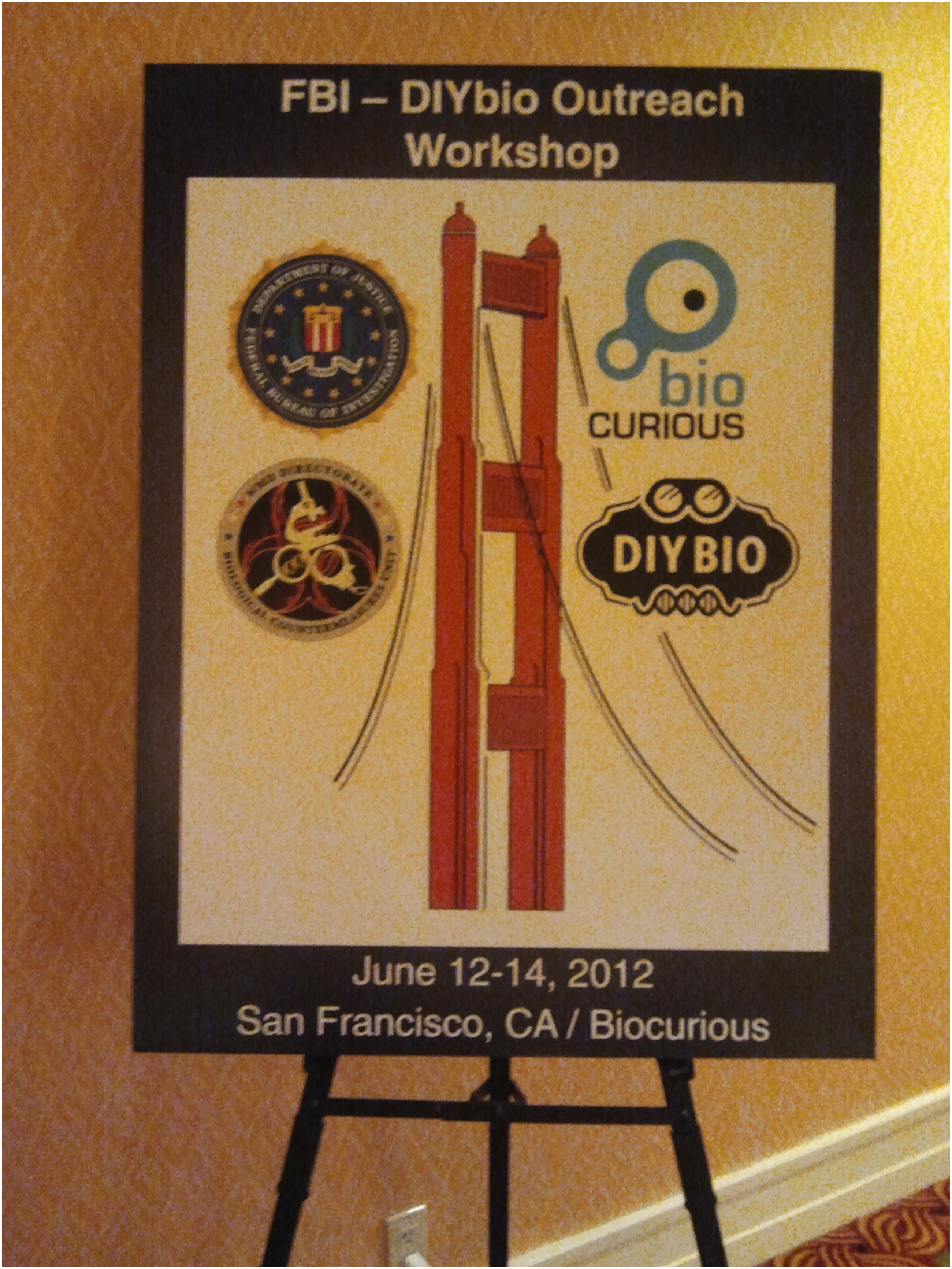
During their opening comments to the crowd of nearly 70 DIYbiologists, the FBI agents assigned to DIYbio introduced themselves as part of the “new FBI,” which, they stressed, operated in a different manner than the “old FBI.” Several FBI agents stood up and gave personal testimony to the differences in training, outlook, and priorities between the new and old FBI. The dividing line between old and new FBI, per the agents’ testimony, was the string of events leading up to the 9/11 terrorist attacks. At every point, agents emphasized that it was not the actual attacks per se but rather the unobserved activities of the attackers in the months leading up to 9/11 that marked a point of departure between old and new FBI. The new FBI was interested in identifying behaviors and discourse inside DIYbio laboratories they believed could translate into terrorism, for example, the laboratory equivalent of enrolling in flight school without an interest in learning to land. As the FBI-produced brochure distributed to DIYbiologists at the conference explained: scientists and laboratory managers need to be aware of these threats and understand the warning signs of potential targeting. Just as medical doctors use signs and symptoms to identify diseases, scientists can learn to identify suspicious activity and report it to law enforcement.
The testimony received a muted reception.
Day one: Meeting the laboratories
The morning session following the opening remarks was composed of presentations about DIYbio projects mixed with presentations about laboratory organization. They came in one long string lasting four hours, giving a whirlwind tour of the global state of DIYbio and the activities of DIYbiologists.
The first presentation was from an independent DIYbiologist based in Europe discussing the development of a low-cost DNA synthesizer for DIYbio. As is the case with most homemade laboratory equipment, this project was largely theoretical, and the device was not yet in use. Next, Mac Cowell presented the diybio.org website he had developed with Jason Bobe, billing it as “a way to connect the community.” A duo from Chicago presented an open science organization with long-term plans to become a publisher of how-to manuals in the DIYbio space. This presentation prompted an interesting question about federal regulations governing DIYbio in the United Stated, directed to the FBI agents. The FBI answered that most regulatory compliance issues affecting DIYbio (in the United States) existed at the local level, making, at least in the United States, fire marshals the most important regulatory body for DIYbio. In the discussion following this question, someone suggested that an online repository of regulations resembling one started by backyard chicken farmers would be a useful resource.
Soon, it was BioCurious’s turn to present. Kristina Hathaway was the designated presenter. She presented BioCurious as a volunteer-driven and volunteer-organized organization. A slide titled “Tribes of BioCurious” followed this declaration. This slide claimed that BioCurious consists of 33% entrepreneurs, 33% technology workers, and 33% next-generation scientists. The following slide was further broken down into a set of marketing personas with names like “moonlighting hobbyists” and “low-cost advocates.” Next came a slide presenting BioCurious-sponsored activities: Training Series, Biotech Bootcamp, Biz of Biotech, Founders’ Tales, and Saturday Morning Science. Despite spending five days a week in the laboratory, the only activity I had seen on the laboratory schedule was “Saturday Morning Science.” The next topic addressed was safety. A list of bullet points was projected behind Kristina: A Maze of Regulations, No Editorial Control on Experiments, Meet Safety and Legal Restrictions, Community Oversight, and Transparent Lab Architecture. Each bullet point was given a sentence or two of explanation before the next slide was presented.
Hewing to a standard startup trope, Kristina’s story about the first class at BioCurious featured an “aha” moment. In Kristina’s telling, the first class hosted at BioCurious ended with another board member’s surprised reaction, “Oh my God, this might actually work.” This section of the presentation followed closely the “next big thing” verbiage deployed during the crowdfunding campaign, depicting BioCurious as the future of biotech innovation. Finally, the topic of volunteering at BioCurious emerged from the slide deck. Volunteers, like safety, got bullet points: Motivations are Different, and Experience for Time. Kristina explained that waves of volunteers had come and gone from BioCurious and said, “the people who get you there don’t always get you to the next level.” As the first volunteer at BioCurious to work a full shift in the laboratory, I tried not to take that last comment personally. Following a few words about local regulations and the process of finding a municipality willing to allow BioCurious to operate within its limits, the presentation ended. No questions followed.
After the BioCurious presentation came still more laboratory presentations. The presentations included the well-known Genspace in New York and BosLab in Boston, but also labs operating in Baltimore, Victoria (Canada), Manchester (UK), Amsterdam, Paris, the Czech Republic, and Indonesia. Many of the presentations revolved around similar themes: the difficulty of finding equipment and reagents, decisions about how to organize and support the laboratory, the trials of finding a suitable space, and negotiating local regulations. At least for the North American labs, most were small, with a handful of members forming the core of laboratory membership.
The laboratory in Baltimore started as an offshoot of a community college laboratory and wanted to continue in that vein by collaborating with the local community college and hosting laboratory classes for college credit. They viewed DIYbio as an educative practice and a way to augment shrinking community college budgets. The lab in Manchester was housed around the corner from the flat where Engels wrote The Conditions of the Working Class in England. In a departure from the norm, the Manchester group was not organized around a membership model, but rather relied on the largesse of a friendly landlord and support from the Wellcome Trust and a local university. While they had access to sources of funding not available in the United States, they were unable to tinker with common model organisms (E. coli bacteria and Arabidopsis plants, in particular) on a whim as one could in the United States. Whereas regulations in the United States tended to follow the principle that not explicitly banned is allowed, in the rest of the world, regulations tended toward the principle that not explicitly allowed is banned.
The Amsterdam group was housed in the room where Rembrandt painted The Anatomy Lesson of Dr. Nicolaes Tulp. Their group took time to explain the set of regulations governing experimental programs in the Netherlands. They were subject to three interweaving levels of regulations and had to obtain and maintain several permits and certifications to run even basic experiments. Additionally, the group was required to have a safety manual of no fewer than 400 pages and to name a safety officer who was personally responsible for ensuring safe and ethical experimentation in their lab. Later, a group from Paris also revealed extensive support from the city accompanied by an even larger amount of paperwork. And here, another consequential difference between DIYbio in Europe and the United States was made plain. In the United States, if municipal ordinances and the local fire marshal were satisfied, DIYbiologists were free to experiment without reporting requirements.
The presenters’ respective attempts at humor, an unexpected and enjoyable feature of the morning session, indexed the divergence of local regulations. Whereas the North American labs all joked about being mistaken for a “meth lab” by local police and pleading with municipalities for permits to operate, the European labs joked about having too much paperwork to do and not enough time to experiment.
One of the final presentations in the lab series was given by Denisa Kera, who presented on DIYbio in Indonesia and Singapore. She talked about the loose confederation of DIYbio labs across Southeast Asia and discussed how their objectives differed from the American and European labs. Primarily, this difference was seen through their ambiguous relationship with genetically modified organisms (GMOs). For most European and North American laboratories, GMOs represented a point of commonality and confluence with academic and industrial biologists. They shared a concern with furthering the development and use of GMOs, though their means and methods differed. In contrast, Kera pointed out that several labs in Southeast Asia viewed and experimented with GMOs in a more critical manner, sometimes attempting to return GMOs to a natural state as a form of protest (Kera, 2012). Following Kera came the Indonesian group, House of Natural Fibers (HONF). Instead of presenting, they played a promotional video for the HONF which had little to do with biology and focused instead on hacking electronics and computer-generated art and music. This presentation (of sorts) would be their last appearance at the official conference.
These informal presentations gave a brief peek into the diverse activities of DIYbiologists and the differing ways a DIYbio lab can be organized. DIYbio activities ranged from laboratory science to all manner of engineering projects, to bio art, educational efforts, and philosophical and design inquiries into the nature of life. Nearly any space seemed to be a candidate for laboratory conversion: old warehouses, bathrooms, unused space in an existing hackerspace. Laboratories had been organized by PhD-level researchers, artist collectives, designers, and aspiring entrepreneurs. Financial models ranged from anarchist collectives like the Chaos Computer Club and Noisebridge to customer-centric models like BioCurious, with most labs employing some combination of membership, classes, and donations.
When the first day’s presentations had ended, an FBI agent announced from the banquet room that the next day would consist of security scenarios around issues that might come up at the intersection of safety and DIYbio. If the first day’s sessions had the feel of a networking event, with time for socializing built into the schedule, the FBI agents stressed that the second day would form the substantive work of the conference, the reason the assembled DIYbiologists had been flown to the Bay Area
Day two: Safety scenarios
Attendance was visibly lower on the second day. Later I would learn that a large contingent of DIYbiologists flown in from Europe and Asia had skipped the second day of the conference to visit the hackerspace Noisebridge in San Francisco, a short trip via train from the conference hotel. What had been an international conference on the first day had by the second day taken on a distinctly domestic feel, as the morning’s session was mainly attended by lab organizers from the United States.
To start the session, an FBI agent announced that the purpose of this day was to “reinforce sharing and cooperation between the two communities [the FBI and DIYbio].” This day, sharing and cooperation would take the form of scenario training. The FBI would offer a variety of scenarios for the assembled DIYbiologists to work through, while FBI agents would listen to and assess our conversation. But before the introduction to the security scenarios could commence, there was another round of personal testimony from FBI agents detailing the differences between the old and new FBI. In the wake of 9/11, the agents again testified, the FBI was reborn as a kinder and gentler agency reliant on cooperative policing to preempt crimes rather than kicking down doors, handcuffing suspects, and reflexively seizing assets. Following the testimony, the FBI agent leading the security scenarios commented on the low attendance and asked those present to contact the missing DIYbiologists and remind them that the security scenarios were about to start. This request also met a muted reception and while a few more DIYbiologists eventually made it to the banquet hall, attendance remained noticeably lower than the previous day.
The security scenarios presented by the FBI were utterly fantastic and betrayed the deep divide between how DIYbio experimenters and the FBI perceive security and the scientific process. In one scenario, an imaginary DIYbiologist returns from Asia (a more specific location was not given) and begins asking fellow DIYbiologists for papers about the poison ricin. This scenario was met with scattered chuckling and much head shaking. The FBI agents asked what a proper course of action might be. A couple of answers were given: “confront them in a friendly way,” and “this is the same problem as someone not sharing their project.” Having passed this test, the FBI agent next asked about heated political conversations in the lab. Is there an anarchistic bent in DIYbio? More questions followed. Can a meaningful difference be drawn between a DIYbio lab and a hackerspace? These inquiries were met with the same stock answer, DIYbio laboratories are not places for political activity, all of which seemed to satisfy the “new FBI.” I was left wondering how the FBI developed these security scenarios. None of the DIYbiologists I asked claimed to participate in their creation, and the FBI agents were silent on their provenance.
Following the midmorning break came another round of presentations, again a mix of laboratories and projects. After the break, the conference room was noticeably full, as many DIYbiologists who had skipped the morning’s scenario training arrived in time for the presentations. The projects were largely like the projects presented on the first day. The laboratories, however, continued to surprise with their diversity and research interests. DIYbio labs in Los Angeles, Newcastle, Helsinki, Berlin, San Diego, Redding, Istanbul, and Copenhagen presented. Here, another distinction quickly became evident: some labs were focused on critical engagements with bio art and others on potentially profitable engagements with government and industry.
The Helsinki lab had pushed critical, legal, and olfactory boundaries by using a decaying horse as a display piece in an artistic inquiry into cellular death. One DIYbiologist from Copenhagen opined that Denmark was one of the easiest European countries to work in because of the political climate and the ease of establishing a friendly relationship with regulatory officials. He remarked that many questions could be cleared up simply by inviting someone from the regulatory agency to discuss ambiguities over a cup of coffee. A group from Berlin talked about their association with the Chaos Computer Club (CCC) and their efforts to bring the anarchist spirit the CCC embodied into DIYbio. They described themselves as a small organization of frustrated PhD students organized in the spirit of free inquiry. Several FBI agents scribbled intently during this presentation. A group from Istanbul, similarly, was a loose confederation of students organized around their interest in evolution and genetics. In the following discussion about organization, Ellen Jorgensen from Genspace critically commented on the prevalence of business incubator/laboratories in North America by wryly observing, “I want to be a scientist, not a landlord.”
On the final day, there was an evening session centered on connecting DIYbio labs and entrepreneurs with the world of government contracting. This part of the presentation was heavy on how to properly fill out the requisite government forms and navigate government websites. An unannounced presentation, given by a project manager from the Defense Advanced Research Projects Agency (DARPA), followed. DARPA’s vision extended beyond the standard contracting stable of assays and testing, envisioning a future where DIYbio labs were production hubs for novel biological materials. Existing industrial production processes and supply lines were too vulnerable to threats, the DARPA representative explained, so the future of biotech is distributed craft production and DIYbio has an important role to play.
This session drove home why so many DIYbio lab organizers have welcomed the FBI. Associating with the FBI, apart from lessening the odds of their door being kicked in, legitimizes DIYbio in the eyes of municipal governments, the biotech industry, and the public. Associating with the FBI means DIYbio is open for business, allowing DARPA and venture capitalists, not unlike those in Bell’s audience at PARC, to see DIYbio as a steady stream of disruptive innovations, ready to be bent to new ends.
Later that evening, there was a party at a live/work loft in Oakland owned by a well-known open-source software developer. Nearly the entirety of the 2012 DIYbio/FBI conference, minus the FBI, and most of BioCurious members (who repaired early that evening to clean the lab in preparation for the scheduled tour) were in attendance. As alcohol and gossip flowed, the outlines of the split, already evident from patterns of participation in the conference, between DIYbiologists based in the United States and those in Europe and Asian came into sharper focus. For American labs, the FBI legitimized their activity and made explaining DIYbio to municipal governments, fire marshals, insurance companies, the media, and the public easier. But for labs outside the United States, the only upside of associating with the FBI was a free trip to the Bay Area. One European DIYbiologist voiced concerns about what information might be shared with local policing organizations and the future ramifications of associating with the FBI. Another mused that the point of DIYbio was independent inquiry free of institutions like the university, the FBI, or the market. Driving the point home, he observed that it was difficult to find critical or artistic expressions of DIYbio in the United States where DIYbio tended to a prosaic activity aimed at either education or innovation.
Day three: Touring BioCurious
On the third and final day, the FBI/DIYbio conference moved from the Marriott hotel in Walnut Creek to BioCurious in Sunnyvale. When I arrived at BioCurious that morning, there were already two dozen people touring the lab. I recognized several Genspace members, some from the London lab, the Boston lab, and the Baltimore lab. It seemed almost everyone made the FBI-arranged shuttle down to BioCurious, except for the members of the Indonesian lab House of Natural Fibers. There were four FBI agents, conspicuous in their suits, as well and the representative from DARPA (Figure 3). The BioCurious laboratory tour. Source: Photo by the author.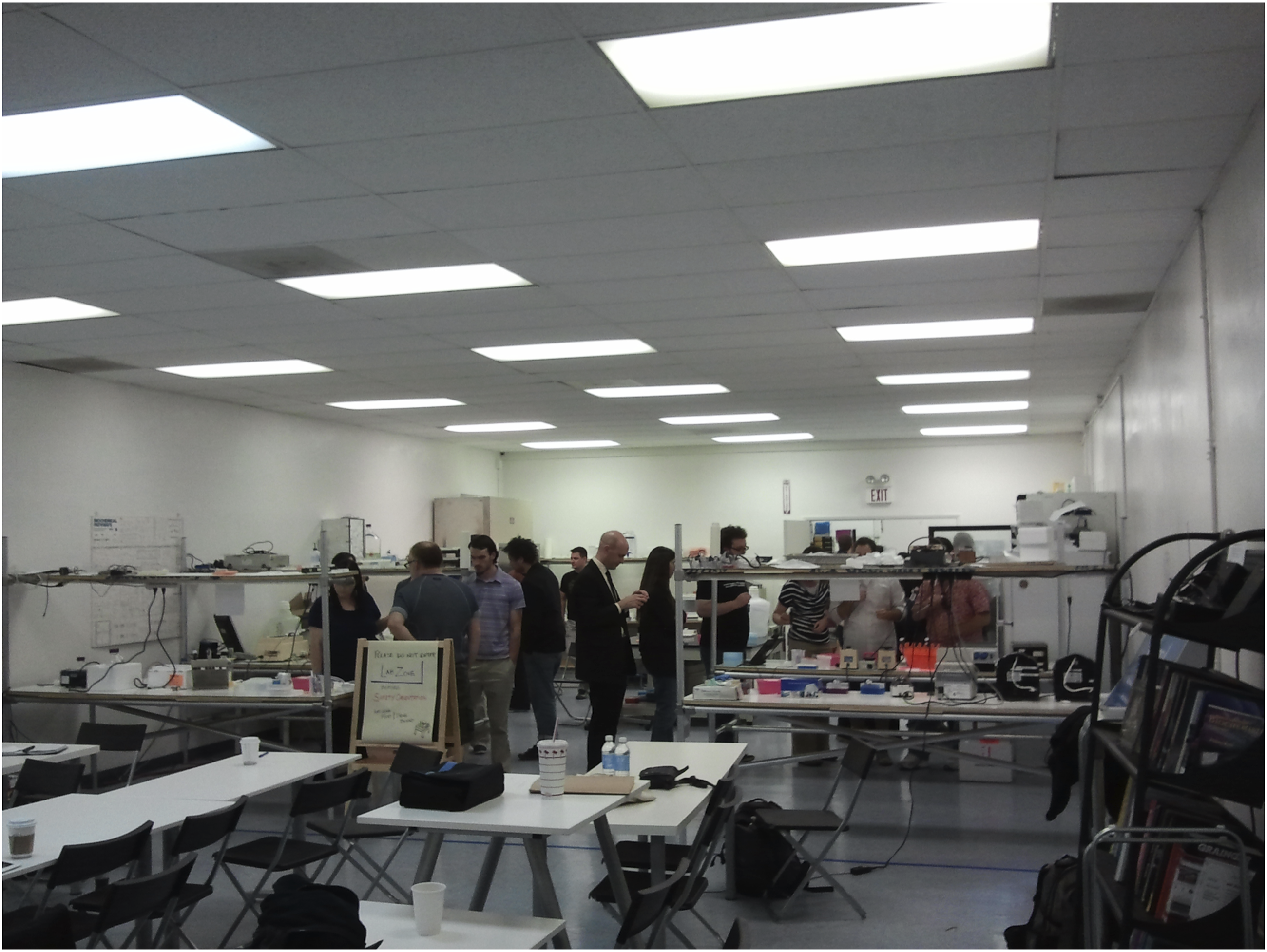
After the laboratory tour, I settled into the now empty laboratory to do some work on a project I was pursuing with another volunteer. We worked just across from Ellen Jorgensen from Genspace. As we prepared for our day of laboratory work, I struck up a conversation with her about DIYbio and the relative difficulty of laboratory biology. She offered an interesting opinion: preparing bacterial plasmids (purifying and extracting DNA in bacteria), one of the main laboratory skills, is not particularly difficult. Despite having no formal background in biology, she said, one member at Genspace was as skilled at plasmid preparation as anyone she had worked with in academia or industry. I pointed out that several members of BioCurious were similarly skilled. She said that plasmid preparation, usually performed with materials and directions from a kit, was more akin to baking than rocket science. Knowing how to organize an experiment, being disciplined enough to keep a notebook, and formulating follow-up work are the most difficult scientific skills to learn and the skills she had the most trouble teaching at Genspace.
I told Ellen that we were working on a project about dandelion speciation, attempting to figure out if there were 20 or 2000 species of dandelions in the Bay Area (Scroggins, 2017b). She reminisced that as a graduate student, her driving interest was in understanding natural processes, and she had tried to bring this to DIYbio. Echoing the complaints of many European DIYbiologists I had talked to over the long weekend, Ellen complained that DIYbio had become a place for those interested in the technology for the sake of making markets and starting companies. Curiosity for its own sake seemed to be in short supply, and critical projects were few and far between.
After my lab partner and I finished our preparations, I found an opportunity to talk with an FBI agent who had been watching us work from the next bench. Because this was the last day of the conference, I asked him directly what the “new FBI” was hoping to get out of this conference. He echoed the same refrain I had heard the previous two days: the FBI was looking to build relationships with DIYbio because they knew they would not be able to see everything and hoped to enroll the DIYbio community as an extra set of eyes and ears. Prior to 9/11, the FBI waited for something to happen. But post-9/11, the FBI assumes something is going to happen and works to establish the kind of relationships that might preempt an incident. He also argued that DIYbio should not be afraid of the media fallout of working with the FBI because the fallout from not working with the FBI would be worse.
This carrot and stick strategy has worked within the United States. The paucity of critical artistic interventions around DIYbio in the United States has been one of the more enduring outcomes of working with the FBI. The “new FBI” no longer needs to knock down doors. DIYbiology, at least in the United States, polices itself. Many labs had become de facto startup incubators, attracting early-stage entrepreneurs with low overheads and a neutral stance on intellectual property rights; these entrepreneurs are happy to have the FBI and DARPA’s blessing.
While the FBI hoped to establish a friendly working relationship with DIYbio, the tacit admission that a DIYbio laboratory was a potential threat and that DIYbiologists, if not exactly assumed guilty, were not exactly assumed innocent either was a new and consequential fact of living with the new FBI. The FBI directorate covering DIYbio falls under the rubric of weapons of mass destruction and brings the harshest punishments the United States can offer. Further, it was unclear how the FBI kept tabs on the DIYbio community beyond establishing relationships with existing laboratories or with which other intelligence agencies (foreign and domestic) they might share information.
By hosting the 2012 conference, the FBI emerged as one of the most important institutions in the diffusion of DIYbio. Globally, no more than a few thousand people have worked in a DIYbio lab, and of that number, a far smaller number have carried out a sustained project. The number of people involved in organizing DIYbio laboratories is small enough that they can get to know one another on a personal level during a three-day conference. Of course, this can only become possible if an organization with deep pockets such as the FBI is willing to fly everyone to the same location so they can trade presentations and gossip. With no academic or industry organization to sponsor DIYbio, the FBI conference was the only way DIYbiologists could find a venue to share ideas and socialize face to face. The following year, there would be more DIYbio labs, they would be better organized, and the projects more elaborate, in large part due to the “new” FBI’s approach to policing. This too must be a central commandment of the new FBI: help spread that which you wish to police, and your budget will never be lacking (Scroggins, 2012; Tocchetti and Aguiton, 2015; Wolinsky, 2016).
Further security engagements: Containing the coming pandemic
The 2012 conference would be the last public conference between DIYbio and the FBI, but it was not the final word. Conferences would go on, but they would be smaller and less publicized. Contacts, often muddy and mysterious, would continue. In summer 2016, I was invited to a one-day private workshop held at a secure location (owned and operated by the Chinese government) in Silicon Valley. 7 In attendance were every relevant three-letter US government agency – the CIA, FBI, DIA, NSA, EPA – a handful of DIYbiologists, and a surprising number of academics directly funded with monies from those agencies. Sometimes this support was direct and obvious, as with DARPA challenge grants, and other times subtle and indirect (cf. Price, 2011). We were advised in the invitation email to leave our cellphones in our cars, which I did, but I noticed several other attendees texting and making calls during the workshop.
At this more discreet meeting, the morning agenda revolved around dealing with the media and handling public opinion when the inevitable accident happened at a DIYbio laboratory. Media consultants were on hand to brief laboratory operators on how to massage and soothe the media in times of crisis: keywords to utter and keywords to avoid, what to wear and how to groom yourself, proper diction, and tone, and when to refer the press to the relevant government agency. In this portion of the workshop, the scenarios and their fallout were presented as whens, not ifs. After a brief lunch break, though, the mood turned more serious as new fears were revealed.
The afternoon session was devoted to two new safety threats: virus-enhancing gain-of-function experiments and so-called gene drive work in population genetics. To discover basic mechanisms of viral transmission, a few researchers had conducted experiments aimed at increasing the efficiency of existing pandemic viruses such as H1N1 and H7N9 (Burki, 2018; Fouchier et al., 2013; Malakoff, 2013). In brief, gain-of-function experiments involve passing viruses through multiple animals in a laboratory, mimicking a long process of natural evolution in a compressed timeframe. A troublesome side-effect, from a policing perspective, is that gain-of-function experiments using animals (normally ferrets) often remove the tell-tale signs of genetic engineering. Proceeding along a different path, but no less disconcerting to the attendees, were so-called gene drive experiments aimed at introducing novel genetic information into a population in order to create or eliminate certain traits (Akbari et al., 2015). A commonly stated ambition of gene drive experiments – at least by experimenters and funders – is creating a population of sterile mosquitoes to quell the spread of malaria. The fears expressed at the workshop about these two techniques were twofold: first, that engineered insects and animals with potent genetic mutations might escape the BSL-4 laboratories where work on gain of function and gene drives was conducted and, second, that the spread and ease of use of a new rDNA technology, CRISPR, might put the ability to create and to do gain-of-function and gene drive experiments in the hands of DIYbiologists (Doudna and Charpentier, 2014; Ledford, 2015).
Weighing heavily on those at the workshop were an Atlantic article written by security researchers speculating on the near-future creation of personalized bioweapons (Hessel et al., 2012) and, in an echo of the post-9/11 anthrax attack, the possibility of a rogue researcher using CRISPR to recreate the H1N1 virus that caused the 1918 pandemic. 8 During the open question-and-answer session which followed, I suggested a modification to the gene drive security scenario. Where the FBI thought retired professors trying to continue their research might be a threat, I suggested that the more dangerous threat were graduate students and postdocs without a venue to continue research they had invested upwards of a decade developing.
The final session, early in the evening, addressed how to stop the spread of information on viruses and diseases in scientific journals and prevent the identification of specific genetic sequences common to pandemic viruses. Ideas were brainstormed: the creation of a backlist for certain sequences and the censoring of certain researchers and controlling purse strings – in short, how to close the feral shoots of open science.
Over dinner and drinks that evening, I interviewed a member of the team from Lawrence Livermore National Laboratory who had worked on the 9/11 anthrax investigation. While there were many aspects of the investigation he could not discuss, his allusive comments left no doubt that the anthrax attacks could only have been carried out by one of a handful of PhD-level scientists with access to weaponized anthrax. It could not have been the work of amateur DIY biologists, he repeated, because the strain of anthrax was too refined and the lineage too specific to have been created by an amateur at home. And, in his opinion, it would be difficult for DIYbiologists to make a pandemic virus, even with new techniques like CRISPR, as gain-of-function experiments require specialized expertise that is difficult to acquire and easy to track.
From policing DIYbio to user innovation in biotech
DIYbio has gone in many different directions since the 2012 conference, including direct-to-consumer GMOs (Souleles and Scroggins, 2017), cellular agriculture (Mattick, 2018), and crowdfunded drug and microbiome research (Gallegos et al., 2018). Along the way, it has developed a distinctively open form of scientific practice. Rather than academic journals and conferences serving as a venue for reporting results, openly broadcast video conferences, Google groups, and shared data carry the load. Likewise, rather than the scientists of Asilomar politely asking their colleagues to police themselves and stay within agreed boundaries, the “new FBI” now sets the guardrails.
As I intimated earlier, for the FBI, viewing the activities of DIYbiologists as feral shoots requiring policing has a scalability problem. In the final analysis, even the FBI’s vast budget has limits. After the 2011 and 2012 FBI/DIYbio conferences, the public role of the FBI receded into the background as more discreet conferences became the primary venue for policing DIYbio. In part, the FBI’s public step back was driven by DIYbiologists’ success in convincing agents that, as social and socializing institutions, DIYbio labs are unlike the flight schools where the 9/11 attackers learned to fly, but not to land, jetliners. And, in part, the step back stemmed from the realization that DIYbiologists, as Ellen observed, can readily become skilled at common technical tasks like making plasmids, but the more onerous aspects of science that lead to new (and potentially dangerous) discoveries are difficult for DIYbiologists to achieve. So, if DIYbiologists were not a likely source of the next terrorist attack or pandemic virus, what of the seemingly feral activities of DIYbio?
As the tech executives and engineers in Bell’s PARC audience knew, one institution’s policing problem is another’s economic engine. When the FBI stepped back from its public relationship with DIYbio, a new institution stepped into the gap. In 2017, as part of its Community Biotech Initiative (CBI), the MIT Media Lab begin to host an annual Global Community Bio Summit, inviting DIYbiologists from around the globe to participate in “community organizing and movement building.” In addition to the resources of MIT and the Media Lab, the Global Community Bio Summit is an opportunity for global DIYbiologists to meet face to face without the ramifications of associating with the FBI. Prominent is an open-innovation track, highlighting developments within DIYbio having commercial potential and offering lines of communication to companies and investors interested in taking those developments to market. Tellingly, the annual Global Bio Summits have a distinctive trajectory. The initial summit posed the question “Are We a Movement?” and subsequent conferences defined and clarified shared values, ethical commitments, and establishing norms of behavior. Whether DIYbiologists will agree to abide by these engineered norms, or whether DIYbio is, in fact, amenable to governance remains to be seen. Despite the persistence of these questions, every year the summit attracts a more diverse and more international audience of DIYbiologists. In helping to expand the number and diversity of DIYbiologists, the summit, like the DIYbio/FBI conferences, has been a resounding success.
With the involvement of the MIT Media Lab, DIYbio has come full circle. Its deviations and swerves away from the norms of academic and industrial research, reflexively perceived by the FBI as dangerous following 9/11, have resolved in the hands of the MIT Media Lab into something approaching Carlson’s vision of garage biology as a form of disruptive innovation (Scroggins and Souleles, 2021). Returning to Bell’s talk, to the observation that institutional control of technology is always partial and ineffective and often comedic, we can add that the most potent comedy of all may be assuming DIYbio’s ability to make good on the dangers or disruptions assumed imminent over the last two decades.
Footnotes
Declaration of conflicting interests
The author(s) declared no potential conflicts of interest with respect to the research, authorship, and/or publication of this article.
Funding
The author(s) received no financial support for the research, authorship, and/or publication of this article.
