



Abstract
This article traces the way the intersection between gender, class and family values is reorganised in relation to state policies that enable propertied citizenship through home-ownership. Focusing on ethnographic data from Kolkata, India, it discusses how women realise propertied citizenship in exchange for care work rather than through employment as developmentalist and liberal feminist discourses suggest. Here the way women’s lives are envisaged and represented through investment in high levels of educational attainment is in contrast to low levels of employment, symptomatic of what I call ‘liminal states’ – a gendered state of immaturity and dependence on kin. Home-ownership as a means of ‘empowerment’ configures the home as the economic and affective focus of gendered care work, which reproduces Berlant’s ‘cruel optimism’, whereby the desire to own a home and the practices of homemaking hamper autonomy and restrict the efficacy of agency.
It has long been noted that India’s economic liberalisation, which had come to roost across the nation by the mid-1990s, combined earlier ideologies of state-led development and redistribution with a distinctly neoliberal orientation towards market-led and investment-friendly interventions. Crucially this reorganisation of state–citizen relationships relies on the state actively promoting the interests of affluent sections of the population (Harvey, 1989) and the ‘spatial fix’ – ‘capitalism’s insatiable drive to resolve its inner crisis tendencies by geographical expansion and geographical restructuring’ (Harvey, 2001: 24). Linking booming property markets to processes of exclusion and class formation, this suggests that material and political aspirations towards home-ownership constitute a a global middle-class phenomenon. The housing market is thereby marked as a site that produces propertied citizenship through urban restructuring, with the middle-class family home at its centre.
In the Indian context, home-ownership as a marker of middleclassness is not new. Home-ownership was a major site of state policy-making that framed citizenship during the period of Nehruvian reforms (Rao, 2013) and ‘modern’ residential designs for appropriately middle-class subjects were promoted as early as the 1920s (McGowan, 2020). But it is in the decades after economic liberalisation that home-ownership has become a necessary marker of middleclassness and that notions of propertied citizenship have taken centre-stage as real estate markets and the construction industry are booming across India (De Neve, 2015; De Neve and Donner, 2015).
The construction industry has revived the formerly stagnant economy of West Bengal, and Kolkata has experienced urban restructuring that changed the cityscape beyond recognition. State policies are crucial drivers of these changes, whether they allow new zoning regimes to trigger further expansion, or provide online platforms and infrastructures to market and manage the actual construction and purchase of homes. The complex layering of policy regimes, regulatory practices and class formation in India has been shown to be productive of a spatial politics predicated on hegemonic ideas about middle-class lifestyles (Fernandes, 2004). Specific domesticities that rely on private home-ownership promise upward mobility and modern selfhood based on large-scale urban restructuring (see, for ethnographic examples, Bose, 2015; Brosius, 2010; Donner, 2012; Fernandes, 2006; Searle, 2013; Srivastava, 2014). In this article I will look at how these larger processes are affecting middle-class women in an attempt to understand how access to real estate has become a new site for subject-formation and neoliberal transformations of the family from within (Anagnost, n.d.). 1
In the public sphere, narratives of progress and the possibility of realising a ‘good life’ for all have come to hinge on an embrace of aspirational consumerist lifestyles which are closely associated with home-ownership – and a focus on domesticities that allow the ‘family’ to anchor individual life projects. Parallel, but by no means unrelated to the rewriting of urban spatial relations, middle-class women have become hypervisible in the media, and are hailed as emblems of ‘freedom’ and social change as cities are reimagined in a hypermodern mode (see for example Rangwala et al., 2020). Such imagery is embedded in specific forms of domesticity, for example in adverts that focus on marital status and motherhood. By mediating the relationship between middle-class women and home-ownership through family law, but also the provision of loans, pensions, education and employment opportunities, the state is a major driver in the production of gendered forms of such propertied citizenship. This, I will argue in this article, reproduces gender inequality by tightening, rather than loosening, middle-class women’s dependence on their kin, as it is through their role as daughters and wives that they exchange care work for access to property. As the ethnography will demonstrate, family law, customary understandings of inheritance and women’s access to parental and affinal property rub against the global and national rhetoric of women’s entitlements and empowerment through employment, property ownership and access to markets (see Agnes et al., 2012).
Recent scholarship on neoliberal subjectivities has highlighted how the individual, the family and the nation intersect in novel ways which depend on imageries co-produced across a wide range of cultural fields. The imagery associated with home-ownership taps into shared affective landscapes that rely on middle-class domesticities to reproduce what Raymond Williams famously called collective ‘structures of feeling’. Lauren Berlant (2011) has argued that ‘cruel optimism’ – hope against the odds – relates the neoliberal promise of opportunity and better futures to the de facto experience of surplus time and labour as part of a stalled lifecyle expectation among the global North’s precariat, and ethnographers like Weiss (2021), Jeffrey (2010) and Petitt (2019) have shown how this manifests in cultures of waithood among unemployed graduates, who are kept in a ‘liminal’ state. In this article I argue that such approaches can be usefully employed to analyse many Indian middle-class women’s experiences of urban change, where younger interlocutors imagine their personal trajectory in terms of educational and career achievements, while narratives across the life course show that middle-class women’s experiences of global capitalist forms are determined by the institutions of kinship and marriage that make social use of their ‘surplus time’ as gendered care work.
The article argues that ‘homemaking’ is a major site to accomplish full personhood and that owning the perfect family home represents a lifetime aspiration. In fact, rather than fulfilling ambitions related to educational pursuits and the zest with which individal marital and professional decisions are embraced and represented at a younger age, marriage is often followed by a confirmation of patriarchal gender relations manifest in the importance of women’s roles as homemakers and carers as the revived salience of the term ‘housewife’ demonstrates (Donner, 2020; cf. Hughes, 2022, this volume). Thus, the article discusses state policies towards women’s empowerment through mortgages and loans in the context of negotiations of inheritance and rights in property, affinal and parental, before it turns towards what, paraphrasing Giddens (1992), could be referred to as a form of ‘affective collectivism’ centred on the nuclear family across two generations as focus of ‘homemaking’. For women to become home-owners, kin work needs to be extended towards care of one’s parents’ who in turn contribute to home-ownership and this emphasis on the role of a daughter runs counter to discursive assertions of women’s autonomy. The article suggests that unpaid care work and the rewriting of the ‘home’ as its centre links state policies around home-ownership to the ‘liminal’ state middle-class women find themselves in.
Rights, loans, and inter-generational links: The making of women home-owners
Indian women’s access to property has been almost entirely discussed in terms of legal frameworks, and this article builds on long-standing debates around rights in property. Notably, patrilocality and the ideal of arranged marriage framed communal ideologies that found their way into family law from the colonial period onwards (Basu, 2015). Sinha observes that even in ‘progressive’ discussions about the Hindu Code Bill, which came to fruition with its introduction as law in 1956, Hindu women’s rights in their husband’s estate depended on motherhood as a central value (Sinha, 2007). After independence, gendered rights in property have been a site of prolonged feminist activism with a focus on the reform of family laws known as ‘personal codes’ – which are differentiated according to religious/ethnic affiliation. Given the impact of communal values and uneven practices enshrined in these codes, feminists have campaigned for a uniform code. As all my interlocutors in Kolkata were upper caste Hindus, the focus in the remainder of this article will be on laws and practices common among these communities.
With reference to property, until very recently Hindu women only figured as dependents of male kin. According to Halder and Jaishankar (2008) it was only with the amendment of the Hindu Succession Act in 2005 that Hindu women’s rights in their parents’ property (irrespective of marital status), as well as their affinal home, were confirmed (2008: 662–3). However, based on notions of ‘customary arrangements’, married women still do not usually realise their share in their parents’ home, as they are expected to waive their rights in favour of brothers. Drawing on fieldwork with middle-class women in Delhi in the 1990s, Basu (1999) states that marriage, not inheritance, was the most common route to female property ownership. In common with well-rehearsed ‘customary’ views, her interlocutors maintained that daughters were ‘receiving their share’ in the form of a dowry upon marriage and only unmarried women would automatically be expected to have residential rights in parental property.
In a typical example from my research, an octogenarian resident of South Kolkata placed men at the centre of complex negotiations about women’s access to ‘shelter’ and property in his family: Mr Chandra, who was 85 in 2020, reported that he lives in a flat above his daughter, who has been separated from her husband for some years, and has moved back to what was her natal home. He was an only child and had inherited a large property in South Kolkata, which he occupied with his family until he sold it to a developer, who erected a four-storey apartment block in its stead. In part exchange for the land, Mr Chandra was given two flats, while the developer sold the other two and kept the profit. At the time it was clear that one of his two daughters would need shelter after her separation, and as his wife had been ill for some time, he says her separation and subsequent move into the parental property was advantageous to her parents, as the daughter is now looking after her mother’s health and generally can run the household.
This rather typical account reflects shared understandings in many families I met from the 1990s onwards, but since then inheriting a property upon the death of a parent or a husband is no longer seen as the only way to become a female home-owner. Recently, the state has made middle-class women’s access to real estate a major focus of a range of policies that promote mortgages and personal loans taken out in the name of married women, with perks including lower interest rates, tax benefits and, in the case of home loans, reduced stamp duty. Other measures include affordable housing schemes for couples registering as joint owners, with additional tax and stamp duty benefits (Gupta, 2015) (Figure 1). Advertisement for home loans, State Bank of India, 2019.
Certainly in the view of the state, such products address women as consumers of an aspirational lifestyle predicated on home-ownership in line with the logic of consumer citizenship. As I have discussed elsewhere, this discourse links education, employment and loans provided to women in India in order to ‘unlock their economic potential’ to make the nation flourish (Donner, 2020). Globally packaged and situated at the intersection of government, multinational agencies and community, the underlying ideological predispositions emphasise the impact women’s entry into the labour market has – not as a means to make a living, but as gateway to less tangible economies of desire based on consumption.
Politically such infrastructures of credit are promoted in terms of ‘smart economics’, a set of dispositifs which, according to Kalpana Wilson, ‘is premised on the assumption that women will always work harder, and be more productive, than their male counterparts; further, they will use additional income more productively than men would’ (Wilson, 2015: 809). For poor women, middle-class ideologies of ‘progress’ and ‘empowerment’ materialise in the form of micro-credit schemes, which as Sohini Kar shows, chart creditworthiness in terms of the active participation in consumerist behaviours (Kar, 2020). Particularly among the more affluent, homes are central to this as a sites of consumption, but also as a consumable. Mortgage debt among upwardly mobile Black South African families enhanced consumption patterns based on credit, in turn followed by more borrowing, as Deborah James writes: ‘If the house is the venue where resources are husbanded, it is also the site where consumption occurs: and it is consumption that generates the need to borrow’ (James, 2015: 231pp). Similarly, home-ownership among Indian middle-class citizens is expected to lead to more loans.
The meanings of ‘home’
While home-ownership does not necessarily imply particular homemaking practices, it links gender and class to wider processes. Thus, Li Zhang (2010) argues that gendered lifestories in upwardly mobile Chinese families connect home-ownership directly to much broader ways of making meaning in a changing world, and Krisztina Fehérváry (2011) discusses suburban Hungary’s preferred ‘house with garden’ as an aesthetic form that reflects the experience of different temporalities and political regimes. In India, Hungary and China, housing is reinterpreted and aligned with the values of a new ‘era’ and ideals of consumer citizenship that rely on the symbolic and material anchor of the middle-class home as an inter-generational investment uniting married couples and their children (Zhang, 2010, 2017). In India as elsewhere, a rhetoric of individualism and autonomy, and discourses of choice stand in sharp contrast to the reality of the enhanced importance and longevity of filial, conjugal, and parent–child relationships. These interdependencies have become more, rather than less, entangled with shared long-term projects and aspirations of the global middle classes. Jane Collier observed, with reference to the changes that ideas of migrating Spanish villagers about kinship underwent from the 1980s onwards, that these also re-ordered property relations (Collier, 1997) as rural property diminished in symbolic and economic relevance, while the urban nuclear family home became the site of emotional investment and individual success. If the emphasis on intimate partner relationships drove Spanish villagers away from homes owned by extended family, Michelle Gamburd’s (2020) more recent study of inheritance in rural Sinhala families in Sri Lanka emphasises the pull of the natal home for women, who negotiate the division of ancestral land through engagement with elder care.
The common conflation of the making of home-owners across generations and the labour of making homes disguises the novel conditions under which propertied citizenship reshapes the creation of the ‘home’. It does so by shifting the terms of boundary work, and as part of class formation through reproductive labour in all its facets. Deborah James has shown how credit is vital in financialising the idea of ‘family’ through home loans among an upwardly mobile Black South African middle class in line with gendered regimes of care that emerge at the intersection of salaried employment and aspirational lifestyles (James, 2015). In Kolkata, gendered middle-class subjectivities build on an ideal of ‘professionalism’ that is not solely reliant on ‘employment’ but is enabled by appropriate forms of parenting, educational provision, and practices like grooming, leisure pursuits, and a command of English, which signals young women’s autonomy. Closely related are forms of cultural capital that are embodied by women and are dependent on idealised residential arrangements represented by condominum living (Searle, 2013) and homes as sites of individuation and meaningful consumption. As Sanjay Srivastava (2014: 116) has argued, the excessive focus on the materiality of the family residence links the governmental practices of public planning to the long-standing concern about the production of model citizens through appropriate domesticities. As such, discourses about urbane lifestyles and the politics of urban space converge in the emblematic reference to apartment living, and women play a crucial role as chief consumers who manage multiple infrastructures whereby appropriate domestic arrangements can be reproduced (Donner, 2020) (Figure 2). Products advertised by State Bank of India, Gol Park Branch, Kolkata, 2019.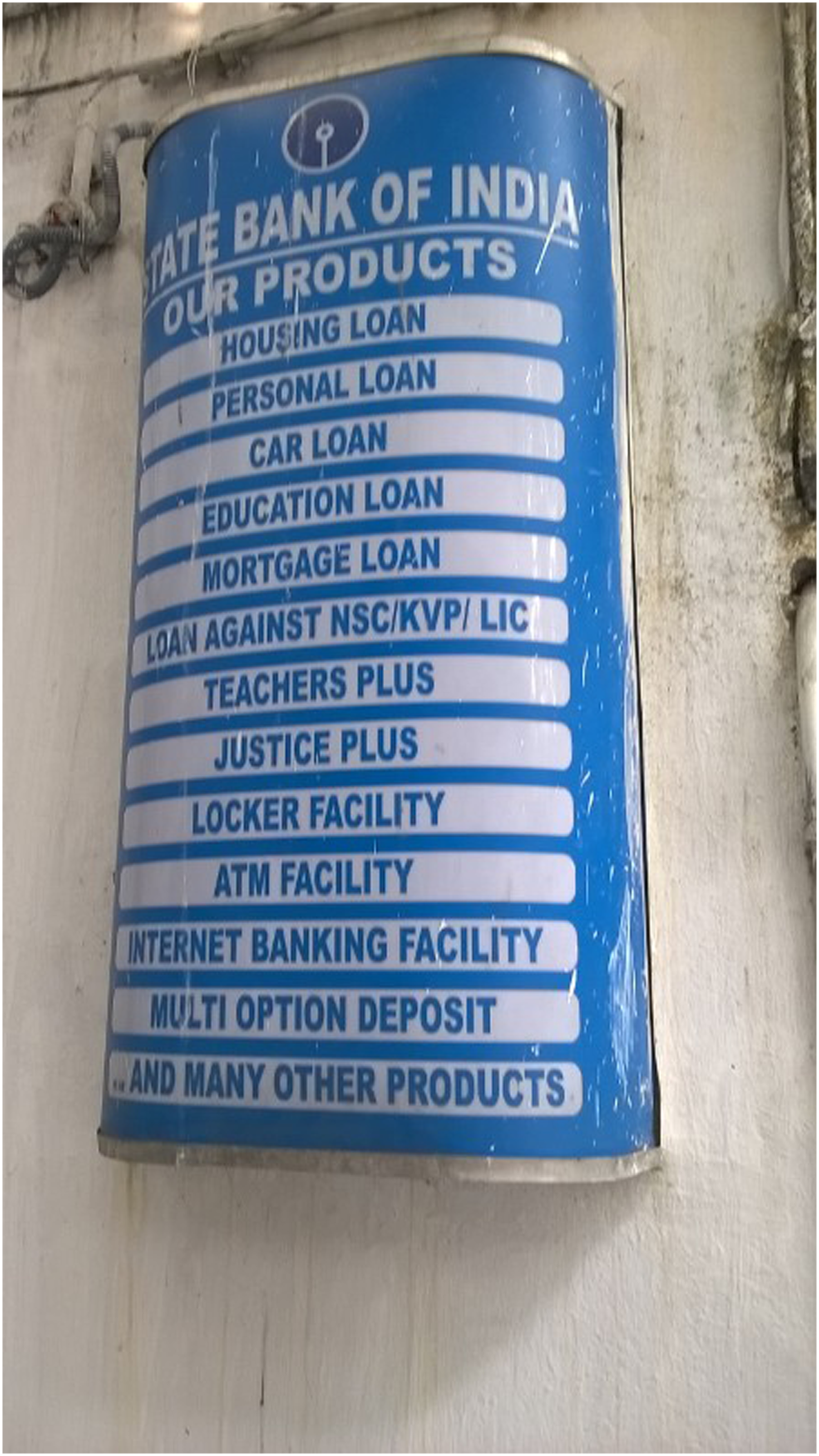
For my interlocutors, and no doubt a wide section of India’s female citizens who would have earlier lived patrilocally, changing cityscapes have promoted nuclear family life and allow for proximity to parents and their home. In many instances the idea of a ‘room of their own’ funded by their parents, or co-ownership of a flat with a husband, opens new spaces of negotiation. Such entanglements were repeatedly represented as sites of ‘liberation/freedom’ from earlier patrilocal residential patterns as a way to avoid hierarchies of authority between mothers- and daughters-in-law. Among middle-class families in Kolkata and across India, female employment, and investment in property by and for women, are on the rise, and proudly represented as signs of upward mobility by my interlocutors. But parents also referred extensively to their daughters’ potential as carers in old age, and in some cases had bought flats for them or had received a flat from a daughter to accommodate these needs, planning around her and her future family. Earning daughters regularly helped their parents to do their natal home up, which was seen as a sign of care but also as staking a claim in that property. Furthermore, in more than one case a single daughter’s husband was expected to move in with his wife’s parents, thereby turning into the proverbial ghor jamai (husband living uxorilocally), traditionally the butt of jokes. Childcare is commonly the bait that persuades a couple to stay put even where they have invested in a property of their own. During my fieldwork it became apparent that many apartments purchased off plans were the stuff of drawn-out conjugal arguments. In a shift towards a more bilateral form of attachment, young women remain emotionally and practically much more involved in their own parents’ homes, often sharing the rewards of their education and jobs, and actively prepare to make claims on the property and parental resources in the form of childcare.
Discourses of empowerment
Within this context, the state- and media-promoted image of India as a ‘growing’ market is propped up by the competing notions of ‘untapped potential’ and ‘sophisticated differentiation’ and links gender and nationalist narratives. The focus on women’s economic empowerment as a means to overcome sluggish development, and the financialisation of intimate relationships, marks ‘home-ownership’ as a site of such nationalist reimagining. Home-ownership is constructed as the result of women’s entry into the labour market and signifies individual and collective aspirations. The fact that employment rates among Indian urban middle-class women remain extremely low raised concerns in the wake of debates on ‘smart economics’ and is reflected in various reports on India’s economic trajectory as well as policies (Das et al., 2015). But as I have pointed out elsewhere, it is motherhood that cuts middle-class women’s careers short and, by extension, limits their financial and old-age security and keeps them dependent on their affines (Donner, 2012). In response to the vulnerability of women to losing a marital home, home-ownership (just like micro-credit) is cast as a state-enabled measure to ‘empower’ women, and is expected to reflect positively on women’s agency and decision-making power inside and outside the home. But even where, in line with the imagery of a global and professional new Indian female elite, single women are targeted by real estate developers, ordinary single women complain about discrimination as married couples remain the normative buyers. In addition, the values of patrilocality and patrilineality have not disappeared, as the following account by a brother detailing why his sister could not access their parental property shows: Mr Banerjee, a 62-year-old retired bank employee, had inherited his paternal property after his father’s death, and although he has a sister he sold it and kept the profit from selling it to invest in a flat elsewhere. He argued that his sister is settled in her affinal home and was in employment so she draws a pension. His own daughter, who stays in her in-laws’ house, is an only child and will inherit his current property, although he doubts she will need it. However, he says: ‘It will give her security should she ever need it.’
Because middle-class women are often depicted as perpetual dependents in the domain of law and patriarchal property relations, women’s access to property is routinely described as a matter of ‘autonomy’ and ‘security’ by interlocutors. Moreover, home-ownership rather than employment is simultaneously a means and a marker of self-realisation and independence. Yet this status should ideally be realised within the framework of marriage, even where more and more professional women join the ranks of home-owners. A closer look at the way loans are structurally interdependent reveals that, as the advertisement for credit in Figure 3 suggests, agents of financialisation often construct women’s newly won status as consumers of their products as the result of successful matchmaking and ongoing parental investment. Both, marriage and parental investment are discussed as access routes to home-ownership for women below. Advertisement for mortgage, State Bank of India, 2019.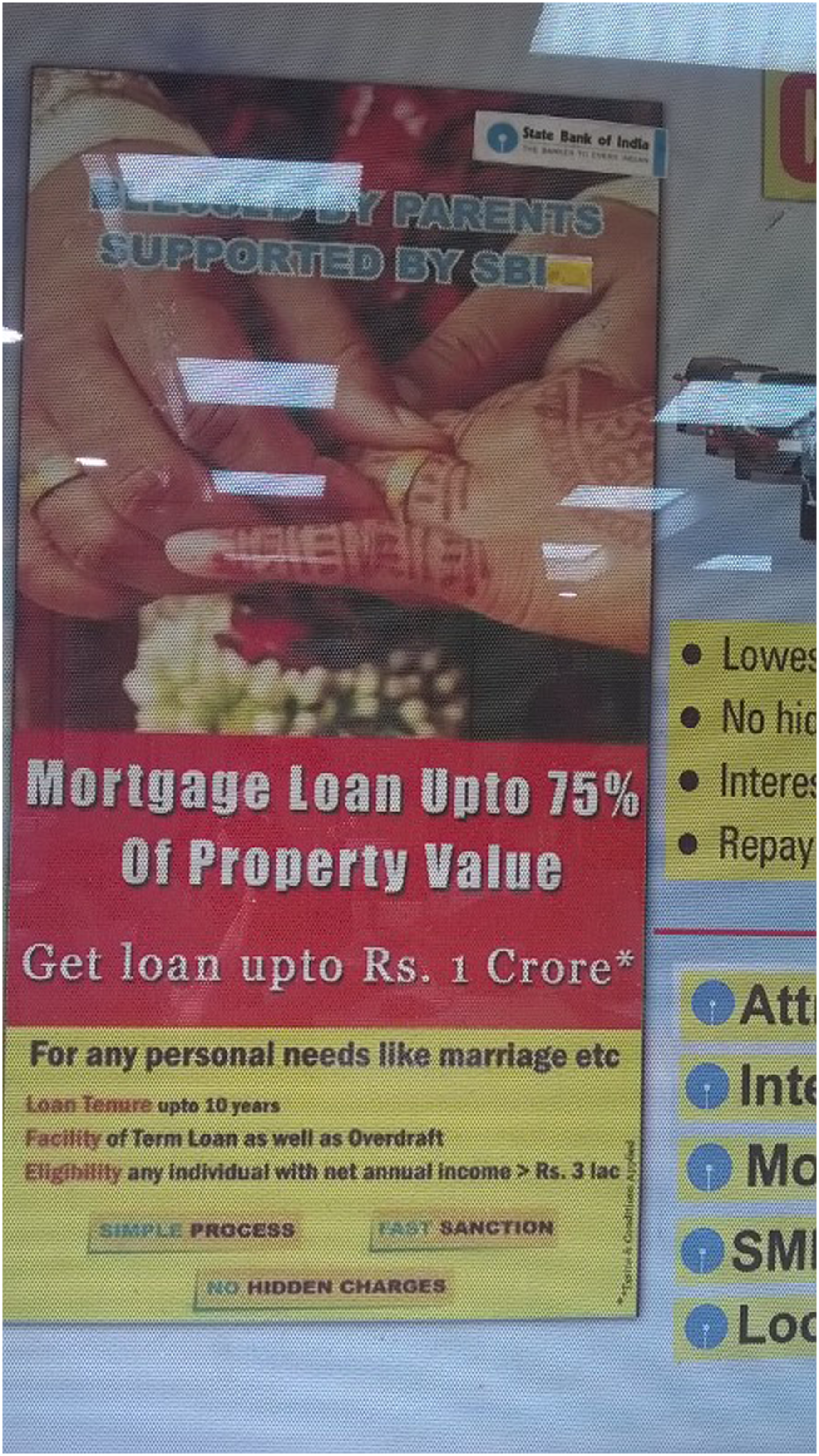
The elevated status of the parent–daughter relationship is the result of changing demographies, as most middle-class families no longer have several children to educate, and may only support one child through education and into employment. My own long-term research confirms middle-class women’s educational attainment, and that daughters are expected to complete a degree regardless of whether they have siblings (Donner, 2006; Clark, 2016). But depending on their background, they do so with very different outcomes, and while talk about employment is de rigueur, self-making and upward mobility do not hinge on a career, but are closely linked to discourses about family forms and consumerist lifestyles. In this context, ‘trends’ and ‘fashions’ related to consuming a middle-class home have made the domestic sphere into an important site for public presentations of the self related to regimes of care, as this vignette demonstrates: Visiting old friends after some years, I was shown into their refurbished kitchen, which was the only room in the home that had been done up. The middle-aged couple were proud of the new layout, the materials, and laughingly admitted that their decision to refurbish had been driven by their desire to impress their new daughter-in-law. She had chosen the designs, I was told, as according to her mother-in-law she ‘has modern tastes’, although the changes and investment were, in relation to their background, rather modest. As this flat was part of a jointly held property, and their son is a single child, both were hopeful that the couple would move in with them upon their return from a placement in a mofussil town.
2
However, as they conceded, the two had already begun to save and were considering putting a payment down to purchase an apartment in a new development nearby. It was clear that the availability of the in-laws’ flat did not sway the daughter-in-law’s decision to live ‘separately’, and her in-laws saw this desire as an expression of appropriate modern forms of conjugality, a matter of ‘progress’.
I have argued elsewhere that many young women harbour hopes of ‘living separately’, but these are equally often put on the backburner when concerted cultivation (an intensive parenting style popular among the global middle classes) and childcare become an issue (Donner, 2006). Charting the discursive construction of the ‘autonomous’ and ‘professional’ Indian middle-class woman, Smita Radhakrishnan points towards the link between female professionalism, middleclassness and the enactment of global lifestyles referenced in depictions of iconic transnational workers (Radhakrishnan, 2008). Even in Kolkata, where female rates of employment are traditionally very low, the rhetorical link between employment and agency is evident in young women’s appropriations of ‘professional’ styles. Gendered engagements with ‘enterprise culture’ (Gooptu, 2013) inculcate an orientation towards the market and professionalism through self-education and presentation, including the way that middle-class women are expected to acquire ‘expertise’. Managing a home based on financial infrastructures like loans and insurance requires knowledge and, increasingly, financial products play a role in the way the ‘expertise’ of the housewife and mother is utilised by middle-class women to create the perfect home (Donner, 2020). Among my interlocutors, things like training certificates and the cultivation of a groomed ‘professional’ persona (responsible for the booming beauty industry) were associated with ‘entrepreneurship’ and made middle-class notions of ‘professionalism’ accessible even to urban working-class women (Donner, forthcoming) as the following vignette suggests: In January 2020 I was engaged in research on the beauty industry, and interviewed a young woman who works at a housebrand beauty counter in a large mall. We were discussing the growing demand for cosmetics and why the beauty industry attracted young, class 11-educated women like her. She argued, ‘Everyone now wants to be groomed, to look professional. If you went out without make-up as my mother’s generation still used to do when they were our age, that would be unprofessional, you would not feel good about yourself. Even my mother does not leave the house without make-up any more.’
Indeed, as Gooptu (2009) has argued, the ‘cultivation of enterprising personality traits’ as well as the development of ‘soft skills’ of self-presentation and communication, which are now much valued in the job market, particularly in the feminised, service sector, rely on suitably disciplined gendered bodies. For the enactment of this kind of middle-class femininity to work, one needs to be employable, rather than be in employment, and this latent value shapes young women’s relationships with the market.
Demography, kinship and changing practices
Marriage is the main factor that determines how women’s agency is understood by my interlocutors, although it is of course not the sole source of identity or self-representation. Its inevitability is often seen in terms of ‘security’, whereby the vagaries of access to shelter for women across the life course are acknowledged. As Sarah Lamb argues, being single cuts off kin ties that are crucial to organise everyday life, including shelter (Lamb, 2022) and, where home-ownership is solidly positioned within the cultural and legal framework of marriage, single women’s access to loans and actual properties is severely curtailed. Not only do bank loans privilege married women by providing better conditions to couples applying for credit; developers are known to stop single women from ‘booking’ an apartment off plan, and the infamous societies that run residential complexes are hostile to singles too.
In Bengali Hindu families, property is only passed between the generations upon the death of a father to his sons. Given the legal rights of daughters, many women would, even in the 1990s, go to court and ask for their share after their father’s death. This was the case with Shibani Bose, who lived in her affinal home, a very spacious central Calcutta house. Uncharacteristically, she was a teacher in her parents’ suburban neighbourhood and she had visited their house frequently throughout her adulthood. After her father’s death Shibani had started a court case against her two brothers to get her share in his property: I know I have the right to that property, and I know that my father would have wanted me to have it, given I visited my parents whenever I was in the neighbourhood on duty and ran errands for them – my brothers and their wives may have lived with them, but in the end my parents depended on me and my husband to be looked after. The house is large enough for my brothers to find a solution, they can sell a part and pay me with the returns from that sale.
Like so many other cases, hers was lingering in the family courts, providing only lawyers with a profit (some courts operate without lawyers). While Shibani herself did not expect an outcome any time soon, her determined stance confirms Srimati Basu’s (2015) assertion that educated litigants are deeply invested in the legal construction of the case they put forward.
As I have argued elsewhere, the single-child norm in middle-class families has triggered changes in gender relations and in the way affinity is constructed, and in the course of these changes the importance of inheritance from a woman’s natal family has become enhanced (Donner, 2015). With single children becoming a middle-class norm, the value of daughters in the complex household strategies that bring care, property and futures into everday conversation has risen.
3
All of these changes are noted by interlocutors as indices of progress and ultimately seen as benefiting the nation, with middle-class women as model citizens, and home-ownership an important contribution to growth and national prosperity. Often parents would emphasise that ‘today’ a daughter could expect an apartment upon her marriage, as ‘daughters are just like sons now’, implying that parents no longer rely on sons for security in old age (see also Donner, 2014, 2015): I had met Mitu Banerjee only very briefly when she came to the office of the NGO I was working with to discuss her return to work after maternity leave with her boss, a friend of mine. Previously, she had been employed in a leading position in the office, and had earned a decent salary that had allowed her and her husband to take out a mortgage on a flat nearby. This was her second child, and she had only taken six months off before she came to see the director. As it turned out, she needed to come back asap to pay the mortgage, which her boss later described as ‘excessive’. Her desire to own a flat in a prestigious development close to her parents’ house in South Kolkata was clearly a stretch for the couple after a second child had been born. When discussing her case further with the employer, it turned out that her parents had paid the deposit for the flat upon her marrriage, in order to allow their daughter to live ‘separately’ but also to ensure she stayed close by. There was no doubt in anybody’s mind that the deposit had been part of the dowry negotatiations, and that her parents had agreed to this arrangement to ensure she had access to independent shelter, but also to organise her household in relation to their own possibilities and needs.
There is growing evidence that single daughters are increasingly encouraged to marry close to home, and may be provided with a flat near their parents’ house, or are encouraged to move their family into their natal home. It is by bypassing cohabitation with in-laws that apartments are represented as an investment in a daughter’s future security, discursively linking female home-ownership to prevention of domestic abuse. As septuagenarian widow Minakshi Chatterjee, who owned a flat in a housing association, argued, her daughter’s rights in this cooperative flat guaranteed ‘she will always have a place to stay’. Marital breakdown would mean that her daughter would need to return to her parental home, as she would not be able to realise rights in her affinal property. Furthermore, home-ownership is an ongoing theme in everyday negotiations around gender hierarchies in the joint family. In the case of Usha Ghosh, a neighbour who brought up her daughter with her husband and widowed mother-in-law in rented accommodation, the apartment the couple had purchased on the eastern outskirts of the city acted as a safety valve when conflicts with her mother-in-law arose. In an ironic twist, her mother-in-law, a retired lawyer, ultimately moved into her own place, leaving Usha and her husband with reputational damage for ‘driving the old woman out of the house’ and disrespecting their duty of care. This shows that values of filial duty and joint family ideals (even where these are not fulfilled) play a role in decision-making processes about gendered access to home-ownership. Where in reality the multiple players involved in elder care include paid carers and a whole host of relatives, it usually falls to daughters and daughters-in-law to organise such care. As expert homemakers, middle-class women have become adept at utilising technologies to arrange caring responsibilities, for example by managing domestic servants via WhatsApp messages even across continents in order to perform the role of dutiful daughter as part of practised middle-class respectability (Ahlin and Sen, 2020). Interestingly, single daughters and their parents are increasingly embracing the logic of care but defy the patriarchal prioritisation of life with a husband’s parents in favour of uxorilocality, of sorts. Thus, living near her parents, looking after them, and thereby staking a claim in parental property, is the reward a daughter gives her parents who helped out with a down payment for a mortgage. Crucially, this kind of investment in a daughter’s future is perceived as separate from substantial dowries and wedding expenses borne by the parents of a bride, which are gifts given directly to a daughter (Basu, 2021).
Conclusion
What does the reconfiguration of property and kinship tell us about the role of the state in promoting class formation as neoliberal ideas of the self reshape relationships and practices? Enabling home-ownership has become one of the most effective means of governance, and it shapes intimate lives as financialisation deepens. Home-ownership is a collective effort – as it depends on couples collaborating, on kin to chip in, and on the ideological construction of the middle-class family. As a means of governance, home-ownership is present in the way citizens relate to normative notions of the family and of urban space, and propertied citizenship directly encourages the class-specific and gendered ‘socialisation of risk’ (Martin, 2002) via the individual loan secured through global financial transactions. This financialisation of daily life is individually experienced in terms of an intensified reliance on others, especially ‘kin’, who get entangled in webs of interdependence that are marked by transfers of money in exchange for the ‘delayed’ returns of care work. While a narrative of reciprocity is common, the reality is that such lives depend on the exploitation of wives, daughters, and female care workers. Just as parenting feeds into the way aspirations and class relate to marriage, domesticities and property across global middle-class lives (Golden et al., 2021), elder care is another mode of bringing care work as a classed practice into conversation with globalised middle-class subjectivities and the state.
Much hinges on the ideal of gendered ‘empowerment’ through being modern, rational and independent, as the discourse on ‘professionalism’ suggests. Together with employment, home-ownership is hailed as a chance to escape patrilocal residential arrangements. However, the ‘freedom’ associated with a room ‘for one’s own’ rarely translates into ‘transformative’ agency in the sense of Naila Kabeer (Kabeer, 2005: 15) due to the structural constraints that limit the efficacy of rights in property. The complex interweaving of the way women appear as ideal neoliberal agents and home-ownership’s possibilities creates a wide spectrum of such effects, across degrees of affluence and lifecycle stages. Furthermore, the analysis of gendered regimes of home-ownership shows ‘agency’ to be a contingent part of processes of class formation. Use of the rhetoric of liberal feminism, with its focus on individual empowerment through access to markets, may lead to ongoing engagements with financial infrastructures that shape intimate relationships, but may hamper agency in the long run. Property as a way to ‘empower’ women is emphasised here in the context of aspirational lifestyles, but the spectre of downward mobility is ever present. Crucially, access to property hinges more directly on demographic change – being an only daughter – than rising rates of educational attainment or holding down a job. Where young women can realise rights in real estate, they more often than not do so as spouses or single daughters, and their rights stem from the promise of future care work rather than paid employment.
It is therefore, I would argue, not solely, and probably not even primarily, through women’s employment but kin work that gendered labour, urban property markets, and class formation are reorganised. Caught betwixt and between in a liminal state, middle-class women are enabled to act assertively and develop aspirational spaces in their lives within the context of extended family ideologies, which are no longer envisaged as exclusively patrilineal, but include care for a woman’s parents. The establishment of middle-class homes is mediated by kinship relations, but it also may break links among kin. This is related to the inherent contradiction where the mobilisation of an ‘egalitarian’ rights discourse by and through state agencies coexists with a more ‘hierarchical’ patriarchal kin morality that structures discourses around family homes as James (2015: 191) has argued. While the status of home-owner may provide a sense of security, it also encourages serial debt relations to realise a range of aspirations, many of them indexed publicly in terms of consumption patterns and gendered practices of homemaking. Kin morality often subjects women as sisters and wives to a reorganisation of patriarchal gender relations that enables homes to be turned into ‘assets’ secured through debt. By providing debt facilities and actively encouraging loans, the state indirectly destabilises women’s security as a home can come under threat.
How do the successes and failures of such processes redefine the relation between ‘state’ and ‘citizens’ – the much-cited social contract – in different contexts? Policies play a major role in the way practices of consumption take centre-stage in the current reconfiguration of citizenship and the state, which according to Lai gives the state a lead role due to the way intimate lives depend on market solutions for personal problems and security (Lai, 2018), for example loans to purchase education, health insurance and old-age financial security. This brings the discursive construction of women as agents of change, symbols of progress and guarantors of repayments into sharp focus. At first sight, middle-class women’s entanglements seem to be far removed from such narratives, which are routinely used where microfinance for poor women is concerned. However, if the role of institutions shaped by state policies, including marriage and the family, is taken into account, processes like the financialisation of intimate relations are linked through women’s roles as homemakers and the value and materiality of the family home. A focus on how loans are promoted and the local context of kin relations they are situated in draws attention to the multiple realities of property ownership, which, as Katherine Verdery (2003: 18–19) has shown, brings embodied values to the fore as states create overlapping regimes of ownership where land and real estate are concerned. Due to this overlap – the state supporting women’s access to property through specific financial products may also promote women’s dependency on family – care work becomes the glue that sets off credit against kin dependencies.
Home-ownership fits neatly into changing relationships between governance, knowledge regimes (for example about real estate and financial products) and new forms of subjectification, which, as Ong (2006) suggests, emphasise consumer sovereignty based on propertied citizenship. It is in this global form that state institutions and processes – such as the policies of economic liberalisation, the governing of inheritance or taxation, and the provision of financial products like loans – contribute to class formation, shape inter-class relationships and have effects in the private and intimate lives of citizens. Citizenship that results from the middle-class privilege of home-ownership relies on capital flows, often across generations and continents (see Brijnath, 2020; Gamburd, 2020), which are enabled by female labour, both affective and other. Together with the education of children (Donner, 2006), care for the elderly is always understood as gendered, and in the South Asian context firmly situated within ideas about inter-generational reciprocity. Ethnography has shown how such labour also includes the affective creation of classed ‘others’, evident in Leyton and Rojas’ (2017) work on middle-class mothers’ affective creation of working-class others through school choice in Chile using Berlant’s terminology, while Qayum and Ray’s (2003) ethnography of domestic service in Kolkata provides insights into the role of middle-class homemaking as a major site of the ‘marking’ of abject working-class subjects. Both are reminders that class formation is intrinsically linked to inter-class relationships: middle-class women engage with care work that makes their homes in Kolkata and elsewhere with reference to working-class ‘others’, in particular domestic servants, without whom the home would not be respectably run.
The enhanced visibility of middle-class women as ideal citizen subjects disguises their liminal state, which results from the complexities of the life course envisaged and processes of urban restructuring, labour markets and demography. It also hides the similarities between relatively affluent middle-class women and precarious subjects, including the urban poor, where access to shelter is concerned. Maxim Bolt has argued that, in the case of disputes over home-ownership in South Africa’s post-Apartheid townships, bureaucracies do not simply impose normative ideas about appropriate kin relations but mediate between highly flexible arrangements and a plurality of social expectations (Bolt, 2021). In Kolkata, and indeed in India more generally, middle-class women’s access to real estate and residences relies on ‘cultural’ norms, legal codes, affective landscapes and material practices. Where neoliberal logics frustrate expectations towards financial independence and enhance women’s precarious relationship with the labour market, home-ownership becomes the focus of self-making projects, which rely on what Lauren Berlant refers to as ‘cruel hope’ (Berlant, 2011). If middle-class mothering can be understood as exploitative affective labour based on the ‘othering’ of working-class subjects in order to create a ‘community of equals made up of middle-class subjects’ (Leyton and Rojas, 2017: 567), then propertied home-ownership in India enhances this ‘affective collectivism’ by focusing on the home of the nuclear family, segretated spatially in condominiums and enclaves. The spatial politics at play and the social engineering required to realise these sites enable detachment from ‘abject objects’(Berlant, 2011) and the re-attachment to ‘one’s own’, through active boundary creation within such permeable spaces as the middle-class home (Dickey, 2000). Care work as affective labour in the middle-class home thereby is ‘entirely immersed in the corporeal, the somatic, but the affects it produces are nonetheless immaterial. What affective labour produces are social networks, forms of community, biopower’ (Hardt, 1999: 96).
On the ground, the state is crucially affecting middle-class women’s lives through the link between gendered care work for kin and access to property. However, the rhetoric of the state as arbiter of women’s rights still holds promise and is frequently mobilised even where the chances of winning court cases are minimal. Second, while long-standing patriarchal residential arrangements are frequently challenged, and are argued against in the idioms of personal autonomy, women’s agency and self-realisation, the same women need to shoulder more care work rather than less in order to become home-owners. Both moves, I would like to suggest, need to be analysed within the broader context of affective economies of late capitalist class formation in which gendered labour as kin work plays a crucial role.
Footnotes
Declaration of conflicting interests
The author(s) declared no potential conflicts of interest with respect to the research, authorship, and/or publication of this article.
Funding
The author(s) received no financial support for the research, authorship, and/or publication of this article.
