



Abstract
Introduction:
Occupational therapy is named a key profession within primary care, with growing demand due to an ageing population and increase of people living with long-term conditions. Despite this, occupational therapy within primary care remains an evolving, under researched area of practice. This scoping review explored the role of occupational therapy within primary care including the populations and interventions currently provided.
Methods:
The Joanna Briggs Institute (JBI) methodology for scoping reviews was followed with systematic searches conducted across CINAHL, PubMED and AMED databases with grey literature also sourced. The findings are presented in tabular format and analysed using descriptive statistics and frequency counts to identify patterns and trends alongside narrative reporting.
Findings:
This scoping review identified 40 relevant articles, with older adults reported as the most frequent population supported by occupational therapists. Interventions focused on physical health including providing equipment/assistive devices, supporting mental health through stress and anxiety management, with limited reported interventions with children and young people.
Conclusion:
This review has highlighted key interventions provided by occupational therapists and the breadth of the role within primary care. Research and sharing of best practice is required to showcase occupational therapists evolving contribution within primary care.
Keywords
Background
Occupational therapy is named a key profession within primary care (European Commission, Directorate-General for Health and Consumers, 2015), with growing demand due to an ageing population and increase of noncommunicable diseases (World Health Organization [WHO], 2018). Across both health and social care sectors, there is ambition to protect and improve health outcomes and reduce health inequalities to lower National Health Service (NHS) and social care reliance (Public Health England [PHE], 2019). Despite this, the role of occupational therapy within primary care remains an area of practice that is under researched, with a need to promote best practice, based on evidence worldwide (Freeman et al., 2025). Across Europe, the development of primary care and the services within this area differ dramatically, with varying degrees of occupational therapy uptake within primary care (Bolt et al., 2019). As primary care continues to adapt to the changes of population demands, the multidisciplinary offering will need to also adjust to ensure primary care is adequately meeting the needs of the people it serves. Increased evidence will add clarity to showcase what different health professions can provide, ensuring every primary care network is designed to meet local and regional needs.
General practice is under surging pressure due to high workload, an ageing population and increasingly complex patients (Primary Care Workforce Commission, 2015). Not only have General Practitioners (GPs) seen a substantial increase in their workloads, but the nature of appointments is also becoming more complex. Many are presenting to primary care services with concerns and conditions linked to issues managing their day-to-day lives effectively, including living with multiple or chronic conditions, mental health, cost-of-living crises and retaining or gaining employment. As primary care evolves to meet the demands of a modern society, the opportunities to utilise a wider multidisciplinary team grow, with recognition that allied health professionals, including occupational therapists, can offer expertise in managing daily life when faced with a range of barriers to participation. The Royal College of Occupational Therapists (RCOT, 2021), in a document presented to the House of Commons Health and Social care Committee inquiry, identified occupational therapists holding three key ‘superpowers’ when working within primary care relating to supporting: frail older adults, people experiencing mental health problems and working age adults with employment difficulties. In order to share practice development within primary care, RCOT have a growing evidence base on their website including an evaluation of occupational therapy in primary care for older adults (RCOT, 2023a).
Additionally, traction is being gained with occupational therapists in First Contact Practitioner (FCP) roles and as Primary Care Advanced Practitioners (Health Education England [HEE], 2021). FCP roles were developed in response to optimising integrated primary care teams and to ensure patients were ‘seeing the right person in the right place at the right time’ (HEE, 2021: 8). FCPs are clinicians working at the top of their clinical scope of practice and have underpinning knowledge to assess and manage patients with undifferentiated and undiagnosed presentations (HEE, 2021). Additionally, Primary Care Advanced Practitioners can be from a range of professions including but not limited to pharmacists, dieticians and occupational therapists who demonstrate advanced clinical capabilities, with the skills and knowledge to expand their scope of practice to meet the needs of the population they work with (HEE, 2021). The development of these advanced clinical roles were created to support GPs and to enhance the patient care pathway (HEE, 2021). However, uptake is sporadic and barriers to successful integration exist with limited evaluation of these roles to date. Primary care often has misunderstandings of the role of occupational therapists and their unique contribution in a range of areas across physical health, mental health and social care. As a result, the profession is too often underutilised within primary care (Dahl-Popolizio et al., 2017).
There is growing evidence demonstrating that occupational therapists have the skillset to work within primary care (Dahl-Popolizio et al., 2017; Donnelly et al., 2023). A cross-sectional study highlighted that although occupational therapists have the necessary skillset, there are a multitude of barriers that inhibit occupational therapists from working within primary care, including perceptions of other healthcare workers, uncertainty of the contribution of the profession, role clarity and the heterogeneity of how services are funded in this area (Dahl-Popolizio et al., 2017). These factors contribute to the perceived lack of scope to work within primary care. Bolt et al. (2019) further built on these challenges that identified unfamiliarity from the public of the profession, lack of clarity from policymakers and health professions of what services occupational therapists can offer and lack of support for occupational therapists working within primary care. Despite some useful developments, a deeper review of the literature is needed to fully understand the role occupational therapists have within primary care teams. A role for occupational therapists within primary care is being identified in the United Kingdom and includes aspects of holistic care, health promotion and prevention (Chamberlain et al., 2019).
Despite research spanning over a decade, occupational therapy is still in its infancy within primary care, and it is imperative to explore why there is still a lack of occupational therapists working within this area of practice. A previous scoping review by Donnelly et al. (2023) of occupational therapy services in primary care, identified assessments and interventions. This scoping review sought to build on the review by Donnelly et al. (2023) by further exploration into the specific areas of primary care that occupational therapists work in and the life stages occupational therapists work with.
This scoping review explores the role of occupational therapy within primary care, which can help to inform evidence-based practice and support the role expansion into this area of practice, including the populations regularly supported and interventions used within primary care by occupational therapists. This scoping review aims to delve into the interventions that help address the research question of ‘What interventions are provided by occupational therapists within primary care?’
Method
The scoping review was conducted in accordance with the Joanna Briggs Institute (JBI) methodology for scoping reviews (Peters et al., 2020) that follows a contemporary methodological framework.
Review question
−What interventions are provided by occupational therapists in primary care?
Research objectives
−To outline the interventions currently used by occupational therapists in primary care.
−To identify the life stages occupational therapists support within primary care.
Inclusion criteria
The PCC (population, concept and context) framework was adopted to establish the population, concept and context of this scoping review (Peters et al., 2020).
Population: studies of all ages, genders and conditions, and professionals who hold the title of ‘Occupational therapist/s’, ‘First Contact Practitioner’ and ‘Advanced Practitioner’.
Concept: Occupational Therapy interventions
Context: Primary Care
This review only considered studies conducted in the United Kingdom, Ireland, Canada, Australia and New Zealand as they are higher-income countries, and all have healthcare systems underpinned by public insurance; however, the level of public insurance may vary across these countries, and some may have elements of private practice within their healthcare systems. Therefore, to maintain clarity, private practice was excluded from this scoping review. Only research conducted in English language were included as there were no translation resources available.
Types of evidence sources
The search strategy aimed to locate both published and unpublished studies. This scoping review included primary research and grey literature including opinion papers. However, this review excluded systematic reviews, meta-analysis, scoping reviews and conference abstracts although reference lists of relevant systematic reviews and scoping reviews were scanned. Literature published between July 1989 to January 2024 were considered for this review, starting from Bumphrey (1989) as the first published research exploring occupational therapy within the primary care team.
Search strategy
A three-step search was adopted to uncover published and unpublished studies as per the JBI manual (Peters et al., 2020). An information specialist assisted to refine the search strategy. An initial limited search of CINAHL (EBSCOhost) and PubMed was undertaken to identify literature (first phase). The text words contained in the titles and abstracts of relevant articles, and the index terms used to describe the articles were used to develop a full search strategy (second phase). Table 1 shows a preliminary search example undertaken in CINHAL (EBSCOhost).
An example of preliminary search undertaken on CINHAL (EBSCOhost) database.

CINAHL (EBSCOhost), PubMed and AMED (Allied and Complementary Medicine Database) were used to conduct the searches. Grey literature was sourced using the PCC framework and investigated the first 50 returns of Google Scholar were investigated.
The search strategy, including all identified keywords and index terms, was adapted for each included database. For phase three, 10% of the articles included in the full-text search were searched for relevant articles which resulted in six further articles sourced one of which were included. Duplicate and articles with their full-text unavailable were excluded. Boolean operators, truncation and Medical Subject Headings were used in the search strategy. All database search strategies and their subsequent generated results are available in Supplemental Appendices 1–3.
Evidence screening and selection
All identified references were collated and uploaded to Endnote Online (Clarivate Analytics, PA, USA) reference manager and duplicates were removed. The titles and abstracts were screened for eligibility against the inclusion criteria for this review by the primary researcher and 10% by a secondary reviewer. The full text of selected sources were assessed against the inclusion criteria by the primary researcher and 10% by the secondary reviewer. Five disagreements arose between the reviewers and were resolved through discussion and with a third researcher. The Preferred Reporting Items for Systematic Reviews and Meta-analyses (PRISMA) flow diagram (Page et al., 2021) outlines the search and the study inclusion processes (see Figure 1).

PRISMA 2020 flow diagram for new systematic reviews, which included searches of databases, registers and other sources (Page et al., 2021).
Data extraction
Data were extracted using a modified version of the JBI data extraction tool (Peters et al., 2020). The data extraction from databases into Microsoft Excel gathered the following details: author(s), year of publication, title, country, study aim, methodology and methods, client group, area of practice and interventions. The data extraction tool was modified and revised as necessary during extracting data from each included evidence source, therefore adopting an iterative approach.
Data analysis
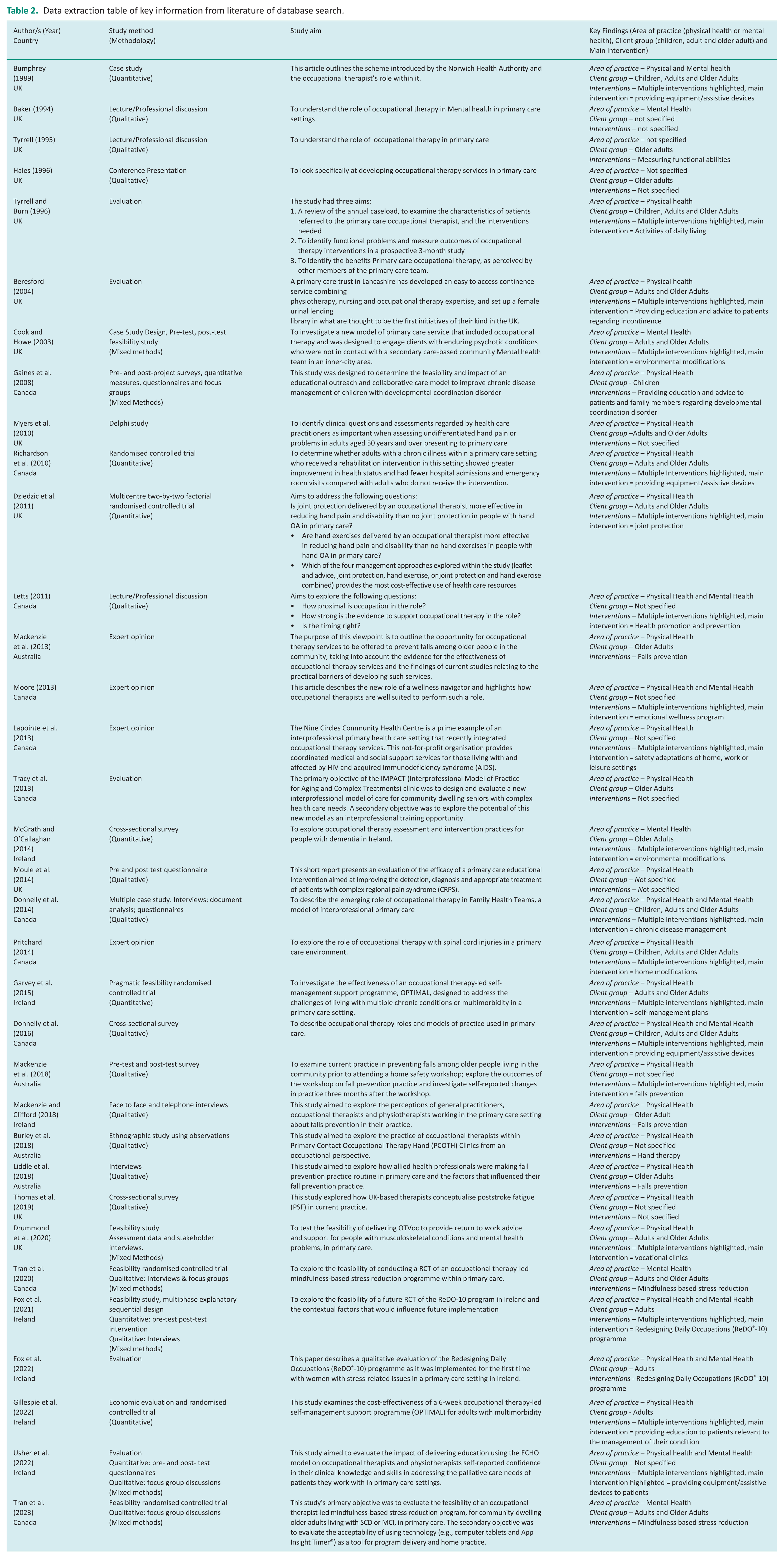
This review analysed data via descriptive statistics which entailed using a simple frequency count of the data. Extracted data were presented in tabular format and a narrative summary of the studies included. A frequency count of the following areas were undertaken which link to the objectives of this review; areas of practice, client group and interventions. A summary of all data included in this review can be found in Tables 2 and 3.
Results
This scoping review aimed to summarise and map the findings for occupational therapy interventions within primary care in the United Kingdom, Ireland, Canada, Australia and New Zealand.
Review of the selection process
Forty sources were included in this review. Table 2 provides a summary of the research literature included. Table 3 illustrates the data extraction of key information from the grey literature search included in this review. Tables 2 and 3 provide overviews of the data included, some sources highlighted more than one intervention used therefore, only the main intervention has been highlighted.
Data extraction table of key information from literature of database search.
Data extraction table of key information from literature of grey literature search.

Descriptive summary
Of the 40 included sources, the majority of the studies were qualitative studies (n = 12), followed by expert opinion (n = 10), mixed/multiple methods (n = 7), evaluation (n = 4), quantitative (n = 6) and a Delphi study (n = 1). Spanning from 1989 to 2024 (35 years), most of the research carried out was in the UK (n = 18), Ireland (n = 7), Canada (n = 11), Australia (n = 4) and no studies were found from New Zealand (n = 0). In the following sections the area of practice, life stages and interventions used in primary care are explored in tabular format, including a frequency count of the data.
Areas of practice
Please see Table 4 for a frequency count of the specific domains within Physical Health and Mental Health areas of practice identified. Some sources highlighted working within more than one area of healthcare practice. Of the 40 sources included in this review, 25 physical areas of practice were highlighted, and 10 mental health areas of practice. Six studies highlighted working in both physical and mental health areas with no further explanation on the specific domains within these. Three studies did not specify if they focused on physical or mental health needs.
Specific domains within physical health and mental health areas of practice identified that occupational therapists work within.

Looking at physical areas of practice, the most common area of practice for occupational therapists in primary care was supporting people who fall (n = 10). The most common mental health areas of practice highlighted were mild-to-moderate mental health conditions including anxiety and stress which was highlighted in four studies. Subtle cognitive decline/mild cognitive impairment was highlighted by four studies, respectively.
Lifespan
From reviewing the literature, eight studies highlighted occupational therapists working with the client group children (0–17 years of age). Adults aged 18–65 years of age were the second most common age group identified (n = 19). Older adults aged 65 plus were the most common age group receiving occupational therapy interventions (n = 23). A total of 10 studies did not specify the client group that they worked with. Despite Tyrrell and Burn (1996) highlighting occupational therapists supported individuals across the lifespan, 87% of the patients were over 64 years of age, with occupational therapists only working at that time with a small percentage of children and adults. The following studies highlighted occupational therapists worked with individuals across the entire lifespan with children, adults and older adults; Tyrrell and Burn (1996), Donnelly et al. (2014), Pritchard (2014), Donnelly et al. (2016) and Cameron et al. (2023). Out of the 23 sources of literature identifying occupational therapists worked with older adults, nine highlighted occupational therapists solely worked with this client group. Table 5 presents the frequency distribution of the literature sources that identify the life stages occupational therapists work with.
Life stages identified that OTs work with in primary care.

Interventions
There were 66 interventions identified as used by occupational therapists in primary care. A total of 11 sources did not specify what interventions were used. Table 6 includes a frequency count of all interventions highlighted, also illustrating 10 overarching categories of interventions and then specific interventions within these are detailed in the corresponding area.
Interventions identified that are used by occupational therapists in primary care.

Occupational therapy interventions to support physical health were identified with the most frequency, with 19 identified. The most identified physical health interventions were providing equipment/assistive devices reported by 10 sources. Interventions relating to individuals’ mental health were the second most frequently reported with eight interventions highlighted. The most frequently reported intervention being stress and anxiety management, with five studies highlighting this in practice. Vocational interventions for adults were identified in two sources; one supporting people with musculoskeletal conditions and mental health problems and the other where occupational therapists supported people with employment retention issues due to a variety of health conditions.
From examining the subcategory of paediatrics, three interventions were highlighted, all by the same source of literature. The following interventions were highlighted: advising and delivering paediatric-specific written material, providing direct access to sensory-based advice, parent handouts, picky eating advice, useful links and sensory parenting online training and directing parents to local parenting courses and early help services.
Discussion
In this scoping review, current knowledge regarding occupational therapy in primary care is explored. Exploring the client groups including their life stage and health conditions and interventions, has offered insights into occupational therapy practice in primary care across the UK, Ireland, Canada, Australia and New Zealand. The literature explored in this review highlights that primary care is an emerging area of practice for occupational therapy. Despite only five countries being explored, it identifies the research and practice opportunities including the potential role expansion of occupational therapists within primary care. This review highlighted 66 interventions from 40 sources, identifying the depth and breadth of occupational therapy practice in primary care, including providing interventions (outlined in Table 6) across the lifespan (outlined in Table 5). The structure of the discussion follows the life stages of children, adults and older adults with the subsequent findings in the relevant life stages.
According to RCOT (2023a), occupational therapists can play a substantial role in the transformation of primary care and support the necessary growth in capacity required by national strategies; however, this review acknowledged there is limited evidence investigating occupational therapy within primary care. A theme emerged in the literature relating to occupational therapists as generalists by three studies, first explored by Bumphrey (1989) and later by Donnelly et al. (2014) and Donnelly et al. (2016). The generalist role can be explored as working within the occupational therapists full scope with individuals across the lifespan with different conditions providing a variety of interventions (Donnelly et al., 2014). Donnelly et al. (2014) further explores that this role is not unique to occupational therapy, but it is crucial to working within primary care.
It is important to highlight, this is not the first review to explore the role of occupational therapy in primary care. A literature review by Tse et al. (2003) investigated occupational therapy and primary health care in New Zealand. Although this review aimed to uncover research from New Zealand, no literature from this country was found during the data collection stage. Therefore, there is no similarity between Tse et al. (2003) and this review. There is a similarity between Donnelly et al. (2023) and this review as they both explored interventions. This review explored areas of practice and client groups in addition to interventions, further uncovering the extent of the role of occupational therapy in primary care. To the authors’ knowledge, this makes this scoping review the first to explore these specific areas in primary care.
Children: Supporting children and families
Although there was a paucity of literature in relation to children and youth identified, there has been an increasing demand for paediatric occupational therapy services across the UK (RCOT, 2023b). The results of this review found eight sources highlighting working with children, two of which were highlighted in grey literature. Despite eight sources reporting interventions with children, only one source of literature, Pasokhy-Holmes et al. (2023) detailed specific paediatric interventions delivered by a first contact practitioner. Pasokhy-Holmes et al. (2023), focused on interventions relating to the children's parents, one of the interventions featured was providing direct access to sensory-based advice, including parent handouts, picky eating advice, useful links and sensory parenting online training. This recognises the importance of parent education and involvement to enable caregivers to adequately support their children’s needs (Lin et al., 2018).
There is a need for research into occupational therapy interventions relating to children and young people to be undertaken to raise awareness for the public, GPs and healthcare professionals to understand the scope of occupational therapy with this life stage in primary care. It could be argued that the lack of information regarding interventions relating to children is not delivering patient-centred practice which is pivotal to providing high-quality care (Grover et al., 2022). Therefore, more research is required on specific interventions for children, for more understanding of the depth of the scope for occupational therapists in paediatric primary care. Pasokhy-Holmes et al. (2023) explore how the first-contact practitioner occupational therapy role in Dorset has improved children’s and family’s health and wellbeing, satisfaction and access to services as well as reduced appointments for GPs. The first contact practitioner role is a role expansion for occupational therapists and more awareness is needed in educational curricula at pre- and post-graduate levels and in healthcare settings, especially primary care.
There is literature examining paediatric occupational therapy but limited literature specifically on paediatric occupational therapy in primary care. This indicates more research is needed on this life stage, however, with consideration that this is a vulnerable population. Research undertaken needs to be focused on current and future occupational therapy practice and follow the corresponding guidelines to conduct research with children and young people.
Adults: Emerging role within supporting return to work
Interventions relating to physical health, mental health and work (employment) were highlighted with the most frequency in the literature. Adults and interventions relating to employment, were the third most frequent interventions (see Table 6). The PHE 2020–2025 strategy outlines one of the main priorities is to promote mental health to support individuals to live longer in good health (PHE, 2019). Supporting individuals to remain in, return to or obtain work is a key function of occupational therapy (RCOT, 2018). In support of this, Drummond et al. (2020) explored using occupational therapists in vocational clinics in primary care, where they provided interventions specific to the individuals needs and the provision of fit notes/ Allied Health Professions Health and Work Reports. Drummond et al. (2020) suggested that occupational therapists were a better fit and had more time in comparison to GPs to deal with mental health related work issues. Despite Drummond et al. (2020) being a small feasibility study, findings highlighted potential for occupational therapy vocational clinics to positively impact patients and GPs. Borthwick and Atkinson (2023) further explored the provision of fit notes and suggested that occupational therapy interventions in primary care for individuals with work-related issues improved return to work rates. These findings confirm there is a role for occupational therapy interventions within primary care for work-related issues. To support the development and role expansion of occupational therapy vocational clinics in GP surgeries, more research is needed, including case studies and trials to continue to highlight the benefits, challenges and effectiveness of the delivery of this intervention and also the difference occupational therapy can make when working within primary care.
Older adults: Falls prevention
Older adults were the main focus of the literature included in this review, with falls prevention interventions commonly identified (see Table 5). Falls not only impact an individual’s quality of life, but there is a financial impact on health services, with unaddressed fall hazards in the home estimated to cost the NHS in England £435 million per year (Office for Health Improvement & Disparities, 2022). Prevention and early intervention to prevent disease or reduce the impact of disability can support individuals to maintain a healthy lifestyle, which are key patient outcomes for occupational therapy in primary care (Bolt et al., 2019). Opportunistically asking older people and those over 50 at higher risk of falls if they have fallen in the last year, can ascertain which referral or intervention may be most relevant, including home hazard assessments undertaken by occupational therapists (National Institute for Health and Care Excellence (NICE), 2025).
Despite this review identifying occupational therapists working across the lifespan in primary care, a recent primary care research project examining occupational therapy in GP surgeries only explored older adults (RCOT, 2023a). Therefore, there is a need for the professional body to broaden their scope and explore adults and children in research, to highlight the benefit occupational therapists can have with delivering interventions to all ages. This could potentially develop the understanding of an occupational therapy role by the public, government, other healthcare professionals and occupational therapists. Considering the RCOT (2021) occupational therapy ‘superpowers’ in primary care which focuses on working with frail older adults, individuals with mental health problems and adults with employment difficulties, it has been identified throughout this scoping review that occupational therapists’ roles are broader and more diverse than these three key areas. Additionally, this review has highlighted the role of occupational therapists with children and young people in primary care, should be considered as an additional ‘superpower’. This will demonstrate the true extent of the profession’s scope, which could encourage occupational therapists to branch out into working in primary care.
Strengths and limitations
This review followed a systematic process, strengthening the consistency and robustness of the research. Also, including literature from countries where primary care services with occupational therapists are at varying stages of development enhanced the findings. Only including studies in the English language is a potential limitation of this scoping review. Also, where possible, further data extraction related to where the occupational therapists were working and the interprofessional team members they connected with may have further enhanced this scoping review. This review has brought together a significant amount of literature in this field to support the development of occupational therapy in primary care and explored what already exists and how this can be further developed in the future.
Future implications
Practice
This review highlights the breadth of occupational therapy interventions across the lifespan in primary care, while exposing gaps in potential complex areas where occupational therapy could make a difference across the lifespan. For children, evidence is limited and largely centred on parent/carer education, signaling the need for research into more child-focused interventions, to ensure that holistic and client-centred therapy is offered, highlighting the role of occupational therapy in addressing the physical, mental, social and sensory needs of children and young people and their families/carers at primary care level. For adults, vocational clinics show promise in supporting employment related health needs and reducing GP workload; however, larger studies are needed to establish impact and sustainability. For older adults, falls prevention remains a central priority, reinforcing the importance of embedding occupational therapy expertise into preventative care and the management of successful ageing. Collectively, these findings suggest the profession’s role in primary care extends beyond current priorities, with potential for children and families to be recognised as an additional occupational therapy ‘superpower’, broadening the evidence base and strengthening the case for occupational therapy across all life stages within evolving primary care.
Education
Pre- and post-registration education plays a vital role in the development of occupational therapy roles within primary care. Specifically, when developing the necessary knowledge, skills and confidence to address the unique demands of primary care. Occupational therapists need to be prepared to meet the evolving needs of individuals across the lifespan within the primary care context, potentially embracing a more generalist role and also be prepared to engage in interprofessional working for the needs of communities they serve.
Research
More research including case studies and trials are required to further investigate and support the role expansion of occupational therapists into primary care, including occupational therapy-led vocational clinics to capture the benefits this can have on patients’ lives and the reduction of workload pressures on GPs. As the life stage of children were underrepresented, research is required with consideration of the role occupational therapists can have in supporting children and young people’s development and successful participation. Developing research and service evaluations to establish how to successfully develop AHP roles in primary care, including how best to facilitate interprofessional working and to explore what primary care providers seek when developing primary care for the future health of communities is also recommended.
Conclusion
This scoping review has outlined the interventions currently used by occupational therapists in primary care and the life stages occupational therapists support in this area. Despite this, a gap in the literature has been identified for the representation of occupational therapy in primary care and more specifically relating to children and young people. This review has highlighted a breadth of occupational therapy practice in primary care, working with a wide range of physical and mental health conditions across the lifespan. Further research is required to build on this review, to facilitate further integration, understanding and awareness of occupational therapy in primary care.
Key findings
Occupational therapy has a role across the lifespan in primary care, although evidence is skewed with stronger focus on older adults and falls prevention, emerging work on vocational clinics for adults, and limited research with children beyond parent education.
Future research must prioritise child and family interventions, evaluate the effectiveness of vocational clinics, and embed occupational therapy expertise in preventative care for older adults.
Recognising children and families as an additional occupational therapy ‘superpower’ could extend the profession’s influence and strengthen its positioning in primary care.
What the study has added
This scoping review has outlined the interventions currently used by occupational therapists in primary care and the life stages occupational therapists support. By mapping occupational therapy’s contribution across the lifespan, this study highlights gaps in evidence and calls for increased research to develop in all areas which a specific area of development needed in child and family interventions within primary care.
Supplemental Material
sj-docx-1-bjo-10.1177_03080226261417185 – Supplemental material for Mapping the role of occupational therapy within primary care services: A scoping review
Supplemental material, sj-docx-1-bjo-10.1177_03080226261417185 for Mapping the role of occupational therapy within primary care services: A scoping review by Katie-Mai Davies, Alison Warren and Sam Wakley in British Journal of Occupational Therapy
Footnotes
Acknowledgements
We gratefully acknowledge the support of Kathryn Burden for her support as a reviewer in this scoping review.
Research ethics
Not applicable.
Consent
Not applicable.
Patient and public involvement data
During the development, progress, and reporting of the submitted research, Patient and Public Involvement in the research was not included at any stage of the research.
Declaration of conflicting interests
The authors declared no potential conflicts of interest with respect to the research, authorship and/or publication of this article.
Funding
The authors declared no financial support for the research, authorship and/or publication of this article.
Contributorship
All authors were involved in the study development and KMD took a lead role in conducting the review. All authors reviewed and edited the manuscript and approved the final version of the manuscript.

Supplemental material
Supplemental material for this article is available online.
References
Supplementary Material
Please find the following supplemental material available below.
For Open Access articles published under a Creative Commons License, all supplemental material carries the same license as the article it is associated with.
For non-Open Access articles published, all supplemental material carries a non-exclusive license, and permission requests for re-use of supplemental material or any part of supplemental material shall be sent directly to the copyright owner as specified in the copyright notice associated with the article.
