




Abstract
Introduction:
The recent UK Royal College of Occupational Therapists survey found a significant proportion of respondents expressed an intention to leave the profession despite the majority agreeing that occupational therapy is a rewarding career. This scoping review aimed to synthesize the literature on enablers and barriers to career planning and development for occupational therapists working in mental health.
Methods:
We searched Embase, CINAHL, Medline, Scopus, Web of Science, TROVE, Research Direct and websites of relevant professional organizations.
Results:
Twenty-six papers were included. Most of the articles were set exclusively in Australia and can be categorized into: career planning and development, workforce planning, onboarding, recruitment and retention. Resource shortages, gender, age, unmet expectations, organizational demands and the lack of a career pathway framework were identified as barriers. Enablers of career success include undergraduate mental health practice placements, early career programmes, personal motivation, greater flexibility, professional resilience, leadership training and research opportunities.
Conclusion:
A better understanding of the factors that influence career development can facilitate focused recruitment and help retention.
Keywords
Introduction
Career planning and development is defined as comprehensive employment planning and support that assists individuals in achieving or advancing in competitive integrated employment (Lent and Brown, 2013). Contemporaneous career planning and development have become much more complex due to greater mobility from globalization, rapid digital advancements, blurred disciplinary boundaries and changes in how individuals view and enact their careers (Sullivan and Al Ariss, 2021). Unlike previous generations, employees are making more career transitions within and across the boundaries of occupations, industries and countries (European Training Foundation, 2020). Similarly, changing behaviours and attitudes have altered society’s perception of careers and what are the measures of career success. In the past, career success was typically defined as climbing the corporate ladder, whereas some employees now view flexibility and better work–life balance as the ultimate success (Rostami et al., 2021; Sullivan and Al Ariss, 2021). Meanwhile, the healthcare sector is facing significant clinical, financial and operational challenges due to changing demographics, the aftermath of the COVID-19 pandemic associated with healthcare workforce burnout (Gambaro et al., 2023; Lluch et al., 2022; Sica et al., 2023), and the containment of the systematic impacts of the cost-of-living crisis. A recent survey conducted by the UK Royal College of Occupational Therapists found that over a quarter of the respondents reported an intention to stop working as an occupational therapist in the next 5 years (Royal College of Occupational Therapists, 2023). This finding concurred with the earlier Swedish survey findings that 35% of the respondents contemplated leaving the occupational therapy profession (Porter and Lexén, 2022).
In Australia, for instance, the 200,000 allied health professionals represent one-third of the healthcare workforce and provide more than 200 million healthcare services yearly (Allied Health Professions Australia, 2022). Allied health is a rapidly growing part of the Australian healthcare workforce, and demand is expected to continue to grow over the next decade due to an ageing population and a shortage of skilled allied health professionals (Workforce Planning and Talent Development, 2022). There is also a greater demand for allied health professionals to work in the publicly funded National Disability Insurance Scheme sector to support meaningful occupations for Australians living with disability (Mangiameli et al., 2021; Pho et al., 2021b). Occupational therapy is a unique allied health profession that enables people to participate in daily activities that are important and meaningful to them despite illness, injury or disability (Occupational Therapy Australia, 2021; World Federation of Occupation Therapists, 2012, 2022). Career planning and development in occupational therapy are not necessarily linear and are associated with significant recruitment and retention problems. According to the Occupational Therapy Board of Australia, there are currently 27,760 registered therapists (as of 30 September 2022). Although registrations peak at 6266 for the 25–29 age group, registrations rapidly decline from 30 years old onwards. Currently, only 1758 registered therapists aged between 50 and 54 are practising (Occupational Therapy Board, 2023). In England, there is also an increased rate of occupational therapy workforce turnover (14.4% in 2022 vs 12.0% in 2021) (Local Government Association, 2024). Workforce retention is a long-standing problem in the profession with Bailey (1990) and Rugg (1999) identifying career planning and development as a recruitment and retention problem more than 20 years ago. At the time of their work, the most common reasons for leaving the occupational therapy profession included family, the lack of part-time work, geographic location, burnout, limited continuing professional development, supervision and promotional opportunities. Despite advances in occupational therapy career planning and development, these findings remain relevant today (Keane et al., 2012; Nelson et al., 2015; Rodwell et al., 2009), and workforce retention continued to be the predominate focus of occupational therapist workforce research (Jesus et al., 2023).
Furthermore, occupational therapists working in mental health settings are more likely to have a career path that is not satisfactory and an increased risk of experiencing professional burnout due to the nature of the work (Lloyd et al., 2005). The blurring of the role and conflicting professional requirements undermine traditional career planning methods for occupational therapists within mental health settings (Goh et al., 2019; Lloyd and King, 2004a; Scanlan and Hazelton, 2019).
Lack of career planning and development also has enormous consequences for employers and healthcare organizations (Jones, 2004). Regarding the economic costs associated with staff turnover, health services will spend additional time, money and resources recruiting, onboarding and training replacement employees. Although data are currently unavailable for the turnover costs of occupational therapists, in Australia, the average turnover cost per nurse was reported to be $16,634.45 (O’Brien-Pallas et al., 2006). There are also costs in client care when experienced and skilled occupational therapists are lost to the profession. A skill gap can compromise continuity of care and patient safety (Delgadillo et al., 2018; Woltmann et al., 2008).
Many health organizations are beginning to invest in career planning and development in an attempt to develop initiatives to support and retain allied health staff strategically. For instance, the Nepean Blue Mountain Local Health District in New South Wales, Australia, specifically identified career planning and development as a priority in its 2018–2023 strategic plan and developed an allied health career pathway framework to provide a blueprint for occupational therapists’ career progression, describing increments in skilled performance based on experience and education. This framework is underpinned by Benner’s novice-to-expert model (Benner, 1982; Benner, 2004). The model discusses how an individual progresses from novice to expert level based upon concrete experience rather than abstract principles alone.
According to Benner (1982), a novice is in the first year of clinical education without prior experience. An advanced beginner is considered a new graduate with full legal and professional responsibility for patients but functions at the same level as a student in the final year of clinical education. The third stage is competency, whereby clinical skills are developed following 1–2 years of practice; however, competence is also recognized as context dependent and based on the quality of supervision available. During the proficient stage of performance, clinicians have sufficient experience to plan and predict patient needs holistically rather than individual components of care, demonstrating a higher overall level of professional reasoning. Proficient clinicians develop and refine their practice based on introspection and reflection rather than increments on a fixed scale. Finally, the expert clinician is considered to have extensive knowledge and clinical skills in a specific area of practice, relying on intuition rather than analytic principles to guide practice. Benner (2004) also suggests that not all clinicians will progress to the proficient or expert level.
Several national and international career pathway frameworks have used Benner’s novice-to-expert model to map career pathways for allied health professionals to transition from stages of their careers. These include the (Australian) Victorian Allied Health Career Pathways Blueprint (Victoria Health and Human Services, 2019), the Welsh Government career pathway framework for modernizing the allied health professional workforce and planning for future service needs (Welsh Government, 2020), and the Royal College of Occupational Therapists career framework in England (Tempest & Dancza, 2022). Although Benner’s model is increasingly being applied in allied health settings, this model was originally developed to assess professional competencies and leadership skills in clinical nursing.
Therefore, as informed by Benner’s model, this scoping review employs a deductive synthesis of barriers and enablers to career planning and development for occupational therapists working in mental health settings.
Methods
This scoping review was conducted in accordance with the Joanna Briggs Institute (JBI) approach to conducting the scoping review (Peters et al., 2015), followed by the Preferred Reporting Items for Systematic Reviews and Meta-Analyses extension for Scoping Reviews checklist for transparency (Tricco et al., 2018), per the registered a priori protocol (OSF.IO/U4H3W). A scoping review was chosen as an iterative approach to identify the different types of evidence available in a given field, clarify key concepts and definitions in the literature, investigate how research is conducted on a specific topic, identify key characteristics or factors related to concepts, and identify knowledge gaps (Levac et al., 2010).
The review question is as follows: What are the enablers and barriers to career planning and development for occupational therapists in mental health settings?
We have opted for the phrase ‘occupational therapists working in mental health settings’ as an alternative to occupational therapists specializing in mental health to capture literature including emerging/novice occupational therapists who develop skills to specialize in mental health.
A comprehensive search was conducted in five databases: Embase (Ovid), CINAHL (EBSCO), Medline (Ovid), Scopus (Elsevier) and Web of Science(Clarivate). Nonindexed grey literature was sought through TROVE (NLA), Research Direct and relevant professional organizations, including the Occupational Therapy Board of Australia, the World Federation of Occupational Therapists and the World Health Organization’s websites. An updated search was performed in November 2023. The reference lists of all included sources of evidence were screened to identify potentially relevant records.
All records were imported into EndNote X9 for reference management (Clarivate Analytics, PA, USA). Records were considered for inclusion in this scoping review if they described:
Population: occupational therapists
Concepts: career planning or development
Context: working in a mental health service or setting.
This review considered any quantitative, qualitative, mixed-method studies or reports published in English. No restriction was imposed on the date range or countries.
The selection of the retrieved records was completed in two phases: (i) review of title and abstract and (ii) review of full text. This process involved two reviewers (PF and DL or RB) independently screening the articles in both phases. Disputes were resolved through discussion with a third reviewer (DL, RB or CE).
Data were extracted as free text from the included record using an a priori JBI template independently by two reviewers (PF and DL), and content was analysed inductively for themes relating to barriers and enablers to career development and planning. The reviewers met fortnightly with two other reviewers (RB and CE) to compare, contrast and validate the findings to ensure reliability and reproducibility in the data collection process (Pho et al., 2021a). A subsequent deductive content analysis based on Benner’s model was used to summarize and frame the recommendations. The data analysis approach for this scoping review was fundamentally descriptive, and the reviewer KYL independently audited and validated the synthesis.
While a formal evaluation of methodological quality is not generally required for a scoping review, omitting quality appraisal is a commonly reported study limitation (Pham et al., 2014; Pho et al., 2021b). To minimize the limitations of this study, a quality assessment was completed using the appropriate JBI critical appraisal checklists. Given that the scoping review aims to capture the breadth of available literature, the function of the quality appraisal was not selective but rather descriptive and to aid in data analysis and interpretation.
Findings
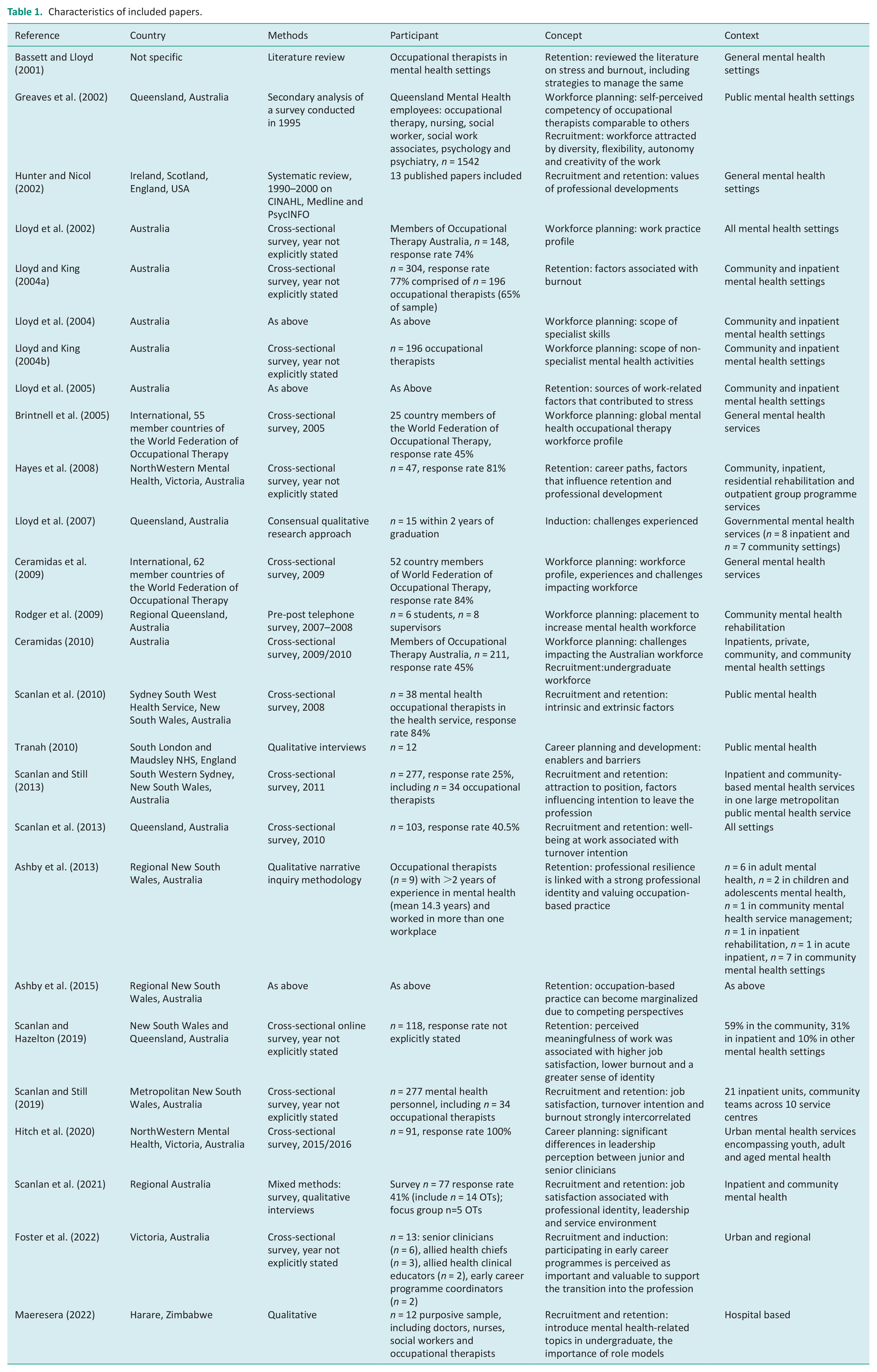
Of the 9319 potential records, 26 papers from 19 primary studies, a practice report (Tranah, 2010), a systematic review (Hunter and Nicol, 2002) and a narrative literature review (Bassett and Lloyd, 2001) were eventually included (Figure 1). The studies included in the systematic and narrative literature review are not duplicated in this review. The characteristics of the included papers are outlined in Table 1. The papers were published between 2001 and 2022. Twenty-one papers were exclusively set in Australia. Four papers included international data on career planning and development for occupational therapists working in mental health settings (Brintnell et al., 2005; Ceramidas et al., 2009; Hunter and Nicol, 2002). Thirteen papers were exclusively set in a public mental health setting. Seven papers provided a generic ‘mental health’ description as the setting. Five papers included public, private, non-government and other mental health services as the setting. One paper included a public tertiary and forensic mental health setting (Foster et al., 2022). In their study, Hitch et al. (2020) included mental and physical health services. All included papers had an author with a professional background in occupational therapy. Key authors include Justin Scanlan, The University of Sydney, and Chris Lloyd and her collaborators in Queensland, Australia. Studies varied in sample sizes, ranging from n = 9 to n = 1345 occupational therapists. One paper included occupational therapy students (n = 6) as participants (Rodger et al., 2009). Four areas of focus were identified. The themes were developed into a conceptual framework below, aligning with Benner’s model shown in Figure 2.
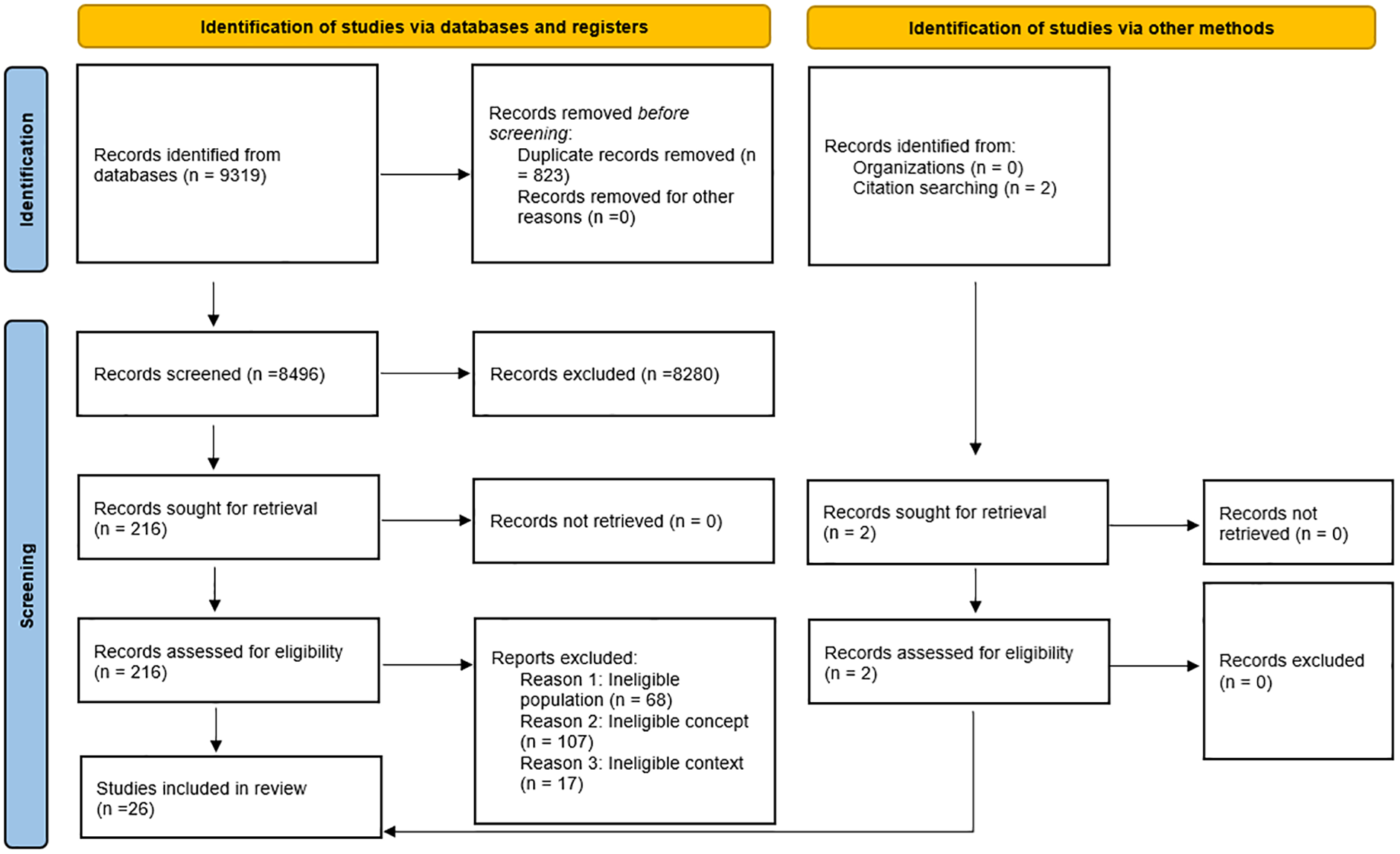
PRISMA flow diagram.
Characteristics of included papers.
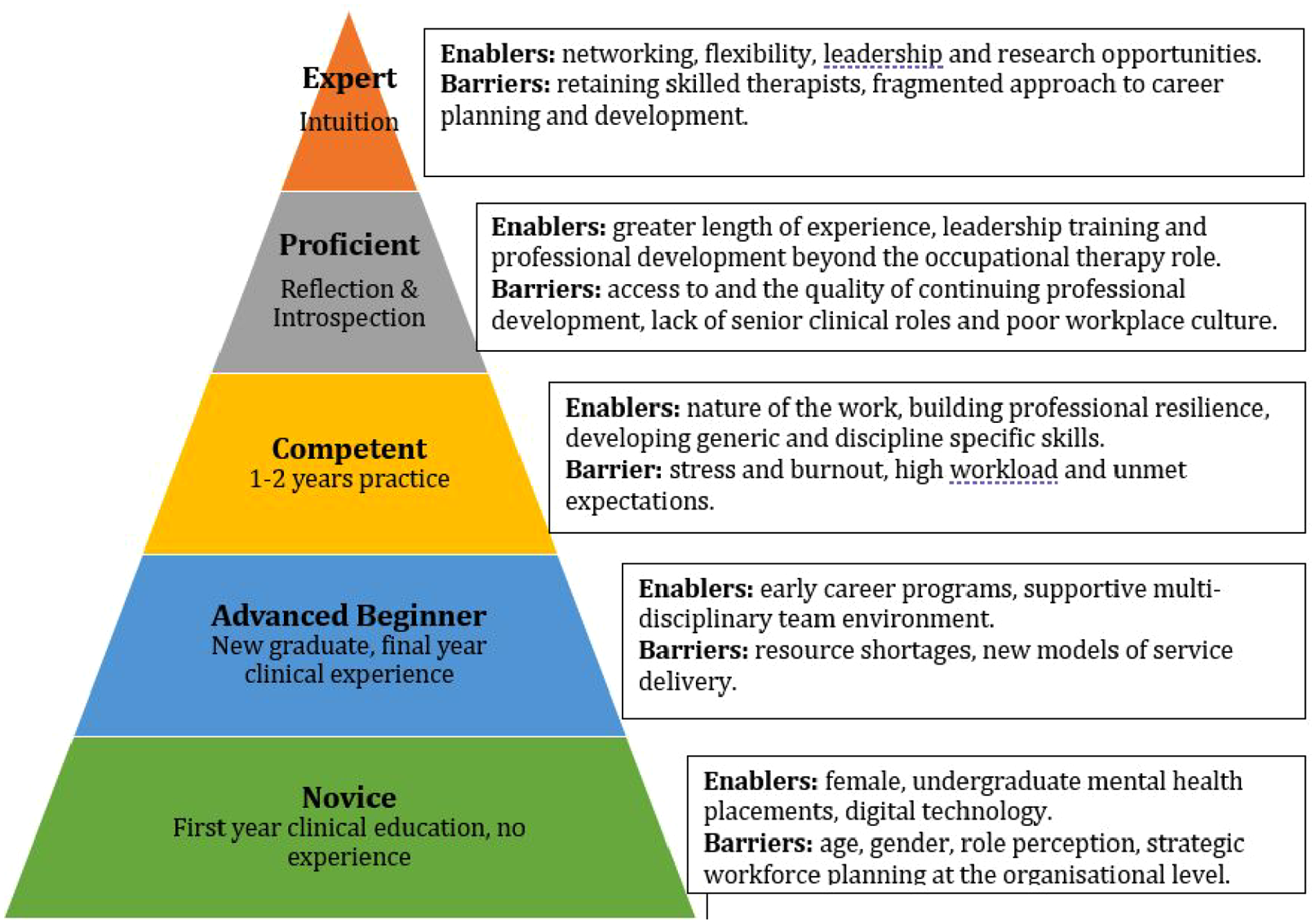
Alignment of barriers and enablers from the scoping review with Benner’s model.
Career planning and development
Two papers identified enablers and barriers to career planning and development; however, these were general in nature. Tranah (2010) provided insights into 12 senior occupational therapists’ experiences of career planning and development. The findings of this report identified key barriers such as lack of a career pathway framework, funding, unsupportive workplace culture, changing roles, personal motivation and circumstances or random opportunities. The enablers of career planning and development included practice placement experiences, rotations to support a wide range of clinical experience and expertise, preceptorship, education and training beyond occupational therapy, networking, leadership and research opportunities. Hitch et al. (2020) explored leadership styles in occupational therapy practice. A survey was used to collect data from clinicians working in mental health (n = 43) and physical health (n = 48) services. Occupational therapists in mental health practice apply transformational leadership style and some aspects of transactional leadership to support career planning and development. The results identified significant differences in leadership perceptions between senior and junior clinicians. Few differences were detected between clinicians working in mental and physical health services.
Workforce planning
Effective career planning and development at the organizational and individual levels requires strategic workforce planning at the occupational therapy professional association level. Five empirical studies investigated the mental health occupational therapy workforce, as it is often suggested that the workforce is young and relatively inexperienced. Lloyd et al. (2002) examined work practices and workforce issues. Most of the respondents were women with a median age of 37 years (no range reported) and had, on average, 7 years of experience working in mental health and had been in the current job for an average of 36 months. The findings identified two groups (traditional rehabilitation role vs case manager) of occupational therapists working in mental health settings. Specific issues impacting the workforce included the need for research and evidence-based practice, blurring of roles, recruitment and retention and professional development.
Two papers provided demographic data on the workforce and insights from a global perspective. Brintnell et al. (2005) surveyed 25 World Federation of Occupational Therapy member countries. This study was consistent with the above findings that the workforce is predominantly female and aged between 20 and 39 years. Japan, South Africa and Venezuela were the only countries with occupational therapists aged 60 or older. The United Kingdom and Finland have the highest percentage (42% and 39%, respectively) of mental health occupational therapists. However, the authors describe the declining number of occupational therapists choosing to work in mental health settings as a concern. In response to the above study, Ceramidas et al. (2009) investigated occupational therapists’ experiences working in mental health settings. The 2009 World Federation of Occupational Therapy study found a relatively balanced workforce pattern overall in terms of the youngest (age 20–29 years: 25.2%) and the oldest (age 50 years: 25.3%) being equally represented. The majority of the workforce was in the 30–39 age range (26.7%), while the 40–49 age group was less represented (22.9%). Australia only retained 46.5% of its original workforce at 50 years of age. Poor work environment, lack of resources and professional recognition are deterrents for occupational therapists considering employment in mental health. Professional resilience and dedication allowed occupational therapists to adapt and continue working in mental health under difficult circumstances.
Ceramidas (2010) focused on the Australian occupational therapist working in mental health settings from the 2009 World Federation of Occupational Therapy study. The results revealed that 36% of the respondents were younger than 30 years of age, were from metropolitan areas, with 4–6 years of experience in mental health. The majority, 85%, of occupational therapists were part of a multidisciplinary team, employed in the public sector and working with adults in a community setting. The author described recruitment and retention issues, including role blurring, resource shortages, difficulty recruiting new graduates, and lack of supervision and career development.
Another study evaluated the education of innovative practice to increase the workforce of mental health occupational therapy workforce (Rodger et al., 2009). This study trialled four mental health placement sites in role-emerging and collaborative supervision models. Students indicated a strong interest in working in mental health after graduation, and educators were positive about undertaking innovative placements in the future to overcome the lack of clinical experiences available for students in mental health.
Onboarding
Two empirical studies explored onboarding as an enabler of career planning and development at the organizational level. Foster et al. (2022) reviewed current practices in early career programmes for occupational therapists working in mental health settings to support a successful transition into the profession. Thirteen participants from Victoria, Australia, were surveyed. Participants identified their professional roles as senior clinicians (n = 6), allied health clinical educators (n = 2), allied health chiefs (n = 3) and early career/new graduate programme coordinators (n = 2). Findings demonstrated that early career programmes are important and valued by clinicians. The authors described how a comprehensive and well-designed early career programme facilitates a successful transition into the occupational therapy profession and provides a pathway for career progression from an organizational perspective. Key features of onboarding programmes include clinical exposure and supervision to grow the emerging novice into a competent and proficient clinician and exposure to staff and/or services outside of one’s professional area. Several supervision models were utilized, including group, peer, generic and discipline-specific. These supervisions were generally an hour weekly for the first 3–12 months, followed by 1 hour monthly.
In earlier work, Lloyd et al. (2007) explored the challenges new graduate occupational therapists experienced when commencing work in a mental health setting. Participants described difficulty across three domains: skills and knowledge, preparation for practice and achieving competence. The findings indicated that new graduates required more discipline-specific and generic skills to demonstrate competency. All participants identified that the quality of supervision and support is critical for development. Five of the fifteen participants had a practice placement in mental health before graduation, and all five participants noted how important this was in preparation for the transition into the role.
Recruitment and retention
The largest body of research, 18 papers, focused on recruitment and retention issues impacting career planning and development at the individual level. A systematic review explored the value of continuing professional development to enhance mental health occupational therapists’ recruitment and retention (Hunter and Nicol, 2002). The authors analysed 13 studies in four countries (see Table 1). The results did not show conclusive evidence of the influence of continuing professional development as an isolated recruitment strategy. Two articles (Hayes et al., 2008; Scanlan et al., 2010) discussed enablers and barriers to recruitment and retention of occupational therapists working in mental health settings. Enablers include personal and professional factors such as a supportive team environment, supervision, professional development, the nature of the work and the use of discipline-specific skills. On the contrary, workload/insufficient time, organizational change or juggling multiple demands, location, family/ personal factors, the generic nature of work and the lack of career development prompted respondents to consider leaving their positions.
Five papers focused on the role of occupational therapists in Australian mental health services. Greaves et al. (2002) conducted a survey that compared occupational therapists (n = 55) to other mental health professionals (including psychiatrists, psychologists, nurses and social workers) in general self-efficacy and efficacy in specific competencies to perform a broad spectrum of clinical and case management roles. The findings indicated that the general self-perceived competence of occupational therapists working in mental health settings is comparable to that of other mental health professionals.
Lloyd et al. (2004) examined the type of work activities carried out by occupational therapists (n = 196) and social workers (n = 108). In this Australian study, the majority of the respondents were women, under 30 years old, and had worked in their current position for less than 5 years. The findings revealed that both professional groups performed more generic work activities than discipline-specific or specialist ones. Two other studies used surveys to determine whether there was a discrepancy between actual and preferred work activities. Lloyd and King (2004a) included occupational therapists (n = 196) and social workers (n = 108), while Lloyd and King (2004b) only included occupational therapists (n = 196). The results of the combined study showed that occupational therapists and social workers experienced a significant discrepancy between their actual and preferred work activities. The discrepancy between actual and preferred work activities was a source of stress for both professions. In the second study with only occupational therapists, findings indicated that occupational therapists would prefer more specialist rehabilitation work activities in addition to other generic work roles. Lloyd and King (2004b) used a survey to evaluate actual and preferred work roles for occupational therapists across four categories. Generic work activities are the primary work activity of occupational therapists. The most frequently performed specialist clinical skill was the use of activities of daily living as part of rehabilitation. Although occupational therapists preferred higher levels of specialist and generic work activities, especially regarding supervision, professional development, research and evaluation roles, these findings suggest that generic work activities are congruent with mental health occupational therapy expectations.
Three papers investigated stress and burnout among mental health occupational therapists. Bassett and Lloyd (2001) conducted a narrative review of the literature on stress and burnout. The authors described the nature of mental health work, including the nature of clients, the work environment, a lack of professional identity and career structure as additional stressors. The authors also highlighted the need to implement personal and professional strategies for coping with stress and burnout. Lloyd and King (2004b) investigated the extent to which occupational therapists (n = 196) and social workers (n = 108) are affected by burnout. This study confirmed that both groups experienced high emotional exhaustion, moderate de-personalization and high personal accomplishment. Lloyd et al. (2005) explored stress among occupational therapists (n = 196) and social workers (n = 108). Findings indicated that both groups experienced increased stress levels; however, social workers reported slightly more overall stress than occupational therapists. Factors influencing stress included a lack of resources, relationships and conflicts with other professionals, workload, professional self-doubt and working in a case management role.
Five papers explored job satisfaction, burnout and turnover in Australian mental health services. Scanlan and Still (2013) examined the factors related to job satisfaction, turnover intention and burnout. Findings revealed that burnout was associated with lower job satisfaction and higher turnover intention. Higher remuneration and recognition were associated with higher job satisfaction, while stress, the nature of mental health work and career progression were associated with higher turnover intention among occupational therapists. Scanlan and Still (2013) considered the factors associated with workplace well-being and turnover intention. This study demonstrated that all measures of well-being at work, including work/life balance, effort invested in work, rewards and recognition, prestige and personal satisfaction, were associated with turnover intention.
Scanlan and Still (2019) explored the relationship between job satisfaction, burnout and turnover intention concerning specific job demands and job resources. The authors surveyed mental health personnel (n = 277), including occupational therapists (n = 34). Job satisfaction, turnover and burnout were significantly intercorrelated (disengagement p < 0.001 and exhaustion p < 0.0001). Specific job resources impacting the relationship included rewards and recognition, job control, feedback and participation. Specific job demands included emotional demands, shift work and work–life balance. Another study explored the relationship between job satisfaction, burnout, professional identity and meaningfulness of work activities (Scanlan and Hazelton, 2019). Higher levels of meaningful work activities were associated with higher job satisfaction, lower burnout and a stronger sense of professional identity. Occupational therapists identified ‘value to self’ as the most influential element of meaningful work.
Scanlan et al. (2021) investigated job satisfaction in multidisciplinary teams. The authors surveyed mental healthcare workers (n = 77), which included (n = 14) occupational therapists. In this study, 79% of occupational therapists were satisfied. ‘Meaningful work’ was identified as the most satisfying aspect of their work. Occupational therapists define ‘meaningful work’ as using discipline-specific skills and knowledge when working with clients. Team dynamics and team leadership were also key features in supporting occupational therapists as part of a multidisciplinary team.
Two studies focused on professional resilience (Ashby et al., 2013, 2015). Ashby et al. (2013) interviewed 18 occupational therapists with more than 2 years of mental health experience and had worked in more than one workplace. The authors found a strong link between professional resilience, professional identity and valuing an occupational perspective of health. The positive factors that influenced professional resilience included seeking good supervision, establishing support networks, and finding a job that valued and encouraged occupational therapy skills and knowledge. In the subanalysis of nine participants who had worked in mental health for over 5 years, Ashby et al. (2015) described how occupation-based practice can become marginalized due to competing professional requirements. Coping strategies included accepting and embracing the role.
Discussion and implications
Career planning and development in occupational therapists working in mental health settings are associated with significant barriers and potential enablers, as highlighted in this review.
Demographic findings revealed that the mental health occupational therapy workforce in Australia was predominantly female, between 25 and 39 years old, and less than 10% of occupational therapists chose to work in mental health. Occupational therapists working in mental health settings had a dual scope of practice in rehabilitation and case management. Furthermore, role blurring, resource shortages, high workload and difficulty in effective career planning and development are potentially additional barriers to the recruitment and retention of mental health occupational therapists (Keep et al., 2024).
The role is congruent with expectations; occupational therapists working in mental health settings who have adapted well to their dual roles reported greater self-perceived personal accomplishment and a desire to carry out even more generic work activities, especially in leadership and research. Acceptance of the role was associated with increased professional resilience, improved professional identity and job satisfaction.
This review also highlighted the importance of early grassroots-level career planning and development, especially mental health placements, to ensure that new graduates (‘novice’) are inspired and competent to work in this unique discipline/speciality of practice after graduation and be exposed to the professionalism necessary for the role. Innovative practice placements, including role emerging and collaborative supervision, are one approach that can be used to overcome the limited availability of mental health placements.
Recommendations
Early career programmes for ‘advanced beginners’ such as rotations in mental health settings, networking and socializing with mental health professionals, having a role model, and exposure to generic professional development in areas of professional competencies other than rehabilitation may also support emerging ‘competent’ clinicians with successful transition into the specialization and the potential to reduce incidences of unmet expectations and stress from role ambiguity. Hitch et al. (2020) identified significant differences in leadership skills between senior and junior occupational therapists, suggesting that leadership training is necessary for a successful transition between pay grades and from ‘proficient’ clinicians to ‘expert’. Figure 2 provides an overview of the barriers and enablers identified in this review and aligned with clinicians’ experiences as they progress in their mental health occupational therapy careers. This diagram may support further discourse and complement existing resources, such as the Victorian Allied Health Career Pathways Blueprint (Victoria Health and Human Services, 2019) on how best to support effective recruitment, selection and retention of occupational therapists in mental health settings. Furthermore, having a global and national analytical platform to profile the profession of occupational therapy in mental health is also crucial and builds on the existing legacy of work by the World Federation of Occupational Therapy.
Limitations
Whilst the majority of the included studies were based in Australia, three papers included multiple countries, one other was specifically from England and another from South Africa. Despite broad similarities in contemporary mental health practice worldwide, there are nonetheless differences in occupational therapy education, training, registration and specialization. Further exploration of factors influencing occupational therapist retention and career development may benefit from meta-aggregation or meta-ethnographic factors alluded to in this scoping review.
Most of the member countries of the World Federation of Occupational Therapy do not collect sufficient data on the number of practitioners by speciality area or educational attainment level. A lack of current and accurate data is a limitation in supporting the profession and professional growth, and thus, in the background section of this manuscript, we have alluded predominantly to Australian workforce data.
Conclusion
The recent Royal College of Occupational Therapists survey found an increase in mental health needs accounted for 54% of the increased demands on occupational therapy services, Occupational therapists working in mental health settings fill an important need as the profession strife across the traditional rehabilitation and case management roles in supporting patients in meaningful engagement and mental health recovery. Supporting and enabling effective career pathways is essential to focus recruitment and improve workforce retention.
Key findings
Organizational and individual factors impact career planning and development for occupational therapists working in mental health.
Effective career planning and development are critical to the profession’s success and growth.
What this study has added
This scoping review has synthesized the current literature on barriers and enablers to career planning and development for occupational therapists working in mental health. This review makes recommendations on how occupational therapists working in mental health settings could be supported as they progress from novice to expert.
Footnotes
Acknowledgements
None.
Research ethics
Western Sydney University (EX2022-05) exempted this review from human research ethics in concordance with the Singapore Statement on Research Integrity and the Montreal Statement on Research Integrity in Cross-Boundary Research Collaborations.
Consent
Not applicable.
Patient and public involvement data
During the development, progress and reporting of the submitted research, Patient and Public Involvement in the research was not included at any stage of the research.
Declaration of conflicting interests
The author(s) declared the following potential conflicts of interest with respect to the research, authorship and/or publication of this article: This scoping review contributed to the Bachelor of Occupational Therapy (Honours) degree for PF. The authors have no other conflict of interest to declare with respect to the research, authorship and/or publication of this article.
Funding
The author(s) declared no financial support for the research, authorship and/or publication of this article.
Contributorship
DL, RB and CE designed the study. PF performed the literature review search under the supervision of RB and CL. Decisions on articles to include/ exclude were made by PF in consultation with DL, RB and CE and checked by DL. KL audited and validated the findings. PF wrote the first draft of the manuscript, including all figures and tables. Revision and editorial input were provided by DL, RB, CE and KL. I confirm that all authors listed consent to publication and have made a substantial contribution to the article through the conception, design and/or drafting of the manuscript.
Data Availability
The data that support the findings of this study are available from DL upon reasonable request.
