




Abstract
Introduction:
With the inclusion of 40 hours of simulated practice education for UK occupational therapy students and the subsequent impact of the COVID-19 pandemic, universities have been exploring simulated placement opportunities. However, the evidence available to guide the development of such placements is sparse. This article presents the first stage of a grounded theory study that seeks to understand what students learn during the course of their first practice placement, with the intention of informing simulated placement development.
Method:
Grounded theory methodology was used to guide semi-structured individual interviews with 15 participants – seven undergraduate students, three practice educators and five postgraduate pre-registration students. Interviews occurred close to the end of the first practice placement. Concurrent data collection and analysis led to the development of categories of learning.
Findings:
Four core categories of learning were identified: learning about oneself, learning about the occupational therapy profession, learning about practices and learning about service users.
Conclusion:
Understanding of these four categories of learning may enable educators to consider learning which occurs that may not be anticipated, particularly in regard to personal development. This can enable educators to consider how learning can be targeted within simulation for an authentic simulated placement.
Introduction and context
With the increased focus on alternative methods of delivering practice education necessitated by the COVID-19 pandemic, higher education institutions are giving fresh consideration to university-based placements including simulated placements. Prior to 2019, the Royal College of Occupational Therapists did not permit any simulated learning to be counted towards placement hours due to a lack of evidence supporting this practice (College of Occupational Therapists, 2014). Simulation has since been demonstrated to deliver comparable results for students on placement (Imms et al., 2018) and can now make up a maximum of 40 hours of the required 1000 hours of occupational therapy practice learning in the United Kingdom (RCOT, 2019). A scoping review of the use of simulation in occupational therapy practice was carried out to provide context for this study and has been published separately (Grant et al., 2021). This review established that a variety of modalities including simulated patients, mannequin activities, case studies and virtual reality are used to simulate occupational therapy practice internationally, but there remains a paucity of evidence as to how these may be used to simulate a placement. Only one article provides any guidance in terms of how to construct a simulated placement (Chu et al., 2019). For any setting to appropriately develop simulated placement experiences, it is necessary to understand the learning that students currently experience during their traditional, non-simulated placements.
Interchangeably referred to in the literature as practice placements, practice learning and sometimes fieldwork, occupational therapy students worldwide are expected to undertake 1000 hours of learning on placement (WFOT, 2016). Whilst organisation of these hours varies across courses even within nations, there exists some consistency of understanding about what makes a quality placement experience (Rodger et al., 2011). Within the United Kingdom (UK), the intended learning outcomes for placements are guided by the regulatory body standards of proficiency (HCPC, 2013) and by the professional body in terms of entry-level knowledge and skills (RCOT, 2016). Little, however, has been previously documented about what students feel they learn on placement.
Healey (2017) described emotional labour and management, suggesting that students experience emotional challenges and learning throughout their placement. Honey and Penman (2020) identified two overarching outcomes from interviews with Australian occupational therapy students across year groups when recalling their first placements. These were described as ‘confirmation of occupational therapy as a career choice’ and ‘experience to draw on for future learning and practice’ (p5) as ways of meeting the prescribed learning outcomes. However, in informal discussions with students and educators, it has become apparent that learning may not be fully captured by the intended learning outcomes, which can only reflect what students are assessed against, rather than what they actually learn. This could be perceived as part of the hidden curriculum, which describes all of the things that are learned which fall outside of a formal curriculum and may be unarticulated (Gardeshi et al., 2018). The concept of the hidden curriculum is considered to be particularly relevant to professional education, as students are exposed to the predominant culture of the profession (Lempp and Seale, 2004).
This article therefore seeks to respond to the research question ‘What do occupational therapy students learn during their first practice placement?’
This study was undertaken with both undergraduate and postgraduate pre-registration occupational therapy students at a university in the UK. Practice educators for undergraduate students were also included in the research interview data gathering. Undergraduate students undertook a 10-week part-time placement in semester two (January–May) of their first year, and postgraduate students undertook a 6-week full-time placement between semesters one and two (November–December). Due to the timing of data collection and the impact of the COVID-19 pandemic on placement capacity, the first-year undergraduate students included in this cohort experienced a slightly altered placement structure which comprised part clinical and part project placement.
Method
This article describes the initial phase of a grounded theory study (Glaser and Strauss, 1967) which used qualitative individual interviews to explore the learning that students and practice educators feel is gained during a first practice placement. Grounded theory was selected as the most appropriate methodology to be able to capture the heterogeneities of participants’ experience. As part of a grounded theory study, no formal literature review was undertaken before data collection (Thornberg and Dunne, 2019), although a scoping review to support development of the study has already been published (Grant et al., 2021). Findings have been reviewed in relation to existing literature in Discussion. Further theory development will be reported separately, with this article focusing on students’ and educators’ understanding of what was learned during a first placement. The study focused on skills, knowledge and behaviours, as these are expressed by the World Federation of Occupational Therapists as the focus of practice learning (WFOT, 2016), with a view to considering which of these could be replicated via simulated placements. In this study, techniques of concurrent data collection and analysis, along with constant comparative analysis (Chun Tie et al., 2019) were used to develop an understanding of student learning.
Ethical approval for the study was obtained from the institution where it took place (CHLES20210003-R). Due consideration was given to the researcher’s dual role as researcher and lecturer, and the inherent power relationship between participants and researcher. Written informed consent was collected from all participants prior to interview.
Sampling and recruitment
All students were introduced to the study by another member of the teaching team and shown a video presentation from the researcher. Care was taken to mitigate the risks of perceived coercion (BERA, 2018; University of Worcester, 2019, 2020) by inviting students to opt into the study via email to the researcher’s student address, and by rearranging workload so that the researcher did not engage in marking of any placement-related student work during the semester of the study. Practice educators were recruited via a direct email from the researcher to all clinicians who had provided a placement for undergraduate students during the relevant placement period, with an invitation to opt into the study. A total of 53 undergraduate students, 19 postgraduate students and 27 practice educators were invited to participate.
Data collection
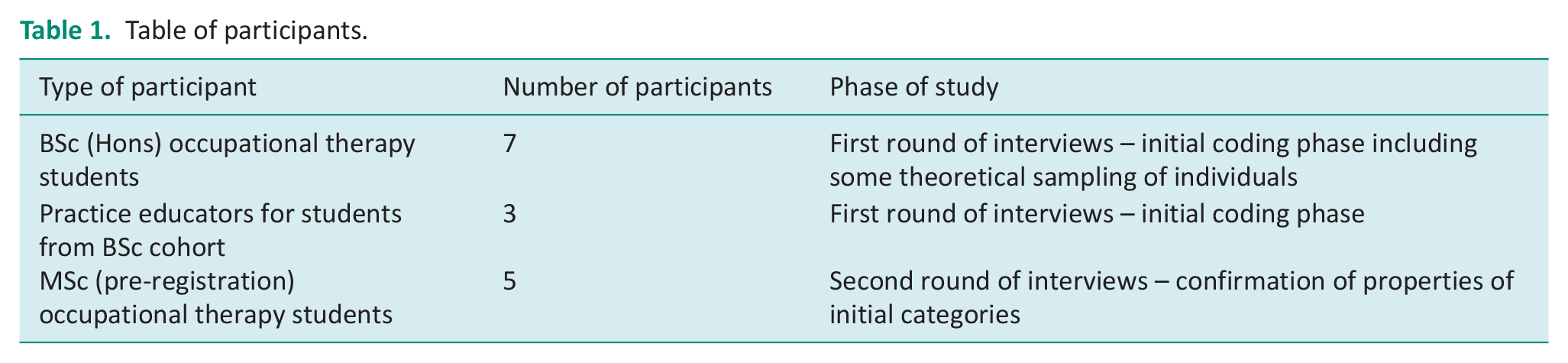
In all, 15 participants took part in this study (Table 1). They were interviewed individually via Microsoft Teams after the first practice placement had taken place and, in the case of students, before they commenced the second placement. First-year occupational therapy students and practice educators are far from a homogeneous group, with differences in age, gender, ethnicity, previous experience and placement type, all of which can be expected to generate different learning experiences. Selecting one-to-one interviews enabled the researcher to hear the perspectives of a variety of individuals and to probe for depth of information (Flick, 2021). Whilst recognising the challenges of the virtual environment and associated technological issues that may arise (Sah et al., 2020), recent evidence suggests that using video-conferencing software such as Microsoft Teams is received favourably by participants and researchers alike with some specific benefits in terms of scheduling and efficiency (Pocock et al., 2021; Sah et al., 2020). The semi-structured nature of the interviews ensured that all participants had the opportunity to express their views about learning. Students were asked questions such as ‘what do you think was your biggest learning on placement’ along with questions that directed them to specifically consider knowledge, skills and behaviours learned. Practice educators were asked to consider the same questions in relation to the student who had most recently been on placement with them from the same cohort.
Table of participants.
Data analysis
Interview data were analysed using constant comparative analysis, which is a key feature of grounded theory methodology (GTM) (Chun Tie et al., 2019) and occurred concurrently with data collection. Interview transcripts initially underwent line-by-line coding which generated a wide range of initial codes. For each subsequent interview, this process was repeated, and new codes were compared with the existing ones. This constant comparison enabled relationships between codes to be explored, thus allowing the codes to be organised into initial categories. No new codes emerged after completion of the first round of interviews in which seven undergraduate students and three practice educators participated. In line with the grounded theory method of theoretical sampling (Corbin and Strauss, 2008), further practice educator interviews were not pursued and the five postgraduate student interviews were used to confirm that the properties of the four main categories had been fully established. These postgraduate interviews were therefore used to clarify that data saturation for the purposes of this study had been achieved.
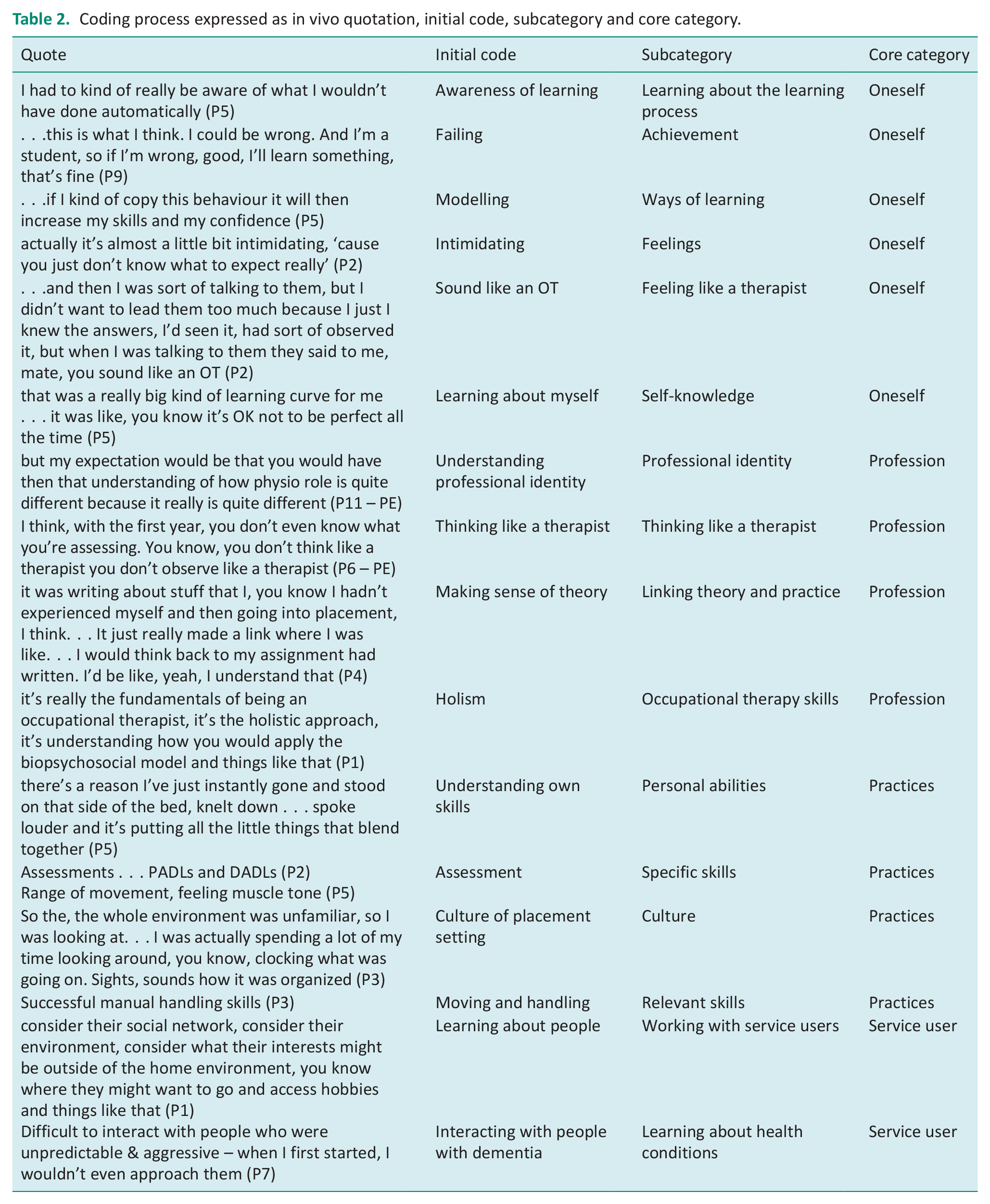
Through the iterative process of data collection, coding and comparison common to grounded theory (Birks and Mills, 2012), the four initial categories developed were further refined to include subcategories (Table 2). Coding for this study was carried out solely by the lead author. Sharing of transcripts and coding processes, along with regular discussion of emerging categories with the remaining authors sought to enhance credibility.
Coding process expressed as in vivo quotation, initial code, subcategory and core category.
Findings
Data analysis revealed four core categories of learning that were expressed by all participants. These core categories are as follows: learning about oneself, learning about the occupational therapy profession, learning about practices and learning about service users. Examples of quotes from participants about each of the core and subcategories are shown in Table 2. An overview of the core categories and subcategories is shown in Figure 1.
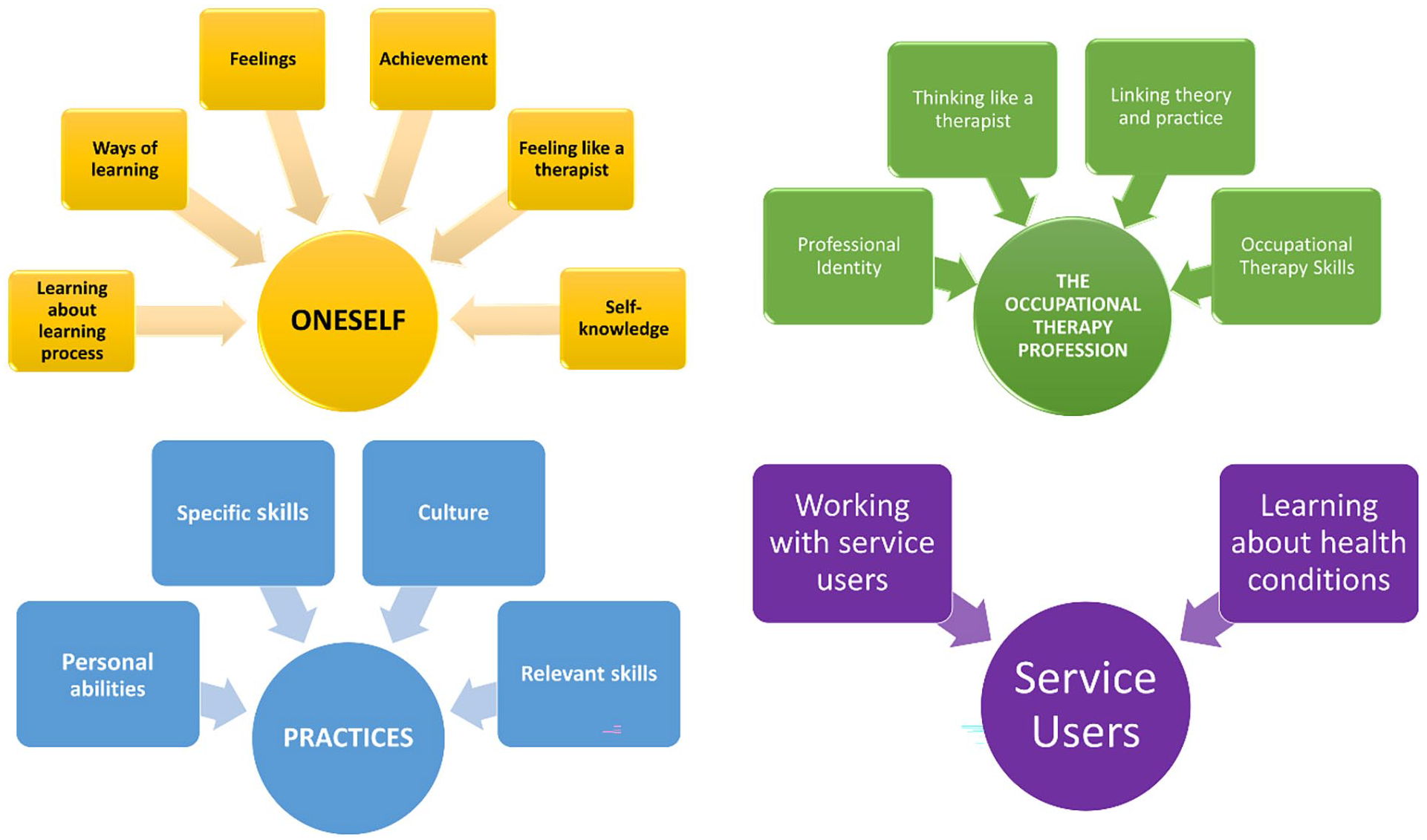
Core categories and subcategories.
Learning about oneself
The category of learning about oneself explained the individual learning each student experienced that was not necessarily related to the profession or the service users they were supporting. Instead, this learning described the self-development that students recognised.
I learned not to be hard on myself; I was proud of myself because I did things I didn’t think I was going to do. I left feeling. . .different about myself (P7)
This category was the largest of the four and was further expressed in six subcategories which express the different learning about themselves that students experienced as: learning about the learning process, achievement, ways of learning, feelings, feeling like a therapist and self-knowledge. For example, participant 7 explained how they became aware that the placement might not always meet their learning preference: I learned that I couldn’t always participate when I wanted to. So I couldn’t always practically learn (P7)
Achievement was expressed in both positive and negative terms. One participant highlighted their desire to achieve success with patients in the same way they perceived that their educator did: I saw, like, how the patients responded to her. I wanted them to respond like that with me as well (P5)
Others recognised that they were comfortable that they would not always be successful: . . .this is what I think. I could be wrong. And I’m a student, so if I’m wrong, good, I’ll learn something, that’s fine (P9)
Participants identified a variety of methods of learning on placement, such as the learning that occurred from students copying, or modelling, behaviours of their practice educator: if I kind of copy this behaviour it will then increase my skills and my confidence (P5)
The emotionally challenging nature of placement was also highlighted.
I think I found it emotionally challenging. . . you know they [service users with dementia] were so scared, and it was about me trying to find a way to sort of help them not be scared, you know, and it. . . I think I found it quite challenging, ‘cause you know they didn’t know where they were, they were asking where’s their home, when am I going home, and they were getting really upset and I found it quite. . . yeah. . . I think emotionally challenging trying to deal with that situation professionally (P4)
Learning about the occupational therapy profession
All students discussed occupational therapy-specific learning during their placement. Subcategories that participants expressed were developing professional identity, thinking like a therapist, linking theory and practice and becoming aware of occupational therapy-specific skills. One participant summarised the impact that placement had in terms of their learning about the profession as they began to make sense of the theory they had learned: Going into placement was when it all clicked into place and I was like, that’s this, that’s that . . . and so I could understand what was assessment, was intervention, was part of the OT process . . . I think the . . . like the placement was definitely where it clicked for me (P5)
Learning to carry out practices
Distinct from learning about the occupational therapy profession, participants described practical learning in terms of the skills they developed and the tasks and activities they practiced during their placements. This category included four subcategories in which students variously described learning about their personal or individual abilities, skills which were specific to occupational therapy within that practice area (such as the ability to complete an occupational therapy assessment, or the ability to position a hemiplegic arm), the culture or subculture of health and social care and the practices they observed or learned about within that culture (such as ward rounds and documentation) and other relevant or associated skills and practices which were relevant to all health and social care practice learning (such as communication skills and moving and handling skills).
Participant 4 described the ways in which they developed and practiced communication skills with the multidisciplinary team: every week, so we would communicate with the staff. So with a sort of chat about the patients would be like developing their care plans and stuff. So I’d be communicating about the patients to them. So yeah, I guess like in terms of being in a multidisciplinary team meeting like yeah, communicating professionally with them (P4)
Participant 3 described their developing understanding of assessment and intervention in their placement setting: So all of the initial assessment is verbal, verbal discussion. There might be further information gathered from family and relatives generally over the phone. Um, there might be further referrals, but the main, interventions were, were provision of small equipment (P3)
Participant 4 explained the way in which they learned to observe function in detail: I think what I learned was to like, really, you know, watch in detail and see what kind of movements they did, whether they were like you know, pushing up with their arms or just getting up on their own and working out what level of mobility they were at, whether they’re gonna need maybe a stick or a walker to support them. Yeah, so analyzing then what I’ve observed. And yeah, basing the support then on what we’ve observed within mobility (P4)
The concept of the ‘hidden curriculum’ was best outlined by one practice educator participant who explained all the aspects of conducting an assessment that their student had learned that had not been specifically planned for: She got an opportunity to experience . . . being unprepared for, or under-prepared for an assessment that she was going to do . . . that was a big learning experience for her . . . we’d run through how you do it. She hadn’t. . . I don’t think she’d practiced doing it actually with . . . with anybody, and she’d sort of . . . she hadn’t even taken it away with her to go through, so she sort of came back, came in on a Tuesday morning and sort of, you know, we . . . let’s go and do this this assessment. She knew she was doing it, she was happy to do it. But then when she did it, she discovered that it wasn’t quite as straightforward as she was expecting it to be . . . so that was a big learning experience for her (P6 PE)
The student had learned the importance of planning, which would not be part of the formal curriculum but is an important part of managing the workload.
Learning about service users
Unsurprisingly, all participants discussed the different elements of learning that occurred when working with service users, including their individual features and the lived experience of their health conditions.
Participants 2 and 4 expressed the way they developed understanding of service users on a deeper level than afforded to them in the classroom: I mean I knew a little bit about stroke, but I’ve learned a lot I did find that no stroke patient is the same (P2) It was more like get to know the patients. You know, ask them questions, get to know about their past (P4)
Participant 7 talked about their developing understanding of the impact on the service users’ health conditions on their behaviours and abilities.
I had a. . .a basic knowledge of dementia. But I didn’t really know how it can affect different people, so . . . obviously there’s more forms of it as well. I think there’s vascular dementia and things like that . . . Some people act differently because they’ve got a different type of dementia (P7)
Discussion
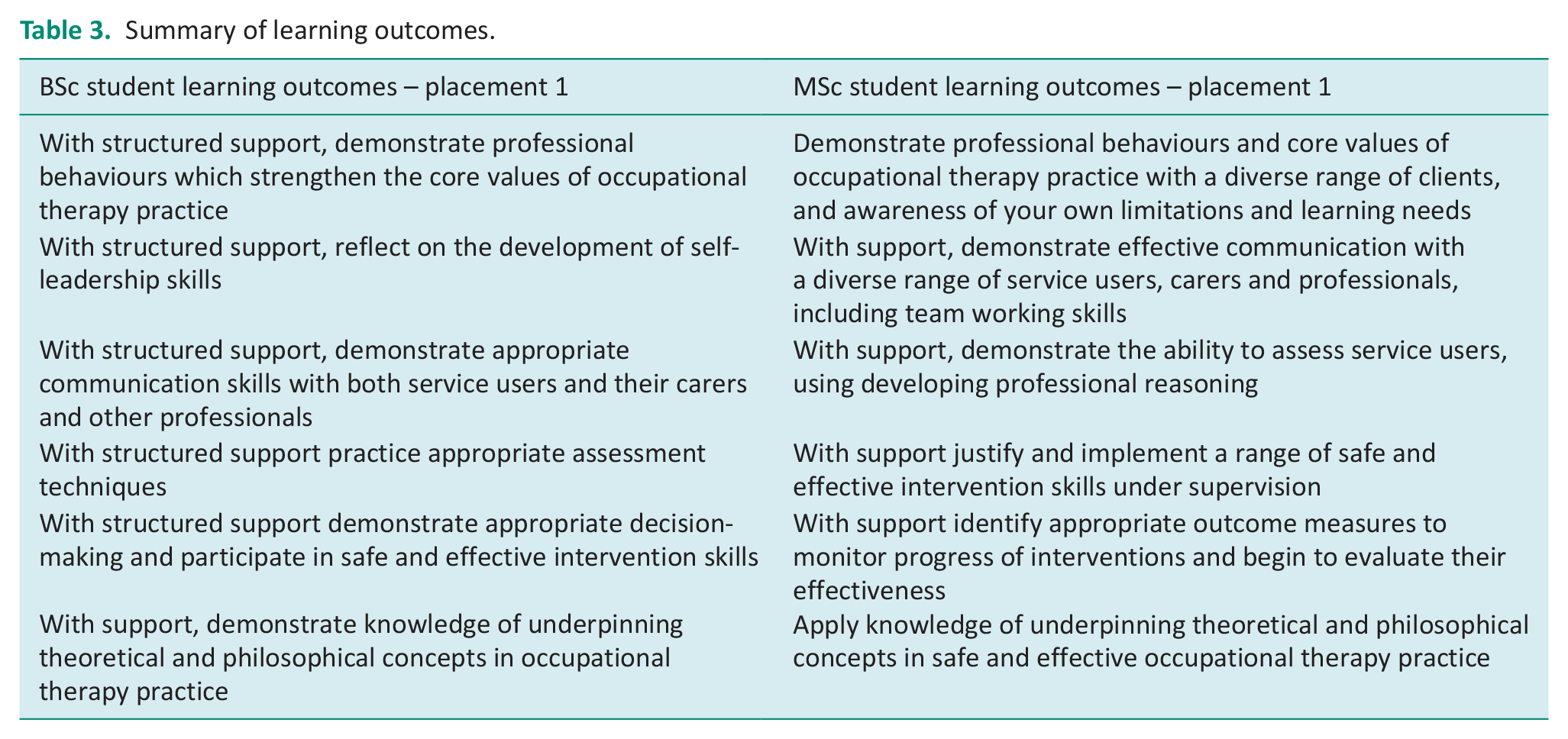
This study aimed to gain an understanding of the learning that students gather during their first practice learning placement, regardless of whether that learning is explicitly evident in the intended learning outcomes. In fact, neither student nor practice educator participants referred to the overt learning outcomes in their responses. However, it is fair to conclude that some of the learning experience is already captured in the placement’s intended learning outcomes (Table 3), which map directly to the required entry-level occupational therapy skills provided by the professional body (RCOT, 2016). These entry-level skills are identified by the Royal College of Occupational Therapists as ‘core professional reasoning skills that make up the occupational therapy process’ and include assessment, identification, analysis and prioritisation of occupational needs; facilitating occupational performance and engagement and evaluation of occupational outcomes.
Summary of learning outcomes.
The categories of learning about the profession and practices are both logical and anticipated as they are reflected in the entry-level occupational therapy core knowledge and practice skills (Brzykcy et al., 2016; RCOT, 2016).
In addition, in reporting on their own practice education curricula, other authors have also identified learning about the profession and about practices as part of the student experience. Mulholland and Derdall (2007) found that students learned how to apply principles of professionalism during their first placement, whilst Leclair et al. (2013) reported that students learned to apply theory to practice and Nielsen et al. (2017) reported learning communication skills and learning to think like an occupational therapist as frequently reported outcomes of Fieldwork 1, which includes the first placement undertaken by students in the United States (AOTA, 2017).
More tacit learning about the profession, such as understanding the role of the occupational therapist in a particular setting (Britton and Rehmel, 2019; Honey and Penman, 2020; Mulholland and Derdall, 2007) and learning in the domain of cultural competency (Dyck and Forwell, 1997; Nielsen et al., 2017; Sonn and Vermeulen, 2018) have also previously been reported.
Practice educators expect students to develop a range of professional and technical skills during early placement experiences, with communication and planning, implementing and grading interventions identified as the most important (Mason et al., 2020). Students expressed a variety of different practices depending on their placement setting, with assessments covering such tasks as hemiparetic limb assessment, interest checklists and personal activities of daily living assessments, and interventions variously being expressed as equipment provision, group work and identifying care needs. This range of practices highlighted by students reflects the contextual dependence of practice skills, listed as entry-level skills in terms of activities, participation and environmental factors (RCOT, 2016).
Learning about service users could also be argued as identified within existing learning outcomes, although participants identified more nuanced learning than can reasonably be captured in this way. This could be suggested to be part of the development of professional knowledge identity as students learn to understand and develop a professional relationship with people as occupational beings. It is also recognised as an entry-level skill to be able to understand the lived experience of each individual and practice in a person-centred and collaborative way (RCOT, 2016). Little has been written about this learning in the literature, perhaps reflecting it as an obvious and expected outcome, although learning from exposure to clients with certain conditions can be inferred from positive changes in the attitudes of occupational therapy students towards these clients (Beltran et al., 2007).
The fact that the learning identified by students themselves includes that which is covered in the intended learning outcomes serves to validate the importance of the first placement experience. It not only can confirm the choice of profession, as identified by Honey and Penman (2020), but also can lay the foundations for progression towards the required graduate entry-level skills (RCOT, 2016). This is significant in any discussions about the relevance of early placements and the associated expectations placed on students.
The area identified by students that is not reflected in existing learning outcomes is the learning about oneself. It is clear that all participants identified the personal journey that they underwent during their first placement. Grenier (2015) found that students identified themselves as facilitators or barriers to their own learning, reflecting their journey of self-discovery. Honey and Penman (2020) also identified the importance of this type of learning, while Healey (2017) explored the emotional management that is necessitated during placement. This personal journey is perhaps not something that can be planned for or scheduled. However, it is important that it enables students to develop a sense of themselves as occupational therapists and may influence not only future learning, but also the manner in which they interact with service users. Honey and Penman (2020) identified that this learning feeds into future placement experiences and enables students to progress their learning journey.
It is impractical, and potentially not possible, to create a measurable learning outcome that reflects personal development and growth, given the differing rates at which this is likely to happen for students. However, recognition of the experience of this learning by educators could be supportive for students who are struggling to meet their placement requirements. Identifying the placement as having not only practical and academic value, but also personal value, places the student as an individual back at the centre of their learning experience.
Honey and Penman’s Australian study (2020) followed a similar GTM. They sought to understand students’ views about the values and characteristics of a first placement, and conducted focus groups with students at all stages of their studies, reflecting back on their first placement. Despite significant differences between the participants in this study and those in Honey and Penman’s study, including nation, length of time since first placement and duration of first placement, the four core categories identified in this study align closely with the proximal valued outcomes identified by Honey and Penman (2020), as demonstrated in Figure 2. This would suggest that the four categories of learning, including the unexpected category of learning about oneself, are shared between students on opposite sides of the globe, with very different placement durations and expectations.
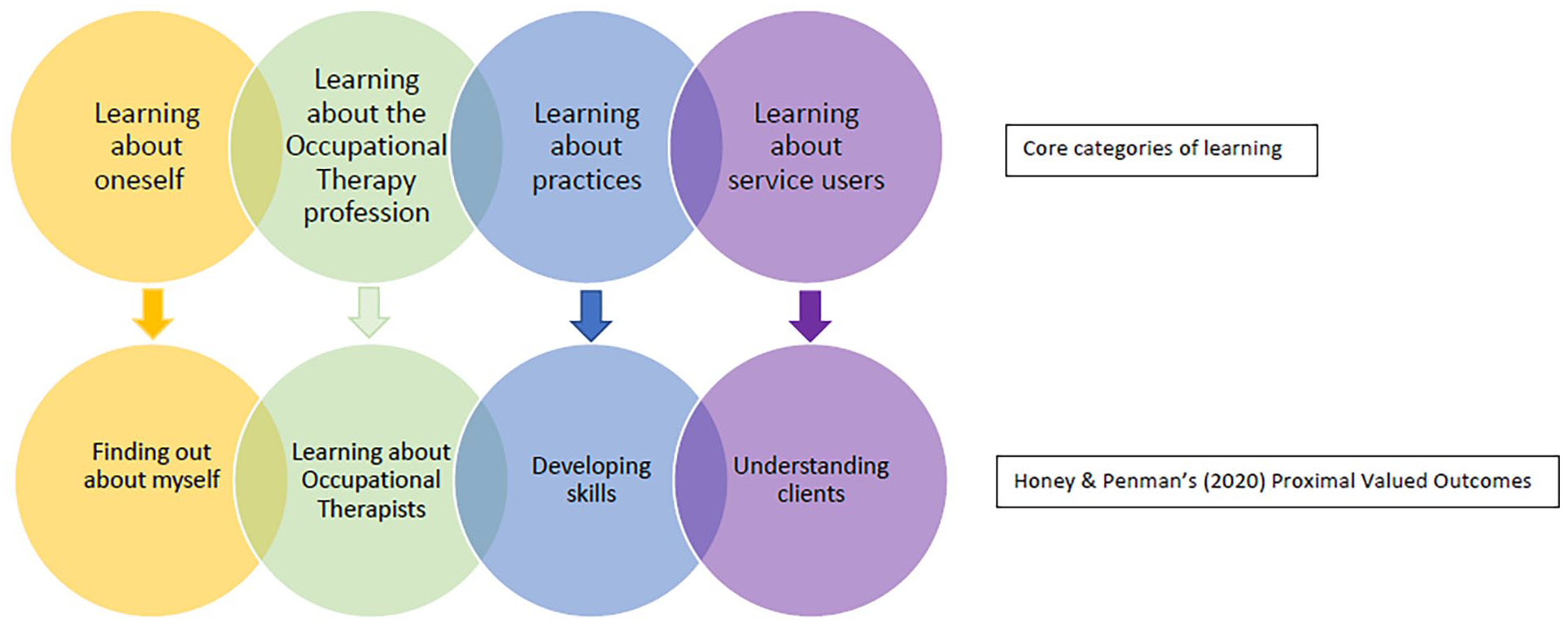
Comparison of categories of learning with Honey and Penman’s (2020) proximal valued outcomes.
Implications for practice
This study, which unintentionally resembled a recent exploration of first-year practice learning in Australia, has a number of implications for education and practice. Two similarities are noted.
First, the similarity of categories of learning between the two studies suggests that the outcomes of first occupational therapy placements may be broadly universally experienced. This makes qualitative information about placement learning relevant to students despite differences in courses and placement types.
The shared learning experiences of students may also be useful in providing reassurance to students that, although their placement might not look like that of their peers in terms of setting, duration or structure, they are likely to be undergoing similar learning experiences. Understanding that some degree of personal development can also be expected may help students to cope with the daunting prospect of perceiving themselves as future occupational therapists, by helping them to realise that they will undergo change in themselves as well as learning new skills and knowledge. This could be particularly helpful in supporting students to develop resilience and cope with the challenges of practice learning.
Second, the categories identified in this study sought to describe the types of learning that students on placement experience to be able to consider such learning when designing and creating a simulation curriculum. Rather than identifying specific skills, knowledge and behaviours, which may be different for each placement area, a broader understanding of different types of and approaches to learning has been gained. Some aspects of the learning derived, such as learning about practices, lend themselves more easily to simulation than others. The identification of the importance of learning about oneself during the placement experience could also be considered within simulation planning and seen as a necessary part of any simulated placement.
Limitations
This study forms a part of the lead author’s doctoral research and was by necessity carried out by one researcher. While steps were taken to mitigate the impact of this on the study, this could be considered a limitation both in terms of ethical recruitment of students and data analysis. Consideration should be given to the power dynamic between students and researcher which may have limited student participation, therefore limiting the pool of respondents and/or influencing the data collected. In terms of data analysis, it is recognised that the development of codes by one researcher does not allow for cross-checking, and the results generated will therefore be influenced by researcher positioning. The memoing process which forms a part of GTM was used extensively in an attempt to minimise the impact of this on the findings, along with regular discussions with the other authors to help to generate the categories.
Recommendations
Awareness of the learning that students experience in their first practice education placement, particularly the impact of the placement on the student’s personal knowledge and development, should be considered when designing simulated placement experiences.
Conclusion
The learning that students experience on their first placement encompasses not only skills and knowledge of the profession and of service users, but also brings an element of personal development that could be more widely recognised to help students better understand their placement experience. These different types of learning can be considered when designing simulated placement experiences to ensure that such placements provide similar and complementary benefits to traditional settings.
Key findings
Students on placement undergo personal development and learn about themselves, as well as learning about the occupational therapy profession and the individuals they serve.
Four categories of placement learning – learning about oneself, learning about occupational therapy, learning practices and learning about service users – are experienced by students in Australia and the UK.
All aspects of student learning should be considered when designing simulated placements.
What the study has added
This study has provided a breakdown of four main types of learning that students experience during their first placement.
Footnotes
Acknowledgements
The authors would like to thank all of the students and practice educators who participated in this study.
Research ethics
Ethical approval granted by University of Worcester Health, Life & Environmental Sciences research ethics panel on 16 November 2020 (REP CODE: CHLES20210003-R). Amendment to ethical approval granted on 4 October 2021 (same REP code).
Patient and public involvement data
During the development, progress and reporting of the submitted research, Patient and Public Involvement in the research was not included at any stage of the research.
Consent statement
Written informed consent was collected from all participants prior to interview.
Declaration of conflicting interests
The author(s) declared no potential conflicts of interest with respect to the research, authorship, and/or publication of this article.
Funding
The author(s) received no financial support for the research, authorship, and/or publication of this article.
Contributorship
TG conceived the study and carried out recruitment, data collection and data analysis. YT, PG and LB were involved in protocol development and YT and PG in gaining ethical approval. TG wrote the first draft of the manuscript. All authors reviewed and edited the manuscript and approved the final version of the manuscript.
