




Abstract
Yellow coffins produced during the 21st Dynasty were the result of the integration of the festive dress type of coffins with the scheme used in the black coffins. The early stages of the yellow type preserve many features detected in the festive dress type, but they fell progressively into disuse. However, by the late 21st Dynasty, we witness a revival of the features previously used in the festive dress type in a process that has been described as ‘archaising’ or as ‘opportunistic’. In this paper we will examine some examples of this late use of the festive dress layout in the yellow corpus in order to better understand its significance.

Introduction
During the reign of Hatshepsut–Thutmose III and beyond, black coffins emerged as the predominant funerary receptacles adopted by the elite of Egyptian society. 1 The Amarna Period introduced the novel concept of anthropoid coffins portraying the deceased adorned in festive garments. 2 Following Akhenaten’s rule, a fusion of these coffin styles occurred, birthing a new decorative coffin tradition that eventually evolved into the yellow coffin type during the late Ramesside era. 3 In this evolutionary process, the full-length depiction of the deceased in festive garments was gradually transferred from the lid to the overall iconographic programme. 4 In general, the lids and mummy-covers of the yellow type depict the deceased in mummiform guise. However, initially, yellow coffins retained elements reminiscent of the earlier festive dress type, such as festive wigs 5 and pleated sleeves over the arms. Nevertheless, these features diverged from the opulent white garments characteristic of earlier Ramesside coffins, depicted as worn by the deceased. 6 By the mid-21st Dynasty, these references to the festive dress type fell completely into disuse, supplanted by the increased size of the floral collar concealing the arms of the deceased. 7 Even the iconography along the sides of the boxes transitioned from showing the deceased wearing loose, pleated white robes to tight-fitted dark garments. 8 This evolution signifies a notable departure from earlier coffin traditions, 9 marking a significant shift in Egyptian funerary customs.
In the late 21st Dynasty, the density of decoration in the yellow type increased even further. However, it was within this period that a revival of features previously associated with the festive dress type emerged, a process that has been described as archaising. 10 This revival entailed the reintroduction of characteristics from the early stages of the yellow type, such as the depiction of forearms and the use of white ground. 11 This phase highlights some of the most notable occurrences of the revival of the festive dress type within the yellow corpus. This paper examines examples of this late adoption of the festive dress type within the yellow corpus, seeking to comprehend its significance.
The Coffin Set of Meritamun from Bab el-Gasus
In the Tomb of the Priests of Amun, a splendid coffin set (A.71) was discovered, prepared for Meritamun, the daughter of Menkheperre. This coffin set comprised an inner coffin and a mummy-board, both unique pieces within the context of the yellow corpus.
The mummy-board reflects the layout of the festive dress type used during the early Ramesside period, with the right arm positioned along the body and the left arm crossed over the chest (figs 1 and 2). 12 The deceased is dressed in a white festive garment adorned with long ivy branches and a lengthy red belt. The wig is intricately decorated with a headband featuring rosettes and various flower motifs, alongside braided locks of hair and small intertwined rings. The forearms are adorned with a profusion of bracelets, and a naophoric pectoral hangs from a long necklace (fig. 3). The object is finished with a thick layer of varnish, abundantly applied over the face, wig, 13 breasts, shawl, and forearms. This varnish coating gave the deceased a reddish skin tone, characteristic of early Ramesside artefacts. Additionally, the area of the abdomen was loosely coated with varnish to suggest the transparency of the garments.
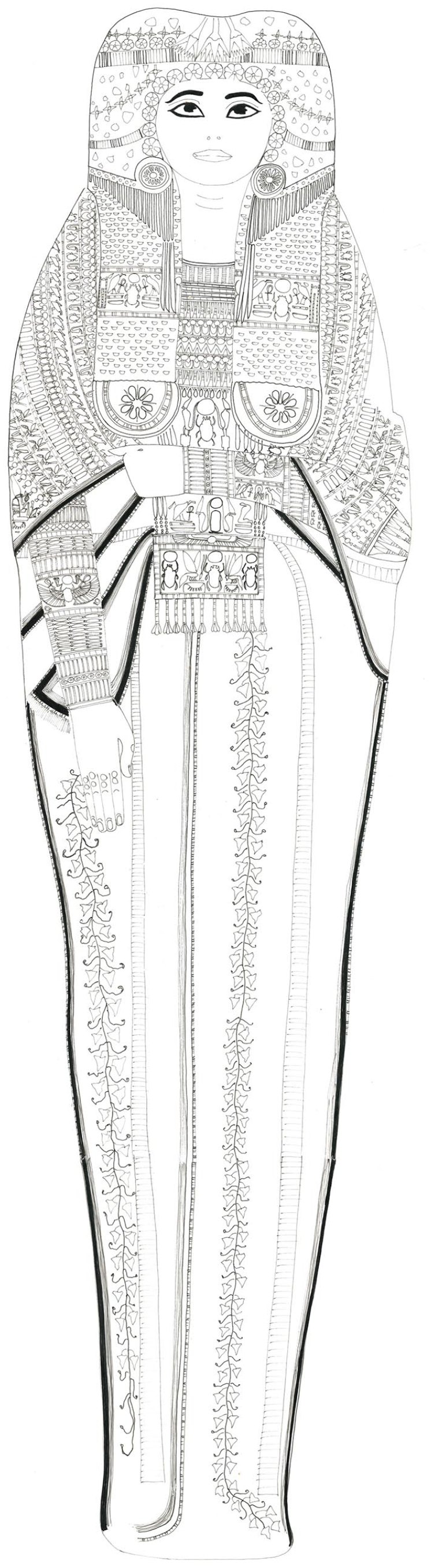
Mummy-board of Meritamun (A.71) (drawing: Rogério Sousa).
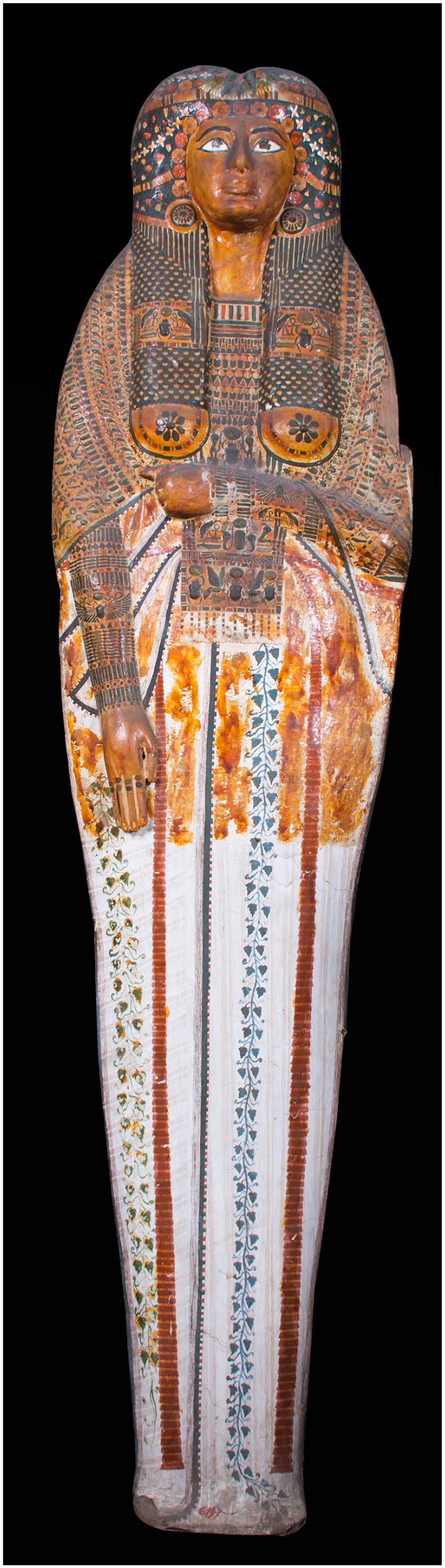
Mummy-board of Meritamun (photo: Egyptian Museum in Cairo).
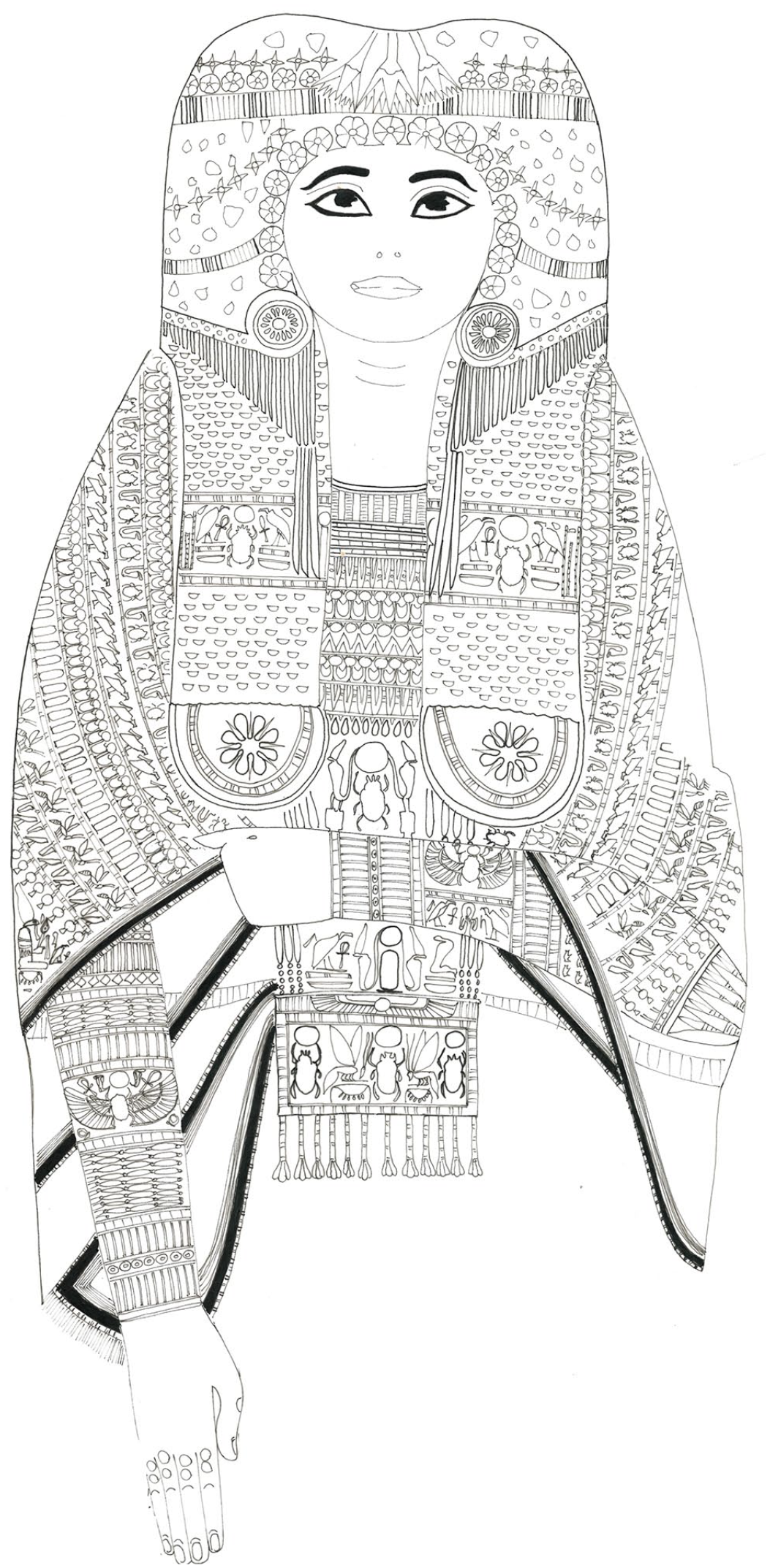
Mummy-board of Meritamun: headboard and upper section (drawing: Rogério Sousa).
The lid features an even more elaborate layout (figs 4 and 5). The headboard and upper section follow the layout of the mummy-board, displaying the deceased in full length, wearing heavily decorated garments (fig. 6). The headboard shows an intricate headband adorned with rosettes and star-shaped flowers. The wig is further enhanced with small rings, delicate locks of hair, and binding bands decorated with liminal elements. These small signs, which are also referred to as space-fillers, 14 are commonly found in coffins dating from the second half of the 21st Dynasty and played a crucial role in the design of yellow coffins. 15
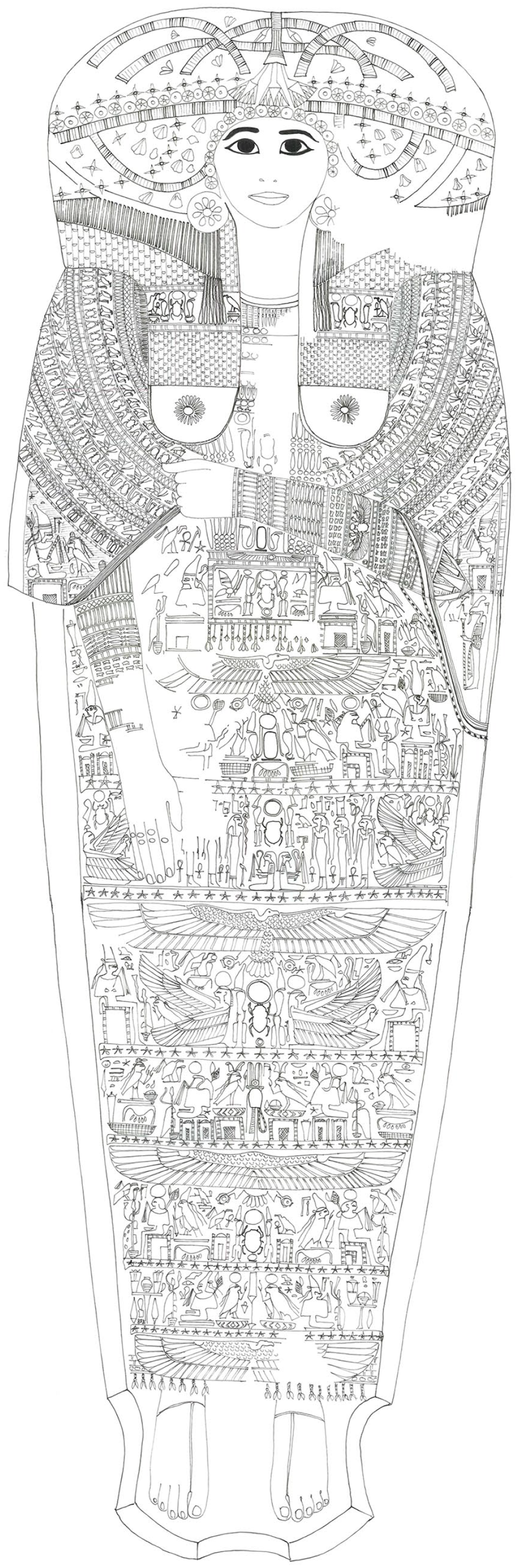
Lid of Meritamun (drawing: Rogério Sousa).
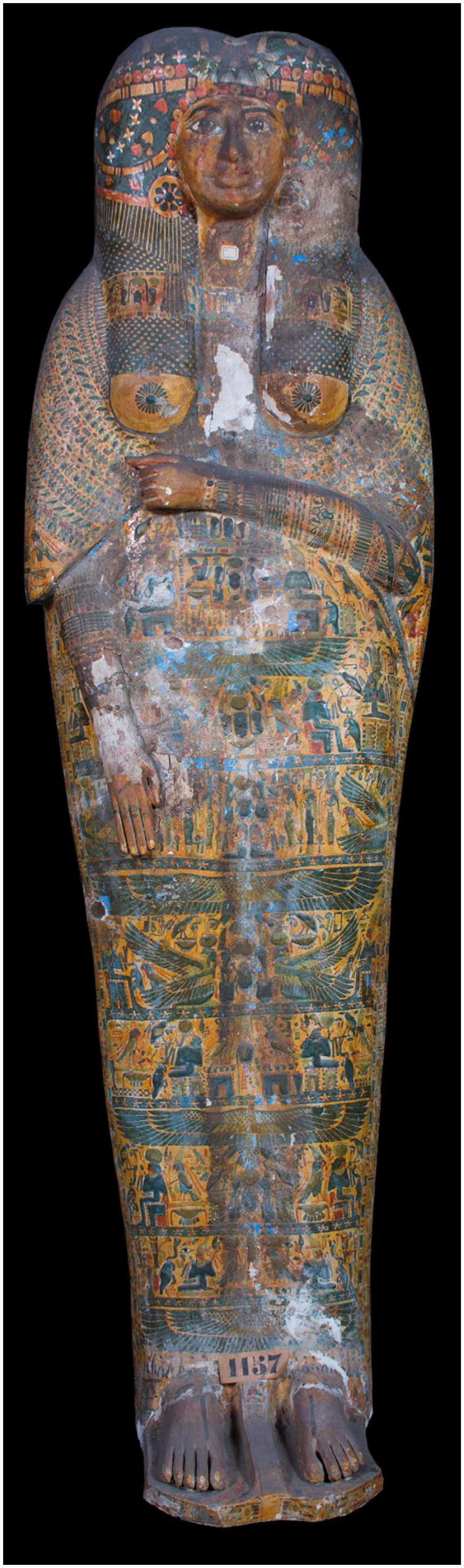
Lid of Meritamun (photo: Egyptian Museum in Cairo).
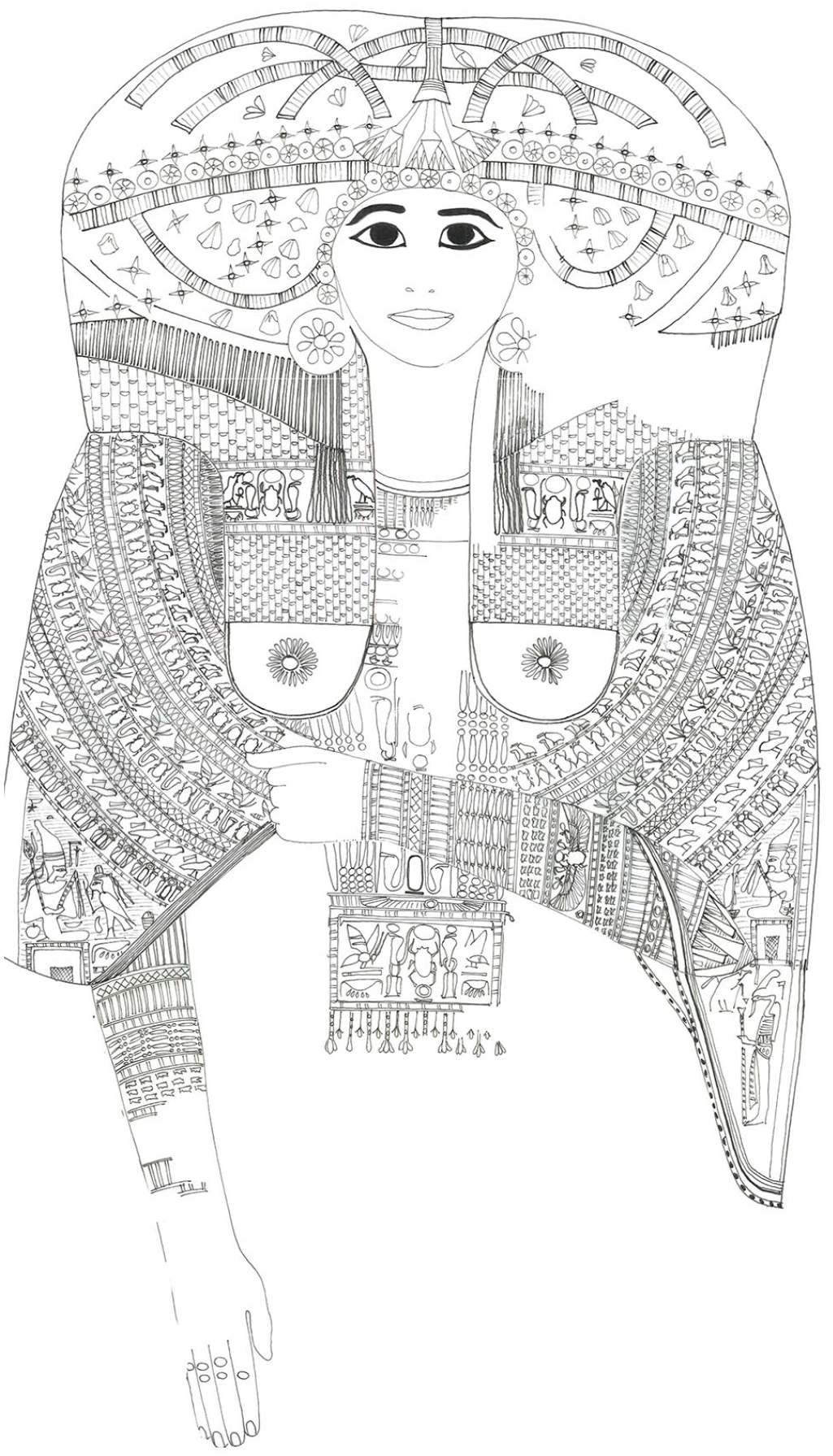
Lid of Meritamun: headboard and upper section (drawing: Rogério Sousa).
The same prevalence of liminal elements observed on the mummy-board is also evident on the lid, particularly in the upper section, where a shawl adorned with bands of liminal elements is prominently featured (fig. 6). The deceased also wears a naophoric pectoral similar to that depicted on the mummy-board.
The most distinctive feature of the lid is found on the lower part of the dress, which is adorned with ten transversal registers alternating between vultures with outstretched wings and symmetrical compositions alluding to Osirian and solar motifs (fig. 7). In these compositions, the deceased is repeatedly depicted as a ba-bird. This layout is an extended version of the central section typically found in objects dating from the late third quarter of the 21st Dynasty. 16 A fringe displayed over the feet suggests that the whole composition should be seen as an embroidered dress.
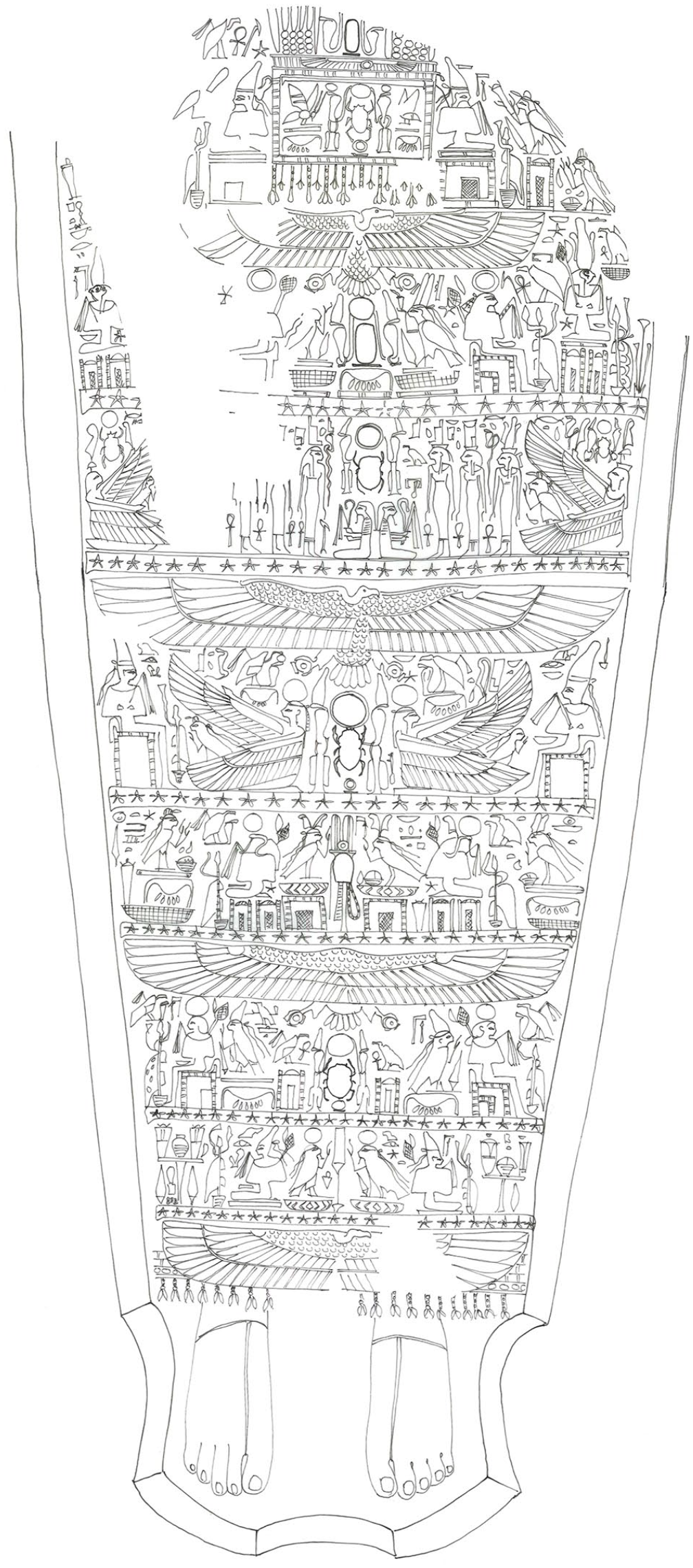
Lid of Meritamun: lower section and footboard (drawing: Rogério Sousa).
From a strictly typological point of view, this object is irregular, and not only due to the festive dress layout of the lid. In the upper section, the typical floral collar is replaced by a shawl, a rare occurrence in the yellow corpus. 17 As observed, an extended version of the central section is depicted over the dress, a feature categorised under Type III (Central section). However, because the first register is headed by a pectoral, this composition falls under Type III.b, further highlighting its typological uniqueness. 18
The box programme is heavily influenced by temple decoration, focusing on rites of Osirian significance. Interestingly, the deceased is consistently depicted in the black garment associated with the later stages of coffin decoration, rather than the white festive dress shown on the mummy-board.
The unique layout of the lid and mummy-board has led scholars to interpret this set as stemming either from an archaising trend that emerged in the late 21st Dynasty 19 or from the re-use of early Ramesside materials. 20 From a craftsmanship standpoint alone, the lid is probably a repurposed Ramesside object originally designed in the festive dress type layout. Not only does the wooden structure adhere to the expected design of such objects, with well-defined feet, arms, and abdomen, but the headboard was heavily plastered to enhance the volume of the wig, a technique often associated with object re-use.
Concerning the mummy-board, although its general layout resembles early Ramesside models, the lower placement of the binding bands on the lappets 21 suggests it might not be a re-used object from that period. The lack of a footboard further supports this notion, 22 although it is worth noting that an early Ramesside mummy-board’s footboard could have been altered through carpentry – for example, by removing the footboard.
However, despite the evidence pointing towards re-use, the adoption of the festive dress layout was probably not merely opportunistic, as Cooney suggests. 23 Both the lid and mummy-board were redecorated entirely by the third quarter of the 21st Dynasty, maintaining consistency in style and decoration. Although the general layout of the mummy-board recalls early Ramesside archetypes, some of its features, such as the long red belt, are unprecedented in these earlier artefacts. 24 The prevalent use of liminal elements in both objects – especially in the upper section, where a shawl decorated with scarabs, vultures, royal cartouches, bees, falcons, and floral motifs replaces the usual large floral collar – further underscores the innovation. Furthermore, the binding bands on the lappets, the pectoral, and the bracelets show an abundant use of liminal elements, which is a conspicuous feature of the late yellow corpus. 25
Overall, despite the archaising atmosphere suggested by the festive dress layout, this set exhibits deeply innovative features, showcasing a masterful composition and a sophisticated use of visual resources from the Theban coffin tradition. Although it uses the layout of the festive dress type, which is rooted in the very origins of the yellow corpus, the decorators incorporated innovative elements in such a bold manner that it is difficult to categorise this set purely as archaising, as suggested by Niwiński. 26
Other Coffin Sets from Bab el-Gasus that Adhere to Similar Iconographic Models and Decorative Arrangements
Despite the remarkable nature of the coffin set of Meritamun (A.71), additional evidence of the revival of the festive dress layout can be found on other coffins from the Tomb of the Priests of Amun, as discussed below. The coffin set A.17 (Egyptian Museum in Cairo, JE 29699) 27 is an ensemble consisting of an outer coffin, an inner coffin, and a mummy-board. 28 Similar to Meritamun’s set, both the inner lid and the mummy-board of A.17 are designed following the festive dress layout. The upper sections of both the mummy-board and the lid display identical layouts, featuring a collar adorned entirely with liminal elements such as vultures, falcons, bees, and scarabs. 29 However, a notable difference between the two sets lies in the shape of the upper section, which in Meritamun’s set resembles a shawl.
Despite this distinction, several features remain consistent between the sets, including the decoration of the chest of the mummy-board (a scarab flanked by cobras) and the decoration of the binding bands on the lappets. A significant difference between these sets is observed in the decoration of the dress depicted over the lids. In A.17, two compositions are displayed: the central section (arranged in seven registers) and the lower section (showing a tripartite panel). The central section recalls that of Meritamun, including the pectoral hanging from a necklace (Type III.c) and large vultures alternating with solar-Osirian compositions. As in Meritamun’s lid, the ba-bird is repeatedly depicted. The lateral partitions of the lower section, in particular, show a composition heavily shaped by late references, mostly of Osirian character (Type III). The central partition, on the other hand, shows vignettes with the sacred scarab flanked by liminal elements (Type III.b), a layout associated with the third quarter of the 21st Dynasty. Another noticeable difference between these sets is on the headboard which, in A.17, is decorated with a chequered pattern instead of the elaborate floral motifs detected on Meritamun’s set.
Despite these differences, the level of resemblance between the two sets implies the utilisation of the same or similar patterns and models, possibly even involving the same network of craftspeople.
Another complete anonymous coffin set, A.74, 30 reflects echoes of the festive dress type as interpreted by these objects. Although none of the objects in this set feature a full-length depiction of the deceased, the headboards on the inner lid and the mummy-board share the same decorative layout as Meritamun’s set (A.71) and set A.17, including a profusion of floral motifs, braided motifs lying along the lappets, and intertwined rings interspersed in the wig. Despite these similarities, set A.74 appears to be of a later period than Meritamun’s set, displaying a higher degree of complexity, particularly in the number of rows included in the headband and the abundance of liminal elements featured over the binding bands of the lappets.
Furthermore, interesting parallels can be drawn with the layout of the inner lid from A.17. The lower section of the lid reveals many similarities, such as the bands of text displaying yellow inscriptions against a black background 31 and the lateral partitions depicting Osirian deities without including the deceased. 32 The central section of both objects also shares common features, although the composition of A.74 is more stylised, featuring a composition with three registers typical of the classical scheme, 33 to which vultures – a privileged motif of this iconographical model – are juxtaposed above and below. Additionally, the edges of both lids display block-friezes instead of text bands, similar to Meritamun’s lid, where block-friezes flank the inscribed text bands.
Certain iconographic and stylistic peculiarities discussed in the aforementioned objects are also evident in other coffin sets and elements. This suggests the use of similar patterns and iconographic models for decorating a specific group of objects. As is explained later, this model was commonly employed in the adornment of items owned by the high elite, which is supported by the characterisation of the individuals associated with these objects and specific iconographic features. However, it is possible that individuals of lower status imitated similar decorative solutions, indicating the replication and circulation of motifs and iconographical arrangements throughout the Theban area and among networks of craftspeople.
Several of the characteristics mentioned are also evident on the outer lid associated with an anonymous woman (Egyptian Museum in Cairo, JE 29622). 34 Despite the absence of a full-length depiction of the deceased, significant similarities can be observed between this element and the previously referenced objects. Similar to the inner lid of Meritamun (A.71), the outer lid JE 29622 features a comparable naophoric pectoral hanging from a necklace, a rare occurrence, in the upper section. Additionally, it features an extended central section with six transverse registers in the lower part. The composition prominently exhibits a recurring depiction of a female divinity, a vulture, and a cobra, all with outstretched wings, alternating with symmetrical arrangements suggesting Osirian and solar motifs as the primary iconographic themes. Furthermore, the consistent portrayal of the deceased as a ba-bird, excluding any human representation, is noteworthy within the composition. Notably, the lid lacks any block-friezes or text bands on its edges.
These shared attributes are not exclusive to female coffins, indicating that the same model might have been employed without gender distinction. Another example reflecting these traits is found in an inner coffin and mummy-board (National Museum of Natural History, Smithsonian Institution in Washington, 154959 (inner coffin) and 364999 (mummy-board)) belonging to set A.39. The set was decorated for a male individual, although his name was omitted from the objects under discussion. 35
Similarly to the previously mentioned object, both the lid and mummy-board of set A.39 exhibit an elongated central panel interspersing depictions of vultures with outstretched wings alongside the Osirian-solar arrangement, featuring a diverse array of underworld deities. The decorative elements are densely packed, with the presence of space fillers notably prominent, permeating all compositions on the lid. Moreover, the space fillers are nearly as large as the primary figures, making them dominant elements within the compositions. The edges of the lid display a band of inscribed text along with block-friezes flanking the texts, similar to the lid associated with Meritamun. The covers of set A.39 adhere to the complex scheme. 36
According to the complex scheme ideal type, the floral collar is typically expected to cover the forearms entirely. However, on the mummy-board the elbows are visible, and both the elbows and forearms are represented on the inner lid. These inconsistencies may be attributed to potential redecoration, whether associated with the practice of re-use or not. Although the lower sections of the two elements are identical, indicating they were probably decorated by the same craftsperson, the headboard and upper sections, including the floral collars, differ significantly. This suggests that, at the very least, the inner lid was redecorated. Its lower section was presumably redecorated to align with the complex scheme, a recent innovation at that time, whereas the upper section, featuring a more conservative and earlier typology, remained unchanged.
Another pertinent example for discussion is the coffin set A.61, decorated for a male individual 37 (Egyptian Museum in Cairo, JE 29653/CG 6205, 6207 (outer coffin), CG 6206, 6171 (inner coffin), and CG 6172 (mummy-board)). Similar to the outer and inner lids of sets A.17 and the covers of set A.74, set A.61 features two distinct compositions in the decorative structure of its covers: the central section and the lower section. Concerning the central panel, both the inner lid and the mummy-board display an alternation between the vulture with outstretched wings and solar-Osirian iconography. Additionally, consistent with the coffins under discussion, the registers contain numerous liminal elements and representations of the deceased as a ba-bird.
The lower section is divided into a tripartite panel on both the outer and inner lids. Like set A.17, the lateral partitions feature an Osirian-themed composition, in line with Type III, and the central partition vignettes display the sacred scarab flanked by liminal elements (Type III.b). Furthermore, the outer lid presents a pectoral akin to those previously examined. The edges of the outer lid display an inscribed text band alongside block-friezes flanking the texts, and the inner lid excludes the text band but incorporates the block-friezes.
Finally, another notable example within the group is set A.85, decorated for a male individual 38 (Egyptian Museum in Cairo, JE 29680/CG 6043, 6044 (outer coffin), CG 6041, 6042 (inner coffin), and CG 6045 (mummy-board)). Similar to the representations observed in set A.61, the decoration of set A.85 also highlights a significant difference in the composition of the central panel and lower section. The former includes depictions of the vulture with outstretched wings and Osirian solar iconography. Although the lower partition of all covers is divided into three sections, preceding the footboard on the outer lid, there is a depiction of a vulture with outstretched wings, possibly mirroring the concept of an extended central panel. Notably, on the edges of the outer lid, there is no text, only a block-frieze, whereas on the edges of the inner lid, there is text partially accompanied by a block-frieze. Additionally, in contrast to the previously discussed examples, the underside floorboard of the outer box is adorned with a coiled serpent, a rare occurrence 39 that implies the deceased held a high status, a detail that will be further discussed later.
The Fingerprint of a Theban Group of Decorators
The coffins and coffin elements examined in this study share a multitude of attributes, indicating a strong connection among the artefacts and implying the use of a common or similar iconographic model or models by interconnected groups of decorators. The striking similarities between these objects may even suggest the potential involvement of a single network of craftspeople or a single decorator in the creation of some of them.
Distinct elements, such as the portrayal of shetjit-shrines and pedestals characterised by the use of dots and red lines in their design, along with the elongated blue pt sign embellished with yellow stars dividing the registers and vignettes, stand out prominently. The evident horror vacui persists throughout the objects, with similar liminal elements occupying the remaining surfaces of the scenes after the inclusion of the main figures, such as vultures atop nbw signs, ba-birds, and the aforementioned shetjit-shrines. These elements maintain a consistent presence across the various coffin elements.
Furthermore, the selection of underworld divinities for the Osirian iconography demonstrates consistency across the elements. Osirian scenes form the primary iconographic repertoire, in various depictions, including squatted, seated, or standing mummiform gods positioned atop the intricately decorated shrines or pedestals, holding sceptres, and occasionally accompanied by adorating ba-birds and/or winged divinities. Additional scenes feature the recumbent figure of Osiris on the embalming bed, or Osiris seated on a throne, receiving offerings, protection, or adoration from winged divinities.
In the representation of mummiform gods, allusions to underworld deities, potentially associated with the Litany of Ra, are apparent. These deities often feature serpent heads, either single or double, although they are occasionally depicted with vulture heads, crocodile heads (often adorned with two feathers), hare heads, benu-bird heads, or jackal heads, among other variations.
These specific motifs, found exclusively on coffins conforming to the same model and not found elsewhere, could either originate from the model itself or serve as distinct signatures of a network of craftspeople or individual decorator(s), whether operating independently or collaboratively. Comprehensive investigations are necessary, encompassing stylistic analyses and archaeometric studies, in order to offer valuable insights into this subject.
Notably, according to the established iconographic pattern, the prevalence of representations featuring the deceased as a ba-bird is observed, contrasting with the absence of depictions in human form on the covers. In contrast, such depictions are found on the accompanying boxes. It remains uncertain whether this discrepancy is related to differences in ritual practices.
The anonymity of the objects is a recurring characteristic among these elements, with the majority of sets within this group remaining anonymous. In cases where the name of the deceased is on the objects, it occupies previously blank spaces, suggesting a later inclusion of the name after the completion of the object’s decoration. The new inscriptions are executed in a distinct monochromatic pigment, setting them apart from the existing texts. It remains uncertain whether this practice reflects advance planning for the objects, a method linked to re-use, or other unknown and possibly ritualistic reasons. However, the identification of accompanying funerary equipment that features the deceased’s information, including name and titles, allows for the recognition of the owners when their associated objects remained anonymous.
However, various differences are evident on the covers in this group, revealing variations and different decorative solutions, including an elongated central panel or the coexistence of both a central and a lower section, each distinct in its arrangement of decoration. The reasons for these divergent approaches remain elusive, although they could be attributed to adaptations of the model used or the incorporation of complementary models on the same artefacts. The specific individuals responsible for these decisions and the extent of the commissioner’s involvement, whether the owner or another party, in the decoration of the objects remain uncertain.
The elements collected in these sets clearly contribute to isolating the activity of a particular Theban network of craftspeople operating in the late third quarter of the 21st Dynasty. The sets provide a small series in which it is possible to detect how Theban decorators built up innovative results by using their own designs. The first aspect that should be considered is the pivotal role performed by the inner lid in the layout of the set.
The earliest of these assemblages is probably that of Meritamun, where the archaising depiction of the deceased as a living being is combined with innovative features carefully introduced in each section of the lid. The headboard stands out due to its distinctive floral decoration, while the upper section features a shawl fully adorned with liminal elements. In the lower section, the layout adapts the extended version of the central section to the dress. Despite the ‘archaising’ depiction of the deceased as a living being, nothing else in this object can be acknowledged as such. On the contrary, this ‘archaising’ form is simply used as a background to display innovative compositions. However, the archaising resonances implied in the use of an early Ramesside lid showing the deceased as a living being must have played an important role, because the layout of the festive dress type is again referenced in the mummy-board. The latter object, while suggesting a closer association with the ‘pure’ Ramesside layout of the festive dress type, has innovative features on the headboard and upper section.
The activity of this same decorator is evident in set A.17. The inner lid again shows the deceased depicted as a living being, suggesting the re-use of an early Ramesside object. As in A.71, the headboard was heavily re-worked with the addition of paste to enhance the volume of the wig. Here again, the archaising background of the festive dress layout is merely used as a canvas to display an innovative programme sharing many features with Meritamun’s set. The large collar featuring liminal elements instead of floral motifs is the most conspicuous of these. Unlike Meritamun’s inner lid, in this object the usual division between central and lower section is used. Despite being much shorter, the central section shows a layout similar to Meritamun’s composition, with the same prevalence of vulture deities and starry bands. In summary, despite the differences, the inner lid of A.17 clearly references the layout of Meritamun’s corresponding object. The layout of the upper section is replicated almost exactly, and the central section preserves much of the decorative scheme of the corresponding composition in Meritamun’s lid. Innovative inputs were inserted into the headboard and the lower section through the depiction of a chequered wig and a tripartite panel, respectively.
As in Meritamun’s set, the mummy-board of A.17 suggests a closer association with the festive dress layout, but assuming that this resulted from an archaising aim might be misleading, given the innovative features used on the headboard and upper section of this object.
In the inner lid of A.74, there is a notable shift back to the more traditional layout of the yellow type, with the deceased no longer depicted in full length as a living being, and the addition of a conventional floral collar. However, this apparent return to the typical trend of coffin decoration of the period is deceiving, because two pectorals are introduced on the upper section: a heart amulet 40 and a winged cobra. 41 During the late 21st Dynasty, the heart amulet became a significant central marker of the upper section. At this stage, it is seen as an innovation, much like the winged cobra, which remains a rarity.
Although there are subtle differences, the central and upper sections of this lid adhere closely to the general layout of A.17. In fact, the influence of the same decorative model is evident in various details. The central and lower sections of the inner lid exhibit similar rare features found in the inner lid of A.17, such as the black bands of text, the arrangement of the vignettes, and the block-friezes along the edges. However, the most striking similarity is in the headboard, where we find the same distinctive floral decoration seen in Meritamun’s set. Notably, in all three inner lids the floral headband includes a row adorned with interspersed red and white rosettes, a feature not commonly observed.
Craftspeople working for the high Theban elite used various techniques to produce innovative results. In this context, the revival of the festive dress layout was not merely an attempt to mimic old models in an archaising manner, but rather a deliberate process to achieve innovation. By combining the earlier Ramesside layout with innovative features, such as the extensive use of liminal elements and unique floral motifs, these craftspeople produced strikingly original designs.
The Status of the Owners Associated with the Materials
When examining the identities of the individuals connected to the coffin sets, it becomes apparent that they occupied privileged positions within society. 42 This is not only evident from the titles inscribed on the coffin sets or their associated funerary equipment but also from the nature of the funerary equipment itself. Furthermore, this assertion is supported by specific iconographic elements present on both the lids and boxes.
Regarding the first aspect, the inner lid associated with set A.71 identifies Meritamun as a špst, 43 denoting her association with the upper strata of society. Similarly, the outer lid JE 29622 refers to the deceased as a sȝt n ḥm-nṯr tpy n ʾImn, among other titles, though the precise identity of the owner remains undisclosed because her name was not inscribed on the object. Additionally, the outer lid was originally gilded, indicating her elevated status and close association with the high priest of Amun. In the case of the other sets, A.39 was commissioned for an individual who, among other titles, held the position of a scribe associated with the military, 44 indicating a potential affiliation with the entourage of the high priest of Amun, given their military roles and influence. Furthermore, A.61 was probably prepared for an individual named Panebenkemetnekhet, who held various roles including scribe of the treasury, a title discerned from the funerary equipment linked to the set, 45 despite the anonymity of the coffin set itself. His involvement with the treasury as a scribe implies his influential position. Finally, set A.85 is associated with a ḥm-nṯr of Sobek named Psusennes, 46 whose elevated status was underscored by his role as a ḥm-nṯr connected with a specific deity beyond the Theban triad.
Regarding the characteristics of the funerary equipment itself, the documented funerary items associated with the discussed sets exhibit exceptional quality, including fine linens and amulets crafted from luxurious materials such as gold, silver, bronze, 47 and gilded wood. Additionally, certain types of these funerary items, notably including pectorals and uraei, are often associated with royalty and individuals of high standing, likely within the sphere of influence of the high priest. This collective analysis suggests the elevated status of the individuals who owned these coffin sets.
In terms of iconography, this notion gains further support from the presence of rare and specific iconographic elements found on the objects. Notably, some lids feature unique decorations adorning the female wigs, potentially signifying the elevated status of their owners. Additionally, vultures appear as the primary deity in the central panel registers in the majority of the examples, either alongside or as substitutes for the more common representation of a squatting goddess with outstretched wings. The prevalence of the vulture with outstretched wings could also be linked to the presence of pectorals observed in the funerary equipment of these individuals.
Furthermore, the boxes also portray unique scenes, such as the active participation of the deceased in the offering and presentation of multiple crowns, accompanied by various divinities engaged in the ritual. This specific and rare scene may have been reserved exclusively for the elite. Furthermore, the depiction of a coiled serpent in the underside floorboard of the outer box of Psusennes reinforces this notion. Notably, this individual was discovered with a uraeus on his forehead, suggesting a potential connection with royalty and the family of the high priests of Amun. It is worth mentioning that a son of the high priest of Amun Menkheperre, sharing the same name, has been documented. 48 His burial probably occurred in Abydos, although his coffin set, if it survived, has not yet been discovered.
Consequently, this suggests that the chosen model for adorning these coffins was favoured within an exclusive network of skilled craftspeople, probably associated with an elite circle.
Other Examples
The late revival of the festive dress type is also evident in coffins of lesser quality. An example of this is the coffin of Tamutmutef (CGT 1010/cat. 228, Museo Egizio in Turin), 49 where the lid, though less sophisticated in design, reveals a layout akin to that of Meritamun’s, depicting the deceased in festive attire. In Tamutmutef’s lid, the upper section features the typical floral collar, and the wig lacks any decoration. However, some similarities with Meritamun’s lid design can be observed, such as the fully covered forearms adorned with bracelets and an extended central section with eleven registers over the dress. This composition resembles that of Meritamun, with alternating depictions of vultures and compositions of solar and Osirian significance.
Despite these similarities, the coffin exhibits significantly lower levels of craftsmanship, both in the carpentry work and in the decoration layer. The style of the pictorial work appears rougher and sketchier, indicating the involvement of a different craftsperson or group of craftspeople. Unlike the coffin set for Meritamun, this one was evidently not intended to serve the highest Theban elite. This is especially apparent when examining the decoration of the box, which is notably poor. 50
Additionally, concerning craftsmanship, it is noteworthy that one side of the box remained unfinished for unknown reasons. Moreover, the box features empty spaces intended for the inclusion of the deceased’s name, which was never added. In contrast, the inner lid does bear the name of the deceased. Furthermore, some of the texts exhibit errors, such as the sequence ỉmȝḫy ḫr, which is erroneously presented as ỉmȝḫy rḫ on both the lid and box. This recurrent mistake is unsurprising, given the rough palaeography of the signs, suggesting the involvement of a less skilled craftsperson and decorator in crafting the object.
The coffin thus seems to have been created as a more modest version of the coffin of Meritamun, suggesting that the activity of the individuals who produced Meritamun’s set piqued enough interest to trigger the production of ‘cheaper’ versions. The adaptation and appropriation of high elite models indicate that the craftsmanship of funerary items, particularly coffins in this context, for individuals of lower rank mirrored the activity of their more luxurious counterparts. Moreover, innovations were keenly and quickly absorbed into their work.
Conclusion
Based on stylistic analysis, it becomes evident that towards the end of the third quarter of the 21st Dynasty, an artistic network in Thebes associated with the high elite reignited interest in the festive dress style. The coffin of Meritamun offers a slightly more precise dating for this phenomenon – although the historical context provided by the mummy associated with set A.17, dated to the pontificate of Psusennes, cannot be used to date the set itself, it does serve as additional evidence of re-use within this context.
The presence of re-used coffins within this context inevitably raises questions about the practice. 51 Typically, re-use is seen as a pragmatic occurrence, with little consideration given to the symbolism of the festive dress layout. However, the re-use and redesign of Ramesside objects in the late 21st Dynasty by a specific group of decorators should not be seen merely as a utilitarian act. Instead, it represents a conscious decision to incorporate and reinterpret the symbolism of the Ramesside festive dress layout within a new context.
In the case of both Meritamun (A.71) and the anonymous set A.17, the revival of the festive dress layout was coupled with iconographic innovations of Theban artistic networks. This included the heavy use of liminal elements and the adoption of contemporary designs, such as the extended central section. However, the eventual re-use of early Ramesside lids aimed less at reviving an old model 52 and more at showcasing innovative patterns. Despite their incorporation of early Ramesside elements, the lids of A.71 and A.17 cannot be considered archaising due to their overall innovative design.
The mummy-boards of these sets, although they are closer to the Ramesside models, also served to create a contrast between traditional features and innovative ones. Although these coffins cannot be categorised as archaising, they probably played a role in stimulating the revival of the early yellow type, particularly among the highest elite.
The innovative elements introduced in these sets are closely linked to the use of liminal elements. These features, rich in symbolism, evoke the sacred realm of the Duat and enhance the divine significance of the coffin. 53 The extended central panel, as seen in Meritamun’s lid and to a lesser extent in set A.17, draws inspiration from temple ceilings, further emphasising associations with the heavenly realm. These coffins depict the deceased in sacred garments, symbolising the heavenly mother’s her protection and the sacredness of the divine. Additionally, the application of varnish would have bestowed upon the deceased a solar/divine radiance, imbuing her with the light and power of a goddess.
The decorators of this lid did not merely (perhaps) re-use a Ramesside object, which by that time could be considered archaic, but rather used the arrangement of the festive dress type to convey a deeper layer of meaning, where the decorators were aware of tradition but reinterpreted it with decorative innovations of the time. Furthermore, the depiction of the deceased in festive garments is not just about participating in divine festivals, as the festive dress layout originally intended. Once it is integrated into this new context, the deceased appears truly adorned in garments of light, intricately embroidered with sacred beings, evoking the heavenly realm itself. Consequently, the representations associated with sacred space, strongly linked with the yellow coffins, 54 are reinterpreted in a more nuanced manner, seen as a sacred ‘garment’ that intimately adheres to the deceased’s body. 55 This close association between the coffin, the body, and the symbolic use of garments was particularly esteemed. It is noteworthy that all the inventoried objects resembling the festive-type dress in their craftsmanship were prepared for women, suggesting that this interpretation of the coffin as a sacred garment was especially developed for a female audience.
The limited known examples indicate that this layout was employed in both high- and middle-ranked burials, hinting at a wider dissemination than current data suggests.
All the discussed examples originate from Bab el-Gasus. It is conceivable that additional materials from the recently (re)discovered group of coffins from Bab el-Gasus, stored in the basement of the Egyptian Museum in Cairo, as well as other objects in various collections, may one day be incorporated into the group of objects discussed in this study. For instance, there is a wall associated with an inner box of an anonymous woman currently preserved at the Walters Art Gallery in Baltimore (62.2), although its fragmentary state precluded its inclusion in this study. 56 It shares some of the elements discussed here, as well as stylistic similarities. Unfortunately, there is no context for this object suggesting the same origin, though future research may shed light on this aspect.
Footnotes
Funding
This work is financed by national funds through FCT – Foundation for Science and Technology, I.P, in the scope of the projects UIDB/04311/2020 and UIDP/04311/2020.
2.
Sousa 2018: 33–36; Grajetzki 1996. Although it is not stated explicitly, the idea that the festive dress type is rooted in the Amarna Period is also put forward by  : 55).
3.
Sousa 2020a: 3. The corpus of Ramesside anthropoid coffins is often identified with the yellow coffins produced during the 21st Dynasty ().
5.
See the coffin of Nedjemet (Egyptian Museum in Cairo, CG 61024: Daressy 1909: pl. XXVI), coffin set of Tayuheret (Egyptian Museum in Cairo, CG 61032: Daressy 1909: pl. LIV), coffin of Hori (inv. no. 525: Kitchen 1990: 109–110), coffin set of Panebmontu (Louvre Museum, inv. E 13029, 13046: Seipel 1989: nos 472–473), coffin set of Amenemhat (Museo Arqueológico Nacional in Madrid, nos 15216–15218: : 97).
6.
For the latter, see the funerary board of Sennedjem (Egyptian Museum in Cairo, JE 27308: : 115) and the lid of Iset (Egyptian Museum in Cairo, JE 27309: Sousa 2019: 121).
7.
Coffin of Tauseretempernesu (Musées royaux d’Art et d’Histoire in Brussels, inv. E. 5883: Delvaux and Therasse 2015: 86–87); coffin of Djedmutiuesankh (Sociedade de Geografia de Lisboa, SGL-AC-517: : 281).
8.
Coffin of Hori (Museo Egizio in Turin, CGT 10112: Niwiński 2004: table XXII.1); anonymous outer coffin (Musées royaux d’Art et d’Histoire in Brussels, inv. E. 5879: Delvaux and Therasse 2015: 102–105); coffin of Ankhefenkhonsu (National Museum of Denmark in Copenhagen, 3910: Sousa and Hansen 2022: 197–210; anonymous coffin (Museum of Fine Arts in Budapest, inv. no. 51.2093/1–2: Liptay 2011: 88); coffin set of Hori (Egyptian Museum in Cairo, JE 29619: : 135–137).
11.
12.
Funerary board of Iyneferty (Metropolitan Museum of Art, 86.1.5: : fig. 141); funerary board of Tamakhet (Ägyptisches Museum und Papyrussammlung in Berlin, inv. no. 10832: Cooney 2007: fig. 5); coffin of Weretwahset (Brooklyn Museum, 37.47Ea-b: Bleiberg 2008: figs 124–125); coffin of Henutwati (Louvre Museum, E 18848: Cooney 2007: fig. 125).
13.
With the exception of the flowers, which remained white.
15.
The term ‘liminal elements’ aims to highlight that the role of these features is not limited to ‘filling in’ the space but rather is to connect the exterior walls of the coffin with the sacredness associated with its interior areas. The most common liminal elements are vultures, shetjit-shrines, and scarabs. See : 108–110.
19.
20.
21.
Those bindings are usually missing on early Ramesside objects (funerary board of Tamakhet (Ägyptisches Museum und Papyrussammlung in Berlin, no. 10832: : fig. 5); coffin of Weretwahset (Brooklyn Museum, 37.47Ea–b: Bleiberg 2008: figs 124–125); coffin of Henutwati (Louvre Museum, E 18848: Cooney 2007: fig. 125)). However, when included, they are found next to the earrings (funerary board of Iyneferty (Metropolitan Museum of Art, 86.1.5: Cooney 2007: fig. 141)).
22.
An early Ramesside board would typically include a footboard featuring the feet of the deceased (see examples in n. 12).
24.
The long red belt is detected in late Ramesside mummy-boards. See anonymous mummy-board from TT 97 (Ikram and Dodson 1998: 173); mummy-board of Shedwyduat from TT 400 (: 189).
26.
: 123. According to this author the set is included in Type IV-c (Niwiński 1988: 128).
27.
The set was intended for a female individual. Although all three covers associated with the set contain a blank space designated for the deceased’s name, which was left unfilled, the outer box remained anonymous without any such reserved space. In contrast, the inner box features the name Tjenetpaherunefer, which is included on the pyramidion of the scene depicting Hathor emerging from the sacred mountain.
28.
The female mummy buried in this set was equipped with mummy braces and a shroud inscribed with the name of the high priest Psusennes.
29.
30.
The outer coffin, inner lid, and mummy board of the set are in Bern (Historisches Museum, E/1894.305.0010 (formerly AE 10): Küffer and Renfer 1997: 68; : 252–253), and the inner box is in Vienna (Kunsthistorisches Museum, ÄS 6267b). This fragmentation of the set highlights the persistent confusion surrounding the materials and shipments of objects from Bab el-Gasus to foreign destinations. The set was decorated for a female, although her name is not on the objects.
31.
This is still a rare feature at this stage. Yellow texts inscribed in yellow bands are typically associated with coffins dating from the last quarter of the 21st Dynasty. In Bab el-Gasus it is rarely found, such as in A.52 (Musée d’Art et d’Histoire in Geneva, inv. no. 007363: Küffer and Siegmann 2007: 71–74) and in A.4 (Sociedade de Geografia de Lisboa, SGL-AC-514: Sousa 2017: 275). In the Royal Cache this feature is found in the coffin set of Asetemkhebit (Egyptian Museum in Cairo, CG 61031: : pl. L).
33.
34.
35.
Niwiński 1988: 179 no. 426. Fortunately, the outer lid linked to the set was recently rediscovered in the basement of the Egyptian Museum in Cairo (: 367). However, the location of the corresponding outer box remains unknown. The outer lid, dedicated to a male individual depicted in the lateral vignettes, originally featured a blank space that was later filled with the information of the deceased, namely Amenhotep. This information was not present on the inner coffin and mummy-board. Despite plans for the set to be shipped to the United States, the outer coffin never reached its destination, for reasons that are still unclear. Notably, the outer lid displays a different decorative arrangement, suggesting a distinct production compared with the other elements of the set discussed in this study. More extensive access to and publication of this rediscovered component will provide further insight into this matter.
37.
Niwiński 1988: 122 no. 98. It should be noted that the information regarding the identity of the deceased, as provided by Niwiński, is a mistake originating from Lieblein’s list published in : 997 no. 61. The information reported by both authors is not on the coffin nor on any of the associated funerary elements. Although the coffin set remained anonymous, its associated funerary equipment was decorated for Panebenkemetnekhet.
38.
Niwiński 1988: 126 no. 118; : 6–22, pls I–IV. The coffin itself remained anonymous, although the accompanying papyrus referred to the owner as Psusennes.
39.
This unique decoration has only been observed in the case of Tjanefer, a direct member of the high priest’s family (A.151). It is plausible to suggest that this distinguishing feature signifies individuals of elevated status.
41.
The association of a heart amulet with a winged cobra is extremely rare.
42.
A study regarding the identities of the owners of the examined coffins and their corresponding funerary equipment is currently being prepared by Vilaró-Fabregat.
43.
44.
45.
The title is visible on the papyrus of the Amduat linked to the individual (S.R.VII. 11506).
46.
This information derives from the papyrus of the Amduat associated with the set (S.R.VII. 10273).
47.
55.
The idea of a ‘semiotic wrapping’ (meaning the use of coffin decoration as an extension of the mummy wrappings, one that is composed essentially of symbols and signs that ‘wrap’ and protect the mummy: Sousa 2024, 511) is here beautifully and innovatively expressed through the association with a garment, whereas the usual associations are of an architectonic nature. For this concept and its architectonic manifestations see Sousa 2018: 197–207. For the concept of architectonisation in the yellow corpus see : 361.