




Abstract
This article examines an ancient Egyptian coffin that was donated in 1867 to the Natural History Museum of Trieste and then moved to the Trieste Antiquities Museum in 2004. The coffin is a type dating to the Third Intermediate Period and belonged to an anonymous priestess. It is characterised by rather careless decoration and by extremely repetitive inscriptions that can hardly find parallels in the vast panorama of coffin production of the period. Its unique feature, though, is the large mummiform figure depicted on the bottom of the coffin box. The technical, decorative, and textual features hint at this coffin being part of a sort of ‘ready-made’ production by a Theban workshop.

Introduction
The Antiquities Museum of Trieste, or Civico Museo d’Antichità ‘J. J. Winckelmann’ as it is officially named, hosts within its Egyptian collection a hitherto unpublished Egyptian wooden anthropoid coffin of the Third Intermediate Period, inventoried with the number E4 and presenting some peculiarities that make it worth studying. 1
Not many scholars, thus far, have dealt with the Egyptian collection of Trieste. The first one was Claudia Dolzani, 2 who in her vast production of scientific articles dedicated fifteen of them, spanning from 1949 to 1989, to Egyptian objects held in Trieste. 3 She seems to have been most interested in the small bronze figurines depicting deities, the few stone sculptural fragments, and the mummified humans, but she also dedicated two papers to the – then – one Egyptian wooden coffin and two stone sarcophagi of the Antiquities Museum, whence it can be deduced that her approach was mainly based on art history rather than philology, since the inscriptions on the objects are not treated in great detail and sometimes with patent mistakes. 4 Interestingly, she also wrote an article about a second wooden coffin, at the time held in the Natural History Museum, also in Trieste, together with the coffin under examination here, which in turn was completely neglected. 5
In 2004, all the objects from Egypt owned by the Municipality were moved to the Antiquities Museum. This, though, did not change the situation: Franco Crevatin, former professor of glottology at the University of Trieste, published only the inscriptions on a few small objects of the Museum between 1994 and 2013; 6 and Marzia Vidulli Torlo, curator of the Museum since 1997 and specialist in Paleochristian archaeology, has limited her contributions to the history of the Egyptian collection. 7
In 2013, finally, Crevatin and Vidulli Torlo curated the scientific catalogue of the whole collection, this time including an entry about the E4 coffin, written by the present author. 8
After ten years, the present contribution will not only establish the date and probable provenance of the coffin, but will analyse its unique characteristics and place them in the wider context of coffin production in the Third Intermediate Period, with the aim of proving that this particular artefact was a relatively cheap product made with no specific buyer in mind, probably as a sort of training exercise for less experienced artisans. The publication of this coffin will, therefore, be helpful in reconstructing, at least in part, how funerary workshops of the time functioned.
Description of the Coffin
The anthropoid coffin, composed of two main parts (lid and box), is presently not in very good condition. The decorated surface is cracked in many places, uncovering the underlying mud stucco or even the wood underneath it. The hands, which were usually carved out of separate pieces of wood and attached to the lid by means of wooden dowels, are now missing. Damage done by wood-eating insects is visible, especially in the feet area. Furthermore, the external painted layer is generally rather faded and the bottom of the coffin box has suffered so much damage, probably due to humidity given the dissolution of the external stucco and paint layers, that it is currently supported by modern planks, which have unfortunately been fastened by means of iron nails. This has also caused the original bottom to be ‘pushed up’ inside the box, so that it no longer rests in its original position. 9
The coffin is 190 cm long, 62 cm wide at the shoulders, and approximately 60 cm high (lid and box together; the latter is 35 cm high). Using a well-documented technique, 10 both the lid and the box were made from several planks and even small pieces of wood – probably sycamore, though no analysis has ever been carried out to confirm this – joined together by means of small cylindrical wooden pegs, sometimes visible under the cracks of the painted decoration. The condition of the object reveals an interesting technical detail: the wooden planks present, in some places, black marks that must have been made by the carpenter to mark the spots where cuts had to be made, sometimes correcting previous marks made with other methods. 11 In figure 1, for example, the two black arrows indicate the black marks that correspond to the groove carved in the thickness of the wood for the coffin’s closing mechanism, while two parallel saw marks probably indicate the first, and incorrect, attempt at marking the spot.
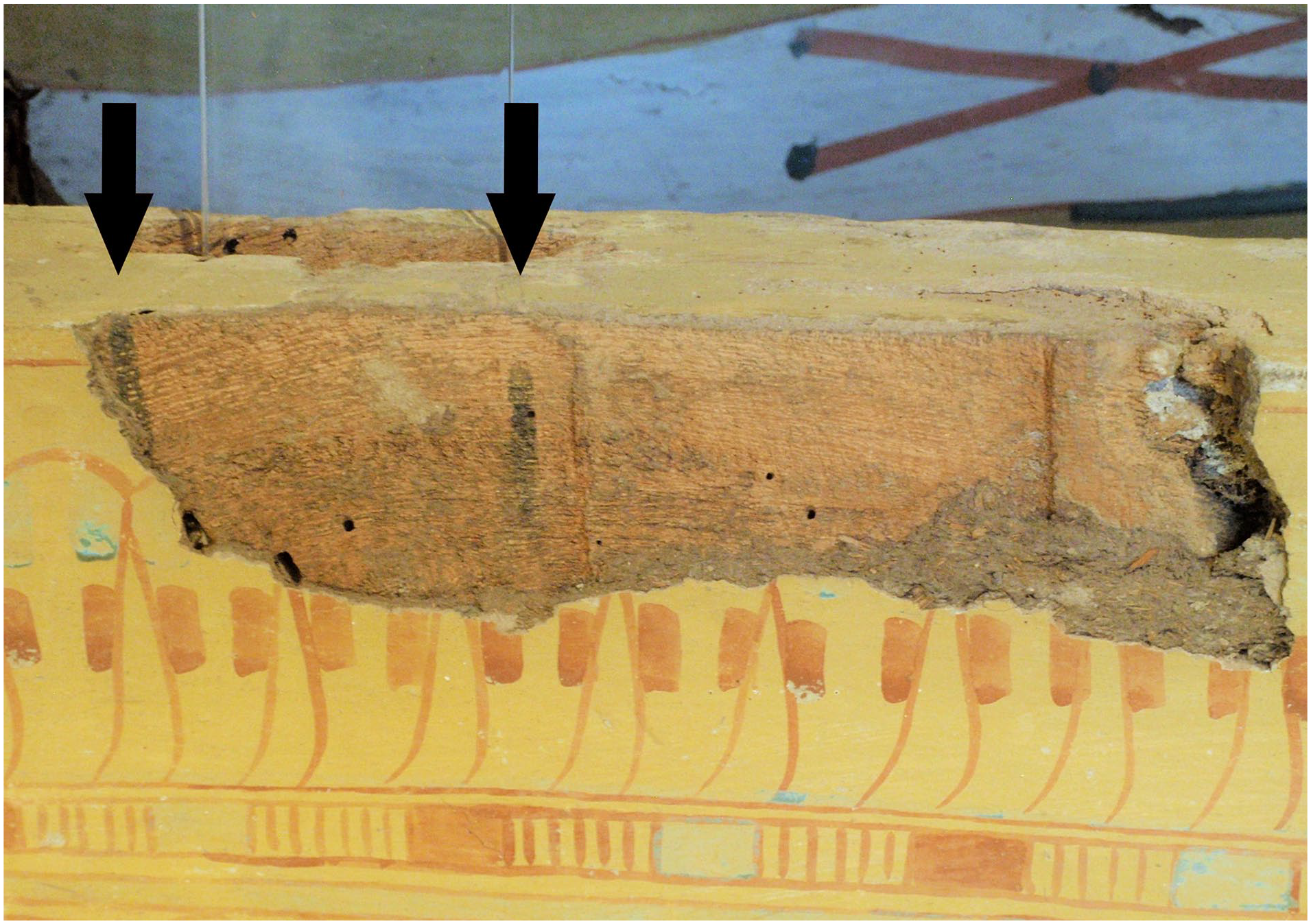
Detail of the coffin box: the black arrows indicate two black lines marking the correct position for the groove for the closing mechanism of the coffin (photo: author).
The closing mechanism of the coffin is noteworthy. Even if the mortise-and-tenon method is the classic one, 12 with four grooves carved on each side in the thickness of the box, it is unusual that the round transversal holes for the insertion of cylindrical pegs (which locked the tenons in place once the coffin was closed) are entirely missing. 13
After all the pieces were assembled, the painted decoration was applied over a layer of stucco made from Nile mud mixed with straw, which was spread on the coffin to even out the surface, and which in turn was covered by a thin layer of white gesso.
The coffin lid was painted only on its external surface (the interior shows traces of the mud stucco that filled in some gaps), though the external surfaces corresponding to the soles of the feet on both lid and box bear no trace of decoration. As far as the box is concerned, while it is not possible to say anything about the exterior of the bottom (which is now covered by the modern planks), 14 the rest is painted both inside and out. The colours used are peculiar: yellow for the background, red for the first outline of figures, then blue and green for filling in some details, and then white and black for other parts and final outlines. 15 The outer decoration is far more simplified, in terms of colours, than the internal one, but a common characteristic is the general horror vacui: small figures and single hieroglyphic signs cover the background to avoid leaving any empty space.
The lid (figs 2–3)
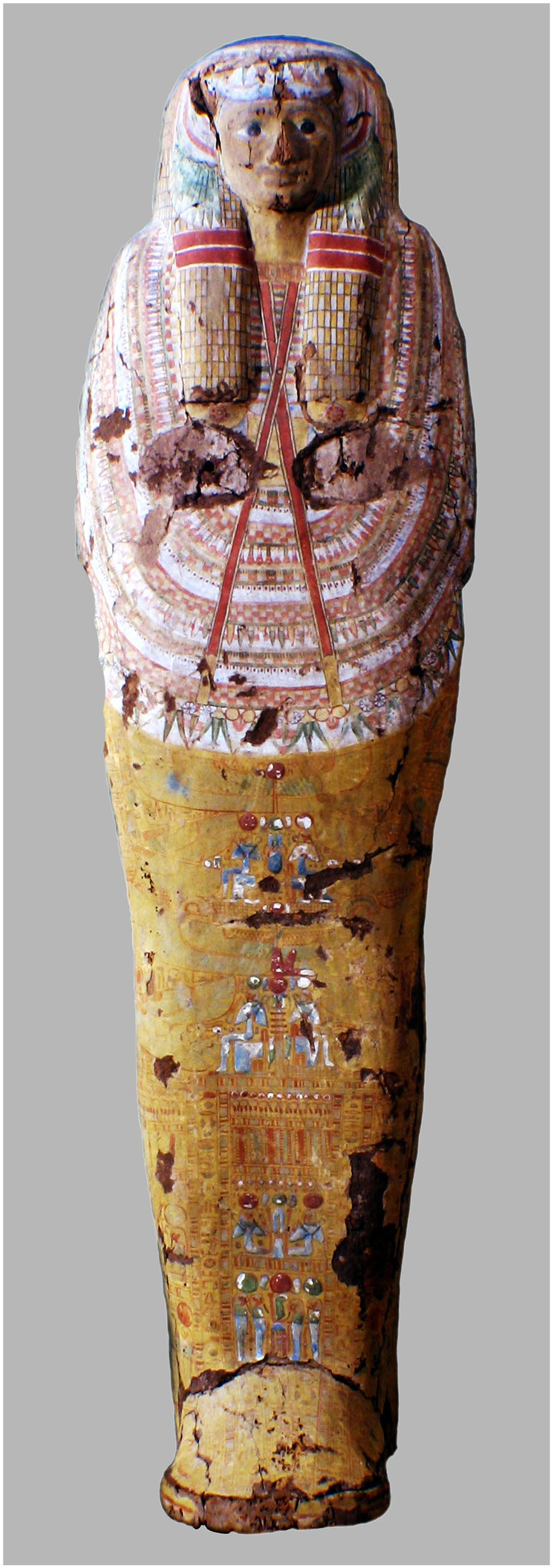
The lid of coffin E4 of the Antiquities Museum in Trieste (photo: courtesy of Antiquities Museum, Trieste).
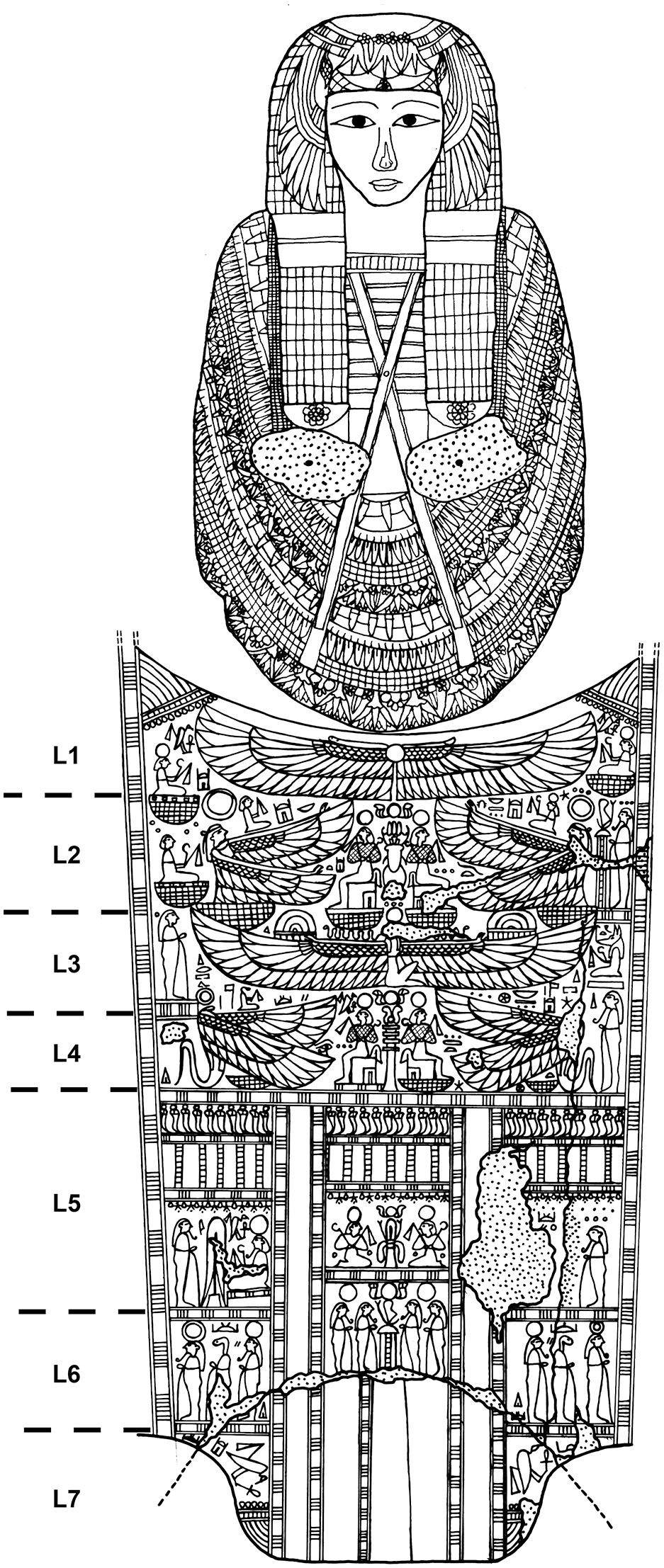
Decorative scheme of the lid of coffin E4 (drawing: author).
The lid represents the deceased as a mummy. The face is yellow, with the tip of the nose now broken; there is no hole for the insertion of an Osirian beard under the chin. The ears are hidden behind the lappets of the tripartite wig, which is decorated by a headdress composed of a garland of lotus flowers and two vulture wings on the sides. Directly under the wig, the breasts are visible in the form of two yellow semi-circles with red and blue rosettes in the centre. Between the lappets, instead, there is a geometrical motif indicating that the deceased is wearing a broad collar, on top of which there are the so-called ‘mummy braces’.
The rest of the chest and the belly are covered in a motif representing an array of vegetal garlands. On top of them, there used to be the hands, made with separate pieces of wood but now lost.
The lower part of the lid is divided into horizontal registers (L1 to L7) showing:
L1: A winged sun disk, 16 flanked by a vulture holding an ʿnkh and an Osirian figure sitting on a neb-sign on each side, all facing the centre;
L2: A central scarab with an atef crown, between two figures of Osiris sitting on a throne and facing outwards; on each side there is a winged goddess and, behind them, two Osirian figures (one standing and the other sitting), all facing the centre; an imentet symbol accompanies the standing Osirian figure;
L3: A kneeling winged goddess extending her wings and facing right, flanked by an Osirian figure to the left and a kneeling jackal-headed deity on the right;
L4: A central djed-pillar, between two figures of Osiris sitting on a throne and facing outwards; on each side there is a winged cobra facing the centre; on the right-hand side there is also a standing Osirian figure.
Under a frieze of uraei covering the whole width of the lid, each register is divided into three squares by columns of hieroglyphs (discussed below):
L5: The central square shows a tjet symbol flanked by two kneeling Osirian figures facing the centre; the scene in the square on the left depicts two Osirian figures, one standing and one sitting, that face an imy-wt symbol in the centre; the square on the right probably bore a mirroring image, but is now badly damaged;
L6: At the centre there is an imentet symbol, flanked on each side by two standing Osirian figures facing the centre; the side squares have a symmetrical scene, each with three standing funerary deities (the central one has a snake head);
L7: The feet portion is almost entirely covered in hieroglyphs (see below), but in the outmost corners there are two images of a vulture holding a flail.
The external surfaces of the box
The external sides of the coffin box are decorated by a frieze of uraei at the top, while the rest is divided into panels (B1 to B14) alternating with columns of hieroglyphs whose texts do not seem to have any connection to the scenes (T6 to T21, discussed below). The decoration of the left side of the box (figs 4–5) runs as follows: B1: A winged scarab with an atef crown holds in its front paws a solar disk; the lower part of the scene is hardly readable, but it looks like the scarab is standing on a chequered neb-sign; B2: Two standing Osirian figures alternating with the symbols of East and West, plus some filling hieroglyphs, under a geometrical decorative motif; B3: Framed by a motif that recalls the per-nw chapel, there is an imy-wt symbol at the centre, with a standing Osirian figure and the symbol of the West to the left and a kneeling Osirian figure to the right; B4: A central Abydos fetish, flanked by two couples of kneeling Osirian figures: the upper ones rest on neb-signs and face outwards, while the lower ones both face right; B5: A central tjet symbol, flanked by two standing Osirian figures facing outwards and by the symbols for East (to the right) and West (to the left); B6: A central crowned scarab, flanked on each side by a sitting Osiris facing outwards, an imy-wt symbol and a standing Osirian figure facing the centre; B7: Three Osirian figures (two standing and one sitting) with their backs to a funerary chapel. The decoration of the right side (figs 6–7) includes: B8: The scene is damaged, but there are three djed-pillars and a tjet symbol in the upper part, while in the lower one there seems to be a standing Osirian figure facing left, a per-nw chapel, and other symbols; B9: Under a geometrical decorative frieze, there is an imy-wt symbol at the centre, with a standing Osirian figure to the left and a sitting Osirian figure to the right; both figures face the centre; B10: Framed by a motif that recalls the per-nw chapel, an imy-wt symbol stands at the centre, with a sitting Osirian figure to the left and two standing Osirian figures to the right; all figures face the centre, where the imy-wt symbol is; B11: A central tjet symbol with a solar disk on top is flanked on each side by two standing Osirian figures facing outwards; under the whole scene there is a neb-sign, while directly above each couple of Osirian figures there is a semicircular decorative element with concentric lines: although in other instances it can be identified with the roof of the per-nw chapel, here it might be the symbol of the primeval hill;
17
B12: A central Abydos fetish, flanked on each side by a standing Osirian figure facing a symbol of the West; B13: A symbol of the West at the centre, flanked by two sitting figures of Osiris facing outwards, plus, to the right, a standing Osirian figure facing left, which makes this elongated scene asymmetrical; B14: A geometrical pattern of wavy lines alternating with dots symbolises the rocks of the mountains where tombs were cut.
18
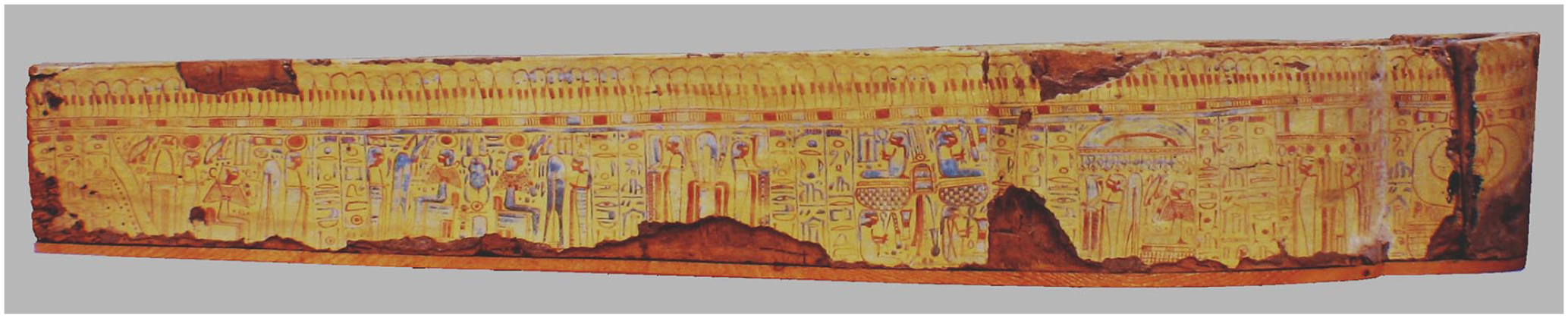
The left side of the coffin box (photo: courtesy of Antiquities Museum, Trieste).

Decorative scheme of the left side of the coffin box (drawing: author).
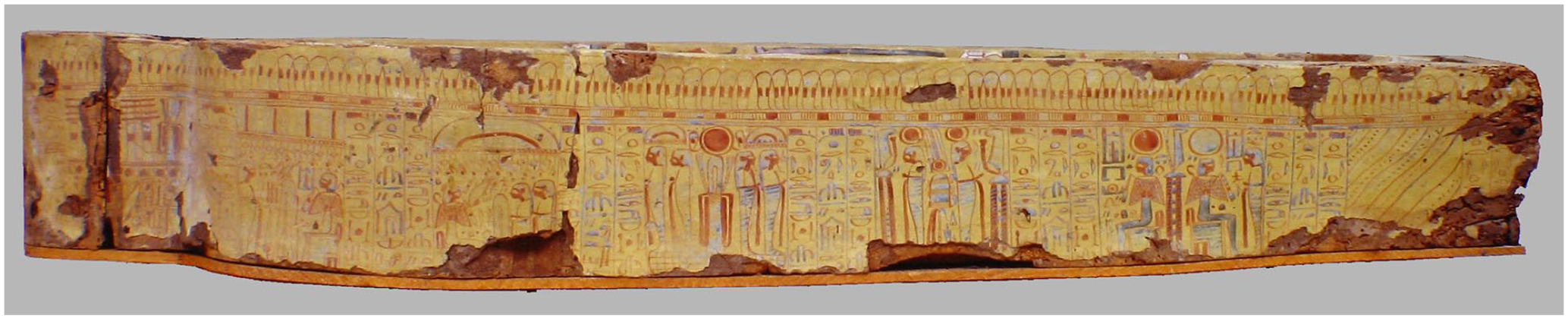
The right side of the coffin box (photo: courtesy of Antiquities Museum, Trieste).
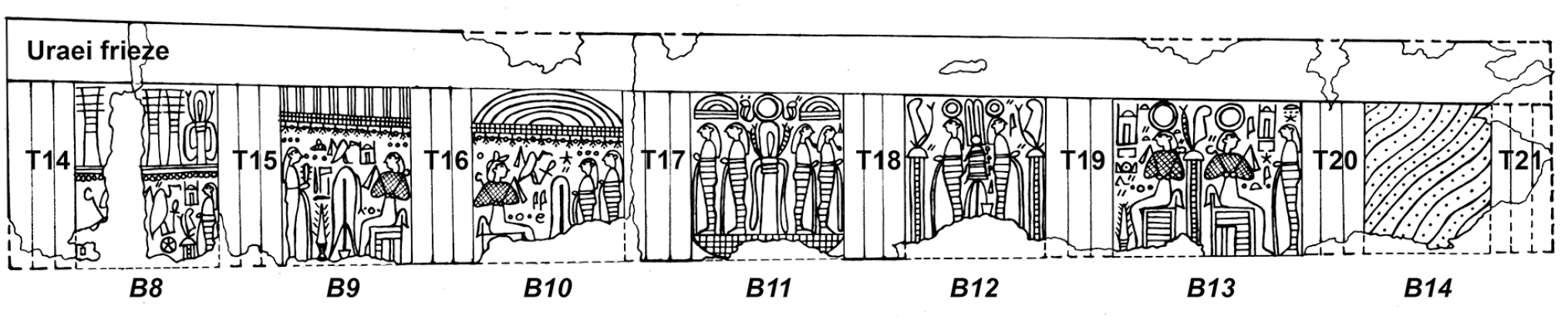
Decorative scheme of the right side of the coffin box (drawing: author).
The interior of the box (figs 8–9)
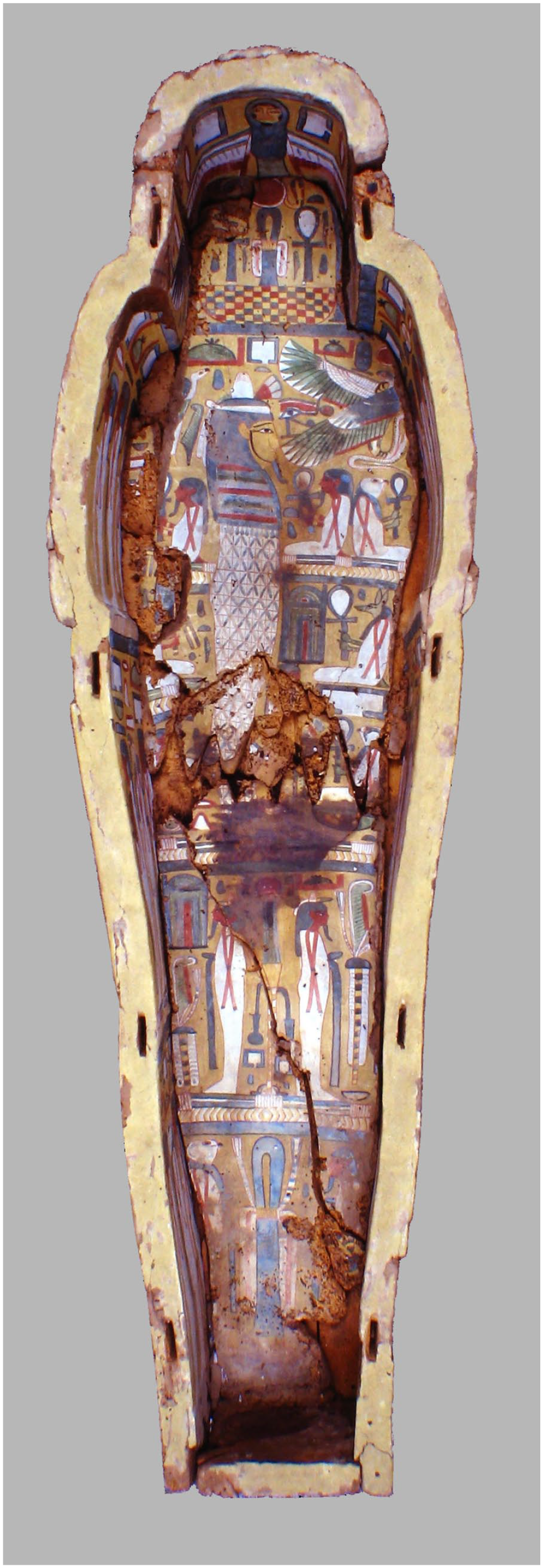
The interior decoration of the box (photo: courtesy of Antiquities Museum, Trieste).
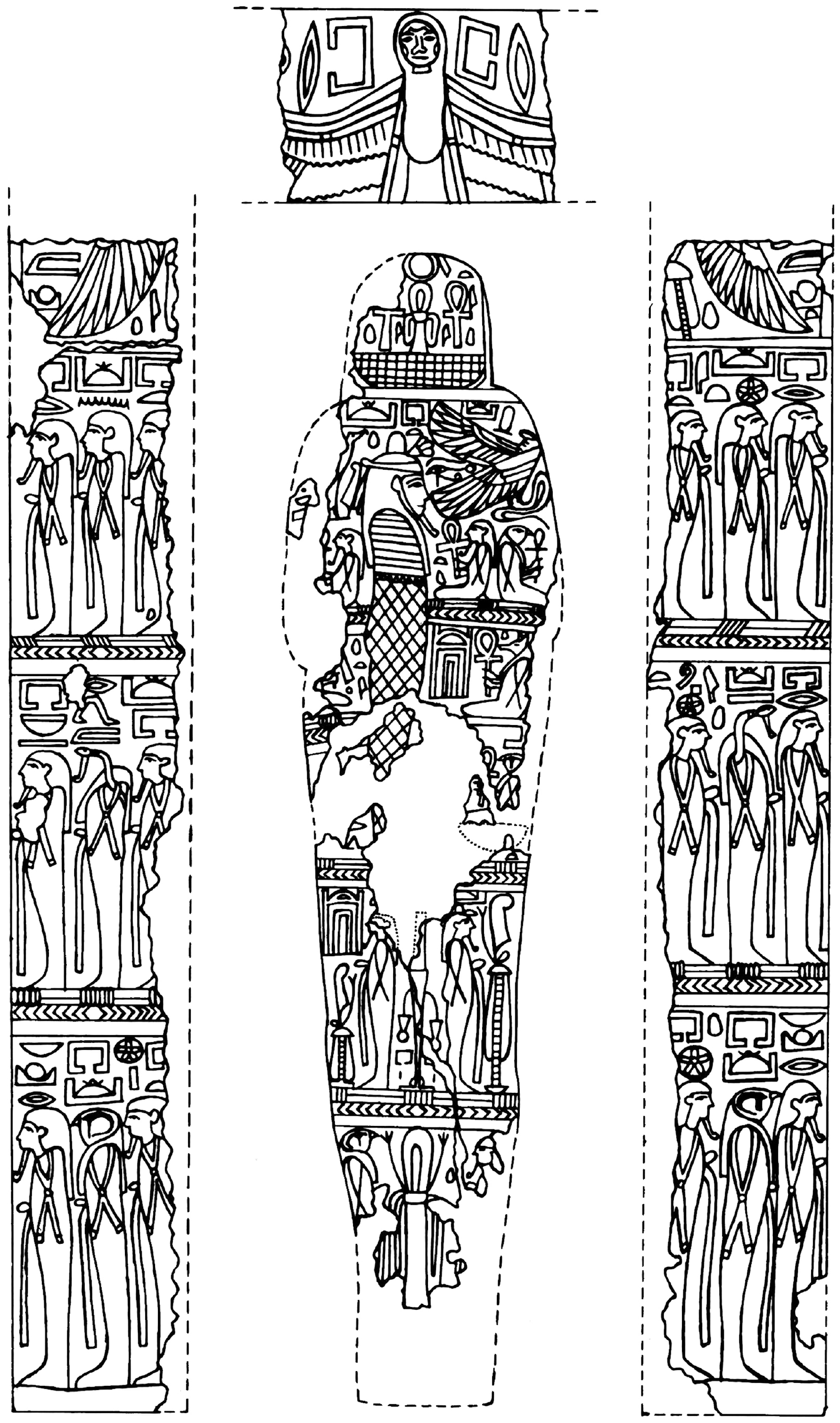
Decorative scheme of the interior of the coffin box (drawing: author).
The entirety of the interior of the coffin box has painted decoration, except for the foot board. The polychromy is more accentuated than on the external surfaces: black, white, and light blue pigments are used in addition to the yellow background and the usual red, blue, and green ones. Colours are also better preserved here.
The internal sides of the coffin box bear a symmetrical decoration. At the top, where the head of the mummy lay, there is a figure of the ba with extended wings. Its appearance is rather peculiar due to its face, portrayed frontally, and a sort of hood around the head. Above each wing there is a short hieroglyphic text reading pr m ȝḫ.t ‘The one who exits to the horizon’, a text that appears with small variants on all sides, as a filling motif. On each side, then, there are three superimposed groups of three funerary deities each: the uppermost group has human heads, whereas the central and lower ones have the central deity with a snake and a falcon head respectively. All of them have red mummy braces and face the external edge of the coffin box; above each group there is the sign for ‘sky’ and below a reed mat is depicted. Each register is filled, above the deities’ heads, with pseudo-inscriptions.
The bottom of the coffin shows, from the top: a tjet and two ankh symbols, separated from the rest of the decoration by a large, chequered neb-sign; a large image of a mummified figure with a perfumed cone and a flower on its head, a white band on its forehead, and the ritual beard at its chin. The body is decorated by a motif of blue lozenges on a white background, while the area of the shoulders shows a pattern of red and blue horizontal stripes, terminating with a line of drop-like blue elements, like some sort of collar. The empty spaces around this figure are filled by a winged cobra and several kneeling funerary deities, some of which have a falcon or a jackal head. Other images, such as the vulture and the per-nw chapel, are to be considered as filling motifs.
Further below, there is a fetish formed by a sekhem-sceptre with two menits. The fetish is flanked on each side by a standing Osirian figure and a symbol for the West. The last decorative register, rather damaged, shows a tjet symbol at the centre, flanked by two funerary deities: the one on the right has a human head, the one on the left is falcon-headed.
The inscriptions
The inscriptions on the lid of the coffin run as follows (see fig. 10 for their distribution): T1: ỉmȝḫy
19
ḫr Wsỉr nb ḥḥ ḫnty ʾImnt.t … pr … ỉmȝḫy ḫr ʾInpw ḫnty sḥ-nṯr tpy [ḏw=f or S.t-Mȝʿ.t] ‘The honoured one in front of Osiris, lord of eternity, foremost of the West, …who exits…the honoured one in front of Anubis, foremost of the divine hall, on top of [his mountain OR the Place of Truth]’; T2:
ỉmȝḫy ḫr Wsỉr nb ḥḥ ḫnty ʾImnt.t
‘The honoured one in front of Osiris, lord of eternity, foremost of the West’; T3:
ỉmȝḫy ḫr Wsỉr nb ḥḥ …
‘The honoured one in front of Osiris, lord of eternity, …’; T4:
ỉmȝḫy ḫr Wsỉr nb ḥḥ ḫnty ʾImnt.t
‘The honoured one in front of Osiris, lord of eternity, foremost of the West’; T5:
ỉmȝḫy ḫr Wsỉr nb
20
ḥḥ ḫnty ʾImnt.t pr-m-ȝḫt ỉmȝḫy ḫr … ḫnty sḥ-nṯr tpy S.t-[Mȝʿ.t] …
‘The honoured one in front of Osiris, lord of eternity, foremost of the West, the one who exits to the horizon.
21
The honoured one in front of [Anubis], foremost of the divine hall, on top of the Place [of Truth…]’.






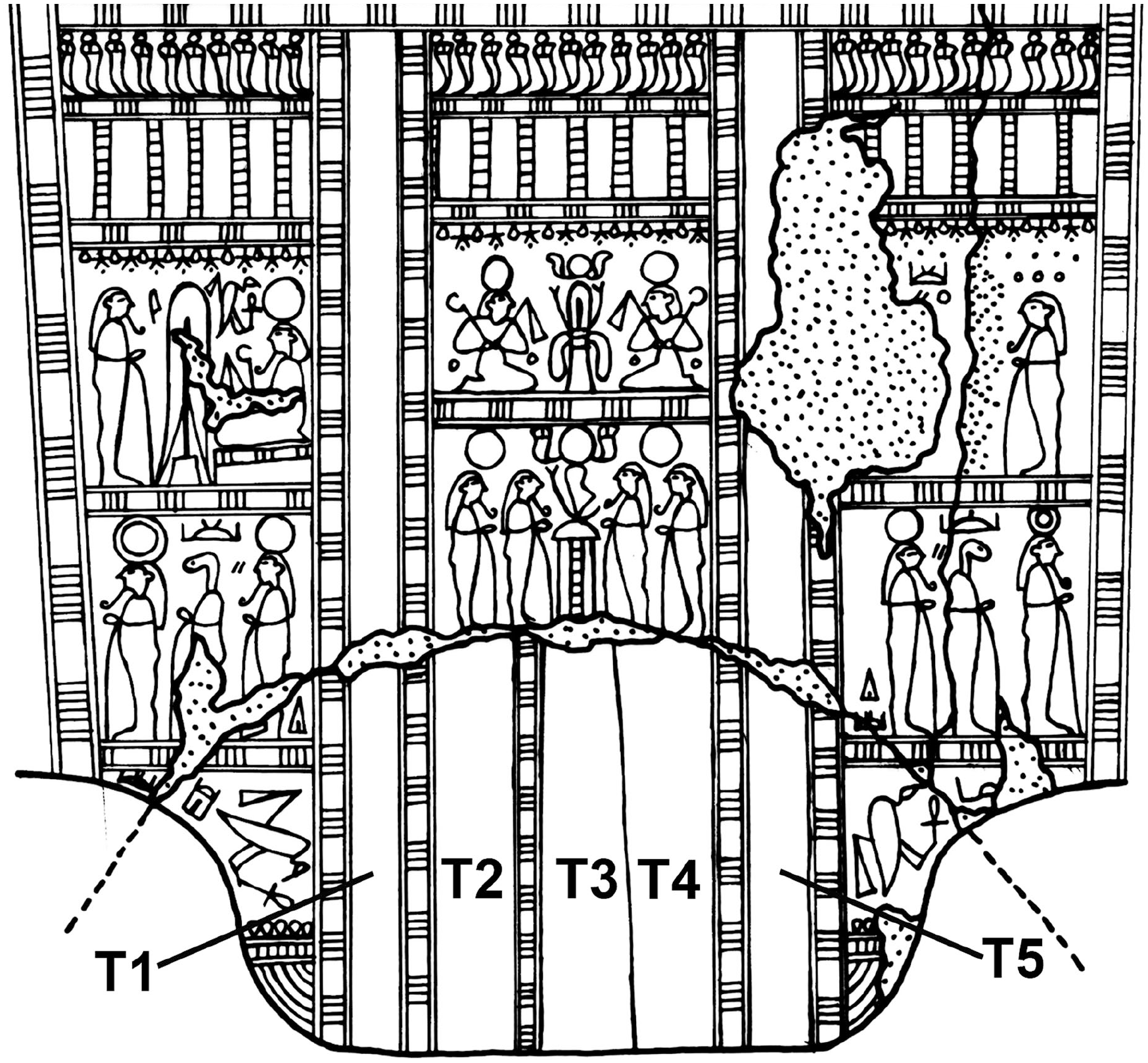
The position of the inscriptions on the lid (drawing: author).
The texts on the coffin box, arranged in groups of two or three columns, 22 repeat the same formulas with different arrangements. It is noteworthy that sometimes the text is interrupted before the logical end of the sentence, because the space for writing was finished. The formulas are:
a)  ỉmȝḫy ḫr ʾInpw ḫnty sḥ-nṯr tpy n
‘The honoured one in front of Anubis, foremost of the divine hall, who is on top of’;
b)  ỉmȝḫy ḫr Wsỉr nb ḥḥ ḫnty
‘The honoured one in front of Osiris, lord of eternity, foremost of’;
c)  ỉmȝḫy ḫr
23
… (text missing because of wood damage)
ỉmȝḫy ḫr
23
… (text missing because of wood damage)
‘The honoured one in front of…’;
d)  ỉmȝḫy (ḫr) ʾInpw ḫnty pr-m-ȝḫ.t
‘The honoured one (in front of) Anubis, foremost of who exits to the horizon’;
e)  ỉmȝḫy ḫr ḫnty sḥ-nṯr … (some text missing)
‘The honoured one in front of the foremost of the divine hall …’;
f)  ỉmȝḫy ḫr pr-m-ȝḫ.t …
‘The honoured one in front of the one who exits to the horizon’;
g)  ỉmȝḫy ḫr ḫnty ʾImnt.t n
‘The honoured one in front of the foremost of the West of’.
The formulas’ sequence for each text is as follows. On the left side of the coffin: T6 is too damaged and therefore unreadable; T7 has a and b; T8 has b-a-b; T9 has b-c-b; T10 has d-e-b; T11 has a-b; T12 has f-b; T13 has b-a and the third column is unreadable. On the right side: T14, T15, and T16 all have b-a-b; T17 has b-g-b; T18, T19, and T20 all again have b-a-b; T21 is too damaged to be read.
As can be noticed from this overview on the texts, the name of the coffin owner is nowhere to be found, nor there is any space left blank for its insertion. Any possible clues to the owner’s identity, therefore, must be deduced from the study of the coffin itself.
Discussion
The Egyptian collection of Trieste was, for the most part, the fruit of the vast commercial network that the city (the main seaport of the Habsburg Empire) enjoyed during the late eighteenth and nineteenth centuries. 24 In particular, coffin E4 was recorded as having been presented to the Natural History Museum by Greek merchants Ciriaco and Anastasio Vardacca and Stamati Zizinia on 25 April 1867. 25 It was only in 2004 that the coffin officially entered the Antiquities Museum collections. 26 However, this early arrival in a European city has a negative bearing on the matter of the original provenance. As often happened with donations made to museums at that time, the coffin was simply recorded as being ‘from Egypt’, with no further information on the specific place and date of acquisition. 27 The names of the tradesmen involved have unfortunately not led to any discovery in this direction.
Therefore, information about provenance and dating must be drawn from an analysis of the coffin itself. The first aspects that need to be taken into account are the style and quality of the decoration. Due to the yellow background of its decoration, the coffin can clearly be attributed to the production of the Third Intermediate Period, but the presence of the mummy braces on the lid indicates that it is part of the group of so-called ‘stola coffins’. 28 However, other features make this coffin peculiar; therefore, the parallels that will be taken into account will not be restricted to this type of coffin.
First of all, the quality of the decoration is rather low, at least on the exterior. Apart from the aforementioned horror vacui, 29 the figures are noticeably stylised, not only in the colour palette but also in their design. This simplification on the one hand contrasts with the care with which the internal decoration was carried out, 30 and on the other is paralleled by the choice of scenes and texts that are painted on the coffin. These are generic and repetitive, and do not show any obvious link to the Book of the Dead or other funerary texts used at that time. ‘Classical’ scenes like the creation of the world, the hours of the night, or the weighing of the heart are entirely missing.
This does not mean, however, that there was no planning of the decoration. There is a certain symmetry in the scenes on the sides of the box: B2 and B3 are surmounted by the same decorative elements that also appear above B9 and B10, respectively. The others have the same arrangements of divine figures around a central element, which is usually a symbol of Osiris on one side and a symbol of Isis on the other (alternating, so that on each side of the box both symbols appear, but in different orders). The same principle of symmetry is also visible on the lid, where the decoration develops around a central vertical axis.
On the basis of the typology established for this type of material by Andrzej Niwiński, 31 the decoration is coherent with a dating to the end of the 21st or beginning of the 22nd Dynasty: the lid of coffin E4 can be ascribed to Niwiński’s type V, 32 the external decoration of the box to the late phase of his type B, 33 and the internal decoration to his type 4. 34 All of these types are attributed by Niwiński, as a matter of fact, to the period of transition between the 21st and the 22nd Dynasties. A more detailed analysis of the decorative patterns on this type of coffin is made by René van Walsem. 35 According to van Walsem’s classification, the lid of coffin E4 is of type I2Ba, 36 the outer decoration of the box does not find a perfect match but is close to type Ib, 37 the box floor-board is of type IIa, 38 and the box inner sides belong to type Ia. 39 As the author does not provide an absolute chronology for the evolution of his types, 40 the only chronological criteria are relative: ‘six, instead of eight slots for tenons fastening the lid is a criterion of the late phase’, 41 and jasmine flowers and a vulture headdress are later in the sequence. 42 Trieste coffin E4 has the jasmine flowers and vulture headdress, but also has eight slots for the tenons, thus eliminating any possibility of narrowing down the dating interval.
Other details of the decoration, which are not very common and were not considered by Niwiński, also concur to confirm the dating without further clarifying it: the ‘hooded’ frontal ba-bird is also found on a number of other coffins, 43 and in particular on Cairo coffin CG 6074, 44 on Vienna coffin ÄS 6265, 45 on Turin coffins CGT 10114, 10115, 10116.b, 46 and on the Cleveland coffin 1914.714.a–b. 47 In particular, the three coffins in Turin also show a distinctive similarity to Trieste coffin E4 in terms of the scenes depicted on the outer and inner sides of the box (although on the inside of the Turin coffins the background is red and not yellow). Niwiński attributes these coffins to the same workshop, active in the second half of the 21st Dynasty. Given the low quality of coffin CGT 10116.b, comparable with that of coffin E4, it is tempting to insert the latter among the works of the very same workshop.
Another aspect of the decoration overlooked in Niwiński (1988), but well studied in van Walsem (1997), is the upper part of the lid, with the face, hands, and collar/garland of flowers. The closest parallels with the specimen in Trieste are a coffin in Berlin (no. 9679 48 ) and Iamut’s coffin in Bristol (inv. no. H.4633 49 ). Both present the same pattern of the wig with the vulture headdress and no visible ears, red mummy braces over the broad collar, and female breasts depicted directly under the wig’s lappets. Apart from once again confirming the date of the coffin (all these examples are also dated to the 21st–22nd Dynasty), they confirm that the coffin was destined for a female owner, 50 who unfortunately remains nameless since her name does not appear in the inscriptions. 51
The unique characteristic of the Trieste coffin is the large mummiform figure depicted on the bottom of the coffin box. 52 Given the presence of the perfumed cone and flower on the head, the divine beard, and the absence of any other attribute, there is no other choice than to identify this figure with that of the mummy of the deceased. The beard furthermore seems to suggest that this is a male figure instead of a female one. In the catalogue of the Third Intermediate Period coffins of the Museo Gregoriano Egizio in the Vatican, A. Gasse states that, when such a large figure appears, it is always a deity or a divinised pharaoh. 53 They are usually easily recognised thanks to the crowns, sceptres, and other insignia they are holding. On the other hand, Niwiński does not even mention what these large mummiform figures represent in the part of his study devoted to the internal decoration of coffins. 54 The only known parallel for such a figure on a yellow coffin is the bottom of a coffin box now held in the Historisches und Völkerskundemuseum St. Gallen in Switzerland (inv. no. C 3530 55 ), but with the difference that, according to the colleagues who examined it, the figure seems to be holding a sceptre in front of him, making him clearly a representation of the deceased that has been assimilated with the god Osiris. 56 Nevertheless, such an assimilation can be ruled out for the figure on the Trieste coffin, since the hands are not even shown. Then why was this figure represented this way? In view of the overall carelessness of the decoration, especially concerning the religious and ritual value of the images and texts, the author thinks that this might be a simplification made by the artist (here intended merely as the person or group of people who carried out the painted decoration), probably due to a misunderstanding of the meaning of the same type of figure as seen on coffins made by others.
The same sloppiness is even more evident in the inscriptions. As noted above, the sentences are often interrupted before having logical sense, 57 the formulas are extremely repetitive, and there are spelling mistakes. This insistent use of the ỉmȝḫy ḫr formula does not find any parallel, 58 whereas the absence of the owner’s name (or even of a blank space for inserting it later) is not a new thing. 59
Among the closer parallels for the inscriptions, one can notice that the type of inscriptions on coffin E4 roughly coincides, in terms of extension and repetition of formulas, with the box of coffin 51.2096/2 in Budapest. 60 There, however, the orthography and quality of the hand are clearly superior to the specimen of Trieste. Another parallel is the box of Amenhotep’s coffin in Museo Gregoriano Egizio (inv. no. 25 003.2.2 61 ): even though the level of detail and accuracy of tracing are far better than those in coffin E4, they have in common the fact that the imakhy-sign (Gardiner’s F39 62 ) is written facing both right or left, with no connection whatsoever to the direction of the rest of the text. This happens both for aesthetical purposes and because, at this stage, the texts had no meaning anymore for the people who painted them on coffins, therefore suggesting a workshop where a professional scribe was not available or was employed only for special commissions.
Conclusions
On the basis of the above discussion, it is possible to draw some conclusions concerning coffin E4 in the Antiquities Museum of Trieste. In the first place, all its stylistic and typological elements confirm that it can be confidently dated to a period between the end of the 21st and the beginning of the 22nd Dynasty (c. 1030–890 BC). Secondly, it is now sure that the coffin was supposed to be owned by a woman. In addition, a great number of coffins of the ‘yellow’ type for which the exact provenance is known come from the Theban necropolis and – for the most part – from the two cachettes of Deir el-Bahari that were discovered close to Hatshepsut’s temple, 63 and these coffins all belong either to members of the royal family of the time or to priests and priestesses of the god Amun. Yellow coffins have also been found in Akhmim, 64 so it is likely that the coffin under examination here originally came from somewhere in Upper Egypt and perhaps belonged to a priestess of Amun, probably not of very high status due to the limited quality of the coffin itself.
This latter aspect calls for some explanation. It has been repeatedly underlined that the texts and scenes are extremely generic in their content and rather sloppy in their execution. Even the unique image of the mummified deceased on the interior of the box can be explained as a simplification made by an artist who did not understand the meaning of the image and/or was unable for some reason to replicate the complex details of other divine figures otherwise attested.
Keeping this in mind, it is worth remembering that some of the closest parallels for coffin E4 are the coffins CGT 10114, 10115, and 10116.b in Turin (see above), which have all been attributed to the same Theban workshop. In particular, coffin CGT 10115, though of better quality, shows the same rare closing mechanism as coffin E4, while coffin CGT 10116.b is of lower quality than the other two, but still slightly better than the example in Trieste. There will, of course, never be absolute certainty that these coffins were made by the same people, but nonetheless it is possible to suggest something about the way funerary workshops organised their labour. The most skilled artisans worked on the most expensive coffins and perhaps other items of funerary furniture – that is, the ones which were expressly commissioned by the highest-ranking people before their death. The less experienced ones, instead, were given routine work, sequential – and nameless – production that still served a purpose: these rather crude coffins were probably cheaper than the most beautiful ones and, if kept at the ready, could be bought if a person died a sudden and unexpected death.
This view is in accordance with the common sense showed by the ancient Egyptians in other fields of their life and proves once more that what is considered as a given (that is, the practice that every rich person had a ‘made to measure’ coffin and funerary equipment) must always be checked against the facts that can be deduced from the surviving artefacts of this great civilisation.
Footnotes
Acknowledgements
My gratitude goes to Dr Marzia Vidulli, curator of the Antiquities Museum, who granted me unrestricted access to the Egyptian collection and rewarded me with a great friendship. I would also like to thank the two reviewers and the editors of my paper for giving me the opportunity to improve it. Any remaining mistakes are, of course, my sole responsibility.
Funding
The author did not receive funding for this project.
1.
The coffin has always contained a non-pertinent mummified male, who is inventoried under the same number but will not be included in this contribution.
2.
Claudia Dolzani (Trieste, 1911–1997) studied at the University of Florence, where she studied Egyptology with the renowned Italian Egyptologist Giuseppe Botti. She then qualified for university teaching and started teaching Egyptology at the University of Trieste. Her courses lasted until 1981. She specialised in the study of Egyptian Museum collections and her work on the canopic jars of the Egyptian Museum in Turin ( ) is still considered a reference work on the subject.
4.
Dolzani 1953 and .
6.
Crevatin 2001; Crevatin 2002/03; Crevatin 2006: 144–145; Crevatin 2007: 50–52; /13: 138–146.
9.
The conditions described here were already documented in 2010, when the author first had the chance to personally observe the coffin. Since no official conservation intervention has ever been recorded since the accession of the coffin, it is possible to suppose that the damage happened in ancient times or very soon after the arrival of this artefact in Trieste, a period to which one could ascribe the clumsy repair of the bottom.
10.
Niwiński 1988: 57–64; Nicola 1986; .
11.
Nicola 1986: 36; : 186.
13.
Even though instances are known where the presence of the cylindrical pegs was masked by means either of retouches to the decoration (Niwiński 1988: 63 para. 58) or by the original decoration itself, applied once the coffin was definitively sealed (Nicola 1986: 32), this can be ruled out in the case of coffin E4. A lacuna in the decoration in correspondence with one of the mortises in the coffin box proves beyond doubt that the lid was not locked in place by cylindrical pegs at all. A parallel for this rare occurrence is coffin CGT 10115 of the Museo Egizio in Turin (: 203–204), which presents many other similarities to the coffin under examination here (see below).
14.
15.
Even though Niwiński (Niwiński 1988: 60–62, 65 in particular) states that only two shades of blue were used (one darker and one lighter) and that these look green because they are on a yellow background, at least in the case of coffin lid EA35287 of the British Museum (which is very similar to the lid of coffin E4), this is not true. Recent analyses proved that the blue shade is actually Egyptian Blue, while the green shade is definitely a green pigment obtained through a mixture of Egyptian Blue and orpiment (: 83–84). Only a chemical analysis would determine beyond doubt the nature of the pigments on coffin E4, but since no conservation or scientific research (like CT scans, for example) has ever been done on it, there are no data available on this or other aspects, which will, therefore, not be debated here.
16.
It is worth noting that the solar disks on the central part of the coffin lid are all executed in relief with the pastillage technique (Niwiński 1988: 62; : 187).
17.
Compare, in this respect, Englund 1974: 44 fig. 4, 52 .
18.
Compare the motif of the hill in scene B7 with the funerary chapel and Englund 1974: 48 , 49–50.
19.
Throughout the texts on this coffin, the expression imȝḫy ḫr is always written redundantly. Such a redundancy of signs can be explained either with a demotic sample from which the inscriptions were copied or by the ignorance of the hieroglyphic script by the person (or persons) who painted the decoration.
20.
Notice that the nb sign for ‘lord’ has been here erroneously replaced by the painter with the mn sign.
22.
Only T6 is made up of one column only.
23.
Here the r sign has been erroneously depicted as a pr sign.
25.
26.
This fact is also reflected in the unusual inventory number: whereas all the objects belonging to the Antiquities Museum have a completely numerical inventory number, the Egyptian objects transferred in 2004 are labelled with a capital E standing for ‘Egypt’ and a consecutive number from 1 to 6. There were, indeed, only six Egyptian objects left at the Natural History Museum: coffin E4, another wooden coffin with a mummified individual and its cartonnage (inv. no. E1), two mummified crocodiles (inv. nos E2 and E3), a Ptolemaic cartonnage funerary pectoral (inv. no. E5), and a Roman linen funerary mask (inv. no. E6).
28.
30.
40.
This is because his volume is only the first part in a two-part study, whose second part would have dealt with inscriptions and prosopography of the stola corpus (: xv). Unfortunately, the second part of his study (which would have contained the discussion about chronology) seems never to have been published.
43.
A frontal and ‘hooded’ figure of a ba-bird inside a coffin head-board is not a very common feature. Out of the 129 coffins included by van Walsem in his corpus of stola coffins, only thirteen are listed as having a frontal figure of the ba-bird, making up only 10% of the whole (see van Walsem 1997: 270, nn. 824 and 825; in reality, his coffin Cr 2 also has a frontal ba-bird, but he does not mention it; for this see Babraj and Szymanska 2000: 55–60). If we enlarge the sample to the rest of the yellow coffins, the percentage is difficult to calculate because Niwinski 1988 does not provide this information for the coffins he examined, but if we consider the catalogues listed in the bibliography of the present paper, the percentage seems to increase but never reaches the majority: for example, in the Catalogue of Third Intermediate Period coffins of the Egyptian Museum in Turin (Niwinski 2004) there appear four coffin boxes that have a frontal ba-bird out of a total of fourteen boxes (28.5%); in the catalogue of the Museo Gregoriano Egizio (Gasse 1996), out of eleven coffin boxes only one has a frontal ba-bird (9%); and, lastly, in Vienna (), there are only five coffin boxes, of which one has a falcon, another one has a frontal ba-bird, and three have a ba-bird with its head in profile (for our statistic, the percentage becomes 20%).
48.
Schmidt 1919: 144 no. 730, corresponding to : 109 no. 31.
49.
Taylor 1989: 45 fig. 35 = : 112 no. 46.
50.
The vulture headdress, hidden ears, and female breasts, as well as hands with outstretched fingers (in this case missing), are common gender markers for female coffins during the Third Intermediate Period.
51.
52.
Since in some cases, like in the Naples catalogue (Napoli 1989: 186–188) and in the catalogue entry on Pentahutres’ coffin in the Státní zámek of Kynžvart (inv. no. 1986, : 56–93), the decoration of the bottom of the box was not described because the mummy had never been lifted, it is possible that the lack of parallels for this type of decoration is due simply to a gap in the documentation available. After all, the coffin in the St. Gallen Museum had already been studied by Niwiński, who was nonetheless unable to describe its internal decoration.
55.
Küffer and Siegmann 2007: 93–97 and, in particular, fig. 7 on p. 97 = : 168 no. 355.
56.
Küffer and Siegmann 2007: 97.
57.
58.
Even the coffin presently held in the Archaeological Museum of Bergamo (Italy), which shows an outstanding similarity in the hand who traced the scenes and the inscriptions with coffin E4 in Trieste, has a wider variety of formulae (mostly of the ḥtp-dỉ-nswt and ḏd-mdw in type). The coffin has recently been re-studied by Jonathan P. Elias and Sabina Malgora and the results are to be published shortly (Elias and Malgora, forthcoming). For images of the coffin in Bergamo, see the first publication (: 8–14).
63.
64.
See Germer, et al. 2009: 113–126.