




Abstract
The present paper aims to serve as an initial publication focusing on a collection of rock inscriptions situated in the north-eastern cliff, positioned above and to the right of the façade of the renowned Speos at Gebel el-Silsila. Its purpose is to offer a preliminary glimpse into a comprehensive compilation of rock inscriptions from the area, presently being prepared for publication. Within this paper, nineteen inscriptions are presented, predominantly comprising personal signatures. Some inscriptions also include naval and administrative titles dating back to the Middle Kingdom. Notably, inscription number 8 contains a date and references the royal name of Senusret I. These texts, however, suffer from significant erosion, resulting in poor preservation. It is important to note that no pictorial graffiti were documented on these specific panels. As this publication primarily focuses on the inscribed texts, the interpretation of their function and significance within the landscape remains limited at this stage.

Introduction
An initial survey of Gebel el-Silsila was conducted by Georges Legrain in the late 1890s during his tenure overseeing Upper Egypt’s monuments, which encompassed the Speos (the rock-cut temple) located on the west bank of the Nile. Legrain catalogued and numbered a significant portion of extant inscriptions and pictorial graffiti and declared his intent to create a detailed copy of the official texts and decorations and to subsequently prepare their publication. Regrettably, he did not fulfil this task. 1 Instead, the Speos remained unstudied until the 1950s when Ricardo Caminos conducted an epigraphic survey under the auspices of the Egypt Exploration Society (EES). 2 However, the comprehensive publication of the monument did not materialise until many years later, when Christina Thiem presented it in her doctoral thesis. 3 Nevertheless, neither Caminos nor Thiem paid attention to the interior or exterior graffiti, leading to the continued absence of publication for the current collection of texts.
In 2014, renewed interest in this enigmatic rock-cut temple and its epigraphy emerged when the Swedish Gebel el-Silsila Project, affiliated with Lund University, commenced a thorough re-documentation. Employing a combination of analogue and digital methodologies, the objective was to comprehensively document the Speos, encompassing its various temporal layers of activity and its current state of preservation. Utilising diverse digital applications, light adjustments, and photogrammetry techniques, the investigation revealed compelling findings. The study unveiled repurposed reliefs, indicating an earlier phase of the temple and its iconographic program. 4 Concurrently, the research team documented secondary epigraphy, including a series of poorly preserved and highly faded Ramesside dipinti discernible with the aid of D-stretch technology on the interior walls. Additionally, various incised textual and pictorial graffiti on the exterior surfaces were recorded, among them the texts listed below.
Location
The collection of nineteen rock inscriptions presented in this study constitutes a distinct series positioned in the upper right corner above the façade of the Speos, as illustrated in figure 1. In stark contrast to the refined and prepared surface of the temple façade, the cliff area housing these inscriptions remains in its natural, unworked state, exhibiting an inherent unevenness, as depicted in figures 2–3. Overall, these inscriptions suffer from poor preservation and partial illegibility, largely attributable to erosion. This degradation arises due to the Speos’ placement along a natural fissure-line, resulting in a wind tunnel effect that consistently transports sand particles, abrading the northern exterior of the temple and the surrounding natural cliff surfaces. Notably, inscriptions 6, 8, and 10 exhibit a relatively clearer and more legible state. An assessment of the inscription positions, particularly inscriptions 1–3, in conjunction with the surrounding landscape and the placement of rock inscriptions therein, suggests that the cliff likely inclined westwards, sloping towards the Nile, providing the artisan with a stable foundation during the incision process. 5
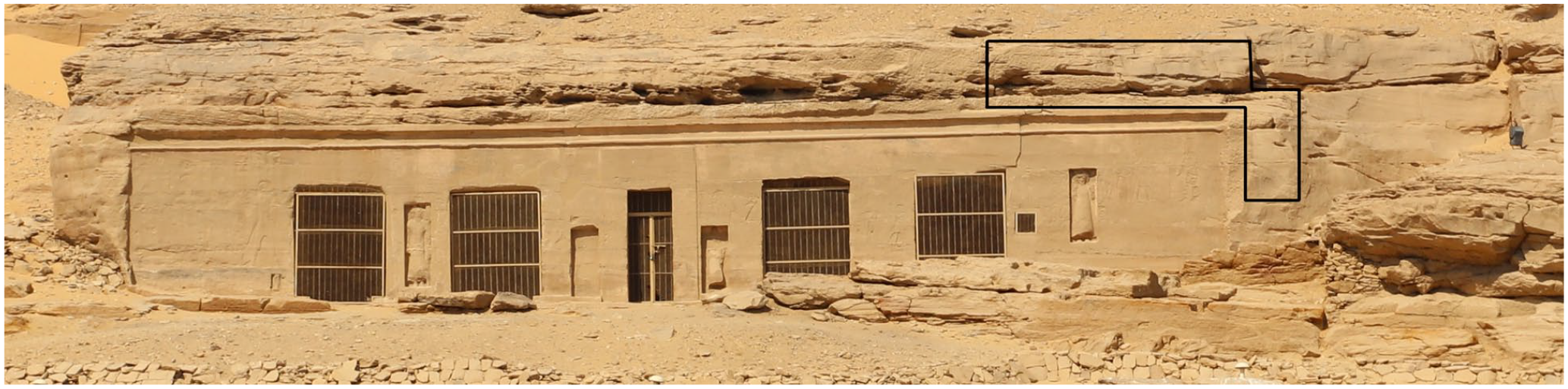
Façade of the New Kingdom Speos, the locations of the texts are enclosed (photo: Maria Nilsson).
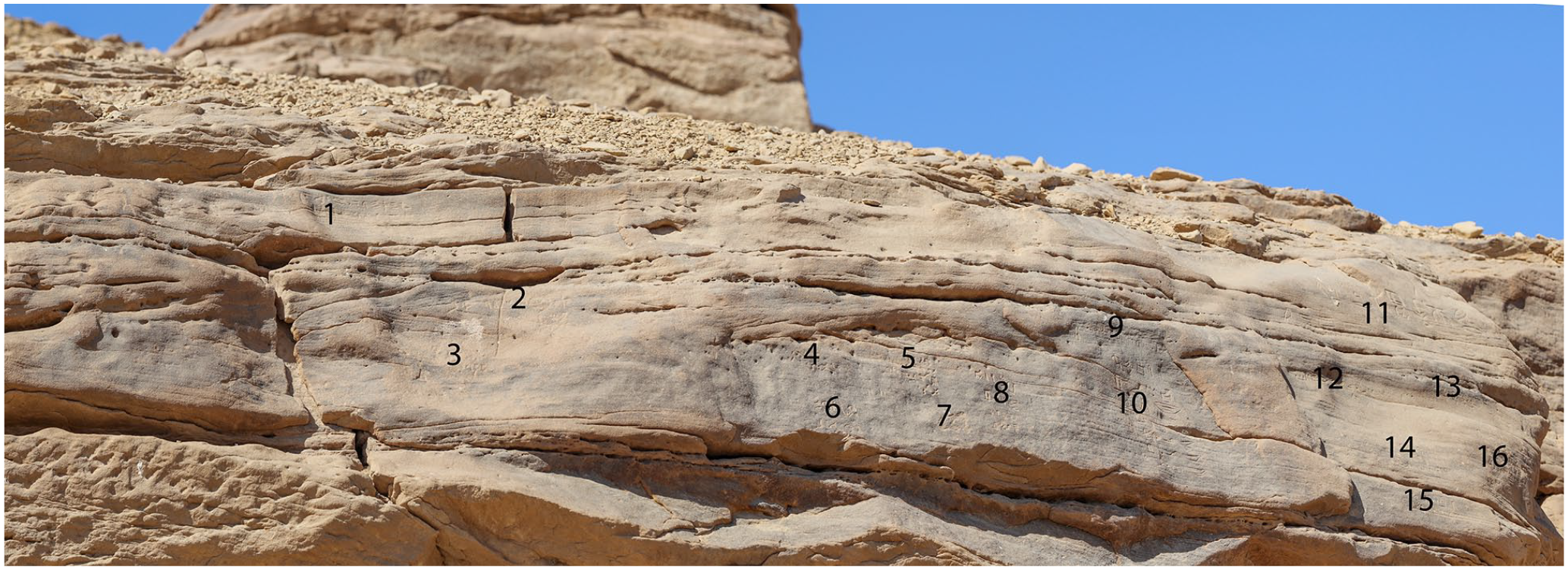
Upper panel, nos 1–16 (photo and editing: Maria Nilsson).
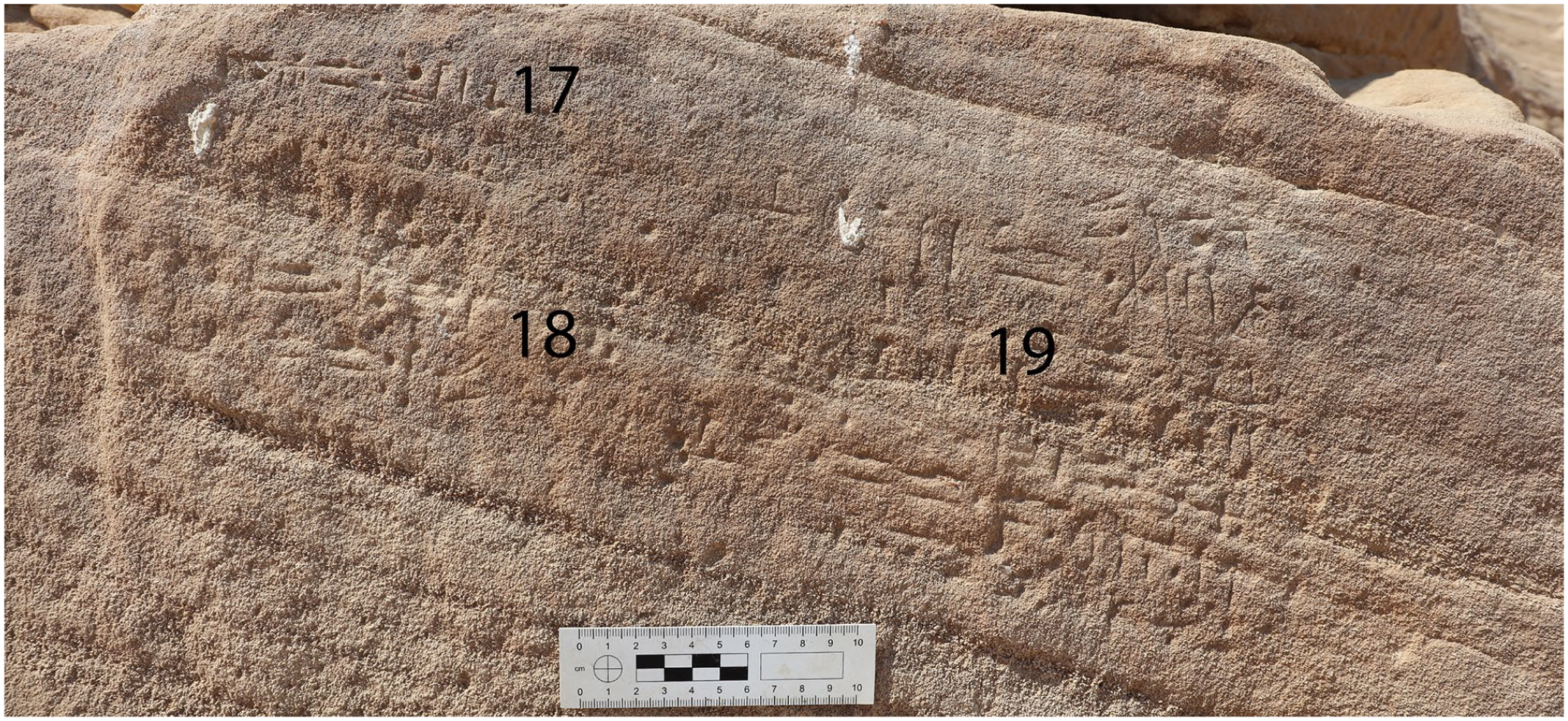
Lower panel, nos 17–19 (photo and editing: Maria Nilsson).
Description
The script observed within these inscriptions exhibits a predominantly cursive style, albeit retaining its hieroglyphic nature, and adheres to a right-to-left directionality facing north. The largest inscription (no. 11), however, deviates from this trend and comprises true hieroglyphs. Geological strata lines or fractures were intermittently utilised to accentuate specific details or delineate registers of text. These texts were incised using a sharp implement, likely a lithic blade, such as flint or steatite. Inscriptions 8, 10–12, and 14–19 share comparable incision techniques and tool applications, manifesting sharp, deep, and distinct outlines achieved through a single stroke for each line. In contrast, the outlines of inscriptions 1–7, 9, and 13 appear blunt and hammered, indicative of multiple movements employed in creating each line. Habitually, the total width of the individual inscriptions ranges between approximately 10 and 25 cm, with exceptions found in inscriptions 11 and 12, which are considerably broader. Regarding height, individual lines measure around 5 cm, while multi-lined texts reach a maximum height of 32 cm (observed in inscription no. 10). Remarkably, the panels housing these inscriptions do not contain any pictorial graffiti.
Interpretation
The inscriptions primarily comprise individual personal signatures, cataloguing the names, titles and/or parental relation to 43 individuals. Among these, there are seven instances of the ms.n-formula, 6 encompassing partially or fully legible female names or matronyms. 7 Reference is made to five fathers, including four legible patronyms, using Middle Kingdom filiation patterns. 8 Inscription no. 9 presents a date – year 35 – alongside the royal name of Senusret I, indicating a relative date for the panel. The majority of the names adhere to a style consistent with Middle Kingdom signatures documented in other locations, including examples from the nearby site of Shatt el-Rigal. 9
The nautical title ỉmy-ỉrty appears four times (nos 18–19), combined with (ỉmy-r) ʿḥʿ.w in inscription 19. Inscription no. 11, occupying the largest space, enumerates the title ỉmy-r ʿȝw ẖry-tp nswt for an individual named ỉntf. It is noteworthy that there are no explicit references to any quarrying expedition within the inscriptions. Instead, one might consider the possibility of these inscriptions being associated with visitation connected to the fortress of Kheny. 10
The horizontal panel (fig. 2) can be visually divided into three distinct clusters: nos 1–3 situated on the left side, nos 4–10 positioned in the centre, and nos 12–16 located on the right side, above which lies no. 11. These divisions become apparent upon closer examination of calligraphic differences or writing styles. For instance, no. 1 contrasts with nos 2–3 due to the former being hammered, creating several protrusions to form each line, while the latter were scratched using a semi-sharp implement. Moreover, despite the poor preservation, the author(s) of nos 2–3 seemingly exerted consistent pressure with a similarly sized tool, angled slightly towards the left. Comparing nos 4–6 with nos 8–10, it appears that the creators of the former scratched signs using a softer tool, resulting in distorted edges (similar to nos 2–3), whereas nos 8–10 exhibit deep, clear incisions likely made with a harder implement, such as a blade. No. 7 stands out within the central group, characterised by larger signs and a different technique involving hammering and rubbing.
The right group displays non-uniform characteristics. No. 12 shares similarities with nos 8–10 in terms of production technique and pressure exerted on the tool. Notably, similarities between nos 10 and 15 are evident in the use of sȝ-signs (Aa18), male determinatives, s-signs (S29), and the problematic determinative (also used in no. 8), which is here suggested as a variant of the seated man (A1). These similarities indicate a potential common authorship. Although the author of no. 8 employed similar signs, a slightly different technique suggests contemporaneous creation by a different individual. No. 11 stands out within this collection for several reasons, including that it occupies the largest and highest space, presents the largest signs, and is the only inscription in a clear, defined hieroglyphic script. Its association with Intef, described as the confidant of the king (ẖry-tp nswt), might explain its prominence. Conversely, despite its importance, no. 9, which provides the royal name and the only dating formula, exhibits smaller signs and appears executed with less precision.
Positioned in the right corner, no. 16 shares a similar style, technique, and composition with nos 17–19, all of which are equally poorly preserved. The creator(s) of these latter inscriptions likely utilised a sharp implement, possibly a blade, applying primary pressure from the top and moving downwards in an uninterrupted motion. Their spatial proximity, shared stylistic traits, and the repeated presence of the nautical title ỉmy-ỉrty suggest contemporaneity and potentially indicate the work of the same individual.
Catalogue
Each catalogue entry presents the original photograph, facsimile, hieroglyphic transcription, transliteration, translation and commentary. Also included is information about field number (inv. no.), dimensions (H: height; W: width) in centimetres, state of preservation (conditions – ‘good’: intact and legible; ‘poor’: fragmentary, but still legible; ‘illegible’: too poorly preserved to interpret), and, if available, date. Photos and facsimiles were produced by the Mission Director, Maria Nilsson.
Rock inscription no. 1
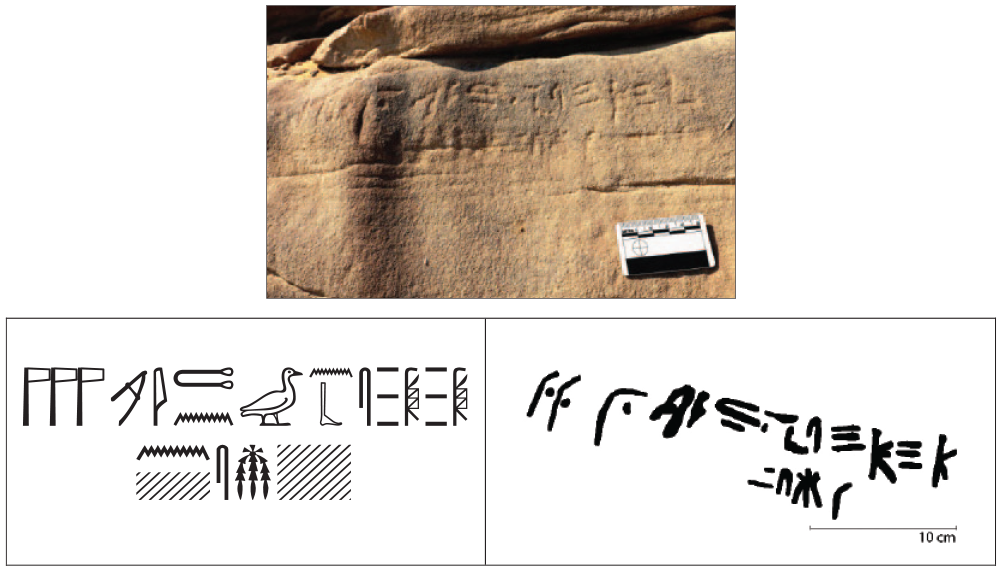
1. šmsw šmsw-snb sȝ ṯnỉ mrỉ-nṯrw
2. ms.n […]
1. The follower, Shemesu-Seneb’s son, Tjeni-Merynetjeru
2. born by […]
Measurements: H 8 cm; W 28 cm
Inv. no.: GeSW.RIS.17.Insc. 1
State of preservation: poorly preserved due to erosion. L1. Good; L2. Mainly illegible.
Commentary
L1. The horizontal line in front of the first sign is illusory. For šmsw snb see Ranke PN I: no. 328: 17; PNM 2670 (Middle Kingdom (MK)). An alternative writing of šmsw is attested in nearby Shatt el-Rigal as ỉmỉ-rȝ st – an overseer of the seat. 11 For Ṯnỉ, see Ranke PN I: 391 no. 17–18; PNM 845. For mrỉ-nṯrw see Katrin-Scheele 2014: 385 no. 1323 (Old Kingdom (OK)).
The first syllable of the personal name Šmsw is repeated twice, but rather than interpreting the word as accidentally repeated, 12 it is here interpreted as the title ‘follower’. 13
Rock inscription no. 2
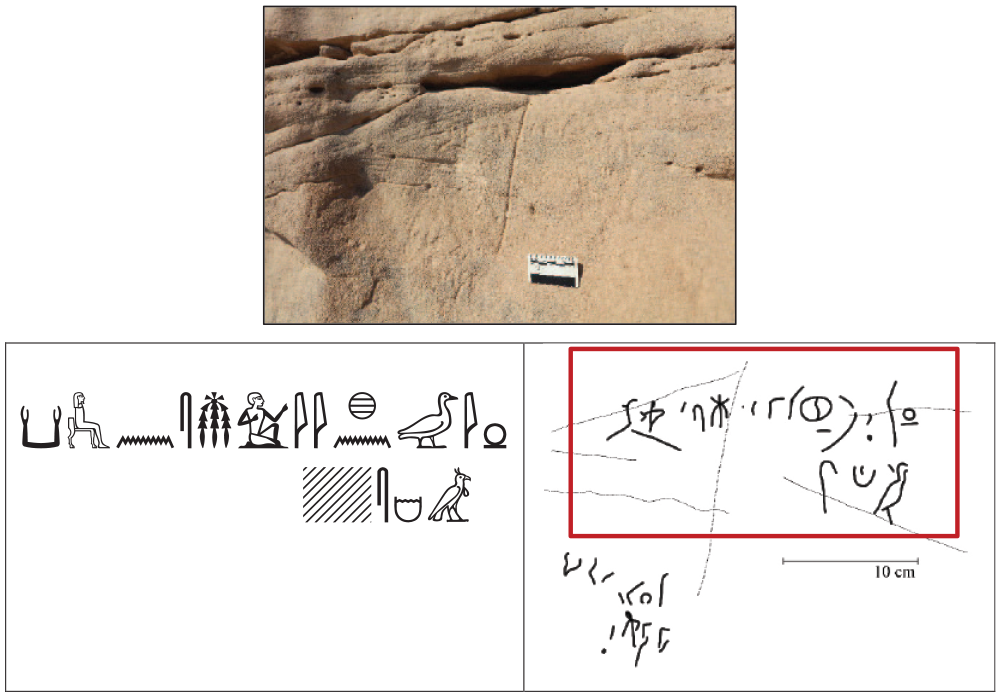
1. šnỉ sȝ ḫni ms.n šps.ỉ.t-kȝ
2. […]
1. Sheny’s son Kheny, born by Shepset-ka
2. Illegible
Measurements: H 12 cm; W 23 cm
Inv. no.: GeSW.RIS.17.Insc. 2
State of preservation: L1. Poor; L2. Illegible
Commentary
L1. For šnỉ see Ranke PN I: 328 nos 22–23 (šny); Ranke PN II: 319 no. 3; PNM 2441 (MK). For ḫnỉ see Ranke PN I: 270 no. 2 (Ranke PN I: 270 no. 3; PNM 2043: ḫnỉ.t) (MK).
L2. Possibly a variant of nḥm see Ranke PN I: 208 nos 3–20; PNM 2347 (MK).
Rock inscription no. 3
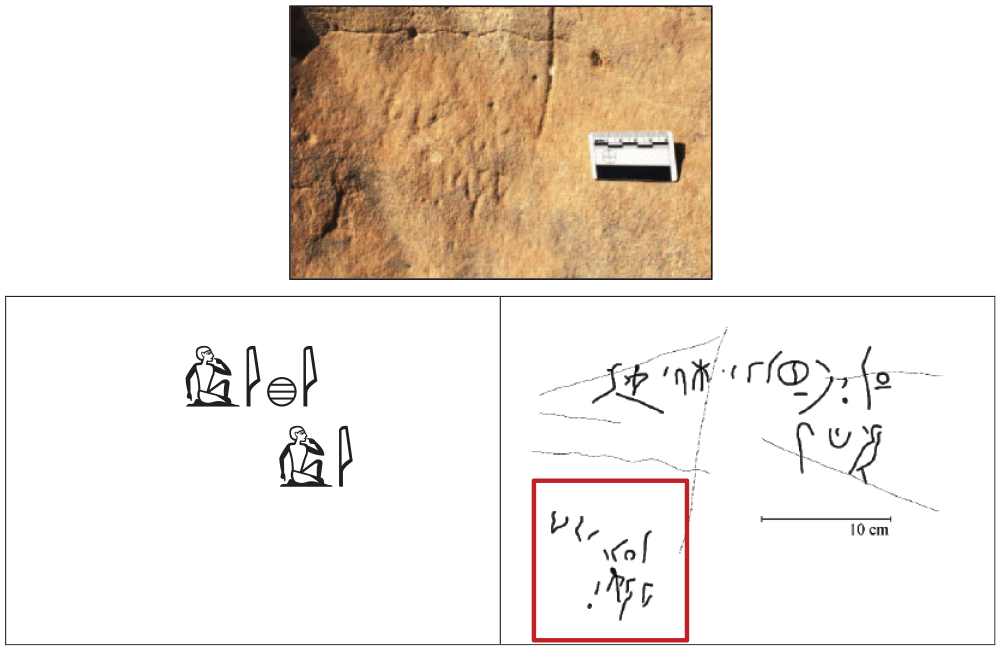
1. ỉḫỉ
2. ỉ
1. Ikhy
2. Iy?
Measurements: H 8 cm; W 7 cm
Inv. no.: GeSW.RIS.17.Insc. 3
State of preservation: Poor
Commentary
L1: For this spelling of ỉḫỉ, see Ranke PN I: 45 no. 10; PNM 2587 (MK).
L2. For ỉ see Ranke PN I: 5 nos 3–4; PNM 4851 (MK). 14
Rock inscription no. 4
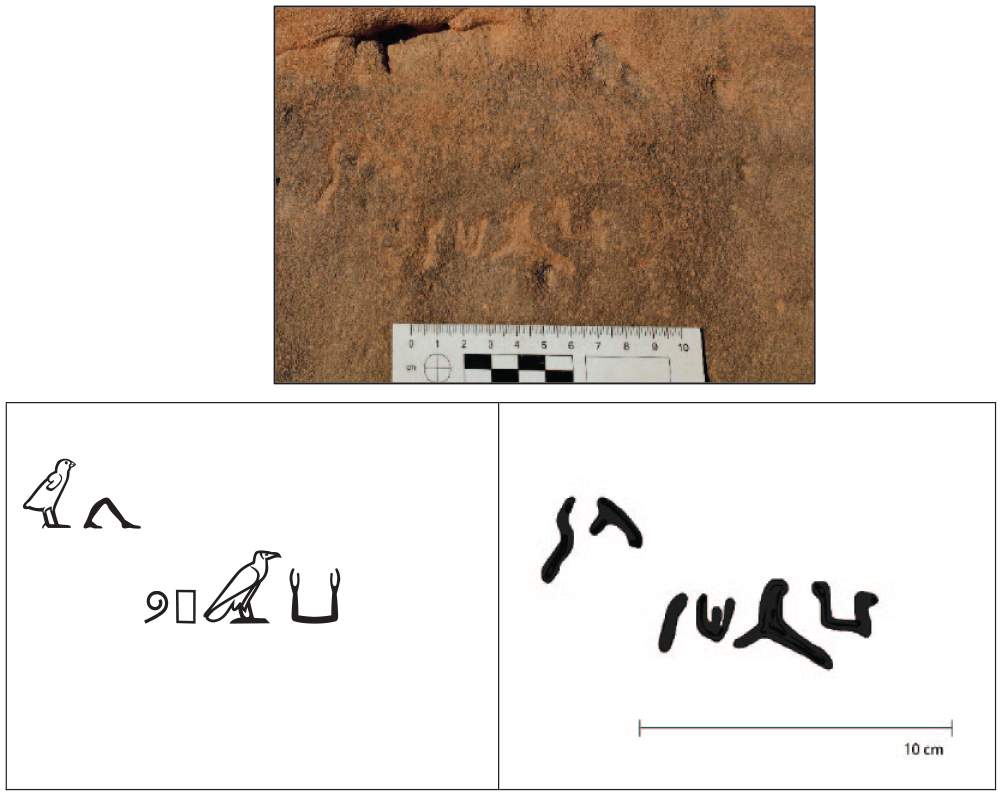
1. ỉww
2. kȝ(ỉ.)-pw
1. Iu
2. Kapu
Measurements: H 5 cm; W 12 cm
Inv. no.: GeSW.RIS.17.Insc. 13
State of preservation: Poor
Commentary
L1: For alternative spellings of ỉww see Ranke PN I: 8 no. 1; PNM 2535 (MK).
L2: For kȝ(ỉ.)-pw see Ranke PN I: 339 no. 9; cf. PNM 1718 (MK).
Rock inscription no. 5
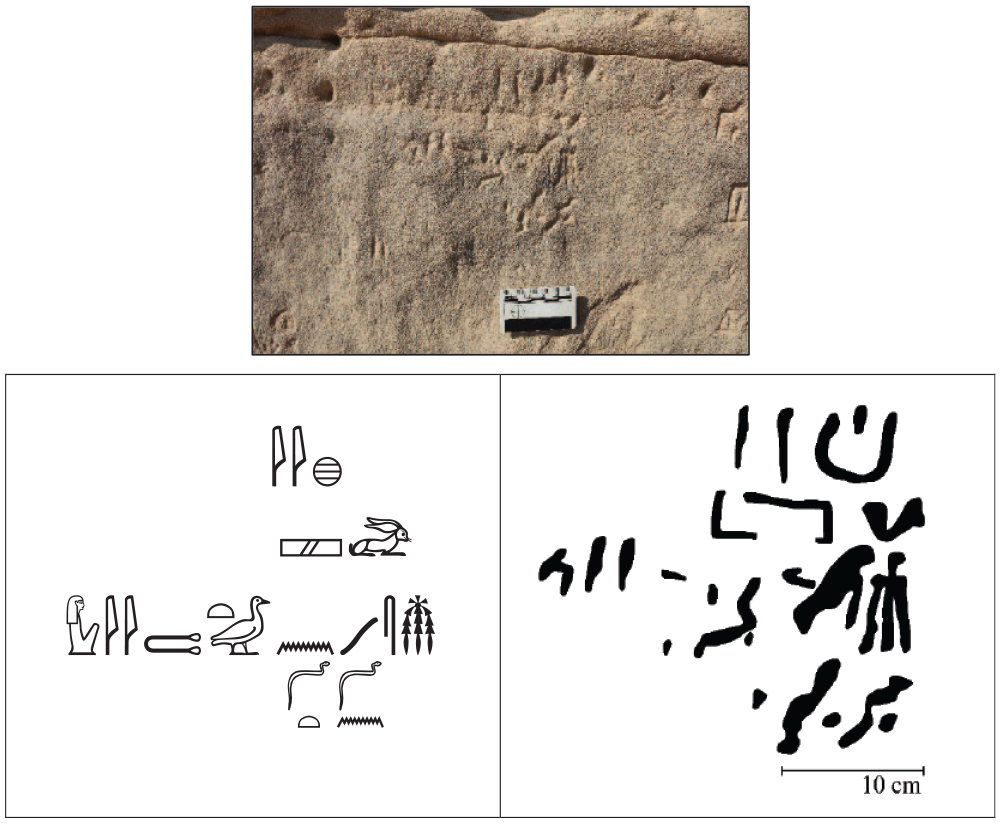
1. ḫỉỉ
2. wnš
3. ms.n sȝ.t-ṯỉỉ
4. ḏnḏ.t
1. Khy
2. Unesh
3. Born of Sat-ty
4. Djendjet
Measurements: H 12 cm; W 16 cm
Inv. no.: GeSW.RIS.17.Insc. 17
State of preservation: Poor
Commentary
L1. For ḫ.ỉỉ see Ranke PN I: 263 no. 6; PNM 1082 (MK).
L2. For wnš, see Ranke PN I: 80 no. 4; PNM 1426 (MK). A possible reading is wr-š, see Ranke PN I: 83 no. 6. However, such form of wr is previously unattested before the Graeco-Roman Period.
L3. For sȝ.t-ṯỉỉ see Ranke PN I: 294 no. 21; PNM 5225 (MK).
L4. For ḏnḏ.t see Ranke PN I: 407 no. 3; PNM 5424 (MK).
Rock inscription no. 6
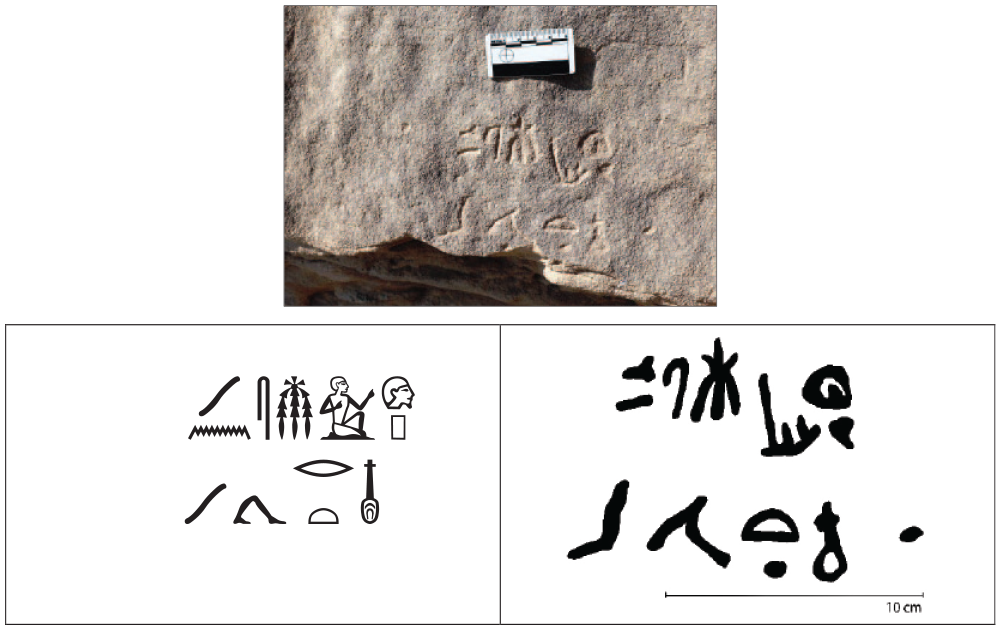
1. tp ms.n
2. ỉw-nfr.t
1. Tep, born by
2. Iuneferet
Measurements: H 8 cm; W 11 cm
Inv. no.: GeSW.RIS17.Insc.4
State of preservation: Good
Commentary
L1. For tp, cf. Ranke PN I: 379 no. 25; PNM 779 (tp-ʿ) (MK).
L2. For ỉw-nfr.t and nfr.t-ỉw as the honorific transposition, see Ranke PN I: 201 no. 13; PNM 760 (MK–SIP).
Rock inscription no. 7
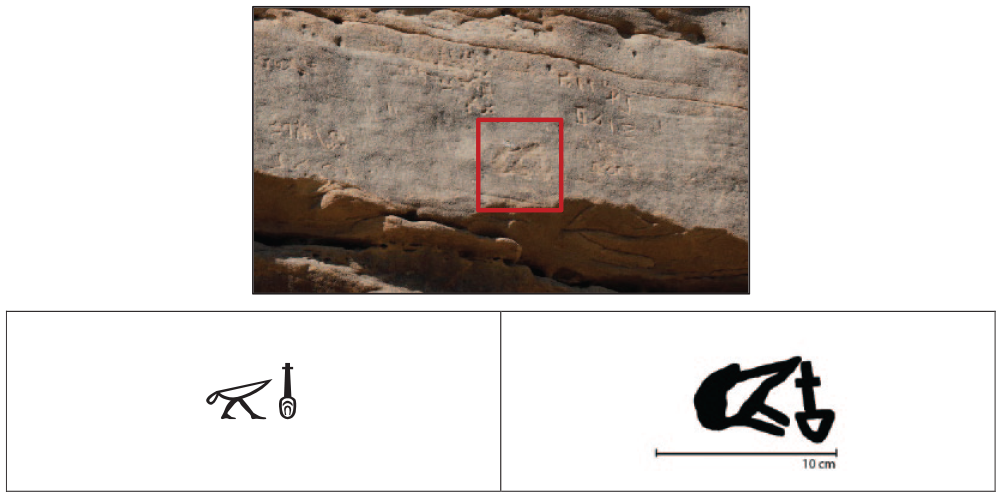
nfr-sšm
Nefer-seshem
Measurements: H 5.5 cm; W 8 cm
Inv. no.: GeSW.RIS17.Insc.19
State of preservation: Poor
Commentary
For ffr-sšm see Ranke PN I: 200 no. 4; PNM 6202 (MK) from Shatt el-Rigal. 15 An alternative reading could be nfr-ḫnỉ, see Ranke PN I: 199 no. 14.
Rock inscription no. 8
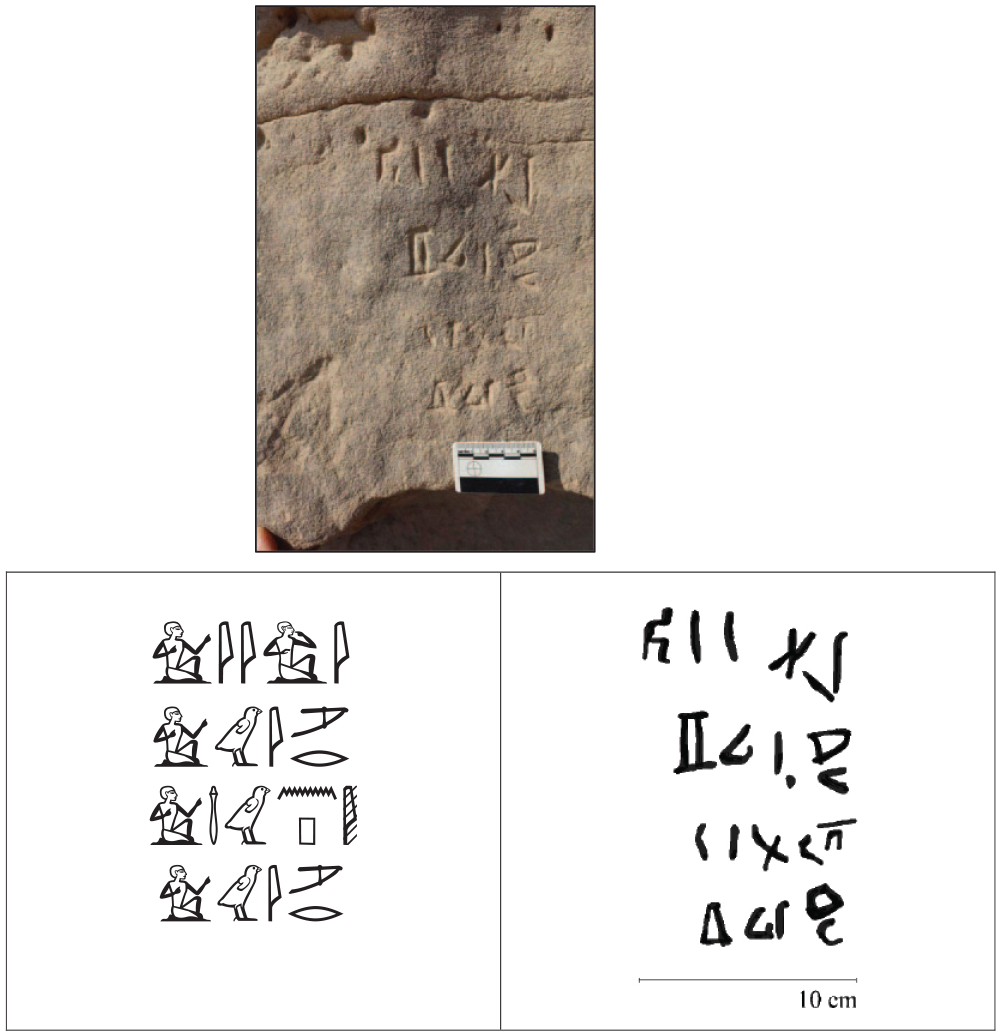
1. ỉy
2. mr.ỉ.w
3. ỉnp-w-ʿȝ
4. mr.ỉ.w
1. Iy
2. Meriu
3. Inpu-Aa
4. Meriu
Measurements: H 13 cm; W 9 cm
Inv. no.: GeSW.RIS17.Insc. 5
State of preservation: L1–2, 4. Good; L3. Poor
Commentary
L1: For ỉy with the current sign usage, see Ranke PN I: 7 no. 17; PNM 345 (also Ranke PN I: 8 no. 8) (MK). Cf. no. 3, above.
L2 and 4: For mr.ỉ.w cf. Ranke PN I: 162 no. 5; PNM 2455 (mr.ỉỉ.w) (MK).
L3: Cf. Ranke PN I: 37 no. 5; PNM 4645.
The final sign of L2 and 4 is problematic as there are no immediate parallels in any of the surrounding rock inscriptions at Gebel el-Silsila or Shatt el-Rigal. 16 Alternatively, the sign may be interpreted as a very simplified form of ỉnb (MdC O 36) used as a determinative to indicate the profession of the person as a ‘builder’. 17
For Middle Kingdom parallels for the combined application of a single and double reed for ỉ and ỉỉ appear in both papyri 18 and graffiti. 19
Cf. Rock inscriptions nos 10 and 15 for parallel palaeography.
Rock inscription no. 9
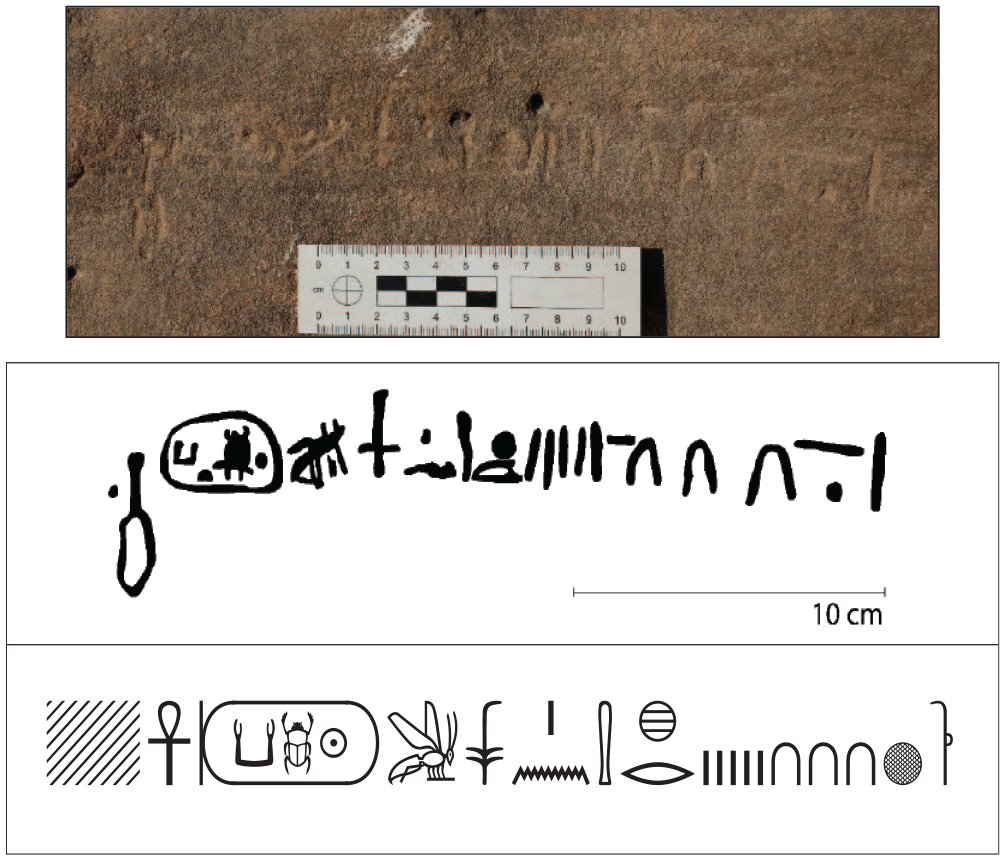
ḥʿt sp H̱š ḫr ḥm n nsw bỉty ḫpr –kȝ- rʿ ʿnḫ […]
Year 30 under the majesty of king of upper and lower Egypt (Kheper-Ka-Re), may he live…
Measurements: H 5 cm; W 25 cm
Inv. no.: GeSW.RIS.17.Insc. 6
State of preservation: Good, although the cartouche is poorly preserved
Commentary
The final sign is illusionary in its resemblance with the nfr-sign, but it is more likely a combination of a two lined-addition to the inscription: the upper level (parallel with the main inscription) forms a very crude ʿnḫ followed by an illegible sign, while the lower part of the illusionary nfr-sign may be interpreted as two ḥ-signs flanking a central solar disc, forming the word nḥḥ, thus forming the formula ʿnḫ nḥḥ ḏt. 20
For the royal name, see Ranke PN I: 269 no. 1; PNM 827.
The inscription was likely produced by a different hand than the adjacent texts due to the different palaeography. It provides an abbreviation of the dating formula as it excludes reference to the season, month and date. 21
The text follows the Middle Kingdom custom of listing only the praenomen of the king. 22 It emphasises the importance of the location in relation to adjacent panels (not marked with the royal insignia). It also reflects an overall interest in ancient Kheny during the Middle Kingdom, and corresponds with two graffiti (inv. nos GeSW.RIS11.Insc.17; RIS12.Insc.2) recorded in the far south of Gebel el-Silsila (west bank) dated to year 45 of Pharaoh Senusret I. 23
The outlines of the cartouche are shallower than the surrounding text.
Rock inscription no. 10
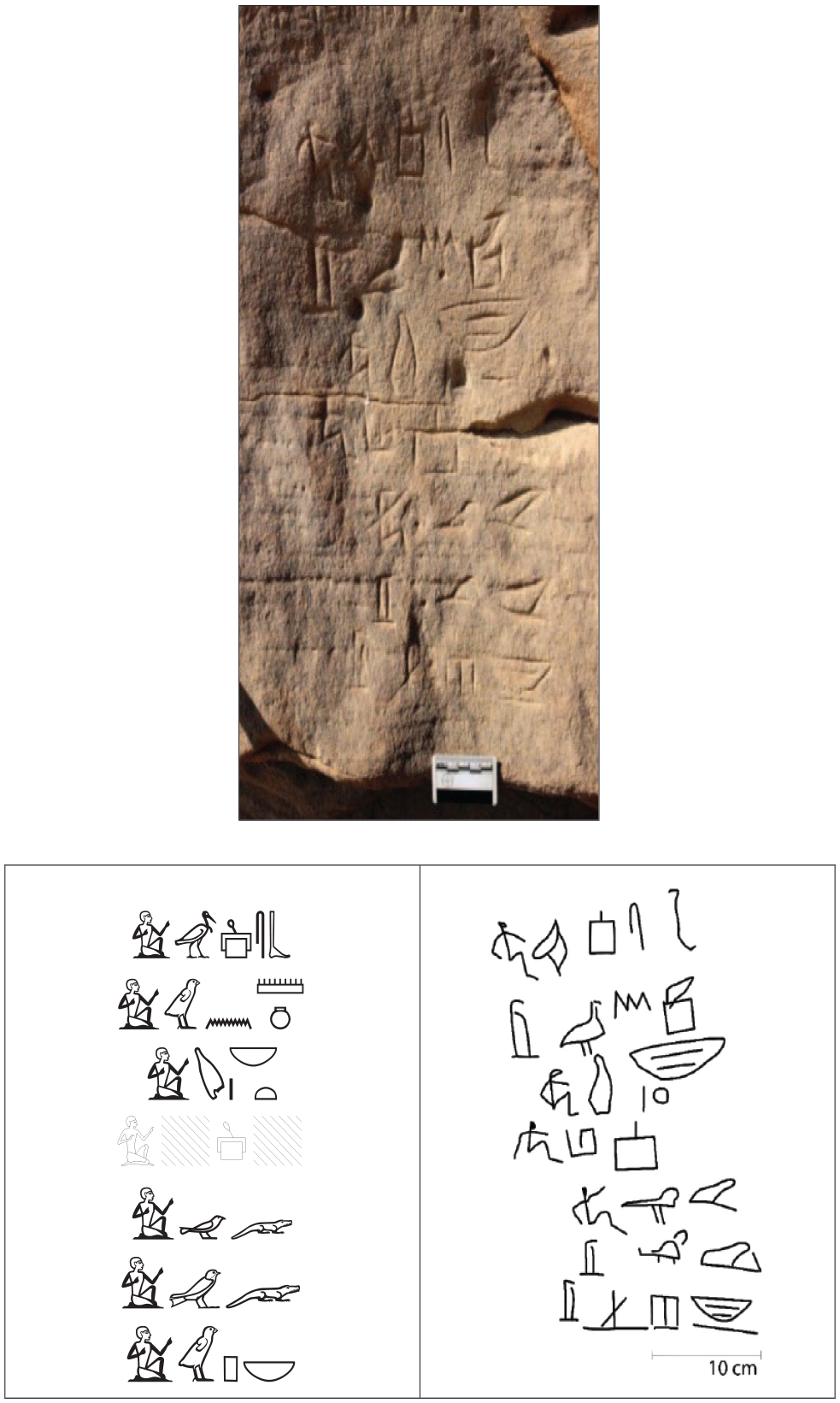
1. bś
2. mnw
3. ḥḏ.t
4. […] sȝ […]?
5. sbk-wr
6. sbk-wr
7. nb(ỉ)- pw
1. Bes
2. Menu
3. Hedjet
4. […] sa […]
5. Sobek-ur
6. Sobek-ur
7. Neb-pu
Measurements: H 32 cm; W 21 cm
Inv. no.: GeSW.RIS.17.Insc. 7
State of preservation: Good
Commentary
L1. For bś see Ranke PN I: 98 no. 14; cf. PNM 2923 (MK).
L2. For mnw see Ranke PN I: 151 no. 9; PNM 486 (MK). For the determinative of L.2, 5–7 see no. 8, above.
L3. The reading is hypothetical. For parallels of ḥḏ.t, see Ranke PN I: 261 no. 14; PNM 1166 (MK). An alternative reading could be nbj-ḥḏt, see Ranke PN I: 184 no. 9. Other alternatives include nbt-ḥḏt and nb.t (ỉ)-mwt. However, the latter two appear unlikely as male designations.
L4. Could be a repetition of L2.
L5. sbk-wr is also recorded in Shatt el-Rigal, 24 see also Ranke PN I: 303 no. 27; PNM 620 (MK). However, due to the application of the nṯr-sign as a determinative, it is more likely a matter of a reference to Sobek, the residing deity of the area.
L6. A repetition of L5?
L7. For nb(ỉ)- pw see Ranke PN I: 184 no. 14; PNM 1282.
The application of two variants for the male determinative may indicate the writing by two different hands.
Rock inscription no. 11
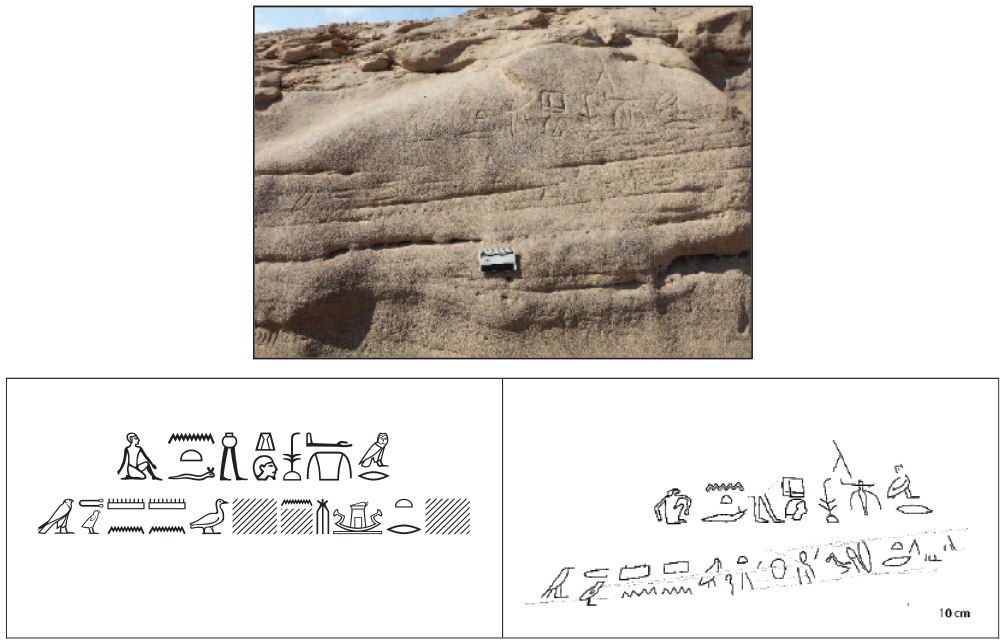
1. ỉmy-r ʿȝw ẖry-tp nswt ỉntf
2. […] tr dpt ms.n [.….] sȝ mn-mnṯ.w (?)
1. Overseer of interpreters, confidant of the king, Intef
2. […] .tr dpt born by […, ..]’s son Menmonthu (?)
Measurements: H. 18 cm; W 68 cm
Inv. no.: GeSW.RIS17.Insc. 12
State of preservation: L1. Good; L2. Poor
Commentary
L1. For ỉn-ỉt.f see Ranke PN I: 34 no. 1; PNM 288 (MK).
For ỉmy-r ʿȝw, see Favry 2004: 93 no. 7; Fischer 1997: 41.
For ẖry-tp nswt see Grajetzki 2000: 226. This title, together with the name ỉntf, is recorded in a rock inscription at Bi’r Minayh. 25
The sign for p in tp nsw, is designed with storks of matting, a common shape for Old Kingdom examples. 26 Usually, this sign was shown with stroked shapes. 27
The determinative variant of the personal name ʿIntf is unusual. 28
L2. There are no direct parallels for Mn-mnṯ.w, for which the current reading is tentative.
For Middle Kingdom applications of the theophoric name Mnṯ.w see Ranke PN I: 153 no. 20; PNM 743 (MK), including examples from Shatt el-Rigal. 29
Rock inscription no. 12
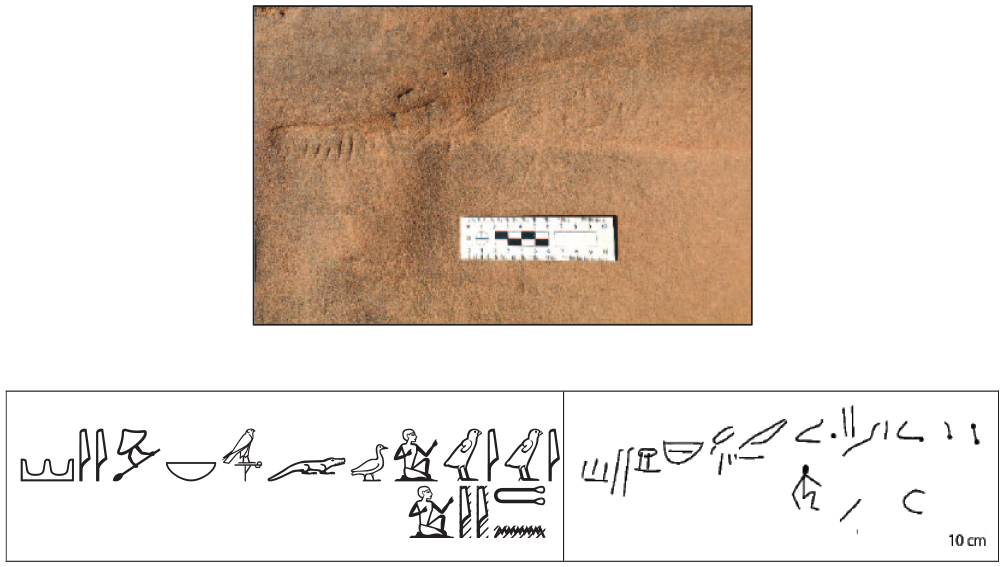
1. ỉwỉw ʿȝ sbk-nb-ẖny
2. ṯnỉ (?)
1. Iuy’s son Sobeknebkheny
2. Tjeny (?)
Measurements: H 8 cm; W 34 cm
Inv. no.: GeSW.RIS17.Insc. 8
State of preservation: L1. Poor; L2. Illegible
Commentary
L1. For ỉwỉw see Ranke PN I: 16 no. 20; PNM 4443 (MK).
šbk-nb-ḥny is here interpreted as a theophoric personal name, which indicates an individual with a local connection to Kheny.
To the authors’ knowledge, it is the first appearance of H̱ny using the ḫȝst-sign (N25) as a determinative. 30
L2. For ṯnỉ see Ranke PN I: 391 no. 18; PNM 845 (MK).
Rock inscription no. 13
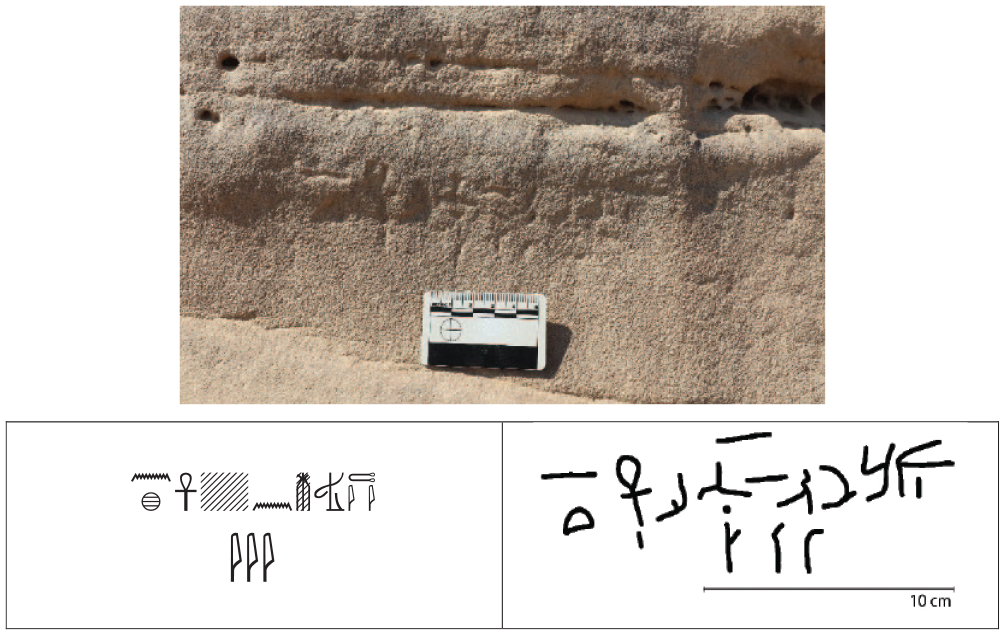
1. ṯỉ ms.n […] ʿnḫ
2. ỉỉ
1. Thy, born by […] -ankh
2. Iy
Measurements: H 6 cm; W 16 cm
Inv. no.: GeSW.RIS.17.Insc. 11
State of preservation: Poor
Commentary
L1. For ṯỉ see Ranke PN I: 389 nos 23–26, 30; PNM 5197 (MK).
L2. For ỉy, see Ranke PN I: 7 no. 15, 24–26; PNM 345, spelling in accordance with no. 351, including two examples from Shatt el-Rigal. 31 Only the latter part of the matronym is preserved.
Rock inscription no. 14
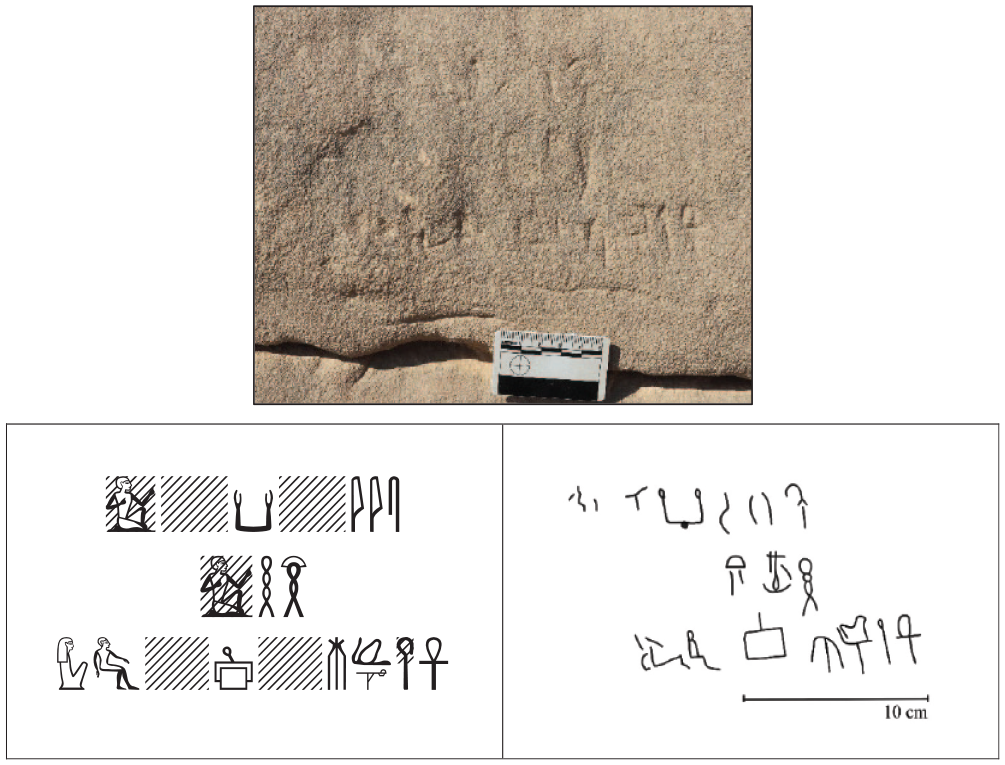
1. śỉ […]-kȝ
2. wȝḥ
3. ʿnḫ-ḥḳȝ(?) ms[…] sȝ […]
1. Si …- ka
2. Wah
3. Ankh-heka (?), born by Sa…
Measurements: H 11 cm; W 18 cm
Inv. no.: GeSW.RIS.17.Insc. 9
State of preservation: Poor
Commentary
L1. For possible name identification based on śỉ, see Ranke PN I: 300, 10ff. Alternatively, Ranke PN I: 301 no. 20; PNM 510.
L2. For wȝḥ see Ranke PN I: 72 no. 26; PNM 1575 (MK), including an example from Shatt el-Rigal. 32 An alternative interpretation may be wȝḥ-nfr.
L3. The reading ʿnḫ-ḥḳȝ is tentative. Alternatively, see nḏs-ʿnḫ in Ranke PN I: 216 no. 8; PNM 4763.
Although grouped here as one rock inscription, differences in style and calligraphy may indicate that the three lines were composed by different authors.
Rock inscription no. 15
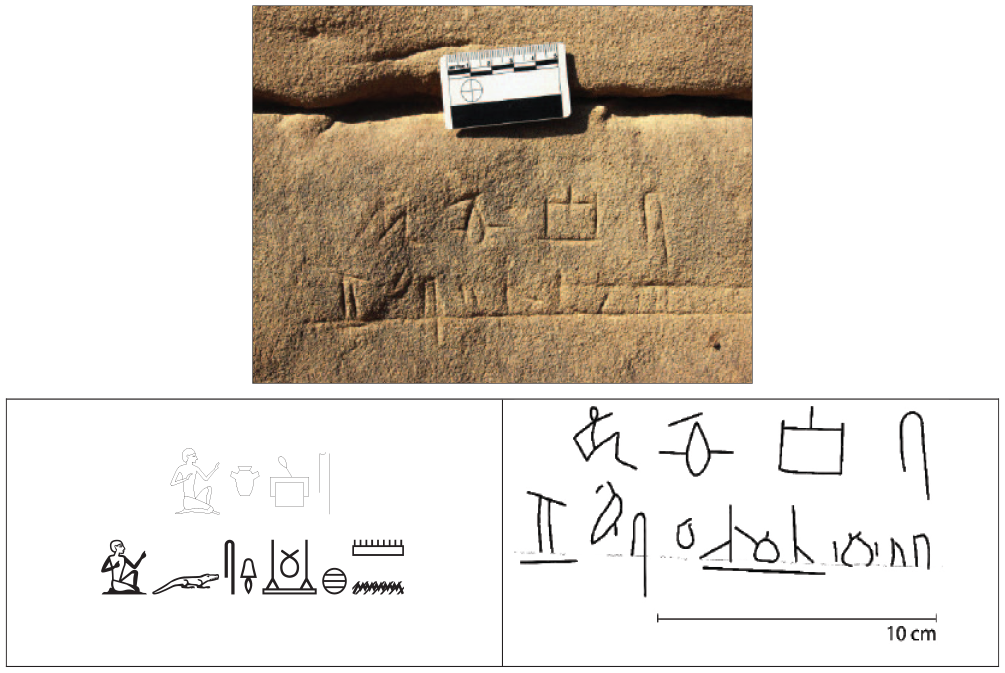
1. sȝ(ỉ)-ỉb
2. mnḫ-sbk
1. Sa(i)-ib
2. Menekh-Sobek
Measurements: H 6 cm; W 12 cm
Inv. no.: GeSW.RIS.17.Insc. 10
State of preservation: L1. Good; L2. Poor
Commentary
L1. For sȝ(ỉ)-ỉb see Ranke PN I: 428 no. 1; Katrin-Scheele 2014: 620, 2899 (OK). For the application of the determinative, see no. 11, above. 33
L2. For mnḫ-sbk see Ranke PN I: 153 no. 12; PNM 1368. For the determinative, cf. nos 8 and 10.
Rock inscription no. 16
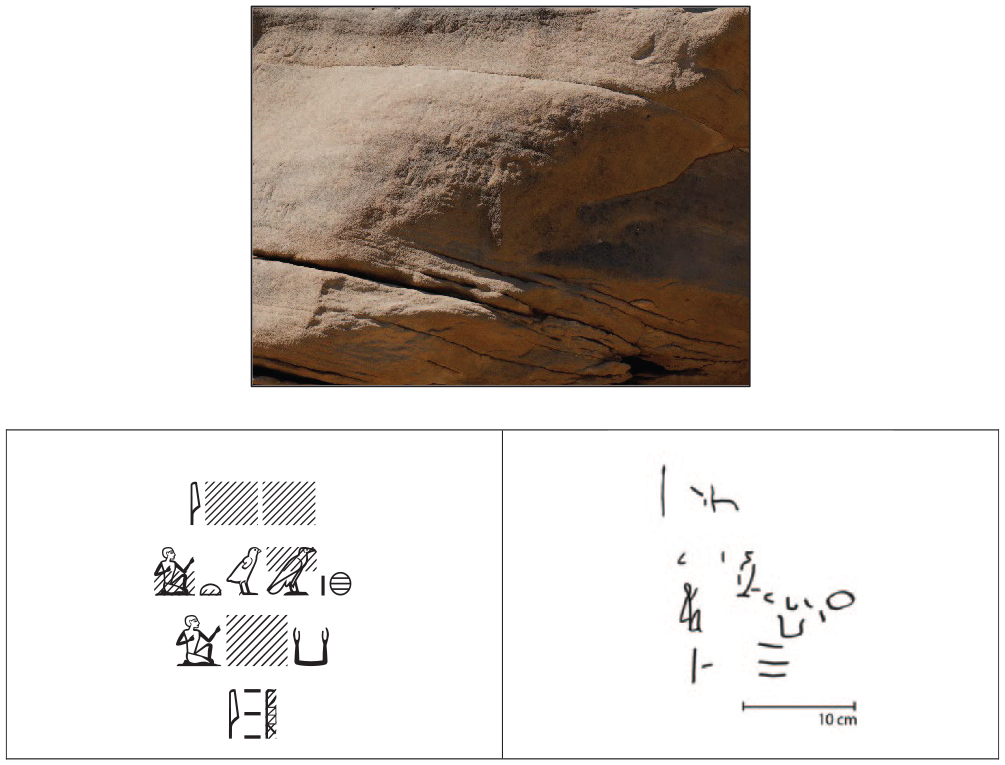
1. ..ỉ
2. ḫȝw.t
3. kȝ
4. šms.w ỉ
1. illegible
2. Khaut
3. Ka
4. Shemsu i
Measurements: H 20 cm; W 12 cm
Inv. no.: GeSW.RIS.17.Insc. 16
State of preservation: L1. Illegible; L2–4. Poor
Commentary
L2. For ḫȝw.t with different sign application see Ranke PN I: 262 no. 25.
L3. For kȝ see Ranke PN I: 337 no. 21; PNM 1007 (MK).
L4. For šms.w see Ranke PN I: 328 no. 19. Cf. no. 1, above.
Rock inscription no. 17
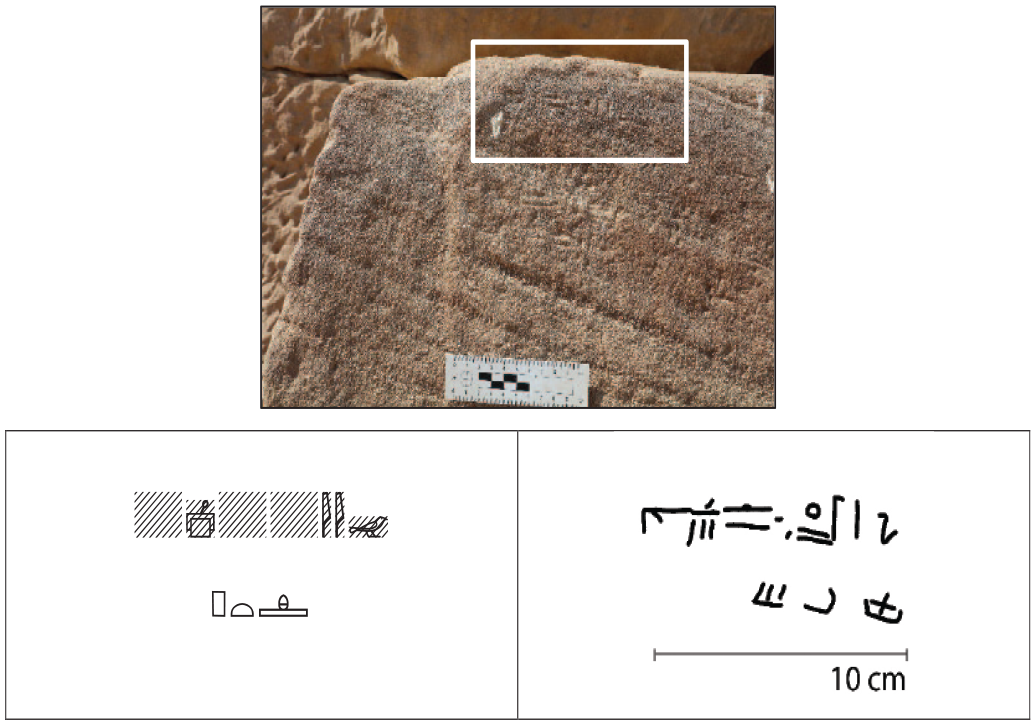
1. […]
2. ḥtp
1. Illegible
2. Hotep
Measurements: H 4 cm; W 11 cm
Inv. no.: GeSW.RIS.17.Insc.17
State of preservation: L1: Illegible, L2: Poor
Commentary
L1. The surface is too weathered and problematic. Any reading would be too speculative.
L2. For ḥtp see Ranke PN I: 257 no. 22; PNM 296 (MK).
Rock inscription no. 18
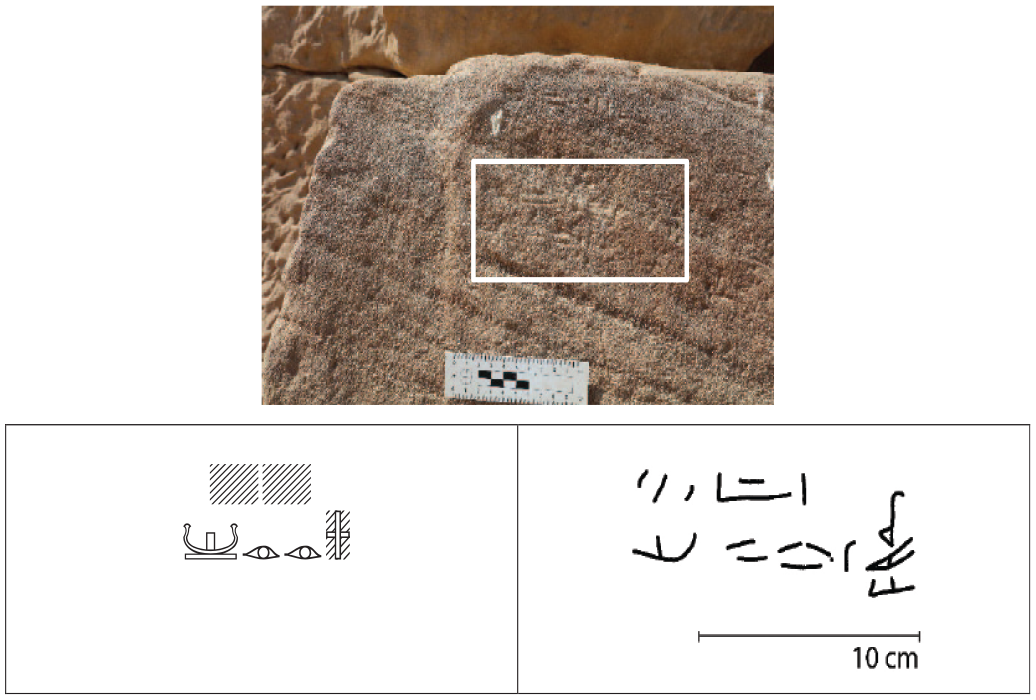
1. […]
2. ỉmy-ỉrty
1. Illegible
2. Ship’s captain
Measurements: H 5 cm; W 13 cm
Inv. no.: GeSW.RIS.17.Insc. 18
State of preservation: L1. Illegible; L2. Poor
Commentary
L2. Cf. no. 19, below.
Rock inscription no. 19
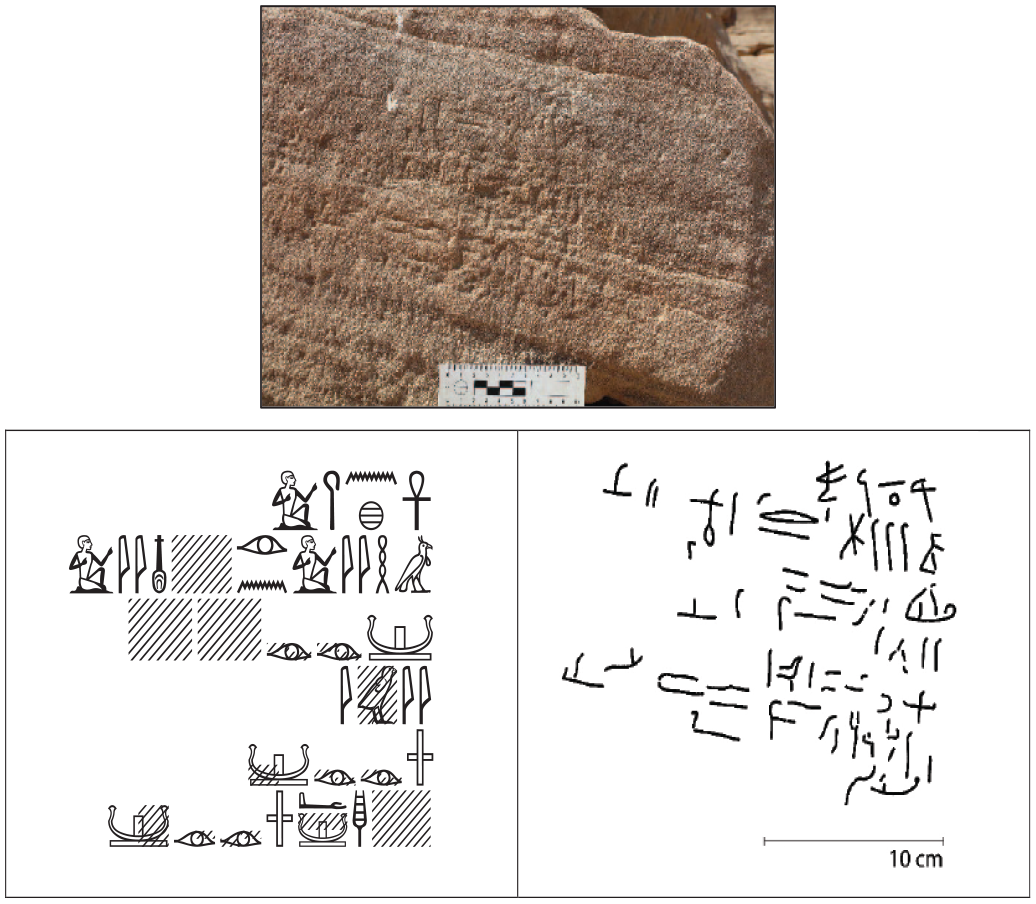
1. ʿnḫ-ḥḳȝ
2. nḥy ỉr.n […] nfry
3. ỉmy-ỉrty
4. ỉwy
5. ỉmy-ỉrty
6. (ỉmy-r) ʿḥʿ.w ỉmy-ỉrty
1. Ankh-heka
2. Nehy’s son Nefery
3. Ship’s captain
4. Iuy
5. Ship’s captain
6. Commander of ships/flotilla, ship’s captain
Measurements: H 16 cm; W 22 cm
Inv. no.: GeSW.RIS.17.Insc. 16
State of preservation: Poor
Commentary
L1. For ʿnḫ-ḥḳȝ see Ranke PN I: 66 no. 5; PNM 5138.
L2. For nḥy see Ranke PN I: 207 no. 15; PNM 628. For nfry see Ranke PN I: 194 no. 5; PNM 514, including several examples from the reign of Senusret I. 34
L3 and 5. For the nautical title ỉmy ỉrty, see Jones 1988: 49; 35 PNM 754.
L4. For ỉwy see Ranke PN I: 55 no. 17. Cf . Ranke PN I: 16 no. 15; PNM 632 for  . Cf. no. 12, above.
L6. See Jones 1988: 54. The title is listed twice in Shatt el-Rigal. 36
Footnotes
Acknowledgements
The authors wish to extend their sincere appreciation to the Ministry of Tourism and Antiquities and the Permanent Committee for their gracious permission, allowing the Swedish Mission to continue their research efforts. Our achievements owe a debt of gratitude to the entire scientific team involved in the Gebel el-Silsila Project. Special thanks go to assistant director John Ward for his invaluable contributions to the documentation of the current texts. Additionally, we express our gratitude to Nils Billing and Philippe Martinez for their linguistic insights and guidance and to Huibert van Verseveld and Ahmed Mansour for their assistance with documentation. We would also like to acknowledge the support and cooperation with the inspectorates of Aswan and Nubia and Gebel el-Silsila respectively, and our assigned inspectors.
Funding
The documentation process was made possible through the generous financial backing provided by the Gerda Henkel Stiftung (AZ 28/F/23), Crafoordska Stiftelsen (20160607), and the Swedish Bank of Sweden Tercentenary Foundation (RJ: P19-0860).
5.
7.
Nos 1, 2, 5, 6, 11, 13, 14.
8.
Nos 1, 2, 7 (illegible), 12, 19.
9.
See Caminos and Osing 2021;  .
.
10.
Nilsson and Moniem Said 2019: 71–79; : 18–27; P.Brooklyn 35.1446, L21; P.Berlin 10495.
11.
Petrie 1888: no. 398; : no. 61E.
13.
We would like to thank our reviewer for pointing this out.
15.
Petrie 1888: no. 387; : no. 61AD.
18.
Möller Hieratische I: 282.
20.
We would like to express our gratitude to our reviewer for this suggestion.
21.
Gardiner EG: 205.
22.
Allen 2010: 67; : 209–210; Gardiner EG: 73–74.
23.
Nilsson, et al. 2018: 74–75 no. 2.
28.
Gardiner EG: 442.
29.
Caminos and Osing 2021: no. 22B; : nos 371, 585.
30.
The geographical name is otherwise determined by the nỉwt-sign (O49); for Kheny see Wb III: 374; Barguet 1952: 48–50; Caminos 1955: 51–55; Gardiner EG: 587. Cf. : 129–130, 254: ‘Sobek, den Herrn von lHnjj’.
31.
Caminos and Osing 2021: no. 22D; : no. 596.
32.
Caminos and Osing 2021: no. 80A (= : nos 546–547).
33.
Cf. no. 1.
34.
36.
Caminos and Osing 2021: nos 48C (= : no. 429) and 27P.