




Abstract
Ancient Egyptian ontologies have been commonly approached as related to order and chaos. Associated with the latter are the concepts of existence and non-existence, which may be expressed by the verb wn ‘to be’ and its derivatives, as well as the substantive n.tyt ‘what is’ and its negation iw.tyt ‘what is not’. The earliest attestations of n.tyt and iw.tyt are found in the Pyramid Texts, reflecting the importance of (non)existence in cosmic and funerary beliefs. By the Middle Kingdom, n.tyt and iw.tyt occur in titles and epithets of officials, some of whom were involved in boundary formation and traversal. This paper provides an overview of these developments and their insights on Middle Kingdom conceptions of the world. Exploring the role of transregional activities, it questions whether ‘what is’ and ‘what is not’ may reflect an ontology of boundaries connected with socio-political shifts of the early second millennium BCE.

Introduction
In 1971, Hornung published his seminal analysis on ancient Egyptian conceptions of gods. 1 Amid its exploration of divine power is a short excursus on the ‘challenge of the non-existent’ that questions how the Egyptians generally perceived being and nothingness. 2 Hornung was ‘well aware of the conceptual difficulties involved’ in his inquiry, especially given its association with ontology and philosophy. 3 His suggested approach was to identify, analyse and clarify sources on existence, to then assess ‘the conceptual framework of Egyptian ontology and perhaps to fit it into the historical perspective of what Martin Heidegger calls the “contemplation of the existent as existent” – into the history of philosophy.’ 4
This conceptual framework of Egyptian ontology has been a topic of ongoing discourse, yet only a few have critically assessed its complexities anew. Perceptions of Egyptian concepts of the world, of life, of death, and of the cosmos, have not yet widely adjusted nor updated nineteenth and twentieth century approaches including those regarding the afterlife and the other. Such approaches remain well-embedded in Egyptological methodologies, providing the bases of archaeological, historical, art historical, and text-based points of inquiry. Some Egyptologists have recently sought to recursively revise such approaches to enrich perceptions of ancient Egyptian culture and society. Inspired by the anthropological ‘ontological turn’, 5 they have attempted to push past cultural relativism in their research by arguing that worlds or ontologies differ. 6 Unfortunately, the degree to which this has impacted understandings of ancient Egyptian ontologies remains limited.
For instance, understandings of interactions between groups of diverse socio-cultural origins within and beyond Egypt have been significantly revised in recent decades due to newly-discovered or freshly-appraised materials, as well as the incorporation of more current anthropological and sociological perspectives. 7 Nevertheless, Egyptian ontologies of socio-cultural boundaries are yet to be fully clarified, as with the ontologies of boundaries themselves. 8 Remaining fundamental to such concepts is the framework of order (mȝʿ.t) and chaos (ỉsf.t). Since at least the mid-twentieth century, Egyptologists have generally approached Egyptian political, ideological, and socio-cultural manifestations and developments in association with the cosmological maintenance of mȝʿ.t over ỉsf.t. 9 Accordingly, the pharaoh was responsible for this maintenance, especially in the ordered realm of Egypt. 10 As an extension of this role, boundaries with chaotic elements had to be reinforced and protected, thereby keeping at bay forces that could threaten order, including peoples from beyond the geographic and socio-cultural boundaries of Egyptian communities. Thus, the maintenance of order over chaos, together with these forces’ evidently distinguishable aspects, has been approached as one of the most enduring and immutable concepts across pharaonic history. This overall synthesis has been rightly re-examined and questioned in recent years alongside updated understandings of Egyptian encounters with its surrounds; 11 however, the perception of such concepts in view of Egyptian ontologies, and their possible variances and transformations across time and space, still require re-assessment.
Thus, this paper aims to stimulate further discussion on Egyptian ontologies, specifically those associated with forces related to mȝʿ.t and ỉsf.t. To explore this, the paper assesses a particular expression regarding ‘what is’ and ‘what is not’ that becomes increasingly attested in the early second millennium BCE, and questions whether it signals either a transforming ontology, or a changing means to represent it. It first surveys the earliest known attestations of this expression that occur in late third to early second millennium BCE Pyramid and Coffin Texts, followed by those associated with specific officials. It then considers the role of boundary-maintenance and traversal among the many potential means to understanding the attestations. Rather than explicitly arguing against the importance of mȝʿ.t and ỉsf.t, it focusses on the conceptualisation of boundaries between forces related to these elements, particularly in view of its consequent impact on how cross-border activities are understood in Egyptology. While following the approach favoured by Hornung as described above, it concludes with the implications on our understandings of how Egyptians of the early second millennium BCE may have approached the world around them.
What Is and What Is Not in Pyramid and Coffin Texts
The expression in focus comprises two words: n.t(y)t, a substantive derived from a relative adjective that directly translates to ‘that which is’ or ‘what is’; and its negation ỉw.t(y)t for ‘that which is not’ or ‘what is not.’ Its earliest known attestations are from the Pyramid Texts of the 6th Dynasty King Pepi I. One spell on the ascension to the sky notes that the pharaoh is sš mḏȝ.t nṯr ḏd(.w) n.t(y)t sḫpr ỉw.t(y)t ‘the god’s document scribe who says what is and brings into being what is not’ (PT 510). 12 The phrase has been interpreted as a reflection of the cognitive process on speaking and writing – that is, a scribe who says or reads what is written and writes down what is not yet existent. 13 This aligns with an ontological approach in which the scribe recognises what is verbally, but transforms what is not into existence via the process of writing. Such an approach need not counteract an interpretation regarding the totality of what the scribe recites and writes, but rather retains the scribe’s role in manifesting what is not (yet) existent. This nuance is, to the author’s knowledge, not attested in other Old Kingdom examples of n.t(y)t and ỉw.t(y)t. The limited Pyramid Text spells that mention the terms instead utilise them to express alternate meanings that are not associated with manifestation nor (non)existence. 14
By the early second millennium BCE, an increase in the occurrences of these two words is attested in texts relating to existence, several of which are found in the Coffin Texts. Initially, the emergence of the Coffin Texts was erroneously believed to reflect a religious shift that enabled non-royal individuals to access the Pyramid Texts, previously reserved for the royal family, following a decline in royal power via a ‘democratisation’ process. 15 While the Coffin Texts share parallels with the Pyramid Texts, with many repeated spells, 16 the variations indicate other factors of influence. 17 Although similarities between Coffin Texts and tomb inscriptions of the Old Kingdom and First Intermediate Period have been identified, 18 their earliest attestations within coffins of non-royal individuals are likely of First Intermediate Period date, with the custom clearly observed by the Middle Kingdom. 19
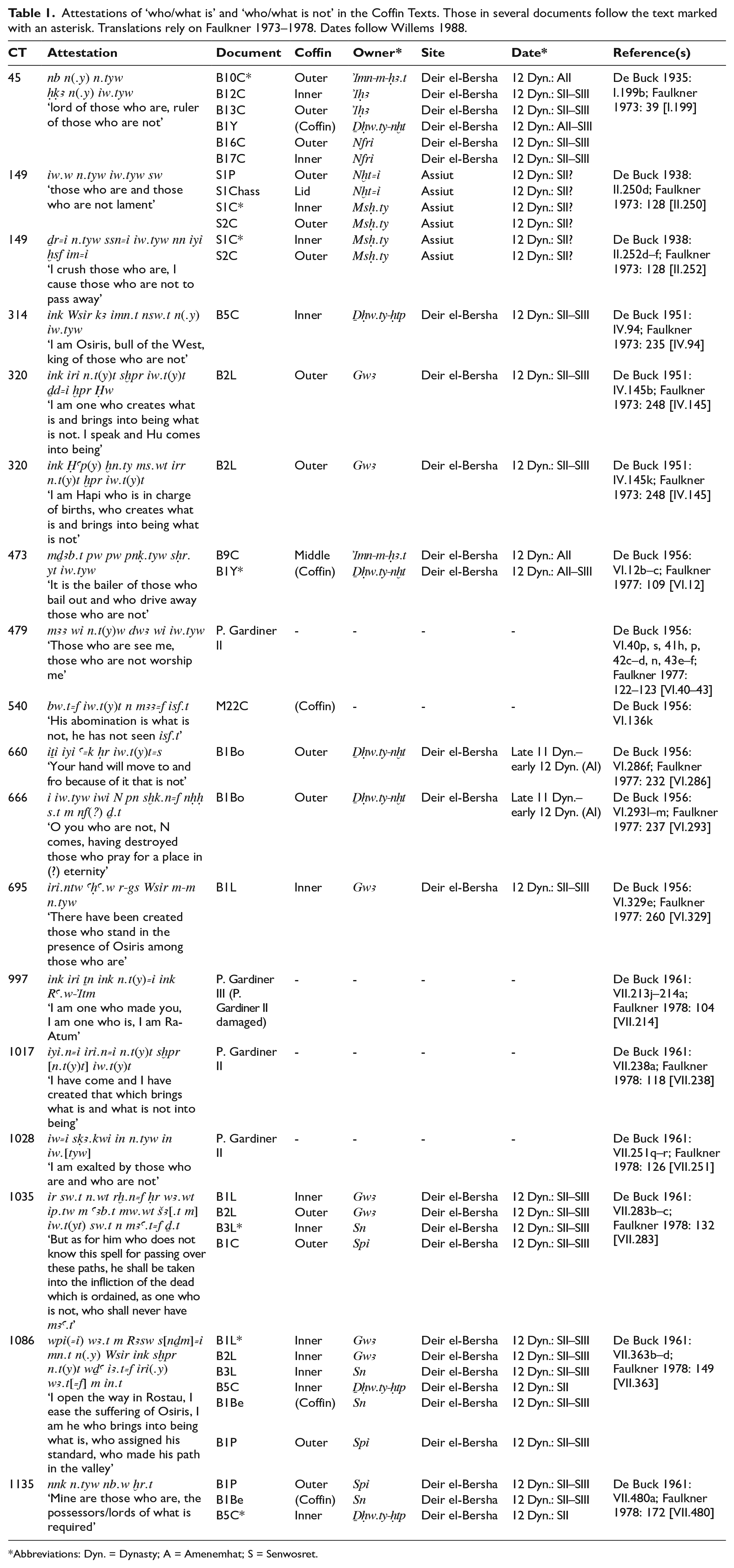
Regarding ‘what is’ and ‘what is not’, the earliest Coffin Text occurrences date from the late 11th to the early 12th Dynasty reign of Amenemhat I (Table 1). 20 They are found in two spells, CT 660 and CT 666, on the outer coffin of the ḥȝ.ty-ʿ ‘count’ ḏḥw.ty-nḫt of Deir el-Bersha. Most of the remaining attestations are generally assigned to around the reigns of Senwosret II and III. Apart from those in Papyrus Gardiner II and III, all are from coffins of men, and most are from Deir el-Bersha, with a few from the nearby site of Assiut and one from Meir. There seems to be no correlation between the attestations and the kinds of coffins on which they are featured, with the expressions occurring on inner and outer coffins, single coffins, and one coffin lid. 21 Closely paralleling PT 510’s ‘what is’ and ‘what is not’ are the attestations in CT 320, in which the deceased creates what is but brings into being what is not, with one clause identifying the deceased as Hapi, god of the Nile’s inundation. Similarly, CT 1086 states that the deceased brings into being what is, while Papyrus Gardiner II’s CT 1017 deems the deceased as a creator of both what is and what is not. The association between these attestations and the act of creation or manifestation (‘bringing into being’) is evident.
Attestations of ‘who/what is’ and ‘who/what is not’ in the Coffin Texts. Those in several documents follow the text marked with an asterisk. Translations rely on Faulkner 1973–1978. Dates follow Willems 1988.
Abbreviations: Dyn. = Dynasty; A = Amenemhat; S = Senwosret.
In contrast, the remaining occurrences utilise the relative adjective and its negation to refer to entities, those ‘who are’ and ‘who are not’. The two are apposed in five spells: CT 45, CT 149, CT 473, CT479, and CT 1028 (Table 1). For instance, CT 1028 notes that the deceased is ‘exalted by those who are and who are not’. Among the epithets provided for the deceased in CT 45 are two that distinguish him as ‘lord of those who are, ruler of those who are not’. On the other hand, CT 314 specifically identifies the ‘king of those who are not’ as Osiris. The paths to reach the abode of Osiris, or Rostau, are described in the so-called Book of Two Ways, 22 of which CT 1035 stresses the importance of knowing the spell to traverse these paths and avoid becoming like ‘one who is not, who shall never have mȝʿ.t’. As CT 1072–1082 attest, the paths are guarded by dangerous, armed beings or gatekeepers and can only be accessed if the deceased has the required knowledge. 23 CT 1035 thus suggests that the deceased risks being like one who is not along these paths, providing rare insight that this entity will never have mȝʿ.t. If this is the case, then the question remains as to whether the deceased who has knowledge to traverse the paths would be among those who are. CT 695 may offer elucidation here: the spell occurs on the same coffin as CT 1035 and concerns a ritual that was likely purposed to ensure that the deceased’s property enters the realm of the dead. Cautiously interpreting the unclear spell, it could refer to the desert or the West as the place of the deceased, where those who stand have been created ‘in the presence of Osiris among those who are’. Assuming that to be in the presence of Osiris signals reaching Rostau, then CT 1035, alongside CT 695, suggests that those who reach Rostau may be defined as those who are.
If these terms are understood as ‘existent’ and ‘non-existent’, 24 then another epithet of Osiris in the Coffin Texts is relevant here. This occurs in textual witnesses of CT 335. The spell concerns the journey into the day from the realm of the dead. Among the entities it describes is the ỉr sỉp n(.y) n.t(y)t wn ‘The supervisor of what exists’. 25 Most textual witnesses from around the reigns of Amenemhat II to Senwosret III add a gloss that explains this further: ptr r=f sw Wsỉr pw ỉr n.t(y)t wn n nḥḥ pw ḥnʿ ḏ.t ‘Who is he? He is Osiris. As for what exists, it is eternity and everlasting.’ 26 One textual witness, however, attributes the epithet to Ra rather than Osiris. 27 In all cases, the stative form of the verb wn ‘to exist’ is utilised to convey a similar meaning to n.t(y)w ‘those who are’. Thus, Osiris is ‘lord of those who are’ as well as ‘supervisor of what exists’. Unlike n.tyw and its occurrences, CT 335’s n.t(y)t wn ‘that which exists’ is found on coffins from Thebes, Lisht, Saqqara, Meir, and Beni Hassan.
Apart from spells that indicate everlasting existence, 28 Coffin Texts that use the verb wn and its derivatives to identify existence otherwise include expressions that appose the existent and the non-existent. For instance, CT 1042 mentions that the deceased creates a spirit (ȝḫ) that thereby exists while that which is hated does not exist. 29 Another expression notes how a Seth-related gift would disallow existing, 30 while an additional spell on surviving the realm of the dead states that the deceased ‘appeared’ and thus exists. 31 A few attestations are related to creative forces, as with CT 162 in which the four winds of heaven are mentioned to have come into being before gods existed, 32 or CT 306 in which Atum is [ỉr] p.t ḳmȝ wnn.t ‘one who made the sky and created what exists’. 33 Alternatively, CT 997 places Ra-Atum as one who made the gods and as ‘one who is’. This signifies the first point of creation and, perhaps, of existence. As supported by the discussed Coffin Text spells, creation was thereafter a dynamic process, with entities that could become existent, and those that could become non-existent. This agrees with current understandings of Egyptian concepts of creation.
Clearly, the creation of wnn.t or existence is associated with creator deities like Ra and Atum. The Coffin Texts additionally indicate that either Ra or Osiris could be ‘supervisor of what exists’. However, the survey of attestations of n.tyt and ỉw.tyt signal that, from at least the Middle Kingdom, Osiris was king or ruler of those who are not, an association supported by CT 695 which could refer to those who are not in the presence of Osiris. To reach his abode, CT 1035 points to the importance of having specific knowledge, signalling that the deceased could avoid becoming like those who are not. It is this role of the individual in determining what is and what is not that is suggested by further attestations of n.tyt and ỉw.tyt. PT 510 hints at this by referring to the pharaoh as scribe who can bring into being what is not (yet) existent, whereas a few Coffin Texts attribute this role to the deceased. Would this thereby imply that the individual could manifest ‘everything’?
Indeed, when written together, n.tyt ỉw.tyt ‘what is and what is not’ are commonly translated as ‘everything’. 34 The translation expresses the useful concept of a totality, but one which may lead to more limited interpretations if the specificity of the Egyptian terms are not considered. In cases where creation is concerned, the nuance of n.tyt ỉw.tyt in noting the manifestation of what is not (yet) should be considered. This nuance may otherwise be captured by approaching ‘everything’ as a rhetorical totality that could include the existent and the non-existent, which is further addressed below regarding additional attestations of n.tyt ỉw.tyt.
Ontologically, however, Hornung highlights that the translation is problematic due to its paradoxical equation of existence with non-existence. 35 Instead, to define non-existence, Hornung suggests examining the moment of creation. At this point there is no space, no time, no gods, and no things. 36 CT 75, for instance, mentions the watery abyss before the creation of Shu by Atum, 37 while CT 76 describes this pre-creation universe as one with waters (nw), darkness (kk.w) and obscurity (tnm.w). 38 Such qualities are juxtaposed against those of the created, existent, universe. 39 When creation ensues, it does not remove what came before; together with the totality of existence is an endless remainder that is not transformed. 40 As Hornung writes, this is ‘the final limit, or the realm beyond all boundaries, which is encountered when one reaches outside the limited world of being.’ 41 Thus, the existent is embedded in the non-existent, and features the cosmic and the physical realms. Accordingly, the non-existent could also be encountered across these realms including, for example, in the voyages of the deceased, or in day-to-day activities. 42
Consequently, Hornung proposes that the constant presence of the non-existent offered potential for both renewal and hostility. 43 Its potential for renewal or renewed creation is especially due to the observed continuous creation and the continuation of existence alongside non-existence. 44 The non-existent, however, could also pervade the fixed limits of ordered creation which may lead to hostile confrontation. 45 Indeed, as CT 1035 notes, those who are not would never have mȝʿ.t; yet, would this indicate that they instead have ỉsf.t, or elements thereof, or could non-existent elements threaten the continuance of mȝʿ.t? Of uncertain reading, 46 CT 540 seems to suggest that what is not is an abomination as it restricts one from even seeing or identifying ỉsf.t. This, as Hornung notes, would impede a deceased individual from being blessed. 47 He agrees with the link between the non-existent and ỉsf.t, and notes that the maintenance of mȝʿ.t was required to ensure the endurance of existent elements. 48 This would accordingly relate to the various activities that kept ỉsf.t at bay, including the Egyptian pharaoh’s duty to maintain mȝʿ.t, not in inertia (an aspect of the non-existent), but rather in dynamic continuity, justifying its persistent significance for the Egyptians. 49
While the implications of the non-existent’s potential will be further explored in the following sections, it is pertinent to mention one further approach to what is not that stems from the aforementioned interpretation of PT 510. As el-Sayed observes, the existent can refer either to a thing or a living being that has a form, a name, a soul, and a spirit, while the non-existent is that which is not yet existent, and thus remains in the divine secrets. 50 This is based on attestations that not only occur in the Pyramid and Coffin Texts, but also on a limited number of 11th to 19th Dynasty stelae as well as New Kingdom statues and religious texts. Those dating after the Middle Kingdom, and thus beyond the chronological parameters of this study, mainly include epithets regarding the creation of the existent. 51 These epithets continued to be used for Osiris and (Ra-)Atum, as in the Coffin Texts, but are also attested for other creator deities, including Amun, Khnum, Neith, Ptah, and Thoth. 52
What Is and What Is Not in Epithets and Titles
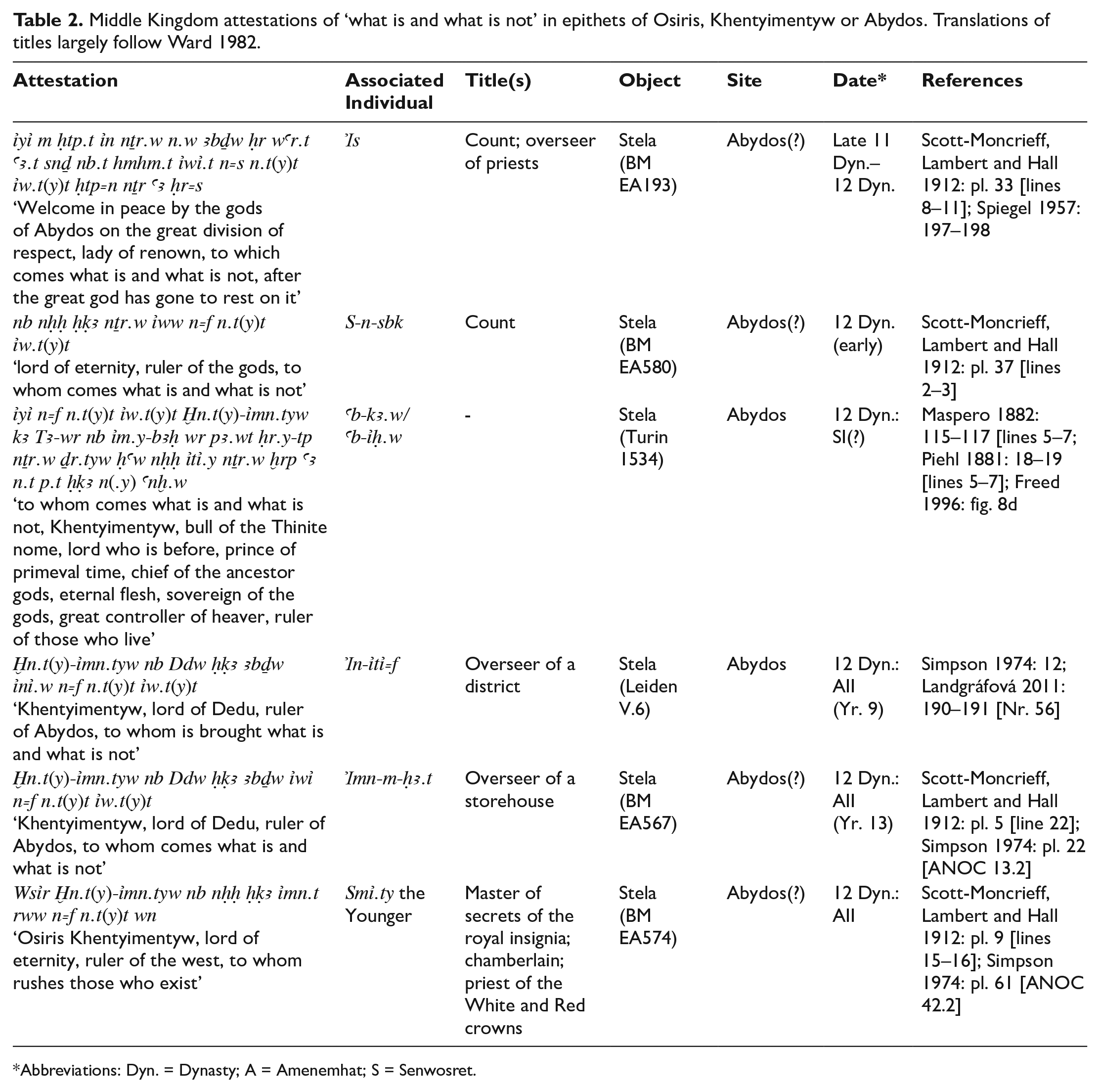
Additional epithets of the late 11th to 12th Dynasties are associated with Osiris, Khentyimentyw, and Abydos. As observed from the selection in Table 2, these can occur on stelae commissioned for officials with a range of duties. The epithets concern the ‘coming’, ‘rushing’ or ‘bringing’ of existent and non-existent entities to the deity or city. Stelae BM EA580 and EA574 identify Osiris as ‘lord of eternity’, supporting CT 335’s definition of the existent with eternity, and thus Osiris as ‘supervisor of what exists’. Stela Turin 1534 reveals additional pertinent details, classifying Khentyimentyw as the ‘prince of primeval time, chief of the ancestor gods’. This hints at the deity’s creative potential, and corroborates Hornung’s argument regarding the importance of the point of creation for understanding existent and non-existent entities.
Middle Kingdom attestations of ‘what is and what is not’ in epithets of Osiris, Khentyimentyw or Abydos. Translations of titles largely follow Ward 1982.
Abbreviations: Dyn. = Dynasty; A = Amenemhat; S = Senwosret.
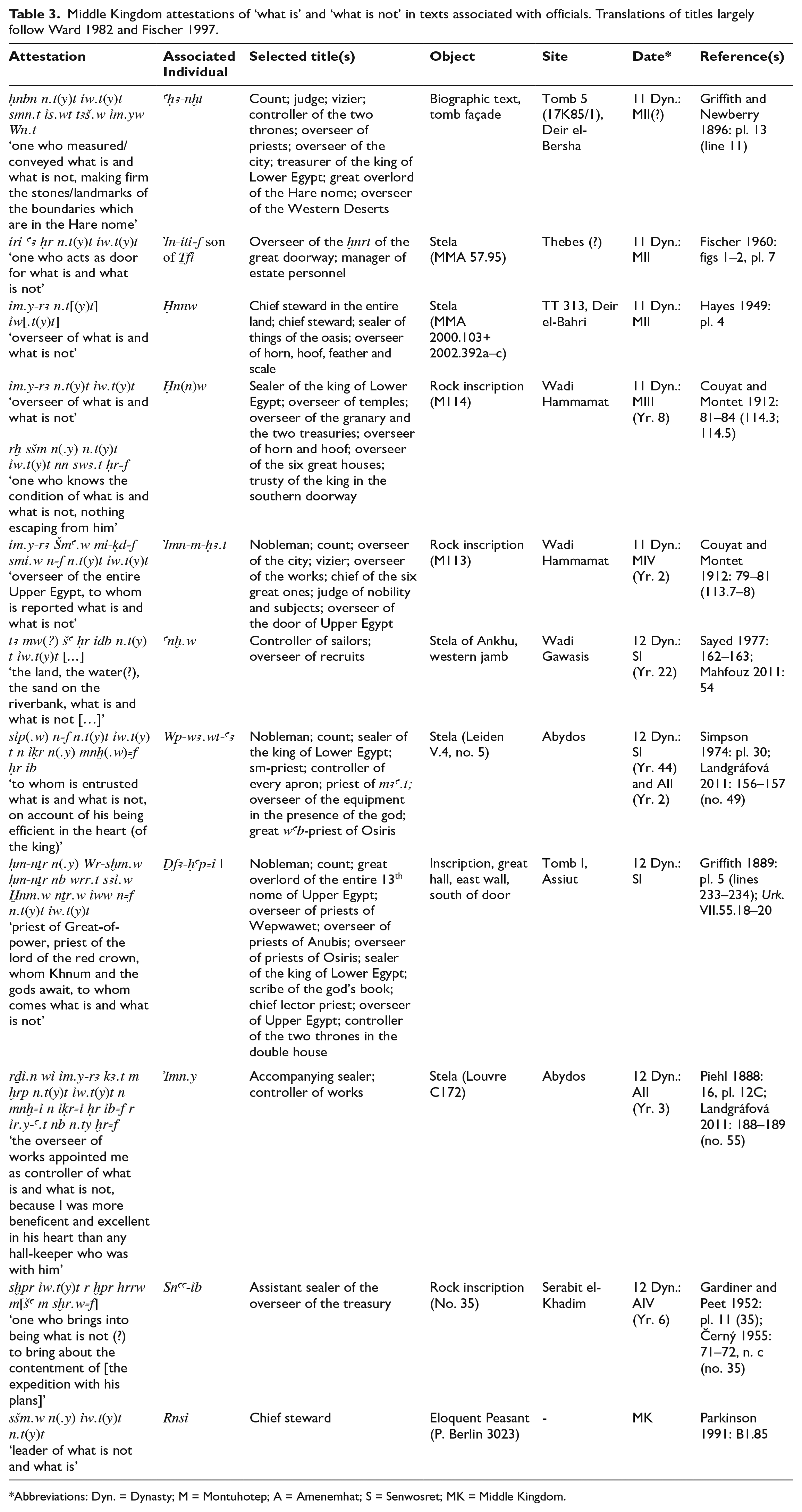
Nevertheless, the role(s) of the non-divine in such creation may be gleaned from texts that, in fact, are first attested before these epithets and before the Coffin Text occurrences. According to collated attestations (Table 3), the earliest thus far found is from the tomb of ʿḥȝ-nḫt at Deir el-Bersha. 53 It occurs in an epithet associated with ‘measuring’ what is and what is not, possibly in relation to this high official’s ability to demarcate, or newly create, the boundaries of his district. According to his other titles, ʿḥȝ-nḫt was also responsible for judiciary and cultic activities, and for expeditions to the Western Desert. Perhaps these could similarly infer his management of ‘measuring’ what is and what is not in relation to law and order, the cultic and the profane, and to paths beyond the Nile Valley.
Middle Kingdom attestations of ‘what is’ and ‘what is not’ in texts associated with officials. Translations of titles largely follow Ward 1982 and Fischer 1997.
Abbreviations: Dyn. = Dynasty; M = Montuhotep; A = Amenemhat; S = Senwosret; MK = Middle Kingdom.
The importance of boundaries is discerned in another epithet of Montuhotep II’s reign. ʾIn-ỉtỉ=f, son of Ṯfỉ, is ‘one who acts as door for what is and what is not’. The stela on which this is inscribed otherwise describes how the official kept commoners away from the king, and met with visitors at the palace. As such, Lichtheim notes that the official was ‘the “door” between the king and the people’. 54 His position as ‘overseer of the ḫnr.t of the Great Doorway’ could also point to another role. The Great Doorway may be associated with the former capital of the Herakleopolitan Dynasty, newly controlled by Montuhotep II and thus significant for the formation of the new state, 55 whereas a ḫnr.t at this time was likely a defensive enclosure. 56 Thus, hypothetically, as overseer of this defensive structure at Herakleopolis, the official perhaps acted as ‘door’ between what was part of the newly ordered state, and what was not (yet) part of it, consequently also protecting this boundary from potential hostility with entities that were not (yet) ordered, or from vulnerability to non-existence.
Another official under Montuhotep II, Ḥnnw, was ‘overseer of what is and what is not’. His fragmentary tomb inscription at Deir el-Bahri ascribes him with additional titles indicating possible expeditions to the Western Desert oases, as well as responsibility over animals. 57 The inscription also comprises a description of an expedition conducted by Ḥnnw, possibly to the Levant for the acquisition of timber. 58 This appears to be the first known state-sponsored expedition to this region that can be assigned to the 11th Dynasty. Another inscription from the Eastern Desert’s Wadi Hammamat attributed to the same Ḥnnw records how he resumed activities in the Eastern Desert, dug wells, and brought incense from Punt, again for seemingly the first time in the 11th Dynasty but during the reign of Montuhotep III. 59 Alongside these repeated expeditions are the official’s responsibilities as ‘trusty of the king in the Southern Doorway’ at Elephantine, from where activities further south to Nubia were coordinated. Perhaps these combined duties relate to another epithet in the Wadi Hammamat inscription that describes Ḥnnw as ‘one who knows the condition of what is and what is not, nothing escaping from him’. Accordingly, such knowledge and oversight of what is and what is not could be interpreted in several ways: they may be associated with responsibilities that are not well-explored in the inscriptions, such as those at the treasuries, at the temples, or over animals; or they may be correlated with Ḥnnw’s roles in conducting transregional activities and re-establishing expeditions on behalf of the new administration. Considering the focus of both inscriptions, the latter is more likely.
An association with a myriad of roles may also be suggested for ʾImn-m-ḥȝ.t. This official’s epithet as one ‘to whom is reported what is and what is not’ immediately follows his title as ‘overseer of Upper Egypt’, suggesting a reference to events that had and had not yet taken place. However, ʾImn-m-ḥȝ.t is also an ‘overseer of the door of Upper Egypt’, 60 again highlighting a possible association with a boundary between the perceived ordered and non-ordered entities. The very location of this inscription at Wadi Hammamat points to ʾImn-m-ḥȝ.t’s role in or management of an expedition to/via the Eastern Desert.
Two additional attestations have been found beyond the Nile Valley. Dating to Senwosret I’s reign is the fragmentary inscription of ʿnḫ.w at the Red Sea coast’s Wadi Gawasis. The text concerns an expedition to Bia-Punt, with mention of products from God’s Land. 61 Sayed’s transcription suggests the reading of line 8 as ‘their counting in a list of the sand upon the riverbank, that which is and that which is not’. 62 This has been interpreted as an emphatic indicator of the numerous range of goods brought back, 63 with n.t(y)t ỉw.t(y)t thereby translated as ‘everything’. Mahfouz, on the other hand, transcribes line 8 to directly translate to ‘their [creation], the land, the water, the sand on the riverbank, what is and what is not’, 64 which could instead describe the existent and non-existent entities that could be encountered along the path to/from Bia-Punt. The creation of what is not is otherwise inferred in Snʿʿ-ỉb’s inscription at Serabit el-Khadim. However, given the sentence in which it occurs, this probably refers to manifesting that which is not yet existent to ensure the success of an expedition. 65
Additional 12th Dynasty attestations may be related to cultic duties. A ‘controller of works’ ʾImn.y is described as ‘controller of what is and what is not’. His Abydos stela otherwise mentions ʾImn.y’s involvement in directing work in temples of gods across Egypt, 66 and the consequent presumed demarcation of the sacred from the secular. The inscription of Ḏfȝ-ḥʿp=ỉ I mentions the ‘coming’ of what is and what is not to the deceased, the epithet echoing those associated with Osiris, Khentyimentyw, and Abydos. This mayor was otherwise involved in temple duties, with his tomb inscription also known for its inclusion of contracts with priests of the main deities in his district. 67 As a ḥr.y sštȝ m Wsỉr ‘master of secrets/transformation of Osiris’ and bs štȝ n(.y) nb ȝbḏw ‘one initiated in the secrets/transformation of the lord of Abydos’, Ḏfȝ-ḥʿp=ỉ I was clearly closely associated with the Abydenian cult, 68 which may explain the attestation of ‘what is and what is not’ in his tomb. The (s)štȝ ‘secrets/transformation’ of the existent is otherwise featured in a 13th Dynasty stela from Edfu, which provides another mayor, Mḥ-ỉb-Ḥr, with the unique title ḥr.y sštȝ n.t(y)t wn.t ‘master of secrets/transformation of what exists’. 69 It is uncertain if the absence of the non-existent in this case may be associated with the official’s relation to Horus (as priest of Horus of Edfu) rather than Osiris. Similarly, it remains theoretical if the identification of Wp-wȝ.wt-ʿȝ on a stela from Abydos as one ‘to whom is entrusted what is and what is not’ is associated with his roles as priest of mȝʿ.t and great wʿb-priest of Osiris. 70
One other Middle Kingdom attestation regarding the existent and non-existent is worthy of mention. This occurs in the literary composition of The Eloquent Peasant. A main character, Rnsỉ, is identified by the Peasant as a ‘leader of what is not and what is’. As he is the official to whom the Peasant pleads for justice and who presents the Peasant’s case to the king, this epithet may be linked with (a) Rnsỉ’s delineation and judgement of order, which accords with his description as a sḥtm grg sḫpr mȝʿ.t ‘destroyer of falsehood, creator of mȝʿ.t’ 71 or a ỉwsw ‘balance’; 72 (b) hearing and reporting events that may or may not have occurred, and which could eventually be recorded, as occurs in the tale; 73 (c) Rnsỉ’s duty to act as ‘door’ between commoners and the king, in a manner similar to that posited for In-ỉtỉ=f son of Tfỉ; or (d) all of the above.
Overall, the titles and epithets of the non-divine in connection with what is and what is not signal at a wide range of possible interpretations. The initial attestation at Deir el-Bersha is thus far the earliest of the 11th Dynasty, predating known Coffin Text attestations at the site. Together with subsequent 11th Dynasty examples, the texts reveal significant aspects of what is and what is not. A high official could report, have oversight over, and have knowledge of the condition of what is and what is not. One could also measure and demarcate what is and what is not, as well as control their movement. In the 12th Dynasty, they could be entrusted, controlled, and led by officials. In one case, they came to an official as they would to a deity, and in another, what is not was probably even created. Accordingly, el-Sayed proposes that the expression was a means to honour officials of high rank who should have knowledge of the future, but also dominate and imagine it. 74 This brings the intriguing notion of non-existence as that which is not (yet) existent or known.
Still, due to the limited number of attestations across the variant sources, it is difficult to pinpoint to what degree attestations in titles and epithets reflect the concepts of (non)existence as represented in the Pyramid and Coffin Texts. The epithets of Osiris, Khentyimentyw, and Abydos signal at this correlation; however, there may exist several potential means to interpreting n.t(y)t ỉw.t(y)t in officials’ inscriptions. As aforementioned, if translated as ‘everything’, then n.t(y)t ỉw.t(y)t could be considered as a rhetorical totality: as a combination, or a new, slightly different, whole. Accordingly, the epithets and titles could be interpreted via either an epistemological or an ontological perspective, or both. For instance, an epithet for ‘one who acts as door for what is and what is not’ could refer to an official’s duties as doorkeeper of a broad range of goods and peoples. On the other hand, it could additionally refer to duties as a doorkeeper between the known and not (yet) known or the ordered and not (yet) ordered. As such, more nuanced meanings of n.t(y)t ỉw.t(y)t could be explored by understanding the terms both individually and collectively via such perspectives. The following section explores one such potential interpretation: namely, that concepts of boundaries may be correlated with attestations of what is and what is not. This is framed by the observation that most officials with epithets and titles concerning n.t(y)t ỉw.t(y)t held responsibilities along or beyond such limits, as well as the Pyramid and Coffin Texts’ representation of the individual’s role in manifesting what is and what is not (yet). It also employs Hornung’s suggestion regarding the pervasive potential of non-existence in the physical and cosmic realms.
A Case for the Role of Boundaries and Boundary Traversal
A boundary is defined as a general separator indicating any type of limit. 75 In many cases, the officials listed in Table 3 held roles linked with geographic limits of political or administrative units or borders. 76 These include boundaries between districts (ʿḥA-nḫt’s inscription) and those delineated as the Great and Southern Doorways (as in the texts of ʾIn-ỉtỉ=f and Ḥnnw). All were either in the process of being established or newly demarcated in the 11th Dynasty. Although they were not yet the fixed territorial boundaries typically conceptualised for the Middle Kingdom, they were still likely ‘imposed by command of the king,’ as per the Egyptian ideology of kingship. 77
Imposing boundaries also entailed their maintenance and their protection from threatening forces. Accordingly, both 11th and 12th Dynasty rulers continued third millennium BCE practices of representing their control over Egyptian districts and the subjugation of threatening forces. For instance, one fragmentary scene at Montuhotep II’s chapel at Gebelein depicts a procession of provinces, 78 highlighting their desired or actual acquiescence to the king. Another shows Montuhotep II smiting an Egyptian, behind which are three kneeling men each labelled as St.yw, St.tyw and Ṯḥnw.yw to identify groups from/beyond Egypt’s southern, north-eastern and western borders respectively. 79 This represents the aggressive subordination of peoples who were conceived as threats to the king’s newly ordered realm, as supported by the scene’s caption specifying wʿf tp.(y)w tȝ.wy grg Šmʿw tȝ Mḥw ḫȝs.wt ỉdb.wy pḏ.t 9 nw.t […] ‘subduing the chiefs of the Two Lands, setting in order Upper and Lower Egypt, the foreign lands, the two banks, the nine bows, the towns […].’ Clearly, it was of equal importance for the king to maintain the internal stability of Egypt’s territory as it was to control forces beyond this territory.
To further protect Egypt’s imposed boundaries and control the movement of goods and people across its limits, the administration commissioned the construction of structures or monuments at strategic locations. Alongside the Great and Southern Doorways, those of the early Middle Kingdom include boundary stelae as well as enclosures. 80 Examples are the so-called Walls of the Ruler, which were evidently built to keep out north-eastern groups, or to ḫsf ‘repel’ the St.tyw and ptpt ‘crush’ the Nmỉ.w-šʿ as in the Tale of Sinuhe, 81 and nn rḏỉ.t hȝỉ.y ʿȝm.w r Km.t ‘to not allow the ʿȝm.w to descend to Egypt’ as in the Prophecies of Noferty. 82 The Prophecies note the intended result: ỉw mȝʿ.t r ỉyỉ.t r s.t=s ỉ[sf.t] dr(.ty)=sy r rw.ty ‘Mȝʿ.t will return to its place, ỉsf.t being driven out’. 83 The re-establishment and maintenance of the internal and external boundaries of the 11th and 12th Dynasties were thus represented as a means to continuously create organisation, and consequently maintain mȝʿ.t.
This fits well with the ideology of mȝʿ.t and ỉsf.t that aligns the physical with the cosmic realms. However, focussing only on the hostile, threatening aspects of ỉsf.t may problematise the traversal of boundaries for reasons other than protection and defence. Why would Egyptians be involved in such activities if they were conceived to be as dangerous as purported by the conceptualised opposing principles of mȝʿ.t and ỉsf.t? According to such inscriptions as those of Ḥnnw, the new administration was commissioning expeditions beyond Nile Valley communities to (re-)establish control over strategic routes, but also to retrieve desirable resources. These included the various minerals, metals, flora and fauna of the Eastern and Western Deserts, as well as the resources of more distant areas such as the Levant, the Red Sea coast, Punt, or the Western Desert Oases.
Combined with the implication that the continuous creation of order could lead to encounters with non-existence with its potential for renewal and creation, the attestations of ‘what is’ and ‘what is not’ in the early Middle Kingdom offer different understandings. They provide a further justification as to why the perceived limits of mȝʿ.t were traversed and managed by the king and, especially, by non-royal individuals who would have to ensure the continuation of existence at these boundaries. Perhaps individuals who were responsible for delineating or protecting boundaries, and navigating through or to deserts, were associated with encountering the existent and the non-existent. This would support, for instance, the interpretation of such creatures as griffins in desert landscapes of 11th to 12th Dynasty tomb scenes as a possible ‘reflection of the desert’s chaotic and strange character’. 84 It also agrees with later attestations of potential encounters with griffins near the Red Sea coast. 85 As representatives of their ruler, officials would have to traverse and/or protect the newly established boundaries of order, but in doing so they might also acquire new knowledge or commodities, or encounter new groups that had not yet been known by the ruler or by leading officials, especially in the 11th Dynasty period of state formation. These may then represent the potential of non-existence. The boundary-traversers would thus be responsible for what is and what will be, as well as what is and what is not, whereas the non-existent offered potential for knowledge, routes, resources, and valuable social relations.
This interpretation should not be assumed to reflect the pharaoh’s reduced role in controlling ‘foreign’ affairs. The attestations indicate that many, if not all, of the officials’ activities were commissioned by a king. Moreover, it was not only earthly or geographical boundaries that were assumed to be traversed or delineated, but those wherein non-existence may generally pervade existence, where mȝʿ.t had to be maintained so that ỉsf.t may be recognised or ‘seen’ (CT 540; Table 1). Following Englund, the Duat may similarly be conceptualised as ‘neither good nor bad’, with potential for hostility and renewal, where knowledge is available but dangerous forces are also present. 86 If the Coffin Texts point to the individual’s role in determining what is and what is not and in becoming who is and who is not in the realm of the dead, then perhaps this role was paralleled in the realm of the living. It is, therefore, tempting to infer that expressions regarding ‘what is’ and ‘what is not’ emerge in the early 11th Dynasty due to either a transforming ontology or a transforming means to represent it across a wider range of texts. That is, the surviving texts suggest that ‘what is’ and ‘what is not’ are newly associated with individuals who were responsible for achieving stability, and possibly represent individual agency over a rhetorical ‘everything’. Perhaps, this might be linked with the early second millennium BCE political crisis experienced in Egypt when it was not ruled by one pharaoh who would maintain mȝʿ.t.
Conversely, the Coffin Texts also highlight how individuals could transfigure into spirits, navigate the path to Rostau, and join the company of deities. As such, the expressions on ‘what is’ and ‘what is not’ may instead correlate with the increased representation of the non-royal individual’s role in cosmic processes, and in creating, negotiating, and maintaining mȝʿ.t in the physical and cosmic realms. 87 Accordingly, this may reflect the ontology of the self as Osiris in death, with Osiris, Abydos, and Khentyimentyw receiving existent and non-existent entities, and Osiris ruling those who are and who are not. Whether this is then due to the political changes of the Old to Middle Kingdoms, the religious developments across this period, the growing importance of the cult of Osiris, 88 or merely the nature of the preserved evidence, remains uncertain. Still, such observations stress that mȝʿ.t and ỉsf.t should not only be studied in reference to the pharaoh; the agency of non-royal individuals who were involved in traversing, delineating, or controlling liminal spaces should also be considered. By knowing, reporting, controlling or leading what is and what is not, officials could be signifying considerable responsibilities in managing and coordinating cross-boundary activities.
Conclusions
The analysis of attestations of n.tyt ‘what is’ and ỉw.tyt ‘what is not’ has led to several interpretations regarding conceptualisations of boundaries, the world, and the self. The translation of the terms together as ‘everything’ is not incorrect, but should be approached in consideration of the rhetorical totality of manifestations, particularly in relation to what is not and what is not yet. The variations in use from the late third to early second millennium BCE point to a wider range of sources in the early Middle Kingdom, and perhaps widening understandings of existence and non-existence. Those in the Coffin Texts signify an association with creation and manifestation, as well as the role of Osiris as a ruler of those who are and those who are not. Those who are seem to have been approached as those who appear before Osiris; those who are not were unsuccessful in traversing the paths to Rostau, never having achieved mȝʿ.t ‘order’. As CT 540 suggests, what is not cannot recognise ỉsf.t ‘chaos’. The direct identification of ‘what is not’ as ỉsf.t, however, is not clearly stated in the Coffin Texts nor in other examined attestations. This neutrality between mȝʿ.t and ỉsf.t supports the potential for hostility and renewal perceived to be offered by non-existence.
Yet, such potential requires manifestation and organisation. While the pharaoh is typically assumed to be responsible for creating and maintaining mȝʿ.t, officials were also tasked with this important duty. As discussed, the early Middle Kingdom occurrences of n.tyt and ỉw.tyt indicate that officials could oversee, report, control, measure and have knowledge of what is and what is not. A case for the role of boundaries in these activities was proposed, with their delineation conceptualised as a form of creating and maintaining mȝʿ.t. Those involved in traversing or protecting such boundaries may have conceived their activities in association with what is and what is not, with the latter offering potential for new knowledge, desired commodities, or fruitful relations, but also hostile confrontations.
These diverse outcomes of cross-border activities in the Middle Kingdom are well-known. However, approaching them only via the opposing concepts of mȝʿ.t ‘order’ and ỉsf.t ‘chaos’, with the latter threatening Egypt and Egyptians, can problematise the ideological justification for travelling beyond the limits of mȝʿ.t in search for resources or diplomatic relations, especially when such exchange and interactions were not yet state-controlled nor formalised. Instead, a consideration of the potential of non-existence would support such activities by non-royal individuals. This slight shift in conceptualisation amplifies the role of individual agency in the maintenance and traversal of different types of boundaries. It also leads to the question whether entities from beyond these boundaries could have been perceived to have the potential offered by non-existence. If so, this may have wider implications on how Egyptologists study ontologies of the early second millennium BCE, as, for instance, those regarding identity and the perception of individuals originating from and beyond the boundaries of the Egyptian state. Therefore, there remains more research to be completed on ancient Egyptian ontologies, particularly in relation to mȝʿ.t, ỉsf.t and their boundaries, and how these may have transformed alongside socio-political and religious developments. At least for the early second millennium BCE, the expressions regarding ‘what is’ and ‘what is not’ offer pertinent insight on the role of individuals and, possibly, on the nature of boundaries at a transitional period when they were once again being (re)structured.
Footnotes
Acknowledgements
Some of the ideas in this paper were first presented at the University of Sydney’s Being and Nothingness in Antiquity conference held in 2022, for which I thank Professor Dean Rickles for the invitation. A preliminary version was also presented at the Sixth Australasian Egyptology Conference 2022. I am additionally grateful to Professor Bronwen Neil for reading and commenting on an earlier draft, as well as Gemma Green for her assistance in proofreading the article. Thanks are further owed to the article’s reviewers for their valued feedback. Suffice to say, any errors herein are my own.
Funding
Funding for this work was supported by a Macquarie University Research Fellowship for the project ‘The Ties that Bind: Negotiating Foreign Relations in the Second Millennium BC’.
1.
Hornung 1971;  .
.
2.
5.
For more on the ontological turn, see Henare, et al. 2007; Holbraad 2012; .
6.
Examples that specifically employ the ontological turn include Nyord’s reappraisal of Egyptian mortuary religion (Nyord 2017; Nyord 2018), Matić’s evaluation of the pharaoh as Montu (Matić 2019), and Brémont’s study on the desert (Brémont 2018). Contributions that share a similar approach, albeit not in direct reference to the ontological turn, include .
7.
For instance, Schneider 2003; S.T. Smith 2003; S.T. Smith 2018; Hubschmann 2010; Liszka 2012; Näser 2012; van Pelt 2013; Bader 2021; Boozer 2015; De Souza 2020; Mourad 2015; .
8.
See, however, Quirke 1989; Assmann 1996; Galán 1995; O’Connor 2003; .
9.
For more on mȝʿ.t and ỉsf.t, see Hornung 1956; Assmann 1990; Ockinga 2001; .
10.
For more on the pharaoh and mȝʿ.t, see Assmann 1970: 65; Blumenthal 1970: 432–441; : 1–4.
11.
See, for instance, Brémont 2018; .
14.
Interestingly, all are attested in the corridor of Pepy I’s pyramid. These include PT 511 (Allen’s P 450; Sethe’s Pyr. 1160b), which concerns the act of saying what is and its negation, or ḏd ḏd n.t(y)t ỉm=k ḏd ỉw.t(y)t ‘Speaker, say what is and do not say what is not’ (: 154). One other spell, PT 507 (Allen’s P 461; Sethe’s 1102a) mentions one who has and one who has not, specifically: ỉ ḥm.ty n n.ty n=f ỉw.ty n=f ʿȝ ‘Helmsman, say to him who has that he who has not is here’ (Allen 2005: 157).
15.
See Finnestad 1989; Sørensen 1989; Willems 2008: 131–140; M. Smith 2009; Willems 2014: 124–135; Nyord 2021; .
16.
Mathieu 2004; .
17.
Willems 2008: 213–214; .
18.
Coulon 2004; Hays 2004: 190–191; .
19.
Jürgens 1995: 6–7; Willems 2008: 140–142; : 226.
20.
22.
For the Book of Two Ways, see Schack-Schackenburg 1903; Grapow 1909; Lesko 1971; Lesko 1972; Hermsen 1991; Rößler-Köhler 2003; Backes 2005; .
25.
De Buck 1951: IV.200–201; : 262 (IV.200).
26.
These include B9Cb, M54C, M1C, L3Li, M1Ny, Sq1C, Sq7C, M8C, M7C, B1P, T1Be, M57C, T2Be, T3Be and T3L. De Buck 1951: IV.200–201. In addition, a few witnesses (Sq1C, Sq7C, Sq1Sq and BH1Br) clarify: ỉr nḥḥ rʿ pw ỉr ḏ.t grḥ pw ‘As for eternity, it is day; as for everlasting, it is night’ (De Buck 1951: IV.202). For more on glosses or commentaries in CT 335, see Rößler-Köhler 1995; .
28.
See CT 404 (De Buck 1954: V.196a; : 50 (V.196)), CT 693 (De Buck 1956: VI.326; Faulkner 1977: 258 (VI.326)), and CT 782 (De Buck 1956: VI.412; Faulkner 1977: 306 (VI.412)).
29.
De Buck 1961: VII.293–294; : 134 (VII.293–294). See also CT 1151 (De Buck 1961: VII.501; Faulkner 1978: 181 (VII.501)).
30.
CT 587 (De Buck 1956: VI.209; : 190 (VI.209)).
31.
See CT 638 (De Buck 1956: VI.260; : 217 (VI.260)).
32.
De Buck 1938: II.400a; : 140 (II.400).
33.
De Buck 1951: IV.60e; : 224 (IV.60).
34.
Goodwin 1876: 102–103 (2); Gardiner 1957: 153 (§203.4); Fischer 1973: 5 n. 2; : 360 n. 2.
37.
De Buck 1935: I. 332–338; Faulkner 1973: 72 (I. 332–338). For more on this spell, see : 14–18.
38.
De Buck 1938: II.10–17; Faulkner 1973: 77–80 (II.10–17). As Allen (1988: 20) notes, ‘the meaning of tnm.w may be associated with its root verb tnm “to go astray” and relate to the ‘undetermined character of the external universe (“Nowhere” vs. the defined “Where” of the world) or to its lack of order’. For more on this spell, see Allen 1988: 18–21; Bickel 1994: 26–27. For more on Nu and the pre-creation universe, see Pépin 1989; Rotsch 2005; Bickel 2005; Popielska-Grzybowska 2017; Assmann 2019: 21; : 2–7.
39.
Bickel 1994: 31; : 13–15.
40.
43.
Hornung 1982: 180–85. Nu is also described as having potential for creation and destruction (: 22).
46.
Faulkner suggests that Spell CT 540, line 136k, is corrupt, and instead translates it as: ‘I detest him who will not see wrong’ (Faulkner 1977: 158 (VI.136)). Its translation in Table 1 follows : 181.
53.
The tomb’s dating to the reign of Montuhotep II, probably after the reunification of Upper and Lower Egypt, follows Willems 2007: 84–88. See also Brovarski 1981; .
54.
Lichtheim 1988: 51 n. 6. For more on gatekeepers in ancient Egypt, see .
56.
Quirke 1988; : 94–95.
61.
Sayed 1977: 162–163; : 88–89.
62.
Sayed 1977: 162–163. This translation is by Cruz-Uribe, as published in : 89.
66.
Piehl 1888: 16, pl. 12C; : 188–189 (no. 55).
67.
Griffith 1889: pls 6–8 (lines 273–324); .
68.
Griffith 1989: pls 4 (230), 9 (347); Urk. VII. 54.18, 65.17. For the title ḥr.y sštȝ ‘master of secrets’, see Rydström 1994: 76; Beatty 2000; Balanda 2009. has proposed the translation of sštȝ as ‘transformation/disambiguation’.
69.
Edfu 10 (Stela Cairo CG 20530). Ward 1982: 121 (1024); Kubisch 2008: 208–213, fig. 13 (line 6), pl. 5 (line 9); Trapani 2007: 1831, fig. 1, pl. 1 (line 9). The dating follows : 285.
73.
79.
Habachi 1963: 39, fig. 17, pl. 11b; Brovarski 2010: 61; : 11, 52, fig. 15.
80.
Quirke 1989; Galán 1995: 104–114; Török 2008: 79–92; Moreno García 2016: 112; .
84.
McDonald 2017: 32. Among the earliest is the griffin depicted in the tomb of ʿḥȝ-nḫt at Deir el-Bersha (Griffith and Newberry 1896: pl. 16). See also the griffin in the tomb of Nhrỉ at Deir el-Bersha, and the composite creatures in the Beni Hassan tombs of Bȝḳ.t III, ẕtjj and ẕnm.w-ḥtp(.w) II, most recently recorded in Kanawati and Evans 2014: pls 37a, 124, 127c; Kanawati and Evans 2018: pls 13a, 67; Kanawati and Evans 2020: pls 17b, 94–95. For more on the interpretation of these scenes in reference to order and chaos, see Houlihan 1996: 43–44. See also Vasiljević 2003; .
85.
Darnell 1995: 80; Quack 2009: 349. For more on griffins in ancient Egypt, see Wengrow 2014; Gerke 2014; .
87.
For more on mȝʿ.t in Middle Kingdom society, see Lichtheim 1992; : 484–485.
88.
For more on the cult of Osiris, see J.W. Wegner 1996; : 57–104.