




Abstract
Pliny the Elder mentions two Egyptian stones he names as marmor Augusteum and marmor Tibereum (NH 36.55–56). The implied imperial connections and early dates make it of great interest to identify the stones and sources. Recent survey work and new documents prove that Tibereum was quarried at Wadi Barud, just south of Mons Claudianus, and is the granito bianco e nero of the Italian artisanal tradition. The fact that this quartz diorite was used in imperial palaces on the Palatine Hill (the Domus Tiberiana and the Domus Transitoria) – and hardly elsewhere – further raises the stakes for m. Augusteum. This paper examines the evidence assembled to support a proposal, the only one to date, to identify Augusteum with ophites (granito della sedia) from Wadi Umm Wikala/Semna, and concludes that it is insufficient. It then assesses other possibilities and ends with a tentative suggestion for another identification. This paper is dedicated to the memory of Amanda Claridge, with whom I first went to Egypt.

Introduction: What’s at Stake
Near the end of his Natural History, Pliny the Elder mentions stones called marmor Augusteum (‘Augustan marble’) and marmor Tibereum (‘Tiberian marble’), discovered in Egypt during the reigns of the respective emperors. 1 The imperial names are attention-grabbing, particularly m. Augusteum, partly because the stone Pliny describes remains unidentified, but more importantly because Augustus was the first Roman ruler of Egypt. Anything bearing upon his policies is of unusual interest, especially in the mineral-rich northern half of the Eastern Desert whose organization remains poorly documented and unclear in comparison to the larger part of the desert, long oriented toward the rich trade with east Africa and India. 2 Thus, at a minimum, the name m. Augusteum must be a reliable guarantor of an Augustan date (early or late), for the beginning of quarry works, or at least the preparation of essential infrastructure.
In the first century of Roman rule in Egypt, imperial toponyms and epithets were frequently mere ‘loyalist’ honorifics and do not necessarily imply any specific imperial involvement. 3 But in contrast to names bestowed on, for instance, individual quarrying areas (latomiai) within organized districts (metalla), imperial names for metalla themselves are consistent with the commitment of considerable resources pursuant to official policy. 4 Thus, m. Augusteum is the first of an evident series of three, along with m. Tibereum, now identified as the stone quarried at the metallon Tiberianón, centred on the fort Tiberiane in Wadi Barud, 5 and the famous m. Claudianum, the tonalite gneiss at Mons Claudianus (fig. 1). 6 The workings of Tiberianón are substantial, with a main quarry site and several smaller quarries with slightly different textures. 7 The district called Mons Claudianus was an order of magnitude larger, with 130 working sites identified and complex infrastructure including slipways, loading ramps, watch towers, a large fort, and several shrines. 8 The progression in size in the series from quite small, as the Augusteum operation must have been (see below, section ‘If not ophites…’), to moderate to gigantic is probably not fortuitous but a direct product of growing imperial investment. Of course, we are not entitled to tie the specifics of development in the desert to the emperors named: Tiberius was notably disengaged from the details of provincial governance, and at Mons Claudianus there is almost no physical evidence of activity as early as the reign of Claudius himself (AD 41–54). But the overall trend is clear, as is its purpose since the products of both the metallon Tiberianón and Mons Claudianus were restricted to imperial buildings in the capital. 9 M. Tibereum is now convincingly identified with granito bianco e nero, as it is known in the Italian artisanal tradition, and its first certain appearance is in the fountain court (the so-called Bagni di Livia) in Nero’s Domus Transitoria (c. AD 60–64). 10 This is also where the similar but more abundant granito del foro from Mons Claudianus made its debut, most famous (as its Italian name reflects) for its use in the Forum of Trajan, as well as the porch of the Pantheon. 11 This paper examines the only identification proposed to date for m. Augusteum and finds it problematic on several fronts. Alternatives are canvassed, and one is tentatively put forward.
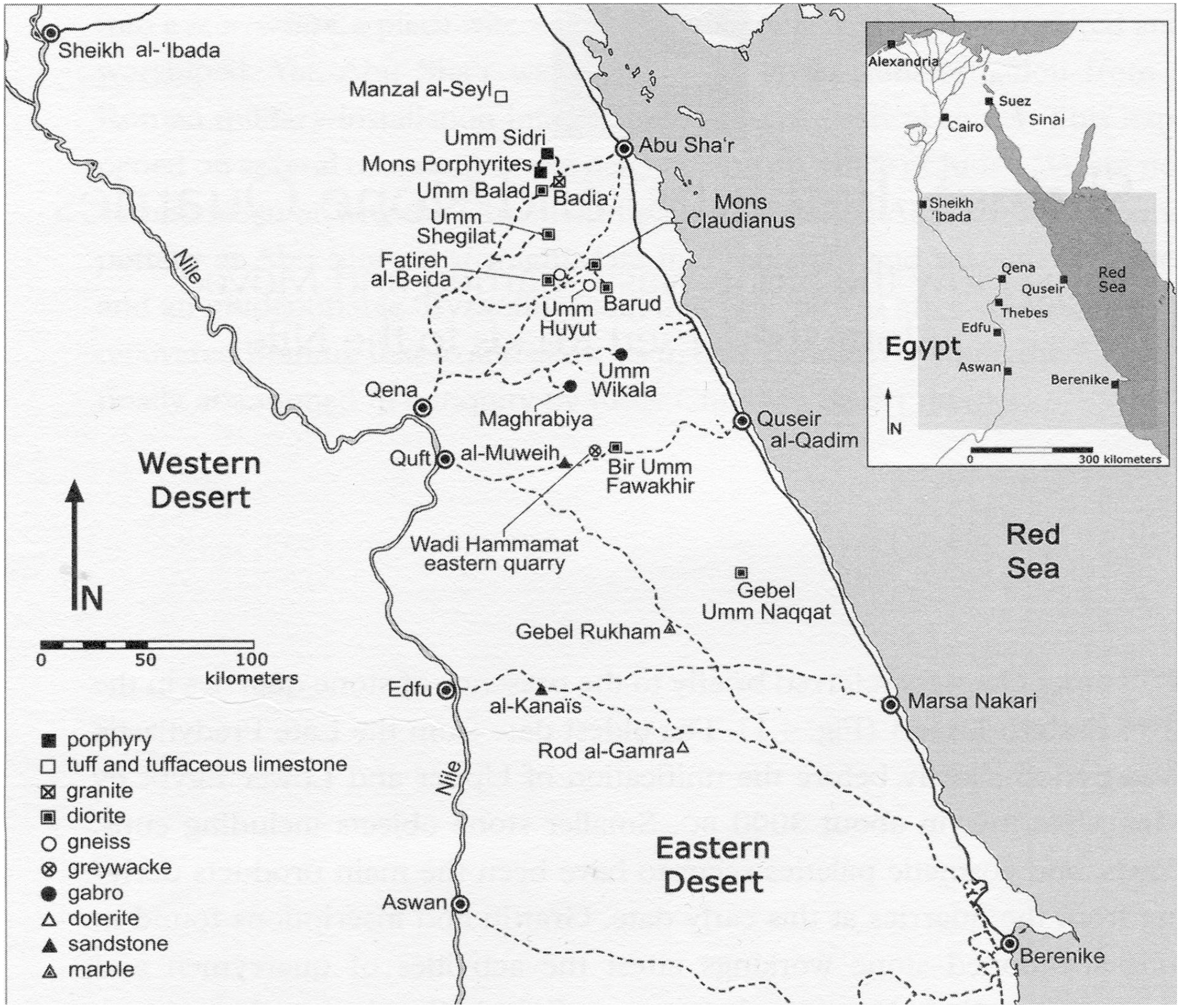
The major quarries in the Eastern Desert (map after Sidebotham, et al. 2008: fig. 4.1).
In 2001, the team of S. Sidebotham, H. Barnard, J. Harrell, and R. Tomber published the results of the first (and still the only) survey of the largest quarry site in the Eastern Desert after Mons Claudianus and Porphyrites, at Wadi Umm Wikala at its confluence with Wadi Semna.
12
This valuable contribution opens with a discussion of a key inscription on a stela, dated AD 11, dedicating a Paneion and naming the locale as (Mons) Ophiates. The text is commonly called the ‘curator’ inscription after Tregenza’s convenient designation (see ‘The “curator” inscription’, below). It connects with Pliny the Elder’s discussion of the stone ophites as well as of marmor Augusteum and marmor Tibereum, which – it is worth emphasizing – are mentioned nowhere else in ancient literature, Latin or Greek. The authors of the Wadi Umm Wikala survey argue for identifying ophites as marmor Augusteum. This is their argument in full: In his Natural History, completed about AD 77, Pliny describes a stone he says comes from Egypt and is called ophites (= ‘snakey’) because of its resemblance to a snake’s markings (NH 36.11.55–6). He distinguishes two varieties of ophites: marmor Tibereum and marmor Augusteum. The former is now known to refer to the quartz diorite quarried by the Romans in the Eastern Desert at Wadi Barud. Of the Augusteum ophites, Pliny says it was ‘found in Egypt for the first time during the principate of Augustus’ and that its markings ‘curl over like waves so as to form coils’. He next recognizes yet two other varieties of ophites: molle candidi, ‘soft and light coloured’, and nigricantis durum, ‘hard and dark coloured’ (NH 36.11.56). The soft variety may be a talc-rich rock called steatite (or soapstone) that the Romans are known to have quarried in the Eastern Desert. This rock typically does have contorted layering and so conforms well to Pliny’s description of marmor Augusteum. The authors discovered a steatite quarry dating from the late first through early third centuries AD in Wadi Saqiyah, 11.5 km south of Wadi Umm Wikala. The rock from this quarry is actually a moderately dark greyish-green but in other localities, where the talc content greater, the colour is much lighter. Although its markings are unlike those described of marmor Augusteum, the hard, dark variety of Augusteum ophites is clearly the gabbro from Wadi Umm Wikala, given the date of the ‘curator’ inscription and the name it provides for the quarry. Lucan’s description of ophites in his Pharsalia strengthens this attribution. In this work Lucan says (Pharsalia 9.712–14) that ‘the conchris (a type of snake), … moves ever in a straight line – its belly is more thickly checkered and spotted than the Theban (= Egyptian) ophites with its minute patterns’. This description fits well the appearance the medium-grained Wadi Umm Wikala gabbro with its light-coloured plagioclase grains scattered amongst the much darker pyroxene and hornblende.
13
We can consider this argument under three heads: the philology of the Pliny passage, the significance of the ‘curator’ inscription, and the usefulness of Lucan’s lines alluding to ophites.
Understanding the Pliny Passage
Despite Pliny’s rambling style and almost offhand use of the Augustan and Tiberian as examples of stones found underground, rather than in open-cast quarries, he is really giving them a rarefied standing, as belonging to the pretiosissimum genus, the most prized kind of stone. But, as often, he backs into his theme, which is that he is winding up his survey of the most celebrated stones with these two; the long first sentence undercuts his point by saying that there are so many famous marbles from so many places that it is hardly worthwhile trying to give a full account. But his focus becomes clearer as he devotes the rest of the section to famous Egyptian stones familiar from uses in the Roman capital (after this section he continues on to discuss porphyrites, i.e. purplish-red porphyry, and basanites, bekhen stone). He opens this discussion by carefully distinguishing the Augustan and Tiberian from ophites with detailed descriptions: differentia eorum est ab ophite, ‘they have this difference from ophites’, which lies in the markings. Another difference is that ‘only quite small columns from ophites can be found’.
Ophiates/ophites as a place name links up nicely with the stone of Pliny and Lucan called ophites, snakelike, from the Greek ὄφις, and is in turn known to the Italian artisanal tradition as granito della sedia di S. Lorenzo (fig. 2) or di S. Pietro, 14 the latter being a variation with rare patches of larger grains. The rock is not a granite, but a gabbro or metagabbro. Gnoli was apparently the first to connect ophites with granito della sedia. 15 He further tied it to Pliny’s marmor Augusteum. But I believe that in construing the passage he made a rare mistake. He translates the crucial words of Pliny as I do: ‘They [that is, Augusteum and Tibereum] differ from ophites in this, that while the former is similar to the markings of serpents…’ But here and in page 155, footnote 2 he says, ‘in common usage of the Julio-Claudian period the word ophites embraced also the two varieties which Pliny calls marmor Augusteum e marmor Tibereum…’ 16 This view may spring from a passage he cites from Dioscorides, 17 noting, as Pliny does, that ophites came in two varieties (hard and soft), but then concluding ‘l’ofite doveva abbracciare diversi tipi di pietre macchiettate’. But how he moves from two varieties to the open-ended diversi tipi, and then connects these to Pliny’s Augusteum and Tibereum, remains unclear to me. The clear import of Pliny’s sentence is that ophites is one entity, albeit in soft, light-coloured and hard, dark-coloured varieties, and the two imperial marbles entirely separate entities. The authors of the Wikala report, however, follow Gnoli (knowingly or not) in understanding Pliny as saying that Augusteum and Tibereum are varieties of ophites.
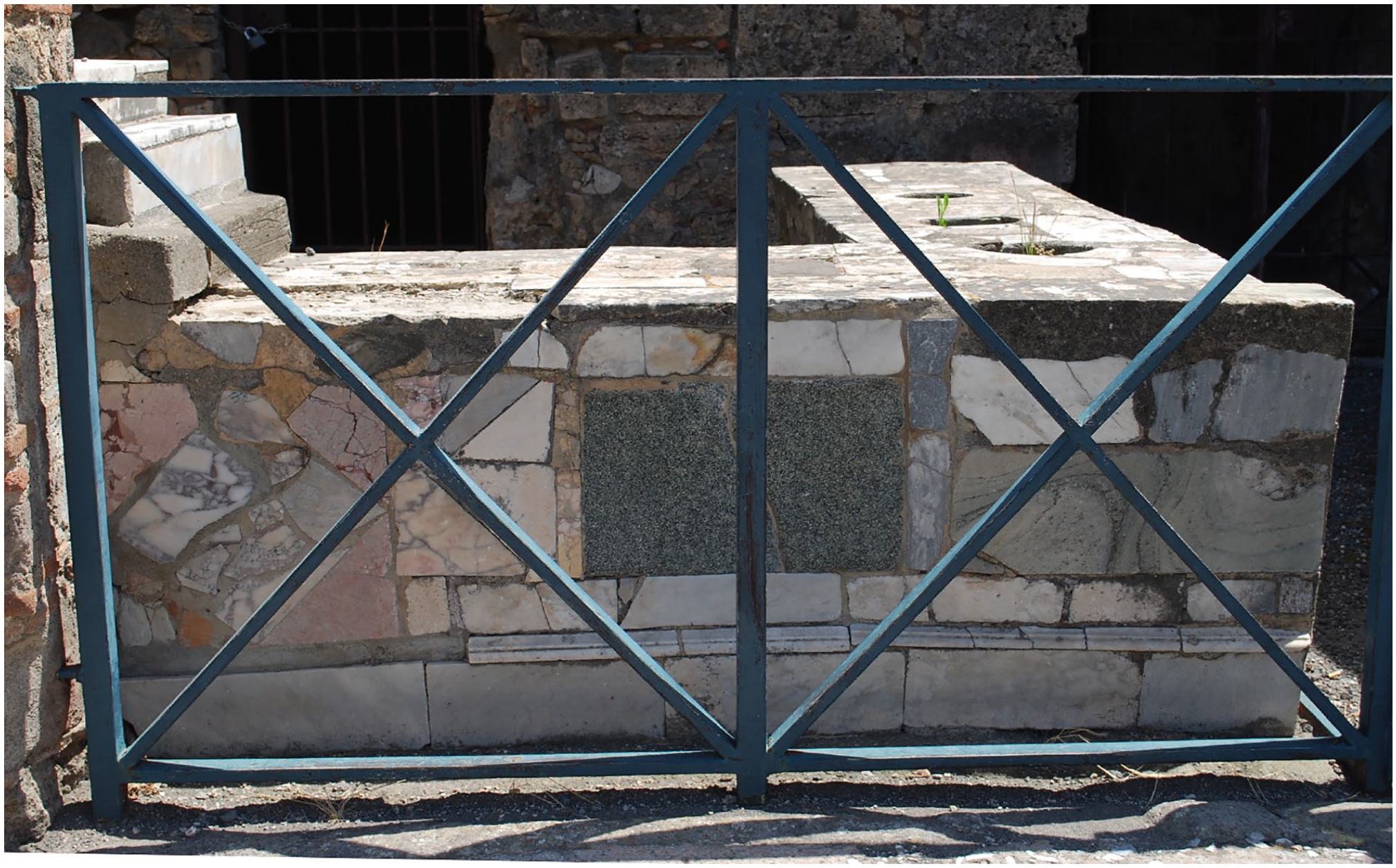
Detail of plaque of ophites/granito della sedia di S. Lorenzo, 47 cm by 30.5 cm, façade of bar VI 10, 1 at Pompeii (photo: S. J. Barker, courtesy Parco Archeologico di Pompei).
Here is Pliny’s Latin text:
18
marmorum genera et colores non attinet dicere in tanta notitia nec facile est enumerare in tanta multitudine. quoto cuique enim loco non suum marmor invenitur? et tamen celeberrimi generis dicta sunt in ambitu terrarum cum gentibus suis. non omnia autem in lapicidinis gignuntur, sed multa et sub terra sparsa, pretiosissimi quidem generis, sicut Lacedaemonium viride cunctisque hilarius, sicut et Augusteum ac deinde Tibereum, in Aegypto Augusti ac Tiberii primum principatu reperta. NH 36.54–56 [boldface added] Not all [of the most famous stones] are born in quarries, however; many, even some of the most prized, in fact, are also scattered under the soil; examples are the Lacedaomonian, green and more cheerful than all others, the Augustan marble and then the Tiberian marble, first discovered in Egypt in the reigns of those emperors. They
Pliny says twice that the imperial namesake ‘marbles’ differ from ophites: differentia eorum est ab ophite, and neque ex ophite columnae nisi parvae… The value of neque here is not ‘and’ with a trailing negative, but to connect two negatives, with differentia understood as a negative: ‘not the same as…’ Hence I gladly borrow ‘another difference’ verbatim from Eichholz in the Loeb edition. 20 It could be tempting to assume that the only reason Pliny brings in the imperial stones here is because of a close resemblance, variations on the general type of ophites. The connecting thread, though, is more likely to be their Egyptian origin. In fact, in the last line quoted, he goes on to say that there are two varieties of ‘it’, eius, singular, which can only refer to ophites, not to the two imperial stones. Failure to observe these distinctions seems to have led the survey report authors to identify five forms of ophites: ophites as the broad category, ‘Augusteum ophites’ (two words which are never juxtaposed in ancient texts), Tiberian ophites (which they correctly note is now identified as granito bianco e nero from Wadi Barud), and then ‘yet two other varieties of ophites: molle candidi, “soft and light coloured”, and nigricantis durum, “hard and dark coloured”’, which then is turned back to reconnect with Augusteum, while the soft and light kind is proposed to be the soapstone found in quarries a few kilometres south of Wadi Umm Wikala. The category of ophites, both in colour and hardness, has become so broad as to lose usefulness.
Pliny’s descriptions of stones are not always as straightforward as they appear at first sight. For instance, the ophites description is incomplete: he is interested in the pattern of markings, like those of ‘snakes’, plural. 21 Lucan, in contrast, tells us the name of the specific snake (see the section on ‘Lucan’s comparison’, below). Pliny does not mention the prevailing green hue of the stone at all. Thus, we would be right to be cautious of his description of m. Augusteum. However, we do have a proxy to measure it by, m. Tibereum, which Pliny says ‘has grey markings that are dispersed, not rolled up’. Granito bianco e nero is just that, a quartz diorite with large black hornblende crystals more or less evenly distributed on a white ground (fig. 3). 22 While Pliny’s canities, white like grizzled hair, may seem a bit off for the pure white of fresh samples, his observation of the pattern, that the markings are isolated from each other rather than coiled up in clusters with overlapping grains, is quite specific and accurate. The quarries at Wadi Barud, near Mons Claudianus, have been recognized as the source of a black and white quartz diorite at least since Murray, 23 while Gnoli seems to have been the first to identify the stone with granito bianco e nero, 24 and subsidiary quarries with slightly different textures have since been found. 25 When the fort below the quarries was explored by Peacock and Maxfield, ostraca were found naming the fort Tiberiane 26 and the quarry field itself metallon Tiberianón. 27 The adjectival forms of the name Tiberius and the close match of Pliny’s description together support the identification of m. Tibereum as granito bianco e nero, and this has been widely accepted in the literature. 28
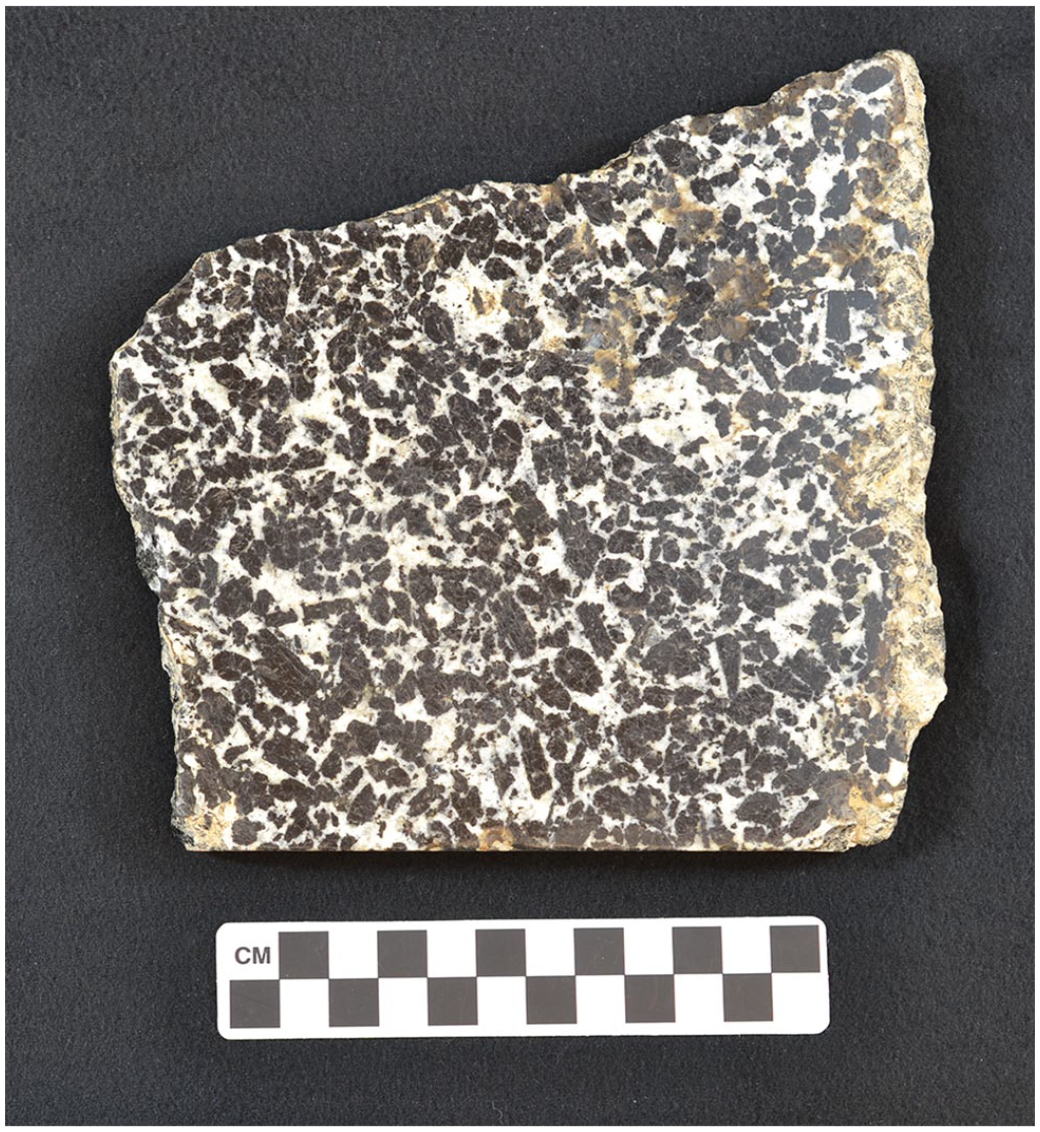
Marmor Tibereum, granito bianco e nero, unpolished quarry debris, private collection (photo: author).
This should bolster confidence in Pliny’s word picture of m. Augusteum as gathering its ‘markings in a different manner: the Augustan curls like waves into crests’. Again, he is more attentive to pattern than colour, but the comparison to waves is quite specific. This is at odds with the appearance of ophites, as the authors candidly acknowledge, in its common form with a profusion of very small white specks against a darker green ground. This is Corsi’s granito della sedia di S. Lorenzo: like a speckled snake skin, yes, perhaps, but not very much like waves. The rarer form of ophites, named after its use in the throne in St Peter’s Basilica in Rome, granito della sedia di S. Pietro, is easier to see as wavelike since the patches of much larger grains can be seen to rise from the smaller ones somewhat like waves, 29 but Pliny’s statement that they are different from ophites rules this variety out also.
The ‘Curator’ Inscription
The ‘curator’ inscription (fig. 4), so named by Tregenza after the quartermaster Tholemaios in charge of construction, is certainly one of the most important sources on the early Roman development of the Eastern Desert. 30
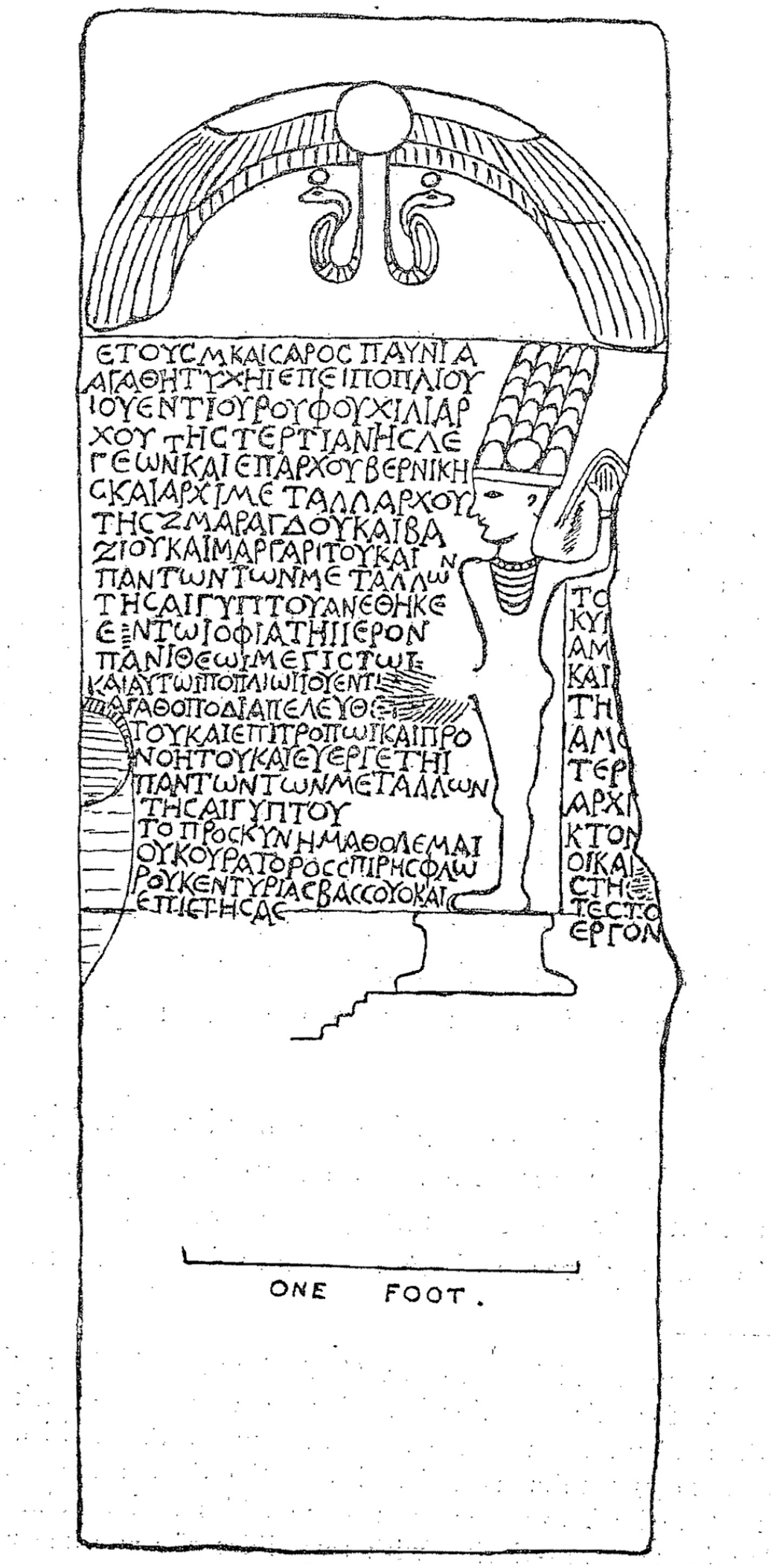
The ‘curator’ inscription (sketch: Tregenza 1951: 40).
The stela marks the dedication of a shrine to Pan at Ophiates by P. Iuventius Agathopous, freedman of P. Iuventius Rufus, the prefect of Berenike. The text includes a date, the 40th year of Caesar. Since only Augustus had such a long reign, this points to the year AD 11. Sidebotham and co-authors appropriately give it prominence at the beginning of their report. In the translation by Sidebotham, with revisions by Bagnall and Harrell, the text reads: Year 40 of Caesar (= Augustus), the first (day of the month) of Payni, with good fortune, when Publius Iuventius Rufus was tribune of the III legion (Cyrenaica), prefect of Berenike and director general of the smaragdus mines, the topazos (mines), the pearl (fisheries) and all of the mines of Egypt, he had dedicated at Ophiates a sanctuary to Pan, the greatest god, for his own health, by Poplius Iuventius Agathopous, his freedman, procurator, administrator and benefactor of all the mines of Egypt. The act of adoration of Tholemaios, curator of the cohort of Florus, of the century of Bassus, and who was in charge (of the building). The act of adoration of Mersis and of Soter, the two architects who were also in charge of the work.
31
The text documents a noteworthy gathering of Roman institutional effort applied to the facilities at Mons Ophiates (the ‘mountain’ being assumed from analogy with the attested placenames Mons Basanites, Mons Claudianus – mons being a representation of the Egyptian word that is better translated ‘desert’ than ‘mountain’ 32 ) in the late years of Augustus. Agathopous was there executing the directives of Rufus to set up quarrying. His entourage included two architects and the quartermaster (curator) of a cohort, whose presence implies a good number of soldiers even if it was a small detachment of the cohort of Florus. The architects Soter and Mersis are credited with building the shrine, but abundant evidence associates architects with a range of activities beyond construction, and especially with quarrying. 33 Quarrying may well have been under way already and the modest Paneion a brief diversion for the architects from their usual work of strategizing the extraction and transportation of stone. Iuventius Agathopous, now calling himself ‘administrator of all [quarries]’, made a similar dedication in AD 14 while supervising construction at the revived bekhen stone quarries in Wadi Hammamat, again on his patron’s behalf and with much the same entourage. 34
The ‘curator’ inscription, for all its importance, does not show that Mons Ophiates was the sole centre of imperial effort and thus the most likely source of a stone to be named for the founder of the new dynasty. This implicitly relies on an argument from silence since comparable inscriptions at other sites cannot be assumed to have survived. Wadi Barud is a case in point: there is no inscription (shrine dedication or lintel over the fort entrance, for instance) attesting the imperial name of Tiberius; without the ostraca, we would still be in the dark.
Lucan’s Comparison of the Belly Marking of Cenchris to Ophites
A passage in Lucan’s Pharsalia (9.712–714) is cited as strengthening the proposed identification that ‘the hard, dark variety of Augusteum ophites is clearly the gabbro from Wadi Umm Wikala, given the date of the “curator” inscription and the name it provides for the quarry’. 35 Lucan reverses the usual direction of the metaphor: where Pliny prosaically notes that the stone drew its name from the snake, Lucan conjures the appearance of the snake from the stone. This explicit connection of ophites’ appearance to that of the Libyan snake, Cenchris 36 (one of many born from Medusa’s blood), is vivid evidence for the presence of ophites in the cultural vocabulary of the Neronian elite. The adjective Thebanus ties ophites to Egypt.
Et semper recto lapsurus limite cenchris: Pluribus ille notis variatam tingitur alvum, Quam parvis pictus maculis Thebanus ophites. The straight-gliding cenchris, whose underbelly Is flecked more elaborately than Theban serpentine.
37
Lucan is doing more here than simply piling up descriptions. The snakes, of whom Cenchris is one, form a ghoulish army to attack Cato’s army in the Libyan desert, each with venom producing yet more horrific effects. Thus, the comparison to a spotted stone now connects to the standard critique of luxury as decadence and moral blindness which would soon be applied to Cleopatra’s luxurious palace and her lavish entertainment of Caesar, the bane of liberty. 38
Lucan gives us a date and a cultural context in which an allusion to an exotic Egyptian stone would be at home. There is a decent chance that Lucan had actually seen ophites with his own eyes when he was one of Nero’s amici, dining and exchanging verses from AD 60 to perhaps 63 – exactly when construction of his new palace, the Domus Transitoria with its summer nymphaeum and marble pavement enriched with squares of ophites, was being finished. 39
Pliny, when he says of ophites ‘serpentium maculis simile, unde et nomen accepit’ (‘it resembles the spots of snakes, whence its name’), may be directly echoing this passage. Lucan provides precious cultural context, but he does not make any connection to the name m. Augusteum.
Finally, the name ophites stems from no earlier than the Ptolemaic Period; it is unlikely to be a calque of an Egyptian word, as oros and mons are of dw, 40 because of its formation from the base noun ὄφις ophis (compare πορφυρίτηc porphyrites from πορφύρα porphyra, the famous Tyrian purple dye). Unless the curator inscription records the very moment of naming, as Cuvigny interprets the Paneion dedication at Porphyrites (but not this one), 41 the name is likely to have been well established among Greek-speakers. And here arises the most fundamental objection to the proposed identification of ophites with m. Augusteum, namely that the stone already had a name and thus was a poor candidate for renaming with an imperial honorific in light of the persistence of established usage (see, for instance, the failure of the bombastic name ‘Avenue of the Americas’ to displace the traditional 6th Avenue among New Yorkers). The text of the stela (I. Pan 51) certainly does not invoke any imperial honorifics. It is hard to imagine that Romans (that is, people working for the Romans) on site during Augustus’s reign would attempt to honour him by making him the eponym of a stone which already had a firmly rooted name. Cuvigny points out that the Romans in the Eastern Desert imposed their toponyms upon the landscape sparingly, and rarely in place of existing names. 42 Toponyms and stone names are naturally closely interwoven, the former being often derived from the latter. 43 Of newly minted names for the separate quarrying areas at Mons Claudianus, only five of the 45 names emerging from the ostraca honour imperial figures. 44 What is certain is that the stela does not record the bestowal of the name Augusteion.
If not Ophites…?
Marmor Augusteum may be forever lost to us if rubbish dumps containing ostraca at the other small quarries cannot be excavated because of vandalism or competing projects, and it is likely that ostraca will be the only decisive evidence, as has proven to be the case at Wadi Barud for m. Tibereum. But it is worth canvassing the possibilities. We should be looking for a stone:
which had no previous name as far as we know;
which has a plausible early date, necessarily Augustan;
whose appearance is a reasonably good fit with Pliny’s description, although subjectivity is inevitably involved here; and
which had a successful uptake on the Roman end – but because of the unknowns at the moment of naming and vagaries of artefact preservation, this is the weakest criterion.
M. Augusteum cannot be the product of either of the largest quarries which, more than all others, put their stamp on the architecture of the capital city and building and sculpture empire-wide, respectively marmor Claudianum and porphyry from Gebel Dokhan. This is obvious in the first case, and for the second, the date of the prospector’s claim of discovery, AD 18 (four years after Augustus’ death), 45 and the silence of hundreds of later ostraca mentioning the name Porphyrites with no Augustan epithet can be considered conclusive.
Verde ranocchia, serpentina moschinata/Umm Esh/Wadi Atallah
This serpentinite with mottled lighter and darker green with dark markings 46 (fig. 5) has a possible claim on an early date. Wadi Atallah branches off Wadi Hammamat just west of Bir Umm Fawakhir, 47 from where the crews working to restart operations at the bekhen stone quarries at Wadi Hammamat had to fetch their water. 48 The gold mine at Bir Umm Fawakhir – which is well attested in the New Kingdom but probably known in the Ptolemaic Period, when interest in gold was high – may possibly have kept its location alive in memory, and there are also poorly preserved and understood granite quarries at Fawakhir. 49 Apart from a handful of small artefacts from the Predynastic Period and Middle Kingdom, there is just one instance of pre-Roman exploitation, though perhaps an important one: a serpentinite column drum inscribed with the name of Ptolemy III Euergetes (246–222 BC); it is supposed to have come from a temple near the quarries, now destroyed. 50 This appears now as an isolated case, but the quarry may well have been opened and exploited to produce other material for the temple, or for other occasions, too. If so, it is hard to imagine quarrying a stone for any length of time without giving it a name. 51 Was that name lost or did it persist, in the chancellery or in oral tradition? The name batrachites, ‘frog stone’, is mentioned by Pliny (NH 37.149) as coming ‘from Coptos’. Since Wadi Atallah branches off the Coptos road, it would be easy to find the source of this striking light and dark green stone. Pliny describes three varieties: one green as a frog, another similar but with veins, and a third, which is red. If by ‘Coptos’ Pliny meant ‘the road coming from Coptos’, the green varieties are a good fit for the Wadi Umm Esh serpentinite. 52
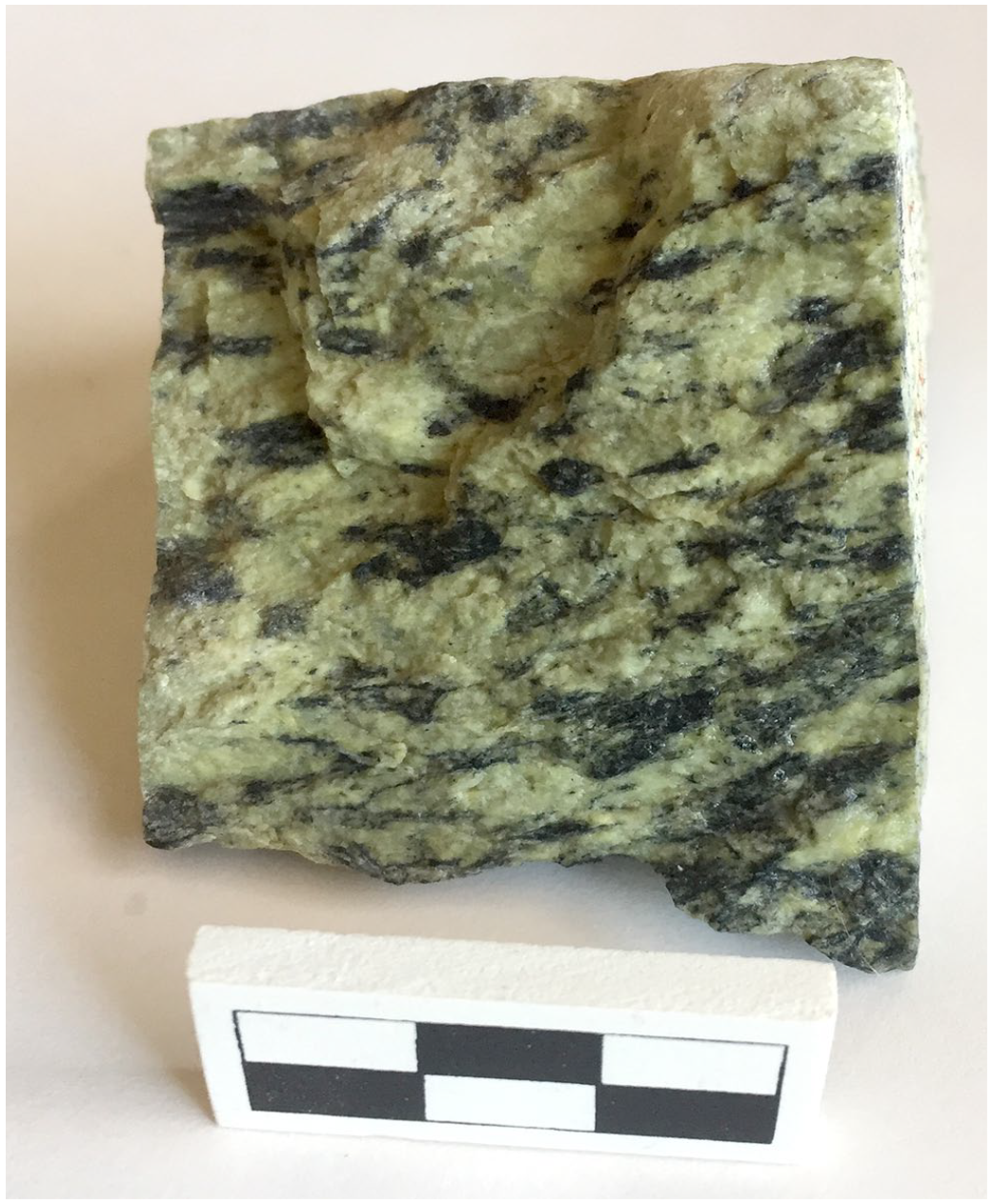
Serpentinite from Wadi Umm Esh, unworked quarry debris, private collection (photo: author).
Otherwise, stone from Umm Esh in Campania has a similar distribution profile to eufotide, and well-dated examples similarly cluster in the later Julio–Claudian period. 53 Harrell considers the Wadi Umm Esh serpentinite the best possible candidate for m. Augusteum after ophites. 54 But the quarry site has been destroyed by modern workings, making future discoveries, particularly of a potential Paneion or documents like ostraca, unlikely. Finally, the physical appearance of the stone is, to this eye, hard to reconcile with Pliny’s description of the Augustan curling its markings like waves into crests.
Granito della colonna, Wadi Umm Shegilat
New evidence showing that this striking pegmatitic diorite (fig. 6) was quarried, exported, and traded as early as 20 BC certainly makes it a candidate to be m. Augusteum since, on present evidence (always subject to new discoveries), it was the earliest quarry to be developed under Roman rule. 55 Several factors weigh against the identification, however: the very limited quarry faces and small workers’ village, and the extreme rarity of the stone in Italy. It is always possible that the stone was named directly upon discovery, in the expectation or hope that more extensive deposits would be found in further prospecting. But more telling is the stone’s appearance, with chaotic black crystals up to 7 cm or even 10 cm in length against a white ground, 56 which cannot by any stretch of the imagination be seen to match Pliny’s crests of Augusteum.
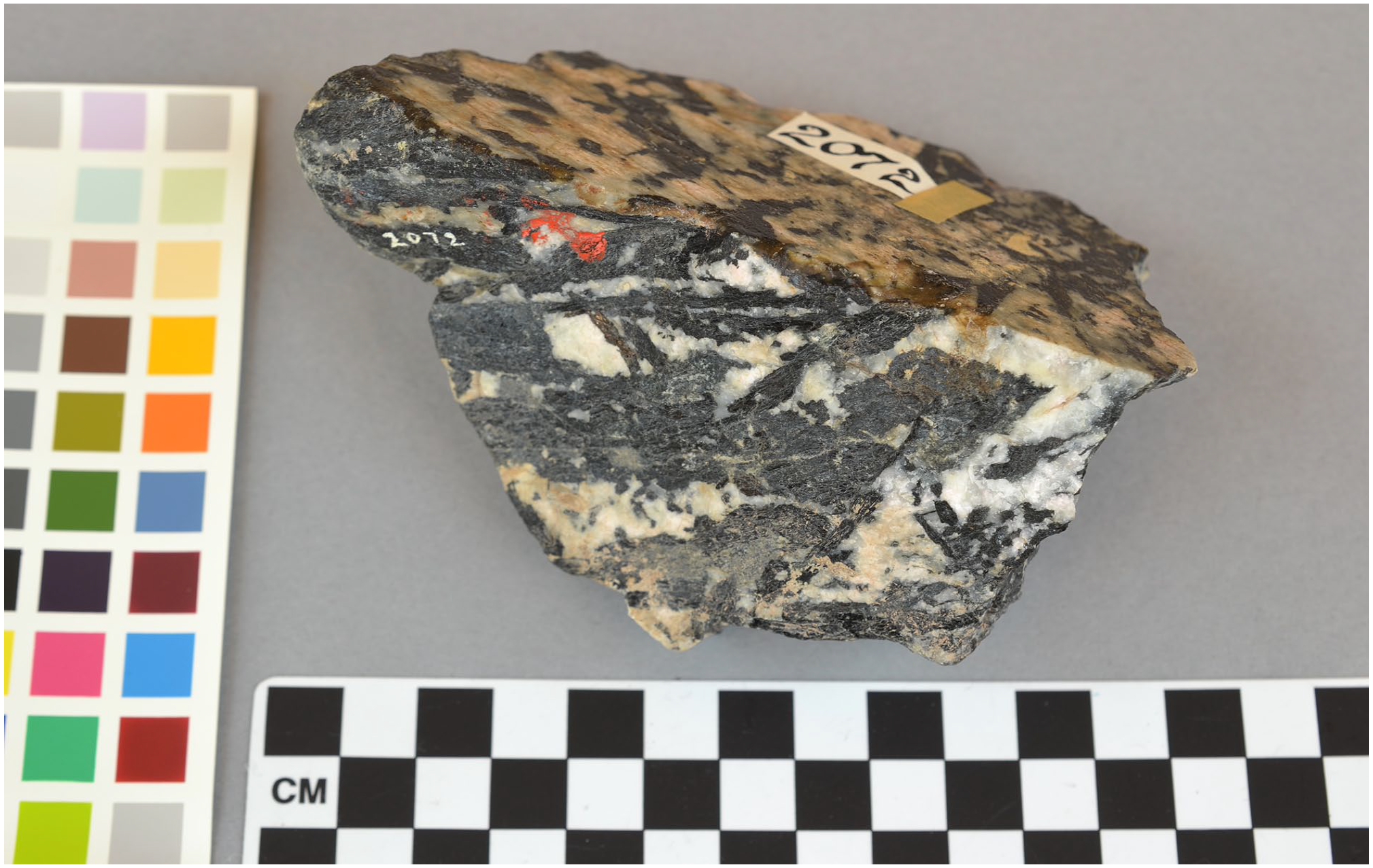
Granito della colonna from Wadi Umm Shegilat, KM 2072 = Fant, et al. 2024: cat. 13 (photo: J. Newhall, courtesy Kelsey Museum of Archaeology).
Gabbro eufotide, Wadi Maghrabiya
Gnoli introduced his discussion of this stone (fig. 7), a metagabbro, directly upon concluding his rumination on the exact identity of m. Augusteum, perhaps hinting at his answer. This stone, distinguished in Italian nomenclature from other gabbros as eufotide, 57 came from Wadi Maghrabiya, a modest establishment consisting of three large multi-room buildings and twelve quarry faces. 58 The surveyed site, however, seems perhaps inconsistent with the stone’s prominent presence in Italy, similar to that of ophites itself. Used principally in paving, both by itself and frequently paired with ophites (fig. 8), it was often highlighted in a central or dominant position. 59 This may suggest, or at least does not exclude, that eufotide was developed in Egypt roughly in parallel to ophites. 60 Gnoli’s suggestion that Augusteum is one of the three Egyptian stones considered here is endorsed by the absence of other contenders. If ophites is ruled out, Pliny’s marmor Augusteum must be either the serpentinite from the destroyed quarries at Wadi Umm Esh or the gabbro eufotide from Wadi Maghrabiya. The former’s markings are mostly linear rather than curled, and its green hues elicited names from Italian scalpellini alluding to frogs and moss, 61 and thus on both counts it seems unlikely to have elicited Pliny’s comparison to wavelike whorls, although reasonable observers may have differing perceptions in a case necessarily involving a degree of subjectivity. In my own view, gabbro eufotide, on the other hand, with dark green markings of varying density against a white ground, could easily evoke moving water, the deep green of Mediterranean waves, and the frothy white of foam. 62
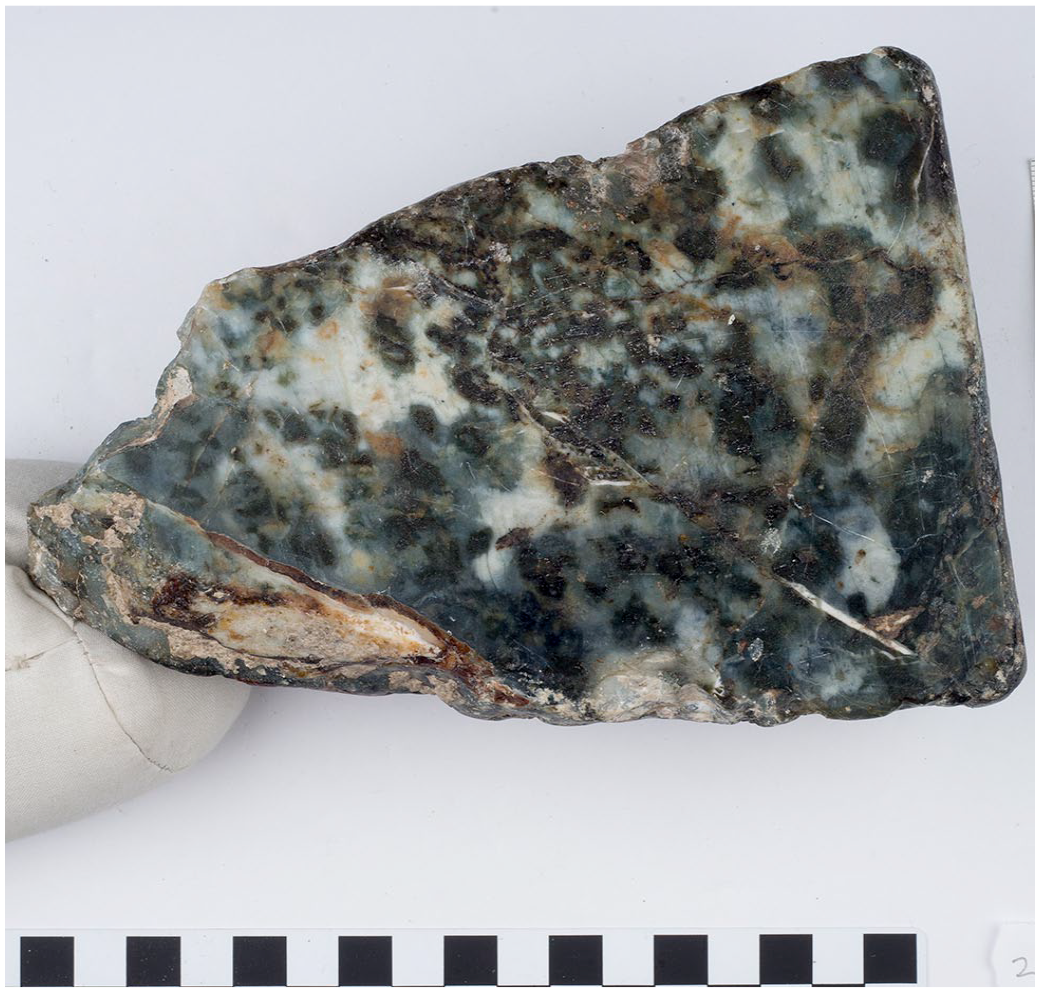
Gabbro eufotide paving fragment, KM 2217 = Fant, et al. 2024: cat. 5 (photo: J. Newhall, courtesy Kelsey Museum of Archaeology).
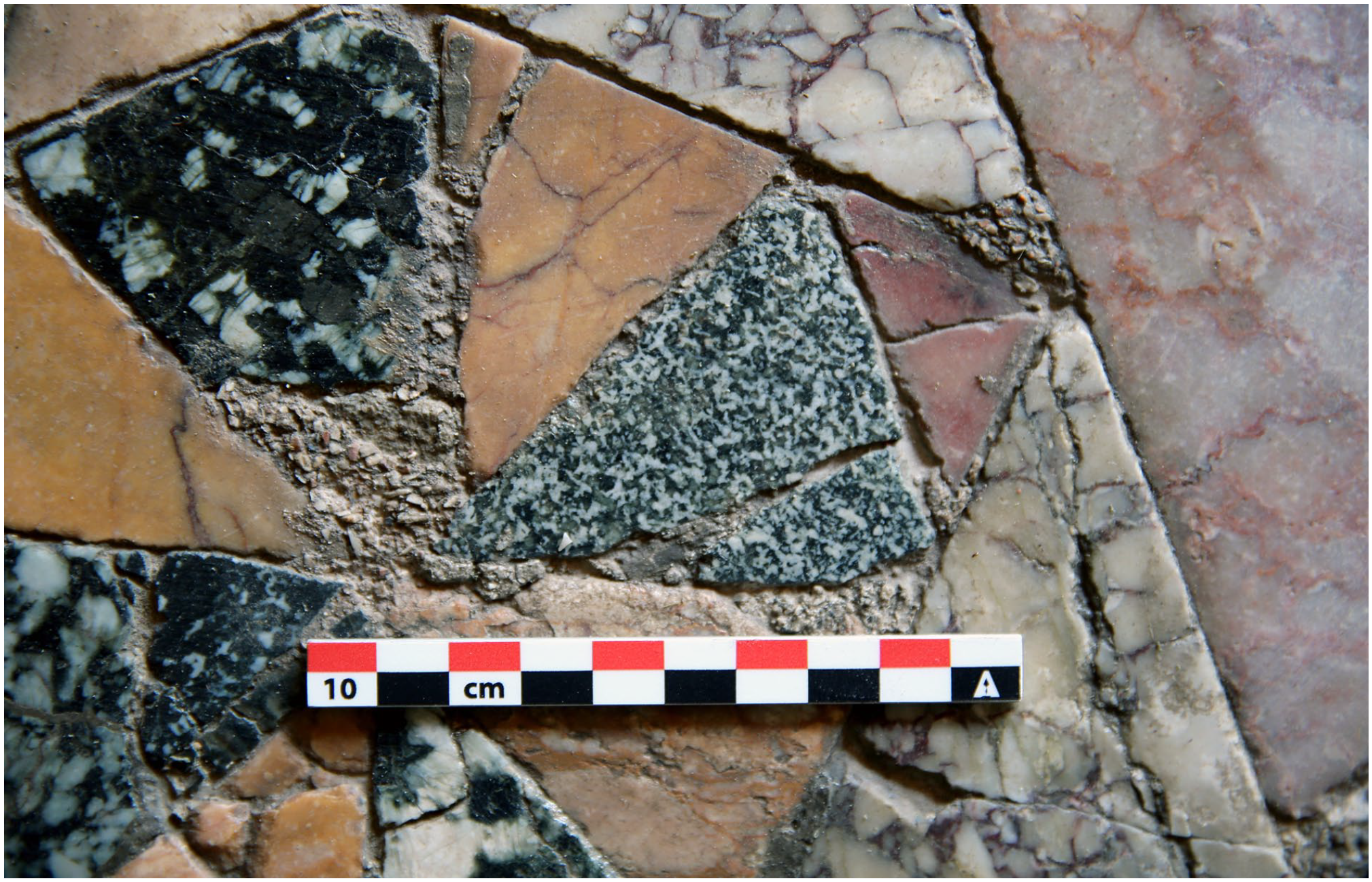
Ophites and gabbro eufotide, Casa dei Cervi, Herculaneum (photo: S. J. Barker, courtesy Parco Archeologico di Pompei).
Evidence of early use in Italy would bolster the claim of the stone from Wadi Maghrabiya to being Pliny’s ‘Augustan marble’ because it could corroborate the date of discovery and show that it was making an impression. Such evidence appeared recently in excavations at the Ligurian port city of Luna. An impressive house, the Domus Settentrionale, presents a marble-paved triclinium with an emblema framed by one foot-square tiles of this gabbro. The excavators date the construction of the house to the Augustan–Tiberian period and note that the structure remained substantially unchanged until its destruction by earthquake in the late fourth century. 63 This is important because it seems to rule out the insertion of exotic Egyptian materials after the original setting of floors, which we have noted at Pompeii. 64 Luna is a particularly significant location for this find because it was the harbour through which Luna marble was exported in just this period, triggering vast monumentalization not only in Rome but also in cities in southern Gaul, Mediterranean Spain, and beyond. 65
Context for eufotide in commerce comes from a shipwreck at Porto Novo on the Bocche di Bonifacio, the narrow passage between Corsica and Sardinia. The date of the ship’s last voyage emerges from a gold coin of the Lugdunum mint dated AD 27, pointing to the middle Julio–Claudian period. 66 Gabbro eufotide itself was not found in the Porto Novo wreck, but panels of the diorite from Wadi Umm Shegilat (discussed above) outnumbered those of other stones. This diorite was always scarcer than our gabbro but otherwise similar in date and history The coin, however, offers a terminus post quem only for that last voyage, and since the stone of interest to us was left over from a previous cargo, that voyage would have fallen in the earlier part of the date range, possibly even before the gold coin was minted. The principal cargo of the last voyage was 130 metric tons of Luna marble columns, clearly destined for a major monument in Spain or, less likely, southern Gaul. Sawn panels of ten lithotypes on board were read by the French underwater team as remains of an earlier cargo since they were apparently used as dunnage for the columns rather than stowed separately, and in total they amounted to less than 7 m 2 , too small to make a floor larger than 2.5 m on a side and leaving no reserve for breakage in shipping or installation. That earlier cargo of panels was almost certainly intended for creation of an impressive floor like that of the Domus Settentrionale. Since the ship’s route most likely began at Rome (Portus), the destination of ships bringing stone from the eastern Mediterranean and Egypt (along with grain), and since on its last voyage it called at Luna to load the columns, the overall picture highlights Luna as an important node in the western Mediterranean trade in imported marble. The presence of one rare Egyptian stone in the cargo suggests that well-developed trade routes were routinely handling exotic exports from the Eastern Desert alongside the more familiar polychrome marbles of the Aegean and North Africa.
Therefore, with our present state of knowledge, the gabbro of Wadi Maghrabiya seems to fit best as Pliny’s marmor Augusteum. But the gold standard for evidence would be documentary confirmation from ostraca.
Footnotes
Acknowledgements
I wish to thank Simon Barker for reading and commenting on the whole text. Kelly Shannon-Henderson at the University of Cincinnati was kind enough to apply her expertise in Silver Age prose to reading and improving the philological arguments. Lorenzo Lazzarini and Patrizio Pensabene answered many questions. The two anonymous reviewers for this journal pointed out errors, ambiguities, and areas where the argument could be strengthened. The manuscript was completed during a Tytus Fellowship at University of Cincinnati Classics Department, for which I thank the faculty and the amazing staff at the Burnham Library, particularly Michael Braunlin.
Funding
The author did not receive any funding for this project.

Notes
Author biography
J. Clayton Fant is trained in the University of Michigan’s multi-disciplinary approach, J. Clayton Fant’s academic career at every step has involved philology, history, and (increasingly) archaeology. He has done field work in Turkey, Egypt, Greece, and Italy, and held fellowships at the American Academy in Rome, All Souls College at the University of Oxford, the National Humanities Center (USA), and the University of Cincinnati.