




Abstract
This article discusses the private statue of Minnakht, which is currently preserved in the Egyptian Museum in Cairo. The statue owner holds the title of ‘the god’s father of Mut’ ỉt-nṯr n Mwt. The statue likely dates to the mid-18th Dynasty based on its stylistic and iconographic features, the inscriptions on the kilt, and the decorations on the sides. The provenance of the statue is debated, but it is generally believed to have originated from the broader area of Thebes. The inscriptions on the sides of the seat and the back pillar are unique based on their exclusively funerary nature and their reference to the well-known Book of the Twelve Caverns. Although there have been many scholarly discussions surrounding this composition and multiple published translations of the texts inscribed on CG 624 by Piankoff and Allen, this paper marks the first time the statue is closely examined as a whole despite its importance.

Description
The statue is made of painted sandstone, measuring 64 cm in height, 34 cm in length and 70 cm in width (fig. 1). 1 Minnakht is shown seated, with his wife and son depicted in a smaller size on either side of his legs. 2 Unfortunately, the upper part of the statue is missing (above the waist), while the lower part is better preserved. Minnakht is represented seated on a cube-shaped seat with a footrest extending in front of the seat. The edges of the pedestal are painted in yellow and black, traces of which can be identified throughout the piece.
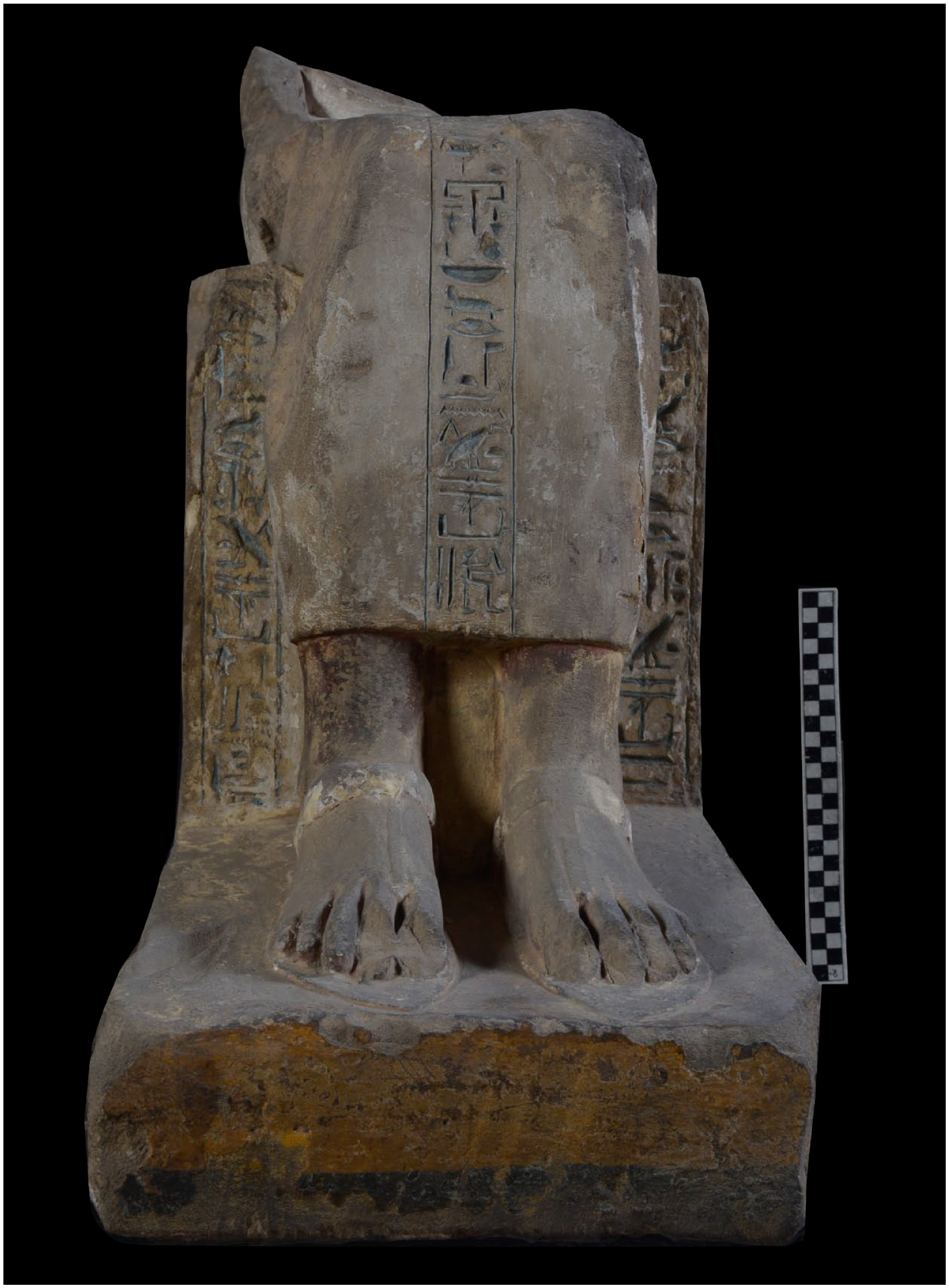
Front view of the statue (photo: courtesy of the Egyptian Museum in Cairo).
On the proper right side of the leg of Minnakht, there is a carved figure of his son (fig. 2). The body of his son is painted red as is customary for men, and he is wearing a triangular white kilt. His left hand is elevated towards the right leg of his father, whereas the other is flat against his side. His title can be identified on a column above his head. The son’s facial features are clear compared to those of Minnakht’s wife. On the proper left side of the seat, Minnakht’s wife is shown standing with her figure depicted in the silhouette style (fig. 3). Her body and face are also painted red. 3 She is wearing a long white dress, a black tripartite wig and is likely holding in her hand a menat necklace. She seems to hold the menat from its middle, thus giving it the appearance of two parts and a handle. 4 Minnakht is wearing a long white kilt as well as sandals, which were considered one of the priestly privileges in ancient Egypt. 5
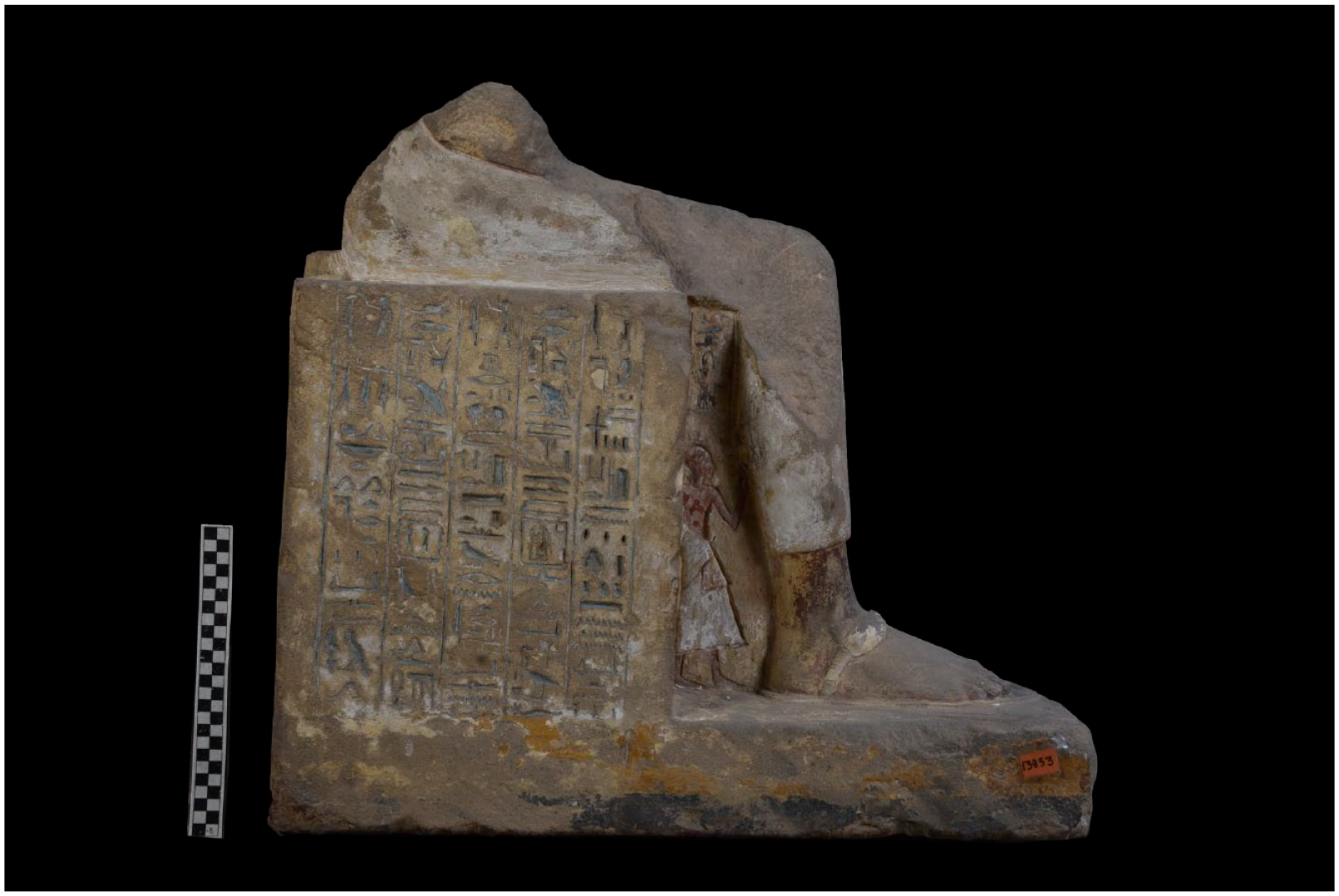
Right side of the statue (photo: courtesy of the Egyptian Museum in Cairo).
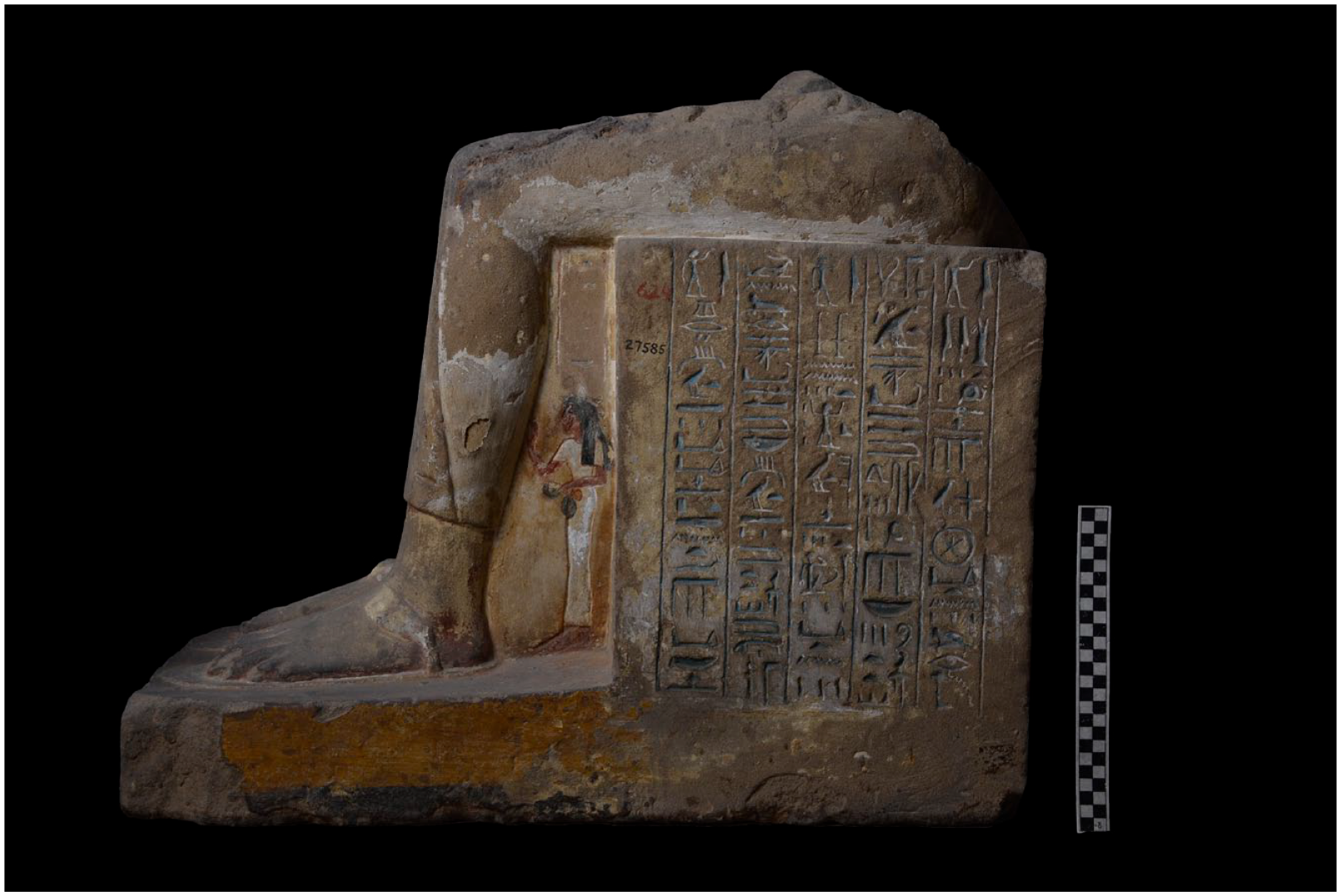
Left side of the statue (photo: courtesy of the Egyptian Museum in Cairo).
Traces of black colour can be identified on the toes along with the left side of the kilt. The red-brown colour of Minnakht’s skin can be seen on some parts of his legs. As commonly seen on the statues of the same period, a column of hieroglyphic inscriptions is engraved on the middle of the kilt.
The sandstone is covered with a layer of plaster to make it easier to incise the hieroglyphs and the figures. Some parts of the statue are not in a good state of preservation, with flaking paint, revealing the original colour of the sandstone, whereas in other parts, the outer coat of white plaster can be detected. Traces of blue colour are still evident on some hieroglyphic signs, particularly on the sides and the back of the statue (figs 2–4). Both sides of the seat as well as the back of the statue are inscribed with five columns of hieroglyphs, the majority of which are intact. Thin lines are incised between the columns.
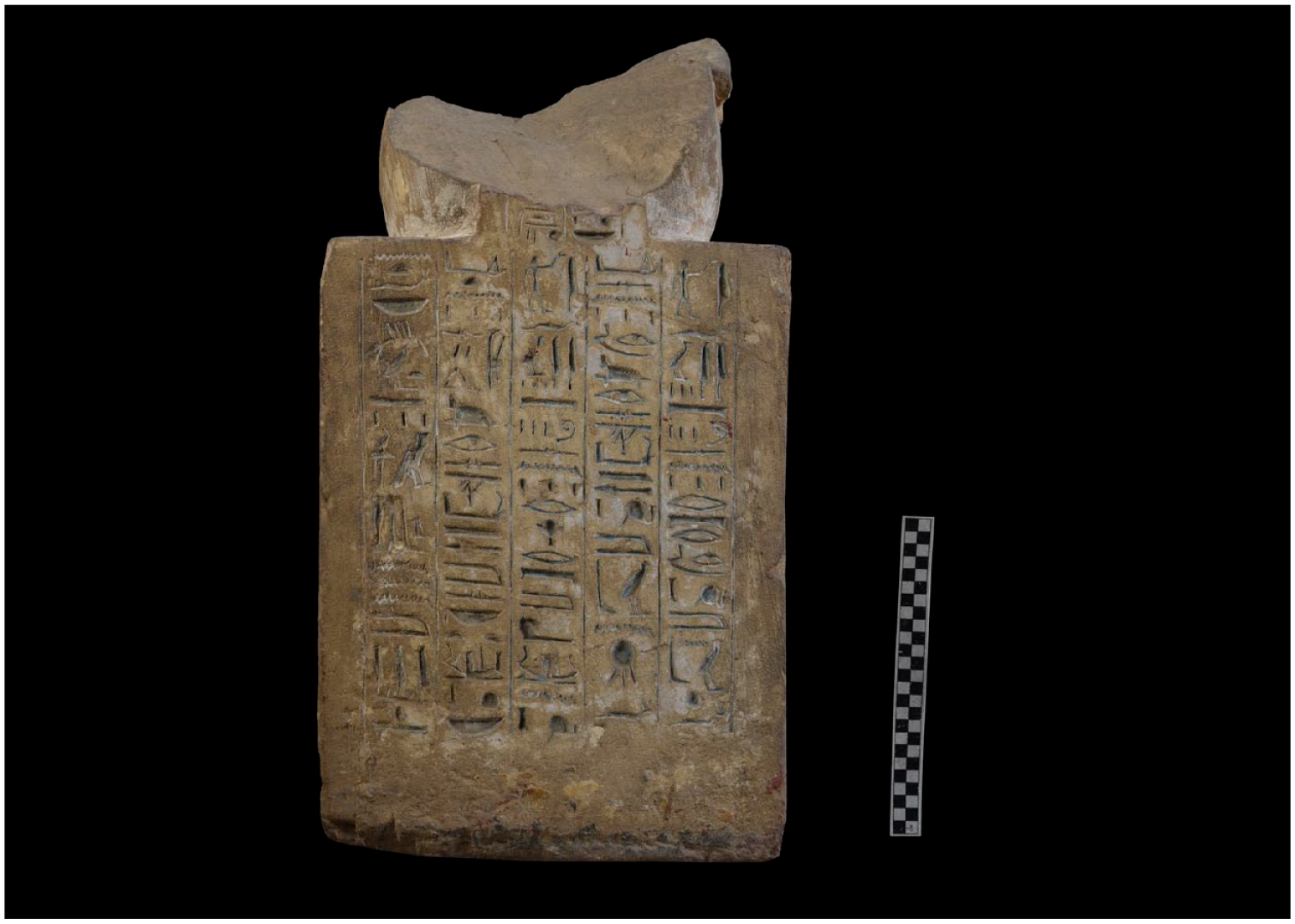
Back pillar of the statue (photo: courtesy of the Egyptian Museum in Cairo).
The Inscriptions
The religious composition inscribed on the statue was previously known by Naville as Chapter 168 of the Book of the Dead or the Book of the Going Forth by Day. 6 According to Piankoff, this nomenclature is inaccurate because this chapter constitutes a separate composition, which he called The Quererts. 7 Piankoff and Allen provide us with ten sources each to study the aforementioned composition, some of which are common between them. 8 Later, Méndez-Rodríguez added more examples to reach a total number of 33 inscribed sources ranging from the mid-18th Dynasty until the end of the Ptolemaic Period. 9 Méndez-Rodríguez also renamed the composition as the Book of the Twelve Caverns. 10 CG 624 is engraved with a text referring to the deities of the eighth cavern and the first group of the ninth cavern (fig. 5). It is the only statue to be inscribed with this composition; other sources include a sarcophagus, papyri, stelae, temple and tomb reliefs, and mummy wrappings. 11 The earliest evidence of this composition was found on the Papyrus Cairo CG 24742, which was discovered in the tomb of Amenhotep II (KV 35) inside statuette CG 24619. 12 Méndez-Rodríguez alludes to a new feature adopted in CG 624 which is the use of the extended forms in writing the deities’ names (Element IIIa); such feature is more commonly adopted in funerary sources from the 19th Dynasty onwards. 13 Piankoff considered the insertion or the elimination of elements II (short introductory texts put before the beginning of each cavern) and IIIc (the number of gods who composed each group) as a criterion to discern between the two versions. Version I includes the elements and version II omits them, 14 which is why Piankoff considered CG 624 as the first source using version II. For him, it was the proof that this version did exist in the early New Kingdom. 15
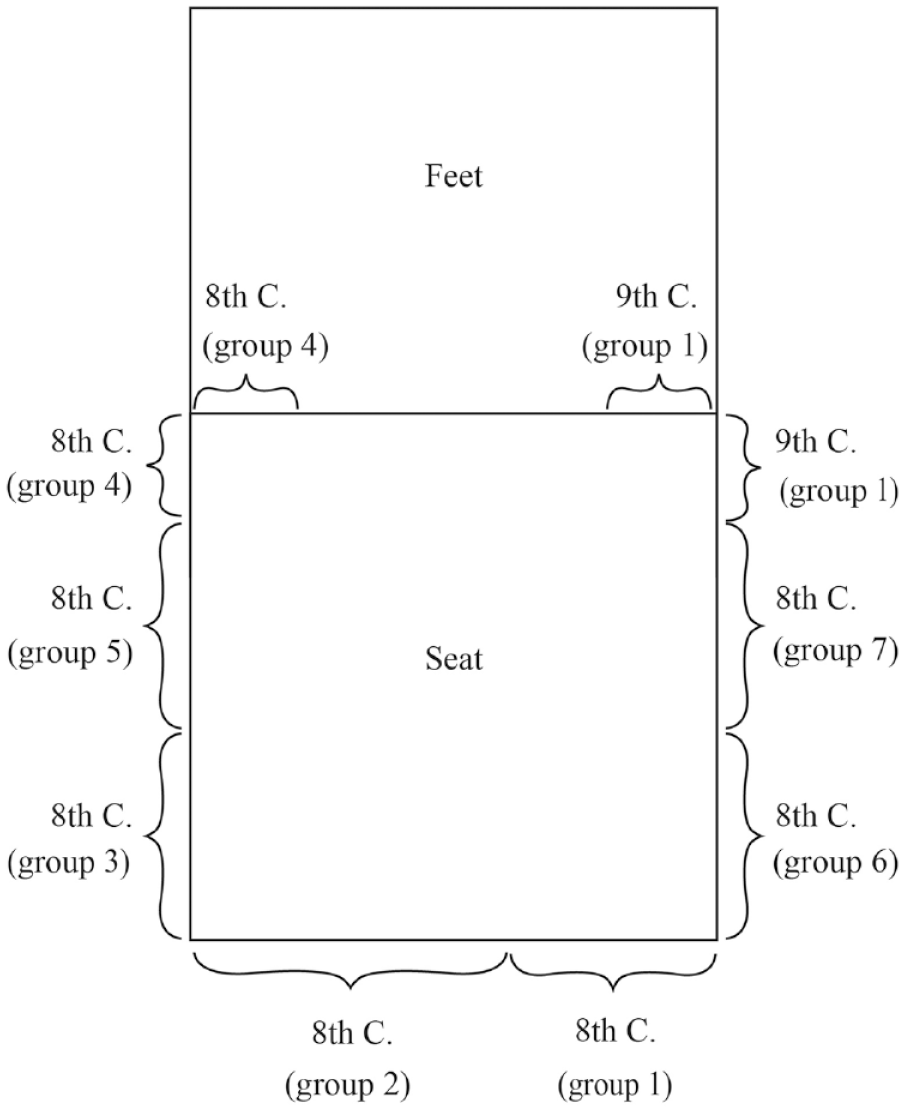
Diagram of the distribution of the texts from the Book of the Twelve Caverns on the statue (drawing: D. Méndez- Rodríguez).
Inscriptions on the back pillar of the statue (figs 4, 6)
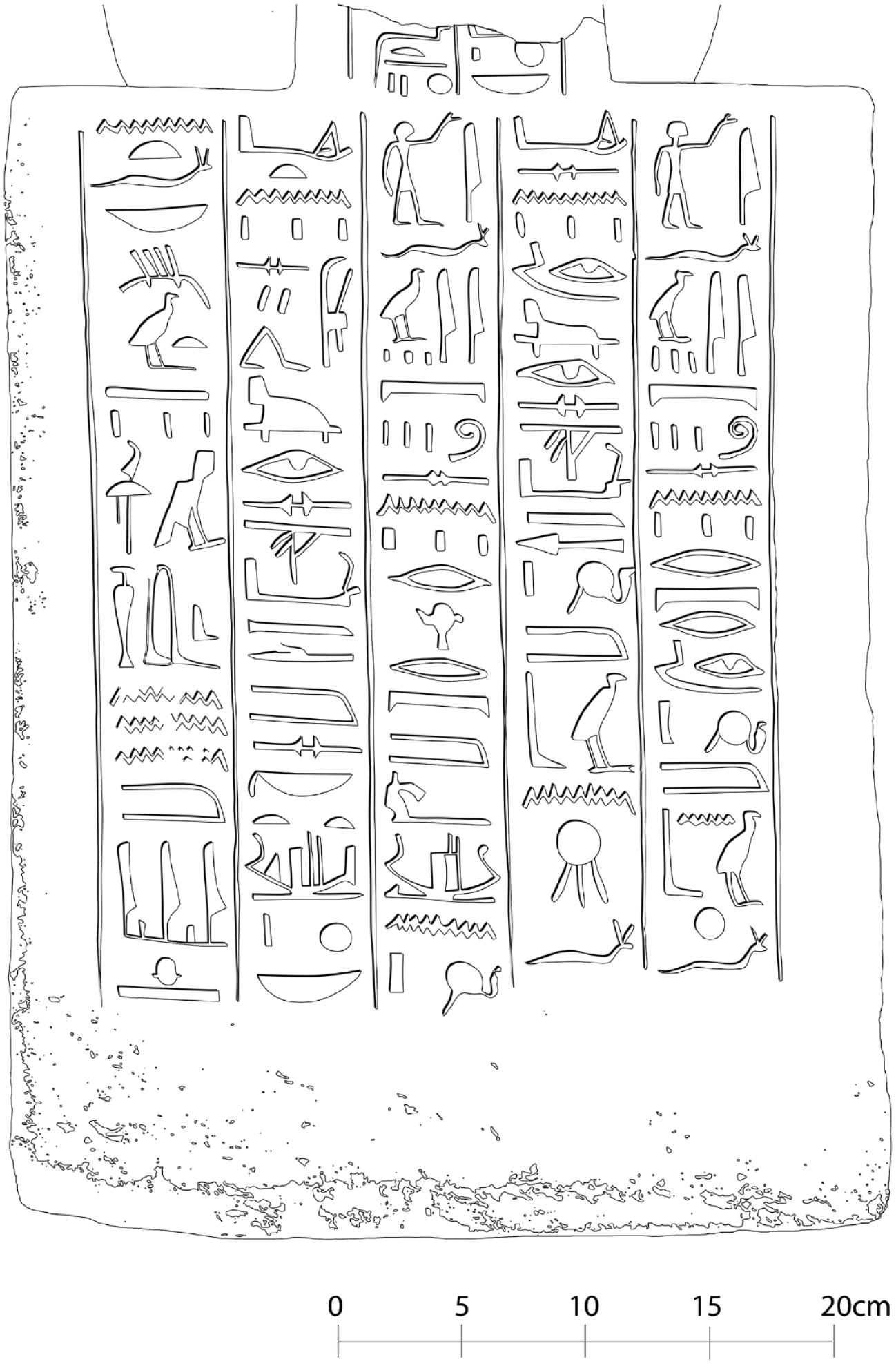
Facsimile of the back pillar of the statue (drawing: Mohamed Osman).

[…] (?) Rʿ nb […] ḏt sp-sn
[…] (A) everyday […] forever and ever (B)


ʾI fȝyw ḥryw.sn 16 r pt r mȝȝ Rʿ m wbn.f
dỉ.sn mȝȝ Wsỉr Mnw-nḫt mȝʿ-ḫrw Rʿ m wbn.f (8th cavern, group 1)(C)
O (D) those (masc.) who carry the ones who are upon them to the sky in order to see Ra at his rising. May they allow that the Osiris, Minnakht, the justified (lit.: true of voice), see Ra at his rising.



ʾI fȝyw ḥryw.sn 17 r ḥrt m-ḥȝt mʿnḏt n Rʿ
dỉ.tn šmsy Wsỉr Mnw-nḫt mȝʿ-ḫrw msktt Rʿ-nb
ntf nb ȝwt m ỉmnt obḥw m sḫt-ḥtp (8th cavern, group 2)
O those (masc.) who carry the ones who are upon them to the sky in the prow of(E) the morning barque of Ra. May you(F) allow that the Osiris, Minnakht, the justified, be a follower in the night barque every day. He is the lord of offerings in the West,(G) and cold water in the field of offerings. 18
Inscriptions on the left side of the statue (figs 3, 7)
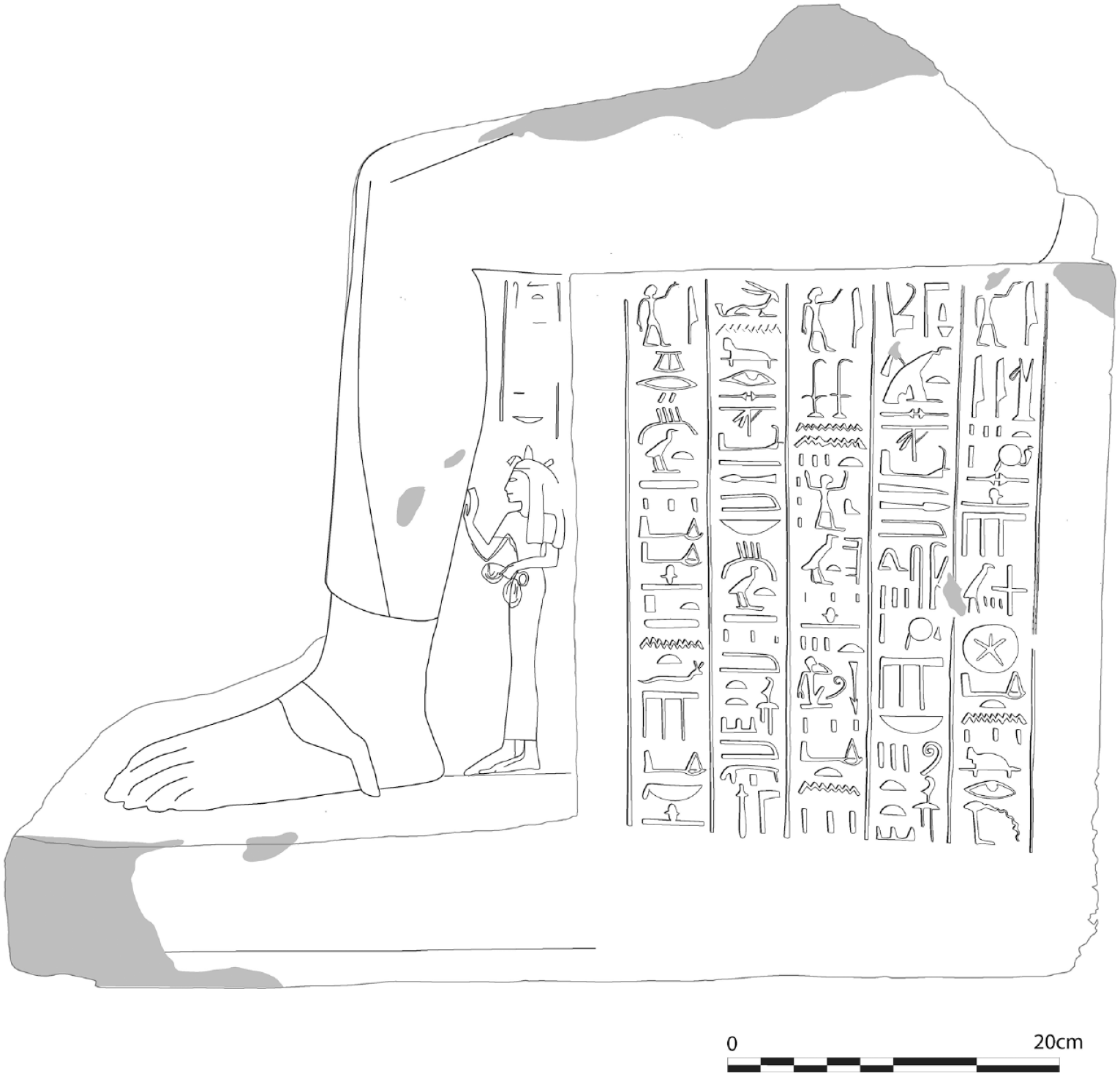
Facsimile of the left side of the statue (drawing: Mohamed Osman).


ʾI ḥnywt-Rʿ sḥtp nṯrw ỉmyw dwȝt dỉ.tn Wsỉr wʿb
ỉt-nṯr n Mwt Mnw-nḫt mȝʿ-ḫrw m šmsw Rʿ nṯrw nbw ỉmntt (8th cavern, group 3)
O householders of Ra,(H)19 those who satisfy the gods who are(I) in the netherworld. May you allow that the Osiris, the wab-priest, the god’s father of Mut, Minnakht, the justified be in the following of Ra, 20 and of the gods who are the lords of the west.


ʾI nn(yw) ḳȝ twr 21 ḥtpw ḫrw dỉ.tn
wn Wsỉr Mnw-nḫt mȝa-ḫrw m nb ȝwt m ỉmntt m-bȝḥ nṯr-aȝ (8th cavern, group 5)
O tired 22 ones (fem.) with high, respectful(J) and calm voices.(K) May you allow that the Osiris, Minnakht, the justified, be as the possessor of gifts in the West 23 before the great god.

ʾI
O those (masc.) who carry the sacrificial gifts,(L)25 and who present offerings to the father of the gods. May you give…
Column to the left of the legs (figs 8–9)
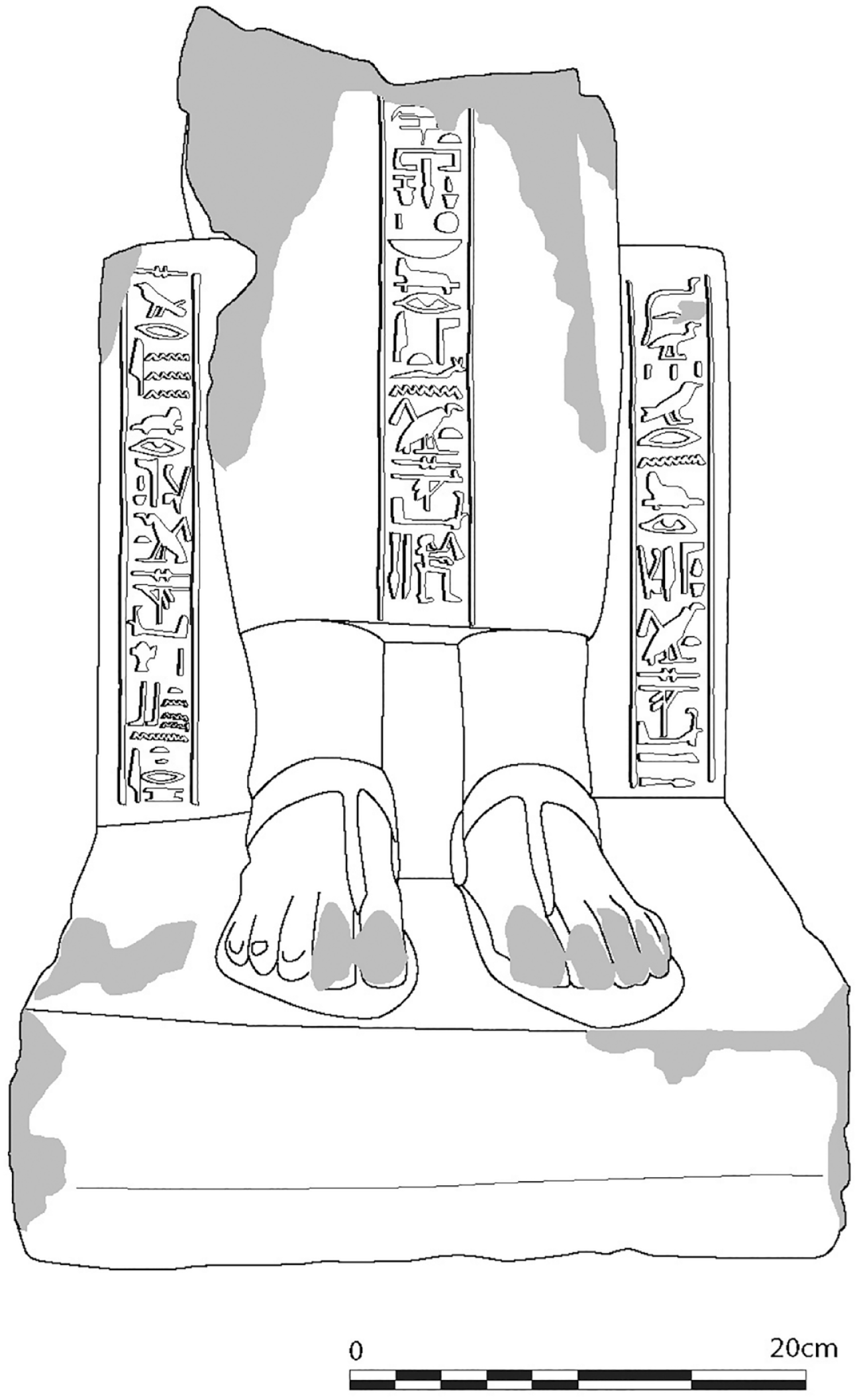
Facsimile of the front view of the statue (drawing: Walid El-Sayed).
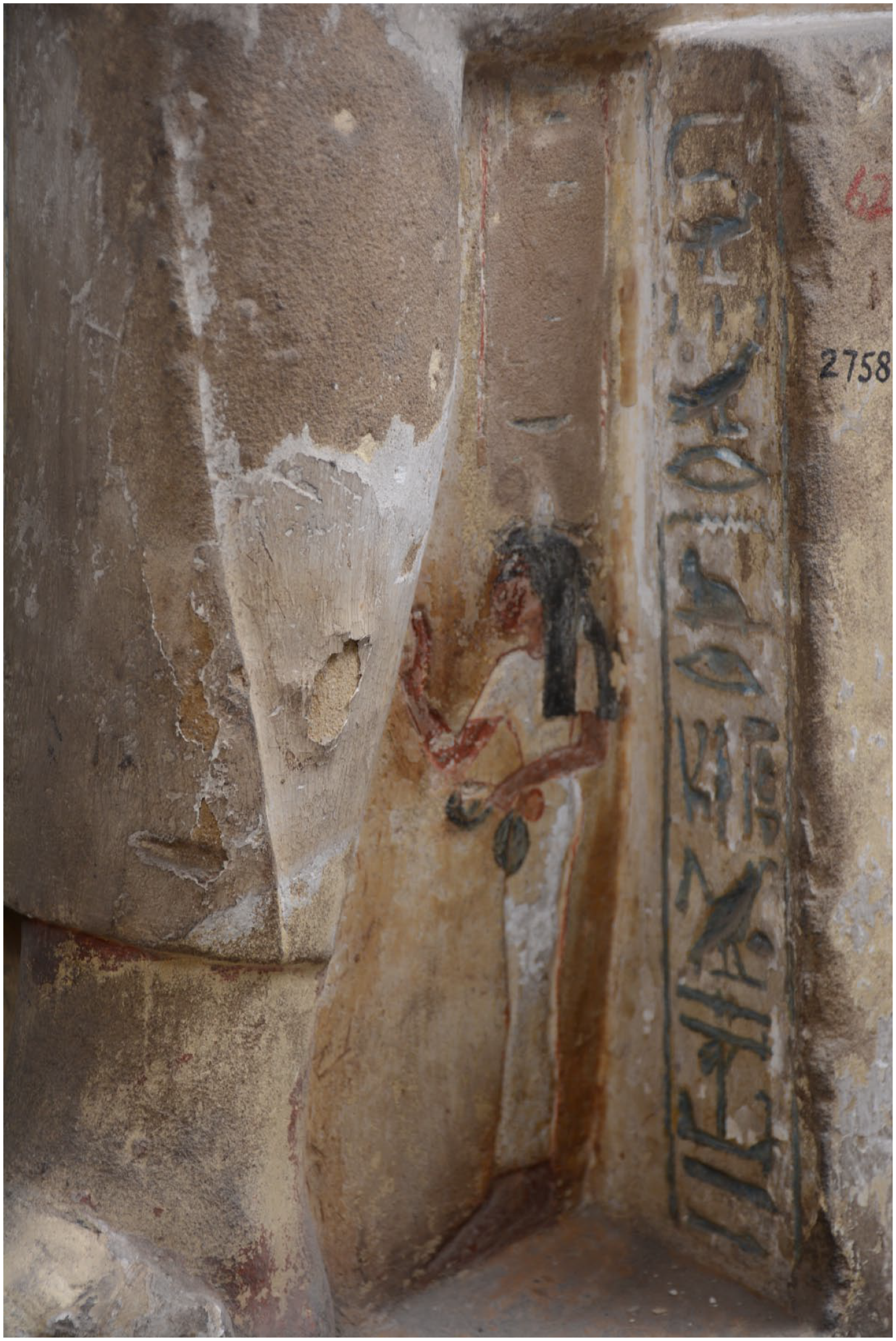
Column to the left of the legs (photo: courtesy of the Egyptian Museum in Cairo).

ḏfȝw wr n Wsỉr ỉt-nṯr ỉn (M) Mwt Mnw-nḫt mȝʿ-ḫrw (8th cavern, group 4)
… a large (amount) of offerings and provisions 26 to the Osiris, the god’s father of (lit.: by) Mut, Minnakht, the justified.
Inscriptions on the right side of the statue (figs 2, 10)
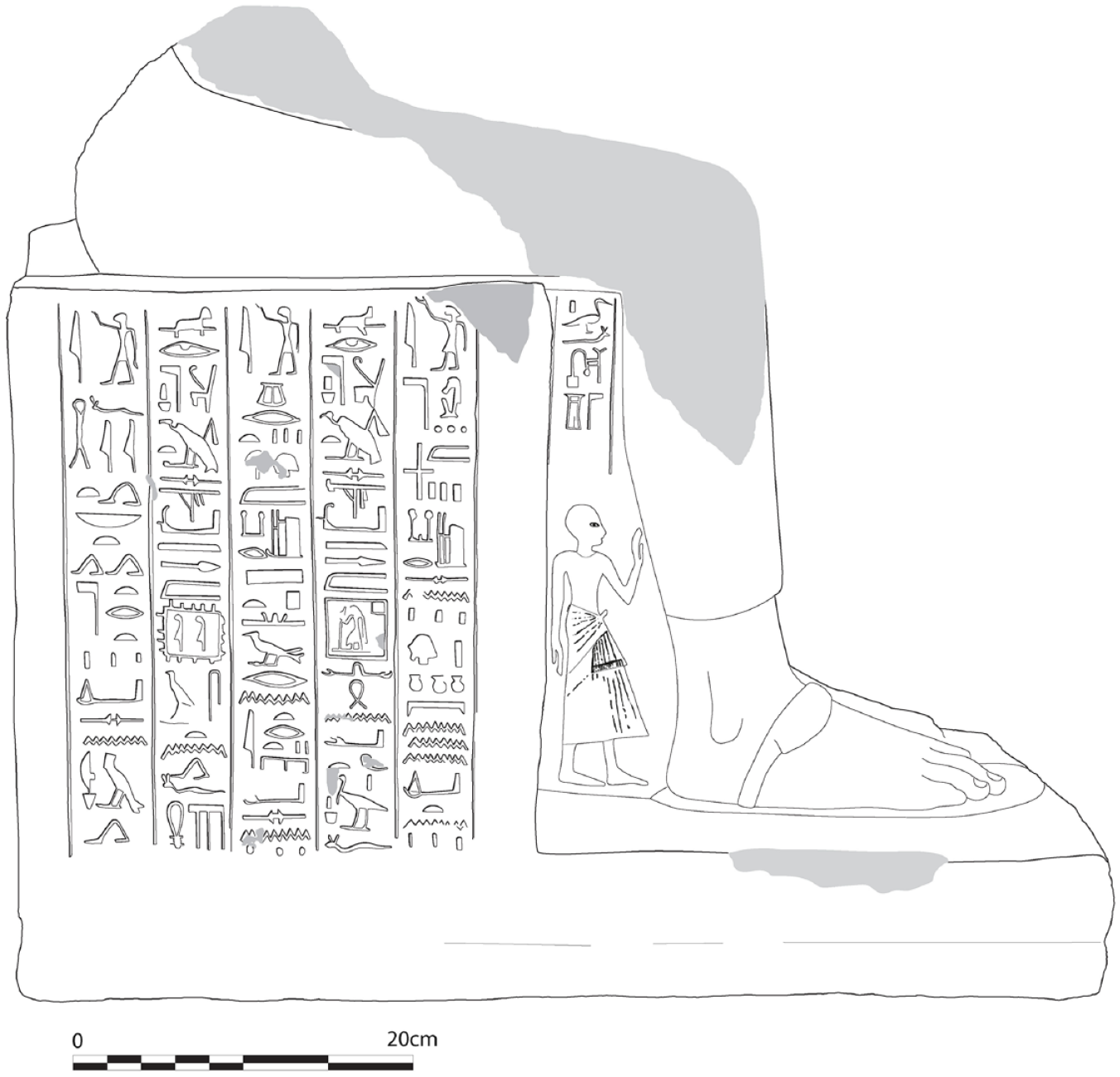
Facsimile of the right side of the statue (drawing: Mohamed Osman and Walid El-Sayed).


ʾI ḥf(ȝ)yt nbt nmtt 27 nṯrwt dỉ.sn nmỉ 28
Wsỉr ỉt-nṯr n Mwt Mnw-nḫt mȝʿ-ḫrw m wsḫt mȝʿty 29 wstn.f 30 mỉ nṯrw (8th cavern, group 6)
O she who renders homage, 31 the mistress of the steps(N) (of) the goddesses. May they allow that the Osiris, the god’s father of Mut, Minnakht, the justified move from the hall of the two truths and that he may travel freely like the gods.


ʾI ẖrw 32 ḥr(yw)-tp m kȝr štȝ wr n ỉtrty 33 dỉ.sn
Wsỉr ỉt-nṯr n Mwt Mnw-nḫt mȝʿ-ḫrw m ḥwt-sr N šna.tw 34 bȝ.f (8th cavern, group 7)
O householders, chiefs of the great mysterious chapel of the double shrine.(O) May they grant that the Osiris, the god’s father of Mut, Minnakht, the justified, be in the princely house(P) and that his ba not be repulsed.

ʾI nṯrw ỉmyw kȝr(ỉw).sn tp(yw) Nwn 35 dỉ.tn (9th cavern, group 1)
O gods who are in their shrines, above the primeval waters.(Q) May you allow that…
Column to the right of the legs (figs 8, 11)
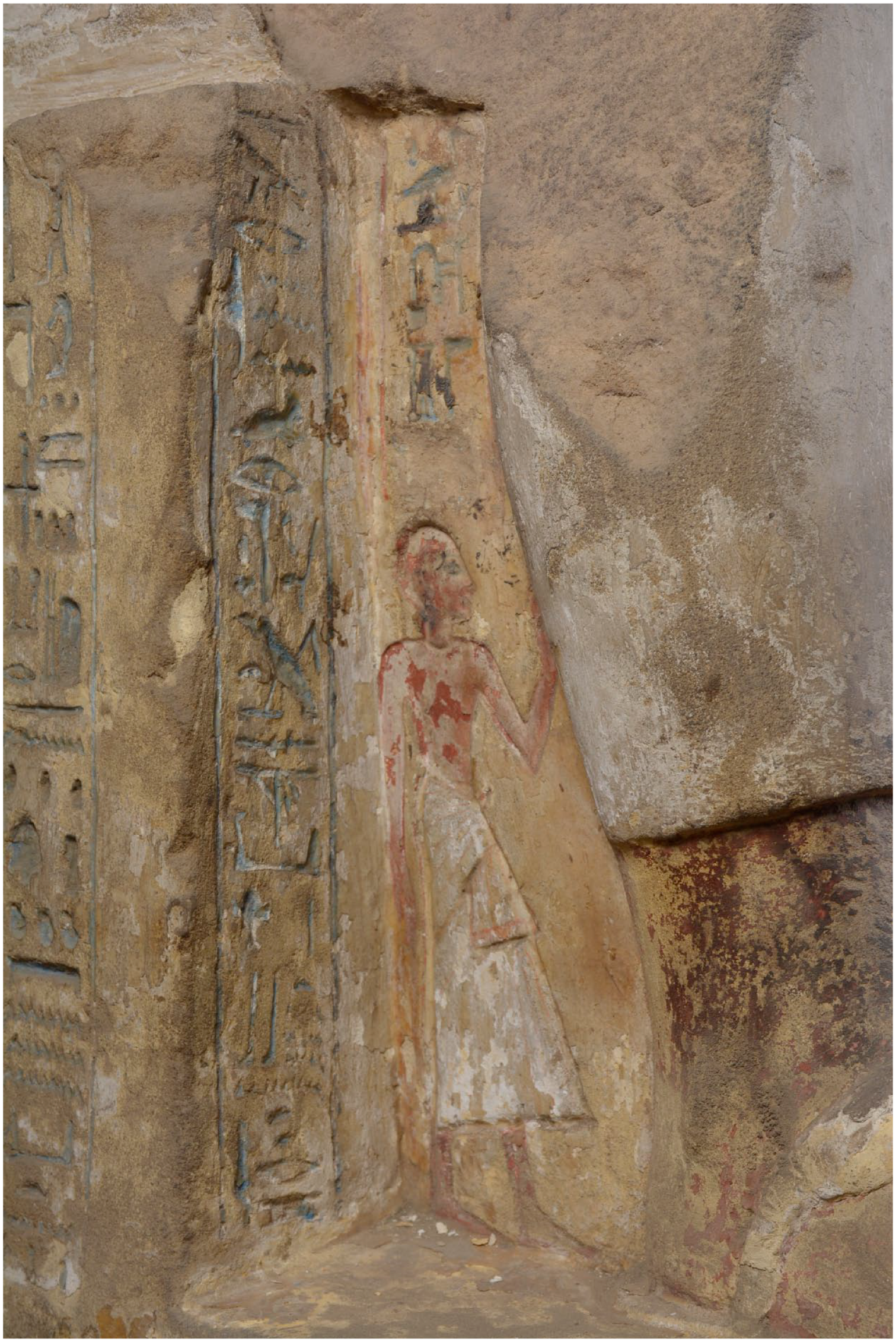
Column to the right of the legs (photo: courtesy of the Egyptian Museum in Cairo).

swr Wsỉr ỉt-nṯr n Mwt Mnw-nḫt ḥr bȝbȝt nt ỉtrw (9th cavern, group 1)
…the Osiris, the god’s father of Mut, Minnakht, drink from the eddy of the river. 36
Inscriptions on the side of the wife (figs 7, 9)
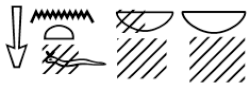
snt.f nb(t ?) […] nb (?) […]
His wife,(R) the lady (?) […](S)
Inscriptions on the side of the son (figs 10–11)
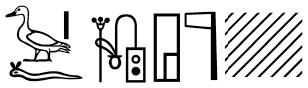
sȝ.f sš ḥwt-nṯr […]
His son, the scribe of the temple […]
Inscriptions on Minnakht’s kilt (figs 1, 8, 12–14)
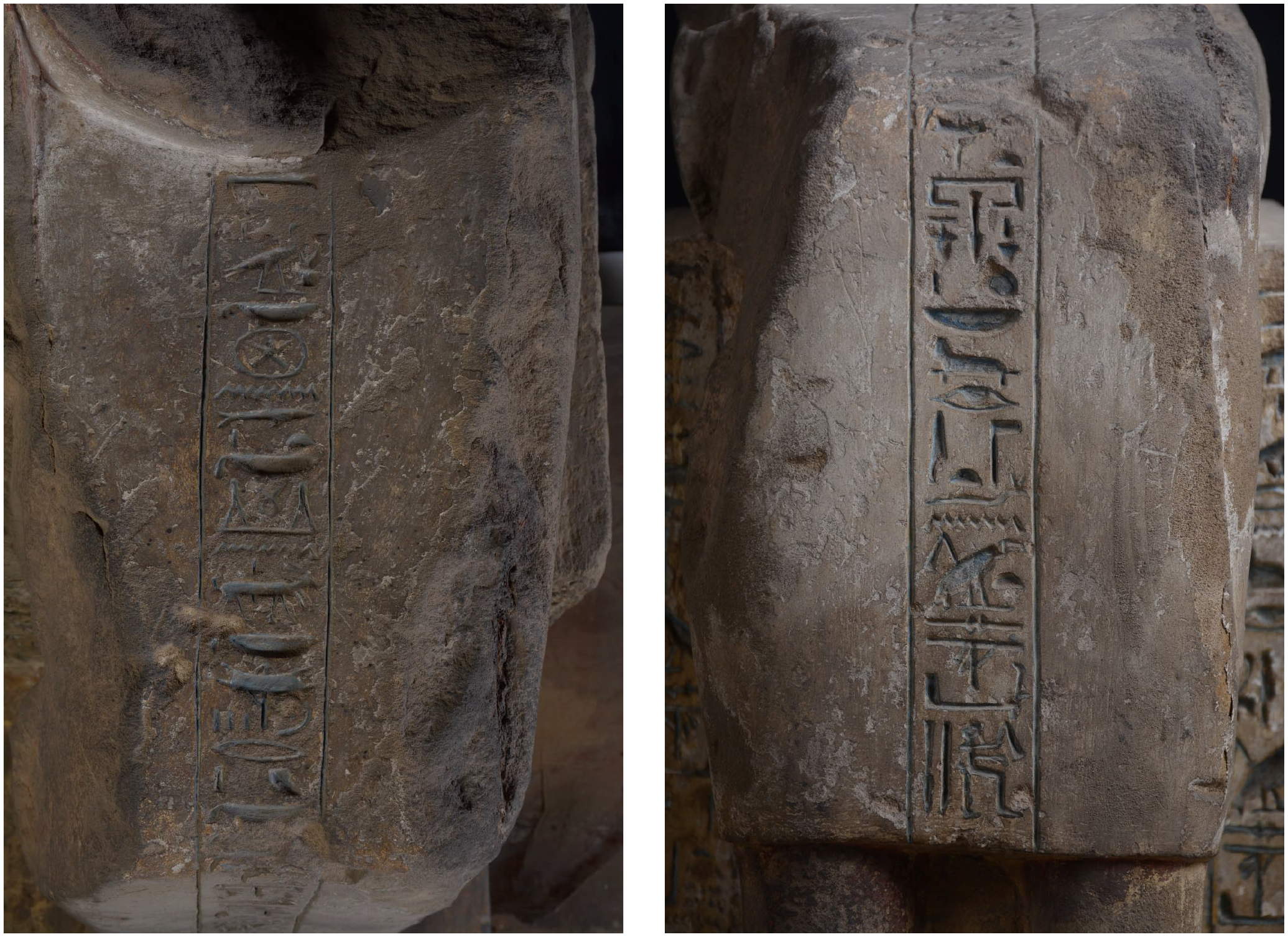
Photos of the upper and lower parts of the kilt of Minnakht (photos: courtesy of the Egyptian Museum in Cairo).
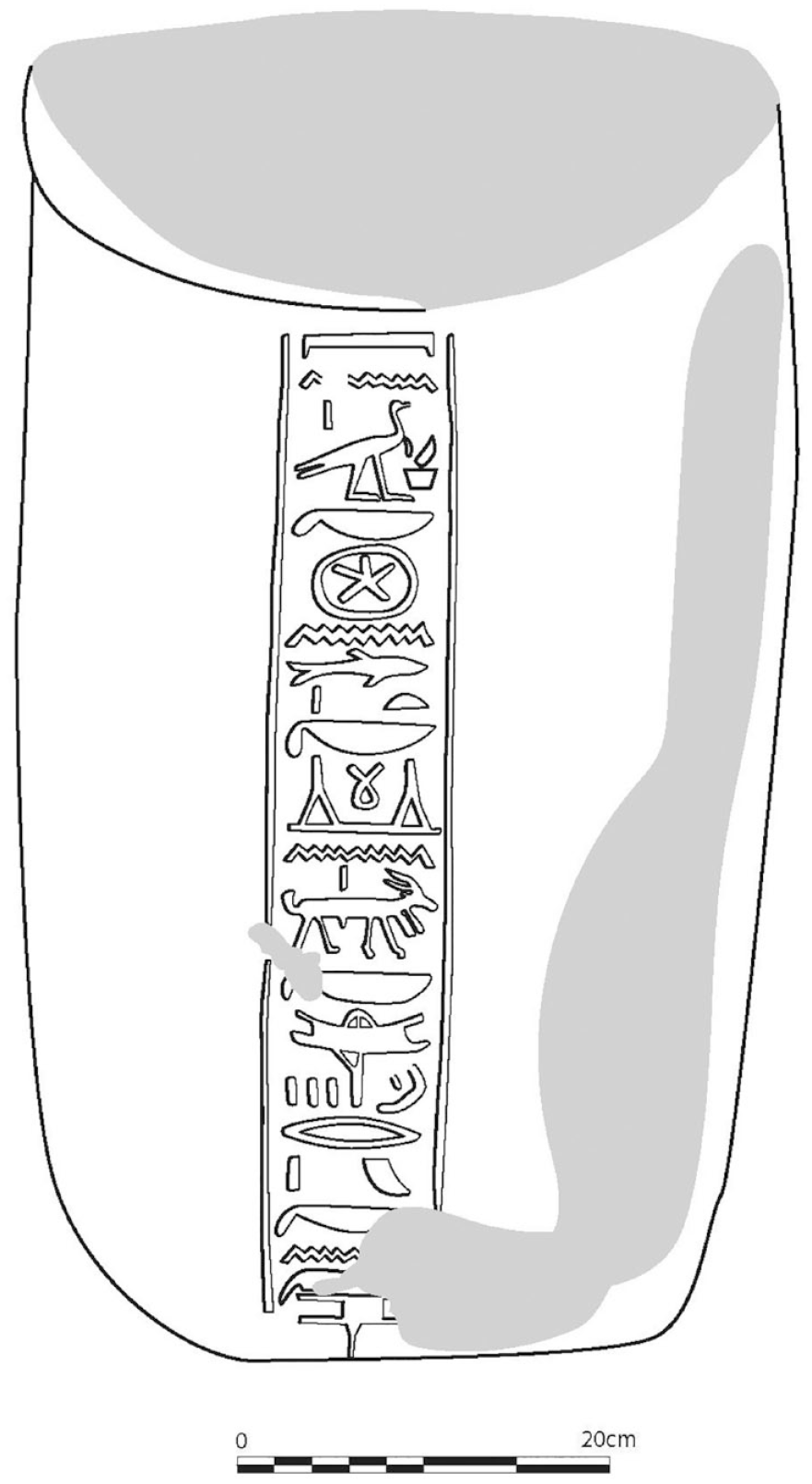
Facsimile of the upper part of the kilt of Minnakht (drawing: Walid El-Sayed).


pt n bȝ.k dwȝt n ẖȝt.k mnḫt n sʿḥ.k ṯȝw r fnD (?).k
n mḥtt prt-ḫrw t ḥnkt Rʿ-nb Wsỉr ỉt-nṯr n Mwt Mnw-nḫt mȝa-ḫrw
The sky is for your ba, the netherworld is for your corpse, clothing is for your mummy, 37 the breath of the north wind(T) is at your nose(?).(U) An invocation-offering consists of bread and beer every day, (O) Osiris, the god’s father of Mut, Minnakht, the justified.
Commentary on the Inscriptions
(A) There are remains of a sign above the word Ra, which is perhaps a trace of a forearm to write the name of the god (Gardiner sign list,  D36).
D36).
(B) According to Allen, this is a part of another prayer that is destroyed. All that remains is ‘[…] everyday […] forever and ever.’ This prayer is supposed to continue on the upper part of the back pillar (which is missing). 38
(C) The inscriptions are not ordered according to the normal sequence of the Book of the Twelve Caverns. They begin with the first and second groups of the eighth cavern on the back pillar. The left side of the seat contains the third, then the fifth and the fourth groups of the eighth cavern. The scribe was supposed to switch the order between the fifth and the fourth. The right side begins with the sixth, then the seventh groups of the eighth cavern and ends with the first group of the ninth cavern (fig. 5).
(D) The left and right sides of the seat are organised in the same manner. Each side consists of five vertical columns incised in blue and separated by vertical lines also painted in blue. On each side, we have three invocations addressed to the deities, and every invocation starts with the vocative particle ʾI  ,
39
whereas the back pillar contains only two invocations. According to Fischer, the inscriptions are directed backwards on the two sides, which means that they face the back of the statue rather than its front.
40
,
39
whereas the back pillar contains only two invocations. According to Fischer, the inscriptions are directed backwards on the two sides, which means that they face the back of the statue rather than its front.
40
(E) According to Leitz, the fȝw ȝryw.sn were ‘the bearers of those who are (seated) above them (…).’ 41 The function of this group of deities was to carry their masters to the sky in the prow of Ra’s morning barque, so that the deceased can accompany Ra when he rises.
(F) In most cases throughout the statue, the scribe is using the suffix pronoun sn  ‘they’ or the plural tn
  ‘you’, and in few cases sn
  with no strokes.
(G) Wente compares the construction ntf nb ȝwt ‘he is the lord of offerings’ (independent pronoun + nominal predicate) with another construction ỉw nswt N + adverbial predicate that is used in the Osireion of Abydos. 42 The latter sentence that was used by the kings is adopted here by Minnakht. In both cases, the king or the private person (Minnakht) is the giver of offerings.
(H) Based on Leitz’s translation, ḥnwt-Rʿ means ‘cheering Ra’, whereas Quirke translates ḥwyt-Rʿ as ‘the clapping women of Ra’. 43 Other texts variants are cited by Piankoff and Méndez-Rodríguez, such as ‘those who mourn for Ra’ and ‘those who strike for Ra’. 44
(I) The three strokes  after
after 
 are not mentioned by Borchardt, even though they are clear on the original statue.
45
are not mentioned by Borchardt, even though they are clear on the original statue.
45
(J) Some versions use dỉwt instead of twr. According to Méndez-Rodríguez, perhaps the intention was to write the word dỉwt instead of twr, in which case it would be translated as ‘high-pitched shrieks’. 46 He sees the use of twr as a mistake especially when comparing it with Papyrus Berlin 3006 and Papyrus New York MMA 35.9.19. I agree with Méndez-Rodríguez’s opinion, especially since the adjective ḳȝ, meaning high, is followed by a second adjective twr. Instead of using two adjectives, it would have been better to use ḳȝ dỉwt in order to create two parallel expressions with ḥtpw ḫrw or ʿȝ ḫrw that are detected in other monuments and versions of the Book of the Twelve Caverns. 47 Méndez-Rodríguez points out that some sources display more extended textual translations, which describe the sounds created by the deities, such as our example here, in which the voice is high, respectful, and calming. 48 According to Leitz, the functions of these goddesses (nnyw) is to roar loudly (ḳȝwt dỉwt), but also to possess a quiet voice (ḥtpwt ḫrww). 49
(K) After the word twr, there are three strokes that were not cited in the Catalogue Général. In addition, there is a missing  in the word ḫrw between the oar sign (Gardiner sign list, P8) and the seated man.
50
in the word ḫrw between the oar sign (Gardiner sign list, P8) and the seated man.
50
(L) According to Leitz, these deities’ duty is to make offerings to the father of the gods.
51
Borchardt mistakenly reads the first sign of  ?’ (Gardiner sign list, W11), whereas the correct reading should be
  (Gardiner sign list, T28). The same applies to the third line on the right side of the statue, which should be read as
(M) I think the scribe mistakenly wrote the title ỉt-nṯr ỉn Mwt 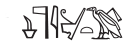 instead of ỉt-nṯr n Mwt, as he was using n and not ỉn throughout the statue.
53
Additionally, the indirect genitive n is typically defined as ‘of’ rather than the agent ‘in’, which means ‘by’.
instead of ỉt-nṯr n Mwt, as he was using n and not ỉn throughout the statue.
53
Additionally, the indirect genitive n is typically defined as ‘of’ rather than the agent ‘in’, which means ‘by’.
(N) Leitz reads this part as nbwt nmtt ‘the mistresses of the steps’, whose role is to let the deceased roam freely, and he alludes to our piece as the only evidence of the title in the New Kingdom. 54 Alternatively, Piankoff translates as ‘mistress of coming and going (?)’. 55
(O) According to Leitz, ẖr means ‘the relatives’.
56
The ẖrw are the chief masters in the very hidden chapel of ỉtrty sanctuaries. The two strokes  after the t
  sign in the word ỉtrty are not mentioned by Borchardt, although they are visible on the original piece.
57
sign in the word ỉtrty are not mentioned by Borchardt, although they are visible on the original piece.
57
(P) According to Leitz, mȝʿ-ḫrw m ḥwt-sr means ‘the justified in the princely house’. 58 In his opinion, it is a name of the deceased that was only used in the New Kingdom. Hannig translates it as ‘Fürstenhaus’. 59 Separately, at the end of this line, there is a stroke in the word bȝ that is not mentioned by Borchardt. 60
(Q) Leitz translates the line nṯrw ỉmyw kȝr.sn tpyw Nwn as ‘the gods who are in their chapel, who are on Nun’. He did not mention CG 624 among the cited examples. 61
(R) It is hard to determine whether this part was damaged or originally incomplete. Only snt and remains of f below it can be seen on the upper part. Immediately after snt.f, there is trace of a nb, then a lacuna and another nb just before the end of the caption. I agree with Borchardt’s reconstruction of this part and I think the intention was to write the common title nbt pr for the first part followed by the name of Minnakht’s wife. The same applies to the son, whose name was supposed to exist after his title sš ḥwt-nḥr. Several scholars have discussed the term snt.f and how it started to replace ḥmt.f in the 18th Dynasty. Černý alludes to the early evidence of the use of the term snt.f during the reign of Thutmose III (tomb of Nebamun TT24). Then, Whale discussed the use of the term starting from the reign of Hatshepsut/Thutmose III, and he finally concludes that by the reign of Thutmose IV, snt.f was considered the prevailing term to mean the wife. 62
(S) According to Kawai, the owner of CG 624, Minnakht, was the father of Ay/Iy (who served during the reign of King Ay). 63 Kawai established the connection between the title of Minnakht as the god’s father of Mut and that of Ay as the high priest of Mut. Kawai suggests the reconstruction of the name of Minnakht’s wife with that of (Mut)emneb. 64 Based on the inscriptions on the block statue of Ay from Dahamsha (Brooklyn Museum 66.174.1), Ay’s father (i.e. Minnakht) holds the title of a sȝb ‘judge’. However, based on the state of preservation of CG 624 and due to the absence of the names of both the wife and the son, along with the unpreserved upper part of the statue, it is very difficult to confirm the suggestions proposed by Kawai. In addition, we do not have any evidence tying Minnakht to the title sȝb, which exists on the block statue. 65
(T) As mentioned by Shubert, the ‘breath of the north to your nostrils’ is considered a part of ‘the refreshment of the nose formula’, which was used in the 18th Dynasty instead of the ‘breath of the mouth’ that was adopted before the New Kingdom. 66 According to Assmann, the purpose of the funerary rituals was to achieve the dissociation between the corpse and the ba. 67 Before placing the mummy in the sarcophagus, the ba goes up to the sky. Such formulae were prevalent in New Kingdom funerary texts. This separation is fundamental for the ‘transformation of the deceased into a transfigured ancestral spirit’, 68 i.e. the alteration of the deceased into an effective akh.
(U) This sign  is possibly a scribal error (Gardiner sign list, N34). The word that would be more appropriate for the content of the text is fnḏ (nose). Both Borchardt and Daressy copied F63
  (head of a calf with ear), translated as ‘nose’ by Faulkner.
69
Based on the existing sign, I assume that the variant F63A
(head of a calf with ear), translated as ‘nose’ by Faulkner.
69
Based on the existing sign, I assume that the variant F63A  (head of a calf) was the intended original text that was probably mistakenly copied.
Commentary on the Titles of Minnakht
The title ỉt-nṯr is challenging to translate satisfactorily, as unfortunately none of the previous studies settle the entire complexity of its translation. It is clear that throughout different periods, the title was used with two different interpretations. The first one is the priestly title or meaning, whereas the second title alludes to some connection with the royal family. 70 In the 18th Dynasty, the title was assigned to a particular type of priest, and its holder was no longer associated with the royal family as it was during the Old Kingdom. In this discussion, we will focus on the priestly title of the god’s father, his duties and the prevalence of the title god’s father of Mut.
The duties played by the god’s fathers are mentioned in the New Kingdom administrative texts. God’s fathers are mentioned in temples and mortuary contexts in which they cooperate with other priests in conducting daily offering duties and presenting to the Ba of the deceased. 71 According to Shafer, it was the god’s father’s job to proceed in front of the divine image and to scatter the path with clean water when passing through the courtyards of the temple or outside the temple’s enclosure wall. 72 ʾIt-nṯrw are involved with carrying the food and provisions to the temple and examining the temple estates. 73 In one papyrus, it is clear that the ỉt-nṯr informs the king that the property of some temples were robbed. Teeter also added that at the Karnak temples, ỉt-nṯr was responsible for revealing ‘the divine face and opening the doors of heaven’. 74 By the end of the 18th Dynasty, the ỉt-nṯr title held no association with the royal family and was instead categorised as a priest. 75
After looking at the main duties of the ỉt-nṯr, it is interesting to examine the hierarchy that a priest would follow in his lifetime. The autobiography of the high priest Bakenkhonsu from the Ramesside Period sheds light on the hierarchical evolution of priesthood. 76 Following school and military youth training in the stable of Seti I, Bakenkhonsu began his career as a wab-priest for four years and then spent twelve years as god’s father. Afterwards, he served fifteen years as third priest of Amun, twelve years as second priest of Amun, and 27 years as first priest of Amun. What is important for our purpose is that the ỉt-nṯr was treated as the agent of the deity and was connected with the temple that he works for, 77 as was the case with Minnakht.
Leitz mentions several deities associated with ỉt-nṯr such as Amun, Osiris, Ptah, Ra, Hapy, Geb, Horus, Sobek, Atum, Nun and others, but the title ỉt-nṯr n Mwt, god’s father of Mut, is not cited by him. 78 The title ỉt-nṯr n Mwt is mentioned by Al-Ayedi and he cites only one example from TT203 of Wennefer (reign of Ramses II). 79 However, there are examples of individuals in the 18th Dynasty associated with the priesthood of Mut, who held different titles to the one in question. The owner of TT59, Qen (reign of Thutmose III), held the title of ‘the first priest of Mut’, and his brothers were also priests and officials in the sphere of Amun. 80 Qen also has the epithet of ḥsy m pr-Mwt ‘praised in the house of Mut’. According to Shirley, the family of Qen was an influential one, and she concludes that nepotism played an essential role in how his brothers acquired their positions. 81 Shirley also alludes to another example of nepotism that can be detected in the family of the vizier Aametu, whose family served from the reign of Amenhotep I until the early years of the reign of Hatshepsut/Thutmose III. The family of Aametu’s wife was influential and therefore positively influenced her descendants. One of her sons called Nacht(amun) was a wab-priest of Mut. 82 A third individual is Hori, the eldest son of Wennefer/Parennefer, who served as high priest of Mut and ḥm-nṯr priest of Mut. It seems likely that Hori held these titles early on his career, as they are only mentioned in his father’s tomb. 83 A fourth example is Ay/Iy who served as a second prophet of Amun and a high priest of Mut as well as a steward of the domain of Tiye in the estate of Amun. 84 In summary, there is a gap in the examples of titles and monuments relating to the priests of Mut in the 18th Dynasty. I think part of the difficulty, as mentioned by Te Velde, 85 results from the fact that the goddess Mut’s importance started slightly before the 18th Dynasty. Thus, we possess meager evidence or data belonging to the goddess prior to the New Kingdom, which might explain the few priests associated with Mut in the 18th Dynasty.
There are more examples, however, of the title ỉt-nṯr n Mwt, in subsequent dynasties. Stevens discusses the title ỉt-nṯr n Mwt and she points out that there are limited epithets that connect men with the goddess Mut compared to those of Amun. Stevens gathers fourteen people who took the title ỉt-nṯr n Mwt; however, all the evidence she uses dates to the 21st Dynasty. She also highlights the infrequency in attestation of most of the priestly titles associated with Mut, not only ỉt-nṯr n Mwt. She concludes that most jobs associated with the goddess are scribal administrative jobs such as sš pr Mwt, sš ḥwt-nṯr n Mwt, sš ḥwt-nṯr n pr and Mwt wrt nb ỉšrw. 86 The person that carried the title of god’s father of Mut was also sometimes called god’s father of Amun-Ra, as was the case on the papyri of Ankhefenmut and Nespaneferher. 87 The title ỉt-nṯr n Mwt is also present on some shabtis from Bab El Gasus, also dating to the 21st Dynasty. The owners of some shabtis and papyri held the title god’s father of Mut as well as the god’s father of Amun-Ra and god’s father of Khonsu, such as the shabtis of Nesypernub 88 and the papyri of Amenhotep and Nesyamun. 89
Another Piece Belonging to Minnakht
According to Hari, there is currently one other piece (inventory number MF 756) that is believed to have belonged to Minnakht. 90 This cone is currently preserved in the ’, Genève. 91 The cone is made of reddish-brown terracotta, patterned with stamped inscriptions. The base of the cone shows manufacturing defects, such as holes and cracks. The cone dates to the 18th Dynasty and its original location is likely Thebes. Unfortunately, the exact location of Minnakht’s tomb has not been identified. Yet, Pomarska mentions that the cone of Minnakht was found in two divided parts at Deir El-Bahari across the two tombs discovered during the Polish excavations undertaken on the temple of Thutmose III. 92 The first half of the funerary cone (F 6630) was found first in the well of tomb 2. Then, another fragment of the funerary cone (F 7829) was discovered near tomb 1. Only three columns of text remain from each fragment. Pomarska concluded that although the two fragments were broken, they complement each other. She additionally suggests that Minnakht was perhaps the owner of tomb 2. 93 Whether Minnakht was the owner of the tomb at Deir El-Bahari or not, however, is difficult to ascertain.
The cone gives a list of the titles of its owner which are:
94
Wsỉr wʿb ẖry-ḥb(t) n Mwt Mnw-nḫt wʿb n ḥȝt ỉt-nṯr n Mwt Mnw-nḫt sš mḏȝt nṯr n Mwt Mnw-nḫt mȝʿ-ḫrw sš ḥtpw-nṯr n Mwt Mnw-nḫt mȝʿ-ḫrw Wsỉr
Osiris, the wab-priest, the lector priest of Mut, Minnakht, the wab-priest in the front,
95
the god’s father of Mut, Minnakht, the scribe of the divine books of Mut,
96
Minnakht, the justified, the scribe of the divine offerings of Mut, Minnakht, the justified, Osiris.
The cone consists of six vertical columns written in hieroglyphs indicating that Minnakht held five well-known titles: lector priest of Mut, the wab-priest in the front, the god’s father of Mut, the scribe of the divine books of Mut and the scribe of Mut offerings. Dewachter points out that the style of the cone is indeed a work of the 18th Dynasty. He also adds that the repetition of the deceased’s name at the bottom of each column of the cone is typical of a composition of the 18th Dynasty. 97 Throughout the statue CG 624, the title ỉt-nṯr n Mwt is the dominant epithet used. Only on the first column of the left side was the title wʿb mentioned before ỉt-nṯr n Mwt, which might be additional evidence for attributing the cone (on which the wʿb title is cited) to Minnakht. Even if we agree that the cone indeed belonged to Minnakht, it is difficult to confirm whether the cone was manufactured before our statue or not. Despite the presence of five titles on the cone, only wab-priest and the god’s father of Mut are written on the statue. It is probable that other titles were supposed to exist on the missing part of the statue (which could explain the discrepancy between the higher and lower position of the clergy). Although the title ‘the scribe of the divine books of Mut’ is not explicitly mentioned on our statue, there is a connection between this role and the Book of the Twelve Caverns. Being ‘the scribe of divine books of Mut’ could explain Minnakht’s access to such religious and sacred text; in addition, it shows how prestigious his position was, allowing him to own the only statue in ancient Egypt to be inscribed with the Book of the Twelve Caverns.
Comparison between CG 624 and Other Pieces
The objective of this section is to identify similarities between CG 624 and other similar individual pieces to potentially support in dating our piece. In his discussion around individuals’ seated statues, Vandier did not specifically mention the depiction of additional figures in relief, presumably due to the limited number of such examples. 98 To the best of my knowledge, there are five key categories of individual statue inscriptions: (1) inscriptions on the two sides of the seat and a plain back; (2) hieroglyphs on the two sides with a figure in relief on each side; (3) scenes and hieroglyphs on the sides along with a column of incised hieroglyphs on the back; (4) inscriptions on the two sides and a column of incised hieroglyphs on the back; (5) inscriptions on the sides and the back along with a figure in relief on each side. Among the examples that Vandier stylistically grouped with CG 624 is the diorite statue of Amenemhat A52, which dates to the reign of Amenhotep III and much resembles our statue, particularly in its manner of filling the two sides of the seat with hieroglyphic inscriptions and the column that runs on its owner’s kilt. 99 The back of A52 is only incised with one vertical column of hieroglyphs (category 4 above). A second example also mentioned by Vandier is CG 42119, which is a seated statue of the vizier Wsr-ʾImn, dating to the reign of Thutmose III. 100 CG 42119 is in a bad state of preservation, and the body is mostly missing. However, based on what remains, it is clear that the owner’s kilt was inscribed with a column of hieroglyphs (category 3). A third example that can be added to those mentioned by Vandier is the fragmentary granite statue of Mery CG 973, the high priest of Amun during the reign of Amenhotep II, in which Mery is depicted wearing a long kilt with few inscriptions preserved. The two sides of CG 973 are fully inscribed, whereas the back of the statue is plain (category 1). 101 A fourth example, dating to the reign of Thutmose III, is the black granite statue no. 617 of Amenemhab, whose wife Nedjemet is precisely shown in relief on the sides of the seat (category 2). 102 A fifth identical example to CG 624 is the statue of Nebnefer, which was found in the funerary chapel of Wadjmose and is currently preserved as Brussels E1103 (category 5). 103 The statue dates to the reign of Amenhotep III. Even though E1103 differs in the type of kilt used and the specific placement of the figures, it is the most similar one to our statue due to the existence of the inscriptions on the three sides of the statue along with a depiction of figures on the two sides of the seat. It is important to highlight that the above list of additional pieces is non-exhaustive, as there are potentially other comparable pieces to CG 624. 104
Provenance and Dating
There has been some debate surrounding the statue’s original location. Per the museum’s database and according to Daressy, the statue was found at El-Qurnah. 105 Other scholars, such as Quirke, specify Karnak, while Porter and Moss generalise to the broader location of Thebes. 106 In my opinion, it is possible that the piece was found in Karnak where the temple of Mut is, given Minnakht’s role as the god’s father of Mut. The statue could have also come from Deir El-Bahari, since that is where the funerary cone with Minnakht’s name and titles was found. An alternate possibility is that Minnakht was based in Karnak, but the statue was found elsewhere such as El-Qurnah. In any case, it is safe to conclude that CG 624 was found in the larger area of Thebes.
As for the dating of the piece, it is important to remember that most scholars attribute CG 624 to the 18th Dynasty. Daressy prefers a date before the Amarna Period, while other scholars such as Fischer, Scalf, Whelan, Wente, Dewachter, Quirke, Allen, Piankoff, Porter and Moss all agree to the 18th Dynasty without indicating a specific king’s reign. 107
Moreover, according to Vandier’s classification, our statue dates back to the New Kingdom. He indicates that the type of kilt that Minnakht wears in CG 624, which is the long plain kilt that ends just above the ankles, was considered the preferred type of costume for private men in the 18th Dynasty until the reign of Amenhotep III. 108 Such kilts were detected in all dyad and family statues of the 18th Dynasty and survived under the reign of Amenhotep III and during the Ramesside Period (albeit not as common).
Another criterion to take into consideration when dealing with CG 624 is Méndez-Rodríguez’ extensive research on the Book of the Twelve Caverns. There are three attestations of this composition that date to the 18th Dynasty: Papyrus Cairo CG 24742, Papyrus Vatican, 109 and CG 624. They are considered the earliest pieces of evidence of the Book of the Twelve Caverns. Papyrus Cairo is likely the first of the three pieces, as it dates to Amenhotep II’s reign. It is difficult to confirm in this case whether CG 624 is the second or the third attestation of the Book of the Twelve Caverns.
As for the iconographical posture and features encountered in CG 624 and based on (1) the five examples previously compared to CG 624, (2) the type of kilt on which a column of inscriptions is incised, (3) the full hieroglyphic texts covering the two sides and the back of the seat, along with the figures depicted on the sides of Minnakht’s legs, I believe that our statue fits well in the mid-18th Dynasty. However, the possibility of it being slightly earlier in date to Amenhotep’s III reign cannot be excluded.
Conclusion
CG 624 is a unique piece across two dimensions: (1) the content of the text and its purely religious aspect and (2) the title ỉt nṯr n Mwt. The statue is also significant because it highlights one of the least known titles, which is the god’s father of Mut, despite the preponderance of other deities associated with the title ‘god’s father’. Additionally, the piece in question is the only statue to be inscribed with the Book of the Twelve Caverns. The existence of this religious and cosmographic composition on the private statue of Minnakht highlights the significance of its owner’s position. Minnakht’s high prestige and ranking in the priesthood of the Theban Triad is obvious, judging by his possession of the only statue among the 33 sources inscribed with this sacred text.
As previously mentioned, it is better to identify the provenance of the statue as the larger area of Thebes. Finally, it is worth noting that most scholars assign CG 624 to the 18th Dynasty. Comparable private statues range between the reigns of Thutmose III to Amenhotep III, and E1103, which most resembles our statue, dates to the reign of Amenhotep III. Based on the posture, the style, the iconography, the clothing, and the inscriptions that correspond with the typical features in similar pieces, I tend to believe that CG 624 most likely dates back to the mid-18th Dynasty.
Footnotes
Acknowledgements
I am grateful to the former Director of the Cairo Egyptian Museum Ms. Sabah Abdel Razeq for giving me permission to publish the statue and to Mr. Sameh Abdel Mohsen for taking the photographs. I am also indebted to Dr. Daniel Méndez-Rodríguez for creating the diagram on my behalf and for his invaluable insights and helpful remarks on the article. A special thank you is dedicated to my friend Dr. Elizabeth Waraksa for her useful guidance on the article and to Dr. Mohamed Osman and Mr. Walid El-Sayed for creating the facsimile illustrations. This contribution was prepared for publication through the author’s participation in the Mentoring for Egyptian and Sudanese Authors (MESA) scheme of the Egypt Exploration Society thanks to generous funding from their Patrons, with Dr. Daniel Méndez-Rodríguez acting as a mentor to the author.
Funding
This research received no specific grant from any funding agency in the public, commercial, or not-for-profit sectors.
2.
SR 4/13853. For CG 624, see Daressy 1889: 88–89, no. XXXV; Borchardt 1925: 170–171, Blatt 114; PM I/2: 785; Totenbuchprojekt Bonn, TM 135593: <
https://totenbuch.awk.nrw.de/objekt/tm135593#Statue%20Kairo%20CG%20624
> (accessed 17.01.2024). See PN 1935: 152 (6), where Ranke gives examples of the name being written as Minnakht or Nakhtmin during the Middle and the New Kingdoms. Among the holders of the same name in the 18th Dynasty are the following: (1) Scribe statue of Minnakht, early 18th Dynasty, Walters Museum 22.230; (2) Minnakht the owner of TT87 during the reigns of Hatshepsut/Thutmose III (Shirley 2005: 124, 129, 183); and (3) Nakhtmin the during the reign of Tutankhamun ( : 521–527).
3.
It was customary in Egyptian art to paint women in light yellow and men in reddish-brown, based on the assumption that women spent most of their time indoors, while men spent more time outdoors. However, this distinction in colour was not uniformly applied in all periods of Egyptian history. Examples of such variations (e.g., when women would also be depicted in the reddish-brown colour) can be detected occasionally in the Middle Kingdom, then in the Amarna Period, in the tomb of Nakht (TT52), as well as in the tomb of Nebamun and Ipuki (TT181). For information about the colour variations of men versus women, see Robins 1993: 180–181; Robins 2015: 122; Eaverly 2008: 3, 9; Bianchi 2014: 233–235; : 285.
4.
For a similar depiction, see the back of the statue of Yuni and Renenutet in the MMA:
5.
41. Comparable 18th Dynasty examples depicting at least one figure wearing sandals include: Dyad MMA 62.186 (early 18th Dynasty, see Fischer 1974: 27–29, figs 35–38); group statue BM EA31 (mid-18th Dynasty); statue EA1280 (mid-18th Dynasty); group statue E10443 (reign of Amenhotep II); dyad statue BN104 (mid-18th Dynasty, see Metawi 2013: 101–116). Another unique example is the pseudo-block statue of Tety who is wearing sandals (reign of Thutmose III, see : 124–125). There are other examples of private statues with figures wearing sandals dating to the late 18th Dynasty, but I focused on examples from the first half of the 18th Dynasty until the reign of Amenhotep III in order to see if the sandals can be helpful in dating. However, based on the inconsistency of its use, it was hard to use as a dating criterion.
8.
Piankoff 1974: 43–44; : 162 n. 271, 168 n. 272.
12.
For the reuse of the tomb, see Stevens 2018: 78–82, figs 2.2–2.3; Hornung 1999: 54–55; Scalf 2019: 22 n. 59; Méndez-Rodríguez 2017a: 408 n. 9; : 374 n. 34.
14.
Piankoff 1974: 42; : 32.
16.
Méndez-Rodríguez 2017a: 408; Méndez-Rodríguez 2019: 267; : 54 (C).
18.
Méndez-Rodríguez 2015: 85; : 279.
20.
LGG III: 220.
21.
Wb V: 252 (14); Hannig 2006a: 991; , II: 2661.
22.
Wb II: 275; Hannig 2006b, I: 1301; LGG IV: 249–250; : 66.
25.
Piankoff 1974: 57 (C); : 408.
29.
LGG III: 217.
31.
Hannig 2006a: 560; , II: 1653; Wb III: 73; LGG.
32.
Hannig 2006a: 693; , II: 2007.
35.
Hannig 2006a: 421; , I: 1214–1215.
36.
Piankoff 1974: 61 (C); , I: 785.
37.
Hannig 2006b, II: 2115–2116; Whelan 2016: 323 n. 292; : 168 n. 272.
41.
LGG III: 189–190. For variations of this vignette, see Piankoff 1974: 54–55; : 66.
44.
Wb III: 6–7, 46, 49. For variations of this vignette, see Piankoff 1974: 55–56; 2017b: 217– 227–228, fig. 8; : 268.
46.
For other variants in the texts, see 220–223. For dỉwt, see Hannig 2006a: 1042; , II: 2791.
47.
Méndez-Rodríguez 2019: 269 n. 28. For variations of this vignette, see : 57–58.
58.
LGG III: 219.
59.
Hannig 2006a: 551; , II: 1636.
61.
LGG IV: 467. For variations of this vignette, see Piankoff 1974: 61; 2017a: 407, .
62.
Černý 1954: 27–28; : 251–253.
63.
Kawai 2005: 470–471, 481–482. For the block statue of Ay, see Sauneron 1968: 66–68, pls XII–XIII; : no. 425, pl. LXXXIV.
65.
Kawai dates the statue of Minnakht to the reign of Tutankhamun-Ay (?), while Gabolde states that we have weak evidence to justify Kawai’s opinion. I agree with Gabolde that dating our piece to Tutankhamun is improbable: Gabolde 2015: 154, 575 n. 67; : 481.
68.
Assmann 2005: 91; : 321–323.
69.
Borchardt 1925: 171; Daressy 1889: 88; : 98; Wb I: 577 (12).
70.
For different definitions of the title, see Lorenz 2017: 506–507; Brunner 1961: 99–100; Roehrig 1990: 351–356; Bryan 1991: 45–46; Walle 1963: 79; Vandersleyen 1968: 255; : 121–124.
72.
Shafer 1998: 15; : 81–82, 84.
74.
Teeter 2011: 24; : 19, 31, 33 n. 1.
76.
Birrell 1998: 77–78, 80–81; Kees 1961: 123; : 27.
78.
LGG I: 580–581.
80.
Shirley 2005: 181 n. 781; : 92.
82.
Shirley 2005: 97, 169–170; : 86, 92.
83.
Kawai 2005: 479–480; : 105–106. According to Kawai, Hori is contemporary of Tutankhamun-Horemheb.
85.
Te Velde 1979/80: 3, 5; : 454.
88.
Daressy A.142 < https://www.ushabtis.com/bab-el-gasus/#Shabti%20Nesypernub%20%E2%80%93%20nsy-pr-nwb > (accessed 17.01.2024).
89.
Stevens 2018: 262 (Amenhotep), 263, 353 (Nesyamun); : 175.
91.
Hari 1974: 258, , 260, 262.
92.
155–156.
93.
155–156, figs 1–; Lipińska 204 (no. 128), pl. LXIX, fig. 99.
95.
96.
Wb III: 480 (8).
97.
1979: 152–153.
98.
Vandier compares our piece to other fragmentary pieces, such as an unnamed fragmentary statue currently preserved in the Museum of Fine Arts at Virginia, CG 952, CG 976, CG 1014, and E 16350. The fragmentary statue in the MFA is in a poor condition with only the bust of the statue remaining. The bust of the statue depicts a seated figure wrapped in a large coat, but it is difficult to judge the rest of the statue (Vandier 1958a: pl. CXL.5). CG 952 is a black granite statue of Tjaia and is also in a bad state of preservation. As for CG 976, only the upper part of the statue of Ahmose remains, whereas the base, the arms and the legs are destroyed. CG 1014 consists of eight fragments of the statue of Hekaneheh showing him seated and depicted as Osiris. The sides of the owner’s seat are decorated with scenes and few lines of hieroglyphs. The limestone statue E 16350, which is currently preserved in the Louvre Museum, represents a seated man with a curly short wig. It is difficult to compare E 16350 with CG 624 based on its deteriorated state and the absence of inscriptions throughout the statue. For these pieces, see Vandier 1958b: 437 n. 1, 656 (CG 624), 659 (CG 952 and CG 976), 669 (Karnak-nord E.134), 676 (E 16350). CG 976 is likely dated to the Middle Kingdom based on Vandier and to the end of the 17th or the beginning of the 18th based on Porter and Moss (see Malek, et al. 1999a: 476, no. 801-530-150). Statuette E 16350 dates to the reign of Hatshepsut/Thutmose III (see Malek, et al. 1999b: 549, no. 801-626-530).
99.
For A 52, which is currently preserved in the Louvre Museum, see Malek, et al. 1999b: 548, no. 801-626-511; : 671 <
https://collections.louvre.fr/en/ark:/53355/cl010013458
> (accessed 17.01.2024).
100.
For more details about the statue CG 42119, see Dziobek 1998: 94–95; : 509, 661. <
https://www.ifao.egnet.net/bases/cachette/ck392
> (accessed 17.01.2024).
102.
It is currently preserved in the Musée Jacquemart-André in Paris1987: 12, figs 4–, 21–22.
103.
Capart and Spiegelberg 1902: 160–168, figs 1–2; Capart 1902/03: 22; Fukaya 2012: 196 (table 2), 199–200; /91: 123, pls XXVI–XXVIII <
https://www.globalegyptianmuseum.org/record.aspx?id=216
>(accessed 17.01.2024).
104.
According to Vandier, in dyads, family members are often engraved on the visible surfaces of the seat (on its front or on its sides), whereas in the group statues, it became common to find secondary figures in the round along with other figures in relief (Vandier 1958b: 441, P.N.E. VI, 445, P.N.E. IX). For examples of dyad statues, containing inscriptions and/or figures in relief, see Brooklyn Museum 40.523 (Hema 2005: 179–181, pls 81a–c); Louvre Museum A 53EA29. SM 2298 (mid-18th Dynasty) resembles CG 624 in having his son and daughter portrayed in relief in front of the seat, one on each side of the parents. The two sides are fully inscribed whereas the back is plain <
https://upload.wikimedia.org/wikipedia/commons/5/58/Seated_figure_of_Amenhotep-user_and_his_wife_Tentwadj.jpg
> (accessed 17.01.2024), see Hema 2005: 82–83, pl. 36. For group statues, see the group statue of Sennefer and Senay CG 42126; EA31 3057;KS 1814 <> (accessed 17.01.2024).

107.
Daressy 1889: 88; Fischer 1977: 29; 2019: 23 (table 1); Whelan 2016: 323 n. 292; Wente 1982: 170; 1979: 152; Quirke 2013: 407; Allen 1974: 168 n. 172; : 43; PM I/2: 785.