




Abstract
The papyri of the Wadi el-Jarf mention some ‘waterways’ in connection with ‘palace service’ (stp-zȝ) that are also found in autobiographical inscriptions of the Old Kingdom. These findings provide a link between the textual and archaeological data.

During the Old Kingdom, two types of autobiographies can be differentiated. 1 On the one hand, there are event biographies (also called career biographies), which thematise commissions of the king (expeditions, royal orders) and rewards given by him for participation in campaigns. One inscription of this type informs us, for example, about Wnj’s 2 harem conspiracy, his expeditions to the quarries, and also about different groups of rebels and where they were active. This type of autobiography still possesses – at the time of the Old Kingdom – a factual, historical background. 3
To be distinguished from event biographies are so-called ideal biographies, which employ, to a large extent, fixed phraseology to report on actions and speech in accordance with maat. Variants of this type are even attested – comparable to the later coffin texts – in other periods. 4
Recent excavation discoveries have led to a re-evaluation of these ideal biographies that helps us to better understand their phraseology and to place them in their historical context.
The excavations of Pierre Tallet in the Wadi el-Jarf, where papyri A and B (see below) have been found in the ‘galleries’, deserve special attention. 5 These reports document the work of a crew that operated for a period of three to five months and was responsible for transporting the casing blocks from Tura for the construction of Khufu’s pyramid at Giza. The papyri themselves not only contain information about the organisation of the transport, but also the names of various places along the route between the Wadi el-Jarf and the pyramid, making it possible to determine their location names more precisely. An observation made previously 6 has also confirmed that the term stp-zȝ does not refer only to a building (‘palace’) 7 but rather to a ‘palace service’, i.e. an activity for the king. According to the newly discovered papyri in the Wadi el-Jarf, the king’s palace building was to be found near the pyramid itself. 8
In addition, the Wadi el-Jarf papyri show that the pyramid was accessible via a system of waterways with canals and harbours as well as a port near Khufu’s pyramid. 9 The Egyptian term used for the water transport infrastructure is m-ḫd ‘sail downriver’ 10 and m-ḫsfwt ‘sail upriver’. 11 Precisely this link between waterways and the stp-zȝ is also mentioned in several autobiographies of the Old Kingdom, which can now be interpreted anew on the basis of the archaeological evidence.
Therefore, we read in the inscription of Ptḥ-špss 12 at Saqqara in the time of Niuserre (col. 4, fig. 1):
(a) ʿḥ-nṯr šmʿ.w ‘God’s Palace of Upper Egypt’ is not a palace in the true sense of the word, but rather a kind of shrine or ‘residence’ for different deities. 15
(b) Important in this context is the remark of Gundacker, 16 that each public presence can be associated with ḫʿw ‘appearance’, which means that there is no singular event in question here.
It should be emphasised at this point that the mention of wjȝ ‘cult barque’ (or ‘processional ship’) 17 is an unambiguous reference to water.
In almost the same words Sȝbw, rn=f nfr Jbbj, 18 who served under Teti, describes this procedure (1st col. of the outer right hand jamb of his false door, fig. 2) as follows:

Autobiography of Ptḥ-špss (after Gundacker 2015: fig. 1).
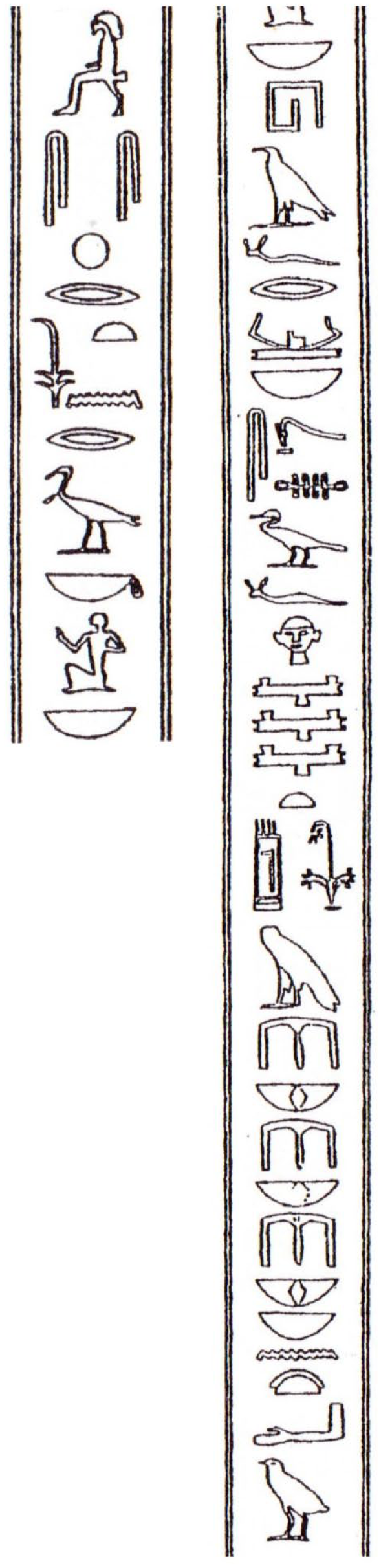
Autobiography of Sȝbw (after El-Khadragy 2005: figs 1–2).
The same phraseology is also found at Saqqara in the autobiography of Ḥzj 19 (who lived in the time from Asosi to Teti), therefore, this is obviously a constant phraseological sequence. In Old Egyptian the first person singular is not written 20 and the phraseology is the same as used by Ptḥ-špss and Sȝbw, consequently, one must add =j instead of the suffix =f to the text of Ḥzj.
In addition, the way the text is split into columns once again graphically illustrates that it is a fixed sequence of actions. 21 Thus for Ḥzj it reads (at the right/west passage, cols 4–6, fig. 3):
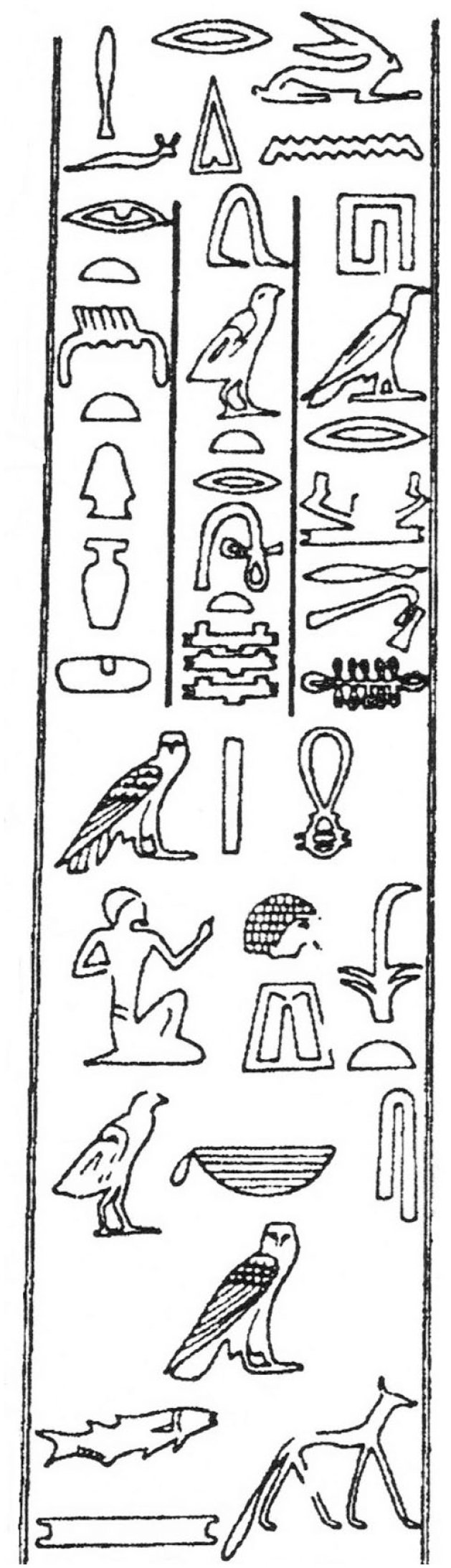
Autobiography of Ḥzj (after: Kanawati and Abder-Raziq 1999: pl. 59).
The phrase wn rḏ(j) ḥm=f makes it explicit that the king had to grant the right (of entering the barque). Moreover, the grammatical expression wn=f sḏm=f expresses habitual actions, 26 again emphasizing that it is not a singular event.
Further evidence for this phraseology is found in the inscription of Wnj, who, as he himself declares, pursued his career under Teti and until the reign of Merenre as jmj-rȝ šmʿ.w ‘overseer of Upper Egypt’ and was buried in Abydos. 27 The text reads (col. 28, fig. 4):

Autobiography of Wnj (after: Hofmann 2002: fig. 2, col. 9).
Here again, the parallel spelling m jr(j).t expresses the following actions: (1) stp-zȝ and (2) going on/preparing the paths and (3) ‘doing/preparing’ the offerings. The reference to the barque (wjȝ) has been omitted here – possibly so as not to break the parallelism of m jr(j).t.
It is obviously not just a fixed phraseological connection, but also a ‘real’ sequence intended to be understood as a royal privilege granted to officials. The description of actions is also based on a phraseology which is oriented more towards the course of the deed itself than forming a phraseologically fixed ‘cluster’ in the sense of a transmitted phraseology, traceable locally as well as chronologically. 30
The chronological continuation of this sequence could lead to an episode that is depicted in the so-called great temple relief at Abu Gurob in the sun sanctuary of Niuserre (fig. 5): Half-bowing officials lower their staffs to the ground before the king, saying wȝ.t nfr.t ḫft-ḥr [nsw] ‘Perfect path in the face [of the King]’; to the right there are the šms.w pr ʿȝ ‘servants of the of the royal palace’ and to the left the šms.w ḏbȝ.t ‘servants of the of the robing room (in the palace)’. 31 This lowering of the staffs possibly formed part of the stp-zȝ, i.e. performing of the palace service, like it is described in the inscriptions listed above.
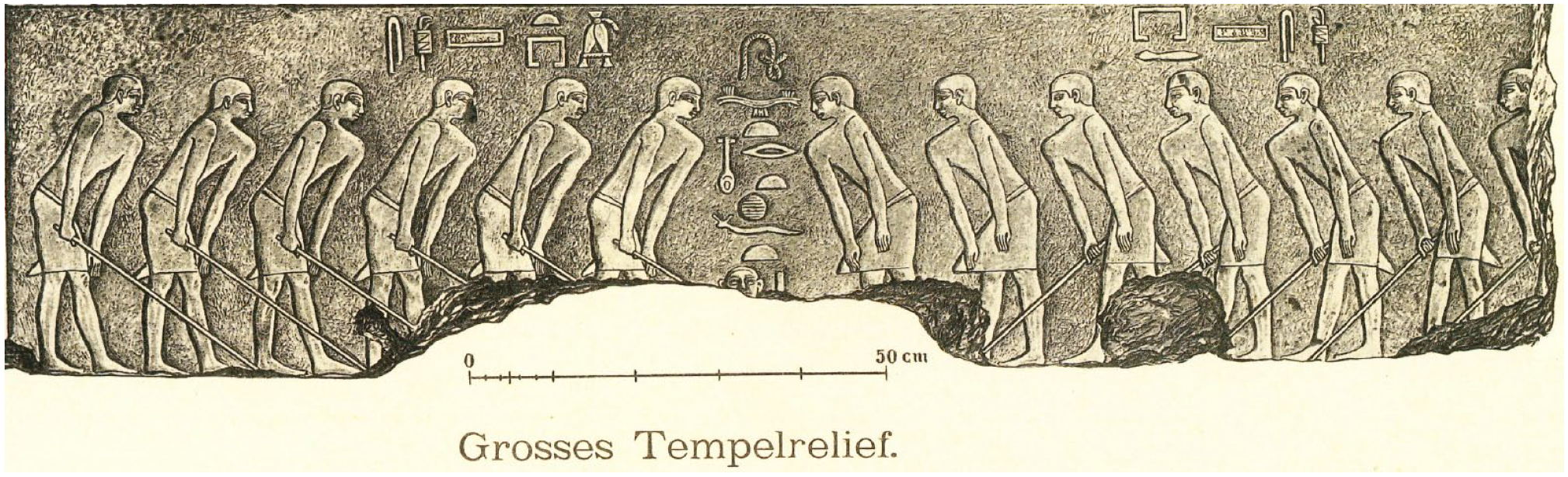
‘Great Temple Relief’ in the Sun Temple of Niuserre (after: Borchardt 1907: pl. 16 detail).
Summary
In various tombs of the Old Kingdom, fixed phraseology is used to describe how the officials are honoured by the king and allowed to accompany him in the royal barque. The phraseological sequence is as follows:
1) Praise/award from the king (ḥz(j) ḥm=f, špss ḫr nsw)
2) Descending into the cult barque (hȝ(j) r wjȝ)
3) Performing the ‘palace service’ (stp-zȝ)
4) Entering the ways of the ‘Palace of the God of Upper Egypt (on all Feasts of Appearance)’ (ʿq ḥr wȝ.wt ʿḥ-nṯr šmʿ.w)
5) Receiving offerings from the king (jr(j) ʿḥʿw.w/ȝw.wt).
This sequence is embedded in different contexts within the autobiographies: in the text of Ptḥ-špss 32 after the education at court and his royal marriage; in the version of Sȝbw, rn=f nfr Jbbj 33 at the beginning of his autobiography; in the autobiography of Ḥzj 34 after his promotion under three kings; and finally in the text of Wnj 35 after the promotion to smr-wʿtj ‘sole companion’ and jmj-rȝ ḫnt(j).w-š pr-ʿȝ ‘overseer of field labourers of the palace’. What they all have in common is the incipient turning point within the autobiography that leads to another episode.
According to the newly found papyri in the Wadi el-Jarf together with the excavations of Mark Lehner and his team, it can be proven that the pyramid as well as the neighbouring palace building of the king were all accessible by ‘water transport infrastructure’. 36 The logistics were probably self-evident from the Egyptian point of view: the route over the Nile was a natural transport route, but the fact that these were supplemented by artificial canals around the pyramids is a new discovery. These (artificially constructed) water canals are even found in the autobiographies of the Old Kingdom. The inscriptions speak of a ‘great barque’ near the pyramids and the associated activities/rituals are described (see as listed above). These new discoveries are reflected in the autobiographical inscriptions of the Old Kingdom, which can now be placed in an archaeologically comprehensible context.
Footnotes
Funding
The author did not receive funding for this project.
1.
For an overview, cf. Kloth 2018. See also Stauder-Porchet 2017;  .
.
2.
See Sethe 1933: 98.8–110.2; .
3.
See Chauvet 2013; : 49–51.
6.
See Goelet 1986; .
7.
See Goelet 1986: 85; Hannig 2003: 1259 ‘Palast, Palastklausur’: the palace as a building can be identified when the word is written with the determinative of a house. But compare also : 203–205 on the conceptual overlap of the term stp-zȝ for the royal court and the skilled workers with close relationship to the king.
9.
Lehner 2014: 14–23; : 259, plans 11.12, 11.31.
12.
Gundacker 2015; Dorman 2002: 95–110, pl. 11; : 25–26.
14.
15.
Goelet 1982: 292–295; cf. also : 50.
18.
Most recently El-Khadragy 2005: 169–199; : 30.
19.
Stauder-Porchet 2015; Roccati 2011: 307–308; Kloth 2002: 25–26; Silverman 2000: 8; Kanawati and Abder-Raziq 1999: 38, pl. 59; Kanawati 1999: 69, .
20.
Edel 1955: §160;
21.
Helck 1974: 33; : 19.
22.
Hannig 2003: 34 jwj r ‚kommen nach (Ort)‘; as well as : 44 jw r ‚kommen nach einem Ort‘.
23.
Wȝ.t is also recorded as ‘route of a ship’: cf. Steindorff 1913: table 77 (see also : 301).
24.
Baud and Farour (2001: 50) read here t ḥnq.t ‘pain et bière’, but this is most likely a determination for graphic reasons to ȝwt ‘Gabe (von Speisen), Opfer, Spende’ (: 4).
25.
I follow the publication by Kanawati and Abder-Raziq (1999: 37) as taking the vertical stroke after the split column as a separating stroke that is not read, see also : 194, n. l.
27.
The inscription is now in the Egyptian Museum in Cairo (CG 1435/JdE 34570) and was last studied by El-Khadragy 2002: 61–67 (with photo and drawing), and by Hofmann 2002: 225–237 (text in standard hieroglyphs). : 145–157) was also able to prove that Wnj first had a tomb in Saqqara before abandoning it in favour of his final burial place in Abydos (cf. also n. 2).
28.
29.
Fischer (1976: 14) translates ʿḥʿw as ‘(performing) attendance’ and Edel (1955: §260) as ‘Aufwartung’. : 11, n. 12) regards this passage as referring to ‘holding up’ the barriers during receptions of the king.
31.
See Borchard 1907: Bl. 16; as well as Grdseloff 1951: 131. The gesture of lowering the staffs is not mentioned in : 35, where she considers officials greeting and worshiping the king or the gods with raised arms, described with the terms rḏ(j)/jr(j) jȝw or dwȝ.
32.
Dorman 2002: 100, .
36.
Lehner 2014: 14; : 191–292.