




Abstract
The relationship between the owners of G 4940 and G 5080, whom Junker deemed to be Seshemnofer I and II, respectively, has long been questioned by Egyptologists. Some scholars consider Seshemnofer I to be the father of Seshemnofer II, while others refute this idea because the wife of Seshemnofer I did not have the same name as the mother of Seshemnofer II. Junker raised the possibility that Seshemnofer I was married more than once, and although there is no direct evidence for this, there may be some rather suggestive indirect evidence. Using wall scenes from the tombs of the Seshemnofer family, statuary and other inscriptional evidence, the idea that Seshemnofer I was married multiple times will be reconsidered. This study aims to provide more clarity on the relationship between Seshemnofer I and Seshemnofer II, and highlight the subtleties used by tomb owners to distinguish the different maternities of their children.

Introduction
Around the beginning of Egypt’s 5th Dynasty (c. 2435 BC), 1 the state administration underwent several significant changes. One of these changes saw the expansion of the administration, in which officials outside of the royal family were able to infiltrate the bureaucracy and attain some of the highest administrative positions, including the vizierate. Perhaps because the loyalty of officials was no longer assumed from their royal background, 2 there is significant evidence to suggest that appointment to the administration became increasingly hereditary, and was no longer solely based on merit. 3
Correspondingly, powerful families began to emerge from around the reign of Noferirkare onwards. One of these was the Seshemnofer family, who are buried in the Cemetery en Echelon at Giza. As the Seshemnofer family frequently represented one another in their tomb decoration, and many of these names correspond with those of neighbouring tombs, it is reasonably easy to recreate their family tree. 4 With this being said, there is still some disagreement about the so-called founder of this family, Seshemnofer (G 4940), whom Junker labelled as Seshemnofer I following his study of this group of officials, and whether this man was the father of Seshemnofer II (G 5080). 5 As the most securely dated tomb in the Seshemnofer family probably belongs to Seshemnofer III (G 5170), the recreation of this family’s genealogy will be presented in reverse chronological order, beginning with Seshemnofer III.
Relative Dates of the Seshemnofer Family
The tomb of Seshemnofer III is generally dated to the reign of Djedkare 6 based on his relationship to other members of the Seshemnofer family, such as Rawer II (G 5470). Rawer II is usually considered to be the son of Seshemnofer II and the brother of Seshemnofer III, 7 as a man named Rawer appears in the tomb inscriptions of these men as sȝ.f ‘his son’ and sn.f ‘his brother’, respectively. 8 These inscriptions, when taken with the close proximity of their tombs, makes this identification of the relationships highly likely. In Rawer II’s burial shaft, a sealing with the cartouche of Djedkare was discovered by Junker. 9 If Rawer II and Seshemnofer III were indeed brothers, they certainly lived contemporaneously, and probably also constructed their tombs around the same time. This appears to indicate that Seshemnofer III’s tomb should be dated to approximately the same period as that of Rawer II. 10
The relative position of Seshemnofer III’s tomb may also attest to a date in the reign of Djedkare. Seshemnofer III built his tomb against that of Rawer I (G 5270), who in turn built his tomb against that of Djaty (G 5370). 11 Djaty’s tomb contained sealings of lector priests of Sahure and Noferirkare, 12 which suggests that his tomb probably dates to the reign of the latter. Allowing for a time lapse between the construction of Djaty and Rawer I’s respective tombs may place the tomb of Rawer I in about the reign of Niuserre. 13 This date corresponds with Baer’s research about the title sequences recorded in his tomb and Reisner’s observation about Rawer I’s chapel type (4b), 14 both of which assign the tomb to within the Noferirkare–Djedkare period. 15
Rawer I is often considered to be the son of Seshemnofer I, as Seshemnofer I depicted a son named Rawer in his tomb decoration, 16 but Djaty’s relationship to the Seshemnofer family is unclear. Reisner suggested that Djaty may have been a brother or a son of Rawer I, 17 but as his tomb was constructed before Rawer I’s, it is unlikely that Djaty was the son of this man. It remains plausible that Djaty was Rawer I’s brother; however, it is important to recognise that a son named Djaty does not appear among the children of Seshemnofer I. Given that Djaty seems to have died around the reign of Noferirkare, it seems that he may have been somewhat older than Rawer I, who probably did not begin his tomb until the reign of Niuserre. It therefore may be suggested that Djaty was in fact the brother of Seshemnofer I: their tombs are dated to a similar period, are located reasonably close to one another and have an identical layout, 18 and both men held the titles wr mḏ šmʿ, ‘greatest of the tens of Upper Egypt’ and jmj-r kȝt nswt, ‘overseer of the king’s works’. 19
The father of Seshemnofer III was almost certainly Seshemnofer II, whose tomb is generally dated to the reign of Niuserre. 20 According to Junker, a scene in this mastaba was copied from the tomb of Iymery (G 6020), 21 which probably dates to late in Noferirkare’s reign and may indicate that the two tombs were relatively close in time. 22 This may also be supported by the presence of an estate called grgt Jj-mrjj, which appears in both the tomb of Iymery and in the tomb of Seshemnofer II. 23 Additionally, Strudwick has argued that in Giza tombs with two false doors, instances where the space between the doors is filled by the depiction of an official seated facing to the right at the right side of the southern false door is only attested between the reigns of Niuserre and Djedkare. 24 Attributing Seshemnofer II’s tomb to the reign of Niuserre may also agree with the generational gap between Seshemnofer II and his son Seshemnofer III, whose tomb has already been dated to the reign of Djedkare.
The owner of G 5280, Pehenptah, was also probably a member of the Seshemnofer family. 25 It is likely that he was the son of Seshemnofer I, as a son named Pehenptah is represented on the west wall of Seshemnofer I’s chapel, 26 and the mother of Pehenptah and the wife of Seshemnofer I had the same, unique name of Imendjefaes. 27 The location of the mastaba may also attest to his connection to the Seshemnofer family, as it is located immediately north of Rawer I’s tomb, amongst other tombs whose owners probably belong to the Seshemnofer bloodline. 28
The final official to be discussed here is Seshemnofer I himself. Junker’s study assigned the tomb of Seshemnofer I to the early 5th Dynasty based on the type and position of the tomb. 29 This date was also supported by Baer’s research, which indicated that the tomb of Seshemnofer I should be dated more specifically to the period before Noferirkare, as it violated the standard title sequences brought into use under this king. 30 Strudwick, Harpur, Willoughby-Winlaw and Swinton all propose a date in the early 5th Dynasty, 31 yet Kanawati suggests that the tomb may date to the Sahure–Niuserre period based on a comparison between this tomb and that of Iymery (G 6020). 32 However, the date he accepts for the tomb of Iymery – the middle years of Niuserre’s reign – is probably too late for this tomb; 33 consequently, a date in the reign of Niuserre for the tomb of Seshemnofer I is also probably too late. Thus, it may be suggested that the tomb of Seshemnofer I dates to the early 5th Dynasty, perhaps to the reign of Sahure.
Multiple Marriages?
As was already alluded to, there is still some confusion about the relationship between Seshemnofer I and Seshemnofer II, and whether these two men were father and son. In favour of this argument is the representation of a son named ‘Seshemnofer the Younger’ on the west wall of G 4940 (fig. 1), 34 the fact that both Seshemnofer I and Seshemnofer II recorded funerary estates named grgt Sšm-nfr and Ddnw/Ḥpt Ddnw in their tombs, 35 and the similar scribal responsibilities of the two men. 36 The reasonable proximity of their tombs in the Western Cemetery also supports a father/son relationship, 37 as does the relative dates assigned to their tombs.
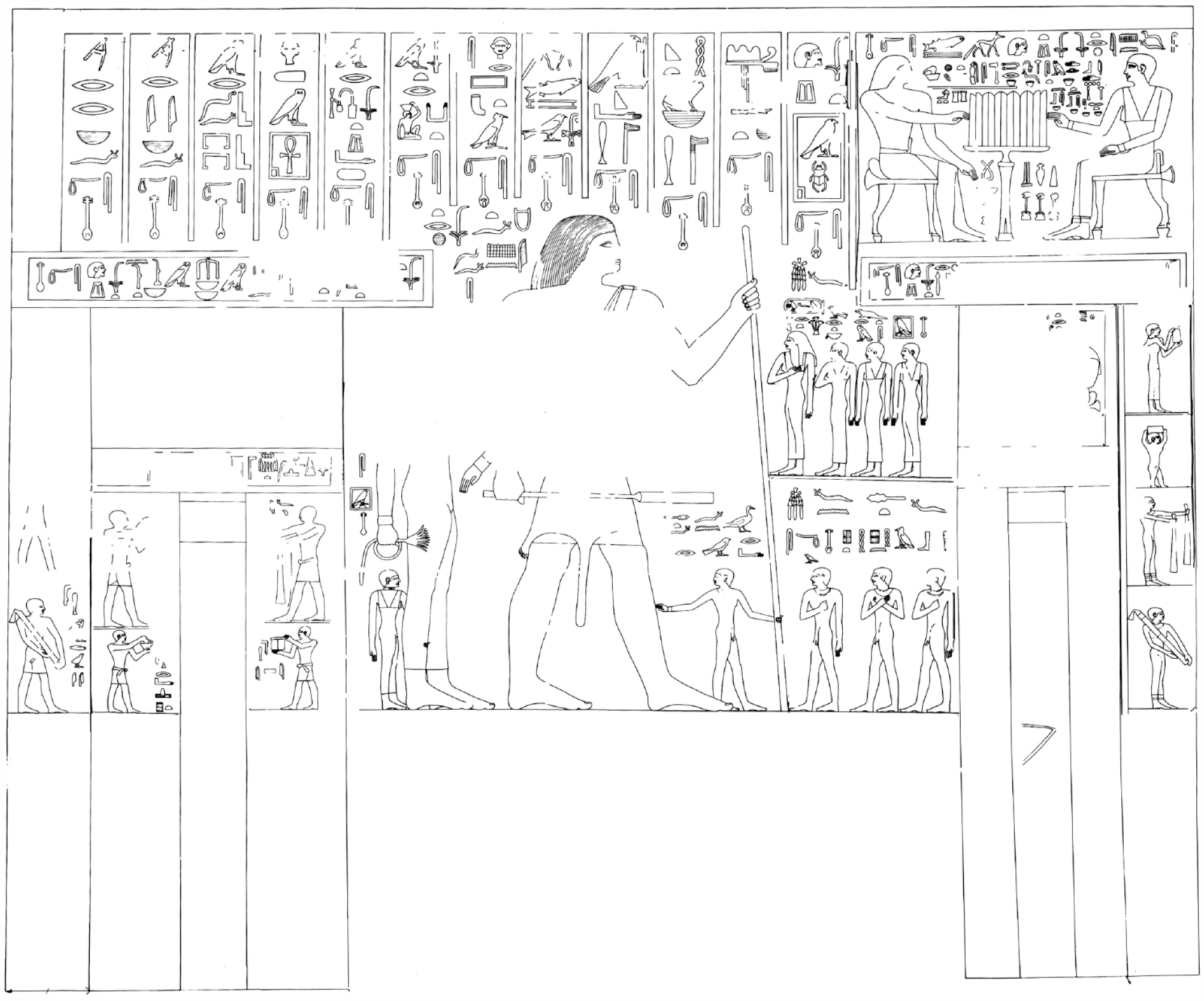
West wall of Seshemnofer I’s chapel (drawing: Kanawati 2001a: pl. 42).
Against this identification is the fact that the wife of Seshemnofer I and the mother of Seshemnofer II had two different names. Seshemnofer I’s wife was called Imendjefaes, 38 yet on the west wall of Seshemnofer II’s tomb, a woman named Meretites is described as mwt.f, ‘his mother’ (fig. 2). 39 Thus, the scholarship is divided: Baer, Kanawati, Altenmüller and Swinton accept the identification of Seshemnofer I as the father of Seshemnofer II, 40 yet Junker, Strudwick and Harpur remain unconvinced. 41
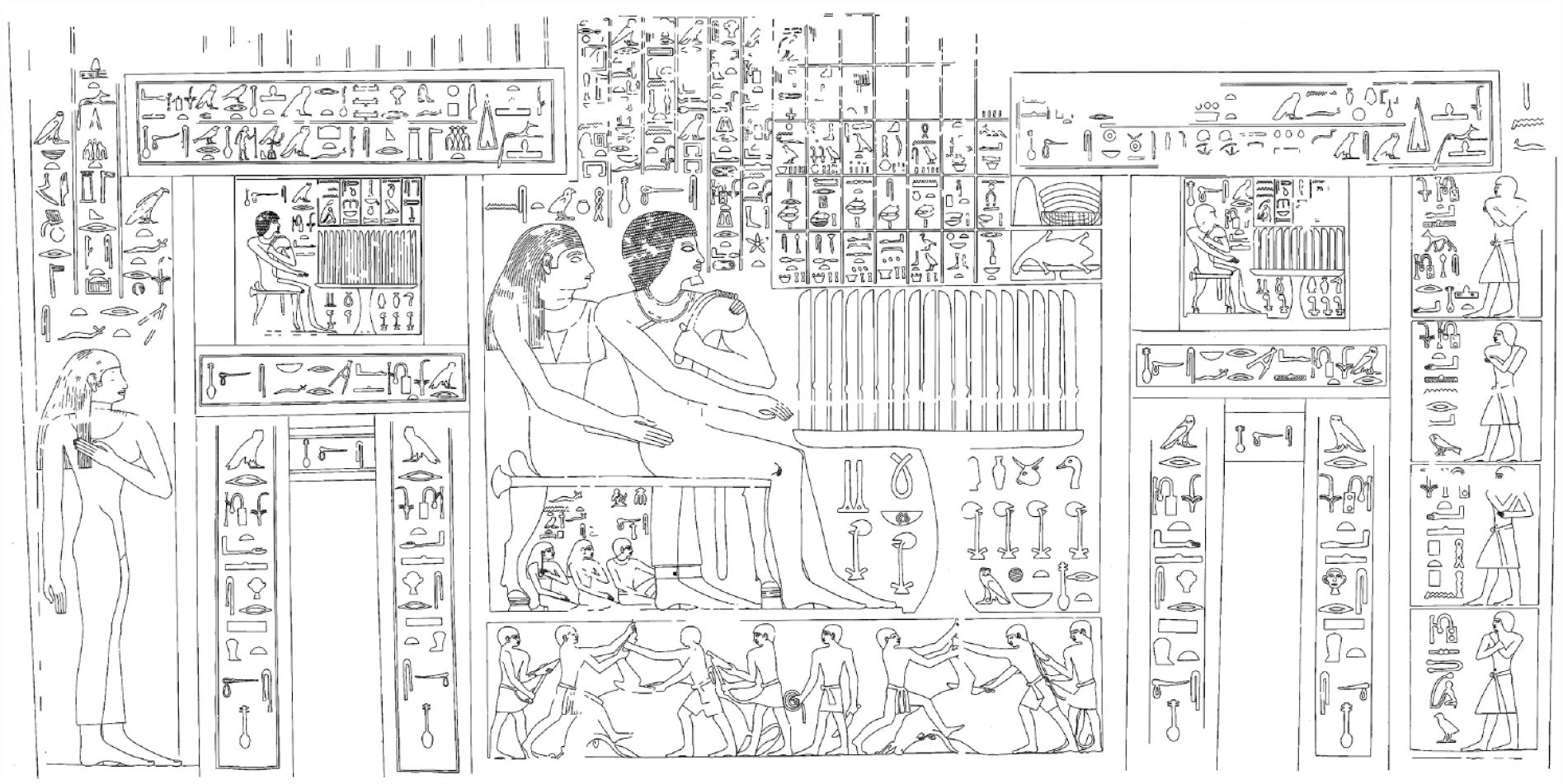
West wall of Seshemnofer II’s chapel (drawing: Kanawati 2002: pl. 63).
Given the tendency for tomb owners and/or their wives to have two names – a rn ʿȝ, ‘great name’ and a rn nfr, ‘beautiful name’ – it may be argued that Imendjefaes and Meretites were one and the same person, but it is certain that this was not the case. 42 Vittmann refers to the rn ʿȝ as the major name and the rn nfr as the minor name, 43 which correctly infers that the rn ʿȝ was the usual way to designate an individual, while the rn nfr was seen as sort of a nickname. It is often the case that the rn nfr was a shortened version of an official’s rn ʿȝ, for example, Seshethotep with the rn nfr Heti (G 5150); 44 Noferherenptah with the rn nfr Fefi (G 8412); 45 and Noferseshemre with the rn nfr Sheshi. 46
As the rn ʿȝ was the main name of the person, it is usually not labelled as such when written on its own. This is not the case for the rn nfr, which is consistently designated as a different name for the individual. 47 In the tomb of Mereruka, for example, there is always a distinction made between his mother’s rn ʿȝ, Nedjetempet, and her rn nfr, Titi. 48 There are no extant examples where ‘Titi’ is not preceded by the rn nfr hieroglyphs. Alternatively, sometimes it is the rn ʿȝ which provides the differentiation between the two names. This can be identified in Nedjetempet’s own tomb, where an inscription reading Tjtj rn.s ʿȝ Nḏt-m-pt, ‘Titi, her great name, Nedjetempet’ is found on her sarcophagus. 49 Thus, if Imendjefaes and Meretites were the two names of one woman, it is almost certain that one would have been differentiated from the other, so as not to confuse the ‘major name’ and the ‘minor name’. 50
To account for the confusion about Meretites and Imendjefaes, Junker raised the possibility that Seshemnofer I was married more than once. 51 Instances of an official being married more than once are fairly well attested: according to McCorquodale, there are up to 32 instances where polygamy may have been represented in an official’s tomb, throughout the entire Old Kingdom. 52 While there is no direct evidence in Seshemnofer I’s tomb to indicate the existence of another wife, Simpson considered that it was unlikely for a wife who was dead or divorced to be commemorated in her husband’s tomb, 53 and this may explain Meretites’ absence in the wall scenes of G 4940. Yet regardless of the fact that only one wife is depicted in Seshemnofer I’s tomb, the way that his children are represented may be suggestive of them being born to two different women. 54
The Maternities of Seshemnofer I’s Children
The children of Seshemnofer I are represented on the west wall of his chapel (fig. 1), 55 with the exception of Khufuankh, who only appears on the north wall (fig. 3) and who will be discussed later. 56 To the right of Seshemnofer I and Imendjefaes are two superposed registers depicting the tomb owner’s children, who are divided by gender. The upper register depicts four daughters, Noferthakhufu, Weretka, Sobekremetes and Noferhathor I, and the lower register depicts three sons, Seshemnofer the Younger, Pehenptah and Ab. Standing in front of Seshemnofer I is a small son named Rawer, who faces to the right but turns his head back to touch his father’s leg while holding onto his staff. Behind the couple, a small female named Noferhathor II touches the leg of Imendjefaes, and although her designation is not fully preserved, it can probably be reconstructed as [sȝt].s, ‘her daughter’. 57 It is reasonably certain that Noferhathor II was not the same person as Noferhathor I, as there are no extant examples where the same child was represented twice in the same wall scene and the practice of giving several children the same name is well attested. For example, the 4th Dynasty official Tjetji had two daughters named Noferthakhafre; 58 the 5th Dynasty official Ptahshepses represented two sons named Ptahshepses in his tomb at Abusir; 59 and the early 6th Dynasty official Ankhmahor/Sesi may have had up to four sons with the name Ishfi. 60 Given that Noferhathor II was evidently a different person to Noferhathor I, the question now remains: why was Noferhathor II represented separately to her sisters?
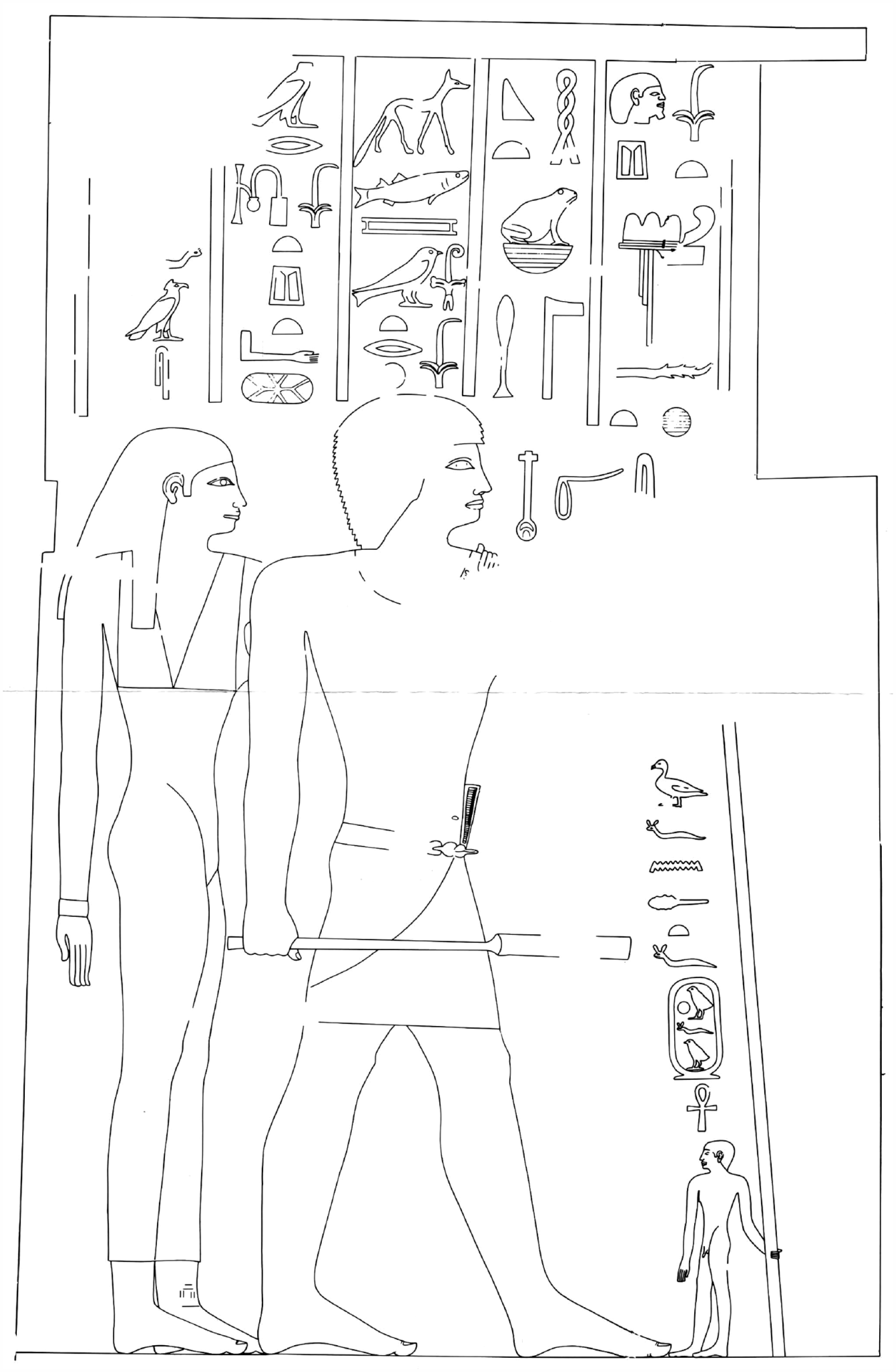
North wall of Seshemnofer I’s chapel (drawing: Kanawati 2001a: pl. 51).
This may be reconciled if we take into account Junker’s suggestion that Seshemnofer I was married more than once. Assuming that the restoration of Noferhathor II’s fragmentary designation …s to [sȝ.t].s, ‘her daughter’ is correct, it appears that the relationship between Noferhathor II and Imendjefaes is being emphasised here. According to McCorquodale, it was not uncommon for tomb owners with children from different wives to try and differentiate which children were born of which spouse, and for ‘any new children with his second wife [to] be referred to as “her son/daughter” to distinguish them further’. 61 It therefore seems that the representation of Noferhathor II behind her mother with this inscription was a way to distinguish her from the children of Seshemnofer I and another wife, who was presumably Meretites.
Although there are instances where the children from a wife’s previous marriage are referred to as ‘her son’ or ‘her daughter’, this does not appear to be the case here. For example, in the tomb of Kaiemnofret at El-Hagarsa, a son is represented with the tomb owner’s wife, Debet, on the right jamb of her false door (fig. 4). 62 This son, whose name has been lost, does not appear with Kaiemnofret on his own false door, nor is he represented with the couple on the entrance to the south burial chamber. 63 The clear separation between Kaiemnofret and this son led McCorquodale to consider the son as ‘the son of a previous husband [of Debet], either dead or divorced’. 64 As Noferhathor II holds onto the leg of Imendjefaes, who in turn links her arm through that of her husband Seshemnofer I, it may indicate that the three were connected as a ‘family unit’; where children were born from a previous marriage, there is usually an attempt to separate them from the new spouse.
False door of Debet in the tomb of Kaiemnofret (drawing: Kanawati 1993: fig. 21).
An example of this can be found on the north wall of room two in tomb G 2378, belonging to Senedjemib/Mehi (fig. 5). 65 In this scene, three children are represented with the tomb owner and his wife, Khentkaus: two sons named Senedjemib and Mehi, and a daughter named Khentkaus. Senedjemib holds onto the staff of his father and turns his face towards him, while Mehi stands behind his father with birds in his hands, and the younger Khentkaus stands behind her mother and reaches out to touch her leg. In this scene, Senedjemib is described as sȝ.f smsw and Mehi as sȝ.f of Senedjemib/Mehi, while the younger Khentkaus is described as sȝt.s of the elder Khentkaus. The daughter Khentkaus touches her mother, yet the elder Khentkaus does not reach out to touch her husband. According to McCorquodale, this may suggest that ‘the daughter belongs to the wife alone, not the tomb owner’. 66 This subtle lack of ‘communication’ between the tomb owner and his wife is not seen in the representation of Imendjefaes and Seshemnofer I with Noferhathor II, which probably indicates that she was the biological daughter of this couple.
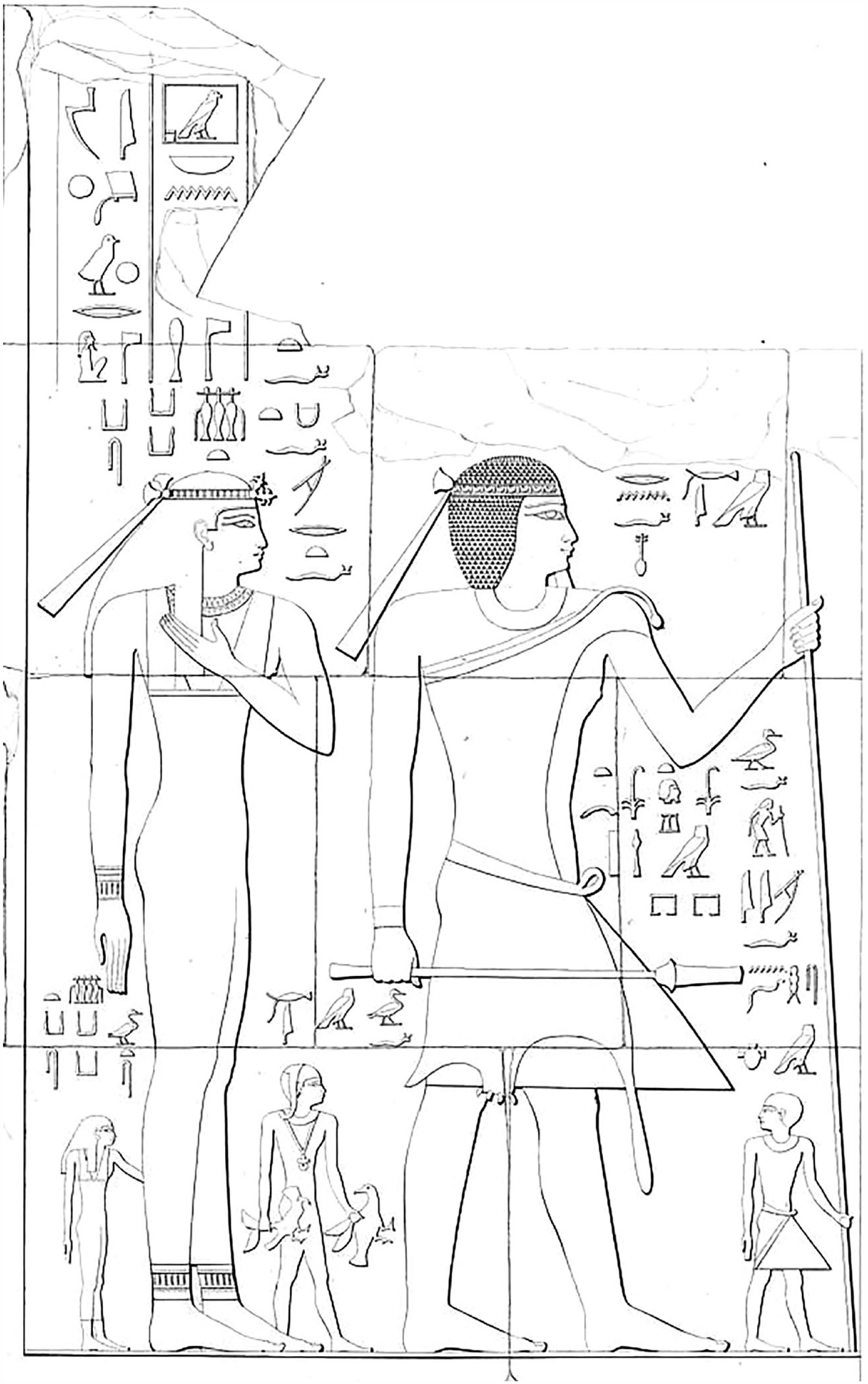
Room two, north wall of the tomb of Senedjemib/Mehi (G 2378) (drawing: LD II: pl. 73 right).
Given that Rawer, who is described as sȝ.f n ẖt.f ‘his son of his body’, interacts with the ‘communicating’ couple as well, it appears that he was also the son of Seshemnofer I and Imendjefaes. This may also be the case for Khufuankh, who is not represented in this family scene, but appears on the north wall with the tomb owner and his wife (fig. 3). 67 In this scene, Imendjefaes is depicted resting her hand on Seshemnofer I’s shoulder and Khufuankh is depicted standing toe-to-toe with his father while holding onto his staff, which seems to infer that the three were being intentionally associated with one another.
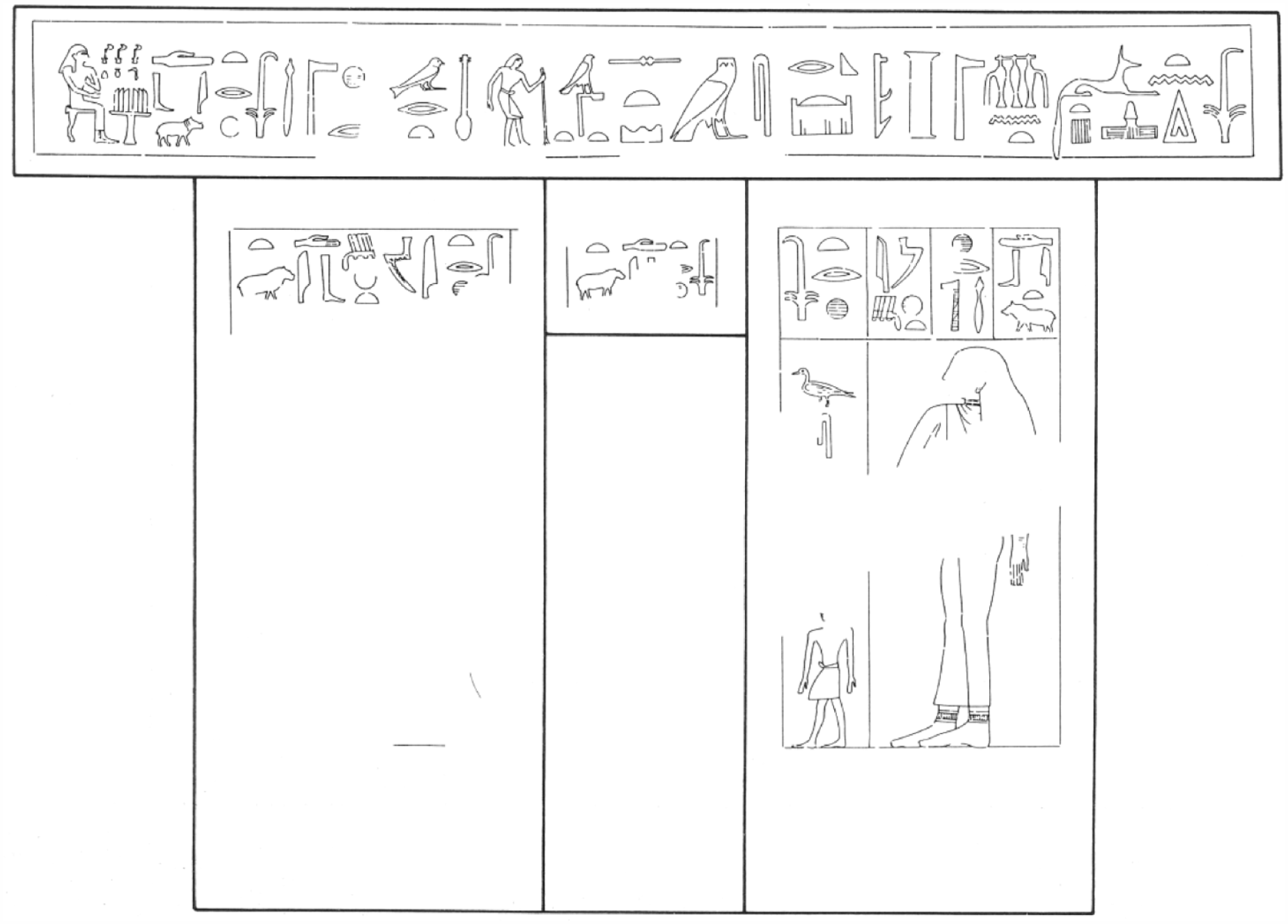
Unfortunately, there is no evidence from inside Seshemnofer I’s tomb to assist in establishing the maternities of Seshemnofer the Younger and Pehenptah, but the examination of some external sources may be useful. If the identification of Seshemnofer the Younger with Seshemnofer II (G 5080) is correct, then the mother of this child was Meretites, as stated on the west wall of his tomb.
68
Meanwhile, in Pehenptah’s uninscribed tomb (G 5280), a fragmentary statue was discovered with an inscription confirming that his mother was Imendjefaes (fig. 6):
rḫ nswt sš ʿ n nswt Pḥ.n-Ptḥ
acquaintance of the king, scribe of the king’s documents, Pehenptah
mwt.f rḫt nswt Jmn-ḏfȝs
69
his mother, acquaintance of the king, Imendjefaes
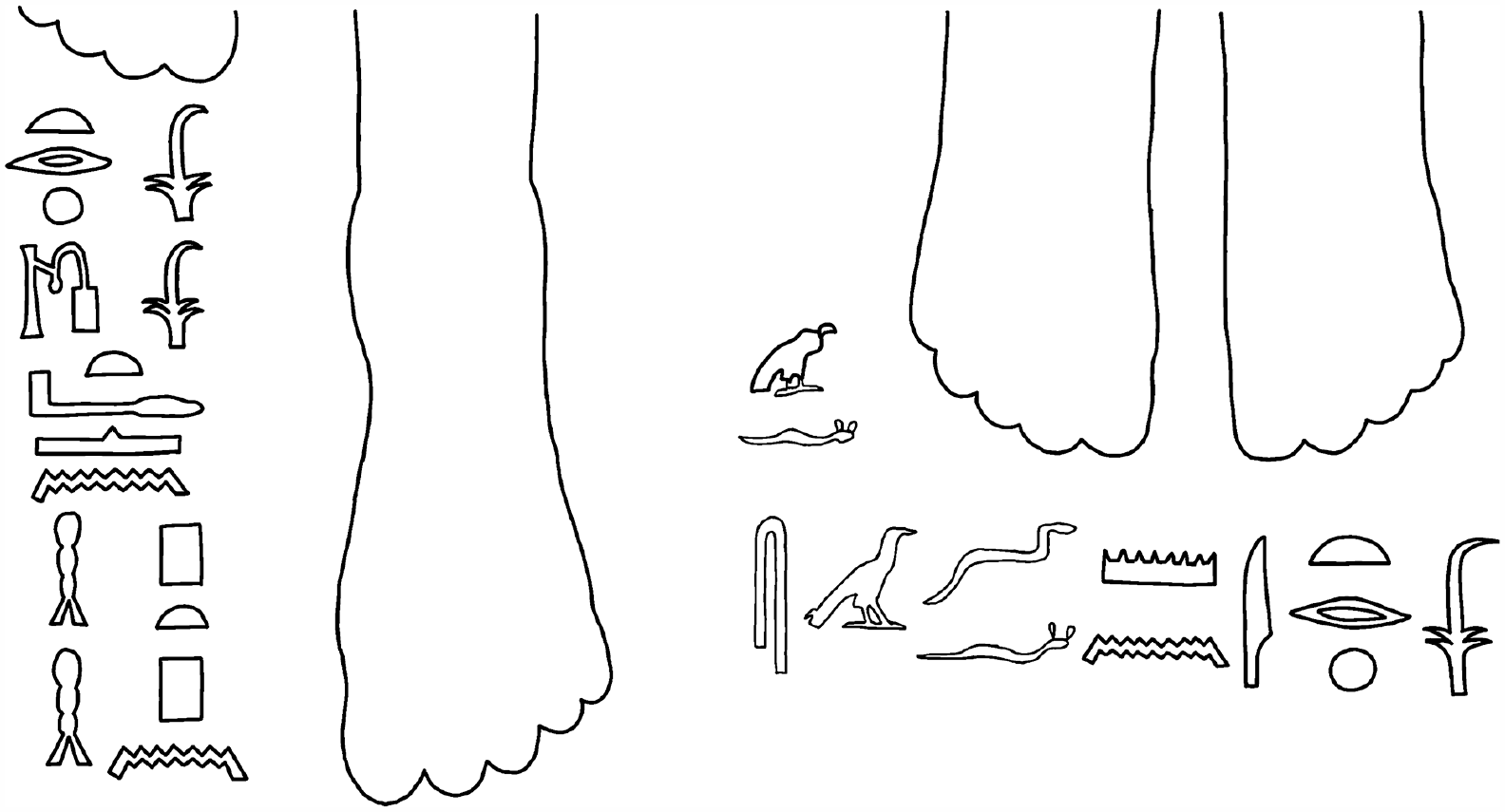
Pair statue of Pehenptah and Imendjefaes from the tomb of Pehenptah (G 5280) (drawing: Jack Bettar, after Junker 1938: fig. 43 upper).
Regrettably, there is no direct evidence about the maternity of the remaining son of Seshemnofer I, whose name was Ab, or the daughters Noferthakhufu, Weretka, Sobekremetes and Noferhathor I. However, it may be suggested that Ab’s representation behind Pehenptah indicated that he was younger, and perhaps should also probably be considered a son of Imendjefaes. Meanwhile, the explicit designation of Noferhathor II as the daughter of Imendjefaes may infer that Noferthakhufu, Weretka, Sobekremetes and Noferhathor I were daughters of another wife, who was presumably Meretites. However, these suggestions largely rest on the notion that Seshemnofer I engaged in serial monogamy. While this is certainly possible, it is not the only option, as it has already been established that polygamy is quite well attested in Old Kingdom tombs. 70 Thus, the question of whether Seshemnofer I enjoyed a polygamous marriage should be further explored. This may be illuminated by further scrutinising the clothing, size, and relative age of Seshemnofer I’s children, to understand the sequence in which they may have been born.
The Relative Ages of Seshemnofer I’s Children
As Seshemnofer I’s sons are not represented together in one scene, the order in which they were born is not immediately obvious. There are two pieces of evidence which may suggest that Seshemnofer the Younger was the tomb owner’s first-born son, even though he is not described as such. Firstly, both the eldest son of Seshemnofer III and probably the eldest son of Seshemnofer II were also named Seshemnofer, 71 indicating a tendency for the eldest sons in this family to be named after their father. Secondly, some of the administrative positions enjoyed by Seshemnofer II were very similar to those held by Seshemnofer I, 72 which was also typical for the eldest son of the tomb owner during this period. As Seshemnofer the Younger was probably the first-born son of his father and was evidently born to Meretites, it seems very likely that the marriage of Meretites and Seshemnofer I occurred before his marriage to Imendjefaes. This may also be supported by the incomplete decoration of Seshemnofer I’s tomb, 73 likely due to his untimely death, as it seems to infer that he was married to Imendjefaes for the later part of his life.
Based on Rawer’s representation with his ‘family unit’ on the west wall, it appears that he may have been the eldest son of Seshemnofer I and Imendjefaes’ union. This would explain his special position next to his father and probable mother, and may also explain the absence of a designated sȝ.f smsw, ‘his eldest son’. If Rawer was the eldest son of Imendjefaes and Seshemnofer I, perhaps he was not labelled as such to avoid confusion with Seshemnofer the Younger, who was likely to have been Seshemnofer I’s true eldest son.
If the designation of Seshemnofer the Younger and Rawer as the respective ‘eldest’ son of each wife is correct, Pehenptah’s position behind them in the family scene may suggest that he was younger than both of them. The youngest son represented in this scene was probably Ab, as he is depicted standing behind Pehenptah.
The final son left to discuss is Khufuankh, whose mother was probably Imendjefaes. It is more difficult to establish where Khufuankh falls in the relative sequence of Seshemnofer I’s sons, as he only appears on the north wall and is not depicted with his siblings on the west wall. Individuals were sometimes depicted separately from the collective group if they were deceased, 74 but this does not appear to be the case for Khufuankh. Kanawati has argued that in private tombs, ‘artists took great care to show a kind of ‘communication’ (using the word in its broadest sense) between the two living individuals’. 75 As Khufuankh appears to interact with his father by holding onto his staff, 76 it seems that Khufuankh was still alive while the north wall was being decorated.
In terms of the relative chronology of his birth, there may be two possible explanations. The first is that Khufuankh was the eldest son of Seshemnofer I and Imendjefaes, who died or fell out of favour after the decoration of the north wall was completed but before that of the west wall commenced, and the second is that Khufuankh was the youngest son of this couple, who was born after the west wall was decorated. Both of these options should be further explored.
In favour of Khufuankh being the eldest son of Seshemnofer I and Imendjefaes are the titles attested for Seshemnofer I on the north wall. Some of Seshemnofer I’s highest titles, such as jmj-r kȝt (nt) nswt, ‘overseer of the king’s works’ and jmj-r stj-ḏfȝw, ‘overseer of the two places of provisions’ 77 only appear on the west wall of his tomb, which may suggest that it was the last wall to be decorated. Additionally, as the names of both Khufuankh and Seshemnofer I’s eldest daughter, Noferthakhufu, were formed with the cartouche of Khufu, it is plausible that Seshemnofer I named his eldest daughter and his eldest son to Imendjefaes in honour of this king. Khufuankh’s absence in the family scene on the west wall could therefore be explained by his premature death. 78
While this is possible, there is a critical piece of evidence that may refute this theory: the size of Khufuankh’s figure. Size is often used to denote age seniority or inferiority in children, and it is noticeable that Khufuankh’s figure is approximately 10 cm smaller than those of his brothers. This is not a result of the north wall and the west wall being decorated on different scales, as this size disparity is also reflected in Khufuankh’s representation in relation to his father: while the height of his brothers reaches Seshemnofer I’s lower knee, Khufuankh’s figure only reaches the middle of Seshemnofer I’s calf. This is a clear indication that Khufuankh was younger than his brothers, and infers that he was probably missing from the family scene on the west wall because he was not yet born. Overall, the evidence suggests that the order in which Seshemnofer I’s sons were born was: Seshemnofer the Younger, Rawer, Pehenptah, Ab and Khufuankh.
Fortunately, discerning the relative chronology of Seshemnofer I’s daughters is less difficult. It is certain that Noferthakhufu, Weretka, Sobekremetes, Noferhathor I and Noferhathor II were all older than their brothers, as indicated by their portrayal in full adult dress. When children have not yet reached adulthood, they are usually represented with the lock of youth, sucking their thumb, or, as is the case with Seshemnofer I’s sons, in the nude. 79 It is also certain that Noferthakhufu was Seshemnofer I’s eldest daughter, probably born to Meretites, as she wears a long, tripartite wig and is a head taller than all of her sisters in the family scene. Depending on when Seshemnofer I married Imendjefaes, it is theoretically possible for Weretka, Sobekremetes and Noferhathor I to have been born to either wife.
Yet Kanawati has raised the possibility that officials may have engaged in polygamy in order to produce male children. 80 If he is correct, it may suggest that Noferthakhufu, Weretka, Sobekremetes and Noferhathor I were born to Meretites, and that Seshemnofer I’s second marriage with Imendjefaes sought to bear him a son. As Noferhathor II was probably the first-born child of Seshemnofer I and his new wife, it appears that this did not happen straight away, and ironically, it appears to have been Meretites who gave birth to Seshemnofer I’s first son. Given that Meretites is not represented in Seshemnofer I’s tomb and does not seem to have borne him any other sons besides Seshemnofer the Younger, she may have died, or the couple may have divorced following the birth of this child. Remarkably, there may be evidence that Seshemnofer I and Meretites divorced.
mwt.f rḫt nswt ḥtp di [nswt] Jnpw ḫntj sḥ-nṯr ḳrst […] m nbt jmȝḫw(t) ḫr nṯr Mrt-jt.s
81
his mother, the acquaintance of the king, an offering which the king and Anubis, foremost of the divine booth, give. A burial […] as an honoured one before the god, Meretites
This partially preserved inscription from the tomb of Seshemnofer II seems to record Meretites’ burial, which may indicate that Seshemnofer II was responsible for the burial of his mother. As Seshemnofer II appears to have been the only son of Meretites and Seshemnofer I and the last child born to this couple, their marriage may not have continued for too long after his birth. If Meretites and Seshemnofer I were still married, her omission from the tomb scenes of her husband and her probable burial in the tomb of her son, rather than in the tomb of her husband, may be unusual and difficult to explain.
Another Seshemnofer Dilemma
If the above analysis of the children of Seshemnofer I is correct, it may have repercussions for another Seshemnofer dilemma, which originates from a study conducted by Altenmüller. 82 Altenmüller’s paper re-examined the family relationships in the tombs of the Seshemnofer family in light of the work of Pieke, who argued that the lotus offering scene in private tombs at Giza usually depict the tomb owner offering to his father. 83 According to Pieke, the figure on the south wall of Seshemnofer III’s tomb (fig. 7) would therefore be Seshemnofer II, and the figure on the south wall of Seshemnofer II’s tomb (fig. 8) would be Seshemnofer I. 84 As a result, Altenmüller attempted to clarify other relationships which are represented in these tombs but which are not entirely clear. His findings were as follows:
Adapted from Altenmüller 2008: 155 table 2.
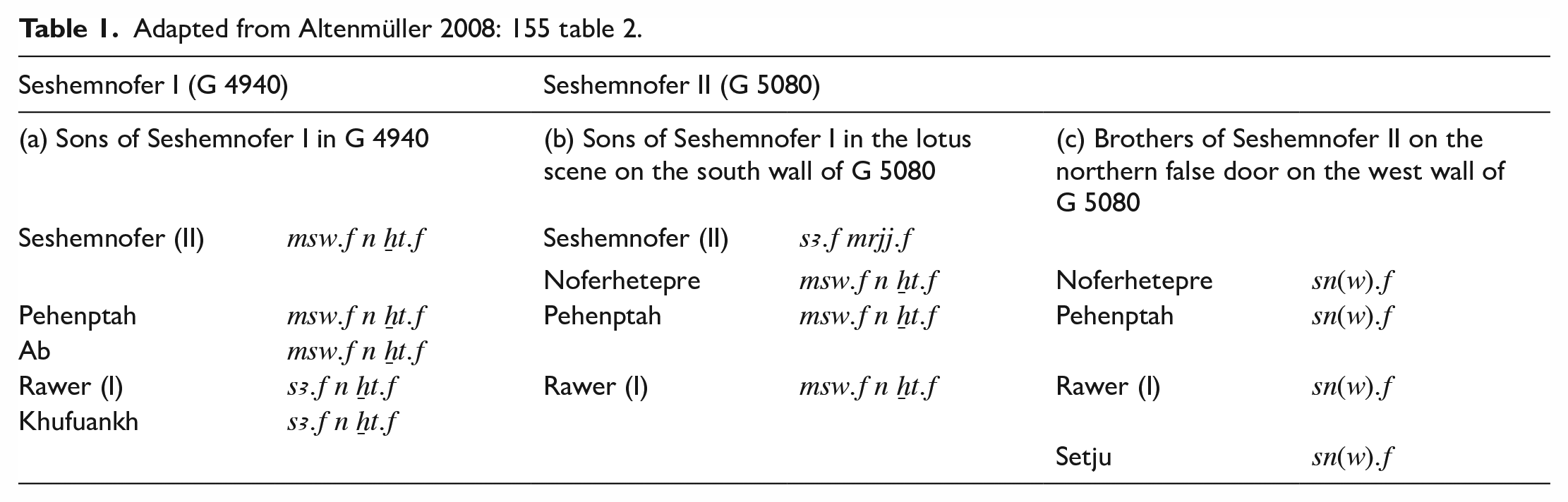
Adapted from Altenmüller 2008: 157 table 4.
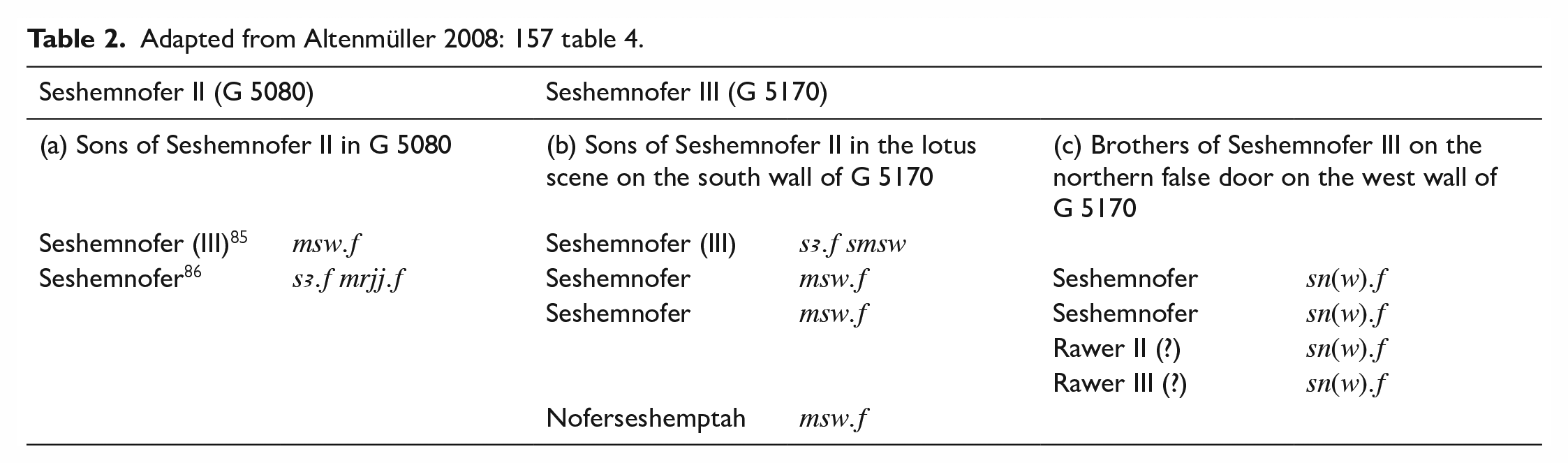
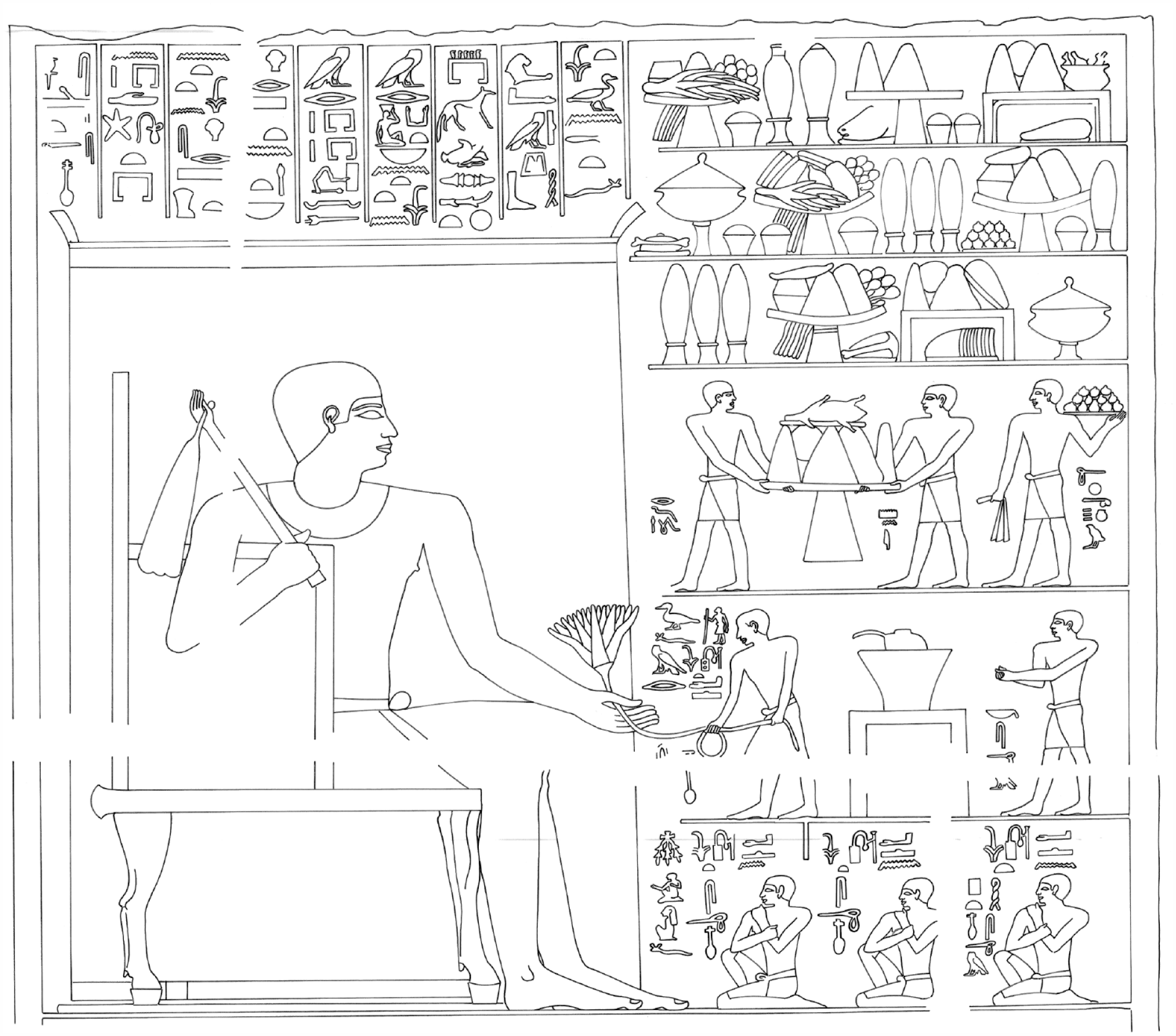
South wall of Seshemnofer III’s chapel (drawing: Sameh Shafik, after Brunner-Traut 1982: supp. 4).
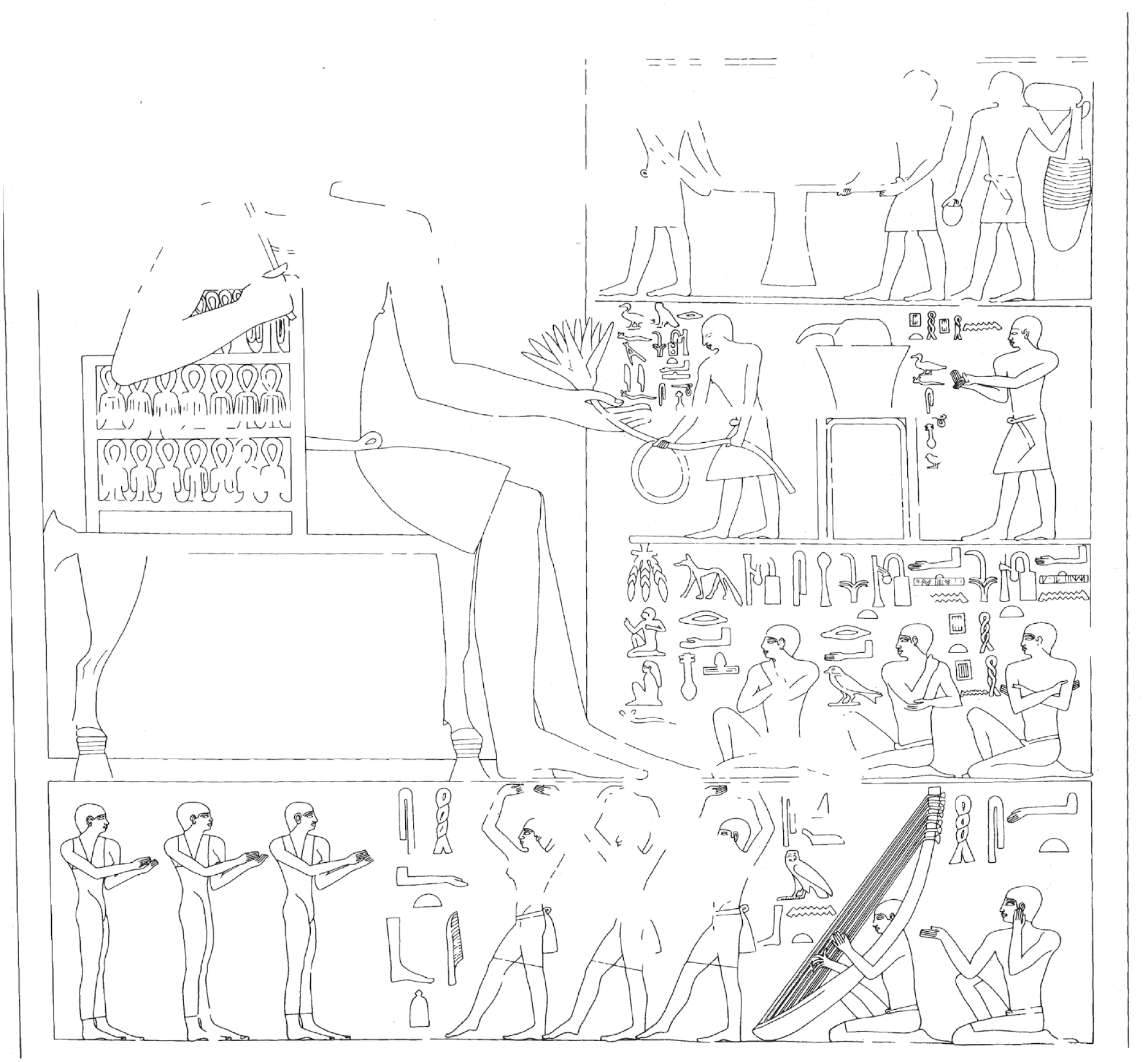
South wall of Seshemnofer II’s chapel (drawing: Kanawati 2002: pl. 64).
In light of his view that the large figure on the respective south walls of G 5080 and G 5170 was the father of the tomb owner, Altenmüller evidently considered the men described as msw.f ‘his children’ to be the children of the tomb owner’s father (i.e. the brothers of the tomb owner), rather than the children of the tomb owner himself. However, a comparison of the lotus presentation scene from G 6020, the tomb of Iymery, may suggest that this is not the case.
The layout of this scene on the south wall of Iymery’s tomb (fig. 9) is identical to those found in the tombs of Seshemnofer II and Seshemnofer III: a large seated figure is being presented with a lotus flower by a small figure with the designation sȝ.f smsw, ‘his eldest son’, and in the register below the eldest son are multiple men with the designation msw.f ‘his children’. 87 In Iymery’s lotus presentation scene, the large figure being presented with the lotus is named Shepseskafankh, the man described as sȝ.f smsw is named Iymery, and the men described as msw.f are named Noferbauptah, Sankhniptah and Nikhutptah. In this case, the family relationships can be established with certainty: it is known from wall scenes found in the Western Cemetery tombs of this family that Shepseskafankh (G 6040) was the father of Iymery (G 6020), 88 and that Iymery was the father of Noferbauptah (G 6010). 89 From this, it can be deduced that the register of men designated as msw.f ‘his children’ were the children of the tomb owner, Iymery, and not of the tomb owner’s father. 90 If this model is applied to the tombs of Seshemnofer II and Seshemnofer III, then the men described as msw.f in the lotus presentation scene on the south wall should also be considered the children of the tomb owner; thus, Noferhetepre, Rawer and Pehenptah were probably the children of Seshemnofer II, and Seshemnofer, Seshemnofer and Noferseshemptah were probably the children of Seshemnofer III.
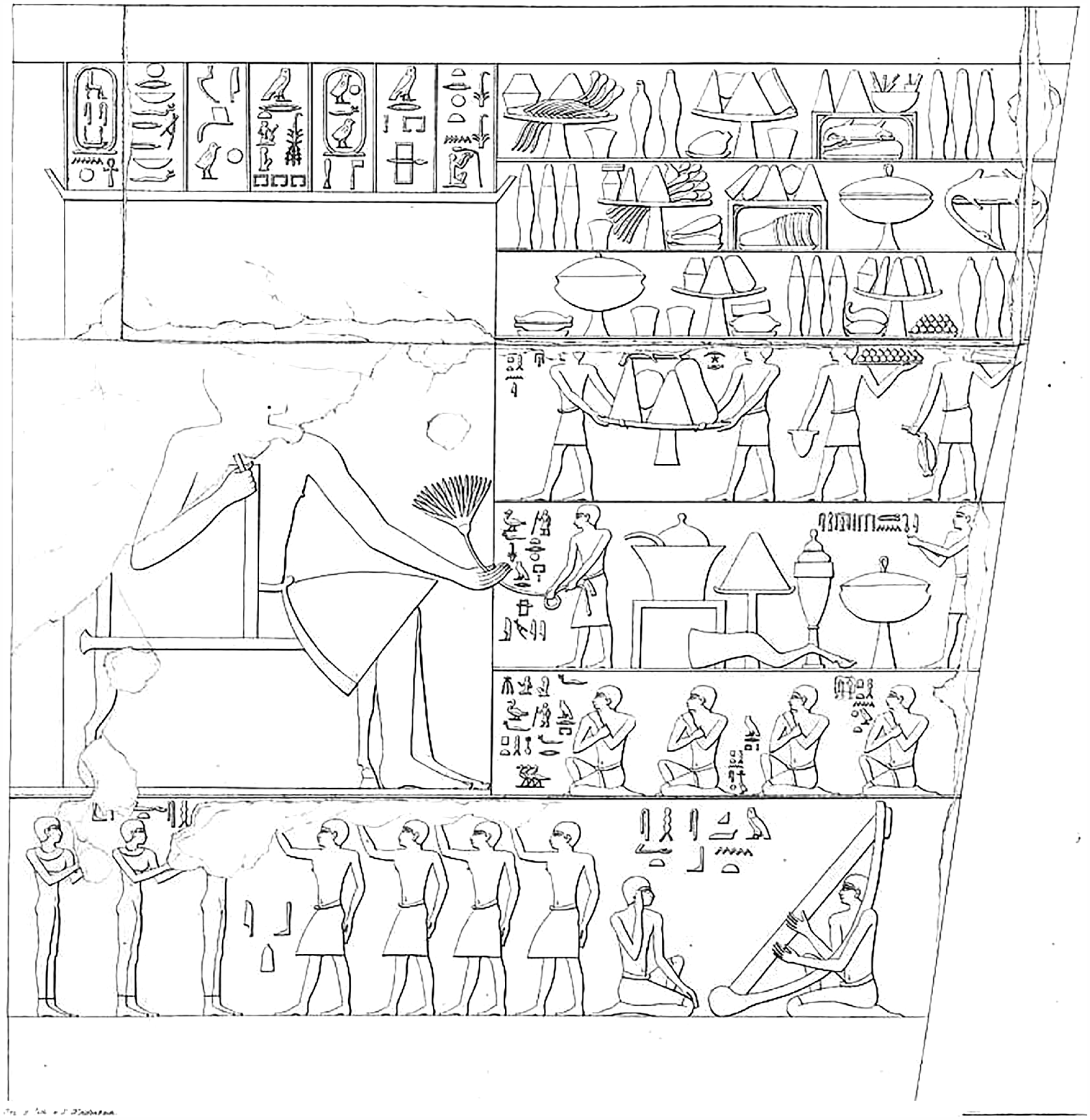
Room three, south wall of the tomb of Iymery (G 6020) (drawing: LD II: pl. 53a).
In the case of Seshemnofer II, the earlier analysis of the relative chronology of Seshemnofer I’s sons may also indirectly attest to the suggestion that Noferhetepre, Rawer and Pehenptah were not his brothers. On Seshemnofer II’s northern false door, Noferhetepre appears in the top register (fig. 2); if we assume that the individuals depicted here were represented in order of age, it seems to indicate that he was older than the men represented below him in registers 2 (Rawer), 3 (Pehenptah) and 4 (Setju). Noferhetepre also appears preceding Rawer and Pehenptah on the south wall of Seshemnofer II’s tomb. In both of these instances, he is ascribed more titles than his companions, which may indicate that he held his administrative position for longer, seemingly supporting the suggestion that he was older than these men.
If Noferhetepre was a son of Seshemnofer I, and we accept the chronology of Seshemnofer I’s sons offered above, his birth would have occurred either between the births of Seshemnofer II and Rawer I, or prior to the birth of Seshemnofer II. Due to the tendency for officials to name their eldest son after themselves during this period, the former may be more likely. If this is correct, the absence of Noferhetepre in Seshemnofer I’s tomb cannot be attributed to him being born after the tomb had already been decorated, and, given that Noferhetepre appears with his siblings in the tomb of Seshemnofer II, cannot be attributed to an early death prior to the decoration of Seshemnofer I’s tomb.
Due to Seshemnofer I’s apparent affinity towards polygamy, it is plausible that Noferhetepre was the offspring of a union with another unknown wife. However, this seems doubtful because Seshemnofer I’s wall scenes evidently depict children who were not born to Imendjefaes, the wife that is found in his tomb. Thus, if Noferhetepre was the son of another unknown wife, it seems likely that he would still be afforded a place in his father’s tomb scenes.
The possibility that the men found on the west wall of G 5080 (fig. 2) were not the brothers of Seshemnofer II may also be supported by inscriptional evidence. While there is a group of three hieroglyphs found immediately above Noferhetepre that probably refer to the four men shown below, there is some disagreement in the scholarship about their meaning. Although the latter two signs are clearly  (Gardiner N35 and Gardiner I9), the first sign in this group is not fully preserved. Kanawati, who did not attempt to transliterate or translate them in his republication of G 5080, commented that ‘the significance of [these signs] is not clear’.
91
Altenmüller evidently considered the first hieroglyph to be
(Gardiner N35 and Gardiner I9), the first sign in this group is not fully preserved. Kanawati, who did not attempt to transliterate or translate them in his republication of G 5080, commented that ‘the significance of [these signs] is not clear’.
91
Altenmüller evidently considered the first hieroglyph to be  or
or  sn (Gardiner T22 or Gardiner T23) and consequently regarded the four men depicted below as the brothers of the tomb owner; however, this may be difficult to reconcile based on what remains of the sign’s shape.
92
Due to the apparent obscurity of these hieroglyphs, it does not appear that these men can be confidently identified as the brothers of Seshemnofer II, and, given the similarities of these names to the names of his sons found on the south wall, should perhaps be considered his sons instead.
sn (Gardiner T22 or Gardiner T23) and consequently regarded the four men depicted below as the brothers of the tomb owner; however, this may be difficult to reconcile based on what remains of the sign’s shape.
92
Due to the apparent obscurity of these hieroglyphs, it does not appear that these men can be confidently identified as the brothers of Seshemnofer II, and, given the similarities of these names to the names of his sons found on the south wall, should perhaps be considered his sons instead.
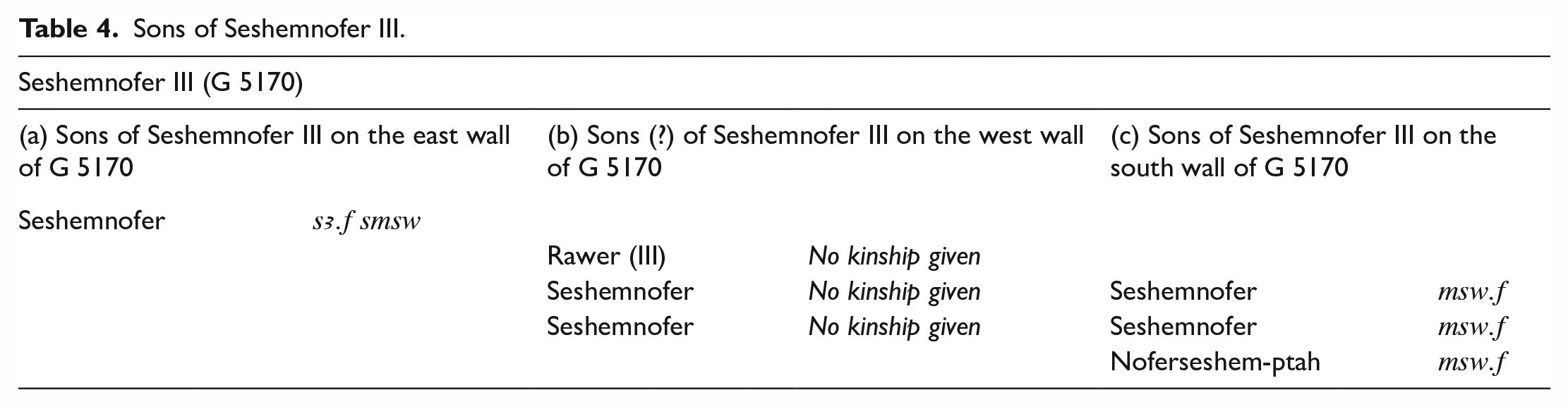
If Noferhetepre, Rawer, Pehenptah and Setju were the sons of Seshemnofer II, then they were also the brothers of Seshemnofer III. This may have implications for Altenmüller’s suggestion that the four men depicted on the side panel of the northern false door in Seshemnofer III’s tomb were his brothers, which, with the exception of Rawer II, is not certain. It is clear that Rawer II was the brother of Seshemnofer III, as deduced from the position of the sn.f ‘his brother’ hieroglyphs immediately above his head (fig. 10). As these signs end almost perfectly perpendicular to his body, their placement is suggestive, and may infer that the other three men found here – Rawer (III), Seshemnofer and Seshemnofer – did not also have this relation to the tomb owner. Perhaps these three men were the sons of Seshemnofer III, in which case the two Seshemnofers may be equated with the two namesake sons found on the south wall of G 5170. Rawer’s absence on the south wall may be attributed to his early death, while Noferseshemptah’s absence on the west wall may indicate that he was not yet born when this part of the tomb was decorated.
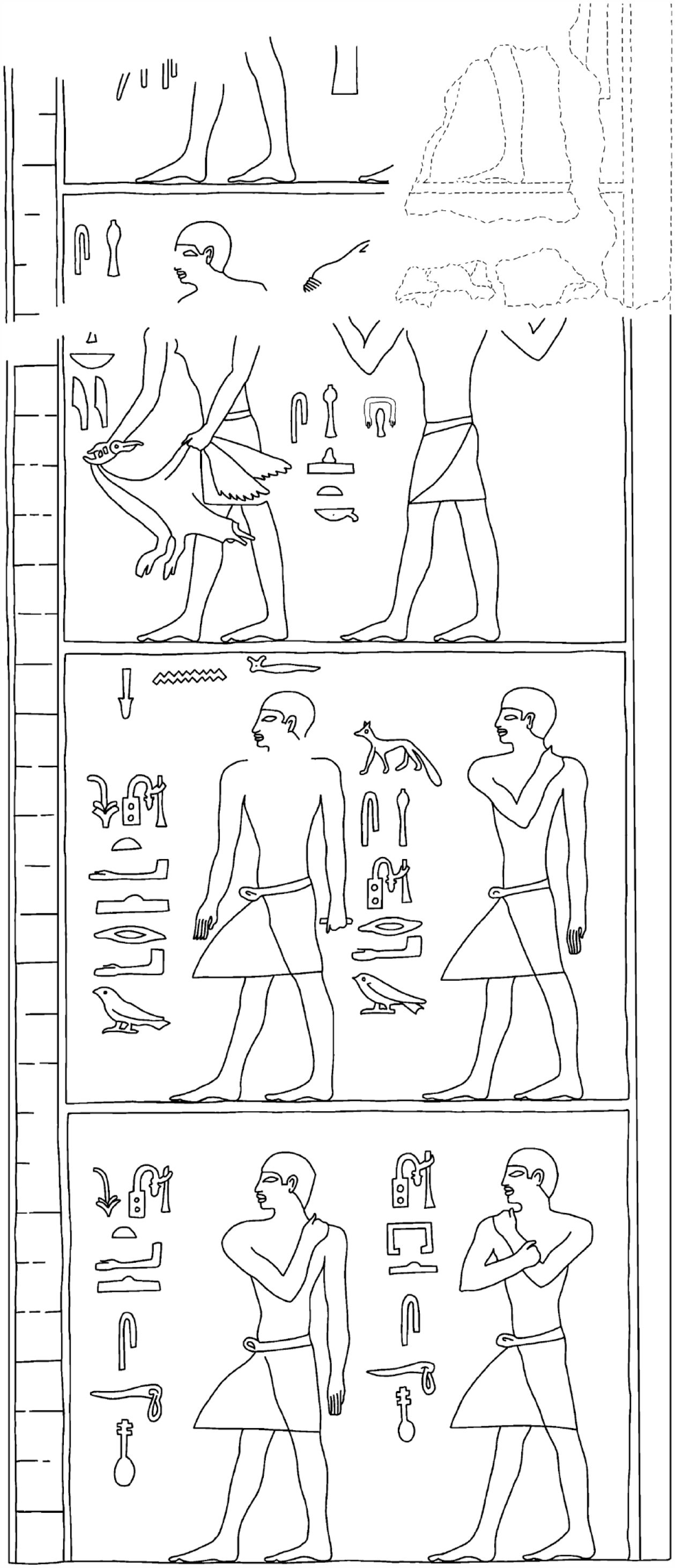
Right side of the northern false door, west wall of Seshemnofer III’s chapel (drawing: Jack Bettar, after Brunner-Traut 1982: supp. 3).
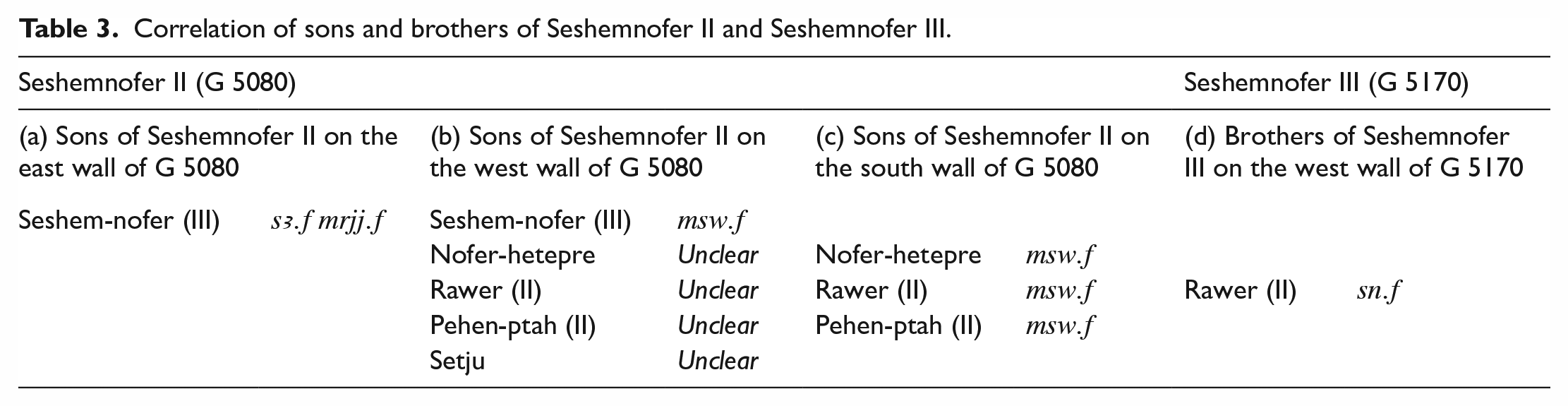
The relationships in G 5080 and G 5170 as suggested by the present study may thus be summarised as follows:
Correlation of sons and brothers of Seshemnofer II and Seshemnofer III.
Sons of Seshemnofer III.
Conclusion
The frequent representation of family members in the tombs of the Seshemnofer family have largely allowed us to investigate the different wives of Seshemnofer I and thus the different maternities of his children. With the evidence as it stands, it appears that Seshemnofer I’s first wife was Meretites, and that his first four children born to her were daughters: Noferthakhufu, Weretka, Sobekremetes and Noferhathor I, who were born in that order. After the birth of Noferhathor I, it may be suggested that concern about the lack of male children in the family saw Seshemnofer I marry Imendjefaes, whose first child together, Noferhathor II, was also a daughter. Finally, after the birth of five daughters, Seshemnofer I’s first wife Meretites gave birth to a son, whom they named Seshemnofer after his father, and perhaps not too long afterwards, it is possible that Meretites and Seshemnofer I divorced. Following this, it appears that Imendjefaes gave birth to four sons – Rawer, Pehenptah, Ab and Khufuankh – who brought the total number of Seshemnofer’s children to ten.
Although it is not immediately obvious, a close examination of the evidence may suggest that Seshemnofer I had more than one wife, and that his son Seshemnofer the Younger can indeed be equated with Seshemnofer II, the owner of G 5080. Given the apparent overlap between Seshemnofer I’s respective marriages, it appears that he did engage in polygamy, but perhaps only for a short period of time and perhaps stemming from the need to produce a son.
The case of Seshemnofer I has revealed that tomb owners took great care to distinguish the different maternities of their children, and perhaps indicates that children could be equally cautious about declaring their parentage in their own tombs if they were part of a polygamous family. Although we may never have all the answers, the careful scrutinisation of the evidence can reveal that there is always more than meets the eye in elite tombs scenes, and this is certainly true of Seshemnofer I and his family.
Footnotes
Acknowledgements
I would like to express my gratitude to Professor Naguib Kanawati for his insightful comments and suggestions on the preliminary versions of this paper, and to Professor Sameh Shafik and Jack Bettar for dedicating their time and effort to provide some of the line drawings used in this article.
Funding
This project was funded by a Macquarie University PhD scholarship, RTP no. 20201462.
2
According to Bárta, ‘…the fact that the state started to be run by officials of non-royal origin caused the proliferation of a specific group of titles beginning with the component ḥrj-sštA, “keeper of the secrets” … Given its context and range of duties, it must be supposed that the title was applied to those non-royal officials who replaced former members of the royal family for which (being members of the royal family) this duty was a self-evident mode of behaviour’.  : 170.
4
6
An exception to this is Cherpion 1989: 227 and : 59, who erroneously suggest that Seshemnofer III should be dated to the reign of Noferirkare, as the cartouche of this king is the latest found in the tomb.
7
Junker 1938: 13–14; Strudwick 1985: 139–140 (no. 131); Harpur 1987: 288 (table 2.18); Altenmüller 2008: 156 (table 3); : 32 (no. 65).
8
Kanawati 2002: pl. 64; : colour pl. 6, supp. 3.
10
11
Junker 1938: .
14
‘The most important chapels of type (4b) are those in the mastabas built by the descendants of the Seshem-nofer family and the descendants of Kanofer of G 2150, east of the Cem. En Echelon in the Western Field. One of the last of these, G 5470 of Rawer II, contained a sealing of Isesy in a burial chamber, and the whole of the seven mastabas in the group probably range from Neferirkara to Isesy.’ : 251.
15
Baer 1960: 292 (no. 297); : 251.
16
Baer 1960: 97–98 (no. 297); PM III/1: 158; Harpur 1987: 288 (table 2.18); : 155.
18
See PM III/1: plans XXVIII (G 4940), XXIX (G 5370).
20
Baer 1960: 132 (no. 477); Strudwick 1985: 139 (no. 130); Harpur 1987: 270 (no. 233); Kanawati 2002: 53; : 38 (no. 91).
22
Baer 1960: 287 (no. 21); : 265 (no. 14).
23
See Kanawati 2002: pls 31, 65 and : fig. 32, respectively.
24
An exception to this is the tomb of Senenuka Keki (G 2041), whose tomb may not postdate Noferirkare, according to Strudwick 1985: 48 (table 5); however, : 126 (no. 452A) suggests that the tomb may be as late as the middle of the 5th Dynasty.
25
Junker 1938: 8–14; : 153–154.
27
See Kanawati 2001a: pls 42, 51 and : fig. 43 (upper), respectively.
28
Junker 1938: .
29
Junker 1934: 25–26; : 8–14.
31
Strudwick 1985: 138–139 (no. 129): early 5th Dynasty; Harpur 1987: 270 (no. 232): Userkaf–Noferirkare; Willoughby-Winlaw 2007: 62: Userkaf–Sahure; Swinton 2014: 38 (no. 90): Sahure-Noferirkare. : 311 broadened the date to between the reigns of Menkaure and Noferirkare.
33
The tomb of Iymery contains estate names formed with the cartouches of Sahure and Noferirkare, yet in the tomb of his son Noferbauptah (G 6010), Iymery is described as a ḥm-nṯr of Niuserre. The cartouche of Niuserre does not appear in Iymery’s tomb, which probably indicates that his tomb was completed before the reign of this king, even though Iymery apparently lived into the reign of Niuserre. For the tombs of Iymery and Noferbauptah, see : 21–58.
35
Kanawati 2001a: pl. 41; : pls 31, 65.
36
See Kanawati 2001a: 51–52 for the titles of Seshemnofer I and : 51 for the titles of Seshemnofer II.
40
Baer 1960: 131 (no. 476); Kanawati 2007: 48; Altenmüller 2008: 155; : 38 (no. 90).
41
Junker 1938: 14; Strudwick 1985: 139 (no. 130); Harpur 1987: 288 (.18).
42
The single, identical title held by both women, rḫ(t) nswt, ‘acquaintance of the king’, should not be used to argue that Imendjefaes and Meretites were the same individual, as this was a very common designation for wives of officials. See : 327–328 (no. 1206) for this title and for other female holders.
47
See, for example, inscriptions in the tomb of Mereruka, rn nfr Meri (PM III/2: 525–535); Senedjemib, rn nfr Inti and his son Senedjemib, rn nfr Mehi (PM III/1: 85–89); Remenuka rn nfr Imi (PM III/1: 261–262). This is also the case for dependants of the tomb owner, for example: Seshseshet rn nfr Sheshit, the wife of Noferseshemptah (Lloyd, et al. 2008: pls 22, 38); the false door of Mesni rn nfr Tjetju in the tomb of his father Tjetju (Simpson 1980: fig. 18); Djemy, rn nfr Mesni in the tomb of his father Harkhuf (Edel 2008: 652, fig. 5). An exception to this is in the tomb of Khentika, who is frequently referred to as Ikhekhi, a name that is not explicitly stated to be his rn nfr in every instance. With the evidence currently available, though, Khentika appears to be the exception rather than the rule for both tomb owners and dependants of tomb owners. See for the tomb of Khentika.
48
Kanawati, et al. 2011: pls 74, 76, 82.
50
51
Junker 1934: 25–26; : 10.
52
McCorquodale 2013: 75, 85. See also : 149–160.
65
LD II: pl. 73 (right).
69
Junker 1938: fig. 43 (upper); : pl. XLVIII.2.
71
Although Seshemnofer II’s son Seshemnofer (III) is not described as smsw, he is always represented immediately next to or interacting with his father, a position which is usually reserved for the eldest son. Kanawati 2002: pls 62–64; : supp. 4.
72
Seshemnofer I was jmj-r sš ẖrt-ʿ nswt ‘overseer of scribes of the document-case of the king’ and jmj-r kȝt nswt ‘overseer of the king’s works’, while Seshemnofer II was jmj-r sš ʿ nswt ‘overseer of scribes of the king’s documents’, jmj-r kȝt nbt (nt) nswt ‘overseer of all works of the king’, ḥrj-sštȝ n ẖrt-ʿ nswt ‘privy to the secret of the document-case of the king’ and sS ẖrt-ʿ nswt, ‘scribe of the document-case of the king’.
74
See, for example, the east wall of the tomb of Meresankh III, in which her father Kawab is not represented in the papyrus boat with Meresankh III, a small child, and her mother Hetepheres II, but instead is represented standing alone to the left of the scene. Another indicator that Kawab was deceased at the time that this scene was decorated is the fact that his figure faces to the left, while those of his wife, daughter and presumable grandson face to the right. See Dows and Simpson 1974: fig. 4 for this scene and : 214–215 for more.
78
It is theoretically possible that Khufuankh fell from grace after the decoration of the north wall had been completed; however, individuals who fall out of favour typically have their names and/or images removed from the tomb, so as not to allow them an afterlife. As Khufuankh’s name and figure remain intact, it does not appear that he suffered this fate. See : 158–160.
90
It may be important to note that there is no evidence in any tomb of the Shepseskafankh family which may indicate that Shepseskafankh had another son named Noferbauptah.
92
This may be suggested by the difference in the shape of T22 compared to this hieroglyph, and the absence of the two diagonal lines which protrude out of the lower third of T23.