




Abstract
The material culture of the late Middle Kingdom is marked by an increased presence of figurines in different materials, pooled together by a common range of forms, types, and iconographic or stylistic motifs. The subjects and variety of these figurines do not find any precedent in the recent past, while – unexpectedly – the closest comparanda go back to the early/mid-third millennium BC, in the votive material of the so-called Early Dynastic temples with a gap of over half a millennium. The figurines from the Early Dynastic Period overlap with the corpus of the Middle Kingdom to a considerable and unexpected extent, so much that they could be possibly considered their forerunners or, indeed, their prototypes. During the late Middle Kingdom, royal initiatives to preserve and restore Early Dynastic sites and structures are well documented. This practice may have led to the rediscovery and absorption (by copying and reinventing) of earlier images and motifs into contemporary material production, as might be the case of the late Middle Kingdom figurines.

Keywords
Miniatures in the Late Middle Kingdom
Iconography
In the Middle Kingdom, especially in the latter part of it (Senwosret III–mid-13th Dynasty, c. 1875–1700 BC), the material culture of Egypt is permeated by an increasing presence of small-scale objects, in the form of self-standing figurines, showing peculiar features and pooled together by a common range of forms, types, and iconographic or stylistic motifs (see fig. 1). These figurines are widespread across Egypt, though concentrated in particular key sites, 1 and – with less frequency – are found in peripheral areas and abroad. 2 Their manufacture seems to follow canons and style governed by a centralised system, because their forms and subjects are rather standardised and repetitive. They are produced in various materials, such as faience, stone, wood, and ivory, with only a few (preserved) in metal. 3 Clay figurines do not seem to belong to this large set, because they differ in form, style, and iconography: with the exception of the hippopotamus and the female figure, it is rare to find a close correspondence of forms between clay figurines and miniatures produced in other materials in the Middle Kingdom. In addition, clay figurines do not show a similar chronological development, attested since prehistory, 4 and they have a different geographical distribution, being more uniformly widespread across the whole of Egypt. 5 Finally, clay figurines are less frequently attested in funerary contexts. 6
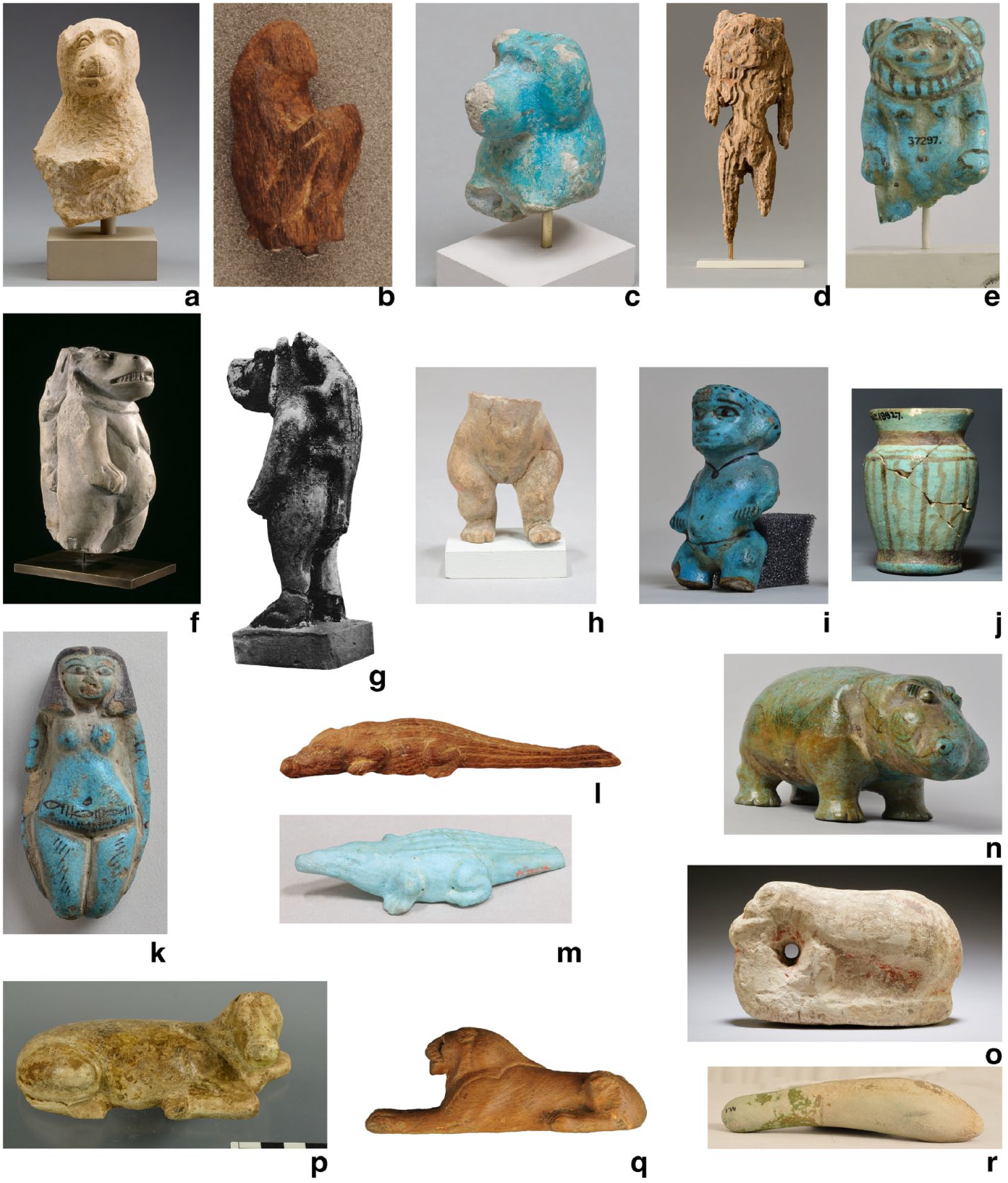
Late Middle Kingdom figurines. a) Limestone baboon from Lisht North (MMA 34.1.179, © CC0 MMA); b) wooden baboon from Lahun (UC 7398, photo: author) c) faience baboon from Lisht North (MMA 15.3.8, © CC0 MMA); d) wooden figurine of Bes from Lisht North (MMA 15.3.1088, © CC0 MMA); e) faience figurine of Bes from Abydos (BM EA37297, photo: author); f) stone figurine of Taweret (Louvre E 26900, © 2014 Musée du Louvre/Georges Poncet); g) faience figurine of Taweret from Byblos (image from Dunand 1950–58: pl. 102); h) lower part of a wooden dwarf figurine from Lisht North (MMA 15.3.414, © CC0 MMA); i) faience grotesque figurine, unprovenanced (Fitzwilliam Museum E.60.1984, photo: author); j) faience vessel from Sedment (UC 18827, photo: author); k) faience figurine of a female lady with truncated legs, unprovenanced (BM EA52863, photo: author); l) wooden crocodile from Lahun (UC 16741, photo: author); m) faience crocodile from Lisht North (MMA 07.227.19, © CC0 MMA); n) faience hippopotamus, unprovenanced (BM EA35004, photo: author); o) limestone hippopotamus from Lahun (The Manchester Museum no. 136, photo: author); p) faience cow from Byblos (Beirut DGA 1672, photo: author); q) wooden lion from Lahun (UC 16647, photo: author); r) faience vegetable melon from Elkab (Ashmolean Museum E 3790, photo: author).
The iconographic corpus of figurines for the late Middle Kingdom includes zoomorphic (the vast majority), anthropomorphic, hybrid composite, vegetal, and inanimate types. The zoomorphic group can be dived into two types of animals: wild (especially hippopotami, baboons/simians, lions, hedgehogs, jerboas, hares, and frogs; see fig. 1a–c, l–o, q) and domestic (especially dogs, cats, cows, and rams; see fig. 1p). 7 The hippopotamus is certainly the most popular icon, followed by the baboon and lion. Despite the high number of crocodile representations in paintings and reliefs of the time, the number of figurines depicting that animal is conspicuously low (see fig. 1l–m), especially when compared to figurines of the hippopotamus, with which crocodiles are often paired in iconography and literature. 8
The anthropomorphic figurines can be divided in two broad categories: ‘standard’ and ‘grotesque’. The ‘standard’ type models the human figure according to the traditional canons of ancient Egyptian plastic art, 9 and encompasses the first specimens of ‘shabti’ statuettes. 10 The ‘grotesque’ type, on the other hand, aims at representing an altered or unusual human body. 11 The ‘grotesque’ type is particularly characteristic of the late Middle Kingdom: at this time small-scale human figures, often wrongly interpreted as dwarves, 12 are depicted with a large head, prominent stomach, and short limbs (see fig. 1h–i). Women with truncated legs should perhaps also be included in this category (see fig. 1k). 13
The range of ‘composite creatures’ 14 reproduced in small scale in the Middle Kingdom is rather limited, and is almost exclusively restricted to two types: a) the human–hippopotamus–crocodile–lion combination (which is occasionally labelled with the name Ipy or Rer 15 in Middle Kingdom representations, 16 and identified in later sources with a deity called Taweret; see fig. 1f–g); 17 and b) the human–lion combination (which is occasionally labelled with the name Aha 18 in contemporary representations, 19 and identified in later sources with a deity called Bes; see fig. 1d–e). 20 The absence of any other deity from the miniature world of Middle Kingdom Egypt may place the representation of ‘Aha’ and ‘Ipy’ types in an uncertain field. Given a certain iconographic ‘instability’ in the ‘Aha’ and ‘Ipy’ types in the Middle Kingdom, corresponding to a canonisation phase of their iconography, it can be suggested that these figurines in this period represent a compositional and experimental phase between the zoomorphic and anthropomorphic worlds. A few other figurines of the time show hybrid compositions between humans and simians, 21 rams, 22 and lions 23 but these seem to be isolated examples rather than part of a more consistent iconographic production. Rather unexpectedly, all of the other hybrid creatures present in the iconography of the Middle Kingdom, occurring for instance in the imagery of the birth tusks or cuboid rods 24 (e.g. jackal-headed leg, winged griffin with human head on its back, disk on legs, etc.), were either ignored or not selected for three-dimensional reproduction.
Other miniature categories documented for the Middle Kingdom come from vegetal and inanimate worlds, such as models of fruits, vegetable melons, jars, cups, and bowls (see fig. 1r). 25
Although these figurines are reproduced in different types of materials, the faience figurines stand out for having been mass produced and widely distributed. 26 So, too, the world of faience figurines belonged to a common iconographic repertoire, sharing forms, subjects, and concepts. 27
The archaeological context
The predominant context in which the Middle Kingdom figurines were found is funerary, and many of them seem to have been placed in burials in the context of a precise funerary scope/ritual. 28 The predominance of the burial context covers almost 90% of the entire corpus, although this value must be measured against the preserved context types.
Only a few figurines were documented in cult or temple contexts of the late Middle Kingdom, and these are most often attested in the areas outside Nile Valley Egypt (e.g. Mirgissa, 29 Serabit el-Khadim 30 ). However, the dearth of figurines in Middle Kingdom temple areas may be due to the few preserved contexts. 31 On this evidence, it should be noticed that by the early Middle Kingdom the conception of the temple had radically changed, and the range of votive materials transformed. The progressive seizure of the temples by the central state 32 led to a slow but inexorable exclusion of the local communities – and probably also to a suppression of the symbols of their personal piety, embodied in the symbolic world of figurines. 33
Only a few figurines have been documented for the domestic and settlement contexts of the late Middle Kingdom. 34 This is certainly due to the poor preservation of Egyptian settlements: domestic areas were largely ignored by archaeologists of the nineteenth and twentieth centuries, and the exponential growth of Egypt’s modern population has contributed to the obliteration of ever more ancient settlement sites. 35 Were the main urban centres of the Middle Kingdom – Itjtawy, Memphis, and Thebes – accessible to archaeologists, the patterning might be less clear. Nonetheless, for the late Middle Kingdom some towns and villages do survive: e.g. Kom el-Hisn (only a few Middle Kingdom areas excavated), Tell el-Basta, Tell el-Dab‘a, Kom Rabi‘a, Dahshur, Lisht, Lahun, Dendera (not published), Wah Sut (Abydos), Edfu, and Elephantine. 36 The number of figurines from such contexts is rather limited 37 and they tend to be mainly formed from clay. 38
For instance, only 22 faience figurines were discovered at the townsite of Lahun, 39 and far fewer of wood, ivory, and stone (excluding the wooden estate models typical of the early Middle Kingdom). One of the few figurines documented in context is a composite wooden miniature of a lion-maned/-eared female human being (later to be identified with ‘Beset’), which was found buried in a hole in the floor of one of the middle group of southern chambers (rank A sector) together with a pair of ivory clappers. 40 This special deposition suggests that miniatures – in general – would have played an important role in daily life. Nonetheless, the figurine was not self-standing, unlike the other miniatures diagnostic of the Middle Kingdom, but had small pegs below the feet: this could indicate a different use for it. However, the number of figurines from Lahun is suspiciously limited for a town, especially in comparison with the hundred or so (102 is the total amount known today) clay figurines coming from the same site 41 (cf. the quantity of figurines recorded at Amarna). 42 Unfortunately, the rapid clearance of the Lahun townsite in just ten weeks by Petrie in 1889 and the absence of a vertical stratigraphy meant the locations of the figurines are mostly unrecorded. Many – especially those not in clay – may well have come from funerary contexts, as Petrie mentioned that infants were frequently buried beneath the floors of houses in the town. 43
In conclusion, although the prevalence of artefact types in particular site categories must always be measured against the proportion of relevant contexts, their association with funerary domains remains predominant. The large presence of figurines in funerary contexts does not mean per se that they were (exclusively) produced for funerary purposes and/or that they were banned from other contexts, but it indicates a strong patterning. Certainly, by the reign of Senwosret III, burial customs in Egypt had radically changed, 44 and the introduction of figurines in funerary equipment was definitely part and parcel of this innovation. 45
Lack of immediate direct parallels in earlier, adjacent times
With the exception of a few categories (vessel, 46 food, 47 and hippopotamus 48 figurines), late Middle Kingdom figurines have few parallels in the material culture of previous centuries. 49 Even these exceptions have been sparsely documented in the preceding periods. For instance, only around 30 documented hippopotamus figurines are attested before the Middle Kingdom (with several doubtful cases), whereas in the Middle Kingdom – and especially in its latter part – more than 210 specimens have been recorded (mostly made of faience: c. 193). 50
Human figurines might seem to show continuity, given that they are attested since the Predynastic Period, but this is only apparent. The concept and forms completely change from the Old Kingdom and early Middle Kingdom to the late Middle Kingdom. Miniatures – often made in stone – representing humans performing various types of work (e.g. food production, cooking, and serving) are the main types of figurine or statuette documented from the Old Kingdom. 51 At the end of the Old Kingdom and into the early Middle Kingdom, individual labourers multiplied, were miniaturised, and became embedded into the ‘wooden models’ of estate workshops. 52 These figurines – made of wood – carried on with food production and storage, but also participated in the transport of offerings, industry, agriculture, animal husbandry, river transport, games, warfare, and funerary mourning. The themes, iconography, and scope of these human figurines do not overlap with those of the late Middle Kingdom.
Tenuous traces of continuity?
A tenuous degree of continuity for the iconography of the Middle Kingdom miniatures might be found in the repertoire of amulets and button seals found in Old Kingdom and First Intermediate Period tombs in the districts of the Cobra region (Upper Egypt, centred around Qau and Badari). 53 If so, however, it is odd that the presence of amulets with similar iconographic motifs did not translate into real production of figurines before the second half of the Middle Kingdom (or it is somehow almost invisible in the archaeological records). 54
Otherwise, only a few figurines have been found in the relatively recent past that evidence a sort of ‘continuity’. For instance, from Tomb M 1104 at Dendera 55 comes a deposit (no. 1102) of objects dated to around the 11th to early 12th Dynasty, 56 which included two roughly modelled miniature clay hippopotami and ten miniature vessels (together with a clay incense burner?) and a globular jar. 57 The hippopotami are depicted standing on a flat rectangular platform, calling to mind the iconography and style of the Middle Kingdom figurine corpus 58 (see fig. 2). From the contents of the so-called Montet jar found at Byblos and dated to the late 11th–early 12th Dynasty 59 comes a seated stone miniature of a baboon (no. 105) holding its young and seated on a square platform. 60 The baboon is of Egyptian manufacture and has a close iconographic correspondence with the figurines of the Middle Kingdom (cf. the late Middle Kingdom baboon figurine from Deposit f of Byblos, DGA 943; see Dunand 1950–58: 749, no. 15217; Miniaci 2024b: 680, 683, Byb-bab52; see fig. 3).
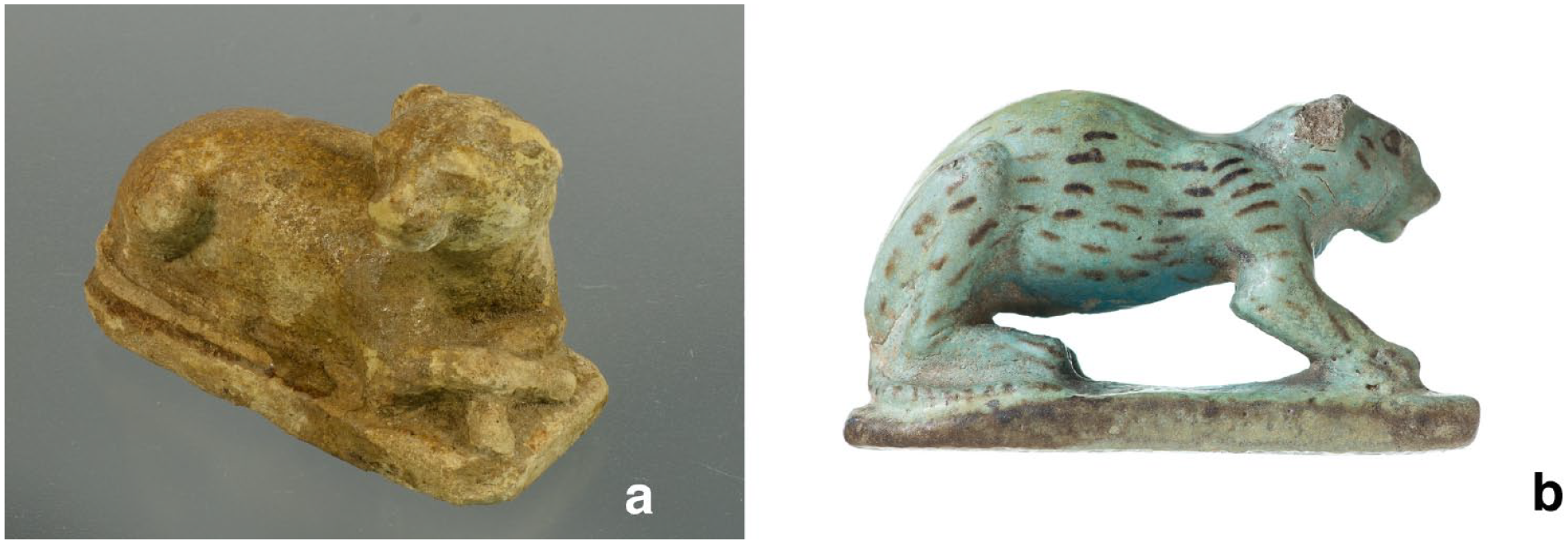
a) Faience figurine of a lion from Deposit f of Byblos (DGA 941); b) faience figurine of a cat from Abydos Tomb 416 (Liverpool, Garstang Museum E 160) (photos: author). To be noted the flat rectangular platform. Only a few hippopotami are presented over such a type of a platform.
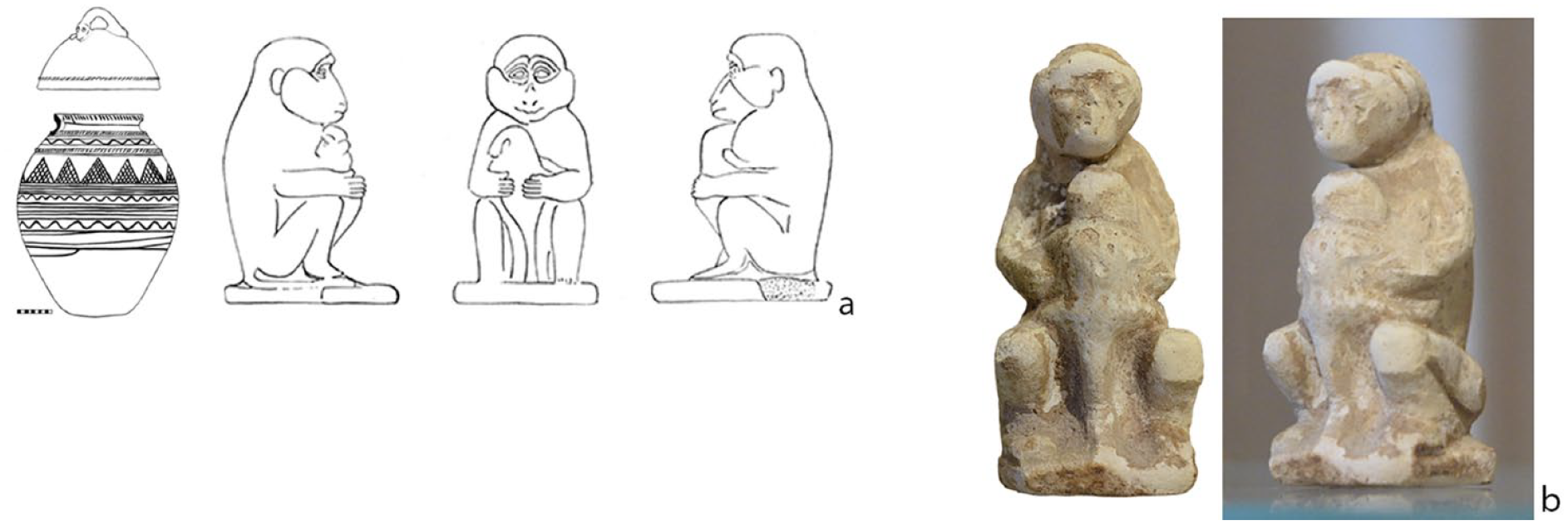
Faience baboon holding its young and seated on a square platform: a) the Montet jar from Byblos and the baboon figurine found in it (from Montet 1928: pls 60, 62); b) Beirut National Museum DGA 943 (?) (photo: author).
In sum, the examples of figurines predating the late Middle Kingdom are too few to be considered the inspiration for the large corpus documented from the reign of Senwosret III onwards.
The Third Millennium BC Figurines as the Closest Models
Unexpectedly, the closest corpus paralleling figurines goes back – with a gap ranging from around a half to over one millennium – from the late fourth to the mid-third millennium BC (see Table 1). These constitute the miniatures found mainly in the deposits of Early Dynastic temples in Egypt: Tell el-Farkha, Tell Ibrahim Awad, Abydos, Hierakonpolis, and Elephantine. 61
Schematic bar view of the variation of attestations of figurines (with the exception of clay specimens) with overlapping motifs in the archaeological record.


At Tell el-Farkha, two deposits, found in the eastern and western parts of the Western Kom, contained a group of figurines: namely, rattles, vessels, baboons, human figurines of different types (including dwarves and hybrid compositions), crocodiles, piriform mace-heads, and zoomorphic vessels representing a water bird, all made of faience. 62
At Tell Ibrahim Awad in the north-eastern Delta, nearly a thousand votive objects were discovered buried in purpose-built chambers in different areas of a small mud-brick temple and scattered within the surrounding soil. The miniatures include a variety of shapes representing humans, baboons, hippopotami, lions, crocodiles, antelopes, birds, frogs, boats, shrines, mace-heads, game pieces, vessels, tiles, and jewellery. 63
At Kom el-Sultan in Abydos, Petrie identified and excavated three brick pit deposits (M 64, M 65/89, and M 69), probably sunk below a complex of ka-houses or in a sanctuary, 64 containing miniatures representing humans, animals (frogs, baboons, lions, birds, and hippopotami), tiles, boats, shrines, fruits, flowers, and vessels. The miniatures were made mainly in faience, although other materials such as ivory, stone, and clay are also documented. 65
At Hierakonpolis, the Main Deposit contained a remarkable number of ivory (majority), stone (travertine, limestone), and faience (minority) miniatures representing anthropomorphic figures, animals (monkeys, including monkeys holding their young, birds, frogs, hippopotami, gods, gazelles, ibex, scorpions, and scorpion tails), mace-heads, and vessels (see fig. 4). 66
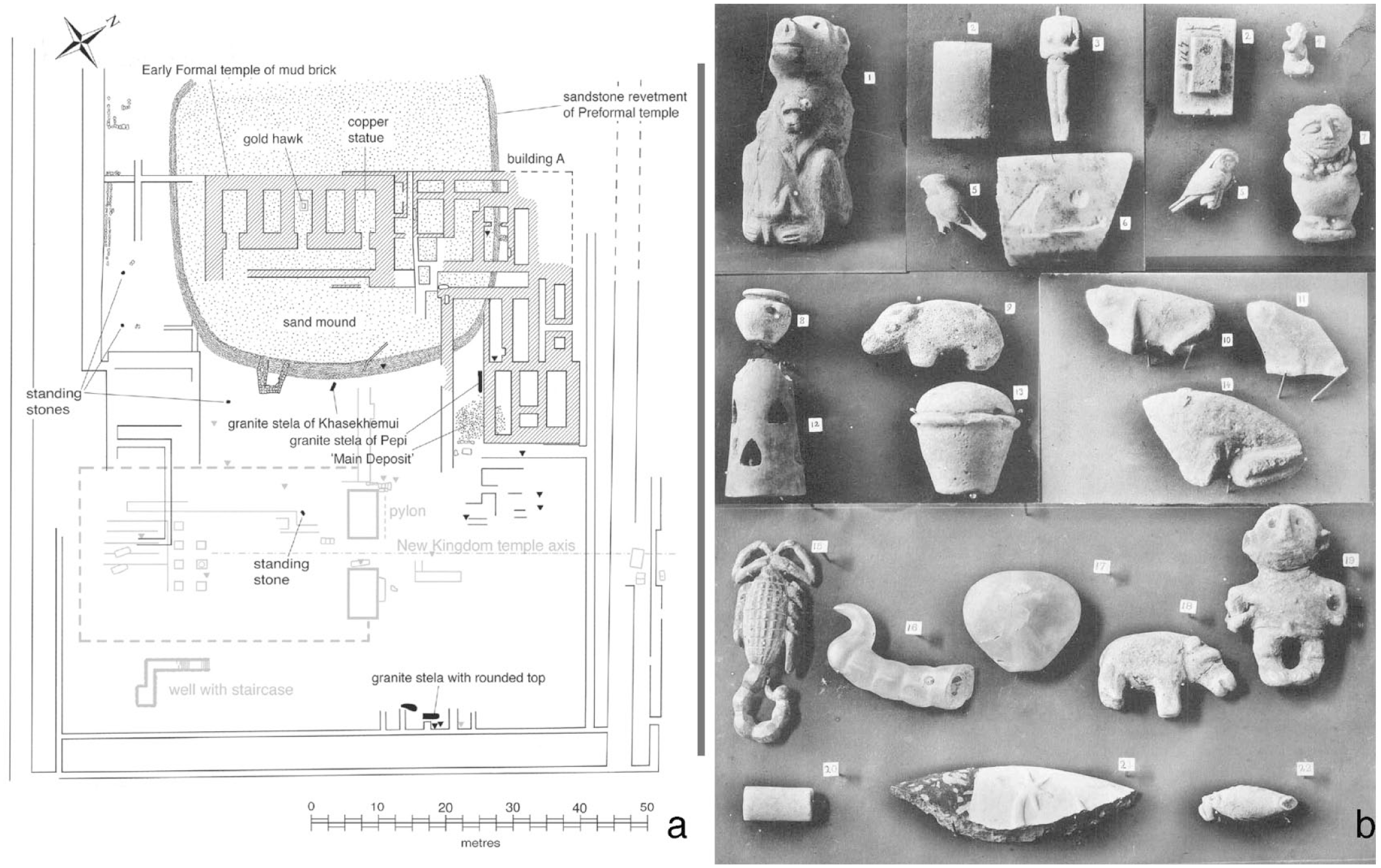
Plan of the temple of Horus at Hierakonpolis (adapted from Kemp 2018: fig. 3.9); b) selection of figurines from the Main Deposit at Hierakonpolis (from Quibell and Green 1900: I, pl. 10).
Several hundred votive objects have been found in the temple of Satet at Elephantine, scattered in different layers. The miniatures, mostly made of faience, but also in pottery, ivory, limestone, and sandstone, represent human beings, baboons, crocodiles, hedgehog-shaped ships, mace-heads, vessels, tiles, name-plaques, and jewellery (see fig. 5). 67
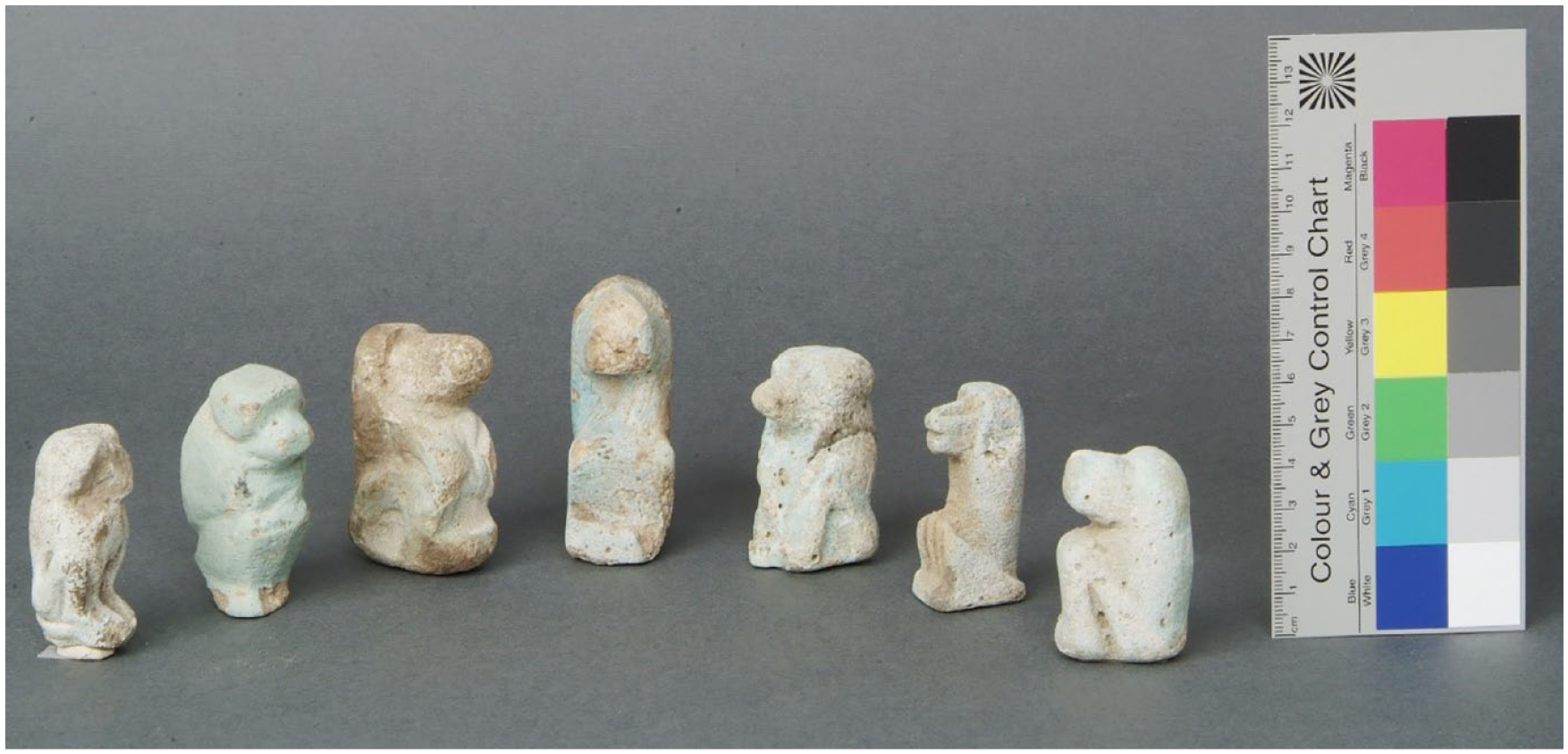
Baboon figurines from the temple of Satet at Elephantine (DAIK photo archive, photo: Peter Windszus, © DAI and courtesy of Dietrich Raue).
The dating of the so-called ‘Early Dynastic’ miniatures
The dating of the Egyptian miniatures found in the votive deposits – from Tell el-Farkha to Elephantine – poses some problems, due to the limited stratigraphy provided by the early excavation reports and the nature of the deposits themselves, which contain objects of different periods grouped in a synchronic act of (re-)deposition after use, disuse/discard, and collection. 68 However, some chronological indications can be proposed. The miniatures from Tell el-Farkha were deposited certainly no later than the Early Dynastic (terminus ante quem: mid-First Dynasty). 69 For Tell Ibrahim Awad, the deposits of the figurines do not date beyond the early Old Kingdom (4th Dynasty – Phase 2). At Elephantine, the terminus post quem for the sealing of the layers containing the denser cluster of votive artefacts (layers VI–VIIv; contexts 6952–6954; 7956; over 350 artefacts in 2.5 m2) is no later than the end of the 5th Dynasty. 70 The archaeological report for the Abydos deposits provides no indication of any stratification of their contents; however, a re-examination of the pottery from pit M 69 shows that its formation could belong to an advanced phase of the Old Kingdom. 71 However, also in this case, the formation of the deposit does not prevent an inclusion of earlier materials or an accumulation over time.
In conclusion, the corpus of the so-called ‘Early Dynastic’ figurines floats between the Early Dynastic and Old Kingdom, although all the deposits could be collocated in the earliest phases of the dynastic period (approximately from Naqada III to the 2nd–3rd Dynasties). The archaeological evidence does not seem to exclude the possibility that a later phase of circulation (if not also of production) of the figurines could have continued until the mid-Old Kingdom. 72 Therefore, the term ‘Early Dynastic’ figurines with inverted commas is adopted here to indicate that the mass of material from the temple deposits belongs to a wider time span, which extends from the Early Dynastic Period into any possible phases of an early/mid-Old Kingdom.
The Overlap of ‘Early Dynastic’ and Middle Kingdom Figurines
The figurines from the ‘Early Dynastic’ overlap with the corpus of the Middle Kingdom to a considerable and unexpected extent. The overlap concerns the medium employed, type, style, and iconography (see figs 6–7).
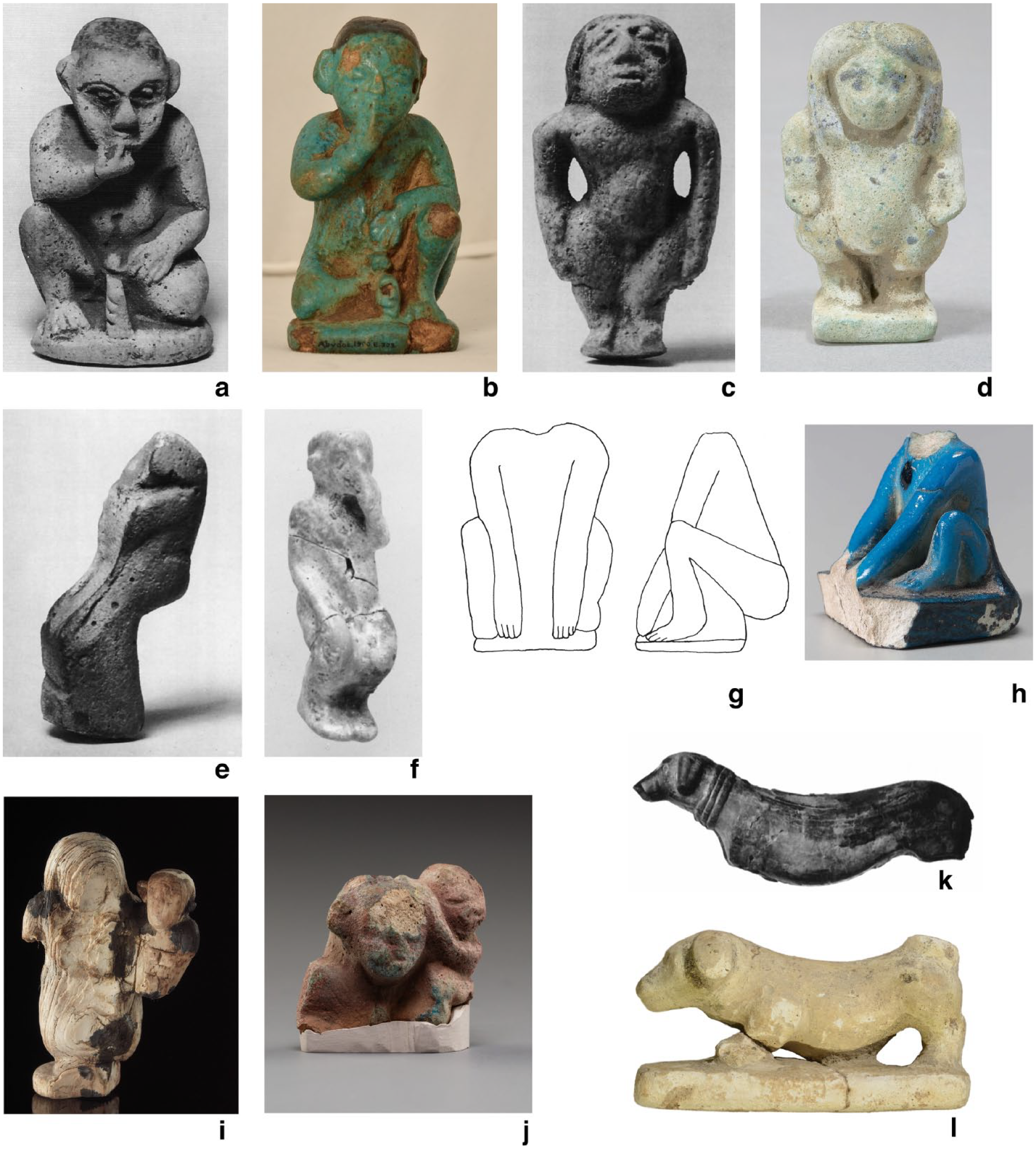
‘Early Dynastic’ and late Middle Kingdom figurines in comparison: a) ‘Early Dynastic’ figurine of a human from Elephantine (from Dreyer 1986: cat. no. 86, pl. 22); b) late Middle Kingdom figurine from Abydos (Ashmolean Museum E 2199, photo: author); c) ‘Early Dynastic’ figurine of a standing human from Elephantine (from Dreyer 1986: cat. no. 1, pl. 11); d) late Middle Kingdom figurine of a human from Lisht North (MMA 22.1.1163, © CC0 MMA); e) ‘Early Dynastic’ figurine of a squatting human from Elephantine (from Dreyer 1986: cat. no. 147, pl. 27); f) late Middle Kingdom figurine from Lisht (photo: Neg. MMA L31–32: 210); g) ‘Early Dynastic’ figurine of a squatting human from Abydos (from Dreyer 1986: pl. 60, fig. f); h) late Middle Kingdom figurine of a human from Deir el-Bersha (courtesy of the MFA); i) ‘Early Dynastic’ figurine of a woman with a child on her shoulder from Tell el-Farkha (from Ciałowicz 2009: fig. 21); j) late Middle Kingdom figurine from Lisht North (MMA 09.180.2271, © CC0 MMA); k) ‘Early Dynastic’ figurine of a dog from Hierakonpolis (Ashmolean Museum E 310, from Quibell and Green 1900: pl. 12.7); l) late Middle Kingdom figurine of a dog from Byblos (Beirut DGA 1248, photo: author).
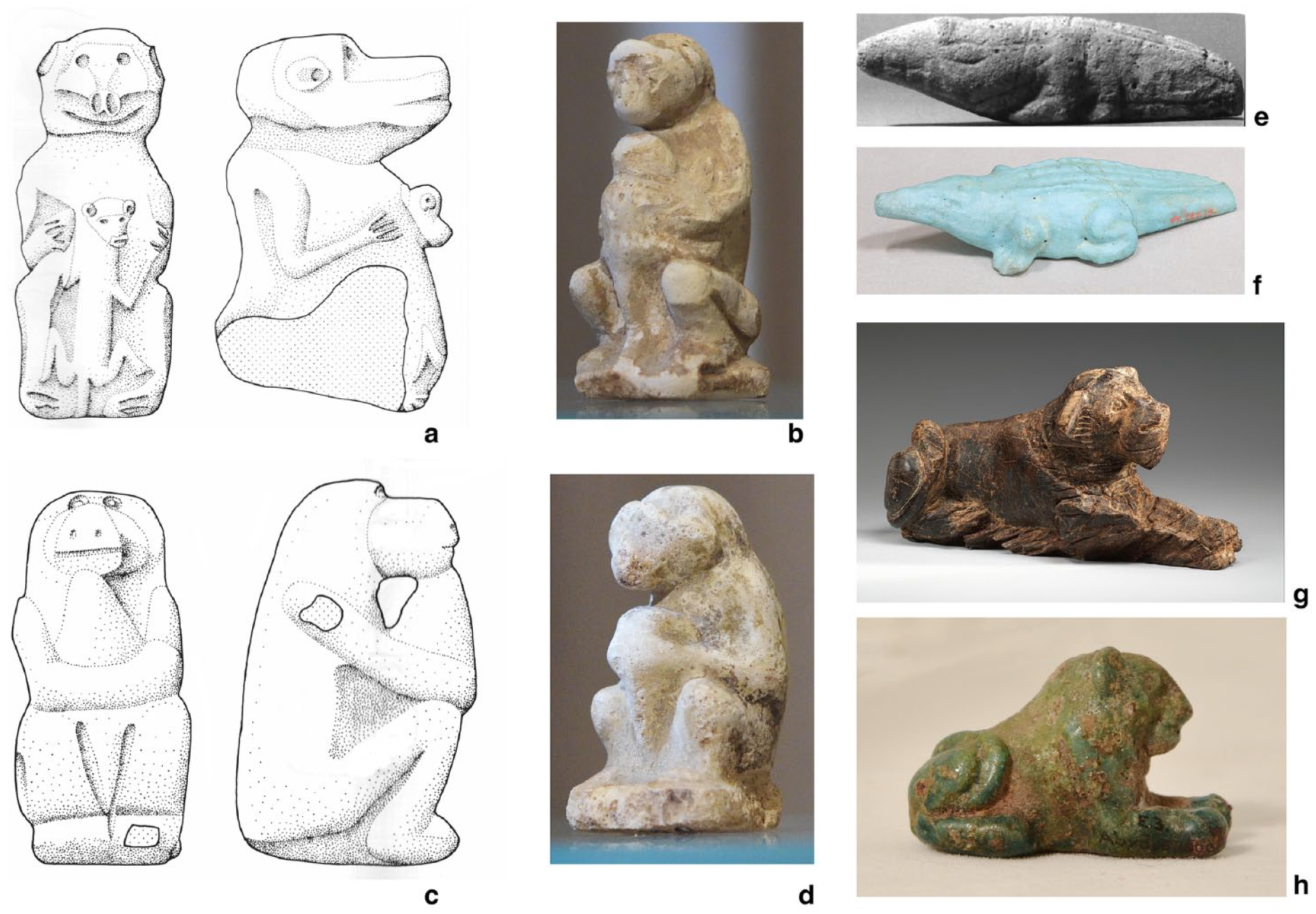
‘Early Dynastic’ and late Middle Kingdom figurines in comparison: a) ‘Early Dynastic’ figurine of a baboon with its young from Hierakonpolis (UC 15000, from Bussmann 2010: II, 143, fig. 5.348); b) late Middle Kingdom figurine from Byblos (Beirut DGA 943 (?), photo: author); c) ‘Early Dynastic’ figurine of a baboon holding a cone in its hands from Abydos (BM EA38020, from Bussmann 2010: II, 224, fig. 5.790); d) late Middle Kingdom figurine of a baboon from Byblos (Beirut DGA 951, photo: author); e) ‘Early Dynastic’ figurine of a crocodile from Abydos (MMA 03.4.8, image from Petrie 1903: pl. 6.75); f) late Middle Kingdom figurine of a crocodile from Lisht North (MMA 07.227.19, © CC0 MMA); g) ‘Early Dynastic’ figurine of a lion from Abydos (MMA 03.4.13, © CC0 MMA); h) late Middle Kingdom figurine of a lion from Abydos (Ashmolean Museum E 2183, photo: author).
Overlap in the medium
Apart from Hierakonpolis and Tell el-Farkha, faience is the most used material, accounting for up to 90% of the whole corpus of ‘Early Dynastic’ votives. 73 As already noted above, figurines in faience also represent the vast majority of all those attested for the late Middle Kingdom. Although there is no comprehensive work on the whole corpus of figurines from the late Middle Kingdom, as is available for those of the ‘Early Dynastic’, 74 the total number of specimens in faience amounts to over a thousand miniatures (c. 1151 figurines documented) 75 and is currently the most substantial assembled corpus for the late Middle Kingdom. Only clay figurines could possibly reach a comparable high number of specimens; however, as mentioned at the beginning, they seem to belong to a different value and concept context. 76
Overlap in the types
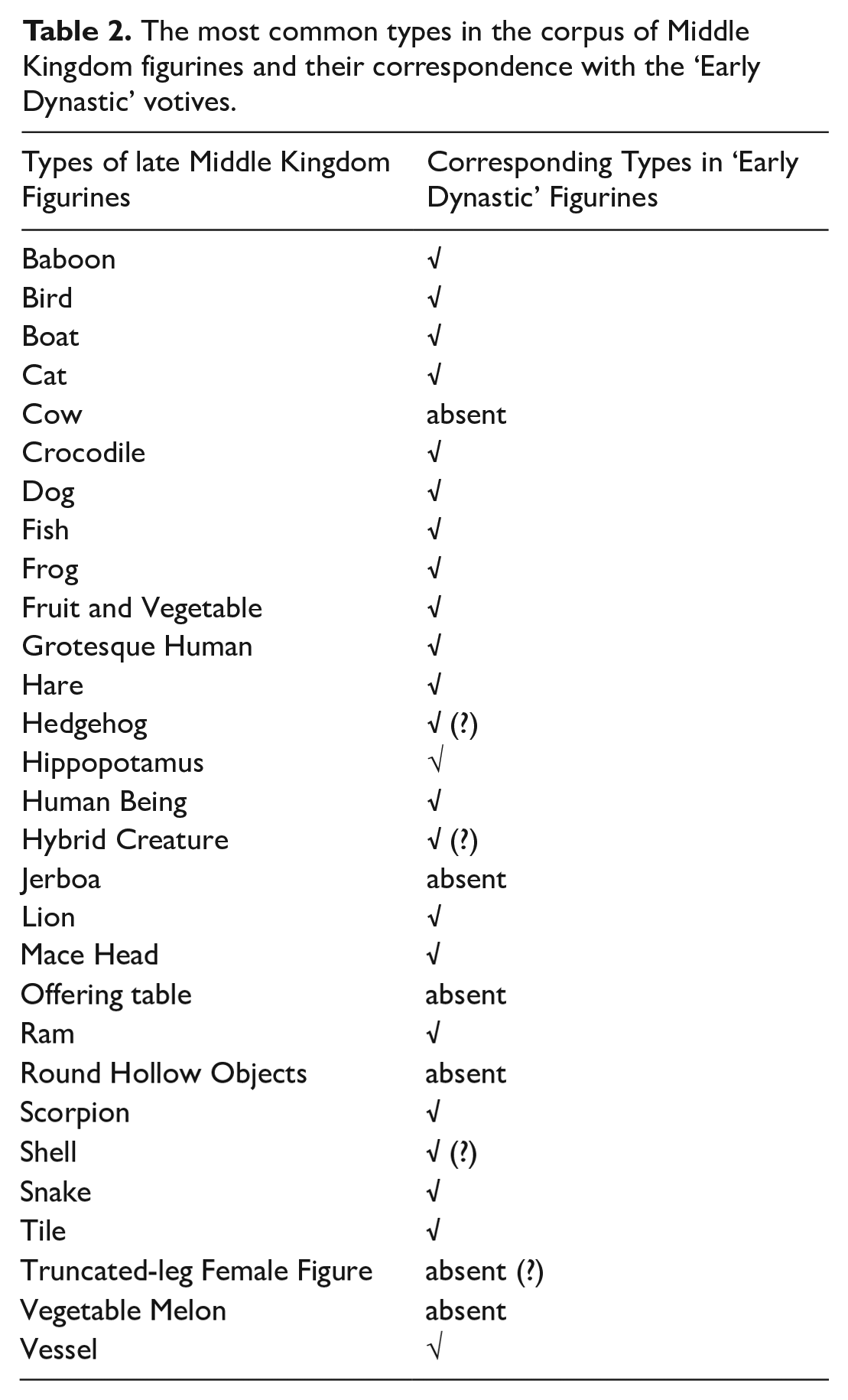
Although the range of types and the selection of motifs for ‘Early Dynastic’ figurines varies from site to site, they still form a consistent corpus 77 that overlaps almost perfectly with those of the late Middle Kingdom, especially with respect to animal figures 78 and humans, and to a lesser extent also vegetable and inanimate objects (see Table 2).
The most common types in the corpus of Middle Kingdom figurines and their correspondence with the ‘Early Dynastic’ votives.
Hippopotami, baboons, lions, other recumbent felines, and dogs are amongst the most representative animal figurines in the corpora of both periods. Human miniatures are also attested in the corpora of both periods. Many humans attested in the ‘Early Dynastic’ show unusual body features, being disproportionate, stocky, and heavy (see fig. 8); some have also been interpreted as dwarves or display some achondroplasia features. 79 Their physical disproportion can be compared to the same features shown by the ‘grotesque’ human category, in the Middle Kingdom corpus.
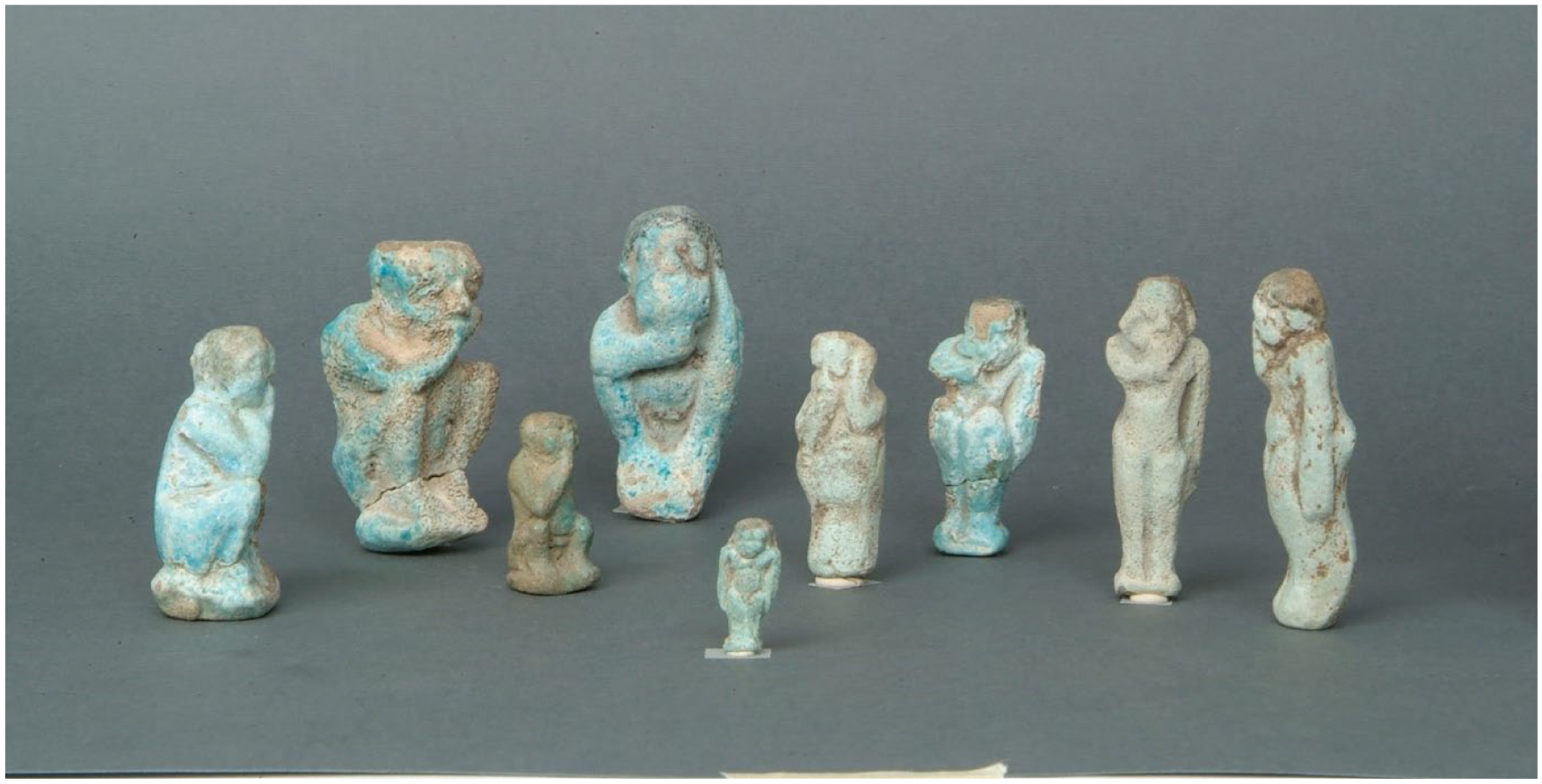
Human miniatures from the temple of Satet at Elephantine (DAIK photo archive, photo: Peter Windszus, © DAI).
The hybrid creature figurines, which are documented to a limited extent for the Middle Kingdom and much more frequently for two-dimensional representations, find a correlate in the ‘Early Dynastic’ corpus, where composite creatures are also extremely rare in plastic arts. 80 The repertoire of hybrid compositions differs from the ‘Early Dynastic’ to the Middle Kingdom, given the fact that the ‘Aha’ and ‘Ipy’ types first appear 81 only in the early second millennium BC. 82
Among the vegetables and inanimate objects, vessels, tiles, mace-heads, and boat figurines are categories that overlap the two periods, while vegetable melons and round hollow objects are not documented in the ‘Early Dynastic’ corpus. Miniatures of shells, which are underrepresented in both categories, are attested in the Middle Kingdom corpus with the Helical shell and in the ‘Early Dynastic’ corpus with the Aspatharia shell (from Tell el-Farkha). 83
Overlap in the style
The coincidences do not relate only to the types but also to the style of the figures represented: most of the ‘Early Dynastic’ figurines are self-standing and do not interact with any other figure. 84 They are frequently isolated on a thin or thick platform, and their essence is captured, exactly like their Middle Kingdom counterparts. For both ‘Early Dynastic’ and Middle Kingdom figurines the inactive pose prevails over the active pose: figurines are represented in different positions – standing, squatting, or recumbent/sitting – but rarely performing an action. When the human beings are represented performing an action, there are a number of similarities between the two corpora: humans may be shown holding or carrying an object or a human being (a vessel or an undetermined item in their hands, or a baby in their arms or behind their back; see fig. 6i–j). 85 The small stroke-type incisions on the back of the hybrid creature from Tell el-Farkha could aim at representing animal fur, 86 as is usually represented by black ink on faience figurines. Also, some ‘Early Dynastic’ vessels are decorated with Nilotic motifs (water-lily pad petals) present in the Middle Kingdom corpus. 87
Overlap in the iconography
The analogy extends also to the details of the iconography, in the pose and attitude of the figurines. In some instances, the similarity is extremely high, so much so that the ‘Early Dynastic’ miniatures could be considered the forerunners of the Middle Kingdom figurines, almost as if directly copied from them. Table 3 highlights the most striking and relevant correspondences.
Selected examples which show a great degree of overlap between the late Middle Kingdom and ‘Early Dynastic’ figurines.
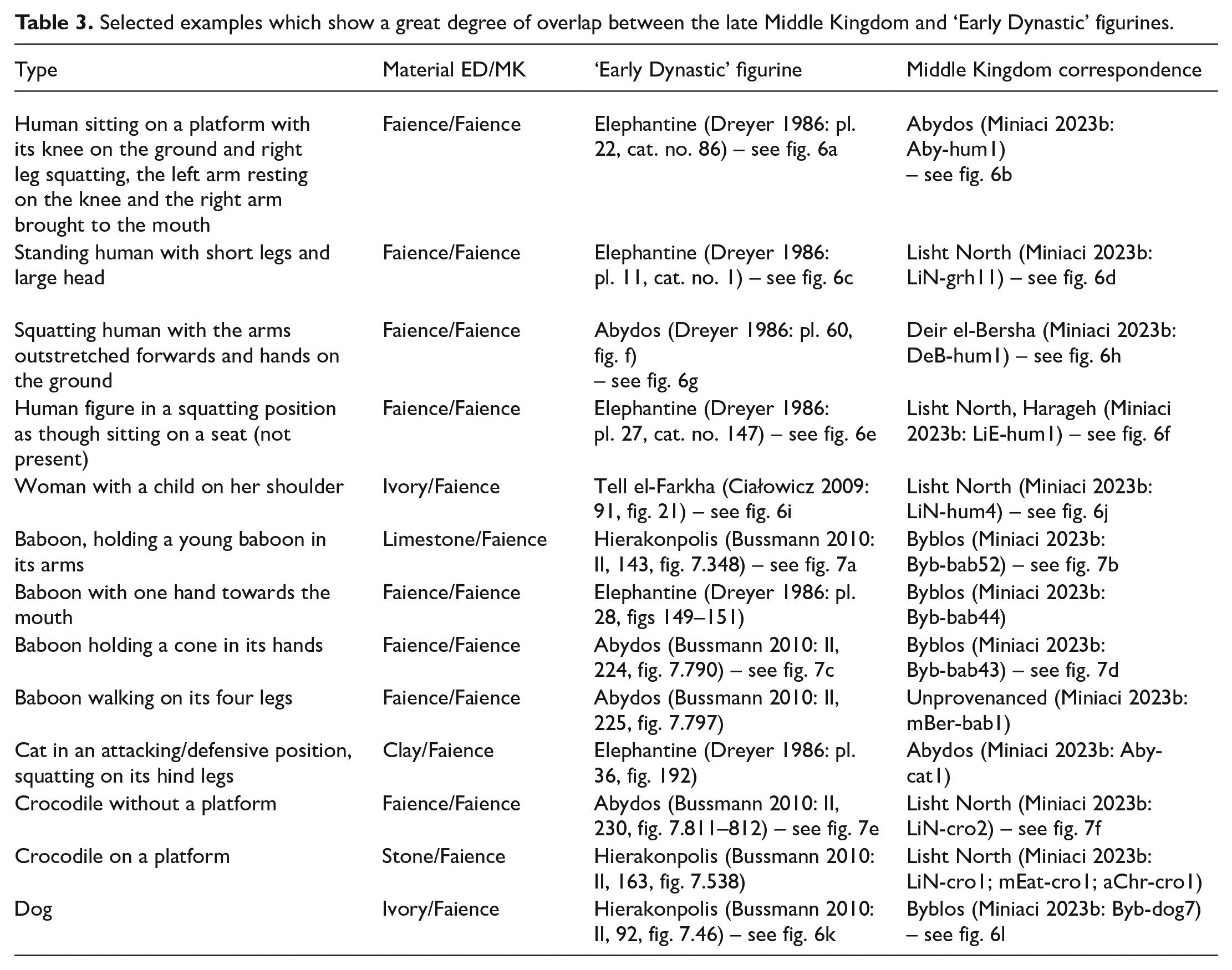
The iconographic analogy is transmitted or reproduced also in the ‘concept’ of the representation. For instance, ‘Early Dynastic’ human figures or baboons holding a circular object 88 or a vessel 89 in their hands are also reproduced with some variation of motifs and poses by some of the miniatures of the Middle Kingdom (see fig. 7c–d). The attitude shown by the ‘Early Dynastic’ human figures holding an infant in their arms 90 is likewise reproduced by figurines in the Middle Kingdom corpus (see fig. 6i–j). Some of the ‘Early Dynastic’ figurines (cf. Elephantine baboons) show a very narrow profile, 91 which can be found in the categories of dogs (cf. BM EA57338, Miniaci 2024b: 933, mBri-dog2) and hares (cf. UC 45468, Miniaci 2024b: 963–964, mPet-har1). The curled tail around the hind legs of the ‘Early Dynastic’ lion miniatures 92 matches with the positioning of the tail of late Middle Kingdom lion figurines, which also appears on several other quadrupeds (e.g. cows and cats) (see fig. 6g–h).
A few mismatches
There are a few evident mismatches occurring between the two corpora. For instance, cows and jerboas are not attested in the types documented (yet) for the ‘Early Dynastic’. The hedgehogs are almost entirely absent from the ‘Early Dynastic’ material thus far documented, 93 with the exception of some miniatures of ships depicted with a hedgehog face. In the ‘Early Dynastic’ corpus, the snake is mainly represented by cobras depicted with inflated hoods, 94 which are rare in the Middle Kingdom groups. 95 One of the most frequently represented birds in the ‘Early Dynastic’ deposits is the falcon, which is present only once in the Middle Kingdom corpus.
The Bridges Between the Late Middle Kingdom and the ‘Early Dynastic’
During the late Middle Kingdom, there seems to be a special connection with the material culture of the ‘Early Dynastic’, which gave impetus and focus to an obliterated past and ‘buried’ traditions. Several archaeological records show a large-scale attempt to build a bridge to a deep past connected with the rise of power and kingship in ancient Egypt.
At Abydos, for instance, the attention paid to the Early Dynastic remains in the late Middle Kingdom is widely visible in the archaeological record. 96 The tomb of one of the first sovereigns, Djer, became the object of late Middle Kingdom processions, ceremonies, and offerings. 97 Inside, Amélineau discovered a granite sarcophagus or bed 98 with a figure of the god Osiris upon it, 99 dedicated by a king of the 13th Dynasty, probably Khendjer (see fig. 9). 100 The processional route crossing the necropolis of Abydos and going through the Great Wadi to the Early Dynastic Cemetery of Umm el-Qaab was protected by a royal decree of the early 13th Dynasty which prohibited people from building their tombs in the area. 101 The importance of Abydos as a venue for building activities and displays of royal power in the late Middle Kingdom noticeably increased during the reign of Senwosret III, 102 who carried out construction work in the temple of Khenti-amentiu 103 and built a vast funerary complex at South Abydos. 104 All these documented activities would have led to the unearthing and discovering of earlier artefacts, considered sacred but forgotten over time.
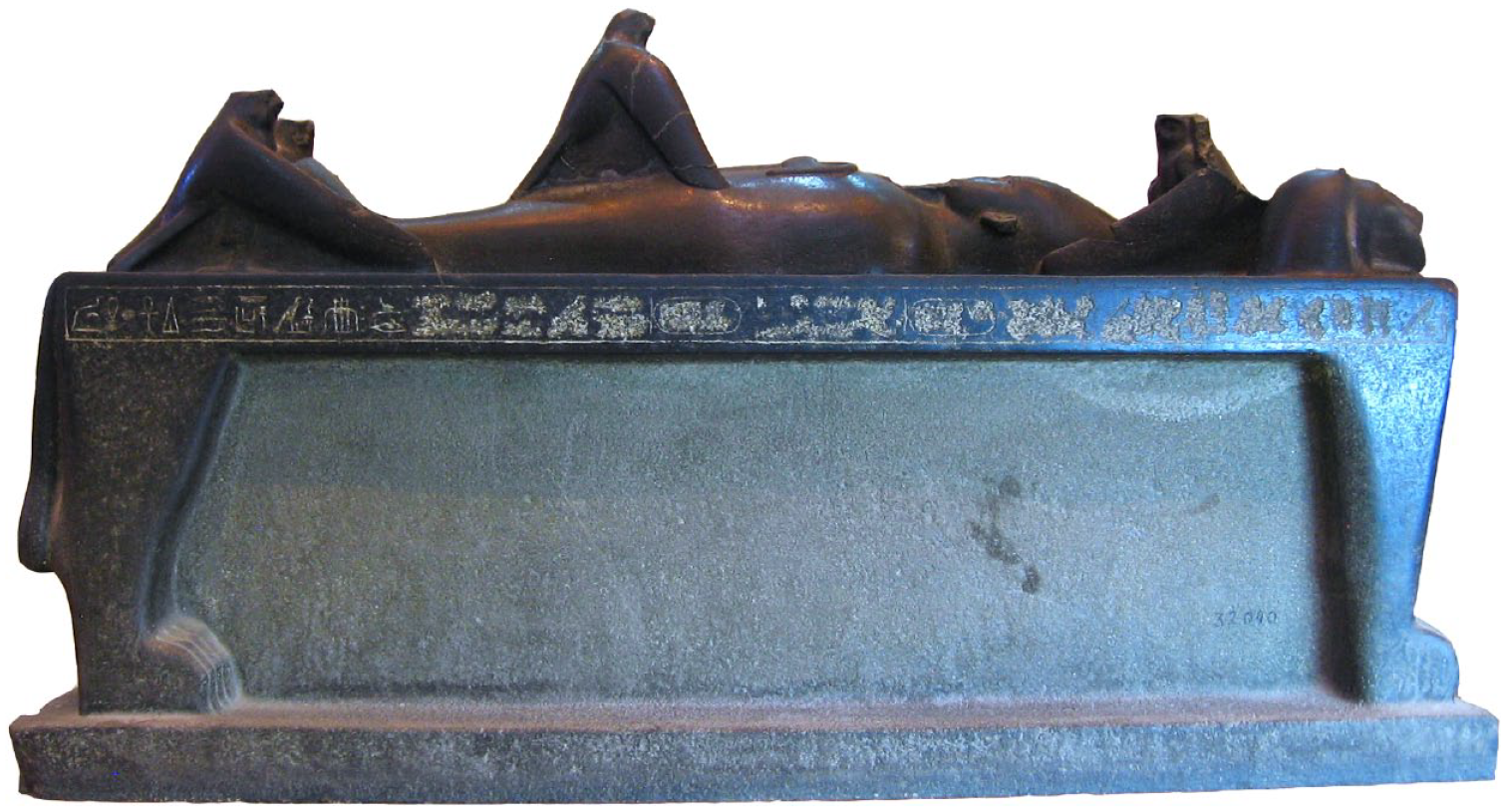
Late Middle Kingdom granite sarcophagus/bed discovered in the tomb of Djer at Abydos (photo: author, courtesy of the Egyptian Museum Cairo).
At Hierakonpolis the presence of the royal statues of Senwosret II, Senwosret III, and Amenemhet III (CG 422, 423, and 425), other private elements, and several rock inscriptions definitely indicate a particular interest in the site during the whole late Middle Kingdom. 105 In addition, in the stela of Horemkhawef (MMA 35.7.55), a chief inspector of priests of Horus of Nekhen and overseer of the fields, there could be traces of a deeper exchange (in both directions?) of votive materials between Hierakonpolis and the capital Itjtawy during the late Middle Kingdom: Horemkhawef was commissioned to bring a new cult statue of Horus and Isis from Itjtawy to Hierakonpolis. 106 The stela could have been commissioned in relation to some works carried out on behalf of the crown in the temple of Hierakonpolis. Work in the areas of Early Dynastic buildings at Hierakonpolis during the late Middle Kingdom would certainly have brought to light material from this earlier time. Probably not by chance, the ‘Main Deposit’ at Hierakonpolis was found in close proximity to Middle Kingdom structures and in a ‘heap’ rather than a pit (see fig. 4a), 107 as would be more logically expected: the heap may perhaps even have been the result of the removal of earlier deposits, later protected somehow. It is unlikely to be a coincidence that during the late Middle Kingdom, images of serpopards and griffins – widely attested in the iconography of the Early Dynastic ceremonial palettes from Hierakonpolis 108 – reappeared again on ivory birth tusks after being absent for over a millennium. 109
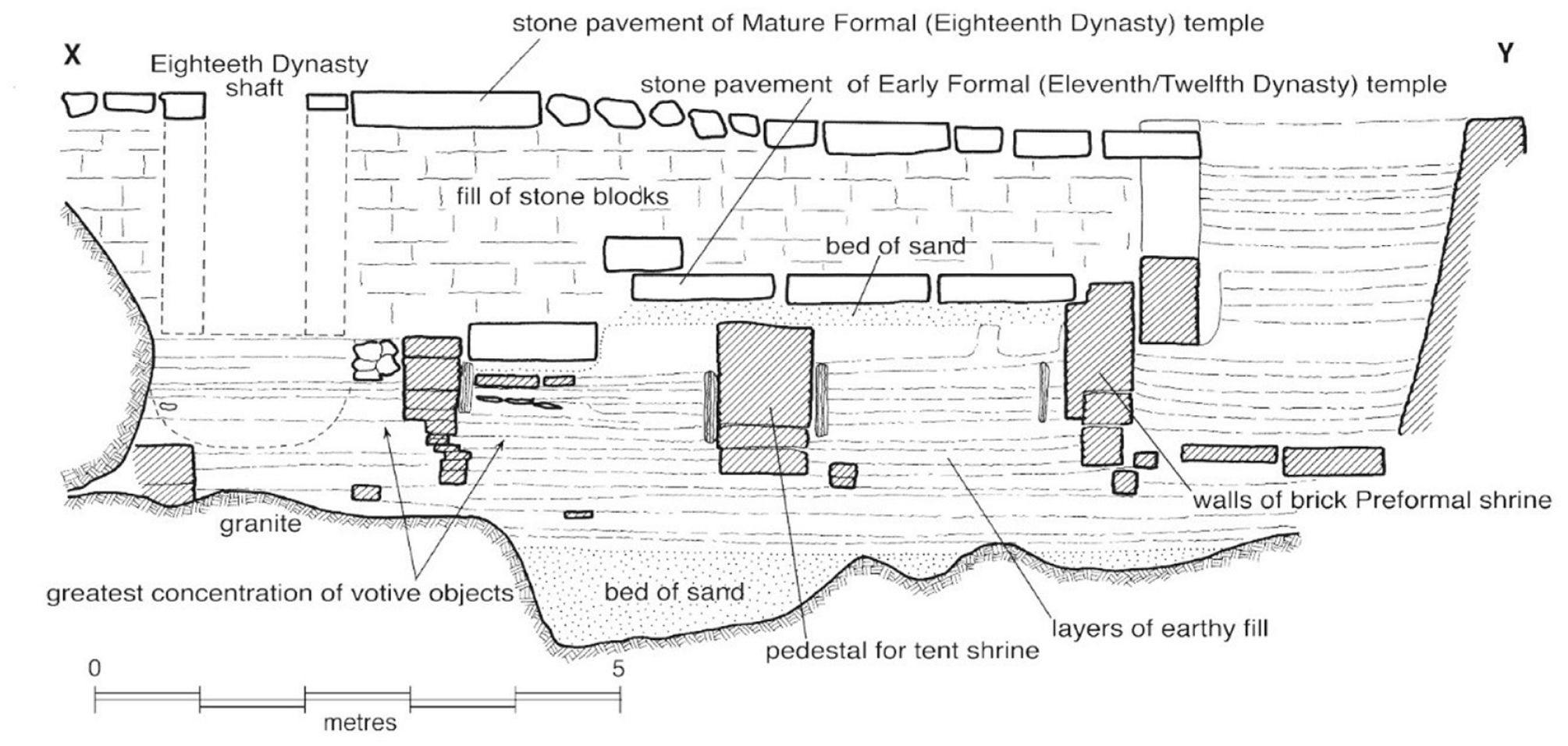
At Elephantine, the attention paid to the Early Dynastic remains/layers in the later period is even better documented in the archaeological record and it might also have involved the ‘Early Dynastic’ miniatures. A shaft cut during the 18th Dynasty in the temple of Satet (Schachtgrube mit Sandfüllungen 5975 and 5977) goes down to the ‘Early Dynastic’ levels, also reaching the ground layers which featured scattered votive figurines of the time (see fig. 10). 110 The shaft of the 18th Dynasty could have intruded into an earlier shaft of the Middle Kingdom. Such a shaft has been interpreted by Kemp as a wish to reach earlier remains considered sacred. 111 The excavators of the shaft would have encountered the large deposits of miniatures buried in that area, bringing them to light. A similar practice may, perhaps, have been attested elsewhere as well.
A similar process may have occurred at Saqqara. For instance, votive material – also in the form of figurines – dated to the Early Dynastic–early Old Kingdom was discovered inside a tomb dated to the late Middle Kingdom on the sacred hillside at north-west Saqqara, behind a large, layered stone structure. The deposit of votive material, typical of the temples of the ‘Early Dynastic’, in a tomb of the late Middle Kingdom is to be considered ‘non-normative’ for various reasons but especially because of the chronological mismatch and funerary context. However, the presence of this material in the tomb seems to be linked with the large, layered stone structure found in its proximity, which is dated to the ‘Early Dynastic’ (to the early Old Kingdom). If the large, layered stone structure is interpreted as a cult building, it is not impossible that in the late Middle Kingdom restoration or exploration activity carried out around it may have brought to light earlier material, which became incorporated into the funerary domain at that time. 112
An archaeological discovery in the late Middle Kingdom?
Some scholars have already highlighted the strong correlation between certain types of objects that appeared during the late Middle Kingdom and ‘Early Dynastic’ artefacts. Ellen Morris has noted that the appearance of ivory birth tusks and hand-shaped clappers in the late Middle Kingdom could be related to the deposition of similar objects in votive deposits of the ‘Early Dynastic’. 113 Susan Allen has also noted how the potters and artists of late Middle Kingdom faience dishes could have been aware of the White Cross-Line ware of the Predynastic, where the rendering of the figures with white lines and nestled or filled triangles is comparable to later incised representations on the fish dishes. 114 The artistic influence of the ‘Early Dynastic’ is documented on the sarcophagi of Senwosret III and some members of his royal family: the decorative pattern of these sarcophagi follows the motifs of the panel façade of Djoser’s Step Pyramid at Saqqara. 115 Senwosret III shows particular interest in Djoser’s funerary complex, so much so that some of its features have been reproduced in the royal complex at Dahshur. 116 The bridges with the ‘Early Dynastic’ artistic tradition come through also in the statuary of Amenemhat III: some statues belonging to the sovereign find their closest parallels in the private statuary of the ‘Early Dynastic’ or take inspiration from some of the features documented on the colossal statues of Min at Coptos. 117
As noted by Morris, the link connecting the artefacts of the two periods was not only a matter of artistic inspiration; it was related to a more complex phenomenon of forgetting, rediscovering, adopting, and re-interpreting materials of the ‘Early Dynastic’ in the late Middle Kingdom. 118 The Middle Kingdom religious authorities who encountered these ‘Early Dynastic’ models during temple renovations would clearly have recognised them as sacred and worth re-introducing into the contemporary ritual repertoire. Their original ontological meaning, however, may have been eclipsed over the centuries. In this case, the act of ‘discovery’ and of creative re-imagining was the key. In the late Middle Kingdom, there seems to have been a strong tendency to resume earlier (abandoned?) traditions and places 119 of Early Dynastic to early Old Kingdom date, 120 followed by an impulse towards a diachronic entanglement: 121 copying, absorbing, and reinventing shapes, iconography, and motifs, and adapting them to the religious and cultural beliefs of the time. 122 The ‘revival’ of figurine production (especially those in faience) could have been dictated by similar processes and by the direct contact with votive offerings in ‘Early Dynastic’ temples. 123
This re-imagining of figurines therefore fits perfectly into a larger pattern of late Middle Kingdom emulation of ‘Early Dynastic’ material culture. Some figurines were copied and imitated in an attempt to slavishly profile the same iconographic identity. Others were inspired by Early Dynastic models and reinvented: the human figurines with deformed physical traits, for instance, may have been a reinterpretation of ‘Early Dynastic’ figurines representing dwarves or heavily damaged human figures. The hedgehogs could have derived from the ‘Early Dynastic’ boats bearing hedgehog heads. Likewise, the female figurines with the lower part of their body truncated at the height of the knees and tapered could have derived from ‘Early Dynastic’ female-shaped tags/figurines with the upper part formed as a human body and the lower part shaped as a picket, as documented at the sites of Tell el-Farkha, Naqada, and Abadiya (although not – yet? – attested in any temple deposits) (see fig. 11). 124
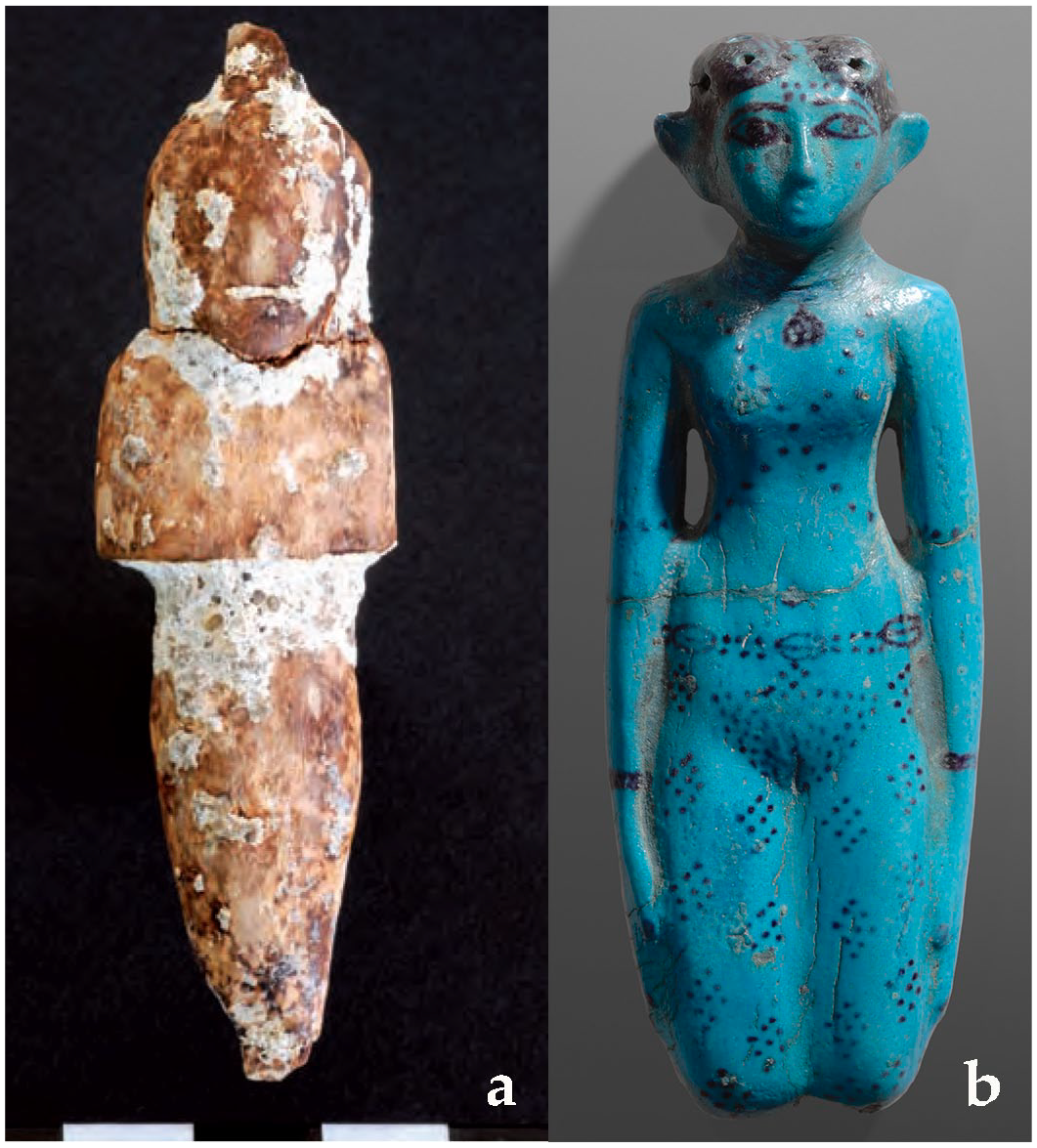
a) Man-shaped tag (hippopotamus tusk) from the Eastern Kom at Tell el-Farkha (from Chłodnicki, et al. 2012: 234, fig. 39); b) Truncated-leg female figurine © photo Ägyptisches Museum und Papyrussammlung in Berlin, Inv.-Nr. 9583 / Jürgen Liepe.
In conclusion, the practice of preservation and restoration of the ‘Early Dynastic’ sites and buildings in the late Middle Kingdom could easily have led to the rediscovery of the old material culture and materials, which produced an absorption of content, images, style, iconography, and motifs. In other words, the materiality of the ‘Early Dynastic’ could have passed into the late Middle Kingdom material culture in a very direct way, with a series of ‘archaeological’ discoveries as a bridge, after a gap of more than half a millennium. By revivifying the artefacts, the authorities made a conscious decision not to consign the past – a glorious past – to oblivion but to entangle their present with it.
Footnotes
Acknowledgements
I am very grateful to Richard Bussmann, Wolfram Grajetzki, Stephen Quirke, and Paul Whelan for several suggestions on this paper. I am indebted to Paul Whelan for reading through my English.
Funding
The author did not receive funding for this project.
2.
For two case studies, see Miniaci 2019b (Kerma) and  (Byblos).
3.
Works that take into consideration the small-scale plastic representations in the Middle Kingdom are manifold; the main references are: Bourriau 1988; Oppenheim, et al. 2015; Quirke 2016; Miniaci 2023b; and Miniaci 2024b. For the few metal figurines, see comments in : 344–346.
7.
Miniaci 2018d; : 94.
9.
Eaton-Krauss 2011. Cf. .
10.
Miniaci 2020a. For a summary on shabti statuettes, see Milde 2012: 2–4 and .
12.
Dasen 1993: 279–285. See especially Miniaci 2018d: 74–76 and : 122–124.
13.
Pinch 1993: 198–234; Tooley 2017; Tooley 2020a; and .
14.
15.
See Quirke and Price 2020: 175–176. For a late use of the name Reret as deity, see /03 IV: 694–695.
17.
Ceruti 2017; .
18.
Altenmüller 1965: 152–154; : 466–471.
21.
A cynocephalus human simian seated on a platform and with hands held to its snout, Copenhagen National Museum, inv. no. 13364; Cassirer 1953: 108–109; : 859, 861, mCoN-hyb1.
22.
Composite creature with the upper body and head of a horned quadruped, probably a ram, and the lower part of a human being; Dunand 1950–1958: 755, no. 15278, pl. 102; : 764, Byb-hyb9.
23.
A humanoid figure with the head of a feline, probably a lioness, shown in the act of playing a harp, BM EA49712; Ross 1931: 151, fig. 1 [second from the right]; Miniaci 2018d: fig. 14; : 948, 950, mBri-hyb2.
25.
Long 2021. For a more complete overview of these iconographic categories, see Miniaci 2023b: 533–540 and Miniaci 2024b. Several examples can also be found in : 112–121.
26.
Miniaci 2023b: 151–186. Faience figurines are skilfully manufactured with a high degree of accuracy, finely modelled by hand, showing particular attention to detail, sensitivity in modelling, technical ability, and aesthetic taste; see Nicholson 1998; Tite, et al. 2008; .
27.
For instance, examples of Middle Kingdom hippopotamus miniatures are made of limestone (Behrmann 1989: Dok. 134a–c, 136a, 139), serpentine (Behrmann 1989: Dok. 136c), and calcite (Behrmann 1989: Dok. 137a–b; although MMA 20.2.25 can be dated to a later period, Bianchi 2015: 147–156). Angela Tooley collected over 163 examples of legless female figurines, among which almost two-thirds were made in materials other than faience (wood, ivory, limestone): .
28.
Miniaci 2017: 265–270; Miniaci 2023b: 221–257. See also for the ritual aspect of the funerary deposition.
30.
Petrie 1906: 138–139, 148–149, 153; : 49–58.
31.
Late Middle Kingdom temple sites that preserve small finds are very limited: Tell Ibrahim Awad (van Haarlem 2019: 14–15), Tell el-Dab‘a, where a mud-brick structure at Ezbet Rushdi el-Saghira might belong to the time of Senwosret III (Czerny 2015: 80–151), Medinet Madi in the Fayum (Bresciani and Giammarusti 2012: 59–105), Elephantine (von Pilgrim 2006: I, 403–418), and Qasr el-Sagha (). However, none of the preserved temples (including cult and funerary domains) have yielded figurines from surface surveys, votive deposits, or discarded material.
32.
Kemp 1995: 25–54; : 111–135.
34.
Miniaci 2023b: 223–229. See, for later periods, .
35.
Cf. Moeller 2016: 55–56; McCarthy 1976; .
36.
For a general summary and bibliographic reference, see Moeller 2016. For other more specific references: Kom el-Hisn (Wenke, et al. 2016), Tell el-Basta (Bietak and Lange 2014), Tell el-Dab‘a (e.g. Bader 2020), Kom Rabi‘a (Giddy 2016), Lahun (Petrie 1890; Petrie 1891), Lisht (Arnold 1996), Wah-Sut (e.g. Wegner 2021), Edfu (Moeller 2010), Elephantine (von ).
37.
Cf. a site like Çatalhöyük in Turkey; see Meskell, et al. 2008; .
38.
See Jensen 2024; Miniaci 2024a; Sarrazin 2024; .
45.
Bourriau 1991; : 147–163.
46.
The inanimate categories of vessel and food miniatures are in evidence almost uninterruptedly since the Old Kingdom. One of the earliest attestations of miniature vessels was found in tomb G 7440 Z at Giza dated to the 4th Dynasty and comprises a set of 80 examples in calcite found scattered on the floor of the burial chamber beside the sarcophagus of an unidentified woman: D’Auria, et al. 1988: 77–78, cat. no. 7; : 90–112.
47.
Food offerings are also attested since the Old Kingdom, especially in the burial equipment of some private tombs at south Saqqara (around the pyramid of Pepi II), Abusir, and Giza. They usually represent miniatures of fowl, cuts of meat (i.e. beef haunch), bread (i.e. conical and bullet-shaped loaves), cakes, and probably fruits and vegetables, usually reproduced in limestone or calcite; Allen 2006; Long 2021; D’Auria, et al. 1988: 93, cat. no. 25, see also cat. no. 26.
48.
Single statuettes of hippopotami have been identified at Adaïma, Badari, Hierakonpolis, and el-Amra; Midant-Reynes and Buchez 2002: 454, pl. 4.23, no. 3; Brunton and Caton-Thompson 1928: 6, 34, pls 5, 27; Needler 1984: 121, 359–360, cat. no. 285; Hill 2010: 325, 356, .28.
50.
Count based on Behrmann 1989 and : 461 (121 have a secure documented archaeological context, while 73 are of unknown provenance).
52.
53.
Dubiel 2004: 156–188; Dubiel 2008: 199–221. See also Grajetzki 2017; Grajetzki 2020; and : 65–67, esp. cat. no. 37.
55.
The tomb comprises ten vertical shafts running parallel to each other and surrounded by a common low mud-brick wall.
58.
Another pottery hippopotamus figurine (Chicago ISAC E 4729; : 25, no. 11) also from Dendera comes from a ‘context’ noted as ‘602’. Other unprovenanced hippopotamus miniatures share a number of analogies with the Dendera hippopotami: MFA 48.252; Cairo Museum (no inv. no.; see Tony-Réveillon 1950: 61–62, fig. 9); see Lacovara 1992.
59.
Occasionally attributed in the past to the mid-12th Dynasty–late Middle Kingdom, Hayes 1953: 191; Tufnell 1975: 68–70; : 50–56, 99–102.
60.
Tufnell and Ward 1966: , pl. 16.
61.
For an overview, see Bussmann 2010: I, 211–430; : 55–62. To this group can also be added the Kofler-Truniger collection that, although unprovenanced, comprises a similar array of miniatures stylistically attributed by scholars to the Early Dynastic Period (see below).
62.
: 83–85; Bussmann 2010: I, 111–112 (eastern part); Chłodnicki, et al. 2008; Ciałowicz 2009 (western part).
64.
Kemp 1968: 153–155, fig. 4; Kemp 2006: fig. 43; van Haarlem 2014: 45; : 47, 51.
65.
Petrie 1903; Bussmann 2010: I, 84–99. To this group can also be added a lot of figurines coming from the antiquities market as part of the private collection of Kofler-Truniger in Luzern, Switzerland, and other minor private collections. The group included human figures, animals (frogs, scorpions, baboons, hippopotami, pigs, crocodiles, lions, and birds), shrines, tiles, gaming pieces, and vessels and they are reported to come from Kom es-Sultan, Abydos. They can be stylistically dated to the same range as the ‘Early Dynastic’ material from Egypt; : 60–61.
66.
Quibell and Green 1900–1902; Wengrow 2006: 182–184; Bussmann 2010: I, 42–58. : 172–178 distinguishes between one group belonging to the ‘elite’, which includes realistic statues and statuettes and ceremonial objects, and a second numerically larger group belonging to the ‘non-elite’ which included smaller and much less detailed works.
67.
Dreyer 1986; : I, 15–39.
68.
Hendrickx 2012: 465. See also .
69.
Chłodnicki, et al. 2012: 163–171.
70.
Dreyer 1986: 20, , 12.
73.
Bussmann 2013: . Other materials used for votives are ivory, mud, clay, limestone, hard- and semi-precious stones. These do not mirror a similar production in the Middle Kingdom, underlining the role played by faience in the transmission of figurines from one epoch to another.
77.
: 750. The range of categories of the Early Dynastic votive miniatures is very similar in all of the temples, suggesting a high degree of conformity and widespread uniformity throughout Egypt: ‘It seems that a common iconographic pool was shared throughout Egypt with artistic conventions of varying degrees of cohesiveness. Beyond these shared conventions, a more loosely defined art existed without necessarily forming distinct local traditions’ Bussmann 2011: 757.
79.
Ciałowicz 2009: 93–95; Ciałowicz 2012: 82–4; see .
80.
82.
See wall decoration of the tomb of Iti-ibi-iqer at Asyut, el-Khadragy 2007: 111, .
84.
Except for some rare exceptions both in the Early Dynastic and late Middle Kingdom corpora.
85.
Ciałowicz 2012: 75–80; : 103.
87.
Bussmann 2010: II, 238, .881.
89.
Dreyer 1986: pl. 14, figs 25, 27; pl. 28, figs 149, 151; : II, 193, fig. 5.685.
91.
Cf. Bussmann 2010: II, 199–200, .703–5.721.
92.
Bussmann 2010: II, 189–190, .672–5.676.
96.
Dreyer, et al. 2000: 118.
98.
Amélineau 1911; Leahy 1977; Trello 1997; Effland, et al. 2010: 30–35.
99.
JE 32090; Amélineau 1899: 109–115, pls 3–4; : 65, fig. 65.
100.
Ryholt 1997: 217, .4.
102.
107.
108.
Cf. the Narmer Palette (JE 14716) and the Two Dog Palette (Ashmolean E.3924).
109.
Wengrow 2014; .
110.
Dreyer 1986: 22–23, see also 24–25 and .
114.
116.
Arnold 2002: 121–122; : 474.
117.
Connor 2020: 37. See also comments in .
118.
Morris 2017. See also .
119.
On the reappropriation of abandoned assets in past and modern societies, see Buono, et al. 2024.
121.
Stockhammer 2012; cf. .
124.
Chłodnicki, et al. 2012: 234–235, figs 39–40; Patch 2011: 116–117, cat. nos 95–97. Ellen Morris has provided an alternative explanation, that the shape of the truncated-leg female figurines emulated the broken female figurines of earlier times, discovered with the lower part of their legs missing, because the slim legs were one of the weakest parts of a figurine’s body: ‘This artistic choice becomes more easily explicable, however, if their shape is seen as an effort to emulate the (broken) votive statuettes recovered from Egypt’s earliest temple deposits’ : 328.