




Abstract
This study of the Contendings between the Body and the Head presents a new edition and the first English translation of the Turin tablet CGT 58004. Closer analysis of the manuscript suggests a more precise date of the text and facilitates engagement with issues raised, but not expanded upon, by other scholars relating to its composition. Evidence will be considered as to firstly, whether the text was written by a student and secondly, whether the Contendings are extracted from a lengthier, no longer extant, composition. Lastly, it will be argued that an as yet unattested pedagogical method, that of abridgement, was being employed.

Introduction
The following study presents the first English translation 1 of the Late Egyptian literary text, The Contendings between the Body and the Head, a humorous courtroom drama in which a (female) Body 2 takes its (male) Head to court to dispute his supremacy. The text is uniquely preserved on tTurin CGT 58004. 3 Whereas another recent study of the text provides a new edition and German translation, as well as a textual analysis which considers the themes, literary style and generic profile of the text in a late-Ramesside literary context, 4 the analysis undertaken here considers the material aspects relating to scribal practice and pedagogy. Features of the manuscript, including its condition, are appraised to propose a dating of the tablet. The hieratic palaeography and orthography will also be scrutinised in reference to the date, usage and composition of the manuscript. These features will allow theories about the text to be tested, such as whether the text was the work of a student 5 and whether the text on the tablet was an abridged version of a longer, no longer extant, text, written out during a dictation exercise. 6 To be clear, abridgement is distinct from excerpting, i.e., copying selected, but usually unconnected, passages from longer texts. Abridgement is the reduction of a longer text in such a way that the important elements are retained to obtain a whole picture of the text, while reducing the text in length. Having overviewed the textual features that allow for speculation on these points (scribal ductus, 7 orthography, morphology, syntax and punctuation), I suggest that an inexperienced hand is likely, and that abridgement is demonstrable. However, since there is cause to doubt that the pedagogical context in which this text was produced was dictation-based, this work will propose an alternate hypothesis.
About the Manuscript
The writing board, known as tTurin CGT 58004 (= Cat. 6238; old inventory number 16355), belongs to the Drovetti collection at the Museo Egizio di Torino. 8 It is 35 cm wide, 9.5 cm high and 1 cm thick. It was originally connected to another piece of similar size via three dowels pushed into holes along the thickness of the longest side of both pieces. Two other holes near each edge, which may originally have comprised four, two on either side of the join, 9 might have strengthened the join with cords, but could also indicate the board’s reuse. 10 Another hole on the left-hand side, at the juncture of the two parts of the board, would have accommodated a cord of some kind, either to carry the board around, 11 or to affix a scribal palette. 12 As was customary, the board was plastered. In modern times, it may have been glazed, perhaps to preserve the plastered surface, which has given the board a sheen and a dark red colour. 13
Eight lines of text are written upon one side in hieratic script and both text and verse points are written in black pigment. 14 We can presume that the missing bottom half would have contained a roughly equal number of lines. The reconstructed height of 19 cm is standard for boards of the New Kingdom and corresponds roughly to the height of contemporary papyri. 15 Since board sizes decreased and plastering was eschewed during and after the Third Intermediate Period, 16 the physical features support a date of the early Third Intermediate Period at the latest. The text is unfortunately not in exemplary condition: the signs in the first line (and part of the bottom line), as well as on both sides, are abraded. Fortunately, a generous margin on the right-hand side means that the text is better preserved on that side.
Contextual Questions: Dating, Usage and Composition
The hieratic script on the writing board has been assigned dates ranging from the end of the 20th Dynasty
17
to the 22nd Dynasty.
18
However, the features of some of the signs, while acknowledging the limitations of the palaeographic approach,
19
may allow a more precise dating that conforms to the material qualities of the tablet discussed above. The abbreviated writing of Gardiner Sign A2, A2a, seems to appear from the end of the 20th Dynasty into the Third Intermediate Period.
20
The low number of ligatures in the text is moreover reflected in manuscripts dating to the early Third Intermediate Period, such as one of the El-Hibeh papyri, Papyrus Moscow 127 (Tale of Woe / Letter of Wermai).
21
The dot-like diacritic, used in combination with various signs, is also a feature of early Third Intermediate Period calligraphy.
22
In the Turin tablet, it appears under the beard of the head /dp
23
Gardiner Sign (D1, Möller Sign 79)
24
in Lines 1, 3, 4, 7 and 8 ( in Line 7), as well as under the phallus (D53, Möller 96) in Line 1 (
 ) and under the piece of flesh classifier (F51, Möller Sign 178) on every line (
 in Line 4).
25
in Line 4).
25
The writing of ḥȝ.t (F4, Möller Sign 146)  in Line 4 is more cursive than Third Intermediate Period comparanda (see, for instance, pMoscow 127, 1.8:
  )
26
and thus cannot be seen as diagnostic for that time. Likewise, the writing of ẖ (F32, Möller Sign 169) as seen on Lines 1 and 2 (
)
26
and thus cannot be seen as diagnostic for that time. Likewise, the writing of ẖ (F32, Möller Sign 169) as seen on Lines 1 and 2 (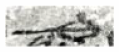 in Line 2), is different from the El-Hibeh papyri, as the left extremity has no small dash.
27
In keeping with variable writings of r (D21, Möller Sign 91), both open (pMoscow 120)
28
and closed (pMoscow 127),
29
in the Third Intermediate Period,
30
we see
in Line 2), is different from the El-Hibeh papyri, as the left extremity has no small dash.
27
In keeping with variable writings of r (D21, Möller Sign 91), both open (pMoscow 120)
28
and closed (pMoscow 127),
29
in the Third Intermediate Period,
30
we see 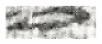 on Line 1 and
  on Line 3. Lastly, the writings of šȝ (M8, Möller Sign 274) in Line 6 appear as
  , compared to pMoscow 127 (see 4.5
  ) or pMoscow 120 (see 1.6
  ), thus are too dissimilar to be diagnostic. The ligature on our tablet bears more likeness to late Ramesside flourishes than the more self-contained later style.
31
The Turin tablet thus has a style bridging Ramesside and 21st Dynasty styles, due either to the time of composition, the scribe’s education or style, or the date of the Vorlage.
), thus are too dissimilar to be diagnostic. The ligature on our tablet bears more likeness to late Ramesside flourishes than the more self-contained later style.
31
The Turin tablet thus has a style bridging Ramesside and 21st Dynasty styles, due either to the time of composition, the scribe’s education or style, or the date of the Vorlage.
Regarding usage, the writing tablet was possibly employed for the instruction of a young scribe, as Erman hypothesised, 32 since this was frequently the case with such objects. 33 Though the tablet has no known find-spot, 34 the presence of the hole for appending a cord or another object, together with the signs of wear on the edges, including vestiges of ruled lines on Lines 4–6 on the left hand side, suggest consistent use. This is naturally insufficient to indicate use as a school tablet, but we shall see that there are more indications that this was indeed the case. To date, no studies have focused on signs of writing training on this tablet, in the manner carried out for other manuscripts. 35
Concerning the method of composition, Kammerzell suggested that, even intact, the writing board would have accommodated only a portion of the story. He argued that the remaining text suggests that the complete text, like the Contendings of Horus and Seth, would have presented speeches and responses, provisional decisions, new arguments, revocation of the preliminary judgments, and so on. 36 Kammerzell also hypothesises the conditions under which this abridgement took place, namely, that ‘einzelne orthographische Besonderheiten deuten womöglich darauf hin, daß die Niederschrift nach einer mündlichen Vorlage (z.B. Diktat) entstand’. 37 This study attempts to test this hypothesis.
Method: Ways of Tracking Scribal Expertise
There are several approaches to quantifying the expertise (or lack thereof) demonstrated by the scribe of a given document. This being said, lack of experience in conducting the specific task at hand is far easier to glean than, for instance, the educational level (student, apprentice, master) of the individual. It may be that a scribe well-trained in a specific type of output was attempting a different task and not excelling at it. Thus, it is also problematic to attribute to each uncertain writing attempt a pedagogical exercise: additional markers must be sought out. In any case, though it is safer in most instances to look for the dilettante rather than the student per se, since the literature concerns itself with educational level, we will review the state of this discourse.
One marker of an educational context might be the genre of the work, scribal Miscellanies being, since Erman, an oft-used example. 38 However, Gardiner, followed by Hagen and others, cast doubt on this hypothesis. 39 In another case, pSchulübung (pBerlin P 13639), a Ptolemaic Demotic text, Prada indicated that the attributed errors are indeed not present and that far from being a scribal exercise, the papyrus might be a ‘textbook’. 40
We could also potentially consider the role of the medium in whether the text in question was illustrative of an exercise or not. The current scholarly consensus (in absence of evidence) is that scribes at the earliest stage of instruction wrote on cost-effective ostraca, as illustrated by ostraca upon which signs have been repeatedly written. 41 However, a number of scholars have expressed reservations about how widespread this practice was. 42 For intermediate students, writing boards may have been preferred over papyrus on the basis that they were more easily erased and reused. 43 According to this reckoning, papyrus would have then been principally used by advanced students, some of whom were already ‘assistants’ (ẖr.yw-ʿ). 44 However, since this writing surface-based model is hypothetical, the aptitude of the scribe must instead be assessed on a case-by-case basis.
Concerning the stylistic features of an inexperienced attempt, scholars have highlighted the following features: an imprecise scribal ductus, both in terms of sign and ligature formation and in terms of sign grouping, 45 problematic orthography (though the similarity of errors across copies can also suggest the careful copying of corrupt earlier versions), 46 lapsus of words (sometimes corrected by the student or their master) 47 and a problematic grasp of morphology and grammar. 48 Philologists now eschew attributing cases of textual variation to ‘scribal error’ in the first instance, as many cases present equally comprehensible variants. 49 Thus, a clear case has to be made for something going truly wrong in the text to claim error.
Another potential indication of an inexperienced hand can be the use of delimiting or structuring devices, like verse points, 50 or structuring marks (Gliederungspunkte). 51 In longer literary works, these points were sometimes dispensed with before the end of a document, 52 which obscures their purpose. When used in a potentially educational context, some argue that the marks were made by students, to show they had identified the textual unit 53 or that a passage had been ‘read out after they had been copied’. 54 Others take the mark as showing that ‘the student scribe or his teacher has checked the completion (and accuracy) of the copy against the master document, unit by unit’. 55 Cases of misplacement, especially when the point is more than two signs away from where it should be, might indicate that the scribe may have formed a different idea of the text in their head in the process of writing to what they ended up copying – or checking. 56 On the other hand, seeing many of these placements as alternative readings rather than errors implies that the scribes had no verse points to copy in the Vorlage – or that they were inattentive to them.
As for the kinds of skill-building being prioritised, various papyri, 57 ostraca 58 and writing boards 59 attest to calligraphic practice, a natural requirement for scribes who needed to quickly produce documents and copies. 60 Onomastica, 61 lists of lexemes in specific word-fields 62 and lists of items in model letters in the Miscellanies 63 reflect a focus on learning (and memorising) lists. The satirical letter of Hori to Amenemope includes references to memorising texts, 64 exercises of practical mathematics, 65 learning the geography of Western Asia and as well as gaining familiarity with foreign terminology. 66
As for the exercises carried out to acquire some of these skills, it is possible that much lies in the recitation of texts for the purpose of memorisation. 67 Other kinds of drills are also attested. Conjugation exercises are attested from the New Kingdom 68 and exercises converting sentences from classical to more colloquial forms (so-called Middle to Late Egyptian) appear in the Ramesside Period and beyond. 69 We have cases of a teacher copying out the first part of the text and having a student continue 70 or the student directly copying lines written prior by the teacher, even on the same surface. 71 From the Late Period on, sign lists, word lists, grammatical paradigms, mathematical calculations and even calligraphic exercises are known. 72 In lists of such exercises made by scholars to date, abridgement is not mentioned, 73 whereas excerpting – especially of the beginnings of texts – can be seen on a range of writing boards and ostraca, as well as in dipinti. 74 Whereas excerpting is carried out by scribes of all calibres and cannot be linked unequivocally to pedagogy, abridgement, at least in the manner practiced on this writing board, gives genuine indications that an exercise was underway. I cannot comment on whether abridgement was generally used as a pedagogical technique – to the best of my knowledge no other cases of abridgement exist on writing boards – but I hope to be able to test this in a subsequent study.
Another exercise long regarded as being utilised in ancient Egyptian pedagogical contexts is copying. Though the manner of producing copies was controversial, 75 most scholars now see copying, not dictation, as being the main means of transmitting texts in an educational setting, based on the visible errors. 76 In other words, if errors are made, they are more likely to be typographical slips or lapses of memory rather than errors of hearing.
We can conclude that questions relating to the scribe and their process are best addressed via a multi-dimensional approach that takes ductus (via palaeography), orthography, morphology, syntax and punctuation into consideration, often in relation to each other. In addition to this, an approach that considers both the doing and the thinking behind the doing will assist us in elevating the conclusions from the purely mechanical to the cognitive. 77
Findings I: Palaeography
The scribal ductus of the Turin tablet (seen in fig. 3) is not always very careful (fig. 1). In Line 1, the sign for ḳj/ḳȝj ‘character’ ( ) looks more like Gardiner Sign A30 than A53.
78
On Line 2, the signs of mȝʿ.t n pȝ are poorly formed. The dp ‘Head’ (D1) in Line 4 (
) looks more like Gardiner Sign A30 than A53.
78
On Line 2, the signs of mȝʿ.t n pȝ are poorly formed. The dp ‘Head’ (D1) in Line 4 ( ) may demonstrate superfluous ink in the pen and/or a lack of hand control. The writing of D6 (
 ) on Lines 4 and 6 is idiosyncratic, but not unlike versions on documentary ostraca,
79
though with more flourish. The sign groups are also generally of varying heights, which gives the impression that the lines of text are not straight,
80
as seen by wn{n} (E34:N35:N35) in Line 5. Writings of s (S29) low on the line (Lines 4, 7 and 8) also disrupt the line spacing.
81
However, some disproportionately large signs, like ẖ (F32, Möller Sign 169) in Lines 1 and 2 and ṯȝ.w (P5, Möller Sign 379) in Line 5, rather reflect 20th and 21st Dynasty calligraphy.
82
Moreover, though the free variation in sign formation
83
might be indicative of a lack of experience, several studies indicate that such is to be expected even from learned hands.
84
) on Lines 4 and 6 is idiosyncratic, but not unlike versions on documentary ostraca,
79
though with more flourish. The sign groups are also generally of varying heights, which gives the impression that the lines of text are not straight,
80
as seen by wn{n} (E34:N35:N35) in Line 5. Writings of s (S29) low on the line (Lines 4, 7 and 8) also disrupt the line spacing.
81
However, some disproportionately large signs, like ẖ (F32, Möller Sign 169) in Lines 1 and 2 and ṯȝ.w (P5, Möller Sign 379) in Line 5, rather reflect 20th and 21st Dynasty calligraphy.
82
Moreover, though the free variation in sign formation
83
might be indicative of a lack of experience, several studies indicate that such is to be expected even from learned hands.
84
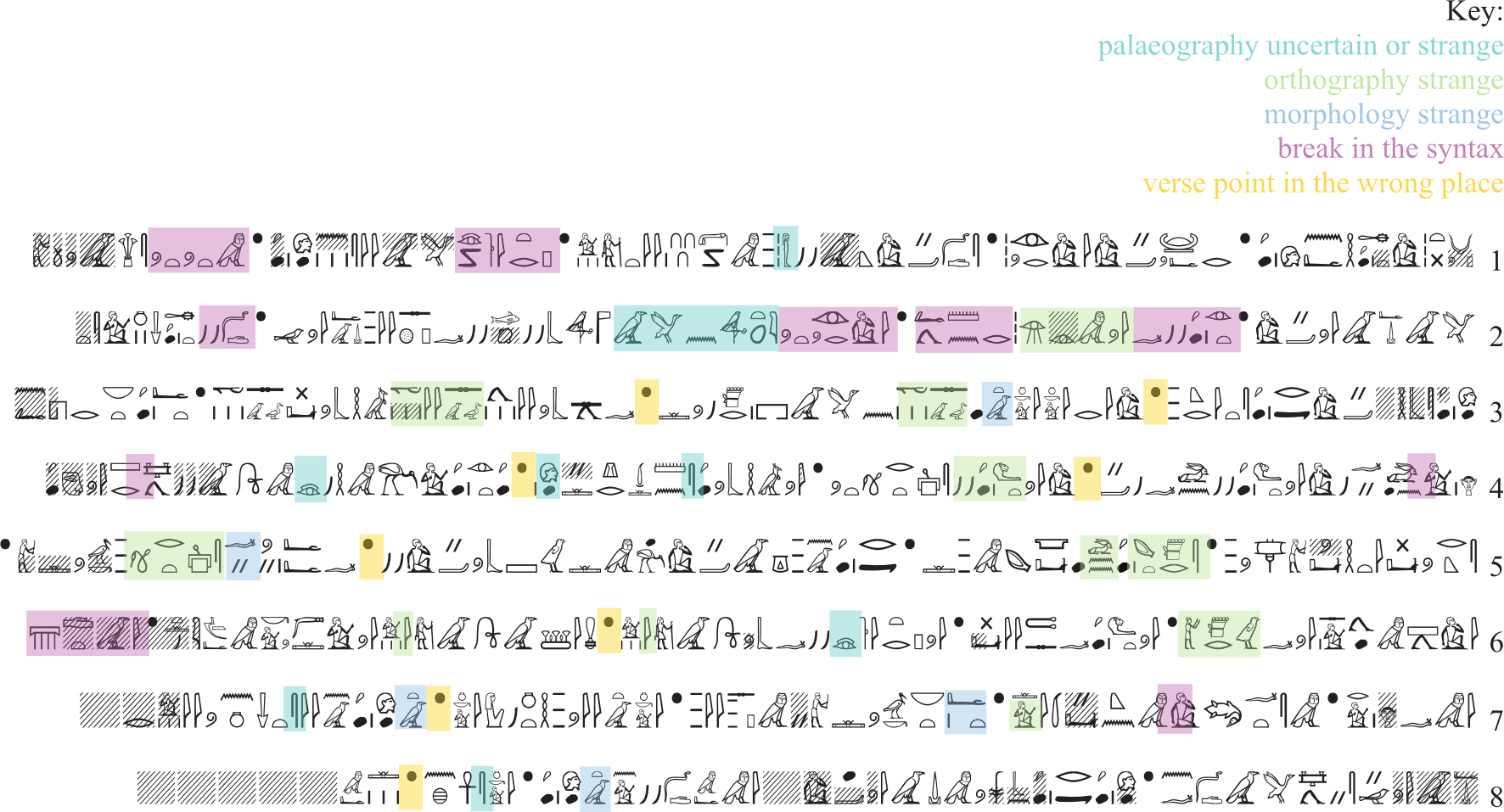
Transcription of the writing board showing variations or problems in palaeography, orthography, morphology, syntax and verse points.
Findings II: Orthography
Orthography, as attributable to the ‘carelessness’ (or not) of a scribe, has featured in discussions of manuscripts attributed by some scholars to didactic pursuits. 85 Orthography, however, is a problematic notion in a context without a canonised orthographic system and at a time in which written and spoken language poorly reflected each other. 86 Indeed, in this document, New Kingdom orthographic and/or phonological changes are visible, such as missing feminine .t endings 87 on nouns (šr(.t), Line 4 and wšb(.t), Line 5) to reflect the silent final /t/. In addition, we note the seemingly ‘extraneous’ half-consonant phonograms, such as ï, j and w, at the ends of words 88 (wḥʿwï and sḏdï, Line 1).
Nevertheless, some cases of potentially ‘uncertain’ orthography emerge (fig. 1). In Line 2, it might seem like rm(j) ‘to weep’ is spelled {jw}<r>m(j). Though jw is often an allograph for r, 89 to the best of my knowledge, such a spelling of rm(j) is unaccounted for in Ramesside and Late Period texts. 90 Perhaps the scribe was attempting to shorten a longer passage (including jw and rm(j)) into a few signs. On Line 3, zȝy/zȝw is spelled two different ways and in Line 4, ʿ.t ‘body part’ has been written as ḥȝ.tï, which appears elsewhere on the line. 91 In some cases, elements of words are missing or extraneous. In Line 5, msḏr.t ‘ear’ is spelled without an m and the verb wn ‘to be open’ is spelled as wnn. 92 In Line 6, ḏr ‘stay distant’ is spelled as wḏr 93 and in Line 7, the dependent pronoun wj is written as =j.
Some variations, however, might attest to conscious decisions of style: sn.nw ‘inferior’ is abbreviated before a classical possessive construction using a suffix pronoun (Line 2) and written fully in a colloquial construction following a possessive article (Line 7). Also, in equating a bwȝ ‘nobleman’ with a šwȝ ‘poor man’ (Line 6), both nouns bear the same classifier, though A21 is unusual for šwȝ. This might indicate a clever association of the pair of antonymic words via both assonance and classification, which reflects the case that in the text, the Head is accused of not being able to distinguish one from the other.
Findings III: Morphology
Morphological variation (fig. 1) offers insight into the scribe’s grammatical knowledge in their temporal context, visibly mixing more classical features (Participles without j-, Lines 3 and 8) with more colloquial ones (articles marking gender, status pronominalis of the Infinitive ḳn(j), Line 7). 94 Nominal morphology may show a little uncertainty: the dual =fï after ʿ.wï is superfluous (Line 5) 95 and the singular ʿ.t ‘limb’ in Lines 4 and 7 would make more sense in the plural. However, the ‘feminisation’ of two nouns via the feminine article (tȝ) and possessive article (tȝy=): zȝy/zȝw ‘strut’ (Line 3) and dp ‘head’ (Lines 7 and 8) is deliberate. As discussed elsewhere, 96 this does not indicate Ramesside gender shift: 97 it is a rhetorical strategy of the feminine and feminised Body to gain prominence over the – in her words, ineffective – (masculine) Head. The feminised word ‘strut’ is used metaphorically to describe the Body’s strength and diligence and is echoed in her feminisation of the word ‘boss (lit. head)’ when used in reference to herself. 98 In short, morphology is a poor indicator of inexperience.
Findings IV: Syntax
A key part of the study focuses on syntax to uncover the process of writing the text. Some interesting syntactic features of the text communicate register variation: whereas the narration (Line 2) employs traditional forms (sn.nw=s), the direct speech (Line 7) has more colloquial elements for the same phrase (nȝy=s sn.nw), mirrored also in the orthography for these words, as discussed above. However, as we shall see, other interesting syntactic cases reveal word omission, which is indicative of breaks in the text. We will then consider whether such features interact with markers indicative of the writing process.
Omissions of words causing breaks in the text
Words can be omitted from texts for a number of reasons and by scribes of all calibres, as contemporary writing studies indicate: generalisation driven by expectation drives a notorious amount of human perception and output, causing ‘misperception errors’. 99 The association between word omission and lack of (copying) experience is only clear where corrections are made. 100 This study is interested in another type of lapsus, however: one indicative of attempts to shorten a text. Thus, this study considers ‘breaks’ in the syntactic flow via ‘unfinished’ clauses and unexpected arguments (fig. 1). These breaks seem to indicate not only that the tablet is an abridged version of a longer text, but also that we can anticipate where and why parts of the text were excised.
As can be seen in the translation (Appendix), 101 in Line 1, the text starts straightforwardly, employing the term wp(j).t ‘a litigation’, characteristic of a ‘Contendings’: 102 the parties are introduced and their actions and audience are outlined. Between Lines 1–2 the first abridgement seems to have taken place. A question (with pw-tr, written ptr) 103 is abrupt: pw-tr pAy=sn dp ‘Who is their boss (lit. head)?’ 104 This is equally abruptly followed by a conjunctive mtw=tw sḥȝ(j) pȝ ʿḏȝ.w ‘and one reveals the wrongdoer’. Since the conjunctive usually follows modally marked forms, 105 its placement after an interrogative clause is surprising. The conjunctive might extend the preceding r + infinitive r wḥʿ ‘in order to clarify’, thus reading: ‘and in order that one reveal the wrongdoer’. 106 This progression appears in the legal register, 107 and thus befits literature (humorously) drawing on its structural features.
Line 2 abounds in syntactic anomalies. Between pȝ ʿḏȝ.w ‘the wrongdoer’ (the identity of whom the text has not established) and jr.tï=f ‘his eyes’ there was probably more text, as the suffix pronoun =f has an unclear prior referent. 108 The male person who is <r>m(j) ‘weeping’ could be the Head (the defendant) or ‘the god’ (pȝ nṯr), who in this version has not yet been introduced. Following <r>m(j) is a prepositional phrase r mn ‘in order to fluctuate(?)’, whose meaning is unclear. The phrase ‘(impending) demotion(?)’ has been suggested for the English translation, but the phrase is strangely out of context and has led to varying interpretations. 109 A direct object is missing at least, but it is more likely that a clause was here excised. Another abrupt change of theme, outlining the purpose of the trial, follows. The introduction of ‘the god’ as beneficiary is also strange, since he has not been introduced.
At the juncture of Lines 2–3, the text jumps to a paraphrase of the plaintiff’s opening statement: ḏd ẖ.t sn.nw=s dp ‘The Body stated that the Head is her subordinate (lit. second)’. The sentence following it was probably governed by a verb of communication (possibly sbḥ ‘to cry out’), given the A2 classifier and the following direct speech, though the adverb (r-)jḳr is not frequently used with verbs of communication. 110
The Body’s petition on Lines 3–4 is more legible. However, in Line 4 it is possible that before the first wnf.ï a <ḥr> (the noun ‘face’) might be missing, which would mean that wnf.ï is no longer a modifier ‘gladly’ but rather a predicative element (in the resultative): ‘<The face> is glad (and) the heart is glad’. 111 Also, the listing of body part functions in Lines 4–5 might lack something in the description of the eye’s function, as it is the only phrase describing a body part without a two-part structure: ‘My eye sees into the distance (lit. sees in distancing itself), the nose can breathe and draws breath, the ear is receptive (lit. open) and hears, the mouth articulates (lit. shouts) and makes (lit. finds) its response, and the arms are controlled (lit. clever) and render service’. 112
In Line 6 it is unclear, due to a lacuna, whether there is text missing between the Body’s recapitulation of her own actions, jw=j mḥ.kw m mȝʿ.t ‘while I am doing everything right (lit. full of maat)’ and her summation, in which she describes her wellbeing in Lines 6–7, [jȝd.t?] jm=f [ḥr]=j ‘[The conflict (lit. lack)?] with him weighs (lit. is) [upon] me!’.
In Line 7, the Body then cuts to the chase and makes her plea. Prohibitive forms start abruptly, and may indicate abridgement, but make sense in context. Certainly at least a dependent pronoun <wj> is to be expected after the prohibitive m sft: ‘Don’t hurt (lit. slaughter) <me?>!’ 113
In Line 8, if the translation proposed is followed, the Body’s summation and accusation of naysayers make sense and do not indicate abridgement: [ʿḏȝjwï] (w)sï pȝ ḏd n=f dp {r’} bn sw m ḏȝ.jw(t) ‘How [wrong] is the one that says concerning it: ‘The Head, he is not in the wrong’!’ Other translations naturally bring different outcomes. If we follow Popko, the Body is here referring to things already said by the Head: [ʿḏȝ.jw] (w)sj pȝ ḏd n=f dp <r> r’’ bn sw m ḏȝ.jw(t) ‘Gänzlich [Unrecht] hat das sogenannte Haupt <bezüglich> (seiner) Meinung (?), (dass) es nicht in Unrecht sei(?)’. 114 Popko’s interpretation would imply a more invasive abridgement process – i.e., cutting out the Head’s defence – than this study presumes. It also requires more reconstructions and does not provide a fluid translation. It is more likely that the student has abridged a lengthier first petition by the Body, in which she is anticipating arguments by her opponent or his defence. The response by the Head/defendant would have then followed on the other half of the board. Thus, based on the reading proposed, the abridgement mostly occurs in Lines 1–2 but might also be found in more subtle ways throughout the text.
Syntax and its interaction with the writing process
The following analysis unites the aforementioned breaks in the syntax with the material factors helping us trace the writing process: the placement of the so-called verse points and signs of re-inking the pen (i.e., recharging the pen with ink) (fig. 2). 115 Regarding the verse points, Kammerzell remarked that they are ‘nicht immer sehr konsequent’, 116 without substantiating further. In fact, of the 28 verse points now visible in photos (fig. 3), 117 the distribution is quite regular, though sometimes faulty (fig. 2): Line 1 (4), Line 2 (3), Line 3 (3, with 2 incorrectly placed), Line 4 (3, with 2 incorrectly placed), Line 5 (4, with 1 incorrectly placed), Line 6 (4, with 1 incorrectly placed and 1 with traces), Line 7 (4, with 1 incorrectly placed), Line 8 (3, with 1 incorrectly placed).
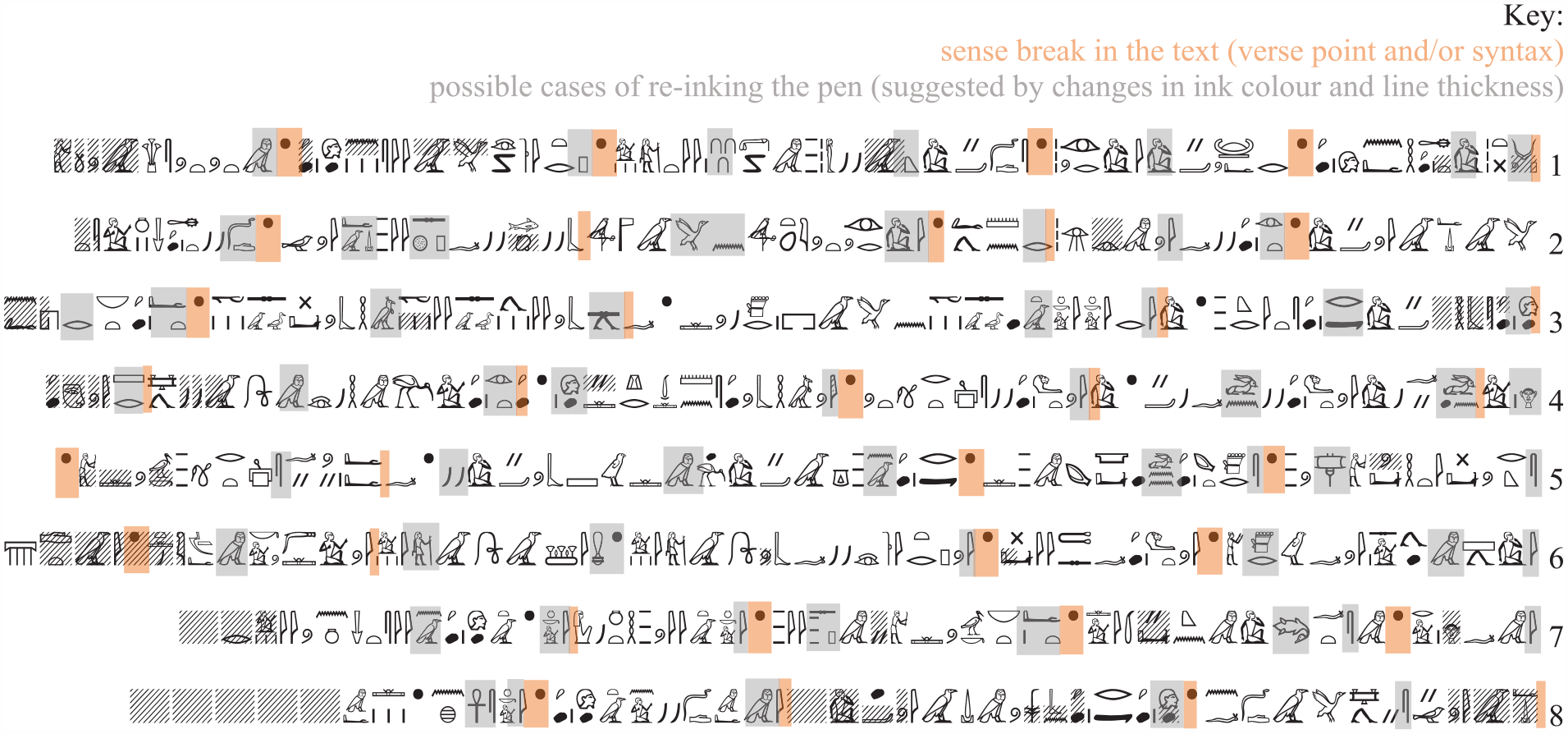
Transcription of the writing board showing sense breaks and possible re-inking.
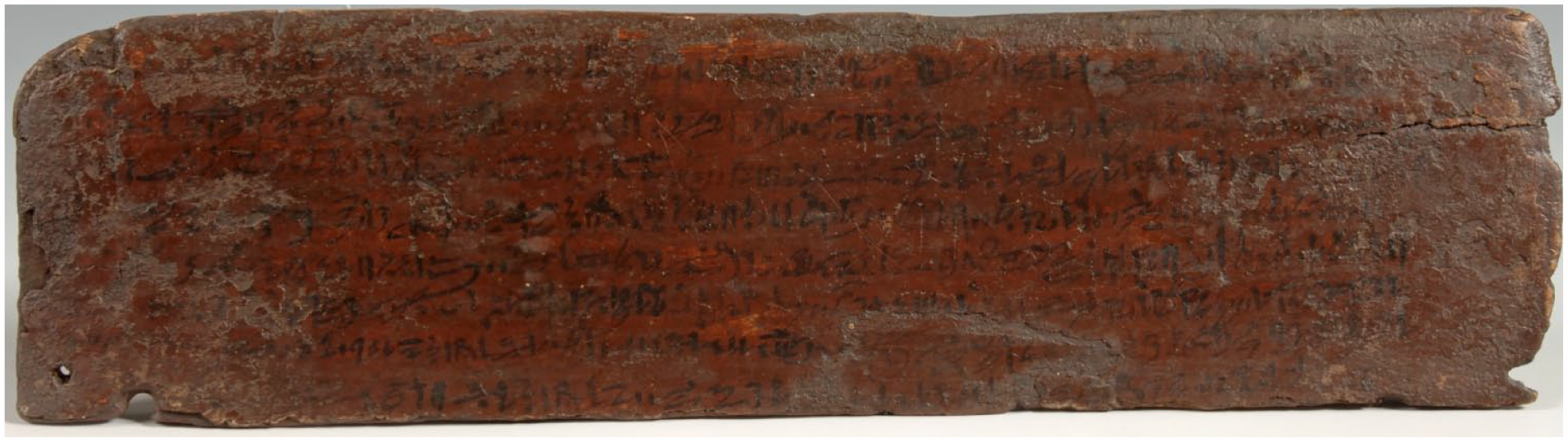
Photograph of the writing board (photo: courtesy Museo Egizio, Torino).
Concerning the eight verse points in problematic places (fig. 1), they precede (rather than follow) the A2 and the suffix pronoun =f in Line 3, the classifiers A2 and F51 in Line 4, the suffix pronoun =f in Line 5 and the classifier group Y1:Z2 in Line 8. The points are out only by a single sign/group, a common error. 118 However, two other errors occur in unexpected places, which leads us to consider how the scribe was reading, writing or correcting the text. In Line 6 the verse point segments the predicative elements of a clause from the adverbial phrase: jw pt{r}j=f bwȝj {VP} mj Sȝwȝj ‘he has taken a nobleman • for a poor man’. In Line 7, a verse point divides the subject of a nominal non-verbal sentence from its predicate: jnk {VP} tȝ dp ‘I am • the (female) boss (lit. head)’. In this case, perhaps the scribe misread the passage, seeing the jnk as the possessive pronoun (‘my’) of the preceding noun ḥn.wt ‘mistress’. This is possible in Late Egyptian with several antecedents, 119 but does not make sense in context, as a possessive pronoun tȝy=w already precedes ḥn.wt. These errors make it possible that the scribe was mostly inserting the verse points after the composition was completed, as Tacke suggested for the Miscellanies. 120 Two things support this: firstly, as we shall see, the fact that there is a correlation between sense breaks and re-inking (i.e., independent of whether verse points are in the right place or not, see below) and secondly the location of the verse points (Table 1). In eleven of 28 cases, there is no extra space between signs for the verse points, suggesting that they are later additions. Also, the fact that many verse points have a similar shape and hue (contrasting with the signs around them, see throughout Line 7) may also suggest they were made together.
Number of verse points above the final sign group compared to the number of verse points per line.

The placement of the verse points, however, is not always haphazard. The 20 of 28 correctly placed cases are clearly connected with sense-breaks in the text (fig. 2). Mathieu, on this basis, claims that the verse points mark couplets in the text, 121 which is true for the most part. However, where verse points are missing in longer stretches, couplets fall apart and abridgement seems to have taken place. Following the second verse point on Line 2, the theme changes without further separation by a verse point. This is the most garbled part of the text, suggesting that the scribe, perhaps overwhelmed by their task, could not decide where to put in visual breaks, as they were cutting so much text that they couldn’t follow the visual cues of the original.
Nevertheless, as we will see, even where the scribe was not sure where to put verse points, they do seem to have had a natural sense of where the sense breaks were. We can tell this based on having tested the potential correlation between interruptions in syntax and signs of the scribe re-inking the pen. 122 Cases for re-inking are derived from changes in ink colour and line thickness. Though colour contrast can help, the state of the surface must likewise be taken into consideration. As for line thickness, though helpful, it can be misleading, since straight signs (signs like s and j), in which the full thickness of the pen is pushed onto the surface, tend to be the thickest. On the other hand, perhaps scribes predominantly chose to re-ink before writing straight signs, to discharge extraneous ink before tackling more complex signs. In any case, to avoid charges of arbitrariness, the thickness is only regarded as significant when it is concomitant with colour change.
Though some see frequent inking as a hallmark of inexperience, 123 one must consider that many variables (such as speed and need for display) come into play here. 124 Nevertheless, this half writing tablet has at a minimum 60 cases of re-inking and on average seven dips per line (see Table 2, figs 2 and 3).
Estimated number of cases of re-inking the pen per line.

The top and bottom lines, as well as the beginnings and ends of lines, present the most difficulties, since the surfaces are so abraded. Regardless, from those cases in which the beginnings of lines can be read, re-inking seems to be common at the beginnings of lines (at least six to eight times). Moreover, as mentioned, re-inking also often correlates with sense breaks: of the 33–34 natural breaks in the syntax (with or without verse points, an average of four per line), re-inking co-occurs at least 24 times. Re-inking is also visible in places where there are surprising jumps in the text (i.e., likely abridgement): twice on Line 1 (ptr and mtw=tw) and four times on Line 2 (jr.t=f, r mn, j-jr and ḏd) (fig. 2). In papyrology, re-inking where a clear sense-break in the content occurs (instead of in the middle of a word) can be taken as indication of attention to content. 125 Thus, correlations of these features can highlight comprehension and composition method. If that is the case, a commensurate kind of attention is visible here in about 73% of cases, indicating frequent correlation between pausing at the end of a phrase (or line) and re-inking the pen. Similarly, the six cases of pausing to re-ink before a major jump in the text (in Lines 1 and 2) are indicative of a process of slower action and concentration.
Conclusions
The user of the writing board
Given the state of the text on the writing board, we can hypothesise that its owner was a student who had reached an intermediate stage of formation. Though errors of syntax are most common at the beginning of the text (with six of ten in the first two lines alone), verse point issues are distributed throughout. Though the morphological features are more representative of the chronolect or style than of inexperience, orthographic particularities are visible (at least ten cases), as are indications of an immature scribal ductus (eight have been marked).
The writing exercise being executed
Since so little is known about the didactic process, Goelet opts to use the term ‘reproduction’ to cover ‘direct copying, copying from memory, and taking dictation’. 126 His list, however, does not include processes like abridgement. Abridgement is, however, very likely to have been practiced here, 127 in contrast to the calligraphic exercises and excerpting on most other writing boards. 128 The findings might also suggest under what conditions this abridgement took place. While Kammerzell argues for the textual errors to be attributed to taking dictation, 129 this presumes that an already abridged version of the text was the text being read aloud. The errors point in a completely different direction. For one, we do not have the kinds of errors attributed to dictation, like homonyms of a word. 130 Moreover, if the student had been inattentive and omitted words, such mistakes would occur throughout the text. Instead, they are limited to the first two lines. Once the Body’s speech starts, the text reads fluently. For this reason, it is likely that the student had a fuller text in front of them and they had to find a way to accommodate a shorter version onto sixteen lines. Wanting to get to the prosecution, the scribe attempts to cover key points from what must have been a lengthy and convoluted introduction – with less than spectacular results. One could hypothesise, based on these findings, that the second half concerns itself principally with the defence address of the Head, followed by a brief description of the verdict.
The erroneous placement of verse points (eight of 28) also seems to indicate that the verse points and text were not checked after copying, by the student 131 or the master. 132 Despite this, it seems that verse points were inserted after the text was completed, not as a checking mechanism 133 but rather as a hasty means of completing the text. We see this in the absence of verse points from highly abridged passages as well as in the way verse points are squashed above signs or in the wrong place.
To conclude, the orthography and ductus indicate that this writing board contained a student exercise. That abridgement was the exercise being carried out, rather than another copying exercise, is suggested by cases of disjunction in the syntax, as well as the setting of verse points. These findings suggest that this was a first pass, as it does not seem to have been corrected by a master. The verse points are more likely to be indicative of a student hand and bear signs of having been hastily inserted to finish the task. They were certainly not inserted while the text was being read through carefully. In sum, this tablet reveals heretofore unknown pedagogical practices from the Late Ramesside and Third Intermediate Periods and encourages a closer look at the way in which writing boards were used by their owners.
Footnotes
Appendix: Translation of The Contendings between the Body and the Head
This translation is confronted by a methodological issue: To what extent should translators attempt an elegant translation of an abridged text by mitigating potential gaps, and to what extent should they attempt to translate in a way that reveals textual problems? The following attempt presents as smooth a translation as possible, while indicating via (?) cases in which gaps prevent a clear translation.
[1] The litigation (lit. judging) of the Body against (lit. with) the Head • in order to clarify what they do • and to proclaim their (respective) characters before the Tribunal of Thirty • —who their boss (lit. head) is • —and in order that one reveal [2] the wrongdoer • —his (the Head’s?) eyes were weeping because of the (impending?) demotion(?) (lit. fluctuation) • —It is for the god (?) that one carries out justice, as his abomination are cases of injustice. • The Body stated that the Head is her subordinate [3] and her mouth [cried out] loudly (lit. a lot): • ‘As far as I am concerned, I am the (female) strut of the whole • house, who guides the (other) struts and who steadies (lit. harnesses) the (other) struts. • Each limb leans [4] gladly on me, the heart being glad, • the {heart} <limb> being controlled (lit. clever), • and the neck being established under the head. • My eye sees into the distance (lit. sees in distancing itself), the nose [5] can breathe and draws breath, • the ear is receptive (lit. open) and hears, • the mouth articulates (lit. shouts) and makes (lit. finds) its • response, and the arms are controlled (lit. clever) and render service. • [6] That the man goes around, staying distant, • his forehead being lifted (so far) up • that he has taken a nobleman • for a poor man, (is) while I am doing everything right (lit. full of maat)! • [The conflict (lit. lack)?] [7] with him weighs (lit. is) [upon] me! • Don’t hurt (lit. slaughter) <me?>! Don’t subjugate (lit. conquer) me! • Each limb works with the other. · I am their mistress! I am • the (female) boss (lit. head) of her subordinates […] [8] How [wrong] is the one that says about this: • ‘The head, he is not in the wrong […]’! Let one call me the (female) boss (lit. head)! • I am one who vivifies • […]’.
Acknowledgements
I would like to express my thanks to Susanne Töpfer of the Museo Egizio (Turin) for supplying excellent photos of the writing board. This paper would not be what it is without the wonderful work of Jaqueline Stock, with whom the text was translated into German and analysed, for which see  . I am also most grateful to Niv Allon and Hans-Werner Fischer-Elfert, who made insightful comments on earlier drafts of this article, as well as to the two astute peer reviewers.
Funding
The author did not receive funding for this project.
1.
Since Blackman’s translation (Erman 1927: 173–174) is an English translation of Erman’s German translation (), rather than of the original text, it is not included in this statement.
2
The word ẖ.t can be used to mean both ‘body’ and ‘torso’. Because the ẖ.t in this story rules over the limbs, it remains unclear whether ẖ.t means only the torso or the entire body without the head. Although the first possibility sounds reasonable, this reading would mean that not all the limbs are on trial. One would then have to imagine a situation like a custody trial, with two parties fighting over the custody of dependent members. The ambiguity about this means that for this purpose ‘Body’ is used as a translation for ẖ.t (also : 106), although ‘Torso’ could just as easily be meant here.
4
5
Erman 1923: 224; : 278.
10
Lutz Popko, personal communication (16.06.2022).
11
Parkinson and Quirke 1995: 20; Kammerzell 1995: 952; : 179.
13
López 1984: 50. Though plaster can also discolour to a dark brown colour (: 179), the shiny surface suggests lacquering.
15
Černý 1985: 8, 16; : 704.
16
Vernus 1984: 704; : 19–20.
17
Maspero 1883: 262; Kammerzell 1995: 952; : 182–183.
18
Erman 1923: 224; Bresciani 1999: 339. Palaeographic dating to the Amarna Period (López 1999/2000: 477) is unlikely (see, for instance, the writing of Gardiner Signs A2 and G1). : 105 also disputes Lopez’s dating on grammatical grounds.
19
Janssen 1984: 305; : 161.
20
Möller 1927: 3 (Sign 35B); : 102.
21
: 3. pMoscow 127 = pPushkin I b 127 (Letter of Wermai / Tale of Woe) has been dated via relative dating – the palaeography of other El-Hibeh papyri, such as pMoscow 120 = pPushkin I b 120 (Misfortunes of Wenamun) and pMoscow 128 = pPushkin I b 128 (Onomasticon of Amenemope), as well as their common find spot inside a jar – and absolute dating, such as the mention of early Third Intermediate Period rulers in pMoscow 120.
22
See Golénischeff 1899: 75 in relation to pMoscow 120. In n. 4, he astutely establishes a palaeographic link with the roughly contemporary pBoulaq 4 (Teachings of Ani). See also : 4.
24
Line 1 has an exception. This feature occurs in pMoscow 127, 1.7 and 3.9, in : 4; pMoscow 128, 4.10 and 6.3, in Gardiner 1947: pls 10 and 12, and in two decree texts (Caminos 1977: 4).
25
This can be compared with cases of F51 (Möller Sign 178) from Nodjmet (Möller 1927: 15) and Takelot (: 16).
26
Caminos 1977: 4, referring to pMoscow 127, 1.8 and 2.9. See also pMoscow 120, 1.3 and 2.70, in Schipper 2005, plates not numbered, and pMoscow 128, 7.12, in : pl. 13 for more cursive variants.
27
See pMoscow 127, 1.10, 2.7, in Caminos 1977: 5; pMoscow 128, 3.5, 6.12, in Gardiner 1947: pls 9, 12, and pMoscow 120, marginalia below 2.83, in Schipper 2005. Our X resembles the contemporary pBM EA 10298, 8, in : 115.
30
Compare Möller 1927: 8 with : 8.
31
Compare Möller 1927: 25 with : 25.
35
Erman 1925; Brunner 1957; Brunner 1975: 572–573; Hagen 2007: 38–51; Venturini 2007: 1885–1896; Goelet 2008: 102–110; .
38
Erman 1925: 6–12 (followed by Brunner 1957: 91–93 and : 219–220) based his theory on corrections, verse points, dates at specific intervals, auto-attribution as sbȝ.yt and dedications to a teacher.
39
Gardiner 1935: 45, based on autocorrection on pChester Beatty V; Quirke 1996: 383; : 84. Though autocorrection does not disprove a didactic context, I concur with Hagen that dedicatory colophons by competent scribes are not unambiguously indicative of a didactic relationship.
41
See oCGT 57101 = s. 6428 and oCGT 57300 = s. 6389, in López 1980: 11, 69, Tab. 53 and 53a, 95a. Also, oCGT 57471 = s. 9770, in : 16, Tab. 160 and 160a.
42
Janssen 1992: 86 refers to Posener 1950: 75, n. 4, who argued that literary extracts on ostraca could be taken together as various sheets of longer manuscripts, and to Černý 1949: 69, who pointed out that poorly written exemplars are relatively rare (also McDowell 1996: 603; McDowell 2000: 221). : 74, n. 49 suggests that this may have been due to early versions being washed off and the surfaces reused.
43
Brunner 1957: 74; Goelet 2008: 105; Hagen 2019: 207; : 30–36.
44
45
For instance, oCGT 57471 (= s. 9770), in López 1984: 16, Tab. 160 and 160a; Venturini 2007: 1886; Hagen 2007: 42–43; Carnarvon Tablet VIII, Side A, in Hagen 2019: 203. For cases bearing a practised and an unpractised hand, Galán 2007: 95–116, fig. 11; Jurjens 2019: 130, .
46
Posener 1950: 78; Burkard 1977: 68; Quack 1994: 23–26; Spalinger 2002: 335; Hagen 2007: 41; : 207.
48
Brunner 1957: 90 describes New Kingdom students writing in problematic Middle Egyptian; for the Ptolemaic Period, .
49
Quack 1994: 24; Prada 2018: 111, referring to : 311–312.
51
Burkard 1983: 106; Buchberger 1993: 22–23; Landgráfová and Mynárová 2016: 187 on the grounds that literariness is not a criterion for the use of these marks. Tacke 2001: 145 agrees, but uses ‘Verspunkte’, because of its conventionality in Egyptology. ‘Verse points’ are used here, not only for convention, but also because this is a literary text that seems to aspire to group the text into phrases of similar size. These might be couplets (using regular metre), as argued by Mathieu 2020: 105, though the reconstructions required for the text to be read thus raises questions about whether the copying scribe was able to maintain the hypothetical metre of the original in his abridged copy. The cultural materialist approach (e.g., ) adopted here is rather in favour of representing the attempt as it actually is.
52
Ashmolean Ostracon of Sinuhe, in Barns 1952: 34; also : 141.
55
Goelet 2008: 109; also : 140–141.
58
Brunner 1957: 77; : 1887–1888.
59
MMA 28.9.5, in Hayes 1953: 294 (no photo); : 179.
60
61
oBrussels E 6768, Vso 11; oCGT 57471; oMoscow 4478 + oBerlin P 9026, in Venturini 2007: 1888–1889; : 52.
63
Gardiner 1947: 3–4; : 42.
64
Fischer-Elfert 1983: 11.1–8 and Fischer-Elfert 1986: 94. Regarding memorisation of literary texts, : 606–607.
65
Fischer-Elfert 1983: 13.4–18.2; : 118–157.
66
Fischer-Elfert 1983: 18.3–26.9; Fischer-Elfert 1986: 158–193; : 574.
68
oPetrie 28, in Černý and Gardiner 1957, 3, pl. VIII.7; oCairo CG 25227, transcription in Daressy 1901: 55 (no image); Allam 1973: pl. 28; oBM EA 21186, 21216 and 21284, in .
71
oCGT 57300 (= s. 6389) in Venturini 2007: 1888; tAshmolean 1948.91, in Hagen 2013: 77; also the Dra Abu el-Naga board, in Galán 2007: 93; oCairo SR 12191, in : 32.
73
Brunner 1957; also : 1886–1893, whose focus is ostraca.
74
Hagen 2019: 179 (Carnarvon Tablets VI and VII); Verhoeven 2020; : 235.
75
Skeat 1956: 179–208; Fischer-Elfert 1986: 249 (copying); : 130 (memorising).
76
Barns 1952: 34–35; Burkard 1977: 68–71, 142–145; Schenkel 1978: 123–126, contra Volten 1937: 10–36 and Van de Walle 1948: 62. For examples of reading/copying errors see Barns 1952: 34 and Quack 1994: 25 and for clearer cases of dictation based on classifier variation, see : 93–101 (pLeiden I 344, Rto).
77
Yuen-Collingridge 2018: 1, argues that ‘[t]he extended mind thesis (and developments thereof) enables us to view writing as thinking, to ask after the consciousness of the scribes involved in the production of manuscripts, and above all to emancipate the scribe from accounts of textual variation’. This application of a cognitive integrationist approach is based on : 621–632, who argues that ‘the manipulation of external vehicles enables us to complete cognitive tasks that would otherwise be difficult or impossible’ (Menary 2007: 624). These ‘cognitive tasks’ are interpreted by Yuen-Collingridge 2018: 2 as being ‘higher-level cognitive processes like editing, composing, and computation’ and the ‘manipulation of external vehicles’ is tied to writing. Consequently, the act of writing can be regarded, so Menary 2007: 630, as ‘thought in action’, both generating and generated by thought. Its vestiges, the resulting texts, can thus presumably be regarded as vestiges not only of the action but also of thought.
78
Compare A53 (Möller Sign 10, : 2) with A30 (Möller Sign 2, Möller 1927: 1). Here there are two protruding ‘arms’ (like A30), though A53, usually with a protruding ‘beard’ makes more sense.
83
See cases of Y1 (Möller Sign 538) on lines 3–7 and of r (D21, Möller Sign 91) throughout the text. Also, though A2 is regularly written in the shorthand, ‘full’ versions can be found in Lines 4 and 7.
84
oNicholson R97, in Eyre 1979: 86 and pBaldwin, in : 53–56.
90
DZA 25.895.030 and DZA 25.895.040, Digitalisiertes Zettelarchiv (henceforth DZA), <https://aaew.bbaw.de/tla/servlet/DzaBrowser> (accessed 04.08.2021). See also the database of Projet Ramsès (Liège), <http://ramses.ulg.ac.be/> (accessed 22.06.2020). : 107 suggests reading ‘jr.ty=f jw ø m {jr} rmw’ as ‘ses yeux, ils seront en pleurs’, treating jr as an error, seeing the subject =sn as missing and reducing the word rmw to the sign D9.
91
López 1984: Tab. 184a, n. h. See for commentary.
92
Compare Wb. I 308 and 311.
93
94
Junge 2005: 80–81; : 56.
97
Winand 1992: 137; : 154.
98
See : 65. On the other hand, Mathieu 2020: 106 suggests that cases with feminine demonstratives are actually ‘tp(.yt), première’ and unmarked masculine cases are ‘tp, tête’. There are two problems with this: the case on Line 1 is masculine (written with pȝy=sn) but translated as ‘primauté’ (F) rather than ‘tête’ (M). This reading also doesn’t explain why other masculine words, like zȝ(y), ‘strut’ (Line 3), are also feminised. The key is that these words are used in contexts in which the body is describing herself (Di Biase-Dyson and Stock 2022: 61–62).
103
Wb. I 506.8.
104
106
Junge 2005: 233; also , though one of the two examples (Wenamun, pMoscow 120, 1.x+20–21, in Frandsen 1974: 117) represents a conjunctive following not the infinitive but the nominal subjunctive.
107
pAbbott 6.15–17, in Frandsen 1974: 117–118; pSalt 124, Rto 2.13, in Junge 2005: 237; pBM EA 10054, Vso 1.8–9, in : 442–443.
108
Kammerzell 1995: 953, followed by Mathieu 2020: 108, takes =f as pertaining to the god. The connection to the ‘wrongdoer’, followed here, is proposed by .
110
Amarna Boundary Stela B, 7, in Murnane and Van Siclen 1993: 90, in which ḏd.t r-jḳr means ‘to say’ (with emphasis), or ‘to speak properly’, and the letter to Ankhiri (pLeiden I.371, Rto 33, in : pl. VIII), in which the speaker rmj r-jḳr ‘cries a lot’.
113
114
Popko 2009. : 111 reads: ‘La bouche, n’est-elle pas son contradicteur?’.
115
‘Re-inking’ relates to re-inking the pen, see Head and Warren 1997: 446–473. For another interpretation of re-inking, see .
117
121
Mathieu 2020: 105.
122
Naturally, viewing the manuscript on site or photographing it in different light, etc. may provide different results.
124
Compare Pentaweret’s calligraphy on pSallier III = pEA10181, https://www.britishmuseum.org/collection/object/Y_EA10181-3 (accessed 01.06.2022) with the shorthand of Qenherkhepeshef on pChester Beatty III, Vso = EA10683, <> (accessed 01.06.2022). In the latter, the scribe re-inks only when necessary, indicating haste. Neither case can be taken as demonstrating lack of skill.
125
Parkinson 2009: 106–107; : 4.
130
Gardiner 1937: xi and xiv, contra Burkard 1977; .