




Abstract
This short article is the publication of a hieratic ostracon (O. SES 23) from the Ramesside Period in the collection of the Finnish Egyptological Society that preserves parts of the title, the exordium, and the first paragraph of The Instruction of a Man for His Son. The provenance and the exact acquisition history of the ostracon are unknown, but indirect evidence suggests that it derives from Deir el-Medina and was acquired in Luxor by the late Professor of Egyptology in Finland, Rostislav Holthoer, in the early 1970s. A textual variant in line three, also attested in another ostracon from Deir el-Medina, suggests that the first paragraph of the composition does not juxtapose the life of a scribe with that of a farmer, as is commonly believed, but instead with that of a soldier.

Keywords
Introduction
This short article provides an editio princeps of a hieratic ostracon (O. SES 23) from the Ramesside Period now in Finland. On the obverse are five written lines that partially preserve the title, the exordium and the first paragraph of The Instruction of a Man for His Son. 1 In addition to the text edition, the paper includes a short overview of the history and nature of the Finnish Egyptological Society’s little-known collection. This article is the result of the efforts of several members of the Egyptology Study Group in Helsinki, whose raison d’être is to keep academic Egyptology alive in Finland.
History and Nature of the Finnish Egyptological Society’s Collection
The Suomen Egyptologinen Seura ry (SES), i.e., ‘The Finnish Egyptological Society’, was founded in 1969 by Rostislav Holthoer (1937–1997) 2 to promote Egyptology and the knowledge of ancient Egyptian culture in Finland. 3 Besides arranging monthly lectures, Holthoer led study trips for members of the Society to Egypt in the 1970s and 1980s as well as a research survey to Deir Abu Hennis (Middle Egypt) and other sites in 1969 and 1978. 4 During these trips, as well as while in office in Uppsala, we assume he assembled and/or purchased a collection of Egyptian objects, mostly for teaching purposes at the University of Helsinki, where he taught as a docent from 1979. 5 These objects, along with a few artefacts donated to the Society, form the current collection of the Finnish Egyptological Society.
During the first International Congress of Egyptology in 1976, Holthoer gave a presentation entitled ‘Egyptology in Finland’, from which it emerged that in addition to collecting objects, he had begun to catalogue Egyptological state and private collections in Finland – including objects that are now part of the Society’s collection. 6 Thus, this paper provides a terminus ante quem for the acquisition date of several objects in the collection. His notes are now in the archives of the Society, and they were consulted when its collection was recently inventoried. Unfortunately, they rarely provide information on the provenance and the acquisition history of the objects.
Today, the collection comprises over 200 inventory numbers assigned to the objects which was saved in a Microsoft Excel file in 2018. Most objects are small-scale sherds of pottery or samples of flakes or stone types, but there are also several more complex artefacts ranging from a Neolithic arrowhead to Roman statuettes, including funerary objects, fragments of Coptic textiles, and ostraca written in hieratic, Demotic, Greek, and Coptic. Overall, the collection serves as an introduction to the history of ancient Egypt, illustrating both daily life and beliefs in the afterlife. In the spring of 2022, the collection was deposited in the Riihimäki Art Museum, where it is now permanently housed. 7
Only very few of the objects are published. In 2007, Jaana Toivari-Viitala (1964–2017) 8 published one hieratic ostracon as O. FES 4 (= O. SES 24), 9 and Alain Delattre published a Coptic ostracon (O. SES 28) in 2012. 10 In 2016, Ivan Miroshnikov examined Coptic manuscripts in Finland and identified the contents of further Coptic ostraca that will be published by him as O. FES 1–3 (= O. SES 29, O. SES 31, and O. SES 30), and O. FES 5 (= O. SES 34). 11 He also discovered that a hieratic limestone ostracon that was exhibited in Tampere Art Museum in 1993/94 as catalogue number 317 has gone missing. 12 Finally, O. SES 23 – together with some of the other objects belonging to the Society – was exhibited at the Helsinki University Library in 2001 and described and depicted in the accompanying exhibition catalogue. 13
The Acquisition History of O. SES 23
O. SES 23 came to the collection via the hands of Holthoer, but regrettably, his notes about the object and how it came into his possession can no longer be found in the Society’s archive. 14 Although its provenance is uncertain, several factors point towards Deir el-Medina, or its surroundings, as a likely place of origin. Firstly, the two other hieratic ostraca in the collection were acquired in Luxor. 15 Secondly, all the hieratic ostraca have been tentatively dated to the late New Kingdom, and palaeographical analysis of the trained hand who wrote the text suggests that O. SES 23 was inscribed sometime during the 19th or 20th Dynasty – at the zenith of this community’s history. Thirdly, the only other example (known to us) of a textual variant found on this object (cf. d in the textual commentary below) derives from Deir el-Medina.
The acquisition history of O. SES 23 is also unknown, but it is likely that the piece was purchased with or around the same time as the other inscribed ostraca of the Society’s collection. The collection’s inventory list contains data on a total of fifteen ostraca, of which seven have information on the time and place of acquisition: all from Luxor, with dates ranging from 1965–1969 to 1977. 16 Importantly, all except one predates 1973. For instance, O. FES 4 was donated to the Society and later exhibited at the Amos Anderson Art Museum, Helsinki, already in 1970. 17
Given the meagre information on the provenance and acquisition history of the object, the question of research ethics arises regarding the further study and publication of the object. Legally, this is not an issue, as neither Egypt nor Finland had banned the export/import of cultural heritage objects at that time. Egypt ratified the UNESCO ‘Convention on the Means of Prohibiting and Preventing the Illicit Import, Export and Transfer of Ownership of Cultural Property’ in 1973, and Finland in 1999. 18 Further, the UNESCO agreement is only the first serious attempt to curb the antiquities trade in Egypt, while the principal law governing cultural heritage in the country today (with the 2010 amendment), which forbids any trade in antiquities, was only passed on 6 August 1983. 19
Concerning research ethics, two conflicting concerns arise: (1) the commitment to try and stop the destruction of cultural heritage and the (legal and) illegal displacement of historical objects by refraining from conducting research on ancient Egyptian objects exported after 1973/1983; and (2) the commitment to study and publish unknown historical primary sources. Since the object is already partially published, its acquisition history cannot be checked anymore (the former owners being dead), and the acquisition likely took place pre-1973, we consider that the historical information obtained by publishing the ostracon outweighs ethical concerns related to unwittingly interacting with modern antiquities trade.
Object Description
The limestone ostracon measures 11 by 10 cm and shows traces of carbon-based black ink on both sides (fig. 1). The presence of verse-points in red ink on the obverse, likely made from red ochre (Fe203), indicates that the scribe used a palette rather than ephemeral inks made on the spot. 20 The scribe’s handwriting is graceful, of average size, and nearly free of ligatures.
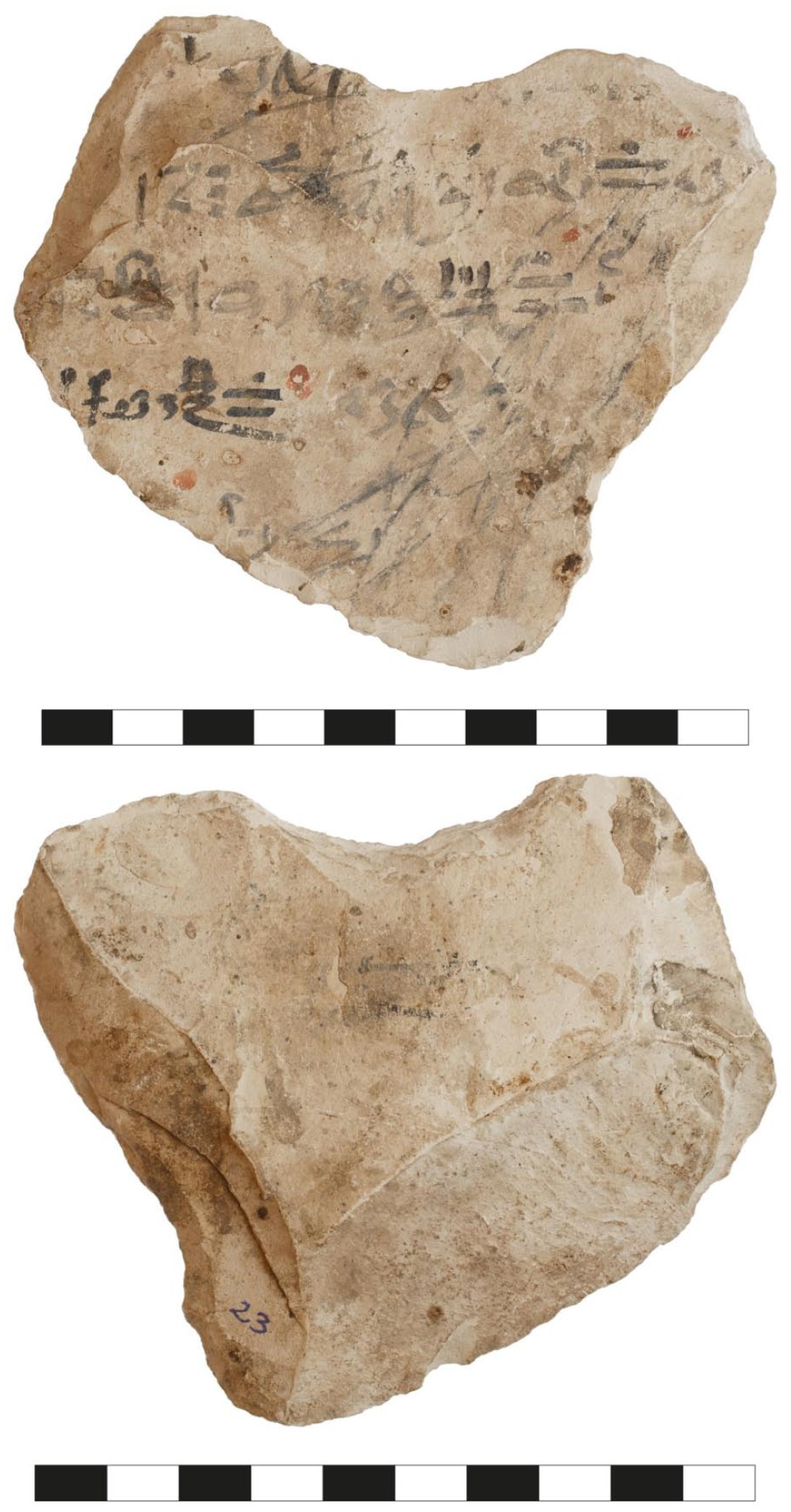
Obverse (top) and reverse (bottom) of the hieratic ostracon O. SES 23 (photo: Jaakko Haapanen).
Due to the identification of the text on the obverse as the beginning of The Instruction of a Man for His Son, it is possible to make a rough estimate of the width of the limestone at the time of writing (cf. the synopsis below). On average, seven sign groups are lost on the right side (c. 6 cm) and nineteen groups on the left (c. 18 cm), which amounts to an original width of c. 35 cm (fig. 2).
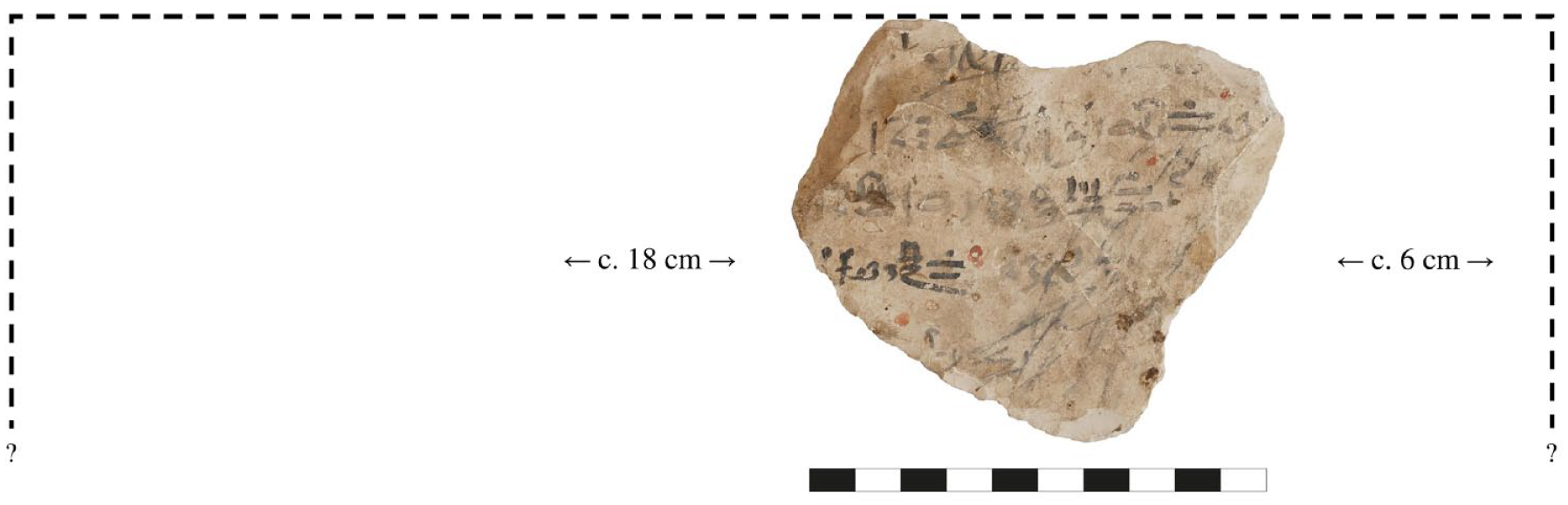
Schematic illustration of the approximate original size of the ostracon.
The height of the ostracon cannot be established with the same amount of certainty. However, since the signs in the first line partially preserve the beginning of the composition, the writing in the upper left corner of the obverse likely shows the position of the top of the ostracon. It is impossible to ascertain whether the lower edge is preserved, but visual examination of the breaks of the object suggests that it is not preserved. 21
Nonetheless, an argument can be made that the height is largely complete. Firstly, the bottom line preserves the last line of the first paragraph of the composition (cf. g in the textual commentary below). Secondly, the hieratic sign-group on the reverse, that probably reads ‘ending’ (cf. h in the textual commentary below), is inscribed at the centre of the preserved surface. Both arguments are, however, inconclusive given that the lower edge is broken and only a portion of the reverse surface is preserved. Thus, another possibility is that the sign-group on the reverse was added after the object received (most of) its current shape.
As far as the history of the object is reflected in the relative dating of the breaks, this notion is strengthened by the materiality of O. SES 23. Looking at the obverse, sign breaks and missing text show that (most of) the top, as well as the left and right sides, were chipped or broken off after the object was inscribed, and presumably in at least two stages. 22 The youngest are the breaks found at the bottom, which still appear relatively fresh and suggest that the original bottom is not preserved.
Finally, a comment should be made on the black lines preserved on the right-hand side of the obverse, running vertically alongside the right break. The ink streaks are most prominent above the break edge, do not go beyond the upper right hieratic signs, and do not intrude into the dents of this break. This suggests that the lines were smeared by diagonal scraping in an upper right to lower left direction. It is beyond the aims of this paper to explain what happened but considering that the scribe appears to have used a palette, it is unlikely that the black ink would not have contained a binder. Since the binder would have made the ink durable and enabled it to dry fast, it would not have been easily rubbed off, even a short time after application. The lines are thus likely caused by the object being scraped over a hard surface sometime after the text was copied onto the ostracon.
Whereas figure 3 presents the text preserved on O. SES 23, the synopsis in figure 4 provides an overview of the amount of text lost and enables us to produce a revised translation of the difficult first paragraph of The Instruction of a Man for His Son. Besides O. SES 23, the synopsis only reproduces a transcription of the relevant passages of the primary witness to the beginning of the composition, namely leather roll BM EA 10258 from the 18th Dynasty (Fischer-Elfert source 9). 23
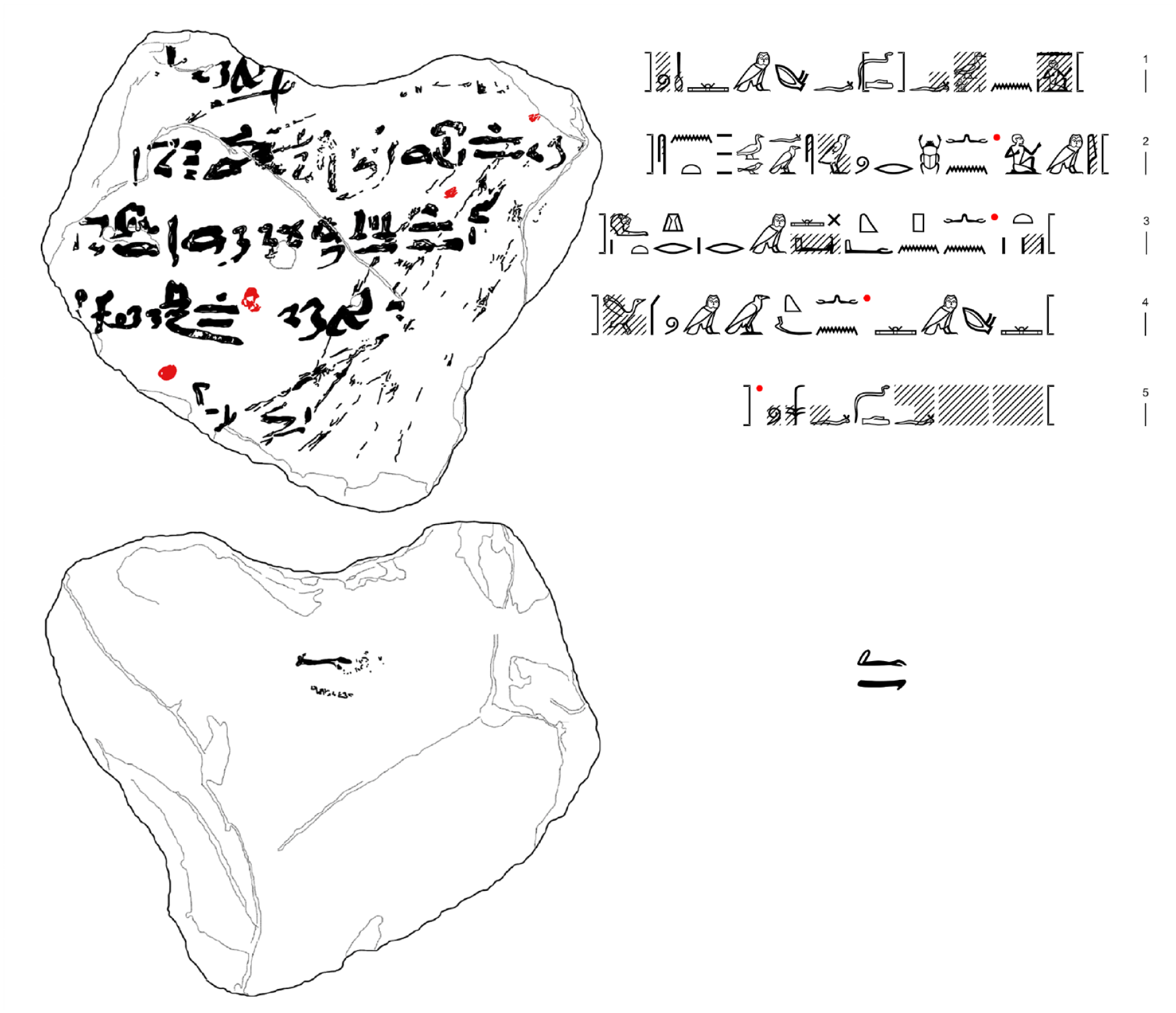
Facsimile drawing and transcription of O. SES 23 (facsimile: Thomas Christiansen).
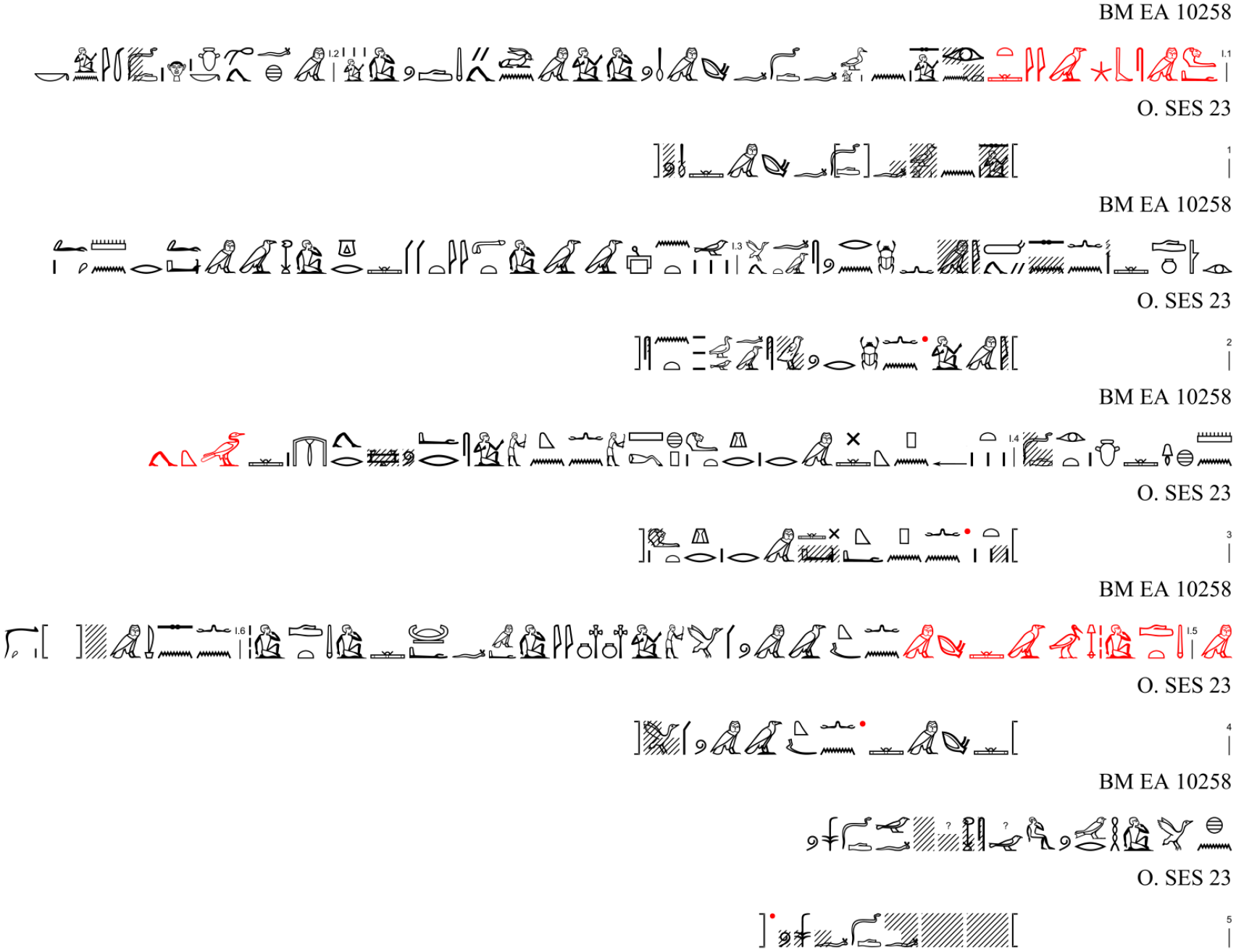
Synopsis of the title, the exordium, and the first paragraph of The Instruction of a Man for His Son in BM EA 10258 (Col. I, l. 1–5) and O. SES 23.
Text Edition
Obverse
Reverse
grḥ Endingh
(a) The scribe of O. SES 23 writes ỉm=ỉ instead of just ỉm as in BM EA 10258. The same variant is found in O. Michaelides 94 and probably also in O. Petrie 69. 24
(b) Since all attestations of this passage from the Ramesside Period contain the same writing as O. SES 23, we translate and transliterate the verse as a negated future/prospective (nn ḫpr.w wsfȝ.t n.t sȝȝ), 25 instead of emending the text according to the 18th Dynasty witnesses (BM EA 10258 and the two dipinti TW7 and TS26): n{n} ḫpr{.w}<.n> wsfȝ.t n.t sȝȝ (negated aorist). 26
(c) This clause can alternatively be construed as a bi-partite nominal sentence: ‘The effective one (lit. the effective of heart) is the one who does what is said’.
(d) In O. SES 23 and BM EA 10258 ‘words’ (mdw.w) are omitted after ‘mouth’ (r), which perhaps is a mistake, since other witnesses agree in writing it out. 27
The first verse (nn pnḳ m r ẖr-ḥA.t ḫpš […) is also negated in O. DeM 1665 I+, where the clause is inscribed as a rubrum. 28 That it is negated seems to make better sense of the text, since in paraphrase it indicates a meaning akin to: ‘it is not worth wasting words on a brute, as a soldier will never amount to anything at court’. It further speaks in favour of our interpretation of the passage that the emendation suggested by Fischer-Elfert in the second verse (not preserved in O. SES 23) is thus unwarranted; he proposes to read ‘Garbenträger’ (ḳn<ỉ.w>), i.e., ‘a person carrying sheaf’, 29 although every manuscript that preserves this sentence agrees in writing ‘brave man, warrior’ (ḳn). 30
Simpson does, however, translate the word as ‘brave man’, but his interpretation of the couplet differs significantly from the one proposed here: ‘There is no valorous man who speaks in front of a strong arm. There is no brave man who extols (?) advice.’ 31 Verhoeven, who vacillates between translating the word as ‘Starker’ and ‘Garbenträger’, is closer to our understanding of the text: ‘Das Ausschöpfen mit Redearbeit kommt vor Kraft. Es gibt keinen Starken (Garbenträger?), der zu der Ratsversammlung hinauf geführt wird.’ 32
(e) As suggested by Quack, we translate the two verbs in this verse (not preserved in O. SES 23) as imperatives. 33 Unlike in the 18th Dynasty manuscripts, BM EA 10258 and P. Amherst XV, these sentences were not rubricated in the Ramesside Period. 34
(f) In keeping with our interpretation of the former couplet (c), we translate ḳmȝw as ‘(type of) soldier’ 35 instead of ‘winnower’, 36 which is typically preferred in the modern renderings of the verse.
That the career of a scribe is often contrasted with the uninfluential and miserable life of a soldier, in, for instance, the Late Egyptian Miscellanies, supports our understanding of the first paragraph of this instruction. 37
(g) Unlike the other witnesses of this verse, which contain the participle of ḏd, ‘the one who speaks’, the traces suggest that O. SES 23 preserves a circumstantial sḏm=f, ‘when he speaks’.
It is impossible to establish with any certainty how much (if any) text is lost at the end of the ostracon. However, the text ends with the last line of the first paragraph of the instruction, thus it is possible that the scribe did not copy out more of the composition than what is partially preserved, i.e., the title, the exordium and the first paragraph (cf. description above).
(h) On the reverse some faded ink strokes (pen trials?) are preserved, as well as what appears to be the sign D41 (forearm with palm of hand downwards). If not a rubbed off sign-group, it is perhaps a writing of the word ‘ending’ (grḥ). 38 If this reading is correct, it is likely a statement relating to the copying out of the text on the obverse.
Conclusion
O. SES 23 is an important witness to the first paragraph of The Instruction of a Man for His Son, as it contains, in line three, a variant thus far only attested in another ostracon from Deir el-Medina, namely O. DeM 1665 I+, which was written by another scribe. 39 This argues for a divergent textual tradition instead of the currently assumed understanding of the variant as an accidental writing, especially since the unnegated version of the line is also only attested twice (BM EA 10258 and O. Petrie 69). 40 As explicated in the textual commentary, it makes better sense of the text and suggests that the first paragraph juxtaposes a scribe’s life with that of a soldier, rather than that of a farmer, as is the communis opinio. Such an understanding of the paragraph obviates the need for emendation, which again speaks in favour of our interpretation.
Footnotes

1
The principal edition(s) of the composition is Fischer-Elfert 1998; Fischer-Elfert 1999a–b. Recently, the earliest attestation of the text (Second Intermediate Period) was published in Hagen 2019: 202–203, figs 11–12.
2
Cf. Bierbrier 2012: 262.
3
For the history of the Society, see Salmenkivi 2001; Toivari-Viitala 2009: 18–29; Jauhiainen 2019a. For the history of Egyptology in the Nordic countries (Sweden, Denmark, Finland, and Iceland), cf. Bagh 2021.
4
Holthoer 1979: 309; Jauhiainen 2019b.
5
Cf. Holthoer 1979: 309, where he states that during the study trips, special attention was paid to the material offered for sale by the antiquities’ dealers.
6
Holthoer 1979: 308.
7
Temppelikatu 8, FI-11100 Riihimäki, Finland.
8
Cf. Berg 2019.
9
Toivari-Viitala 2007.
10
Delattre 2012.
11
Miroshnikov (in press).
12
Cf. Holthoer 1993: 196. From what can be ascertained of the text in the small black and white photograph in the catalogue, it seems to be a letter or communication from the Ramesside Period.
13
The ostracon was also exhibited at the Loviisa Town Museum in 2009 (Toivari-Viitala 2009: 67, no. 244), and described and depicted in 2019 in the 50 anniversary Festschrift of the Society (Salmenkivi 2019: 92).
14
Notes by Holthoer pertaining to the ostracon are mentioned in Toivari-Viitala 2009: 67 no. 244; Salmenkivi 2019: 91.
15
Holthoer 1993: 196; Toivari-Viitala 2007: 421.
16
1965–1969 (O. SES 26); 1969 (O. SES 29); 1970 (O. SES 24); 1970 (O. SES 30); 1970 (O. SES 31); 1972 (O. SES 25); 1977 (O. SES 27).
17
Suomen Egyptologinen Seura 1970: 12; Toivari-Viitala 2007: 421.
19
See Hagen and Ryholt 2016: 138.
20
Lucas 1962: 362–364.
21
Only basic optical methods were used in the analysis of the breaks and inks presented in this paper.
22
In contrast to all other breaks, produced by intentional or accidental pressure in a right angle to the inscribed surface, the right side is flaked off by falling or being pressurised from the side/slightly from the front.
23
Fischer-Elfert 1999b: X. For other – mostly very fragmentary – sources that partially preserve the title/the exordium/§ 1, cf. Fischer-Elfert 1998: 87–88; Fischer-Elfert 1999b: VIII–XXIV; Verhoeven 2020a: 89–90, 97–98, 150–154; Verhoeven 2020b: pls 83, 85, 88, 113–115, 228, 232–234, 282–286; Hagen 2021: 44, pl. 69 (O. T3.L22). Our transcription of the beginning of BM EA 10258 includes a few readings that are clearly visible in the pictures of the manuscript provided by the British Museum, <https://www.britishmuseum.org/collection/object/Y_EA10258> (accessed 24.03.2022), which are not included in Fischer-Elfert’s hieroglyphic rendering of the text, Fischer-Elfert 1999b: § 1.4–1.10. At the end of line 3, t is written below iri; in line 4, both the determinatives of pnq and the following m r are preserved; in line 6, ns is distinguishable (showing that the correct reading is smn-ns); cf. the comments by Dils, P. Thesaurus Linguae Aegyptiae, Lederrolle BM EA 10258, Die Lehre eines Mannes für seinen Sohn, <https://aaew.bbaw.de/tla/servlet/GetTextDetails?u=guest&f=0&l=0&tc=994&db=0> (after login; accessed 19.08.2022).
24
Fischer-Elfert 1999b: §1.1. We refer to the sources by the sigla assigned to them in Fischer-Elfert 1999b: VIII–XXV.
25
Similarly, Simpson 2003: 176.
26
Fischer-Elfert 1999b: §1.2; Verhoeven 2020b: pls 232–233, 285–286.
27
Fischer-Elfert 1999b: §1.4.
28
Fischer-Elfert 1999b: §1.4.
29
Fischer-Elfert 1999a: 36–37.
30
Wb V: 44.7–16. Cf. Fischer-Elfert 1999b: §1.6.
31
Simpson 2003: 175
32
Verhoeven 2020a: 97, 151, 154.
33
Quack 2000: 538.
34
35
Wb V: 38.3.
36
Wb V: 34.1.
37
Caminos 1954: 91–95, 168–170, 235–236, 304–305, 400–410, 477–478.
38
Wb V: 183.5–9.
39
Posener 1981: pl. 77.
40
Fischer-Elfert 1999b: §1.4.