




Abstract
This article describes and analyses a zoomorphic siltstone palette housed in the Metropolitan Museum of Art (MMA 10.176.84). The palette is first situated within the wider corpus of zoomorphic palettes from the Naqada II Period. Considerations of form and design accompanying the development of palettes during Naqada I/II, and comparisons with visually similar forms attested on knife handles and other palettes, suggest that MMA 10.176.84 may represent a fish–antelope composite figure, ‘antelope’ here being broadly defined as a non-domesticated, horned quadruped of the Bovidae family. It is the first example of a palette modelled as such. The social functions of palettes in Predynastic southern Egypt are then outlined in order to consider the significance of modelling a palette in this way, as well as to explore implications of the palette’s form for understandings of cultural developments in the late Predynastic Period.

Introduction
Siltstone palettes are some of the most characteristic artefacts from the Nile Valley of southern Egypt in the Predynastic Period (c. 4000–3000 BCE). 1 Extracted from the Wadi Hammamat in the Eastern Desert, the stone was carved, smoothed, and occasionally incised and inlaid to produce functional, decorative, mostly portable objects that seem to have served as grinding or mixing surfaces for pigments applied to the body for cosmetic purposes. The term ‘cosmetic’ is problematic; although it is retained in the literature and in this article, it should be understood to encompass body surface decoration, including the application of substances, that were not used for narrowly ‘beautifying’ purposes. 2
The shapes and decorative schemes of palettes varied over time. Rhomboidal forms predominated in Naqada I (c. 4000–3500 BCE). These were undecorated except for a few late examples with carved surface decoration depicting human and/or animal figures, some in riverine environments. 3 These themes were elaborated in Naqada II (c. 3500–3250 BCE), when zoomorphic forms proliferated. 4 This context in the wider representational culture should be borne in mind when considering the form of the palette MMA 10.176.84, which has no known parallel.
This palette (figs 1, 2) was purchased in Luxor from the antiquities dealer Mohammed Mohassib in 1910. Like many examples, it is unprovenanced. Measuring 3.9 cm by 11 cm, its profile has the form of a hitherto unidentified creature. The zoomorphic form points toward a Naqada II date. The creature has a roughly rectangular head with an elongated muzzle and four straight protrusions extending from its crown; the palette has a deliberately undulating surface here, with protrusions forming ridges separated from one another by depressions. The protrusions are chipped at their ends. Neither side of the palette shows an eye socket, but the muzzle features an indentation suggestive of a socket positioned on the frontal edge—a highly unusual feature. The long, sinuous neck joins the roughly oval body. Along the dorsal edge, the shoulder curves sharply to join the relatively straight back, the upper portion of which features short incisions across the edge of the palette. A circular hole is located near the midpoint of the back. The rump of the creature curves downward and terminates with a tapered end that curls slightly upward. The rump bears short incisions across the palette’s edge, similar to those on the dorsal edge. The ventral edge of the creature has a gentle convex curve that is interrupted opposite the upper back by a small oblong protrusion, chipped at its forward end. Extensive brown surface discolouration, as well as cracks across the midsection, are visible on both sides of the palette, together with fine striations from the process of carving and smoothing the stone. No signs of use, such as surface pitting or staining from pigment, are present. The marks on the edges of the palette are all similar in form, and feature brown and white accretion deposits consistent with those on the smoothed faces, suggesting that the piece is genuine and not reworked.
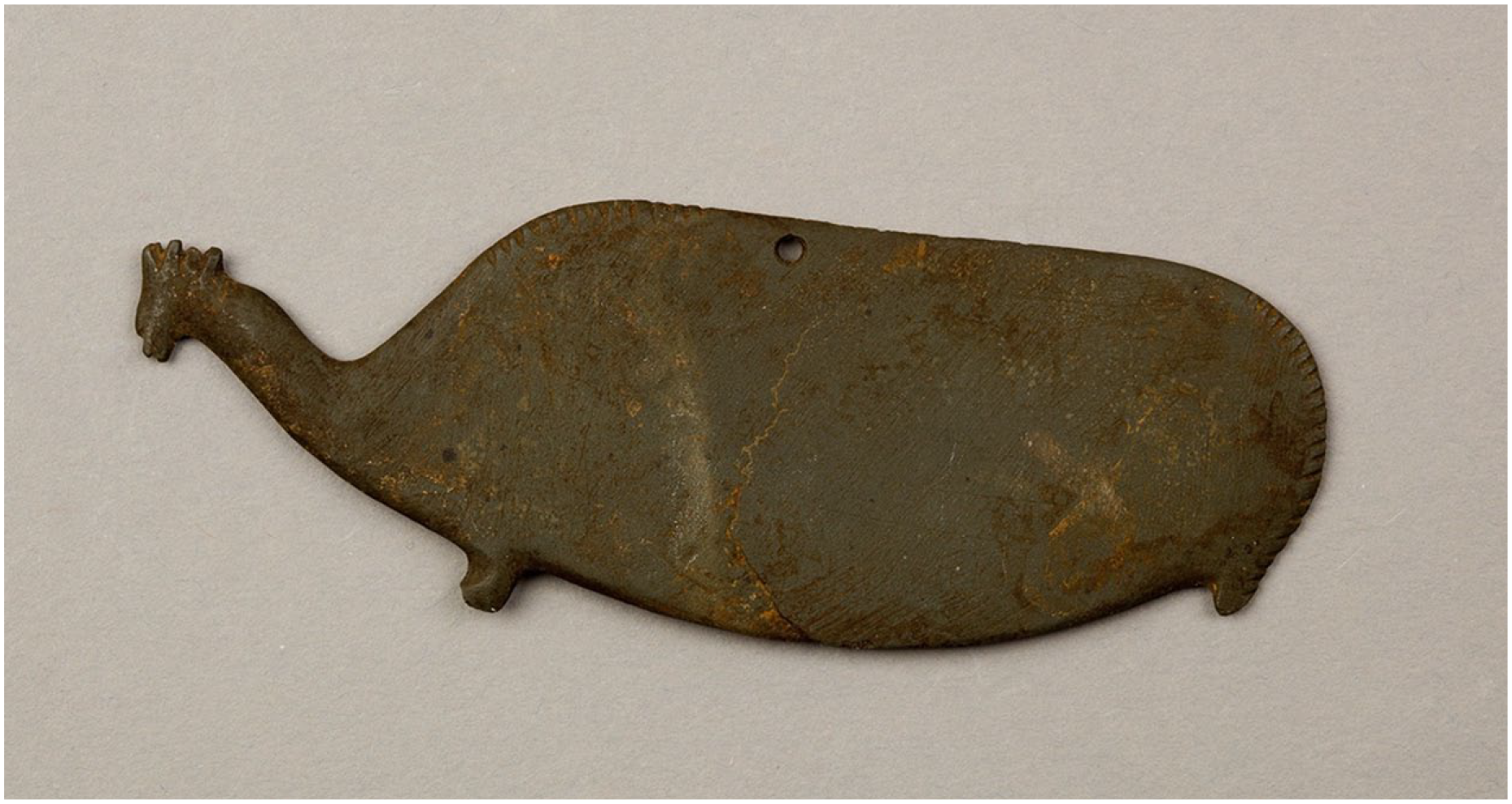
Palette MMA 10.176.84, left-facing side (photo: courtesy of the Metropolitan Museum of Art, New York, licensed under CC0 1.0).
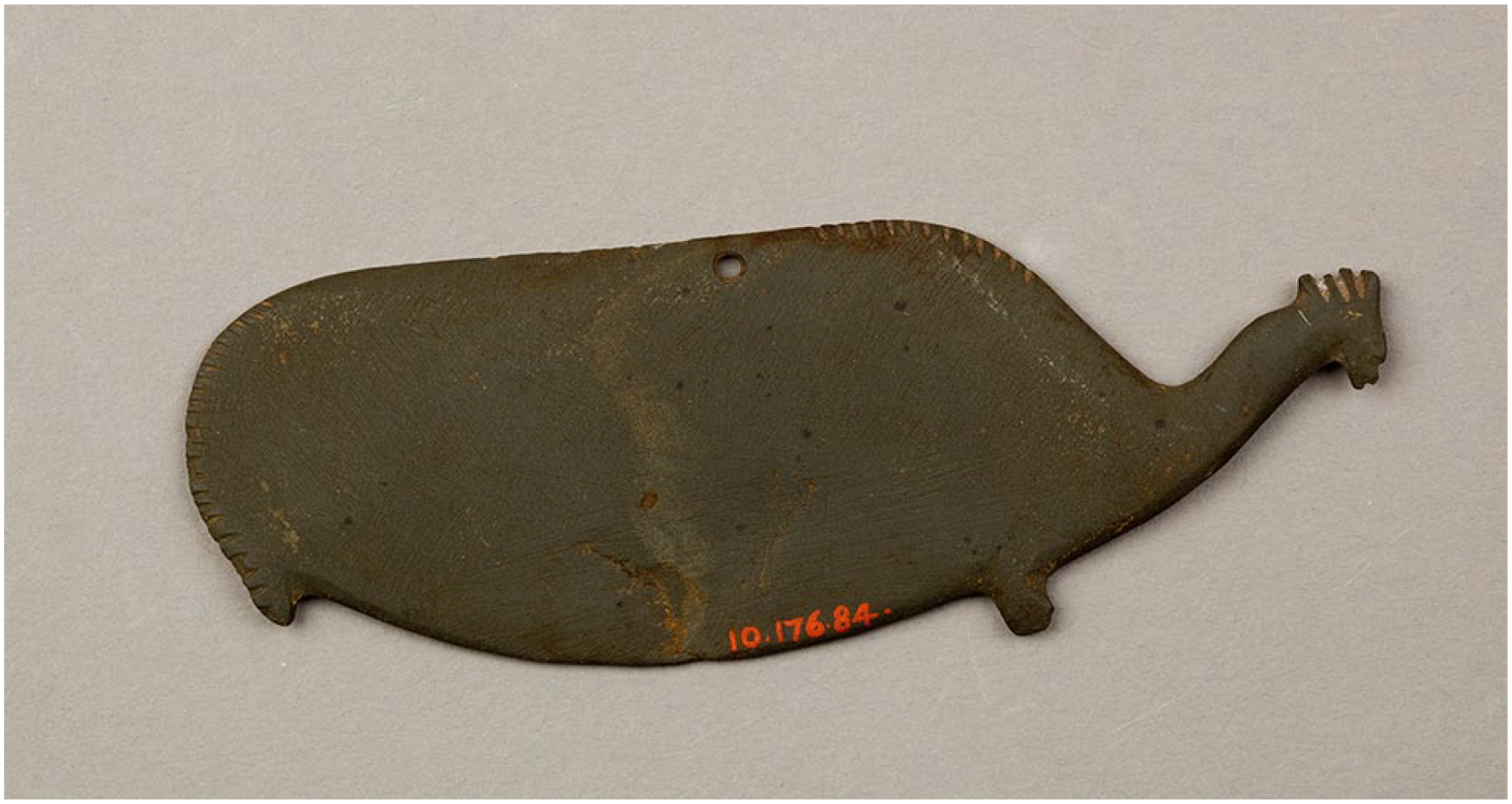
Palette MMA 10.176.84, right-facing side (photo: courtesy of the Metropolitan Museum of Art, New York, licensed under CC0 1.0).
The Design of Zoomorphic Palettes
Most zoomorphic palettes are fish-shaped, almost all of which depict species of tilapia. 5 Palettes with the form of animals that inhabit the floodplain, savannah, and low desert are rarer; birds predominate, but elephants, hippopotami, ruminants, and turtles are also attested. This pattern of species may relate to the cultural associations of palettes, to siltstone itself, 6 and/or to the landscapes valued by those involved in palette production. It may also arise from the actual or symbolic function of the palette as a surface for processing pigment through grinding or mixing. A number of rhomboidal palettes from Naqada I have a central depression for this purpose, while some later examples bear clear traces of the grinding process. The shift to zoomorphic forms was incompatible with the geometry of Naqada I palettes and eliminated the central depression.
A large oval or circular area is retained on the majority of zoomorphic palettes. Body parts such as gills, dorsal and caudal fins, horns, and long fur are incised near or along edges, 7 or they form part of the object’s overall outline. In contrast, features that lie further away from the outline, such as wings, pectoral fins, and musculature, are seldom modelled on the surface of palettes. 8 Relief work on palettes is generally rare during Naqada II, occurring more often in Naqada I and from the Naqada II–III transition onward. 9 Certain forms, particularly turtles, fishes, and birds, were little affected by these conventions, since their shape approximated an oval or circle, 10 while the proportions of subjects such as ruminants and elephants became more exaggerated.
Composite figures are attested, but infrequently. The most common form is that of two birds, joined at the back and facing outward. 11 A pair of conjoined turtles is also known. 12 Of a more unusual form are palettes with an oval central portion, the head of an antelope modelled at each top corner, a turtle’s head extending from the bottom edge, and incisions or protrusions on the bottom corners representing the front feet of a turtle. 13 Such composite figures conjoin the bodies of two or more animals to create a large central area in the shape of an oval or rhomboid, or they attach elements of one or more animals to the edges of such an area. MMA 10.176.84 belongs to a different figural type. It may be treated as a hybrid form that combines elements of distinct species to create a single, coherent body, with a rather seamless integration of parts.
MMA 10.176.84 as a Fish–Antelope Composite
At first glance, MMA 10.176.84 could perhaps be identified simply as an antelope, perhaps an ibex, Barbary sheep, or hartebeest. Several palettes representing these animals are known, and they exhibit comparable features to this one, including the long neck, spiky projections from the head, and the tapering downward extension from the rump representing the hind leg. The oblong protrusion on the ventral surface represents the foreleg. Perhaps the closest parallels to the general form of MMA 10.176.84 are palettes British Museum EA 35049 and Museum August Kestner Hannover 1967.45 (fig. 3), whose lyre-shaped horns suggest identification as hartebeests. 14 The latter palette is tentatively dated to Naqada IIA–B. Both the British Museum and Hannover palettes are very similar to MMA 10.176.84, particularly in the curving elongated neck, the prominent hump of the back, and the position of the minimally modelled legs. Moreover, the head of the British Museum palette features a notched muzzle and prominent brow that may be compared with those of MMA 10.176.84.
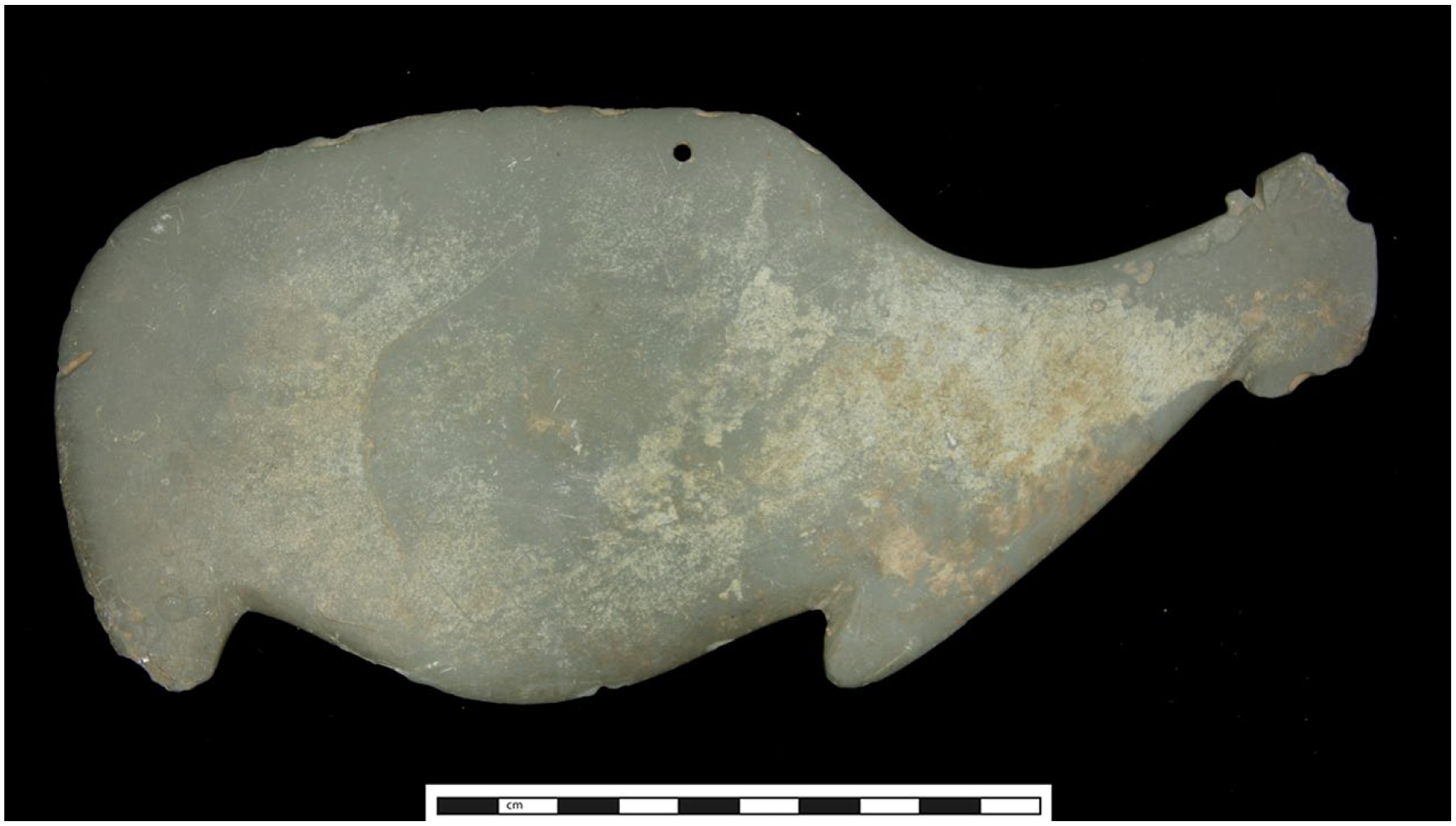
Palette Hannover 1967.45 (photo: courtesy of Xavier Droux).
The form of MMA 10.176.84 may also be compared with images on decorated knife handles. Although small, details of these images, as well as their occurrence on knife handles, are significant for understanding the cultural position of MMA 10.176.84. First is a carving of a recumbent antelope, likely an ibex, on a fragmentary knife handle excavated from Abydos grave U-503 and dating to Naqada IIC–D (fig. 4). 15 The antelope lies at an angle aligned with a relief band representing crossed leather bindings enveloping the knife handle. Its hind leg is curled beneath its abdomen. In the case of the creature represented by MMA 10.176.84, stylization to fit conventional palette design resulted in its legs being represented only minimally, but similarities between the palette and the antelope on the knife handle are striking: from their oval body shape and the location of their hind legs, to the straight extension of their muzzles (in contrast to the stylized downward curve of several antelope-shaped palettes) and even the sinuous curve of their necks. The antelope on the handle features a notched ear and a damaged large horn, both extending from the back of the head. 16

Recumbent caprid on knife handle Abydos U-503 (redrawn by Jordan Miller, after Dreyer, et al., MDAIK 54, 99, fig. 7).
However, a simple identification of MMA 10.176.84 as an antelope does not seem tenable. The incised decoration on its edges is absent on both the Abydos knife handle and the Hannover palette. On the handle, the location of the antelope along the edge of the object makes it unlikely that such details were present, because space for them is insufficient. On the Hannover palette, only two short incisions on the rump of the creature, at oblique angles to its edge, are present. They represent a short tail typical of non-composite antelope-shaped palettes. Broadening the survey to include other antelope-shaped palettes highlights these discrepancies. Incisions on antelope-shaped palettes seem to be used only for detailing on horns and to represent the mane on the neck and chest. 17 Their positioning on MMA 10.176.84 instead resembles the modelling of the rays of dorsal and caudal fins on fish-shaped palettes. MMA 10.176.84 may thus represent a fish–antelope composite figure.
Parallels for such details are known from three decorated knife handles of late Naqada II and IIIA date, discussed together by Dirk Huyge: 18 Brooklyn 09.889.118 (the Abu Zaidan knife handle); Berlin 15137; and Petrie Museum UC16294. 19 The handles of each bear images of one or more antelopes with long, prominent horns—likely a Nubian ibex (Capra nubiana)—and with dorsal and caudal fins characteristic of tilapia species attached to the back and rump (fig. 5). 20 On the knife handles, the composite figures occur together with other standing or striding animals, typically quadrupeds. Both the fish–antelope composites on the knife handles and the creature represented by MMA 10.176.84 have elongated heads with protrusions extending from the back of the head, as well as indications of fins along the back and rump. Differences in pose between the palette and knife handles—possibly recumbent on the former, and standing or striding on the latter—may not be significant, since the general design of zoomorphic palettes appears to preclude anything more than minimal representation of animals’ limbs.
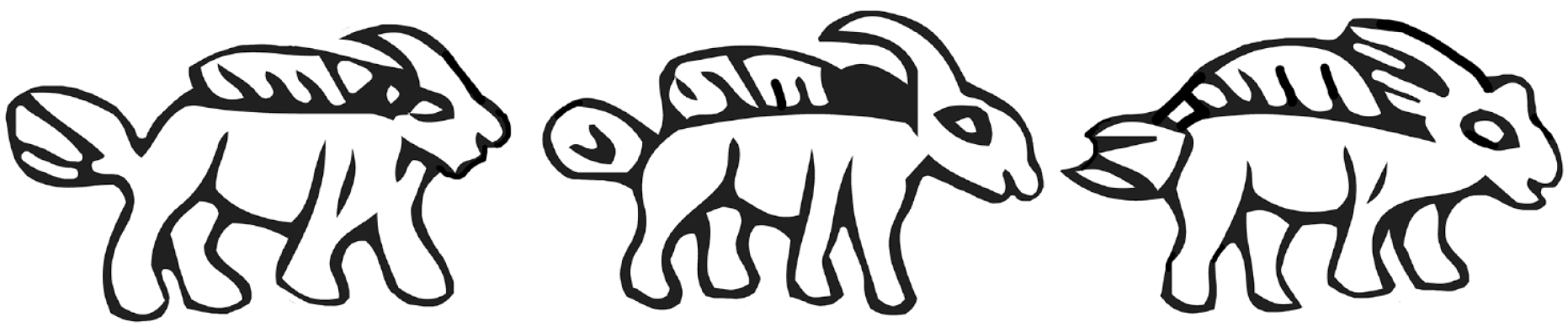
Ibex–tilapia composites on knife handle Brooklyn Museum 09.889.118 (redrawn by Jordan Miller, after Churcher, in Needler (ed.), Predynastic and Archaic Egypt in the Brooklyn Museum, 154).
Huyge’s interpretation revises Charles Churcher’s identification of the creatures on the knife handles as North African crested porcupines (Hystrix cristata). 21 Only one representation of a porcupine is known from Egypt prior to the first millennium BCE, in a relief from the Fifth Dynasty mastaba of Pehenuka at Saqqara. 22 Although the spines projecting from the head of this porcupine resemble those of the creature depicted on the Berlin knife handle, the latter’s head and body more closely resemble those of antelopes. Fish, antelopes, and various composite forms are furthermore widely attested in all periods, including the Predynastic. Identification as a porcupine is therefore less likely.
Taken together, the evidence suggests that MMA 10.176.84 was designed mainly in the form of an antelope—perhaps a hartebeest but incorporating conventions shared with other antelope species—with added fish elements playing on the potential of its oval silhouette. Its short tail, held close to the rump, is a frequent feature of non-composite antelope-shaped palettes and doubles as a caudal fin whose webbed, rayed structure is represented by incisions, while the dorsal incisions characteristic of fish-shaped palettes may play on examples of horn or ventral neck detailing on antelope-shaped palettes.
This method of combining elements is paralleled on palette Chicago OI E11470, which has been identified as a composite of a fish and bull and is dated to Naqada IIIB–IIIC1. 23 In contrast to MMA 10.176.84, however, the Chicago palette seems to have been designed mainly in the form of a fish, with the bull’s head as an added element. In line with broader patterns in the design of composite figures in the mid- to late fourth millennium BCE, both palettes exemplify the practice of modelling, in detail, ‘particular structural features and elements that correspond to an empirical reality below the skin’; they may belong to ‘an earlier art of ambiguity where the forms of living beings mingle and interpenetrate on contact, and where meaningful relations emerge from the blending of affinities rather than from the assemblage of contrasts’ 24 —a phenomenon known from a number of cultures.
Material Distributions of Cultural Values
The significance of the fish–antelope composite form may be approached by considering the position of palettes within the archaeological record of its period. Palettes were one of several material genres in which individual identity could be displayed and commemorated in mortuary settings. Others include combs and other cosmetic implements, 25 jewellery, masks, and knives, as well as textiles and pottery. All such objects were carried on, applied to, or located adjacent to the human body. They could bear faunal imagery and/or take zoomorphic form. 26 The faunal world was saturated with meaning, and appending images of it to the ‘symbolic media’ of human skin and hair may have been a means of incorporating its elements into the social person—a ‘cultural idiom’ that David Wengrow terms ‘embodiment’. 27
Most provenanced examples of these objects were found in assemblages in burials that appear to have functioned as arenas for displaying individual identity in the community. The raw materials for many grave goods were likely collected during communal expeditions into wadis and on desert roads
28
or were acquired through exchange. Depositing objects in the grave signified the cessation of previous social relations and eternalized them in the tableau created by the corpse and its accoutrements.
29
At the same time, objects could materialize values and beliefs that were vital to the mortuary context. Alice Stevenson notes: Many [palettes] have been discovered in burials with the bright green copper ore malachite still adhering to their surface. Such malachite could have been used to line the eyes, as excavated predynastic human remains have shown.
30
In contrast, red ochre features more frequently on palettes excavated in settlement contexts. 31 Green pigment was used in later periods to adorn the eyes of statues, perhaps as part of their ritual activation as manifestations of the depicted persons. 32 Palettes suggest that comparable practices may have been present in predynastic times. 33
With objects such as palettes and knife handles, meaning is generated by the intersection of the object, images they bear or constitute, and someone’s body. Some animal images on knife handles can be interpreted as symbols of ‘victory, power and wealth’ 34 —a feature they share with elements of palette iconography, especially during Naqada III. On both object types, animals surround and sometimes circumambulate the central lug handle (often termed the ‘boss’) or grinding area. Lug handles enabled knives to be hung close to the body, while the cosmetics processed on palettes—themselves perhaps suspended—were the interface between powerful images and the owners of the objects.
The foci of the predynastic elite on the construction of increasingly monumental tombs and well-outfitted graves, as well as on ceremonial pageantry that included slaughter—both are attested at Hierakonpolis locality HK6, for example 35 —show that regeneration and destruction were salient, likely complementary facets of ideology. Knife handles and palettes bore a parallel symbolism and were statements of social position and of the kinds of agency exercised by their owners. Their forms and the images depicted on them clarified and elaborated upon these meanings. 36 The Abu Zaidan knife handle, which probably dates to Naqada IIIA, illustrates this well. Its several dozen animals are arranged in straight, horizontal rows or registers, organized by species. 37 Particularly striking is the depiction of a ‘rosette’, hunting dog, and catfish at the end of these rows, as if pursuing the animals. These were symbols of royal power exercised through violence. 38 Their inclusion suggests that the ‘animal row’ motif bore a heavy symbolism, with some elements approaching the status of hieroglyphs. 39 The reception of these objects was perhaps guided by their notional use, as well as by the means and contexts of their creation, acquisition, and transfer between individuals. Discoveries of knife handles and palettes datable to earlier periods in later contexts hint strongly at the existence of practices of gifting, inheritance, and ritual ‘deactivation’ or destruction of objects. 40
As a class of object, knife handles may have condensed and expressed a wider range of meanings and values than palettes. Unlike palettes, knives intrinsically connote aggression and dominance, and the images on them match that association. When the handles incorporated fish–antelope composites as symbols of fertility and regeneration, the resultant composite amplified the common associations of both animals, extending established traditions of juxtaposing depictions of riverine and desert animals in single compositions. 41 By contrast, palettes prior to Naqada IIC rarely seem to embody a symbolism of aggression and dominance, even though faunal remains from HK6, as well as hunting scenes in Hierakonpolis Tomb 100 and on C-ware vessels, show that these qualities were desired by the elite. 42 Their forms suggest instead that ideas of regeneration were central to palettes: tilapia were potent symbols of fertility; 43 turtles could be incorporated into objects relating to rebirth; 44 and Diana Craig Patch has suggested that the palette modelled as two conjoined turtles ‘may represent a mating pair’. 45
The development of elaborately carved palettes featuring scenes of hunting and battle in Naqada IIC–IIIB (c. 3300–3000 BCE) marks a major change in this regard. Zoomorphic composites such as the ‘serpopard’ and ‘griffin’, which are attested mainly on knife handles prior to Naqada III and have clear associations with elite and royal power, 46 become prominent elements on the ceremonial palettes of this period. 47 The changing distribution of zoomorphic forms (both composite and non-composite) across the two categories between Naqada II and III reflects shifts in values and in the functions served by palettes, which grew closer to knife handles in their social and cultural significance. As they increased in size and came to depict animals on their surfaces instead of being shaped as animals, palettes lost the position in material culture and social life represented by small, relatively widespread types such as combs and jewellery, which also often included animal forms in their shapes. The increasing symmetry of palettes and knife handles can be related to the ‘aesthetic deprivation of the non-elite’, which involved concentrating elite values into previously more widely available object types. 48
The form and detailing on MMA 10.176.84 fit with these developments. The comparably shaped Hannover palette, mentioned above, has been dated to Naqada IIA–B. Since MMA 10.176.84 adds new elements to this style, it may belong to a transitional period between Naqada IIB and IIC, before differently shaped representations of hartebeests emerged in Naqada IIC–D. 49 Further support for this dating comes from the palette Manchester 5476, which may be of Naqada IID: its integration of animal elements using both the overall palette shape and relief decoration on its surface extends the developments represented by MMA 10.176.84—its top edge has regularly sized and spaced pointed protrusions, with those at each end modelled as ostrich heads and the central ones ‘perhaps indicating wings’, while the surface bears relief images of three ostriches and a man. 50 Thus, the weight of the evidence suggests that MMA 10.176.84 is roughly contemporaneous with decorated knife handles depicting fish–antelope composites. It crosses boundaries in more ways than one.
Conclusion
If the palette MMA 10.176.84 represents a fish–antelope composite, it is a significant addition to the examples previously identified. If it was made in Naqada IIC, the palette would antedate the examples on knife handles, which were probably created between Naqada IID and IIIA. A composite form like this one was therefore not peripheral to the iconography which was being developed to express elite values. 51 The form provides further evidence for iconographic commonalities between different object types of Naqada II in motifs and meanings, filtered through aesthetic conventions and materiality: rendering the fins of the fish as incisions on the dorsal and posterior edges and not in three dimensions was a choice grounded in existing norms of palette design. The same can be said for the creature’s pose: it accords with the general outline of other antelope-shaped palettes, such as Hannover 1967.45, and does not run counter to known ways of depicting antelope in other contexts, such as on the Abydos U-503 knife handle. 52 The recumbent form—if it is to be identified as such—was not semantically distinct from its standing or striding counterparts.
Even though both palettes and knife handles stemmed from the same cultural background and may have played similar social roles, one should not assume that the aesthetic and material conventions governing the two genres were entirely congruent. The selection of material to deposit in a burial related to the actual or notional functions of object types. Including several pieces in a single assemblage allowed the meanings incorporated by each type to come together around the body and person of the interred individual, imparting a perpetual presence to various dimensions of his or her position in society.
Viewed in parallel with the decorated knife handles, MMA 10.176.84 suggests that single genres of objects could speak to one or more complexes of ideas and values, and that similar meanings could be conveyed by different object types found in the same context. The range of values encapsulated by palettes expanded during the Naqada II–III transition, and became comparable with the symbolism of decorated knife handles. If this model is accepted, the palette Chicago OI E11470, cited above, may also be re-dated, placing it in the Naqada IIB–IIC Period rather than Naqada IIIB–IIIC1 as has previously been suggested. Its fish–bull composite form follows the same ‘modular principles of assembly’ as the fish–antelope form of MMA 10.176.84, 53 while its stylistic details call to mind those observed on later ceremonial palettes. 54
The process just described was part of broader developments in material culture, through which the ownership of palettes became increasingly restricted to a small elite group. The decorative programmes of these objects condensed layers of meaning that were less salient for other sectors of society. The same process is not seen with the knife handles, perhaps because their circulation was restricted from the outset, not sharing in the palettes’ original, wider distribution. While belonging in the cultural context of Naqada I and early Naqada II, the form and significance of MMA 10.176.84 also foreshadows the rapid iconographic and aesthetic developments of late Naqada II and III.
Footnotes
Acknowledgements
I am grateful to John Baines, Elizabeth Frood, and Xavier Droux for comments on drafts, Diana Craig Patch for her kind assistance and advice, and to the anonymous reviewers for their suggestions.
Funding
The author did not receive funding for this project.
1.
I follow the chronology of S. Hendrickx, ‘The relative chronology of the Naqada culture: Problems and possibilities’, in A. J. Spencer (ed.), Aspects of Early Egypt (London, 1996), 64. For a revised chronology based on radiocarbon dating, see M. Dee, D. Wengrow, A. Shortland, A. Stevenson, F. Brock, L. Girdland Flink, and C. Ramsey, ‘An absolute chronology for early Egypt using radiocarbon dating and Bayesian statistical modelling’, Proceedings of the Royal Society A 469 (2159, November, article no. 2013.0395) (2013).
2.
A. Stevenson, ‘The material significance of Predynastic and Early Dynastic palettes’, in R. Mairs and A. Stevenson (eds), Current Research in Egyptology 2005: Proceedings of the Sixth Annual Symposium, University of Cambridge, 6–8 January 2005 (Oxford, 2007), 150.
3.
E.g., H. Asselberghs, Chaos en Beheersing: Documenten uit Aeneolithisch Egypte (DMOA 8; Leiden, 1961), pls 44–6 (cat. 64–70).
4.
K. Ciałowicz, Les palettes égyptiennes aux motifs zoomorphes et sans décoration: Études de l’art prédynastique (Krákow, 1991), 21, 24.
5.
Ciałowicz, Palettes, 20–1; D. C. Patch, ‘From land to landscape’, in D. C. Patch (ed.), Dawn of Egyptian Art (New York, 2011), 26; A. Stevenson, ‘Material culture of the Predynastic Period’, in E. Teeter (ed.), Before the Pyramids: The Origins of Egyptian Civilization (Chicago, 2011), 70; M. Szafran, ‘Object biography: Manchester Museum 7556’, Birmingham Egyptology Journal 7 (2020), 75.
6.
For discussions of Egyptian cultural values and symbolism of stone and individual rock types, see J. Baines, ‘Stone and other materials: Usages and values’, in J. Baines, Visual and Written Culture in Ancient Egypt (Oxford, 2007), 263–80, and R. S. Bianchi, ‘The stones of Egypt and Nubia’, in Z. A. Hawass and J. E. Richards (eds), The Archaeology and Art of Ancient Egypt: Essays in Honor of David B. O’Connor (Cairo, 2007), I, 109–17.
7.
J. C. Payne, Catalogue of the Predynastic Collection in the Ashmolean Museum (Oxford, 1993), 221.
8.
Combs of the period are similarly designed.
9.
A very unusual example is the fish-shaped palette Kunsthistorisches Museum Wien AEOS 9067 < > accessed 18.03.2022, with reliefs of riverine fauna surrounding a circular grinding zone delimited by a raised and hatched border similar to those on Naqada III palettes, and recalling representations of circular hunting traps on Naqada IB–IIB artefacts and in Tomb 100 at Hierakonpolis. See, e.g., X. Droux, Riverine and Desert Animals in Predynastic Upper Egypt: Material Culture and Faunal Remains (PhD thesis, University of Oxford; Oxford, 2015), 184, cat. 4.24; J. E. Quibell and F. W. Green, Hierakonpolis, II (Cairo, 1902), pl. 76. The palette is unprovenanced; if it is not a forgery, these features would support a date between Naqada IID and IIIA.
10.
E.g., Ciałowicz, Palettes, 35–6; Patch, in Patch (ed.), Dawn, 27.
11.
E.g., MMA 35.7.14: Patch, in Patch (ed.), Dawn, 40, cat. 29; W. M. F. Petrie and J. E. Quibell, Naqada and Ballas (BSAE 1; London, 1896), pl. 49; Payne, Catalogue, 222, cat. 1809. Compare a comb surmounted by a pair of outward-facing ducks (MMA 23.2.3): Patch, in Patch (ed.), Dawn, 59, cat. 59.
12.
MMA 10.176.78: Patch, in Patch (ed.), Dawn, 26, cat. 11.
13.
MMA 21.6.113; Ashmolean AN1895.841: Patch, in Patch (ed.), Dawn, 60, cat. 60; Petrie and Quibell, Naqada and Ballas, pl. 47.11–12.
14.
I. Woldering, Ausgewählte Werke der aegyptischen Sammlung (2nd enlarged edn; Hannover, 1958), 218, no. 2; P. Munro, Kestner-Museum: Ägyptische Abteilung (Hannover, 1976), 6, no. 14; X. Droux, ‘Les palettes à fard prédynastiques en forme de bovidés sauvages’, in S. Vuilleumier and P. Meyrat (eds), Sur les pistes du désert: Mélanges offerts à Michel Valloggia (Gollion, 2019), 51, figs 4.15, 4.19. British Museum EA 35049 <> accessed 18.03.2022.
15.
G. Dreyer, U. Hartung, T. Hikade, E. C. Köhler, V. Müller, and F. Pumpenmeier, ‘Umm el-Qaab: Nachuntersuchungen im frühzeitlichen Königsfriedhof, 9./10. Vorbericht’, MDAIK 54 (1998), 98–100, fig. 7, pl. 5a–b; Droux, Riverine and Desert Animals, cat. 4.27.
16.
A non-recumbent point of comparison is the ibex located to the right of the boss or lug handle on the Gebel el-Araq knife handle (Louvre E1157), of Naqada IID–IIIA date. Its ear and two horns form a similar series of raised projections, and the shape of the skull is also similar, including the modelling of the mandible and projecting brow: É. Delange, Le poignard égyptien dit ‘du Gebel el-Arak’ (Paris, 2009), 38, fig. 8.
17.
E.g., Ashmolean 1895.855: Petrie and Quibell, Naqada and Ballas, pl. 47.1; Rhode Island School of Design 14.489 <https://risdmuseum.org/art-design/collection/gazelle-palette-14489> accessed 18.03.2022. Other examples: Droux, in Vuilleumier and Meyrat (eds), Sur les pistes du désert, figs 1–.
18.
D. Huyge, ‘A double-powerful device for regeneration: The Abu Zaidan knife handle reconsidered’, in S. Hendrickx, R. Friedman, K. M. Ciałowicz, and M. Chłodnicki (eds), Egypt at its Origins 1: Studies in Memory of Barbara Adams. Proceedings of the International Conference ‘Origin of the state: Predynastic and Early Dynastic Egypt’, Kraków, 28th August – 1st September 2002 (OLA 138; Leuven, 2004), with references to earlier studies.
19.
The last of these was most probably made in modern times (I. Taylor, unpublished lecture, Fifth British Egyptology Conference, 3 December 2020).
20.
Huyge, in Hendrickx, et al. (eds), Egypt at its Origins 1, 828–30.
21.
C. S. Churcher, ‘Zoological study of the ivory knife handle from Abu Zaidan’, in W. Needler, Predynastic and Archaic Egypt in the Brooklyn Museum: With a Reexamination of Henri de Morgan’s Excavations Based on the Material in the Brooklyn Museum Initially Studied by Walter Federn and a Special Zoological Contribution on the Ivory-handled Knife from Abu Zaidan by C. S. Churcher (WilbMon 9; Brooklyn, 1984), 159.
22.
Berlin ÄM 1132: Y. Harpur, Decoration in Egyptian Tombs of the Old Kingdom: Studies in Orientation and Scene Content (London, 1987), fig. 188, top right.
23.
S. Hendrickx, P. Simoens, and M. Eyckerman, ‘“The facial veins” of the bull in Predynastic Egypt’, in M. D. Adams (ed.), Egypt at its Origins 4: Proceedings of the Fourth International Conference ‘Origin of the State. Predynastic and Early Dynastic Egypt’, New York, 26th–30th July 2011 (Leuven, 2016), 520–3. The dating of the palette is discussed below. The authors’ identification of other palettes as possible composites of birds and fishes is uncertain, however, and may be better interpreted as representations of trussed fowl.
24.
D. Wengrow, The Origin of Monsters: Image and Cognition in the First Age of Mechanical Reproduction (Princeton, 2014), 49, 54.
25.
E.g., G. Brunton and G. Caton-Thompson, The Badarian Civilisation and Predynastic Remains near Badari (BSAE 46; London, 1928), pl. 24.1,3; G. Brunton, Mostagedda and the Tasian Culture: British Museum Expedition to Middle Egypt, First and Second Years, 1928, 1929 (London, 1937), 34, 53, pls 24.21–2, 24.31–3, vii; Payne, Catalogue, 231–2, cats 1902–18, figs 77, 78. For combs, see also W. Needler, Predynastic and Archaic Egypt, 316–17.
26.
Items commonly classified as jewellery include shells from the Red Sea, and semi-precious stones—both worked and unworked—gathered from the desert: Needler, Predynastic and Archaic Egypt, 308; D. Wengrow, The Archaeology of Early Egypt: Social Transformations in North-East Africa, 10,000 to 2650 BC (Cambridge, 2006), 70. For masks, see, e.g., Quibell and Green, Hierakonpolis II, pl. 76; Ciałowicz, Palettes, 43, ; X. Droux and A. Pieri, ‘Further adventures at HK6: The 2010 season’, Nekhen News 22 (2010), 5; R. Friedman, ‘The masks of Hierakonpolis Cemetery HK6’, in M. A. Jucha, J. Dębowska-Ludwin, and P. Kołodziejczyk (eds), Aegyptus Est Imago Caeli: Studies Presented to Krzysztof M. Ciałowicz on his 60th Birthday (Krákow, 2014), 123–5.
27.
Wengrow, Archaeology of Early Egypt, 71.
28.
J. C. Darnell, ‘Iconographic attraction, iconographic syntax, and tableaux of royal ritual power in the Pre- and Proto-Dynastic rock inscriptions of the Theban Western Desert’, Archéo-Nil 19 (2009), 83–107.
29.
C. Gosden and Y. Marshall, ‘The cultural biography of objects’, World Archaeology 31:2 (The Cultural Biography of Objects) (1999), 169, 173; Wengrow, Archaeology of Early Egypt, 70; J. Robb, ‘Burial treatment as transformations of a bodily ideology’, in N. Laneri (ed.), Performing Death: Social Analyses of Funerary Traditions in the Ancient Near East and Mediterranean (OIS 3; Chicago, 2007), 289; A. Stevenson, ‘Social relationships in predynastic burials’, JEA 95 (2009), 177.
30.
Stevenson, in Teeter (ed.), Before the Pyramids, 70.
31.
Stevenson, in Teeter (ed.), Before the Pyramids, 70. See also N. Baduel, ‘Tegumentary paint and cosmetic palettes in Predynastic Egypt: Impact of those artefacts on the birth of the monarchy’, in B. Midant-Reynes and Y. Tristant (eds), Egypt at its Origins 2: Proceedings of the International Conference ‘Origin of the State: Predynastic and Early Dynastic Egypt’, Toulouse (France), 5th – 8th September 2005 (OLA 172; Leuven, 2008), 1068. Bodies at Hierakonpolis have been found covered in red ochre, however, so that green was not the only pigment to play a role in mortuary practices (Xavier Droux, personal communication, 28.12.2020).
32.
E.g., Louvre A36, A37, A38: entries by C. Ziegler, in anonymous (ed.), Egyptian Art in the Age of the Pyramids (New York, 1999), 180–3; J. Baines, ‘Display of magic in Old Kingdom Egypt’, in K. Szpakowska (ed.), Through a Glass Darkly: Magic, Dreams & Prophecy in Ancient Egypt (Swansea, 2006), 6.
33.
See also a female figurine with green eye-paint (MMA 07.228.71): D. C. Patch, ‘The human figure’, in Patch (ed.), Dawn, 122–3, cat. 102.
34.
K. M. Ciałowicz, ‘La composition, le sens et la symbolique des scènes zoomorphes prédynastiques en relief: Les manches de couteaux’, in R. Friedman and B. Adams (eds), The Followers of Horus: Studies Dedicated to Michael Allen Hoffman (Oxford, 1992); K. M. Ciałowicz, La naissance d’un royaume: L’Égypte dès la période prédynastique à la fin de la Ière dynastie (Krákow, 2001), 176.
35.
E.g., B. Adams, ‘Something very special down in the elite cemetery’, Nekhen News 10 (1998), 3–4; D. Huyge, ‘Giraffes in ancient Egypt’, Nekhen News 10 (1998), 9–10; S. Warman, ‘How now, large cow?’, Nekhen News 12 (2000), 8–9; R. Friedman, ‘Excavating an elephant’, Nekhen News 15 (2003), 9–10; R. Oldfield and J. Jones, ‘What was the elephant wearing?’, Nekhen News 15 (2003), 12; W. Van Neer and V. Linseele, ‘A second elephant at HK6’, Nekhen News 15 (2003), 11–12.
36.
The status of knives and palettes as markers of agency does not imply that they were actually used. The precise symbolism of the iconography is therefore difficult to determine. Interpretations include the idea of the image as ‘a magical guide or reinforcement of the hunter’s action’, and the view that the animals are under the control of the knife wielder, ‘marching towards the sacrificial blade’: W. Davis, Masking the Blow: The Scene of Representation in Late Prehistoric Egyptian Art (Berkeley, CA, 1992), 67; R. Friedman, ‘Hierakonpolis’, in Patch (ed.), Dawn, 93.
37.
Other objects designed in this way include the knife handle MMA 26.7.1281 and the comb MMA 30.8.224: Davis, Masking the Blow, 66, fig. 23; W. C. Hayes, The Scepter of Egypt: A Background for the Study of the Egyptian Antiquities in the Metropolitan Museum of Art. Part I: From the Earliest Times to the End of the Middle Kingdom (New York, 1978), 27–8, fig. 20.
38.
J. Baines, ‘Symbolic roles of canine figures on early monuments’, Archéo-Nil 3 (1993), 57–74; S. Hendrickx, ‘The dog, the Lycaon Pictus and order over chaos in Predynastic Egypt’, in K. Kroeper, M. Chłodnicki, and M. Kobusiewicz (eds), Archaeology of Early Northeastern Africa: In Memory of Lech Krzyżaniak (Poznán, 1996), 723–49. The rosette appears next to representations of the Naqada IIIB kings Scorpion and Narmer, and the latter’s name included the hieroglyph of a catfish; he could even be depicted emblematically as a catfish with attached human arms, wielding a weapon to smite an enemy. See, e.g., Ashmolean AN1896–1908 E.3915: H. Whitehouse, ‘A decorated knife handle from the “Main Deposit” at Hierakonpolis’, MDAIK 58 (2002), 434, .
39.
Tomb U-j at Abydos, also of Naqada IIIA date, provides the earliest examples of a graphic sign system, which shares parts of its sign inventory with knife handles and other decorated objects, while composite hieroglyphs came to be used extensively in the Early Dynastic Period. See J. Baines, ‘Aesthetic culture and the emergence of writing in Egypt in Naqada III’, Archéo-Nil 20 (2010), 134–49; H. G. Fischer, ‘Some emblematic uses of hieroglyphs with particular reference to an Archaic ritual vessel’, MMJ 5 (1972), 5–23; H. G. Fischer, ‘The evolution of composite hieroglyphs in ancient Egypt’, MMJ 12 (1977), 6–7; Wengrow, Origin of Monsters, 51–6, 110.
40.
E.g., S. G. el-Baghdadi, ‘La palette décorée de Minshat Ezzat (delta)’, Archéo-Nil 9 (1999), 9–12; S. G. el-Baghdadi, ‘Proto and Early Dynastic necropolis of Minshat Ezzat, Dakahlia province, Northeast Delta’, Archéo-Nil 13 (2003), 143–52; Huyge, in Hendrickx, et al. (eds), Egypt at its Origins 1, 823.
41.
Huyge, in Hendrickx, et al. (eds), Egypt at its Origins 1, 830–4, with references; Droux, Riverine and Desert Animals, 153, cat. 1.46 and elsewhere. Note also how desert and riverine animals, specifically antelopes and hippopotami, could occur on painted female figurines, perhaps in connection with ideas of fertility and motherhood. See, e.g., R. Nyord, ‘The Nile in the hippopotamus: Being and becoming in faience figurines of Middle Kingdom ancient Egypt’, in I.-M. B. Danielsson and A. M. Jones (eds), Images in the Making: Art, Process, Archaeology (Manchester, 2020), 19–33; Droux, Riverine and Desert Animals, 245. For such symbolism in later periods, see, e.g., Å. Strandberg, The Gazelle in Ancient Egyptian Art: Image and Meaning (Uppsala, 2009), 170–3, with references.
42.
A rare exception may be the palette British Museum EA 67650, which has been described as a large felid (Patch, in Patch (ed.), Dawn, 56, cat. 53), although identification as a hippopotamus is perhaps more likely (compare British Museum EA 29416 and British Museum EA 58336). See also Droux, Riverine and Desert Animals, 78 n. 26. It is difficult to determine the symbolism of hippopotami, which were not always aggressive.
43.
I. Gamer-Wallert, Fische und Fischkulte im alten Ägypten (ÄA 21; Wiesbaden, 1970), 124–5; Patch, in Patch (ed.), Dawn, 26.
44.
P. A. Piccione, ‘Mehen, mysteries, and resurrection from the coiled serpent’, JARCE 27 (1990), 43–52; Patch, in Patch (ed.), Dawn, 29–30.
45.
Patch, in Patch (ed.), Dawn, 26. For an alternative interpretation, see J. Smolik, ‘Six monstrous zoomorphic predynastic palettes: Representations of real conjoined twins?’, Archéo-Nil 29 (2019), 179–93.
46.
Examples include the Gebel el-Tarif knife handle, Cairo Museum CG 14265: J. E. Quibell, Archaic Objects (CGC nos 11001–12000, 14001–754; Cairo, 1905), 237; a fragment of a dagger handle from Abydos, site magazine no. K1104: G. Dreyer, U. Hartung, and F. Pumpenmeier, ‘Umm el-Qaab: Nachuntersuchungen im frühzeitlichen Königsfriedhof, 5./6. Vorbericht’, MDAIK 49 (1993), 26–7; a notched ivory blade from Hierakonpolis: J. E. Quibell and F. W. Green, Hierakonpolis, I (London, 1900), pl. 16; M. Campagno, ‘Encore une réflexion sur le motif prédynastique du maître des animaux’, CCE (S) (2010), 119.
47.
The Two Dog palette, Ashmolean AN1896–1908 E.3924: J. E. Quibell, ‘Slate palette from Hieraconpolis’, ZÄS 36 (1898), 83; D. C. Patch, ‘Early Dynastic art’, in Patch (ed.), Dawn, 138–9; and the Narmer palette, Cairo CG 14716: Quibell and Green, Hierakonpolis I, pl. 29.
48.
J. Baines, ‘Communication and display: The integration of early Egyptian art and writing’, in Baines, Visual and Written Culture, 288–93; J. Baines, ‘On the status and purposes of ancient Egyptian art’, in Baines, Visual and Written Culture, 302–5.
49.
Droux, Riverine and Desert Animals, 191; Droux, in Vuilleumier and Meyrat (eds), Sur les pistes du désert, 53–4.
50.
Ciałowicz, Palettes, 42–3; Davis, Masking the Blow, 73, fig. 25; B. Midant-Reynes, The Prehistory of Egypt: From the First Egyptians to the First Pharaohs (tr. I. Shaw; Oxford, 2000), 193; Droux, Riverine and Desert Animals, 199.
51.
The man depicted on the palette Manchester 5476 seems to have the head of an ostrich (or he is wearing an ostrich mask), so he too is in some way a composite figure. An opposite configuration is exemplified by the canid figure standing on its hind legs and playing a flute on the reverse of the Two Dog palette (Ashmolean AN1896–1908 E.3924).
52.
See also the row of four recumbent ibexes depicted near the top of the painted wall in Tomb 100 at Hierakonpolis, which dates to Naqada IIC (Quibell and Green, Hierakonpolis II, pl. 76).
53.
Wengrow, Origin of Monsters, 68–73.
54.
Hendrickx, et al., in Adams (ed.), Egypt at its Origins 4, 505–20.