




Abstract
This article analyses the offering table from the chapel of Satinteti, a Memphite Priestess of Hathor, dating to the First Intermediate Period. The false-door and side-pieces are now held by the Museum of Fine Arts, Boston (24.593a–c). The offering table, however, is still in the Teti Pyramid Cemetery and was fashioned from a reused block from the chapel of Princess Watetkhethor Zeshzeshet, the eldest daughter of King Teti of the Sixth Dynasty. The former inscriptions on the offering table are transcribed and the block digitally resituated on the southern wall of room B5 in Watetkhethor’s chapel. The dating for the chapel is assessed from several perspectives, and the technique and motivations for the reuse of the offering table are discussed. It is proposed that Satinteti may have deliberately sought a block from the chapel of this earlier, eminent woman in the completion of her own monument.
Keywords

Introduction
During the Service des antiquités de l’Égypte excavations in the Teti Pyramid Cemetery between 1920–22, an intact chapel for a priestess named 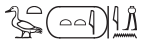 Z3.t-Ttỉ-ỉn(ỉ) (‘Daughter of Ttỉ-ỉn[ỉ]’) was discovered near the northern face of Teti’s pyramid (fig. 1a).
1
Satinteti’s monument probably dates to the early First Intermediate Period and was established in an area of dense repurposing and reburial that occurred in this cemetery during this period. The false-door and side-pieces for her chapel are now kept in the Museum of Fine Arts, Boston (24.593a–c),
2
and were probably purchased by George Reisner in 1924.
3
For reasons left unrecorded, the offering table was never purchased by the museum. It is currently in the Teti Pyramid Cemetery, stored inside the Middle Kingdom chapel of Ihy (fig. 1b) along with a small number of other loose blocks and false-doors from this cemetery.
4
Z3.t-Ttỉ-ỉn(ỉ) (‘Daughter of Ttỉ-ỉn[ỉ]’) was discovered near the northern face of Teti’s pyramid (fig. 1a).
1
Satinteti’s monument probably dates to the early First Intermediate Period and was established in an area of dense repurposing and reburial that occurred in this cemetery during this period. The false-door and side-pieces for her chapel are now kept in the Museum of Fine Arts, Boston (24.593a–c),
2
and were probably purchased by George Reisner in 1924.
3
For reasons left unrecorded, the offering table was never purchased by the museum. It is currently in the Teti Pyramid Cemetery, stored inside the Middle Kingdom chapel of Ihy (fig. 1b) along with a small number of other loose blocks and false-doors from this cemetery.
4
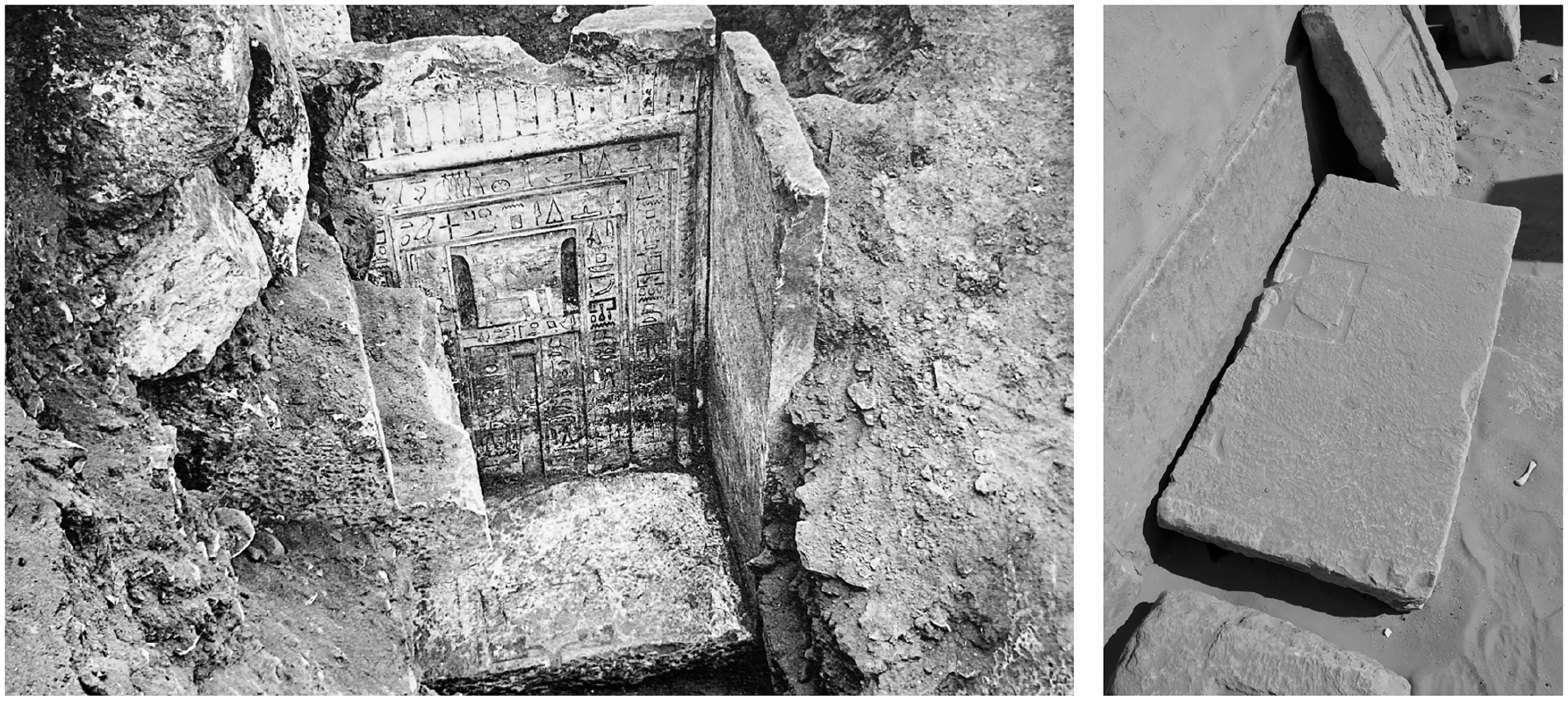
Left (a) Satinteti’s false-door and offering table in situ (detail adapted from Firth and Gunn, TPC II, pl. 20 [c]); Right (b) the offering table now in the chapel of Ihy (photo: author, January 2019).
The offering table is of particular interest as it is a reused block originating from the chapel of Princess Watetkhethor Zeshzeshet (hereafter Watetkhethor), eldest daughter of King Teti of the Sixth Dynasty and wife of vizier Mereruka Meri (fig. 2). The reuse that occurs in Satinteti’s monument is not unknown to Egyptologists. Battiscombe Gunn observed in 1926 that the offering table featured the erased figure of a woman, whom he speculated was Watetkhethor. 5 Subsequent publications that feature the false-door and sidepieces have also mentioned the reused offering table. 6 As yet, however, no attempt has been made to resituate the block in Watetkhethor’s chapel, nor to contextualize it among other evidence of repurposing among the monuments in the cemetery. This article publishes a line-drawing of the offering table, including a transcription of the traces of its former decoration, and provides a hypothesized reconstruction of the block on the southern wall of room B5 of Watetkhethor’s chapel (fig. 3). This is followed by a discussion of the pragmatics of reuse within the Teti Pyramid Cemetery in the late Old Kingdom and First Intermediate Period, during which Satinteti erected her monument.
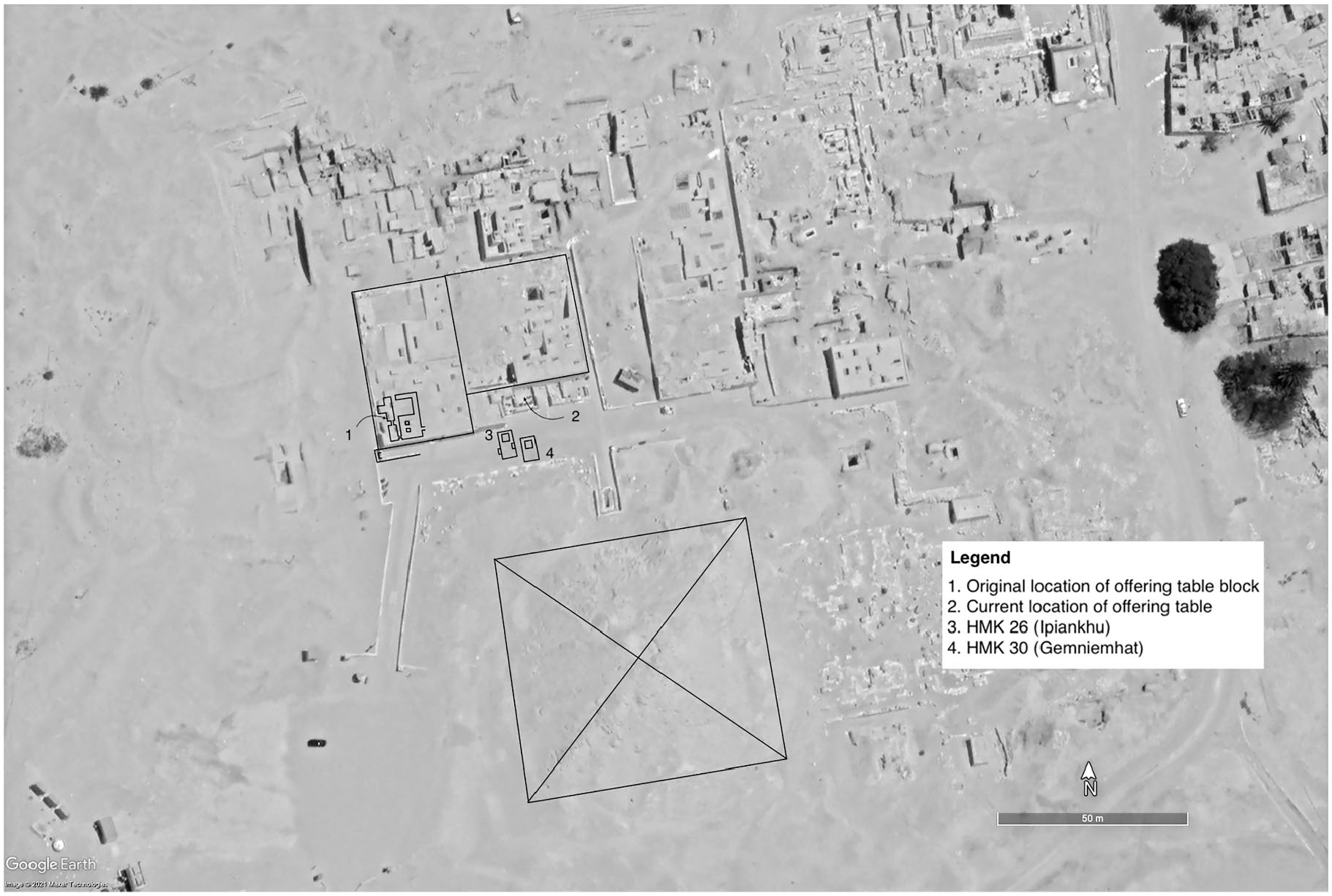
Map of the Teti Pyramid Cemetery with the key locations discussed in this paper indicated (adapted by the author from Google Earth, 2021).
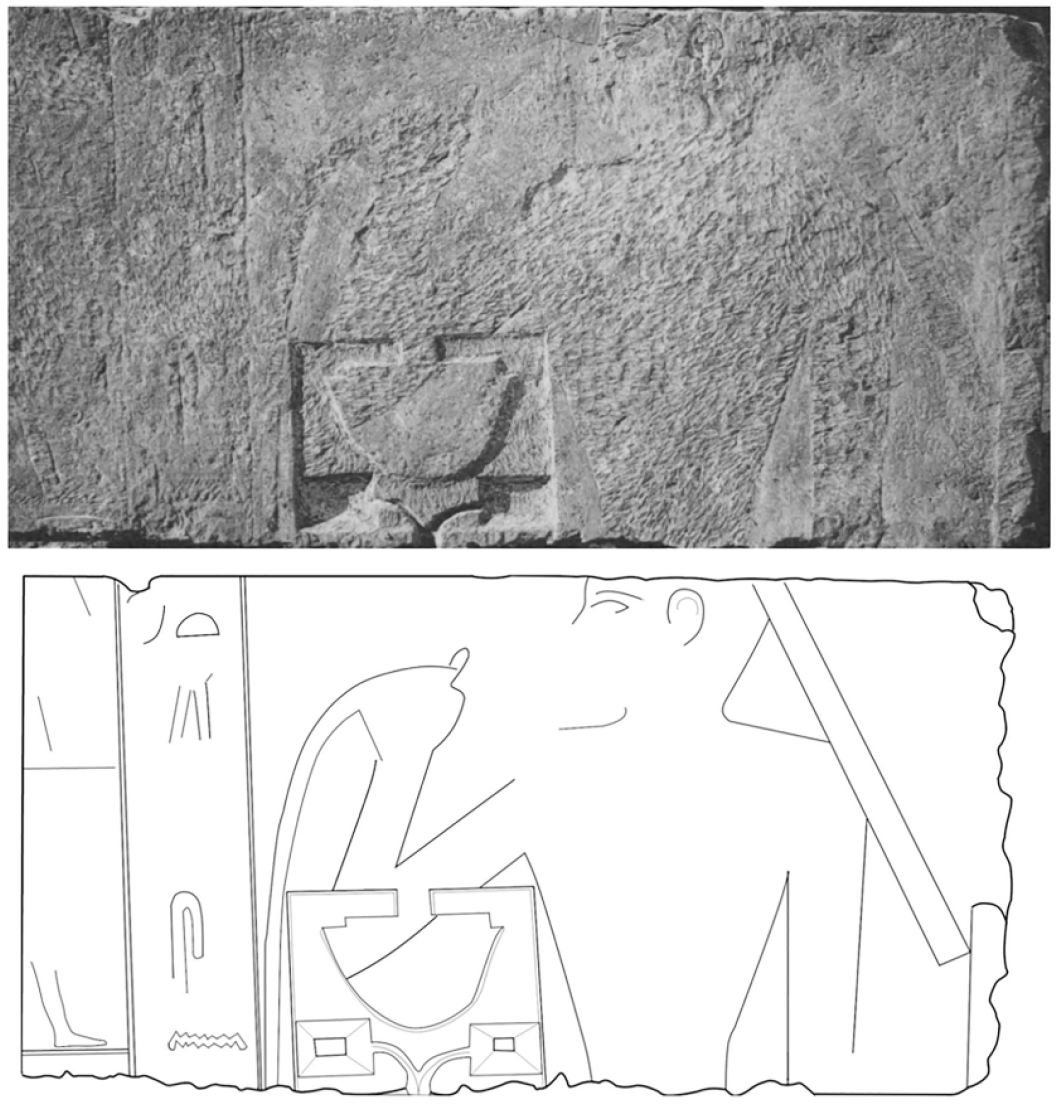
Above (a) Satinteti’s offering table (after Firth and Gunn TPC II, pl. 20 [d]); Below (b) line drawing of the offering table (drawing: author).
Description of the offering table and its former inscriptions
The offering table from Satinteti’s chapel is a slab of limestone measuring 56.5 cm by 111 cm and 22 cm deep. Its original surface decoration was carefully chiselled away at some point before it was reused, although the shape of a woman holding a lotus bloom to her nose is still visible and portions of hieroglyphic texts in raised-relief on the left side can be distinguished (fig. 3). A stiff streamer extends from the back of her head, which would have been adorned with a fillet crown. On the far left, facing the image of the erased woman, fragments of legs belonging to striding figures can be made out, and these mark the beginning of a scene of offering bearers. Apart from the offering basin, no further inscriptions were carved into the block; the excavation photographs of the whole chapel in situ are therefore the sole record of this offering table being connected to the false-door and side-pieces which name Satinteti.
The offering basin is off-set from the centre of the block, occupying the lower-left corner. The channels of the basin follow the outline of a large and stylized upside-down loaf upon a mat, resembling the hieroglyph  (Gardiner R4), and lead to two rectangular sunken troughs with a drainage channel between them.
7
The position of the offering basin is particularly striking when Satinteti’s chapel is viewed in situ (fig. 1a). Plaster and paint may have been applied to the surface of the block as part of its preparation for reuse.
8
Although this can no longer be observed on the offering table, a similar situation was noted by Cecil Firth in the excavation of the offering place of Khenu, established within the forecourt of Mereruka’s mastaba at its western end: the former inscriptions had been ‘carefully filled in and obliterated with whitewash’.
9
This alone does not explain why the offering basin occupies a relatively small area in the chapel, and it may have been desirable that a visual referent to the block’s former owner, Watetkhethor, remained; the motivation for this is considered later. On the left side of the block, what remains of a few hieroglyphic signs can be discerned. This was once an inscription in a column between the image of Watetkhethor and at least three registers of striding figures walking towards her. Reading right to left, beginning from the top: a –t
(Gardiner R4), and lead to two rectangular sunken troughs with a drainage channel between them.
7
The position of the offering basin is particularly striking when Satinteti’s chapel is viewed in situ (fig. 1a). Plaster and paint may have been applied to the surface of the block as part of its preparation for reuse.
8
Although this can no longer be observed on the offering table, a similar situation was noted by Cecil Firth in the excavation of the offering place of Khenu, established within the forecourt of Mereruka’s mastaba at its western end: the former inscriptions had been ‘carefully filled in and obliterated with whitewash’.
9
This alone does not explain why the offering basin occupies a relatively small area in the chapel, and it may have been desirable that a visual referent to the block’s former owner, Watetkhethor, remained; the motivation for this is considered later. On the left side of the block, what remains of a few hieroglyphic signs can be discerned. This was once an inscription in a column between the image of Watetkhethor and at least three registers of striding figures walking towards her. Reading right to left, beginning from the top: a –t  (Gardiner X1), the legs of ỉn[nt]
  (Gardiner W25), the third person feminine suffix =s
  (Gardiner S29), and
  (Gardiner N35).
A fuller transcription and translation can be proposed when the reused block is joined with the rest of the scene on the south wall of room B5 (fig. 4). This is the only location in Watetkhethor’s chapel where the block could have originated, based on the direction of the figure of Watetkhethor (←) and that of the fragmentary feet of offering bearers walking towards her (→), as well as the corresponding break at her waist.
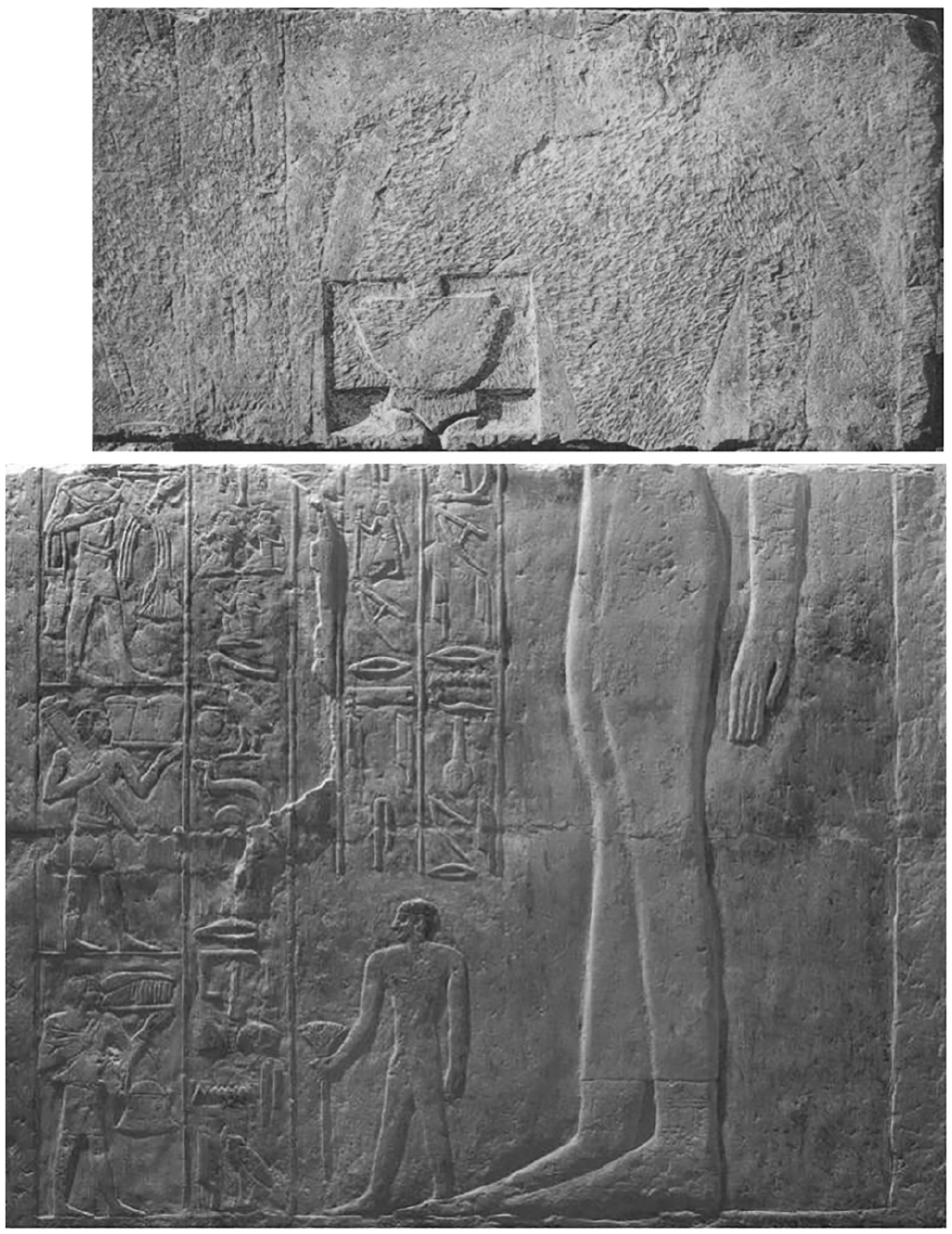
Composite image by the author with Satinteti’s offering table approximately in place on the south wall of room B5 in Watetkhethor’s chapel (detail adapted from Kanawati and Abder-Raziq, Waatetkhethor, pl. 36(a)).
It is clear from this restoration that another section of the wall is missing from above this block, as the initial part of the hieroglyphic inscription is missing. Once the block is resituated, the fuller sense of the caption becomes clearer, describing the action of male offerings bearers presenting goods from her funerary estates:
(↓←) [sḫpt nḏt-ḥr rnpwt ḫt nbt] nfrt ỉn[nt] <n>=s [ỉ]n ḥmw-kȝ nw ḏt=s r prt ḫrw n=s ỉm
‘[Bringing salutation offerings, year offerings,
10
and all] good [things], which are brought <for> her by the kȝ-servants of her estate in order that invocation offerings be made for her there.’
It is difficult to restore the first part of the inscription precisely. Based on the height of the decorated wall that survives elsewhere in room B5 there was space for several sign groups above ỉn[nt]. The inscription almost certainly related to the nḏt-ḥr offerings, a type of ‘salutation gift’ for the deceased, which included choice plants and cuts of meat and ‘all good things’. 11 The items being presented by offering bearers in the adjacent registers to the left reinforce this interpretation: they carry trays and vessels containing plants, vegetables, and other foodstuffs towards Watetkhethor and Meryteti, her son, whose name and titles partially remain above his image on the south wall of room B5 (fig. 4). A corresponding scene occurs at the northern end of the east wall, in which the offering bearers present Watetkhethor and Meryteti with fowl and cattle butchered in the adjacent registers. 12 As this scene is more complete, the restoration of the inscription there aids in proposing a fuller restoration of the inscription on the south wall. 13
The closest parallels to these scenes and their associated captions come from within the same complex, in the chapels for Watetkhethor’s husband Mereruka and her son Meryteti. 14 It is notable that in Watetkhethor’s reliefs the inscription on the northern wall elides nbt nfrt; 15 this may not have been the case on the south wall. Gunn tentatively restored a nfr sign in his transcription of the reused block, 16 and the lower part of this sign may fit the curved line that occurs to the left of -t in the earlier photograph (fig. 2). As the -t in this position would not easily match the orthography for any of the other elements in the formula, it seems likely that [nbt nfr]t can thus be restored on the south wall. The carving of the offering basin appears to have obliterated the opening signs of an inscription in two vertical columns naming Watetkhethor’s son, Meryteti, the rest of which continues on the remaining south wall of room B5 (fig. 4).
Dating Satinteti’s chapel
Satinteti’s chapel probably dates to the early First Intermediate Period (Herakleopolitan Ninth and Tenth Dynasties), and it is one of the rare instances in which a false-door with side-pieces and offering slab table were discovered and recorded with a photograph in situ in the Teti Pyramid Cemetery. 17 It is not possible to establish whether the monument was commissioned by Satinteti herself or by another member of her family. 18 As the offering table itself was not reinscribed, the dating of Satinteti’s monument rests on the wider archaeological context of the chapel and the stylistic criteria of the false-door and side-pieces. As the latter have been discussed by Edward Brovarski, 19 Khaled Daoud, 20 and Nigel Strudwick, 21 the remarks concerning the style of relief in the chapel are summarised, thus focusing on the rarer elements from Satinteti’s chapel, and further points concerning archaeological context and onomastics are added.
A pyramid town for Teti’s funerary complex
The form of a small chapel consisting of a false-door enclosed by side-pieces shares several similarities with smaller non-royal cult-offering chapels from the mid-Sixth Dynasty (reign of Pepi II) onwards; as such, Satinteti’s chapel cannot date earlier than this. 31 The particular form exemplified by Satinteti’s monument appears to be typical of false-door chapels from the Teti Pyramid Cemetery, dating between the end of the Old Kingdom and the First Intermediate Period (reign of Merikare); 32 thus, the archaeological context of monuments within the cemetery is an important factor in distinguishing diachronic development among them. Originally, Satinteti’s chapel may have been set into the east wall of a small mastaba made of mudbrick covering a burial shaft, although these features did not survive. 33 The orientation of the false-door is difficult to reconstruct from Firth’s notes, and it is possible that this was altered in the process of its reuse in the later monument of a man named Ipiankhu, enumerated HMK 26. 34 HMK 26 was located in an area dense with shaft burials between the northern face of Teti’s pyramid and the later Middle Kingdom chapels adjoining Kagemni’s mastaba. It is from this general area that a large number of false-doors and offering tables of a late Old Kingdom–First Intermediate Period type originated. Unfortunately, while their inscriptions were copied by Gunn, the locations of these monuments were inadequately documented. This complicates a clearer understanding of the archaeological (and perhaps social) relationship between these structures. Only seven false door chapels discovered during these excavations, including Satinteti’s, were given certain locations on the cemetery plan. 35 It seems that by the end of the Old Kingdom, the tombs of Kagemni and Mereruka had fallen into disrepair, and blocks from Mereruka’s tomb were reused in at least two monuments in the cemetery, including Satinteti’s.
At an indeterminable point at the end of the Old Kingdom or early in the First Intermediate Period, the streets between the large tombs north of Teti’s pyramid appear to have been cleared of the accumulated funeral chapels. New monuments were erected that replaced or added to existing chapels and earlier burial shafts were reused, often resulting in two shafts being combined to create a newly enlarged space. 36 Firth argued this was characteristic of burials dating to the Herakleopolitan Tenth Dynasty. 37 The burial shaft that may have been associated with Satinteti’s chapel seems to have been reused for Ipiankhu’s burial, dated between the late First Intermediate Period and early Middle Kingdom based on his decorated and inscribed coffin, 38 providing a terminus ad quem for the cult-use of Satinteti’s chapel. A period of time must have passed before the location was usurped and ‘built up in the later superstructure of the tomb of Ipiankhu’, 39 and according to Firth’s description, it would seem that this later structure completely removed Satinteti’s chapel (‘serdab recess’) from view. 40 Firth supposed that the burial shaft underneath Ipiankhu’s tomb belonged to Satinteti but no burial was recorded in association with this shaft, and it was noted to have been heavily disturbed. While Satinteti’s monument must predate Ipiankhu’s, establishing more precisely when the chapel was commissioned and used is more difficult; nevertheless, a tentative date-range can be provided on stylistic and palaeographic grounds.
In many respects, Satinteti’s false-door shares the general appearance of false-doors produced in Memphis from the mid-Sixth Dynasty onwards,
41
but some features indicate a date at the very end of the Old Kingdom and into the First Intermediate Period. Satinteti’s false-door and side-pieces include the orthography of imȝḫt  , without a phonetic complement or filling stroke, and they also include the epithet nfr m ỉs=s n ḫrt-nṯr following prt ḫrw; both of these criteria point to a post-Old Kingdom date.
42
The introduction of a flared central panel to false-doors in the Teti Pyramid Cemetery has been dated narrowly to the Tenth Dynasty by Brovarski.
43
This was seemingly a stylistic evolution from a panel with squared apertures (‘T-shape’) attested in the late Old Kingdom,
44
although the flared panel occurs among some late Old Kingdom false-doors originating in South Saqqara.
45
The flared central panel is shared among seventeen false-doors in the Teti Pyramid Cemetery, including Satinteti’s.
46
Among this group is the false-door of Gemniemhat (Ny Carlsberg Glyptotek AEIN 1616), which dates no earlier than the late Tenth Dynasty due to his titles associated with the priesthood of the pyramid of Merikare.
47
Gemniemhat’s burial (HMK 30) also appears to have been contemporaneous with Ipiankhu, which was the initial impression of the excavators.
48
This may point to a shared provenance of these false-doors in a local workshop associated with the community of Djedsut, but it does not provide evidence that all false-doors sharing this feature were contemporaneous. This should be called into question especially given the archaeological context of Satinteti’s chapel at a lower stratigraphic level than those of Ipiankhu and Gemniemhat, as this would indicate that her chapel predates theirs by some time (perhaps several generations).
, without a phonetic complement or filling stroke, and they also include the epithet nfr m ỉs=s n ḫrt-nṯr following prt ḫrw; both of these criteria point to a post-Old Kingdom date.
42
The introduction of a flared central panel to false-doors in the Teti Pyramid Cemetery has been dated narrowly to the Tenth Dynasty by Brovarski.
43
This was seemingly a stylistic evolution from a panel with squared apertures (‘T-shape’) attested in the late Old Kingdom,
44
although the flared panel occurs among some late Old Kingdom false-doors originating in South Saqqara.
45
The flared central panel is shared among seventeen false-doors in the Teti Pyramid Cemetery, including Satinteti’s.
46
Among this group is the false-door of Gemniemhat (Ny Carlsberg Glyptotek AEIN 1616), which dates no earlier than the late Tenth Dynasty due to his titles associated with the priesthood of the pyramid of Merikare.
47
Gemniemhat’s burial (HMK 30) also appears to have been contemporaneous with Ipiankhu, which was the initial impression of the excavators.
48
This may point to a shared provenance of these false-doors in a local workshop associated with the community of Djedsut, but it does not provide evidence that all false-doors sharing this feature were contemporaneous. This should be called into question especially given the archaeological context of Satinteti’s chapel at a lower stratigraphic level than those of Ipiankhu and Gemniemhat, as this would indicate that her chapel predates theirs by some time (perhaps several generations).
Satinteti’s false-door and side-pieces include several atypical features that are also noteworthy for dating. Her tabular offering list is substantially longer than most other offering lists on side-pieces that survive from this cemetery, occupying the upper half of both the right and (fragmentary) left side-pieces; the right side-piece includes 97 elements. 49 The offering list is not known to occur on side-pieces in this form before the First Intermediate Period, 50 and this development appears to mark the evolution of the false-door niche at Saqqara into a fully-fledged ‘microcosm of the tomb superstructure.’ 51 During this period and later there was a trend to reduce the tabular offering list on the side-pieces, as also found on decorated coffins from the mid-Sixth Dynasty onwards, 52 while more space was devoted to visual representations of offerings and burial goods. 53 This is a strong indication that Satinteti’s monument dates earlier in the First Intermediate Period and not later. Satinteti is represented on three of the lower jambs as standing and holding a lotiform staff (fig. 5a). The latter is very rare among representations of non-royal women before the Eighth Dynasty, which is compelling evidence for a dating of the false-door to this period or soon after. 54
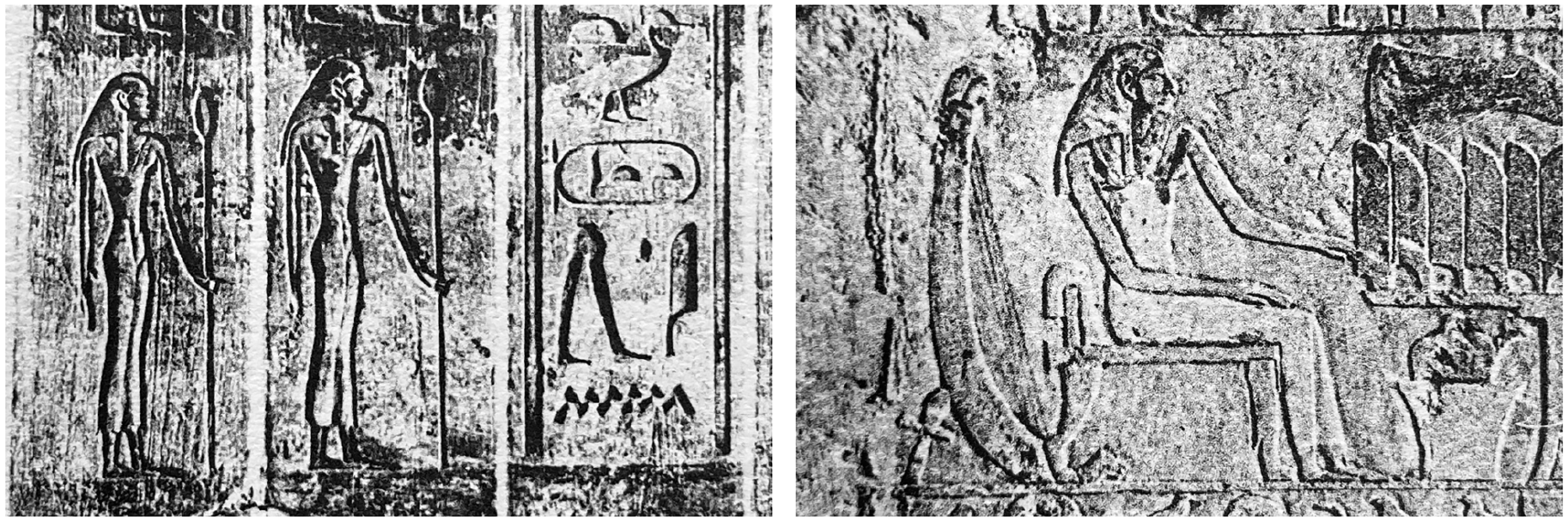
Satinteti in two different stances: Left (a) holding a lotiform staff, from the lower left jamb of her false-door; Right (b) Satinteti seated at her offering table on the right side-piece, with a harp supported by an ankh-sign placed behind her. The presence of a nasolabial fold at the edge of her cheek may indicate that she is older in this representation (details adapted from Firth and Gunn, TPC II, pl. 21).
As noted by Lubica Hudáková, 55 the lotiform staff was especially associated with the priesthood of Hathor, and as Satinteti’s titles include ḥm[t]-nṯr Ḥwt-ḥr ‘Priestess of Hathor’, this is the most probable explanation for her representation in this manner. 56 Yvonne Harpur has argued that the lotiform and papyriform staves held by women may have developed out of the representation of women holding a long-stemmed lotus reminiscent of a staff, 57 a motif well-attested among representations of women in Memphis including Watetkhethor.
A further unusual motif is the arched harp on the right side-piece, which has been placed behind Satinteti, who is seated at her offering table (fig. 5b). The harp is represented in profile with a human head and leonine foot, and it is supported at its base by an ankh-sign. The shape of the harp is an ‘intermediate’ between the more commonly attested shovel-shaped harp of the Old Kingdom and the ladle-shaped and boat-shaped harps that developed later, a form which was also common in Middle Kingdom representations of harps. 58 While Brovarski has postulated that the inclusion of the harp on Satinteti’s monument may be ‘a rare instance of the intrusion of the personality and pastimes of the owner’, 59 it is more probable that these motifs—the harp and its support by an ankh—signify Hathoric cult items and Satinteti’s position as a Priestess of Hathor. 60 This religious title was acquired and not inherited, and its holders were not members of a professional class by virtue of it; 61 therefore, the inclusion of these motifs probably served to underscore Satinteti’s role in Hathor’s priesthood in Memphis, signalling that this was integral to the display of her status.
On onomastic grounds, Satinteti’s name alludes distantly to the post-mortem veneration of the deceased King Teti, which also suggests a late Old Kingdom to First Intermediate Period date for this chapel.
62
Satinteti’s name deictically expresses filiation to a man named Ttỉ-ỉn[ỉ] (‘The one brought by Teti’), who was probably her father. In its fullest form, the internal orthography of the name places Teti’s cartouche in honorific transposition before the lexeme ỉn(ỉ). This writing occurs on the inner jambs closest to the emblematic entrance on the false-door, and once on the left side-piece in a caption narrating the preparation of a bull for slaughter. The shortened form of the name 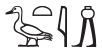 is attested in all other places on the false-door, with the cartouche and phonetic complement -n omitted. The orthography of the name on the upper right side-piece is notable as a gap occurs after the lexeme ỉn(ỉ), and here the phonetic complement -n is included. In this example, other elements of the name were composed at a smaller scale to accommodate several group-writings. It can be speculated that this was a mistake if the intention was to include the cartouche of Teti, which would ordinarily occur in the initial position and not at the end where the gap falls. The attention to these orthographic variations of Satinteti’s name demonstrates that the decorum surrounding basilophoric names in their hieroglyphic form persisted long after the death of the king whom they honoured.
63
is attested in all other places on the false-door, with the cartouche and phonetic complement -n omitted. The orthography of the name on the upper right side-piece is notable as a gap occurs after the lexeme ỉn(ỉ), and here the phonetic complement -n is included. In this example, other elements of the name were composed at a smaller scale to accommodate several group-writings. It can be speculated that this was a mistake if the intention was to include the cartouche of Teti, which would ordinarily occur in the initial position and not at the end where the gap falls. The attention to these orthographic variations of Satinteti’s name demonstrates that the decorum surrounding basilophoric names in their hieroglyphic form persisted long after the death of the king whom they honoured.
63
Very few names of this type (Zȝ/.t-N) are known among women before the reign of Pepi I, and they seem to occur more towards the end of the Old Kingdom. 64 A close parallel to this name is Zȝ.t-’In(i)-it=f (‘Daughter of Inyitef’), 65 from a false-door of unknown provenance (probably Saqqara) now in Berlin (ÄM 7718). Another is Zȝ.t-Gmn(ỉ)-ḥtp (‘Daughter of Gemnihetep’), 66 discussed below. In addition to Satinteti’s name, the syntax and semantic content of Satgemnihetep’s name, belonging to one of the named female offering bearers on Satinteti’s right side-piece, demonstrate that it almost certainly post-dates the Old Kingdom. 67 Satgemnihetep is an exophoric name that deictically references her father Gmn(ỉ)-ḥtp (‘Gemni is satisfied’), whose own anthroponym honoured the vizier Kagemni. This phenomenon in onomastics concerning the lexeme Gmn(ỉ) is particularly local to the community buried in the Teti Pyramid Cemetery between the end of the Old Kingdom and the early Twelfth Dynasty. 68 These names are similar in a sense to an earlier name, N(y)-s(ỉ)-nzwt (‘She belongs to the king’), 69 but the desired closeness is expressed in more literal and bodily terms. Decorum surrounding expressions of filiation to the king in titles and personal names appears to have relaxed towards the end of the Old Kingdom. 70 This demonstrable growth of vocabularies of filiation (in names and titles) may indicate the lifting or shifting of restrictions around how one could express closeness to deities and the king. While earlier in the Old Kingdom the honorific use of such titles appears to have been actively discouraged, 71 towards the end of the Old Kingdom and in the First Intermediate Period this practice may have prominently marked local networks of professional connectedness and kinship. 72
The sum of the evidence points to a dating for Satinteti’s chapel between the end of the Old Kingdom (Eighth Dynasty and later) and the early First Intermediate Period, some time before the chapels of Gemniemhat and Ipiankhu were built. In particular, the archaeological association between Satinteti’s chapel and Ipiankhu’s burial monument, specifically the incorporation of her chapel in this later structure, is the clearest evidence of a passage of time between the establishment of Satinteti’s chapel and the usurpation of its location for a new monument. The reuse of a decorated block from Watetkhethor’s chapel for Satinteti’s offering table also obliquely indexes the depth of time between the cultic use of the chapel and the reuse of its fallen blocks, which probably did not occur during the Sixth Dynasty. 73
Why reuse a block from Watetkhethor Zeshzeshet’s chapel?
Leire Olabarria has made a compelling case that funerary stelae are active participants in the networks of people and monuments that converge in a funerary landscape: they are ‘not simply an addition to pre-existing landscapes, but an integral component of them.’ 74 Olabarria focuses especially on Middle Kingdom Abydos for her discussion, but this perspective is equally informative when applied to the religious landscape of the Teti Pyramid Cemetery in the late Old Kingdom and First Intermediate Period. While the false-door and side-pieces of Satinteti’s chapel carry inscriptions that offer the most information about Satinteti’s profession and status to Egyptologists, core elements of the monument have been disassociated from it during the history of its excavation. These hint at how she—and her monument— articulated relatedness to her community. The offering table was an integral part of the chapel’s intended function for the performance of cult and provision of offerings. It also reflects the practice of adapting and repurposing earlier monuments to meet contemporary needs. 75
The ancient use of the cemetery by the community of Djedsut, especially during the period of the late Old Kingdom through the First Intermediate Period during which Satinteti lived and was buried, is only distantly echoed in the cemetery’s current state as an archaeological site. The photographs of the chapel in situ, and the in-progress excavations of this part of the cemetery between 1920–22, reveal clear competition for space to display in the cemetery. The reuse and usurpation of earlier burials and monuments must be viewed through this lens. It is unlikely that erasing the image of Watetkhethor was connected to damnatio memoriae, like that found in other parts of the Teti Pyramid Cemetery during the mid-Sixth Dynasty. 76 René van Walsem has discussed the opposition between discourse and practice evident in this obliteration and borrowing from other monuments, which was relatively widespread in ancient Egyptian cemeteries. 77 Egyptian ethics condemned such actions, as found in the Teaching of Merikare (l. 78–9): 78 ‘do not destroy the monument of another… do not build your tomb out of the demolition of what has been made’; yet, such practices clearly occurred. Arguably, they may have been condemned in ethical texts precisely because they were common. This situation is exemplified on a massive scale in the reuse of earlier royal monuments in the construction projects of later kings. 79 The dismantling of earlier tombs in the Teti Pyramid Cemetery appears to be attested from its conception as a royal cemetery site. For example, a fragment of a decorated block carved in shallow raised-relief, featuring the lower half of a scene of antelopes and possibly a scimitar oryx being driven by two men, is found set into the floor of Mereruka’s chapel in room A9, under the join with the west wall. 80 This almost certainly originates from a Fifth Dynasty non-royal monument, although it is impossible to determine which one. The reuse of Sixth Dynasty monuments in later chapels is also attested in the Teti Pyramid Cemetery, and in addition to Satinteti’s offering table the excavators noted that a fragment of a stela belonging to an individual named Nesuserti bore a part of a relief from the mastaba of Mereruka. 81 This monument, which was not published in the volume, may be related to the owner of a false-door now in the Cairo Museum (CG 57186). 82
Rather than evincing a negative act towards the memory of Watetkhethor, the reuse of a block from her chapel for Satinteti’s offering table could hypothetically be attributed to admiration and active imitation of this earlier, very eminent woman who was also a Priestess of Hathor. Watetkhethor’s role was prominently displayed in Mereruka’s complex, 83 and on her own false-door; 84 she is also depicted playing the harp before her husband in a particularly rare scene in Mereruka’s complex. 85 Direct evidence for such a relationship or intentional mimicry is lacking; 86 however, it is important to recall that the recarving of the offering basin avoids mostly further cutting into Watetkhethor’s image, even though the erasure of the images and signs results in the ‘deactivation’ of their reference to her. If this was done out of respect to the specific woman from whose monument the relief block originated, at the very least it indicates a respectful gesture to the previous life of the block bearing a human image in a sacred space, from the cultic heart of Watetkhethor’s chapel. Other explanations should not be excluded. Satinteti’s chapel was established close to Mereruka’s complex in an area of dense burial activity between the late Old Kingdom and early First Intermediate Period, and practical reasons may have governed the choice of the block, as it could be sourced from close-by. Yet, even if this were the case, the choice of location may nonetheless have been guided by a desire to be close to celebrated occupants of the Teti Pyramid Cemetery—not only King Teti himself, but also Mereruka, Watetkhethor, and Kagemni.
Conclusion
Satinteti’s chapel reflects the complex social and architectural history of the Teti Pyramid Cemetery between the end of the Old Kingdom and the First Intermediate Period. The reuse of an earlier monument is not exceptional in and of itself and Satinteti’s own chapel was later subsumed into that of Ipiankhu; however, the meaning inherent to this action is bound up with the locality in which it occurred. Recontextualizing the offering table with the rest of Satinteti’s chapel provides a fuller record of the site at which her memory was celebrated; similarly, attention to the offering table’s provenance within the wider cemetery enriches the life-history of both Satinteti’s and Watetkhethor’s monuments. Such reuse materializes the entanglement of the lives and afterlives of two women through the production of monuments to honour their names and images in perpetuity.
Footnotes
Acknowledgements
With thanks to Stacey Leonard (Museum of Fine Arts, Boston) for confirming details about the acquisition of Satinteti’s false-door and side-pieces, and Melanie Pitkin (Chau Chak Wing Museum, University of Sydney) who shared advance chapters of her forthcoming monograph on the dating of First Intermediate Period false-doors and stelae.
Funding
The author disclosed receipt of the following financial support for the research, authorship, and/or publication of this article: Research for this article was carried out in Saqqara (January– February 2019) courtesy of a doctoral bursary awarded by Institut français d’archéologie orientale, Cairo.
