




Abstract
When constructing the rock-cut tombs in the Theban necropolis, the ancient Egyptian builders kept track of the progress by recording the amount of rock that was excavated. This is clear from Eighteenth Dynasty ostraca from the tomb chapel of Senenmut, TT 71, which record stages of excavation and measure the production output in units of dnỉ. The current article reconfirms the observations of J. Černý on the dnỉ-unit and its usage as a measure exclusively for capacity, particularly in building projects involving excavation of rock. From this, the article outlines the implications for the understanding of other tomb construction terminology, in particular the ȝʿʿ, the šʿd and the dḳr. The consequence is to acknowledge that the tomb builders of Senenmut only recorded progress of excavation, and not different stages of decoration. In addition, the article suggests that baskets filled with stone flakes at Deir el-Bahri from the Middle Kingdom may represent a practical use of the dnỉ-unit.
Keywords

When constructing the rock-cut tombs in the Theban necropolis, the ancient Egyptian builders kept track of the progress by recording the amount of rock that was excavated. This is evident from hieratic ostraca dating to the early part of the Eighteenth Dynasty, in particular from the tomb chapel of Senenmut, TT 71. Found within and below the courtyard of this tomb and published in 1942 by William C. Hayes, 1 these ostraca (hereafter referred to as the Senenmut ostraca) primarily record and describe the excavation, cutting and shaping of rock prior to any stages of painted decoration. 2 Several of the different tomb building tasks referred to in the texts are linked by having their daily results recorded by the same unit of measurement, namely the dnỉ, which has been firmly established by J. Černý as a measure for capacity equal to one cubic cubit. 3 At the same time, Černý suggested that the dnỉ was simply a basket, dnyt, which became a standard measure for stone chips.
The current article reconfirms Černý’s observations as to the size of the dnỉ and its usage as a measure exclusively for capacity, particularly in building projects involving excavation. It will also be suggested that the dnỉ-measure was already in practical use during the Middle Kingdom at Thebes, and that it possibly has been found archaeologically as baskets filled with stone flakes at Deir el-Bahri. In addition, the article will outline the significance of the reconfirmation of the dnỉ being a measure of capacity in regard to the understanding of the tomb construction terminology used in the Senenmut ostraca, in particular the ȝʿʿ, the šʿd and the dḳr. The consequence is first and foremost to acknowledge that the builders of the tomb of Senenmut only recorded the progress of excavation and not decoration. Furthermore, because the same focus on excavation progress is found in and supported by other textual sources from the Theban necropolis, this approach seems to have been the normal way in which a rock-cut tomb at a practical level was managed during its construction.
Translations of dnỉ
There are several translations for and interpretations of the word dnỉ, which additionally occurs in numerous texts that have nothing to do with the excavation of tombs. Traditionally, dnỉ has been associated with ‘dam’ or ‘dike’. 4 For example, when analysing an ostracon from the Osireion of Seti I in Abydos, B. Gunn translates two instances of dnỉ occurring in the same line 5 as both ‘dike-making’ and as ‘dike’ (the latter instance specified as pȝ dnỉ). 6 The same passage is translated by K. Kitchen as ‘dyke (-making)’ and ‘canal’. 7 In the Hymns to King Senwosret III (P. UC 32157, 2,12) 8 dnỉ is used as a verb with the meaning of ‘stop’, ‘restrain’, or ‘dam up’: ‘Truly, he is the dam (or bulwark) that stops (or restrains) the river (ỉsw ʿ pw dnỉ ỉtrw)’. In a tomb construction setting, such a meaning could, perhaps, be used in relation to the building of retaining walls above the façade of the private Theban tombs or on either side of the characteristic open courtyards. However, neither dam nor canal or other related words seem to be applicable for the Senenmut ostraca. Here the term dnỉ is mentioned a total of ten times in six different documents, 9 and in every instance relates to work that has been done inside the tomb. The term is mentioned in the text alongside a numerical value that signifies a daily production result and it has in this context previously been translated as ‘section’ or ‘area’. 10 Certainly for Hayes it signified a measure of a two-dimensional area of a surface. 11 However, this interpretation is never substantiated or specified in any of the Senenmut ostraca. It seems that Hayes translated dnỉ as ‘sections’ or ‘area’ because of his understanding and translation of the three construction terms ȝʿʿ, šʿd and dḳr, which he interpreted as having to do with working, plastering and decorating wall space. 12
W. Helck refers to a special kind of dnỉ-basket which was explicitly said to have been woven from reed grass and other similar materials. 13 Similarly, but focusing mainly on the price of various objects, Jac J. Janssen described the dnỉ(t) on the one hand as a basket, but on the other hand accepts Hayes’ definition of dnỉ being a measure, in particular for work done on a ‘section’ or ‘area’ of a wall. 14 In analysing O. Ashmolean Museum 183 (O. Gardiner 183), 15 Janssen cautiously attempts to set a price on labour cost for work done in decorating an unspecified tomb based on a number of dnỉ mentioned. 16 The ostracon does mention deben prices for work on a coffin and has an incomplete mention of a tomb (ʿḥʿt) on the recto, but the two mentions of dnỉ on the verso do not appear to have a conclusive connection to the work on the coffin or the possible work in the tomb. 17
Textual Sources
Černý refuted the translation of the dnỉ as ‘area’ by drawing attention to O. Gardiner 51 (O. Ashmolean Museum 57) and O. Gardiner 26 (O. Ashmolean Museum 26). 18 The latter text contains a line (l. 5), which reads: ‘6 cubits by 2 cubits (by) 4 cubits (in) depth, making 48 dnỉ (mḥ 6 r mḥ 2 mḏwt mḥ 4 ỉrỉ.n dnỉ 48)’, 19 clearly demonstrating the three-dimensional aspect of the dnỉ-measure. From the two texts, Černý concluded that the dnỉ must be equal to a measure of capacity of 1 cubic cubit, most probably a basket, and stated that ‘it is natural that the cubit should be not only a unit of length but also the basis of capacity’. 20 Thus following Černý and the reading of O. Ashmolean Museum 26, R. Hannig defines the dnỉ as a ‘Kubikelle’. 21 In his PhD thesis on the ancient Egyptian cubit, A. Hirsch came to the same conclusion as Černý and defined the dnỉ as a cubic cubit and, as a major part of his argument, linking it to the royal system of measurements, i.e. to the cubit. 22 In preparing a publication of a number of ostraca from Deir el-Bahri, M. Römer also interprets the dnỉ as a measurement, possibly a container and very likely a basket for determining a volume of stone. 23
In addition to O. Ashmolean Museum 26, the following papyri from the Twentieth Dynasty demonstrate that when referring to the dnỉ, the Egyptians were in fact using a measure for capacity. This capacity or volume consisted of three different measurements of cubit-lengths that when multiplied together resulted in a number that was preceded by the dnỉ as a unit. The verso of P. Turin 1923 is a survey of the already constructed hallways in the tomb of Ramesses V and VI (KV 9), as well as calculations for future productivity in excavation that was needed in order to complete the remaining elements of the tomb. 24 Line 8 reads: ‘(a hallway) which is after it: (length) of 15 cubits, width of 6 cubits, height of 7 cubits, making 630 (dnỉ) 25 (nty ḥr sȝ=f n mḥ 15 wsḫ n mḥ 6 ḫyt n mḥ 7 ỉrỉ.n 630)’. A similar phrasing is found on P. Turin CGT 55002, 26 which on both sides depict a plan of KV 2 (Ramesses IV) annotated with hieratic writing and dimensions. The recto, which portrays an initial plan of the tomb, 27 contains the following phrase: ‘The noble treasury: (length of) 6 (cubits), width of 6 cubits, height of 5 cubits, (making) 216 dnỉ (r-ḥḏ špsy [n mḥ (?)] 6 wsḫ n mḥ 6 ḫyt n mḥ 5 dnỉ 216)’. 28 The scribe of the latter phrase’s inability to correctly calculate the result notwithstanding, the sequence of the cubit measurements in the two examples illustrate the fact that the Egyptians thought of the dnỉ as having three dimensions. The same sequence of dimensions in cubits can be found several times in P. Turin Cat. 1885 29 and a single occurrence in P. Cairo JE 52002, 30 although without any mentions of the dnỉ-unit in either document. Nevertheless, based on the content of the texts and on the examples given here, we may with some confidence assume that the dnỉ was implicit.
In a similar way, the results of two pieces of work are recorded on O. Senenmut 76 without mentioning the dnỉ, but very clearly referring to volumes: ‘The work of Kay: the […] width 2 cubits, depth 2 cubits […] by 7 cubits. The other activity (?)[…] 5 cubits, depth 4 cubits, by 7 cubits (pȝ bȝkw n kȝy tȝ […] wsḫ mḥ 2 mḏwt mḥ 2 […] r mḥ 7 pȝ ky r-a[… wsḫ] mḥ 5 mḏwt mḥ 4 r mḥ 7)’. 31 This way of recording is, however, uncommon for the Senenmut corpus and the results of work are usually denoted by the dnỉ-unit followed by a number. A close parallel to this way of recording is found in a similar, albeit smaller, unpublished ostraca corpus from TT 29. 32 These texts document the construction of TT 95, which is situated just above and to the west of TT 29 on the Sheikh Abd el-Qurna hill. TT 95, which is currently being excavated and studied by the University of Basel (directed by A. Loprieno-Gnirs), belonged to the High Priest of Amun, Mery, from the time of Amenhotep II. Where the term dnỉ occurs in the TT 29 ostraca, 33 it records the work of either stonecutters (ẖrty) or men carrying rubble (ḫmʿ), most often compiling the numbers into monthly results. Noticeably, all the dnỉ amounts recorded in the TT 29 corpus are ‘neat’ numbers (e.g. 15, 20, 30, and 45) and it is therefore possible that the records show not the achieved work but instead the intended work, i.e. budgeted work quotas. This tenuous interpretation would, however, depend greatly on the actual moment of writing, which is difficult to ascertain. What this corpus clearly demonstrates, however, is the fact that the work output was recorded in the dnỉ-measure, which, due to the lack of any other terminology, suggests that the records concern the measuring of stone work and indeed the removal of stone (ḫmʿ). 34
The dnỉ-Measurement from a Practical Point of View
Compared to the geological composition of the western part of Sheikh Abd el-Qurna in which TT 95 is situated, 35 TT 71 was built in an area where the local limestone is of relatively poor quality, 36 which at some point later in time no doubt contributed to the complete collapse of the ceiling in the north end of the transverse hall. Near the top of Sheikh Abd el-Qurna the limestone is coarse, friable, perforated with intrusions of sedimentary gravel, and filled with cherty nodules of flint and other types of harder stone. 37 Also, the top of the hill is generally riddled with fractures and fissures that make the stone relatively weak and therefore not particularly suited for sculpted underground structures, as evidenced by TT 71 and the surrounding tombs, e.g. TT 72 (Re), 38 TT 73 (Amenhotep), 39 TT 120 (Anen), 40 and TT 121 (Ahmose). 41 The general excavation of rock is therefore unlikely to have happened in neat blocks of stone, but rather as loose stone flakes and compressed gravel. Recording the progress of tomb production based on the removal of such materials could be achieved by simply filling and counting containers of roughly similar proportions. From a practical point of view, this would entail removing the materials not in vessels with the capacity of a cubic cubit (144.7 litres), but rather in smaller and more manageable containers, 42 perhaps leather sacks or wicker-work baskets. 43 Once outside the tomb, the workers could transfer the collected limestone rubble to dnỉ-baskets (or bags), making sure to fill them to the brim in order to standardise the measure in which a scribe could then count and record.
Archaeological evidence from the excavation of another Theban monument, albeit from the Middle Kingdom, supports the interpretation of filled containers standing in rows for the scribe to count and record. In 1921, H. Winlock and the Metropolitan Museum of Art Egyptian Expedition uncovered 50 baskets standing in a number of rows outside the southern parapet wall of the court at Mentuhotep II’s mortuary temple in Deir el-Bahri (fig. 1). The baskets were left between two building phases and not removed when work recommenced because they were too rotten and therefore impossible to move while filled and were as a result simply covered and incorporated in the later building phases. 44
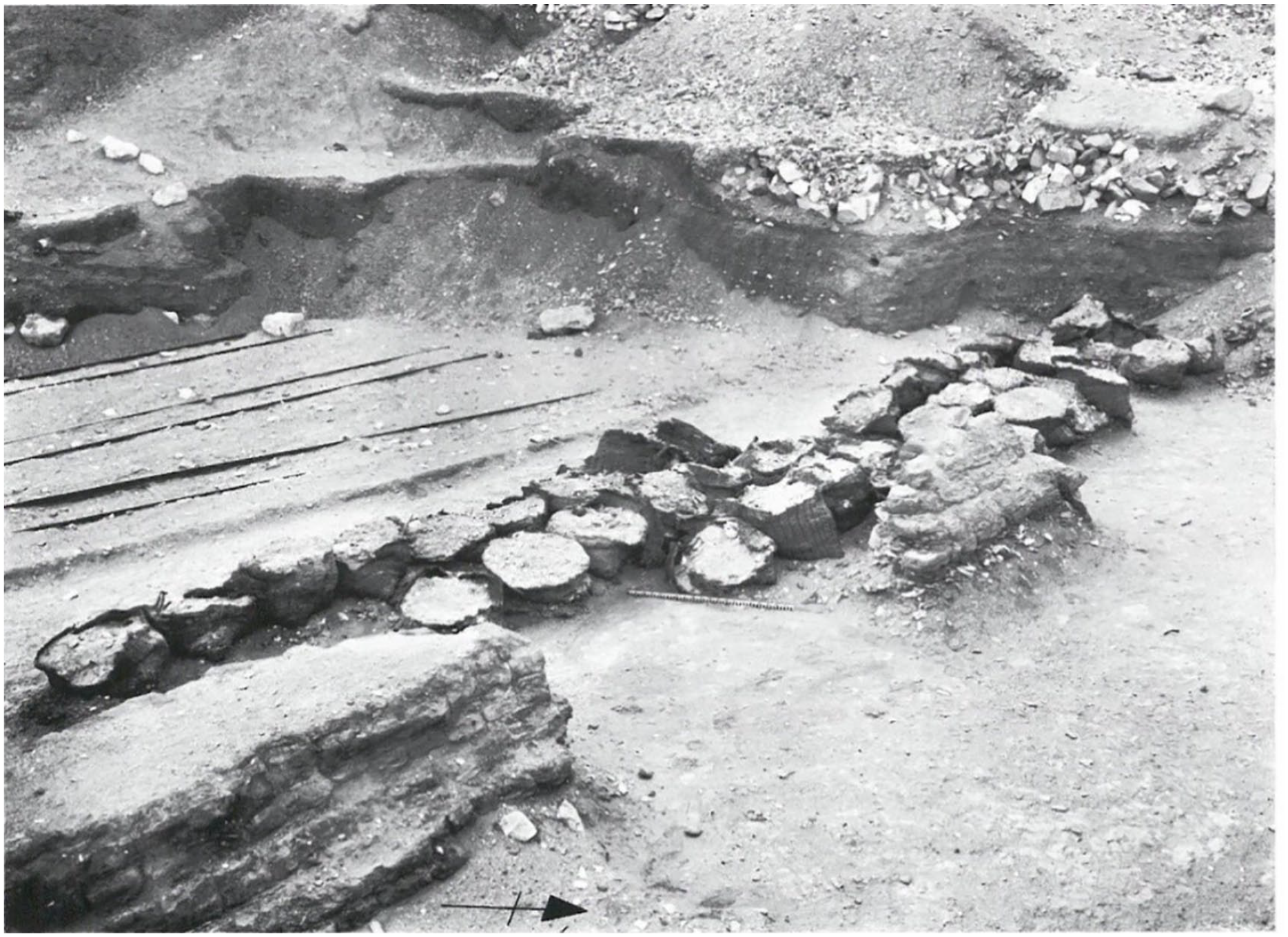
50 baskets in four rows containing limestone flakes, rubble and sand. The scale in the centre of the image in front of the baskets is 1 meter (photo: from Arnold, Temple of Mentuhotep, pl. 36c).
The baskets were filled with stone flakes (fig. 2) and, due to their condition, not moved by the ancient Egyptian ‘basket boys’ as D. Arnold labelled them. 45 The reason for storing the baskets in lines is not completely clear, but with the image of a scribe recording the progression of the building process, the suggestion that the baskets were awaiting documentation is plausible. If they had been counted and recorded, one would assume that they would have been emptied and reused elsewhere.
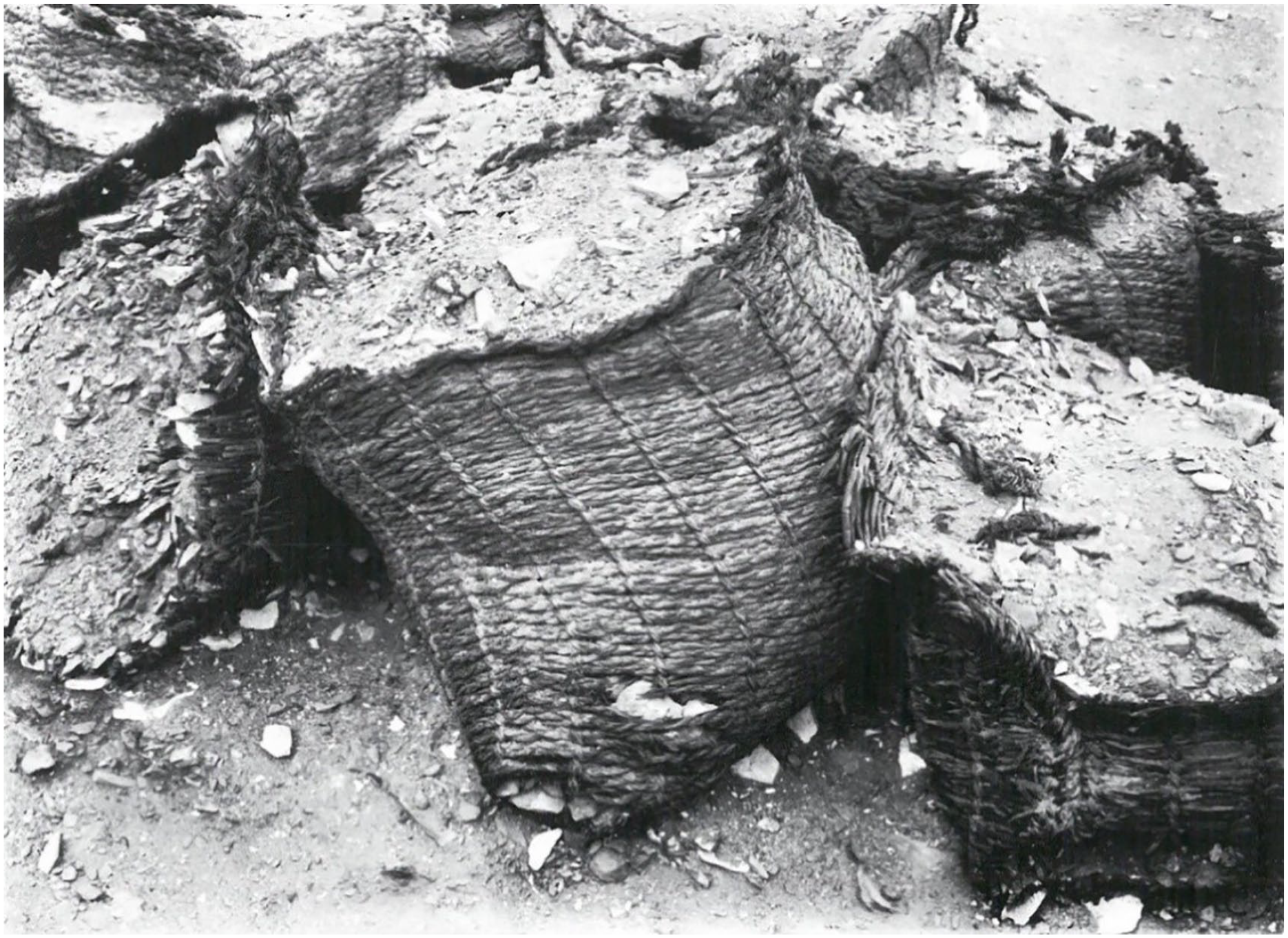
Close-up of baskets filled with limestone flakes, rubble and sand (photo: from Arnold, Temple of Mentuhotep, pl. 36d).
The same excavation uncovered another two baskets of rope (fig. 3); however, these baskets were empty and found within the temple area proper. 46 The baskets were found on top of the foundation blocks inside the south retaining wall of the ramp, behind the north-western corner of the south lower colonnade wall. Thus, there can be little doubt that they are from the time of the construction of the ramp and artificial terrace of the temple. 47 Whether called a basket or a bag, these two have the approximate dimensions of the cubic cubit, both exceeding the 52.5 cm of a royal cubit in length but not quite in width. Depending on the stretching capabilities of the material, which appears to be woven thread, it is plausible that they could contain approximately 144.7 litres. The scale used in figure 1 also suggests a similar capacity for the 50 baskets found standing in rows.
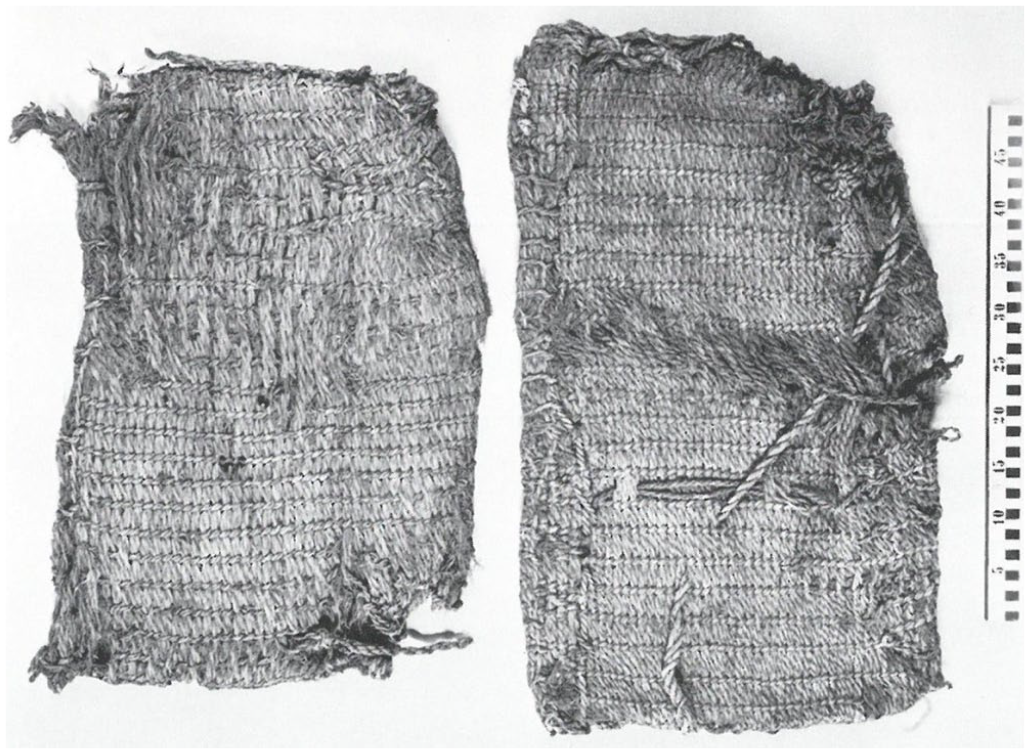
Two baskets found in the temple area of Mentuhotep II in Deir el-Bahri (photo: from Arnold, Temple of Mentuhotep, pl. 35c).
This means that these baskets were fairly large, possibly too large and heavy when filled than what a single person could lift and carry. From other textual sources come indications of the use of such baskets precisely because they were large. In the Eighteenth Dynasty funerary papyrus of Nebseni, which contains Spell 172 of the Book of the Dead, a passage reads: ‘NN has breath, his nose has air. (He has) 1000 geese and 50 dnỉ-baskets 48 of all good and pure things’. 49 From the content of the text it is clear that this refers to large baskets, i.e. a large volume of all good and pure things. The same is clear from a partial offering list of Amenhotep IV at Karnak, where four entries for products are defined by the use of dnỉ-measurements. For example, incense: 2 dnỉ, and fruit: 2 dnỉ. 50 Here, the unit is without a doubt a three-dimensional container, but it is unclear whether it is a basket or another form of vessel. Several other examples can be cited where a translation of dnỉ as basket or vessel is preferable. 51
Tomb Construction Terminology
Where it occurs in the Senenmut ostraca, the dnỉ-unit probably also refers to the use of a physical object, most likely a sack or a basket, with a capacity of approximately 145 litres, corresponding to one cubic cubit (52.5 cm3 or 0.1447 m3). 52 Hence, the construction terminology recorded in the Senenmut ostraca is unlikely to refer to stages of the decoration as previously interpreted. 53 This interpretation stems from the misconception of the term dnỉ, having been thought of as a vague and/or flexible unit that could be used in measuring both surfaces as well as capacities. This is not only impractical but also unnecessary as the ancient builders already utilised the cubit rod (and to a lesser extent the nbỉ rod) to indicate measures of area. The terms šʿd, ȝʿʿ, and dḳr are all recorded in the Senenmut ostraca alongside a numerical value, i.e. a result, which are signified as units of dnỉ. 54 Therefore, each of these construction tasks produced results that was measured in volume, which in turn merits a reinterpretation of each term and purpose within the tomb construction process.
šʿd - cutting of stone
The meaning of the word šʿd is fairly well established and usually relates to cutting by means of a tool made of metal. 55 The use of the knife determinative (Gardiner T30) in all the examples from the Senenmut ostraca makes a similar interpretation plausible. 56 Hayes translated šʿd as ‘cut’ or ‘trim’ in the ‘work documents’ and envisioned an edged tool used in an operation of truing the wall surfaces after the initial excavation. 57 In another ostracon (O. Senenmut 86, l. 8), Hayes translated the word as ‘sawyers (of wood)’, 58 which seems appropriate as the document is a list of people with various professions. 59 Thus, šʿd basically means ‘to cut’ in most circumstances, 60 but can also be translated as ‘to trim’ in the context of tomb construction. In the Senenmut ostraca dealing with construction, šʿd very likely refers to the straightening of the walls and ceilings after the initial excavation. That šʿd is unlikely to describe the initial excavation, or the cutting of virgin rock, is clear because it is always recorded in the Senenmut ostraca as having produced relatively low numbers of dnỉ, between ½ and 2, 61 and always fewer than both dḳr and ȝʿʿ (see below), which perhaps is because it was a slower process or required more precision.
ȝʿʿ - reconstruction and repair
Most occurrences of the term ȝʿʿ are translated in a way that relates to the process of plastering or repairing. 62 In his review of the Wörterbuch der Aegyptischen Sprache, Gardiner refers to ‘a hieratic ostracon (Twentieth Dynasty) acquired for the Ashmolean Museum’ in which he translates ȝʿʿ as ‘to patch up’. 63 B. Bryan describes the ȝʿʿ-procedure as a ‘plastering to fill in wall gaps, hide rock deficiencies, and create a surface for decoration’. 64 While this interpretation seems likely, the problem is that when it occurs in the Senenmut corpus, 65 the ȝʿʿ-task is not measured in, for example, the menet-jars, 66 in which normal plaster (kḏw) was brought to the construction site. 67 In fact, where the number is preserved, the ȝʿʿ was recorded in resulting in quantities of between one and twelve dnỉ . 68 The present appearance of TT 71 reveals that the walls and ceiling had been heavily patched and reconstructed in many places using limestone flakes that are set in a coarse pinkish mortar or plaster. 69 In certain places this was then covered by a layer of the same kind of mortar but without the inclusion of limestone flakes, 70 and then, a finer plaster of lime or gypsum was applied as a basis for the painted decoration (see fig. 4). 71 I therefore suggest that the application of the mortar with limestone flakes represents the ȝʿʿ-procedure. The remaining problem is to explain the measuring of ȝʿʿ in dnỉ quantities.
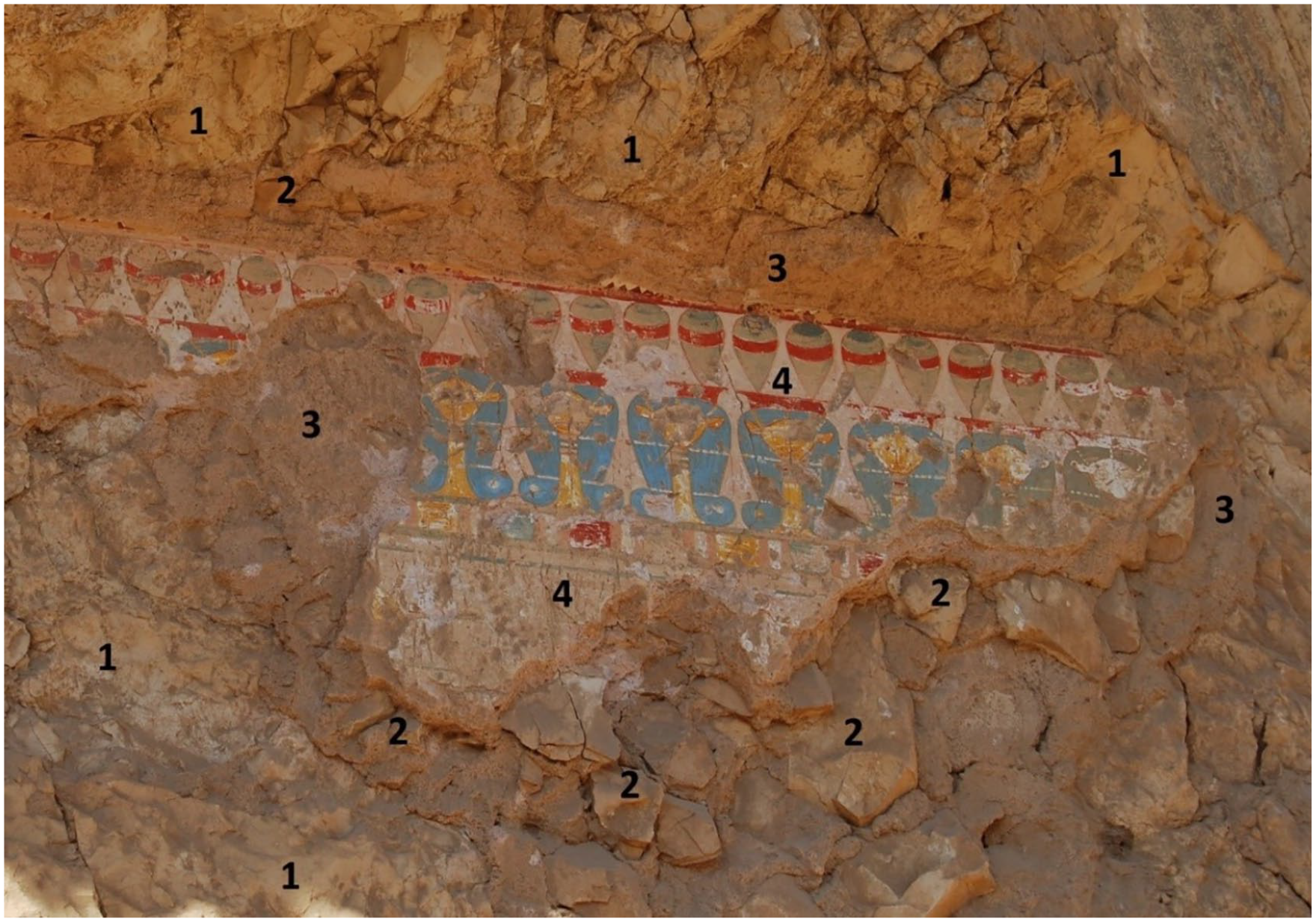
North-western wall of the transverse hall in TT 71, illustrating the stages of ȝʿʿ. 1) Natural rock; 2) primary stage of ȝʿʿ (coarse mortar with heavy inclusions of limestone flakes); 3) secondary stage of ȝʿʿ (coarse mortar); 4) fine gypsum plaster with coloured decoration (photo: Heidi Kontkanen, 2011).
In the textual material, it is the workman Sennefer who in each instance performs the ȝʿʿ-procedure. He is in O. Senenmut 65 called the ‘reinforcer’ (sḳn) and in O. Senenmut 69 the ‘shorer’ (twȝw), both titles suggest an aspect of building, i.e. of adding material in contrast, for example, to a stonecutter who removes material. This building aspect provides an important clue to the measuring of ȝʿʿ in dnỉ, which may not have been removed from the tomb, but rather brought back inside and added to the walls and ceilings along with the coarse mortar. Whether the dnỉ-baskets were simply being hauled inside again or whether the ḫmʿ-crew had to unload them into smaller containers is not clear, but we can observe a similar situation in the TT 29 ostraca. On the verso of O. 291437, the ȝʿʿ is mentioned alongside the terms dnỉ, ḫmʿ, plaster (ḳḏw), and menet-jars. I therefore argue that the recording of a dnỉ-measure in connection with the ȝʿʿ-procedure points to the limestone flakes already removed by the initial excavation, having been counted outside the tomb, being brought back inside to be used with a coarse mortar in the repairing of the walls and ceilings.
Dqr - working with stone
The term dḳr refers to a rough or ‘normal’ smoothing or outlining of features depending on the stone and place. It is very likely related to the verbs dḳ, ‘to grind’, 72 and dgȝ, which relates to stonework or building in stone. dḳr occurs only once in the Senenmut corpus, 73 where the stonecutter Teti was recorded as having produced 2 dnỉ, which is the equivalent of 289.4 litres or about 750–810 kilos depending on the density of the limestone, the size of the limestone flakes and the packing density of the dnỉ-basket. 74 According to Hayes, dḳr is ‘apparently an old form of dgȝ ’, and he therefore suggests translations of the term as ‘to face’, ‘to coat’, ‘to overlay’, and ‘to cover’. 75 He argues that ‘the fact that on the versos of both the ostraka on which this word occurs the principal activity recorded is the fetching of plaster and water suggests that dḳr describes specifically the plastering of the walls of the tomb’. 76
The mention of plaster on the verso of O. Senenmut 63 (and O. Senenmut 64) is unlikely to be related to the technical aspect of the term dḳr, which occurs in the beginning of the recto before the mention of both šʿd and ȝʿʿ. The term dgȝ is most likely the same as, or at least closely related to, dḳr, because both terms in some way produce results that can be measured in dnỉ. In O. Ashmolean Museum 7 the term dgȝ is used no less than ten times. 77 In each entry, the same phrase is used: ‘Those who are dgȝ-ing (nty ḥr dgȝ)’, which is followed by a result measured in either dnỉ or as a number of stone blocks. It is not entirely clear what the document is describing, but the main point for the present paper is that the dgȝ is here measured in terms of volume, in dnỉ and stone blocks. 78 According to A. Erman and H. Grapow, dgȝ is used as an ‘Ausdruck bei der Mauerarbeit’ and has to do with stone-laying, the establishment of columns, or vault building. 79 L. Lesko’s suggestion for a translation of dgȝ is ‘to plate, to cover, to erect’ 80 which encompasses both the plastering aspect as well as the stone working/building aspect. Finally, the term dḳr occurs once in the TT 29 corpus, 81 involving work being done on columns by a single stonecutter and with no mention of plaster. It seems, therefore, that the dḳr is more likely to be related to stonework in some sense.
Conclusions
Based on the findings of my PhD dissertation, which partly dealt with the archaeology of the two tombs of Senenmut and the related textual material, 82 I understand the three terms as follows. The šʿd was the trimming of stone most likely using a copper or bronze tool following the initial excavation. The ȝʿʿ was the term used for the repairing, shoring, or patching of cavities in the poor-quality rock surface using large quantities of previously excavated limestone flakes set in a pinkish mortar. The dḳr was a rough smoothing or outlining of features or details within the tomb, e.g. the outlining of pillars. Because all three tasks were connected to the removal or reuse of rock, their production rate was measured in numbers of dnỉ, and, from a practical point of view, very likely in dnỉ-baskets. Thus, the purpose for recording the precise numbers of dnỉ, in the Senenmut ostraca and elsewhere, was to keep track of the progress of construction, specifically the progress of excavation and cutting of rock by measuring the extracted volumes. The dnỉ, then, is the key to analysing the production rate of the New Kingdom rock-cut tombs and to calculating the speed with which they were built.
Footnotes
Acknowledgements
I would like to thank Professor Fredrik Hagen (University of Copenhagen) and Dr Daniel Soliman (Rijksmuseum van Ouheden, Leiden) with whom I collaborated on the project The Economy and Infrastructure of Tomb Construction in the Egyptian New Kingdom (2015–18). Their input and critique have been greatly appreciated. I would like to extend my thanks to Dr. Dimitri Laboury (Université de Liège) for allowing me access to images of the ostraca found by the joint project of the University of Brussels and the University of Liège working on TT 29 (Mission archéologique dans la Nécropole thébaine). I also extend my thanks to Dr. Andrea Loprieno-Gnirs (Universität Basel), who graciously allowed me to lift the veil on the content of the TT 29 ostraca, which are currently planned to be published in full by her and Professor Pierre Tallet (Université Paris-Sorbonne).
Funding
The author disclosed receipt of the following financial support for the research, authorship, and/or publication of this article: This article is based on research done during the author’s PhD, which was part of the project The Economy and Infrastructure of Tomb Construction in the Egyptian New Kingdom (2015–18) funded by the Velux Foundations.

1.
W. C. Hayes, Ostraka and Name Stones. From the tomb of Sen-Mut (No. 71) at Thebes (PMMA 15; New York, 1942).
2.
The article is based on part of my PhD dissertation, R. Olsen, Socioeconomic aspects of ancient Egyptian private tomb construction. A study on New Kingdom tomb volumetrics as economic markers (PhD thesis, University of Copenhagen; Copenhagen, 2018), that analysed the terminology and measurements used by the ancient Egyptian builders during the construction phase of TT 71.
3.
J. Černý, The Valley of the Kings (BdE 61; Cairo, 1973), 20–1.
4.
dnỉ is translated similarly by the following: A. H. Gardiner, Egyptian Grammar (3rd rev. edn; Oxford, 1957), 602: ‘to dam off, restrain – dnỉt = dam (n.)’; R. Faulkner, A Concise Dictionary of Middle Egyptian (Oxford, 1962), 314: ‘to dam, construct, restrain, hold back, revet’; A. Erman and H. Grapow, Wörterbuch der Aegyptischen Sprache, V (Berlin, 1971), 464: ‘abdämmen, befestigen, zurückhalten’; L. Lesko, A Dictionary of Late Egyptian (Berkeley, 1989), 135: ‘to dam, to dyke, to block up, to be checked, stopped’.
5.
O. BM EA66302, l. 7: ỉry.t m dnỉ m pȝ dnỉ.
6.
B. Gunn, ‘The graffiti and ostraka’, in H. A. Frankfort (ed.), The cenotaph of Seti I at Abydos (London, 1933), 92–3. There are similar examples of pȝ dnỉ in P. Wilbour which suggest that it refers to a specific part of the villages described or their immediate surroundings; Cf. A. H. Gardiner and R. Faulkner, The Wilbour Papyrus, 4 (Oxford, 1952), 92. This in turn suggests that the temple of Seti I at Abydos had a similar feature in close proximity; this is specifically described as a feature ‘which is upon the southern (side) of the temple Menmaatre, L.P.H., is beneficial to Osiris (nty ḥr rsy ȝḫ mn-mȝʿt-rʿ ʿnḫ wḏȝ snb n wsỉr)’.
7.
K. A. Kitchen, Ramesside Inscriptions, Translated and Annotated: Translations I (Oxford, 1993), 107.
8.
M. Collier and S. Quirke, The UCL Lahun Papyri: Religious, Literary, Legal, Mathematical and Medical (BAR IS 1209; London, 2004), 16–19.
9.
The word occurs in the following Senenmut ostraca, each with its own small variation in orthography: O. 63 recto l. 4 () and l. 5 (), O. 64 recto l. 3 (now lost), O. 65 l. 2–3 () and l. 5 (), O. 66 l. 8 () and l. 9 (), O. 67 l. 4 (), and O. 69 l. 3 () and l. 3–4 ().
10.
Hayes, Ostraka and Name Stones, 40–1.
11.
Hayes’ suggested interpretation of the dnỉ does come with some caution. First, that there was ‘some uncertainty to the meaning of this key word’, and second, that the dnỉ was distinct from the linear measures of the nbỉ-rod and the cubit (Ostraka and Name Stones, 40). Unfortunately, these caveats have at times been overlooked, leading to interpretations and translations that cannot be substantiated in the surviving textual material. See, for example, B. Bryan, ‘The ABCs of Painting in Mid-Eighteenth Dynasty Terminology and Social Meaning’, in R. K. Ritner (ed.), Essays for the Library of Seshat: Studies Presented to Janet H. Johnson on the Occasion of Her 70th Birthday (SAOC 70; Chicago, 2017), 9 n. 23.
12.
Hayes, Ostraka and Name Stones, 31, 39–41.
13.
W. Helck, Materialen zur Wirtschaftsgeschichte des Neuen Reiches, Teil V (Mainz, 1964), 918–19.
14.
J. Janssen, Commodity Prices from the Ramessid Period. An Economic Study of the Village of Necropolis Workmen at Thebes (Leiden, 1975), 140–3.
15.
Unpublished, Černý Notebook 45.85 and 107.16.
16.
Janssen, Commodity Prices from the Ramessid Period, 143.
17.
See also K. M. Cooney, The Value of Private Funerary Art in Ramesside Period Egypt (PhD thesis, Johns Hopkins University; Baltimore, 2002), 125–7, who argues along the same lines as Janssen.
18.
Černý, The Valley of the Kings, 20–1.
19.
Černý (The Valley of the Kings, 20 n. 5) cautions that only a tiny trace of the hieratic figure for 8 in 48 remains in the text.
20.
Černý, The Valley of the Kings, 21.
21.
R. Hannig, Großes Handwörterbuch Ägyptisch - Deutsch (4th rev. edn; Mainz am Rhein, 2006), 1054.
22.
A. P. Hirsch, Ancient Egyptian Cubits – Origin and Evolution, (PhD thesis, University of Toronto; Toronto, 2013), 119.
23.
M. Römer, personal communication, 19.10.2016.
24.
R. Ventura, ‘The Largest Project for a Royal Tomb in the Valley of the Kings’, JEA 74 (1988), 137–56.
25.
The unit is omitted in this line, but it is used in line 6 in summing up the volumes, and it is clear from the context that this is what is meant in line 8. The unit occurs a total of nine times on the papyrus.
26.
S. Demichelis, ‘Le projet initial de la tombe de Ramses IV?’, ZÄS 131 (2004), 114–33.
27.
Demichelis, ZÄS 131, 132–3.
28.
Demichelis, ZÄS 131, 118–19, table XIII.
29.
A. H. Gardiner and H. Carter, ‘The Tomb of Ramesses IV and the Turin Plan of a Royal Tomb’, JEA 4 (1917), 130–58. See also W. Pleyte and F. Rossi, Papyrus de Turin (Leiden, 1869–76), pls LXXI–LXXII.
30.
Verso l. 3. Cf. P. Posener-Kriéger, ‘Construire une tombe à l’ouest de mn-nfr (P Caire 52002)’, RdE 33 (1981), 47–58.
31.
Hayes, Ostraka and Name Stones, pl. XVI.
32.
These ostraca, found by the joint project of the University of Brussels and the University of Liège working on TT 29 (Mission archéologique dans la Nécropole thébaine), are currently planned to be published by Pierre Tallet (Université Paris-Sorbonne) and Andrea Loprieno-Gnirs (Universität Basel).
33.
O. 291492 r. ls 4,7 and vs. l. 3; O. 291239 vs. l. 4; O. 291437 vs. ls 1, 5; O. 291386 r. l. 7 and v. l. 3; O. 291436 r. l. 6 and v. l. 5; O. 291491 r. l. 8. It is worth noting that the writing of dnỉ in the ostraca from TT 29 is consistently without any additional determinatives or strokes () unlike the majority of examples from the Senenmut ostraca.
34.
It is also worth noting that both the TT 71 and the TT 29 sets of ostraca record similar numbers of workers, and a single document generally does not include more than ten workers, usually only four to six workers are mentioned.
35.
Cf. C. Karlshausen and C. Dupuis, ‘Architectes et tailleurs de pierre à l’épreuve du terrain. Réflexions géo-archéologiques sur la colline de Cheikh Abd el-Gurna’, BIFAO 114:1 (2014), 274–5.
36.
P. Dorman, The Tombs of Senenmut. The Architecture and Decoration of Tombs 71 and 353 (PMMA 24; New York, 1991), 87–8.
37.
P. A. Piccione, ‘Theban Tombs Publication Project: Theban Tombs No. 72 (Ray) and 121 (Ahmose): Report on the 2001 Field Season’, ASAE 79 (Cairo, 2005), 128. See also C. Dupuis, M. P. Aubry, C. King, R. Knox, W. Berggren, M. Youssef, W. Galal, and M. Roche, ‘Genesis and geometry of tilted blocks in the Theban Hills, near Luxor (Upper Egypt)’, Journal of African Earth Sciences 61 (2011), 247–54, fig. 6.
38.
F. Kampp, Die Thebanische Nekropole. Zum Wandel des Grabgedankens von der XVIII. bis zur XX. Dynastie (Mainz am Rhein, 1996), 304–5; Piccione, ASAE 79, 128–30.
39.
T. Säve-Söderbergh, Private Tombs at Thebes, Vol. I. Four Eighteenth Dynasty Tombs (Oxford, 1957), 1.
40.
Kampp, Die Thebanische Nekropole, 409.
41.
Piccione, ASAE 79, 128–30.
42.
This is possibly illustrated on O. KV18/6.872 from the Valley of the Kings, where eight men are depicted carrying containers both inside and outside a royal tomb. A. Dorn, ‘Men at Work. Zwei Ostraka aus dem Tal der Könige mit nicht-kanonischen Darstellungen von Arbeitern’, MDAIK 61 (2005), 1–11, pls 1–4.
43.
Cf. Černý, The Valley of the Kings, 19–20.
44.
D. Arnold, The Temple of Mentuhotep at Deir el-Bahri (PMMA 21; Mainz am Rhein, 1979), 62.
45.
Arnold, The Temple of Mentuhotep at Deir el-Bahri, 62.
46.
Arnold, The Temple of Mentuhotep at Deir el-Bahri, 61.
47.
Arnold does not describe how H. Winlock was able to find the baskets in this position and makes no reference to Winlock’s notebooks. However, by comparing the images ‘M5C 115’ and ‘M4C 1’ (Arnold, The Temple of Mentuhotep at Deir el-Bahri, pls 35c, 36a) it is clear that the excavators in February 1924 had dismantled the remains of the southern lower colonnade terrace retaining wall, which was in a much poorer state of disrepair than its northern counterpart. Cf. D. Arnold, Der Tempel des Königs Mentuhotep von Deir el-Bahari, I Architektur und Deutung, AVDAIK 8 (1974), 13.
48.
49.
P. BM EA 9900 (Nebseni) (1), BD 172 (column 46).
50.
R. Saad and L. Manniche, ‘A Unique Offering List of Amenophis IV Recently Found at Karnak’, JEA 57 (1971), pl. XXI.
51.
See, for example, O. BM 29555; O. Gardiner 151; O. Gardiner 163; O. Gardiner 238; O. Gardiner 286; O. IFAO 1261; O. Michaelides 13; and O. Turin 57378. For an example from the Valley of the Kings, see O. 694 (rto. l. 4) in A. Dorn, Arbeiterhütten im Tal der Könige. (AH 23; Basel, 2011), tables 573–5.
52.
Černý, The Valley of the Kings, 19–21.
53.
See, for example, B. Bryan, ‘Pharaonic Painting through the New Kingdom’, in A. B. Lloyd (ed.), A Companion to Ancient Egypt (Oxford, 2010), 1004; and Bryan, in Ritner (ed.), Essays for the Library of Seshat, 6–19.
54.
Although the text in some of the ostraca breaks off before the number and supposed mention of the unit of measure, this still seems a highly probable suggestion in each instance.
55.
See the translations of, for example, Gardiner, Egyptian Grammar, 594: ‘to cut off/up/down’; Erman and Grapow, Wörterbuch IV, 422: ‘schneiden’; Lesko, A Dictionary of Late Egyptian, 138: ‘to cut’; or Hannig, Großes Handwörterbuch, 874: ‘schneiden, abschneiden, fällen, zurechtschneiden, zerschneiden’. See also B. Haring’s translation ‘cutting’ in relation to overseeing the construction of a royal tomb: B. Haring, ‘Workmen’s Marks and the Early History of the Theban Royal Necropolis’, in J. Toivari-Viitala, T. Vartiainen, and S. Uvanto (eds), Deir el-Medina Studies, Helsinki, June 24-26, 2009 Proceedings (The Finnish Egyptological Society - Occasional Publications 2; Vantaa, Finland, 2014), 92.
56.
O. Senenmut 63 l. 4, O. Senenmut 64 l. O. Senenmut 65 l. 5, O. Senenmut 67 l.2, and O. Senenmut 73 l. 7.
57.
Hayes, Ostraka and Name Stones, 39.
58.
Hayes, Ostraka and Name Stones, 24.
59.
Compare this, e.g., with the usage in the Second Kamose Stela (Luxor Museum J.43) line 12: ‘I will cut/chop down your trees/orchards (šʿd=j mnw=k)’.
60.
See, for example, P. Westcar (P. Berlin 3033, lines 10 and 11.), P. Berlin 10463 (lines 4–7 recto), O. Varille 26 (recto l. 5), or O. DeM 1213 (line 4). It also occurs in the biographical text of Amenemheb called Mahu in his tomb, TT 85: ‘I was the one who cut off his hand (ỉnk šʿd ḏrt=f)’ - Urk. IV, 894.
61.
The result for šʿd is only preserved in two ostraca, O. Senenmut 63 and 65.
62.
See, for example, the translations of Erman and Grapow, Wörterbuch I, 2 (13): ‘Ausdruck für “bauen”‘; Lesko, A Dictionary of Late Egyptian, 2: ‘to coat (with plaster), to smooth, to patch’; or by Hannig, Großes Handwörterbuch, 2: as ‘bestreichen, glätten’.
63.
A. H. Gardiner, ‘The First Two Pages of the “Wörterbuch”‘, JEA 34 (1948), 18.
64.
Bryan, in Lloyd (ed.), A Companion to Ancient Egypt, 1004. See also the description in Bryan, in Ritner (ed.), Essays for the Library of Seshat, 12.
65.
O. Senenmut 63, rto l. 5; O. Senenmut 65, l. 2; O. Senenmut 66, l. 6; and O. Senenmut 69, l. 3. It arguably also occurs on O. Senenmut 64 recto l. 5, but the passage is too damaged to say for certain.
66.
For the size and capacity of the menet-jars, there is currently no set value. Cf. Hayes, Ostraka and Name Stones, 35; Janssen, Commodity Prices, 330; B. Kemp, ‘Reviewed Work: Commodity Prices from the Ramessid Period. An Economic Study of the Village of Necropolis Workmen at Thebes by Jac. J. Janssen’, JEA 65 (1979), 183; J. D. Bourriau, P. T. Nicholson, and P. J. Rose, ‘Pottery’, in P. T. Nicholson and I. Shaw (eds), Ancient Egyptian Materials and Technology (Cambridge, 2000), 140; and M. Müller, ‘Es werde Licht? Eine kurze Geschicte von Öl und Fett in Deir el-Medina in der 20. Dynastie’, in B. Haring, O. Kaper, and R. Van Walsem (eds), The Workman’s Progress. Studies in the village of Deir el-Medina and other documents from Western Thebes in Honour of Rob Demarée (Leiden, 2014), 180.
67.
Inside the burial chamber of Djehuty (TT 11), a jar was found with mortar residue that might be considered a menet-jar. Cf. J. Galan, ‘The Inscribed Burial Chamber of Djehuty (TT 11)’, in J. Galán, B. Bryan, and P. Dorman (eds), Creativity and Innovation in the Reign of Hatshepsut (SAOC 69; Chicago, 2014), 255.
68.
O. Senenmut 65: 5 dnỉ; O. Senenmut 66: 12 dnỉ; O. Senenmut 69: 1 dnỉ. The last document records another measure of 6 cubits immediately after the mention of dnỉ. This could be unrelated, but in O. Senenmut 63 and O. Senenmut 64, the ȝʿʿ-task is followed by the word cubit (mḥ), although without a numerical value. In fact, the space immediately after the word ȝʿʿ in both documents is left blank, giving the impression that the scribe was unsure how to record the result. The cubit measure mentioned on O. Senenmut 69 refers, as I understand it, to the length of wall the ‘shorer’ Sennefer had reinforced.
69.
Dorman, The tombs of Senenmut, 26.
70.
On the description of ‘mud-plaster’, which is similar to the plaster used in TT 71, see E. MacKay, ‘The Cutting and Preparation of Tomb-Chapels in the Theban Necropolis’, JEA 7 (1921), 159–60.
71.
For similar techniques of plastering in TT 81, see E. Dziobek, Das Grab des Ineni, Theben Nr. 81 (AVDAIK 68; Mainz am Rhein, 1992), 22–3; and in TT 99, see N. Strudwick, The Tomb of Pharaoh’s Chancellor Senneferi at Thebes (TT99) (Oxford, 2016), 61–2, figs 51–3.
72.
Gardiner, Egyptian Grammar, 603: ‘to press, move, expel’; Lesko, A Dictionary of Late Egyptian, 143: ‘to hack up’; Hannig, Großes Handwörterbuch, 1061: ‘to grind’ (mahlen) or ‘to crush’ (zerkleinern).
73.
O. Senenmut 63, rto l. 3, and O. Senenmut 64, rto l. 3. The two texts are slightly different versions of each other, recording the same activities on the same day.
74.
As a solid limestone weighs approximately 2.6–2.8 tons per cubic metre. Cf. O. V. Rasmussen, Kemiske og Fysiske Tabeller (Chemical and Physical Charts) (9th rev. edn by P. Hartmann-Petersen; Copenhagen, 2003), 56.
75.
Hayes, Ostraka and Name Stones, 41.
76.
Hayes, Ostraka and Name Stones, 41. Perhaps drawing on Hayes’ statement, Hannig (Großes Handwörterbuch, 1061) translates dḳr as ‘überziehen (Grabwand mit Verputz)’, and Bryan states that the term refers to ‘background painting with a blue or white frit mixture with emphasized adhesive qualities to cover any visual inconsistencies. Also means “whitewash”‘ (Bryan, in Lloyd (ed.), A Companion to Ancient Egypt, 1004). Elsewhere, Bryan noted that the term means ‘to apply background paint’ (Bryan, in Ritner (ed.), Essays for the Library of Seshat, 14).
77.
Lines 1, 3, 6, 10, and 11 on the recto, and lines 4, 5, 6, 7, and 9 on the verso.
78.
The same occurs in O. Berlin P. 10621, O. Leipzig 13, and possibly O. Ashmolean Museum 42, although the term used here is dḳȝ and appears to concern the construction of a roof (recto line 3).
79.
Erman and Grapow, Wörterbuch V, 499 (7–9).
80.
Lesko, A Dictionary of Late Egyptian, 143.
81.
O. 291492, recto line 3.
82.
Olsen, Socioeconomic aspects of ancient Egyptian private tomb construction, 88–103.