




Abstract
This paper is a discussion of the essential, indeed the key, element of New Kingdom pictorial representations of warfare in Asia surrounding the depiction of the enemy citadel-fortress. We appear to find this depiction from the early stages of the 18th Dynasty onwards, but its inclusion as well as absence needs further specification, and that is the aim of this study. Based on earlier analyses of images of warfare, the following contribution carries the vector of imagery and historical development. The contrast of these urban scenes with Libyan and Nubian combat depictions, frequently touched upon in scholarship, will be partially limned in this paper.

Keywords
Background
When covering issues connected to warfare in the ancient Near East it is commonplace in any discussion relating to pharaonic Egypt to refer to the large number of Ramesside temple depictions of war and to view them as accurate representations of the events described. This accepted method of interpretation is not as simplistic as it may first appear and, in fact, parallels modern attempts to reconstruct the itinerary of the New Kingdom pharaoh’s campaigns in Palestine and Syria. 1 For example, the overt ideological overtones of the superhuman size of the warrior pharaoh, acting alone either in a chariot or on the ground, forms one of the bases for scholarly interpretation of the material. The narrative development of the war scenes, as well, has not suffered from a lack of art historical interpretations. 2 Moreover, the utilization of these pictorial accounts in conjunction with the textual, often following the frequently asserted viewpoint that all texts and accompanying depictions belong together and so establish a homogeneous unity, has tended to follow a utilitarian historical approach, one in which every element depicted must reflect temporal and geographical accuracy. 3 Recent studies on the Ramesses II’s post-Kadesh war depictions against Asiatic, especially Syrian fortresses, has shown that a more complex orientation is needed, especially one wherein the attempt at verisimilitude is balanced by a programmatic native Egyptian ideological spectre. 4 In addition, the oft repeated term ‘propaganda’, one especially used with respect to modern interpretations of Egyptian pictorial narratives of war, also has its limitations, if not its unproductive side. 5 Indeed, the issue of the audience as well as the purpose of the temple in which such reliefs were commissioned is worthy of additional commentary. For example: the oft cited scene of the devastated landscape in Ramesses II’s post-Kadesh battle reliefs at Luxor ought to warn us against perennially arguing for verisimilitude. 6
The truthfulness or, perhaps to put it more boldly, the veracity of such approaches leave all too many questions begging, and among these I wish to turn to the concept of the physical enemy fortress as a key icon in the New Kingdom Egyptian conceptualization of the enemy. 7 This paper, then, shall concentrate upon the use of such bastions as symbols of the Other 8 and their role in the mental conceptualization of the enemy. 9 I am fully aware that this analysis is, at best, a starting point for further research, and a critical interpretation of other images present in these reliefs is necessary. 10 Nonetheless, the following evaluation of the basic visual material relating to the king’s foes and their citadel-fortresses provides a useful stepping-stone for a more detailed project which is underway; namely, the questions surrounding the various royal images of power (warfare). 11 It is not enough to describe the specific movements of activities within each ‘snapshot’ or even within one connected series of reliefs, the latter carved under the constraint of one register. 12 It is also necessary to analyse these pictorial messages with regard to their contents and forms. Naturally, additional political and cultural factors need to be brought into the discussion, such as the presumed audience (if any) of these scenes, the use of standard patterns, and the background ideology manifested by them. 13 The means of ‘reading such images’ – the entire collections of scenes in this case – has already been approached by Eric van Essche-Merchez and David O’Connor. 14 By and large, however, the core icons have been overlooked for the sake of reconstructing the programme of images. 15 Thus, I believe it useful to return to individual scenes and analyse their components one by one.
The conception of the king as a performative being is magnified by his visual presence on the battlefield. The war scenes, albeit annalistic in approach, include the common representations of primordial activities now transferred to the present. Specificity remains but its mimetic outlook cannot be overlooked when we examine the frequent repetition of the one-on-one combat or the smiting acts that often result from such hostile encounters (see, for example, the common Libyan depictions). 16 Granted that the perennial Chaos versus Order, Truth against Falsehood, and Unity contrasted with Disunity prevail. These are, nevertheless, to be expected. Their presence, whether reflected by heaps of disorganized enemies or irregular patterns of the opponents, are but reflections of the core belief structure of these contemporary Egyptians.
Seti I War Monument 17
Consider now the regularity of the fortress scenes. First and foremost, they always occur in the context of the northern opponents of the pharaohs. This may be expected. After all, the Nubians certainly do not have large cities situated on the top of mounds or tells. In similar fashion, neither do the Libyans. Quite to the contrary, with respect to the former, a typical cowardly army effectively dispersed without any true resistance is depicted. The Nubians flee home, some of which end up in a small hamlet being received, in mournful, if not tearful, fashion, by their womenfolk and children. The Beit el Wali reliefs of Ramesses II, undoubtedly indicating a campaign to the south that the crown prince Ramesses undertook under the aegis of his father Seti I, indicate this aspect very well 18 (see fig. 1 for the physical set-up of Seti’s war monument at Karnak). The entire scene is a topos, mimetically telling the viewer, and at the same time reflecting the position of the Egyptians, that the southern foes were not serious contenders in military tactics or strength. An often-overlooked study by Eliezer Oren and Joseph Shereshevski has recovered the stylistic and artistic representations under consideration here, and their conclusions, whilst somewhat different than ours, nevertheless point out the accuracy of representation in conjunction with these migdol forts in border zones, especially along the ‘Ways of Horus’. 19
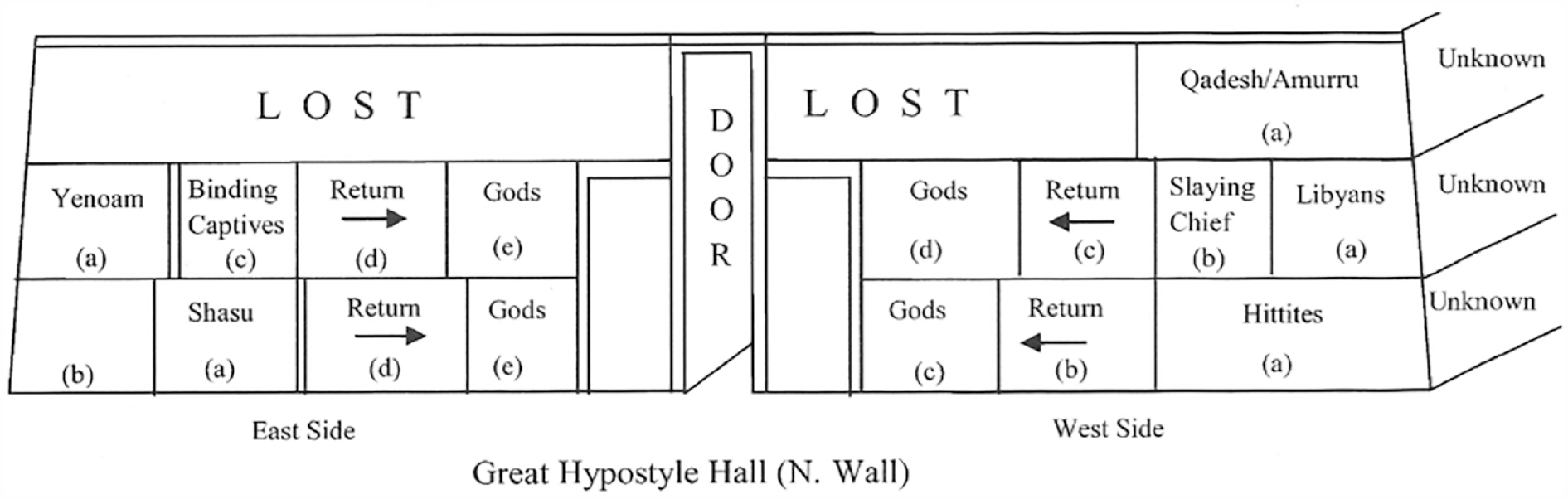
Seti I Karnak war monument (photo: Spalinger 2011: fig. 4).
Consider, now, the key scene and compare it to the Shasu depiction of Seti I (fig. 2). 20 Both reveal an enemy that lacks any sophisticated and up-to-date war equipment. In addition, neither foe is able to rally within a citadel or hold off the pharaoh in an expected siege. Nubians and Shasu alike were considered some of the least capable opponents of the Egyptian monarch. Their heaps of fallen, fleeing, surrendering, or struggling men cannot even rise up to face the pharaoh. No single chief is present who, because of his size and direction of action, faces the Egyptian king. The Shasu, in fact, fight outside of a citadel-fortress, one located on the way to the Egyptian centre of Gaza. 21
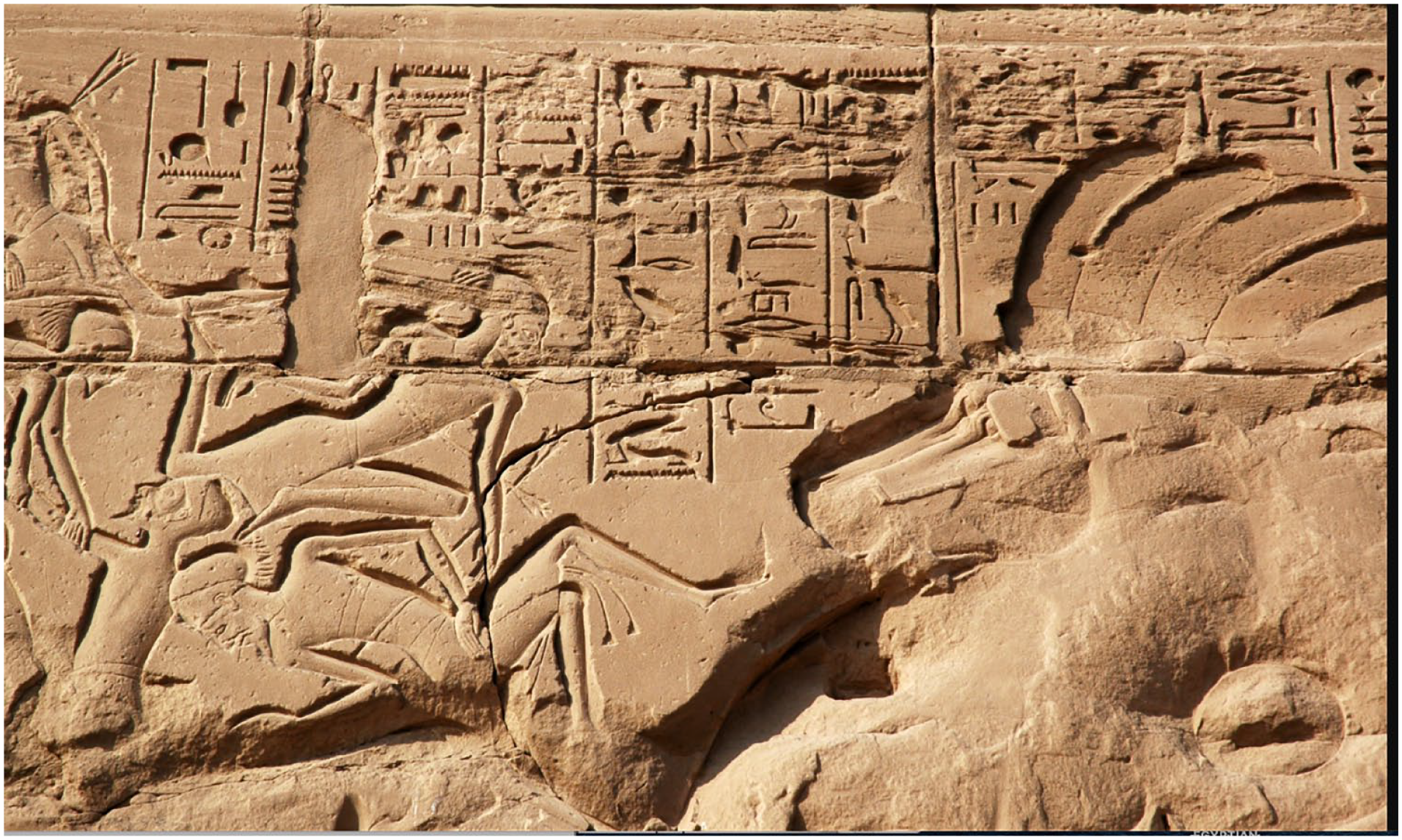
Seti I Karnak war monument, Shasu encounter (photo: courtesy of Peter Brand).
At this point let us compare Seti I’s depictions of that clash of arms with his later one against Gaza (fig. 3). In the first, the enemy Shasu, clearly not containing any effective military equipment or virile warriors, is pushed against a row of Egyptian way stations that conveniently are located right above the ground or base line. This is neatly drawn to further emphasize the enemies’ inability to seek escape and rest. There is no cessation of war. Seti charges ahead and his piled-up opponents fill every convenient space between the various Egyptian fortresses.
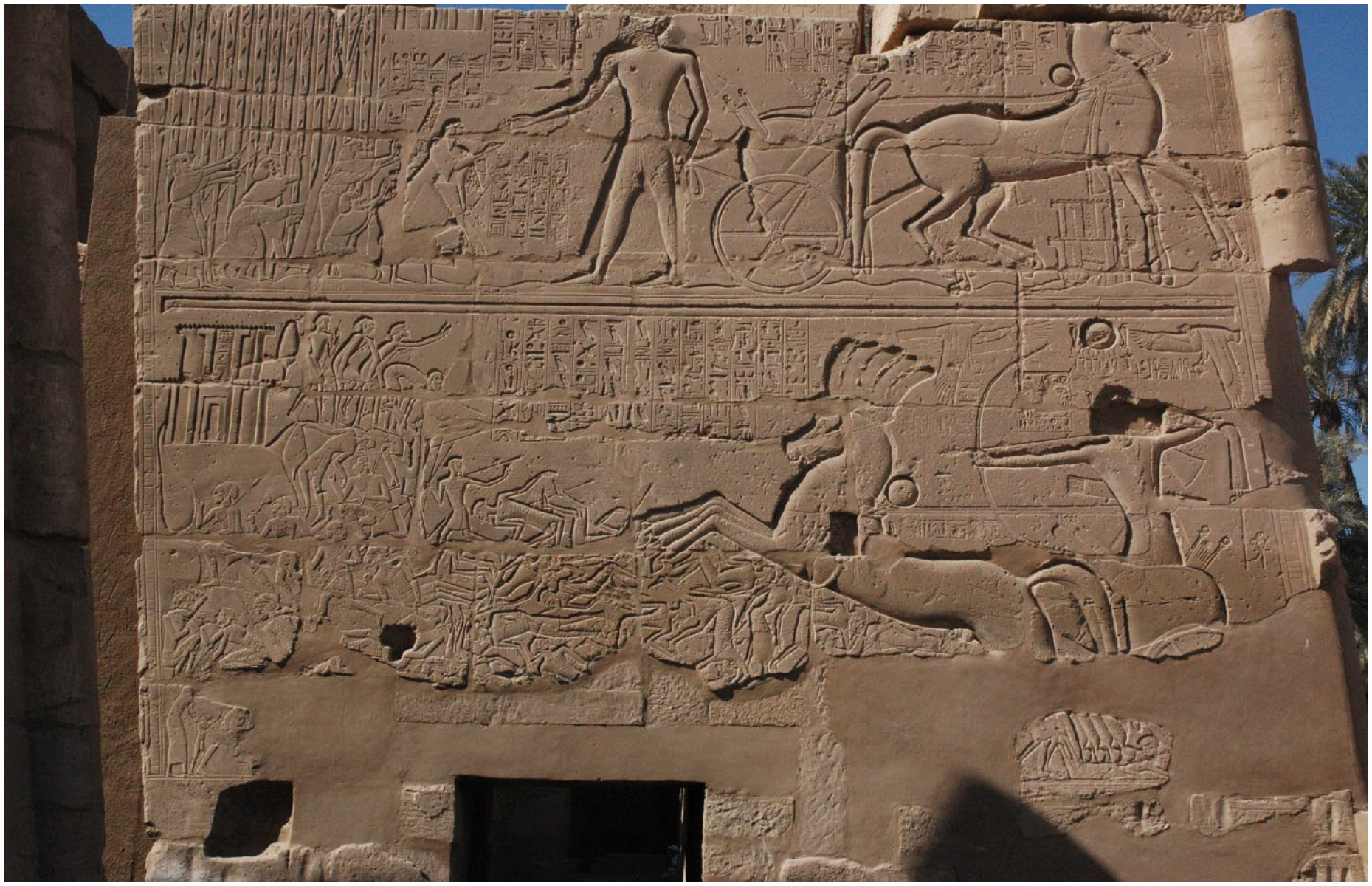
Seti I Karnak war monument, encounter near Gaza (photo: courtesy of Peter Brand).
We can see more clearly a standard mimetic representation being used with enemies different from settled people with respect to the Gaza scene in which additional Shasu opponents are depicted. 22 In this case the king crushes the land-based (i.e., infantry) foe. The presentation is sharply drawn and the Shasu are located on the knoll located outside of Gaza, ‘the City of Pa-Canaan’. Those far away from the king and his horse-driven chariot surrender with gestures. 23 The latter action, fixed by iconographic convention, should not be so easily dismissed if only because later depictions of warfare directed against Asiatic citadels and fortresses present the king’s success in a different manner. 24 For the moment, however, let us focus upon the city itself.
Gaza is depicted in a traditional manner. 25 By this time such locations were always drawn in a schematic manner, one that was standard but also reflected a predetermined concept that the Egyptians desired. 26 The city is actually a fortress; its gate is always indicated in a frontal position and its crenelated bastions were de rigueur for the artist. A moat conveniently surrounds the locality or at least partly runs around the base of the fortress. No living quarters are ever rendered: the place is a pure fortress icon. Here, no enemies are placed within Gaza because they are not city dwellers. Quite to the contrary, this scene (and the one preceding) makes it self-evident that the mimetic reference is to a non-urban foe. Their actions and movements, nonetheless, parallel other Asiatic enemies of the Egyptians.
It is with Yenoam, also conquered by Seti (although not necessarily in person) that we can see the archetypical icon of resistance, the fortress city, and the commonplace rendition that so often is present within the narrative war depictions (fig. 4). 27
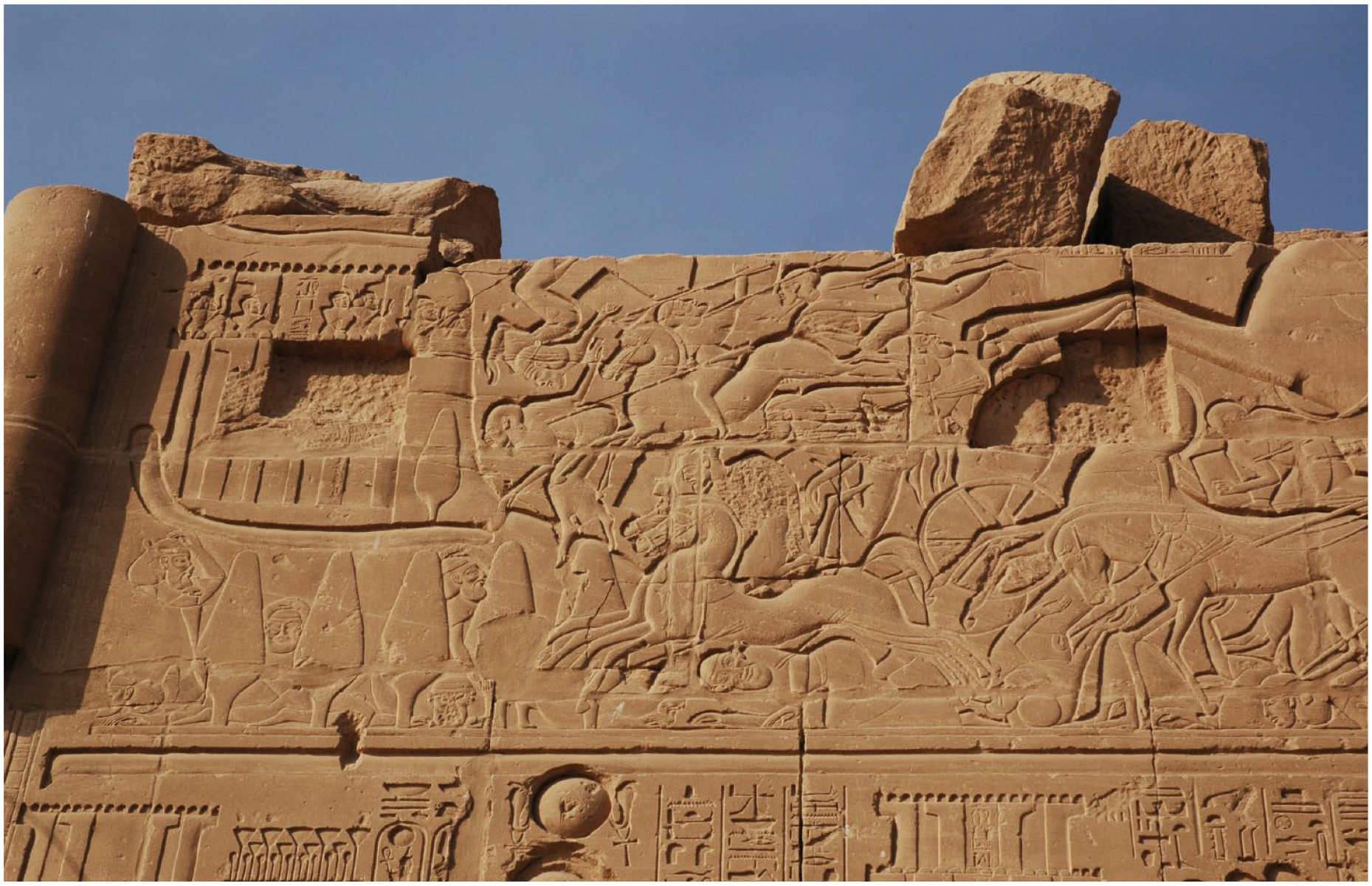
Seti I Karnak war monument, attack on Yenoam (photo: courtesy of Peter Brand).
Here are the standard components:
1) The king is in his chariot, alone, and he shoots his arrow against enemies.
2) The latter are drawn in a typical rising away ‘fashion’. That is to say, they create an increasing acute angle with the base line being the ground of the military encounter, and they fill in the entire scene from bottom to right at the place furthest away from the pharaoh.
3) The king is prepared to shoot his arrow at a slight downward angle and thus virtually into the centre of the enemy mass, i.e., the arrow will reach the furthermost portion of the scene, far away from the royal chariot, at a point almost exactly between the bottom and the top of the register. The height is bisected.
4) The citadel, when represented, will resemble a closed fortress. Carved at this extreme distance from the king and chariot, it is traditionally composed with two battlements. The lower section normally is the only one that contains the besieged foe. In fact, they are traditionally represented by the city’s elders, one of whom might be the local potentate (see below, however). Additional requirements appear to be the ‘brazier scene’ and the sacrifice of a young man. 28 All of the men are shown beseeching peace with raised hands, palms open to Egyptian leader. These basic gestures as well as others that are more complex will be a subject for further research. Note also the presence of an artificial or real moat, or a river, surrounding the fortress city.
Thus, the Yenoam scene in Seti’s Karnak war memorial provides the viewer with the standard repertoire of most of these iconic representations. 29 But also to be noted is the battle scene itself. Here, the Egyptian monarch, though coursing through his defeated foe, nonetheless expends his energy in a personal manner. The pharaoh is shown engaged with a key opponent who is also depicted in a chariot. At this point the centre of activity is overtly indicated. The Egyptian war commander and the city leader fight against each other. The mental framework of the scene at Yenoam (and elsewhere) is thus strikingly intimate; we witness a duel between two war leaders. Although Seti (or whoever is the pharaoh) is carved in the typical superhuman size and towers over all opponents, the Asiatic enemy, Canaanite in this case, is also rendered in a size greater than his allies and/or relatives. This increase in dimension is purposely drawn because it enables the viewer to recognize the leader of the opposition. The Other, therefore, is not merely singled out by personal engagement with the Egyptian ruler but also by his size, and at Yenoam we see Seti lunging down towards his chief enemy and ready to cut him to pieces.
The enemy city is likewise placed in the position of hostility, albeit of a passive nature. Its gates are closed and its appearance is similar to that of a military outpost, garrison or fortress. There is absolutely no difference between the representation of Gaza, the Egyptian way stations and staging points (the ‘fortified’ wells), and Yenoam. One might be hypercritical concerning this analysis and argue that Gaza is definitely upon a tall hill whereas Yenoam is not. Furthermore, we can see the opposing Canaanites peering out to us, or else in the direction of the Egyptian king, from between various trees. All of the latter images, however, are mere tactical artistic renditions of defeat. The frontal position for example, never employed for an Egyptian, be he the king or non-royal, turns up in the context of the Other. When a face looks directly at us, we immediately recognize the purpose: to provide fear and trepidation: the pharaoh is all-powerful. Moreover, the trees at Yenoam merely serve as column dividers between which fearful Asiatics may be seen and made fun of by the viewer. This is all ideological and cunningly drawn so that the simple motifs can reinforce one another.
But let us examine the locations of each of these fortresses at Karnak. In register one of the west exterior wall of the Hypostyle Court, they are conveniently located in key positions. 30 The king moves away from the centre doorway. As expected, he is leaving Egypt. His direction is thus to the outside or, in this case, to the left (east). This is the normal way of presenting the voyage outward, but when the pharaoh turns back and marches to Egypt, the direction is reversed. At this moment, the latter cuts through the order on the east side but not the west (right), an important difference if we want to analyse the historical record from a vantage point superior to that of ‘pure’ empiricism.
At any rate, the two fortress scenes constitute effective statements of intent and they, as well, serve as defined limits. The first serves as the split between trip away from home and return. The king then reaches Gaza and this depiction, as well, provides an effective caesura. In fact, the latter depiction is the last one in a series of three. Sandwiched in between is a booty reception scene; note that the king still faces outwards. In that depiction we also can see additional fortresses. One is called a town or city (dmj) whereas the others are wells (ḫnmt). Notwithstanding the difference between them, the artistic design is identical save that the well bastions have no inner story. In other words, once more the iconic representation is what the scene demands, not any specific details. 31 Incidentally, the city of Gaza is empty and the locals, among whom there ought to be some Shasu, 32 are praising Seti.
The Yenoam scene is parallel to the Shasu battle depiction in the first register on this side. Here they are in register two of the east side and again at the beginning of the military activity. I am not interested in whether this event and the one following – Seti in Lebanon – belong, historically speaking, to the lower register or not. 33 What is important for me is the use of a battle depiction plus garrison-fortress as the initial snapshot of one complete narrative band (or row). But there is also a second city above Yenoam, and its moat and lowest battlements can be seen. Unfortunately, the higher portions of the wall are lost and we cannot tell whether it was occupied with enemies or not (I suspect it was).
On the west side only, the top register presents the common king and fortress image. In the middle register, Seti is shown in combat against a Libyan (figs 5 and 6). The precise image is to be expected. The traditional smiting pose of pharaoh versus Libyan, already well established in one of Mentuhotep II’s reliefs of the 11th Dynasty, is all too frequently used by the New Kingdom artists when depicting wars of their kings in the west. 34 The lowest register on the west (right side) has only a battle scene and no city is present. Thus, we must turn to the icon of the city of Kadesh itself in the third or top register. Here, despite the ensuing battle, the imagery is clearer than the earlier Yenoam depiction. First, the personal combat of Seti against the enemy leader is easier to see owing to the separation of this main opponent, his charioteer, chariot and two horses from the rest of his army. In other words, the ‘duel’ is made more visible and stark owing to the technique of reducing the number of heaped up and climbing enemies in the centre. True, the latter still arrange a gradual rising acute angle moving upwards away from the pharaoh and in the direction of the fortress-city, here located at the extreme west (corner) of the wall. But one can note the lance of Seti in the chest of his main opponent as well as the careful juxtaposition of his chariot, driver and the like underneath the arched four front feet of the king’s team of horses.
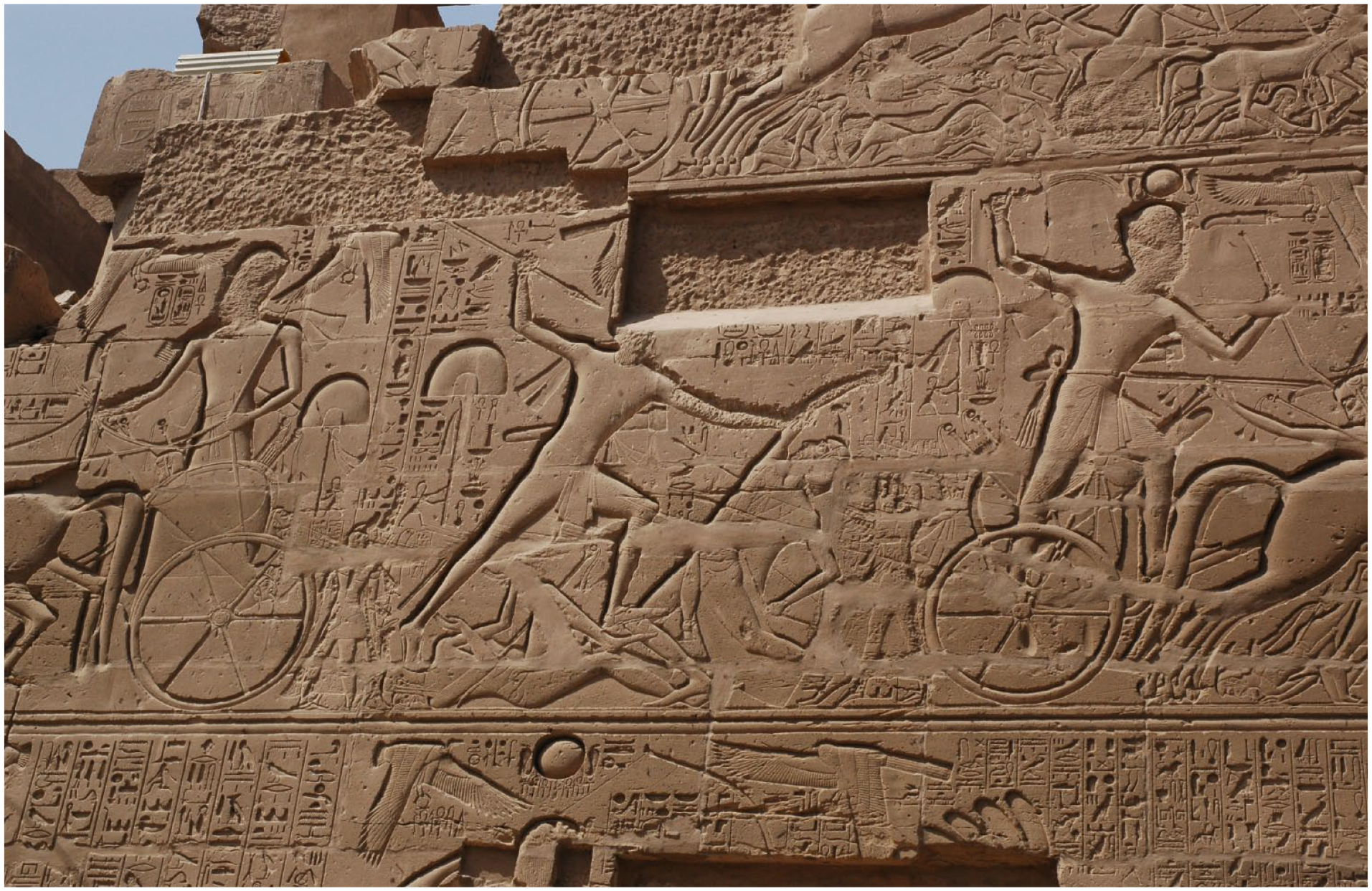
Seti I Karnak war monument, combat with Libyans, left (east) portion (photo: courtesy of Peter Brand).
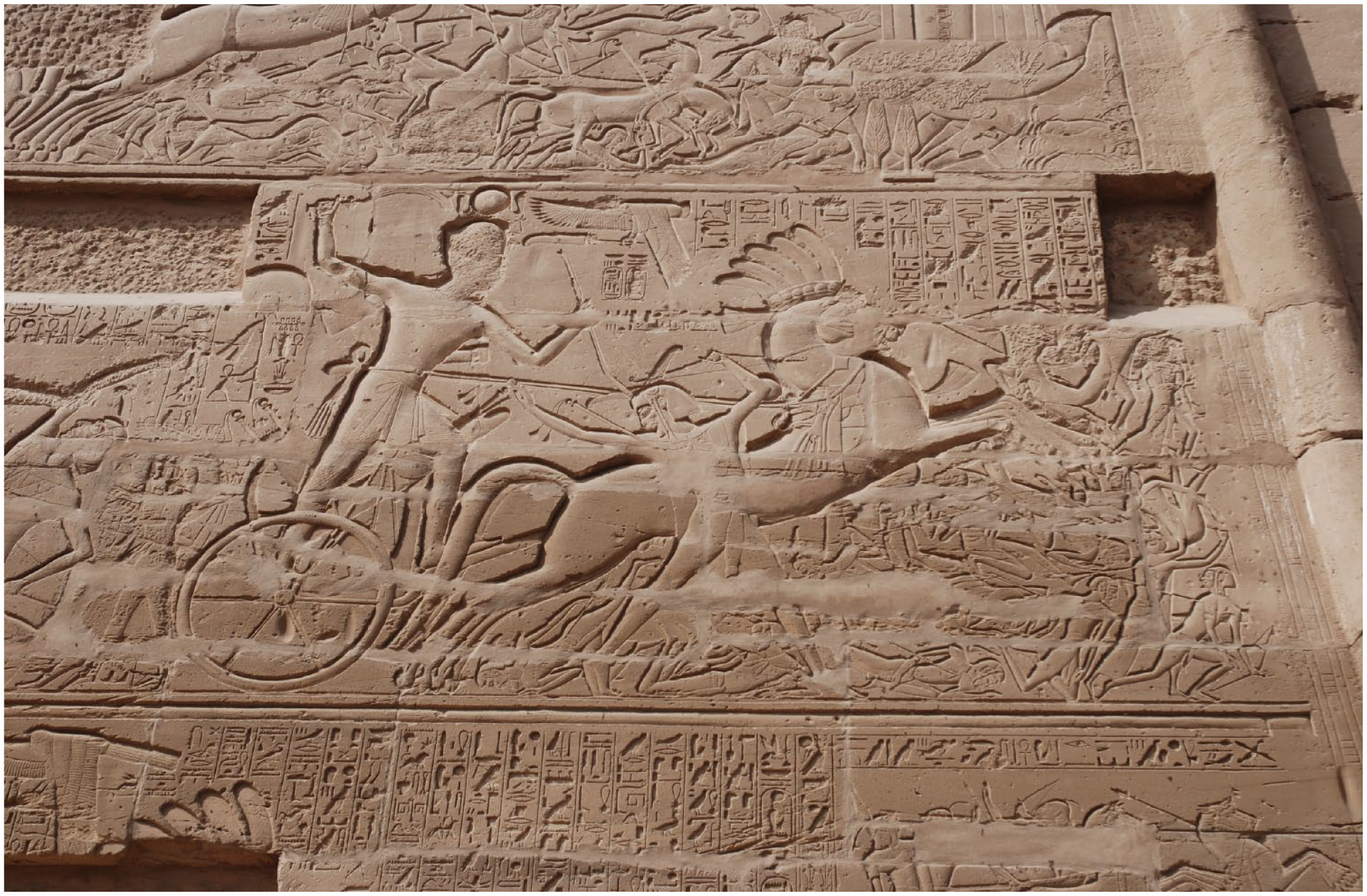
Seti I Karnak war monument, combat with Libyans, key scene on right (west) (photo: courtesy of Peter Brand).
The importance of this representation cannot be oversimplified in analysis. Seti’s Kadesh depiction reveals a higher degree of ethnocentric behaviour on the part of New Kingdom Egyptians (fig. 7). Here we immediately note this personal antagonism, one that is rendered greater than others owing to the large size of the opponent. Moreover, the representation of the man’s city, while still depicted as a fortress, includes numerous artistic touches that are not included for ordinary city-states of Palestine. In this light, the antithesis with the Yenoam relief in register two on the east (left) side is striking. The viewer is immediately made aware of the beseeching and pathos-ridden men in the citadel. They too are drawn in a more specific manner than the rather commonplace Canaanites on that same side of the king’s war monument, referring specifically to their gestures. Then too, the fortress of Kadesh has two separate bastions, crowded inside and on top with Asiatics. This is not true with respect to Yenoam. As befits the lower status and importance of that border town, only the lower outer balustrade shows the enemy.
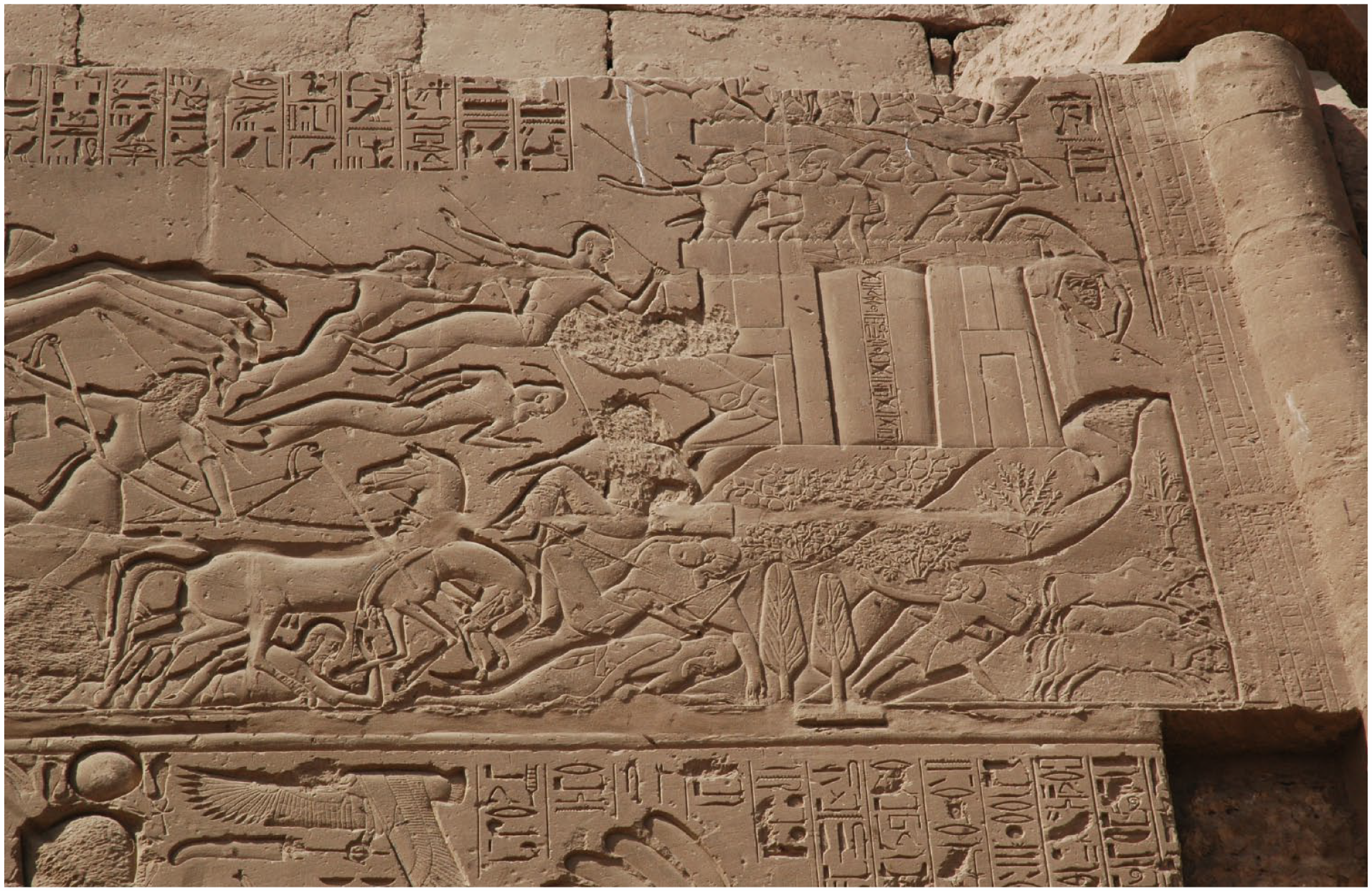
Seti I Karnak war monument, combat with Kadesh (photo: courtesy of Peter Brand).
The Kadesh relief of Seti thereby allows us to discuss yet another position in the Pharaonic ranking system of foreigners. On the battlefield such is also the case. In fact, it is even more obvious. We commence with the lowest ethnic group according to the Egyptians: the Nubians. The lack of contemporary war material is balanced by the absence of any leader. With the Shasu, we climb to the standard tell or mound situation even though the enemy, still depicted leaderless, fight (and live) outside the walls of any Egyptian garrison or Canaanite fortress. 35 Then we ascend to the people of Yenoam. The enemy is urban, but their citadel is represented exactly as any Egyptian well/fortress or staging post, such as Gaza, would be. Thus, Yenoam appears just as any other garrison-town. But the enemy is different and its hostile activity to the Egyptian ruler is more marked and significant than the preceding foes of Seti. Now we have reached the important city of Kadesh, far more significant than Yenoam. Many more town elders and important men can be seen within the citadel. On the battlefield, the single conflict is made even more engaging and important by using the positioning on the part of the opponent: his gestures and body movement may be labelled by the term pathos. The javelin through his left cheek is extremely startling. Note the method of success, also: only arrows and javelins are shown. Hence, the artist has intended the battlefield to have been one determined by the elite chariot division of the Egyptians. In fact, no Egyptian infantry archers appear, and the scene’s intent is definitely to record a clash between two chariot forces even though enemy infantry are present. In a sense, Kadesh is commended by a concession to the Egyptian ideology: it is able to stand up to the superior elements in the triumphant pharaonic army even though it is no equal to the pharaoh.
Yet we can go even further. The fortress is removed with the direct attack of the Hittites against the Egyptians in the bottom register on the west side (fig. 8). It is as if these mighty enemies of pharaoh have no home base that is truly theirs. Instead, the action is depicted with only the battlefield and the two protagonists holding sway. The soldiers, all Hittite (or allies) in this case, maintain a series of detailed yet standard poses. In other words, the two living competitors are pharaoh and the Hittite commander (the latter’s chariot driver is already dead in the action). Yet no citadel-fortress need be shown as the action is focused upon the two large figures and the posture of surrender on the part of the Egyptian king’s opponent. Truly the pharaoh is a super-hero. 36
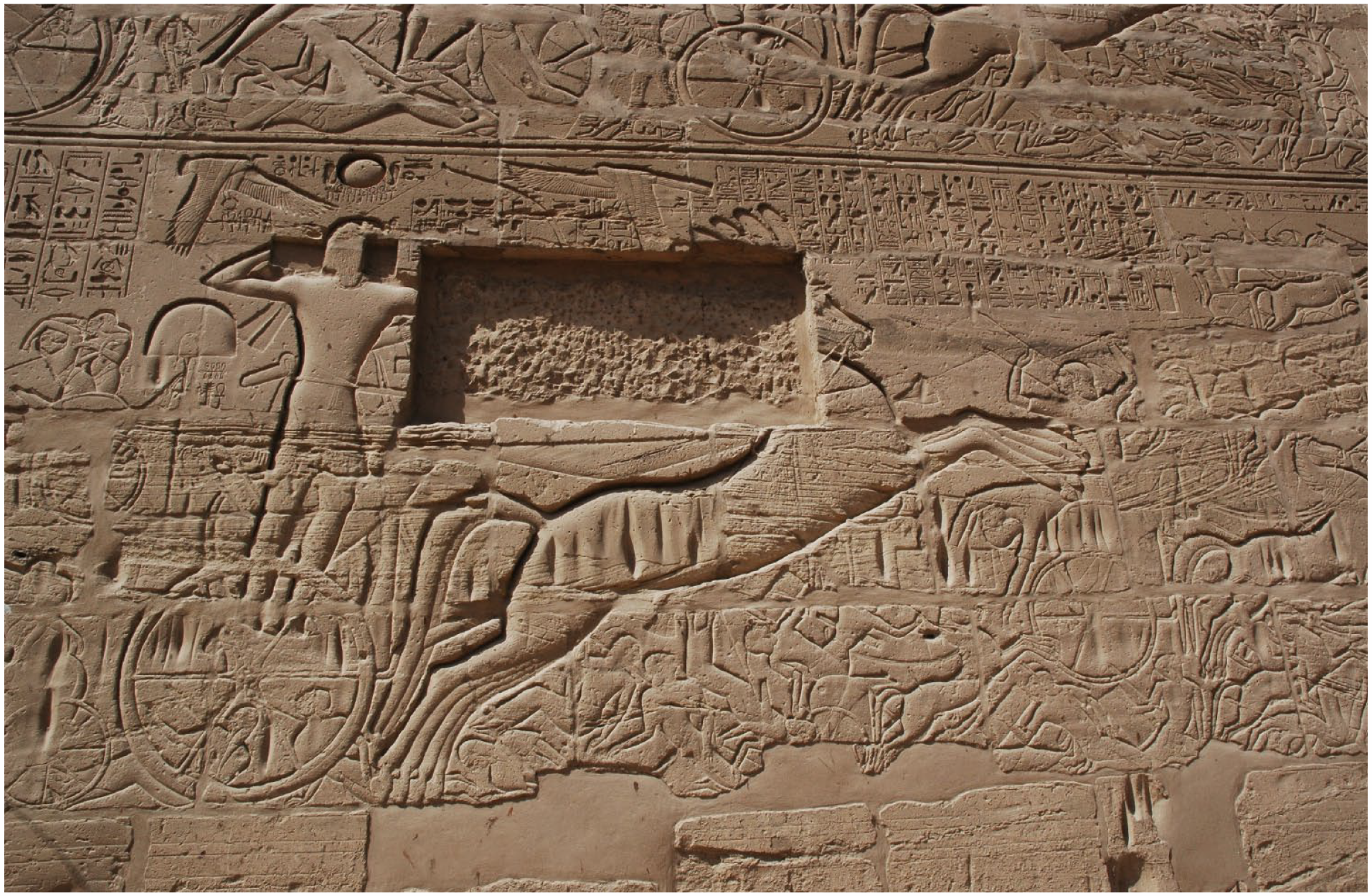
Seti I Karnak war monument, combat with Hittites (photo: courtesy of Peter Brand).
The location of the key combat scenes on the west or right side of the monument is equally important to discuss. The Hittite encounter in the first register is balanced by the Kadesh scene on top. The difficulty in these two cases is that we cannot analyse the extant side depictions owing to the presence of the Second Pylon. Yet it is relatively clear that the fortress depiction at Kadesh should be followed by an additional depiction, and this applies to the remaining two registers. In essence, at least at this monument, the standard repertoire demanded a battle scene to be succeeded by a scene dealing with the presentation of booty. With respect to the Yenoam snapshot, the continuation around the corner covers a similarly organized theme: the reception of timber from subservient Asiatics of Lebanon. Then too, the image of Yenoam is cut off from the battlefield binding of captives, a depiction that, properly speaking, moves us back home and therefore is inwardly directed to the northern doorway. Hence, the only war depiction on that register – the one on the battlefield with the fortress-citadel of Yenoam – has to include a post war presentation depiction, but as the warlike aspects of the campaign are now over, and the king presumably is in Lebanon, the results of that conflict are connected to the return trip.
Ramesses II: Beit el Wali
The Beit el Wali reliefs of Ramesses II are equally useful for any discussion of the expression of Egyptian military reliefs (fig. 9 for the layout). Once more, let me remain focused upon this aspect of the pictorial narrative rather than seek historical veracity. The inside of the north wall contains the Asiatic components of the conflicts as well as the Libyan ones. To the east, which is reasonable, are the depictions of the kings’ northern conflict. The pictorial arrangement is as follows; the plate numbers refer to the standard Chicago editio princeps. 37
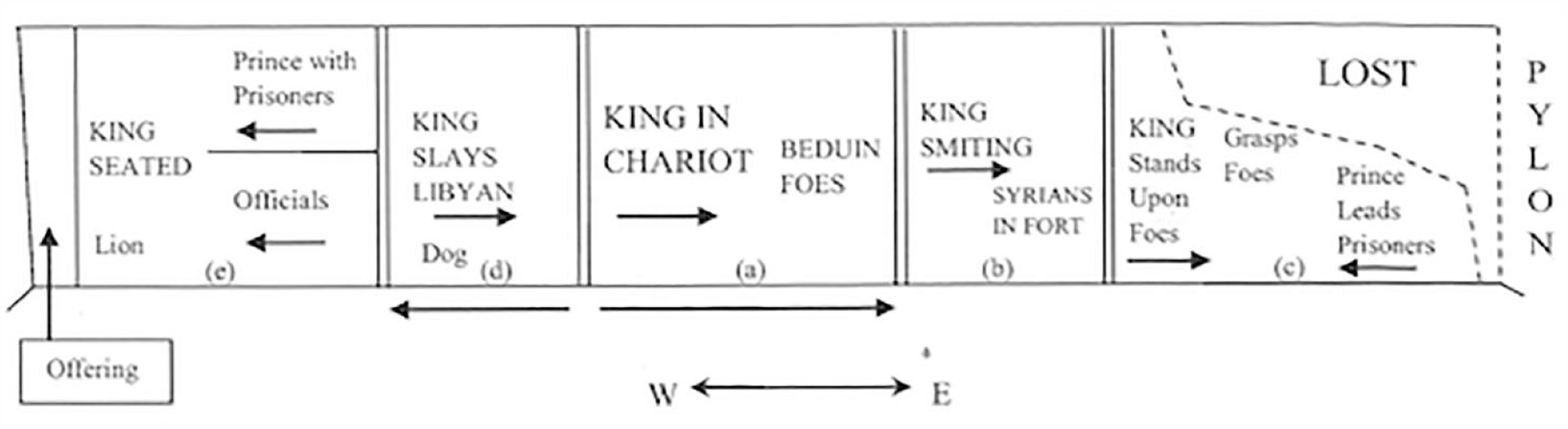
Ramesses II Beit el Wali layout (photo: Spalinger 2011: V, fig. 6).
The first is a simple triumph scene in which Ramesses’ son brings forward captive northerners who are tethered (pl. 11). In fact, the entire depiction covers the presentation of captives; the timeframe is definitely post-battle. The pharaoh carries his bow in his left hand but of course it is not ready for action. Similarly, his battle-axe is held peacefully in his right hand to be brandished over the enemies as a deliberate sign of awesome power and domination. Finally, Ramesses is placed upon a small platform, thereby accentuating the official nature of the event. One can assume that this representation concludes the events revealed in the following depiction.
But it is the following pictorial representation which bears closer examination (fig. 10; pl. 12 in the original publication). An Asiatic fortress city is subdued. Although there is an attack upon the walls of a fortress, the king’s son performs this activity. At this point, the symbolism of fortress and its chief/prince predominates. The king is ready to cut off someone’s head with a sickle sword. The enemy holds a bow at an angle of defeat. Both this symbol and his posturing – he emerges vertically from the fortress – indicate a transference from the iconic representation of king versus enemy chief on the battlefield, both antagonists being located within their chariots. Therefore, this distinctive portrayal, one especially signalled by the identity of the enemy fortress with its leader, has been transformed from the more commonplace and standard field encounter. One can ignore the question of whether this picture indicates an actual siege or not. The crucial iconic point is that the chief of the fortress-city is in the city. Both are to be destroyed, of course, but in an expectant sense both are the same. 38
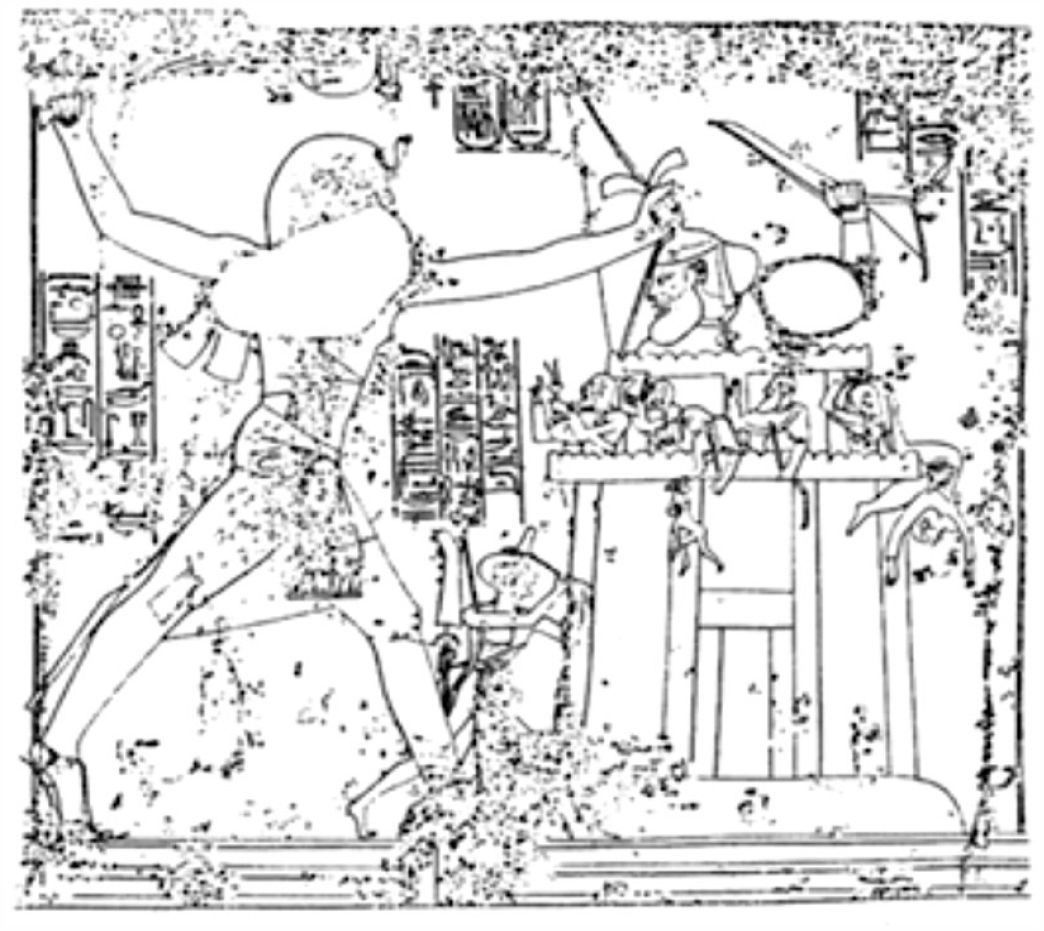
Ramesses II Beit el Wali scene (photo: Spalinger 2011: XVIII, pl. 5).
A third representation is the commonplace chariot attack on the battlefield, but the king employs the sickle sword (pl. 13 in the original publication). This is a further indication that the depictions on the north wall are structured to belong together: pharaoh holds the same weapon when preparing to smite the Libyan as well as the fortress leader. Because the enemies lack chariots and horses, Kitchen’s assumption of ‘Bedouin’ holds true. 39 The enemy weapons include small sickle swords and spears, almost as if we were to expect them to possess chariots. 40 The king’s arrows strike into the centre of the chest of one enemy. Yet it remains significant that Ramesses’ foes lack bows and arrows. Pharaoh furthermore has arrows in his back quiver and spears in the chariot, and he is ready to dispatch two enemies. There can be little doubt that the depiction is more interested in the effect of the king’s power upon the viewer than in narrating an actual battlefield encounter.
Yet this representation must be viewed separately from the preceding one. True, there is a logical progression in the narrative: (1) it moves to the east, as befits the action which is originally centred in the middle of the wall; and (2) the story provides its key events that run from battlefield encounter, siege/attack on fortress, and reception of defeated enemy. Furthermore, the juxtaposition of these smiting scenes with the one on the immediate left, the Libyan depiction, provides the centre of the eye’s activity. The artists have rendered the northern wall in a simple fashion. In the centre is Ramesses against a group of minor foes. His actions indicate their weakness and extreme inferiority: he is ready to cut their heads off with his sickle sword. Immediately to the left he is doing the same with a Libyan. Granted that the latter is commonplace with regard to these westerners; nonetheless, it is noteworthy that the basic motif occurs in two separate places on the northern wall at Beit el Wali. In other words, the centre events are also coordinated with those in the west. The image of the sword-wielding monarch is preserved.
Equally to the right we find the same basic image. The fortress may be represented by a human opponent of Ramesses, the city chief. Yet he, as well, is about to be ritually dispatched by the king’s scimitar. Thus, we are presented with three similar interconnected scenes, all of which point to the ritual slaughter of a foe of the Egyptians. That is to say, the structure of the north wall is blatantly oriented to this aspect. In fact, if one questions the presence of the Libyan depiction (geographically western) among these other four scenes because the latter are oriented to the north, an answer is quickly forthcoming. The Libyan relief reflects the age-old Libyan topos; the only difference that has occurred is the updating to sickle sword from mace. But it fits within the icon of Ramesses preparing his sword against the Asiatics in the two other depictions. Moreover, in the final official depiction of the reception of captives to the left, the prisoners should be Libyans but instead there are only Asiatics. Owing to this we can readily conclude that the entire row of five scenes had to be essentially Asiatic in origin (or inspiration), as befits their placement on the interior north wall of the entrance hall. A small alteration occurred with the addition of the Libyan slaying picture, but the reception of living captives remained true to the geographic location; no Libyans are present.
Thus, Beit el Wali provides a very stark, if artistically effective, presentation of one fortress scene that partly anthropomorphizes the citadel. In addition, the expressive content of the whole wall demanded that the fortress-city be shown in a manner distinct from typical battlefield events. Hence, the regularity of king in chariot fighting near a tell upon which the enemy city sits is lacking. Even more, one sees the absence of those urban opponents on the field of battle. In its place, there are two independent events, the first of which reveals opponents quite different from those typically resisting the pharaoh in a fortress-city.
With the above comments in mind, some general parameters of fortress depictions can now be sustained. First and foremost, we should not regard them as containing exact factual evidence. Quite to the contrary, the fortress itself, always placed upon a hill or a small mound, is a commonplace icon that can be used to indicate any northern foreign locality, whatever it was. As a rule, even in reduced and simplified format, the architectural structure remained the same. After all, it could serve as a stopping off place for the king and his troops, whether for peaceful or bellicose activity. Second, the image presents the facet of alien resistance, but one of a weakened nature. The king is usually first shown fighting his opponents in the field. Then comes an attack upon the recalcitrant city that refuses to surrender, or, at least, appears to continue the resistance. Sometimes a further scene will be interposed. The fortress presents the passive mode of opposition, one of defence. But unless the whole narrative sequence is abbreviated, one views the pictorial development of progress outwards, chariot attack, and then the assault upon a resisting garrison. Noteworthy is the pictorial representation of the king’s major opponents. In the battlefield they are relatively large, but when the Egyptian monarch advances to the fortress by chariot or, more normally, on foot, the leaders opposing him are smaller. Thus, it would appear that the actual combat engagement of chariot upon chariot – a ‘duel’ – was the important military event, at least ideologically and heroically speaking. The fight at the fortress had less appeal, perhaps because it may have been more problematic but probably also due to its static nature. Warlords fighting with horses and chariots could do little against the wall of an enemy citadel, and the glory gained on foot (or in a chariot) was worthy of more emphasis. After all, was it not more personal and more dangerous?
Fortress scenes were conceived as the final event within a separate, enclosed, or limiting pictorial narration. That is to say, they provided a completion of activity. When there were more than one to overcome, or to receive submission from, the artist normally placed two at the end of the depiction, the lower one always being empty so that his ruler could still be seen attacking one citadel. In this case, the normal procedure was to retain the chariot attack but pictorially direct it against the upper resisting locality. This was nothing more than a combination of two separate and basic images.
The original or ‘correct’ diagram had a chariot attack preceding in time and place those occurring at the base of a fortress. In the latter case, the Egyptian ruler would have descended from his vehicle and fought against the enemy as an archer, or at least this is what the artistic renditions would like us to believe. The expressive content of the mimetic depiction entailed a personal relationship between pharaoh and his primary enemy, the chief.
First there was king versus the enemy leader. The latter had to be set among his troops and ideally, or at least if important and powerful enough, the enemy leader would have been deployed with his rapid moving war machines and be placed in one of them. Otherwise, the mimetic presentation would diverge, as the examples of the Shasu, the hapless Nubians, and the pathos-ridden Libyan leader prove.
Then came the king, once more revealing his overpowering military strength. The foreign antagonist, having been dispatched in the field, was now replaced by a more impersonal image, the fortress. Within it, or to be more exact, on its battlements and ramparts, were placed various town officials, elders, troops, and the like. But, in essence, all were preparing for surrender. In some cases, Egyptian troops moved right up to the city’s walls and were carved in the act of demolishing the gates. In other cases, we see enemies falling out of their bastions, but these were side elements of the mimetic totality. Individual components reflecting verisimilitude were not necessary. If the enemy citadel was important, then it must contain inner and higher ramparts; it must be better built, taller, thicker, and possess more towers. Otherwise, it would be carved in a standard manner, independent of localities of Palestine or Syria.
But the fortress scene need not consist of one ‘ribbon’, ‘band’, or long progressive event. The king would have to move to other localities or return. Usually, each individual register dealt with one sequence of events. If many fortresses or cities were encountered, then the more schematic presentation of two per scene would be utilized. In some cases, not described here, the depictions would be virtually identical: city after city attacked and about to surrender. Those visual ‘lists’ of captured fortresses provide the most schematic pictorial representation; no other details would be given.
Thus, the fortress served as the key iconic image of the northern enemies of the pharaoh. Not the special physiognomy or different clothing, but rather the basic urban image of an enclosed place provided the artists with their template. Through this image, the battlefield depiction would almost always be followed by or sometimes even replaced by a fortress depiction against which the Egyptian king attacks. Other images were necessary but not so specific. Yet the standardization was so rigid that the general structure of Asiatic urban depiction of military warfare paralleled the Nubian ones (or vice-versa). Even the ‘barbarian’ and lowly Shasu would be set within a standard pattern involving a chariot attack of the pharaoh upon a heap of disorganized foes. The same may be said for the truly mimetic image of the Libyan slaughter. Yet the one and only image that separated the northern urban Others from all remaining opponents of the Egyptian monarch was the fortress. And here it is noteworthy that even the Hittites, far away from home, are set within the separate battlefield topos because there were no native places for them to return except the expected Asiatic fortress, be it in Palestine or Syria.
Our concern has been with these visual expressions, not the viewpoint that text and picture achieve a unity based on their common purpose of presenting to the viewer/reader a victorious king suppressing chaos and reestablishing order. The content that is expressed and by its nature chosen for that purpose had to be repetitive. In our case, it was the resistance to the pharaoh enunciated by an opposing fortress that mattered. The kings’ continual attempts to subdue Asia led them to fight against one enemy city-fortress after another. How that basic mimetic image played itself out with regard to other visual factors of presentation will be the subject matter of a lengthier study. Nonetheless, the fortress as the point of resistance and not as an icon of exoticism mattered. Once the pharaoh dispatched his foes on the ground, conveniently located close to an enemy citadel, he was then required, pictorially at least, to advance to the city gates. We should not assume that this was often the case but rather view the total image of the fortress (people included as well) as an icon of passive resistance. Following these images, even though the Asiatics could fight well and had, according to the Egyptians, up-to-date attributes of civilization and military technology, they were nevertheless cowards, remaining in their fortresses and passively opposing the arms of the Egyptian monarch. Their citadels, therefore, resembled places of refuge, but only for a temporary period of time. The Egyptian war commander would always take the locality, and in one notable case theoretically destroy all, including the landscape.
The Asiatic fortress-citadel was thus a standard means of representing Egyptian imperialism in the land northwards of the home country. Thrusting a picture of a foreign metropolis and its alien physical setting to the viewer supplied more than simple alterity. We can set the image in contrast to those of the Sinai bastions, so well carved by the Egyptians under Seti I (see above), or even the Egyptian fortresses at the extreme west, thoroughly explicated by Oren and Shereshevski.
41
But far more significant is their purpose, one nested within the overt ideological factor of warfare, conquest, destruction, and pharaonic virility. Each individual citadel was a model of a place of attack as well as a stopping-off point for the kings’ armies. I have written that with regard to Thutmose III’s Megiddo campaign,
42
overtly apparent is the: use [of] the war diary extracts as the skeleton for narrative development. The syntax is undemanding. After all, one begins with date/time and location and then moves forward. If there is a necessity of including the king’s words, they can be effortlessly placed within a strictly dated scenario, one beloved by historians but which I suspect is somewhat deplored by consummate literary-minded individuals.
Hence, they served exactly as the daybook entries of the Egyptian army scribes – namely, just as the campaign war diary presented a ratcheted approach to narrative, so too did the citadel depictions. Indeed, it is owing to this method of visual and artistic presentation that Egyptologists, among others, have been able to reconstruct the northern itineraries of New Kingdom armies in a reasonable manner. 43 To be sure, each act of the Egyptian monarch at these bastions was a viewable repetition of a general theme of victory irrespective of the singular nature of the event. 44 Each provided a dramatic stepping stone that served to maintain the high level of pharaonic success and domination. Certainly, these citadels were the metropoleis of their small kingdoms or provinces and thus were the centre of the urban activity in Late Bronze Age Palestine and Syria. Logically, therefore, they were taken to be excellent emblems of their society and as felt so by the Egyptians. In other words, they are akin to banners or flags surmounting medieval castles in modern simplistic comic-like portrayals. But they also served as identifying the enemy’s ensconced strongholds, ones that must be destroyed if they did not automatically submit.
With regard to the relatively straight-forward New Kingdom war narrative that depended mainly upon the army’s ephemerides, 45 I pointed out that the following parameters generally held. Likewise, they do so here with respect to the visual narratives: 46
a. Move forward in time. Do not retrace events.
b. Start at the beginning, preferably, and if necessary be indirect as to time (e.g., ‘xth campaign of might’ – note that the integer yields a relative temporal position).
c. Attempt to provide a specific date and locality for events because they are important.
d. Hallmark each event with one goal, one zenith, among the actions staged. As in drama, there is one climax.
e. Close each event with a booty list.
The coincidence of the diary approach with these registers of late New Kingdom war depictions is easy to discern even if the written accounts definitely supply the reader with more specific data.
But note how different the representation of the city of Kadesh was during the eventful year five campaign of Ramesses II. 47 In no way do any of the variants resemble the commonplace fortress-citadel pictorial topos. 48 To the contrary, it is walled to be sure, but full of enemies standing upright and possessing two levels as well as revealing various types of enemy troops. Undeniably, the Egyptian artist(s) have depicted their warrior pharaoh advancing upon the city even though he never could cross over the Orontes River to the east in order to merely come into sight of Kadesh’s high walls. The city is furthermore conveniently separated from the extensive terrain by the Orontes on two sides (up and down, so to speak, on the reliefs), and both Luxor (L1 version) and Abu Simbel mainly dovetail on this matter. The first Ramesseum version, R1, is simple but the basic arrangement as just described holds, and R2 at the same temple essentially follows the same pattern, thus allowing one to conclude that the same artists were involved in both pictorial reproductions. Needless to say, the large-sized Hittite king is outside Kadesh. 49 Here, the images are construed to reflect the innate power of Kadesh, its strong defence and purposely assumed to be situated in/on an island, which it was not, of course.
Significant, as well, is the lack of any battle taking place right outside the wall of this great city. It never happened, of course. In similar fashion, no scene of submission could be presented as, for example, the Shasu did outside of Gaza or the Lebanese did on their shore. One can thus argue that the Egyptian artists could never have presented the commonplace, artistically rhetorical, image of the fortress-citadel as the pharaoh would had to have won and taken the city for such a pictorial representation to occur as in, for example, Seti I against the Hittites (fig. 8). Even the clichéd written account in the Kadesh Poem covering the second day of fighting was purposely omitted from the visual narrative. 50 Thus the depiction of Kadesh, conveniently separate in the east from the combat scenes on the other side of the river, must have been commissioned from the start with an orientation quite different from the expected ones. This aspect, however, is best left for further discussion but it may be said in conclusion that the city in no way serves as a stock character in a paly or story. It is not a stopping point for the king’s success in the field. Rather it is the centre, on the east side of the Orontes, where Mutawalli II, Ramesses’ opponent stood, observing the combat actions to the west. Indeed, it is king in conference, the attack on his bivouac, and the resultant fighting in the open field that are epically depicted by the Egyptian artists. Hence, the standard representations had to be jettisoned for the pharaoh’s epoch-making confrontation with the Hittites.
Coda: Remarks on Development
When I completed my Icons of Power volume, I had hoped that the reader would at least be convinced that right at the commencement of the 18th Dynasty, a standard system of pictorially narrative warfare existed in Egypt. 51 At the date of publication (2011) we already possessed more than just a few visual representations, all telling stories, of pharaonic military endeavours abroad. One now had a wealth of evidence from the reign of Tutankhamun, as well as from that of Ahmose, to disprove the contentions of a Hollywood host of Egyptologists that it was not an infrequent practice for the Egyptians, at a time considerably predating the reign of Seti I, to commemorate their monarch’s virile war deeds in relief work. Furthermore, in the mid-1980s, blocks of a doorway of Amenhotep II were published which confirmed this assertion. 52 Yet even earlier, with the Deir el-Medina material brought forward by Bernard Bruyère, such had already been the case quite possibly under Thutmose II 53 (they have been subsequently dated to the end of Thutmose III’s rule, but Hatshepsut’s may fit better). 54 To them one can add fragments, now in the Metropolitan Museum of Art, dating to the mid-18th Dynasty, 55 and further Thutmose III scenes 56 were subsequently provided that showed a rather more extensive use of a visual narrative account than hitherto realized by scholarship predating World War II or immediately thereafter. Some of these chariot scenes, the Thutmose IV war vehicle with its eight-spoked wheels in particular, will be analysed further in a discussion particularly oriented to Egyptian chariots and their wheels. 57 But see now the pictorial data from Thutmose III’s mortuary temple in which one enemy citadel (called a migdol) is present and a northern war (or wars) are visually recounted. 58
The case under examination reveals that despite many immoderate, if striking, art historical evaluations with respect to Ramesside two-dimensional art, an illogical, indeed un-scientific working procedure had been followed. A rejection (or overlooking) of primary visual source material took place. By the present time, the recent full publication of the ‘Thutmose I war material’, fragments including representations of horses and chariots, no longer conveys with it any sense of newness or surprise. 59 Instead, the question to be asked is why did an inaccurate sensus communis prevail for so long when at least one counter-example had already become the proverbial elephant in the room. In science, any counter example destroys a theorem, or even a hypothesis, no matter how preferred the position had become over time. Such should have occurred c. 1952 when the Bruyère material was published.
Thus, the more significant issue of origin and development presently holds stage. We certainly possess far more pictorial narrative data with respect to earlier phases of ancient Egypt’s history. The remarkable causeway reliefs of Niuserre are a case in point. In the past, there were two working scholarly vectors followed, and they should not have been combined. The first is the obvious, or simple, one: the (presumable) lack of sufficient data at hand to conclude that in the 18th Dynasty, narrative pictorial war representations never occurred. The second, totally independent of that assertion, was the more intellectually treacherous one. Unprovable reasons for the falsely asserted new and different perceptions of pictorial narrative in Egypt in the 19th Dynasty and onwards were argued. One can overlook the former contention because it is easy to argue against past interpretations when they are mainly based upon lack of sufficient – indeed any – extant data. This ‘policy’ of interpretation is similar to the search for a ‘missing link’, whether the absent trait be physical ones (as with the hunt for undiscovered age-old hominidae) or otherwise (the origins of Greek epic poetry), or even the search for an Urvater, the ‘first’ X. The latter postulations, to the contrary, are considerably more tenuous because they build castles out of mirages – or at best molehills – if not chimeras out of pure imagination.
Older suppositions must therefore be discarded and a search for pre-Ahmose material – parallel in nature – needs to begin, somehow and in some fashion. If there was an icon of the isolated fortress-city represented by Avaris in the graphically illustrated narrative accounts of Pharaoh Ahmose serving as the centre of activity, a still unproven assertion, surely this had been dependent upon earlier concepts of an enemy Egyptian citadel being attacked. If so, then we must now go back further in time to look for its earlier traces in the Egyptian mentality, and that needs to be the working practice for future endeavours. 60 But for the moment, evidence is lacking and, in fact, the presumed ‘Thutmose II fragments’ from Deir el-Medineh, appear to show an unexpected pictorial representation. 61
Footnotes
Funding
The author did not receive funding for this project.
1
The following discussion is partly based upon Spalinger 2011a and Spalinger 2011b, to which we can add the later studies of Monnier 2012 and Monnier 2014. With respect to Amara West, see the subsequent publication by Spencer 2016, in particular pls 70–77 (note the collapsing fortress and the horses), and for probably Hatshepsut: Iwaszczuk 2021. In a personal communication (01.06.2022) she writes: ‘the cryptogramme frieze and names of the queen suggest the dating of the decoration to the reign of Hatshepsut’. The parallel to reconstructing a fully organized campaign for the kings of the New Kingdom in Western Asia was adumbrated in Spalinger 2020: 36–37, but see the pertinent comments also in  , yet see note 28 below.
2
Although the following two standard works differ considerably from each other in outlook, methodology and result, in essence they form a unity owing to the avoidance of ideological factors connected to the elite’s wish to present certain mimetic images. Moreover, they avoid questions surrounding intent and veracity. I am referring to Gaballa 1976 and Heinz 2001. Another vantage point can be seen in Müller 1995. He attempts to provide a structural analysis of all pictorial war compositions by following a system of patterns. The study considerably advances from Gaballa and differs from Heinz’s compendium in purpose and orientation. For example, see Obsomer 2003 for a new approach to the pictorial images of the battle of Kadesh. He revised some of his arguments later in Obsomer 2012: 127–171 and 2016. For related matters, see Cain 1997; on page 142 she discusses the usual employment of stock images, among which, at least in Ramesside military art, were the fortresses. I do not follow Schulz 2016, who is too modern in approach for my aesthetic appreciation of the ancients; on page 285, she even manages to have Pharaoh Ramesses II seen in ten different directions.
3
In addition, the ludic nature of these depictions cannot be overlooked. That issue shall not be addressed here as I have covered some of the issues in Spalinger 2007. But then this study needed to apply The Law of Parsimony to affect a resolution of her various scholarly vectors. For Ramesses II and Kadesh, see now .
4
In addition to Schulz’s recent study cited in note 2, which needs bolstering, see Brentjes 1995 and Schneider 2004. It is noteworthy, however, that a similar analysis has been proposed also for non-military historical reliefs, especially the ones dedicated to Hatshepsut’s expedition to Punt. Let me cite the following studies to which I have been alerted: Barbotin 2004; O’Connor 2009 and Taterka 2019. See also : 92–94.
5
Taterka 2022; see my comments in : 1–26 (‘Introduction and Themes’).
6
Spalinger 2011b: 64–65 and 149; with Matić 2017; Davies 2012. In a recent volume, Morris 2018, the pictorial evidence for new Kingdom warfare is only briefly discussed. The two major exceptions are when she covers the Sinai fortifications of the Egyptians and the army’s progress northwards through this inhospitable region, as well as the depiction of collaboration on the part of the Nubians. In Morris 2005: 817–820, her earlier work, she discusses the situation of the migdol fortresses, but purely from archaeological – material – evidence and not the contemporary Egyptians’ interpretive one. See as well Manassa 2013: 205 n. 25 and .
7
In this context I can refer to the seminal volume of Siegfried Frey (2005). This icon appears first in the early 18th Dynasty, and I covered the Ahmose representations in , following Steven Harvey. Thus, the image became standard soon after Egypt’s move north of the Sinai into southern Palestine. Its derivation, not discussed here, probably was partly dependent upon the concept of the pharaoh attacking a city. Indeed, the complex of Egyptian king opposing an enemy city is redolent of a potential siege operation even if the structure is a simple one: king versus opponent, the latter represented by the foe’s metropolis. Thus, the city mattered, not the opposed governor.
8
9
Extremely useful for comparative reasons are the two Assyriological studies of Zaccagnini 1982 and : 409–424, 425–435.
10
An approach to similar material (from the Old Kingdom) and a study that I found useful in this context is that of Moreno García 2003. 1982. Following him, a bit, one can now question the utility of such food production scenes from the mastabas of the Old Kingdom as well as the specific images of flora and fauna. Hence, the use of these wall scenes in Butzer 1958/59 can be queried and refined. But now add the very pertinent commentary of Angenot 2011. Also, as a healthy antidote, see Liverani 1990, where many of these issues are discussed, albeit from the written vantage point. Brief preliminary remarks of his are also found in : 22–26.
11
The programmatic intent of Crowley (1995) provided a useful stepping-stone for my research in .
12
One such example, simple though not seen until recently, has been pointed out by : 124–125: The princes of Ramesses II are shown smaller than their father but often they vary in size among themselves. The latter situation is a visual reflection of ‘who was the closest and most important to the king’.
14
16
Similarly, note the fundamental analysis of Loprieno 1988: Chapter 4. This section covers the Nubian and Libyan images. The key visual concept that the Egyptian had with regard to Libyans is most clearly viewed from the Gebelein reliefs. Conveniently, let me refer to Habachi 1963, especially 38–40, figs 16–17. See as well Yoyotte 1968: 115 for a parallel with CT VI 268 d–f and .
17
A different perspective is presented in Spalinger 2011b: Chapter 3. For a contrasting viewpoint see Wernick 2011. I am not so convinced that the examples of Seti conform to specific, then in situ, citadels in Western Asia. The author’s position in this study argues that the topos of the fortress-city was a standard, no matter how significant the enemy city was. Furthermore, the issue under consideration reflects more than mere artistic desires. In general, add Brand 2000. We can now add Degrève 2006 and Spalinger 2016. argues once more, as earlier scholars did, that the location served as a triumphal gate.
18
I am using the edition of the Oriental Institute, University of Chicago: Ricke, et al. 1967. The edition of Kitchen in KRI II: 195–200 is extremely helpful owing to his diagrams.
19
Oren and Shereshevski 1989; Spalinger 2011a. The approach taken here focuses upon the iconic message of the fortress rather than its ‘truth’ as an image of reality. A similar analysis is that of Heinz 2002. Add .
20
At this point I am referring to the Seti I war monument on the northern exterior wall of the Hypostyle Hall: Epigraphic Survey 1985. Incidentally, we can see the difficulties that William Murnane faced when he attempted to determine total veracity from the visual war record of Seti. I refer the reader to Murnane 1985 and Murnane 1990, as well as to the historical commentary of the Oriental Institute edition. There is a detailed study of armour (of all types) during the Late Bronze Age by Hulit 2002. This is now outdated. See now Pollastrini 2017 and , his major study. The last effectively replaces all previous discussions.
21
Note the recent study of which is connected to my thesis. Here, the counter argument would be: the Shasu are not urban. Hence, they cannot be located within a fortress or even a town. Let us grant this. Nonetheless, the situation remains: why have a fortress depicted and the enemy outside of it? Perhaps the rejoinder would be: the Shasu were there, close to the city of Pa-Canaan. Similarly, their defeat in the first depiction (the battle on the Sile-Gaza highway) must include a fortress as it is necessary for the standard scene, especially as the citadel represents or iconographically speaking, points to the northeast regions.
22
The representation of the Shasu – indeed of all foreigners but especially northern ones – need not possess the verisimilitude that many Egyptological art historians wish. This assumption has been exploded some time ago by Ward 1972; and more recently by Darnell 1991. Although pinpointing mistakes, errors, confusion and the like, issues that ought to be covered more frequently in the literature, neither scholar has addressed the issues of cultural issues pertaining to the Egyptians, such as exoticism or ideology. The related study of needed more work.
23
There are a large number of studies concerning gestures in art, whether or not the works be overtly tinged (or overladen) with royal ideological flavouring. I shall restrict myself to the following: Mauss 1979: 945–949 (Part IV: Body Techniques) – a classic; Bremmer and Roodenburg 1991 (various chapters); Kendon 1986; Cifarelli 1995; Cifarelli 1998; .
24
In a military context, the remarks of Jacob Burckhardt are apropos : 184–185, nn. 68–70 with regard to Titian and the Allocation (Allocuzione, the oration before battle) – Allocation of Alfonso d’Avolos to His Troops, Museo del Prado, Madrid; pl. 20 in Burchardt’s study. Here, gesture plays a key role with regard to the ensuing battle.
25
I am assuming that the city of Pa-Canaan is Gaza. Maybe not.
26
Yet note : 44, n. 50. To him, the war scenes present a series of manifestations of unchangeable basic patterns; Vernus 1995: 38, see also 71–72, 115 n. 473).
27
A summary is presented by Abbas 2007, but note on the anthropomorphic concept of the Egyptian town. I find nothing startling in this ancient Egyptian attitude. After all, see ‘Thebes the Victorious’.
28
Spalinger 1978; Keel 1975. It does not matter whether such a ritual took place at every city or most of the cities in Palestine and Syria. The purpose of including this true to life representation was to indicate the hopelessness of the enemy situation: they now have to beg even their deities for support. The image expressing this condition of defeat ignores my earlier study where the ḫtp-ritual was discussed (and thanks given to W. W. Hallo). The ‘child descending’, in these war depictions of citadels under siege, is a boy and he is most certainly near dead. His back is to the city wall with legs stretched owing to his vertical position, and his arms are equally limp. I can now add : 248–249.
29
Yet the viewer may not really be present. Compare Fales 1982: 433–434 n. 1. That is to say, in some cases the visual ideological message may function within the minority elite as ‘self-indoctrination’, to use Fales’ term. The questions surrounding any presumed viewer of Egyptian military scenes has to take into consideration the problems connected to the height of the wall. Even if the depiction was on the exterior surfaces of a temple, this does not mean that all of the scenes were able to be seen. In addition, interior war images, though located in the outer (open air) courts, often may very well have had a more esoteric audience than these others. I am inclined to follow Vernus 1995: 164 n. 695, even though his interest lay with inscriptions. His telling point is the position of the ‘Annals’ of Thutmose III (and thus successfully argues against Bleiberg 1985/86). Note as well, the interesting analysis of the location of viewer with regard to Hittite monumental reliefs: Stokkel 2005, wherein he argues for a dichotomy between ‘ceremonial’ rock reliefs (not to be seen) and those that served as ‘land markers’ (visible). : 48–51, also covers the issue of the viewer in such depictions.
30
At this point it is best to follow Kitchen’s schematic diagram in KRI I: 6. Gaballa 1976: 100–106 is now supplemented by Murnane’s study, referred to in note 20 above, which may also be helpful. Both studies, nonetheless, founder upon their attempt to provide a historical and definitive ‘last-statement’ to the arrangement and veracity of the images. For easy access to the scenes, there is : 242–251.
31
32
If they are Shasu then the lack of horses and chariots speaks in defence of this interpretation. If they are residents of Gaza we must assume that they were in rebellion against Seti. Moreover, their body protection is definitely more substantial than that worn by the Shasu in the preceding scene of carnage on the road, and thus one ought to separate these soldiers from the Shasu. In essence, the problem centres upon on the modern scholar’s wish to identify in a firm and final manner, the identity of all foreigners depicted in New Kingdom reliefs. Can this be done? Considering the errors that could creep in – see Darnell and Ward’s useful comments referred to in note 22 above – this attempt at a final resolution seems doomed. Compare, for example, Murnane’s seeming exasperation with the carved details of Shasu and non-Shasu in Murnane 1985: 41–52. One can supplement these analyses by Kitchen 1964 and . Of equal if not greater importance, however, is the situation of intent. Unless we examine the mimetic significance of each individual scene, isolate the key as well as the minor power icons, and finally stress the attempt at expression rather than sober veracity, then, I believe, we are caught within a web of pictures lacking a sure guide.
34
See note 16 above.
35
Urban people must be depicted inside a city, no matter how desperate for their own lives they are. If that locality is destroyed, then the situation changes. Nonetheless, the icon of the fortress city has to remain.
37
Ricke, et al. 1967; add the scenes in : 259–260.
38
This image flanks on the right the centre depiction of the pharaoh in his chariot just as the Libyan smiting scene does to the left. Both images, wherein Ramesses is on foot, serve as counterpoises to the king in chariot, and both reveal a one-on-one encounter. The imagery and mimetic presentation has been carefully worked out from an artistic point of view. Thus, the remaining two scenes, those at the two extreme ends of the north wall, must similarly be parallel. And they are: in the two cases Ramesses is presented prisoners by his sons. This evaluation is simple to make and renders questionable a historically based interpretation of these war records. This is not to say that the young man may have campaigned under his father Seti and these depictions indicate those fact: see Spalinger 1980, now outdated. It is only now that I feel a deeper structural analysis of the material is needed. Hein 1991 adds much to this discussion but see now Morris 2005 and .
39
KRI II: 195.
40
On spears, see Wernick 2013 and of course .
41
See note 19 above.
43
See note 1 above.
45
In this context of narrative see the three recent studies of di Biase-Dyson 2015; Maderna-Sieben 2009; .
46
Spalinger, in press. The study concentrates upon the two major war records of Amenhotep II.
47
Schulz 2022; Spalinger 2020: Chapter 3; Obsomer’s two studies cited in note 2 above and : Chapter 4. Note that even this representation, at best, barely reflects what the contemporary physical city was.
48
Spalinger 2011b: Chapter 14 in particular. Assmann 1983 is always useful to consult even with the static representation of the Kadesh battle. But of inestimable value is the special section on the battle in : 281–293.
49
Spalinger 2020: 195–196 n. 113 in contradiction to Prakash 2011/12. Add Spalinger 2021: 117 and .
50
Pictorially, Mutawallis never submits to Ramesses.
51
In general, I shall restrict myself to my analyses in Spalinger 2005: 60–63, covering the Ahmose and Bruyère material. This is easy to consult. Add Spalinger 2011b. Sabbahy 2018 is disappointing. I was sorry to see that the significant work of Vernus 2009 on the words for horse, team of horses, and chariots was lacking as was Spalinger 2011b. Yet the discussion of lexical items lacked up-to-date linguistic analysis. At the minimum, see Schneider 1999; Schneider 2008; the chapters in Raulwing, et al. 2019 and now Turner 2021. is a useful scientific study of New Kingdom chariot technology.
52
Zayed 1987; : 121.
53
Bruyère 1952: pls III–IV; reproduced in : 60–61.
54
Gabolde and Gabolde 1989; with Gabolde 2009: 175–176, argue for late Thutmose III as the date of these fragments. Taterka 2017 might be closer to the mark when he dates these fragments to Hatshepsut, but this I shall discuss at a later date; see . These Deir el Medineh chariot depictions are highly significant and have yet to be properly analysed.
55
Aruz, et al. 2008: 263, fig. 163; . The fragment has been dated to Amenhotep II.
56
Martínez Babón 2012 with .
57
Spalinger forthcoming. See : pls 122–123, in particular.
58
Chapon 2018: pl. 80 (Inv. No. 1455). Some of the pictorial fragments cover Thutmose III’s later wars (or a single one) in Asia. See : 200–201.
59
Iwaszczuk 2021; Spalinger forthcoming. I am fully aware that the dating of these fragments is probably post Thutmose I. Hence, see the inverted commas that I use in the text. For the moment add Iwaszczuk 2016a and Iwaszczuk 2016b: 143–144. The issue of the chariot wheel in one fragment here as well as those represented in fragments at Deir el Medineh and published by Bruyère 1952: pl. IV shall also be covered at a later date in Spalinger forthcoming. For the moment add .
60
I am not one, however, who looks for ‘missing links’.
61
See n. 53 above. Let us date them to Hatshepsut, if we follow Taterka 2017, or possibly later (Thutmose III, later time, following both Gaboldes). : 548–549, figs 95–96 has inaccurate reconstructions.