




Abstract
A gypsum plaster relief fragment from the Amarna Royal Tomb is currently kept at the Museum of Archaeology and Ethnology of the University of São Paulo, Brazil. The fragment consists of an addition to the corpus of relief fragments from the Royal Tomb compiled by G. T. Martin. This paper presents the object and contextualises the relief fragment within the decorative scheme of the Amarna Royal Tomb.

Introduction
The Amarna Royal Tomb has been the focus of Egyptological research since the 1890s. Facsimiles of wall decorations and objects from the tomb were comprehensively published in two volumes by G. T. Martin, 1 whose publication also includes a catalogue of relief fragments from the Royal Tomb, which are now in various museums. 2
Nevertheless, one relief fragment from the Amarna Royal Tomb remained unknown. It belongs to the Egyptian collection of the Museum of Archaeology and Ethnology of the University of São Paulo, Brazil. 3 This paper introduces the previously unrecognised object and attempts to retrace its original location within the Royal Tomb’s decorative scheme. Based on decoration and an assessment of the object’s biography, it is suggested that the São Paulo fragment of the Amarna Royal Tomb originally comes from wall B in room gamma, possibly the burial chamber of princess Meketaten. 4
The object
Object 68/2.1 in the Museum of Archaeology and Ethnology’s collection is a gypsum plaster relief fragment measuring 15 cm in height by 14 cm in width. The bas-relief depicts a bare breasted woman with one of her arms raised in front of her face. The woman has a triangular hairstyle and is depicted wearing a headband. Traces of red ochre are still visible on the woman’s face (fig. 1).
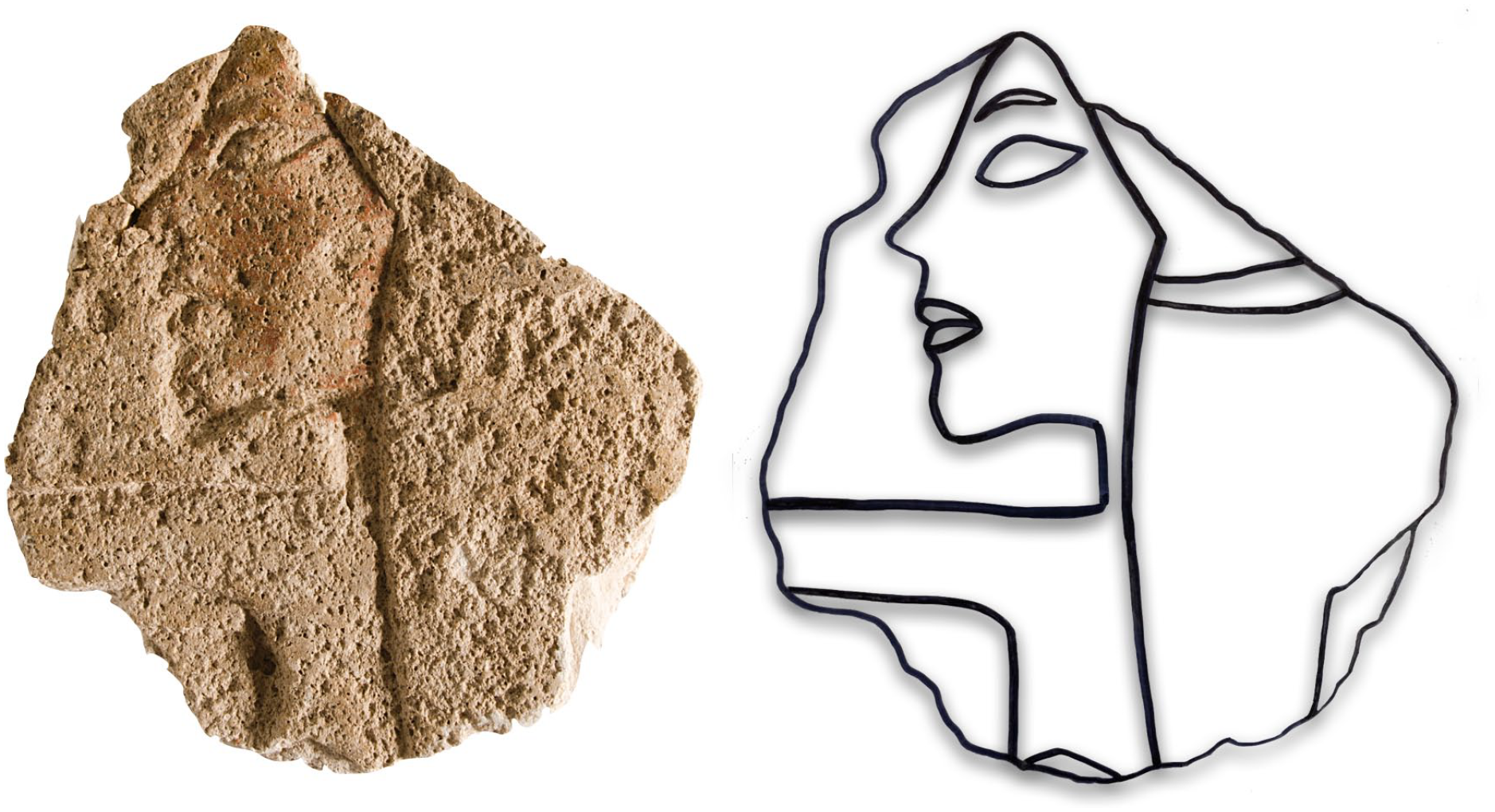
Left: object inv. 68/2.1, Museum of Archaeology and Ethnology, University of São Paulo (photo: Ader Gotardo, courtesy of the Museum of Archaeology and Ethnology, University of São Paulo). Right: drawing of object inv. 68/2.1 by R. Lemos.
According to museum records, Walter Wreszinski (1880–1935) originally collected the object ‘in the burial chamber of Princess Meketaten’ at the Amarna Royal Tomb at the end of the nineteenth century. In fact, it is known that artefacts attributed to the Amarna Royal Tomb appeared on the antiquities market before the first official expeditions to the site in the 1890s. 5 It is unclear, however, how the relief fragment ended up in Brazil in the possession of antiquities collector Franz Hermann Edgar Tapajós Hipp. Tapajós Hipp later sold part of his collection, including the Amarna fragment, to the Museum of Archaeology and Ethnology in 1968. 6
According to museum records, the fragment depicts an Amarna princess, namely Meketaten, an interpretation also followed by local scholars. 7 However, this is not the case, as a comparison with other fragments from the Royal Tomb clearly reveals that the woman depicted on the São Paulo fragment is one of the attendants to the royal ceremony represented several times in the Royal Tomb. The type of hairstyle depicted consistently matches the hairstyles of female mourning attendants on wall reliefs in rooms alpha and gamma, as well as in the main burial chamber (pillared hall E) of the Amarna Royal Tomb. 8
Discussion
The São Paulo fragment is similar to several gypsum plaster fragments from rooms alpha and gamma, and pillared hall E published by Martin. 9 There are, in total, eleven fragments from room alpha, thirteen from room gamma, and five from an undetermined location within the tomb, possibly pillared hall E. Most of these fragments are the result of unofficial activities at the site after Pendlebury’s 1931–2 expedition. 10
A comparison of a set of photographs produced in 1935 11 with the first drawings of the Royal Tomb’s decoration in the 1890s by Bouriant and his colleagues 12 allowed Martin to reconstruct certain scenes and identify the original location of some fragments. 13 Certain fragments now belong to museum collections, though the whereabouts of other pieces remains unknown. 14
The São Paulo fragment is an addition to the Martin corpus, although it seems to have been acquired before the severe damage to the scenes that occurred after Pendlebury’s work at the Royal Tomb. The first epigraphic documentation of the Royal Tomb by Bouriant and his colleagues already recorded damage to the wall reliefs. Although difficult to determine with certainty, it is possible that the São Paulo fragment was already missing from the walls by the time of the first archaeological work at the Royal Tomb at the end of the nineteenth century to the beginning of the twentieth century.
The main decorative scheme of room alpha is the adoration of the Aten, depicted both as the rising Sun and the Sunset in different corners of the room. The relief fragments from room alpha gathered by Martin include scenes of chariots, officials and foreigners that attended the ceremonies. 15 Wall F is an exception, as it depicts the death of Meketaten where it is possible to identify similar representations to the São Paulo fragment (fig. 2). After an examination against drawings by both Bouriant and his colleagues and Martin, it is unlikely that the São Paulo fragment belonged to any part of this scene, as it has survived major destruction efforts across time. 16 Furthermore, the woman depicted on the São Paulo fragment seems to have only one arm raised in front of her face, while the damaged attendants on wall F in room alpha have both arms raised in front of their faces.
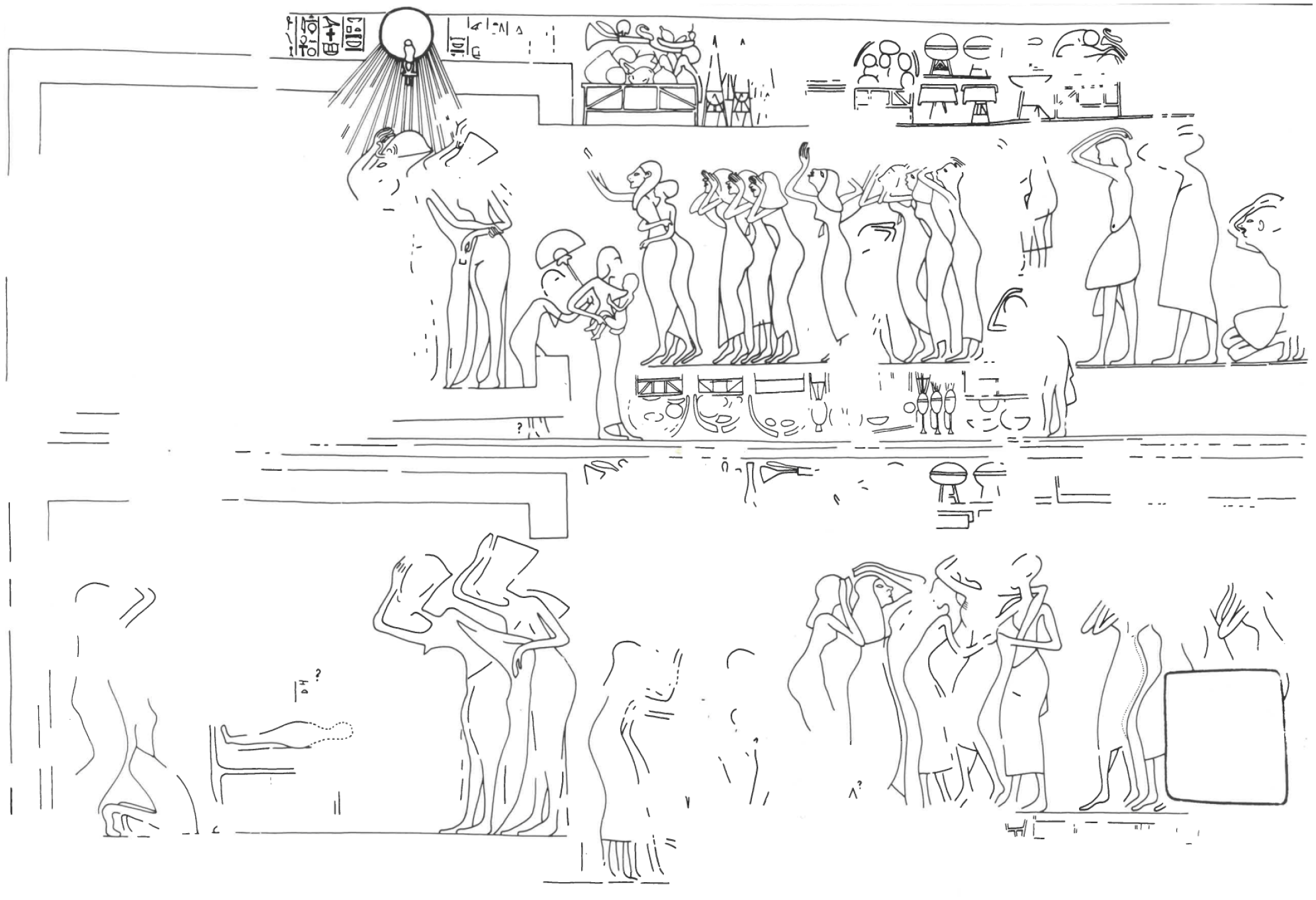
Wall F, room alpha from Martin, The Royal Tomb II, pl. 58 (courtesy of the Egypt Exploration Society).
The decoration scheme in room gamma predominantly consists of mourning scenes. In gamma, the so-called birth scene is considerably well preserved. 17 Therefore, it is unlikely that the São Paulo fragment belonged to this scene. However, one possible location for the fragment in question is the right side of the lower register of the mourning scene on wall B in room gamma (fig. 3).
Wall B in room gamma from Martin, The Royal Tomb II, pl. 68 (courtesy of the Egypt Exploration Society).
Bouriant’s drawing of the scene on wall B of room gamma includes damaged areas amongst the mourning women in the lower register. 18 If the São Paulo fragment originally comes from this scene—and museum records in São Paulo suggest that the fragment comes from Meketaten’s burial chamber—it would mean that the fragment was removed from the Royal Tomb before the first expedition to the site in the 1890s. Martin’s drawing of the same scene shows that wall B in room gamma suffered little damage since Bouriant’s visit, which would suggest that it is unlikely that the São Paulo fragment comes from this wall. On the other hand, the history of the object’s acquisition would suggest that the relief fragment was in fact originally part of wall B in gamma.
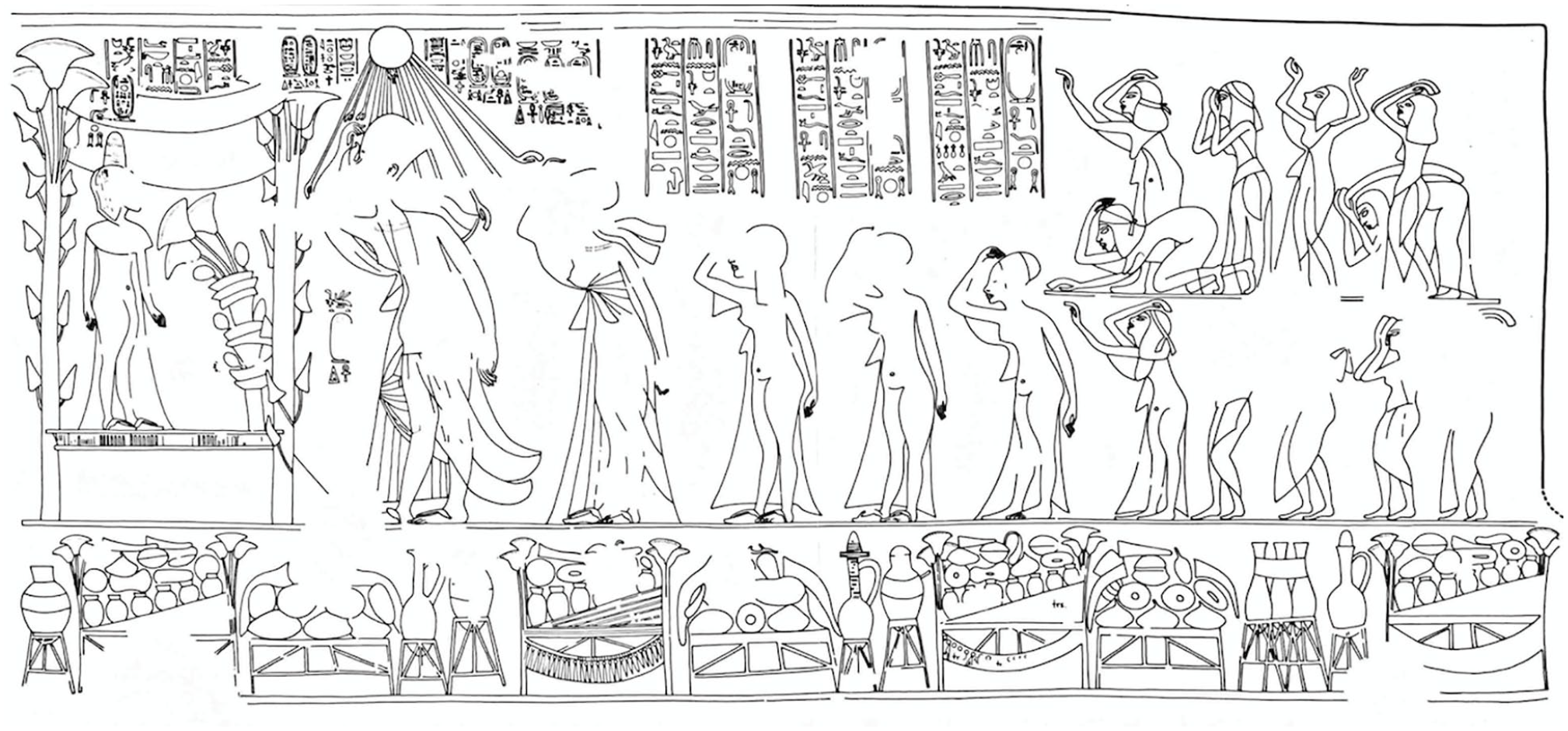
Another possible location for the São Paulo fragment would be pillared hall E. 19 The reliefs in this room, which was never fully decorated, 20 were heavily damaged after Pendlebury’s work in the tomb in 1931–2. 21 In fact, in 1982, Martin was still able to note several fragments in the debris in pillared hall E, including plaster fragments. 22
In the scene on wall B in pillared hall E, several mourning women are depicted (fig. 4). 23 These women have the same hairstyle as the one shown on the São Paulo fragment, similar to the mourning women in rooms alpha and gamma. The São Paulo fragment might possibly come from this wall; although, if this is true, it would be impossible to precisely place the fragment in the scene.

Mourning women, wall B (detail), pillared hall E from Martin, The Royal Tomb II, pl. 26 (courtesy of the Egypt Exploration Society).
Conclusion
The São Paulo fragment of the Amarna Royal Tomb could potentially be from three different parts of the tomb. These possible locations are wall F in room alpha, wall B in room gamma, and wall B in pillared hall E. Discussion of any symbolic aspects of the scenes on these walls is beyond the scope of the present contribution. 24
According to museum records, the relief fragment from the Amarna Royal Tomb now in São Paulo was collected at the end of the nineteenth century, prior to the destruction of the decoration of pillared hall E as recorded by Pendlebury in the 1930s. At the same time, it seems that the São Paulo fragment was already absent from the tomb before Bouriant’s 1890s expedition. Additionally, wall F in room alpha seems to be an unlikely location for the São Paulo fragment, both due to the incompatibility of the position of the arms of the royal attendants in the scene and the woman depicted on the relief fragment, and because the wall suffered little damage since the initial recording.
Although difficult to determine with certainty, I would suggest that the fragment comes from the right side of the lower register on wall B of room gamma. This would also explain the misinterpretations of the relief fragment in the museum’s archive and by local scholars. Instead of representing princess Meketaten, the fragment might actually have been found in room gamma, allegedly Meketaten’s burial chamber.
The wall reliefs in the Amarna Royal Tomb have suffered from severe damage. This makes it impossible to determine the location of the São Paulo fragment with precision. It is possible that other small fragments from the tomb lie unrecognised in other museum collections. If fragments eventually emerge, they could point us towards a better understanding of the tomb’s decorative scheme and the history of the Amarna Period.
Footnotes
Acknowledgements
I was lucky enough to have had the chance to prepare this contribution under the mentorship of Professor Geoffrey T. Martin, to whom I would like to express my sincere gratitude for assisting me with all aspects of this investigation. I am also grateful to Victoria Arroyo for facilitating my access to archival material in São Paulo, and to Paulo DeBlasis, Carla Gibertoni Carneiro and Julio Bomfim at the Museum of Archaeology and Ethnology of the University of São Paulo for giving me permission to publish the fragment of the Amarna Royal Tomb in their collection.
Funding
The author received no financial support for the research, authorship, and/or publication of this article.
1.
G. T. Martin, The Royal Tomb at El-‘Amarna I: the Objects (EES ASM 35; London, 1974); G. T. Martin, The Royal Tomb at El-‘Amarna. II: the Reliefs, Inscriptions and Architecture (EES ASM 39; London, 1989).
2.
For instance, C. Aldred and G. T. Martin, ‘Egypt’, in S. Hooper (ed.), Robert and Lisa Sainsbury Collection: Catalogue in Three Volumes, II (New Haven, 1997), 302.
3.
As a whole, the University of São Paulo Egyptian collection remains unpublished. The only existent catalogue is in an unpublished Masters thesis: A. Brancaglion, Arqueologia e Religião Funerária: a Propósito do Acervo Egípcio do Museu de Arqueologia e Etnologia (MA thesis, University of São Paulo; São Paulo, 1993). This catalogue consists of a list of objects with brief descriptions.
4.
See G. Daressy, ‘Tombeaux et stèles-limites de Hagi-Qandil’, RT 15 (1893); M. Raven, ‘A sarcophagus for Queen Tiy and other fragments from the Royal Tomb at el- Amarna’, OMRO 74 (1994); J. van Dijk, ‘The Death of Meketaten’, in P. Brand and S. Cooper (eds), Causing his Name to Live: Studies in Egyptian Epigraphy and History in Memory of William J. Murnane (Leiden, 2009).
5.
Martin, The Royal Tomb I, 4–5.
6.
The acquisition history of the object is unclear. According to Haiganuch Sarian, former Keeper of Antiquities of the Museum of Archaeology and Ethnology, Tapajós Hipp inherited his collection from an antiquities collector from Berlin, who was related to an archaeologist and conservator at the Berlin Museum. H. Sarian, ‘Entrevista: Reflexões sobre o Mundo Grego e o Antigo Oriente Próximo’, Heródoto 2:2 (2017), 13. According to museum records, the previous owner of some objects in the Tapajós Hipp collection was Mr. Hahn from Berlin who moved from Germany to Rio de Janeiro before the start of World War II. Once in Rio de Janeiro, Mr. Hahn would have started selling items in his private collection. Tapajós Hipp was actively purchasing antiquities by that time, both before and after the war, although the museum’s archive only offers incomplete information in that regard.
7.
Brancaglion, Arqueologia, 17–18; A. Brancaglion. ‘Coleções Egípcias no Brasil’, in M. Bakos (ed.), Egiptomania: o Egito no Brasil (São Paulo, 2004), 36; A. Brancaglion, ‘Um Egito ainda desconhecido: Coleções e Colecionismo no Brasil’, Tempo Brasileiro 193 (2013), 50.
8.
Martin, The Royal Tomb I, 99.
9.
Martin, The Royal Tomb I, 99–103.
10.
Martin, The Royal Tomb I, 99.
11.
TA-RT.NEG.34–35, now in the archive of the Egypt Exploration Society.
12.
U. Bouriant, G. Legrain, and G. Jéquier, Monuments pour servir à l’étude du culte d’Atonou en Égypte (MIFAO 8; Cairo, 1903).
13.
Martin, The Royal Tomb I, 99.
14.
Aldred and Martin, in Hooper (ed.), Robert and Lisa Sainsbury Collection, 318.
15.
Martin, The Royal Tomb I, pls 58–60; Aldred and Martin, in Hooper (ed.), Robert and Lisa Sainsbury Collection, 319, 321.
16.
Martin, The Royal Tomb II, 37.
17.
Bouriant et al., Atonou, pl. VII; Martin, The Royal Tomb II, pl. 61.
18.
Martin reconstructed the same scene using the drawing by Bouriant and his colleagues and photographs in the Egypt Exploration Society’s archive. Martin, The Royal Tomb II, pl. 68.
19.
G. T. Martin, personal communication, February 2019.
20.
Bouriant et al., Atonou, 10.
21.
Martin, The Royal Tomb I, 99. In Pendlebury’s words, the tomb ‘has been terribly damaged not only in antiquity but also in recent times during some feud between the guard and his fellow-villagers’. J. D. S. Pendlebury, Tell el-Amarna (London, 1935), 60–1.
22.
Martin, The Royal Tomb II, 50.
23.
Bouriant et al., Atonou, 10.
24.
Other scholars have already discussed the symbolical aspects of these scenes: C. Vandersleyen, ‘Les scènes de lamentation des chambres alpha et gamma dans la tombe d’Akhénaton’, RdÉ 44 (1993); M. Gabolde, D’Akhénaton à Toutânkhamon (Lyon, 1998); J. R. Harris. ‘En sag om forveksling’, Papyrus 24:2 (2004); van Dijk, in Brand and Cooper (eds), Causing his Name to Live.