




Abstract
This methodological review includes literature (1987–2022) concerning the role and influence of musical practices—including music therapy and participatory music interventions—on well-being in carceral settings such as jails, prisons, and immigration detention centers. We provide a thorough description of key methodological procedures used in 55 studies: (1) Key Elements of Research Questions; (2) Types of Musical Practices; (3) Musical Genres; (4) Methodologies and Designs; (5) Locations; (6) Theoretical Frameworks; and (7) Samples. Our review indicates that there is difficulty in conducting research in prisons due to limitations imposed on researchers, a paucity of randomized-control trials, and limited generalizability of results due to the heterogeneity of methodological approaches. We suggest that the literature base would benefit from increased attention to issues related to sampling procedures, research questions related to race and gender identity, as well as the delineation between the types of musical practices utilized by music interventions.
Introduction
This methodological review follows a comprehensive scoping review on the effects of musical practices on well-being in carceral settings, including jails, prisons, and immigration detention centers (Im & Pinto, 2024). Our literature base includes research from a diverse array of disciplines, including ethnomusicology, music education, criminology, and psychology. By conducting a scoping review, we identified three clusters of papers reflecting three themes around the use of musical practices, which include practices as varied as choral singing, music therapy, and listening to music, in carceral settings, which include jails, prisons, and immigration detention facilities.
First, this body of literature suggests that musical practices have a positive impact on the well-being of incarcerated people. The literature shows a strong connection between musical practices such as listening to relaxing music (Bensimon et al., 2015), participation in ensembles like choral groups (Cohen, 2009a), and music therapy interventions (Richards et al., 2019) with decreased levels of anxiety, depression, and stress as well as increased levels of sociality, self-esteem, and ability to cope with the experiences of incarceration. Second, musical practices in carceral settings may simultaneously be a source of empowerment and resistance, such as singing as a form of protest while on lockdown (Hemsworth, 2016) and disempowerment, such as the use of “loud music” in Guantanamo Bay as a tool of torture and interrogation (Cusick, 2008). Finally, musical practices like writing and performing rap music (Baker & Homan, 2007; Bramwell, 2018; Ierardi & Jenkins, 2012) may affect processes of identity formation and facilitate the learning and re-learning of social identities.
The literature we reviewed has generated a rich knowledge base that can now be used to guide future research concerning the role of music practices in the well-being of incarcerated people. Nevertheless, the methodological and theoretical approaches used in the studies we reviewed have limitations which need to be disseminated in order to improve the findings and quality of future research. These limitations include: (1) weakened methodological rigor due to the poor explication of sampling procedures; (2) the lack of comparisons between the impact of different types of musical practices; (3) lack of generalizability due to a paucity of randomized-control trials; and (4) difficulties conducting research in prisons due to restrictions imposed upon researchers. We offer recommendations about how to build on these methodologies to implement culturally sensitive interventions and solutions moving forward.
Methods
Procedures for Article Selection: Inclusion and Exclusion Criteria
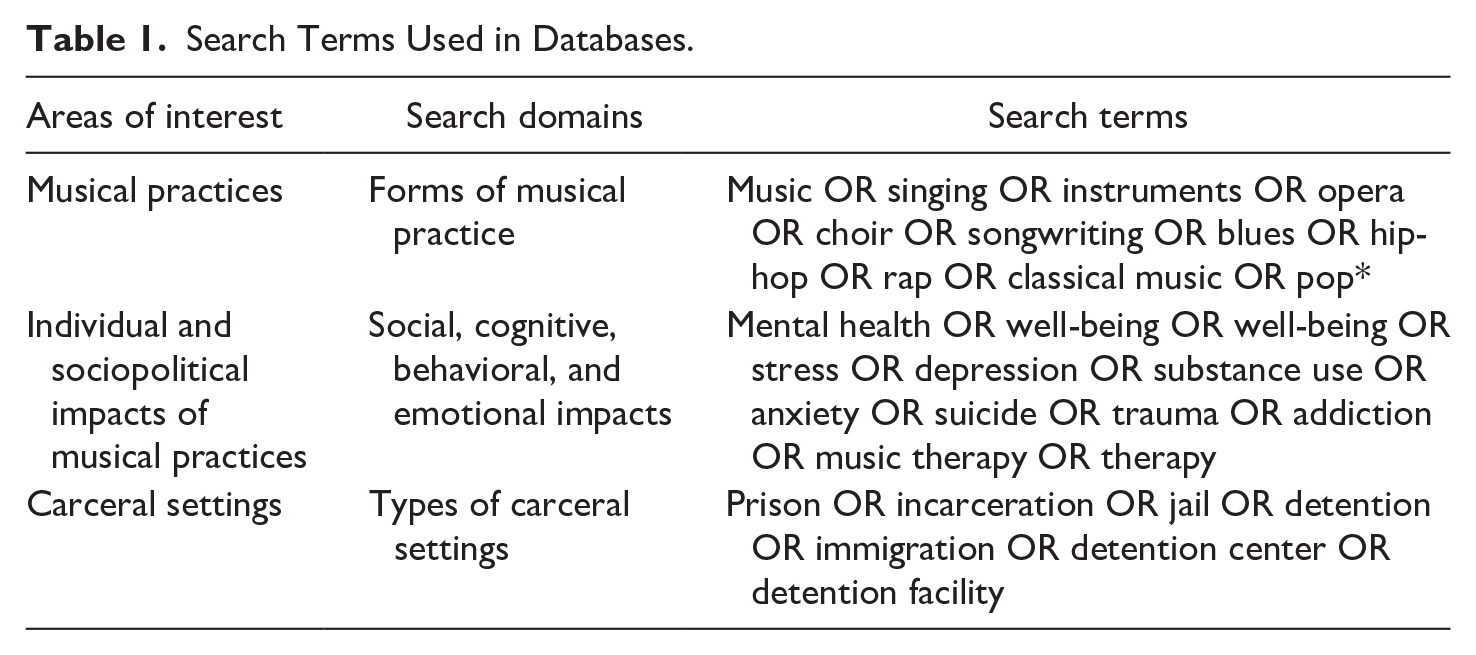
The databases that we utilized were ProQuest, Web of Science, Google Scholar, and PsycInfo. Web of Science, Google Scholar, ProQuest were utilized for their extensive reach, whereas PsycInfo was specifically used due to our interest in the effects of musical practices on outcomes related to well-being (Table 1).
Search Terms Used in Databases.
Definition of Search Terms
Musical Practices as a search term refers to the various ways in which music may be conceptualized as various practices, techniques, and forms of knowledge (Sonevytsky, 2019, p. 294). This includes practices as varied as singing and playing musical instruments as well as musical genres from hip-hop to classical music. Individual and Sociopolitical Impacts of Musical Practices refers to the areas of well-being, defined as the multi-dimensional experience of positive emotions, life satisfaction, and purpose, that musical practices may impact (Fancourt & Finn, 2019). Carceral Settings refer to institutions wherein human beings may be detained for behaviors perceived as criminal, which we define as behaviors that violate criminal law (Lynch et al., 2015), and for the purposes of this review include prisons, jails, and immigration detention facilities.
Inclusion and Exclusion Criteria
As defined by our search terms, this methodological review examines peer-reviewed research concerning the individual and sociopolitical impacts of musical practices on well-being in carceral settings. The original search yielded 124 results. We put aside 69 papers as they did not match our inclusion criteria, which included research with formerly incarcerated individuals as well as papers that did not examine music in carceral settings. Thus, this review contains 55 peer-reviewed research studies on the psychosocial impacts of musical practices on individuals in carceral settings. Aligned with our search terms, studies that focus on formerly incarcerated individuals, and re-entry or parole settings have been excluded.
Given the heterogeneity of the literature base surveyed here, our methodological review is grounded in an integrative review method (Cronin & George, 2023; Whittemore & Knafl, 2005). The integrative review method differs from meta-analyses and systematic reviews in that the integrative approach is the broadest type of research review method (Whittemore & Knafl, 2005). It is designed to encompass a diverse body of methodologies, from experimental to non-experimental approaches, in order to understand a broad topic of concern; additionally, the expansive sampling frame allows for a comprehensive, birds-eye view of many complex theories and concepts (Whittemore & Knafl, 2005).
Results
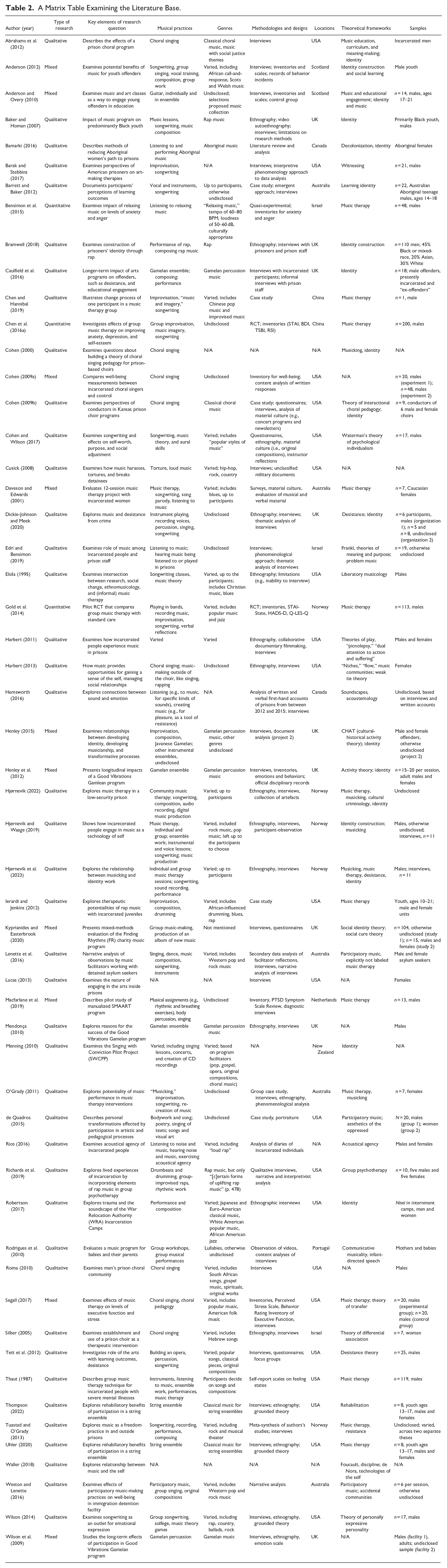
We included a total of 55 articles in this methodological review (Table 2). Of these studies, 76% (n = 42) of the literature constituted qualitative research, which include ethnographies, interviews with incarcerated participants and prison staff, and the thematic analysis of musical artifacts like song lyrics and music compositions; 18% (n = 10) utilized mixed-methods research which include the use of both qualitative approaches like interviews and ethnography as well as quantitative tools such as surveys, scales, and questionnaires; approximately 5% of papers (n = 3) comprised quantitative research, which constitutes two randomized-control trials and one study with a quasi-experimental design. In this section, we describe the methodologies and corresponding procedures utilized to study the role and influence of musical practices in carceral settings.
A Matrix Table Examining the Literature Base.
Key Elements of Research Questions
Reflecting our inclusion and exclusion selection criteria, all of the articles examined the role and influence of music on well-being in carceral settings. The heterogeneity of the studies contributed to an extraordinarily diverse array of research questions focusing on: (1) evaluations of existing music intervention programs, such as the Good Vibrations Gamelan program (Henley et al., 2012; Mendonça, 2010; Wilson et al., 2009); (2) examinations of the effects of music on outcomes related to well-being, such as the impact of relaxing music on levels of anxiety anger (Bensimon et al., 2015); (3) examinations of music on the effects of identity, such as the relationship between music, identity transformation, and desistance (Caulfield et al., 2016; Dickie-Johnson & Meek, 2020; Hjørnevik et al., 2023; Tett et al., 2012); and (4) conceptual investigations into the nature of musical practice in carceral settings, such as its utilization as a tool of torture and interrogation (Cusick, 2008).
Types of Musical Practices
Thirty-six percent (n = 20) of the papers examined songwriting practices. Twenty-two percent (n = 12) examined music therapy or psychotherapy as a primary practice which included the use of musical practices like musical improvisation (Chen & Hannibal, 2019), performance (O’Grady, 2011), performance of rap music (Richards et al., 2019), and body percussion (Macfarlane et al., 2019). Twenty percent (n = 11) of the studies included some form of instrumental playing including guitar lessons (Anderson, 2012; Anderson & Overy, 2010) and participation in a string ensemble (Thompson, 2022; Uhler, 2020). Sixteen percent (n = 9) specifically examined choral and group singing as a musical practice. Nine percent (n = 5) specifically examined the role of Gamelan ensemble playing as a musical practice. Other forms of musical practice include non-choral group singing (Anderson, 2012; de Quadros, 2015), listening to music (Cohen & Wilson, 2017; Edri & Bensimon, 2019; Rice, 2016), and improvisation (Barak & Stebbins, 2017; Chen & Hannibal, 2019; Chen et al., 2016a, 2016b; Cohen & Wilson, 2017; Henley, 2015; Ierardi & Jenkins, 2012; O’Grady, 2011; Richards et al., 2019).
Musical Genres
We identified the musical genres used in concert with the musical practices examined by this literature. We define genre as a “class, type or category, sanctioned by convention” that appeals to a set of shared conventions (Samson, 2001). This definition of genre is reflected in our search terms which include “hip-hop,” “classical music,” and “blues.” Twenty-two percent (n = 12) of the literature explicitly examines or utilizes a specific musical genre in their interventions or analyses of musical practice in carceral settings. This includes Gamelan percussion music (Caulfield et al., 2016; Henley et al., 2012; Mendonça, 2010; Wilson et al., 2009), Australian Aboriginal music (Bamarki, 2016), rap music (Baker & Homan, 2007; Bramwell, 2018; Richards et al., 2019), classical music (Abrahams et al., 2012; Cohen, 2009b; Thompson, 2022; Uhler, 2020). We labeled 53% (n = 29) of the genres as “varied,” which means that the study examined multiple genres at the same time. These genres were not explicitly disclosed. We chose to include Rodrigues et al. (2010) and Bensimon et al. (2015) within this category, who examined “lullabies” and “relaxing music,” respectively. The remaining 25% of articles (n = 14) did not disclose any musical genres.
Methodologies and Designs
Sixty-five percent (n = 36) of the studies utilized interviews as a methodological technique which included clinical and in-depth structured and unstructured interviews with incarcerated research participants, program facilitators, prison staff, and formerly incarcerated people. Thirty-five percent (n = 19) of the studies utilized ethnography and ethnographic techniques, including participant-observations. Twenty percent (n = 11) of the literature utilized surveys, and reliable scales, such as the Friedman Well-Being Scale (Chen et al., 2016a), the State and Trait Anxiety Inventory, and the Beck Depression Inventory (Chen et al., 2016b). Eighteen percent (n = 10) utilized material culture or documents about or written by incarcerated people, including original musical compositions (Cohen & Wilson, 2017). Four percent (n = 2) of the papers surveyed were two randomized-control trials, and 2% (n = 1) of the studies were quasi-experimental.
Theoretical Frameworks
Twenty-seven percent (n = 15) of the papers surveyed utilized a theoretical framework drawing from the music therapy or psychotherapeutic literature. Forty percent (n = 22) of the literature focuses on the notion of identity transformation and draws from theories like differential association (Silber, 2005), desistance theory (Caulfield et al. 2016; Dickie-Johnson & Meek, 2020; Hjørnevik et al., 2023, Tett et al., 2012). The remaining 33% (n = 18) of the studies utilized theoretical frameworks, including liberatory musicology (Elsila, 1995), theories of meaning and purpose (Edri & Bensimon, 2019), psychological individualism (Cohen & Wilson, 2017), witnessing (Barak & Stebbins, 2017), acoustemology (Hemsworth, 2016), acoustical agency (Rice, 2016), communicative musicality (Rodrigues et al., 2010), theories of play and music communities (Harbert, 2011, 2013), rehabilitation (Thompson, 2022), interactional choral pedagogy (Cohen, 2009b), musicking (Cohen, 2009a; Hjørnevik, 2022; Hjørnevik & Waage, 2019; Hjørnevik et al., 2023; O’Grady, 2011), and participatory music (de Quadros, 2015; Lenette et al., 2016; Weston & Lenette, 2016).
Sampling and Locations
Sampling is the process by which a researcher selects a representative subgroup of individuals for the purposes of generalizability and replicability of their studies and findings (Berndt, 2020). In terms of race, 7% (n = 4) of the studies surveyed noted the races of their research participants, while the remaining 93% (n = 51) made no reference to race. In terms of gender, 76% (n = 42) of the literature mentions the gender identities of their participants, while 24% (n = 13) did not report gender identities. Research involving only males comprised 42% (n = 23) of the papers whereas research involving only female participants made up 9% (n = 5). Research involving males and females comprised 18% (n = 10) of the literature; 7% (n = 4) of the studies utilized more than one group of participants but only provided the gender identities of only one of the groups or neither group. In terms of geography, 38% (n = 21) of the research we reviewed took place in carceral settings in the United States; 20% (n = 11) of the studies were conducted in the United Kingdom; 9% (n = 5) was conducted in Australia, 7% (n = 4) in Norway, 5% (n = 3) in Israel, 4% (n = 2) in Canada, 4% (n = 2) in China, 2% (n = 1) in the Netherlands, 2% (n = 1) in New Zealand, and 2% (n = 1) in Portugal. Five percent (n = 3) of the research is labeled “N/A” as geography was irrelevant to their research questions.
Discussion and Recommendations
Poor Explication of Sampling Types and Procedures of Inclusion
There is a pressing need for the purposeful inclusion of under-represented minoritized populations in carceral settings, especially women and people of color. Alarmingly, 93% (n = 51) of the research made no reference to the racial makeup of their samples, and only 9% (n = 5) of the studies was comprised of research that specifically examined work with women. The studies we examined for the purpose of this methodological review have focused primarily on adult male prisoners in the United States and the United Kingdom. Within this literature, very few studies have explicitly articulated the demographics of their research participants, including such factors as gender, age, and race. Our review also demonstrates that only 7% (n = 4) of the studies explicitly articulated the racial demographics of their research participants. We posit that this is especially relevant for studies implemented in the United States, given that American studies make up 38% of this literature base (n = 21/55). Black males in the United States, for example, are six times more likely to be imprisoned than White males of the incarcerated population (Blankenship et al., 2018) and women in carceral settings tend to be under-represented in discourses around incarceration (Covington, 2013). In terms of age, we also note that the developmental and mental health needs between children, adolescents, young adults, adults, and seniors can vary dramatically (Bond et al., 2005; Kolivoski & Shook, 2016).
Lack of Specificity in Explication of Musical Practices and Genres
The literature generalized extraordinarily varied practices like songwriting, recording, performance, composing and improvising under the umbrella of “music” as opposed to distinguishing between these various practices as being different sources of influence on well-being. This is also true of musical genres, wherein 53% (n = 29) of the studies utilized multiple genres that were not always disclosed. Studies that do not isolate the role and influence of different practices are helpful in that they are multi-dimensional and demonstrate the potential efficacy of such practices in combination with one another. However, the lack of specificity, combined with poorly described sampling strategies, creates confusion and ultimately makes it difficult to apply the results of these studies in other domains and populations. Due to this lack of specificity, it is not possible to comparatively examine the true impact of various practices from an interventional perspective. We argue that future research may benefit from the comparative examination of specific musical practices like music composition as opposed to music performance to more deeply understand the unique and shared mechanisms of change that underlie them.
Lack of Generalizability
We identify the paucity of randomized-control trials, longitudinal and mixed-method research, and consequently, the lack of generalizability of findings as a gap in the literature. We identified two randomized control trials by Chen et al. (2016a) in China and Gold et al. (2014) in Norway, as well as the quasi-experimental study by Bensimon et al. (2015) in Israel. These studies contribute to the knowledge base by demonstrating the positive therapeutic potentialities of music therapy in carceral settings, such as increased self-esteem and decreased anxiety and depression. However, each of these studies has as limitations the lack of longitudinal and follow-up data and non-varied sub-populations (including women and prisoners in different levels of security confinement) and generalizability as they all address work with adult, male prisoners in different sociocultural contexts.
Restrictions Imposed on Researchers
The lack of randomized control trials may be explained by our methodological review, which reveals the difficulties inherent in conducting research in prisons in the first place. We note that authors have explicitly written about the limitations imposed upon researchers in these settings, such as the inability to conduct interviews with incarcerated participants (Baker & Homan, 2007; Elsila, 1995), restrictions on the use of recording technologies (Baker & Homan, 2007), and the very short stays of participants at certain facilities (Gold et al., 2014). Elsila (1995) additionally notes that music may be thought of as a “fringe” activity in prisons that prison guards find little incentive to support or encourage. Lucas (2013) also notes that programming in prisons may be shut down for myriad reasons, including staffing issues, overcrowding, and budget cuts. For both Elsila (1995) and Baker and Homan (2007), there were also strict limitations on group sizes, time spent with participants, and limitations on rehearsal time. The aforementioned restrictions necessitated Elsila (1995) to gather and process data in light of these restrictions, including through correspondence and written testimonials. These issues may explain why non-intrusive qualitative approaches (n = 42/55) to studying musical practices in carceral settings reign supreme and that ethnographic methodologies may be particularly well-suited for this work. We suggest that the literature may benefit from explications of research limitations and procedures in carceral settings such that future work may be informed by these experiences.
Conclusion
This review of the literature shows an extraordinarily diverse array of methodological approaches to the study of music practices and genres in carceral settings and has succeeded in demonstrating both the empowering and disempowering effects that musical practices have on the well-being of incarcerated participants. We offered recommendations for future research that examines the effects of musical practices on the well-being of incarcerated people, particularly as they relate to sampling procedures, lack of specificity around musical practices and genres, lack of generalizability, and the restrictions imposed on researchers in carceral settings.
Footnotes
Declaration of Conflicting Interests
The author(s) declared no potential conflicts of interest with respect to the research, authorship, and/or publication of this article.
Funding
The author(s) received no financial support for the research, authorship, and/or publication of this article.
