




Abstract
Despite rich literature on public opinion on capital punishment, only a few studies examined people’s death penalty support within specific contexts. None have explored if correlates that influence people’s opinion would hold the same effect in general questions and specific case scenarios. Similarly, the Marshall hypotheses have not been tested with specific crime scenarios. Based on a sample of 1,077 students in a quasiexperimental design, this study contrasts Chinese students’ death penalty opinion in general questions with a specific crime scenario, and tests the Marshall hypotheses with the latter. Compared to their support in general questions, students’ support for death sentences dropped significantly in the specific crime scenario. Multivariate analyses showed that different factors influenced people’s decisions in the general questions and in the specific case, and respondents’ choices of preferred punishment in the specific crime scenario failed to lend support to the Marshall hypotheses.
Keywords
Introduction
Though Western studies of public opinion on capital punishment have accumulated a rich body of literature, only a few examined people’s support for capital punishment within specific contexts (Burgason & Pazzani, 2011; Durham et al., 1996; Falco & Freiburger, 2011; Mills & Zamble, 1998). Instead, studies overwhelmingly relied upon general and abstract questions used in polls (e.g., “Do you favor or oppose the death penalty for persons convicted of murder?”). Based on such general questions, poll data often show the majority support within a particular jurisdiction or a nation. In this regard, China is an “imperfect” example: though China has never conducted a national poll on citizens’ death penalty opinions (Lu, 2005), the Chinese government claims “overwhelming public support” to buttress its use of capital punishment.
Nevertheless, the literature clearly showed that people’s death penalty opinions are not immutable, but subject to change. Hood (2018) pointed out that death penalty opinions were far more nuanced and moderate than what governments in retentionist nations believed. Misinterpreting the majority support in survey results, these governments often preach the death penalty as the only appropriate punishment instead of a punishment. Comparative studies conducted in nations such as Canada (Mills & Zamble, 1998), Poland (Krajewski, 2009), China (Oberwittler & Qi, 2009), Malaysia (Hood, 2013), Singapore (Chan et al., 2018), and Trinidad (Hood & Seemungal, 2011) showed that people’s support for capital punishment in specific crime scenarios was lower than their support measured in a general question. Unfortunately, this important lesson about public support for capital punishment is often overlooked or deliberately “ignored” by politicians. In China specifically, while public outrage may put pressure on judges in certain individual cases (e.g., Qi & Oberwittler, 2009, pp. 144–145), public opinions play little role in influencing politicians’ policy- and/or law-making.
Two notable inadequacies exist in past studies that contrasted people’s death penalty positions in general questions with specific crime scenarios: first, no studies explored if correlates that potentially influence people’s opinion would carry the same effect in general questions and specific crime scenarios. It is likely that different factors may influence people’s decisions in different contexts. Second, the famous Marshall hypotheses have not been fully tested within a specific capital crime scenario. Given the finding that specific context matters when measuring people’s death penalty opinion, it is logical to question if Justice Marshall’s belief that informed citizens would abandon capital punishment in general would be applicable when they are asked to make decisions in specific cases.
Based on a sample of 1,077 students and a quasi-experimental design, this study directly contrasts people’s death penalty opinion in general questions with a specific crime scenario. Further, we test the validity of the Marshall hypotheses with a specific crime scenario. In the remaining of the article, we review the literature and discuss why the context matters in studying people’s death penalty opinion. Next, we review studies of China’s public opinion on the death penalty. Then we discuss our data and research design, and present main findings. Lastly, we draw policy implications and discuss limitations of our study.
The Context Matters
Rich literature has been built on death penalty public opinions in Western nations. Based on survey and poll data, these studies covered a wide range of topics such as the extent of public support (Harris, 1986), the rationales for people’s support (Bohm, 1992; Warr & Stafford, 1984), potential factors that influence people’s support (Britt, 1998), whether people’s opinions may change given new knowledge (e.g., the famous Marshall hypotheses) (Bohm et al., 1993; Lambert & Clarke, 2001), and the potential impact of public opinion on death penalty practice (Cullen et al., 2000).
One consensus reached by scholars is that the oversimplified general question used in polls is problematic and fails to uncover the complexities of public opinions (Ellsworth & Ross, 1983; Murray, 2003). As argued, the majority support based on general questions likely shows people’s support for the concept of capital punishment (Williams et al., 1988) and merely reflects people’s acceptance, but not their preference for the death penalty in specific cases (Bowers et al., 1994). Instead, people’s opinions vary depending upon the specific context, subject to influence by a number of factors. First, characteristics of both offenders and victims matter. For instance, though the US Supreme Court struggled with execution of juveniles until its decision in Roper v. Simmons, 543 U.S. 551 (2005), poll data already showed reluctance by the majority of survey respondents to impose capital punishment on juvenile offenders (Durham et al., 1996, p. 708). Second, specific crime scenarios matter. In an effort to understand the complexity of people’s opinions, for instance, Falco and Freiburger (2011) presented to focus group participants four different homicide scenarios, and respondents’ positions changed accordingly.
Third, the type and nature of capital offenses matter, especially when a jurisdiction utilizes a variety of capital offenses. China is known for its willingness to use capital punishment for a variety of capital crimes, including nonviolent and nonlethal crimes (Liang & Lu, 2016). After eleven amendments, the current Chinese Criminal Law (2020) still contains 46 capital offenses. Several studies showed that Chinese people’s support for capital punishment generally declined when the perceived severity of the crime lessened (Kuang et al., 2010; Liang et al., 2019; Oberwittler et al., 2010; Qi & Oberwittler, 2009). Fourth, whether there is viable alternative punishment also matters to people’s decisions. When respondents were presented with alternatives such as life imprisonment without possibility of parole (LWOP), people’s support for the death penalty declined significantly (e.g., Bowers et al., 1994; McGarrell & Sandys, 1996). All of these findings above are further corroborated by comparative studies in a number of nations (Hood, 2018).
The message is clear: the context matters. General questions often fail to provide the necessary context and thus generate misleading information. Nevertheless, whether a specific context would lead to lower public support is unsettled. As early as the 1980s, Williams et al. (1988) tested a group of Texas residents with three general questions on capital punishment and one specific question on murderers. The results showed that the specific question yielded less support. They suggested that “there does appear to be a trend toward less support for capital punishment when less abstract questions are used in a survey (p. 3).” Their suggestion was corroborated by comparative studies conducted in China (Oberwittler & Qi, 2009), Poland (Krajewski, 2009), Malaysia (Hood, 2013), Singapore (Chan et al., 2018), and Trinidad (Hood & Seemungal, 2011). However, this conclusion should not be drawn hastily. For instance, Durham et al. (1996) surveyed a group of Florida residents with 17 homicide scenarios. While the overall support rate for death sentences was 60.8%, the support rate was much higher in some scenarios. Again, the specific context matters: when a brutal crime scenario is portrayed with little room for doubt and sympathy, a high level of support for capital punishment is likely to occur, even higher than that based on a general question.
Albeit past studies suggest that the general questions do not accurately reflect public positions about actual use of the death penalty in specific cases, quantitative or qualitative studies that provided specific contexts to test people’s opinions are rare (Burgason & Pazzani, 2014; Durham et al., 1996; Falco & Freiburger, 2011; Mills & Zamble, 1998; and studies conducted in China, Malaysia, Singapore, and Trinidad cited above). Of particular importance to our inquiry, only five studies, all conducted in non-US nations, directly contrasted people’s support for capital punishment in a general question with specific crime scenarios. Four studies conducted in China, Malaysia, Singapore, and Trinidad relied on similar survey designs (see Hood, 2018). In the fifth study, Mills and Zamble (1998) examined Canadian respondents’ opinions based on a general question and 12 vignettes of homicide with varying information: while the general question elicited a 38% support rate for capital punishment, support rates in 12 vignettes ranged from 2% to 51%. Two inadequacies of these five studies should be noted: first, aimed to test the effect of various mitigating and aggravating circumstances, these studies relied on multiple crime scenarios, thus leaving each scenario rather succinct (ranging from a few sentences to a paragraph). As a trade-off, the short length suffers from lack of specificity. Second, none of them conducted multivariate analyses and tested if some potential correlates (e.g., gender, deterrence, retribution) would exhibit similar effect on people’s support in a general question and a specific crime scenario.
Another line of scholarly inquiry in this field is whether people’s attitudes may change given new knowledge, typified by the famous Marshall hypotheses. In Furman v. Georgia, 408 U.S. 238 (1972), Justice Marshall suggested that American citizens would be subject to reasoned persuasion and the majority of American citizens would oppose the use of capital punishment once they become informed about the flawed death penalty system. Despite his belief, Justice Marshall recognized that an informed decision may not lead to people’s attitude change if the basis for their support is retribution. A solid body of literature has been built to test the Marshall hypotheses, and the overall results are mixed and inconsistent (see Liang et al., 2019 for a summary). One glaring inadequacy, nevertheless, is lack of testing with a specific crime scenario: despite various designs, almost all empirical studies tested the hypotheses with a general question only. Given the problem associated with the use of general questions discussed above, a logical question is whether knowledge would affect people’s support for capital punishment in a specific crime scenario. Two recent studies attempted to test the Marshall hypotheses in specific crime scenarios, but both suffered from methodological flaws. Diaz and Garza’s (2015) study randomly assigned 135 Texas students into four groups, three of which received a particular form of intervention (either via a general video about wrongful conviction, a video by a crime victim who shared personal experience about a wrongful conviction, or reading on wrongful conviction). All three treatment groups and one control group were provided with five short crime vignettes (with length ranging from one sentence to a paragraph) and students were asked to indicate their willingness to fix the death penalty. Among other findings, students who were exposed to the crime victim’s video or the reading were more likely to choose the death penalty in one of the vignettes, compared to the control group, thus contradicting the Marshall hypotheses. 1 Among other issues, this study did not control any other variables in multivariate analyses and confounded its comparison between treatment groups and the control group with comparisons between treatment groups.
Boots et al.’s (2018) study exposed students who took death penalty-related courses in Texas and California to information about a real homicide case in Texas and examined students’ choice of sentences when they were asked to fix the penalty. Their bivariate and multivariate results showed that students with initial opinions against or uncertain about capital punishment at the beginning of the class were significantly more likely to recommend the LWOP than those who initially supported capital punishment. Unfortunately, there was no control group in this study, as students in the study all took death penalty classes. Therefore, a conclusion cannot be drawn if the intervention (i.e., the class) would have affected students’ choice of sentences.
Study of China’s Public Opinion on Capital Punishment
Study of China’s public opinion (minyi) on capital punishment is still at its infancy compared to the Western literature, and empirical studies are rather limited. Existing studies can be categorized into two groups: one focused on the statistical form of minyi and relied upon survey data to examine Chinese citizens’ support; the other turned to people’s spontaneous reactions to controversial cases and examined how people’s outrage in high-profile cases may have influenced judicial sentencing in individual cases (see Liu & Liang, 2019 for a summary). Our review below focuses on quantitative survey studies only.
To date, independent studies produced 13 published articles by overseas scholars (Cao & Cullen, 2001; Jiang & Wang, 2008; Jiang et al., 2007, 2009, 2010, 2018; Lambert et al., 2007; Liang et al., 2006, 2019; Oberwittler & Qi, 2009; Oberwittler et al., 2010; Qi & Oberwittler, 2009; Wu et al., 2011) and seven studies conducted by Chinese domestic scholars (He, 2009; Jia, 2005; Jiang, 2008; Kuang et al., 2010; Yuan, 2009; Zhang & He, 2011; Zhao, 2015). While Chinese domestic scholars often examined people’s support for capital punishment in a variety of capital offenses across different professions, overseas scholars relied upon sophisticated statistical analyses to examine correlates with people’s support for capital punishment and contrast Chinese groups with counterparts from other nations. One common problem, however, is the inadequacy of research design and/or nonrepresentative and nonrandom sampling. In fact, only two studies (Oberwittler & Qi, 2009; Zhao, 2015) managed to collect random samples in limited regions of China: three provinces in the former study and one undisclosed mid-size city in the latter.
Collectively, existing studies confirmed the overall majority support for capital punishment in China, though the support rates varied greatly from percentages in the 50s (He, 2009; Qi & Oberwittler, 2009) to the 90s (Kuang et al., 2010). Studies that covered multiple capital crimes showed that people’s support rates generally declined when the perceived severity of the crime lessened (Jia, 2005; Kuang et al., 2010; Liang et al., 2019; Oberwittler et al., 2010; Qi & Oberwittler, 2009). Further, people’s support varied based on their professions (Jiang, 2008; Oberwittler et al., 2010; Yuan, 2009; Zhang & He, 2011). For instance, Yuan (2009) managed to survey opinions of 726 inmates: one-third (n = 240) openly opposed capital punishment, a drastic contrast with other groups.
Consistent with Western research, studies conducted by overseas scholars showed that Chinese death penalty supporters embrace major justifications of punishment such as deterrence, retribution, and incapacitation (Jiang et al., 2007, 2009; Liang et al., 2006; Oberwittler & Qi, 2009; Wu et al., 2011). Besides demographics, several variables such as one’s fear of crime, victimization experience, and belief in punitive penal ideology were found correlated with one’s support for capital punishment (Oberwittler & Qi, 2009; Wu et al., 2011). Several studies found that Chinese respondents reported higher levels of support compared to counterparts from other countries (Cao & Cullen, 2001; Jiang et al., 2010; Qi & Oberwittler, 2009; Wu et al., 2011).
Similar to the Western literature, however, very few studies (three in total) tested people’s opinions in specific crime scenarios. In two studies conducted by the same researchers (Oberwittler & Qi, 2009; Qi & Oberwittler, 2009), a set of vignettes with varying degrees of mitigating and aggravating circumstances were posted to respondents to solicit their preferred punishment. The results showed that respondents’ support was invariably lower than their support in a general question. A third study (Zhao, 2015) focused on one capital offense, organizing prostitution, 2 and asked respondents to fix a penalty based on a crime scenario adapted from a real case: merely 4.1% of respondents chose the death penalty, an unsurprising result given the nature of this nonlethal and nonviolent crime. None of these three studies tested correlates that potentially influence people’s opinion in multivariate analyses.
Regarding the Marshall hypotheses, Liang et al.’s (2019) study is the only known attempt to study whether Chinese people are subject to reasoned persuasion. Based on a non-random college student sample, the results showed promising signs of opinion change after students were better informed, but the effect of student “learning” depends on what knowledge is conveyed and how it is conveyed. This study, however, only tested students’ opinions measured by general questions, and did not explore if the Marshall hypotheses would be valid in a specific case. 3
Current Study
In this study, we test three questions: (1) Is people’s support for the death penalty subject to change when it is measured in general questions and in a specific crime scenario? (2) Do correlates that potentially influence people’s support hold the same effect when their opinion is measured in general questions and in a specific crime scenario? And (3) how do the Marshall hypotheses fare when people’s opinion is measured in a specific crime scenario? Specifically, the third question is tested in two parts: (i) when presented with a specific case, would students who are better informed more likely opt for non-death penalty punishment? (ii) compared to non-believers, would people who hold a strong belief in retribution less likely disfavor capital punishment after being informed with new knowledge?
Data and Methodology
Data were collected on a branch campus of a Normal University in Southern China with an average of 30,000 student enrollment in 2017. This university was conveniently selected due to our professional connection. Procedures equivalent to the IRB in the United States were approved and followed before questionnaires were distributed to all 12 colleges of the university (100 questionnaires were distributed to each college with a target sample size of 1,200). Granted, our sample is not representative, a major limitation we discuss later.
To test the Marshall hypotheses, three essays were created to test the effect of students’ learning. In the first essay (titled “international trend”), we contrast the global abolition movement with China’s excessive use of capital punishment, and emphasize the roles of international standards. In the second essay (titled “wrongful conviction”), we focus on the effect of wrongful convictions, as past studies showed that information on wrongful convictions could potentially change people’s opinion (Clarke et al., 2001; Lambert & Clarke, 2001; Lambert et al., 2011). In the third essay (titled “deterrence”), we discuss the presumed deterrence effect of capital punishment and the lack of empirical support. In all three essays, given the lack of information in China, we turn to other nations (e.g., the USA) to contrast with China, albeit arguments built upon information from other nations are likely not as persuasive to the Chinese audience. Each essay carried about 800 words and was pilot-tested (see Liang et al., 2019 for detailed information). Besides three experimental groups, a control group contained students whose questionnaire did not include any essay.
To ensure random assignments, four questionnaires (three with essays and one without essays) were randomly distributed to survey administrators before they were distributed to students. As overseas scholars were not allowed to implement the research, the host university facilitated the survey execution. Though we did not have direct control over data collection, detailed instructions and trainings were provided to survey administrators. Admittedly, this is not complete random sampling. Instead, we relied on this compromised approach to even out potential group differences (Clarke et al., 2001). A comparison of demographic variables and three control variables (victimization, fear of crime, and retribution, see coding below) across four groups produced little significant differences, indicating the effectiveness of random assignment (see Liang et al., 2019 for detailed information). A total of 1,077 valid questionnaires (a 89.8% response rate) were utilized below after removing incomplete or problematic surveys.
Each questionnaire consisted of five parts. In Part I, demographic information was collected. In Part III, questions targeted students’ opinions on capital punishment and rationales for their support. In Part IV, information about respondents’ victimization experience, and fear of crime was collected. Unrelated to our research questions, Part II and V were not utilized in this study. Intervention essays were inserted between Part II and Part III. Thus, any differences found in Part III between the control group and intervention groups would be presumably due to the intervention of the essays.
Measurements
Students were first asked to rate their overall opinion on capital punishment on a 5-point likert scale (from “strongly agree” to “strongly oppose”). Next, students were asked to rate their opinion in a group of capital offenses, including murder, rape, drug trafficking, other violent crimes (causing human death), non-violent crimes (without human death), and corruption. We recoded students’ responses into three categories (from “support,” “neutral,” to “oppose”). Second, a hypothetical case, adapted from a real wrongful conviction case occurred in 1998, was provided to the students (see Appendix). After reading the case, students were asked to choose their preferred punishment from a list of options, ranging from the death penalty with immediate execution (the death penalty), the death penalty with a two-year suspension (the suspended death penalty), 4 to terms of incarcerations (e.g., 25 years), and to “not-guilty release.” We further collapsed students’ answers into three groups, consisting of “death penalty,” “suspended death penalty,” and “non-death sentences.” As our hypothetical case deals with a homicide scenario, we contrast the results of students’ preferred punishment with students’ overall opinion on capital punishment and their opinion for homicide below.
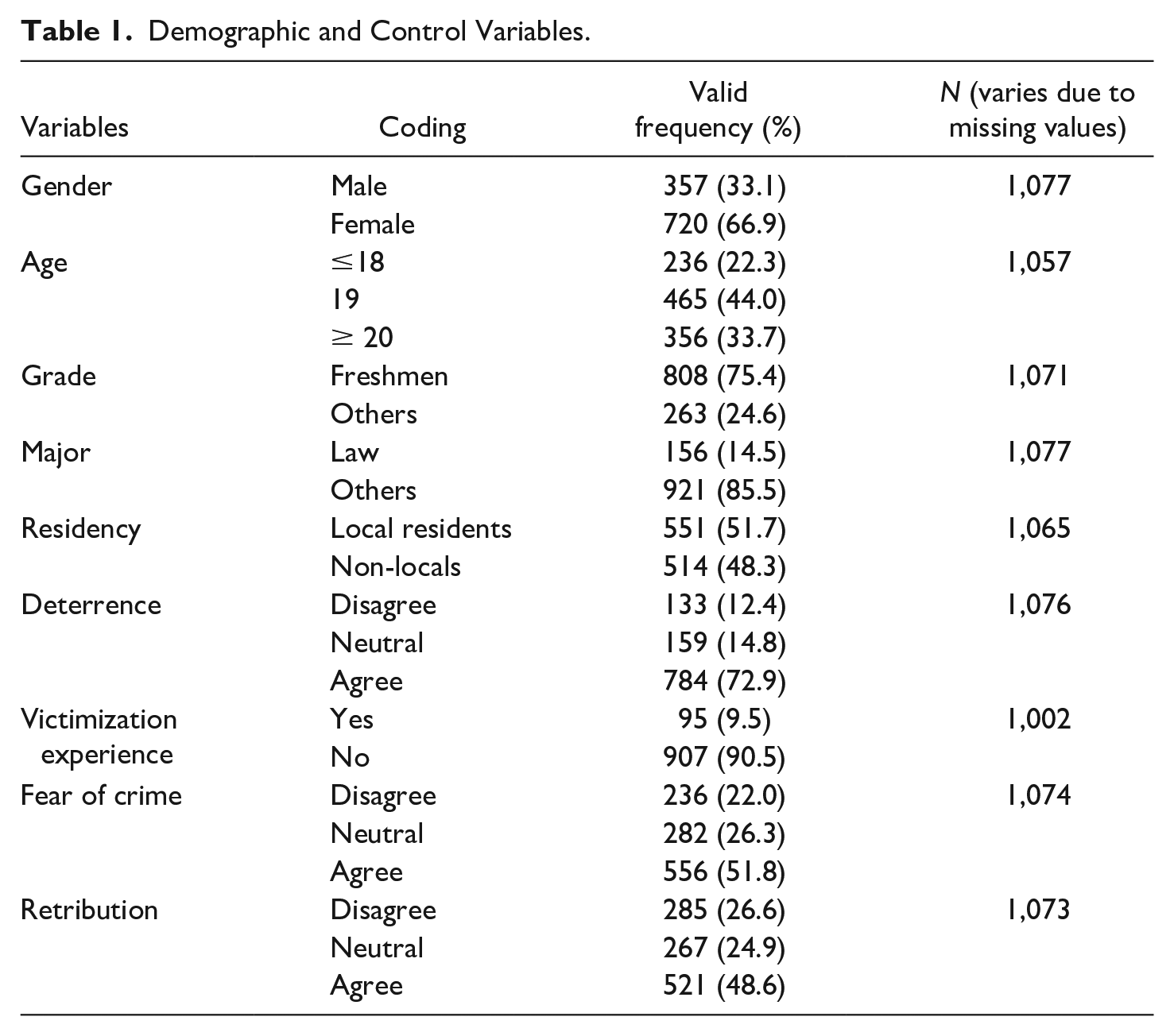
A number of demographic and control variables were included. Among the demographic variables, a few (e.g., one’s employment, marital status) were excluded due to lack of variations. As shown in Table 1, 66.9% of all respondents were females 5 and two-thirds were 19 years old or younger, and 51.7% of students were local students; over 75% were freshmen, raising concerns about the representation of our sample. Since all 12 colleges were covered, we witnessed a broad range of students’ majors. As there is no criminal justice major in Chinese academia, we contrasted law majors (14.5% of our sample) with other (non-law) majors. Four other control variables were included, given their saliency in past studies. One’s belief in deterrence was a recoded scale variable generated from three questions, 6 and over 72% of respondents believed in deterrence. One’s victimization asked “whether one suffered from a violent crime in the last 5 years” and 9.5% reported such experiences. 7 The variables “fear of crime” and “retribution” asked respondents to rate their opinion on a 5-point likert scale if “they fear doing outdoor exercises alone” and “the death penalty is retribution (an eye for an eye) to criminals.” Statistics in these variables were recoded into three categories. As shown, 51.7% of respondents expressed fear and 48.6% supported retribution.
Demographic and Control Variables.
Results
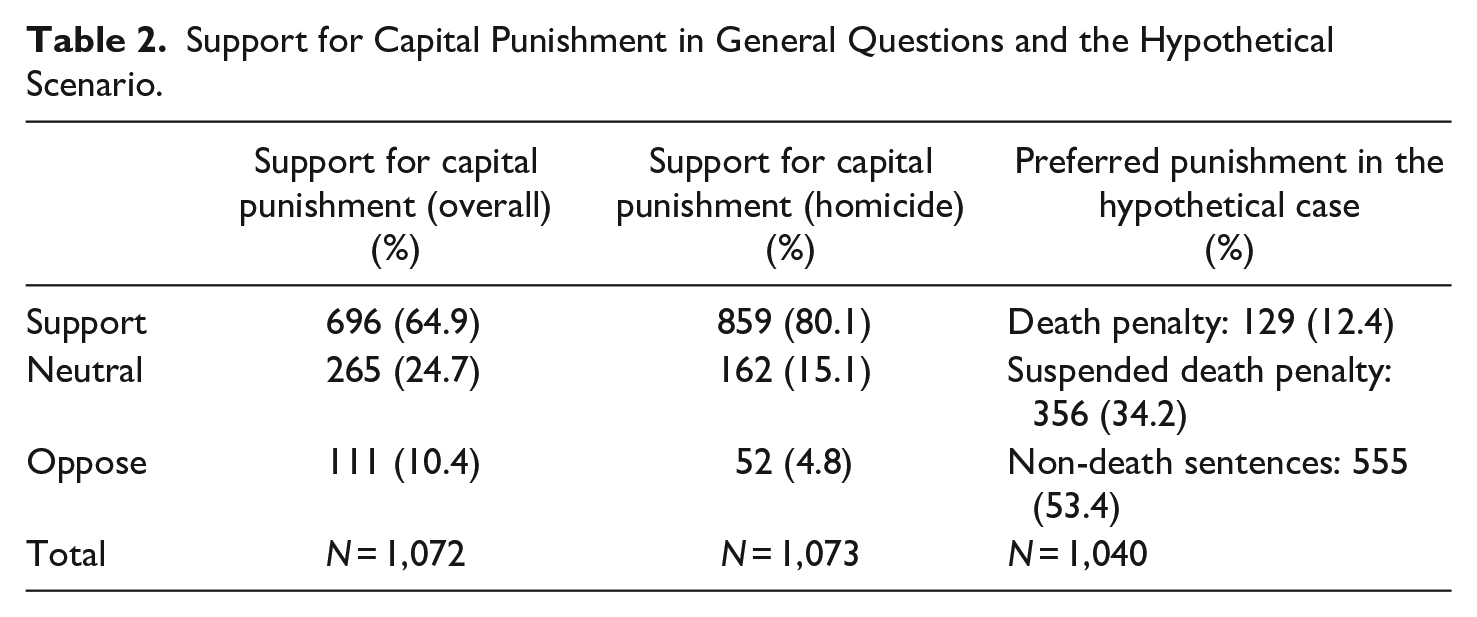
First, to test if students’ support for capital punishment would be subject to change, we contrasted their support in general questions with their preferred punishment in the hypothetical case. As shown in Table 2, 64.9% of students supported capital punishment in the overall assessment and 80.1% of them supported the use of capital punishment for homicide. 8 A significant proportion of students reported “neutral” position in both general questions (24.7% and 15.1% respectively), more than the percentages of students who rejected capital punishment, thus a major reason why we decided to use this trichotomized coding. In contrast, only 12.4% chose the death penalty as the preferred punishment in the hypothetical scenario; over half of respondents (53.4%) chose various non-death sentences, and another 34.2% opted for the suspended death sentence. The results showed that respondents’ support for capital punishment is subject to change, and their general support is very different from an application of the extreme punishment in a specific case.
Support for Capital Punishment in General Questions and the Hypothetical Scenario.
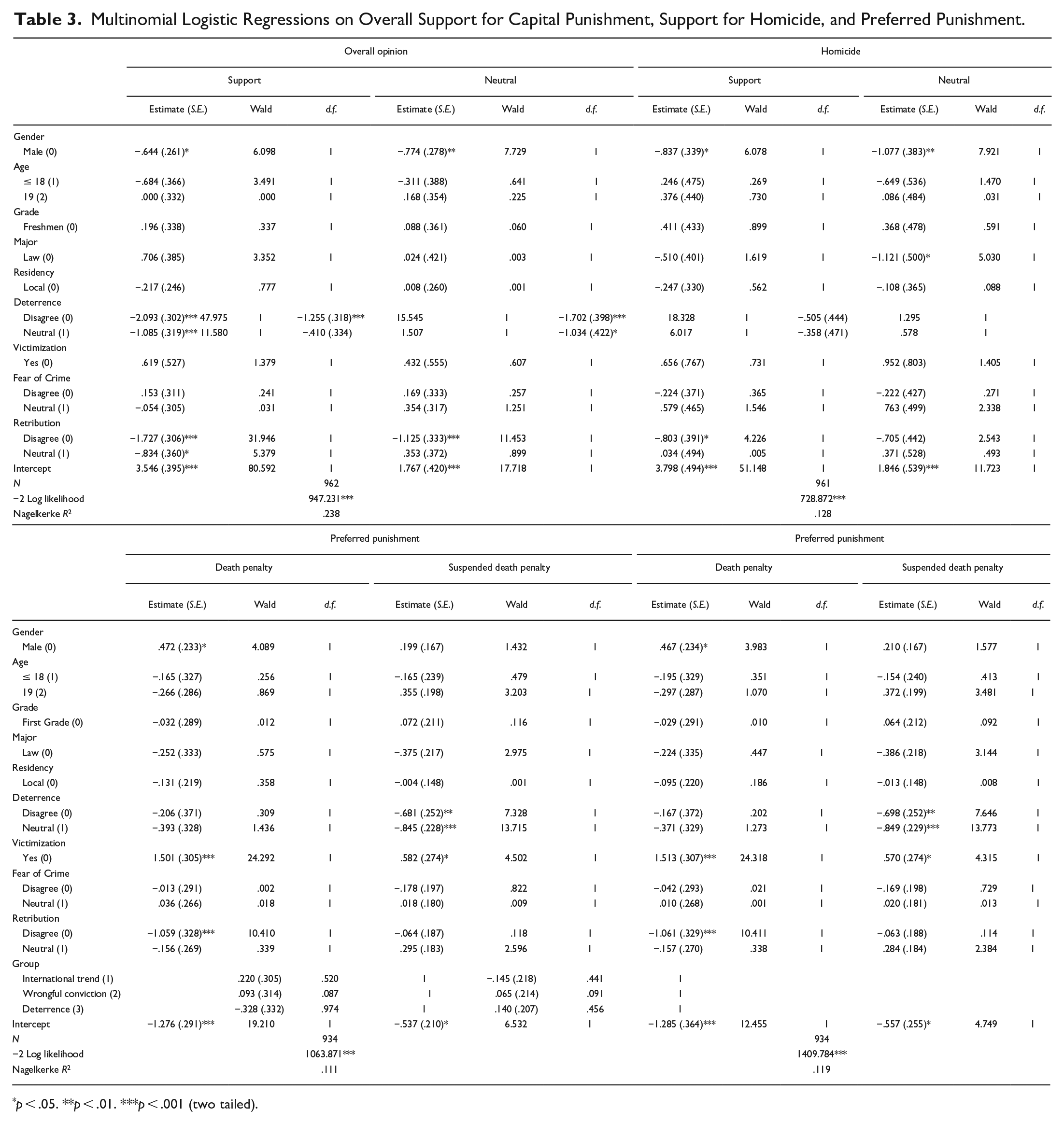
Second, to test if variables that potentially correlate with people’s support for the death penalty would hold the same effect in general questions and in the specific case, we turned to regression analyses in Table 3. Specifically, we ran three multinominal logistic regressions (MLR) 9 to test if any of the demographic and control variables would exhibit similar impact across three models, on regressing students’ overall death penalty opinion, their opinion for homicide, and their preferred punishment in the hypothetical case (the first three models in Table 3). In the first two models, MLR produced results that contrasted both the “support” and “neutral” groups to the “oppose” group (the reference group). In the third model, MLR results contrasted students’ choices of “the death penalty” and “the suspended death penalty” to the option of “non-death sentence punishment” (the reference group). All demographic and control variables were entered into our models, and the last categories of all these variables were set as the reference groups.
Multinomial Logistic Regressions on Overall Support for Capital Punishment, Support for Homicide, and Preferred Punishment.
p < .05. **p < .01. ***p < .001 (two tailed).
As shown, results for the first two models are close to each other: among demographic variables, the most consistent and strongest predictor is gender, which produced significant results in both models. Holding other variables constant, compared to males, female students were significantly more likely to support or be neutral than to oppose the death penalty. After holding other variables constant, two control variables, deterrence and retribution, exhibited a significant effect in some of the statistical comparisons in the two models, especially when students who hold divergent views (believers in deterrence and retribution vs. non-believers) were contrasted: believers of deterrence and retributions were significantly more likely to support or be neutral than to oppose the death penalty; some significant results were also found between students who hold neutral positions in deterrence and retribution and believers in both models, with the former group less likely to support capital punishment.
When testing the effect of demographic and control variables on students’ preferred punishment in the hypothetical case, the results in model 3 are noticeably different: first, gender was again significant but with a different effect: holding others constant, compared to males, female students were significantly more likely to opt for non-death sentences than the death penalty. Second, among control variables, one’s victimization experience had consistent, strong significant effect: compared to students without victimization experience, students who experienced violent crime were more likely to choose the death penalty or the suspended death penalty than non-death sentences. Deterrence and retribution, in contrast, exhibited significant effect seemingly in a specific context: compared to believers of deterrence, students who are non-believers or neutral in their position were more likely to choose non-death sentence punishment than the suspended death penalty; compared to believers of retribution, students who are non-believers were more likely to choose non-death sentence punishment than the death penalty. In sum, the MLR results showed similar result patterns for the two general questions but a distinct pattern for the hypothetical case.
Third, we tested the Marshall hypotheses with the hypothetical case. This was done in several steps. First, in Table 4, we displayed students’ choices of punishment across four groups, and tested if the results were statistically different when we compared each intervention group with the control group. The chi-square tests failed to produce any significant results. Across four groups, the majority of students (52%–53%) selected non-death sentence punishment, followed by students who chose the suspended death penalty (30%–36%); students who chose the death penalty ranged from 9% to 16% only. The bivariate results did not support the effect of any intervention compared to the control group. Second, we reran the MLR model in Table 3 (the last model), after controlling all demographic and control variables and one’s group (with the control group as the reference group): the multivariate results again failed to show any significant effect of one’s group on preferred punishment. The results of demographic and control variables, otherwise, were very similar to the previous model in which grouping was not included. In sum, both the bivariate and the multivariate results failed to produce any significant effect of intervention on students’ preferred punishment in the hypothetical case, thus lending no support to the Marshall hypotheses.
Students’ Preferred Punishment by Intervention Groups.
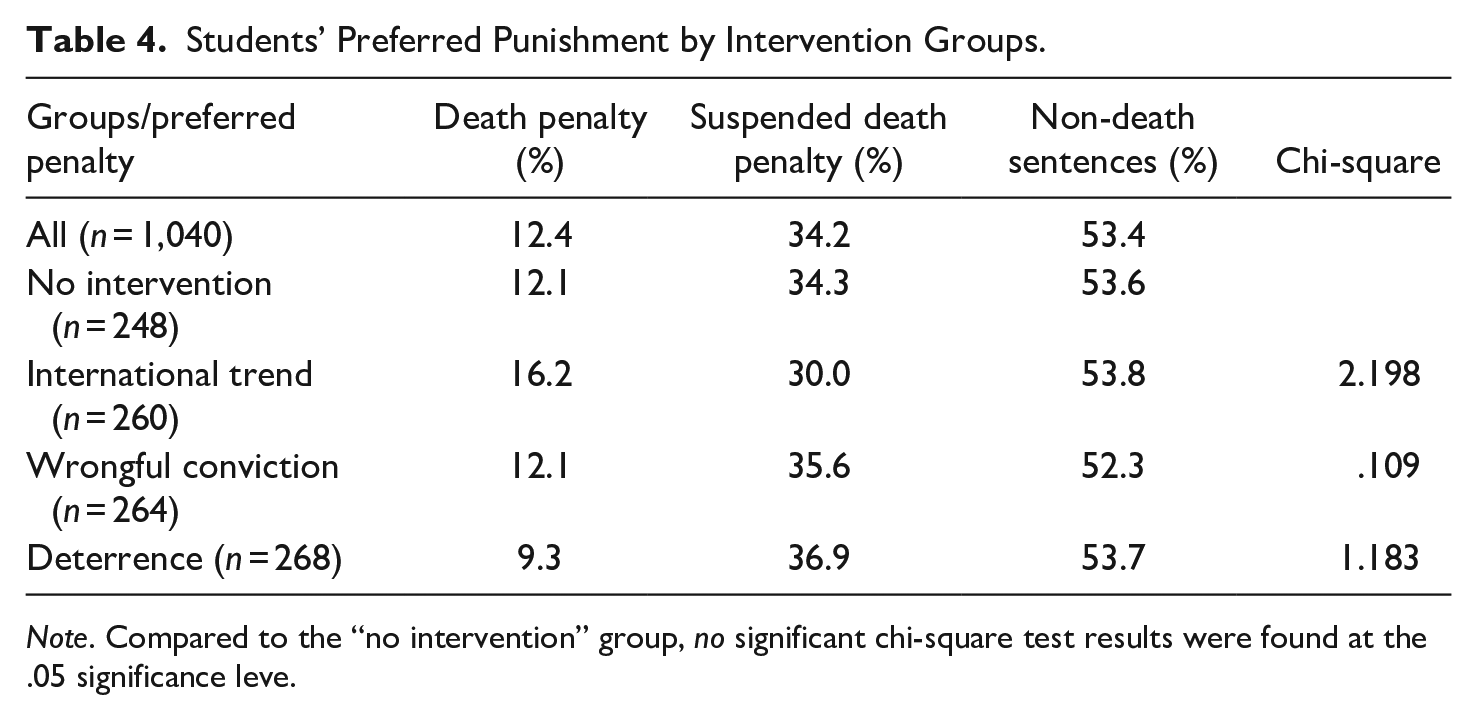
Note. Compared to the “no intervention” group, no significant chi-square test results were found at the .05 significance leve.
As an important qualification to his hypothesis, Justice Marshall suggested that exposure to new knowledge would have little effect on those who support the death penalty for the purpose of retribution. Testing the effect of retribution on learning, however, is difficult for our study due to two primary reasons. First, due to the design of our study, we did not have both the pretest and posttest to measure potential changes of respondents’ opinions (i.e., we did not survey students’ choice of punishment twice for the same case, before and after the intervention). Instead, we relied on comparisons between the control group and the intervention groups (conceptually equivalent to pretest and posttest) to observe the effect of learning at the group level but not the individual level. As a result, we cannot examine potential correlation between each individual’s retribution belief and his or her potential opinion change. Second, as shown above, our comparisons between the control group and the intervention groups produced no significant differences in the hypothetical case. It is difficult (if not impossible) to examine the claim that this “no difference” result was due to the effect of retribution on students’ learning. 10 As an attempt, we examined the intervention effect on students’ preferred punishment, conditioned by retribution in Table 5. For each level of retribution (agree/support, neutral, disagree/oppose), Table 5 displayed cross-tab analyses of students’ preferred punishment by groups and corresponding chi-square results (with each intervention group compared to the control group). If belief in retribution were correlated with students’ learning, significant differences would be expected between believers and non-believers (e.g., bigger and/or significant changes would have occurred to non-believers than believers) when comparing the control group with an intervention group. However, as shown, no significant between-group results were produced in Table 5 at any retribution level: for each comparison between the control group and an intervention group, retribution was not significantly correlated with choice of punishment, inconsistent with Justice Marshall’s suggestion. We further retested the last MLR model in Table 3 for believers and non-believers of retribution separately (results not shown but available upon request): again, for either believers or non-believers, no significant intervention effect was found after controlling other variables. Granted, our examination here is limited and not fully satisfactory, as we tested only group-level effect with a “no difference” result. It is possible, for instance, that retribution affected student learning at the individual level, but produced no significant group differences in a specific case scenario. More studies with better design are thus warranted in the future.
Effect of Retribution on Preferred Punishment Between Groups.
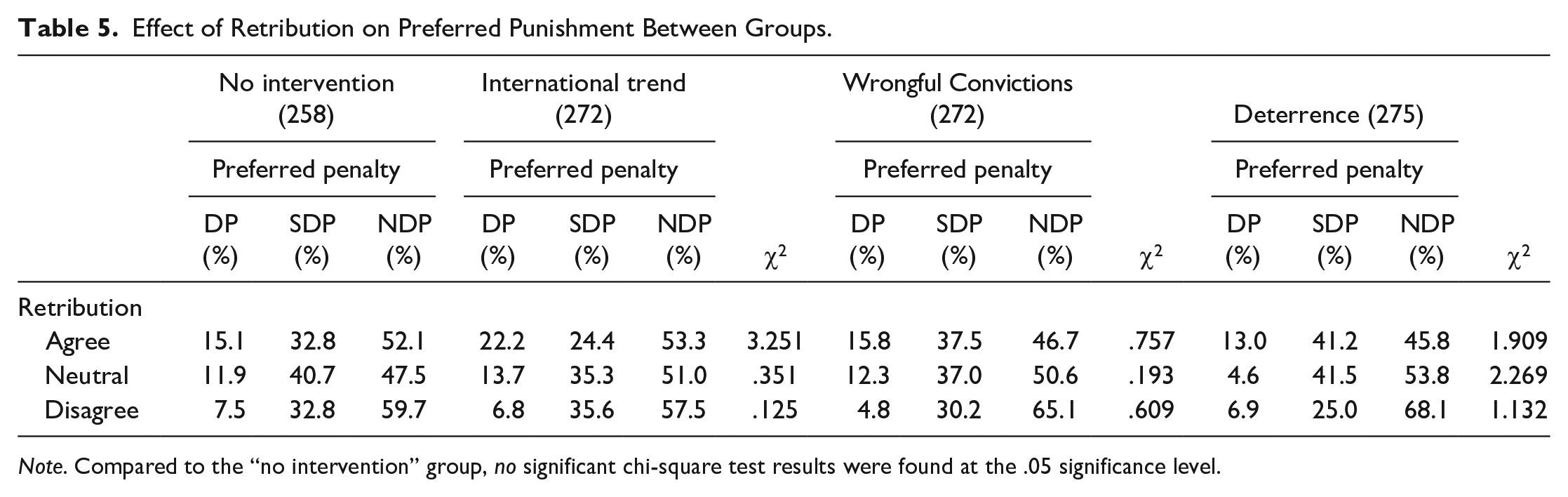
Note. Compared to the “no intervention” group, no significant chi-square test results were found at the .05 significance level.
Discussions
Despite the acknowledgment that specific context matters, past studies of public opinion on capital punishment rarely contrasted people’s support in general questions with that in specific crime scenarios. Our study examined such a contrast in China. Further, our study is the first one to test if potential correlates with death penalty public opinion would hold similar effect in both general questions and specific contexts in multivariate analyses, and if the Marshall hypotheses would hold water in a specific case scenario. Before we discuss contributions and policy implications of our study, we’d like to acknowledge some major limitations.
First, we merely utilized student samples at one university in China (see Liang et al., 2019 for detailed discussion of sampling limitations). Though student samples are frequently utilized (especially in testing the Marshall hypotheses) and believed to be justified (Maggard et al., 2012; Payne & Chappell, 2008), a recent study in China (Jiang et al., 2018) showed that there are potential differences between college students and citizens. Thus the results of this study should be viewed as exploratory. Second, in designing our study, we had to make several compromises which weakened the quality of the study. For instance, though we tried our best to randomize questionnaire assignment to optimize samples, freshmen represented three-quarters of our sample due to reasons unknown. As we had no direct control over the data collection, we had to rely on the local host. Third, in testing the Marshall hypotheses, besides the imperfect design discussed above, we had concerns about the effectiveness of our interventions. Given the impossibility of better stimuli (e.g., a class), we settled with medium-length essays and it is difficult to gauge if our interventions were strong enough in the Chinese setting (see similar concerns by Sarat & Vidmar, 1976).
Despite these limitations, our study broke new ground and presented a number of interesting findings, some consistent with previous studies and some new and unique. First, when contrasting Chinese students’ death penalty opinions in two general questions (one on overall death penalty opinion and the other on opinion for homicide) with their preferred punishment in the hypothetical case, the results clearly showed the variability of students’ opinions. Consistent with past studies, students’ support (80.1%) for capital punishment in homicide (arguably the most serious capital offense) is significantly higher than their overall support (64.9%); however, their willingness to use the death penalty dropped significantly (12.4%) in the specific case (Table 2). Even if we counted suspended death penalty, students’ support for both forms of death sentences merely represented 46.6%. The message is confirmed in China: the context matters. People’s support for capital punishment in a general question does not accurately reflect their preference of punishment in a specific case. 11 Granted, an argument can be made that our hypothetical scenario was adapted from a wrongful conviction case, thus potentially favoring less punishment. Only one past study utilized a real “open and shut case of premeditated murder and guilt” (Boots et al., 2018, p. 45), while other studies utilized hypotheticals with varying mitigating and aggravating circumstances. We echo Mills and Zamble’s (1998) assessment that the results of any specific case would depend significantly on details of information presented, and the specific case method would be preferred though it does not necessarily produce “correct” measures of public opinion (p. 85).
Second, when we tested the effect of various demographic and control variables on students’ death penalty opinions in general questions and in the hypothetical case, the results (Table 3) showed distinct patterns: the outcomes of the two general questions resembled each other, but the outcome of the hypothetical case was different. Specifically, the variable “gender” exhibited a consistent effect in the models of general questions: holding else equal, compared to male students, female students in our sample were more likely to support or be neutral than oppose the death penalty. This is contrary to the Western literature in which women were consistently found less supportive to capital punishment than men (Trahan et al., 2019). In China’s context, this result is consistent with Zhao’s (2015) study, but contrary to the findings of two other studies (Liang et al., 2006; Wu et al., 2011). Besides gender, the results of two general questions showed that one’s belief in deterrence and retribution were significantly correlated with Chinese people’s support for capital punishment, consistent with past studies.
In comparison, the results of the hypothetical case exhibited differences in two significant ways: (1) gender again turned out to be significant, but its effect was opposite to that of the general questions: holding others equal, compared to males, Chinese female students were more likely to opt for non-death sentences than the death penalty this time. The different results suggest important effect of the context on gender, especially for female students. Future studies should further explore the effect of gender in varying contexts. 12 The lack of effect from other demographic variables is not surprising and echoes what Burgason and Pazzani (2014) argued that respondents would likely base their decisions on information about a specific case, which may mediate any demographic effects (p. 832); (2) one’s victimization experience was significantly correlated with one’s preferred punishment, leaning one toward more punitive punishment. In the meantime, the effect of deterrence and retribution was limited compared to that of the general questions. The results showed that people’ positions on the appropriateness of the death penalty may vary not only because of the context, but also potential influence of different correlates. While people’s general belief in deterrence and retribution may influence their opinion in general questions, circumstances of specific cases and respondents’ personal experiences such as victimization may play a more important role in their decisions in individual cases.
Third, our study tested the Marshall hypotheses with a specific crime scenario for the first time, as past studies almost exclusively measured people’s opinion with general questions. The results of our test (Tables 4 and 5) cast doubt on Justice Marshall’s hypotheses: (1) compared to students in the control group, new knowledge (delivered via essays) provided to students in the experimental groups failed to lessen students’ support for capital punishment, and (2) our limited test on the effect of retribution on students’ learning did not corroborate Marshall’s suggestion either. The results make more sense when compared to past studies that tested the Marshall hypotheses with general questions: though past studies produced mixed and inconsistent results, some studies lent support to Justice Marshall’s prediction that new knowledge could potentially lessen people’s support for capital punishment (e.g., Lambert & Clarke, 2001; Lambert et al., 2011; Murray, 2003; Sarat & Vidmar, 1976) and a strong belief in retribution would make people less likely to be influenced by such knowledge (Lee et al., 2014; Michel & Cochran, 2011; Sarat & Vidmar, 1976). The only test done in China (Liang et al., 2019) confirmed such effects. However, this current study would suggest that the Marshall hypotheses, if valid, would only hold water when people’s opinions are measured by general questions. When tested in a specific case, it is likely that people’s decisions would not be affected by (new) general knowledge as suggested by Justice Marshall. Rather, their decisions would more likely focus on case-specific information (e.g., circumstances about the offender, the victim, and the crime). Retribution, along with other general beliefs (e.g., deterrence) would have limited effect in people’s choice of punishment in a specific context. Instead, respondents’ personal experiences such as victimization might have more impact on their decisions. Again, the results need to be read with caution due to limitations of our study and its novelty.
Our study carries a number of potential policy implications and suggestions for future studies. First, our study called for more studies on specific crime scenarios. A glance of the most recent publications in this field shows that studies still exclusively relied on often dichotomized general questions to measure people’s opinion (Anderson et al., 2017; Porter et al., 2018; Trahan et al., 2019). Though general questions allow convenient use in statistical analyses, overreliance on such questions could distort people’s support in real cases (Hood, 2018). Second, the fact that over one-third of Chinese students chose the suspended death penalty in the hypothetical case showed the popularity of this unique practice in China. Indeed, short of other alternatives, the suspended death penalty (which is, by default, commuted to life imprisonment after the 2-year suspension) has been recommended by the Chinese Supreme Court as a major substitute for the death penalty in the new century (Miao, 2016). In China and elsewhere, a viable alternative punishment (e.g., the LWOP), acceptable to the public, would most likely play a key role in reducing death sentences and executions worldwide.
Third, our study indicated that correlates that influence people’s position on the death penalty could be different for general questions and for specific cases. While demographic variables and one’s general beliefs in deterrence and retribution may influence one’s overall death penalty opinion, people pay more attention to specific circumstances of cases and one’s personal experiences (e.g., victimization) when making decisions in individual cases. If true, it affirms human attitude volatility to specific case decisions in context. Rather, people’s general attitude toward capital punishment is often not informative about their choice of punishment in individual cases. More studies should be carried out to further extend this inquiry.
Fourth, we need more studies to test the validity of the Marshall hypotheses in specific contexts. It is likely that the Marshall hypotheses only work for general opinions but not within specific contexts. Granted, there is always room to improve on the depth and quality of interventions in testing the Marshall hypotheses. In China specifically, the availability and transparency of information is critical to improve the quality of future studies. If China’s death penalty system is more transparent and more information about its criminal justice system is accessible, Chinese citizens might be more empowered to support an alternative to the death penalty.
Last but not least, the results of this study would question the “overwhelming public support” claimed by the Chinese government based on general survey questions. Along with results of qualitative studies (e.g., Liang & Liu, 2021), Chinese people’s willingness to use capital punishment would vary greatly depending upon unique circumstances of specific cases. However, a legitimate question remains to what extent public opinion may influence policymaking in China. Unlike democratic nations where knowledge of public opinion may help politicians with policymaking, the Chinese public still lacks proper channels to exert such an influence. The future of China’s death penalty practice still appears to be a call made by the government alone without much feedback and input from the general public.
Footnotes
Appendix: A Hypothetical Case 1
One day at a certain time, a villager found a dead female body covered by wheat in a wheat field. After identification, the deceased turned out to be a young married woman who lived in the village. The deceased had many bloodstains on her chest, her pants was pulled off to her knees, and two knife cuts existed on the left side of her neck. Forensic examination showed that the deceased was dead because of hemorrhagic shock after she was knocked unconscious and the artery vein of her neck was cut by a sharp instrument. The vagina of the deceased had residual tissues, which suggested that she had sexual intercourse before her death. The police carried out a large scale investigation subsequently, and drew blood samples from the deceased’s husband and several other male villagers in the next a few days.
On one night after 3 months, while sleeping, a suspect (25 years old) was taken by the police to the city police bureau for an investigation. The suspect and the husband of the deceased were high-school classmates, and they lived in the same village and often visited each other. The blood type of the suspect was A, which matched the blood type of the residue found inside the deceased’s vagina. A DNA test could not “rule out the possibility that semen stains on the residual tissues found inside the vagina were from the suspect.” During the interrogation, the suspect firmly denied everything at first. The police increased the intensity of the interrogation. After 2 days and nights of uninterrupted interrogation, the suspect finally admitted that he had an affair with the deceased. After another 3 days and four nights of continued interrogation, the suspect confessed the details of the crime: after they had an affair, he worried that the deceased would be loose-tongued and expose their affair. On the day of crime, he allured the deceased to the wheat field. After having sexual intercourse, he strangled the deceased. When the deceased stopped moving, he was not sure if the deceased was dead, and cut her neck with a sickle. Then he covered the dead body with some wheat and escaped from the crime scene.
After the case file was turned over from the police to the procuratorate, the suspect retracted his confession immediately, and insisted that he was tortured by the police during the interrogation and demanded a DNA retest. The procurator answered that a new test cannot be done because the original DNA source (i.e., the tissues with semen stains) was missing. Based on the suspect’s confession and the results of the DNA test and the blood type, the suspect was believed to be the real criminal. The procurator initiated public prosecution and the suspect was charged with homicide. During the trial, the suspect argued that he did not have time to commit the crime, but his defense was rejected by the court.
Declaration of Conflicting Interests
The author(s) declared no potential conflicts of interest with respect to the research, authorship, and/or publication of this article.
Funding
The author(s) received no financial support for the research, authorship, and/or publication of this article.
